Communication Speed Selection for Embedded Systems
with Networked Voltage-Scalable Processors
Jinfeng Liu, Pai H. Chou, Nader Bagherzadeh
Department of Electrical & Computer Engineering
University of California, Irvine, CA 92697-2625,
USA
f
jinfengl, chou, nader
g@ece.uci.edu
ABSTRACT
High-speed serial network interfaces are gaining wide use in con-necting multiple processors and peripherals in modern embedded systems, thanks to their size advantage and power efficiency. Many such interfaces also support multiple data rates, and this ability is opening a new dimension in the power/performance trade-offs between communication and computation on voltage scalable em-bedded processors. To minimize energy consumption in these net-worked architectures, designers must not only perform functional partitioning but also carefully balance the speeds between com-munication and computation, which compete for time and energy. Minimizing communication power without considering computa-tion may actually lead to higher energy consumpcomputa-tion at the system level due to elongated on-time as well as lost opportunities for dy-namic voltage scaling on the processors. We propose a speed se-lection methodology for globally optimizing the energy consump-tion in embedded networked architectures. We formulate a multi-dimensional optimization problem by modeling communication de-pendencies between processors and their timing budgets. This en-ables engineers to systematically solve the problem of optimal speed selection for global energy reduction. We demonstrate the effec-tiveness of our speed selection approach with an image process-ing application mapped onto a multi-processor architecture with a multi-speed Ethernet.
1.
INTRODUCTION
Networked embedded processors are fast becoming the main-stream in the architecture of embedded systems. Initially used in automobiles and other control-oriented systems, they are now found in everything from consumer electronics to peripheral de-vices attached to workstations. A key trend is towards the use of high-speed serial busses for system-level interconnect, including FireWire, USB, and Ethernet. These “busses” are actually more like networks, and the advent of systems-on-chip (SoC) is also giving rise to a new class of on-chip network protocols that offer compelling advantages as the interconnect of choice for complex
This research was sponsored by DARPA grant F33615-00-1-1719 and Printronix Fellowship.
Permission to make digital or hard copies of all or part of this work for personal or classroom use is granted without fee provided that copies are not made or distributed for profit or commercial advantage and that copies bear this notice and the full citation on the first page. To copy otherwise, to republish, to post on servers or to redistribute to lists, requires prior specific permission and/or a fee.
Copyright 2001 ACM 0-89791-88-6/97/05 ...$5.00.
on-chip modules. In addition to better modularity, composability, scalability, and form factor, high-speed serial network protocols are also power efficient.
Power is an important objective in the optimization of many em-bedded systems. Previous efforts in power optimization focused on the processor, because not only was the CPU the main consumer of power, but it also offered the most flexible options for power management, including voltage and frequency scaling. By running the processor at the minimum speed without violating any deadline, its voltage can be reduced to a more energy-efficient, lower-power level that actually consumes less energy per instruction.
Processor power has been reduced dramatically and is now a smaller percentage of the overall system power, while communi-cation interfaces are now consuming an equal if not larger share of the system power. For example, an Intel XScale processor con-sumes 1.6W at full speed, while a GigaBit Ethernet interface can consume as much as 6W. Many of today’s communication inter-faces support multiple data rates at different power levels, in ways analogous to voltage scaling on processors. However, few research works to date explore their use in power management in conjunc-tion with the processors.
Previous co-design approaches to optimization of such systems focused on functional partitioning among the processors to min-imize communication, and hence communication power. How-ever, existing partitioning techniques lack the ability to explore the power consequences of processor and communication speeds. These resources can compose synergistically or competitively. That is, choosing a power efficient communication speed (respectively, processor speed) in one part of the network may either increase or decrease additional power-efficient opportunities for other re-sources on the network.
We consider a class of networked embedded systems where the processors are networked to execute task in a pipelined fashion and must satisfy an overall latency constraint. The processors cannot all be run at the slowest, most power-efficient speeds; instead, they must compete for the available time and power with each other and with the communication interfaces. A faster communication speed, even at a higher energy-per-bit, can save energy by creating more opportunities for subsystem shutdown or by freeing up more time for voltage scaling the processors. Conversely, a low-power, low energy-per-bit communication speed may actually result in higher overall energy due to increased time in keeping the interface on.
Our objective is to minimize total energy for a given workload on a networked architecture, where both the communication speeds and processor speeds are selectable. Our proposed approach is to formulate the energy consumed by the processors and communica-tion interfaces with their power/speed scaling factors within their available time budget. This enables us to solve the optimal speeds systematically. We envision that this technique be integrated into
TARGET DETECTION FFT IFFT COMPUTE DISTANCE image templates targets and ROIs filtered ROIs targets and their distances ROIs in space-freq domain Node N1: Target Detection / FFT Node N2: Filter / IFFT Node N3: Compute Distance
Figure 1: Block diagram of the ATR algorithm.
the partitioning loop of an existing co-design framework. In this paper, we demonstrate the effectiveness of our approach with an image processing algorithm mapped onto a multi-processor archi-tecture interconnected by a wired GigaBit Ethernet.
2.
RELATED WORK
Previous works in co-design have explored distributed multi-processor systems, communication protocol and speed selection, and power management techniques. [11] presents communication scheduling to work with rate-monotonic tasks, while [5] assumes the more deterministic time-triggered protocol (TTP). [8] distributes timing constraints on communication among segments through pri-ority assignment on serial busses (such as control-area network) and customization of device drivers. While these assume a bus or a network protocol, LYCOS [6] integrates the ability to select among several communication protocols (with different delays, data sizes, burstiness) into the main partitioning loop. However, these and many other works do not specifically optimize for energy mini-mization by exploiting the processors’ voltage scaling capabilities. Related techniques that optimize for power apply voltage scaling to the processors while assuming a fixed communication data rate. [3] uses simulated heating search strategies to find low-power de-sign points for voltage scalable embedded processors. [7] performs battery-aware task post-scheduling for distributed, voltage-scalable processors by moving tasks to smooth the power profile. [10] pro-poses a multi-processor architecture that consumes significantly less power than a single processor on the same task by partition-ing an image processpartition-ing task onto four slower processors whose workload is only 1/4. However, all these techniques focus on the computational aspect without exploring the speed/power scalability of the communication interfaces.
Existing techniques cannot be readily combined to explore many timing/power trade-offs between computation and communication. The quadratic voltage scaling properties for CPU’s do not general-ize to communication interfaces. Even if they do, these techniques have not considered the partitioning of power budgets and timing among components across the network. Selecting communication attributes by considering deadlines without considering power will lead to unexpected, often incorrect results at the system level.
3.
MOTIVATING EXAMPLE
We use an automatic target recognition (ATR) algorithm [9] as our motivating example. Its block diagram is shown in Fig. 1. The algorithm first detects a few targets on the input image. For each target, a region of interest is extracted and filtered by several pre-defined templates. Finally, the distance of each target is computed. A deadline is imposed on processing each frame.
The original ATR algorithm is a serial algorithm. We recon-structed a parallel version and mapped it onto multiple processors in a pipelined organization. In this paper, we partition the algo-rithm onto three processors, shown as blocks with dashed borders in Fig. 1. In general, parallelizing an algorithm has the effect of in-creasing performance, reducing power, or both. Even though more processors are involved, each processor now has reduced workload
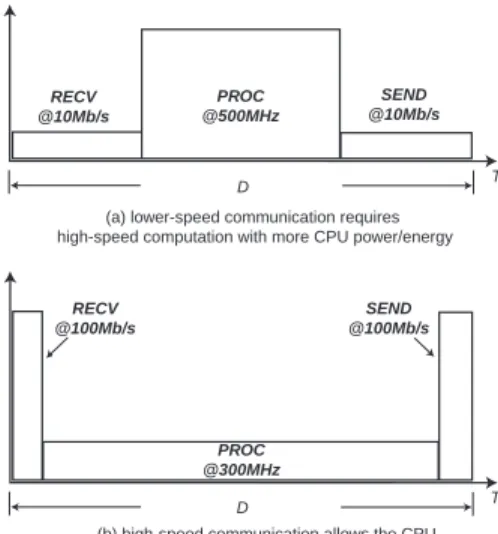
D RECV @10Mb/s SEND @10Mb/s PROC @500MHz D RECV @100Mb/s SEND @100Mb/s PROC @300MHz
(a) lower-speed communication requires high-speed computation with more CPU power/energy
(b) high-speed communication allows the CPU to operate at a lower speed with reduced CPU power/energy
Time Power
Time Power
Figure 2: Choices for communication and computation speeds.
and can afford to run at a much slower speed and voltage level, where it consumes significantly less energy per instruction. Mean-while, parallelism compensates for the reduced performance on in-dividual processors, although inter-processor communication con-sumes both time and energy.
Fig. 2 gives such an example. We assume that each process is modeled by a computation task PROC and two communication tasks RECV and SEND. RECV receives data from either external input or from another processor. The data is processed by PROC, and the results are transmitted by communication task SEND to the next stage or output. Clearly RECV , PROC, and SEND must be fully serialized for a given stage. In addition, SEND must finish before its deadline D. PROC is mapped onto a voltage-scalable processor, while the corresponding SEND and RECV tasks are mapped onto a communication interface with multiple data rates and different power levels. In this case, a node consists of an Intel XScale and a 10/100/1000Base-T Ethernet interface.
The Ethernet interface is a prime target for power management, because it consumes 4 times the power as the CPU at peak speed. If the communication interface were voltage scalable in the same way as the CPU, then the designer would choose the low-power, slow data rate for reducing power and energy at the system level. Fig. 2(a) shows this design point, where the data rate is 10 Mbps. However, this turns out not to be energy efficient. Because of the deadline D, communication (RECV , SEND) and computation (PROC) compete for this time budget. By slowing down commu-nication, it leaves less time budget for computation, thereby forc-ing the processor to operate at 500MHz or faster in order to meet the deadline. Conversely, if a low-power CPU speed were selected first, then it would cut the time budget for the communication, forc-ing a higher-power, faster data rate. This is an example where com-munication must not be considered as fixed timing and power over-head.
Fig. 2(b) shows a solution that uses high-speed communication (100 Mbps) to leave more time for computation, such that the pro-cessor can operate at 300MHz with reduced power and energy. Al-though extra energy could be allocated to communication, if the energy saving on the processor could compensate for this cost, then (b) would be a more energy-efficient design point. There is no sim-ple correlation between the communication speed and the power or energy at the system level. System-level energy consumption is
de-termined by not only the processors and communication interfaces, but also the hardware configuration and the dependencies imposed by the application. Therefore, an energy-efficient design must con-sider all these aspects as an entire system.
The communication-computation interaction becomes more in-tricate in a multi-processor environment. Any data dependency be-tween different nodes must involve their communication interfaces. The communication speed of a sender will not only determine the receiver’s communication speed but also influence the choice of the receiver’s computation speed. For example, in the system-pipelined version of the ATR algorithm, the communication speed on the first node will have a chain effect on all other nodes in the system. Even if this speed setting were locally optimal for the first node, it would still lead to an inferior system design.
4.
PROBLEM FORMULATION
This section formulates the problems of minimizing energy con-sumption in a networked multi-processor embedded system. Sec-tion 4.1 defines such a system-level performance/energy model for both computation and communication components. Section 4.2 formulates the energy minimization problems and discusses their solutions. Section 4.3 outlines the scheduling technique for avoid-ing data collision on the shared communication medium and presents the schedulability conditions for such a multi-processor system.
4.1
Basic definitions
In the scope of this paper, a multi-processor system is a network of M processing nodes Ni;i=1;2;:::;M connected by a shared
communication medium. Each processing node consists of the fol-lowing components: a processor, a local memory, and one or more communication interfaces that send and/or receive data from other processing nodes. We assume on each processing node, only the processor and the communication interfaces are power-manageable. The memory draws a fixed amount of power and is not considered in the energy optimization problem. The power consumption by the communication medium is interpreted to be the total power con-sumed by all active communication interfaces. Therefore, we focus only on the processors and communication interfaces.
We assume the processors are scalable, and their voltage-scaling characteristics can be expressed by a voltage-scaling function Scalep that maps the CPU frequency to its power level. We also assume that each communication interface has a scaling function that char-acterizes the power levels at different communication speeds (data rates). Moreover, we define two separate scaling functions for sending and receiving. They are
Pp=Scalep(Fp); Pr=Scaler(Fr); Ps=Scales(Fs) (1)
where Ppand Fpdenote the power level and the clock frequency of the processor, Prand Frdenote the power and the bit rate for re-ceiving, and Psand Fsdenote those for sending, respectively. Most communication interfaces can support only a few discrete combi-nations of power vs. speed, e.g., 10/100/1000 Mbps Ethernet.
A processing job assigned to a processing node has three tasks: RECV , PROC, and SEND, which must be executed serially in that order. RECV and SEND are communication tasks that receive and send data on the communication interfaces, respectively, and PROC is a computation task that processes the received data on the pro-cessor.
The workload for each task is defined as follows. For commu-nication tasks RECV and SEND, workload Wrand Wsindicate the number of bits to be received and sent, respectively. For the com-putation task PROC, the workload Wpis the number of cycles.
Let Tp;Tr;Tsdenote the delays of tasks PROC, RECV and SEND,
respectively. They can all be calculated as the workload divided by the speed of the component on which the task is executed. That is,
Tp= Wp Fp ; Tr= Wr Fr ; Ts= Ws Fs (2) (2) is reasonable for processors executing data-dominated pro-grams, where the total cycles Wp can be analyzed and bounded statically. However, it does not hold true in general if the effec-tive data rate can be reduced by collisions and errors on the shared communication medium. Section 4.3 proposes a scheduling tech-nique for avoiding collision on the shared medium. To model the non-ideal aspect of the medium, we introduce the communication efficiency terms,ρrandρs, 0ρr;ρs1, such that Tr=
Wr
ρrFr and
Ts=
Ws
ρsFs.
Note thatρrandρsneed not be constants, but may be functions of communication speeds Fr;Fs. Different communication speeds
may incur different error rates. For brevity, our experimental re-sults assume an ideal communication medium (ρr=ρs=1)
with-out loss of generality. A more practical communication model can be directly applied, sinceρrandρscan be very well bounded for a collision-free medium.
There is a deadline D on each processing job. Since each job includes three serialized tasks, Tr+Tp+TsD, if there is any slack
time available, it can always be used to slow down task PROC by voltage scaling to reduce energy. Therefore, we assume the last task SEND finishes just before the deadline. That is,
D=Tr+Tp+Ts (3)
The energy consumption of a task is the power-delay product.
Ep=PpTp; Er=PrTr; Es=PsTs (4)
where Ep;Er;Esare the energy consumption for tasks PROC, RECV ,
and SEND, respectively. For one node Niwith tasks PROCi, RECVi, and SENDi, the total energy of node i is
Ei=Ep
i+Er
i+Es
i (5)
In (5) we ignore the power level of the processor during the ex-ecution of communication tasks RECV and SEND. The processor can remain in a low power mode during DMA cycles. Similarly, the communication interface can be set to a low power mode dur-ing PROC. We leave out these terms for brevity without loss of generality, and they can always be appended to (5) for a more re-alistic model. Finally, the total energy of the system is the sum of energy consumption on each node:
Esys= M
∑
i=1 Ei (6)4.2
Problem statements
We start our problem statements from a single node (Fig. 3); then we extend the problem to the entire system with multiple nodes.
Problem 1 (Single Node) Given a processing node N
(character-ized by Scaler;Scalep;Scales), the workload Wr;Wp;Ws, and
dead-line D, find the communication speeds Fr;Fs and the processor
D
RECV PROC SEND
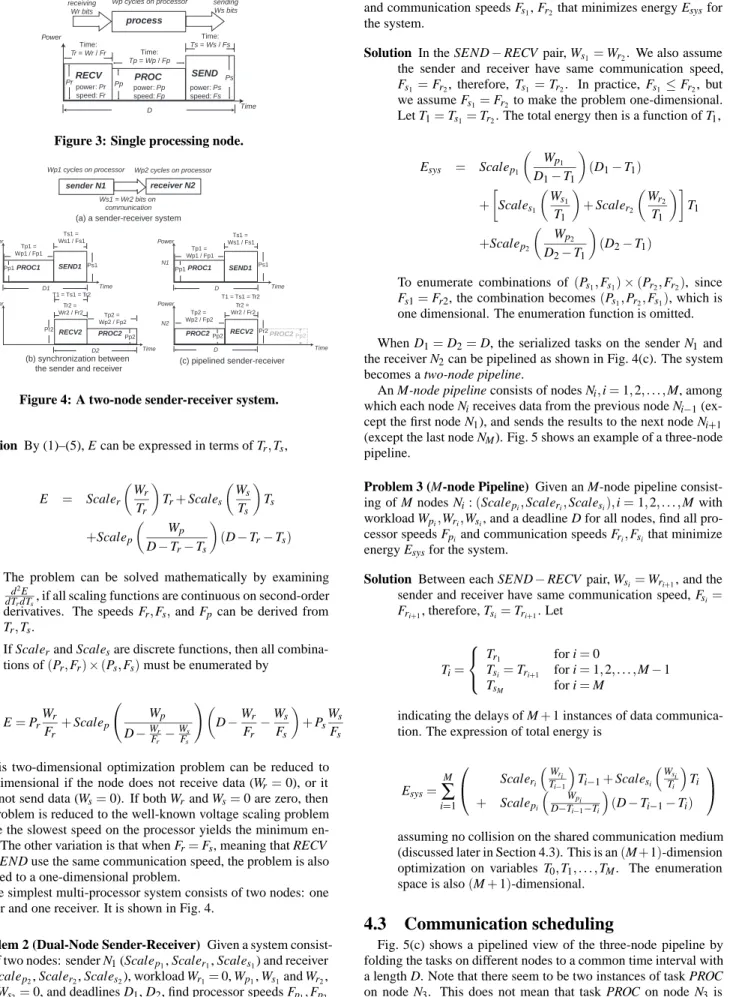
Time Power Pr Pp Ps Time: Tr = Wr / Fr Time: Ts = Ws / Fs Time: Tp = Wp / Fp process
Wp cycles on processor sending Ws bits receiving Wr bits power: Pr speed: Fr power: Pp speed: Fp power: Ps speed: Fs
Figure 3: Single processing node.
D1 SEND1 PROC1 Time Power Ps1 Pp1 Ts1 = Ws1 / Fs1 Tp1 = Wp1 / Fp1 D2 RECV2 PROC2 Time Power Pr2 Tr2 = Wr2 / Fr2 Tp2 = Wp2 / Fp2 (b) synchronization between the sender and receiver
Pp2 T1 = Ts1 = Tr2 Porcessing node N1 Porcessing node N2 sender N1 receiver N2
Wp1 cycles on processor Wp2 cycles on processor
Ws1 = Wr2 bits on communication
(a) a sender-receiver system
D SEND1 PROC1 Time Power Ps1 Pp1 Ts1 = Ws1 / Fs1 Tp1 = Wp1 / Fp1 D RECV2 PROC2 Time Power Pr2 Tr2 = Wr2 / Fr2 (c) pipelined sender-receiver Pp2 N1 N2 PROC2 Pp2 Tp2 = Wp2 / Fp2 T1 = Ts1 = Tr2
Figure 4: A two-node sender-receiver system.
Solution By (1)–(5), E can be expressed in terms of Tr;Ts,
E = Scaler Wr Tr Tr+Scales Ws Ts Ts +Scalep Wp D Tr Ts (D Tr Ts)
The problem can be solved mathematically by examining d2E
dTrdTs, if all scaling functions are continuous on second-order
derivatives. The speeds Fr;Fs;and Fpcan be derived from
Tr;Ts.
If Scalerand Scalesare discrete functions, then all combina-tions of(Pr;Fr)(Ps;Fs)must be enumerated by
E=Pr Wr Fr +Scalep Wp D Wr Fr Ws Fs ! D Wr Fr Ws Fs +Ps Ws Fs This two-dimensional optimization problem can be reduced to one-dimensional if the node does not receive data (Wr=0), or it
does not send data (Ws=0). If both Wrand Ws=0 are zero, then
the problem is reduced to the well-known voltage scaling problem where the slowest speed on the processor yields the minimum en-ergy. The other variation is that when Fr=Fs, meaning that RECV
and SEND use the same communication speed, the problem is also reduced to a one-dimensional problem.
The simplest multi-processor system consists of two nodes: one sender and one receiver. It is shown in Fig. 4.
Problem 2 (Dual-Node Sender-Receiver) Given a system
consist-ing of two nodes: sender N1(Scalep1, Scaler1, Scales1) and receiver N2(Scalep2, Scaler2, Scales2), workload Wr1=0, Wp
1, Ws1and Wr2, Wp2, Ws2=0, and deadlines D1, D2, find processor speeds Fp
1;Fp
2
and communication speeds Fs1, Fr2that minimizes energy Esysfor the system.
Solution In the SEND RECV pair, Ws1=Wr
2. We also assume the sender and receiver have same communication speed, Fs1=Fr
2, therefore, Ts1=Tr
2. In practice, Fs1Fr
2, but we assume Fs1=Fr
2to make the problem one-dimensional. Let T1=Ts
1=Tr
2. The total energy then is a function of T1,
Esys = Scalep 1 Wp1 D1 T1 (D1 T1) + Scales1 Ws1 T1 +Scaler 2 Wr2 T1 T1 +Scalep 2 Wp2 D2 T1 (D2 T1) To enumerate combinations of(Ps 1;Fs 1)(Pr 2;Fr 2), since
Fs1=Fr2, the combination becomes(Ps
1;Pr
2;Fs
1), which is
one dimensional. The enumeration function is omitted. When D1=D2=D, the serialized tasks on the sender N1 and
the receiver N2can be pipelined as shown in Fig. 4(c). The system becomes a two-node pipeline.
An M-node pipeline consists of nodes Ni;i=1;2;:::;M, among
which each node Nireceives data from the previous node Ni 1 (ex-cept the first node N1), and sends the results to the next node Ni+1
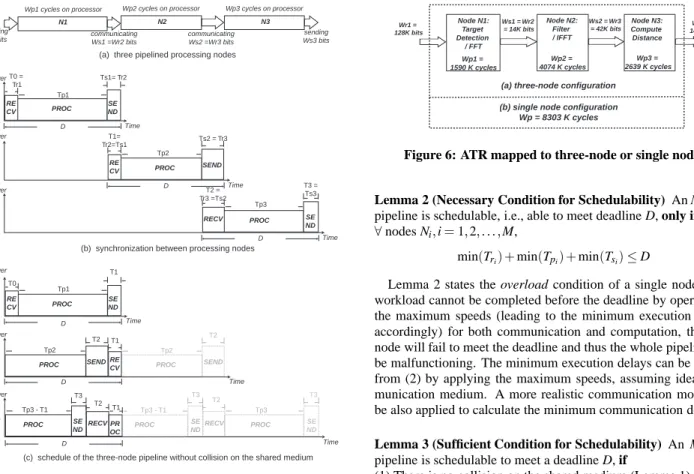
(except the last node NM). Fig. 5 shows an example of a three-node pipeline.
Problem 3 (M-node Pipeline) Given an M-node pipeline
consist-ing of M nodes Ni:(Scalep
i;Scaler
i;Scales
i);i=1;2;:::;M with
workload Wpi;Wr
i;Ws
i, and a deadline D for all nodes, find all
pro-cessor speeds Fpiand communication speeds Fri;Fs
ithat minimize
energy Esysfor the system.
Solution Between each SEND RECV pair, Wsi=Wr
i+1
, and the sender and receiver have same communication speed, Fsi=
Fri+1 , therefore, Tsi=Tr i+1 . Let Ti= 8 < : Tr1 for i=0 Tsi=Tr i+1 for i=1;2;:::;M 1 TsM for i=M
indicating the delays of M+1 instances of data
communica-tion. The expression of total energy is
Esys= M
∑
i=1 0 @ Scaleri Wri Ti 1 Ti 1+Scales i Wsi Ti Ti + Scalep i Wpi D Ti 1 Ti (D Ti 1 Ti) 1 Aassuming no collision on the shared communication medium (discussed later in Section 4.3). This is an(M+1)-dimension
optimization on variables T0;T1;:::;TM. The enumeration
space is also(M+1)-dimensional.
4.3
Communication scheduling
Fig. 5(c) shows a pipelined view of the three-node pipeline by folding the tasks on different nodes to a common time interval with a length D. Note that there seem to be two instances of task PROC on node N3. This does not mean that task PROC on node N3 is
D RE CV SE ND PROC Time Power T0 = Tr1 Ts1= Tr2 Tp1 N1 Wp1 cycles on processor communicating Ws1 =Wr2 bits receiving Wr1 bits N2 Wp2 cycles on processor communicating Ws2 =Wr3 bits D RE CV PROC SEND Time Power T1= Tr2=Ts1 Ts2 = Tr3 Tp2 N3 Wp3 cycles on processor sending Ws3 bits D RECV SE ND PROC Time Power T2 = Tr3 =Ts2 T3 = Ts3 Tp3
(a) three pipelined processing nodes
(b) synchronization between processing nodes
D RE CV SE ND PROC Time Power T0 T1 Tp1 D RE CV PROC SEND Time Power T1 T2 Tp2 D RECV SE ND PROC Time Power T2 T3 Tp3
(c) schedule of the three-node pipeline without collision on the shared medium
SEND PROC T2 Tp2 RECV SE ND PROC T2 T3 Tp3 - T1 SE ND PROC T3 Tp3 - T1 PR OC T1 N1 N2 N3 N1 N2 N3
Figure 5: A 3-node communication pipeline.
preempted. In fact, each instance is a part of an integrated task PROC across the iteration boundary. In this particular view of the pipeline, the iteration boundary resides in the middle during the execution of task PROC. Such a technique is called wrapping and has been well-studied [4].
Fig. 5(c) shows that communication activities are shifted away from each other, such that at any given time, there is at most one active communication instance. This is especially meaningful if all nodes share the communication medium such as Ethernet, PCI bus, etc. If data collision will not occur, then our estimation on both performance and energy of the whole system can be well bounded. Collision is always undesirable because retransmission costs both time and energy. Communication activities should be scheduled such that the system is collision-free.
Lemma 1 (Collision-free Condition) An M-node pipeline does not
have collision on the shared communication medium iff
9Ti;i=0;1;:::;M (where Ticorresponds to the speed settings on
all nodes), such that the utilization of the shared medium is less than or equal to 1. That is,
U= M
∑
i=0 Ti D 1 (7)If Lemma 1 cannot be satisfied, then the communication tasks in-volved in collision will incur extra delay and energy, and thus will force the processors to run faster with even more energy. Given that the extra communication delay is unbounded due to collision, the whole set of assumptions to support our analysis will be invali-dated. Node N1: Target Detection / FFT Wp1 = 1590 K cycles Ws1 = Wr2 = 14K bits Wr1 = 128K bits Node N2: Filter / IFFT Wp2 = 4074 K cycles Ws2 = Wr3 = 42K bits Node N3: Compute Distance Wp3 = 2639 K cycles Ws3 = 14K bits
(b) single node configuration Wp = 8303 K cycles (a) three-node configuration
Figure 6: ATR mapped to three-node or single node.
Lemma 2 (Necessary Condition for Schedulability) An M-node
pipeline is schedulable, i.e., able to meet deadline D, only if
8nodes Ni;i=1;2;:::;M,
min(Tr
i)+min(Tp
i)+min(Ts
i)D (8)
Lemma 2 states the overload condition of a single node: if its workload cannot be completed before the deadline by operating at the maximum speeds (leading to the minimum execution delays, accordingly) for both communication and computation, then this node will fail to meet the deadline and thus the whole pipeline will be malfunctioning. The minimum execution delays can be derived from (2) by applying the maximum speeds, assuming ideal com-munication medium. A more realistic comcom-munication model can be also applied to calculate the minimum communication delays.
Lemma 3 (Sufficient Condition for Schedulability) An M-node
pipeline is schedulable to meet a deadline D, if
(1) There is no collision on the shared medium (Lemma 1), and (2) No node is overloaded (Lemma 2).
Lemma 3 says that the system is schedulable when conditions in Lemma 1 and Lemma 2 are satisfied. However, when the sys-tem has collision but no overloaded node, the schedulability is un-known.
5.
ANALYTICAL RESULTS
To evaluate our method, we experimented with mapping the ATR algorithm onto two architectures: a three-node pipeline and a sin-gle processor. The three-node mapping is shown in Fig. 6 as solid bars. The input data size is 128K bits, and the output is 14K bits per frame. In addition, the internal communication requires 14K bits and 42K bits per frame, respectively. The one-processor map-ping is shown as the surrounding dashed bar. The input and output data rates are the same as before, and there is no internal commu-nication. We assume the deadline D=20ms for both architectures.
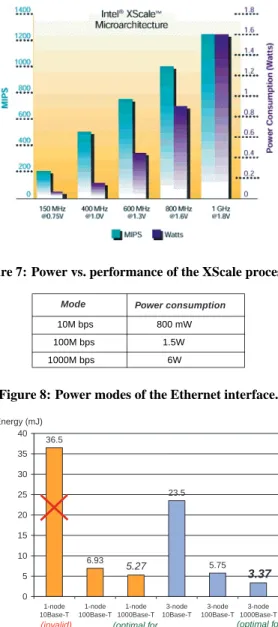
Each of our hardware nodes consists of an XScale processor and an LXT-1000 Ethernet interface from Intel. The Scalepand Scales (same as Scaler) functions, which indicate the power vs. perfor-mance characteristics of a node, are extracted from their data sheets [1, 2] and are shown in Fig. 7 and 8.
Fig. 9 shows the energy consumption for processing one im-age frame at different communication speeds on the one-node and three-node architectures. In both cases, the low-power, 10 Mbps communication speed results in the highest energy, while the highest-power, fastest 1000-Mbps communication speed achieves minimum energy. The three-node pipeline consumes lower energy than the single processor case, and it is conceivable that additional proces-sors can achieve even more energy-efficient design points.
In this particular example, low-power communication at 10 Mbps is undesirable for both the 1-CPU and 3-CPU configurations. For the single node case, the low-speed communication left so little
Figure 7: Power vs. performance of the XScale processor. Mode 10M bps 800 mW 100M bps 1.5W 1000M bps 6W Power consumption
Figure 8: Power modes of the Ethernet interface.
5.27 23.5 5.75 3.37 6.93 36.5 0 5 10 15 20 25 30 35 40 1-node 10Base-T 1-node 100Base-T 1-node 1000Base-T 3-node 10Base-T 3-node 100Base-T 3-node 1000Base-T Energy (mJ)
(invalid) (optimal for 1-node)
(optimal for 3-node)
Figure 9: Analytical results.
time for computation, that the processor would have to operate at 1.5GHz in order to meet the deadline. This is an invalid solution, because it exceeds the 1GHz maximum clock rate. We say that the single node is overloaded and cannot meet the deadline according to Lemma 2. Even if the processor could support a higher clock rate at 1.5GHz, this solution would still demand much more energy.
In the three-node configuration, 10 Mbps communication not only requires more energy, but it is also dangerously close to vio-lating the schedulability condition by Lemma 3. By (7), the utiliza-tion U=0:97. Given that Ethernet is not an ideal communication
medium, in practice it will be overloaded (U>1) when overhead is
taken into account. By Lemma 1, when collision occurs, the system will spend even more (potentially unbounded) time and energy than estimated. By Lemma 3, the system’s ability to meet the deadline is undecidable.
It is notable that given properties of the Ethernet interface in Fig. 8, 1000 Mbps communication will always lead to lower energy energy consumption, even though it has the highest power rating.
This is due to the fact that at the 1000 Mbps data rate, the interface consumes the least energy per bit. Thus, it consumes the least en-ergy for a fixed amount of data while leaving the most opportunity (time) for reducing CPU energy. However, a communication speed with the lowest energy-per-bit will not necessarily lead to the min-imum energy at the system level, if it is not the highest speed. In a general case, optimal speed selection is based on many factors, in-cluding the processor, the communication interfaces, the hardware configuration (number of nodes), the application, and its mapping to the architecture (partitioning). The optimal speed selection may involve a mixture of heterogeneous speed settings between differ-ent nodes. For example, the node N2may communicate with N1at 1000 Mbps and with N3at 100 Mbps.
6.
CONCLUSION
This paper presented a communication speed selection technique for minimizing energy consumption in networked embedded pro-cessors. Communication and computation represent two classes of resources that compete over opportunities for operating at the most power-efficient speeds, but the intricate dependencies between them require that speed selection for optimal energy be performed at the system level. Our formulation captures the data/precedence depen-dencies and their relations to the speed between all pairs of comput-ing/communicating nodes and is generally applicable to networks of embedded processors, as well as single processor architectures that must perform I/O. Our communication speed selection opti-mizes for a particular functional partitioning scheme but we en-vision that it will be easily incorporated into most existing func-tional partitioning co-design loops for enhancing the exploration of power/performance trade-offs in networked embedded processors and systems-on-chip architectures.
7.
REFERENCES
[1] INTEL ethernet PHYs/transceivers. http://developer.intel.com/-design/network/products/ethernet/linecard ept.htm.
[2] INTEL XScale microarchitecture.
http://developer.intel.com/design/intelxscale/.
[3] N. K. Bambha, S. S. Bhattacharyya, J. Teich, and E. Zitzler. Hybrid global/local search strategies for dynamic voltage scaling in embedded multiprocessors. In Proc. International Symposium on
Hardware/Software Codesign, pages 243–248, 2001.
[4] L.-F. Chao, A. LaPough, and E. H.-M. Sha. Rotation scheduling: A loop pipelining algorithm. IEEE Transactions on Computer Aided
Design, 16(3):229–239, March 1997.
[5] P. Eles, A. Doboli, P. Pop, and Z. Peng. Scheduling with bus access optimization for distributed embedded systems. IEEE Transactions
on VLSI Systems, 8(5):472–491, 2000.
[6] P. V. Knudsen and J. Madsen. Integrating communication protocol selection with hardware/software codesign. IEEE Transactions on
Computer-Aided Design of Integrated Circuits and Systems,
18(8):1077–1095, August 1999.
[7] J. Luo and N. K. Jha. Battery-aware static scheduling for distributed real-time embedded systems. In Proc. Design Automation
Conference, pages 444–449, June 2001.
[8] R. Ortega and G. Borriello. Communication synthesis for distributed embedded systems. In Proc. International Conference on
Computer-Aided Design, pages 437–444, 1998.
[9] R. Sims. Signal to clutter measurement and ATR performance. Proc.
of the SPIE - The International Society for Optical Engineering,
3371(1):13–17, April 1998.
[10] E. F. Weglarz, K. K. Saluja, and M. H. Lipasti. Minimizing energy consumption for high-performance processing. In Proc. Asian and
South Pacific Design Automation Conference, pages 199–204, 2002.
[11] W. Wolf. An architectural co-synthesis algorithm for distributed embedded computing systems. IEEE Transactions on VLSI Systems, pages 218–229, June 1997.