INVITED COMMENTARY
Death by Testosterone? We Think Not!
Abdulmaged M. Traish, PhD,* Andre T. Guay, MD,
†and Abraham Morgentaler, MD
‡*Laboratory for Sexual Medicine Research, Boston University, Boston, MA, USA;†Center for Sexual Function, Lahey
Clinic, Peabody, MA, USA;‡Men’s Health, Boston, Harvard Medical School, Brookline, MA, USA
DOI: 10.1111/jsm.12464
A recently published article in
JAMA
alleging
increased risk of death, myocardial infarction
(MI), and stroke in men who received
testoster-one (T) therapy has generated considerable
concern regarding the safety of T therapy among
the global medical community, as well as among
the lay public [1]. This follows a highly
publi-cized report published in the
New England
Journal of Medicine
in 2010 in which a T trial in
elderly frail men was terminated prematurely
because of increased cardiovascular events in men
who received T compared with men who
received placebo [2]. Given the rapid increase in
the use of T therapy over the last decade, it is
critical to gain an appreciation of the risks of this
treatment, particularly cardiovascular risks and
mortality. We here provide our analysis of these
concerning publications, as well as a broader
per-spective on the relationship of T to
cardiovascu-lar disease.
The study by Vigen et al. [1] retrospectively
compared rates of death, MI, and stroke from a
dataset of 8,709 men in the Veteran Administration
(VA) hospital system who had undergone coronary
angiography with prior documentation of serum T
concentration
<
300 ng/dL. The authors reported,
“
The absolute rate of events were 19.9% in the no
testosterone therapy group vs. 25.7%in the testosterone
therapy group, with an absolute risk difference of 5.8%
(95% CI
−
1.4% to 13.1%) at 3 years after coronary
angiography.”
Although this difference was not
sta-tistically significant, the overall rate of events using
T therapy as a time-varying covariate resulted in an
overall 29% increased risk for men who received T
therapy. We have serious concerns regarding the
validity of these results based on author errors,
study design, data presentation, methodology, and
ultimately common sense.
It was incorrect and misleading for the authors
to assert that the absolute rate of events was 25.7%
in the T group. The actual reported rates of events
were 123 in 1,223 men (10.1%) for the T-treated
group, and 1,587 events in 7,486 men (21.2%) in
the no-T group, or double the events per group
for the T group (Figure 1). The authors fail to
acknowledge that the raw data strongly favored T
therapy. It should be no surprise then that
follow-ing publication the authors were obligated to
revise their article, replacing the term “absolute
risk” with a term that more properly reflected the
fact that their conclusions represented a highly
statistical approach to a messy dataset rather than
being supported by raw data: “
At 3 years after
coro-nary angiography, the Kaplan-Meier estimated
cumu-lative percentages with events were 19.9% in the no
testosterone therapy group vs. 25.7% in the testosterone
therapy group, with an absolute risk difference of 5.8%
(95% CI,
−
1.4% to 13.1%).”
This highly statistical approach included
adjust-ing for more than 50 variables. Curiously, it did
not adjust for baseline serum T, which differed
between groups at baseline (T group 175.5 ng/dL
vs. 206.5 ng/dL in no-T group;
P
<
0.001), a
sig-nificant oversight as serum T has been
demon-strated previously to be inversely associated with
cardiovascular risk. The degree of statistical
adjustment is underscored by the fact that the
Kaplan–Meier cumulative estimate of events by
the end of the study was approximately 30% for
the T group, a value three times the actual rate.
Although sophisticated statistical analysis is an
essential tool in modern biomedical research, it
must be acknowledged that the reliability of a
result decreases the further it is removed from the
raw data. In this case, it is particularly concerning
that an actual event rate that was lower by half in
the T group was reported to be threefold greater
after statistical manipulation.
This study design [1] bore no resemblance to
the two-group studies, prospective or
retrospec-tive, that typically inform medical decision
making. The authors elected to use a dataset
derived from a coronary angiography population,
with time zero set for the date of angiography.
Men who had received a prescription for T
therapy prior to angiography were excluded; thus,
all men began in the no-T group. As men initiated
T therapy (after a median of 531 days), they then
entered the T group. However, their lack of events
prior to initiation of T therapy contributed to
results for the no-T group, meaning that the data
for the no-T group were a mix of both groups, but
not vice versa. An MI that occurred on the day a
man filled his T prescription would have been
attributed to the T group, but it would have been
attributed to the no-T group if the prescription
had not yet been filled.
Most
importantly,
this
study
incorrectly
excluded 1,132 men who received T after MI or
stroke. As these men no longer contributed to the
data after suffering an event, it was irrelevant
whether they were subsequently prescribed T. All
events in these 1,132 men should have been
attrib-uted to the no-T group, which would have
increased the number of events in that group by
71%, and almost certainly reversed the primary
results of the study to demonstrate reduced risk in
men who received T therapy.
Finally, it should be noted that there was a
remarkably limited exposure to T among men in
the T group. Mean follow-up serum T on
treat-ment was only 332 ng/dL (11.5 nmol/L), a level
still considered hypogonadal by several expert
groups [3–5]. Although the study duration was
approximately 4 years, 17.6% of men filled the
prescription only once, with a mean of six refills
for 66.3% of men treated with patches. If this
minimal T exposure was truly risky, then how
does one explain the failure to observe more
serious negative results in studies, or clinical
practice, where men are treated more robustly
with T? A summary of shortcomings of this study
[1] is outlined in Table 1.
Two prior well-executed studies revealed
reduced
mortality among men with low T who
received T therapy. Shores et al. [6] investigated
the use of T therapy in men with T
≤
250 ng/dL
(8.7 nmol/L), also within the VA hospital
popu-lation (Figure 2). In that study, mortality in
T-treated men was 10.3% compared with 20.7%
in untreated men (
P
<
0.0001), which is similar to
the primary data of Vigen et al. [1] (Figure 1).
Muraleedharan et al. [7] assessed mortality in
dia-betic men. Men with low serum T (
≤
10.4 nmol/L
or 300 ng/dL) demonstrated increased mortality
of 19.2% vs. 9.0% in men with normal T
(
>
10.4 nmol/L or 300 ng/dL) (
P
=
0.003). Among
men with low T who received T therapy,
mor-tality was reduced to a rate similar to that for
men with normal T, at 8.4%, compared with
19.2% in untreated men (
P
=
0.002) (Figure 2).
These latter results are consistent with a rich and
varied literature spanning 20
+
years strongly
sug-gesting a cardiovascular benefit for men with
normal serum T compared with low levels,
sup-ported by several meta-analyses [8–14], critical
reviews [15–19], and epidemiological studies [20].
Moreover, cardiovascular (CV) benefits have been
shown in numerous interventional studies,
includ-Death MI Stroke All Events0 2 4 6 8 10 5 10 15 20 25 0
% of Events
Untreated Group T-Treated Group 10.1% 21.2%Figure 1 Association between cardiovascular events and
testosterone therapy. Right panel: absolute total event rate of death, myocardial infarction (MI), and stroke in untreated and testosterone (T)-treated men based on the primary data of Vigen et al. [1]. Left panel: absolute rate of death, MI, and stroke in the untreated and T-treated men based on the primary data of Vigen et al. [1].
Table 1 Issues concerning study design of Vigen et al. [1]
Specific flaws and short coming of the study
• Study design was retrospective and complex. All men in the T group contributed data to the no-T group for the period before they began T therapy.
• The groups were unbalanced. Although the T group contributed data to the survival curve for the no-T group, the reverse was not true.
• The two groups differed in important ways at baseline, including age, mean serum T concentration, coronary angiography results, and obesity.
• Improper exclusion from the no-T group of a large set of men who experienced MI and stroke
• Study results relied heavily on statistics, reversing results from raw data.
• Basic information is lacking (e.g., mean follow-up for each group, mean time to events after angiography or initiation of T therapy, serum T concentrations for men who experienced events).
ing benefits of T therapy in men with congestive
heart failure, cardiac ischemia/angina, and reduced
carotid intima media thickness [19–33]. More
pro-vocatively, most but not all longitudinal studies
have identified an inverse association between
serum T concentration and all-cause or
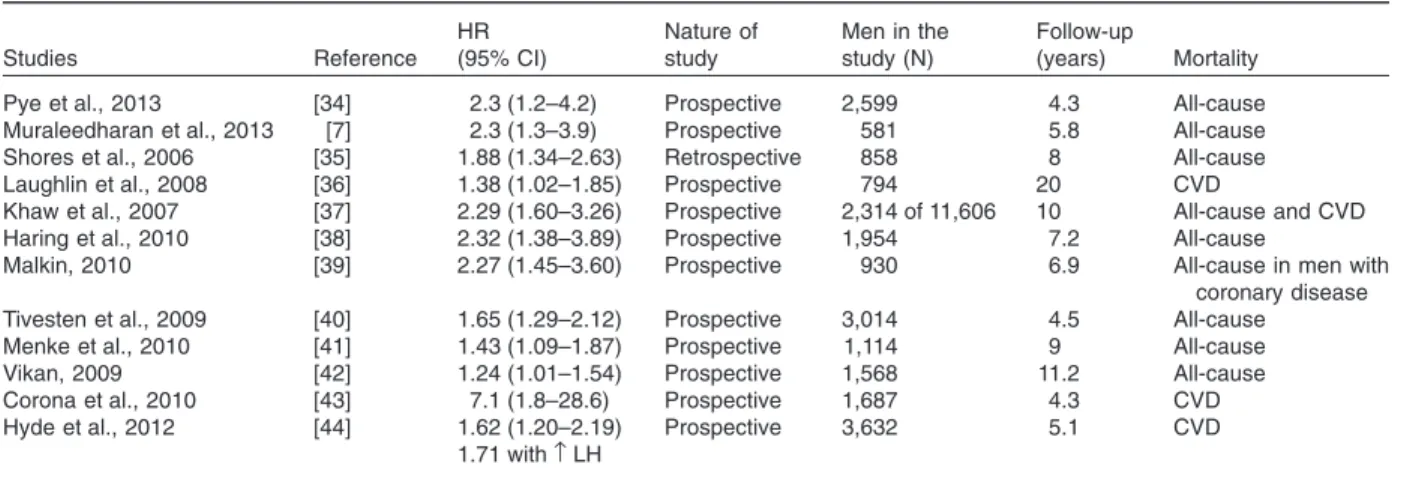
cardiovas-cular mortality (Table 2).
However, none of these studies received the
kind of attention seen with Vigen et al. [1]. The last
time a T study received this level of publicity was in
2010 when headlines announced that a study was
prematurely terminated because of excess CV
events in men who received T gel vs. placebo. That
study by Basaria et al. [2], published in the
New
England Journal of Medicine
, was a 6-month trial
designed to investigate the impact of T gel vs.
placebo on muscle strength and functionality in
older, frail men. Men treated with T gel did in fact
demonstrate improvement in those primary end
points. However, a compilation of adverse events
assigned to the cardiovascular category revealed a
greater number in the T group than placebo (23 vs.
5 events, respectively). This study has been widely
cited as evidence that T therapy increases CV risk,
and Vigen et al. [1] conclude that their own results
support those by Basaria et al. [2].
However, the study by Basaria et al. [2] was not
designed to investigate CV risk. Adverse events
consisted of a combination of subjective symptoms
from patients, medical notes from outside physician
visits, or from the study itself. Only four major
cardiac adverse events (one death, two MIs,
19.2% 9% 8.4% 20.7% Low T Treated Mortality (%)
Low T Normal T Low T Treated Low T 0 5 10 15 20 25
Shores et al., 2012 Muraleedharan et al., 2013
(n = 343) (n =398) 10.3% (n = 633) (n = 64) (n=174)
Figure 2 Testosterone treatment of
men with low testosterone (T) reduces mortality. Left panel, percent of mortal-ity in men with low T who were untreated (black bar) or treated with T (white bar) (Shores et al. [6]). Right panel: percent of mortality in men with low T who were untreated (black bar) or treated with T (white bar). Percent mortality in men with normal T levels
are shown in the gray bar
(Muraleedharan et al. [7]).
Table 2 Association of low T with mortality
Studies Reference HR (95% CI) Nature of study Men in the study (N) Follow-up (years) Mortality Pye et al., 2013 [34] 2.3 (1.2–4.2) Prospective 2,599 4.3 All-cause Muraleedharan et al., 2013 [7] 2.3 (1.3–3.9) Prospective 581 5.8 All-cause Shores et al., 2006 [35] 1.88 (1.34–2.63) Retrospective 858 8 All-cause Laughlin et al., 2008 [36] 1.38 (1.02–1.85) Prospective 794 20 CVD
Khaw et al., 2007 [37] 2.29 (1.60–3.26) Prospective 2,314 of 11,606 10 All-cause and CVD Haring et al., 2010 [38] 2.32 (1.38–3.89) Prospective 1,954 7.2 All-cause
Malkin, 2010 [39] 2.27 (1.45–3.60) Prospective 930 6.9 All-cause in men with coronary disease Tivesten et al., 2009 [40] 1.65 (1.29–2.12) Prospective 3,014 4.5 All-cause
Menke et al., 2010 [41] 1.43 (1.09–1.87) Prospective 1,114 9 All-cause Vikan, 2009 [42] 1.24 (1.01–1.54) Prospective 1,568 11.2 All-cause Corona et al., 2010 [43] 7.1 (1.8–28.6) Prospective 1,687 4.3 CVD Hyde et al., 2012 [44] 1.62 (1.20–2.19)
1.71 with↑LH
Prospective 3,632 5.1 CVD
one stroke) occurred over 6 months in 209
men with substantial comorbidities. Although all
adverse events occurred in the T group, one must
be extremely cautious in drawing conclusions from
such low event rates, particularly as a similar UK
study in frail elderly men reported two major CV
events, both occurring in the placebo group [45].
The other adverse events reported in the study by
Basaria et al. [2] included a wide variety of items,
many of uncertain clinical significance, such as
pal-pitations, premature ventricular contractions noted
on electrocardiogram, or incidental pedal edema.
Given the low number of serious events and the
absence of any predetermined CV end points or
specific CV investigations, it is difficult to conclude
from this study [2] that T therapy is associated with
increased CV risk.
The use of T therapy has always been
controver-sial. It is curious that as the specter of prostate
cancer risk appears to be receding in light of
new evidence, we are now confronted with
new fears regarding CV risk and mortality.
Although definitive assessment of CV risk with T
therapy must await a large prospective controlled
trial, we believe that the evidence to date strongly
suggests that T therapy improves CV risk. We
reject the assertion by Vigen et al. [1] that T
therapy increases CV risks or mortality. Because of
the undeserved yet powerful impact of this
publi-cation, a strong response is needed to combat the
fear and concern that this study has engendered
regarding the risks of T therapy. We invite our
colleagues from the research and clinical
commu-nity with experience in the field of T therapy to add
their names to this commentary.
Conflicts of Interest:
Antonio Aversa, MD: Prof Antonio
Aversa received speaker honoraria from Bayer
Health-care; Arthur Burnett, MD, Endo Pharmaceuticals,
Pfizer, NIH, Auxilium Inc, American Medical Systems,
Coloplast, Reflexonic LLC, Acorda Therapeutics, and
VIVUS. Malcolm Carruthers, MD, none. Culley
Carson III, MD: Dr Carson is an investigator and
con-sultant for Auxilium and for Lilly. Louis Gooren, MD,
none. Geoffrey Hackett, MD: Professor Geoffrey
Hackett is an occasional speaker for Bayer, Lilly and
ProStrakan and has received research support from
Bayer and ProStrakan. Michael Lützhøft Hansen,
MD. Andrea Isidori, MD: Andrea M. Isidori received
consultancies from Bayer and Beslin. Graham Jackson,
MD, none. T. Hugh Jones, MD: Dr Jones is a
con-sultant for ProStrakan (Galashiels, United Kingdom),
has received research grants from Bayer Healthcare,
and received honoraria for educational lectures and
advisory boards from Bayer Healthcare, Lilly, Merck,
and ProStrakan. Mohit Khera, MD, none. Andrew
McCullough, MD and Martin Miner, MD, Advisory
Board: Endo Pharmaceuticals; Repros Pharm. Michael
Zitzmann, MD, none.
The following clinicians/scientists have reviewed and
are in full agreement with the content and
recommen-dation of this editorial:
Antonio Aversa MD
Experimental Medicine Department
Medical Pathophysiology, Food Science and
Endocri-nology Section
Sapienza University of Rome, Italy
Arthur Burnett MD
Patrick C Walsh Distinguished Professor of Urology
Johns Hopkins Medical Institutions
Baltimore, MD, USA
Malcolm Carruthers MD
Medical Director Center for Men’s Health, London,
UK
Culley Carson III MD
Rhodes Distinguished Professor of Urology
University of North Carolina Medical School
Chapel Hill, NC, USA
Louis Gooren MD
Professor Emeritus
Department of Internal Medicine
Endocrine Section, VU University Medical Center
Amsterdam, The Netherlands
Geoffrey Hackett MD
Professor of Men’s Health and Diabetes
University of Bedfordshire, UK
Consultant in Urology and Sexual Medicine
Heartlands Hospital, Birmingham, UK
Michael Lützhøft Hansen MD
Senior Consultant (OB/GYN)
Department of OB/GYN
Stavanger University Hospital, Norway
Director of Copenhagen Cardiovascular Clinic
Copenhagen, Denmark
Andrea Isidori MD
Cattedra di Andrologia,
Università “La Sapienza,” Rome, Italy
Graham Jackson MD
Consultant Cardiologist, UK
Hugh T. Jones MD
Professor of Andrology
Robert Hague Centre for Diabetes and Endocrinology
Barnsley, UK
Mohit Khera MD, MBA, MPH
Assistant Professor of Urology
Director, Laboratory for Andrology Research
Baylor College of Medicine
Houston, TX, USA
Andrew McCullough MD
Professor of Surgery/Urology
Albany Medical College
Albany, NY, USA
Martin Miner MD
Clinical Associate Professor of Family Medicine and
Urology
Warren Alpert School of Medicine
Brown University
Claude Schulman MD, PhD
Professor of the University
Honorary Chairman Department of Urology
Editor Emeritus European Urology
Clinic E. Cavell
Brussels, Belgium
Michael Zitzmann MD
Clinical Andrology
Centre for Reproductive Medicine and Andrology
Muenster, Germany
References
1 Vigen R, O’Donnell CI, Barón AE, Grunwald GK, Maddox TM, Bradley SM, Barqawi A, Woning G, Wierman ME, Plomondon ME, Rumsfeld JS, Ho PM. Association of testos-terone therapy with mortality, myocardial infarction, and stroke in men with low testosterone levels. JAMA 2013;310: 1829–36.
2 Basaria S, Coviello AD, Travison TG, Storer TW, Farwell WR, Jette AM, Eder R, Tennstedt S, Ulloor J, Zhang A, Choong K, Lakshman KM, Mazer NA, Miciek R, Krasnoff J, Elmi A, Knapp PE, Brooks B, Appleman E, Aggarwal S, Bhasin G, Hede-Brierley L, Bhatia A, Collins L, LeBrasseur N, Fiore LD, Bhasin S. Adverse events associated with testosterone administration. N Engl J Med 2010;363:109–22.
3 Wang C, Nieschlag E, Swerdloff R, Behre HM, Hellstrom WJ, Gooren LJ, Kaufman JM, Legros JJ, Lunenfeld B, Morales A, Morley JE, Schulman C, Thompson IM, Weidner W, Wu FC, International Society of Andrology (ISA); Inter-national Society for the Study of Aging Male (ISSAM); Euro-pean Association of Urology (EAU); EuroEuro-pean Academy of Andrology (EAA); American Society of Andrology (ASA). Investigation, treatment, and monitoring of late-onset hypo-gonadism in males: ISA, ISSAM, EAU, EAA, and ASA recom-mendations. J Androl 2009;30:1–9.
4 Buvat J, Maggi M, Guay A, Torres LO. Testosterone deficiency in men: Systematic review and standard operating procedures for diagnosis diagnosis and treatment. J Sex Med 2013;10:245– 84.
5 Wang C, Nieschlag E, Swerdloff RS, Behre H, Hellstrom WJ, Gooren LJ, Kaufman JM, Legros JJ, Lunenfeld B, Morales A,
Morley JE, Schulman C, Thompson IM, Weidner W, Wu FC. ISA, ISSAM, EAU, EAA and ASA recommendations: Investi-gation, treatment and monitoring of late-onset hypogonadism in males. Aging Male 2009;12:5–12.
6 Shores MM, Smith NL, Forsberg CW, Anawalt BD, Matsumoto AM. Testosterone treatment and mortality in men with low testosterone levels. J Clin Endocrinol Metab 2012;97:2050–8.
7 Muraleedharan V, Marsh H, Kapoor D, Channer KS, Jones TH. Testosterone deficiency is associated with increased risk of mortality and testosterone replacement improves survival in men with type 2 diabetes. Eur J Endocrinol 2013;169:725–33. 8 Toma M, McAlister FA, Coglianese EE, Vidi V, Vasaiwala S, Bakal JA, Armstrong PW, Ezekowitz JA. Testosterone supple-mentation in heart failure: A meta-analysis. Circ Heart Fail. 2012;5:315–21.
9 Isidori AM, Giannetta E, Greco EA, Gianfrilli D, Bonifacio V, Isidori A, Lenzi A, Fabbri A. Effects of testosterone on body composition, bone metabolism and serum lipid profile in middle-aged men: A meta-analysis. Clin Endocrinol (Oxf) 2005;63:280–93.
10 Corona G, Rastrelli G, Monami M, Guay A, Buvat J, Sforza A, Forti G, Mannucci E, Maggi M. Hypogonadism as a risk factor for cardiovascular mortality in men: A meta-analytic study. Eur J Endocrinol 2011;165:687–701.
11 Araujo AB, Dixon JM, Suarez EA, Murad MH, Guey LT, Wittert GA. Clinical review: Endogenous testosterone and mortality in men: A systematic review and meta-analysis. J Clin Endocrinol Metab 2011;96:3007–19.
12 Corona G, Rastrelli G, Vignozzi L, Mannucci E, Maggi M. Testosterone, cardiovascular disease and the metabolic syn-drome. Best Pract Res Clin Endocrinol Metab 2011;25:337– 53.
13 Ruige JB, Mahmoud AM, De Bacquer D, Kaufman JM. Endogenous testosterone and cardiovascular disease in healthy men: A meta-analysis. Heart 2011;97:870–5.
14 Haddad RM, Kennedy CC, Caples SM, Tracz MJ, Boloña ER, Sideras K, Uraga MV, Erwin PJ, Montori VM. Testosterone and cardiovascular risk in men: A systematic review and meta-analysis of randomized placebo-controlled trials. Mayo Clin Proc 2007;82:29–39.
15 Fernández-Balsells MM, Murad MH, Lane M, Lampropulos JF, Albuquerque F, Mullan RJ, Agrwal N, Elamin MB, Gallegos-Orozco JF, Wang AT, Erwin PJ, Bhasin S, Montori VM. Clinical review 1: Adverse effects of testosterone therapy in adult men: A systematic review and meta-analysis. J Clin Endocrinol Metab 2010;95:2560–75.
16 Oskui PM, French WJ, Herring MJ, Mayeda GS, Burstein S, Kloner RA. Testosterone and the cardiovascular system: A comprehensive review of the clinical literature. J Am Heart Assoc. 2013;2:e000272.
17 Jones TH. Testosterone deficiency: A risk factor for cardiovas-cular disease? Trends Endocrinol Metab 2010;21:496–503. 18 Carson CC, Rosano G. Exogenous testosterone,
cardiovascu-lar events, and cardiovascucardiovascu-lar risk factors in elderly men: A review of trial data. J Sex Med 2012;9:54–67.
19 Stout M, Tew GA, Doll H, Zwierska I, Woodroofe N, Channer KS, Saxton JM. Testosterone therapy during exercise rehabilitation in male patients with chronic heart failure who have low testosterone status: A double-blind randomized con-trolled feasibility study. Am Heart J 2012;164:893–901. 20 Ohlsson C, Barrett-Connor E, Bhasin S, Orwoll E, Labrie F,
Karlsson MK, Ljunggren O, Vandenput L, Mellström D, Tivesten A. High serum testosterone is associated with reduced risk of cardiovascular events in elderly men. The MrOS (osteoporotic fractures in men) study in Sweden. J Am Coll Cardiol 2011;58:1674–81.
21 Naghi JJ, Philip KJ, DiLibero D, Willix R, Schwarz ER. Tes-tosterone therapy: Treatment of metabolic disturbances in heart failure. J Cardiovasc Pharmacol Ther 2011;16:14–23. 22 Caminiti G, Volterrani M, Iellamo F, Marazzi G, Massaro R,
Miceli M, Mammi C, Piepoli M, Fini M, Rosano GM. Effect of long-acting testosterone treatment on functional exercise capacity, skeletal muscle performance, insulin resistance, and baroreflex sensitivity in elderly patients with chronic heart failure a double-blind, placebo-controlled, randomized study. J Am Coll Cardiol 2009;54:919–27.
23 Aversa A, Bruzziches R, Francomano D, Rosano G, Isidori AM, Lenzi A, Spera G. Effects of testosterone undecanoate on cardiovascular risk factors and atherosclerosis in middleaged men with late onset hypogonadism and metabolic syndrome: Results from a 24-month, randomized, double-blind, placebo-controlled study. J Sex Med 2010;7:3495–503.
24 Mathur A, Malkin C, Saeed B, Muthusamy R, Jones TH, Channer K. Long-term benefits of testosterone replacement therapy on angina threshold and atheroma in men. Eur J Endocrinol 2009;161:443–9.
25 Malkin CJ, Pugh PJ, West JN, van Beek EJ, Jones TH, Channer KS. Testosterone therapy in men with moderate severity heart failure: A double-blind randomized placebo con-trolled trial. Eur Heart J 2006;27:57–64.
26 Pugh PJ, Jones RD, West JN, Jones TH, Channer KS. Tes-tosterone treatment for men with chronic heart failure. Heart 2004;90:446–7.
27 Aukrust P, Ueland T, Gullestad L, Yndestad A. Testosterone: A novel therapeutic approach in chronic heart failure? J Am Coll Cardiol 2009;54:928–9.
28 Makinen J, Jarvisalo M, Pollanen P, Perheentupa A, Irjala K, Koskenvuo M, Makinen J, Huhtaniemi I, Raitakari O. Increased carotid atherosclerosis in andropausal middle-aged men. J Am Coll Cardiol 2005;45:1603–8.
29 van den Beld AW, Bots ML, Janssen JAMLL, Pols HAP, Lamberts SWJ, Grobbee DE. Endogenous hormones and carotid atherosclerosis in elderly men. Am J Epidemiol 2003;157:25–31.
30 Fukui M, Kitagawa Y, Nakamura N, Kadono M, Mogami S, Hirata C, Ichio N, Wada K, Hasegawa G, Yoshikawa T. Asso-ciation between serum testosterone concentration and carotid atherosclerosis in men with type 2 diabetes. Diabetes Care 2003;26:1869–73.
31 De Pergola G, Pannacciulli N, Ciccone M, Tartagni M, Rizzon P, Giorgino R. Free testosterone plasma levels are negatively associated with the intima- media thickness of the common carotid artery in overweight and obese glucose-tolerant young adult men. Int J Obes Relat Metab Disord 2003;27:803–7. 32 Svartberg J, Von Muhlen D, Mathiesen E, Joakimsen O, Bonaa
KH, Stensland-Bugge E. Low testosterone levels are associ-ated with carotid atherosclerosis in men. J Intern Med 2006;259:576–82.
33 Fu L, Gao QP, Shen JX. Relationship between testosterone and indexes indicating endothelial function in male coronary heart disease patients. Asian J Androl 2008;10:214–8.
34 Pye SR, Huhtaniemi IT, Finn JD, Lee DM, O’Neill TW, Tajar A, Bartfai G, Boonen S, Casanueva FF, Forti G, Giwercman A, Han TS, Kula K, Lean ME, Pendleton N, Punab M, Rutter MK, Vanderschueren D, Wu FCW, and the EMAS Study Group. Late-onset hypogonadism and mortality in aging men. J Clin Endocrin Metab. 2013. doi:10.1210/ jc.2013-2052. Ahead of Print.
35 Shores MM, Matsumoto AM, Sloan KL, Kivlahan DR. Low serum testosterone and mortality in male veterans. Arch Intern Med 2006;166:1660–5.
36 Laughlin GA, Barrett-Connor E, Bergstrom J. Low serum testosterone and mortality in older men. J Clin Endocrinol Metab 2008;93:68–75.
37 Khaw KT, Dowsett M, Folkerd E, Bingham S, Wareham N, Luben R, Welch A, Day N. Endogenous testosterone and mortality due to all causes, cardiovascular disease, and cancer in men: European prospective investigation into cancer in Norfolk (EPIC-Norfolk) Prospective Population Study. Cir-culation 2007;116:2694–701.
38 Haring R, Volzke H, Steveling A, Krebs A, Felix SB, Schofl C, Dorr M, Nauck M, Wallaschofski H. Low serum testosterone levels are associated with increased risk of mortality in a population-based cohort of men aged 20–79. Eur Heart J 2010;31:1494–501.
39 Malkin CJ, Pugh PJ, Morris PD, Asif S, Jones TH, Channer KS. Low serum testosterone and increased mortality in men with coronary heart disease. Heart 2010;96:1821–5.
40 Tivesten A, Vandenput L, Labrie F, Karlsson MK, Ljunggren O, Mellstrom D, Ohlsson C. Low serum testosterone and estradiol predict mortality in elderly men. J Clin Endocrinol Metab 2009;94:2482–8.
41 Menke A, Guallar E, Rohrmann S, Nelson WG, Rifai N, Kanarek N, Feinleib M, Michos ED, Dobs A, Platz EA. Sex steroid hormone concentrations and risk of death in US men. Am J Epidemiol 2010;171:583–92.
42 Vikan T, Schirmer H, Njolstad I, Svartberg J. Endogenous sex hormones and the prospective association with cardiovascular disease and mortality in men: The Tromso Study. Eur J Endocrinol 2009;161:435–42.
43 Corona G, Monami M, Boddi V, Cameron-Smith M, Fisher AD, de Vita G, Melani C, Balzi D, Sforza A, Forti G, Mannucci E, Maggi M. Low testosterone is associated with an increased risk of MACE lethality in subjects with erectile dys-function. J Sex Med 2010;7:1557–64.
44 Hyde Z, Norman PE, Flicker L, Hankey GJ, Almeida OP, McCaul KA, Chubb SA, Yeap BB. Low free testosterone pre-dicts mortality from cardiovascular disease but not other causes: The health in men study. J Clin Endocrinol Metab 2012;97:179–89.
45 Srinivas-Shankar U, Roberts SA, Connolly MJ, O’Connell MD, Adams JE, Oldham JA, Wu FC. Effects of testosterone on muscle strength, physical function, body composition, and quality of life in intermediate-frail and frail elderly men: A randomized, double-blind, placebo-controlled study. J Clin Endocrinol Metab 2010;95:639–50.