A Comparison of Random Forest with
ECOC-Based Classiers
R.S.Smith1, M.Bober2 and T.Windeatt1
1Centre for Vision, Speech and Signal Processing, University of Surrey, Guildford,
Surrey GU2 7XH, UK
2Mitsubishi Electric R&D Centre Europe B.V, 20 Frederick Sanger Road, The Surrey
Research Park, Guildford, Surrey GU2 7YD, UK {Raymond.Smith, T.Windeatt}@surrey.ac.uk.
Abstract We compare experimentally the performance of three ap-proaches to ensemble-based classication on general multi-class datasets. These are the methods of random forest, error-correcting output codes (ECOC) and ECOC enhanced by the use of bootstrapping and class-separability weighting (BW). These experiments suggest that ECOC-BW yields better generalisation performance than either random for-est or unmodied ECOC. A bias-variance analysis indicates that ECOC benets from reduced bias, when compared to random forest, and that ECOC-BW benets additionally from reduced variance. One disadvan-tage of ECOC-based algorithms, however, when compared with random forest, is that they impose a greater computational demand leading to longer training times.
1 Introduction
Two of the most popular approaches to constructing multiple classier systems (MCS) to solve multi-class classication problems are random forest [1] and error-correcting output codes (ECOC) [2,3]. In this paper we present the result of an experimental comparison of these two methods when applied to a selection of real-world datasets taken from the UCI repository [4]. We also consider an enhanced version of ECOC, referred to as ECOC-BW, in which bootstrapping1 is applied when constructing base-classier training sets and weighting is applied to base-classier decisions. Previous work has shown these enhancements to be benecial [5].
The random forest algorithm was introduced by Breiman in 2001 [1]. A num-ber of variants of random forest have been proposed but here we focus on the method that is often cited as a reference in the literature, known as Forest-RI. This consists of building an ensemble of unpruned decision tree classiers whose 1 Bootstrapping is a technique whereby new training sets are constructed from a given
training set by repeated sampling with replacement. Each new training set (referred to as a bootstrap replicate) has, on average, 63% of the patterns in the original set but with some patterns repeated so as to form a set of the same size.
classication decisions are combined by a voting procedure. Each decision tree is randomised in two ways: rstly, the training set is modied by constructing a bootstrap replicate and secondly, at each node of the tree, the search for the best split is limited to a subset of features that is randomly selected (without replacement) from the full set of features. Forest-RI thus aims to achieve good classication performance by combining the principles of bagging and random feature selection.
In the ECOC approach, rst described by Dietterich in 1991 [6], a multi-class problem is decomposed into a series of 2-multi-class problems, or dichotomies, and a separate base classier trained to solve each one. These 2-class problems are constructed by repeatedly partitioning the set of target classes into pairs of super-classes so that, given a large enough number of such partitions, each target class can be uniquely represented as the intersection of the super-classes to which it belongs. The classication of a previously unseen pattern is then performed by applying each of the base classiers so as to make decisions about the super-class membership of the pattern. Redundancy can be introduced into the scheme by using more than the minimum number of base classiers and this allows errors made by some of the classiers to be corrected by the ensemble as a whole.
The operation of the ECOC algorithm can be broken down into two distinct stages - the coding stage and the decoding stage. The coding stage consists of applying the base classiers to the input patternx so as to construct vector of base classier outputs s(x) and the decoding stage consists of applying some decoding rule to this vector so as to make an estimate of the class label that should be assigned to the input pattern. A commonly used decoding method is to base the classication decision on the minimum distance between s(x)and the vector of target outputs for each of the classes, using a distance metric such as Hamming orL1. This, however, treats all base classiers as equal, and takes no
account of variations in their reliability. In the ECOC-BW variant of ECOC we assign dierent weights to each base classier and target class combination so as to obtain improved ensemble accuracy. The weighting algorithm is referred to as class-separability weighting (CSEP) because the weights are computed in such a way that they measure the ability of a base classier to distinguish between examples belonging to and not belonging to a given class [7].
Although, unlike random forest, bootstrapping is not a standard feature of the ECOC algorithm, we have shown in [5] that it can be benecial, particularly when combined with the CSEP weighting scheme. For this reason, in ECOC-BW we apply bootstrapping to the training set when each base classier is trained. The eect of bootstrapping is to increase the desirable property of diversity [8] among the base classiers in the ensemble. By this is meant that the errors made by component classiers should, as far as possible, be uncorrelated so that the error correcting properties of the ensemble can have maximum eect. A further potential benet of bootstrapping is that each base classier is trained on only a subset of the available training data and this leaves the remaining data, known as
the out-of-bootstrap (OOB) set, to be used for other purposes such as parameter tuning. Note, however, that the OOB set is unique to each base classier.
When considering the errors made by statistical pattern classiers it is use-ful to group them under three headings. Firstly there is the unavoidable error, known as Bayes error, which is caused by noise in the process that generates the patterns. A second source of error is variance; this is caused by the sensitivity of a learning algorithm to the chance details of a particular training set and causes slightly dierent training sets to produce classiers that give dierent predic-tions for some patterns. Thirdly there are errors caused by bias in a learning algorithm2; here the problem is that the classier is unable, for whatever reason, to adequately model the class decision boundaries in the pattern feature space. When training a classier there is often a tradeo between bias and variance [9] so that a high value of one implies a low value of the other.
In this paper we use the concepts of bias and variance to investigate the reasons for the dierences in the accuracy achieved by dierent classication methods.
The ideas of bias, variance and noise originally emerged from regression the-ory. In this context they can be dened in such a way that the squared loss can be expressed as the sum of noise, bias (squared) and variance. The goal of generalising these concepts to classication problems, using a 0-1 or other loss function, has proved elusive and several alternative denitions have been pro-posed (see [10] for a summary). In fact it is shown in [10] that, for a general loss function, these concepts cannot be dened in such a way as to possess all desirable properties simultaneously. For example the dierent sources of error may not be additive, or it may be possible for variance to take negative values. In this study we adopt the Kohavi-Wolpert denitions [11]. These have the ad-vantage that bias and variance are non-negative and additive. A disadad-vantage, however, is that no explicit allowance is made for Bayes error and it is, in eect, incorporated into the bias term.
The remainder of this paper is structured as follows. The technique of CSEP weighting is described in detail in section 2. Here we also derive an alternative probabilistic interpretation of the method. Section 3 then describes the exper-imental results obtained from each of the three classication methods: random forest, ECOC and ECOC-BW. Finally, section 4 summarises the conclusions to be drawn from this work.
2 ECOC Weighted Decoding
The ECOC method consists of repeatedly partitioning the full set ofN classes Ω intoLsuper-class pairs. The choice of partitions is represented by an N×L
binary coding matrix Z. The rowsZi are unique codewords that are associated
with the individual target classesωiand the columnsZj represent the dierent
super-class partitions. Denoting the jth super-class pair by Sj andSj, element
Zij of the coding matrix is set to 1 or 0 depending on whether class ωihas been
put intoSjor its complement3. A separate base classier is trained to solve each
of these 2-class problems.
Given an input pattern vectorxwhose true classy(x)∈Ω is unknown, let
the soft output from the jth base classier besj(x)∈[0,1]. The set of outputs
from all the classiers can be assembled into a vectors(x) = [s1(x), . . . , sL(x)]T∈
[0,1]L called the output code for x. Instead of working with the soft base clas-sier outputs, we may also rst harden them, by rounding to 0 or 1, to obtain the binary vector h(x) = [h1(x), . . . , hL(x)]
T
∈ {0,1}L. The principle of the ECOC technique is to obtain an estimateyˆ(x)∈Ωof the class label forxfrom a knowledge of the output codes(x)or h(x).
In its general form, a weighted decoding procedure makes use of anN×L
weights matrix Wthat assigns a dierent weight to each target class and base classier combination. The class decision, based on the L1 metric, is made as follows: ˆ y(x) = arg min ωi L X j=1 Wij|sj(x)−Zij|, (1)
where it is assumed that the rows of W are normalised so that PL
j=1Wij =
1 fori = 1. . . N. If the base classier outputs sj(x) in Eqn. 1 are replaced
by hardened values hj(x)then this describes the weighted Hamming decoding
procedure.
The values ofWmay be chosen in dierent ways. For example, ifWij= L1
for all i, j then the decoding procedure of Eqn. 1 is equivalent to the standard
unweighted L1or Hamming decoding scheme. In this paper we make use of the
class separability measure [7,5] to obtain weight values that express the ability of each base classier to distinguish members of a given class from those of any other class.
In order to describe the class-separability weighting scheme, the concept of a correctness function must rst be introduced: given a patternxwhich is known to belong to classωi, the correctness function for the j'th base classier takes
the value1if the base classier makes a correct prediction forxand0otherwise:
Cj(x) =
(
1 ifhj(x) =Zij
0 ifhj(x)6=Zij
. (2)
We also consider the complement of the correctness functionCj(x) = 1−Cj(x)
which takes the value1 for an incorrect prediction and0otherwise.
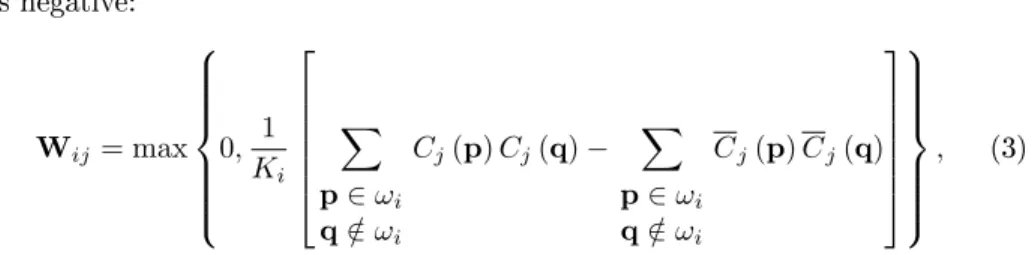
For a given class index i and base classier index j, the class-separability
weight measures the dierence between the positive and negative correlations of base classier predictions, ignoring any base classiers for which this dierence
is negative: Wij= max 0, 1 Ki X p∈ωi q∈/ωi Cj(p)Cj(q)− X p∈ωi q∈/ ωi Cj(p)Cj(q) , (3)
where patterns p and q are taken from a xed training set T and Ki is a
normalisation constant that ensures that the i'th row of W sums to 1. The algorithm for computingWis summarised in g. 1.
Inputs: matrix of training patterns T ∈ RP×M, binary coding matrix Z ∈ {0,1}N×L, trained ECOC coding function
E:RM 7→[0,1]L.
Outputs: weight matrixW∈[0,1]N×LwherePL
j=1Wij= 1, fori= 1. . . N.
ApplyEto each row ofTand round to give prediction matrixH∈ {0,1}P×L.
InitialiseWto0.
forc= 1 toN
fori= indices of training patterns belonging to classc
forj= indices of training patterns not belonging to classc
letdbe the true class of the patternTj.
for k = 1 toL
ifHik=ZckandHjk=Zdk, add 1 toWck
as the predictions for both patternsTi andTjare correct.
ifHik6=ZckandHjk6=Zdk, subtract 1 fromWck
as the predictions for both patternsTi andTjare incorrect.
end end end end
Reset all negative entries inWto0.
NormaliseWso that each row sums to 1.
Figure 1. Pseudo-code for computing the class-separability weight matrix for ECOC.
The weights matrixWij of Eqn. 3 was derived from a consideration of the
spectral properties of the Boolean functions that map base classier outputs to the ensemble decisions. In this interpretation base classiers are weighted by their ability to distinguish the members of a given class from patterns which do not belong to that class. An alternative interpretation may also be given in terms of base classier accuracy probabilities. Let
Pij = 1 Mi X x∈ωi cj(x), Qij = 1 (M −Mi) X x0∈/ω i cj(x0) (4)
whereMis the total number of training patterns andMiis the number of
belong-ing to class ωi. Then Pij and Qij respectively represent estimates of the
prob-ability that the jth base classier makes correct decisions for patterns
belong-ing to and not belongbelong-ing to class ωi. By substitutingMiPij and (M −Mi)Qij
for P
x∈ωicj(x) and P
x0∈/ω
icj(x
0) in Eqn. 3 and making use of the fact that
cj(x) = 1−cj(x), it can be easily shown that an alternative denition of the
CSEP weights is given by:
Wij= max 0, 1 Ki0 [Pij+Qij−1] , (5)
whereKi0 =Ki/Mi(M−Mi)is a modied normalisation constant.
From Eqn. 5 it can be seen that CSEP weighting rewards those base classiers that have a high true detection rate and a low false detection rate for classωi.
Any base classier that cannot outperform random guessing, wherePij =Qij=
0.5, will be zero weighted under this algorithm.
3 Experiments
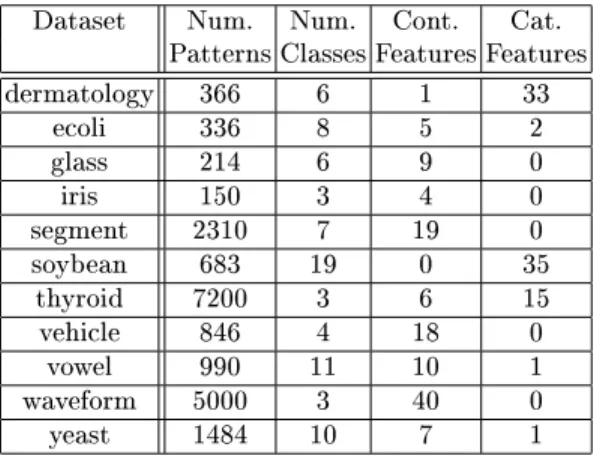
In this section we present the results of performing classication experiments on 11 multi-class datasets obtained from the publicly available UCI repository [4]. The characteristics of these datasets in terms of size, number of classes and number of features are given in table 1 All experiments were based on a 20/80 training/test set split and each run used a dierent randomly chosen stratied training set. These training sets were rst normalised to have zero mean and unit variance.
Table 1. Experimental datasets showing the number of patterns, classes, continuous and categorical features.
Dataset Num. Num. Cont. Cat. Patterns Classes Features Features dermatology 366 6 1 33 ecoli 336 8 5 2 glass 214 6 9 0 iris 150 3 4 0 segment 2310 7 19 0 soybean 683 19 0 35 thyroid 7200 3 6 15 vehicle 846 4 18 0 vowel 990 11 10 1 waveform 5000 3 40 0 yeast 1484 10 7 1
For each dataset, ECOC ensembles of 200 base classiers were constructed. Each base classier consisted of a multi-layer perceptron (MLP) neural network
with one hidden layer. The Levenberg-Marquardt algorithm was used for base classier training as this has been shown to converge more rapidly than back-propagation. Base classier complexity was adjusted by varying the hidden node counts and training epochs. Each such combination was repeated 10 times and the lowest mean test error was obtained. Random variations between each run were introduced by generating a dierent random code matrix and by randomly setting the initial MLP weights. The code matrices were constructed in such a way as to place an approximately equal number of target classes in the super-classesSj andSj.
The ECOC experiments were repeated using ECOC-BW (i.e. with CSEP weighting and bootstrapping being applied). Each base classier was trained on a separate bootstrap replicate drawn from the full training set for that run. The CSEP weight matrix was computed from the full training set each time so its value was determined in part by patterns (the OOB set) that were not used in the training of the base classier.
The random forest experiments were conducted in a similar way to ECOC except that it was found necessary to repeat each experiment 100 times in order to obtain stable results. The number of decision trees in each forest was varied up to 400 and the optimal number required to minimise test error was obtained. The number of random features selected at each node was chosen using Breiman's heuristiclog2F+ 1whereF is the total number of features available4. This has
been shown to yield near optimal results [12].
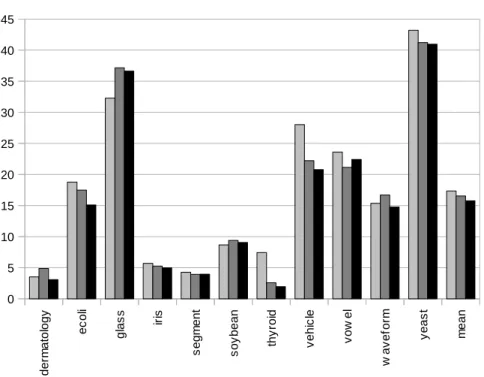
The outcome of these experiments on individual datasets is shown graphi-cally in Fig. 2. This shows a bar chart of the lowest test error attained by the three classication methods. Also shown is the average test error taken over all datasets.
Inspection of Fig. 2 shows that no single classication algorithm gave the best results on all datasets. Indeed, random forest gave the lowest generalisation error on glass and soybean, ECOC gave the lowest error on segment and vowel whilst ECOC-BW was optimal on dermatology, ecoli, iris, thyroid, vehicle, waveform and yeast.
Comparing the dierent algorithms, it can be seen that ECOC gave a lower error than random forest on 7/11 datasets and also had a lower average error taken over all datasets. ECOC-BW yielded lower error than random forest on 9/11 datasets and also beat standard ECOC on 9/11 datasets. ECOC-BW also had the lowest mean error over all datasets. The evidence from these experiments is then that the ECOC-BW algorithm tends to give the best generalisation per-formance out of the three methods. There is also evidence that standard ECOC tends to perform a little better random forest but the advantage is not so con-sistent.
One further consideration that is worth taking into account when comparing these classication methods is that of computational overheads. The decision tree base classsiers used by random forest are of a more lightweight nature that 4 Another commonly used heuristic is√F. For these datasets, however, both formulae
d e rm a to lo g y e c o li g la s s ir is s e gm e nt s o y b e a n th y ro id v e h ic le v o w e l w a v e fo rm y e a s t m e a n 0 5 10 15 20 25 30 35 40 45
Random Forest ECOC ECOC-BW
Figure 2. The lowest percentage ensemble test error attained by dierent classiers on 11 datasets.
the MLP base classiers that were used in ECOC classication and this was reected in the elapsed times of the experiments which were, typically, about 15 times greater for the ECOC-based methods than for random forest.
It is interesting to look at the performance of these classiers in terms of a bias-variance decomposition of the error. Table 2 shows a breakdown of the error incurred by each ensemble type when averaged over all datasets.
Inspection of table 2 suggests that when ECOC is compared with random forest, the variances of the two algorithms are the same and the slightly greater accuracy of ECOC may be attributed to a lower level of bias. It seems likely that lower bias of ECOC is due to the fact that the MLP base classiers themselves will tend to have lower bias due to the fact that they are able to model non-linear decision boundaries between classes. By contrast, random forest uses decision trees as base classiers are thus constrained to model decision boundaries as segments of hyperplanes that run parallel to the feature-space axes.
When ECOC-BW is used, variance is also reduced, leading to a further re-duction in classication error. This is consistent with previous work [13] which has demonstrated that the use of CSEP weighting and bootstrapping tends to
make the ECOC ensemble less prone to over-tting the data so that classier decisions become less sensitive to variations in the training set.
Table 2. A comparison of percentage bias, variance and total error incurred by dierent classiers. The values are averaged over 11 datasets.
Bias2 Variance Total
Error Random Forest 9.8 7.5 17.4
ECOC 9.1 7.5 16.5 ECOC-BW 9.1 6.7 15.8
4 Discussion and Conclusions
In this paper we have compared experimentally the generalisation performance of three types of ensemble classier on general multi-class datasets. The classier types were random forest, ECOC and ECOC-BW in which ECOC is enhanced by the application of class-separability weighting and bootstrapping. The evi-dence from this set of experiments is that, although each classier type can be optimal on some datasets, in general ECOC-BW tends to yield better accuracy than either random forest or ECOC. There is evidence that accuracy of ECOC is slightly better than that of random forest but the advantage cannot be so consistently observed as for ECOC-BW.
A breakdown of the error into bias and variance components reveals that standard ECOC has similar variance properties to random forest but benets from slightly lower bias. It is suggested that this is due to the lower bias of the MLP base classiers that were used with ECOC, when compared to the decision tree base classiers of the random forest algorithm. For ECOC-BW the variance is also lower than for random forest and this leads to a further reduction in overall classication error.
Although ECOC-BW tends to yield greater classication accuracy, it is worth noting that random forest has an advantage over the ECOC-based algorithms in the sense that it has substantially reduced computational requirements.
5 Acknowledgements
This work was supported by EPSRC grant E061664/1. The authors would also like to thank the providers of the PRTools [14] and Weka [15] software.
References
1. Breiman L. Random Forests. Journal of Machine Learning, Vol. 45, No. 1, pp. 5-32, Springer, October 2001.
2. Dietterich TG, Bakiri G. Solving Multiclass Learning Problems via Error-Correcting Output Codes. Journal of Articial Intelligence Research 2: 263-286, 1995.
3. James G. Majority Vote Classiers: Theory and Applications. PhD Dissertation, Stanford University, 1998.
4. Merz CJ, Murphy PM. UCI Repository of Machine Learning Databases, 1998. http://www.ics.uci.edu/~mlearn/MLRepository.html.
5. Smith RS, Windeatt T. Class-Separability Weighting and Bootstrapping in Error Correcting Output Code Ensembles. Proc. 9th Int. Conf. on Multiple Classier Systems, LNCS 5997, pp. 185-194, 2010.
6. Dietterich TG, Bakiri G. Error-correcting output codes: A general method for improving multiclass inductive learning programs. Proceedings of the Ninth Na-tional Conference on Articial Intelligence (AAAI-91) (pp. 572-577). Anaheim, CA: AAAI Press, 1991.
7. Windeatt T. Accuracy/ Diversity and Ensemble Classier Design, IEEE Trans Neural Networks, 17(4), July, 2006.
8. Brown G, Wyatt J, Harris R, Yao X. Diversity Creation Methods: A Survey and Categorisation. Journal of Information Fusion, 6(1), 2005.
9. Geman S, Bienenstock E. Neural networks and the bias / variance dilemma. Neural Computation, 4:1-58, 1992.
10. James G. Variance and Bias for General Loss Functions. Machine Learning, 51 (2), 115-135, 2003.
11. Kohavi R, Wolpert D. Bias plus variance decomposition for zero-one loss functions. Proc. 13th International Conference on Machine Learning, pp. 275-283, 1996. 12. Bernard S, Heutte L, Adam S. Inuence of Hyperparameters on Random Forest
Accuracy. Proc. 8th Int. Conf. on Multiple Classier Systems, LNCS 5519, pp. 171-180, 2009.
13. Smith RS, Windeatt T. A Bias-Variance Analysis of Bootstrapped Class-Separability Weighting for Error-Correcting Output Code Ensembles. Proc. 20th Int. Conf. on Pattern Recognition (ICPR), pp. 61-64, 2010.
14. Duin RPW, Juszczak P, Paclik P, Pekalska E, D. de Ridder, Tax DMJ, Verzakov S. PRTools 4.1, A Matlab Toolbox for Pattern Recognition, Delft University of Technology, 2007.
15. Witten IH, Frank E. Data Mining: Practical machine learning tools and techniques. 2nd edition Morgan Kaufmann, San Francisco. 2005.