PHYSIOLOGY
Evaluation of an Enzyme-Based Method for the Detection
of Stickiness Potential on Cotton Lint
G.R. Gamble*
INTERPRETIVE SUMMARY
Cotton stickiness due to insect honeydew contamination is of major concern to the textile industry. Honeydew is composed primarily of sugars. One of the tests to measure sugar content on cotton lint is the ferricyanide method. This method is widely used, primarily due to the speed with which it is performed and its reproducibility, but it has several disadvantages. One disadvantage is that it measures only a fraction of the sugars present in honeydew, thereby making it somewhat unreliable as a test of insect honeydew contamination. Another disadvantage is that the method relies on the use of environmentally hazardous chemicals, which must be collected and disposed of as hazardous waste. The method described in this study uses an enzyme, glucose oxidase, to give a measure of total sugar content on the honeydew-contaminated cotton, making it a more reliable method for ascertaining the extent of honeydew contamination. In addition, the waste produced by this method is a simple buffer solution, disposable as non-hazardous waste.
ABSTRACT
Cotton bales suspected of being contaminated by insect honeydew are screened by a variety of methods to assess sugar content, one of the most widely used being the ferricyanide reducing sugar test. This study was conducted to determine whether an enzyme method based on the measurement of glucose following acid hydrolysis provides a comparable determination of stickiness potential due to insect honeydew contamination. Whitefly honeydew-contaminated cotton samples exhibiting a wide range of stickiness potential, as measured by the sticky cotton thermodetector, were
quantitatively measured for sugar content by three methods. High-performance, anion exchange chromatography was performed on water extracts to identify and quantify individual saccharide components. Measurement of reducing sugar content was performed using the ferricyanide test, and two different measurements of glucose concentration were made using a glucose oxidase enzyme system in conjunction with an amperometric electrode before and after an acid hydrolysis treatment. Results showed that the difference between pre- and post-hydrolysis glucose concentrations exhibited a substantially higher correlation with stickiness potential as measured by the sticky cotton thermodetector than did reducing sugar content as measured by the ferricyanide test. Glucose measurements based on the glucose oxidase enzyme system were more accurate than the ferricyanide test and provided a cost- and time-efficient method of screening cotton samples for possible honeydew contamination. In addition, screening cotton samples by the glucose oxidase enzyme system does not lead to production of a hazardous waste stream, as is the case with the ferricyanide test.
I
t is generally agreed that the primary cause of cotton stickiness is the presence of sugars on the surface of the cotton fibers. These sugars may be of plant or of insect origin in the form of honeydew excreted by phloem-feeding insects such as the cotton aphid (Aphis gossypii Glover) or silverleaf whitefly (Bemisia argentifolii Bellows and Perring). Insects are responsible for most cases of cotton stickiness (Sisman and Schenek, 1984), and due to the correlation of insect-derived sugars with cotton stickiness, a variety of methods have been developed to measure the sugar content of cotton. Many of these methods have been included in a comprehensive survey of sugar test methods (Brushwood and Perkins, 1993). Of these methods, high-performance liquid chromatography is perhaps the most effective for bothThe Journal of Cotton Science 5:169-173-0 (2001) http://journal.cotton.org, © The Cotton Foundation 2001
G.R. Gamble, USDA/ARS Cotton Quality Res. Stn., P.O. Box 792, Clemson, SC 29633. Received 24 Jan. 2001. *Corresponding author ([email protected])
identification and quantification of individual sugars present. The major drawbacks of employing high-performance liquid chromatography as a screening method for stickiness on cotton are that it is relatively time-consuming, taking up to 30 minutes to analyze a single sample, and the equipment can be cost-prohibitive.
A number of methods based on the oxidation of reducing sugars are used to screen cotton for potential stickiness. The potassium ferricyanide method (Perkins, 1971), sometimes identified as the USDA method or the Perkins method, is included in this category. It is perhaps the most widely accepted method for the quantitative determination of reducing sugars on cotton, due to the fact that it is simple, reproducible, and fast. The quantity of sugar thus determined has been correlated with stickiness problems arising in processing of the contaminated cotton (Brushwood and Perkins, 1993). The test was developed as a method for screening cotton for plant sugars, which primarily comprise glucose, fructose, and sucrose. Sucrose is not a reducing sugar, but glucose and fructose are, and together they account for most of the extractable physiological sugar present on cotton lint. The ferricyanide test thus gives a good correlation between reducing sugars and total sugars when these sugars are of plant origin.
Insect honeydews comprise the same sugars, in addition to a number of oligosaccharides, including trehalulose and melezitose. Many of these oligosaccharides are nonreducing and, as a result, the ferricyanide test does not always provide a satisfactory correlation between reducing sugars and total insect sugars. This is especially so in the case of aphid honeydew, which contains little or no trehalulose (Hendrix, 1999), a reducing sugar. A further disadvantage of the ferricyanide test lies in the fact that several of the reagents required to perform the test are environmentally hazardous, necessitating waste collection and disposal, which may be cost-prohibitive. Therefore, an alternative rapid method providing similar results without the generation of hazardous waste could be of significant benefit.
One objective of this work is to determine the degree of correlation between reducing sugars as measured by the ferricyanide test and glucose as measured by an enzymatic method. Several enzymatic methods for the determination of sugars on cotton have been used (Bailey et al.,
1982), including a relatively simple test in which extracted glucose is reacted with glucose oxidase, producing hydrogen peroxide as a byproduct. The hydrogen peroxide is subsequently reacted with a colorless dye, which is oxidized to a blue color. The color intensity is proportional to the amount of glucose initially present. But this method is sensitive only to glucose, one of several reducing sugars that may be present on the surface of cotton.
The method presented in this work is based on the reaction of glucose oxidase with glucose, with the glucose oxidase immobilized between two membrane layers. The glucose substrate is oxidized as it enters the enzyme layer, producing hydrogen peroxide, which passes through a cellulose acetate membrane to a platinum electrode, where it is oxidized. The resulting current is proportional to the concentration of glucose. Each extract is subsequently subjected to an acid hydrolysis treatment, whereby all of the oligosaccharides present in the cotton extract are cleaved down to their substituent monosaccharide units. When cotton aphids or silverleaf whitefly feed upon cotton, the oligosaccharides in honeydew consist of 90% glucose (Hendrix, 1999), and a measure of total glucose following hydrolysis may thus be significantly correlated with total sugar content. In this study, cotton samples exhibiting whitefly honeydew contamination were measured for surface sugars by three methods, and the results were correlated with each other and to physical stickiness as measured by the sticky cotton thermodetector.
MATERIALS AND METHODS
Cotton samples exhibiting whitefly honeydew contamination were obtained from the Western Cotton Research Laboratory, USDA-ARS. The samples were ginned at ambient temperature, thus avoiding degradation of the sugars due to thermochemical reactions (G.R. Gamble, unpublished data, 2000). The samples were measured for stickiness potential by the sticky cotton thermodetector. Operation of the sticky cotton thermodetector was as described previously (Brushwood and Perkins, 1993).
Each sample was weighed to the nearest gram and subsequently extracted with 20 parts (wt wt-1)
content (reported as % reducing sugar on the cotton sample) by the ferricyanide reaction, as described previously (Perkins, 1971). The remaining extract was analyzed for glucose content using a Model 2700 Bioanalyzer (Yellow Springs Instrument, Yellow Springs, OH). The working electrode of the bioanalyzer consists of a platinum electrode covered by a three-layer membrane system. The layer in contact with the solution is polycarbonate, which acts to limit the diffusion of glucose substrate to the second layer, which contains immobilized glucose oxidase. The third layer is composed of cellulose acetate, which acts to limit only small molecules, including the hydrogen peroxide produced from the reaction of glucose oxidase with glucose, from reaching the electrode. An aliquot of 25 µL of the cotton extract is introduced via a sipping mechanism to an analytical cell containing a buffered water solution, and the resulting current reading is converted to mg L-1via calibration against known
glucose standards.
An aliquot of 8.0 mL of the remaining extract was brought to 0.4 M HCl by addition of 2.0 mL of a 2.0 M solution of HCl. The resulting solution was heated to 95°C for 2 h in a sealed glass vial to ensure that no evaporation occurred. These conditions ensure that nearly complete hydrolysis of all oligosaccharides occurs without a concomitant degradation of glucose. The solution was then cooled to room temperature and neutralized by the addition of 2 mL of a 2.0 M solution of NaOH. The resultant hydrolyzed solution was then analyzed for glucose content using the bioanalyzer described above, and the concentration reading (mg L-1) multiplied by a factor of 1.5 to account
for dilution using the acid and base solutions. The
difference between pre- and post-hydrolysis glucose concentration is defined as ∆G.
An aliquot of 0.5 mL was analyzed for individual sugars using high-performance anion exchange chromatography performed on a Dionex DX-500 (Dionex, Sunnyvale, CA) using pulsed amperometric detection under conditions similar to those described previously (Hendrix and Wei, 1994). Briefly, two Dionex Carbopac PA-1 (4x250 mm) columns were connected in series and elution was carried out at 0.75 mL min-1using 200
mM NaOH as the mobile phase and a sigmoidal gradient of 0 to 500 mM NaOAc. The 0.5mL aliquot was analyzed either directly or following a 10x dilution to keep individual sugar concentrations below 100 mg L-1, above which
saturation of the amperometric detector begins to occur.
RESULTS AND DISCUSSION
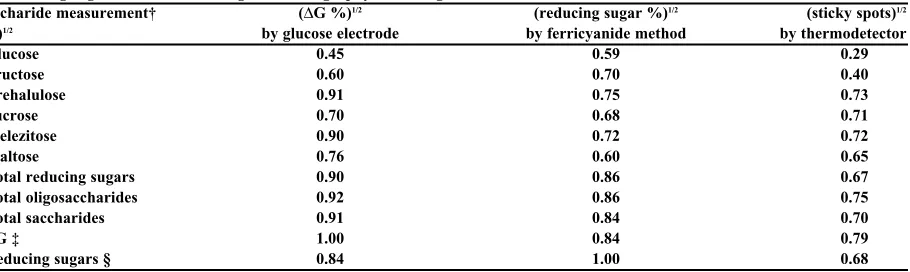
Measurements by the sticky cotton thermodetector ranged from 1 to 88 sticky counts for the set of 57 whitefly-contaminated cotton samples, indicating potential stickiness ratings ranging from nonsticky to extremely sticky (Perkins and Brushwood, 1995). Table 1 shows resulting correlations of the square root of thermodetector counts with individual sugars as measured by anion-exchange chromatography, ∆G as measured by the bioanalyzer, and reducing sugar content as measured by the ferricyanide test. Except for glucose and fructose, each of the sugar variables measured by anion-exchange chromatography, taken individually or in combination, provided the relatively high level of correlation expected if the observed stickiness is due primarily to the presence of insect-derived
Table 1. Coefficients of determination between thermodetector sticky counts and saccharide measurements obtained by the ferricyanide reducing sugar test, anion exchange chromatography, and the glucose oxidase electrode.
Saccharide measurement† (∆G %)1/2 (reducing sugar %)1/2 (sticky spots)1/2
(%)1/2 by glucose electrode by ferricyanide method by thermodetector
Glucose 0.45 0.59 0.29
Fructose 0.60 0.70 0.40
Trehalulose 0.91 0.75 0.73
Sucrose 0.70 0.68 0.71
Melezitose 0.90 0.72 0.72
Maltose 0.76 0.60 0.65
Total reducing sugars 0.90 0.86 0.67
Total oligosaccharides 0.92 0.86 0.75
Total saccharides 0.91 0.84 0.70
∆G ‡ 1.00 0.84 0.79
Reducing sugars § 0.84 1.00 0.68
† Measured by anion-exchange chromatography unless otherwise noted. ‡ Measured by glucose electrode.
sugars on the surface of the cotton fiber. In fact, three of the four oligosaccharides measured by anion-exchange chromatography provided a marginally better correlation with thermodetector counts than did reducing sugar content measured by the ferricyanide method. This relation was reinforced by the observation that total oligosaccharide content measured by anion-exchange chromatography correlated higher with thermodetector counts than did total reducing sugar content measured by anion-exchange chromatography (R2= 0.75 and 0.67, respectively).
∆G, an alternative measure of total
oligosaccharide content, exhibited the highest correlation with thermodetector counts, with
R2= 0.79. Reducing sugar content as measured by
the ferricyanide method exhibited a significantly lower correlation, with R2= 0.68. Comparisons of ∆G and reducing sugar content with thermodetector counts are shown in Fig. 1. Though both methods correlate well with thermodetector counts, the variables measured by each are significantly different. It is therefore cogent that the two methods be directly compared in order to determine whether or not they are interchangeable as rapid screening methods for sticky cotton.
Comparison of reducing sugar content by the ferricyanide method to ∆G as measured by the glucose electrode is shown in Fig. 2. The coefficient of determination, R2= 0.84, indicates a
good relationship over the range of values observed. Of the individual saccharides observed by anion-exchange chromatography, glucose, fructose, trehalulose, and maltose are measured by
the reducing sugar test. ∆G is a measure of oligosaccharide content, and as such, free glucose and fructose are not measured. Trehalulose and maltose, then, are the known sugar variables common to both methods, and individual correlations of ∆G and reducing sugar content with both trehalulose and maltose indicate a substantially higher correlation in the case of ∆G than with reducing sugar. The sum of the four reducing sugars as measured by anion-exchange chromatography correlated higher with ∆G than with reducing sugar content, even though glucose and fructose individually correlate higher with reducing sugar content. Both total saccharide content and total oligosaccharide content as measured by anion-exchange chromatography exhibited higher correlations with ∆G than with reducing sugar content as measured by the ferricyanide method. Oligosaccharide content as measured by anion-exchange chromatography and
∆G exhibited the highest correlations with
Fig. 1. Relationship of percent reducing sugar content by the fer- ricyanide method and percent ∆G by the glucose oxidase enzyme method with sticky cotton thermodetector measur-ments.
Fig. 2. Relationship of percent reducing sugar content by the fer-ricyanide method with percent ∆G by the glucose oxidase enzyme method.
thermodetector counts, and a comparison of these two measurements, as seen in Fig. 3, shows a very high correlation, with R2= 0.92.
On the basis of the work presented here, the most accurate chemical screening methods for potential stickiness due to whitefly honeydew contamination are those that measure oligosaccharide content. The ∆G measurement by the glucose oxidase enzyme electrode determines oligosaccharide content rapidly, accurately, at low cost, and without concomitant production of a hazardous waste stream, making it an effective screening method for cotton stickiness due to whitefly honeydew contamination.
REFERENCES
Bailey, N., C. Bailey, and S. Reichard. 1982. Enzymatic evaluation of sugar content of cotton. Textile Res. J. 52:321–327.
Brushwood, D., and H. Perkins. 1993. Cotton sugar and stickiness test methods. Can. Textile J. 110(6):54–62.
Hendrix, D. 1999. Sugar composition of cotton aphid and silverleaf whitefly honeydews. p. 47–51. In Proc. Beltwide Cotton Conf., Orlando, FL. 3–7 Jan. 1999. Natl. Cotton Counc. Am., Memphis, TN.
Hendrix, D., and Y. Wei. 1994. Bemisiose: an unusual trisaccharide in Bemisia honeydew. Carbohydr. Res. 253:329–334.
Perkins, H. 1971. Some observations on sticky cottons. Textile Ind. 135(3):49–64.
Perkins, H., and D. Brushwood. 1995. Interlaboratory evaluation of the thermodetector cotton stickiness test method. p. 1189–1191. In Proc. Beltwide Cotton Conf., San Diego, CA. 5–8 Jan. 1994. Natl. Cotton Counc. Am., Memphis, TN.