http://researchcommons.waikato.ac.nz/
Research Commons at the University of Waikato
Copyright Statement:
The digital copy of this thesis is protected by the Copyright Act 1994 (New Zealand). The thesis may be consulted by you, provided you comply with the provisions of the Act and the following conditions of use:
Any use you make of these documents or images must be for research or private study purposes only, and you may not make them available to any other person. Authors control the copyright of their thesis. You will recognise the author’s right
to be identified as the author of the thesis, and due acknowledgement will be made to the author where appropriate.
You will obtain the author’s permission before publishing any material from the thesis.
CHANGE READINESS INFLUENCES ON KNOWLEDGE MANAGEMENT PROCESSES: A CASE OF THREE PROFESSIONAL
SERVICE FIRMS
A thesis
submitted in fulfilment of the requirements for the degree
of
Doctor of Philosophy in Management Systems at
The University of Waikato by
FARIZA HANIM RUSLY
Year of submission
ABSTRACT
Introduction: The current dynamic market is characterised by stiff competition and ever-changing clients‘ demand for better and innovative products and services. In this challenging environment, the need for developing and managing knowledge transcends the importance of accumulating physical capital. With an increasing awareness of the potential of knowledge as a competitive source for firms‘ survival, there is an increased knowledge management initiatives and investments by firms. Nevertheless, literature highlights increasing failures of knowledge management initiatives, with reasons for the failure yet to be established conclusively.
On the basis of the premise that implementation of the knowledge management process could induce changes in firms‘ practices and culture, and employees‘ beliefs and cognitive structure, the current thesis addresses the issue from the change management perspective. The main idea that drives the research evolves from the understanding that failure in knowledge management initiatives could be rooted in the lack of readiness to change.
Objective: The primary objective of this thesis is to understand how the change readiness construct shapes the various processes for managing knowledge in professional service firms. Change readiness in this thesis was conceptualised as a multidimensional and multilevel construct. This thesis contributes to the body of knowledge by explicating the way these change readiness elements shape knowledge management processes. The study setting within the professional service industry offers unique insights, which is less explored in the extant KM literature.
Method: The study was conducted within the professional service firms‘ context, on the basis that knowledge represents the main source for survival and competitiveness in this knowledge-intensive industry. This research is grounded in the interpretive paradigm and is studied from the constructivist epistemological lens. This qualitative research employed multiple case study design in three New Zealand professional service firms. Two firms are accounting establishments and one represents an engineering maintenance firm. Sixteen semi-structured interviews, conducted over the period of two months, involved the managerial and
operational professionals in these participating firms. Data were analysed following the grounded theory analysis and findings presented using cross-cases analysis.
Results: This thesis contributes to the body of knowledge in the field of knowledge management (KM) by revealing the distinctive influences of multidimensional elements of the change readiness construct on the knowledge acquisition, knowledge application and knowledge sharing processes in the firms studied.
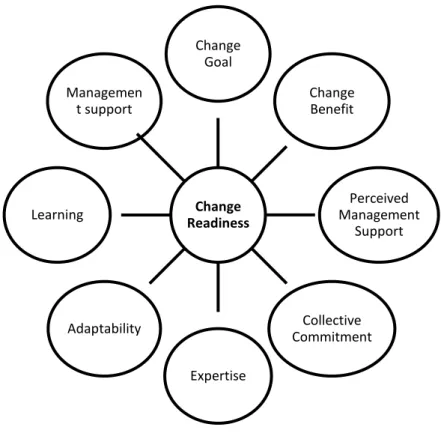
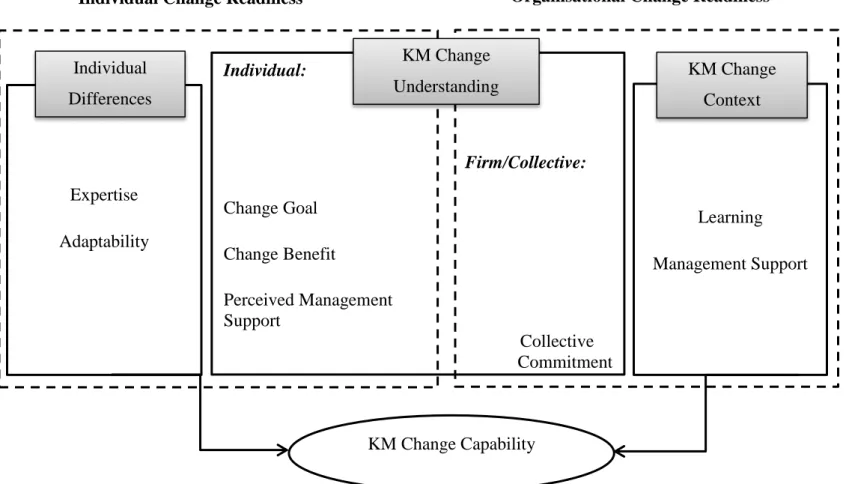
The thesis proposes three dimensions of the change readiness construct, which are categorised as KM change understanding, KM change context and individual differences. The dimension of KM change understanding consists of change goal, change benefit, need for knowledge, perceived management support and collective commitment. The KM change context is comprised of learning, participation, communication and management support. Individual expertise and adaptability represent the individual differences dimension of the change readiness construct.
Specifically, findings show that:
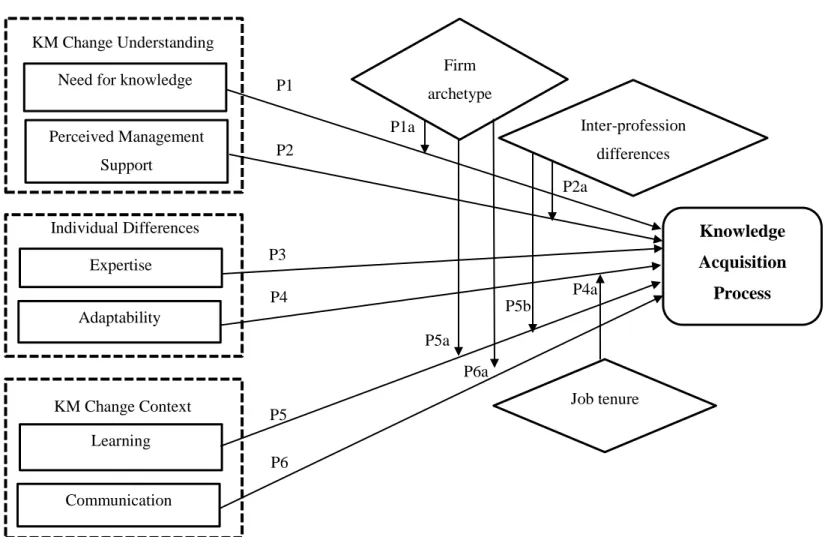
1) Readiness for the knowledge acquisition process is largely shaped by the individual‘s change readiness elements, including the understanding of the need for knowledge and perceived management support, and the individual‘s capability of expertise and adaptability. Learning and communication provides the essential contexts that shape the firm‘s readiness for the knowledge acquisition process.
2) Readiness for the knowledge application process is largely shaped by the individual‘s change readiness elements, including the understanding of change goal, change benefit and perceived management support, and the individual‘s capability of expertise and adaptability. Collective commitment shapes professionals‘ understanding of knowledge application at the firm level. Learning and management support provides the essential contexts that shape the firm‘s readiness for the knowledge application process.
3) Readiness for the knowledge sharing process is largely shaped by the firm‘s change readiness elements, consisting of professionals‘
understanding of collective commitment, and the essential contexts of communication, participation and learning. Understanding of the need for knowledge and change benefit, as well as the professional‘s expertise, shapes the individual‘s readiness for the knowledge sharing process. 4) The way these change readiness elements shapes the distinctive KM
processes in the professional service firms studied vary due to the effects of firm archetypes, inter-profession differences, change nature, knowledge nature and the demographic characteristic. These factors moderates the interrelationships described in in 1), 2), and 3).
v PREFACE & ACKNOWLEDGEMENTS
In the name of God, Most Beneficent, Most Merciful.
I wish to express my sincere appreciation to those who have contributed to this thesis and supported me in one way or the other during this amazing journey.
First and foremost, I would like to express my sincere gratitude to both my supervisors ~ Professor Jim Corner, for his endless encouragement, guidance and inspiration. His wisdom and invaluable insights helped me to see the world from a wider perspective. Your motivation has helped me to move forward when I was down. To Associate Prof. Dr. Peter Sun, thank you for believing in me and guiding me through this endeavour. Your critical views always lead me back on track. To my supervisors, I am so grateful for having the opportunity to be your supervisee ~ for the knowledge that I learnt; for the understanding that I received. Thank you!
I would also like to take this opportunity to thank the Ministry of Higher Education, Malaysia and my employer, Universiti Utara Malaysia, for the sponsorship and support.
My special thanks to Mr. Grant Harris for helping me with my writing. I will always remember your kind assistance during our discussion and conversation.
To my parents: Rusly Mahamud and Rahina Darus, my brothers: Fahrul, Faizal, Fadzlan and my in-laws, thank you for believing in me. For the unconditional love and prayers that I have, without which I would not be here.
To my husband, Shahrir Nordin, my source of strength and inspiration; and my children Muhammad Syazwan Faiz and Fasha Nur Insyirah, for your sacrifice, patience, and love throughout this journey. I love you more than words can say.
I am also indebted to wonderful friends and colleagues for being there to listen when I needed an ear. To my friends, you know who you are, thank you for the friendship and making this journey even more meaningful.
vi
TABLE OF CONTENTS
TABLE OF CONTENTS ... vi
1.0 INTRODUCTION AND OVERVIEW OF THE THESIS ... 1
1.1 Background and Rationale of Thesis ... 1
1.2 Introduction to key constructs ... 5
1.3 Brief Overview of Methods ... 13
1.4 Outline of Thesis ... 14 1.5 References ... 16 2.0 LITERATURE REVIEW ... 23 2.1 Manuscript Status ... 23 2.2 Abstract ... 24 2.3 Introduction ... 25
2.4 Understanding the Change Readiness Concept... 26
2.5 Conceptual model for examining change readiness, knowledge management processes and knowledge management effectiveness. ... 29
2.6 Multidimensional Characteristics of Change Readiness ... 32
2.7 Knowledge Management Processes ... 37
2.8 Implications of Change Readiness for Knowledge Management Processes40 2.9 Knowledge Management Effectiveness ... 53
2.10 Discussion and Conclusion ... 55
2.11 References ... 62
3.0 RESEARCH QUESTIONS ... 71
3.1 Introduction ... 71
3.2 Research Aims and Research Questions ... 71
4.0 RESEARCH METHODOLOGY AND DESIGN ... 74
4.1 Introduction ... 74
4.2 Knowledge claim ... 74
vii
4.2.2 Knowledge Management Processes Perspectives ... 76
4.3 Research Paradigm ... 78
4.3.1 Rationale for the Interpretive Paradigm ... 80
4.4 Research Methodology: Quantitative and Qualitative Research ... 82
4.4.1 Rationales for the Qualitative Research Methodology ... 85
4.5 Qualitative Research Design ... 87
4.5.1 Qualitative Case Study ... 87
4.5.2 Rationales for Multiple-Case Study Design ... 89
4.6 Overview of the Research Design ... 90
4.6.1 Data Collection Technique ... 94
4.6.2 Data Analysis ... 107
4.7 Literature Review ... 118
4.8 Ethical Considerations ... 118
4.9 Quality in Qualitative Studies ... 119
4.10 Chapter Summary ... 122
4.11 References ... 124
5.0 FINDINGS AND DISCUSSION ... 129
5.1 Manuscript Status ... 130
5.2 Abstract ... 130
5.3 Introduction ... 131
5.4 Literature review ... 133
5.4.1 Understanding the Knowledge Acquisition Process ... 133
5.4.2 Factors influencing the knowledge acquisition process ... 136
5.4.3 Knowledge acquisition in the professional service context ... 138
5.4.4 Change readiness for the knowledge acquisition process ... 139
5.5 Research Method and Design ... 141
5.6 Case findings ... 142
5.6.1 Individual level analysis of change readiness for the knowledge acquisition process ... 142
viii
5.6.2 Firm level analysis of change readiness for the knowledge acquisition
process ... 146
5.7 Discussion ... 150
5.7.1 Individual‘s readiness for the knowledge acquisition process ... 152
5.7.2 Firm‘s readiness for the knowledge acquisition process... 157
5.8 Conclusions and future studies ... 160
5.9 References ... 162
6.0 FINDINGS AND DISCUSSION ... 167
6.1 Manuscript Status ... 167
6.2 Abstract ... 167
6.3 Introduction ... 168
6.4 Theoretical Background ... 169
6.4.1 Knowledge Management and Its Processes ... 169
6.4.2 Knowledge Application and Factors Affecting the Process ... 170
6.4.3 Knowledge Application in the Professional Service Context ... 170
6.4.4 Knowledge Management from a Change Perspective ... 171
6.4.5 Change Readiness: An Overview of Conceptualisation and Its Definition ... 172
6.4.6 Understanding Change Readiness in Knowledge Management Research ... 174
6.5 Research Design and Method ... 175
6.5.1 Research Design ... 175
6.5.2 Data Collection... 175
6.5.3 Data Analysis ... 176
6.6 Findings ... 177
6.6.1 The Cross-Case Analysis: Change Readiness and the Knowledge Application Process ... 177
ix
6.7.1 Knowledge Application and Multidimensionality/Multilevel Analysis
of Change Readiness ... 187
6.7.2 Individual Analysis of Change Readiness... 189
6.7.3 Organisational Analysis of Change Readiness ... 197
6.8 Conclusion... 205
6.9 References ... 208
Appendices ... 216
Appendix A: Background of Participants ... 216
Appendix B: Main Categories and Categories Development ... 217
7.0 FINDINGS AND DISCUSSION ... 218
7.1 Manuscript Status ... 218
7.2 Introduction ... 219
7.3 Theoretical Background ... 221
7.3.1 Knowledge and knowledge sharing ... 221
7.3.2 Defining knowledge sharing ... 221
7.3.3 Theoretical perspective on knowledge sharing, and factors influencing the process ... 222
7.3.4 Motivating and managing change in knowledge sharing process: Understanding change readiness ... 225
7.3.5 Knowledge sharing in the professional service context ... 225
7.4 Research Method and Design ... 226
7.5 Findings: Change readiness and the knowledge sharing process ... 227
7.5.1 Individual readiness towards knowledge sharing ... 228
7.5.2 Organisational change readiness towards knowledge sharing ... 231
7.6 Discussion ... 237
7.6.1 Multidimensionality of change readiness and the multilevel knowledge sharing process ... 237
x
7.6.2 Motivating readiness through individual and firm knowledge sharing
understanding and beliefs ... 240
7.6.3 Enhancing knowledge sharing readiness through an individual‘s differences ... 244
7.6.4 Fostering knowledge sharing readiness through a firm‘s change context ... 245
7.7 Conclusion... 250
7.8 References ... 252
Appendices ... 257
Appendix A: Open-ended questions and probes ... 257
Appendix B: Conceptualisation of change readiness concepts ... 258
8.0 CONCLUSIONS, LIMITATIONS, IMPLICATIONS AND FUTURE RESEARCH ... 260
APPENDICES ... 268
Appendix 1: The Interview Protocol ... 268
Appendix 2: Within-case analysis ... 273
Appendix 3: Coding ... 404
Table A: Excerpts of Concepts and Categories development ... 404
Table B: Initial category codes and names ... 405
Table C: Final category codes and names ... 406
Table D: List of core categoriesand categories ... 407
Appendix 4: Ethics-related Forms ... 408
1
1.0 INTRODUCTION AND OVERVIEW OF THE THESIS
This chapter introduces the thesis, which is presented in a hybrid format of three conventional chapters (introduction, methodology and conclusion) and a series of published and publishable journal manuscripts (a literature chapter and three distinctive findings and discussions chapters). This chapter first discusses the background and rationales for the thesis. The chapter then provides introduction to key constructs of the study and finally presents an overview of the research design and outline of the thesis.
Organisations operating in the current ever changing environment need to survive the effects of a challenging economic recession, globalisation, technological advancement and customer orientation, which in turn result in environmental and marketplace complexity (Clarke & Clegg, 2000; Rafferty, Jimmieson & Armenakis, 2013; Walczak, 2005; Wang & Ahmed, 2003). Economic recession increases the possibility of losing businesses and expertise, while the effect of globalisation intensifies competitive pressure in the marketplace. Additionally, technological advancement and customer orientation are forcing the on-going development of human resource capabilities in order to meet the market expectations. In order to deal with the above-mentioned challenges, there is a need for firms to rapidly change themselves and shift the focus of their core competency towards a knowledge-based core competency (Bhasin, 2006).
The current knowledge-based business landscape demands firms to strengthen its intellectual and knowledge base since knowledge represents the critical source for survival and competitiveness (Fong & Choi, 2009; Janes, Patrick & Dotsika, 2014; Sigala & Chalkiti, 2007). Aligned with this idea, strategies to increase firms‘ long term competitiveness should focus on the direction for enhancing human expertise and intellectual capital development. The development of this intangible asset can be achieved through effective processes for managing knowledge in the organisations (Holsapple & Joshi, 2000; Lee & Choi, 2003; Wong & Aspinwall, 2004; Xu, Houssin, Caillaud & Gardoni, 2010).
2
An increasing number of knowledge management (KM) initiatives and investments among firms are apparent; reflecting the growing recognition of KM as a crucial corporate agenda for firms‘ survival and competitiveness (Jasimuddin, 2012; McKenzie, Truc & vanWinkelen, 2001). Similar to other planned activities in the organisation, a KM process implementation requires the design of strategies to achieve its intended purpose (Holsapple, 2000; Yeh, Lai & Ho, 2006). Nevertheless, despite many promising benefits of KM, a high failure rate of KM initiatives is reported (Chua, 2009; Lucier & Torsilieri, 1997; Mehta, 2008; Storey & Barnett, 2000). The discouraging outcomes of such initiatives requires more studies to be carried out in order to understand its‘ underlying reasons.
This thesis embraces the view that embarking on the knowledge processes induces changes in the existing organisation‘s procedures and workflows. Changes in thinking and the extant norms, procedures and practices are inevitable in KM processes implementation (Chen, 2008; Davenport & Prusak, 1998; Holt, Bartczak, Clark & Trent, 2007; Wiig, 1993). For example, these changes could result from double loop learning that occurs during new knowledge implementations (Sun & Scott, 2003). Additionally, acquiring new knowledge infuses changes and expands individuals‘ knowledge bases (Hoe & McShane, 2010). The effectiveness of this process is affected by changes in individuals‘ and firms‘ absorptive capacity (Matusik & Heeley, 2005; Thuc Anh, Baughn, Minh Hang & Neupert, 2006). For these reasons, preparing for KM implementation in the organisation reflects the need to move out of the comfort zone and be adaptable to the altered knowledge culture (Laycock, 2005; Walzack, 2005). In conjunction with that, literature indicates that employees‘ willingness to commit and contribute represents an essential aspect for the KM success (Lin, 2011; Wasko & Faraj, 2005). Unpreparedness among employees towards KM processes implementation could instigate resistance towards the KM initiatives, which is often observed as a challenge in KM implementation (Jasimuddin, 2012).
In relation to that, this thesis argues that one crucial aspect that is largely ignored, yet negatively affects the KM initiatives, is the inadequate assessment of employees‘ change readiness to embark on changes underlying the KM processes implementation. Nevertheless, a recent study indicates that change management, as one of the KM capabilities, has received the least attention from KM implementers (O'Dell & Hubert, 2011). Underestimating the importance of
3
change management leads to disappointments and struggles in KM processes implementation (Laycock, 2005). Thus, literature suggests that an effective approach of change management is seen essential to minimise problems in KM processes implementation (Bhatt, 2001; Damodaran & Olphert, 2000; Holsapple & Joshi, 2000; Sunassee & Sewry, 2002).
The idea of KM assessment from a change lens represents a contemporary area of study in KM field. Literature shows that the integration of change readiness in KM studies has only started gaining attention in recent years. Among seminal works proposing the conceptual integration of change readiness assessment in KM research include e.g. Baskerville and Dulipovici (2006), Holt et al. (2007), Holt, Armenakis, Field and Harris (2007) and Holt, Helfrich, Hall and Weiner (2009). Besides the increasing interest in the area, (e.g. Lam & Lambermont-Ford, 2010; Small & Sage, 2006; Wang & Noe, 2010), review of literature reveals that the empirical studies that integrate the assessment of KM and change management are relatively scarce.
Further, there are several limitations underlying the prevailing studies in the area. Most studies focus on the quantitative measurement of change readiness (e.g., Mohammadi, Khanlari & Sohrabi, 2009; Mohanavel & Ravindran, 2012; Shirazi, Mortazavi & Azad, 2011). These studies also largely adopt the KM critical success factors to represent KM readiness with minimal consideration of other readiness elements and dimensions as proposed in the organisational change literature. KM readiness is represented mainly by organisational elements (Chen, 2008; Siemieniuch & Sinclair, 2004), although the organisational change literature emphasises the complexity of change readiness as a multidimensional and multilevel construct. KM processes implementation involves human-related elements (Chen & Mohamed, 2007), yet assessment of employees‘ readiness for KM processes is largely ignored.
Additionally, empirical studies that interrogate change readiness impacts on specific KM process are lacking (Holt et al., 2007). While those existing studies offer preliminary understandings of KM readiness, some other important readiness elements and their influences on distinctive KM processes are yet to be explored. Consequently, there is limited understanding on the ways change readiness exerts influences on and contributes to the KM processes
4
implementation. For these reasons, the current thesis is designed to address the above problem and limitations in the current KM literature.
The main problem statement of this thesis is:
What are the dimensional elements of change readiness and how change readiness shapes KM processes implementation?
In conjunction with that, this thesis focuses on addressing the problem of change readiness assessment in KM processes implementation to better understand the ways this construct shapes KM processes. In doing so, the main aim of this thesis is:
To discover the complexity of change readiness as a construct and to assess its influences in shaping various KM processes.
In order to provide a better picture of the story, the assessment of change readiness influences on KM processes was carried out within the context of professional service firms (PSFs). The selection of this context is primarily because of the crucial role of knowledge in PSFs‘ operations. Thus, effective ways for managing knowledge could be considered as a backbone in these types of firms‘ operations (Andreeva & Kianto, 2011; Chen, Hwang & Raghu, 2010; Kang & Kim, 2010). For this reason, processes for managing knowledge is crucial for PSFs and failures in their KM process may inhibit the PSFs‘ competitiveness and survival in the current knowledge-intensive market (Fong & Choi, 2009). Although knowledge and processes for managing it is critical in PSFs‘ operations, literature indicates that promoting effective KM is still challenging for PSFs (Witherspoon, Bergner, Cockrell & Stone, 2013).
Findings from this thesis could address limitations in the extant KM literature with regards to change readiness influences in shaping KM processes. Findings could also provide insights on mitigating problems of KM failures that is rooted in the lack of change readiness for KM implementation. This thesis proposes a broad and holistic conceptualisation of change readiness and offers theoretical understandings of change readiness influences in shaping the various KM processes.
5
Knowledge Management
Knowledge management (KM), although yet to be recognised as a mature discipline, is progressing significantly, however, with influences from various disciplines including organisational culture, organisational behaviour, strategic management, information economics and information systems. This variation with a mixture of different ontological and epistemological understanding of knowledge and the processes related to it have revealed the importance of KM transcending any single discipline (Baskerville & Dulipovici, 2006; Jasimuddin, 2012; Nonaka & Peltokorpi, 2006).
There are two major perspectives influencing KM scholars‘ views on the importance of knowledge for a firm: the resource-based view (RBV) and the knowledge-based view (KBV). This study positions itself in the KBV perspective. Knowledge, from KBV‘s perspective, can be replicated and transferred to receivers, with no causes of loss on the contributor‘s side (Grant, 1996).
Knowledge Management Process
Many scholars have concentrated on the technical development of knowledge taxonomies such as knowledge definition and classification; the current study positions itself with other scholarly efforts that empirically assess KM from a process perspective (Gold, Malhotra & Segars, 2001; Lee & Choi, 2003; Mehta, 2008). There are two critical objectives for managing knowledge from a process perspective, according to O'Dell and Hubert (2011). Primarily, KM reflects the management of knowledge through a structured process to ensure effective knowledge delivery. Further to that, through streamlining of the processes, people could access, gain, share and act on the information to produce knowledge and make an informed decision, which consequently enhances firms‘ performance. For this reason, firms‘ participation in the processes for managing knowledge is crucial; it enhances the creation and sustainability of firms‘ competitive advantage in the post-industrial era (Andreeva, 2009; Heisig, 2009; Supyuenyong, Islam, & Kulkarni, 2009).
6
KM, from a process perspective, emphasises the understanding of knowledge flows through different ways and across different levels in the organisation (Mehta, 2008; Nonaka, 1995). The process entails various activities, components and sub-phases that should be performed in a way that is aligned with organisation goals (Heisig, 2009). Moreover, scholars have also asserted that the KM process represents a dynamic set of activities that improve knowledge flow, enabling changes in an organisation (Gold et al., 2001; Mehta, 2008).
Despite the plethora of studies on KM, very few of the empirical studies adopt a process-oriented perspective of organisational knowledge (Lee & Choi, 2003). KM scholars also asserted those firms isolating knowledge processes from their business processes face the risk of losing their long term benefits (Choi & Lee, 2002; Lee & Choi, 2003). Nevertheless, assessment on the processes for managing knowledge play a crucial role in understanding various ways knowledge is acquired, created, organised, disseminated and applied in the firms.
Knowledge Intensive Firms and the Professional Service Context
Professional service firms (PSFs) are generally characterized by their professional identity and knowledge-driven nature; knowledge is crucial to their success in the competitive and dynamic business environment (Fong & Choi, 2009). Some scholars regard PSFs as knowledge-intensive firms (KIFs) because of the composition of experts in the firms‘ operations (Jensen, Poulfelt, & Kraus, 2010). From another perspective, PSFs are classified as a subset of knowledge intensive firms (Alvesson, 2000; Lowendahl, 1997). Although professionalization is regarded as part of KIFs‘ characteristics, acknowledging all KIFs as professional service firms could be misleading.
Despite commonality in terms of hiring specialised expertise in both KIFs and PSFs, not all experts belongs to recognised professions (Starbuck, 1992). With interest in classifying PSFs based on the characteristics of the staff members, in order to be regarded as a profession, the staff members‘ job nature should demonstrate at least five qualities: expertise, an ethical code, cohesion, collegial enforcement of standards, and autonomy (Starbuck, 1992). In a similar way, Alvesson (2000) differentiated PSFs from KIFs by proposing that KIFs represent
7
a wider concept, whereby its characteristics attributed to a particular profession such as codes of ethical conduct, a strong professional association and domination of certain markets through market entry regulation, could be disregarded.
Further, the extant literature highlights other characteristics for firms to be recognised as a professional service provider. For instance, Lowendahl (1997) provides a prominent classification of PSFs by focusing on services delivered by KIFs, rather than the sole assessment of individuals‘ characteristics. In particular, the delivery of services by KIFs is accomplished by the professionals within the boundary of professional rules of conduct. Following this classification, PSFs are considered as a group of genuine KIFs; in which knowledge of the experts represent the foremost important source for provision of value added services. The key characteristics for PSFs from this perspective include:
It is highly knowledge intensive, delivered by people with higher education, and frequently closely linked to scientific knowledge development within the relevant area of expertise; involve a high degree of customisation; involve a high degree of discretionary effort and personal judgement by the expert(s) delivering the service; typically require substantial interaction with the client firm representatives involved and delivered within the constraints of professional norms of conduct, including setting client needs higher than the profits and respecting the limits of professional expertise (Lowendahl, 1997, p.20).
Moreover, in an endeavor towards theoretical development of PSFs, von Nordenflycht, (2010) elaborates taxonomy for PSFs from 3 dimensions: degrees of knowledge intensity, capital intensity and professional workforce. In terms of knowledge intensity, output from PSFs‘ operations relies on embodiment of complex knowledge among the experts and unique skills of the individuals. Heavy reliance on individuals as source of knowledge also implies greater autonomy for employees, but at the same time increases employee mobility. This is a challenge for firms to retain the staff members, except in the situation where the key experts represent partners of the firm. Likewise, since staff members‘ knowledge represents the main focus of firms‘ operations, the need for human capital exceeds the necessity of non-human capital such as machinery and equipment. In the
8
context of PSFs, jobs are accomplished by the professionals themselves with greater emphasis on expertise and intellectuality. The less investment needed in terms of physical capital explains the insignificance of external capital or investment for KIFs operations. Additionally, professional workforce implies that the experts accomplish their jobs according to a set of norms and rules of conduct enforced by professional bodies governing PSFs operations. Since PSFs commonly provide services to other businesses rather than end users, protection of conflict of interests and adherence to standardised rules are crucial.
On the basis of the definition provided by Lowendahl (1997), accounting/auditing, engineering consultants and law firms represent PSFs. Despite ambiguity in defining PSFs, accounting and engineering firms are consistently classified as provider of professional services (Bryson & Daniels, 2007; Fong & Choi, 2009; Greenwood, Deephouse & Li, 2007; Jensen et al., 2010; Malhotra & Morris, 2009; von Nordenflycht, 2010). Although there are various approaches and views in defining PSFs, the similarity of these classification lies on the criticality of knowledge as the primary engine that drives the operation of PSFs. The fact that the quality of services provided by this knowledge intensive sector is highly reliant on employees‘ intellectual capability and their vast experience implies the importance of processes for managing knowledge in PSFs (Gibbins & Wright, 1999; Magnier-Watanabe & Senoo, 2008; Makani & Marche, 2010). In conjunction with that, processes for managing knowledge among PSFs including engineering, consultancy and accountancy are undoubtedly important.
Nevertheless, despite the importance of knowledge and KM in PSFs‘ operations, motivating professionals to contribute in KM processes is still a challenge for most firms (Wang & Noe, 2010; Witherspoon et. al, 2013). For these reasons, assessment of elements that could foster positive movements towards KM processes in PSFs is crucial. This thesis proposes that KM processes implementation infuses changes in the prevailing practices and procedures of PSFs. Hence, the enhancing of professionals‘ contributions in KM processes is better studied from a change management lens.
9 Change Readiness
Preparing people for change has long been recognised as crucial in the organisational change literature (Abdinnour-Helm, Hall, & Lengnick-Hall, 2003; Bouckenooghe, 2010). For instance, scholars emphasised that employees‘ attitude and readiness towards change is a critical element in determining the success or failure of an organisation‘s change initiative (Bernerth, 2004; Rafferty et al, 2013). However, further theoretically grounded enquiries, based on empirical evidence, are needed in the area (Weiner, 2009).
In positioning readiness within the organisational change cycle, Armenakis and Harris (2002) and Holt, Armenakis, Feild, and Harris (2007) proposed a three-stage process of organisational change: readiness, adoption, and institutionalisation of change. This positioning implies readiness should exist at the initial stage of change, in order to prepare the affected staff members coping and embracing the change. However, recent development in the area suggests that due to the dynamic environment underlying the current business landscape, instilling readiness only at the initial state of change is inadequate. Fostering readiness for change in organisations requires an on-going effort, which is aligned with the need to adapt with constant changes in the firm‘s practices (Bernerth, 2004; Stevens, 2013).
Holt, Armenakis, Harris, and Feild (2007) and Bernerth (2004) mentioned that
readiness was first proposed by Jacobson in 1957. His opinion was formed as a result of reflection from Coch and French (1948)‘s case on organisational intervention in mitigating the effect of change resistance. Nevertheless, interest in progressing this construct in the organisational change literature only appeared in early 1990s.
Armenakis and Bedeian (1999), Armenakis and Harris (2002) and Armenakis, Harris and Mossholder (1993) offer seminal works that initiated the development of a well-accepted definition for change readiness. Armenakis defines readiness for change as an individual‘s ―beliefs, attitudes, and intentions regarding the extent to which changes are needed and the organisation‘s capacity to successfully undertake those changes‖ (1993, p. 681). The definition implies the importance of
10
creating beliefs about the proposed change that affects the individual‘s reaction to change. This definition anchored the development of the construct, primarily due to claim that this conceptualisation of readiness considers both individual and organisational elements (Bernerth, 2004; Rafferty et al., 2013).
While the previous definition of change readiness stems from beliefs, with less attention to the acceptance or resistance to changes, the subsequent study by Holt, Armenakis, Feild and Harris indicates the existence of positive attitudes in the change readiness definition (Bernerth, 2004). In a similar direction, Rafferty et al. (2013) asserted that change readiness appeared to be consistently applied in the organisational change literature to represent indicator of positive attitudes for change. Change readiness is defined as ―the extent to which an individual or individuals are cognitively and emotionally inclined to accept, embrace, and adopt a particular plan to purposefully alter the status quo‖ (Holt et al., 2007, p. 235). Additionally, extended classification of change readiness dimension was proposed with the inclusion of change readiness creation through the change recipients‘ evaluation/understanding of what kind of and how change is undertaken. The outcome of evaluation could differ depending on the change recipients‘ attributes.
Further, Weiner, Amick, and Lee (2008) explicate transformation of beliefs into practice/action in defining readiness for change. They state that ―the extent to which organizational members are psychologically and behaviourally prepared to implement organizational change‖ (Weiner et al., 2008, p. 381), is imporant for change readiness. From this definition, apart from triggering internal precursor that cognitively instils a positive mind-set, creation of readiness also brings about positive momentum in embracing the proposed change effort (Bernerth, 2004). Consequently, it is expected that with the positive mind-set, individuals are more prepared and motivated to embark on the changes; hence minimising likelihood of resistance.
Further, as claimed by Amis and Ai¨ ssaoui (2013) and Bernerth (2004), the readiness of an individual could be influenced by their peers‘ beliefs on the change outcome. Hence, at a higher level, individuals‘ beliefs are compounded to create collective beliefs; creation of readiness should transcend an individual‘s
11
consideration, and account for alteration/coordination of collective change recipients‘ mind-set (Armenakis et al., 1993; Weiner et al., 2008).
In this regard, Weiner (2009), Holt et al. (2009) and Rafferty et al. (2013) extended the importance to incorporate organisational level analysis in the readiness assessment. The assessment of the collective cognition is known as supra-individual readiness from Weiner‘s point of view. Still representing a psychological state of change recipients, Weiner (2009) emphasised that collective actions shape employees‘ confidence and effort in undertaking the change.
At this point of development, conceptualisation of readiness still focuses on the cognitive aspect, although been lifted to incorporate shared beliefs that reflect the organisational level of readiness. Additionally, the firm‘s condition or context poses indirect effects on its change readiness. Further works, however, indicate that scholars began to acknowledge the firm‘s and individuals‘ conditions to embark on change as an emerging dimension of change readiness (Holt et al., 2009; Holt & Vardaman, 2013). This dimension is regarded as a structural dimension of change readiness, representing ―circumstances under which change is occurring and the extent to which these circumstances enhance or inhibit the implementation of a change‖ (Holt et al., 2009, p.S51). This notion indicates that beliefs alone could be inadequate to make people ready for changes if firms‘ structure is not supportive of change, and if staff members are ill-equipped with necessary capabilities to implement changes that affect the prevailing workflows, processes and procedures. Structural factors at the individual level include individual‘s skills and knowledge relevant to the changes, while at the organisational level, structural factors include its support climate, facilitation mechanisms and discrepancies in the existing system. In summary, Holt et al. (2009) addressed three broad areas for a comprehensive assessment of readiness for change: psychological factors, structural factors, and level of analysis.
This conceptualisation regards readiness for change as a multidimensional construct that requires assessment at multilevel analysis. On the basis of this development, a more practical definition of readiness is offered. Hence, change readiness is then defined by Holt & Vardaman (2013) as ―the degree to which
12
those involved are individually and collectively primed, motivated, and technically capable of executing the change‖ (p.9). This definition implies that creating readiness means motivating staff members by providing rationales to their action and simultaneously preparing them to act in favour of the change by recognising the firms‘ and individuals‘ capabilities. In a more recent development, scholars however, argued that the absence of change nature and institutional context consideration in the assessment of change readiness limits the understanding of the construct (Holt & Vardaman , 2013).
Looking at the development of conceptual definition for change readiness, the term readiness evolved from crafting an individual‘s cognitive perception or beliefs on the suitability for carrying out change, to the creation of a positive mind-set towards change, and finally to the expression/translation of ―prone-to-change‖ mind-set into a set of behaviour/attitude to embark on and uphold the proposed changes. Further to that, besides the psychological aspect that increases confidence and encourages commitment to change, conditions/circumstances of the firm and capabilities of staff members affected by changes are also crucial in shaping readiness for the proposed change. Hence structural dimension is incorporated. Moreover, implementation of successful change at the organisational level also requires cooperation from the affected change recipients, if not all organisational members. Therefore, instilling change readiness in the organisation means creating collective understandings and beliefs that could be translated into mutual actions among the affected members. In short, the definition of change readiness, on the basis of previous studies, highlight that readiness is not only about beliefs, yet it also represents the translation of beliefs into positive action for proposed/anticipated changes, within prevailing conditions and capabilities.
On the basis of the above discussion, change readiness in this thesis refers to the beliefs and intentions that cognitively shape the positive mind, which is translated into the inclination of behaviour and attitude towards changes in the implementation of KM processes, along with the consideration of firms‘ circumstances and staff members‘ capabilities. In line with the assumptions that readiness is a multifaceted and multilevel construct, assessment of change readiness requires analysis at micro (individual) and macro (firm) levels. This
13
conceptualisation is holistic as it captures readiness from a wider perspective (Holt etal., 2009).
Moreover, implementing KM processes in organisations will affect not only individual employees, but it also affect the existing workflow and procedures, implying the impact on teams or firms as a whole. Thus, successful implementation demands for collaboration among the staff members (Holt et al., 2009; Holt & Vardaman, 2013; Rafferty et al., 2013). Therefore, there is a basis to suggest that an in depth understanding of change readiness effects on KM processes involves multilevel assessments, comprising of individual and organisational levels of analysis.
The research was developed using an interpretive research paradigm. Initially, review of literature was conducted to gain a preliminary understanding of the research problems. During this stage, change readiness was conceptualised as a multidimensional construct. This conceptualisation was performed deductively from KM critical success factors and organisational change literature. Conceptualisation of the construct was integrated with KM processes and outcomes, which produces the initial conceptual model for the study.
Nevertheless, change readiness studies in the KM field are evolving and not much study has been done to understand the phenomenon. Therefore, a qualitative study from the interpretive perspective was decided as appropriate to explore and understand how the multidimensional elements of change readiness affect distinctive processes for managing knowledge in firms. In conjunction with that, a multiple case study, which involves three New Zealand professional service firms, was selected as the research design for the study.
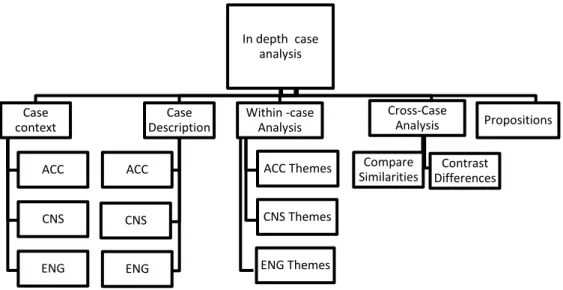
Data gathered from this qualitative study was analysed using grounded theory analysis. Adoption of this analysis led to the identification of concepts, categories and core categories from the emerging data, which underlies the phenomenon of change readiness in KM processes implementation. Findings from this qualitative research offer in-depth understanding of the phenomenon within the context of professional service industry. Finally, the relationships/linkages among
14
multidimensional change readiness elements and the distinctive KM processes implemented in these firms were proposed as theoretical models for the study.
The thesis is divided into several chapters, which intended to answer the research questions and objectives of the study. This thesis represents a hybrid structure: a combination of conventional thesis chapters and a series of publications. There are eight chapters: Introduction, Literature Review, Research Questions, Research Methodology and Design, Findings and Discussions 1, 2 and 3, and the Conclusion.
This first chapter contains the introduction to the research including the background and justification for the study, and the introduction to key constructs discussed in this thesis. It also introduces the research methodology and design for the study.
Chapter 2 presents a manuscript that has been published in the Journal of Knowledge Management, Volume 16, No.2, pp. 329-355. The chapter contains a comprehensive review of three streams of literature: knowledge management, professional service firms and organisational change literature, which formed the basis for the development of the initial conceptual framework of the study. The chapter also provides the context and gaps for the research that corresponds with the research problem that is presented in Chapter 1, which leads to the formulation of research questions as presented in Chapter 3.
Chapter 3 presents research questions of the thesis. This chapter includes changes and modifications made in the proposed research questions, which portrayed the evolving nature of a qualitative study.
Chapter 4 presents the research design for the current study. Prior to the discussion of the study design, the chapter outlines knowledge perspective that is adopted in accomplishing the thesis. Then, the chapter presents discussion of the philosophical stance of this study that is narrowed down to the chosen paradigm, methodology and design for the current research. Finally, this chapter discloses ethical consideration and the issue of the qualitative research quality at the end of the discussion.
15
Chapter 5, 6 and 7 comprise the analysis and discussion of findings of the current study. Three theoretical frameworks of change readiness influences on distinctive KM processes were developed and included in these chapters. Due to the qualitative nature of the study, there are some modifications with regards to change readiness dimensions and elements, in comparison to the initial frameworks. In these three chapters, findings and discussion for the thesis are presented in the form of three published/publishable manuscripts. For these reasons, all manuscripts were prepared in accordance to the format and structure outlined by the respective journal. Due to the fact that these results chapters are structured as journal manuscripts, there are some redundancies and similarities with regard to introductions, literatures, methods, and references sections.
Chapter 5 presents findings and discussions of change readiness influences on the knowledge acquisition process. This manuscript has been submitted to the
Knowledge Management Research and Practice and is currently being revised for resubmission (first round of revise and resubmit).
Chapter 6 presents findings of change readiness influences on the knowledge application process. This manuscript will be submitted to the Journal of Management Information Systems for publication consideration.
Chapter 7 presents findings and discussions of change readiness influences on the knowledge sharing process. This manuscript has been accepted for publication in the Journal of Knowledge Management.
Chapter 8 concludes and declares limitations of the thesis. Also, this chapter highlights the thesis implications to research and practice, and offers fruitful areas for future research.
16
Abdinnour-Helm, S., Lengnick-Hall, M., & Lengnick-Hall, C. (2003). Pre-implementation attitudes and organisational readiness for implementing an enterprise resource planning system. European Journal of Operational Research, 146(2), 258-273.
Alvesson, M. (2000). Social indentity and the problem of loyalty in Knowledge‐ Intensive Companies. Journal of Management Studies, 37(8), 1101-1124. Amis, J. M., & R. Ai¨ ssaoui (2013). Readiness for change: An Institutional
perspective. Journal of Change Management, 13(1), 69-95.
Andreeva, T., & Kianto, A. (2011). Knowledge processes, knowledge-intensity and innovation: a moderated mediation analysis. Journal of Knowledge Management, 15(6), 1016-1034.
Andreeva, T. (2009). Tensions between knowledge creation and knowledge sharing: Individual preferences of employees in knowledge-intensive organizations. In: D. Jemmielniak and J. Kociatkiewicz (Eds.), Handbook of research on knowledge intensive organizations. New York, NY: Information Science Reference.
Armenakis, A. A., & Bedeian A. G. (1999). Organizational Change: A review of theory and research in the 1990s. Journal of Management,25,293-315. Armenakis, A. A., & Harris, S. G. (2002). Crafting a change message to create
transformational readiness. Journal of Organizational Change, 15(2), 169-184.
Armenakis, A. A., Harris, S. G., & Mossholder, K. W. (1993). Creating readiness for organizational change. Human Relations, 46(6), 681.
Baskerville, R., & Dulipovici, A. (2006). The theoretical foundations of knowledge management. Knowledge Management Research & Practice, 4(2), 83-105.
Bernerth, J. (2004). Expanding our understanding of the change message. Human Resource Development Review,3, 36-52.
Bhasin, M. L. (2006). Knowledge management through intranets for accounting firms. Chartered Accountant-New Delhi, 54(8), 1207.
Bhatt, G. D. (2001). Knowledge management in organisations: Examining the interaction between technologies, techniques and people. Journal of Knowledge Management, 5(1), 68-75.
17
Bouckenooghe, D. (2010). Positioning change recipients‘ attitudes toward change in the organizational change literature. The Journal of Applied Behavioral Science,46,500-531.
Bryson, J. R., & Daniels, P. W. (Eds.). (2007). The handbook of service industries. Edward Elgar Publishing.
Chen, A. N. K., Hwang, Y., & Raghu, T. S. (2010). Knowledge life cycle, knowledge inventory, and knowledge acquisition strategies. Decision Sciences, 41(1), 21-47.
Chen, L., & Mohamed, S. (2007). Empirical study of interactions between knowledge management activities. Engineering, Construction and Architectural Management, 14(3), 242-260.
Choi, B., & Lee, H. (2002). Knowledge management strategy and its link to knowledge creation process. Expert Systems with Applications, 23, 173-187. Chua, A. Y. K. (2009). The dark side of successful knowledge management
initiatives. Journal of Knowledge Management, 13(4), 32-40.
Clarke, T., & Clegg, S. (2000). Changing paradigms: The transformation of management knowledge for the 21st century: HarperCollins Business. Coch, L., & French, J. R. P. (1948). Overcoming resistance to change. Human
Relations, 1(4), 512-532.
Damodaran, L., & Olphert, W. (2000). Barriers and facilitators to the use of knowledge management systems. Behaviour and Information Technology, 19(6), 405-413.
Davenport, T. H., & Prusak, L. (1998). Working Knowledge. Boston: Harvard Business School Press.
Fong, P. S. W., & Choi, S. K. Y. (2009). The processes of knowledge management in professional services firms in the construction industry: A critical assessment of both theory and practice. Journal of Knowledge Management, 13(2), 110-126.
Gibbins, M., & Wright, A. M. (1999). Expertise and knowledge management in public accounting professional service firms: A North America perspective.
Australian Accounting Review, 9(3), 27-34.
Gold, A. H., Malhotra, A., & Segars, A. H. (2001). Knowledge management: An organizational capabilities perspective. Journal of Management Information Systems, 18(1), 185-214.
18
Grant, R. M. Toward a knowledge-based theory of the firm. Strategic Management Journal, 17,(1996), 109-122.
Greenwood, R., Deephouse, D. L., & Li, S. X. (2007). Ownership and performance of professional service firms. Organization Studies, 28(2), 219-238.
Heiseg, P. (2009). Harmonisation of knowledge management: Comparing 160 KM frameworks around the globe. Journal of Knowledge Management,
13(4), 4-31.
Hoe, S. L., & McShane, S. (2010). Structural and informal knowledge acquisition and dissemination in organizational learning: An exploratory analysis. The Learning Organization, 17(4), 364-386.
Holsapple, C. W., & Joshi, K. D. (2000). An Investigation of factors that influence the management of knowledge in organizations. Journal of Strategic Information Systems, 9, 235-261.
Holt, D. T., Armenakis, A. A., Feild, H. S., & Harris, S. G. (2007). Readiness for organizational change: The systematic development of a scale. Journal of Applied Behavioral Science, 43, 232-255.
Holt, D. T., Bartczak, S. E., Clark, S. W., & Trent, M. R. (2007). The development of an instrument to measure readiness for knowledge management. Knowledge Management Research & Practice, 5(2), 75-92. Holt, D. T., Helfrich, C. D., Hall, C. G., & Weiner, B. J. (2009). Are you ready?
How health professionals can comprehensively conceptualize readiness for change. Journal of General Internal Medicine, 25(SUPPL. 1), S50-S55. Holt, D. T., & Vardaman, J. M. (2013). Toward a comprehensive understanding
of readiness for change: The case for an expanded conceptualization.
Journal of Change Management, 13(1), 9-18.
Janes, S. H., Patrick, K., & Dotsika, F. (2014). Implementing a social intranet in a professional services environment through Web 2.0 technologies. The Learning Organization, 21(1), 26-47.
Jasimuddin, S. M. (2012). Knowledge Management: An Interdisciplinary Perspective (Vol. 11). Singapore: World Scientific.
Jensen, S. H., Poulfelt, F., & Kraus, S. (2010). Managerial routines in professional service firms: transforming knowledge into competitive advantages. The Service Industries Journal, 30(12), 2045-2062.
Kang, M., & Kim, Y. G. (2010). A multilevel view on interpersonal knowledge transfer. Journal of the American Society for Information Science and Technology, 61(3), 483-494.
19
Lam, A., & Lambermont-Ford, J. P. (2010). Knowledge sharing in organisational contexts: a motivation-based perspective. Journal of Knowledge Management, 14(1), 51-66.
Laycock, M. (2005). Collaborating to compete: achieving effective knowledge sharing in organizations. The Learning Organization, 12(6), 523-538.
Lee, H., & Choi, B. (2003). Knowledge management enablers, processes, and organizational performance: An integrative view and empirical examination.
Journal of Management Information Systems, 20(3), 179-228.
Lin, H. F. (2011). Antecedents of the stage-based knowledge management evolution. Journal of Knowledge Management, 15(1), 136-55.
Løwendahl, B. R., Revang, Ø., & Fosstenløkken, S. M. (2001). Knowledge and value creation in professional service firms: A framework for analysis.
Human Relations, 54(7), 911-931.
Lucier, C., & Torsilieri, J. (1997). Why Knowledge Management Programs Fail: A CEO Guide to Managing Learning. Strategy and Business., 9(4th Quarter), 14-28.
Magnier-Watanabe, R., & Senoo, D. (2008). Organizational characteristics as prescriptive factors of knowledge management initiatives. Journal of Knowledge Management, 12(1), 21-36.
Makani, J., & Marche, S. (2010). Towards a typology of knowledge-intensive organizations: Determinant factors. Knowledge Management Research & Practice 8, 265-277.
Malhotra, N., Morris, T., & Hinings, C. B. (2006). Variation in organizational form among professional service organizations. Research in the Sociology of Organizations, 24, 171-202.
Matusik, S. F., & Heeley, M. B. (2005). Absorptive capacity in the software industry: identifying dimensions that affect knowledge and knowledge creation activities. Journal of Management, 31(4), 549-572.
McKenzie, J., Truc, A., & vanWinkelen, C. (2001). Winning commitment for knowledge management initiatives. Journal of Change Management, 2(2), 115-127.
Mehta, N. (2008). Successful knowledge management implementation in global software companies. Journal of Knowledge Management, 12(2), 42-56. Mohammadi, K., Khanlari, A., & Sohrabi, B. (2009). Organizational readiness
assessment for knowledge management. International Journal of Knowledge Management, 5(1), 29-45.
20
Mohanavel, S., & Ravindran, S. (2012). A Study on Organisational Readiness for Knowledge Management. European Journal of Scientific Research, 71(2), 152-162.
Nonaka, I. (1994), "A Dynamic Theory of Organizational Knowledge Creation",
Organization Science, 5(1), 14-37.
Nonaka, I., & Peltokorpi, V. (2006). Objectivity and subjectivity in knowledge management: a review of 20 top articles. Knowledge and Process Management, 13(2), 73-82.
Nonaka, I., & Takeuchi, H. (1995). The Knowledge-Creating Company: How Japanese Companies Create the Dynamics of Innovation. New York, NY: Oxford University Press.
O'Dell, C., & Hubert, C. (2011). The New Edge in Knowledge: How Knowledge Management is Changing the Way We Do Business. New Jersey, NJ: John Wiley & Sons, Inc.
Rafferty, A. E., Jimmieson, N. L., & Armenakis, A. A. (2013). Change Readiness: A multilevel review. Journal of Management, 39(1), 110-135.
Shirazi, A., Mortazavi, S., & Azad, N. P. (2011). Factors affecting employees' readiness for knowledge management. European Journal of Economics, Finance and Administrative Sciences, 167-177.
Siemieniunich, C. E., & Sinclair, M. A. (2004). A framework for organisational readiness for knowledge management. International Journal of Operations & Production Management, 24, 79-98.
Sigala, M., & Chalkiti, K. (2007). Improving performance through tacit knowledge externalisation and utilisation: Preliminary findings from Greek hotels. International Journal of Productivity and Performance Management, 56(5/6), 456-483.
Small, C.T., & Sage, A.P. (2006). Knowledge management and knowledge sharing: A review. Information, Knowledge, Systems Management, 5(3), 153-69.
Starbuck, W. H. (1992). Learning by knowledge‐intensive firms. Journal of Management Studies, 29(6), 713-740.
Stevens, G. W. (2013). Toward a process-based approach of conceptualizing change readiness. The Journal of Applied Behavioral Science, 49(3), 333-360.
Storey, J., & Barnett, E. (2000). Knowledge management initiatives: Learning from failure. Journal of Knowledge Management, 4(2), 145-156.
21
Sun, P. Y. T., & Scott, J. L. (2003). Towards better qualitative performance measurement in organisations. The Learning Organisation, 10(5), 258-271. Supyuenyong, V., Islam, N., & Kulkarni, U. (2009). Influence of SME
characteristics on knowledge management processes: The case study of enterprise resource planning service providers. Journal of Enterprise Information Management, 22(1/2), 63-80.
Thuc Anh, P. T., Baughn, C. C., Minh Hang, N. T., & Neupert, K. E. (2006). Knowledge acquisition from foreign parents in international joint ventures: An empirical study in Vietnam. International Business Review, 15(5), 463-487.
Von Nordenflycht, A. (2010). What is a professional service firm? Toward a theory and taxonomy of knowledge-intensive firms. The Academy of Management Review (AMR),35,155-174.
Walczak, S. (2005). Organizational knowledge management structure. The Learning Organization, 12(4), 330-339.
Wang, C. L., & Ahmed, P. K. (2003). Structure and structural dimensions for knowledge-based organizations. Measuring Business Excellence, 7(1), 51-62.
Wang, S. & Noe, R.A. (2010). Knowledge sharing: A review and directions for future research. Human Resource Management Review,20(2), 115-131. Wasko, M. M. L., & Faraj, S. (2005). Why should I share? Examining social
capital and knowledge contribution in electronic networks of practice. MIS Quarterly, 29(1), 35-57.
Weiner, B. J. (2009). A theory of organizational readiness for change.
Implementation Science, 4(1), 67.
Weiner, B. J., Amick, H., & Lee, S.Y. D. (2008). Review: Conceptualization and measurement of organizational readiness for change: A review of the literature in health services research and other fields. Medical Care Research and Review, 65(4), 379-436.
Wiig, K. M. (1993). Knowledge Management: An introduction and perspective.
Journal of Knowledge Management, 1(1), 6-14.
Witherspoon, C., Bergner, J., Cockrell, C.R. & Stone, D.N. (2013). Antecedents of organizational knowledge sharing: A Meta-Analysis and Critique.
22
Wong, K. Y., & Aspinwall, E. (2004). Characterizing knowledge management in the small business environment. Journal of Knowledge Management, 8(3), 44-61.
Xu, J., Houssin, R., Caillaud, E., & Gardoni, M. (2010). Macro process of knowledge management for continuous innovation. Journal of Knowledge Management, 14(4), 573-591.
Yeh, Y. J., Lai S. Q., & Ho C. T. (2006). Knowledge management enablers: a case study. Industrial Management & Data Systems,106,793-810.
23
2.0 LITERATURE REVIEW
The purpose of conducting the literature review is to identify the current development of knowledge management (KM) research particularly from a change management lens. Specifically, the focus is given on processes for managing knowledge in knowledge-based professional service firms.
This thesis was designed on the basis of three broad literature streams. The first stream relates to the understanding of change management, specifically change readiness. Since the implementation of KM involves organisational change approaches, understanding the importance of change readiness in shaping those processes for managing knowledge in organisations seems vital. The second stream of literature focuses on understanding KM and its‘ influencing factors. Discussion was made with reference to vast amount of KM frameworks and concepts for developing KM processes. Another significant literature area for the study concerns with the professional service sector, which represents the subset of knowledge intensive organisations.
Critical analysis of these three literature streams highlights the gaps for studying and understanding change readiness influences on processes for managing knowledge within the professional service context. Discussion and integration of these literature streams contributed to the development of initial frameworks for the thesis. They are presented in the following manuscript, which was published in the Journal of Knowledge Management.
Title:Positioning Change Readiness in Knowledge Management Research
Publication Status:
Rusly, F. H., Corner, J. L., & Sun, P. (2012). Positioning change readiness in knowledge management research. Journal of Knowledge Management, 16(2), 329-355.
Declaration: I developed the proposed theoretical model for the study. I wrote the first draft of the paper while my co-authors assisted in reviewing and editing the
24
flow of writings. The co-authors also contributed in the improvement of the theoretical model by providing insights and expertise in the area of study. Overall, the theoretical contributions are largely derived from analysis and synthesis of literature performed (see Appendix 5 for the Co-Authorship consent).
Additionally, the literature review was updated and enhanced as the study progressed. These changes in the literature reflect findings that emerged during data collection and analysis; a fluid nature of a qualitative study. Integration of new literature is particularly important in Chapter 5, 6 and 7, which offers theoretical bases and arguments to support findings of this thesis.
Article Title - Positioning Change Readiness in Knowledge Management Research
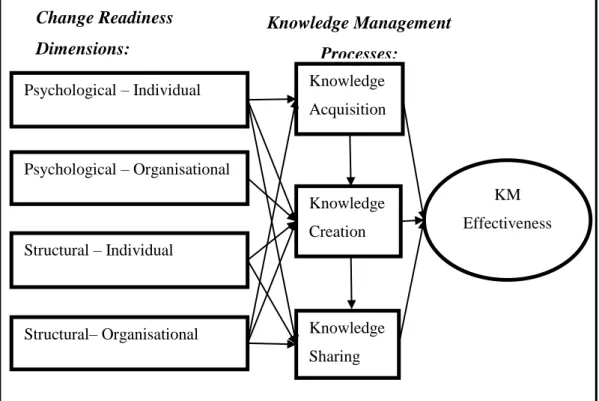
Purpose - This article proposes a conceptual model for understanding the influence of change readiness on knowledge management processes and knowledge management effectiveness. It is suggested that change readiness should be assessed as a multidimensional construct consisting of psychological and structural facets. Furthermore, as the process of managing organisational knowledge requires interaction among members of the organisation, a holistic view of readiness at individual and organisational levels is presented.
Design/methodology/approach - A comprehensive literature review results in the development of the conceptual model that depicts potential relationships between change readiness and knowledge management processes. It also postulates the effects of different knowledge management processes on effective knowledge management implementation.
Findings - Potential implications of change readiness from both psychological and structural dimensions for knowledge acquisition, creation and sharing processes are put forward. Further, it offers possible fruitful areas for continuous research of knowledge management effectiveness from a change perspective. Research limitations/implications - This article puts forward a number of potential relationships among the construct that are empirically testable to further