University of Kentucky University of Kentucky
UKnowledge
UKnowledge
Theses and Dissertations--Computer Science Computer Science 2012
Privacy Preserving Distributed Data Mining
Privacy Preserving Distributed Data Mining
Zhenmin Lin
University of Kentucky, [email protected]
Right click to open a feedback form in a new tab to let us know how this document benefits you. Right click to open a feedback form in a new tab to let us know how this document benefits you. Recommended Citation
Recommended Citation
Lin, Zhenmin, "Privacy Preserving Distributed Data Mining" (2012). Theses and Dissertations--Computer Science. 9.
https://uknowledge.uky.edu/cs_etds/9
This Doctoral Dissertation is brought to you for free and open access by the Computer Science at UKnowledge. It has been accepted for inclusion in Theses and Dissertations--Computer Science by an authorized administrator of UKnowledge. For more information, please contact [email protected].
STUDENT AGREEMENT: STUDENT AGREEMENT:
I represent that my thesis or dissertation and abstract are my original work. Proper attribution has been given to all outside sources. I understand that I am solely responsible for obtaining any needed copyright permissions. I have obtained and attached hereto needed written permission statements(s) from the owner(s) of each third-party copyrighted matter to be included in my work, allowing electronic distribution (if such use is not permitted by the fair use doctrine).
I hereby grant to The University of Kentucky and its agents the non-exclusive license to archive and make accessible my work in whole or in part in all forms of media, now or hereafter known. I agree that the document mentioned above may be made available immediately for worldwide access unless a preapproved embargo applies.
I retain all other ownership rights to the copyright of my work. I also retain the right to use in future works (such as articles or books) all or part of my work. I understand that I am free to register the copyright to my work.
REVIEW, APPROVAL AND ACCEPTANCE REVIEW, APPROVAL AND ACCEPTANCE
The document mentioned above has been reviewed and accepted by the student’s advisor, on behalf of the advisory committee, and by the Director of Graduate Studies (DGS), on behalf of the program; we verify that this is the final, approved version of the student’s dissertation including all changes required by the advisory committee. The undersigned agree to abide by the statements above.
Zhenmin Lin, Student Dr. Jerzy W. Jaromczyk, Major Professor Dr. Raphael Finkel, Director of Graduate Studies
PRIVACY PRESERVING DISTRIBUTED DATA MINING
DISSERTATION
A dissertation submitted in partial fulllment of the requirements for the degree of Doctor of Philosophy in the
College of Engineering at the University of Kentucky
By Zhenmin Lin Lexington, Kentucky
Director: Dr. Jerzy W. Jaromczyk Lexington, Kentucky 2012
ABSTRACT OF DISSERTATION
PRIVACY PRESERVING DISTRIBUTED DATA MINING
Privacy preserving distributed data mining aims to design secure protocols which allow multiple parties to conduct collaborative data mining while protecting the data privacy. My research focuses on the design and implementation of privacy preserving two-party protocols based on homomorphic encryption. I present new results in this area, including new secure protocols for basic operations and two fundamental privacy preserving data mining protocols.
I propose a number of secure protocols for basic operations in the additive secret-sharing scheme based on homomorphic encryption. I derive a basic relationship be-tween a secret number and its shares, with which we develop ecient secure compar-ison and secure division with public divisor protocols. I also design a secure inverse square root protocol based on Newton's iterative method and hence propose a solu-tion for the secure square root problem. In addisolu-tion, we propose a secure exponential protocol based on Taylor series expansions. All these protocols are implemented using secure multiplication and can be used to develop privacy preserving distributed data mining protocols.
In particular, I develop ecient privacy preserving protocols for two fundamental data mining tasks: multiple linear regression andEM clustering. Both protocols work
for arbitrarily partitioned datasets. The two-party privacy preserving linear regression protocol is provably secure in the semi-honest model, and theEM clustering protocol
discloses only the number of iterations. I provide a proof-of-concept implementation of these protocols in C++, based on the Paillier cryptosystem.
KEYWORDS: Privacy Preserving, Data Mining, Secure Computation, Multiple Lin-ear Regression,EM Clustering
Zhenmin Lin December, 13, 2012
PRIVACY PRESERVING DISTRIBUTED DATA MINING By Zhenmin Lin Jerzy Jaromczyk Director of Dissertation Raphael Finkel Director of Graduate Studies
December 13, 2012 Date
ACKNOWLEDGMENTS
First of all, I would like to thank my advisor, Dr. Jerzy Jaromczyk, who guided me through the whole process of dissertation writing. This work would not have been possible without his support, understanding and technical advice.
I would furthermore like to thank the rest of my committee members: Dr. Tingjian Ge, Dr. Mirek Truszczynski and Dr. Qiang Ye, for their insightful comments and useful suggestions on my work. I would also like to thank the outside examiner Dr. Uwe Nagel for his helpful comments on my dissertation.
Last but not least, I would like to express my great gratitude to my parents, my uncles and my sisters, who have all unconditionally supported and encouraged me throughout my whole life.
Contents
Acknowledgments iii
List of Tables vi
List of Figures vii
List of Algorithms and Protocols viii
1 Introduction 1
1.1 Motivation . . . 1
1.2 Short Survey on Data Privacy . . . 2
1.3 Contributions . . . 4
2 Secure Computation 7 2.1 Introduction . . . 7
2.2 Concepts in Secure Computation . . . 7
2.3 Additive Secret-Sharing Scheme Based on Homomorphic Encryption . 11 2.3.1 Paillier Cryptosystem and Homomorphic Encryption . . . 11
2.3.2 Additive Secret-Sharing Scheme . . . 14
3 An Ecient Secure Comparison Protocol 17 3.1 Introduction . . . 17
3.2 Secure Comparison . . . 18
3.2.1 A Basic Relationship Between a Secret and Its Shares . . . 18
3.2.2 Secure Comparison . . . 19
3.3 Previous Work . . . 23
3.4 Privacy Preserving K-means Clustering . . . 27
3.4.1 K-means . . . 27
3.4.2 Privacy Preserving Two-Party K-means . . . 28
4 Privacy Preserving Multiple Linear Regression 37
4.1 Introduction . . . 37
4.2 Multiple Linear Regression . . . 38
4.3 QR-decomposition . . . 40
4.4 Previous Work . . . 44
4.5 Representing Real Numbers in the Plaintext Domain . . . 45
4.6 Subprotocols . . . 49
4.6.1 Secure Inverse Square Root and Secure Square Root . . . 49
4.6.2 Secure Division . . . 51
4.7 Privacy Preserving Multiple Linear Regression . . . 52
4.7.1 Two-Party Cases . . . 52
4.7.2 Multi-Party Cases . . . 57
4.8 Experimental Results . . . 60
5 Privacy Preserving EM Clustering 63 5.1 Introduction . . . 63
5.2 EM Clustering . . . 64
5.3 Previous Work . . . 69
5.4 Subprotocols . . . 71
5.4.1 Secure Logarithm . . . 71
5.4.2 Secure Exponential Function . . . 73
5.5 Privacy Preserving EM clustering . . . 76
5.6 Experimental Results . . . 95
6 Application of the Schur Complement 98 6.1 Introduction . . . 98
6.2 Schur Complement . . . 99
6.3 Kernel Regression . . . 100
6.4 Application of the Schur Complement in Privacy Preserving Kernel Regression . . . 102
7 Conclusion 104
Bibliography 106
List of Tables
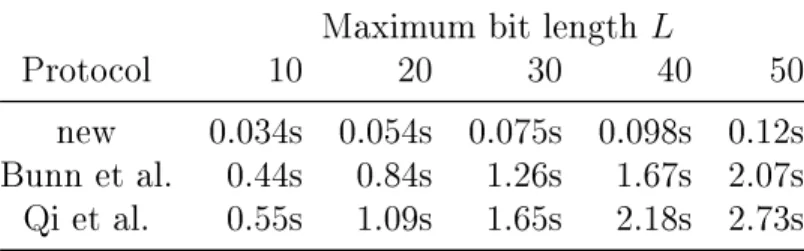
3.1 Execution time of secure comparison protocols (K = 512) . . . 33
3.2 Execution time of secure comparison protocols (K = 1024) . . . 33
3.3 Execution time of secure comparison protocols with precomputation (K = 512) . . . 33
3.4 Execution time of secure comparison protocols with precomputation (K = 1024) . . . 34
3.5 Benchmark datasets for k-means . . . 34
3.6 Execution time of privacy preserving k-means with dierent secure
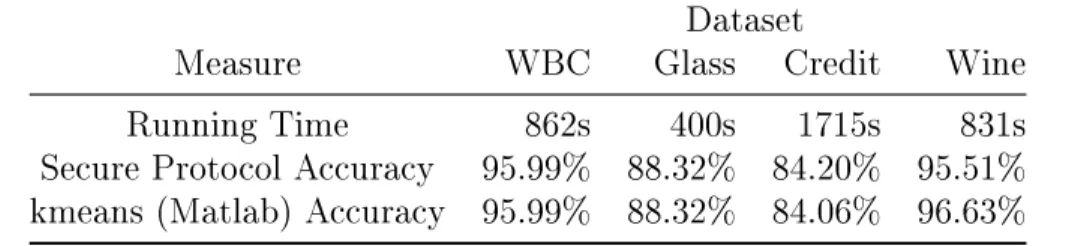
comparison protocols . . . 35 3.7 Experimental results of privacy preservingk-means on benchmark datasets 35
4.1 Benchmark datasets for linear regression . . . 61 4.2 Experimental results of privacy preserving linear regression on
bench-mark datasets . . . 61 5.1 Benchmark datasets for EM clustering . . . 95
5.2 Experimental results of privacy preserving EM clustering on
List of Figures
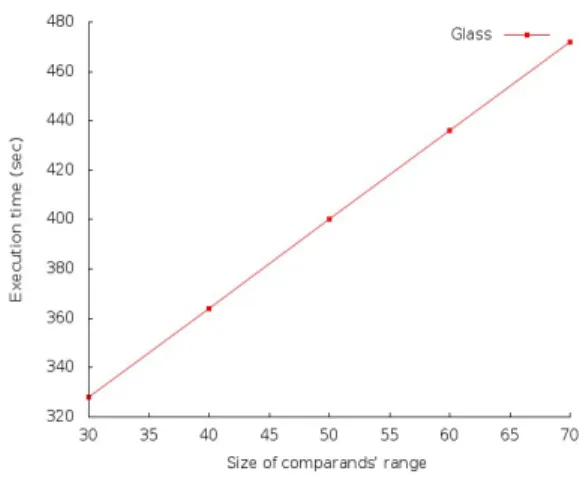
3.1 Scalability of privacy preservingk-means with respect to the maximum
bit length of the comparands (WBC) . . . 36 3.2 Scalability of privacy preservingk-means with respect to the maximum
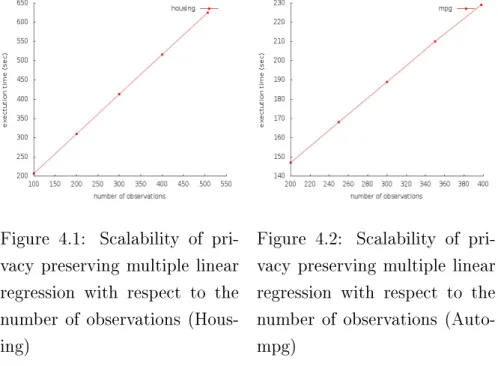
bit length of the comparands (Glass) . . . 36 4.1 Scalability of privacy preserving multiple linear regression with respect
to the number of observations (Housing) . . . 61 4.2 Scalability of privacy preserving multiple linear regression with respect
to the number of observations (Auto-mpg) . . . 61 4.3 Scalability of privacy preserving multiple linear regression with respect
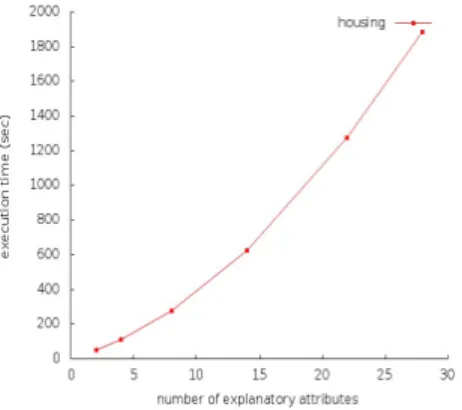
to the number of attributes (Housing) . . . 62 5.1 Scalability of privacy preserving EM clustering with respect to the
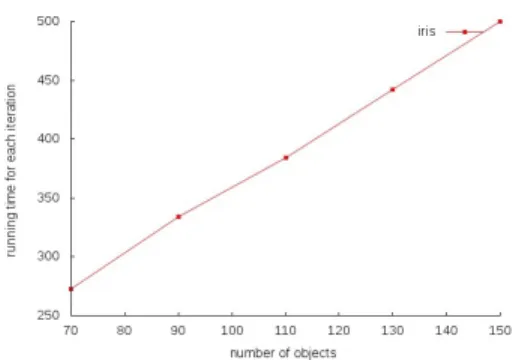
number of observations (Iris). . . 97 5.2 Scalability of privacy preserving EM clustering with respect to the
number of observations (Zoo). . . 97 5.3 Scalability of privacy preserving EM clustering with respect to the
number of attributes (Zoo) . . . 97 5.4 Scalability of privacy preserving EM clustering with respect to the
List of Algorithms and Protocols
2.1 Secure multiplication . . . 15
3.1 Secure comparison . . . 21
3.2 Secure transformation protocol . . . 24
3.3 K-means clustering . . . 27
3.4 Secure squared distance . . . 29
3.5 Privacy preserving two-party k-means clustering . . . 31
3.6 Secure protocol to privately assign a point to the closest cluster . . . 32
4.1 Householder transformation . . . 43
4.2 Back-substitution algorithm for solving linear system of equations . . 44
4.3 Secure division with public divisor . . . 48
4.4 Secure inverse square root . . . 50
4.5 Secure square root . . . 50
4.6 Secure division . . . 52
4.7 Privacy preserving two-party multiple linear regression protocol . . . 54
4.8 Privacy preserving multi-party multiple linear regression protocol . . 58
5.1 EM clustering . . . 68
5.2 Secure computation of m and such that x= 2m(1 +) and −1/2 < <1/2. . . 73
5.3 Secure protocol for computing log (1 +)(−1< <1) . . . 74
5.4 Secure logarithm . . . 74
5.5 Secure exponential function for non-positive real numbers . . . 75
5.6 Secure exponential function for nonnegative integers . . . 76
5.7 Privacy preserving initialization in EM clustering . . . 78
5.8 Privacy preserving M step inEM clustering . . . 80
5.9 Cholesky decomposition without square root . . . 81
5.10 Secure computation of −(x−µ)TΣ−1(x−µ) . . . 82
5.11 Secure protocol for computing m and δ such that 2m ≤x <2m+1 and x= 2mδ. . . . 84
5.13 Privacy preserving E step inEM clustering . . . 87
5.14 Privacy preserving E step (augmented) inEM clustering . . . 89
5.15 Privacy preserving protocol for nal clustering . . . 89
5.16 Privacy preserving two-party EM clustering . . . 90
Chapter 1
Introduction
1.1 Motivation
Privacy preserving distributed data mining aims to design secure protocols which allow multiple parties to conduct collaborative data mining while protecting the pri-vacy of their data. My research focuses on the design and implementation of pripri-vacy preserving protocols based on homomorphic encryption. I have designed new secure protocols for a number of basic operations, including comparison, inverse square root, square root and the exponential function. Using these protocols I develop two funda-mental privacy preserving data mining protocols: multiple linear regression andEM
clustering.
Data mining attempts to discover potentially useful and interesting patterns from large quantities of data. Many useful techniques have been developed in this area, include clustering, classication, regression, association rule mining and outlier de-tection. They have been been successfully applied in domains ranging from business to science and engineering. For example, in market basket analysis, association rule mining is used to nd the purchase patterns of customers. The supermarket can use such knowledge to plan product placement and promotional pricing.
In many applications data may be collected and owned by multiple parties. For example, for a group of persons, the employer companies have their employment information, banks have the nancial information, and hospitals have the health data. Suppose that the whole dataset can be represented as a matrix whose rows correspond to subjects and whose columns correspond to attributes. It can be distributed among the parties in two typical ways:
(a) Vertical partition. All the parties have the same set of subjects, but each party has a dierent set of attributes. The set of data held by employer companies, banks
and hospitals is an example of vertical partition.
(b) Horizontal partition. Multiple parties have disjoint sets of subjects, and each party has the data of all the attributes for each subject he/she holds. For example, dierent colleges have information on disjoint sets of students.
In some cases the dataset may be arbitrarily partitioned among multiple parties. That is, each party holds part of the dataset in an arbitrary way. This includes vertical partition and horizontal partition as special cases.
When data are distributed among multiple parties, collaborative data mining has the potential to produce more accurate knowledge than the use of data owned by a single party. However, privacy concerns, due to conict of interests or legal regulation, may prevent such applications. Consider the following examples:
(a) Two clinics, each of which has the patient data for one disease, conjecture that these two diseases may be correlated. They wish to conduct a joint analysis to verify the conjecture. However, due to law regulation, they are prohibited from disclosing their individual data to each other (Zhang et al., 2006).
(b) The garment market is highly competitive. To raise their competitiveness in this market, two companies would like to cooperate to analyze their joint sales data to obtain knowledge such as how the sale of a particular category of garment is distributed in dierent regions. However, these two companies compete against each other, so they may not be willing to disclose their data.
Privacy preserving distributed data mining addresses this issue and aims to design secure protocols which allow multiple parties to conduct collaborative data mining while protecting the privacy of their data. It has attracted much attention and has become an active research area in recent years.
Secure computation aims to design secure protocols so that a set of parties can perform joint computation privately. The concepts and techniques in secure compu-tation can be applied to the area of privacy preserving distributed data mining. My research focuses on the design of privacy preserving data mining protocols based on homomorphic encryption.
1.2 Short Survey on Data Privacy
In this section, I briey introduce some related work in the area of privacy preserving data mining, including privacy preserving distributed data mining, data perturbation, anonymization and dierential privacy.
Privacy Preserving Distributed Data Mining. Lindell and Pinkas (2000) rst applied the concept of secure computation in the eld of data mining and de-veloped a provably secure two-party decision tree over horizontally partitioned data. Since then, privacy preserving distributed data mining has attracted much attention and many secure protocols have been proposed for specic data mining algorithms, including support vector machines (Laur et al., 2006; Vaidya and Clifton, 2008a), Bayesian network (Yang and Wright, 2006), k-nearest neighbor (Qi et al., 2008), k
-means (Vaidya et al., 2003; Bunn et al., 2007), EM-clustering (Lin et al., 2005),
regression (Du et al., 2004; Sanil et al., 2004; Hall et al. 2011), association rules min-ing (Viadya and Clifton, 2002; Kantarcioulu and Clifton, 2004; Viadya and Clifton, 2005) and outlier detection (Vaidya and Clifton, 2004b).
Some of these protocols are provably secure in the semi-honest model, such as the secure protocols for decision tree (Lindell and Pinkas, 2000), k-means (Bunn et
al., 2007) and support vector machine (Laur et al., 2006). Some protocols choose to disclose additional information to achieve better eciency. For example, the secure support vector machine proposed by Vaidya et al. (2008) discloses the kernel matrix. Other protocols use algebraic techniques to protect the private data. For example, a vector or matrix is protected by multiplying with random matrices (Viadya and Clifton, 2002; Du et al., 2004). However, one should be cautious of using such methods because they may leak signicant information (Goethals et al., 2004).
Data Perturbation. Suppose that a government agency would like to publish a set of electronic health records which may facilitate research. One strategy for pro-tecting the privacy of the individual records is to perturb the original data. Agrawal et al. (2000) proposed an additive perturbation method which adds Gaussian noise to the data and they constructed decision tree on the perturbed data to demonstrate its utility. Chen et al. (2005) proposed a random rotation method which multiplies the original data matrix with a random orthogonal matrix. This method can pre-serve the distances of the original data points. Liu. et al. (2006) proposed a random projection-based multiplicative perturbation method in which the set of data points from high-dimensional space are projected to a randomly chosen low-dimensional subspace.
Anonymization. One obvious way to protect the privacy of tabular data is to remove the identity attributes such as social security number and name. However, this is not sucient because the combination of some attributes such as age, sex and address can be linked with external data and discloses the identity of the record. These attributes are called quasi-identiers. A table is said to be k-anonymous if
every record is indistinguishable from at least k −1 other records over the
quasi-identier attributes (Sweeney, 2002a). To achievek-anonymity, we can replace
quasi-identier attributes values with values that are less specic but semantically consistent (Sweeeny, 2002b).
Dierential Privacy. In the scenario of a statistical database, a trusted curator collects a set of sensitive information (e.g. medical records). He/she answers the queries issued by the users and provides the statistical information about the data. But he/she doesn't want to compromise the privacy of individual records in the database.
We can model the actions of the trusted curator as a randomized algorithm A.
A randomized algorithm A guarantees -dierential privacy (Dwork et al., 2006) if,
when D1 and D2 are a pair of datasets that dier on a single element, then for all
S ⊆Range(A),
P r[A(D1)∈S]≤exp()∗P r[A(D2)∈S]
where the probability is taken over the coin tosses of A. This means that for any two
datasets which are close to one another, a dierentially private mechanism will behave approximately the same on both datasets. This denition gives a strong guarantee that the presence or absence of an individual (single element) will not aect the nal output of the query signicantly.
When the query is a real-valued function, one method to achieve-dierential
pri-vacy is to add Laplace noise according to the sensitivity of the query function (Dwork et al., 2006). When the query maps the database to some discrete structures such as strings or trees, McSherry and Twalwar (2007) proposed an exponential mechanism to provide -dierential privacy.
1.3 Contributions
The focus of my research is to design privacy-preserving distributed data mining protocols with secure computation techniques. I implemented privacy-preserving data mining protocols based on homomorphic encryption. I have designed new secure protocols for a number of basic operations and used these protocols to develop privacy preserving distributed data mining protocols. I summarize our contributions below.
1. New secure protocols for basic operations. I derived a basic relation-ship between a secret and its two shares when we used the additive secret-sharing scheme based on homomorphic encryption (section 3.2.1). With this relationship we
developed two ecient secure protocols: secure comparison (section 3.2) and secure division with public divisor (section 4.5). The new secure comparison protocol needs only 2L+O(1) secure multiplications when the comparands belong to a known
in-terval [0,2L). Existing protocols require at least 12L+O(1) secure multiplications
(Bunn et al., 2007; Qi et al., 2008).
In addition, we designed a secure inverse square root protocol based on the Newton iterative method and hence we proposed a solution for secure square root (section 4.6.1). I also developed an ecient secure exponential protocol based on Taylor's series explanation (section 5.4.2). All these protocols are implemented using secure multiplication and can be used to develop privacy preserving data mining protocols. 2. Design and Implementation of fundamental privacy preserving data mining protocols. I have developed privacy preserving protocols for two funda-mental data mining tasks: multiple linear regression and EM clustering. Privacy
preserving linear regression and EM clustering have been studied in the literature.
Sanil et al. (2004) proposed a privacy preserving linear regression protocol based on the Powell iterative method. It addresses only the case of vertical partition and dis-closes aggregate information during each iteration. Du et .. (2004) proposed secure matrix multiplication and secure matrix inverse protocols and hence designed pri-vacy preserving linear regression protocols for vertically partitioned datasets. Their method protects the data matrix by multiplying with random matrices, which can-not provide theoretical guarantee about privacy. Hall et al. (2011) presented secure linear regression protocols for arbitrarily partitioned datasets based on homomorphic encryption. They designed a secure protocol to invert a matrix, which they used to invert normal matrices and solve normal equations. Generally, it is not desirable to solve normal equations by inverting the normal matrices because inverting a matrix is more expensive and the normal matrix may be ill-conditioned. I designed privacy preserving multiple linear regression protocols based on the stable QR-decomposition method (chapter 4). They work for arbitrarily partitioned datasets The two-party protocol is provably secure in the semi-honest model.
Lin et al. (2004) presented a privacy preserving EM clustering over horizontally
partitioned datasets. Their method chooses to disclose the means and the covariance matrix. I proposed a privacy preserving EM clustering protocol over arbitrarily
partitioned datasets, which includes vertical partition and horizontal partition as special cases. This is the rst solution for vertically partitioned datasets. Our two-party protocol discloses only the number of iterations.
com-plexity of data mining tasks, an important concern is whether privacy preserving data mining protocols are practical or they are of only theoretical interest. I have imple-mented our privacy preserving multiple linear regression and EM clustering
algo-rithms in C++ based on the Paillier cryptosystem and evaluated their performances over benchmark datasets. Our experiments show that although the executions of secure protocols are generally slow, they are feasible for small datasets. Further im-provements and new techniques are needed to make them more practical for larger datasets.
3. Application of the Schur Complement. When data are distributed among multiple parties, the dataset can be represented as a block matrix with each block held by a party. I explored the possibility of using the structure of the block matrix to design ecient privacy preserving data mining protocols. In particular, I studied the potential application of the Schur Complement in the design of ecient kernel ridge regression protocol (chapter 6).
Chapter 2
Secure Computation
2.1 Introduction
The focus of my research is to design privacy-preserving distributed data mining pro-tocols with secure computation techniques. I design privacy-preserving data mining protocols based on homomorphic encryption. In particular, I implement secure pro-tocols using the Paillier cryptosystem. In this chapter, I introduce the background knowledge in secure computation and the additive secret-sharing scheme based on homomorphic encryption.
This chapter is organized as follows. I rst introduce the concepts in secure com-putation in section 2.2. In section 2.3.1, I describe the Paillier cryptosystem, which I use to implement privacy preserving data mining protocols. It is homomorphic, and semantically secure based on some computational assumption. I then describe the additive secret-sharing scheme based on homomorphic encryption in section 2.3.2. The presentation of secure computation in section 2.2 is based on the material from (Goldreich, 2004).
2.2 Concepts in Secure Computation
Let f : ({0,1}∗)m → ({0,1}∗)m be an m-ary functionality 1 which maps m inputs
(x1, . . . , xm)tom outputs, (y1, . . . , ym) =f(x1, . . . , xm). Heref can be deterministic
or randomized. We write yi = fi(x1, . . . , xm). For the moment, we assume that
all xi are of the same length. I will discuss later the issues related to relax this
1In the area of secure computation, the notion of an m-ary functionality refers to a random process which mapsminputs tomoutputs, where functions mappingminputs tomoutputs are a
assumption. Suppose that there are m parties, each holding a local input xi. A
multi-party protocol for computing the functionality f is a protocol such that if all
the parties compute and communicate as specied by the protocol, each party i will
obtain his/her desired output yi = fi(x1, ..., xm) when the protocol nishes. We
assume that the functionalityf is polynomial-time computable and the protocol runs
in polynomial time of the input length.
During the execution of the protocol, the participating parties need to communi-cate with each other with messages. These message may contain sensitive information. Secure computation is concerned about the privacy of the involved parties when they interact with each other. A protocol is considered to be secure if the participating parties don't disclose any information more than necessary. We require that what a party can learn from the joint computation can be inferred from his/her own input and output. More generally, we require that even if a subset of parties collude, what they can learn from the joint computation can be inferred from their own inputs and outputs.
To give a formal denition of privacy, we need the concept of computational indistinguishability.
Denition 2.1. (Goldreich, 2004) Let X ={Xk}k=1,2,... and Y ={Yk}k=1,2,... be two
probabilistic ensembles. X and Y are said to be computationally indistinguishable,
denoted by
{Xk}k=1,2,... ' {Yk}k=1,2,...,
if for every family of polynomial-size circuits {Ck}, every positive polynomial p and
all suciently large k, it holds that
|P rob(Ck(Xk) = 1)−P rob(Ck(Yk) = 1)|<
1
p(k). (2.1)
The formal denition of privacy can be given based on the simulation paradigm. Suppose that thesemparties use a protocolΠto compute the functionalityf(x1, . . . , xm).
Initially, each party i holds a local inputxi and is supplied with some random coins
ri which are used as the random source for the execution of the protocol. In addition,
we also supply each party with a security parameter 1k. Then these parties perform
the computation and communication as specied by the protocol Π and output the
results when the protocol nishes.
Letx= (x1, . . . , xm). We denote the output of partyibyΠi(1k, x)and the outputs
the execution of the protocol Π is dened as the collection of the security parameter 1k, his/her input xi, his/her internal coin toss ri and all the messages he/she has
received during the joint computation(m1, ..., mti),
V IEWiΠ(1k, x) = (1k, xi, ri, m1, . . . , mti).
Given a subset of partiesI ={i1, . . . , is} ⊆ {1,2, . . . , m}, we letfI(x) = (fi1, . . . , fis)
and dene
V IEWIΠ(1k, x) = (V IEWiΠ1(1k, x), . . . , V IEWiΠs(1k, x)).
Suppose that a subset of the parties I collude and they try to infer extra
informa-tion from the computainforma-tion. We assume the semi-honest model. That is, we assume that all the parties follow the protocol and the colluding parties only try to infer useful information from the messages they have received during the joint computation.
Note that in the semi-honest model, all the information these colluding parties obtain is contained in the view of these parties. We consider a protocol to be secure if the view of these colluding parties I can be simulated based on the their own inputs
and outputs. That is, there exists a probabilistic polynomial time algorithm, given the inputs and the outputs of the colluding parties I, can simulate the view of these
parties. We call this algorithm the simulator. The simulation here means that the output of the simulator is computationally indistinguishable from the view of the colluding parties I.
Denition 2.2. Let Πbe a protocol for m parties to compute them-ary functionality f. We say thatΠ privately2 computesf if there exists a probabilistic polynomial time
algorithm, denoted by S, such that for every I ⊆ {1, . . . , m}, it holds that
{(S(I,1k, xI, fI(x)), f(x))}k=1,2,... ' {(V IEWI(1k, x),Π(1k, x))}k=1,2,....
Denition 2.2 says that even if a subset of parties I collude, the information they
can obtain can be eciently simulated based only on their own inputs and outputs. Note that when we say Π is a protocol to compute f, we mean the output of the
protocol Π(x) is identically distributed with f(x). The above denition guarantees
both the correctness and the security of the protocol.
An important special case is secure two-party computation.
Denition 2.3. Suppose that f is a two-ary functionality (y1, y2) = f(x1, x2), y1 =
f1(x1, x2) and y2 = f2(x1, x2). Let Π be a protocol for 2 parties to compute f. We say that Π privately computes f if there exists two probabilistic polynomial time
algo-rithms, denoted by S1 and S2, such that
{(S1(1k, x1, f1(x)), f(x))}k=1,2,... ' {(V IEW1(1k, x),Π(1k, x))}k=1,2,... (2.2)
{(S2(1k, x2, f2(x)), f(x))}k=1,2,... ' {(V IEW2(1k, x),Π(1k, x))}k=1,2,.... (2.3)
In the denition of secure computation we assume that all the inputs have the same lengths. The reason is that in a protocol to compute any functionality, the program of a party usually depends on the lengths of other parties' inputs. One way to ensure this is to pad the inputs with zeros. Another method is simply to add the lengths of all the inputs as a part of the input of each party. This is more practical in the eld of privacy preserving distributed data mining. For example, in the vertically partitioned datasets, we assume that each party knows the number of objects and the numbers of the attributes held by other parties.
Modular Composition of Secure Protocols. A protocol can be augmented with access to an oracle for some functionality g. The access to an oracle means that
if each party i provides xi and they invoke the oracle, they will get the results of
g(x1, . . . , xm) instantly without any computational cost. We can dene the security
of an oracle-aided protocol in the same way as for the ordinary protocol except that the results of the invocations of the oracles are treated as messages and are included in the views of the parties.
Suppose that a protocol Π with an access to the oracle for the functionality g
privately computes the functionalityf and a secure protocolΨprivately computesg.
If we replace the access to the oracle forg in the protocolΠwith the secure protocolΨ,
the composition theorem (Goldreich, 2004, page 673) says that the resulting protocol privately computes the functionalityf.
To use the composition theorem, we need to show that Ψ securely computes g
and that the protocolΠ with an access to the oracle forg privately computes f. The
composition theorem allows us to design secure protocols in a modular way. If the functionality to be computed can be implemented using a number of procedures, we can design new secure protocol or use existing protocol for each procedure and then assemble them together to design a secure protocol for the whole functionality.
Feasibility Results. Yao (1988) proposed a general construction of secure pro-tocol for any function in two-party cases. We know that every function can be
rep-resented as a circuit. The rst party constructs a "scrambled" circuit which consists of pairs of encrypted secrets that correspond to the wires of the original circuit and gadgets that correspond to the gates of the original circuit. The gadget is constructed in such a way that the knowledge of secrets corresponding to the wire entering the gates yields a secret corresponding to the wire that exists the gate. The rst party sends the "scrambled" circuit to the second party. The second party "evaluates" the "scrambled" circuit from top (input wires) to bottom (output wires), obtaining the result, and sends it to the rst party.
Goldreich et al. (1987) extended the results by Yao and proposed a secure protocol for any functionality in multi-party cases. The functionality is expressed as a circuit which consists of only AND and NOT gates. Each bit corresponding to a wire is shared by all the parties which each hold a random bit that sums to the secret mod 2. The computation propagates from top (input wires) to bottom (output wires) along the circuit. When a NOT gate is encountered, the rst party ips its bit and all other parties maintain their bit values. The secure computation of an AND gate in the multi-party case can be reduced to the secure computation of an AND operation in two-party case, which can be implemented using oblivious transfer.
The existence of general construction of secure protocols for any functionality may be sucient for traditional cryptographic applications, such as secure exchange and key management. However, data mining deals with large datasets and such general constructions may be not ecient. Design of ecient secure protocols for specic data mining tasks has been an active research topic in the past ten years.
2.3 Additive Secret-Sharing Scheme Based on
Ho-momorphic Encryption
I rst introduce the Paillier cryptosystem in subsection 2.3.1. The Paillier cryptosys-tem is homomorphic and semantically secure. I then describe the additive secret-sharing scheme based on homomorphic encryption in subsection 2.3.2. I use this scheme to design privacy preserving data mining protocols in the following chapters.
2.3.1 Paillier Cryptosystem and Homomorphic Encryption
An encryption scheme is a triple (G, E, D) of probabilistic polynomial-time
algo-rithms, where G is the key-generator algorithm, E is the encryption algorithm and D is the decryption algorithm. Given input 1k, the algorithm G outputs a pair of
bit strings (e, d) = G(1k), where e is the encryption key and d is the corresponding
decryption key. Here k is the security parameter. We often write G = (G1, G2) and
e=G1(1k) ,d =G2(1k).
Given a pair of encryption/decryption keys (e, d), we can encrypt a message α∈ {0,1}k usingE(e, α)and decrypt a ciphertextβ usingD(d, β). We may writeE(e, α)
asEe(α)andD(d, β)asDd(β). When no confusion will be caused, we often omit the
encryption and decryption keys and write them asE(α)and D(β), respectively. The
encryption algorithm E and decryption algorithm Dsatisfy
P r[D(d, E(e, α))] =α] = 1,
where the probability is taken over the internal coin tosses of the algorithms E and D.
In the public-key encryption scheme, a party, say P, uses the algorithm G to
generate a pair of keys (e, d). He/she keeps the decryption key d private and
publi-cizes the encryption key e. Any other party can send party P private messages by
encrypting them using the public key e. Only party P can decrypt these messages
using his/her private key d, but nobody else can do that.
The particular cryptosystem we use in the design and implementation of secure protocols is the Paillier cryptosystem. It was invented by Pascal Paillier in 1999. The Paillier cryptosystem generates the pair of encryption/decryption keys as follows. Given the security parameter 1k, the key generator G chooses randomly two large
prime numberspandq such thatgcd(pq,(p−1)(q−1)) = 1. Let the modulusn=pq
and λ= lcm(p−1, q−1). The security parameterk is the bit length of the modulus n. The algorithm G then selects a random integer g from ∈ Zn∗2 and computes
µ= (L(gλ modn2))−1 modn, where the functionL is dened asL(x) = b(x−1)/nc. The public (encryption) key is (n, g)and the corresponding private (decryption) key
is (λ, µ). Note that the modulus n is contained in the public key. If p and q are
of equal length, a simpler variant of the above key generation procedure is to set
g =n+ 1,λ = (p−1)(q−1) and µ=λ−1 modn.
The Paillier cryptosystem is a probabilistic encryption scheme. To encrypt a message m ∈ Zn, we select a random integer r ∈ Zn∗ and compute the ciphertext
as c = E(m, r) = gmrn modn2. We often omit the random number r and write
E(m, r) as E(m). Given a ciphertext c ∈ Zn∗2, we can decrypt it using the formula
m=D(c) = L(cλ modn2)µmodn.
That is, given two messages m1, m2 ∈Zn, we have
D(E(m1)·E(m2) modn2) = (m1 +m2) modn (2.4)
D(E(m1)m2 modn2) = (m1m2) modn. (2.5) For convenience, we often write equations (2.4) and 2.5 as
E(m1+m2) = E(m1)E(m2) (2.6)
E(m1m2) = E(m1)m2. (2.7) The homomorphic property allows us to perform operations on the encrypted messages without decrypting them. This is an important property we use to design secure protocols, as I will show in next section.
The security of the Paillier cryptosystem is based on the decisional composite residuosity assumption (DCRA), which states that given a compositenand an integer z, it is computationally intractable to decide whetherz is ann-residual modulon2 or not, i.e., whether there exists y such that z=yn modn2.
Proposition 2.2. If the decisional composite residuosity assumption holds, the Pail-lier cryptosystem is semantically secure. That is, for every family of polynomial-size circuits Ck and for every polynomial p, all suciently large k, any x, y ∈ {0,1}k,
|P r[Ck(G1(1k), EG1(1k)(x)) = 1]−P r[Ck(G1(1
k
), EG1(1k)(y)) = 1]|<
1
p(k). (2.8)
Equation 2.8 states that the cryptosystem is secure against one message attack. It is known that it implies that the cryptosystem is secure against multiple messages attack (Goldreich, 2004). That is, for every family of polynomial-size circuits Ck,
for every polynomial p, all suciently large k, any two sequences of messages x = (x1, . . . , xt(k))andy= (y1, . . . , yt(k))such thatxi, yi ∈ {0,1}kandt(k)is a polynomial
of k, it holds that |P r[Ck(G1(1k), EG1(1k)(x)) = 1]−P r[Ck(G1(1 k ), EG1(1k)(y)) = 1]|< 1 p(k), (2.9) where EG1(1k)(x) = (EG 1(1k)(x1), . . . , EG1(1k)(xt(k)))
EG1(1k)(y) = (EG1(1k)(y1), . . . , EG1(1k)(yt(k))).
Note that equation 2.9 states exactly that(G1(1k), EG1(1k)(x))and(G1(1
k), E
G1(1k)(y))
are computationally indistinguishable.
2.3.2 Additive Secret-Sharing Scheme
One important technique for the design and implementation of two-party secure com-putation and privacy preserving data mining protocols is based on the additive secret-sharing scheme using homomorphic encryption (Bansal et al., 2011; Hall et al. 2011). To be concrete, I use the Paillier cryptosystem as the homomorphic encryption scheme. Suppose that there are two parties, Alice and Bob. Alice has the decryption (private) keyd and both Alice and Bob know the encryption (public) key e. The plaintext domain is Zn = {0,1, . . . , n−1} and the corresponding ciphertext
domain is Zn2 = {0,1, . . . , n2 −1}. Note that in the Paillier system e = (n, g) as
dened in last section.
In the additive secret-sharing scheme based on homomorphic encryption, we try to maintain secret numbers between Alice and Bob in such a way that neither person knows the number but they still perform basic operations on these numbers. For each number x in the plaintext domain, Alice holds a number xA ∈ Zn and Bob
holds a number xB such that x = (xA+xB) mod n. We call xA Alice's share and
xB Bob's share. Since Alice only knows her share and Bob only knows his share,
neither of them knows the numberx. In this way we can hide x as a secret between
Alice and Bob. As a convention, I use the subscript or superscript A to denote the
shares Alice holds and the subscript or superscriptB to denote the shares Bob holds.
When no confusion will be caused, we omit the modulus in the expression and write
x=xA+xB.
I now discuss how to perform secure addition and secure multiplication in the additive secret-sharing scheme. Given two secrets x = (xA +xB) modn and y =
(yA+yB) modn, it is straightforward to compute their sum. Alice adds her shares
zA = (xA+yA) mod n, Bob adds his shares zB = (xB + yB) modn, then zA, zB
are shares of the secret z =x+y. Note that no encryption/decryption operation is
needed and no communication is invoked in this procedure at all.
It is more involved to privately multiple two secrets. Lindell and Pinkas (2000) mentioned that private polynomial evaluation can be performed based on homomor-phic encryption. Yang et al. (2006) and Goethals et al. (2005) presented secure scalar product based on homomorphic encryption, respectively. Secure multiplication
is a special case of secure scalar product. I present secure multiplication below. Protocol 2.1 Secure multiplication
Input: two secrets x and y are split between Alice and Bob, x= (xA+xB) mod n,
y= (yA+yB) mod n.
Output: Alice and Bob obtain their respective shares of z =xy.
1: Alice encrypts xA and yA, m1 = E(xA, s1), m2 = E(yA, s2), where s1 and s2 are uniformly random numbers inZn∗, and sends them to Bob.
2: Bob computes p1 =my1B modn2 and p2 =mx2B modn2.
Bob encrypts a uniformly random number r ∈ Zn, p3 = E(r, s3), where s3 is uniformly random in Zn∗.
Bob computes m3 = (p1p2p3) mod n2 and sends it back to Alice. Bob sets zB = (xByB−r) mod n.
3: Alice decrypts q=D(m3).
Alice sets zA= (q+xAyA) modn.
Note that in Protocol 2.1,
m3 =p1p2p3 (mod n2) =myB 1 m xB 2 E(r, s3) (mod n2) =E(xA, s1)yBE(yA, s2)xBE(r, s3) (mod n2) = (gxAsn 1) yB(gyAsn 2) xBgrsn 3 (mod n 2) =gxAyB+yAxB+r(syB 1 s xB 2 s3)n (mod n2) =E(xAyB+yAxB+r, sy1Bs xB 2 s3) q =D(m3) =xAyB+yAxB+r (mod n) zA =q+xAyA (mod n) =xAyB+xByA+xAyA+r (mod n) zB =xAyB−r (mod n) zA+zB =xy (mod n).
So zA and zB are shares of z =xy. We use Protocol 2.1 as a basic building block
to implement other secure protocols. At the very beginning of those secure protocols, Alice generates a pair of keys(e, d) =G(1k)and sends the public key eto Bob. Then
Alice and Bob use the key pair(e, d)to encrypt and decrypt messages There are two
important facts about the secure multiplication which are used to prove the security of protocols.
(1) Alice receives only one messagem3 =E(xAyB+yAxB+r, s yB
1 s
xB
2 s3)from Bob, which is an encryption of a random number. If we choose any random number r0 in Zn and another random numbers0 inZn∗, then E(r
0, s0)is identically distributed with
m3 no matter whatxA, xB, yA, yB are and no matter whats1 and s2 Alice has chosen to encrypt messages.
(2) Bob receives two messages m1 = E(xA) and m2 = E(yA) from Alice. If we
encrypt two messages m01 = E(0) and m02 = E(0), then according to Proposition
2.2, (e, m1, m2) and (e, m01, m02) are computationally indistinguishable (e=G1(1k) is treated as a random variable).
Now we know how to perform secure addition and secure multiplication in the additive secret-sharing scheme based on homomorphic encryption. If any function can be computed using addition and multiplication, then we are able to implement a secure protocol for the function using secure addition and secure multiplication. Inspired by this idea, I develop a number of new secure protocols for basic operations and use these protocols to design privacy preserving distributed data mining protocols. Because secure addition is trivial in the additive secret-sharing scheme, I often say that we implement a secure protocol using secure multiplication, although secure addition is also needed.
Chapter 3
An Ecient Secure Comparison
Protocol
3.1 Introduction
Number comparison is a common operation in the implementation of data mining algorithms. For example, the k-means clustering algorithm assigns a point to the
closest cluster, and the k-nearest neighbor method assigns a point to the class most
common in its k nearest neighbors, both of which need to compare distances. In
particular, many data mining and machine learning algorithms, such as support vector machine and neural network, are implemented with iterative procedures, in which the stopping criterion is usually to compare some quantity with a threshold.
Secure comparison is a fundamental problem in the area of secure computation and privacy preserving data mining. Design of ecient secure comparison protocol is of practical importance in the implementation of privacy preserving data mining protocols. In this chapter, I propose an ecient secure comparison protocol based on homomorphic encryption (Lin and Jaromczyk, 2012). This protocol requires2L+
O(1) secure multiplications when the comparands belong to a known interval [0,2L).
Previous protocols require at least12L+O(1)secure multiplications. To demonstrate
the eciency of the new secure comparison protocol, I implement a privacy preserving two-partyk-means clustering protocol (Bunn et al., 2007). Experimental results show
that the new secure comparison protocol can improve the performance of the privacy preservingk-means protocol substantially.
This chapter is organized as follows. In section 3.2, I derive a basic relationship between a secret number and its shares and hence propose an ecient secure com-parison protocol. I discuss previous work on secure comcom-parison in section 3.3 and
then present the privacy preserving k-means clustering algorithm in section 3.4.
Ex-perimental results on secure comparison and privacy preserving k-means clustering
protocols are presented in section 3.5.
3.2 Secure Comparison
In this section, I rst derive a basic relationship between a secret number and its shares. With this relationship I propose an ecient comparison protocol in section 3.2.2.
3.2.1 A Basic Relationship Between a Secret and Its Shares
Suppose that we are using the additive secret-sharing scheme based on homomorphic encryption to design secure protocols (section 2.3.2). We denote the plaintext domain of the underlying cryptosystem byZN ={0,1, . . . , N−1}1. To represent both positive
and negative integers in the domain ZN, a possible way is to make the assumption
that all the considered integers x have absolute values |x| < N/2. If x ≥ 0, it is
represented asx inZN; ifx <0, then it is represented as x+N inZN. For example,
if x = −1, it is represented as N −1. Now we make a little stronger assumption
that all the considered integers xhave absolute values|x|< N/3. This assumption is
simple but very useful. As we shall see shortly, it enables us to derive a relationship between a secret number and its shares, with which we are able to design an ecient secure comparison protocol.
Suppose that a secret x is split between Alice and Bob, x = xA+xB (mod N).
Note that xA ∈ [0, N), xB ∈ [0, N), and, by assumption, x ∈ (−N/3, N/3). We
consider the relationship between x and its two shares xA and xB without referring
to modular operations. There are three possibilities.
x=xA+xB;
x=xA+xB−2N;
x=xA+xB−N.
We divide the interval [0, N) into three sub-intervals [0, N/3),[N/3,2N/3) and [2N/3, N). According to the ranges of xA and xB, we are able to determine which
1Hereafter, I use N to denote the modulus of the cryptosystem and K to denote the security parameter. I reserve nfor the number of observations in datasets andkfor the number of clusters
one of the above equations holds.
Theorem 3.1. Suppose that x ∈ (−N/3, N/3), xA, xB ∈ [0, N), x = xA + xB
(mod N). The following holds:
(i) If xA, xB ∈[0, N/3), then x=xA+xB;
(ii) If xA, xB ∈[2N/3, N), then x=xA+xB−2N;
(iii) In all other cases, x=xA+xB−N.
Proof. (i) If xA, xB ∈ [0, N/3), then xA+xB−N ∈ [−N,−N/3), xA+xB −2N ∈
[−2N,−4N/3). Neither[−N,−N/3)nor[−2N,−4N/3)intersects with(−3/N, N/3).
So we must have x=xA+xB.
(ii) If xA, xB ∈[2N/3, N), then xA+xB ∈[4N/3,2N), xA+xB−N ∈[N/3, N).
Neither [4N/3,2N)nor [N/3, N) intersects with(−N/3, N/3). So we have x=xA+
xB−2N.
(iii) As an example, we consider the case when xA, xB ∈ [N/3,2N/3). In this
case, xA+xB ∈ [2N/3,4N/3), xA+xB −2N ∈ [−4N/3,−2N/3). Note that x ∈
(−N/3, N/3), so we must have x =xA+xB−N. Similar arguments hold for other
cases.
Corollary 3.2. Dene α= 1 if xA, xB ∈[0, N/3) and0 otherwise,β = 1 ifxA, xB ∈
[2N/3, N) and 0 otherwise. Let γ = 1−α+β, then
x=xA+xB−γN. (3.1)
Proof. Note that in the rst case in Theorem 3.1, α = 1, β = 0 and γ = 0. In the
second case, α= 0, β = 1 and γ = 2. In all other cases,α= 0,β = 0 and γ = 1.
Equation (3.1) is a basic relationship between a secret and its two shares. It is used to develop an ecient secure comparison protocol in next subsection. Later in section 4.5, I use this relationship to design an ecient secure division with public divisor.
3.2.2 Secure Comparison
Suppose that we use the additive secret-sharing scheme based on homomorphic en-cryption to design secure two-party protocols. We assume that Alice has the private key and both Alice and Bob know the public key. Now suppose that two secrets
0≤ x, y <2L are split between Alice and Bob, x=x
(mod N). Alice and Bob wish to privately compare these two secrets. We assume
that the comparing result is that r = 1 if x ≤y and r = 0 otherwise. Alice obtains
a share rA and Bob obtains a share rB such that r = rA+rB (mod N). Here we
assume that bothxandybelong to a known interval[0,2L)and have a maximum bit
length ofL. The specication of this interval and the maximum bit lengthLdepends
on the application and is agreed on by both parties. The bit length L is typically
much smaller than the security parameter K. We also assume that x, y < N/3, as I
discuss in last subsection. Because N is typically a large number, this assumption is
easily satised in real applications.
Now letz =y−x, zA= (yA−xA) mod N and zB = (yB−xB) mod N. We have
z =zA+zB (mod N). Note that z ∈(−N/3, N/3). By Theorem 3.1, if we consider
the ranges of zA, zB, we have:
(i) If zA, zB ∈[0, N/3), then z =zA+zB, so z ≥0 and x≤y.
(ii) If zA, zB∈[2N/3, N), thenz =zA+zB−2N, so −2N/3≤z <0 and x > y.
We can determine the order of x and y directly in these two cases. In all other
cases, we know that z = zA +zB − N. Note that −2L < z < 2L as we assume
that 0 ≤ x, y < 2L. If z ≥ 0, then the (L+ 1)-th bit of 2K +z is 0; and it is 1
if z < 0. This is true as long as L < K holds. For example, let K = 10, L = 4,
then 210+ 3 = 10000000011 and 210−3 = 0111111111101. So to determine whether
0 ≤ z or not, we only need to compute the (L+ 1)-th bit of 2K +z. Note that
2K+z =z
A+zB+ 2K−N.
Putting all things together, I present an ecient secure comparison protocol in Protocol 3.1. In the protocol, the comparison result r is a secret split between Alice
and Bob. Alice and Bob obtain their respective shares ofrbut neither of them knows
the secret r. This protocol will be used as a building block to design other secure
protocols.
In Protocol 3.1, α= 1 if and only ifzA, zB ∈[0, N/3). In this case, we havex≤y.
β = 1 if and only if zA, zB ∈ [2N/3, N). In this case, we have x > y. Lines 9-16
consider the case when z =zA+zB−N and compute the (L+ 1)-th bit of (2K+z).
Lines 11-16 perform the usual binary addition of p and q:
pL+1pL. . . p1 + qL+1qL. . . q1
d=dL+1dL. . . d1
Protocol 3.1 Secure comparison
Input: two secret integers x and y such that 0 ≤ x, y < 2L are split between Alice
and Bob, x=xA+xB (mod N), y=yA+yB (mod N).
Output: Alice and Bob obtain their respective shares of the comparison result r
such thatr = 1 if x≤y and 0 otherwise.
1: Alice: zA= (yA−xA) modN.
2: Bob: zB = (yB−xB) mod N.
3: Alice: α1 = 1 if zA< N/3 and α1 = 0 otherwise.
4: Bob: α2 = 1 if zB < N/3 and α2 = 0 otherwise.
5: Alice and Bob use secure multiplication (Protocol 2.1) to privately computeα=
α1α2.
6: Alice: β1 = 1 if 2N/3≤zA and β1 = 0 otherwise.
7: Bob: β2 = 1 if 2N/3≤zB and β2 = 0 otherwise.
8: Alice and Bob use secure multiplication to privately compute β =β1β2.
9: Alice: letp=pL+1pL. . . p1 be the lowest L+ 1 bits of zA.
10: Bob: let q=qL+1qL. . . q1 be the lowest L+ 1 bits of zB+ 2K−N.
11: c0 = 0
12: Alice and Bob use secure multiplication to privately compute the following loop 13: for i= 1 to L+ 1 do
14: ci =pici−1+qi(pi+ci−1−pici−1−pici−1)
15: di =pi+qi+ci−1−ci−ci
16: end for
17: Alice and Bob use secure multiplication to privately compute
at least two of pi, qi and ci−1 are 1, ci is 1; otherwise, ci is 0. Note that we need 2
multiplications to compute eachci. dL+1 is the(L+ 1)-th bit of(2K+z). IfdL+1 = 0, then x≤y; otherwise x > y.
Line 17 combines all three cases and it can be interpreted as follows. If β = 1,
which means x > y, so r = 0. Otherwise, β = 0 and r = 1−(1−α)dL+1. If α = 1, we know that x≤y, so r= 1; otherwise α= 0, we have r = 1−dL+1.
Consider the following trivial example. Let N = 143, K = 8, L= 4, x= 5, xA=
70, xB = 78, y = 2, yA = 33, yB = 112. Then zA = (33 −70) mod 143 = 106,
zB = (112 −78) mod 143 = 34. In this case, α = 0 and β = 0. Now p = 01010,
q = 10011 because 106 = (1101010)2, 2K −N + zB = 147 = (10010011)2. So
d=p+q = 11101, and we have r = 1−d5 = 0.
Th implementation of Protocol 3.1 is based on the additive secret-sharing scheme. In the implementation, all the variablesα, β, ci, di andrare secrets split between Alice
and Bob. Note that Protocol 3.1 involves only addition/subtraction and multiplica-tion. Secure addition in the additive secret-sharing scheme is trivial. In the protocol of secure multiplication, both the input and the output are secrets split between Alice and Bob. We can use secure multiplication to implement Protocol 3.1. Protocol 3.1 needs 2L+O(1) invocations of secure multiplication.
As an example, I show how to implement line 17. We have inputs α = αA+
αB (mod N), β = βA+βB (mod N) and dL+1 = dAL+1 +dBL+1 (mod N) before the execution of line 16. Alice rst computes uA = (1 −βA) mod N and vA = (1−
αA) mod N; and Bob computesuB = (−βB) mod N and vB = (−αB) mod N. Then
uA and uB, vA and vB, wA are shares of u = 1−β and v = 1−α, respectively.
Alice and Bob invoke secure multiplication on (uA, vA) and (uB, vB)and obtain their
respective shares ofs =uv. That is, Alice obtains a share sAand Bob obtains a share
sB such that s=sA+sB (mod N). Now Alice and Bob invoke secure multiplication
on (sA, dAL+1 and (sB, dBL+1) and obtain their respective shares of t = sdL+1. Alice computes rA = (uA−tA) modN and Bob computes rB = (uB−tB) modN. Then
rA and rB ares shares of the desired comparison resultr.
In the implementation of the secure comparison protocol, we can use the following three precomputation techniques. They can reduce the running time drastically.
(1) In the secure multiplications of α = α1α2, β = β1β2 and pici−1, Alice needs to encrypt α1, β1 and pi and sends them to Bob. Note that α1, β1 and pi are either
0 or 1 and they are held by Alice. Alice can compute a series of encryptions of 0
and1beforehand. During the execution of the protocol, Alice picks up the encrypted
(2) In secure multiplication, Bob needs to select and encrypt a random number. These random numbers and their encryptions are independent of the execution of secure protocols. So Bob can do these beforehand.
(3) In the Paillier cryptosystem, we encrypt a plaintext x asgxrN modN, where
(N, g) is the encryption key and r is a random number in ZN∗. Note that rN is
independent of the execution of secure protocols. We can compute a large number of numbers rN beforehand and use them when needed in the execution of secure
protocols (Paillier, 1999).
3.3 Previous Work
Secure comparison is a fundamental problem in secure computation and privacy pre-serving data mining. In his seminal paper on secure computation (Yao, 1982), Yao proposed the Millionaires' problem, in which two millionaires wish to know who is richer but without revealing their asset values. The original solution is exponential in time and space. Several ecient protocols have been proposed and they focus on the case when each party knows one number (Lin et al., 2005). The new secure com-parison protocol presented in the previous section assumes that we use the additive secret-sharing scheme based on homomorphic encryption and that the numbers are secrets split between two parties. The adoption of homomorphic encryption enables ecient implementation of secure multiplication, which is a basic and almost indis-pensable operation in the design of privacy preserving data mining protocols. The new protocol assumes that both the input numbers and the output result are secrets split between two parties, so that it can be used as a subprotocol in other privacy preserving data mining protocols.
Bunn et al. (2007) proposed a secure comparison protocol based on homomorphic encryption in the development of their secure k-means protocol. Their comparison
protocol assumes that two secrets x, y ∈[0,2L)are split between two parties and the
comparison result is thatr = 0 if x < y, r = 1 if x > y, and r takes 0 or 1randomly
when x=y. The resultr is also a secret split between Alice and Bob.
Bunn et al. rst proposed a secure protocol to privately transform a secret xinto
its binary representation. It is assumed that the secret x∈ [0, N/2) and x∈ [0,2L).
If we let α = 0 if xA, xB ∈ [0, N/2) and α = 1 otherwise, then x = xA+xB−αN.
LetxA
LxAL−1. . . xA1 and xBLxLB−1. . . xB1 be the lowest L bits of xA and xB, respectively,
andp=pLpL−1. . . p1 be the lowestLbits of2K−N. Then the binary representation of x is computed as the following:
xALxAL−1. . . xA1 xBLxBL−1. . . xB1
+α∗(pLpL−1. . . p1)
x=xLxL−1. . . x1
The authors didn't give the exact details of how to compute the above formula. One possible way is to lines 11-16 in Protocol 3.1 to perform binary addition twice and it takes 4L+O(1) secure multiplications. I present the secure transformation
protocol in Protocol 3.2. In the protocol, β = 1−α.
Protocol 3.2 Secure transformation protocol
Input: a secret integer x such that 0 ≤ x < 2L and 0 ≤ x < N/2 is split between
Alice and Bob, x=xA+xB (mod N).
Output: the binary representation ofx,x=xL. . . x1, whose bitsxi are secrets split
between Alice and Bob.
1: Alice: β1 = 1 if zA< N/2and β1 = 0 otherwise.
2: Bob: β2 = 1 if zB < N/2and β2 = 0 otherwise.
3: Alice and Bob use secure multiplication (Protocol 2.1) to securely compute β =
β1β2. Alice obtainsαA and Bob obtainsβB such that β=βA+βB (mod N).
4: Alice: letp=pL. . . p1 be the lowest L bits of xA.
5: Bob: let q=qL. . . q1 be the lowest L bits of xB.
6: c0 = 0 7: for i= 1 to L do 8: ci =pici−1+qi(pi+ci−1−pici−1−pici−1) 9: di =pi+qi+ci−1−ci−ci 10: end for 11: for i= 1 to L do
12: if the i-th bit of (2K −N) is 1then
13: si = 1−β 14: else 15: si = 0 16: end if 17: end for 18: c0 = 0 19: for i= 1 to L do 20: ci =dici−1+si(di+ci−1−dici−1−dici−1) 21: xi =di+si+ci−1−ci−ci 22: end for
Lines 4-10 computes dL. . . d1, the binary representation of d = xA+xB. Lines
2K−N. In line 12, if the i-th bit of (2K−N)is 1, Alice sets si,A = (1−βA) modN
and Bob sets si,B = (−βB) modN; Otherwise, Alice and Bob set their shares of si as
0. s = sL. . . r1 is the binary representation of α(2K −N). Lines 18-22 compute the binary representation of x=d+s.
Alternatively, we can compute the binary representation of xA + xB, denoted
by uLuL−1. . . u1, using lines 4-10; we then compute the binary representation of
xA+xB+ 2K−N, denoted byvLvL−1. . . v1, using lines 4-10 withxB replaced byxB+
2K−N. Then thei-th bit ofxis then (1−α)ui+αvi. When we use precomputation
techniques as we discuss in the previous subsection, this implementation may be more ecient because in line 8, pi and qi are numbers known by one party and the secure
multiplication can be simplied, while in line 20, both di and ci are secrets.
After transforming x and y into their binary representations, x = xL. . . x1 and
y=yL. . . y1, Bunn et.al used the following formula to compare x and y:
r=(xL⊕yL)xL+ (xL⊕yL⊕1)(xL−1⊕yL−1)xL−1
+ (xL⊕yL⊕1)(xL−1⊕yL−1⊕1)(xL−2⊕yL−2)
∗xL−2+· · ·+ (xL⊕yL)...(x2⊕y2⊕1)(x1⊕y1)
+ (xL⊕yL⊕1). . .(x1⊕y1⊕1)t,
where t takes 0 or 1 randomly and ⊕ is the XOR operation. Note that a⊕b =
a+b−2ab. This formula needs 4L+O(1) invocations of secure multiplication. So
the secure comparison protocol takes12L+O(1) secure multiplications totally.
Qi et al. (2008) proposed another secure protocol for comparison when Alice holds
xand Bob holds y. Let cj (dj) be 1if the integer with binary representationxj..x1 is greater (smaller) than the integer with binary representation yj...y1. They used the following formula to compute cL and dL, If j = 1 then
cj =xj(1−yj), dj =yj(1−xj),
If j >1then
cj = (1−dj−1)(cj−1+ (1−cj−1xj(1−yj)))dj
= (1−cj−1)(dj−1+ (1−dj−1yj(1−xj))).
The above formula needs 6L+O(1) multiplications. When the secrets x and y
representations. So the secure comparison protocol takes14L+O(1) secure
multipli-cations.
The three secure comparison protocols discussed so far are all based on homomor-phic encryption. S. From (2006) proposed a secure multi-party comparison protocol based on the Shamir's polynomial secret-sharing scheme. Suppose that two integers
x, y ∈[0,2L) have binary representations x= x
LxL−1. . . x1 and y =yLyL1. . . x1,
re-spectively. To comparexandy, we only need to compute(L+ 1)-th bit of 2L+x−y.
It is 1 if y ≤ x and 0 otherwise. This can be computed by usual binary additions.
When the polynomials are dened on the Galois eldGF(28), which has character2,
S. From (2006) used the following formula to compute the i-th carry-over bit
ci =xiyi+ci−1(xi+yi),
which requires2Lmultiplications. When the polynomials are dened over any prime
eld Zp, S. From used the following formula:
ci =xiyi+xici−1+yici−1−2xiyici−1,
which requires 4L multiplications. As the formula in line 14 in Protocol 3.1 shows,
this can be achieved with only 2L multiplications.
Nishide et al. (2007) proposed secure comparison protocols based on the Shamir's secret-sharing scheme. Their method is derived from interval testing. In their paper the polynomials are dened over some large eld Zp (p is a prime number) so that
all the considered integers are in Zp. In contrast, S. From used polynomials over the
small eld GF(28) to represent secrets of single bits.
Note that both in the additive secret-sharing scheme based on homomorphic en-cryption and in the Shamir's polynomial secret-sharing scheme, the secure comparison protocols presented here are all implemented using secure multiplication. However, the implementations of secure multiplication in these two schemes are dierent. In the additive secret-sharing scheme, the implementation of secure multiplication is based on the homomorphic property of cryptosystems; in the Shamir's secret-sharing scheme, secure multiplication is implemented via multiplication of polynomials. Note that in the Shamir's sharing scheme, secure multiplication and hence secure compar-ison don't work in two-party cases. In contrast, the additive secret-sharing scheme can be used in two-party cases.
3.4 Privacy Preserving
K
-means Clustering
Bunn et al. (2007) proposed a privacy-preserving two-partyk-means clustering
proto-col based on homomorphic encryption, Thek-means protocol uses secure comparison
as a subprotocol. To demonstrate the eciency of the new secure comparison proto-col, I implement a privacy preservingk-means clustering protocol based on the work
by Bunn et al. I present the protocol in this section.
3.4.1
K
-means
K-means clustering is one of the most widely used clustering techniques. Suppose
that we have a dataset X = (x1, . . . , xn)T of n observation with p attributes. We
wish to cluster these observations into k groups, C = {C1, . . . , Ck}, such that the
observations in the same group are similar to each other. Let µj ∈Rp be the center
(means) of the cluster Cj. The k-means method aims to nd a clustering of the
dataset X which minimizes the error function E =Pk
j=1
P
x∈Cjkx−µjk
2 2.
The k-means algorithm is an iterative method for data clustering. Initially, it
selects k cluster centers in some manner. Then it alternates with two steps: assigns
each observation to the cluster with the closest center and then computes the new cluster centers accordingly. I present the k-means clustering algorithm in Algorithm
3.3, in whichµj denotes the current center of thej-th cluster and νj denotes the new
center.
Algorithm 3.3 K-means clustering
Input: a datasetX = (x1, . . . , xn)ofnobservations withpattributes and the number
of clustersk.
Output: a clustering of n observations into k groups Cj (j = 1, ..., k).
1: initialize thek means ν1, ..., νk.
2: repeat
3: µj =νj for j = 1,2, ..., k
4: for each observation xi do
5: assignxi to clusterj such thatkxi−µjk22is the minimum over allj = 1, . . . , k.
6: end for
7: compute the new cluster centers νj for j = 1,2, ..., k.
8: until convergence
The initialization of the cluster centers is an important issue. It determines the nal solution and aects the speed of convergence. We can select the initial centers randomly, or we can apply the k-means algorithm on a small sample of the dataset