
Institute of Architecture of Application Systems University of Stuttgart
Universitätsstraße 38 D–70569 Stuttgart
Master Thesis
Integration of IoT Devices via a
Blockchain-based Decentralized
Application
Afzaal AhmadCourse of Study: Infotech
Examiner: Prof. Dr. Dr. h. c. Frank Leymann Supervisor: M.Sc. Michael Falkenthal,
Dr. rer. nat. Uwe Breitenbücher
Commenced: 23 May 2017
Completed: 23 November 2017
Abstract
Blockchains are shared, immutable ledgers for recording the history of transactions. They foster a new generation of transactional applications that establish trust, accountability, and transparency. It enables contract partners to secure a deal without involving a trusted third party. Initially, the focus was on financial industry for digital assets trading like Bitcoin, but with the emergence of Smart Contracts, blockchain becomes a complete programmable platform. Many research and commercial organization start diving into blockchain world bringing new ideas of its application in different sectors like supply chain, Health, and autonomous shopping.
This thesis presents an idea to integrate Internet of Things (IoT) devices via a blockchain based decentralize application based on Ethereum.The application consists of front-end application which can be deployed to any web server, and a smart contract which will be deployed on private blockchain network comprises of Peer-to-Peer (P2P) connected IoT devices acting as full ethereum node. The application emulates the digital transport ticketing system where the asset is a ticket which be can be bought and paid by the user using ether in their ethereum account on blockchain. Once the purchase transaction is mined, then it is propagated to all the peer. Ticket now can be accessed locally without requesting any centralize device which makes the system easily accessible, and safe because of the data Integrity and decentralization on the blockchain.
Contents
1 Introduction 15 1.1 Problem Statement . . . 16 1.2 Scope of Work . . . 16 1.3 Outline . . . 17 2 Fundamentals 19 2.1 Introduction to Blockchain . . . 192.1.1 Blockchain as State Transition System . . . 19
2.1.2 Merkling in Blockchain . . . 22
2.1.3 Scripting in Blockchain . . . 26
2.2 Ethereum Virtual Machine (EVM) . . . 27
2.3 Ethereum Clients . . . 28
2.4 Ethereum Account Managment . . . 29
2.4.1 Ethereum Keyfiles . . . 30
2.4.2 Ehtereum Account Creation . . . 30
2.4.3 Account Update . . . 33
2.4.4 Account backup and restore . . . 34
2.5 Ether . . . 34
2.6 Ethereum Network . . . 36
2.6.1 Ethereum blockchain Types . . . 36
2.6.2 Connecting node to network . . . 37
2.7 Mining in Blockchain . . . 38
2.7.1 Ethash Mining Algorithm . . . 38
2.7.2 Ethash Directed Acyclic Graph (DAG) . . . 39
2.7.3 Central Processing Unit (CPU) Mining . . . 39
2.7.4 Graphical Processing Unit (GPU) Mining . . . 41
2.7.5 Pool Mining . . . 41
2.8 Transaction, Message, and Gas . . . 41
2.8.1 Transaction . . . 42 2.8.2 Message . . . 42 2.8.3 Gas . . . 43 2.9 Smart Contract . . . 43 2.9.1 Contract Compilation . . . 44 2.9.2 Contract Deployment . . . 45
2.10 Decentralize Application (Dapp) development Tools and Technologies . . . . 46
2.10.1 Web3.js . . . 46
3 Related Works 51 3.1 Blockchains everywhere - a use-case of blockchains in the pharma supply-chain 51
3.1.1 Motivation . . . 51
3.1.2 Implementation Approach . . . 51
3.2 Towards Better Availability and Accountability for IoT Updates by means of a Blockchain . . . 53
3.2.1 Motivation . . . 53
3.2.2 Implementation Approach . . . 53
3.3 CONNECT: CONtextual NamE disCovery for blockchain-based services in the IoT . . . 54
3.3.1 Motivation . . . 54
3.3.2 Implementation Approach . . . 55
3.4 Towards an Optimized BlockChain for IoT . . . 56
3.4.1 Motivation . . . 56
3.4.2 Implementation Approach . . . 57
3.5 Blockchain as a Service for IoT . . . 58
3.5.1 Motivation . . . 58
3.5.2 Implementation Approach . . . 59
4 Concept and Specification 61 4.1 System Overview . . . 61 4.2 User Roles . . . 63 4.2.1 Contract Owner . . . 63 4.2.2 Customer . . . 63 4.3 Storage Requirement . . . 63 4.4 Non-functional Requirements . . . 64 4.5 Use Cases . . . 64 5 Design 77 5.1 System Architecture . . . 77 5.2 Data model . . . 79
5.3 Requests Pattern for Contract functions using Blockchain RPC Interface . . . 80
6 Implementation and Validation 85 6.1 Private Blockchain Configuration . . . 85
6.2 Smart Contract Development and Deployment . . . 88
6.3 Front-end Application . . . 94
6.4 Validation . . . 95
7 Conclusion and Future Work 99
List of Figures
2.1 Bitcoin State Transition . . . 20
2.2 Ethereum State Transition . . . 21
2.3 Merkle Binary Tree . . . 22
2.4 Merkle Tree with Inconsistency . . . 23
2.5 Merkling in Bitcoin . . . 24
2.6 Merkling in Ethereum . . . 25
2.7 Ethereum Blockchain Network with different clients . . . 29
2.8 Mist browser connected to private network . . . 29
2.9 Ethereum Wallet Dapp . . . 32
2.10 Ethereum wallet create new account . . . 33
2.11 Web3 base Layer Services . . . 47
3.1 Modum.io AG supply-chain Architecture . . . 52
3.2 IoT Updates by means of a Blockchain, Prototype Architecture . . . 54
3.3 Blockchain based discovery process . . . 55
3.4 Blockchain-based Smart Home . . . 57
3.5 Request with 300 ms delay to fog hosted blockchain . . . 59
3.6 Request with 300 ms delay to Bluemix hosted blockchain . . . 60
4.1 System Overview of Ticketing Dapp . . . 62
4.2 Use Case diagram of Contract Owner . . . 65
4.3 Use Case diagram of Customer . . . 65
5.1 System Architecture, Blockchain based ticketing Dapp . . . 77
5.2 Data Model for Ticketing System . . . 79
6.1 Private blockchain Peers List . . . 88
6.2 Invalid Address error while buying ticket . . . 95
6.3 Unkownn Account error . . . 95
6.4 Insufficient fund error . . . 96
6.5 Ticket Price Change in wei . . . 96
6.6 Successful purchase transaction hash . . . 97
6.7 Check Current Valid Ticket . . . 97
6.8 Check Ticket History for a customer . . . 98 6.9 Ether Transfer from Contract Account to Externally Owned Accounts (EOA) 98
List of Tables
2.1 Ethereum Clients . . . 28
2.2 Denominations of ether and its value in Wie . . . 35
2.3 EVM operation Gas Cost . . . 44
4.1 Decription of use-caseCreate an Account for the Contract Owner . . . 66
4.2 Decription of use-caseDeploy Contract . . . 67
4.3 Decription of use-caseChange Ticket Price . . . 68
4.4 Decription of use-caseTransfer Ether . . . 69
4.5 Decription of use-caseDestroy Contract . . . 70
4.6 Decription of use-caseCreate an Account for the Customer . . . 71
4.7 Decription of use-caseBuy Ticket . . . 72
4.8 Decription of use-caseCheck Current Valid Ticket. . . 73
4.9 Decription of use-caseCheck the List of Tickets . . . 74
4.10 Decription of use-caseCheck the Account Balance . . . 75
5.1 Decription of Contract functionPurchase ticket . . . 80
5.2 Decription of Contract functiongetCustomer . . . 81
5.3 Decription of Contract EventticketPurchase . . . 81
5.4 Decription of Contract functionsetTicketPrice . . . 82
5.5 Decription of Contract functiontransferFromContract . . . 83
List of Listings
2.1 Account creation using geth account new . . . 31
2.2 Account creation using geth console . . . 31
2.3 Account creation using eth . . . 33
2.4 Account Update . . . 34
2.5 Importing an Unencrypted private key . . . 34
2.6 Using Geth console to transfer ether . . . 35
2.7 Node Information . . . 37
2.8 Peers list . . . 37
2.9 Adding Peer . . . 38
2.10 Arbitrary DAG generation . . . 39
2.11 CPU Miner manipulation commands . . . 40
2.12 Checking miner mined Blocks . . . 40
2.13 GPU Mining with single GPU . . . 41
2.14 Soldity Contract complilation . . . 45
2.15 Contract deployement . . . 46
2.16 Contract Initialization with truffle-contract . . . 48
6.1 Genesis Block Configuration . . . 86
6.2 Private Blockchain Initialization . . . 86
6.3 Account Creation on Private Blockchain . . . 86
6.4 Starting Geth for Private Blockchain . . . 87
6.5 Pairing Nodes using Static-nodes.json on Private Blockchain . . . 88
6.6 Truffle initialization and Directory Structure . . . 89
6.7 truffle.js Configuration . . . 89
6.8 Smart Contract for Ticketing System Part-1 . . . 90
6.9 Smart Contract for Ticketing System Part-2 . . . 91
6.10 Smart Contract for Ticketing System Part-3 . . . 92
6.11 Smart Contract for Ticketing System Part-4 . . . 93
6.12 Migration configuration for contract deployment . . . 94
List of Abbreviations
ABI Application Binary Interface. 46AJAX Asynchronous JavaScript and XML. 48 API Application program interface. 36 CPU Central Processing Unit. 5 CSS Cascading Style Sheet. 16 DAG Directed Acyclic Graph. 5 Dapp Decentralize Application. 5 DNS Domain Name Service. 54 DOM Document Object Model. 48 EOA Externally Owned Accounts. 7 EVM Ethereum Virtual Machine. 5 GB Giga Bytes. 40
GDP Good Distribution Practice. 51 GPU Graphical Processing Unit. 5 GUI Graphical User Interface. 31
HTML Hyper Text Markup Language. 16 HTTP Hyper Text Transfer Prototocol. 51 ICO Initial Coin Offering. 16
IoT Internet of Things. 3 IP Internet Protocol. 54
IPC Inter Process Communication. 87 IT Information Technology. 99
JSON Javascript Object Notation. 38 P2P Peer-to-Peer. 3
PoW Proof-of-Work. 19
RAM Random Access Memory. 40
REST Representational State Transfer Protocol. 52 RPC Remote Pocedure Call. 38
SPV Simplified Payment Verification. 23 SVG Scalable Vector Graphics. 49 TX Transaction. 20
URI Universal Resource Identifier. 54 URL Universal Resource locater. 51 UTXO Unspent Transaction Output. 20 VM Virtual Machine. 53
1 Introduction
The concept of blockchain first introduced by Satoshi Nakamoto in 2008 in his paper which is later implemented by Bitcoin blockchain. The paper titled "Bitcoin: A Peer-to-Peer Electronic Cash System" discuss P2P electronic cash system which will allow online payment to be sent directly from one party to another without third-party involvement like Banks. The trust issue was resolved using digital signatures, and a solution was provided to another critical issue with Electronic cash system called double-spending in the form of P2P network. The network timestamps transactions by hashing them to an ongoing chain of hash-based proof-of-work, forming a record that cannot be changed. The longest chain serves as proof of the sequence of events witnessed and that it came from the most significant pool of CPU power. The longest chain cannot be generated by attackers until they own more than 50 percent of CPU power. Messages are broadcast on a best effort basis, and nodes can leave and rejoin the network at will, accepting the longest proof-of-work chain [Nak08].Blockchains are shared, immutable ledgers for recording the history of transactions. They foster a new generation of transactional applications that establish trust, accountability, and transparency.
The primary motive of blockchain development was initially for financial application but af-ter the introduction of smart contract, blockchain applications bear no boundary anymore. Blockchain can now be used as for financial and non-financial applications [CNSK15]. Among one of these applications is IoT. Blockchain allow us to have a distributed P2P net-work where trustless members can interact with each other without a trusted mediator, in a provable way. Smart contracts-scripts that reside on the blockchain that allows automation of multi-step processes. Blockchain facilitates the sharing of services and resources leading to the creation of a marketplace of services between devices and allows us to automate in a cryptographically verifiable manner several existing, time-consuming workflows. The blockchain-IoT combination is powerful and can cause significant transformations across several industries, paving the way for new business models and novel, distributed applica-tions [CD16]. In the IoT era, new connected devices will spread highly sensitive personal data. Sending this type of data to centralized system represents a severe risk to privacy. A possible solution to protect privacy is to leverage the use of Peer-to-Peer storage networks in combination with the blockchain. However, such architecture, despite promising, embeds still limitations, especially regarding scalability [CVM17]. There are three significant value propositions provide by blockchain based IoT platform given in [OCo17].
1. Build trust between the parties that transact together. Blockchain-based IoT enables devices to participate in transactions as a trusted party. Individuals in a deal may not trust each other but unmodifiable data from devices stored on blockchain provide the necessary trust for businesses and people to cooperate.
2. Reduce costs which enable participants to reduce monetary and time commitment costs by eventually removing the ‘middle man’ from the process. Transactions and device data are now displayed on a peer to peer basis, removing most legal or contractual costs.
3. Accelerate transactions which enable more transactions overall because the ‘middle man’ is removed from the process. Smart contracts allow organizations to reduce the time needed for completing legal or contractual responsibilities.
Blockchain not only gives the solution to trust, reduce cost, accelerate the transaction, protect privacy but also give decentralize storage, accessibility to data on the blockchain. Which provides a solution to decentralize management of data, digital property resolution which having the vital impact on how big data may evolve [KM17].
1.1 Problem Statement
With the introduction of the Turing-complete smart contract into blockchain world, much well-renowned organizations and startups start diving into blockchain world, but until now most of the blockchain projects are Initial Coin Offering (ICO) which mostly raise money for different projects in return gives digital coins to the contributors. Those coins carry a value which depends on the investment in the project and overall popularity. There are few practical projects available which use blockchain technology for some real-world application such as Energy Sharing and Charging system, Smart Locks [slo17], tool booth payment and water meter system [Inn17]. Some research papers are published recently giving some simulated use of blockchain for IoT such as the solutions discussed in [HCK17] and [SD16b]. In this thesis, the primary objectives are to present the fundamentals of blockchain technology in reference with ethereum blockchain, build blockchain based IoT network, and give a detailed development guide for Dapp development based on blockchain technology.
1.2 Scope of Work
The basic motive behind this thesis is to understand and introduce blockchain technology to non-financial applications by developing a Dapp. So the work in this thesis has been divided into two phases, in the first, we will be focusing on understanding the concepts of blockchain in reference with ethereum, and all the available related literature to get entirely familiar with blockchain. In the second phase, we will work on digital transport ticketing system scenario based on blockchain and IoT, to realize this scenario we will first create our private ethereum blockchain network. Then discuss and use in detail some development technologies used by ethereum such as writing Smart Contract in Solidity, Using Truffle framework for compilation, deployment, and testing. Then we will develop front-end application to enable users to interact with the smart contract deployed on the
1.3 Outline
blockchain. The key technology to realize front-end application are Web3, Truffle contract, jquery, Hyper Text Markup Language (HTML), Bootstrap and Cascading Style Sheet (CSS). For ethereum account management we will be using MetaMask or Mist browser.
The ticketing Dapp will enable us to buy tickets as a digital asset with digital currency ether; the ticket will be stored on blockchain can be accessed and verified on any node of our network locally without to access any centralized server. All the nodes in the network contain a full copy of the data stored on the network which enables us to access the smart contract locally on any available node.
1.3 Outline
The remaining content of the document are arranged in the follwing chapters.
Chapter 2 – Fundamentals: This chapter discuss the fundamental concept of blockchain technology in reference with ethereum blockchain.
Chapter 3 – Related Works This chapter Gives an overview of Up to date related re-search work and there approaches and motivation towards the ongoing application development based on blockchain platform.
Chapter 4 – Concept and Specification System requirements such as functional and non-functional and an overview of the system will be presented in this chapter. Chapter 5 – Design This chapter gives a detailed overview of the Dapp architecture
and data model for storing data on the blockchain which represent our application scenario.
Chapter 6 – Implementation and Validation Dapp Development steps will be described in detail from private blockchain network configuration, smart contract writing, compilation, deployment, front-end application development to validating the whole application.
Chapter 7 – Conclusion and Future Work Will summarize the whole work going through each chapter and will give some direction towards the enhancement in the application for future.
2 Fundamentals
In this chapter, the fundamental concept of blockchain technology will be discussed, explicitly focussing on Ethereum blockchain. We will be using it in our project, which is currently most widely used Dapp development platform based on the blockchain, due to the Turing-complete programming language support called solidity that can be used to write any smart contract.
2.1 Introduction to Blockchain
In this section, an overview of the core concept of blockchain will be presented and a breif comparative analysis of Bitcoin and Ethereum core differences.
The decentralized currency was first time implemented by Satoshi Nakamoto in 2009 [Nak08]. Managing ownership via public key cryptography with a consensus algorithm for keeping track of who owns coins, known as Proof-of-Work (PoW). The mechanism behind PoW was a breakthrough because it simultaneously solved two problems.
1. PoW provided a simple and reasonably efficient consensus algorithm, allowing nodes in the network to agree on a set of updates to the state of the Bitcoin ledger.
2. It provided a mechanism for providing free entry into the consensus process, solv-ing the political dilemma of choossolv-ing who gets to determine the consensus, while concurrently preventing Sybil attacks.
PoW perform this by substituting a formal obstacle to participation, such as the condition to be registered as a unique entity on a specific list, with an economic barrier, the weight of a single node in the consensus voting process is directly proportional to the computing power that the node possesses. The alternative approach has been proposed called Proof-of-Stack (PoS) calculating the weight of a node as being equivalent to its currency holdings and not
its computational resources.
2.1.1 Blockchain as State Transition System
The ledger of a cryptocurrency like Bitcoin may be considered as a state transition system. In which the "state" consisting of the ownership status of all existing bitcoins and a "state transition function," that utilizes the state and a transaction and generate a new state as a result. The state is a balance sheet in the standard Banking system. A transaction is a
Figure 2.1:Bitcoin State Transition [Eth17a]
request to transfer amount X from account A to B. The state transition function reduces the value of former’s account by X and raises the value of later one by X. If the sender account has less than X value, then the state transition function returns an error. The state transition function can be defined as
APPLY(S,TX)→S´or Error[Eth17a]
The Bitcoin state is the collection of all coins Unspent Transaction Output (UTXO) that have been mined but not spent yet, each UTXO having a denomination and an owner defined by a 20-byte address which is a cryptographic public key. A transaction holds one or numerous inputs, with each input contains a reference to an existing UTXO and a cryptographic signature generated by the private key linked to the owner’s address, and one or numerous outputs, each output containing a new UTXO to be added to the state.
Bitcoin state transition function 1. For all inputs in Transaction:
• If the UTXO is not present in S, return an error.
• If the signature provided does not match the owner of the UTXO, return an error.
2. If the total of all input UTXO denominations is less than the sum of the denominations of all output UTXO, return an error.
3. Return the new state S’ with all input UTXO eliminated and all output UTXO added. The state transition functions steps show that it not only prevents the user from using non-existing coins but also restrict it to not use other people coins and at the same time ensures the conservation of value.
2.1 Introduction to Blockchain
Figure 2.2:Ethereum State Transition [Eth17a] Ethereum state transition function
1. The Transaction (TX) has to be checked whether it is well-formed or not by validating the signature and matching the nonce value in the sender account and the TX. 2. The TX fee has to be calculated as STARTGAS * GASPRICE, sending address is
determined from the signature. Then TX fee has to be deducted from the sender’s account and sender nonce to be incremented. If spending balance is less than the available balance, an error has to be returned.
3. The initial value of GAS is set to STARTGAS, then gas per byte is paid for each byte of a TX.
4. The TX value has to be transferred from the sender’s account to the receiving account. Check whether the receiver account exists or not If it does not exist yet, create it. If in case the receiving account is a contract, then run the contract’s code to completion or till the execution runs out of gas.
5. If the transfer of value gets failed due to insufficient balance or execution process runs out of gas, then revert all changes to the state, and except fees payment, then add the fee to the miner account.
6. Remaining gas fee will be refunded to the sender, and the consumed gas fee will be sent to the miner.
2.1.2 Merkling in Blockchain
Merkle tree is a method in which a large number of chunks of data is hashed together which depend on dividing the data chunks into buckets. Each bucket holds only a few chunks, taking the hash of each bucket and perform the same process repeatedly until the total number of remaining hashes becomes one called the root hash [But15].
Binary Merkle tree is the most common form of Merkle tree, in which a bucket always comprises of two adjacent chunks or hashes. The hashing of chunks provide a mechanism
Figure 2.3:Merkle Binary Tree [But15]
called Merkle proof, which comprises of a chunk, the tree root hash, and the branch contains all the hashes from the chunk to the root. The consistency of the hashing can be verified by anyone reading the proof for at least that specific branch, going all the way up to the tree root. So if it is consistent, it means the given chunk exists in the tree. Thus in case if anyone tries to change part of the tree, it will lead to inconsistency somewhere up the chain. As given in Figure 2.4.
2.1 Introduction to Blockchain
Figure 2.4:Merkle Tree with Inconsistency [Eth17a]
Merkle Proofs in Bitcoin
Satoshi Nakamoto [Nak08] First creates Merkle proofs in 2009 in Bitcoin blockchain [Bit17]. The Bitcoin blockchain uses Merkle proofs for the transactions within every block, gives the benefit of Simplified Payment Verification (SPV), which enables us to use "light client," It only download chain of block headers, 80-byte chunks of for every block that contains five components
1. The previous header hash.
2. A timestamp. Difficulty value of mining 3. A nonce for proof of work.
To check the status of a transaction by the light client, it will only ask for Merkle proof, which shows the transaction is in one of the trees whose root is in the block header for the main chain. Bitcoin-style light clients have limitations like they cannot prove anything about the current state such as the holding of digital assets, the status of the financial contract. If you want to check, how many Bitcoin do you have right now? Bitcoin light client uses a protocol which will query multiple nodes with the trust that one of them will notify you if any particular transaction spending from your addresses. For complex applications, the exact nature of the outcome of a transaction depends on several previous transactions, which themselves depend in prior transactions. So you will have to authenticate every transaction in the chain ultimately [But15].
Figure 2.5:Merkling in Bitcoin [But15]
Merkle Proofs in Ethereum
Ethereum block header contains three Merkle trees for three different objects 1. Transactions
2. Receipts (basically, Data pieces determining the effect of each transaction) 3. State
Which provides an advanced light client protocol, which enables light clients to make and get valid answers efficiently to several types of questions.
1. Check whether this transaction has been in included in a specific block?
2. Give me all the instances of an event type X emitted by this specific address in the last 30 days (e.g., crowd-funding contract reaching its goal).
2.1 Introduction to Blockchain
Figure 2.6:Merkling in Ethereum [But15] 4. Is this specific account exist?
5. Let assume by running this transaction on this contract, what will be the output? The transaction tree handles the first question, the second by receipt tree, the third and fourth by state tree. The first four are reasonably straight-forward to compute; the server just finds the object, fetches the Merkle branch and in reply send the branch to the light client.The state tree also handles the fifth one but its computation method is more complex. Merkle state transition proof has to be constructed. Merkle state transition proof make a claim "if you run transaction T on the state with root S, the result will be a state with root S’, with log L and output O" ( output exists as a concept in Ethereum due to every transaction is a call).The proof is computed by the server locally by creating a fake block and setting the state to S and pretending to be a light client while applying the transaction. If the process requires applying transaction in order the client to check the account balance of an account, the light client performs balance query. The light client makes query if we need to check a particular item in the storage of a specific contract and so on for further thing needed. The server responds to all of its queries accurately and keeps track of all the data its send back. The server then sends the combined data from all the requests as proof. The client then follows the same exact procedure, but use the provided proof as a database. If the result is equally as what the server claims, then the client accepts the proof [But15].
Ethereum use Merkle Patricia tree which is a more complex form of Binary Merkle tree; it provides a cryptographically authenticated data structure which can be used to store all bindings. They are fully deterministic in a sense Patricia trie with same key and value bindings are guaranteed to be the same down the last byte and therefore have the same root hash [Tea17a].
2.1.3 Scripting in Blockchain
Bitcoin protocol does support a weak version of "smart contract" in its core without any extension. UTXO in Bitcoin blockchain can be owned by a public key and by a complicated script written in a simple stack-based programming language. In this model, data must be provided by the transaction to satisfy the script. Certainly, even the basic public key ownership system has been implemented with a script. The script takes the signature as input, verifies it against the transaction and the address that owns the UTXO and returns the result "one" if the verification is successful or " zero" otherwise. Some complicated script exists for numerous other cases. One of the cases is to write a script that requires two out of three private keys to sign ("multisign") a transaction; it is beneficial for corporate accounts and some merchant escrow situations. The script can also be used to pay bounties for solutions to computation problems. However, Bitcoin provides such basic scripting functionality, but it has some limitations such as [Eth17a].
Lack of Turing-completeness
Bitcoin scripting language support large subset of computation but does not support every computation. The key missing category is looping. The reason behind this is, to avoid infinite loops during transaction verification; theoretically, its is an attainable barrier for script programmers, because any loop can be simulated by merely many times repeating the underlying code with an if statement, But it leads to a script that is very space-inefficient. Unlike scripting in Bitcoin, Ethereum is Turing complete, has built-in language which support all kind of loops.
Value-blindness
UTXO script does not provide fine-grained control over the amount that can be withdrawn. One of the best cases is that of an Oracle contract, where A and B put in C2000 worth of BTC, and after 30 days the script sends C2000 to B and the rest to A. To perform this operation it would need an oracle to determine the value of 1 BTC in C. Since it is a tremendous improvement concerning trust and infrastructure requirements over the centralized solutions that are currently in operation. However, due to all-or-nothing nature of UTXO, the only way to achieve this is the very inefficient hack of having several UTXO of varying denominations. Unlike Bitcoin Ethereum is fully value-aware platform
Lack of state
UTXO remains in two states either spent or unspent; There is no way for a multi-stage contract to keep internal state beyond these two states. Due to this reason its complicated to make multi-stage options contracts, decentralized exchange offers or two-stage crypto-graphic engagement protocols necessary for secure computational bounties. So UTXO can
2.2 EVM
on be used to build simple contracts not complex state-full contracts like decentralized orga-nizations and makes meta-protocol challenging to implement. Binary state combined with value-blindness makes withdrawal limits impossible in Bitcoin. Unlike Bitcoin, Ethereum fully supports state.
Blockchain-blindness
Bitcoin puts severe limitations in the application of gambling and several other categories, due to UTXO blindness to some blockchain data such as the nonce and previous block hash, which deprive the scripting language of a valuable source of randomness. Ethereum, on the other hand, entirely blockchain-aware platform.
2.2 EVM
Ethereum is a general blockchain platform [Eth17b], which allows developers to define their complex operations in a way they wish to develop. It is used for Dapp development for cryptocurrencies but not limited to it only it this; it can be used for any non-financial Blockchain Dapps, unlike Bitcoin.
Ethereum in the narrow sense refers to protocols suit that defines platform for Dapps. At The heart of it is the EVM [WOO17], which is capable of executing code of arbitrary algorithmic complexity. Ethereum is "Turing complete ." Developers can create Dapps in a built-in language called Solidty, which is modeled on existing languages such as Python and JavaScript.
Ethereum includes a P2P network protocol like any other blockchain. The database of blockchain is maintained and updated by many nodes connected to the network. EVM runs on every node of the network. Likewise, the instructions also run on all the node. Due to this reason, Ethereum is occasionally called a "world computer."
This immense parallelization of computing across the entire Ethereum network does not make computation more efficient. Indeed, this parallelization makes the Ethereum too expensive and too slower than a traditional computer. But every Ethereum node runs EVM to maintain consensus across the network. Decentralized consensus provides Ethereum absolute levels of fault tolerance, which ensures zero downtime by removing a single point of access and make data stored on blockchain censorship-resistant and unmodifiable. The Ethereum platform is designed to be featureless or value-agnostic. It’s up to en-trepreneurs and developers to decide for what purpose it should be used, similar to programming languages. Ethereum is particularly suited for an application that wants to automate direct interaction between peers or facilitate coordinated group action across a network. For example applications for P2P market-place coordination or the complex financial contracts automation. Bitcoin allows individuals to exchange cash without the involvement of any middlemen like financial institutions, banks or governments. Unlike
Bitcoin, Ethereum impact is far more than just financial exchanges automation. It can carry out complex financial exchanges, besides that it can be applied to any of kind of non-financial application where security, trust, and permanence are significant for example voting, asset-registries, governance, and IoT.
2.3 Ethereum Clients
The multiple client implementations across a range of different operating systems, give client diversity and a huge win for the ecosystem from the starting days of the project. And let us verify that the protocol in [WOO17] is undoubtful. It makes way for innovations. But still, its is confusing for a user because there is no single universal installer. The leading implementations are go-ethereum and Parity as of September 2016.
Client Language Developers Latest Release
go-ethereum Go Ethereum Foundation go-ethereum-v1.4.18
Parity Rust Ethcore Parity-v1.4.0
cpp-ethereum C++ Ethereum Foundation cpp-ethereum-v1.3.0 pyethapp Python Go Ethereum Foundation pyethapp-v1.5.0 ethereumjs-lib Javascript Ethereum Foundation ethereumjs-lib-v3.0.0 Ethereum(J) Java <ether.camp> ethereumJ-v1.3.1
ruby-ethereum Ruby Jan Xie ruby-ethereum-v0.9.6
ethereumH Haskell BlockApps no Homestead release yet Table 2.1:Ethereum Clients [Eth17b]
Selection of Ethereum client entirely depends on personal preferences and the functionality it provides. Becuase the clients are not developed by a single entity, and it’s an open platform, can be developed by anyone by following the standards mentioned in [WOO17]. When the client connects to Ethereum network, then it can communicate to any other node irrespective of whether its using Geth, Parity, Ethereum(j) etc as given in Figure 2.7. For a user who doesn’t want to use the command line to interact with Ethereum or don’t want to use miner then Mist / Ethereum Wallet installation is enough and will fulfill their needs. Ethereum Wallet is an only DApp deployment of the Mist browser.
The Mist Browser comes with bundled go-ethereum and cpp-ethereum binaries, which automatically start syncing the blockchain using one of the clients ( default is geth) when Mist starts. In case if a private network is intended to be used, then node should be started first then Mist, it will connect to the private network instead starting one itself [Eth17b].
2.4 Ethereum Account Managment
Figure 2.7:Ethereum Blockchain Network with different clients [Mur17]
Figure 2.8:Mist browser connected to private network
2.4 Ethereum Account Managment
Accounts are the essential component of Ethereum blockchain. It is vital for a user to interact with Ethereum blockchain via transactions. There are two types of accounts [Eth17a; Eth17b; WOO17]
2. Contract accounts.
EOA accounts is simply referred as accounts. Both EOA and contract accounts are state objects. They have a state, EOA has balance and contract has balance and storage. With every block creation, the state of every account is updated to achieve consensus in the network. If only EOA accounts used and allowing transactions between them, Ethereum will become "altcoin," system which can only be used for ether transfer and which is less potent than Bitcoin. Accounts are the identities of the external agents such as human personas, mining nodes or automated agents. Public key cryptography is used by Accounts to sign transaction which allows EVM to validate the transaction sender identity securely.
2.4.1 Ethereum Keyfiles
A pair of keys is associated with every account, a private key and public key. The address is used to index accounts and addresses are acquired from the public key by getting the last 20 bytes. Each private key/address pair is encoded in a key file. Key files are JSON text file can be opened in a text editor but the significant part of the key file which is encrypted with the password we used while creating the account, is the private key. Key files are found in the keystore subdirectory of Ehtereum data directory. It is strongly adviced to backup key files regularly .
Creating a key is comparable to creating an account. 1. No need to tell anybody else while creating it. 2. No need to synchronize with the blockchain 3. No need to run a client
4. No need to be connected to the internet.
Indeed new account will not hold any Ether. It is the creator property, and certainly, without the private key and password, nobody will be able to access it. If the key file does not exist on a node, it will not recognize the account, and the user will not be able to perform a transaction on that specific node. So if you ever want to perform a transaction from a system first copy the key file to the keystore directory of that node or copy the entire directory as it is safe to transfer keys between Ethereum nodes [Eth17b].
2.4.2 Ehtereum Account Creation
2.4 Ethereum Account Managment
Using geth account new
After geth client installation, Account can be created just by executing the "geth account new command" in the terminal, and for executing this command running geth client or sync up with blockchain is not necessary. Similarly to list all accounts whose keyfiles are in the keystore directory of the current node, "geth account list" command is used.
Listing 2.1Account creation using geth account new [Eth17b]
$ geth account new
Your new account is locked with a password. Please give a password. Do not forget this password.
Passphrase: Repeat Passphrase:
Address: {168bc315a2ee09042d83d7c5811b533620531f67}
Using geth console
Listing 2.2Account creation using geth console [Eth17b]
> geth console 2>> file_to_log_output instance: Geth/v1.4.0-unstable/linux/go1.5.1 coinbase: coinbase: [object Object]
at block: 865174 (Mon, 18 Jan 2016 02:58:53 GMT) datadir: /home/USERNAME/.ethereum
OR
$ geth attach
Welcome to the Geth JavaScript console!
instance: Geth/miner1/v1.7.0-stable-6c6c7b2a/windows-amd64/go1.9 coinbase: 0xc53662833a06be78090b4c67ef06fe533155176e
at block: 17148 (Sat, 28 Oct 2017 01:31:08 CEST) datadir: C:\Users\fzlah\OneDrive\IotChain\miner1
modules: admin:1.0 debug:1.0 eth:1.0 miner:1.0 net:1.0 personal:1.0 rpc:1.0 txpool:1.0 web3:1.0
> personal.newAccount() Passphrase:
Repeat passphrase:
"0xb2f69ddf70297958e582a0cc98bce43294f1007d"
To create an account using geth we should have first to start geth in console mode or open a terminal and execute "geth attach" command to attach to an already running instance. The console allows interaction with the local node by issuing commands as shown en Listing 2.2.
Using Mist Ethereum Wallet
The official Mist Ethereum wallet is the Graphical User Interface (GUI) based solution for creating accounts. Ethereum foundation is developing the Mist project. The wallet Dapp is available for all platforms Linux, Mac, and Windows. When wallet Dapp loads for the first time after synchronization with blockchain, it creates the primary account called "coinbase" automatically. To add new account follow the following steps.
Figure 2.9:Ethereum Wallet Dapp [Eth17b]
1. Click add account button shown in figure 2.9. The figure 2.8 show wallet Dapp can also be load in Mist browser using Dapp URI and perform the same actions.
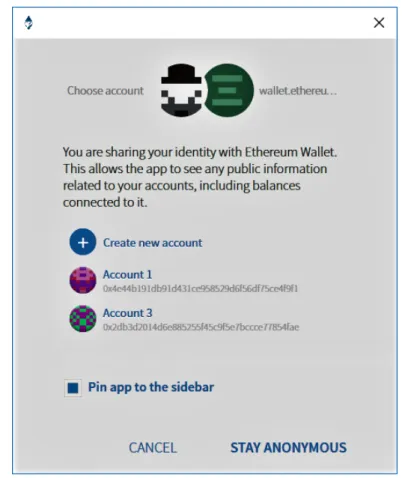
2. Then click create a new account button shown in figure 2.10 and feed the password that’s it, a new account is added.
2.4 Ethereum Account Managment
Figure 2.10:Ethereum wallet create new account Using Eth
Eth provide the same options for key management like geth and can be used the same way as shown in listing 2.3.
Listing 2.3Account creation using eth [Eth17b]
> eth account list // List all keys available in wallet. > eth account new // Create a new key and add it to the wallet.
> eth account update [<uuid>|<address> , ... ] // Decrypt and re-encrypt given keys. > eth account import [<uuid>|<file>|<secret-hex>] // Import keys from given source and
place in wallet.
2.4.3 Account Update
An existing account is updated to upgrade the keyfile to latest keyfile format or upgrade keyfile password. The update is performed through "update" subcommand of geth, using the command line with the account address or index number as the parameter. An important thing to note here is that never rely on the index number because it gets changed.
Listing 2.4Account Update [Eth17b]
$ geth account update a94f5374fce5edbc8e2a8697c15331677e6ebf0b
Unlocking account a94f5374fce5edbc8e2a8697c15331677e6ebf0b | Attempt 1/3 Passphrase:
0xa94f5374fce5edbc8e2a8697c15331677e6ebf0b
account ’a94f5374fce5edbc8e2a8697c15331677e6ebf0b’ unlocked. Please give a new password. Do not forget this password. Passphrase:
Repeat Passphrase:
0xa94f5374fce5edbc8e2a8697c15331677e6ebf0b
2.4.4 Account backup and restore
Account Keyfile is the essential requirement to sign transaction from that account otherwise account is considered as unknown. All the keyfiles are in keystore subdirectory of Ethereum node’s data directory. The default location on different platforms is
1. Windows: C:%appdata 2. Linux: /.ethereum/keystore 3. Mac: /Library/Ethereum/keystore
If backup or restoration is to be done manually, then just copy keyfiles from or to the keystore. Geth supports importing an unencrypted private key . Geth subcommand "geth account import /path/<key.json>" is used to import the key. In case if a custom data directory is used then the command is executed in a way mentioned in listing 2.5. After import operation, check the accounts ordering because the ordering is based on the timestamp due to which it may get changed. So it is advised to double check indexes before using it.
Listing 2.5Importing an Unencrypted private key [Eth17b]
$ geth --datadir /someOtherEthDataDir account import ./key.prv The new account will be encrypted with a passphrase.
Please enter a passphrase now. Passphrase:
Repeat Passphrase:
Address: {7f444580bfef4b9bc7e14eb7fb2a029336b07c9d}
2.5 Ether
Name of the currency used in Ethereum is called ether. All the computation charges are paid in ether within the EVM. This is done implicitly by purchasing gas with ether. There is a metric system of denominations in Ehtereum used as units of ether. Every denomination
2.5 Ether
has its unique name. The most basic denomination of ether is called Wei. There are some other denominations with their values in Wei are list in the table 2.2
Unit Wei Value Wei
wei 1 wei 1
Kwei (babbage) 1e3 wei 1,000 Mwei (lovelace) 1e6 wei 1,000,000 Gwei (shannon) 1e9 wei 1,000,000,000 microether (szabo) 1e12 wei 1,000,000,000,000 milliether (finney) 1e15 wei 1,000,000,000,000,000 ether 1e18 wei 1,000,000,000,000,000,000 Table 2.2:Denominations of ether and its value in Wie [Eth17b]
Getting ether
Ether can be obtained in the following ways • To become an Ethereum miner.
• Trade other currencies for ether using centralized or trustless services.
• Utilize Mist Ethereum GUI Wallet that as of Beta 6 introduced the ability to purchase ether using the http://shapeshift.io/ API.
Sending Ether
Ether can be sent through Ethereum wallet and Metamask (its a browser plugin which enable a normal browser to run Dapps ). Geth console can also be used for the ether transfer from one account to another as shown in the listing 2.6.
Listing 2.6Using Geth console to transfer ether [Eth17b]
> var sender = eth.accounts[0]; > var receiver = eth.accounts[1]; > var amount = web3.toWei(0.01, "ether")
2.6 Ethereum Network
The P2P network of participating nodes which provides a base for decentralized consensus maintain and secure the blockchain. The dashboard which contains all the information related to network stats like current block, hash difficulty, gas price, and gas spending is called EthStats.net. Anyone can add a node to this dashboard [Eth17b].
2.6.1 Ethereum blockchain Types
Based on the permissions such as read and write, the participation of in the network, being a part of the consensus process, The Ethereum blockchain is divided into three types which are.
Public blockchain
The major Blockchain, which anyone from anywhere in the world can read, and can send the transaction to and expect to be added in the block after validation in the consensus process. Consensus process decides which blocks to be added to the chain and determine the current state of the chain. Blockchains are secured by crypto-economics, which means the combination of cryptographic verification and economic incentives using PoW or PoS, which follows a general principle that the weight of influence someone carries in the consensus process is equivalent to the number of economic resources that they can offer.
Consortium blockchain
The blockchain in which consensus process is limited to pre-selected nodes. Let suppose we have a consortium of fifteen financial institutions, every one of which operates a node. To make a valid block and to add it to the chain, it must be signed by ten institutions. Reading from blockchain may be public or restricted to the participants. There are hybrid routes like root hashes of the blocks being public together with an Application program interface (API) that permits public members to perform a limited number of queries and take back partial cryptographic proofs of the blockchain. This sort of blockchain is known as partially decentralized.
Private blockchain
In this type of blockchain write permission are centralized, belongs to one organization. Read permissions may be public or limited to an arbitrary amount. It belongs to a single company; possible applications contain database management system, auditing, etc. In some cases, public readability is desired while in some not at all.
2.6 Ethereum Network
2.6.2 Connecting node to network
Geth in a network continuously try to connect to other nodes in the network until it has peers. If UPnP is enabled on the router or by running Ethereum on an Internet-facing server, it will also allow connection from other nodes. Geth discovers peers through something called the discovery protocol. To find other nodes in the network geth use discovery protocol. In discovery protocol, nodes communicate with each other to find out about other nodes on the network. Initially, geth utilizes a set of bootstrap nodes whose endpoints are stored in the source code. We can use admin API to perform node related operations like getting node info, listing all peers, an addition of a new peer to the network. To check the node Information we use geth console to execute "admin.nodeInfo" command as given below.
Listing 2.7Node Information [Eth17b]
> admin.nodeInfo { Name: ’Geth/v0.9.14/darwin/go1.4.2’, NodeUrl: ’enode://3414c01c19aa75a34f2dbd2f8d0898dc79d6b219ad77f8155abf1a287ce2ba60 f14998a3a98 c0cf14915eabfdacf914a92b27a01769de18fa2d049dbf4c17694@[::]:30303’, NodeID: ’3414c01c19aa75a34f2dbd2f8d0898dc79d6b219ad77f8155abf1a287ce2ba60f14998a3a 98c0cf1491 5eabfdacf914a92b27a01769de18fa2d049dbf4c17694’, IP: ’::’, DiscPort: 30303, TCPPort: 30303, Td: ’2044952618444’, ListenAddr: ’[::]:30303’ }
To check the list of peers use "admin.peers" command as given below. Static node can be Listing 2.8Peers list [Eth17b]
> admin.peers [{ ID: ’a4de274d3a159e10c2c9a68c326511236381b84c9ec52e72ad732eb0b2b1a227793 8f78593cdbe734e6002bf23114d434a085d260514ab336d4acdc312db671b’, Name: ’Geth/v0.9.14/linux/go1.4.2’, Caps: ’eth/60’, RemoteAddress: ’5.9.150.40:30301’, LocalAddress: ’192.168.0.28:39219’ }, { ID: ’a979fb575495b8d6db44f750317d0f4622bf4c2aa3365d6af7c284339968eef29b69 ad0dce72a4d8db5ebb4968de0e3bec910127f134779fbcb0cb6d3331163c’, Name: ’Geth/v0.9.15/linux/go1.4.2’, Caps: ’eth/60’, RemoteAddress: ’52.16.188.185:30303’, LocalAddress: ’192.168.0.28:50995’ }]
added at runtime using the Javascript console by executing "admin.addPeer()" command as given below.
Listing 2.9Adding Peer [Eth17b]
> admin.addPeer("enode://f4642fa65af50cfdea8fa7414a5def7bb7991478b768 e296f5e4a54e8b995de102e0ceae2e826f293c481b5325f89be6d207b003382e18a8e [email protected]:30303")
2.7 Mining in Blockchain
The term mining is used in analogy to gold mining for crypto-currencies. Gold or any other precious metal are acquired through mining, similarly is the case for crypto-currencies. Ethereum has only one way to issue post-launch that is through mining. The mining process is also responsible for securing the network by verifying, creating, publishing, and propagating blocks in the blockchain [Eth17a; Eth17b; WOO17].
Mining ether = Securing the Network = Verifying Computation
Ethereum uses incentive-driven model of security. Ethereum consensus is based on choosing the block with the highest total difficulty. Miners are responsible for block creation, and other nodes check the validity. The well-formedness of a block also depends on whether the block contains PoW of a given difficulty otherwise, it is not considered valid. In the next version of Ethereum PoW will be replaced by PoS.
The algorithm of PoW used is called Ethash. It concerns in finding a nonce input to the algorithm so that the result is under a certain difficulty threshold. The critical point in PoW algorithms is that there is no better approach to find such a nonce than counting the possibitlites, Since outputs have a uniform distribution ( hash application results), it can be guaranteed that on average the required time to find such a nonce depends on the difficulty threshold. This makes it feasible to control the time-span of finding a new block by managing time.
The difficulty can be adjusted dynamically as directed by the protocol. Due to which the entire network create one block every fifteen seconds. In blockchain terminology called blockchain with fifteen seconds block time. This "heartbeat" essentially punctuates the synchronization of system state and guarantees that maintaining a fork( which allow double spend attack) or editing history by an attacker is impossible, unless if the attacker owns at least 51 percent of mining power.
2.7.1 Ethash Mining Algorithm
Mining algorithm, Ethash( previously known as Dagger-Hashimoto) is based around the provisioning of a large, transient, randomly produced dataset which constitutes a DAG (the Dagger-part), and trying to solve a particular limitation on it, partly determined with a block’s header-hash.
2.7 Mining in Blockchain
The algorithm is designed to hash with a fast verifiability time within a slow CPU only environment, But if large memory and high bandwidth is given, it can provide high speed-ups for mining. The large memory needs mean that large-scale miners receive relatively little super-linear benefit. The high bandwidth requirement suggests that a speed-up from gathering on many super-fast processing units sharing the same memory provides a slight advantage over a single unit. That is important in that pool mining have no benefit for nodes doing verification, thus hindering centralization. Communication within the external mining application and the Ethereum daemon for work provision and submission occurs over the Javascript Object Notation (JSON)-Remote Pocedure Call (RPC) API. At least one ethereum account and a fully synced Ethereum client that is enabled is needed to mine. The account is used to send the mining compensations to and usually referred as coinbase or etherbase.
2.7.2 Ethash DAG
The PoW algorithm Ethash uses DAG, which is generated for each epoch such as every 30000 blocks (125 hours). The DAG takes long time span to generate . On-demand generation by a client will face long waiting time at each epoch transition before the first block of the recent epoch is found. DAG is dependent only on the block number, so it can be calculated in advance to avoid long delays at each epoch transitions. Geth and ethminer realize automatic DAG generation and maintains two DAGs at a time for soft epoch transitions. Automatic DAG generation can be turned on or off when mining is managed from the console. It can be turned on at launch time using –mine flag. If multiple instances of any client are running, make sure automatic dag generation is turned off in all but one instance. To generate the DAG for an arbitrary epoch:
Listing 2.10Arbitrary DAG generation [Eth17b]
$ geth makedag <block number> <outputdir>
2.7.3 CPU Mining
CPU mining can be used to mine ether. But as GPU mining is almost two orders of magnitude more productive, that’s why CPU mining is no more profitable. However, it can be used on the testnet or private chain to generate ether for testing contracts and transactions without going to live network and spend real ether. Starting ethereum node with geth does not automatically start mining, you have to explicitly give the command at launch time in terminal or geth console at runtime.The important thing to remember is that before starting miner etherbase(coinbase) address has to be set otherwise miner will not start. The listing 2.11 shows both launch time and runtime command to manipulate the CPU miner. Sometimes it happens frequently that one gets a block which never makes to the accepted chain. It happens because a miner mines a block locally and the state shows a reward for it in its etherbase, but after a sometimes, a better chain is discovered on the network and switch to that chain on which the mined block from a particular miner is not
Listing 2.11CPU Miner manipulation commands [Eth17b]
Launch time commands
// number of threads your want to use , default is the number of processor cores. $ geth --mine --minerthreads= number of threads
// setting etherbase command
$ geth --etherbase ’0xa4d8e9cae4d04b093aac82e6cd355b6b963fb7ff’
Runtime commands
// starting and stoping miner in console > miner.start(8)
true
> miner.stop() true
// to set etherbase account
miner.setEtherbase(eth.accounts[indexnumber of account]) // to check miner hashrate
> miner.hashrate 712000
// To check etherbase account balance > eth.getBalance(eth.coinbase).toNumber(); ’34698870000000’ // coinbase unloking > personal.unlockAccount(eth.coinbase) Password true
included, so no reward is credited. It’s normal if coinbase balance fluctuates. To check which blocks are mined by a particular miner (address), the code in listing 2.12 can be used in geth console.
Listing 2.12Checking miner mined Blocks [Eth17b]
function minedBlocks(lastn, addr) { addrs = [];
if (!addr) {
addr = eth.coinbase }
limit = eth.blockNumber - lastn
for (i = eth.blockNumber; i >= limit; i--) { if (eth.getBlock(i).miner == addr) { addrs.push(i) } } return addrs }
// scans the last 1000 blocks and returns the blocknumbers of blocks mined by your coinbase
// (more precisely blocks the mining reward for which is sent to your coinbase). minedBlocks(1000, eth.coinbase);
2.8 Transaction, Message, and Gas
2.7.4 GPU Mining
For GPU mining, DAG need minimum 1-2Giga Bytes (GB) of Random Access Memory (RAM) . If there are error in GPU mining. GPU memory framgmenation, simply means there is not enough memory. To start mining on single GPU, exeute the command mention in listing 2.13
Listing 2.13GPU Mining with single GPU [Eth17b]
eth -v 1 -a 0xcadb3223d4eebcaa7b40ec5722967ced01cfc8f2 --client-name "OPTIONALNAMEHERE" -x 50 -m on -G
1. -v 1 Set verbosity to 1.
2. -a Set the coinbase, where the mining rewards will be collected.
3. –client-name "OPTIONAL" Set an optional client name to identify you on the network. 4. -x 50 Request a high amount of peers. Helps with finding peers in the beginning. 5. -m on Turn mining on at launch time.
6. -G set GPU mining on.
2.7.5 Pool Mining
Mining pools are cooperatives that aim to ease out expected income by combining the mining power of participating miners. In return, they mostly charge individual miners 0-5 percent of mining their rewards. The mining pool uses a central account to submit PoW and distribute the compensation to participants according to their contributed mining power. Most mining pools are the third party, centralize, they can run away with the participant’s earnings, but there are decentralize pools available with open source codebase. The mining pool does not validate blocks or check state transitions; they only outsource PoW calculations. Regarding security pools behave like single node, their growth poses a centralization risk of 51 percent attack. So it is strongly advised to keep network capacity distribution in check and does not allow pools to grow too large.
2.8 Transaction, Message, and Gas
Transaction, Message, and Gas are the Most frequent words used in blockchain technology. This section gives a detail overview of all terms [Eth17a; Eth17b].
2.8.1 Transaction
Transaction in ethereum refers to the signed data package that contains a message to be transmitted from an EOA to another account on the blockchain. Transactions contains the following parameters
1. The receiver of the message.
2. Signature of the sender, which determine the purpose of the sender to send the message through blockchain to the receiver.
3. The value field, which carries the amount of wei to transfer from the sender to the receiver.
4. Data field, which is optional, contains the message sent to a contract.
5. STARTGAS value, which represents the maximum number of computational steps permitted to be executed by the transaction.
6. GASPRICE value, which represents the fee, the sender is ready to pay. One unit of gas is equivalent to the execution of one atomic instruction such as computational step.
2.8.2 Message
Messages are virtual objects that exist only in ethereum execution environment and never serialized. Messages are transferred from one contract to another. They can be considered as function calls. The message is similar to transaction except it is generated by contract and transaction is generated by an external actor. Message get produced when currently running contract execute the CALL or DELEGATECALL opcodes, which generate a message [Eth17a; Eth17b]. A message contains
1. The sender of the message (implicit). 2. The receiver of the message.
3. The VALUE field, which contains the amount of wei to transfer besides the message from one contract to another contract address.
4. Data field, which is optional, contains the actual input data sent to a contract. 5. STARTGAS value, which restricts the maximum amount of gas the code execution
2.9 Smart Contract
2.8.3 Gas
Ethereum execution environment on the blockchain is called EVM. Every node on the network run EVM as a component of block verification protocol. They check all the transaction in the block and run the code trigger by a transaction. Ethereum executes the same code on all full nodes and stores the same values, that’s why ethereum is computationally efficient, but it is a useful way to reach consensus on system state without relying on third parties. The redundant computation makes them expensive and makes it unsuitable for computation which can be done offchain [Eth17a; Eth17b; WOO17]. The name of the charges the sender pay for the execution of transactions is called Gas. This act as crypto-fuel, driving the motion of smart contracts. Gas is purchased implicitly from the miners that execute the code. Ether and gas are decoupled because units of gas align with computation units having natural cost, while the price of ether fluctuates as a result of market forces. The price of gas is decided by the miners, who has the right to refuse the processing of a transaction with lower gas price than their minimum limit. The purchase process is implicit; the user only specifies the maximum limit. Ethereum protocol uses pay per computational step model. Every step execution on blockchain cost something, which prevents attacks and resource exploitation on the ethereum network. Every transaction must have to include gas limit and a fee that it is willing to pay. If the number of computational steps and all other charges does not exceed the gas limit, then the transaction is processed if it exceeds all changes are reverted except the transaction is still valid and the fee will be collected by miners. It is good practice to keep gas limit high because all extra gas is reimbursed to the user account, so there is no risk of overspending, charges deduction are consumption based. Table 2.3 show gas cost for different operation at EVM.
Total transaction cost = gasUsed * gasPrice [Eth17b]
2.9 Smart Contract
A smart contract in ethereum is a collection of code (its functions) and data (its state) that reside on ethereum blockchain at a unique address. A contract is also called internal account or contract account. A contract lives on blockchain in the ethereum-specific binary format called EVM bytecode. Contract account can send a message to another contract and perform Turing complete computation. A contract can be written in high-level languages like solidity, and serpent [Eth17b].
Solidity is a statically typed contract oriented high-level language whose syntax is similar to that of JavaScript. It supports inheritance, libraries and very complex user-defined types and many other functionalities. Solidity is designed to target EVM To dive into solidity, check the complete documentation with practical examples at [Tea17b].
Operation Name Gas Cost Remark
step 1 default amount per execution cycle
stop 0 free
suicide 0 free
sha3 20
-sload 20 get from permanent storage
sstore 100 put into permanent storage
balance 20
-create 100 contract creation
call 20 initiating a read-only call
memory 1 every additional word when expanding memory txdata 5 every byte of data or code for a transaction transaction 500 base fee transaction
contract creation 53000 changed in homestead from 21000 Table 2.3:EVM operation Gas Cost [Eth17b]
2.9.1 Contract Compilation
There are different ways of contract compilation, but here only one is explained which is easy to use and very helpful for testing contract. To compile the contract open geth console and execute the commands as shown in the listing 2.14. The compiler output contract object which contain list of field which are given below
code The compiled EVM bytecode.
info Additional metadata output from the compiler. source The contract source code.
language Source code language such as Solidity or Serpent. languageVersion The Contract source code language version.
compilerVersion The solidity compiler version that was used to compile this contract. abiDefinition The Application Binary Interface Definition.
userDoc The NatSpec Doc for users.
2.9 Smart Contract
Listing 2.14Solidity Contract compilation in geth JavaScript Console [Eth17b]
// first assign contract source code to variable
> source = "contract test { function multiply(uint a) returns(uint d) { return a * 7; } }"
// now run the compilation script
> contract = eth.compile.solidity(source).test { code: ’605280600c6000396000f3006000357c010000000000000000000000000000 000000000000000000000000000090048063c6888fa114602e57005b6037600435604 1565b8060005260206000f35b60006007820 29050604d565b91905056’, info: { language: ’Solidity’, languageVersion: ’0’, compilerVersion: ’0.9.13’, abiDefinition: [{ constant: false, inputs: [{ name: ’a’, type: ’uint256’ } ], name: ’multiply’, outputs: [{ name: ’d’, type: ’uint256’ } ], type: ’function’ } ], userDoc: { methods: { } }, developerDoc: { methods: { } },
source: ’contract test { function multiply(uint a) returns(uint d) { return a * 7; } }’
} }
2.9.2 Contract Deployment
To deploy a contract to the blockchain, the first step is to unlock the account from which contract is going to be deployed and keep some ether in that account. Then run the script given listing 2.15.
Listing 2.15Contract deployement using geth JavaScript console [Eth17b]
var primaryAddress = eth.accounts[0]
var abi = [{ constant: false, inputs: { name: ’a’, type: ’uint256’ } }] var MyContract = eth.contract(abi)
// arg1, arg2 may be more, are used for constructor of the contract, can be omitted if not required.
var contract = MyContract.new(arg1, arg2, ..., {from: primaryAddress, data: evmByteCodeFromPreviousSection})
2.10 Dapp development Tools and Technologies
In ethereum Dapps are the applications which enable a user to interact with blockchain with a user-friendly GUI. The business logic of Dapps are the smart contracts, and the front-end comprises of technologies like HTML, Javasrcipt, etc. As contract code is redundant and expensive to execute, so Dapps are designed to perform only necessary computation on the blockchain, and all other which can be performed by the clientside are executed on the client machine to avoid unnecessary cost and utilization of blockchain resources [Eth17b]. An overview of some of the Dapps technologies is given below
2.10.1 Web3.js
Ethereum node provide RPC interface. The interface provides access to Dapps to interact with blockchain and utilize the functionalities provide by blockchain. But communication using JSON-RPC interface is very error prone especially when working with Application Binary Interface (ABI). Web3.js is a javascript library which provides an abstraction layer and works on top of ethereum RPC. It is user -friendly and less error-prone. Web3 includes the eth object - web3.eth (for specifically Ethereum blockchain interactions) and the shh object - web3.shh (for Whisper interaction)[tea17].
New developments are underway in addition to blockchain which is an effort to decentralize another aspect of a web application like storage, application-to-application communication. This is an effort towards the distributed web, in which every component of web applications will be decentralized like blockchain, and most of these services will be accessible through web3 API as shown in figure 2.11. Most of the new services support in web3 will be available in the new version 1.0, which is not currently released as per official statement, currently some features are missing like Swarm support.
Swarm is the p2p storage sharing network, which wil be used to store the file contents. In swarm files are addressed by the hash of their content. It is possible to fetch from multiple nodes at the same moment of time. As long as one system has host the data, it will be accessible all over the network.
Whisper is a communication protocol for Dapps to communicate with each other. It’s a low-level API only exposed to Dapps, not users, designed for small data transfer, does not
2.10 Dapp development Tools and Technologies
support real-time communication because of uncertain latency, and its dark with no reliable method for packet tracking [Tea16].
Figure 2.11:Web3 base Layer Services [Eth17b]
2.10.2 Truffle Framework
Truffle is a development environment, testing framework and asset pipeline for Ethereum, trying to make life as an Ethereum developer easier. In this thesis, the truffle is used as a development framework for contract compilation, deployment, etc. Truffle provides the following services [Cou17a].
1. Built-in smart contract compilation, linking, deployment and binary management. 2. Automated contract testing for rapid development.
3. Scriptable, extensible deployment and migrations framework.
4. Network management for deploying to any number of public and private networks. 5. Package management with EthPM and NPM, using the ERC190 standard.
6. Interactive console for direct contract communication.
7. Configurable build pipeline with support for tight integration.
![Figure 2.1: Bitcoin State Transition [Eth17a]](https://thumb-us.123doks.com/thumbv2/123dok_us/9903878.2483693/20.892.121.772.137.319/figure-bitcoin-state-transition-eth-a.webp)
![Figure 2.2: Ethereum State Transition [Eth17a]](https://thumb-us.123doks.com/thumbv2/123dok_us/9903878.2483693/21.892.158.739.187.470/figure-ethereum-state-transition-eth-a.webp)
![Figure 2.3: Merkle Binary Tree [But15]](https://thumb-us.123doks.com/thumbv2/123dok_us/9903878.2483693/22.892.126.765.354.760/figure-merkle-binary-tree-but.webp)
![Figure 2.4: Merkle Tree with Inconsistency [Eth17a]](https://thumb-us.123doks.com/thumbv2/123dok_us/9903878.2483693/23.892.197.680.149.716/figure-merkle-tree-with-inconsistency-eth-a.webp)
![Figure 2.5: Merkling in Bitcoin [But15]](https://thumb-us.123doks.com/thumbv2/123dok_us/9903878.2483693/24.892.131.761.390.680/figure-merkling-in-bitcoin-but.webp)
![Figure 2.6: Merkling in Ethereum [But15]](https://thumb-us.123doks.com/thumbv2/123dok_us/9903878.2483693/25.892.127.765.148.464/figure-merkling-in-ethereum-but.webp)
![Figure 2.7: Ethereum Blockchain Network with different clients [Mur17]](https://thumb-us.123doks.com/thumbv2/123dok_us/9903878.2483693/29.892.126.765.150.483/figure-ethereum-blockchain-network-different-clients-mur.webp)
![Figure 2.11: Web3 base Layer Services [Eth17b]](https://thumb-us.123doks.com/thumbv2/123dok_us/9903878.2483693/47.892.143.752.225.574/figure-web-base-layer-services-eth-b.webp)
![Figure 3.1: Modum.io AG supply-chain Architecture [BRSS17]](https://thumb-us.123doks.com/thumbv2/123dok_us/9903878.2483693/52.892.147.752.172.430/figure-modum-io-ag-supply-chain-architecture-brss.webp)
