www.ijcit.com 1
Quality of Service in Peer to Peer Video on
demand System Using V Chaining Mechanism
Hareesh.K Manjaiah D.H
Research scholar Professor & Chairman
Jawaharlal Nehru Technological University, Department of Computer Sciences,
Anantapur, A.P India Mangalore University, Mangalore [email protected] [email protected]
Abstract-In the tremendous growth of the Internet
technologies has come up the Quality of Service (QoS) problems in heterogeneous, distributed real time applications like Video-on-Demand (VoD) system. The most challenging task in VoD applications is to satisfy various peers request for distinct videos with available resources without compromising the quality of video streams by invoking various QoS parameters. Therefore we have proposed a quality of service in chaining mechanism for peer to peer video on demand system. We have also considered the transmission of video streams among the peers and then compared with our proposed mechanism with some of the existing techniques such as standard, advanced, optimal and accelerated chaining mechanisms. To our proposed VoD architecture we have proposed the quality of service parameters like delay, jitter calculation between the peers. In our Video Chaining (V-Chaining) mechanism improves the performance of the chaining mechanism in terms of quality of service for video streaming and also maintains minimal jitter in the VoD system. Hence we have evaluated this through the simulation for different performance metrics such as average number of requests arrivals, served and rejected in the system, which is compared with the existing mechanism. The results of the simulation show our proposed V Chaining mechanism enhances the quality of video streaming than the existing mechanisms.
Keywords–Chaining; peer; delay; jitter; Quality of Service; video; VoD
I.INTRODUCTION
Video on demand system service attract the many internet users allow to watch their favorite movie from the media server through interactive television system or by
using computers. In the traditional client-server
architecture for video on demand (VoD) servers like patching [1], broadcasting [2] and content delivery [3][4] communication serve the video streams to the large number of users by accessing concurrently their favorite movies. The main disadvantage is not utilizing the uplink bandwidth [5]. The peer to peer (p2p) technology has combined into VoD applications by utilizing the underutilized uplink bandwidth of the peers. The applications of p2p VoD system digital transmission of movies, distance learning system, Live streaming of sports and other programs etc, The p2p networks are highly volatile and heterogeneous networks having different
asymmetric paths and with different uplink and downlink bandwidth capacities. The difference of uplink and downlink capacities is difficult to receive in Live streaming applications, because the whole video data will contribute to the video streaming by the single sender. Hence the performance of the peer to peer Video-on-Demand system can be measured by evaluating various QoS metrics. The Quality of service metrics measured in
this paper is video packet delay and jitter.
The transmission of video streams in peer to peer networks of video on demand system, the video streaming delays are very common. The various possible paths the video streams in the form of video packet might be send to the destination peer by the sender peer. The factors like hardware, rate, bandwidth and congestion in the different paths can cause a delay in arrival of video streams among the peers. When the delay of arriving of video streams exceeds the buffer capacity the video streams are dropped. This drop of video streams can have an effect on video quality. The arrival of delayed video streams usually handles through buffering by the video transmission protocols. Jitter is also defined as the variation of arrival of video streams over time; because the arrivals of video streams are delay from the network. In the video stream arrivals, the variation can be caused due to network congestion, difference in route paths and hardware errors. Usually in the peer side to smooth out the variations, a minimal jitter buffer is required for initial buffering and sequencing the video frames in the correct order by collecting the out of order video frames. If the jitter is high the buffer may exceed then the quality of video streaming degrades its performance which causes the video distortion.
The motivation behind to evaluate the end to end delay and jitter parameter is desirable for real time streaming applications which is to ensure the robustness and guaranteed bandwidth that can be achieved from the application level perspective by decreasing the number of hops between the sender peer to receiver peer. Hence we have evaluated the end to end delay between peers in the VoD system. We have also evaluated the average delay based on minimum among the delays of source peer to destination peer through all the intermediate peers. If the average delay is less than or equal to zero then we have
www.ijcit.com 110
calculated the inter arrival of peers Pi and Pj. The variation
is evaluated as the average video stream transmission time of the sender peer and the actual average playback rate of the requested peer, then the quality of service is either smooth or jitter. If the variation is greater than or equal to x, then the quality of service is Jitter otherwise is smooth, where x is defined as threshold, which is minimal acceptable delay. In this paper we have also evaluated the certain performance metrics for the proposed VChaining approach compared with the existing approaches that is the average number of requests of peer’s arrival into the system, the average number of requests of peer’s served in the system, the average number of requests of peer’s rejected in the system, the average end to end delay between peers in the system. Finally we have evaluated the average jitter or variation and quality of service in terms of video streaming system with the existing chaining approaches is compared with our proposed approach. The rest of the paper is organized as follows: Section II reviews some previous related works; Section III presents an overview of the VoD architecture; Section IV presents the chaining mechanism with delay and jitter calculation; Section V presents V-Chaining algorithm; Section VI presents simulation; Section VII presents results and results; Section VIII concludes the paper.
II. RELATED WORK
In this section, presents the brief discussions of the existing research works in the various chaining mechanisms of video on demand system.
A. Standard Chaining
In the standard chaining [6] chaining between each peer happens that the first peer in the chain receive the video streams from the server and subsequent peers in the chain receive their video streams from their neighboring peers, which are in the chaining. As a result of this, we have observed some of the disadvantages that, use of
minimal time each request peer and is denoted as Wmin
that is minimum time, delay in receiving the video stream from the neighboring peers. The time oldest delayed request must be served to the requested peer will be close down. The video streams are pipelined through peers belonging to the same chain. Here a new chain has to be restarted every time the inter arrival between the two successive peers requests which exceed the buffer capacity of the previous peer buffer. Since, the chaining among the peers requires small buffers in the peers. In our scheme video streams are not pipelined through the peers belonging to same chain. A new chain has not restarted every time the inter arrival between the two successive peers exceed the buffer capacity of the previous peer buffer. The user can get the video streams from the neighboring peers without any duplication.
B. Advanced Chaining
The main disadvantages of advanced chaining [7] is its poor performance observed in the inter arrival rates of the requests of peer. In this chaining combined size of
backward and forward buffers is larger than the play back gap that can cause the delay while joining the one peer with another peer. However the peer cannot join, because utilized fragment of the backward buffer and forward buffer is small to meet the playback which causes the delay, more specifically whenever the time interval between two consecutive requests among the peers exceed time of the video time in minutes. In this chaining we have studied that, every inter arrival of requests exceed the duration of video, to overcome the above problem by inserted every time in minutes the idle peers, and these idle peers will delay the video stream among the peers. In our proposed mechanism, we have not inserted idle peers, the differences of inter arrival of requests will not be exceed the duration of video, and in turn our mechanism will not delay the video streams once each peer upload the video stream to the requested peer our proposed chaining algorithm checks certain conditions discussed in section 4. If the condition is satisfied the peer will starts streaming
the video to the requested peer.
C. Optimal Chaining
This chaining [8] [9] also manages all the peers buffer’s as a single shared resource. In this chaining shared buffer and play back gap heavily affect the number of required streams in optimal chaining. The play back gap itself considered as delay here. If the shared buffer is large enough to fulfill the play back gaps, So that large amount of buffer is utilized it is one of the disadvantage as we have noticed as a result of this, peers can borrow the buffers from the neighboring peers in order to bridge the gaps between the incoming requests of several peers. In this mechanism, we have also introduced the streaming proxy servers in order to increase the chaining responses and resilience. In optimal chaining approach, if a failure occurs on a chain single shared resource causes entire system to fail instead of this scheme we use multi shared resources.
D. Expanded chaining
The expanded chaining is also known as cooperative video distribution protocol [10] it also improves the chaining by taking the advantage of large buffer size of all the peers in the chaining. In case of expanded chaining users can store at least 50% of video streams in their local buffer. Assume if the users store 20% of video streams significantly increase the server bandwidth requirement is one of the disadvantages. The request arrival rate between 2 and 5 arrivals per hour which is significantly increase the delay in arrival of users in to the system. Also required sufficient buffer capacity to store the previously stored video streams they are watching until the finished the watching it. In this mechanism the main drawback is that, the peer will disconnect also stop forwarding the video stream once they have finished the playback of the video. But in standard chaining, each peer forwards the video stream to the next immediate peers starts sending the beginning of the video streams, when a peer has finished playing the video the chain will disconnect and also stop transmitting the video stream. But the streaming server will transmit the remaining parts of the video. In our
www.ijcit.com 111
scheme we are not using the larger buffer size while involved chaining among all the peers, instead we have used the peer buffer based on the streaming time line of the video.
E. Accelerated Chaining
In case of standard and advanced chaining which completely eliminates the server workload that the peer will always keep forwarding the video streams to the next neighboring peers in the chain once they have finished playing the video. In the above mechanism assumption is not reasonable, because the most of the peers are disconnect once they played the video and most of the significant number of peers will also disconnect without playing the full length of the video. In case of accelerated chaining the amount of time spent by the server to the requested peer will be the delay time that is min(D ,dt) where D is defined as the duration of video and dt is the time interval between request being served to its immediate predecessor. In the accelerated chaining [11] peers will forwards the video stream to the neighboring peers in the chain at slightly higher rate compared to other chaining mechanisms and on the video consumption rate. In accelerated chaining higher rate of forwarded the video stream overflows the buffer due to which we have forwarded the video streams based on the availability of bandwidth and playback rate.
III.VoD ARCHITECTURE
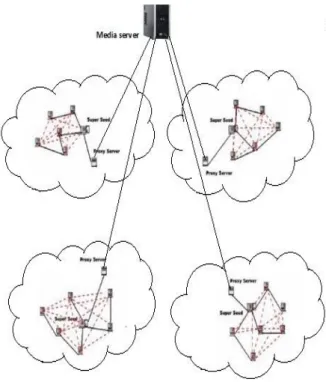
The peer to peer video on demand (P2P VoD) architecture consists of a multimedia server, proxy servers and peers in a cluster. The multimedia server contains movie database in which there will be a collection of video data files. The video data file’s information such as index popularity, minimum bandwidth requirement and minimum buffer capabilities are also stored in the multimedia server. Proxy server in this architecture is used to cache video data files for the nearer peers in a cluster. The purpose of proxy server is to reduce the load on the multimedia server by caching the video data files. A cluster is a logical connectivity of peers which is headed by a proxy server. A peer can be a seed peer or a non-seed peer. A seed peer is a client, which has sufficient bandwidth and buffer capacity as well as it can store and forward video data files to the other peers. A non seed peer is a client, which has only required configuration and it can only playback the received video data file and cannot store or forward the video data files to other peers.
A. Working Principle
Initially, suppose if a peer makes a request to the media server, and then the server downloads the entire video data files to the nearest proxy server of the
requesting peer. In the first case, it is assumed that none of
the peers are requested for the same movie. Thereby, after downloading the movie to the proxy server, the proxy server will transmit the movie to the requesting peer. Subsequently, if another peer from the same cluster makes a request for the same movie to the media server. Then the
media server looks in to its current streaming movies database for the nearest proxy server and its availability of the movies. If such entry is found then media server redirects the requesting peer to the nearest proxy server. Again the proxy server applies the same procedure to find out that any of the peers in the cluster has the movie in its buffer. If such peer is found, then the requesting peer will be redirected to that peer which has the same movie. Then the transmission occurs from that peer to the requesting peer. The transmission of video data file from that of peer
to another peer is called chaining. However, if entry is not
found in the proxy server, then the proxy server starts transmitting the video data files to the requesting peer. Elsewhere, if the entry is not found in the media server then the procedure is followed as if it is a first request from the cluster.
Figure 1 Peer to Peer VoD Architecture
Suppose, if another request from different cluster occurs for the same movie to the media server then the media server redirects to the nearest proxy server of the requesting peer to transmit the video data file to the proxy server of the requesting peer to transmit the video data file to the proxy server of the requesting peer. Now instead of downloading the video data file from media server to the nearest proxy server. The download happens from another proxy server which has the movie to the nearest proxy server of the requesting peer. Therefore, the same procedure is carried out for the transmission of movies among the clusters. If none of the proxy servers has the same movie then the media server downloads to the
www.ijcit.com 112
nearest proxy server and then the proxy server transmits the movie to the requesting peer.
IV. CHAINING MECHANISM WITH DELAY AND JITTER CALCULATION
The transmission of video streams in peer to peer networks of video on demand system, the video streaming delays are very common. The various possible paths the video streams in the form of video packet may have to travel and various factors like hardware, rate, bandwidth and congestion in the different paths can cause a delay in the arrival of video streams among the peers. Usually video transmission protocols handle the arrival of delayed video streams through buffering. When the delay of arriving video streams exceeds the buffer capacity the video stream is dropped. This drop can affect video quality.
Jitter is also defined as the variation of arrival video streams over time; because the arrivals of video streams are delay of a network. The video stream arrival time is in variation can be caused due to network congestion, difference in route paths and hardware errors. Usually a minimal jitter buffer is present in the peer side to smooth out the variations by collecting out of order video frames and sequencing it in the correct order. With severe jitter, the buffer may overflow causing distorted video the
quality of video streaming degrades. The motivation
behind to calculate the end to end delay and jitter is desirable for real time streaming applications which is ensure that robustness and guaranteed bandwidth that can be achieved from the application level perspective by decreasing the number of hops between the sender peer to receiver peer.
The end to end delay can be calculated while transmission
of video streams between any two Peeri and Peerj is
Delay of (DVi)=Actual transmission time of (Vi)- Average
transmission time of (Vi)----(1)
Where DVi is defined as delay, Vi is defined the ith Video
stream.
Average end to end delay per seed peer
--- (2)
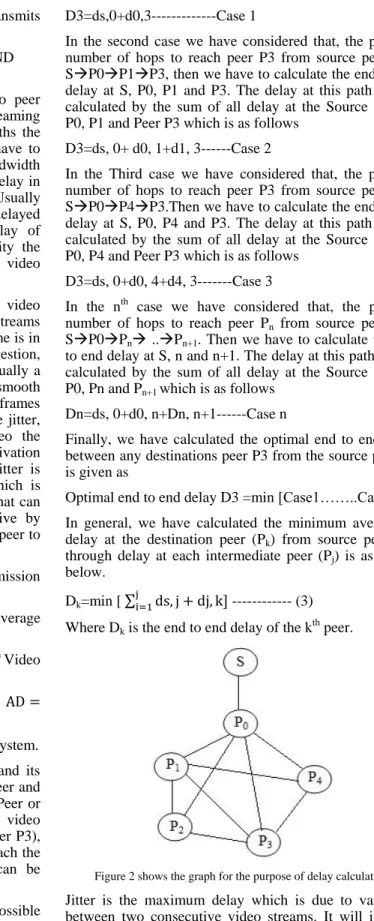
Where N is defined as total number of peers in the system. Let us consider the example of video streaming and its end to end delay calculation: Let S is the source Peer and we have considered peer P3 to be the destination Peer or requesting peer. Let source peer S tries to send video streams to the requesting peer P3or (destination peer P3), first it calculates the possible number of hops to reach the requested peer from the source peer S. This can be calculated as follows:
In the first case we have considered that the possible number of hops to reach peer P3 from source peer S is
SP0P3, then we have to calculate the end to end delay
at S, P0 and P3. The delay at this path can be calculated by the sum of all delay at the Source S, Peer P0 and Peer P3 which is as follows
D3=ds,0+d0,3---Case 1
In the second case we have considered that, the possible number of hops to reach peer P3 from source peer S is
SP0P1P3, then we have to calculate the end to end
delay at S, P0, P1 and P3. The delay at this path can be calculated by the sum of all delay at the Source S, Peer P0, P1 and Peer P3 which is as follows
D3=ds, 0+ d0, 1+d1, 3---Case 2
In the Third case we have considered that, the possible number of hops to reach peer P3 from source peer S is
SP0P4P3.Then we have to calculate the end to end
delay at S, P0, P4 and P3. The delay at this path can be calculated by the sum of all delay at the Source S, Peer P0, P4 and Peer P3 which is as follows
D3=ds, 0+d0, 4+d4, 3---Case 3
In the nth case we have considered that, the possible
number of hops to reach peer Pn from source peer S is
SP0Pn ..Pn+1. Then we have to calculate the end
to end delay at S, n and n+1. The delay at this path can be calculated by the sum of all delay at the Source S, Peer
P0, Pn and Pn+1 which is as follows
Dn=ds, 0+d0, n+Dn, n+1---Case n
Finally, we have calculated the optimal end to end delay between any destinations peer P3 from the source peer P3 is given as
Optimal end to end delay D3 =min [Case1……..Case n] In general, we have calculated the minimum average of delay at the destination peer (Pk) from source peer (Ps)
through delay at each intermediate peer (Pj) is as shown
below.
Dk=min [ --- (3)
Where Dk is the end to end delay of the kth peer.
Figure 2 shows the graph for the purpose of delay calculation
Jitter is the maximum delay which is due to variations between two consecutive video streams. It will increase under hectic load patterns. If the jitter is high, play-out process will pause, frustrating the peer. Therefore we have defined the variation is the difference of average packet receiving rate and the average play back rate of the video. Hence we have calculated the Variation= Average packet
www.ijcit.com 113
receiving rate - Average playback rate. The average video stream transmission time from the sender peer and the actual average playback rate of the requested peer is in variation, then the quality of service is either smooth or jitter.
If the variation is greater than or equal to x, then the Quality of service is Jitter otherwise is smooth, where x is the threshold, which is minimal acceptable delay.
Jitter Variation>=x Quality of service=
Smooth other wise
In the best case of delay Dk of the Kth peer, the quality of
service is smooth. In the average case of delay Dk of the
Kth peer, first it must satisfies the minimum number of
hops, and then the quality of service is smooth. In the worst case of delay Dk of the Kth peer, the quality of service is Jitter.
Average variation per peer= --(4)
V. V-CHAINING ALGORITHM
Nomenclature:
ATij:: Inter arrival time between ith and jth peer, :: size of
the movie , eception rate, Pr :playback rate, b::
buffer of the peer, r:: transmission rate of the movie, AD::
Average delay, ATP:: actual Transmission time ,RTP:: Round Trip time, N:: number of peers, X::threshold, minimal acceptable delay, V:: variation, APKTR::average packet receiving rate, APBR::average play back rate, QoS::Quality of Service.
Step 1: Request arrival of jth peer
Step 2: Redirection from Server to ith peer
Step 3: Calculate ATij =Arrival of jthpeer - arrival of ith peer
Step 4: Calculate for K=1 to N
Compute D=ATP-RTP AD=AD+D End for If AD<=0 then { Step 3 }
Step 5. V= APKTR - APBR
Step 6. If V X,then QoS=Jitter else QoS=smooth
Step 7: If ATij then establish chain between ith and
jth peer
Step 8: else if ATij then establish chain between ith
and jth peer
Step 9: else if ATij then establish chain between ith
and jth peer
Step 10: else receive from server or Proxy
In VChaining mechanism timeline streaming session is taken as reference to chain the peers. The time line is scale the units that reference to chain the peers. The time line is scale the units inter arrival time between the peer. Let us consider the duration of movie D minutes, then the factor in the timeline starts from 0 to D minutes. Let us assume that, the chain has to be established between any two peers
that is Pi and Pj. Let the inter arrival time be ATij between
the peers Pi and Pj. Where the ATij is the difference
between the request Pi and Pj. Let us calculate the delay
between peers Pi and Pj. D=min{d s,i + d j,k}
Also we have to calculate the delay between the Kth peer
to N peers in the cluster is calculated based on the difference of actual transmission time(ATP) and roundtrip time(RTP). Average delay is calculated based on minimum of source peer delay and combined intermediate peers delay with destination peer delay. If the average delay is less than or equal to zero then calculate the inter arrival of peers Pi and Pj
We have calculated the Variation = Average packet receiving rate - Average playback rate. The variation is defined as the average video stream transmission time of the sender peer and the actual average playback rate of the requested peer, then the quality of service is either smooth or jitter. If the variation is greater than or equal to x, then the quality of service is Jitter otherwise is smooth. Where x is the threshold, which is minimal acceptable delay.
Let Bij be the bandwidth capacity between Pi and Pj. Let bi
and bj be the buffer capacity of Pi and Pj. Now the
downloading time of Pi from source is calculated based on
the size of the Movie S and its reception rate Ri. The first
condition is checked for chaining and is given as
ATij ---(5)
If the condition in equation 1 satisfies, then a chain is established between Pi and Pj. If the condition fails, then total playback rate Pri of Pi is calculated based on the video consumption rate
Now, the inter arrival time ATij and the total playback rate
of Pi is checked as second condition and is given as
ATij --- (6)
If the condition in equation 2 satisfies, then a chain is
established between Pi and Pj. If this condition fails,
contains of buffer bi of Pi is observed within streaming timeline. Now, the observation is estimated based on the transmission rate ri of Pi from source and the buffer bi contains within the streaming timeline of the movie’s duration D. The inter arrival time ATij and the buffer bi contain is checked as third condition and is given as
ATij ---(7)
If the condition in equation 3 satisfies, then a chain is
established between Pi and Pj.If none of the above
condition is satisfied, then the video is obtained directly either from proxy server.
www.ijcit.com 114
VI. SIMULATION
The performance of the proposed architecture is evaluated through extensive simulation using MATLAB software. We analyze the performance of the system under various parameters that is different Poisson arrival requests into the system will offered different levels of cooperation presented by the seed peers. Our simulation program assumed that request arrivals for particular videos were distributed according to a Poisson process simulated the requests for a single two-hour MPEG-2 video. We did not consider higher arrival rates as they seemed unrealistic. Each simulation run involved at least 5,000 arrivals over a simulated time period of at least 5000 minutes. The simulation model is evaluated for several times, we have measure the following parameters
1. The average number of requests of peer’s arrival into the system
2. The average number of requests of peer’s served in the system
3. The average number of requests of peer’s rejected in the system
4. The average end to end delay between peers in the system.
5. The average jitter or variation and Quality of service of the various chaining approaches are compared with our proposed approach.
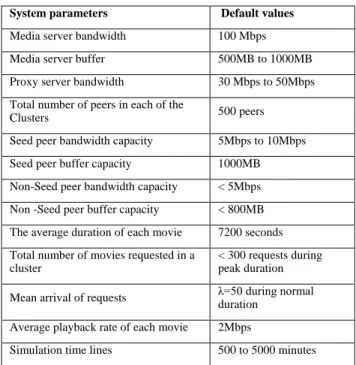
The topology used in our simulation consists of a single media server and 5 cluster based network. Each cluster constitutes a proxy server and 500 peers which includes the seed peers and the non seed peers. The media server consists of MPEG-2 movie files with duration ranging from 4800 min to 6000 min and their popularity is based on Zipf’s law. The media server bandwidth capacity of 100 Mbps and the capacity of the buffer is 5000 MB. The proxy server bandwidth capacity is ranging from 30 Mbps to 50 Mbps and buffer capacity ranging from 500 MB to 1000 MB. Each seed peer has a bandwidth capacity of 5 Mbps to 10 Mbps and buffer capacity of 1000 MB. The non seed peer has a bandwidth capacity of less than 5Mbps and buffer capacity of less than 800MB. The proxy
server maintains a database of currently
streamed/streaming movies and a list of seed peers. The multimedia server contains the information about the movies such as index, size, duration, popularity etc., and this server also maintains two separate files for each of the movie. One file contains the segmented parts of the movie and other file contains the frames of the scene boundary locations. The average duration of each movie is 7200 seconds. The total number of movies requested in a cluster is less than 300 requests during the peak duration. It follows a Poisson request rate with mean λ=50 during the normal durations. The average normal playback rate of each movie is 2 Mbps. The operations are executed on a timeline between 500 minutes and 5000 minutes in a cluster and follows the Poisson request rate with mean λ’=50.
System parameters Default values
Media server bandwidth 100 Mbps
Media server buffer 500MB to 1000MB
Proxy server bandwidth 30 Mbps to 50Mbps Total number of peers in each of the
Clusters 500 peers
Seed peer bandwidth capacity 5Mbps to 10Mbps
Seed peer buffer capacity 1000MB
Non-Seed peer bandwidth capacity < 5Mbps Non -Seed peer buffer capacity < 800MB The average duration of each movie 7200 seconds Total number of movies requested in a
cluster
< 300 requests during peak duration Mean arrival of requests λ=50 during normal duration Average playback rate of each movie 2Mbps
Simulation time lines 500 to 5000 minutes
Table1: System parameters with their default values
VII. RESULTS
The simulation model is executed for several times and the result shown is an average of all simulation trails carried out in all 5 clusters. During the simulation, we have observed from the figure 3, the requests of peer’s of videos arrive to the system according to Poisson’s process with the arrival rate λ. We have first measured the average arrival rate of requests of peers into the system. The mean arrival rate is varying in between 100 to 460 requests of peers.
Figure 3 Average arrivals of requests
In Figure 4, we have observed that, the average numer of requests of peers arrrive to the system is varrying between 100 to 460 peers according to the poissons process.When
www.ijcit.com 115
the requests of movie from the peers arrive to the system,it checks the difference of interarrival time of the new peer and other peers of the existing chain, which is active less than the duration of
Figure 4 Avearge Service rate
movie D minutes.The various conditions with which the chaining occurs will be clearly disucussed in section in section 4. The requests of peers to be served immediately from the active chain and also add them to the currently available existing active chain. Hence our proposed VChaining approach reduce the number of peers requests rejections and increase the serving requests of peers. The observation made from the figure 4, in case of standard chaining average serving rate is ranges from 30 to 135 peers requests.Similarly in advanced, optimal and accelerated chaining approches can serve average of 40 to 180, 50 to 225 and 75 to 338 peers requests respectively.In our proposed V Chaining approach can serve an average of 90 to 352 requests of peers during the simulation.
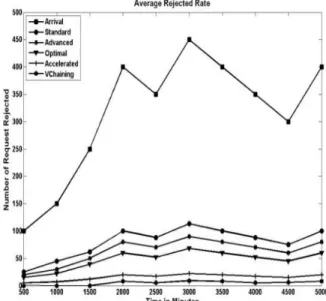
The observation made from the figure 5, In our proposed chaining approach can reject less number of requests of peers between 5 to 9 peers requests.In case of accelerated chaining average rejection rate of peers requests is varies from 5 to 22. Similarly in optimal,advanced and standard chaining approches can reject varies from 15 to 68, 20 to 90 and 25 to 100 peers requests respectively during the simulation.
Figure 5 Average Rejected rate
Normally the delay is common while proceesing the requests of peers. But we have observed from the figure 4, the average delay occurred in all the peers involved in the system.We have calculated the delay at souce peer which is the sender peer will able to send the video strems to the destination or requested peers in the system.The end to end delay between the any peers in the system is calculated is clearly discussed in section 5. The observation made from the figure 6, In our proposed chaining approach can delayed requests of peers ranges from 10 to 45 peers. In case of accelerated chaining average delay of requests of peers is ranges from 20 to 90. Similarly in optimal,advanced and standard chaining approches can delayed ranges from 35 to 140, 40 to 180 and 45 to 203 peers requests respectively during the simulation.
www.ijcit.com 116
The Jitter is the maximum delay that is occurred between any two consecutive video streams, which is the difference of average packet receiving rate and average playback rate. Hence we have observed from the figure 7 the average Jitter in our proposed VChaining approach is 41.2 seconds which is very less compared to average transmission time (other approaches). In case of accelerated chaining average Jitter is 87.3 seconds. Similarly average Jitter in case of optimal,advanced and standard chaining approches is 148.1,168.1and 188.8 seconds respectively during the simulation.
Figure7 Average Jitter
The Jitter is also defined as variation, which is the difference of average packet receiving rate and average playback rate. Hence we have observed from the Figure 8, the variation is between 5 to 6.5 seconds.
Figure 8 Average Variation
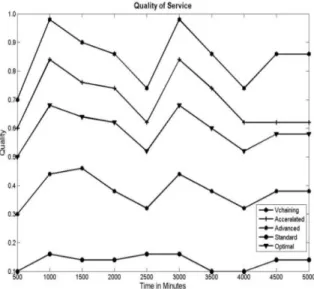
We have observed from the Figure 9, the quality of service, which is measured in terms of the quality of video streaming in the system. If the quality is equal to jitter, means that, the variation is greater or equal to x, otherwise quality is smooth, where x is threshold, which is the minimal acceptable delay this is clearly discussed in section 6. In our simulation considered x is the tolerable delay of 5 to 6.5 seconds. Hence we have observed from the simulation, the quality of service is smooth in optimal, accelerated approaches, but still better that is 70% to 98% smooth in our proposed approach. The quality of service is jitter in case of advanced and standard chaining.
Figure 9 Quality of service of video streaming
VIII. CONCLUSION
In this paper we have evaluated the end to end delay and jitter among the peers in peer to peer video on demand system using V-Chaining Mechanism. We have proposed V-Chaining algorithm with delay and jitter calculation on VoD architecture for the transmission of video streams between peers that improves the performance of the system compared with existing mechanisms. The drawback of existing chaining techniques is end to end delay and jitter is more common while transmitting the video streams among the peers. Hence we have proposed V-Chaining mechanism with delay and jitter calculation is efficiently evaluated delay induced in each peer that is source peer to destination peer and also evaluate the variation in arrival of video streams to the peers. Accordingly selects the best optimal path in chaining the video streams between the peers which enhances the performance of the proposed V-Chaining mechanism in terms of Quality of service and minimal jitter compared with existing techniques. Also we have evaluated through the simulation different performance metrics such as average arrival of requests; average requests of peers served and rejected in the system is comparisons between the existing mechanisms with our proposed V-Chaining mechanism. Conclusively, the result of our simulation
www.ijcit.com 117
shows that our proposed mechanism enhances the quality of video streaming than the existing mechanisms.
REFERENCES
[1] I. Lee and L. Guan, “Reliable video communication with multi-path streaming using MDC,” in Proceedings of IEEE International Conference on Multimedia and Expo,2005, pp. 711-714.
[2] K. A. Hua and M. Tantaoui, “Cost effective and scalable video streaming techniques,” in Handbook of Video Databases: Design and Applications, 2003, pp. 763-784. [3] N. Magharei and R. Rejaie, “Adaptive receiver-driven
streaming from multiple senders", Multimedia Systems, Vol. 11, 2006, pp. 550-567.
[4] X. Hei, C. Liang, J. Liang, Y. Liu, and K. W. Ross, “A measurement study of a large-scale P2P IPTV system,” IEEE Transactions on Multimedia, Vol. 9, 2007, pp.1672-1687.
[5] J. Li, “Peer Streaming: an on-demand peer-to-peer media streaming solution based on a receiver-driven streaming protocol,” in Proceedings of the IEEE 7th Workshop on Multimedia Signal Processing (MMSP ’05), pp. 1–4, November 2005
[6] S. Sheu, K. A. Hua, and W. Tavanapong,”Chaining: a generalized batching technique for video-on-demand systems”, Proc. IEEE International Conference on Multimedia Computing and Systems (ICMS '97), Berlin,Germany, pp. 110–117,1997.
[7] F. Lin, C. Zheng, X. Wang, X. Xue, “ACVoD: A peer-to-peer based video-on-demand scheme in broadband residential access networks”, International Journal of Ad Hoc and Ubiquitous Computing, 2(4)4,2007,.
[8] T.-C. Su, S.-Y. Huang, C.-L. Chan and J.-S. Wang,"Optimal chaining scheme for video-on-demand applications on collaborative networks", IEEE Transactions on Multimedia, 7(5): 972–980,2005
[9] T.-C. Su, S.-Y. Huang, C.-L. Chan and J.-S. Wang, “Optimal chaining and implementation for large scale multimedia streaming”, Proc. 2002 IEEE International Conference on Multimedia and Expo (ICME 2002), Lausanne, Switzerland, Vol.1,August, pp. 385–388 [10] J.-F Pâris 2005, “A cooperative distribution protocol for
video-on-demand”,Proc. 6th Mexican International
Conference on Computer Science, Puebla, Mexico, pp. 240–246.
[13] J.-F Pâris, A. Amer and Darrell D. E. Long,”Accelerated chaining: a better way to harness peer power in video-on-demand applications”, Proc. 26th ACM Symposium on Applied Computing (SAC 2011), Taichung, Taiwan, in press,2011.
[14] G. Barlas, B. Veeravalli,”Optimized Distributed Delivery
of Continuous-Media Documents over Unreliable
Communication Links”, IEEE Trans. parallel and distributed systems, vol. 16, no. 10, 2005.
[15] Frederic Thouin and Mark Coates, McGill University, “Video-on- Demand Networks: design Approaches and Future Challenges’, IEEE Network, 2007. [16] S. Fashandi, S.O. Gharan, and A.K. Khandani. Path
diversity over packet switched networks: Performance analysis and rate allocation. IEEE/ACM Trans. on Networking, 18(5):1373–1386, 2010.
[17] Z. Liu, Y. Shen, K.W. Ross, S.S. Panwar, and Y. Wang “LayerP2P: Using layered video chunks in P2P live streaming”, IEEE Trans. on Multimedia, 11(7):1340–1352, 2009.
[18] Dongni Ren, Y.-T.H. Li, and S.-H.G. Chan. Fast-mesh: A low-delay highbandwidth mesh for peer-to-peer live treaming. IEEE Trans. on Multimedia, 11(8):1446–1456, 2009.
[19] X. Zhang and H. Hassanein. Treeclimber. A network-driven push-pull hybrid scheme for peer-to-peer video live streaming. In Proc. IEEE Local Computer Networks, pages 368–371, 2010.
[20] X. Zhang and H. Hassanein. Video on-demand streaming on the internet-a survey 2010. In Biennial Symposium on Communications (QBSC), pages 88–91.
[21] X. Zhang and H. Hassanein A survey on peer-to-peer video live streaming schemes—an algorithmic perspective. Submitted to Computer Networks, pages 1–30, 2012.