E-Commerce Applications Ranking
Marilena DUMITRACHE
Academy of Economic Studies, Bucharest, Romania [email protected]
The paper presents the cycle of development of e-Commerce applications. The e-commerce applications are analyzed being considered to be a subject for complex evaluations. A set of criteria and factors are presented being considered relevant for e-commerce applications used in complex assessments. A ranking algorithm is proposed based on the AHP (Analytic Hierarchy Process) process, which was implemented and tested with online application IAID. The objective of this paper is to build, implement and test this algorithm with the online application IAID.
Keywords: E-Commerce, Hierarchy, Evaluation Criteria, Analyses, Ranking Algorithm E-Commerce applications
E-commerce refers to: businesses trading with other businesses and internal processes. Based on the parties involved in the business transaction, the e-commerce can be classified in:
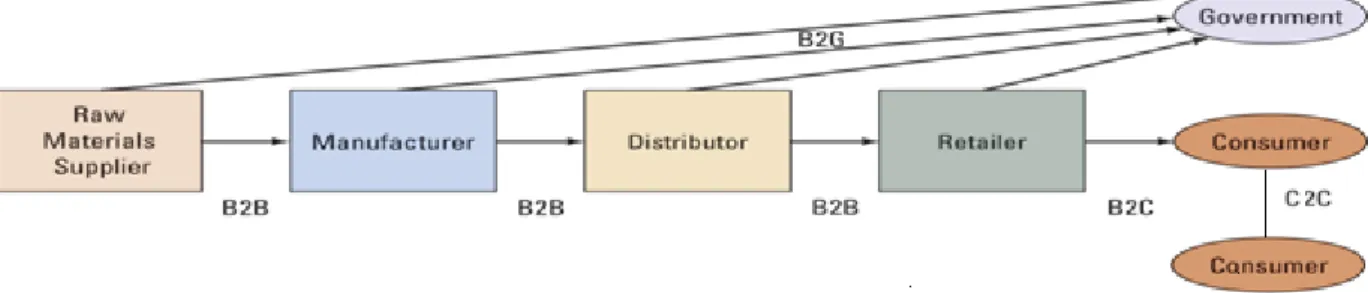
B2C or Business-to-Consumer, e-commerce concerns sales between a supplier and a retail customer / the consumer [1]; a typical information system for B2C provides a Web-based application by which customers enter and manage their orders - Amazon.com
B2B or Business-to-Business, e-commerce refers to sales between companies such as between raw materials suppliers and manufacturers, or between manufacturers and distributors, or between distributors and retailers; all of those can be seen in figure 1. [2], [3]
B2G or Business-to-Government refers to sales between companies and government organizations [1]; it refers to the use of the Internet for public
procurement, licensing procedures, and other government-related operations
C2C or Consumer-to-Consumer is defined in [2] as simply commerce between private individuals or consumers; this type of e-commerce is characterized by the growth of electronic marketplaces and online auctions, particularly in vertical industries where firms/businesses can bid for what they want from among multiple suppliers
B2E or Business-to-Employee is described in [3] as exchange of intra-firm information (such as terms of employment, benefits, policies, operation manuals, company newsletter) with employees over the internet or an intranet
C2B or Consumer-to-Business - a consumer posts his project with a set budget online and within hours companies review the consumer's requirements and bid on the project; the consumer reviews the bids and selects the company that will complete the project [3].
Fig. 1. Classification of E-Commerce
The e-commerce applications are mainly used because of the fallowing advantages:
reduced transaction cost;
flow increased for goods and services;
improved level of customer service;
close coordination enabled among manufacturers, suppliers, and customers;
Worldwide market accessibility.
The sellers of e-commerce applications can maximize their revenues by using the collective intelligence of their Web site visitors while personalizing the application according to the customer needs creating in this way a great experience in real-time. Few years ago they were interested about how to manage, measure, and increase transactions. But most sellers have this figured out by now, so their focus has shifted to maximizing their revenues in new ways. Sellers have grown to be more interested in customer experience and service, personalization, and recommendations. Online retailers are looking for new ways to increase their revenues and to achieve better personalization meeting the customer goals. They are also looking for new ways to maximize revenues by deploying the recommendations they already have in place. The retailers have collected the benefits of the traditional product recommendations. Because they understand the capabilities of these technologies they are interested to tackle the newest issues such as navigating and social elements for their sites while ongoing the quest to improve the search. Therefore, the nature of the second wave of electronic commerce is related with:
Collective intelligence;
Self-service;
Customer centricity;
Personalization;
Recommendation.
The e-Commerce market is still in its preliminary phase. Developing an e-Commerce project implies a certain amount of risk. It is known that there are also projects that can overpass the deadline, there are even projects that do not fit in between the allocated budget, sometimes good projects can offer the expected results, but sometimes they don’t. It is known that there are differences between the estimations and the outcome, but despite all the mentioned above this project will present a realistic algorithm which is meant to rank the e-commerce applications.
In order to succeed with an e-Commerce business, one must imminently start by developing a well structured business plan. A well structured plan must be based on accurate information. In order to bring innovative ideas to the plan the management team must be flexible and creative. The main idea is that a strong business plan represents a successful business. All the projected goals must be reached within the estimated period of time while making use of the developed Internet activity. The information must be used in order to constantly create report sheets and update the business plan. The entire time the team must fallow the two main guidelines of every business: the breakeven point and the profitability ratio. [4]
Creating an e-commerce project implies tasks organization – the tasks must take place in a logical and sequential order. Figure 2 proposes the phases’ list for an e-commerce project.
Each phase is involves activities and tasks. Reference [5] describes important features of e-commerce applications. The quality of the e-commerce applications is very important, and because of that in Romania there’s a periodically organized competition which is meant to verify and ensure the quality for these applications. This competition is being
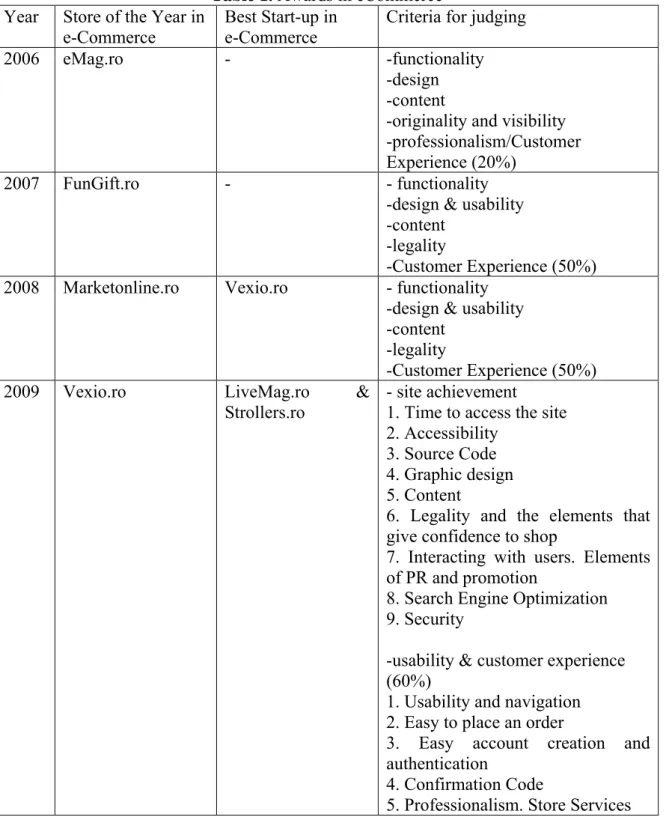
healed each year since 2006 and it is called GPeC (Gala Premiilor in eCommerce - Awards in eCommerce). This competition offers prices as “Store of the Year in Commerce and Best Start-up in e-Commerce”. Table 1 is meant to present the awards and the criteria used for judging between the years 2006 and 2009.
Table 1. Awards in eCommerce Year Store of the Year in
e-Commerce Best Start-up in e-Commerce Criteria for judging
2006 eMag.ro - -functionality
-design -content
-originality and visibility -professionalism/Customer Experience (20%)
2007 FunGift.ro - - functionality
-design & usability -content
-legality
-Customer Experience (50%)
2008 Marketonline.ro Vexio.ro - functionality
-design & usability -content
-legality
-Customer Experience (50%)
2009 Vexio.ro LiveMag.ro &
Strollers.ro
- site achievement 1. Time to access the site 2. Accessibility
3. Source Code 4. Graphic design 5. Content
6. Legality and the elements that give confidence to shop
7. Interacting with users. Elements of PR and promotion
8. Search Engine Optimization 9. Security
-usability & customer experience (60%)
1. Usability and navigation 2. Easy to place an order
3. Easy account creation and authentication
4. Confirmation Code
With respect towards the judging criteria it can be easily seen in table 1 that the usability and customer experience has been emphasized and so it registered each year an increase. Table 1 also shows that with each year that has past the evaluation’s criteria has been improved significantly, which clearly demonstrates that the idea of hierarchy is becoming more and more important for both producers and users.
2 The criteria for e-Commerce applications
Reference [6] presents the criteria for e-Commerce applications which are grouped into 4 main categories: information quality, service quality, systems quality, and vendor-specific quality.
Information quality, in the e-commerce context, insinuates delivering relevant, updated, and easy-to-understand information to significantly influence online customers’ attitude, satisfaction, and purchases. It is suggested that the higher the quality of the website information, the more online customers would select that website for online shopping. Information quality can be measured using information relevance, currency, and understandability. [6] Web content should be personalized, complete, relevant, easy to understand, and secure if we expect prospective buyers or suppliers to initiate transactions via the Internet and return to the site on a regular basis. [7]
Table 2. Sub-criteria for information quality
Sub-criteria Sub-criteria meaning
Information relevance Relevant depth and scope, and completeness of the information
Currency Updating of the information
Understandability ease of understanding and clearness of the information System quality - in the e-commerce context,
website system quality has been known to have a significant effect on online customer satisfaction and online purchases. Customers dissatisfied with websites characterized by poor navigation, slowness, non-vividness, being unsecured, and with no personalized services are likely to leave the site even though the information provided by the
website is of high quality. System quality can be measured using navigability, response time, personalization, tele-presence, and security. [6]
Usability, availability, reliability, adaptability, and response time, are examples of qualities that are valued by users of an e-commerce system. [7] [8]
Table 3. Sub-criteria for system quality Sub-criteria Sub-criteria meaning
Navigability the website’s capability to provide alternative interaction and navigating techniques
Response time the interval between a user-command and the receipt of an action, result, or feedback from the system
Personalization provide online customers an individualized interface, and creation of custom tailored services (such as news pages on the web or specialized newsletters) that meet the individual customer's particular needs or preferences
Tele-presence a set of technologies which allow a person to feel as if they were present, to give the appearance that they were present, or to have an effect, at a location other than their true location
Security the implementation of multiple features like encryption, third-party affiliations, security statement, to assure secure online shopping
Service quality, in the e-commerce context, becomes more critical because online customers transact with unseen retailers.
Reliability, responsiveness, and empathy are applicable to measure e-commerce service quality [6].
Table 4. Sub-criteria for service quality
Sub-criteria Sub-criteria meaning
Reliability the ability to perform the promised service dependably and accurately
Responsiveness the willingness to help online customers and provide prompt service
Empathy the caring and attention the online retailer provides its customers
Also along with the three website quality criteria discussed above, the Internet vendor-specific qualityhas been considered to be an important e-commerce success criterion. [6]
It refers to the awareness of Internet vendors and their reputation and price competitiveness.
Table 5. Sub-criteria for vendor-specific quality
Sub-criteria Sub-criteria meaning
Awareness is related to brand loyalty and network effects
Price savings a cost-focus strategy and selling commodity items where each vendor has the exact same product
Reputation overall estimation of the character or quality of a site of e-commerce generally held by those who know it
An E-Commerce application can be considered successful if users are satisfied by the presented criteria’s quality and revisit the web site. It is crucial to determine what satisfies a user, with respect to the e-Commerce application, and what the potential causes of dissatisfaction are. For this reason it is very important to determine which criteria are preferred by users in the e-commerce applications.
3 Analytic hierarchy process (AHP)
The Analytic Hierarchy Process is a multi-criteria decision-making method allowing decision makers to model a complex problem into simple hierarchical structure which consists of goal, objectives (criteria), sub-objectives, and alternatives. It was developed by Thomas L. Saaty in the 1980 and has been extensively studied and refined since then, for instance has been widely used for evaluation of the software packages. To judge which of each pair is preferred or has a
greater amount of some quantitative property, based on pair wise comparison, which refers to any process of comparing entities in pairs, AHP integrates both criteria importance and alternative preference measures into a single overall score for ranking decision alternatives [5] [7] [8] [9] [10].
AHP consists of four phases [11]:
Structuring the problem and model building;
Data collection through pair wise comparisons and measurement;
Calculation of normalized priority weights of individual factors;
Analyzing the priority weights and deriving solutions to the problem.
Analytic hierarchy process has strengths and weaknesses [9].
Strengths:
AHP enables decision makers to structure a decision making problem into a
hierarchy, helping them to understand and simplify the problem.
It is a flexible and powerful tool for handling both qualitative and quantitative multi-criteria problems.
AHP procedures are applicable to individual and group decision making. Weaknesses:
- AHP is time consuming because of the mathematical calculations and number of pair-wise comparisons that increases while the number of alternatives and criteria increases.
- The decision makers need to re-evaluate alternatives when the number of criteria or alternatives is changed.
- Ranking of alternatives depends on the alternatives considered for evaluation, hence adding or deleting alternatives can lead to changes in the final rank.
4 Ranking algorithm
It is important to question the users of e-commerce applications with regards towards the features of the application. This information is used by managers or designers in order to alter their priorities as for the factors of the site to meet the priorities of the customers. These will help them make the proper allocation of resources so as to increase the competitiveness for the electronic commerce site while maximizing the business performance.
A ranking algorithm with 5 steps is proposed, based on the AHP process that was presented in the previous subsection. The algorithm for ranking of e-commerce websites involves a problem Pr for which the alternatives (e-commerce websites) A1, A2, ..., An are taken into analysis. For these alternatives the evaluation criteria C1, C2, ..., Cm are established,
where:
n - number of alternatives under examination (e-commerce websites)
m - number of evaluation criteria
The optimum e-commerce website is chosen after determining the evaluation criteria and after computing the criteria’s weights and alternatives.
The ranking algorithm fallows the next 5 steps.
Step 1: Initial data input – a number of electronic websites and a specific number of criteria are chosen for the analysis.
Step 2: Define alternatives –defining the alternatives under examination (e-commerce websites)
Step 3: Define evaluation criteria –the evaluation criteria is defined after the alternatives were tested according to literature.
Before step 4 the weight ratio is defined by j i a a ij a where: ai - weight of criterion i, i = 1, 2, . . . m aj - weight of criterion j, j = 1, 2, . . . m m - the number of criteria
In this case for any i, j, t indexes: 1 ji ij a a ; aij ait *atj for any i, j, t where:
ait = the importance given to criterion i in comparison with criterion t, t = 1,2, …, m atj = the importance given to criterion t in comparison with criterion j
Step 4: Define criteria’ weights – constructing a pair wise comparison matrix with a scale of relative importance. For a criterion compared with itself is always assigned the value 1 by convention, so all the main diagonal entries of the pair wise comparison matrix are 1. If there are m criteria, then the pair of wise comparisons will yield a square matrix as the matrix A:
1 ... ... 1 ... ... ... 1 ... 1 ] [ 2 1 2 21 1 12 m m m m ij a a a a a a a A where :
aij - the weight ratio - the importance given to the criterion i in comparison with the criterion j, with values between 1 and 9 or fractions like 1 / x (with x between 1 and 9) to reverse the importance, i, j = 1..m In this context, as Saaty’s scale of relative importance [14], the numbers represent:
1: equal importance, 3: moderate importance of one over another, 5: essential or strong importance, 7: very strong importance, 9: extreme importance, 2, 4, 6, 8 are intermediate values between the two adjacent judgments.
Step 5: Define alternatives’ weights - constructing a matrix with a scale of relative importance in which it is compared the alternatives on each of the criteria. If there are m criteria, then the pair wise comparisons would yield a square matrix as the matrix B below: 1 ... ... 1 ... ... ... 1 ... 1 ] [ 2 1 2 21 1 12 n n n n kl i b b b b b b b B where:
bkl - the importance given to criterion i for the alternative k in comparison with alternative l with values between 1 and 9 or fractions like 1 / x (with x between 1 and 9) to reverse the importance
1 kl lk b
b ; k, l = 1..n
n - the number of alternatives
The significance of the matrix values is the same like in step 4.
Computations
The geometric means of criterion and the relative weights of criteria (priorities) are computed.
The geometric means of criterion i are computed as: m m j ij i a GM
1 4.1 where:aij - the importance given to criterion i in comparison with criterion j , i,j = 1..m
The relative priority of criterion j is:
m j i 1 j i GM GM PC 4.2 where:GMj - geometric mean of criterion j
In the same way is calculated the geometric mean of criterion i and alternative k.
n n l kl ik b GM
1 4.3 where:bkl - the importance given to criterion i for the
alternative k in comparison with alternative l, k,l = 1..n
The relative priority of criterion i for alternative k,
n l 1 il ik ik GM GM RPC 4.4 where:GMik - geometric mean of criterion i and alternative k
GMil - geometric mean of criterion i and alternative l
The global priority for alternative k is:
m i k PG 1 ik i*RPC ) (PC 4.5 where:PCi - relative priority of criterion i, i = 1..m ik
RPC - relative priority of criterion i for alternative k, k = 1..n
Global priorities are sorted in a descending ordered and the optimum choice is the alternative (e-commerce website) with the highest global priority.
Let there be considered the following alternatives (e-Commerce websites): e-Mag.ro, Marketonline.ro, Vexio.ro - and 3 evaluations criteria – information relevance, under-stability and personalization.
The pair wise comparison matrix with a scale of relative importance is:
1 2 / 1 3 / 1 2 1 6 / 1 3 6 1 A
If the formula 4.1 is applied, we obtain the values in table 6.
Table 6. Values for geometric mean of criteria
GM1 2,6207
GM2 0,6933
GM3 0,5503
Values for relative priority of criteria in table 7 are obtained, if we apply the formula 4.2.
Table 7. Values for relative priority of criteria
PC1 0,6781
PC 2 0,1794
PC 3 0,1424
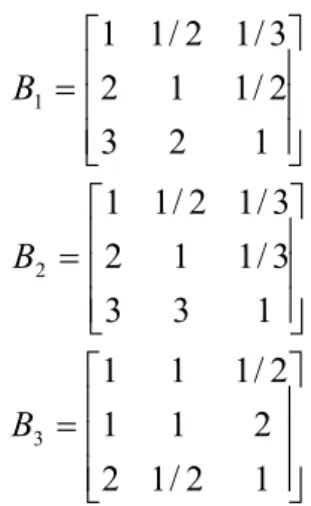
Here are the matrices in which it is compared the alternatives on each of the criteria:
1 2 3 2 / 1 1 2 3 / 1 2 / 1 1 1 B 1 3 3 3 / 1 1 2 3 / 1 2 / 1 1 2 B 1 2 / 1 2 2 1 1 2 / 1 1 1 3 B
In table 8 the values for geometric mean of criterion i and alternative k, obtained with formula 4.3 are presented:
Table 8. Values for geometric mean of criteria
GM11 0,5503 GM21 0,5503 GM31 0,7937
GM12 1 GM22 0,8735 GM32 1,2599
GM13 1,8171 GM23 2,0800 GM33 1
sum 3,3674 sum 3,5039 Sum 3,0536
The values for relative priority of criteria are computed using formula 4.4 and are presented in table 9.
Table 9. Sub-criteria for vendor-specific quality
PC11 0,1634 PC21 0,1570 PC31 0,2599
PC 12 0,2969 PC22 0,2493 PC32 0,4125
PC 13 0,5396 PC23 0,5936 PC33 0,3274
We obtain values of global priorities for alternative k (k=1, 2, 3):
PG 1 = 0,1760; PG 2 = 0,3048; PG 3 = 0,5190.
The global priority values are descendant ordered and the optimum choice in this case is the alternative 3 because it is the highest one.
6 Experimental results obtained through the online application
The algorithm is implemented and tested with the online application IAID, running an Apache server (version 2.2) for processing the PHP pages and a MySQL server (version 5.1) for hosting the database.
The implementation of the ranking algorithm is built in a wizard-like form, so that the user is guided through a series of steps in order to input data into the algorithm. After the last step the results are displayed presenting their interpretation in textual and graphical form.
Fig. 3. Alternatives definition The number of alternatives and the number
of criteria (initial data) were chosen in step 1. Therefore, in step 2 – figure 3, a number of 3 alternatives were defined (site of
e-commerce) in order to be explored. According to the literature, in step 3 – figure 4, the alternatives were used while for each of them 6 criteria were chosen [8] [12] [13].
Fig. 4.Evaluation criteria
The significance of the criteria chosen can be found in tables 2-5.
In step 4 the criteria’ weights are defined. The importance given to each criterion, with
values between 1 and 9 or fractions like 1 / x (with x between 1 and 9) to reverse the importance, can be seen in figure 5.
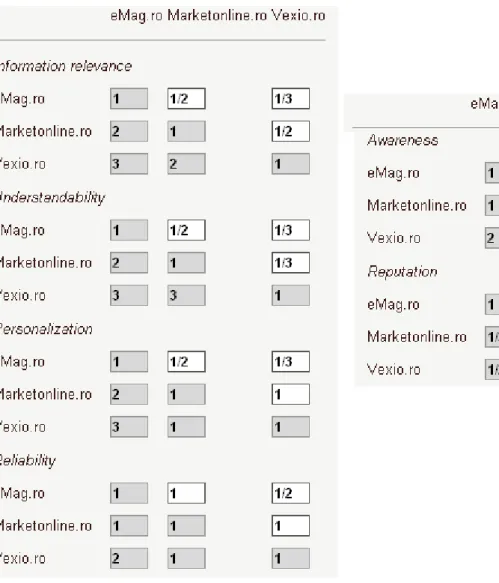
The significance of the values can be found in the description of each algorithm step. In step 5 are defined the alternatives’ weights. The importance given to each
alternative, with values between 1 and 9 or fractions like 1 / x (with x between 1 and 9) to reverse the importance, can be seen in figure 6.
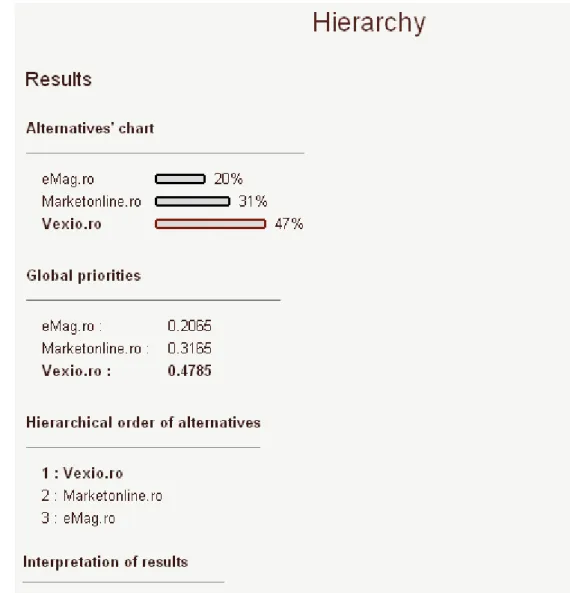
Fig. 6. Alternatives’ weights In figure 7, the results of the algorithm can
be observed (values of global priorities, the optimum choice).
The values for global priorities are 0.2065 for the alternative eMag.ro, 0.3165 for the alternative Marketonline.ro and 0.4785 for the alternative Vexio.ro. Figure 7 shows a ranking of these values in an ascendant order. The preferred website (the optimum choice) is the e-commerce website Vexio.ro.
Fig. 7. Results 7 Conclusion
Nowadays the competition increases daily. The businesses are required to show flexibility, in order to modify themselves to the stable situations of the market change, readiness for constant innovation and guarantee of quality for products and services. Even so there are e-commerce sites do not fully satisfy all the customer’s requirements, and those insufficiencies might eventually threaten the very existence of many of those companies in the market.
This article presents the cycle of development of e-Commerce applications and the e-Commerce applications which were subject to complex evaluations. By adopting DeLone and McLean’s IS success model and applying a ranking algorithm based on the AHP method, this study investigated factors
affecting the website selection, the factors’ relative importance, and the priority of alternative websites. In the end the study validated the ranking algorithm. This algorithm is chosen for the e-commerce sites, through the identification and ranking of their main quality characteristics, as well as an examination of the different developers and users’ points of view. To achieve the preferred quality of software products, it is necessary to produce models that allow evaluation of those products quality. According to ISO, the main purpose of software quality evaluation is to provide results to the software products that are reliable, understandable and acceptable to anyone interested. User satisfaction is also an important consideration.
In order to choose the preferred site of e-commerce applications, the goals of the customer are very important because:
Customer value should be the business driver for competitiveness
Customers are an essential and critical component of the information systems development and their participation and satisfaction allow the system to derive its value.
The system’s development focus is to construct a variety of components for the customer’s chain driven value in order to meet the customer’s changing value. The study showed that each of the four website quality factors were relevant criteria in selecting the preferred website.
The ranking algorithm solves a complex website selection problem. AHP can be applied to future studies solving various multi-criteria decision making problems in e-commerce areas, and also in e-business areas. The proposed ranking algorithm can be used by managers or designers as a guide in order to measure the quality level of their websites. At the same time, the model can be used to compare a company’s website quality level with that of the competitors.
References
[1] D.T. Green and J. M. Pearson, “The examination of two web site usability instruments for use in B2C e-commerce organizations,” Journal of Computer Information Systems, Vol. 49, No. 4, 2009, pp. 19-32
[2] T. Wang and Y. Lin, “Accurately predicting the success of B2B e-commerce in small and medium enterprises,” Expert Systems with Applications, Vol. 36, No. 2, published by Elsevier, 2009, pp. 2750–2758.
[3] M. Lazarica and I. Lungu, Aspecte privind proiectarea sistemelor de comert electronic, ASE Publishing House, 2007, pp. 147.
[4] http://www.networkcomputing.com/917/ 917f2.html
[5] I. Ivan, L. Săcuiu and D. Milodin, “Integrarea aplicaţiilor de comerţ
electronic,” Revista Română de Informatică şi Automatică, Vol. 19, No. 2, 2009, pp. 23 – 42.
[6] Y. Lee and K. Kozar, “Investigating the effect of website quality on e-business success: An analytic hierarchy process (AHP) approach,” Decision Support Systems, Vol. 42, No. 3, published by Elsevier, 2006, pp. 1383–1401.
[7] S. Värlander, “Online information quality in experiential consumption: An exploratory study,” Journal of Retailing and Consumer Services, Vol. 14, No. 5, 2007, pp. 328-338.
[8] E. K. Delice and Z. Gungor, “The usability analysis with heuristic evaluation and analytic hierarchy process,” International Journal of Industrial Ergonomics, Vol. 39, No.6, 2009, pp. 934–939.
[9] A. S. Jadhav and R. M. Sonar, “Evaluating and selecting software packages: A review,” Information and Software Technology, Vol. 51, No. 3, published by Elsevier, 2009, pp. 555– 563.
[10] http://en.wikipedia.org/wiki/Analytic_ Hierarchy_ Process
[11] M. Sambasivan and Y. Fei, “Evaluation of critical success factors of implementation of ISO 14001 using analytic hierarchy process (AHP): a case study from Malaysia,” Journal of Cleaner Production, Vol. 16, No. 13, published by Elsevier, 2008, pp. 1424-1433.
[12] Y. Zhang and J. Jiao, “An associative classification-based recommendation system for personalization in B2C e-commerce applications,” Expert Systems with Applications, Vol. 33, No. 2, published by Elsevier, 2007, pp. 357– 367.
[13] A. Oulasvirta and J. Blom, “Motivations in personalisation behaviour,” Interacting with Computers, Vol. 20, No. 1, published by Elsevier, 2008, pp. 1–16. [14] M. K. Chen and S. C. Wang, “The
critical factors of success for information service industry in developing international market: Using analytic
hierarchy process (AHP) approach,”
Expert Systems with Applications, Vol. 37, No. 1, published by Elsevier, 2010, pp. 694–704.
[15] I. Ivan and C. Boja, Metode statistice in analiza software, ASE Publishing House, Bucharest, 2004, Available at: http://www.ionivan.ro/book11.php
[16] J. Nantela and E. Glaser, “The impact of language and culture on perceived
website usability,” Journal of
Engineering and Technology Management, Vol. 25, No. 2, 2008, pp. 112– 122.
Marilena DUMITRACHE has a background in computer science and is interested in methods for ranking distributed applications. She has graduated the Faculty of Cybernetics of the Academy of Economic Studies in Bucharest. She is currently conducting doctoral research at the Academy of Economic Studies. Other fields of interest include e-commerce applications and project management.