Lin, Xi; Dai, Yan; Shi, Hui; Li, Chunmei
E-learners' satisfaction as predictors of online classroom community
Journal of Contemporary Education, Theory & Research 4 (2020) 2, S. 12-19Empfohlene Zitierung/ Suggested Citation:
Lin, Xi; Dai, Yan; Shi, Hui; Li, Chunmei: E-learners' satisfaction as predictors of online classroom community - In: Journal of Contemporary Education, Theory & Research 4 (2020) 2, S. 12-19 - URN: urn:nbn:de:0111-pedocs-210318 - DOI: 10.5281/zenodo.4256511
http://nbn-resolving.org/urn:nbn:de:0111-pedocs-210318 http://dx.doi.org/10.5281/zenodo.4256511
Nutzungsbedingungen Terms of use
Dieses Dokument steht unter folgender Creative Commons-Lizenz: http://creativecommons.org/licenses/by-nc-nd/4.0/deed.de - Sie dürfen das Werk bzw. den Inhalt unter folgenden Bedingungen vervielfältigen, verbreiten und öffentlich zugänglich machen: Sie müssen den Namen des Autors/Rechteinhabers in der von ihm festgelegten Weise nennen. Dieses Werk bzw. dieser Inhalt darf nicht für kommerzielle Zwecke verwendet werden und es darf nicht bearbeitet, abgewandelt oder in anderer Weise verändert werden.
This document is published under following Creative Commons-License:
http://creativecommons.org/licenses/by-nc-nd/4.0/deed.en - You may copy, distribute and transmit, adapt or exhibit the work in the public as long as you attribute the work in the manner specified by the author or licensor. You are not allowed to make commercial use of the work or its contents. You are not allowed to alter, transform, or change this work in any other way.
Mit der Verwendung dieses Dokuments erkennen Sie die Nutzungsbedingungen an.
By using this particular document, you accept the above-stated conditions of use.
Kontakt / Contact:
peDOCS
DIPF | Leibniz-Institut für Bildungsforschung und Bildungsinformation Informationszentrum (IZ) Bildung
E-Mail: [email protected] Internet: www.pedocs.de
C Copyrigh t © 200
© 2020 Authors. Published by International Hellenic University ISSN: 2654-0274. UDC: 658.8+338.48+339.1+640(05) http://doi.org/10.5281/zenodo.4256511
Published online: 30 October 2020 www.jcetr.gr© 200
Some rights reserved.
Except otherwise noted, this work is licensed under
https://creativecommons.org/licenses/by-nc-nd/4.0
E-learners’ satisfaction as predictors
of online classroom community
Xi Lin
East Carolina University, USA
Yan Dai
Auburn University, USA
Hui Shi
East China Normal University, China
Chunmei Li
Guangdong University of Foreign Studies, China
Abstract
Purpose: This study investigates Chinese college students’ satisfaction with using e-learning systems and its influences on their sense of online classroom community in synchronous, asynchronous, or a blend of both synchronous and asynchronous online course format during the COVID-19 pandemic. Methods: A total number of 307 college students were recruited with 270 usable responses from a southeastern university in China. E-learner satisfaction measurement and Classroom Community Scale (both with a 5-point Likert-type scale) were used as the instruments to investigate the research questions. Descriptive statistical analysis and multiple regression analysis were conducted in SPSS. Results: Results of the analysis show that Chinese college students’ satisfaction of using the e-learning system regarding the learner interface, learning community, content, and personalization positively impacts their sense of online classroom community no matter in synchronous, asynchronous, or a blend of both synchronous and asynchronous online course format.
Implications: A well-developed e-learning system would enhance students’ sense of online classroom community. Specifically, the user interface, interaction, content arrangement, and personalization should be focused on when developing the e-learning system.
Keywords: distance learning, online learning environment, e-learning system, sense of community
JEL Classification: I23, I29
Biographical note: Xi Lin ([email protected]) is an Assistant Professor in the College of Education at East Carolina University, USA. Yan Dai ([email protected]) M.Ed., is a PhD student in the Department of Educational Foundations, Leadership, and Technology at Auburn University, USA.Hui Shi ([email protected]) is a master’s student in the Department of Education Information Technology at East China Normal University, China. Chunmei Li ([email protected]) is the Dean of the Department of English at Guangdong University of Foreign Studies South China Business College, China. Corresponding author: Xi Lin ([email protected])
1 INTRODUCTION
With a rapid development of technology and an implementation of high-speed internet across the campus, universities in China have developed online programs specifically for continuing education (Li & Zhang, 2009). In terms of traditional higher education, online teaching is used as a supplement to the in-person teaching, while this blended teaching approach has been proved to enhance college student understanding of the course content (Tao, Zheng, Lu,
Liang, & Tsai, 2020), and to develop a deeper learning in collaboration and interaction (Sun, Liu, Luo, Wu, & Shi, 2017). Although college instructors have attempted to incorporate distance learning into in-person courses, the face-to-face instruction takes the predominant place. Therefore, compared with countries where online education has become prevalent in higher education for decades, universities in China are still at its early stage regarding implementing distance learning (Huang, Teo, & Zhou, 2020).
E-LEARNERS’ SATISFACTION AS PREDICTORS OF ONLINE CLASSROOM COMMUNITY 13
In the end of 2019, higher education institutions shut campuses in response to COVID-19. Then in early February 2020, all universities have moved to online teaching and learning according to the requirement of the Chinese Ministry of Education. This is the first time that college courses have been completely delivered online in universities across the nation. Further, the implementation of online education leads to an intense competition of learning management systems (LMSs) in the higher education market. Without one LMS (e.g., BlackBoard, Canvas, Moodle) that is used across universities, Chinese college instructors have integrated various online learning systems into their courses. For example, Chaoxing learning APP, which is a versatile and individualized learning application designed for mobile terminals has been widely used. This APP integrates resources, curriculum, evaluation, and interaction, and it enables instructors to provide real-time feedback to students (Bu, 2019).
Statistics reported that Chaoxing platform has stored and delivered more than 3 millions of eBooks, 1.8 millions of academic videos, 1.23 millions of course slides, and 30 millions of teaching resources (Lai, 2019). Similar to Chaoxing, Rain Classroom is another popular mobile learning tool that integrates the information publishing before class, the real-time answering and multi-screen interaction in class (Li & Song, 2018). This APP has been used in more than 2,300 Chinese universities (Lew, 2018). Tencent Classroom, with both webpage and mobile versions, consists of similar functions to Chaoxing and Rain Classroom. It supports both synchronous and asynchronous teaching instructions. The same company also develops Tencent Meeting, which is prevalent used especially in classes with a large size as it supports up to 300 attendees for online conferencing. Tencent has served over 70,000 educational institutes, with more than 300 million users (Liao, 2019). All of the above LMSs offer free faculty training and 24/7 IT support.
Thus, with the multiple choices, instructors design courses with their preferred LMSs in various formats. Scholars noted that building a sense of community is important in an online learning environment, as the feeling of community positively influences student engagement, performance, and retention (Stubb, Pyhältö, & Lonka, 2011). However, it may be the first time that many Chinese college students have attended an online classroom. Therefore, it is possible that their satisfactions of using the e-learning system influence their sense of online community. As a result, this study investigates 1) Chinese college students’ satisfactions of using the e-learning system, 2) and the relationship between their satisfactions of using the e-learning system and their sense of community, using their satisfactions as predictors.
2 LITERATURE REVIEW
2.1 E-learners’ satisfaction of the LMS
The LMS has been identified to provide multiple functions such as distributing the learning content, facilitating instructional activities, delivering various resources, monitoring testing and exams, and evaluating learning objectives (Shavan & Iscioglu, 2017). The LMS also offers
easy communication and collaboration between the instructor and students through online discussion boards. With the many benefits, the LMS has been used among universities to support and improve learning processes (Islam, 2016). Meanwhile, users’ satisfaction would impact the general evaluation of their experiences upon using the LMS. A higher rate of their satisfaction usually increases the benefits provided by the LMS (Almarashdeh, 2016; Haddad, 2018).
Several perspectives are concluded to meet users’ satisfaction. Almarashdeh (2016) investigated 110 college users and indicated that the perceived usefulness and service quality of the LMS contribute to their satisfaction. Similarly, Ghazel and colleagues (2017) examined 174 college students’ acceptance and satisfaction of LMS usage in a blended learning environment, and they also discovered that the system service quality was the most significant factor that positively influences students’ acceptance and satisfaction. Both studies indicated that the services and assistants’ attitudes provided by faculty in the LMS significantly impact students’ satisfaction of using it. The arrangement of course content in the LMS influences students’ satisfaction as well. Xu and Mahenthiran (2016) explored 319 college students’ overall satisfaction of Moodle indicated that students’ satisfaction depends on the organization and sequence of the course content, as well as the ease of using the LMS to engage with the course content. They further noted that a user-friendly LMS should be easy to navigate and have a straightforward interface.
Abdel-Maksound (2018) additional concluded that the ease of use and perceptions of usefulness are the key factors which determine students’ acceptance of the LMS. The capability of personalizing the online learning platform further enhances users’ satisfaction. For example, Sunkara and Kurra (2017) surveyed 622 college students in terms of using an e-learning system. Findings shown that students were not fully satisfied with the present e-learning system, with 65.6% of the participants expressed that they were either rarely or never provided with the precise course content of their choice. These results implied that a personalized e-learning system is needed so as to satisfy e-learners’ demands. Finally, the communication quality of the LMS also influences users’ satisfaction. Specifically, the easier to communicate with others in the LMS often result in a higher level of users’ satisfaction (Ohliati & Abbas, 2019).
2.2 Sense of classroom community
Community is the feeling of membership and belonging within a group (Yuan & Kim, 2014). Scholar concluded that “in a learning community, students work with peers, instructors, and staff to learn collaboratively and support each other in pursuing academic, social, and emotional goals” (Berry, 2017, p. 2). Students receive academic and social benefits if they feel a sense of community in an online learning environment (Lai, 2015). The sense of community also enhances classroom participation and students’ abilities of managing stress and emotional well-being (Stubb, Pyhältö, & Lonka, 2011). Therefore, it is significant to establish a sense of community in an online classroom.
When taking online courses, students are often engaged in either asynchronous, synchronous, or a blend of both distance
learning formats (Shoepe, et al., 2020). Synchronous distance learning refers to a learning activity that students and instructors engage in learning at the same time via audio and/or video conferencing (Ruiz, Mintzer, & Leipzig, 2006). Studies indicated that the synchronous online environment often leads to a positive learning experience (Clark, Strudler, & Grove, 2015). Students usually develop a stronger feeling of connection to their instructor and peers, and they are more engaged in classroom activities (Yamagata-Lynch, 2014). The real-time lectures and discussions along with the instance feedback and interaction would enhance students’ engagement and learning (Abdelmalak, 2015; Watts, 2016). To be specific, the real-time communication with others shortens students’ feeling of distance with their peers and the instructor which leads to a strong sense of community (Francescucci & Rohani, 2019; Pattillo, 2007).
On the other hand, in an asynchronous learning environment where learning does not happen in real time, instructors apply emails and online discussion boards to conduct interaction (Ruiz et al., 2006). The asynchronous distance learning usually provides flexibility as students do not have to be online at the same time, and they are able to self-pace their learning (Hrastinski, 2008; Pang & Jen, 2018). In other words, students can work at their own pace anytime and anywhere, and self-directed learning is often developed in asynchronous distance learning (Chaeruman & Maudiarti, 2018; Cho, Kim, & Choi, 2017). Students can also fully express their thoughts and ideas in an asynchronous online discussion board (Brierton, Wilson, Kistler, Flowers, & Jones, 2016). They usually feel comfortable and flexible to discuss topics in greater detail as they have more time to think before responding (Brierton et al., 2016). Thus, it is concluded that the asynchronous online environment often provides more opportunities for students to conduct a deeper learning (Lowenthal, Dunlap, & Snelson, 2017).
A combination of both synchronous and asynchronous distance learning has been identified as an efficient learning means and are often preferred by learners (Gregory, 2003). These two teaching types usually bring different benefits to student learning. For example, the asynchronous learning environment allows instructors to provide more content exposure to students who need extra time without slowing down the class. While in the synchronous learning setting, the instructor reads students’ body language so that to determine if they are confused and need additional assistance (Horvitz et al., 2019).
Students also feel that they are confirmed by both the teacher and their peers in the course (Norberg et al., 2017). This blended approach has been proved to be more efficient than a single asynchronous and synchronous teaching method. For instance, Ge (2012) compared a single asynchronous learning approach with a blended learning method in distance English education among 70 Chinese adult e-learners. Results indicated that this blended approach attained a significantly better result compared to the single asynchronous approach. Similarly, Xie and colleagues (2018) examined which e-learning approach is most suitable to support and enhance student learning, and they discovered that a blend of asynchronous and synchronous models is more desirable compared to either one used solely.
Accordingly, a good use of LMSs would enhance students’ sense of community through various interaction and collaboration activities (Haar, 2018). Rideout and colleagues (2008) examined the influence of implementation of an LMS on 34 pre-service teachers during their major pre-service practicum, and they found that participants perceived a higher sense of community when interacting with their peers, professors, and supervisors through this platform. They further concluded that the use of the LMS was the primary predictor of learners’ sense of community. As interaction is encouraged via group discussions, announcements, content topics, and instructional videos in the LMS, this platform creates a group site that students and instructors could access beyond regular courses, which further lead to a strong online community (Aldosemani, Shepherd, Gashim, & Dousay, 2016).
Most of the previous studies examined Chinese students’ sense of community in blend of face-to-face and online contexts instead of in fully online environments. Therefore, in a completely online context, this study investigates 1) Chinese college students’ satisfactions of using the e-learning system, 2) and the relationship between their satisfactions of using the e-learning system and their sense of community, using their satisfactions as predictors. It is expected that this study would enlighten Chinese higher education professionals to develop a strong online community and to establish a supportive distance learning environment.
3 METHODS
A convenience sampling procedure was used to recruit participants. College students in one southeastern university in China were invited. An invitation email with the link to the survey was sent through the English Department and lasted for one week. A total number of 307 students participated in the survey with 270 usable responses (usable rate equals to 87.9%).
All of the students have some experiences in synchronous, asynchronous, and blended online course formats during this time. Students were asked to think about one course format before answering the survey. Among those who completed the survey, 22 (8.1%) of them expressed their feelings towards synchronous online courses, 82 (30.4%) shared their thoughts regarding asynchronous online courses, and 166 (61.5%) conveyed their experiences about courses consist of both formats. Additionally, the e-learning system that used comprises several LMSs. Tencent Meeting and Rain Classroom were used for students to take synchronous and/or asynchronous lectures, and Chaoxing was used for conducting assignments, learning activities, and online discussion.
3.1 Instruments
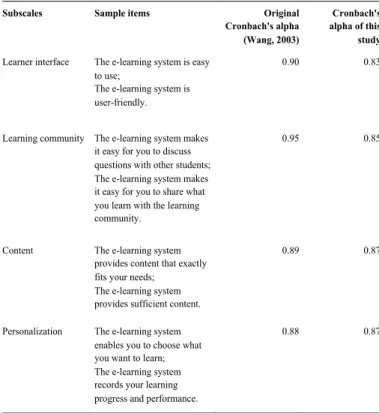
The instrument examining students’ satisfaction towards the e-learning system was adopted from Wang’s (2003) e-learner satisfaction measurement (ELS). This inventory assesses users’ satisfaction towards learner interface with 5 items, learning community with 4 items, content with 4 items, and personalization with 4 items. It is a 5-point Likert-type scale ranging from 1 (strongly disagree) to 5 (strongly agree).
E-LEARNERS’ SATISFACTION AS PREDICTORS OF ONLINE CLASSROOM COMMUNITY 15 Learner interface relates with the ease of using the e-learning
system, and learning community refers to the ease of communicating with others. Content associates with the ease of engaging with the course content, while personalization refers to the capability of managing and customizing one’s learning progress in this system. A higher score indicates a higher level of satisfaction towards using the e-learning system. A few modifications such as minor wording changes were made to the original items so that to make them fit into the context of this study (see Table 1).
Table 1. Sample items and Cronbach’s alpha of ELS
The instrument for measuring students’ online classroom community was adopted from Classroom Community scale (CCS) (Rovai, 2002). The CCS is a 20-item 5-point Likert-type scale, ranging from 1 (strongly disagree) to 5 (strongly agree). This survey evaluates students’ overall classroom community based on two subscales: connectedness and learning, each with 10 items. Connectedness refers to students’ feelings of the community “regarding their connectedness, cohesion, spirit, trust, and interdependence” (Rovai, 2002, p. 206). Three items were reversed, and a higher score indicates a higher level of connectedness. Learning means “the feelings of community members regarding interaction with each other as they pursue the construction of understanding and the degree to which members share values and beliefs concerning the extent to which their educational goals and expectations are being satisfied” (Rovai, 2002, p. 206-207). Seven items were reversed, and a higher score implies a higher level of interaction with other community members while sharing the understanding of the course content (see Table 2).
Table 2. Sample items and Cronbach’s alpha of CCS
3.2 Procedure
Students clicked on the survey link provided in the invitation email, then they read the informed consent and made a decision whether they were willing to participate in the study. The survey was anonymous which took approximately 8-10 minutes to complete. Students were able to withdraw the survey anytime by closing the website. The original items were in English and needed to be translated into Chinese. To guarantee the validity of the Chinese version of the measure, a standard translation and back-translation procedure was used (Hambleton & Patsula, 1998). This study was approved by IRB.
3.3 Data analysis
Listwise deletion method was used in this study, and data was analyzed via SPSS version 23. Descriptive statistics was used to examine students’ satisfaction of using the e-learning system, and a series of multiple regression using stepwise procedure was conducted to investigate the relationship between their satisfaction and the sense of community in synchronous, asynchronous, and blended online courses. The alpha level was set at .05. Harman’s single factor score was examined, and the total variance (ranges from 17.2% to 37.4%) for a single factor is less than 50%. Thus, common method bias did not affect the data (Podsakoff et al., 2003).
4 RESULTS
Overall, results of descriptive statistics show that students hold a slightly positive attitude to learner interface (M = 3.26, SD = 0.62). They also have a slightly positive experience towards learning community (M = 3.44, SD = 0.66), content (M = 3.51, SD = 0.58), and personalization (M = 3.51, SD = 0.64) of the e-learning system. In terms of the different teaching formats, students all have a slightly positive experience of each aspect when using the e-learning system (see Figure 1). To be specific, in synchronous online courses, students have a positive but close to neutral experience of learner interface (M = 3.16, SD = 0.66) and slightly positive experiences toward learning community (M = 3.45, SD = 0.82), content (M = 3.41, SD = 0.72), and personalization (M = 3.50, SD = 0.87). For asynchronous online courses, students are slightly satisfied with learner interface (M =
Subscales Sample items Original
Cronbach's alpha (Wang, 2003)
Cronbach's alpha of this study Learner interface The e-learning system is easy
to use;
The e-learning system is user-friendly.
0.90 0.83
Learning community The e-learning system makes it easy for you to discuss questions with other students; The e-learning system makes it easy for you to share what you learn with the learning community.
0.95 0.85
Content The e-learning system
provides content that exactly fits your needs;
The e-learning system provides sufficient content.
0.89 0.87
Personalization The e-learning system enables you to choose what you want to learn; The e-learning system records your learning progress and performance.
0.88 0.87
Subscales Sample items Original Cronbach's alpha (Rovai, 2002)
Cronbach's alpha of this study
Connectedness I feel that students in this course care about each other;
I feel isolated in this course.
0.92 0.87
Learning I feel that I am encouraged to ask questions; I feel that this course does not promote a desire to learn.
3.27, SD = 0.61), learning community (M = 3.47, SD = 0.65), content (M = 3.52, SD = 0.55), and personalization (M = 3.44, SD = 0.61). Similarly, in courses that combining both synchronous and asynchronous teaching formats, students hold a positive experience in all four aspects,
Mlearner_interface = 3.26, SD = 0.63,
Mlearning_community = 3.43, SD = 0.65, Mcontent = 3.52, SD = 0.57, and Mpersonalization = 3.54, SD = 0.62. One-way MANOVA was used to further examine if students experience differently based on the different teaching formats, while no significant difference was found (p = .58). Figure 1. Chinese college students’ ELS
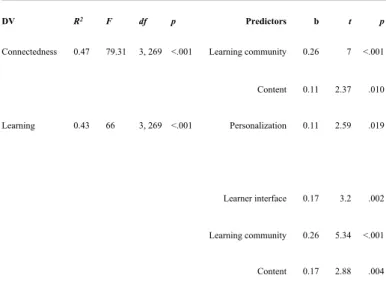
A series of multiple regression using stepwise procedure was conducted to investigate the relationship between students’ satisfaction of using the e-learning system and their sense of community (see Table 3). The three teaching formats were coded, with asynchronous and blended online courses dummy coded as 1, respectively.
Results indicated that learning community, content, and personalization predict the level of connectedness, F (3, 269) = 79.31, p < .001. Forty-seven percent of variance in the level of connectedness is accounted for by the linear combination of the satisfaction degree of these factors (R2 = 47%). For every unit the satisfaction degree of learning community increases, the level of connectedness increases by 0.26 unit while the rest factors remain the same (b = 0.26, t = 7, p < .001). For every unit the satisfaction degree of content increases, the level of connectedness increases by 0.11 unit (b = 0.11, t = 2.37, p = .019). Finally, for every unit the satisfaction degree of personalization increases, the level of connectedness increases by 0.11 unit (b = 0.11, t = 2.59, p = .01). Learning formats do not significantly influence students’ connectedness.
In terms of learning variable, learner interface, learning community, and content predict students’ levels of learning, F (3, 269) = 66, p < .001. Forty-three percent of variance in the level of learning is accounted for by the linear combination of the satisfaction of these factors (R2 = 43%). To be specific, when the satisfaction degrees of learning community and content stay the same, for every unit the satisfaction degree of learner interface increases, the level of learning increases by 0.17 unit (b = 0.17, t = 3.2, p = .002). Meanwhile, for every unit the satisfaction degree of learning community increases, the level of learning increases by 0.26 unit (b = 0.26, t = 5.34, p < .001). Lastly, for every unit the satisfaction degree of content increases, the level of learning
increases by 0.17 (b = 0.17, t = 2.88, p = .004). Learning formats do not significantly influence students’ feeling of learning interaction.
Table 3. Multiple Regression Results
5 DISCUSSION AND CONCLUSIONS
Overall, students are satisfied with using the e-learning system in terms of its interface, learning community, content, and personalization. Students have the highest satisfaction rate with the content and personalization, indicating that they feel engaged with the course content when using this system to conduct distance learning. This finding mirrors the previous statement that the organization and sequence of the course content along with the ease of using LMS to engage with the learning materials would impact students’ satisfaction (Xu & Mahenthiran, 2016).
Similar to previous conclusions that a personalized e-learning system usually meets users’ needs (Sunkara & Kurra, 2017), this study indicates that students are satisfied if they are able to customize and manage their learning progress while using the e-learning system. Additionally, as Ohliati and Abbas (2019) stated that communication via the LMS contributes to learners’ satisfaction, findings of this study indicates that the easier to communicate with others in the e-learning system, the higher degree of satisfaction students would have. Finally, students have a positive experience with learner interface implying that the e-learning system is easy to navigate, and it is user-friendly. However, students do not experience differently when using this system to conduct synchronous, asynchronous, or blended courses.
Further, content and learning community of the e-learning system link positively with both connectedness and learning variables. To be exact, how the course is organized and how the content is sequenced significantly influence the feeling of the community. Students who are more engaged with the course arranged in the e-learning system would develop a stronger sense of community. Additionally, the ease of interacting with others in this system also positively contributes to their sense of community. This finding echoes the previous conclusion that the e-learning system usually
DV R2 F df p Predictors b t p
Connectedness 0.47 79.31 3, 269 <.001 Learning community 0.26 7 <.001
Content 0.11 2.37 .010
Learning 0.43 66 3, 269 <.001 Personalization 0.11 2.59 .019
Learner interface 0.17 3.2 .002
Learning community 0.26 5.34 <.001
E-LEARNERS’ SATISFACTION AS PREDICTORS OF ONLINE CLASSROOM COMMUNITY 17
enhances students’ sense of community through various activities, which would develop a strong online community (Aldosemani, et al., 2016; Haar, 2018). Personalization of the e-learning system specifically associates with students’ feelings of connectedness, cohesion, sprits, trust, and interdependence. In other words, if students are able to customize and manage their learning progress while using the e-learning system, they would engage in this online learning environment. Additionally, the learner interface links with students’ feelings of interacting with other community members as they pursue the construction of understanding. The ease to navigating the e-learning system (i.e., locating the course content, interacting in the discussion board) would develop a strong sense of online community.
5.1 Implications and future study
Four aspects should be focused on when developing the LMS: user interface, interaction, content arrangement, and personalization. The interface is one important factor that influenced learners’ engagement. Vonderwell (2005) stated that students tend to have a high level of participation in the course if the interface of the LMS is visualized and well-organized. Developers should therefore provide an LMS with a user-friendly and straightforward interface. They should also pay attention to the design of the discussion board so as to enhance student engagement and socialization.
A well-designed discussion board enables students to participate in sharing and creating knowledge through exchanging thoughts, ideas, and information (Chootongchai, 2018; Muhisn et al. 2019). Two socialized structures are suggested for discussion boards: the physical form (e.g., brainstorming, audio or video discussion) to benefit synchronous interaction, and the online form (e.g., email, forum) to benefit asynchronous interaction (Barreto, 2004). If more than one LMSs are used, instructors should make a proper match of LMSs and the course content to maximize the effectiveness of the online learning (Sabitha et al., 2017). It would be beneficial if instructors can manage the content in a context that students can understand and relate to what they have learned (Dagger, 2002). In terms of personalization, it would be meaningful if the LMS records the trace of an individual’s learning progress (Avci & Ergun, 2019). In this way, students can evaluate, monitor, and self-regulate their learning progress according to their records, while instructors could provide specific feedback and customized learning content to individual student.
In conclusion, this study provides an overview of Chinese college students’ satisfaction towards using the e-learning system as well as the relationship between their satisfaction and the sense of community. Several limitations exist in the study. First, students were recruited in one department at this selected university. However, instructors within this department probably have different levels of familiarity with online teaching, which would influence the establishment of an online community. It is possible that some instructors are more experienced in online teaching and they create a stronger online community. Therefore, future studies should take the characteristics of instructors into consideration. Additionally, participants were recruited from the English Department, while different subject matters. In other words, instructors may assign more interactive activities or group
projects in non-STEM courses (e.g., English), while teacher-centered lectures are delivered in STEM courses (e.g., engineering). It is also possible that students in majors which require an advanced skill in using technology (e.g, computer) are more experienced using the e-learning system, thus they may have a high level of satisfaction. For this reason, future studies should compare students’ satisfactions of using the e-learning system and their sense of online community within the same field. Lastly, this study recruited participants from one university that located in a well-developed province. Therefore, future studies should be conducted in less developed provinces in order to indicate more comprehensive conclusions.
REFERENCES
Abdel-Maksoud, N. F. (2018). The Relationship between Students' Satisfaction in the LMS" Acadox" and Their Perceptions of Its Usefulness, and Ease of Use. Journal of Education and Learning, 7(2), 184-190.
Abdelmalak, M. M. M. (2015). Web 2.0 technologies and building online learning communities: Students’ perspectives. Online Learning, 19(2), 1-20.
Aldosemani, T. I., Shepherd, C. E., Gashim, I., & Dousay, T. (2016). Developing third places to foster sense of community in online instruction. British Journal of Educational Technology, 47(6), 1020-1031.
Almarashdeh, I. (2016). Sharing instructors experience of learning management system: A technology perspective of user satisfaction in distance learning course. Computers in Human Behavior, 63, 249-255.
Avci, U., & Ergun, E. (2019). Online students' LMS activities and their effect on engagement, information literacy and academic performance. Interactive Learning Environments. doi:10.1080/10494820.2019.1636088
Barreto, C., & D'Eredita, M. (2004). Unraveling expertise and knowledge creation: towards an instance-based model of knowledge (imok). In 37th Annual Hawaii International Conference on System Sciences, 2004. Proceedings of the (pp. 11-pp). IEEE.
Berry, S. (2017). Building community in online doctoral classrooms: Instructor practices that support community. Online Learning, 21(2), 1-22. doi: 0.24059/olj.v21i2.875 Brierton, S., Wilson, E., Kistler, M., Flowers, J., & Jones, D.
(2016). A comparison of higher order thinking skills demonstrated in synchronous and asynchronous online college discussion posts. NACTA Journal, 60(1), 14-21. Bu, X. (2019, October). The Blended Teaching Mode Based on
Chaoxing Learning APP—Taking Advanced English Course as an Example. In 2019 2nd International Conference on Education, Economics and Social Science (ICEESS 2019). Atlantis Press.
Chaeruman, U. A., & Maudiarti, S. (2018). Quadrant of Blended Learning: a Proposed Conceptual Model for Designing Effective Blended Learning. Jurnal Pembelajaran Inovatif, 1(1), 1-5. doi: https://doi.org/10.21009/JPI.011.01
Cho, M. H., Kim, Y., & Choi, D. (2017). The effect of self-regulated learning on college students' perceptions of community of inquiry and affective outcomes in online learning. The Internet and Higher Education, 34, 10-17. https://doi.org/10.1016/j.iheduc.2017.04.001
Chootongchai, S., & Songkram, N. (2018). Design and development of SECI and Moodle online learning systems to enhance thinking and innovation skills for higher education
learners. International Journal of Emerging Technologies in Learning (iJET), 13(03), 154-172.
Clark, C., Strudler, N., & Grove, K. (2015). Comparing asynchronous and synchronous video vs. text-based discussions in an online teacher education course. Online Learning, 19(3), 48-69.
Dagger, D., Wade, V., & Conlan, O. (2002). Towards a standards-based approach to e-learning personalization using reusable learning objects. In Learn: World Conference on E-Learning in Corporate, Government, Healthcare, and Higher Education (pp. 210-217). Association for the Advancement of Computing in Education (AACE).
Francescucci, A., & Rohani, L. (2019). Exclusively synchronous online (VIRI) learning: The impact on student performance and engagement outcomes. Journal of marketing Education, 41(1), 60-69. https://doi.org/10.1177/0273475318818864 Ge, Z. G. (2012). Cyber Asynchronous versus Blended Cyber
Approach in Distance English Learning. Educational Technology & Society 15(2), 286-297.
Ghazal, S., Aldowah, H., & Umar, I. (2017, April). Critical factors to learning management system acceptance and satisfaction in a blended learning environment. In International Conference of Reliable Information and Communication Technology (pp. 688-698). Springer, Cham.
Gregory, V. L. (2003). Student perceptions of the effectiveness of Web‐based distance education. New Library World, 104(10), 426-431.
Haar, M. (2018). Increasing sense of community in higher education nutrition courses using technology. Journal of nutrition education and behavior, 50(1), 96-99.
Haddad, F. S. (2018). Examining the effect of learning management system quality and perceived usefulness on student’s satisfaction. Journal of Theoretical and Applied Information Technology, 96(23).
Hambleton, R. K., & Patsula, L. (1998). Adapting tests for use in multiple languages and cultures. Social indicators research, 45(1-3), 153-171. https://doi.org/10.1023/A:1006941729637 Horvitz, B. S., Garcia, L. R., Mitchell, R. G., & Calhoun, C. D.
(2019). An Examination of Instructional Approaches in Online Technical Education in Community Colleges. Online Learning, 23(4), 237-252.
Hrastinski, S. (2008). Asynchronous and synchronous e-learning. Educause Quarterly, 31(4), 51-55.
Huang, F., Teo, T., & Zhou, M. (2020). Chinese students’ intentions to use the Internet-based technology for learning. Educational Technology Research and Development, 68(1), 575-591. https://doi.org/10.1007/s11423-019-09695-y Islam, A. N. (2016). E-learning system use and its outcomes:
Moderating role of perceived compatibility. Telematics and
Informatics, 33(1), 48-55.
https://doi.org/10.1016/j.tele.2015.06.010
Lai, J. (2019). SPOC Blended Teaching Mode Reform Based on Chaoxing Xuexitong Platform—a Case Study of Course of Real Estate Property Management. Course Education Research, 48,
Lai, K. W. (2015). Knowledge construction in online learning communities: A case study of a doctoral course. Studies in Higher Education, 40(4), 561-579. https://doi.org/10.1080/03075079.2013.831402
Lew, L. (April, 2018). Tsinghua University is using the cloud to make it rain in the classroom. Technode. Retrieved from https://technode.com/2018/04/19/rain-classroom/
Li, H., Zhang, H. (2009). The current status and future development of modern distance education in China. Higher Education and Research, 8, 28-31.
Li, X. & Song, S. (2018). Mobile technology affordance and its social implications: A case of “Rain Classroom”. British
Journal of Educational Technology, 49(2), 276-291. doi:10.1111/bjet.12586
Liao, R. (May, 2019). Tencent’s latest education push is a nod to new collaborative structure. TechCrunch. Retrieved from https://techcrunch.com/2019/05/23/tencent-education/ Lowenthal, P., Dunlap, J., & Snelson, C. (2017). Live synchronous
web meetings in asynchronous online courses: Reconceptualizing virtual office hours. Online Learning Journal, 21(4), 177-194.
Muhisn, Z. A. A., Ahmad, M., Omar, M., & Muhisn, S. A. (2019). The Impact of Socialization on Collaborative Learning Method in e-Learning Management System (eLMS). International Journal of Emerging Technologies in Learning, 14(20), 137-148.
Norberg, A., Stöckel, B., & Antti, M. L. (2017). Time shifting and agile time boxes in course design. International Review of Research in Open and Distributed Learning: IRRODL, 18(6), 88-103.
Ohliati, J., & Abbas, B. S. (2019). Measuring students satisfaction in using learning management system. International Journal of Emerging Technologies in Learning (iJET), 14(04), 180-189. Pang, L., & Jen, C. C. (2018). Inclusive dyslexia-friendly collaborative online learning environment: Malaysia case study. Education and Information Technologies, 23(3), 1023-1042. https://doi.org/10.1007/s10639-017-9652-8
Pattillo, R. E. (2007). Decreasing transactional distance in a web-based course. Nurse Educator, 32(3), 109-112. doi: 10.1097/01.NNE.0000270224.38543.2f
Podsakoff, P. M., MacKenzie, S. B., Lee, J.-Y., & Podsakoff, N. P. (2003). Common method biases in behavioral research: A critical review of the literature and recommended remedies. Journal of Applied Psychology, 88(5), 879–903. https://doi.org/10.1037/0021-9010.88.5.879
Rideout, G., Bruinsma, R., Hull, J., & Modayil, J. (2008). Online learning management systems (LMS) and sense of community: A pre-service practicum perspective. Canadian Journal of Learning and Technology/La revue canadienne de l’apprentissage et de la technologie, 33(3), 1-18.
Rovai, A. P. (2002). Development of an instrument to measure classroom community. Internet and Higher Education, 5, 197-211. https://doi.org/10.1016/S1096-7516(02)00102-1 Ruiz, J. G., Mintzer, M. J., & Leipzig, R. M. (2006). The impact of
e-learning in medical education. Academic Medicine, 81(3), 207–212. doi:10.1097/00001888- 200603000-00002
Sabitha, A. S., Mehrotra, D., & Bansal, A. (2017). An ensemble approach in converging contents of LMS and KMS. Education and information technologies, 22(4), 1673-1694.
Shayan, P., & Iscioglu, E. (2017). An assessment of students’ satisfaction level from learning management systems: case study of Payamnoor and Farhangian Universities. Engineering, Technology & Applied Science Research, 7(4), 1874-1878.
Shoepe, T. C., McManus, J. F., August, S. E., Mattos, N. L., Vollucci, T. C., & Sparks, P. R. (2020). Instructor Prompts and Student Engagement in Synchronous Online Nutrition Classes. American Journal of Distance Education, 1-17. https://doi.org/10.1080/08923647.2020.1726166
Stubb, J., Pyhältö, K., & Lonka, K. (2011). Balancing between inspiration and exhaustion: PhD students' experienced socio-psychological well-being. Studies in Continuing Education,
33(1), 33-50.
http://dx.doi.org/10.1080/0158037X.2010.515572
Sun, Z., Liu, R., Luo, L., Wu, M., & Shi, C. (2017). Exploring collaborative learning effect in blended learning environments. Journal of computer assisted learning, 33(6), 575-587. https://doi.org/10.1111/jcal.12201
Sunkara, V. M., & Kurra, R. R. (2017). An Analysis of Learner Satisfaction and Needs on E-Learning Systems. International
E-LEARNERS’ SATISFACTION AS PREDICTORS OF ONLINE CLASSROOM COMMUNITY 19 Journal of Computational Intelligence Research, 13(3),
433-444.
Tao, J., Zheng, C., Lu, Z., Liang, J. C., & Tsai, C. C. (2020). Cluster analysis on Chinese university students’ conceptions of English language learning and their online self-regulation. Australasian Journal of Educational Technology, 105-119. https://doi.org/10.14742/ajet.4844
Vonderwell, S., & Zachariah, S. (2005). Factors that influence participation in online learning. Journal of Research on Technology in Education, 38(2), 213–230.
Xie, H., Liu, W., & Bhairma, J. (2018, December). Analysis of Synchronous and Asynchronous E-Learning Environments. In 2018 3rd Joint International Information Technology, Mechanical and Electronic Engineering Conference (JIMEC 2018). Atlantis Press.
Xu, H., & Mahenthiran, S. (2016). Factors that influence online learning assessment and satisfaction: Using Moodle as a Learning Management System. International Business Research, 9(2), 1-18.
Yamagata-Lynch, L. C. (2014). Blending online asynchronous and synchronous learning. The International Review of Research in Open and Distributed Learning, 15(2). https://doi.org/10.19173/irrodl.v15i2.1778
Yuan, J., & Kim, C. (2014). Guidelines for facilitating the development of learning communities in online courses. Journal of Computer Assisted Learning,30(3), 220-232. http://dx.doi.org/10.1111/jcal.12042
SUBMITTED: APRIL 2020
REVISION SUBMITTED: JUNE 2020 2nd REVISION SUBMITTED: AUGUST 2020
ACCEPTED: SEPTEMBER 2020 REFEREED ANONYMOUSLY