Annual Report 2013-14
“YOUR SERVICE IS A GREAT EXAMPLE OF TIMELY,
WELL EXECUTED INTERVENTION HELPING BOOST
PRIVATE SECTOR PRODUCTIVITY BY HELPING PARTIES
AVOID COSTLY AND UNPRODUCTIVE LITIGATION.”
PUBLISHED BY THE VICTORIAN SMALL BUSINESS COMMISSIONER
September 2014 Annual Report 2013-14
This report is available at www.vsbc.vic.gov.au © State of Victoria 2014. This publication is copyright. No part may be reproduced by any process except in accordance with the provisions of the Copyright Act 1986.
AUTHORISED BY THE VICTORIAN SMALL BUSINESS COMMISSIONER Level 2 121 Exhibition Street Melbourne Victoria 3000 Telephone: 13 87 22 Toll Free: 1800 136 034 Facsimile: 03 9651 9943 Email: [email protected] Website: www.vsbc.vic.gov.au ISSN 1832-2018
Annual Report 2012-13
1
The Hon Russell NortheMinister for Small Business Level 16
121 Exhibition Street Melbourne VIC 3000
Dear Minister
Annual Report 2013-14
I am pleased to present to you the Annual Report on the operations of the Victorian Small Business Commissioner, covering the period 1 July 2013 to 30 June 2014.
The Report is provided to you under section 14(1) of the Small Business Commissioner Act 2003 (the Act), in order for you to cause the Report to be laid before each House of Parliament as required under section 14(2) of the Act. Yours sincerely
Geoff Browne
Victorian Small Business Commissioner
2
1 Overview of 2013-14 32 Our Services 5
3 Informing Victorian Businesses 8
4 Performance 2013-14 10
5 Amendments to the Small Business Commissioner Act 2003 13
6 Avoiding the Costs of Litigation 15
7 Small Business Commissioner Act 2003 19
8 Retail Leases Act 2003 22
9 Farm Debt Mediation Act 2011 25
10 Owner Drivers and Forestry Contractors Act 2005 27
11 Mediation Policy and Practices 29
12 Current and Emerging Issues 37
13 Building a Sustainable Organisation 40
14 Organisational Arrangements 41
15 Financial Statements 43
3
GEOFF BROWNE
VICTORIAN SMALL BUSINESS
COMMISSIONER
The major event of the year was the passage of the Small Business Commissioner Act Amendment Act 2014, with proclamation on 1 May 2014. The amendments to the Act broadened the scope of disputes my Office can deal with, and added additional powers to encourage parties to engage with my Office to resolve disputes. The amendments followed a consultation process commenced in March 2013. Details of the amendments are provided in Chapter 5. Two further significant outcomes were achieved during the year. Mediation rooms at 121 Exhibition Street, Melbourne were redeveloped to accommodate three mediation sessions concurrently, providing capacity to handle anticipated growth in mediation volumes over the next few years. Research into the costs to businesses involved in litigation at the Victorian Civil and Administrative Tribunal was completed, providing quantitative data on the costs that can be avoided by resolving disputes through mediation. The research also highlights the other adverse impacts of litigation on businesses – particularly small businesses. Chapter 6 summarises the results of this research. Applications for assistance continued to grow, up 2.3 per cent on 2012-13 to 1,711 applications. Consistent with changes first noted in 2012-13, the volume of applications relating to retail leases fell 7.8 per cent to 1,018, more than outweighed by growth in all other types of applications.
The majority of disputes received by the Office continued to be retail lease disputes, although falling to an historic low 59.4 per cent of total applications received. The long term trend rate of growth in retail lease disputes over the past eleven years is 4.6 per cent per annum. While retail lease dispute applications show some cyclical behaviour, there has been a declining trend since the commencement of 2012. It remains to be seen whether this reflects a structural shift in the incidence of such disputes through, for example, improved information and disclosure or an exacerbated cyclical downturn in disputes. Regardless, the reduction in the absolute number of retail lease disputes over the past two years is a welcome outcome.
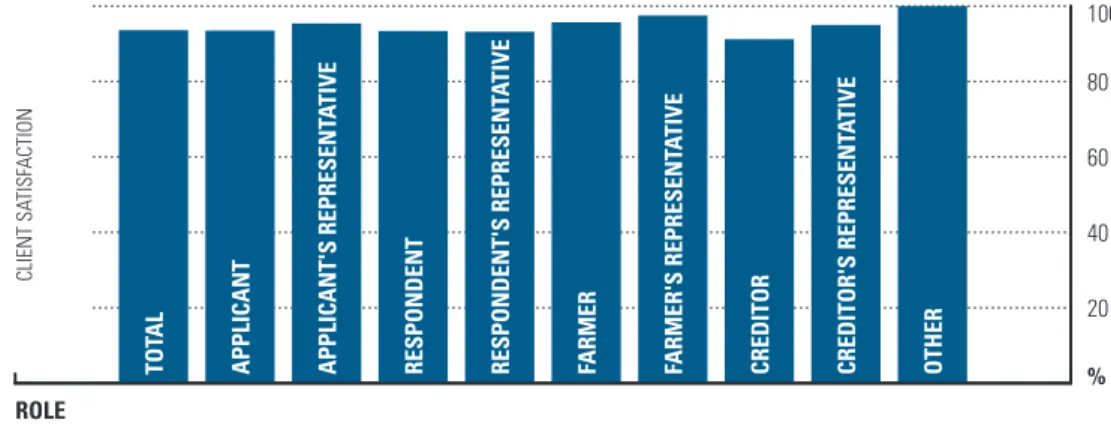
Our mediation settlement rate across all disputes continued at a high 82.7 per cent for the year, marginally lower than last year’s result. High satisfaction ratings by mediation participants also continued at 93.6 per cent. The proportion of disputes settled by staff prior to mediation, at no cost to the parties, jumped from 18.4 per cent last year to 26.6 per cent in 2013-14.
Informing businesses and their advisers of the services my Office provides continued to be a major part of our activities during the year, through multiple channels. Chapter 3 outlines our activities during the year. We continued to work closely with Small Business Commissioners in other States and nationally, and contributed to major reviews. Submissions were made to the review of the Commonwealth Franchising Code, and on the role and functions of the proposed Australian Small Business and Family Enterprise Ombudsman. A submission on the extension of Unfair Contract Term protections to small businesses was also in preparation following the release of a Commonwealth Discussion Paper in May. My Office receives many disputes over terms in the ‘fine print’ of business contracts which, if in consumer contracts, would be considered unfair and void.
CHAPTER 1
4
I was fortunate to have the opportunity to present a paper on the role of the Victorian Small Business Commissioner (VSBC) to a Small Business Conference in Cardiff, UK, in November 2013. I also met with many organisations to discuss the VSBC dispute resolution model and progress with alternative dispute resolution (ADR) in the European Union (EU), following the EU Parliamentary Directive of 2008. This Directive mandated ADR for cross border commercial disputes and encouraged use of ADR for within-border commercial disputes for all member states. There was a great deal of interest in the VSBC model, as no similar model applied in the EU. Encouragement and take up of ADR for commercial disputes appears sporadic across EU member states, ranging from mandatory ADR for most types of disputes in Italy (driven primarily by the inertia of the court system), to reliance on the private sector to demand and provide ADR services in the UK, unless ordered by a Court. The VSBC model – subsidised mediation outside the civil justice system, with statutory referral of some disputes to the VSBC, and settlement rates exceeding 80 per cent – appears a uniquely Australian model, driven primarily by the benefits to business rather than attempts to reduce Court volumes.During the year, the Small Business portfolio responsibility shifted from the Hon. Louise Asher MP to the Hon. Russell Northe MP. I would like to thank both Ministers for their support for this Office during the year. I also appreciate the assistance provided by the Department of State Development, Business and Innovation.
TESTIMONIAL
“I had a very positive experience of your mediation service and want to pass on my thanks and some details of my experience.
I attended a presentation you gave to a small group of retailers at a lease forum run by the Australian Retailers Association in Geelong recently. Until then I did not know about the existence of the Small Business Commissioner or your role in resolving tenancy disputes.
I had recently become embroiled in a dispute with a Landlord that seemed destined for expensive and time consuming litigation. Even my (expensive) lawyer didn’t seem aware of the option and requirement for mediation before proceeding to VCAT.
We had a mediation session this morning, led by one of your mediators. He was calm, thoughtful, concise, helpful and patient. As a result we came to an agreement, signed and delivered within 3 hours and avoided considerable expense, time and angst. The latest catchcry from Canberra is increased productivity. Your service is a great example of timely, well executed intervention helping boost private sector productivity by helping parties avoid costly and unproductive litigation. A big well done and thanks.
Regards, Toby Darvall CEO Ishka August 2013
5
PuRPOSE
The Victorian Small Business Commissioner (VSBC) was established by the Small Business Commissioner Act 2003 to enhance a competitive and fair operating environment for small business in Victoria. The VSBC has a range of functions under that Act, including dispute prevention and dispute resolution. The VSBC also has statutory dispute resolution and prevention functions under the Retail Leases Act 2003 (RL Act), the Owner Drivers and Forestry Contractors Act 2005 (ODFC Act) and the Farm Debt Mediation Act 2011 (FDM Act). On 30 June 2014, the proclamation of the Transport Legislation Amendment (Foundation Taxi and Hire Car Reforms) Act 2013 (Taxi Act) provided the VSBC with a dispute resolution function for disputes between taxi drivers and taxi operators that have not been settled by the Taxi Services Commission and are amenable to mediation.
During 2013-14 the predominant activity of the VSBC was providing a quick, low cost and effective dispute resolution service for businesses in dispute with other businesses. The VSBC also deals with disputes between business and local or state government, or with not-for-profit entities.
There is no statutory definition of ‘small business’ in any legislation administered by the VSBC, and the VSBC accepts disputes from any sized business.
DISPuTE RESOLuTION SERVICES
There are three main elements:INFORMATION AND EDUCATION
The VSBC provides information to businesses on their rights and obligations under relevant legislation to assist them to prevent disputes arising, or resolve the disputes where they do arise. Information is provided by telephone, email, printed materials and through the website. In addition, the VSBC and staff regularly meet with stakeholder groups and businesses to inform them of the services available through the Office. These services are available at no cost to the parties. PRELIMINARY ASSISTANCE AND RESOLUTION When an application for assistance with a dispute under the RL Act, the SBC Act or the ODFC Act is received by the VSBC, staff will initially engage with both parties to see if the dispute can be resolved before proceeding to mediation. Staff expertise in legislative provisions can often assist in bringing the parties to a resolution. If the dispute cannot be resolved at this stage, staff will explain the benefits of mediation to the parties and encourage them to participate, avoiding the emotion, delay, cost and distraction of litigation. These services are available at no cost to the parties.
This process does not apply for disputes under the FDM Act, where the VSBC role is limited to arranging and conducting mediation, or the Taxi Act, where the Taxi Services Commission performs this function, and refers an unresolved dispute to the VSBC only for mediation.
CHAPTER 2
6
MEDIATIONThe timely, low cost resolution of a dispute through mediation can maintain a business relationship and let the parties quickly get back to business. A binding Terms of Settlement between the parties brings clarity and control to resolution of the dispute. Each party to mediation contributes $195 ($95 for mediations under the ODFC Act and the Taxi Act) toward the cost of the mediation, which is otherwise subsidised by the VSBC. Mediations are held in locations to meet the needs of the parties.
Amendments to the SBC Act from 1 May 2014 enable the VSBC to determine what form of alternative dispute resolution (ADR) is most appropriate to use in dealing with a dispute.
DO PARTIES hAVE TO uSE ThE VSBC
SERVICES?
Disputes under the RL Act and the ODFC Act must be referred to the VSBC for attempted dispute resolution before they can progress to litigation at the Victorian Civil and Administrative Tribunal (VCAT) as the relevant jurisdiction. If mediation is unsuccessful, the VSBC can issue a certificate enabling a party to proceed to litigation at VCAT.
While these disputes must be referred to the VSBC, there is no compulsion on a respondent party to participate in mediation with the VSBC. However, if the VSBC certifies that a party has refused to engage in ADR and the matter proceeds to VCAT, VCAT has discretion to award costs against the refusing party.
Where a farmer is in default of a farm debt, the FDM Act requires a creditor to notify the farmer that the farmer has a statutory right to request mediation through the VSBC. However, if the farmer does not exercise that right within 21 days, the creditor may proceed with enforcement action. Where mediation occurs and the VSBC determines that the mediation was ‘satisfactory’, a certificate issued to the creditor enables the creditor to take enforcement action, although compliance with Terms of Settlement reached at mediation may forestall such action. There is no compulsion on either party to attend VSBC mediation. However, if a farmer refuses, a certificate enables the creditor to proceed with enforcement action. If a creditor refuses, a certificate prevents the creditor from taking enforcement action.
There is no statutory obligation for a dispute under the SBC Act to be brought to the VSBC, and until 1 May 2014 no certificate process existed. Parties can elect to litigate a matter at VCAT or the Courts, as appropriate, without use of VSBC ADR services. Amendments to the SBC Act from 1 May 2014 introduced a certificate process which enables the VSBC to certify that a party has ‘unreasonably refused’ to engage in ADR with the VSBC, and name that refusing party in the VSBC Annual Report. However, there remains no obligation for these disputes to be brought to the VSBC. Further details of the SBC Act amendments and ‘unreasonable refusal’ are provided in Chapter 5.
Under the Taxi Act, if a dispute lodged with the Taxi Services Commission is not resolved and the dispute is amenable to a mediated outcome, the Taxi Services Commission issues a certificate to the parties advising that the dispute may be referred to the VSBC. A party does not have to act on such a certificate, but cannot take the dispute directly to VCAT without first progressing to the VSBC for mediation.
7
INVESTIGATIONS
The VSBC can undertake investigations under the SBC Act. Often an investigation arises when similar types of disputes are received – whether in terms of business conduct, type of issue, common party, or common industry – and rather than address the issue on a case by case basis for each dispute, the VSBC seeks to understand the underlying systemic causes or drivers for these repeated situations and works to address these causes or drivers.
An example of such systemic causes is the widespread use of terms in Waste Management Service standard form contracts which, if in consumer contracts, would be unfair and void. In response to a number of disputes relating to such terms, in addition to progressing each individual dispute, the VSBC met with the Victorian Waste Management Association to highlight and discuss the issue, and presented on the issue at the Association’s industry conference in May 2014. Chapter 12 provides further details on this issue. The VSBC also endeavours to facilitate more effective relationships between government agencies and their small business customers and suppliers. Government is both a service provider to small business and a purchaser from small business. Applications to assist with disputes with government agencies are received by the VSBC and may be handled either as one-off disputes, or as investigations if there appears to be systemic issues at play. Amendments to the SBC Act from 1 May 2014 make clear that the VSBC has jurisdiction for commercial disputes between small businesses and local or state government entities. When investigations are completed, if matters remain unresolved the VSBC may make representations to relevant persons or bodies, advise the Minister on the issue in question, or report on the matter through the Annual Report.
OThER ADMINISTRATIVE FuNCTIONS
The VSBC has a range of administrative functions under the RL Act, including appointing Specialist Retail Valuers, issuing certificates to waive a tenant’s right to a minimum 5 year lease term, and assessing applications seeking exemption certificates where a lease is exempt from the RL Act due to the application of certain Ministerial Determinations.Under the ODFC Act, the VSBC issues certificates on application by a contractor seeking to waive the contractor’s obligation to provide a minimum period of notice of termination to the hirer.
8
A major focus of the Victorian Small Business Commissioner (VSBC) during the year continued to be informing businesses and their advisers, through multiple channels, of the services provided by the VSBC.PRESENTATIONS
A total of 70 presentations were made by the VSBC during the year, including events for the Small Business Festival in August 2013.
Information sessions hosted by local councils were held throughout the year in metropolitan and regional locations, supplemented by presentations at the Victorian Consumer and Business Centre at 113 Exhibition St. Regional locations visited are shown below.
GRAPH 3.1 LOCATIONS OF PRESENTATIONS 2013-14
Nine presentations were made to groups of accountants or lawyers. The VSBC attended fourteen business expos during the year including the Franchising Expo, the Nillumbik Small Business Expo and the Australian Booksellers Association Conference. In addition to the opportunity to explain to visitors to the expos the services the VSBC provides, staff at the expos also visit all other stands to ensure exhibiting businesses are aware of our services. The VSBC often shares a stand with Small Business Victoria at these and similar events, providing a one-stop information service for Victorian businesses.
Presentations were given to industry groups including the Lottery Retailers Association, the Property Council leases committee, the Association of Investigators and Security Professionals, Master Electricians, and LEADR. In addition, the VSBC participated in workshops on retail leasing conducted by the Australian Retailers Association across Victoria.
ONLINE
Following a review of its website early in the year, the VSBC entered into a contract to redevelop the website in March 2014. The redevelopment will make the website more accessible and more easily navigable. It will also move from a quite legalistic approach to a more contemporary style.
The website plays a key role in providing information to businesses and their advisers on VSBC services, dealing with disputes, and legislative requirements. Over the past four years, the average number of unique visitors to the website has increased from 2,400 per month in 2010-11 to 4,700 per month in 2013-14. Importantly, the number of new visitors to the site has increased noticeably, to 69 per cent of all visits in 2013-14 as shown in Graph 3.2. The use of the domain name www.vsbc.vic.gov.au commenced in September 2012, together with the 13 VSBC (13 8722) phone number, to reinforce consistent branding across all communication channels.
CHAPTER 3
9
GRAPH 3.2 WEBSITE uSERS 2010-11 TO 2013-14
% 10 20 30 40 50 60 70 80
Average monthly users New visitors % 5 4.5 4 3.5 3 2.5 2 1.5 1 000s 0.5 2010-11 2011-12 2012-13 2013-14 2010-11 2011-12 2012-13 2013-14 % 10 20 30 40 50 60 70 80 5 4.5 4 3.5 3 2.5 2 1.5 1 000s 0.5 2010-11 2011-12 2012-13 2013-14 2010-11 2011-12 2012-13 2013-14 2440 42.6% 2850 44.3% 3580 51.0% 4666 68.6% 38.4 42.6% 45.6 44.3% 57.28 51.0% 74.656 68.6% Interest in the services of the VSBC by accountants
has been assisted by a video, produced by the Institute of Public Accountants and sent to all their members via YouTube. This video is also accessible from the VSBC website, and provides a brief overview of VSBC services. The video was updated in late 2013-14 following proclamation of amendments to the Small Business Commissioner Act 2003.
TELEPhONE
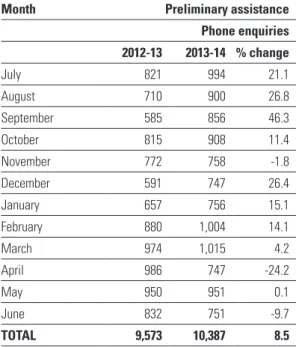
Calls to the VSBC during the year increased 8.5 per cent to 10,387. The 13 VSBC (13 8722) number is a major information channel for the VSBC.
INFORMATION ShEETS AND
GuIDELINES
A range of documents can be downloaded from the website. These include Information Sheets on various aspects of the Retail Leases Act 2003, such as Outgoings (including the Fire Services Levy), Key Money, and What are Retail Premises?, as well as the Information Brochure required by law to be provided by a landlord to a prospective tenant prior to a lease being entered into.
Guidelines on what factors the VSBC takes into account in determining if a business has unreasonably refused to engage in alternative dispute resolution (ADR) were published on the website on 1 May 2014, coinciding with the commencement of amendments to the Small Business Commissioner Act 2003.
BROChuRES
A set of brochures profiling VSBC services is available for downloading from the website as well as in hard copy. This information is in high demand at business expos and other major events which can involve hundreds of businesses.
MuLTICuLTuRAL ENGAGEMENT
The VSBC provided ten articles on its services, in Mandarin, to The New Land, a weekly publication for recent and longer term Chinese immigrants. A Mandarin-speaking VSBC staff member also presented to more than fifty recently arrived Chinese business migrants, via the Adult Migrant Education Service, on VSBC services and tips and traps in buying a business or entering into contracts.10
NuMBER OF APPLICATIONS
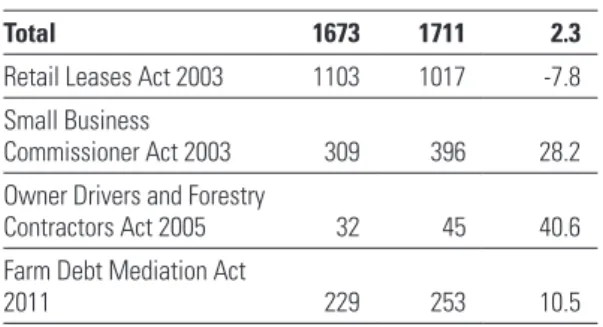
The number of applications in 2013-14 grew 2.3 per cent from 2012-13 levels. The Office received 1,711 applications in 2013-14 compared to 1,673 applications in 2012-13.
Consistent with changes first noted in 2012-13, the volume of applications relating to retail leases fell 7.8 per cent to 1,017, more than outweighed by growth in all other types of applications.
The majority of disputes received by the Office continued to be retail lease disputes, although falling to an historic low 59.4 per cent of total applications received. The long term trend rate of growth in retail lease disputes over the past eleven years is 4.6 per cent per annum.
In 2013-14, the number of general commercial disputes lodged under the Small Business Commissioner Act 2003 increased by 28.2 per cent. However, the total number of these matters is still below the 2010-11 levels.
The number of owner driver disputes was up by more than 40 per cent while 253 applications (increase of 10.5 per cent) were received under the Farm Debt Mediation Act 2011.
TABLE 4.1 APPLICATIONS RECEIVED 2013-14
2012-13 2013-14 increase%
Total 1673 1711 2.3
Retail Leases Act 2003 1103 1017 -7.8 Small Business
Commissioner Act 2003 309 396 28.2
Owner Drivers and Forestry
Contractors Act 2005 32 45 40.6
Farm Debt Mediation Act
2011 229 253 10.5
Retail lease applications fell to 59.4 per cent of all matters referred to the Office during the year, down from 65.9 per cent in the previous year. The proportion of general commercial disputes referred under the Small Business Commissioner Act 2003 grew to 23.1 per cent, up from 17.8 per cent in the previous year (still well down from the 2010-11 level of 29.5 per cent). Owner driver disputes were less than 3 per cent of the total number of applications. In the second full year of the operation of the Farm Debt Mediation Act 2011, farm debt matters comprised 14.8 per cent of all applications, up from 13.7 per cent in 2012-13.
FIGURE 4.1 APPLICATIONS RECEIVED BY JuRISDICTION
Small Business Commissioner Act 2003 (SBCA)
Owner Drivers and Forestry Contractors Act 2005 (ODFCA) Farm Debt Mediation Act 2011 (FDMA)
Retail Leases Act 2003 (RLA)
Small Business Commissioner Act 2003 (SBCA)
Owner Drivers and Forestry Contractors Act 2005 (ODFCA) Farm Debt Mediation Act 2011 (FDMA)
Retail Leases Act 2003 (RLA)
PROFILE OF APPLICANTS
During the year, the Victorian Small Business Commissioner (VSBC) commenced asking applicants to indicate on the application form the number of employees in their business. This information was provided by 181 applicants, which showed: > 19.9 per cent had 0 employees > 50.8 per cent had 1-4 employees > 22.7 per cent had 5-19 employees > 6.7 per cent had 20 plus employees
CHAPTER 4
11
DISPuTE RESOLuTION SuCCESS RATES
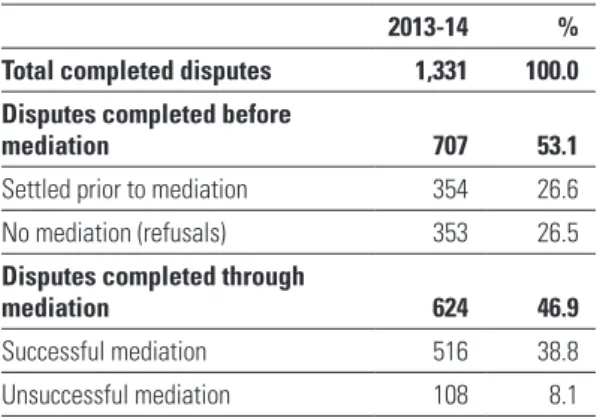
Between 1 July 2013 and 30 June 2014, 1,331 matters were completed through the VSBC’s dispute resolution process. A number of matters still in process were incomplete as at 30 June 2014.
The table below outlines the outcomes for completed matters. Pre-mediation dispute resolution remains a focus of the Office, with 26.6 per cent of matters resolved in this way.
TABLE 4.2 DISPuTE APPLICATION OuTCOMES
2013-14 %
Total completed disputes 1,331 100.0
Disputes completed before
mediation 707 53.1
Settled prior to mediation 354 26.6
No mediation (refusals) 353 26.5
Disputes completed through
mediation 624 46.9
Successful mediation 516 38.8
Unsuccessful mediation 108 8.1
Of the disputes which were referred to mediation, 82.7 per cent were successfully resolved. The settlement rate varies from 77.6 per cent to 96.3 per cent across jurisdictions. Nineteen per cent of mediations were conducted in regional Victoria.
TABLE 4.3 MEDIATION OuTCOMES BY VENuE AND JuRISDICTION
Venue Completed Mediations
Mediations held VSBC Metro RegionalOther Total Successful successfulun- Success Rate Adjourned
100.0% 78.9% 2.1% 19.0% 87.4% TOTAL 100.0% 714 563 15 136 624 516 108 82.7% 90 RLA 67.9% 485 412 10 63 424 329 95 77.6% 61 SBCA 10.5% 75 71 2 2 63 59 4 93.7% 12 FDMA 17.2% 123 50 3 70 109 105 4 96.3% 14 ODFCA 4.3% 31 30 0 1 28 23 5 82.1% 3
RLA Retail Lease Act 2003
SBCA Small Business Commissioner Act 2003 FDMA Farm Debt Mediation Act 2011
12
PRELIMINARY ASSISTANCE – PhONE
ENquIRIES
A significant element of the VSBC work involves taking calls from small business and providing assistance on issues. The majority of queries relate to rights and obligations under retail leases, with a further significant proportion involving disputes which arise between businesses more generally.
The Business Victoria Contact Centre (BVCC) was once again the first point of contact for preliminary phone enquiries, with only a limited number of calls requiring higher level of expertise transferred to the VSBC’s dispute management officers.
TABLE 4.4 PRELIMINARY ASSISTANCE – PhONE ENquIRIES
Month Preliminary assistance
Phone enquiries 2012-13 2013-14 % change July 821 994 21.1 August 710 900 26.8 September 585 856 46.3 October 815 908 11.4 November 772 758 -1.8 December 591 747 26.4 January 657 756 15.1 February 880 1,004 14.1 March 974 1,015 4.2 April 986 747 -24.2 May 950 951 0.1 June 832 751 -9.7 TOTAL 9,573 10,387 8.5
13
In March 2013 the Hon Louise Asher MP, then Ministerfor Small Business, released a Consultation Paper seeking submissions on whether the role and functions of the Victorian Small Business Commissioner (VSBC) continued to be relevant and appropriate, or whether some changes should be made.
Following from that consultation process, amendments to the Small Business Commissioner Act 2003 (SBC Act) took effect from 1 May 2014.
The amendments aim to increase and make clear the range of matters the VSBC can deal with, prevent disputes arising, and encourage parties to disputes to use alternative dispute resolution to resolve them, avoiding the costs and other adverse consequences of litigation.
BROADENING ThE SCOPE OF MATTERS
ThE VSBC CAN hANDLE
The amendments broaden the type of disputes the VSBC can deal with from matters involving ‘unfair market practices’ to also include ‘commercial dealings’ between parties. The amendments further make explicit that disputes between businesses and local government and state government bodies fall within the scope of the SBC Act. Both amendments address issues that have arisen in the past where businesses have refused to deal with the VSBC on the grounds that their conduct did not constitute ‘unfair market practices’, and government bodies have refused to engage as the SBC Act did not expressly include reference to government bodies.
Disputes dealt with under the SBC Act are those disputes which do not fall within the ambit of any of the other legislation administered by the VSBC, and include disputes relating to franchises, non-retail leases, buying and selling a business, distribution agreements, and supply chain issues.
ABILITY TO REFuSE TO DEAL WITh
CERTAIN COMPLAINTS
The amendments provide the VSBC with the authority to refuse to deal with a complaint under the SBC Act if it is trivial or vexatious, it is unlikely to be resolved through alternative dispute resolution, or it is more appropriately dealt with by another entity.
ABILITY TO DETERMINE ThE MOST
APPROPRIATE FORM OF ALTERNATIVE
DISPuTE RESOLuTION
There are various types of alternative dispute resolution, including mediation, conciliation, arbitration, facilitated meetings, and preliminary assistance. The amendments broaden the range of potential approaches the VSBC may take in dealing with a dispute.
POWER TO ISSuE CERTIFICATES
The VSBC now has the authority to issue a certificate relating to a dispute under the SBC Act:> where alternative dispute resolution has been attempted, but has been unsuccessful;
> where alternative dispute resolution is unlikely to resolve the dispute; or
> where a party has unreasonably refused to participate in alternative dispute resolution. Such certificates may be admitted in evidence in proceedings before the Victorian Civil and Administrative Tribunal (VCAT) or a Court.
CHAPTER 5
14
NAMING A PARTY IN ThE ANNuAL
REPORT
The amendments provide the VSBC with the power to include in its Annual Report to Parliament the name of a party which has unreasonably refused to engage in alternative dispute resolution with the VSBC. Due processes must be followed before the VSBC determines to publish such information. Guidelines on what factors the VSBC will take into account in determining whether or not refusal has
been unreasonable have been developed and are published on the VSBC website.
SEEkING AN ADVISORY OPINION
FROM VCAT
The amendments provide the power for the VSBC to refer a matter to VCAT for an Advisory Opinion, including matters relating to the performance of his or her functions or the exercise of powers under any Act, where in the public interest to do so.
On 16 May 2014 the VSBC lodged an application at VCAT seeking an Advisory Opinion on the inter-relationship of a landlord’s obligations to comply with Essential Safety Measures under the Building Act 1993 and the operation of the Retail Leases Act 2003. This is an issue which has led to disputes and legal debate over the past two years. A summary of the issue is included in Chapter 8.
STATuTORY IMMuNITY
The amendments provide the VSBC or another person performing an alternative dispute resolution function of the VSBC under the SBC Act or any other Act statutory immunity in the performance of that function, where undertaken in good faith.
This change ensures a consistency in protection of the VSBC, staff and mediators across all five Acts where the VSBC has a dispute resolution function.
15
BACkGROuND
In 2012 the Victorian Small Business Commissioner (VSBC), in conjunction with the Victorian Civil and Administrative Tribunal (VCAT), commissioned research to quantify the costs incurred by businesses involved in litigation of certain business-to-business disputes at VCAT. The research also sought information on the time taken for the litigation to be finalized, and asked survey participants if there were any other adverse impacts of the litigation on them and their business.
The research sought to fill a gap in quantitative evidence supporting the proposition that resolution of disputes through alternative dispute resolution saves businesses time and money, compared with the alternative of litigation.
ThE SAMPLE
All businesses involved in VCAT litigation concluded in both the Civil Claims List and the Retail Tenancy List in 2012 were initially contacted. Many businesses were involved in multiple VCAT matters during the year, and others elected not to participate in the survey. A total of around 1,000 businesses agreed to receive an online survey, and 312 completed the survey. Seventy seven per cent of participants were litigation applicants, the balance litigation respondents.
The VCAT Civil Claims List handled over 9,000 disputes in 2012-13, and the list is dominated by claims under $10,000. In comparison, the Retail Tenancy List dealt with 333 matters in 2012-13, a high proportion of which were injunction applications. Only 30 per cent of these disputes were less than $10,000.
Disputes dealt with by the VSBC under the Retail Leases Act 2003 and the Small Business Commissioner Act 2003 average around $80,000. While the final survey sample was dominated by Civil Claims disputes of less than $10,000, 36 per cent of the sample involved disputes exceeding $10,000, providing some basis of comparison with disputes handled by the VSBC.
DIRECT AND INDIRECT COSTS
The survey sought data on:> direct costs incurred, including expert services (e.g. lawyers, accountants) and transport and related costs;
> the duration of the litigation, from initiation of the process to a final outcome;
> the amount of time spent by the businessperson or their staff on the dispute and litigation process. An Australian Bureau of Statistics-based hourly rate, according to occupational category of the person/s spending time on the dispute, was applied to generate a cost incurred; and > whether the dispute had an adverse impact on
business performance, work related stress, or general health and wellbeing, and if so, how intensely (low, medium or high).
Costs excluded VCAT application, hearing or other fees.
CHAPTER 6
16
kEY FINDINGS
Costs:GRAPH 6.1 COSTS INCuRRED AT VCAT LITIGATION COMPARED WITh AMOuNT IN DISPuTE
$ 5000 10000 15000 20000 25000 30000 <$1K $1-2K $2-5K $5-10K $10-20K >$20K Total Costs Direct costs Months 2 4 6 8 10
ALL DISPUTES FINALISED A
T HEARING FINALISED A T MEDIA TION DISPUTES < $10K DISPUTES > $10K 0 10 20 30 40 50 60 70 80 0 10 20 30 40 50 60 70 80 %
0-4 Employees Adverse effect High adverse impact
All Adverse effect High adverse impact
Adverse effect
Impact of adverse effect was high
The performance of your business
Your overall level of work-related stress
Your health and wellbeing
None of the above
Performance of your business
Overall level of work-related stress
Health and wellbeing
Performance of your business
Overall level of work-related stress
Health and wellbeing None of the above
0-4 employees All
% 10 20 30 40 50 60
% 10 20 30 40 50 60 70 80 70 80
Costs incurred (vertical axis) increase with amount in dispute (horizontal axis). Total costs include directs costs plus the cost of time spent on the dispute. Key findings were:
> The average cost incurred by each party across the sample was $5,302, more than 70 per cent of the average dispute amount ($7,137).
> The average time spent on the dispute and litigation was 63 hours per party.
> For disputes less than $1,000 the costs incurred by each party exceed the dispute amount.
> Where an external adviser (primarily a lawyer) was used, the average costs were significantly higher at $9,397, increasing for larger dispute amounts, and for businesses with more than 20 employees.
Duration:
GRAPH 6.2 DuRATION OF LITIGATION AT VCAT
$ 5000 10000 15000 20000 25000 30000 <$1K $1-2K $2-5K $5-10K $10-20K >$20K Total Costs Direct costs Months 2 4 6 8 10
ALL DISPUTES FINALISED A
T HEARING FINALISED A T MEDIA TION DISPUTES < $10K DISPUTES > $10K 0 10 20 30 40 50 60 70 80 0 10 20 30 40 50 60 70 80 %
0-4 Employees Adverse effect High adverse impact
All Adverse effect High adverse impact
Adverse effect
Impact of adverse effect was high
The performance of your business
Your overall level of work-related stress
Your health and wellbeing
None of the above
Performance of your business
Overall level of work-related stress
Health and wellbeing
Performance of your business
Overall level of work-related stress
Health and wellbeing None of the above
0-4 employees All
% 10 20 30 40 50 60
% 10 20 30 40 50 60 70 80 70 80
The average duration of the litigation was 6.1 months. Durations were slightly less if the matter settled at VCAT mediation or if the amount in dispute was less than $10,000.
Other impacts of the litigation:
The survey asked participants if involvement in the litigation had an adverse impact on the performance of their business, overall work related stress, or general health and wellbeing.
Sixty-eight per cent of respondents confirmed an adverse impact on at least one of these areas (seventy-six percent of respondents employing less than 5 employees).
17
GRAPH 6.3 OThER ADVERSE IMPACTS OF LITIGATION AT VCAT
$ 5000 10000 15000 20000 25000 30000 <$1K $1-2K $2-5K $5-10K $10-20K >$20K Total Costs Direct costs Months 2 4 6 8 10
ALL DISPUTES FINALISED A
T HEARING FINALISED A T MEDIA TION DISPUTES < $10K DISPUTES > $10K 0 10 20 30 40 50 60 70 80 0 10 20 30 40 50 60 70 80 %
0-4 Employees Adverse effect High adverse impact
All Adverse effect High adverse impact
Adverse effect
Impact of adverse effect was high
The performance of your business
Your overall level of work-related stress
Your health and wellbeing
None of the above
Performance of your business
Overall level of work-related stress
Health and wellbeing
Performance of your business
Overall level of work-related stress
Health and wellbeing None of the above
0-4 employees All
% 10 20 30 40 50 60
% 10 20 30 40 50 60 70 80 70 80
> 37 per cent of all businesses said the dispute had an adverse effect on the performance of their business – forty per cent of these said the impact was high.
> 52 per cent of all businesses said the dispute had an adverse effect on their level of work related stress – sixty two per cent of these said the impact was high.
> 31 per cent of all businesses said the dispute had an adverse effect on their general health and well-being – fifty nine per cent of these said the impact was high.
The likelihood of an adverse effect and the impact of that effect being high was in all cases greater for businesses employing 0-4 employees.
COMPARISON WITh ThE COST
OF DISPuTE RESOLuTION ThROuGh
ThE VSBC
In 2012, Professor Tania Sourdin published a report1 on the costs of resolving disputes outside the Courts. This report included analysis of 49 retail lease matters handled by the VSBC in 2011. The average cost incurred by each party to these disputes going through VSBC mediation was $1,808, for dispute amounts averaging around $80,000. (Not all disputes at VSBC progress to mediation. In 2013-14, 26.6 per cent of disputes lodged with the VSBC were resolved prior to mediation, at negligible cost to the parties). Costs included direct outlays and the cost of time spent on the dispute. This compares with the average cost incurred at VCAT of $9,069 for disputes between $10,000 – $20,000, and $25,352 for disputes exceeding $20,000.
1 Sourdin,T; “Exploring Civil Pre-Action Requirements. Resolving Disputes Outside Courts”, Australian Centre for Justice Innovation, Monash University, 2012.
18
Published and unpublished data from VCAT and the VSBC also show that 80 per cent of matters at the VSBC are finalised in 12 weeks, compared with 24 to 38 weeks for Civil Claims and Retail Tenancy disputes at VCAT, over the past three years.While the methodologies of these two research reports differ and the results may not be strictly comparable, the significant difference in average costs incurred and time taken at VCAT and the VSBC, particularly for disputes greater than $10,000 supports the contention that resolution of disputes through alternative dispute resolution is quicker and lower cost than litigation. Not all matters settle at mediation, of course, so for some parties there is the additional cost of alternative dispute resolution as well as litigation. Nonetheless, these instances need to be considered against the costs saved where mediation is successful. In 2013-14 the VSBC settlement rate at mediation was 82.7 per cent. The other adverse effects of litigation on business performance, work related stress and general health and wellbeing can also be avoided through alternative dispute resolution.
19
LEGISLATION
On 1 May 2014, the Small Business Commissioner Act 2003 (SBC Act) was amended by the Small Business Commissioner Amendment Act 2013. Amongst other changes, the amendment Act enhanced the dispute resolution powers of the Victorian Small Business Commissioner (VSBC) under the principal Act. Chapter 5 provides details of the amendments.
TYPES OF DISPuTES
Disputes handled under the SBC Act are those commercial disputes which do not fall within the ambit of statutory dispute resolution functions under the Retail Leases Act 2003, Owner Drivers and Forestry Contractors Act 2005, Farm Debt Mediation Act 2011 and the Transport Legislation Amendment (Foundation Taxi and Hire Car Reforms) Act 2013.
This includes disputes relating to franchising, supply chain, buying a business, non-retail leases, payment disputes, and distribution agreements.
By virtue of the amendment Act, the VSBC now has express jurisdiction to deal with a broader range of commercial and government related disputes as well as unfair market practices. The VSBC determines the most appropriate form of alternative dispute resolution (ADR) to resolve the matter.
FACILITATED MEETINGS
While the predominant forms of ADR used by the VSBC are preliminary assistance and mediation, for some matters during the year it was determined that a ‘facilitated meeting’ was the most appropriate approach. A facilitated meeting can be used to further both parties’ understanding of the issues in dispute without any presumption of reaching a resolution of the dispute at the conclusion of the meeting (although that may occur). Improved understanding of the issues can result in parties agreeing to ‘next steps’ and clarification of the parameters of the dispute.
As with mediation, an independent person is appointed by the VSBC to facilitate the discussion.
Facilitated meetings can be particularly helpful where one of the parties’ decision making powers rests with a Board, Council or similar and authority (for the matter in dispute) is not or cannot be delegated. Facilitated meetings may also result in parties subsequently agreeing to attend mediation, with appropriate authorities to enter into binding decisions delegated to attendees.
CASE STuDY FACILITATED MEETINGS A small business complained to the VSBC about its dealings with a local Council over a planning permit issue.
The small business had been seeking to build a retail premises for over 20 years. The issue had been before the Victorian Civil and Administrative Tribunal on multiple occasions. On the last occasion, the Tribunal had ruled in favor of the Council.
The small business and its representative contacted the VSBC for assistance. The VSBC wrote to the Council about the issue, seeking to bring the parties together, to discuss a possible way forward. The VSBC proposed to appoint a facilitator to assist the parties. Council agreed to attend the facilitated meeting, notwithstanding the latest VCAT decision. At the meeting, Council explained to the business what it needed to do to lodge a new planning permit application for Council’s consideration.
CHAPTER 7
20
SYSTEMIC ISSuES
In 2013-14, in cases where the VSBC received a number of complaints against the same respondent, the VSBC wrote to the Chief Executive Officer or Director of the business raising this issue with them. It is unusual for the VSBC to receive multiple complaints against the same business. The VSBC considers multiple complaints may indicate a more systemic issue which the respondent business should consider addressing.
The VSBC noticed this issue, in particular, with certain businesses locking in small business customers to so-called ‘rolling contracts’. These are contracts for typically two or three years’ duration which, unless terminated within a narrow window close to the end of the first contract term, ‘roll over’ for another two or three year term. These contracts invariably impose substantial costs on the purchaser if they seek to terminate other than in the tightly controlled terms of the contract. Often the termination costs are the gross revenues payable for the balance of the term, plus administration and legal costs. Other terms often included in these contracts are ‘unilateral variation’ clauses, enabling the supplier to vary the price and other terms of the contract in its absolute discretion. Such terms in standard form consumer contracts are considered unfair, and void, under Australian Consumer Law. Currently, such protection does not extend to business contracts, although the Commonwealth Government is currently considering the extension of such protections to small businesses.
The VSBC considers such contract terms in standard form business contracts are unfair, albeit currently not unlawful. Such terms in business contracts represent poor business practice and are not conducive to maintaining good business relationships. They also contribute to business disputes. The VSBC supports the extension of unfair contract term protections to standard form business to business contracts.
CASE STuDY ROLLING CONTRACTS
In 2008, a Chinese retail food business signed a five year contract for the lease of some kitchen equipment. Each month, for 60 months, the business had automatic payments deducted from its bank account. The business thought – without reading the contract – that at the end of the 5 years the equipment would become its property. As a consequence, it had some of the equipment installed at its premises.
In 2013, at the end of the contracts’ five year term, the business ceased making automatic payments. When these deductions ceased, the leasing company demanded ongoing monthly payments, until the contract was properly terminated. The leasing company relied on the terms of the 2008 contract. In fine print, the contract stated that at the end of the five year term, the business could return the goods or negotiate an extension to the initial term. There was no obligation on the leasing company to notify the business about the end of the contract.
When the leasing company threatened debt collection, the business approached the VSBC for assistance. At mediation, the parties reached a commercial settlement where the business took ownership of the kitchen equipment.
APPLICATIONS
During 2013-14, the VSBC received 396 applications under the SBC Act. This compares with 309 complaints during 2012-13, an increase of 28.2 per cent.
The number of commercial complaints referred to the VSBC under the SBC Act as a proportion of total complaints received by the Office increased from 18.5 per cent to 23.2 per cent.
Thirty per cent of matters lodged with the VSBC were settled without the need for mediation. This compares with 24 per cent last year.
21
The settlement rate for mediated disputes was93.7 per cent.
Last year, the VSBC commented on the relatively higher proportion of cases where a respondent refused to attend mediation under the SBC Act. In 2012-13, the refusal rate was 49.2 per cent. In 2013-14, a similar refusal rate of 51.7 per cent was recorded. Across all jurisdictions, the refusal rate was 26.5 per cent, slightly higher than last year.
uNREASONABLE REFuSAL
The recent amendments to the SBC Act introduced the ability for the VSBC to issue certificates if a party ‘unreasonably refuses’ to engage in alternative dispute resolution. This certificate can be presented as evidence to a Court or Tribunal. The amendments also enable the VSBC to publish in its Annual Report the name of businesses unreasonably refusing to engage with the VSBC.
Certificates can also be issued where a dispute has not been resolved at mediation, or where alternative dispute resolution (ADR) is unlikely to resolve the dispute.
This certificate process applies to applications under the SBC Act received by the VSBC from 1 May 2014. During 2013-14, the VSBC did not issue any unreasonable refusal certificates, or other certificates, under the Act. Consequently, no parties are identified in the Annual Report.
To assist parties, the VSBC prepared Unreasonable Refusal Guidelines, which are available at www.vsbc.vic.gov.au.
The VSBC expects that the recent amendments to the Act will lead to a greater willingness by respondent parties to engage in ADR. Given settlement rates achieved by the VSBC prior to and at mediation, this is of significant benefit to both parties to the dispute.
CASE STuDY UNREASONABLE REFUSAL A small business complained to the VSBC about the terms of a rolling contract. The contract concerned the provision of local advertising. The application was received by the VSBC after the commencement of amendments to the SBC Act on 1 May 2014. The VSBC wrote to the owner of the respondent business seeking its comment about the complaint within 21 days. The respondent did not respond. The VSBC sent the respondent a registered letter seeking a response within 10 days, otherwise an unreasonable refusal certificate would issue. The respondent contacted the VSBC and agreed to attend mediation.
At mediation, it was agreed that the respondent would retain the initial deposit under the contract, but would release the applicant for the term of the 3 year contract and not seek any further monies. The respondent also agreed to return the mediation fee to the applicant.
22
During 2013-14 a total of 1,017 applications were received under the Retail Leases Act 2003 (RL Act) compared with 1,103 applications in 2012-13. While the overall nature of dispute applications received remained consistent with previous reporting periods, the total number of dispute applications fell by 7.8 per cent.Twenty-eight percent of retail lease disputes were settled by Victorian Small Business Commissioner (VSBC) staff prior to mediation and the settlement rate for those matters progressing to mediation was 77.6 per cent. The VSBC conducted 13 per cent of RL Act mediations in Regional Victoria.
The top seven causes of disputes for the reporting period related to:
> tenant owing money; > amounts payable; > repairs and maintenance; > options and renewals; > security deposits; > assignments; and > early termination of lease.
The VSBC continued efforts to educate and inform the retail leasing sector concerning rights and obligations under the RL Act by undertaking the following actions during the year:
> guidelines on What are Retail Premises? were revised and published on the VSBC website; > information sheets on Key-Money and Outgoings
including the Fire Services Levy were published on the website;
> information sessions both in English and Mandarin were conducted by the VSBC focussing on the causes of retail tenancy disputes;
> presentations were made at seminars for solicitors and real estate agents in support of continuing professional development requirements; and > video presentations were prepared for inclusion
on the VSBC website covering Repairs and Maintenance, Outgoings and Assigning a Retail Premises Lease.
CASE STuDY AIR CONDITIONING ISSUES
The dispute concerned the repair and maintenance of air conditioning units and a leaking roof causing water damage to the tenants’ business.
The tenants ran a business which involved the operation of expensive equipment that was, according to them, affected by both the lack of fully functioning air conditioning and the leaking roof. They had sourced their own portable air conditioning units as a temporary solution as they had some difficulty in getting the landlord to repair the unit.
As summer was approaching the tenants were very concerned about the pressing need for an operating air conditioning unit. The existing air conditioning unit then failed completely and the tenants made an application for mediation with the VSBC.
After some discussions with both parties, the landlord informed the VSBC that a new air conditioning unit had been installed in the premises.
The tenants still wanted to proceed to mediation to seek compensation from the landlord under the Retail Leases Act 2003 for losses suffered, including the cost of the temporary units, temporary relocation of the tenants’ activities and lost wages.
At mediation the parties were able to reach a compromise on these issues which involved the payment of a fixed sum from the landlord to the tenants in full settlement of the issues.
CHAPTER 8
23
ADVISORY OPINION
The VSBC commenced a significant project to clarify an issue of complexity concerning the payment of outgoings under a commercial lease, for the benefit of the retail leasing sector.
In May 2014 amendments to the Small Business Commissioner Act 2003 gave new powers to the VSBC to refer a matter to Victorian Civil and Administrative Tribunal (VCAT) for an Advisory Opinion, including matters relating to the performance of his or her functions or the exercise of powers under any Act, where in the public interest to do so.
Following these amendments, the Office made an application to VCAT for an Advisory Opinion on the question of whether a landlord of commercial premises can require as part of a commercial lease a business tenant to meet the landlord’s obligations for Essential Safety Measures under the Building Act 1993, or to pay as outgoings, the costs of compliance with those obligations.
The Advisory Opinion also seeks clarification of the relationship between the Building Act 1993 and RL Act in regard to landlord and tenant obligations for repairs and maintenance, in retail premises. In particular, the question of whether a landlord of retail premises can pass on the costs of compliance with section 52 (repairs and maintenance) of the RL Act to a tenant has been sought.
It is expected that the Advisory Opinion will be handed down by VCAT during 2014-15.
MINISTERIAL DETERMINATIONS
Under Section 5 of the RL Act, the Minister may make determinations excluding the application of the Act in respect to certain retail premises leases. As at 30 June 2014, there have been six Ministerial Determinations made and published in the Victorian Government Gazette. The Determinations exclude from the Act:> Leases of certain retail premises in multi-story buildings.
> Barrister’s Chambers Limited premises. > Leases of 15 years duration or longer with
substantial expenditure obligations on the tenant and a significant disentitlement of the tenant to remove such improvements.
> Melbourne Market Authority leases.
> Municipal Council premises that are leased for certain community or charitable purposes. > Leases where the tenant is a body corporate (or a
subsidiary of a body corporate) whose securities are listed on the New Zealand Stock Exchange Limited.
Full details of the Ministerial Determinations are available on the VSBC website at vsbc.vic.gov.au Two of these Ministerial Determinations require certificates to be obtained from the Commissioner as evidence that the lease is excluded from the coverage of the RL Act.
In 2013-14 there were:
> nine applications for Certificates under the Fifteen (15) Year Leases Determination, with one Certificate being issued; and
> two applications for Certificates under the Municipal Council Leases Determination, with two Certificates being issued.
SECTION 21 CERTIFICATES
Section 21 of the RL Act provides that the term of a retail lease (including options) must be at least five years, and any initial lease of less than five years is extended by the RL Act to a five year term. A tenant may waive its right to a five year term by applying to the VSBC for a certificate.
24
During 2013-14, the total number of requests received increased to 1,198 with 1,113 certificates issued. The remaining requests did not require certificates to be issued or were withdrawn.APPOINTMENT OF SPECIALIST RETAIL
VALuERS
The VSBC is responsible under the RL Act for appointing a Specialist Retail Valuer where a landlord and tenant are unable to agree on the rent to apply as a result of certain circumstances (usually following the application of a market rent review provision of the lease), and the landlord and tenant are unable to agree between themselves on a valuer to appoint.
A total of 103 applications were received in 2013-14, compared with 105 in the previous year.
To appoint a Specialist Retail Valuer, the VSBC seeks a nomination from either the Australian Property Institute or the Real Estate Institute of Victoria. Both bodies seek two competitive quotes from appropriately experienced valuers, and in all but exceptional circumstances recommend the valuer with the lower priced quote to the VSBC for appointment.
25
The Farm Debt Mediation Act 2011 (FDM Act)requires creditors to offer mediation to farmers before commencing debt recovery proceedings under a farm mortgage.
The FDM Act is jointly administered by the Department of Environment and Primary Industries (DEPI) and the Victorian Small Business Commissioner (VSBC). DEPI provides initial information and assistance to farmers and creditors and refers farm debt disputes to the VSBC to arrange mediation.
Mediation is provided at a low cost, with farmers and creditors each paying $195 per mediation session (with the VSBC subsidising the remainder) regardless of the duration of the mediation session.
In the second full year of the FDM Act’s operation, a total of 253 applications were received (126 applications were requests for mediation and 127 requests for certificates), a 10.5 per cent increase on the 229 applications received in 2012-13.
There was a noticeable reduction in the number of applications for mediation in the second half of 2013-14 compared with the first half, with volumes almost halving.
GRAPH 9.1 FDM ACT APPLICATIONS BY quARTER
The reduction in the volume of applications in the second half of 2013-14 may reflect improvement in weather and market conditions affecting farmers. The NSW Rural Assistance Authority, which administers the equivalent legislation in NSW, has also advised of a reduction in applications for mediation in this six month period in that State. The main role of the VSBC under the FDM Act is to organise mediations between farmers and creditors. In 2013-14, the Office received 126 applications for mediation – 122 creditor initiated and four farmer initiated. For mediations completed in the year (a number are scheduled but yet to be held, or have been adjourned), a success rate of 96.3 per cent was achieved.
Farm debt mediations are held in both the VSBC Melbourne offices and across regional Victoria, having regard to the needs of farmers and creditors. A number of mediators on the VSBC’s external mediator list are based in regional Victoria to accommodate the increasing demand for regional mediations, including a Mildura-based mediator added to the list in 2013-14. During 2013-14, 57 per cent of farm debt mediations were held in regional Victoria. This compares to 66 per cent of mediations which were held in regional Victoria during 2012-13.
The other main function for the VSBC under the FDM Act concerns the issuing of exemption and prohibition certificates. Before a creditor may take enforcement action against a farmer, it requires an exemption certificate from the VSBC. Conversely, a farmer may seek a prohibition certificate from the VSBC, which prevents a creditor taking enforcement action until satisfactory mediation has occurred.
CHAPTER 9
FARM DEBT MEDIATION ACT 2011
0 10 20 30 40 50 60 Jan-Mar 2012 Apr -Jun 2012
Jul-Sep 2012 Oct-Dec 2012 Jan-Mar 2013 Apr-Jun 2013 Jul-Sep 2013 Oct-Dec 2013 Jan-Mar 2014 Apr-Jun 2014
■ MEDIATION APPLICATIONS
■ APPLICATIONS FOR EXEMPTION CERTIFICATES
■ APPLICATIONS FOR PROHIBITION CERTIFICATES
26
During 2013-14 the VSBC handled:> 130 exemption certificate requests (122 new requests and eight which were pending from the previous year). Of these, the VSBC issued 100 certificates, six requests were withdrawn, six were refused and 18 remain to be completed in 2014-15. > five prohibition certificate requests. No prohibition
certificates were issued – one request was withdrawn, two requests were refused and two requests were determined not to fall under the jurisdiction of the FDM Act.
The issuing of exemption certificates, in particular, can be a complex role for the VSBC. In most cases, a creditor will seek an exemption certificate following satisfactory mediation attaching terms of settlement between the parties. If an exemption certificate is issued, the Act no longer applies and a creditor may commence enforcement action under a farm mortgage. However, where mediation Terms of Settlement are in force, although a creditor is still entitled to apply for an exemption certificate it should not proceed with enforcement action where Terms of Settlement are being met. During the year, the VSBC amended its standard letters regarding applications for exemption certificates to better inform farmers of this position. The VSBC addressed a number of other issues concerning its mediation and certificate determination processes during the year, seeking legal advice where appropriate to assist in its deliberations. These issues included:
> what legal costs incurred after mediation are void under the FDM Act and therefore cannot be passed on by the creditor to the farmer notwithstanding credit facility terms and conditions;
> Terms of Settlement not including sufficient detail of facilities and securities;
> inconsistent details in section 8 notices (inviting farmers to mediate) and exemption certificate applications;
> whether a farmer is in default under the farm debt (at the time of application and time of the VSBC’s determination);
> the role and status of guarantors in the notification, mediation and certificate process; and
> the definition of farm machinery under the Act. The VSBC recognises the important role of the Rural Financial Counselling Service in assisting farmers during the mediation process. Seventy-five mediations (61 per cent) held during 2012-13 had a Rural Financial Counsellor (RFC) supporting the farmer. The RFCs provide assistance to the farmer through emotional support, financial guidance and document preparation in what is often a highly emotional time for farmers. The VSBC presented at the RFC state conference during 2013-14, and welcomed the opportunity for feedback from the Counsellors. The VSBC also met with local RFCs in a number of regional locations during the year. The VSBC provides quarterly reports to the Minister for Agriculture and Food Security on the operation of the FDM Act. The VSBC once again appreciates the ongoing support of key stakeholders, including Ministers, DEPI, farmers, RFCs and creditors.
27
Under the Owner Drivers and Forestry ContractorsAct 2005, the Victorian Small Business Commissioner (VSBC) provides a dispute resolution service for contractors and hirers in the transport and forestry industries. The VSBC resolves these disputes through preliminary assistance and mediation.
Other related instruments include the Owner Drivers and Forestry Contractors Regulations 2006, information booklets, rates and costs schedules and model contracts.
The legislation prescribes certain minimum conditions for contractors and hirers. Otherwise, it encourages commercial negotiations between parties to regulated contracts. To facilitate bargaining, the legislation enables the appointment of negotiating agents and provides a dispute resolution mechanism via the VSBC. Generally, the VSBC receives 20 to 50 disputes per annum. In 2013-14, the VSBC received 45 disputes, commensurate with previous years. The mediation settlement rate for these disputes was 82.1 per cent in 2013-14.
In addition to resolving disputes, the VSBC provides information and education, advising parties about their respective rights and obligations.
Mediations are conducted by the same mediators who perform this function under other legislation administered by the VSBC. The legislation requires these mediators to have experience in the field of regulated contracts.
Consistent with previous years, disputes generally concern two main issues:
> contractual disputes; and > termination disputes.
Contractual disputes, involving one or more contractors, concern the terms and conditions of regulated contracts. This occurs in the context of either pre-existing written contracts, or no contracts at all. The legislation stipulates that regulated contracts must be in writing.
Contractual disputes may, or may not, involve written contracts. In the VSBC experience, the lack of written contracts indicates a continuing lack of industry awareness of the legislation and its requirements. The VSBC has made similar observations in earlier reports. Most of the disputes that now come before the VSBC concern termination of engagement. These disputes concern termination of the contractor by the hirer with monies allegedly owed to the contractor. Some of these disputes concern a lack of awareness about the minimum notice requirements under the Act. Other disputes concern termination of the contractor on the ground of “serious and wilful misconduct”. While this expression is not defined under the legislation, its meaning was considered by the Victorian Civil and Administrative Tribunal (VCAT) in A D A Cartage Pty Ltd v Holcim (Australia) Pty Ltd [2010] VCAT 1771.
CHAPTER 10
28
OWNER DRIVER TESTIMONIALI am writing to express my sincere appreciation for your assistance ...
The information and assistance you have provided from my initial contact with the (VSBC) has enabled us to proceed with our matter through a process you have made much clearer and easier in a time that was very stressful for myself and my family. We have now resolved our matter for which I am extremely relieved. The process which you have established under the legislation and the manner in which you have related information has been exceptional. I personally have never had to call on the resources of… the (VSBC) for dispute resolution, however, now that our matter is at an end I could not be happier with the services you offer ...
I also want to express my sincere gratitude to our Mediator ... Her approach ... was exceptional, and I am truly grateful ... You and the staff at the (VSBC) are truly a credit ...
If mediation is unsuccessful, or a respondent refuses to attend mediation, the VSBC can issue a certificate under the legislation. This certificate enables the dispute to proceed to VCAT for determination.