Quality in the software development process in SMBs.
A support tool for the application of the COMPETISOFT
basic profile model
Silvia Esponda,
1Ariel Pasini
2, Sabrina Martorelli
3, Rodolfo Bertone
4,
Patricia Pesado
5III-LIDI - Instituto de Investigación en Informática LIDI – Facultad de Informática – Universidad Nacional de La Plata - 50 y 120 – La Plata – Buenos Aires – Argentina.
{sesponda,apasini,smartorelli,pbertone,ppesado} @lidi.info.unlp.edu.ar
Summary. The COMPETISOFT project, in which the authors of this paper participated (in the framework of the Ibero-American cooperation generated by CyTED), proposes solutions for processes and products quality assurance, considering the possibilities of small and medium businesses. Taking this project as starting point, a tool to support SMBs in the application of COMPETISOFT (basic profile) is proposed, with information regarding various issues, such as the importance of roles and their participation in the activities proposed by the model, and the generation of input and output documents for the different levels of these activities.
Keyword: quality models, continuous improvement, COMPETISOFT, roles, documents.
1 Full-Time Associate Professor, School of Computer Science, UNLP 2 Full-Time Associate Professor, School of Computer Science, UNLP
3 Semi-Full-Time Graduate Assistant Professor, School of Computer Science, UNLP 4 Full-Time Head Professor, School of Computer Science, UNLP
1
Introduction
The growing desire of software-developing SMBs of improving their development processes requires the application of a continuous improvement model [1]. In recent years, some Latin American countries presented various process improvement models for SMBs. The COMPETISOFT project was the result of considering this problem from a global perspective, and its aim was the integration of approaches that were common to the countries participating in the project under an only model [2].
The COMPETISOFT model has three categories. [3]
─ High Management (HMAN), containing the Business Management process
─ Management (MAN), which includes the Process Management, Project Management, and Resource Management processes. The latter is in turn subdivided into the Human Resources Management, Goods, Services and Infrastructure Management, and Knowledge Management sub-processes.
─ Operation (OPE), which includes the Specific Project Management and the Software Development and Maintenance processes.
The assessment model proposed by COMPETISOFT is based on the ISO/IEC 15504 – Information technology- Process Assessment standard. This standard defines five capability levels: Performed, Managed, Established, Predictable and Optimizing. Each country can adapt the model based on the needs of software development companies [4].
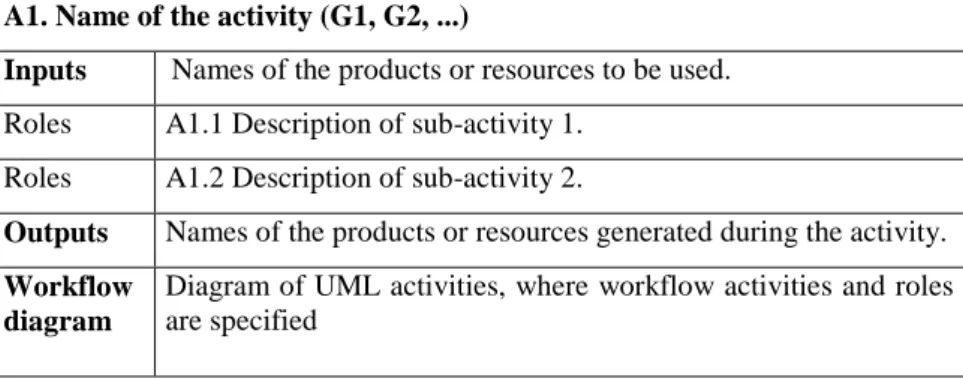
As described in the Model, each process is defined by: Process: Name of the process.
Category: Name of the category to which the process belongs.
Purpose: General measurable goals and expected results of the effective deployment
of the process.
Description: General description of the activities and products making up the
workflow of the process.
Goals: Specific goals (G1, G2, etc.) whose purpose is ensuring the fulfillment of the purpose of the process.
Responsibility and Authority: “Responsibility” is the role that is responsible for the execution of the process. “Authority” is the role that is responsible for validating the execution of the process and the fulfillment of its purpose.
Related processes: Names of related processes. Inputs: Names of the products or resources used.
Outputs: Names of the products or resources generated/modified.
Internal products: Names of the products generated and used within the process. Practices
Roles involved: Identification of the roles involved.
Activities: They are associated to the goals and describe the tasks and the
A1. Name of the activity (G1, G2, ...)
Inputs Names of the products or resources to be used.
Roles A1.1 Description of sub-activity 1. Roles A1.2 Description of sub-activity 2.
Outputs Names of the products or resources generated during the activity.
Workflow diagram
Diagram of UML activities, where workflow activities and roles are specified
Infrastructure resources
Description of software and hardware tools specific for a given activity. Guidance for adjustments
Description of possible modifications to the process that should not affect its goals.
The section Practices is where the organizations should concentrate their efforts, since it is here where the concepts of Roles,Input documents and Output documents for each activity are found. These are the concepts that SMBs find most difficult to apply in the process improvement process.
In the Section "Work carried out", the development process of the tool until realization of the final product is described.
2
Work carried out
When the scope definition stage began, some components were presented with no exact definition in order to allow the implementation of the process proposed by COMPETISOFT. These elements are:
• Role analysis
• Generation of input and output documents
• Application of good practices
The work carried out began with the treatment of these components.
2.1
Role analysis
The test carried out indicated that, in general, the roles defined by the model do not match the organizational structure of the company.
The first activity proposed is in agreement with this consideration. The equivalence between the roles of the model and those presented by the organization
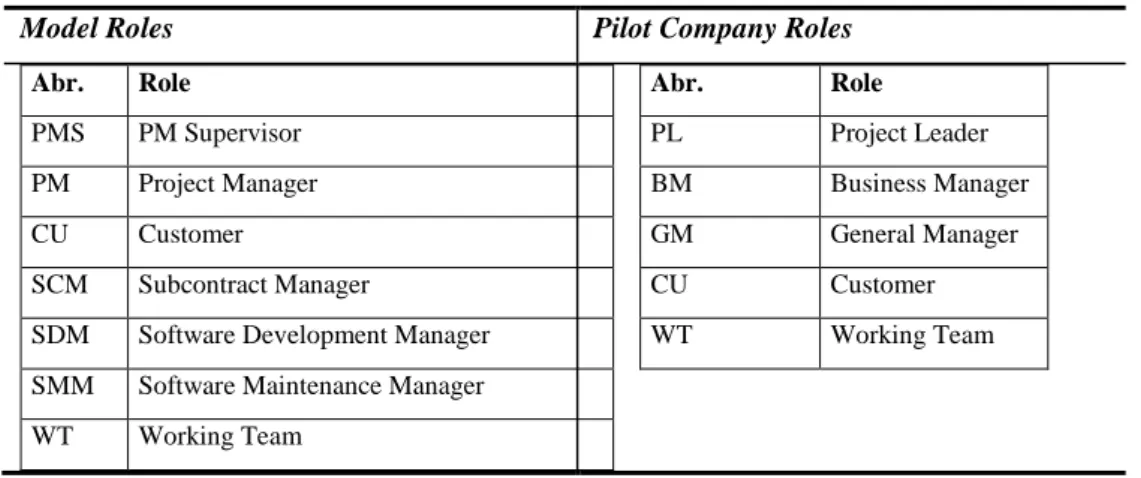
The roles defined to carry out this Specific Project Management (SPM) process and the roles used in a pilot company where the process improvement process is being implemented are presented in Table 1.
Model Roles Pilot Company Roles
Abr. Role
PMS PM Supervisor PM Project Manager CU Customer
SCM Subcontract Manager
SDM Software Development Manager SMM Software Maintenance Manager WT Working Team Abr. Role PL Project Leader BM Business Manager GM General Manager CU Customer WT Working Team
Table 1. Comparison of model roles and pilot company roles
In Table 1, the roles of the pilot company are presented, and, as it can be observed, they do not match those defined by the model.
As a way of settling this divergence, the creation of a relation between the different roles expressed in percentages is proposed. Table 2 shows an example of this relation.
Equivalence percentages between roles
PL BM GM CU WT PMS 0% 50% 50% 0% 0% PM 100% 0% 0% 0% 0% CU 0% 0% 0% 100% 0% SDM 50% 25% 25% 0% 0% WT 0% 0% 0% 0% 100%
Table 2. Relation between model roles and the pilot company roles
Percentages are defined within the organization itself based on the description of the model role and the responsibilities of that role as defined by the organization.
In the model, each sub-activity defined presents, in general, a series of roles involved. These roles do not have equal responsibility for the sub-activity; their share of involvement depends on their competencies.
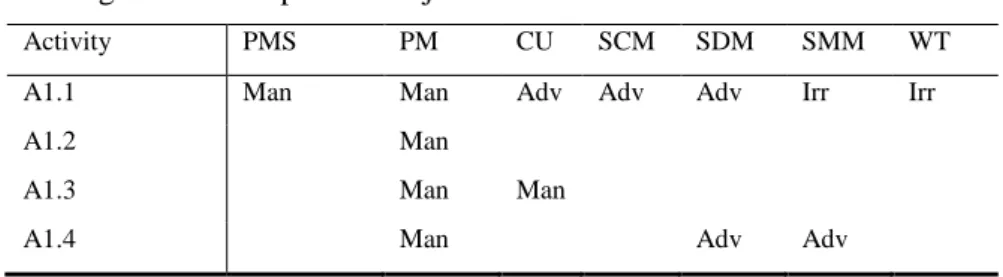
With the problem presented, the situation was assessed for each particular case, establishing the responsibilities of each of the roles for each sub-activity, and three types of priorities were defined: mandatory (man), advisable (adv), and irrelevant (irr)
Table 3 presents the priorities of the first sub-activities of the SPM process
Management of a Specific Project
Activity PMS PM CU SCM SDM SMM WT A1.1 Man Man Adv Adv Adv Irr Irr
A1.2 Man
A1.3 Man Man
A1.4 Man Adv Adv
Table 3. Role priorities
Based on this reference table, the essential roles for each sub-activity can be determined.
2.2
Generation of input and output documents
As mentioned before, the generation of input and output documents from and to the sub-activities is one of the main problems for the improvement process.
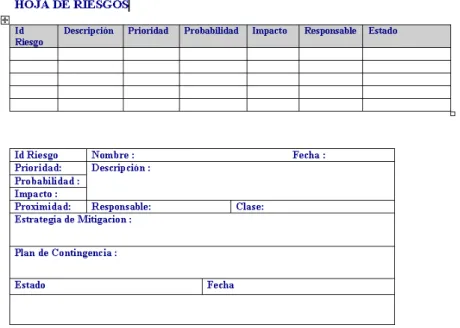
In general, when preparing the document, the organization must consider in detail the information that will be contained in the document. To this end, it is useful to define document templates containing the information base to be included in the document. For the definition of the templates proposed, the information base required has been taken into account, and certain work standards have been adjusted. [7]
Figures 1 and 2 present examples of templates, in this case for the definition of the delivery protocol.
Fig. 2. Risk sheet
2.3
Application of good practices
The model proposes 5 capability levels, each of which can be reached as a result of the improvement cycles implemented by the SMB. To achieve these process improvements, the model requires the application of certain tasks that are known as Good Practices, among which the following can be mentioned:
o Verification & Validation o Definition of Indicators
o Generation of Guidance for Adjustments
The objective of the research group consists in studying and presenting the best implementation alternative for each Good Practice and analyzing the corresponding implementation method with the Company. Also, a knowledge base that allows
learning from experience will be produced, in order to find the best adaptation possible for each plan. [8]
The first stage to be analyzed was the definition of indicators that allow determining to what extent each of the activities is achieved.
As already mentioned, each process defined in the model presents a series of goals whose purpose is ensuring adequate fulfillment. Each of the activities established for each process must be associated to the goals to attain (G1, G2...).
In order to determine goal fulfillment, metrics for each goal will be generated, defining indicators as well in order to be able to determine the corresponding scope.
Taking the ISO/IEC 15939 standard defining the software development measurement process [10] as a starting point, the steps to be followed by the company in order to attain the desired results are determined. Then, the use of GQ(I)M (Goal Question Indicator Metric) [11] is presented as the methodology proposed for generating indicators. GQ(I)M is similar to the goal methodology of GQM (Goal Question Metric) [6], but with more detail regarding the generation of indicators.
3
Tool
The tool developed is aimed at assisting the user during the first stages of the implementation of the model.
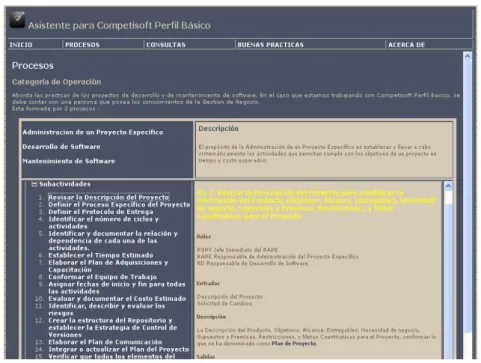
The greatest problems found at the companies that were evaluated are related to roles, documentation, and good practice implementation. For this reason, a support tool for the implementation of the model was designed (Fig. 3). This tool is based on the basic profile of the COMPETISOFT model. This model results in an adaptation of the full model, where only one maturity category is proposed.
This new model is the result from the assessment of several companies under a controlled test environment, which was done by each member group of the CyTED COMPETISOFT project. The conclusion drawn was that the best choice to start an improvement process in SMBs is to begin with the basic, initial category, since most SMBs are at least familiar with it. This category has three defined processes:
o Management of a Specific Project o Software Development
Fig. 3. Wizard
The tool proposed presents a description of each of the processes with their activities and sub-activities in a color-coded manner. Each color defines the level established for the sub-activity.
Sub-activities are in turn described, including a brief description and a hyperlink in case an output document has to be generated. This hyperlink opens the template for the production of the required document. The roles involved are defined as well, indicating which of them are mandatory. Figure 3 shows one of the sub-activities of the Management of a Specific Project activity.
In the case of roles, the tool supports users by allowing them to manage involvement percentages of each role. The end result will allow generating the equivalence between the roles of the model and those of the company.
Additionally, guidelines are presented for the development of the sub-activities related to verification and validation. In this case, a brief tour of the definitions of these concepts is taken, and users are guided for the performance of each sub-activity. [9]
In the case of indicators, the tool proposes an established process using the GQ(I)M methodology to generate them, guiding users in the development of the corresponding metrics and presenting support templates to carry out the task. Also, examples of already established metrics are presented to help users fully understand the issue.
4
Conclusions
A tool to assist SMBs in the implementation of the basic profile of the COMPETISOFT improvement model was developed.
The importance of defining a relation between the roles defined by the model and those actually used by the company was analyzed, and the relevance of these roles for each of the activities was determined in accordance to the level that the company wishes to reach. Finally, a tool was presented for the generation of the input and output documents required by each activity of the model in order to ensure standardization.
The tool is being used in the improvement process being carried out by two software development companies of Argentina.
5
Future lines of work
The possibility of extending the tool for the full COMPETISOFT model is being considered, including the activities of the High Management and Management categories.
Based on feedback regarding the use of the tool in real companies, the items included as Good Practices will be improved.
6
References
1. Bertone, Pasini, Ramón, Esponda, Pesado, Mon, Gigante, De María, Estayno Gestión
de Calidad en la Construcción del Software. Un enfoque para PyME’s. Cacic 2006.
Concordia Entre Ríos, Argentina 2006
2. Pasini, A, Esponda S, Bertone R, Pesado P. Aseguramiento de Calidad en PYMES que desarrollan software. Una experiencia desde el proyecto COMPETISOFT. CACIC 2008. Chilecito La Rioja Octubre 2008
3. Piattini, M; Oktaba, H; Pino, F; Orozco, M; Alquicira, C. COMPETISOFT. Mejora de Procesos Software para Pequeñas y Medianas Empresas y Proyectos. Editorial RaMa. ISBN; 978-84-7897-901-1. 2008
4. COMPETISOFT Modelo de Procesos para PyMEs de Iberoamérica, Proyecto CYTED (Code 3789) August 2007
5. COMPETISOFT Perfil Básico Modelo de Procesos para PyMEs de Iberoamérica, Proyecto CYTED (Code 3789) August 2007
6. Applying the Goal/Question/Metric paradigm in the experience factory. Victor R. Basili Institute for Advanced Computer Studies Department of Computer Science.
7. IEEE Std 830-1998. IEEE Recommended Practice for Software Requirements Specifications
8. Pflegger, S. Ingeniería de Software. Teoría y Práctica. Pearson Education. 2002.
9. Sommerville, Ian, Ingeniería de Software. Pearson Addison Wesley. 2006 10. ISO/IEC 15939:2007 Systems and software engineering -- Measurement
process
11. Goal-Driven Software Measurement –A Guidebook .Software Engineering Institute Carnegie Mellon University