Project acronym: LISE
Grant Agreement Number: 270917
Project title: Legal Languages Interoperability Services
DELIVERABLE
D5.2 Dissemination plan
Dissemination Level: Public
Version No. 1.2
21/07/2011
Document Information
Deliverable Number D5.2
Deliverable title Dissemination Plan
Due date of deliverable according to DOW 2011-07-31 Actual submission date of deliverable 2011-07-29
Main Author(s) Tanja Wissik
Participants Elena Chiocchetti, Günther Schefbeck
Reviewer(s) Gerhard Budin
Work package WP5
Work package leader University of Vienna
Dissemination level PU
Version 1.2
Revision History
Revision Date Author Organisation Description
1.0 2011-06-01 Tanja Wissik University Vienna Initial Draft 1.1 2011-06-06 Gerhard Budin University Vienna Revision
1.2 2011-07-21 Tanja Wissik University Vienna Integration of Partners’
Comments
Statement of originality:
This deliverable contains original unpublished work except where clearly indicated otherwise. Acknowledgement of previously published material and of the work of others has been made through appropriate citation, quotation or both.
Table of Content
List of Figures ... 4 List of Abbreviation ... 5 1. Executive Summary ... 6 2. Dissemination Strategy ... 7 2.1. Objectives ... 72.2. Project results to be disseminated ... 7
2.3. Target audience ... 8
2.4. Source of Dissemination Activities ... 8
2.5. Dissemination Channels and Activities ... 9
3. Performed and Planned Dissemination Activities ... 10
3.1. Performed Dissemination Activities ... 10
3.1.1. General visual identity... 10
3.1.2 Project Website ... 11
3.1.3. Paper dissemination material ... 12
3.1.4 Participation in key conferences and events ... 13
3.1.5 Paper publications ... 13
3.1.6 Scientific paper publications ... 13
3.1.7 Internal transfer of knowledge ... 13
3.2. Planned Dissemination Activities ... 14
3.2.1. Planned participation in key conferences ... 14
3.2.2. Planned Paper Publications ... 15
3.2.3. Planned Scientific Paper Publications ... 15
3.2.3 Planned paper dissemination material ... 17
3.2.4 Planned internal transfer of knowledge ... 17
3.2.5 Planned workshops ... 17
3.2.5 Use of external mailing lists ... 17
3.2.6 Liaising with other projects ... 17
List of Figures
Figure 1: LISE logo. ... 10
Figure 2: LISE logo with full project name. ... 11
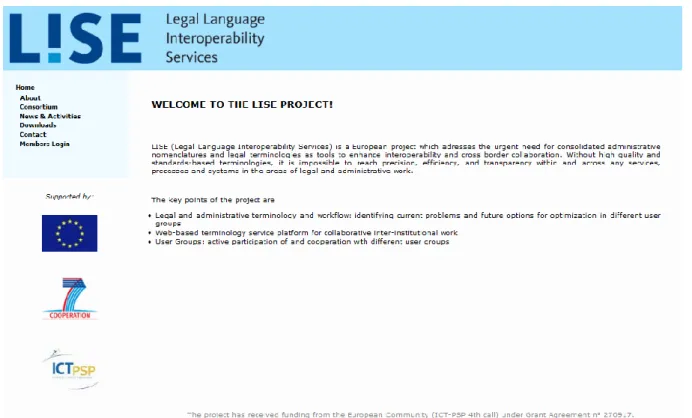
Figure 3: LISE project website – home. ... 12
List of Abbreviation
CMYK CMYK colour scheme (Cyan, magenta, yellow, and key (black))
RGB Red, Green, Blue colour model
ICT Information and Communication Technologies
EC European Commission
1.
Executive Summary
This deliverable provides a detailed dissemination plan for the LISE project. The document describes the adopted dissemination strategy. It provides also information about the planned and performed dissemination activities within the LISE project.
2.
Dissemination Strategy
In this section the dissemination strategy for the LISE project will be described. Dissemination will be carried out at both the consortium level and the partners’ level.
The key element for a successful dissemination is a well structured methodology. The adopted method for the LISE project is based on the following steps:
Defining the objectives of the dissemination actions Defining what will be disseminated
Identifying the target groups for dissemination
Establishing the appropriate sources for the dissemination activities, roles and responsibilities for the dissemination actions
Identifying the appropriate dissemination channels and dissemination actions for the different target groups and for the different stages in the project
The single steps are described in the following sections.
2.1. Objectives
The main objectives guiding the dissemination activities are providing reliable and target oriented information to the interested parties and also the general public about the LISE project and the expected results and the results themselves.
Dissemination can only be effective if the information provided for the addressed target group is comprehensive and oriented to their specific needs and interests. So the main goal is to provide target audience oriented dissemination material to reach the different target groups and to assure an effective dissemination and a higher penetration.
One purpose of the dissemination activities at the beginning and in the middle of the project is to convince relevant organisations to participate in the different user groups since the user groups are a core element of the LISE project. Another purpose of the dissemination activities is to inform the interested parties as well as the general public about the LISE project and the expected results and to spread the project results of the LISE project to the research and academic environment as well as to the institutional environment and to the industry.
2.2. Project results to be disseminated
- General information about the project (motivation, benefits, innovation, expected results).
- Knowledge about methodology and workflow for elaborating legal and administrative terminology.
- Knowledge about web-based terminology work.
- Knowledge about interoperability and standards in terminology work and interconnections between those.
- Guidelines for legal/administrative collaborative terminology work: Best practice guideline for optimized terminology management workflows in legal and administrative operations.
- Web-based terminology service platform for collaborative inter-institutional work.
2.3. Target audience
In this section the potential target audience for dissemination is identified. According to the expected use of the project results the audience is divided into 6 groups
- Institutional community: Public institutions, governments, organizations, public legal offices.
- Scientific community: Researchers in the area of e-Government, in the area of terminology and translation, in the area of linguistics in general, in the area of language technologies, in the area of legal informatics.
- EC- ICT community: With the aim to create liaisons with other projects.
- Industrial community: Large language service providers, private legal offices, businesses with global communication needs.
- Terminologists’ and translators’ community: This target audience is a cross section of the institutional, the scientific and the industrial community since it comprises terminologists and translators working in public institutions, government, organizations or public legal offices or at private language service providers and/or participating in research in the area of terminology and translation. They are mainly the actors in the real work flow scenarios analyzed in LISE.
- General public: Nearly everybody can be an end-user of the terminology, optimised through LISE, that is provided by public institutions, governments, organizations, public legal offices and other institutions and language service provides.
2.4. Source of Dissemination Activities
The LISE consortium members are highly skilled and experienced in disseminating project results to the target audience. The dissemination activities are carried out in WP 5 with
University of Vienna as work package leader. As stated above the dissemination activities are executed at consortium as well as at partner level. For the partner level, each partner has been assigned the task to approach certain target groups as described in detail below:
Academic Partners: LISE academic partners (University of Vienna and EURAC) will disseminate project results on a research level especially in the area of terminology, translation und language technologies. All the academic partners have a long record of dissemination activities in EU projects and they are well connected to the target group communities, especially to the research community, the EC-ICT community and the terminologists’ and translators’ community.
Industrial Partners: LISE industrial partners (Crosslanguage and ESTeam) will disseminate project results to the industrial community. All the industrial partners are well connected to the customer groups.
Institutional Partners: The LISE institutional partner (Austrian Parliamentary Administration) will disseminate the project results to the institutional community and especially to legislative institutions. The institutional partner is well connected to the institutional community. The institutional partner is also well connected to the scientific community in the area of e-Government, e-Democracy and legal informatics. Thus, the institutional partner will also disseminate the project results at research level especially in the area of e-Government, e-Democracy and legal informatics.
Also the members of the user group are invited to participate in the dissemination actions.
2.5. Dissemination Channels and Activities
In order to reach the different target groups in the most effective way, multiple communication channels and activities have to be considered. In that respect, LISE has identified the following dissemination channels and activities
- Project website
- General visual identity (project logo, ppt-templates) - Paper publications (flyers, posters)
- Presentation on key conferences
- Publications in conference proceedings, scientific journals - Networking (mailing lists, etc.)
- Knowledge transfer (internal communication and dissemination) - Liaising with other projects (META–projects)
3.
Performed and Planned Dissemination Activities
3.1. Performed Dissemination Activities 3.1.1. General visual identity
All the dissemination activities should be associated and identified with the LISE project. For this reason it is very important to create a clearly defined visual identity with the creation of a project logo. The project logo should be used in all online and printed documents and also on web pages. The LISE logos are available at the internal project website within the category templates and logos for easy access to all of the partners.
Logo: After several logos were proposed to the consortium, all the partners agreed on the logo showed below inFigure 1 and Figure 2. The logo was elaborated by a media designer. The logo is available in two versions, one with and one without the sub-line text.
The colours chosen for the logo are: dark blue Pantone 287 c CMYK 100c 68m 0y 12k RGB 0/75/147 light blue Pantone 2925 c CMYK 85c 24m 0y 0k RGB 4/146/212
The font used for the sub-line text is Kievit Regular.
The logo uses an exclamation mark instead of the “i”. Usually an accentuation of a syllable is marked with a point below the syllable. The accentuation in the logo is expressed with the exclamation mark. According to the objective of the project (efficiency, accuracy by standardization of terminology, interoperability) an exclamation mark in the sense of "This is it!" seems an appropriate association.
Figure 2: LISE logo with full project name.
PPT template: A LISE ppt presentation template has been created with the LISE logo, the LISE colour scheme and the acknowledgement to EC and ICT-PSP program for funding the LISE project. The ppt templates are available in the private area of the project website within the category templates and logos. The use of the ppt presentation template for all the partners is obligatory when presenting the LISE project.
3.1.2 Project Website
The project website has been designed and created by the University of Vienna (Centre for Translation Studies) according to the visual identity rules explained in the section above. It can be found online under the domain http://www.lise-termservices.eu since the 29th of March 2011 and it is technically supported and maintained by the University of Vienna. The website will be constantly updated.
The project website is divided into two main areas: Public area
Private area
The Public area contains the following sections (see Figure 3): The Home page contains a short description of the project.
The About section contains a more detailed description of the project.
The Consortium section provides a list of all project partners with their logos and the link to their webs sites for further information.
The News & Activities section contains all LISE meetings, all Events at which LISE will be/has been presented and other relevant news for the LISE project.
In the Downloads section, it is possible to download information material and publications (like fact sheet, ppt) and public deliverables.
The Contact section provides contact information.
Over the Section Members Login, it is possible to enter the private area of the website (Figure 4) accessible only to the project partners. For the intranet the open source tool Open Atrium was used and adapted to the LISE project needs. The intranet is used for the internal communication and for collaborative work on documents. Also the guidelines, the logos and the templates and other relevant documents for the partners are available in the private area of the website. Also a calendar with important dates like meetings and relevant
Figure 3: LISE project website – home.
Figure 4: Private area of the LISE project website. 3.1.3. Paper dissemination material
3.1.4 Participation in key conferences and events
The list below shows which partner has presented the LISE project in which occasion.
Event Date Partner Target group Dissemination
activity KÜDES 21-22 March 2011 University of Vienna Institutional community, terminologists and translators community presentation JAMCATT Meeting 27 April 2011 University of Vienna Institutional community presentation GfdS Tagung Deutsch in Österreich und Deutschland 3-4 June 2011 University of Vienna Scientific community presentation Conference on Terminology of the Austrian Defense Academy 7-9 June 2011 University of Vienna Institutional community, terminologists and translators community presentation 3.1.5 Paper publications
The list below shows the popular science publications in newspapers, journals and other types of media:
EURAC Activity Report 2010/11 (2011). “Terminologia condivisa: come unire e amalgamare informazioni diverse.” Bolzano: European Academy Bolzano, p. 10.
3.1.6 Scientific paper publications
The list below shows the scientific paper publications: So far there are no scientific paper publications.
3.1.7 Internal transfer of knowledge
For the internal transfer of knowledge among the members of the consortium, different types of activities were set up:
An internal mailing list for LISE was set up for internal communication ([email protected]).
The private area of the project website was set up (see 3.2.1).
For the internal transfer of knowledge also a number of meetings were organized: The kick-off meeting was organized on the 23rd of March 2011 in Vienna.
The TMB meeting was organized on the 4 of July 2011 in Vienna. WPs-Workshops were organized on the 5th of July 2011 in Vienna.
3.2. Planned Dissemination Activities
3.2.1. Planned participation in key conferences
Event Date Partner Target group Dissemination
activity LSP 2011 22-26 August 2011 (confirmed) University Vienna Scientific community, terminologists and translators community, industrial community presentation ECEG 2012 12th European Conference on e-Government
14-15 June 2012 To be defined Public institutions; governmental institutions presentation IRIS 2012 Internationales Rechtsinformatik Symposium
February 2012 All partners Public institutions, governmental institutions
Presentation, maybe whole workshop
LREC 2012 21-27 May 2012 To be defined Scientific community presentation 9th INTERNATIONAL CONFERENCE ON TERMINOLOGY AND ARTIFICIAL INTELLIGENCE 9ème conférence internationale Terminologie et Intelligence Artificielle Multilingual terminology at the crossroads 7-9 November 2011 To be defined Scientific community, terminologists and translators community presentation 7th EUATC conference 26- 27 April 2012 To be defined Industrial community presentation National and international conferences and workshops on (legal) terminology in Italy
To be defined EURAC Scientific community, terminologists and translators community
3.2.2. Planned Paper or Online Publications
In this section a list of a number of target newspapers and journals for future publications is provided for the following target group:
Target group: General public and local stakeholders
Academia: EURAC’s quarterly magazine for the dissemination of scientific activities to the general public and the local stakeholders, read in South Tyrol and beyond (about 9000 copies distributed).
3.2.3. Planned Scientific Paper Publications
In this section a list of a number of target journals for future publications is provided according to the different target groups:
Target group: Institutional community
There is a list of possible target journals for future publications in the field of e-Practice and in the field of e-Government.
Electronic Government, an International Journal (EG): It is dedicated to design, development, management, implementation, technology, and application issues in e-government. EG aims to help professionals working in the field, academic educators and policy makers to contribute, to disseminate knowledge, and to learn from each others' work through cutting-edge thinking in e-government.1
European Journal of ePractice: It is a peer-reviewed online publication on eTransformation and its aim is to reinforce the visibility of articles as well as that of professionals in eTransformation building an author's community which will strengthen the overall ePractice.eu activity.2
More possible target journals can be found under the following link: http://www.demo-net.org/services/journals.
Target group: Scientific community
Terminology: The journal with a cross-cultural and cross-disciplinary scope is published twice a year. It focuses on one hand on the discussion of solutions of language problems encountered in translation and on the other hand on discussion of monolingual and/or
communication.3
FACHSPRACHE - International Journal of Specialized Communication: It is a refereed international journal that publishes original articles on all aspects of specialized communication and provides an interdisciplinary forum for researchers and teachers interested in this field.4
JoSTrans – Journal for Specialized Translation: It is a peer-reviewed and web-based journal that aims to create a forum for translators and researchers in specialised translation.5
Lebende Sprachen: The German peer-reviewed journal contains articles and reviews on language in general and also covers topics on specific languages and cultures, living languages and the life of language. The spectrum of topics includes interlingual phenomena such as diverse facets of translating and interpreting in theory and practice as well as various aspects of translation studies. The journal is directed at professionals such as translators, interpreters, linguists, philologists, lexicologists, terminologists and students of these fields.6
Target group: Industrial community (large language service providers, private legal offices, businesses with global communication needs)
Multilingual Computing (MultiLingual): It is the leading source of information for the language industry and businesses with global communications needs. It is published eight times a year and it is read by more than 10,000 people in 85 countries.7
Target group: Terminologists and translators community
eDITion Das Terminologiemagazin: It is a German journal dealing with terminology and
specialized communication published twice a year by the
Deutscher Terminologie-Tag e.V. (DTT).8
Universitas Mitteilungsblatt: It is a German journal published four times a year by the Austrian Interpreters’ and Translators’ Association “Universitas”. 9
3 http://www.benjamins.com/cgi-bin/t_seriesview.cgi?series=TERM 4 http://www.fachsprache.net/ 5 http://www.jostrans.org/about.php 6 http://www.degruyter.com/journals/les/detailEn.cfm 7 http://www.multilingual.com/aboutWhat.php 8 http://www.dttev.org/
professional journal for interpreters and translators in German-speaking countries (current circulation 7,000 copies). The main topics are on working tools such as translation memory systems, terminology management programs and dictionaries. Also interviews and background reports on scientific findings and new legislation and other official regulations keep your professional knowledge right up to date are published.10
3.2.3 Planned paper dissemination material
There are different types of paper dissemination material planned especially training material for the user group evaluation activities. As a complement to the project website, also flyers and posters are planned that will cover conventional paper publication channels.
3.2.4 Planned internal transfer of knowledge
There are several meetings planned for the internal transfer of knowledge. Beside the Execute Management Board Meetings and the Technical Management Board Meetings, where all the partners will be normally present also bilateral meetings or meetings with only some of the partners are planned, especially in certain periods for certain WPs where a closer collaboration between the partners is needed.
3.2.5 Planned workshops
Workshops are planned for WP4, the user group evaluation. In this early phase 3 to 4 workshops are planned. If necessary the number of workshops can be adjusted to the needs of WP4. There is also one last workshop planned at the end of the project.
3.2.5 Use of external mailing lists
LISE will use for external communication with the different user groups also several existing mailing lists like Linguist List or other mailing lists.
3.2.6 Liaising with other projects
Liaison activities in the context of LISE sought among initiatives and projects with similar objectives and targets. Liaison activities are possible with projects in the context of META (Multilingual Europe Technology Alliance
4.
Conclusions
This document comprises the Dissemination Plan for the LISE project. It contains also the performed activities in the first 6 months of the project and the planned activities for the next period.