Volume 2013, Article ID 107024,9pages http://dx.doi.org/10.1155/2013/107024
Research Article
BRS-Based Robust Secure Localization Algorithm for
Wireless Sensor Networks
Ning Yu, Lirui Zhang, and Yongji Ren
School of Instrumentation Science and Optoelectronics Engineering, Beijing University of Aeronautics and Astronautics (Beihang University), Beijing 100191, China
Correspondence should be addressed to Ning Yu; [email protected] Received 6 October 2012; Revised 23 January 2013; Accepted 5 February 2013 Academic Editor: Sunho Lim
Copyright © 2013 Ning Yu et al. This is an open access article distributed under the Creative Commons Attribution License, which permits unrestricted use, distribution, and reproduction in any medium, provided the original work is properly cited.
Localization is the key supporting technology for wireless sensor networks (WSNs). Security and accuracy are the premise of the localization application. Real-world applications of wireless sensor networks are often subject to a variety of adverse circumstances interference, and the localization performance is seriously affected. In this paper, we propose a BRS-based robust secure localization (BRSL) algorithm in order to reduce the impact of the malicious attackers in WSNs. The BRSL method includes two phases. In the first stage, the trust evaluation framework is established on the basis of beta reputation system. In the second phase, we employ the weighted Taylor-series least squares method to estimate the coordinates of sensor nodes. Simulation results demonstrate that the proposed algorithm is robust and effective.
1. Introduction
Wireless sensor networks (WSNs) are based on the tech-nology of sensor, wireless communication, tiny embedded devices, and distributed computing. They exchange informa-tion with the environment through sensors and implement the function of collecting and dealing with data. Wireless sensor networks have been widely used in the fields of envi-ronmental monitoring, target tracking, military applications, disaster management, and so forth [1–3].
Self-localization technology of nodes is the prerequisite and basis for the application of wireless sensor networks, especially the position information that is needed for the perceived data. Node localization of WSNs is to determine the positions of normal nodes based on the positions of beacon nodes and the constraint relations between normal and beacon nodes. Positions or coordinates of normal nodes are unknown. Beacon nodes usually get their positions or coordinates through global positioning system (GPS) mod-ules or by manual deployments. Being an essential support technology of wireless sensor networks, node localization has got more and more attention in the recent years [4–10].
Most localization methods depend on measuring the distances or hops between normal and beacon nodes to
obtain the coordinates of normal nodes. In many typical localization algorithms [11–13], the coordinates of beacon nodes are generally assumed to be completely correct without any disturbs of adverse factors, and the normal nodes can use beacon information in security. However, in the actual hostile situations, some malicious nodes may intrude into sensor networks. They pretend to be true beacon nodes or attack other anchor nodes and make them declare false coordinates [14, 15]. The false coordinates or distance estimation will cause a major localization error for normal sensor nodes [16]. In this case, some methods should be explored to eliminate or reduce the adverse influence caused by malicious beacon nodes and ensure safe localization in wireless sensor networks.
In this paper, we develop a BRS-based robust secure localization (BRSL) algorithm for solving the node self-localization problem in the case of malicious nodes existence. In BRSL, normal sensor node first observes the anchor nodes in its communication range and evaluates the trust values of these anchor nodes. Specially, the concepts of the beta reputation system are employed to deal with the uncertain factors in trust evaluation. Then, each anchor node obtains a final trust value, and sensor nodes compare the final trust val-ues of anchor nodes in their multihop communication range
with the stored threshold. Finally, the normal sensor nodes utilize the trustful anchor nodes to estimate their coordinates. All the above operations can be carried out by each node. The method is a completely distributed localization approach. Through simulations, we demonstrate that the BRSL method can efficiently reduce the influence of malicious attackers in WSNs.
The remainder of the paper is organized as follows:
Section 2 introduces related works on secure localization algorithms. Section 3 presents the network model, attack model, and related definitions.Section 4provides the details of the BRS-based robust secure localization (BRSL) algo-rithm. Section 5 presents the simulation results. Section 6
concludes the paper.
2. Related Works
Alfaro et al. [17] consider the localization security of sensor nodes under limited trust anchor nodes. It introduces three algorithms to enable the sensor nodes to determine their positions, but it would fail when the malicious anchor nodes are in colluding conditions.
Liu et al. [18] propose two secure localization algorithms. One is attack-resistant minimum mean square estimation, which excludes malicious anchor nodes by the consistency check. The other is voting-based location estimation. The algorithms are difficult to work for the malicious anchor nodes in colluding conditions.
Zhu et al. [19] propose an attack detection module which can detect compromised beacons and provide a localization service in terms of bounded estimation error by secure localization module, but it mainly concentrates on the one-hop localization.
Liu et al. [20] present a secure localization mechanism that detects malicious anchor nodes claiming fake positions. It uses redundant anchor nodes instead of normal nodes in the sensing field to verify malicious anchors. The method relies on a centralized base station for the detection.
Li et al. [21] introduce a secure scheme “Bilateration” which is derived from multilateration. It calculates the weight of anchor nodes and decides which anchor nodes are mali-cious. After ignoring the coordinates caused by compromised nodes, it uses the average value of the left candidate positions as the estimated location of the sensor node, but it mainly focuses on the one-hop localization.
3. Preliminaries
3.1. Network Model. We consider a network consisting of
two types of nodes, namely, anchor nodes and sensor nodes. The anchor nodes are specially equipped and aware of their coordinates after deployment. The sensor nodes, whose positions are yet to be discovered, estimate their locations by measuring distances to neighboring anchor nodes. All nodes are randomly distributed in a 2D spatial region. Every node has a unique identity (ID). The transmission range or ranging radius of each node is𝑅. Every node is capable of measuring the distance to any of its immediate neighbors.
The ranging error𝑒follows a Gaussian distribution𝑁(𝑢, 𝜆2), where the mean𝑢is 0 and the standard deviation𝜆is within a threshold. Measurement error𝑒is bounded by|𝑒𝑖| ≤ 𝑒max, and the maximum physical inaccuracy𝑒maxcan be obtained experimentally. In multihop localization, each anchor node broadcasts a message that carries its declared position to its one-hop neighbors. Then, the message is propagated in the network in a controlled flooding manner. When a sensor node obtains three or more anchor messages, the sensor node can estimate its location by the localization algorithm.
3.2. Attack Model. We assume that the WSN is in a hostile
environment, that is, there are malicious attackers in the network. The attackers attack the anchor nodes in order to make them declare dishonest coordinates. When an anchor node is attacked and broadcasts erroneous locations, we call it malicious anchor node. The nodes claiming actual coordinates are called benign anchor nodes. We consider an adversarial environment where the malicious anchor nodes are in noncolluding scenario or colluding scenario. If the malicious anchor nodes are noncolluding, they cannot know whether other anchor nodes are malicious or not. They can only fake their own declared locations to affect the localization process. While the malicious anchor nodes are colluding, they can detect whether other anchor nodes are the same type, and each pair of colluding malicious anchor nodes can revise the measure distance between them by changing their declared locations.
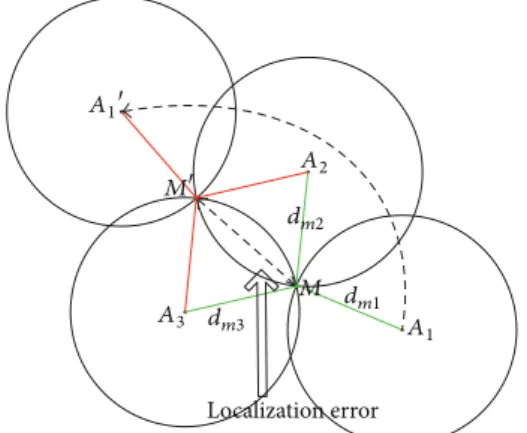
As shown inFigure 1, when a sensor node𝑀gets enough measurement distances𝑑𝑚𝑖(𝑖 = 1, 2, . . . , 𝑘), where𝑘 ≥ 3, to anchor nodes𝐴𝑖, a system of the Euclidean equations can be set up: X𝑚−X12= 𝑑𝑚1 X𝑚−X22= 𝑑𝑚2 .. . X𝑚−X𝑘2= 𝑑𝑚𝑘, (1)
where𝑋𝑚 = [𝑥𝑚, 𝑦𝑚]𝑇is 𝑀’s coordinates that need to be estimated and 𝑋𝑖 = [𝑥𝑖, 𝑦𝑖]𝑇is anchor node𝐴𝑖’s declared position.
If the anchor node 𝐴1 is attacked, it will become a malicious anchor node𝐴1 with fake coordinates. When𝑀 utilizes𝐴1to compute its position, its estimated position𝑀 will deviate far from its physical position, and its location accuracy will be very low.
3.3. Related Definitions. To be convenient, some necessary
definitions are given in the following.
(i) Measurement distance: node 𝑖 is in the communi-cation radius of node𝑗. The physical measurement distance from𝑖 to𝑗 (through RSSI, TDOA, etc.) is called measurement distance.
𝐴1 𝐴2 𝐴3 𝑑𝑚3 𝑑𝑚1 𝑑𝑚2 𝑀 𝑀 Localization error 𝐴1
Figure 1: Node localization with malicious anchor node.
(ii) The Euclidean distance: the distance between the declared coordinates of two anchor nodes𝑖and𝑗, that is,
𝑑𝑖𝑗= X𝑖−X𝑗2= √(𝑥𝑖− 𝑥𝑗)2+ (𝑦𝑖− 𝑦𝑗)2, (2)
where 𝑋𝑖 = [𝑥𝑖, 𝑦𝑖]𝑇 and 𝑋𝑗 = [𝑥𝑗, 𝑦𝑗]𝑇 denote, respectively, the declared coordinates of anchors 𝑖 and𝑗.
(iii) Multihop communication range: the range that a node’s propagation packet can reach through multi-hop forwarding.
(iv) Multihop count: the hops count of the shortest path between a pair of nodes. For example, if the shortest path between nodes𝑖and𝑗passes𝑇nodes (including
𝑖 and 𝑗), the multihop count of nodes 𝑖 and 𝑗 is
HOP𝑖𝑗= 𝑇 − 1.
4. BRS-Based Robust Secure Localization
(BRSL) Algorithm
In BRSL method, every sensor node has the detecting func-tion. The sensor node examines each of the anchor nodes that are available to it and evaluates the reliability of each anchor node according to the geometric relationship among anchor nodes. After the sensor node obtains the final trust values of each anchor node, a weighted Taylor-series least squares method is utilized to compute the sensor nodes’ coordinates. In general, the BRSL method includes two main phases: trust evaluation of anchor nodes and the localization of sensor nodes.
4.1. Trust Evaluation of Anchor Nodes. In this subsection, we
employ the concepts of the beta reputation system [22] to construct the trust evaluation framework of anchor nodes. In contrast to most other intuitive reputation systems, the beta reputation system has a firm basis on the theory of statistics, that is, the beta probability density function. The beta
distribution𝐵(𝑎, 𝛽) can be expressed by using the gamma function as
𝑓 (𝑥 | 𝛼, 𝛽) = Γ (𝛼 + 𝛽)
Γ (𝛼) Γ (𝛽)𝑥𝛼−1(1 − 𝑥)𝛽−1, (3)
where0 < 𝑥 < 1, 𝛼 > 0,𝛽 > 0, andΓ(𝑎) is the gamma function.
The gamma function [23] (represented by the capital Greek letterΓ) is an extension of the factorial function, with its argument shifted down by 1, to real and complex numbers. If𝑛is a positive integer, we get the formulaΓ(𝑛) = (𝑛−1). If𝑧is a complex number, we get the formulaΓ(𝑧) = ∫0⋈(𝑡(𝑧−1)/𝑒𝑡)d𝑡, where the real part of𝑧must be larger than zero(Re(𝑧) > 0). The gamma function is applicable in the fields of probability and statistics. It is also a component in various probability-distribution functions.
The beta reputation system consists of two elements
(𝛼, 𝛽) that can be used separately or in combination to
provide a flexible framework for reputation services of WSNs applications. We use the beta reputation system to establish the trust evaluation framework of anchor nodes. In the network, anchor nodes have two types: benign anchor nodes and malicious anchor nodes. And the two elements(𝛼, 𝛽)of beta reputation system are the most appropriate parameters here to judge the anchor nodes. The probability expectation value of the beta distribution is given by
𝐸 (𝑥) = 𝛼 + 𝛽𝛼 , (4)
and the variance is
Var(𝑥) = 𝛼𝛽
(𝛼 + 𝛽)2(𝛼 + 𝛽 + 1). (5)
In the network, every anchor node has a unique ID, and the sensor node is assumed to have the detecting function. We utilize the beta reputation system to detect the malicious anchor nodes. The detecting process is considered with two possible outcomes (benign anchor node and malicious anchor node). Let(𝑎 + 1)be the observed outcome number of benign anchor nodes, and let (𝑏 + 1)be the observed outcome number of malicious anchor nodes. Then, we have a beta function expressed as𝑓(𝑥 | (𝑎 + 1), (𝑏 + 1)), where
𝑥denotes the benign anchor node. The observed number of benign anchor nodes and malicious anchor nodes is used in the beta function to estimate the probability of anchor nodes to be benign ones, which equals to the expectation value of𝑥. As we do not know whether the anchor nodes are benign or not at the beginning, we initially assume all anchor nodes to be benign ones.
Let 𝑅𝑒𝑝 𝑇denotes the reputation of anchor nodes and
𝑅𝑒𝑝 𝑇 ∼ 𝐵(𝑎 + 1, 𝑏 + 1). Let𝑇𝑟𝑢 𝑇denotes the trust value
of the anchor node. From the beta reputation system, we know that the expectation value of𝑅𝑒𝑝 𝑇is equal to𝑇𝑟𝑢 𝑇, that is, 𝐸(𝑅𝑒𝑝 𝑇) = 𝑇𝑟𝑢 𝑇. Assume that there are 𝑁1 +
𝑁2 anchor nodes and 𝑁3 sensor nodes randomly deployed in the network. Assume 𝑛(𝑛 ≤ 𝑁1 + 𝑁2) anchor nodes
We deploy the network𝑄 times in total. The detail of the detecting process is given as follows.
(1) Compute𝑎𝑖and𝑏𝑖through the geometric relationship among anchor nodes. The values of𝑎𝑖and𝑏𝑖are set to 0 initially. The value of𝑑𝑖𝑗is the Euclidean distance between𝐴𝑖and𝐴𝑗, and𝑑𝑖𝑗denotes the measurement distance between 𝐴𝑖 and 𝐴𝑗 (if 𝐴𝑖 and 𝐴𝑗 are neighbors).
(a) If inequality|𝑑𝑖𝑗− 𝑑𝑖𝑗| ≤ 𝑒maxor 0< 𝑑𝑖𝑗< 2𝑅is satisfied, let𝑎𝑖𝑗 = 1. Otherwise, let𝑎𝑖𝑗 = 0. (b) If inequality|𝑑𝑖𝑗− 𝑑𝑖𝑗| > 𝑒maxor𝑑𝑖𝑗> 2𝑅 > 0is
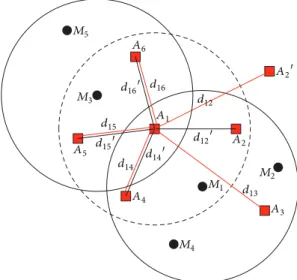
satisfied, let𝑏𝑖𝑗= 1. Otherwise, let𝑏𝑖𝑗= 0. For example, Figure 2shows the geometric relationship among anchor nodes, in which𝐴𝑖(𝑖 = 1, 2, . . . , 6) represents the anchor nodes and𝑀𝑗(𝑗 = 1, 2, . . . , 5) represents the sensor nodes. Anchor node 𝐴2 is attacked, and 𝐴2 is the declared position of 𝐴2. As anchor node 𝐴3 is not the neighbor of𝐴2, we can only obtain the Euclidean distance𝑑23 between them. A set of inequalities can be set up:|𝑑12−𝑑12| >
𝑒max,|𝑑14− 𝑑14| ≤ 𝑒max,|𝑑15− 𝑑15| ≤ 𝑒max,|𝑑16− 𝑑16| ≤ 𝑒max,
and0 < 𝑑23 < 2𝑅. Sensor nodes𝑀1 and𝑀3are in anchor
node𝐴1’s communication range. Therefore, we can get𝑎11 =
2, 𝑏11= 1and𝑎13= 2, 𝑏13= 0.
(2) Compute the trust value of anchor node𝐴𝑖in each network deployment.
(a) Assume that 𝑚 (𝑚 ≤ 𝑁3) sensor nodes
(𝑀1, 𝑀2, . . . , 𝑀𝑚) are available to anchor node
𝐴𝑖. These 𝑚 sensor nodes utilize step (1) to detect anchor node𝐴𝑖. The observed number of anchor node𝐴𝑖to be a benign one is
𝑎𝑖+ 1 =∑𝑚
𝑗=1
𝑎𝑖𝑗+ 1 (6)
and the observed number of anchor node𝐴𝑖to be a malicious one is
𝑏𝑖+ 1 =∑𝑚
𝑗=1
𝑏𝑖𝑗+ 1. (7)
(b) The𝑅𝑒𝑝 𝑇𝐴𝑖𝑝∼ 𝐵(𝑎𝑖+ 1, 𝑏𝑖+ 1). The trust value of anchor node𝐴𝑖is
𝑇𝑟𝑢 𝑇𝐴𝑖𝑝= 𝐸 (𝑅𝑒𝑝 𝑇𝐴𝑖𝑝) = 𝑎𝑖+ 1
𝑎
𝑖 + 𝑏𝑖+ 2
, (8)
and the variance of anchor node𝐴𝑖is
𝜎𝐴𝑖𝑝= (𝑎 𝑖 + 1) × (𝑏𝑖+ 1) (𝑎 𝑖 + 𝑏𝑖+ 2)2(𝑎𝑖+ 𝑏𝑖+ 3) . (9) 𝐴1 𝐴2 𝐴3 𝐴4 𝐴5 𝐴6 𝑑12 𝑑13 𝑑14 𝑑15 𝑑16 𝑀1 𝑀2 𝑀3 𝑀4 𝑀5 𝐴2 𝑑12 𝑑14 𝑑15 𝑑16
Figure 2: Geometric relationship among anchor nodes.
(3) Compute the trust value of anchor node𝐴𝑖after the𝑄 times network deployment. Let𝑝denotes the current deployment time. Repeat step (1) and step (2) until
𝑝 > 𝑄. The final trust value of anchor node𝐴𝑖is
𝑇𝑟𝑢 𝑇𝐴𝑖 = (∑
𝑄
𝑝=1𝑇𝑟𝑢 𝑇𝐴𝑖𝑝)
𝑄 , (10)
and the final variance of anchor node𝐴𝑖is
𝜎𝐴𝑖 =(∑
𝑄 𝑝=1𝜎𝐴𝑖𝑝)
𝑄 . (11)
(4) Judge whether anchor node 𝐴𝑖 is a benign anchor node.
(a) After the anchor node 𝐴𝑖 obtains the final trust value 𝑇𝑟𝑢 𝑇𝐴𝑖, it broadcasts 𝑇𝑟𝑢 𝑇𝐴𝑖 to the network in a multihop flooding manner. The sensor nodes store the final trust values they obtained, based on which they can decide whether𝐴𝑖is a benign anchor node.
(b) The sensor nodes compare the 𝑇𝑟𝑢 𝑇𝐴𝑖 that they received from step (3) with threshold∇. If
𝑇𝑟𝑢 𝑇𝐴𝑖 ≥ ∇, sensor nodes will consider anchor
node𝐴𝑖as a benign anchor node and utilize𝐴𝑖 in the localization phase. If𝑇𝑟𝑢 𝑇𝐴𝑖 < ∇, sensor nodes will take anchor node𝐴𝑖 as a malicious anchor node, and𝐴𝑖will be revoked before the localization stage.
The determination of threshold∇depends on the final trust value of each anchor node. The threshold∇is defined as follows ∇ =𝑁1∑+𝑁2 𝑞=1 (( 𝜎𝑞 ∑𝑁1+𝑁2 𝑞=1 𝜎𝑞 ) × 𝑇𝑟𝑢 𝑇𝑞), (12)
where𝑁1+ 𝑁2is the total number of anchor nodes,𝑞is the ID of anchor node, and𝜎𝑞is the final variance of anchor node
𝑞.
From the above steps, we will get the trust evaluation of anchor nodes. The situation we investigated in this paper is that the percentage of malicious anchor nodes is less than half of the number of anchor nodes. When the malicious anchor nodes are noncolluding, they will not cooperate with each other. Therefore, it is hard for these malicious anchor nodes to obtain high value of𝑎𝑖. As the number of malicious anchor nodes is less than that of benign ones, the colluding malicious anchor nodes will be given more value on𝑏𝑖. When malicious anchor nodes are cooperated, some malicious anchor nodes may obtain more value on 𝑎𝑖 than 𝑏𝑖, but such nodes are very few. Generally, 𝑎𝑖 is smaller than 𝑏𝑖 for malicious anchor nodes, and𝑎𝑖 is bigger than 𝑏𝑖 for benign anchor nodes. Therefore, most benign anchor nodes’ trust values are larger than that of malicious anchor nodes in each network deployment.
Formula (8) shows that the bigger𝑎𝑖 is, the larger𝑅𝑒𝑝 𝑇 is. Similarly, the bigger𝑏𝑖 is, the smaller𝑅𝑒𝑝 𝑇is. The vari-ance of anchor node𝑞denotes the deviating degree of anchor node𝑞’s trust value from the expectation value. If the final variance of anchor node𝑞is big, it means the distribution of anchor node𝑞’s trust values (𝑇𝑟𝑢 𝑇𝑞1, 𝑇𝑟𝑢 𝑇𝑞2, . . . , 𝑇𝑟𝑢 𝑇𝑞𝑄) is relatively discrete in𝑄times network deployment. While the final variance of anchor node𝑞 is small, it means that the distribution of anchor node𝑞’s trust values is relatively concentrated. The differences between most benign anchor nodes’ trust values and their average trust value are larger than those of malicious anchor nodes, that is, 𝜎benign >
𝜎malicious. The weight𝜎𝑞/ ∑𝑁1+𝑁2
𝑞=1 𝜎𝑞of trust values of anchor nodes in formula (12) demonstrates that the trust values of benign anchor nodes account for a higher proportion than malicious anchor nodes’ trust values in the judging threshold, which is helpful in excluding malicious anchor nodes. Therefore, formula (12) indicates the most appropriate threshold here.
4.2. The Localization of Sensor Nodes. When utilizing
mali-cious anchor nodes to localize the sensor nodes, the local-ization accuracy of sensor nodes is very low. To resolve this problem, we eliminate the malicious anchor nodes before the localization phase. The sensor node𝑀utilizes all its multihop communication anchor nodes to estimate its coordinates. The traditional method like maximum likelihood estimation (MLE) has a high computational complexity and always loses much coordinates information.
We employ the weighted Taylor-series least squares algorithm to estimate the coordinates of sensor nodes and the final trust values 𝑇𝑟𝑢 𝑇1, 𝑇𝑟𝑢 𝑇2, . . ., 𝑇𝑟𝑢 𝑇𝐾
(𝑞 = 1, 2, . . . , 𝐾, 𝐾 ≥ 3) of benign anchor nodes are
used as the weight in the localization stage. The weighted Taylor-series least squares method can make better use of the anchor information, and the computing accuracy can be greatly improved. The localization processes are as follows.
Assume 𝑑𝑚𝑖 (𝑖 = 1, 2, . . . , 𝐾) are the measurement distances from the𝑘anchor nodes to the sensor node𝑀and
𝑋𝑖 = (𝑥𝑖, 𝑦𝑖)is the declared coordinates of anchor node 𝑖. The position of sensor node𝑀is denoted as 𝑋 = (𝑥0, 𝑦0). Therefore, we have a set of the Euclidean equations:
𝑇𝑟𝑢 𝑇𝑖× 𝑋 − 𝑋𝑖2= 𝑇𝑟𝑢 𝑇𝑖× 𝑑𝑚𝑖. (13)
Firstly, calculate the centroid coordinates𝑋𝐶 = (𝑥𝐶, 𝑦𝐶) of𝐾anchor nodes, that is,𝑋𝐶= (1/𝐾) ∑𝐾𝑖=1X𝑖.
Secondly, expand the function 𝑓(𝑋) = ‖𝑋 − 𝑋𝑖‖2 in Taylor series at 𝑋𝐶, and ignore the high-order terms. Equation (13) is transformed into the following modus:
𝑇𝑟𝑢 𝑇1(𝑥𝐶𝑑− 𝑥1 1𝐶 Δ𝑥 + 𝑦𝐶− 𝑦1 𝑑1𝐶 Δ𝑦) = 𝑇𝑟𝑢 𝑇1(𝑑1− 𝑑1𝐶) 𝑇𝑟𝑢 𝑇2(𝑥𝐶− 𝑥2 𝑑2𝐶 Δ𝑥 + 𝑦𝐶− 𝑦2 𝑑2𝐶 Δ𝑦) = 𝑇𝑟𝑢 𝑇2(𝑑2− 𝑑2𝐶) .. . 𝑇𝑟𝑢 𝑇𝐾(𝑥𝐶𝑑− 𝑥𝐾 𝐾𝐶 Δ𝑥 + 𝑦𝐶− 𝑦𝐾 𝑑𝐾𝐶 Δ𝑦) = 𝑇𝑟𝑢 𝑇𝐾(𝑑𝐾− 𝑑𝐾𝐶), (14) where𝑑𝑖𝑗denotes the Euclidean distance between𝑋𝑖and𝑋𝑗. Therefore,Δ𝑋𝐶 = (Δ𝑥𝐶, Δ𝑦𝐶)can be obtained byΔ𝑋𝐶 =
(𝐴𝑇𝑊𝑇𝑊𝐴)−1𝐴𝑇𝑊𝑇𝑊𝐵, where 𝑊 = [ [ [ [ [ [ 𝑇𝑟𝑢 𝑇1 0 0 𝑇𝑟𝑢 𝑇2 . .. 0 0 0 𝑇𝑟𝑢 𝑇𝐾 ] ] ] ] ] ] , 𝐵 = [ [ [ [ [ [ 𝑑1− 𝑑1𝐶 𝑑2− 𝑑2𝐶 .. . 𝑑𝐾− 𝑑𝐾𝐶 ] ] ] ] ] ] , 𝐴 = [[ [ 𝑥𝐶− 𝑥1 𝑑1𝐶 𝑥𝐶− 𝑥2 𝑑2𝐶 ⋅ ⋅ ⋅ 𝑥𝐶− 𝑥𝐾 𝑑𝐾𝐶 𝑦𝐶− 𝑦1 𝑑1𝐶 𝑦𝐶− 𝑦2 𝑑2𝐶 ⋅ ⋅ ⋅ 𝑦𝐶− 𝑦𝐾 𝑑𝐾𝐶 ] ] ] 𝑇 . (15)
Thirdly, let 𝑑 = √Δ𝑥2𝐶+ Δ𝑦𝐶2, and judge whether the iteration termination condition𝑑 ≤ 𝜂is satisfied, where 𝜂 is a prior-defined threshold. If𝑑 ≤ 𝜂, we stop the iteration process. Otherwise, we set𝑋𝐶 = 𝑋𝐶+ Δ𝑋𝐶and go to the second step.
Finally, repeat the second step and the third step until the iteration termination condition is satisfied or the maximum iteration number is reached. The final output 𝑋𝐶 is the estimated coordinates of sensor node𝑀.
Table 1: Default network configuration parameters.
Parameters Values
Network size (𝐴) 200 m×200 m
Deployment strategy Random
Number of nodes (𝑁 = 𝑁1+ 𝑁2+ 𝑁3) 200 Number of benign anchor nodes (𝑁1) 20 Number of malicious anchor nodes (𝑁2) 10 Number of normal sensor nodes (𝑁3) 170
Number of simulation rounds (𝑄) 1000
TTL 4
Trust threshold value∇ Formula (12)
Communication radius (𝑅) 30 m
𝑒max 0.1R
The standard deviation𝜆 1
Network connectivity 8∼12
5. Performance Evaluation
In this section, the performance of the BRSL algorithm is tested. All simulations are executed in MATLAB.
The WSN is in a hostile environment, and the malicious anchor nodes are in two conditions: noncolluding or collud-ing. The default network configuration parameters are shown inTable 1. Unless specified, the default parameters are used in the simulations.
Figure 3 shows the random network deployment, and each anchor node has a unique ID in all the simulations, where benign anchor nodes’ IDs are from 1 to 20 and malicious anchor nodes’ IDs are from 21 to 30.
5.1. Trust Evaluation of Anchor Nodes. Firstly, we analyze
the trust evaluation of anchor nodes. Figures4and 5show that the final variances of benign anchor nodes are bigger than those of the malicious anchor nodes, no matter whether the malicious anchor nodes are noncolluding or colluding. Therefore, the weight𝜎𝑞/ ∑𝑁1+𝑁2
𝑞=1 𝜎𝑞is proper in this paper. When malicious anchor nodes are in noncolluding condition, fromFigure 6, we can see that the final trust values of benign anchor nodes are much larger than those of malicious anchor nodes, and the threshold∇is about 0.267032. Therefore, we can remove all the malicious anchor nodes before the local-ization stage. When malicious anchor nodes are colluding, asFigure 7shows, some of the malicious anchor nodes’ final trust values are bigger than those of benign anchor nodes, and the threshold∇is about 0.297201. Although all the malicious anchor nodes can be excluded by the threshold, some benign anchor nodes are also removed. But inSection 5.2, it proves that the localization accuracy is still high although some benign anchor nodes are excluded.
5.2. Evaluation of BRSL Algorithm. In this subsection, we
compare the average localization error (ALE) of the BRSL algorithm with other localization techniques: RMLA2 [15], RMLA1 [15], Bilateration [21], and the traditional multihop
1 2 3 4 5 6 7 8 9 10 11 12 13 14 15 16 17 18 19 20 21 22 23 24 25 26 27 28 29 30 31 32 33 34 35 36 37 38 39 40 41 42 43 44 45 46 47 48 49 50 51 52 53 54 55 56 57 58 59 60 61 62 63 64 65 66 67 68 69 70 71 72 73 74 75 76 77 78 79 80 81 82 83 84 85 86 87 88 89 90 91 92 93 94 95 96 97 98 99 100 101 102 103 104 105 106 107 108 109 110 111 112 113 114 115 116 117 118 119 120 121 122 123 124 125 126 127 128 129 130 131 132 133 134 135 136 137 138 139 140 141 142 143 144 145 146 147 148 149 150 151 152 153 154 155 156 157 158 159 160 161 162 163 164 165 166 167 168 169 170 171 172 173 174 175 176 177 178 179 180 181 182 183 184 185 186 187 188 189 190 191 192 193 194 195 196 197 198 199 200 50 100 200 0 0 50 100 150 200 A rea l en gth Area length 150
Figure 3: Network deployment.
1 2 3 4 5 6 7 8 910 111213 14 15 16 17 18 19 20 21 22 23 24 25 26 2728 29 30 1 5 10 15 20 25 0.5 1 1.5 2 2.5 3 3.5 4 ×10⁻³ ID of anchor nodes Final va ri an ce 30
Figure 4: Final variances of anchor nodes when malicious anchors are in noncolluding condition.
1 2 3 4 5 6 7 8 9 10 11 12 13 1415 16 17 18 19 20 21 2223 24 25 26 27 2829 30 1 5 10 15 20 25 1 1.5 2 2.5 3 3.5 4 ×10⁻³ ID of anchor nodes Final va ri an ce 30
Figure 5: Final variances of anchor nodes when malicious anchors are in colluding condition.
1 2 3 4 5 6 789 10 11 12131415 16 17181920 2122 2324 25 26 272829 30 1 5 10 15 20 25 ID of anchor nodes 30 0.4 0.35 0.3 0.25 0.2 0.15 0.1 0.05 Final tr us t val ues
Figure 6: Final trust values of anchor nodes when malicious anchor nodes are in noncolluding scenario.
1 2 3 4 5 6 7 8 9 10 11 12 13 14 15 16 17 18 19 20 21 22 23 24 25 26 27 28 29 30 1 5 10 15 20 25 ID of anchor nodes 30 0.4 0.35 0.3 0.25 0.2 Final tr us t val ues
Figure 7: Final trust values of anchor nodes when malicious anchors are in colluding scenario.
localization method without trust evaluation in which Taylor-series least squares solver is used (t-TLS for short). Based on our simulations, we show that BRSL has superior perfor-mance in localization accuracy.
The ALE is normalized by the nodes’ communication radius𝑅: ALE= 1 𝑁3𝑅 𝑁 ∑ 𝑖=𝑁1+𝑁2+1 𝑋𝑖− 𝑋𝑖2, (16)
where𝑋𝑖is the estimated coordinates of sensor node𝑖and𝑋𝑖 is the real coordinates of sensor node𝑖.
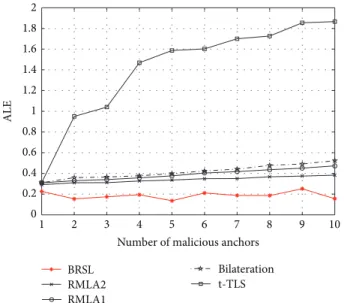
Figures 8 and 9 show the impact of malicious anchor number on the localization accuracy of BRSL, RMLA2, RMLA1, Bilateration, and t-TLS. With the increase of number of malicious anchor nodes, the ALE of RMLA2, RMLA1, Bilateration, and t-TLS rises obviously, while that of BRSL remains stable (no more than 22% in noncolluding scenario and 30% in colluding scenario). Therefore, BRSL is robust for multihop localization and can greatly improve the average
1 2 3 4 5 6 7 8 9 10 0 0.2 0.4 0.6 0.8 1 1.2 1.4 1.6 1.8 2
Number of malicious anchors
ALE BRSL RMLA2 RMLA1 Bilateration t-TLS
Figure 8: ALE versus malicious anchor number when malicious anchor nodes are noncolluding.
1 2 3 4 5 6 7 8 9 10
Number of malicious anchors BRSL RMLA2 RMLA1 Bilateration t-TLS 0 0.3 0.6 0.9 1.2 1.5 1.8 2.1 2.4 ALE
Figure 9: ALE versus malicious anchor number when malicious anchor nodes are colluding.
localization accuracy no matter the malicious anchor nodes are noncolluding or colluding.
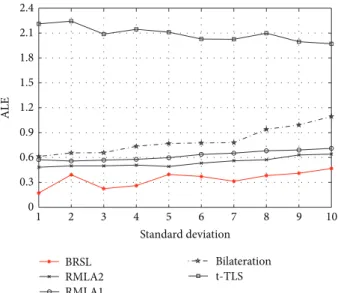
Figures 10 and 11 show the comparison results of ALE under different standard deviation 𝜆 of ranging errors in noncolluding and colluding scenario, respectively. The ALE of each algorithm increases with standard deviation𝜆. Com-pared with RMLA2, RMLA1, Bilateration, and t-TLS, BRSL may approximately improve the localization accuracy by 10%, 15%, 55%, and 110%, respectively, in noncolluding scenario and 15%, 20%, 65%, and 150% in colluding scenario. The BRSL performs much better than other algorithms.
Figures12and13illustrate the relationship of ALE with the times of network deployment. The number of simulation rounds equals to the times of network deployment. The
1 2 3 4 5 6 7 8 9 10 0 0.2 0.4 0.6 0.8 1 1.2 1.4 1.6 1.8 2 ALE BRSL RMLA2 RMLA1 Bilateration t-TLS Standard deviation
Figure 10: ALE versus the standard deviation𝜆 when malicious anchor nodes are in noncolluding scenario.
0 0.3 0.6 0.9 1.2 1.5 1.8 2.1 2.4 ALE 1 2 3 4 5 6 7 8 9 10 BRSL RMLA2 RMLA1 Bilateration t-TLS Standard deviation
Figure 11: ALE versus the standard deviation𝜆when malicious anchor nodes are in colluding scenario.
ALE almost does not change with the number of simulation rounds whether the malicious anchor nodes are in noncollud-ing or colludnoncollud-ing condition. The variety of network topology does not affect the detecting and localization process.
5.3. Cost Analysis. Finally, we analyze the costs of five
algo-rithms. Assume a sensor node𝑀𝑗 can hear𝑛anchor nodes in its one-hop range. In BRSL method,𝑀𝑗needs to compute
(𝑛
2) times to detect each anchor node. Thus, the cost of reputation computation in the network is𝑂(𝑁3 ⋅ 𝑛2). The computation complexity of the localization stage in our method is𝑂(𝑛). Then the total cost of BRSL method is𝑂(𝑁3⋅
𝑛2)+𝑂(𝑛). The costs of RMLA2 equals to that of RMLA1. The
communication complexity of RMLA1 or RMLA2 is𝑂(𝑁3⋅
0 0.2 0.4 0.6 0.8 1 1.2 1.4 1.6 1.8 2 ALE BRSL RMLA2 RMLA1 Bilateration t-TLS 100 200 300 400 500 600 700 800 900 1000
The number of rounds
Figure 12: ALE versus rounds number when malicious anchor nodes are noncolluding.
BRSL RMLA2 RMLA1 Bilateration t-TLS 100 200 300 400 500 600 700 800 900 1000
The number of rounds 0 0.3 0.6 0.9 1.2 1.5 1.8 2.1 2.4 ALE
Figure 13: ALE versus rounds number when malicious anchor nodes are colluding.
𝑛2). And the computation complexity of RMLA1 or RMLA2 is𝑂(𝑛). Thus, the total cost of RMLA1 or RMLA2 is𝑂(𝑁3⋅
𝑛2) + 𝑂(𝑛), which is the same as BRSL algorithm. The costs
of Bilateration and t-TLS mainly focus on the computation stage. The computation complexity of Bilateration is𝑂(𝑛2), while that of t-TLS is𝑂(𝑛). Therefore, the cost of our method is moderate and acceptable.
6. Conclusions
In this paper, we propose a BRS-based robust secure localiza-tion algorithm for the case of presence of malicious anchor nodes. Based on the beta reputation system and the trust evaluation, the malicious anchor nodes are detected and excluded. By utilizing the weighted Taylor-series least squares
method, the coordinates of sensor nodes are estimated. The simulation results demonstrate that the BRSL algorithm can effectively distinguish malicious anchor nodes and improve localization accuracy, as well as resist topology variety and ranging uncertainties. In the future, our work will focus on the secure localization when there are multiple and different attacks in complex environments.
Acknowledgments
The authors are grateful to the anonymous reviewers for their industrious work and insightful comments. This work is supported by National Natural Science Foundation of China under Grant nos. 61001138 and 61201317.
References
[1] J. Albowicz, A. Chen, and L. Zhang, “Recursive position estima-tion in sensor networks,” inProceedings of the 9th International Conference on Network Protocols, pp. 35–41, 2001.
[2] H. A. Oliveira, E. F. Nakamura, A. A. F. Loureiro, and A. Bouk-erche, “Directed position estimation: a recursive localization approach for wireless sensor networks,” inProceedings of the 14th IEEE International Conference on Computer Communica-tions and Networks, pp. 557–562, San Diego, Calif, USA, 2005. [3] T. He, C. Huang, B. M. Blum, J. A. Stankovic, and T. Abdelzaher,
“Range-free localization schemes for large scale sensor net-works,” inProceedings of the 9th Annual International Confer-ence Mobile Computing and Networking (MobiCom ’03), pp. 81– 95, ACM Press, San Diego, Calif, USA, 2003.
[4] M. L. Sichitiu and V. Ramadurai, “Localization of wireless sensor networks with a mobile beacon,” inProceedings of the 1st IEEE International Conference on Mobile Ad-Hoc and Sensor Systems, pp. 174–183, Fort Lauderdale, Fla, USA, October 2004. [5] X. L. Guo, R. J. Feng, Y. F. Wu, and J. W. Wan, “Grid-Scan-Based multi-hop Localization algorithm for wireless sensor networks,” inProceedings of IEEE Sensors Conference, pp. 668– 672, Waikoloa, Hawaii, USA, 2010.
[6] D. Niculescu and B. Nath, “DV based positioning in ad hoc networks,” Telecommunication Systems, vol. 22, pp. 267–280, 2003.
[7] K. Yu, Y. J. Guo, and M. Hedley, “TOA-based distributed localisation with unknown internal delays and clock frequency offsets in wireless sensor networks,”IET Signal Processing, vol. 3, no. 2, pp. 106–118, 2009.
[8] J. Wan, N. Yu, R. Feng, Y. Wu, and C. Su, “Localization refine-ment for wireless sensor networks,”Computer Communications, vol. 32, pp. 1515–1524, 2009.
[9] H. Lim and J. C. Hou, “Localization for anisotropic sensor networks,” inProceedings of 24th Annual Joint Conference of the IEEE Computer and Communications Societies, vol. 1, pp. 138– 149, 2005.
[10] J. W. Wan, X. L. Guo, N. Yu, Y. F. Wu, and R. J. Feng, “Multi-hop localization algorithm based on grid-scanning for wireless sensor networks,”Sensors, vol. 11, no. 4, pp. 3908–3938, 2011. [11] Y. Shang, H. Shi, and A. A. Ahmed, “Performance study of
local-ization methods for ad-hoc sensor networks,” inProceedings of the IEEE International Conference on Mobile Ad-Hoc and Sensor Systems, pp. 184–193, October 2004.
[12] S. Y. Wong, J. G. Lim, S. V. Rao, and W. K. G. Seah, “Multihop localization with density and path length awareness in non-uniform wireless sensor networks,” inProceedings of the IEEE 61st Vehicular Technology Conference, vol. 4, pp. 2551–2555, Stockholm, Sweden, June 2005.
[13] Q. J. Xiao, B. Xiao, J. N. Cao, and J. P. Wang, “Multihop range free localization in anisotropic wireless sensor networks: a pattern-driven scheme,”IEEE Transactions On Mobile Computing, vol. 9, no. 11, pp. 1592–1607, 2010.
[14] J. Hwang, T. He, and Y. Kim, “Detecting phantom nodes in wireless sensor networks,” inProceedings of the 26th IEEE Inter-national Conference on Computer Communications (INFOCOM ’07), pp. 2391–2395, May 2007.
[15] R. J. Feng, X. L. Guo, N. Yu, and J. W. Wan, “Robust multihop localization for wireless sensor networks with unreliable bea-cons,”International Journal of Distributed Sensor Networks, vol. 2012, Article ID 972101, 13 pages, 2012.
[16] H. L. Chen, W. Lou, and Z. Wang, “A novel secure localization approach in wireless sensor networks,” Eurasip Journal on Wireless Communications and Networking, vol. 2010, article 12, 2010.
[17] J. G. Alfaro, M. Barbea, and E. Kranakis, “Secure localization of nodes in wireless sensor networks with limited number of truth tellers,” inProceedings of the 7th Annual Communication Networks and Services Research Conference (CNSR ’09), pp. 86– 93, May 2009.
[18] D. Liu, P. Ning, A. Liu, C. Wang, and W. K. Du, “Attack-resistant location estimation in sensor networks,” inProceedings of the 4th International Symposium on Information Processing in Sensor Networks (IPSN ’05), vol. 11, no. 4, pp. 99–106, 2005. [19] W. T. Zhu, Y. Xiang, J. Y. Zhou, R. H. Deng, and F. Bao, “Secure
localization with attack detection in wireless sensor networks,” International Journal of Information Security, vol. 10, no. 3, pp. 155–171, 2011.
[20] D. Liu, P. Ning, and W. L. Du, “Detecting malicious beacons for secure localization discovery in wireless sensor networks,” in Proceedings of the 25th IEEE International Conference on Distributed Computing Systems (ICDCS ’05), pp. 609–619, 2005. [21] X. Li, B. Hua, Y. Shang, Y. Guo, and L. H. Yue, “Bilateration: an attack-resistant localization algorithm of wireless sensor network,” in Embedded and Ubiquitous Computing, Lecture Notes in Computer Science, pp. 321–332, 2007.
[22] A. Jsang and R. Ismail, “The beta reputation system,” in Proceedings of the 15th Bled Electronic Commerce Conference, pp. 41–55, 2002.
[23] G. E. Andrews, R. Askey, and R. J. Roy, Special Functions, Cambridge University Press, Cambridge, UK, 2001.
Submit your manuscripts at
http://www.hindawi.com
VLSI Design
Hindawi Publishing Corporation
http://www.hindawi.com Volume 2014 Machinery
Hindawi Publishing Corporation
http://www.hindawi.com Volume 2014 Hindawi Publishing Corporation http://www.hindawi.com
Journal of
Engineering
Volume 2014Hindawi Publishing Corporation
http://www.hindawi.com Volume 2014
Shock and Vibration
Hindawi Publishing Corporation
http://www.hindawi.com Volume 2014
Mechanical Engineering Advances in
Hindawi Publishing Corporation
http://www.hindawi.com Volume 2014
Civil Engineering
Advances inAcoustics and VibrationAdvances in
Hindawi Publishing Corporation
http://www.hindawi.com Volume 2014
Hindawi Publishing Corporation
http://www.hindawi.com Volume 2014
Electrical and Computer Engineering
Journal of Hindawi Publishing Corporation
http://www.hindawi.com Volume 2014 Distributed Sensor Networks International Journal of
The Scientific
World Journal
Hindawi Publishing Corporationhttp://www.hindawi.com Volume 2014
Sensors
Journal ofHindawi Publishing Corporation
http://www.hindawi.com Volume 2014
Modelling & Simulation in Engineering Hindawi Publishing Corporation
http://www.hindawi.com Volume 2014
Hindawi Publishing Corporation
http://www.hindawi.com Volume 2014
Active and Passive Electronic Components Hindawi Publishing Corporation
http://www.hindawi.com Volume 2014 Chemical Engineering International Journal of Control Science and Engineering Journal of
Hindawi Publishing Corporation
http://www.hindawi.com Volume 2014
Antennas and Propagation International Journal of
Hindawi Publishing Corporation
http://www.hindawi.com Volume 2014
Hindawi Publishing Corporation
http://www.hindawi.com Volume 2014 Navigation and Observation International Journal of Advances in OptoElectronics
Hindawi Publishing Corporation
http://www.hindawi.com Volume 2014
Robotics
Journal ofHindawi Publishing Corporation