TWINS MULTIMODAL BIOMETRIC IDENTIFICATION
SYSTEM WITH ASPECT UNITED MOMENT INVARIANT
1,2,3
BAYAN OMAR MOHAMMED, 1,2 SITI MARIYAM SHAMSUDDIN
1
UTM Big Data Centre, Ibnu Sina Institute for Scientific and Industrial Research, Universiti Teknologi Malaysia, Johor, Malaysia
2
Faculty of Computing Universiti Teknologi Malaysia, Johor, Malaysia.
3
College of Science and Technology, University of Human Development, Sulaimani, KRG , Iraq. E-mail: 1,2,3 [email protected] , 1,2 [email protected]
ABSTRACT
In the field of pattern recognition twin’s biometric identification is currently a popularly studied subject. In some situations, the mechanism of twins’ biometric Identification leads to the finding a distinctive pattern of a person’s biometric. Correspondingly, there has been considerable improvement made on the Unimodal biometric identification to identify identical twins with respect to its accuracy and reliability, with some traits that show sound performance. However, owing to great level of similarity, it is much more challenging to identify Identical twins as opposed to identifying non-twins. In order to deal with this problem, the application of more than one biometric trait is proposed; the Multimodal biometric system. Meanwhile, in pattern recognition it is crucial to extract and select features that are meaningful. This brings the attention to the major issue in twin handwriting-fingerprint identification: how to obtain features from numerous writing and styles twin handwriting-fingerprint so that the right person between twins can be reflected. Hence, the Aspect United Moment Invariant is proposed in this study as extraction of feature with identical twin multi-biometric identification.
Keywords: Twin Multi-biometric, Global feature, Identification, Individuality, Aspect United Moment
Invariant.
1. INTRODUCTION
Biometric-based identification and verification systems will both be a main technology [1],[2]equipped with applications such as control of access to buildings and computers, decrease of fake transactions in electronic commerce, and dampen illegal immigration [9].Nonetheless, identical twins biometric identification appears to be a lot more difficult in comparison identifying non-twins due to substantial amount of identicalness found between these identical twins[6].This makes twins biometric Identification rather popular among researchers of pattern recognition and computer vision because in certain situations it is the only method that could lead to the discovery of the real person biometric of a pattern from a group of individuals[9], [10],[11],[12],[13],[21]. The Unimodal biometric identification for identical twins has lately improved significantly with respect to reliability and accuracy[6,14]and a number of the traits indicate good performance. Somehow, it should be noted that there are still issues plaguing even the best biometric traits of which are inherently linked to the technology itself. The past researches
however, were focusing on the identification or verification of identical twins employing the Unimodal biometric system. Among those employed include Wonder Ears: Identification of Identical Twins from Ear Images by [14], 3D Face Recognition used for distinguish face for identical twins by [15],Analysis of Facial Marks to Distinguish Between Identical Twins by [10], Double Trouble: Differentiating Identical Twins by Face Recognition by [9].
further investigation of the written texts and patterns of minutiae versus original ones. Meanwhile, the past studies did not consider the global (holistic) features obtained from the cursive word or shape as one whole object for any biometric. Example is a study from [13].
2. INDIVIDUALITY OF TWINS
MULTI-BIOMETRIC
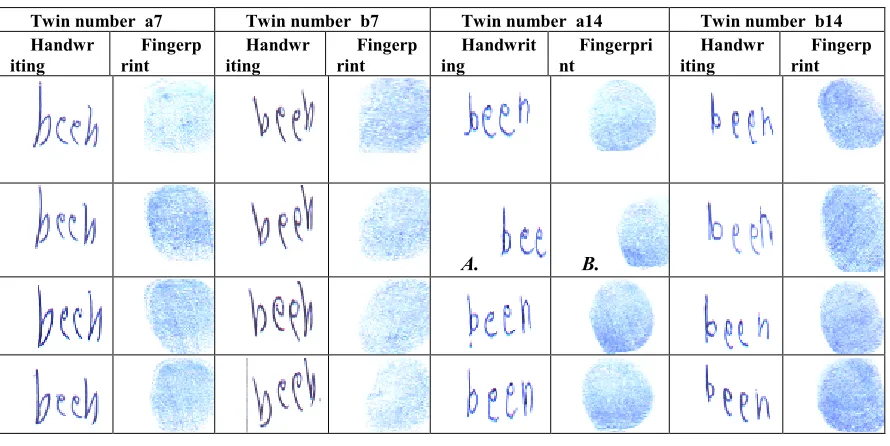
The nature of a person is perceivable via his or her handwriting-fingerprint. The hypothesis constructed in [1],[2],[3],[4],[6] indicated that the individuality of a person with respect to writing and fingerprint style is evidenced by the fact that a person’s handwriting-fingerprint is consistent. Figure 1 shows two pairs of samples in twins. From the figure, it is clear that the writings and fingerprints show only minor difference when the writings and fingerprints are produced by the same person in a pair of twins. Comparatively, there is more defined variance when the writings and fingerprints are produced by different persons in a pair of twins albeit the fact that the shape height is similar. Thus, even though the two persons are identical twins, there is still difference in terms of their handwriting and fingerprint. This difference is termed Individuality of Handwriting-fingerprint. This individuality can be measured by the variances. Here, the value of the person’s feature (intra-class) has to be of lower than the value of different persons (inter-class) [4],[5],[6].If the features contains the smallest similarity error for one individual in a pair of twins (intra-class) and greatest similarity error for both individuals in a pair of twins (interclass), then the individual features are good as well as acceptable[7]. Hence, it is necessary to obtain individual features from the samples of handwritten-fingerprint. This will allow the identification of the individual in a pair of twins.
3. UNIQUE REPRESENTATION WITH GLOBAL FEATURES ON TWIN MULTI-BIOMETRIC IMAGES
Global features that can handle twin multi-biometric images for identification purpose is proposed in this study. This method is an adaptive method and it is used to extract feature extraction. Such usage will separately improve the class because for an individual twin class ,the method relocates the feature points to better places that would assure more efficient representation of individual characteristics of each biometric modality prior to their utilization in the matching process. Numerous researchers in the field of
pattern recognition have their attention on identifying twin by employing the handwritten and fingerprint images shape [5],[8]. In visual domain, shape is an integral feature and in fact, shape is one of the fundamental features for illustrating the content of image [8]. However, it is not easy to extract features that accurately denote and illustrate the shape for a person in twins. Therefore, this study has the first objective of introducing a new mechanism for identical twins with Multimodal biometric identification with various modalities. Meanwhile an algorithm of Aspect United Moment Invariant (AUMI) [8] that can extract a good set of global features has been set as the second objective of this study. The features indicated denote the twin handwriting-fingerprint from the region as well as the boundary depiction of a word and shape of fingerprint. The features that are extracted from the AUMI algorithm then undergo the test of individuality of handwriting and fingerprint in the domain of twin identification.
Further, to analyze the efficiency of global features for minimizing the variation for intra-class while maximizing the variation for inter-class for Individuality of twins’ handwriting-fingerprint in biometric Identification has been set as the third objective of this study. In order to attain this objective, a method comprising a procedure is employed. Such method use is crucial owing to that fact that the application of twin identification strictly requires the usage of technique that fulfils the ‘individuality’ of Multimodal biometric concept. Shown in Figure 2 is the study’s overview that proposes a new procedure for improving the identification of a pair of twins’ handwriting-fingerprint.
3.1 Twin handwriting-fingerprint Shape
Representations
this study will include the exploration of global method in order to ascertain the most fitting technique for upholding the notion individuality of twin handwriting-fingerprint in the domain of twin biometric identification domain.
3.2 Aspect United Moment Invariant for Twin
multi-Biometric
The extraction of individual features from Twin Multi-biometric shape requires an effective technique. As opposed to character, shape demonstrates greater level of individuality in handwriting [8],[16]. As such, the United Moment Invariant (UMI) [17] is chosen in this study to extract the global features from twin handwritten and fingerprint shape. UMI was created according to the Geometric Moment Invariant (GMI) [18] and the Improve Moment Invariant (IMI) [19]. As demonstrated by [19] , GMI is employable for region representation in separate circumstance. However, for boundary representation, the computational times are high. Owing to this, IMI is suggested for boundary and also for quicker computation.
However, the region and boundary of an image has to be extracted in a continuous and separate manner. This will assure the attainment of quality feature in representing an image [17]. As such, UMI is proposed [17] due to its capacity to effectively discriminate the image shape separately and continuously on both region and boundary .However, there are problems that are linked to the scaling factor employed in UMI [18].Hence, [8] suggested that the use of Aspect Invariant Moment (Aspect) scaling factor by [20] in Aspect United Moment Invariant. The invariant features are improved by this scaling factor with no normalization of size. This is why the Aspect’s scaling is also included in the proposed AUMI algorithm; it can preserve the invarianceness of handwriting-fingerprint for twin in the X and Y direction. In fact, this is what characterizes the human’s handwriting-fingerprint of twin. Using the scaling, the global word and the fingerprint features’ shape are singly and continuously extracted from both region and boundary representation, with scale invarianceness from handwriting-fingerprint of twin.
Aspect United Moment Invariant [8] was formulated to have the capacity to extract global features from region and boundary of an object (word or shape) in a discrete and continuous manner, for denoting an individual in a twin. Such
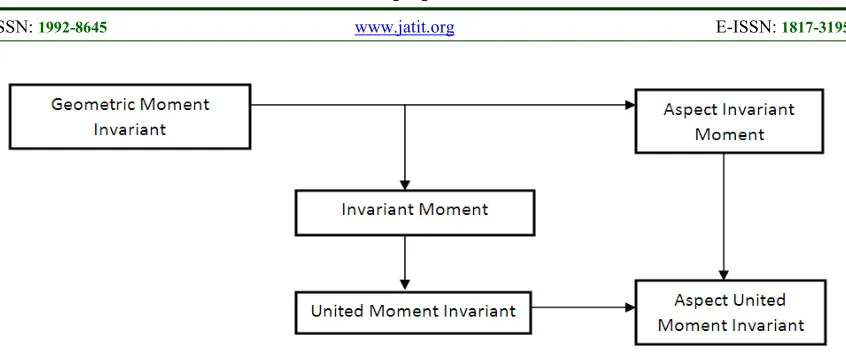
can be attained through the construction of fusion of Aspect’s embedded scaling factor [20] into the UMI [17] (refer to Figure 3).This right away assumes the capacity of these two moment functions in to the proposed Aspect United Moment Invariant. The creation of UMI [17] has association with geometrical representation that considers GMI’s Normalised Central Moment equations [18] and IMI’s Boundary Representation [19]. Lastly, 8 features are shown in AUMI [8] with the formulation of UMI [17] below:
As φi denotes large values, the natural logarithm is employed. As such, below is obtained
for i = 1 to 7 ; θi←log10 φi.
4 TWIN HANDWRITING WITH GLOBAL
EXTRACTED FEATURE (GEF)
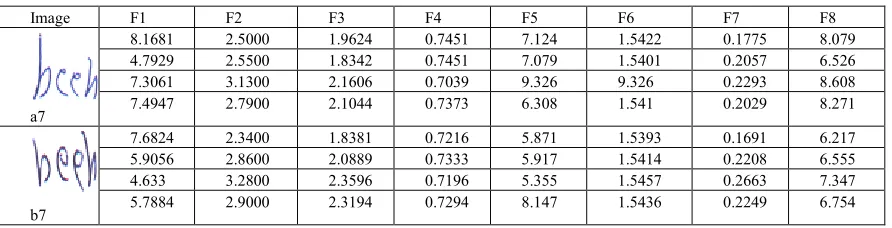
Tables 1, 2, 3, 4 and5 show that low inter-features variability does exist between both individuals in a twin. On the other hand, variability of height intra-features exists with the same individual in a twin.
5 TWIN FINGERPRINT WITH GLOBAL
EXTRACTED FEATURE (GEF)
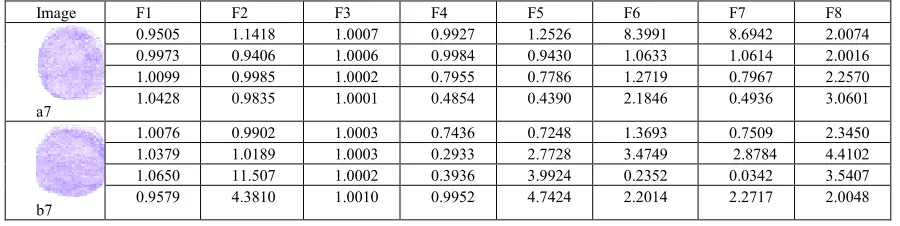
Tables6, 7, 8, 9 and10 show the shape images sample of the extracted twin fingerprint. The original extracted features and also the global feature are contained in these features. Geometrical minute feature extraction (GMFE), United Moment Invariant (UMI), Geometric Moment Invariant (GMI), Aspect Invariant Moment (Aspect) and Aspect United Moment Invariant (AUMI) are included.
A system of identification follows a set of features that is reflective of an individual’s individuality and characteristics in a twin. Nonetheless, it is critical to extract and select only the meaningful features while for the context of twin identification, it is difficult to perform. The multi-biometric features that are stored in the data storage should be employed in identifying twin.
6 SIMILARITY MEASUREMENT
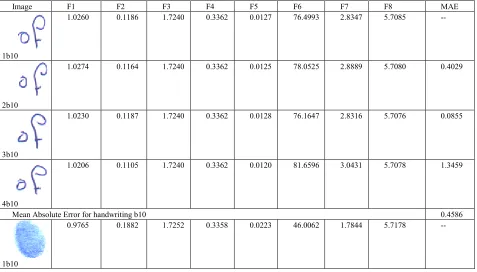
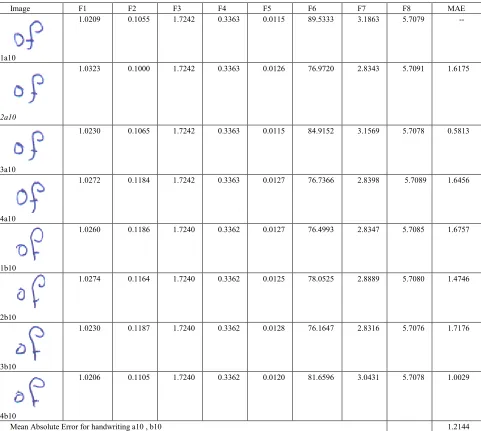
The measurement of uniqueness is performed with the Mean Absolute Error (MAE) function. Tables 11, 12 and 13present the example of MAE computation. Each person is presented by 4 images. The value of MAE provides the invarianceness of twin handwriting-fingerprint as well as the image of reference (first image) [8]. Small errors denote the closeness of the image to the image of reference. MAE’s average is computed from the overall results’ value.
Where:
n denotes the number of images; xi represents the current image;
ri denotes the image of reference or location
measure;
f represents the number of features; i denotes the feature column of image.
This study employs the MAE function as it matches to the individuality of the measurement of the individual twin handwriting-fingerprint in the
domain of twin multi-biometric identification. In a pair of twins, each twin will possess the unique features or characteristic in handwriting-fingerprint. The MAE function allows the measurement of the variance between twin handwriting-fingerprint using two handwriting-fingerprints’ similarity error obtained from detail characteristics in the column of feature. As such, to calculate the variance between two handwriting-fingerprint images for the each column’s features from extracted invariant feature vector of image in this study. Lowest mean MAE value is considered as the most identical to the original image (reference image or first image) to be compared. Conversely, the highest mean MAE value indicates the most different. Also, MAE function has been grouped under robustness theory of statistical procedure and is also regarded as the solution that is simplest and most practical [8].
6.1 Intra-class and Inter-class with MAE
The value of MAE attained from thepriorprocess undergoes the intra-class and inter-class analysis. Intra-class is made of a group of features that are extractedfromthe same twin.Conversely, inter-class is formed by a group of features that are extractedfrom both twins. Smaller value of MAE is required for intra-class, for both handwriting word andshape of fingerprintof twin. For inter-class, the opposite is required.Such would demonstrate the individuality of twin handwriting-fingerprint.
The differences between the intra-classmeasurement (measurement of one individual in a twin) and the inter-class measurement (measurement ofboth individuals in a twin) with the application of the MAE function for the word and shape are shown inTables 11, 12 and 13 respectively. In Tables11 and 12which shows the intra-class, thevalues of MAE are less thanthose of MAEthat are presented in Table 13even thoughthe twin multi-biometricwas applied in both tables. As for the values of MAE inTables 11, 12 and 13they are analyzable for the individuality of twin handwriting-fingerprint verification. Tables 11 and 12, show MAE value that is lower. This indicates that the feature between the handwriting and fingerprint from the exact individual in a twin contains close feature value when contrasted with the handwriting and fingerprint from both twins (see Table 13).
selected because the data obtained are limited. In addition, the MAE function also matches with the individuality of the analysis of twin handwriting-fingerprint. With respect to the intra-class and inter-class analysis, comparison between intra-inter-class and inter-class, the process of similarity measurement run. Here, it is necessary that the variance value for intra-class is smaller than the variance value of inter-class so that the requirement of the individuality of twin handwriting-fingerprint is satisfied. Then, it can be employed in the field of TI.
6.2 Result, Analysis and Interpretation
This study highlights the AUMI results as well. The purpose of presenting the results is to determine the applicability of the method in the domain of Twin multi-biometric identification. At the same time, comparison and analysis of the AUMI can also be performed with other techniques which will prove the hypothesis on the positive value of AUMI in the domain of TI. Table 14 presents the results of MAE value. As demonstrated by the results, there should be more exploration of AUMI algorithm in the context of the TI domain. The similarity error result indicates smaller Uniqueness of authorship for intra-class (same person in twin) when contrasted to that of inter-class (both persons in twin). This satisfies the notion of individuality of twin handwriting-fingerprint in the field of identification. In this regard, the value of MAE for intra-class (exact person in twin) is lower when compared to the MAE value of inter-class (both persons in twin) in terms of handwriting and fingerprint. This is caused by the ability of moment function as representation of image. Hence, the Uniqueness presentation analysis provides affirmation that AUMI is a valuable feature extraction technique in TMI domain. Also, it has been evidenced that extracted feature brings the distinctive features of individual in twin handwriting-fingerprint.
The unique characteristic or individual feature for handwriting-fingerprint of twin is demonstrated by the results above. With respect to inter-class (both twins), the similarity error should be greater while for intra-class (same individual) the similarity error should be smaller, in the notion of individuality of twin handwriting-fingerprint (see Figure 4). The features extracted with the AUMI algorithm appear closer for same individual in a twin while for different individuals in a twin, they appear more different. This leads to the attainment
of MAE value that is smaller for intra-class but greater for the inter-class. Therefore, the proposed technique is indeed useful in the task of features extraction in TI field. Furthermore, many scholars, for instance [6],[21],have reported on the notion individuality of twin handwriting-fingerprint. Thus, it is hoped that this study will become part of the scientific substantiation of individuality of twin multi-biometric attainable with the application of the AUMI algorithm of MF in extraction of feature.
Somehow, this section’s outcome will not be contrasted and analyzed to determine the best technique. The ensuing section will discuss the techniques’ comparison. In this section, the AUMI algorithm is validated for to the notion of individuality of twin multi-biometric in the field of TI. This algorithm can be employed for the same individual in a twin and also for different individuals in a twin. As for the other three techniques, their outcomes also indicate their applicability for twin multi-biometric notion. Thus, in the field of TI, further examination of AUMI, UMI, Aspect and GMI technique of moment function and macro, geometrical minute is worthwhile.
7 COMPARISON OF PERFORMANCE
BETWEEN TECHNIQUES
This section highlights the techniques (Macro, GMI, Aspect, UMI and AUMI) for twin handwriting in terms of their outcomes and (Geometrical minute, GMI, Aspect, UMI and AUMI) for twin fingerprint. This study also includes a comparative study as an attempt to find out the most fitting technique for twin handwriting-fingerprint individuality. Also, AUMI’s ability in the extraction of features of twin handwritten-fingerprint word and shape image in the field of TI is also assessed in this study. As demonstrated, the individuality of the concept of twin handwriting-fingerprint for AUMI is proven. In comparison to that of the inter-class, the error of similarity for intra-class is smaller; that is, for the same individual and also for both individuals in a twin.
measurement similarity, the highest MAE value is needed. With respect to intra-class, the lowest MAE value denotes that extracted features are most related, similar and bring greater individuality characteristic within a group of features. Conversely, for inter-class, the biggest MAE value means that the features are very different in comparison to the others and causes low individuality in that data set.
This section shows the outcomes of the intra-class and inter-intra-class analysis. Table15, 16, 17 as well as18presents the result for both intra-class and inter-class. Four 20 twins are shown.
As shown by the outcomes in Tables 15 through 18, there appears an irregularity of the sequence of technique for the lowest MAE value with the exception of the AUMI technique. Specifically, the smallest value of MAE in most tables is indicated for AUMI. For comparison of intra-class and inter-class, consistency in the technique sequence is required. This allows the evaluation of the best technique. The best technique must possess smallest MAE value for intra-class and biggest MAE value for inter-class at the same time. Somehow, as demonstrated, AUMI satisfies the prerequisite. This is because the value scale for extracted invariant feature vector that is obtained from feature extraction has different nature for each technique. For instance, when compared to other techniques, for invariant feature vector, AUMI will generate the smallest value. As such, AUMI will consistently generate smallest MAE value for intra-class whereas for inter-intra-class, AUMI generates largest value, as shown in table 19.
8 CONCLUSION
The purpose of this study is to show the AUMI technique’s impact on the individuality in identical twin multi-biometric, in order to offer verification to the individuality of twin multi-biometric in the field of twin Identification (TI). Representation of individuality is highlighted in this study so that the individuality of twin multi-biometric is demonstrated by the utilization of Moment Function (MF) when extracting the feature. This study also highlights the individuality representation procedure. Further, this study presents the best technique that is measured by computing the mean between the smallest and largest MAE value is also highlighted in this study. It should be noted that each technique attains different scale value in extracted features. The
experimental outcomes prove that AUMI creates the greatest individuality in addition to the investigation of other techniques of moment in the area of multi-biometric twin identification.
REFERENCES:
[1] Y.Koda, T.Higuchi and Anil K. Jain ,
“Advances in Capturing Child Fingerprints: A
High Resolution CMOS Image Sensor with
SLDR Method” 2016 International Conference
of the Biometrics Special Interest Group (BIOSIG), IEEE, 21-23Sep.2016, pp1-4. [2] S.Karahan, M.Kılınc, H.Kemal Ekenel, ‘How
Image Degradations Affect Deep CNN-based
Face Recognition?’, IEEE Conference
Publications, 21-23Sep.2016 pp. 1-5 .
[3] Ch.Kauba , A. Uhl Wavelab, E.Piciucco , E.Maiorana and P.Campisi, ‘Advanced Variants of Feature Level Fusion for Finger
Vein Recognition’, IEEE Conference
Publications, 21-23Sep.2016, pp. 1-7 .
[4] S.Easwaramoorthy , Sophia F , Prathik A,
‘Biometric Authentication using finger nails’,
2016 International Conference on Emerging Trends in Engineering, Technology and Science (ICETETS), IEEE Conference Publications,24-26 Feb. 2016, Pages: 1 – 6. [5] S.S. Patil, S.Gudasalamani, N.C. Iyer, V.G.
Garagad, ‘Tilt and Scale Invariant Iris
Recognition System’, 2016 IEEE International
Conference on Current Trends in Advanced Computing (ICCTAC), IEEE Conference Publications,10-11 March 2016, Pages: 1 – 6. [6] Sh.Eliabeth , B.Thomas, J. J
Kizhakkethottam,,’ Analysis of Effective
Biometric Identification on Monozygotic
Twins’ 2015 International Conference on
Soft-Computing and Networks Security (ICSNS), IEEE Conference Publications, 25-27 Feb. 2015, Pages: 1 – 6.
[7] P.M.Patil, R.B. Wagh,’ Writer’s Identification
by using Word Reason Feature Transform’,
2016 International Conference on Emerging Trends in Engineering, Technology and Science (ICETETS),I EEE Conference Publications, 24-26 Feb. 2016, Pages: 1 – 4. [8] Azah, K. M, S.M. Shamsuddin. And A.
Abrahamz. Improvement of Authorship
Invarianceness for Individuality
Representation in Writer Identification. ICS
AS CR 2010, Vol. 3, pp. 371-387.
[9] Hamid B. , K. Faez, Introducing a New
Traits, IEEE Conference Publications , ©2013 IEEE, pp. 1-6 ,
[10]Mjolsnes, S.F,” A Multidisciplinary
introduction to Information Security “.
Champan &Hall/CRC, 2012.
[11]Narayanan, A., &Shmatikov,V. “Fast dictionary attacks on password using
time-space tradeoff “,In proceedings of the 12th
ACM conference on computer and communication security Nov.,2012, pp. 364-372).
[12]M.K. Umair, A.K. Shoab, N. Ejaz, and R. Riaz,
“A Fingerprint Verification System using
Minutiae and. Wavelet Based Features,”
International Conference on Emerging. Technologies, 2009, pp. 291-296.
[13]N. Nain, B.M. Deepak, D. Kumar, M. Baswal, and B. Gautham, “Optimized Minutiae–Based
Fingerprint Matching”, Lecture Notes in
Engineering and Computer Science, 2008, vol. 2170(1), pp. 682-687.
[14]W. Y. Leng and S. M. Shamsuddin,
“Fingerprint Identification using
Discretization “Technique, International
Journal of Computer, Electrical, Automation,
Control and Information Engineering, 2012,
Vol:6, No:2,pp;240-248.
[15]Palhang, M. and Sowmya, A, “Feature
Extraction: Issues, New Features, and
Symbolic Representation”, Third International
Conference, VISUAL'99, Amsterdam, 1999,Vol. 1614. pp. 418 – 427.
[16]Yinan, S., Weijun, L. and Yuechao, W.,
“United Moment Invariant for Shape
Discrimantion”, IEEE International
Conference on Robotics, Intelligent Systems and Signal Processing, 2003, pp. 88 - 93. [17]Hu, M.-K. ,“Visual Pattern Recognition by
Moment Invariants”. IRE Transaction on
Information Theory,1962, Vol. 8. No. 2. pp. 179-187.
[18]Chen, C.-C. ,“Improved Moment Invariants for
Shape Discrimination”, Pattern
Recognition,1993, Vol.26, No. 5. pp. 683-686. [19]Feng P. and Keane, M. , “A New Set of
Moment Invariants for Handwritten Numeral
Recognition”, IEEE International Conference
of Image Processing, 13-16 Nov. 1994, . pp. 154 –158.
[20]J.Neves, H.Proenc, ‘ International Challenge
on Biometric Recognition in the Wild’,
Biometrics (ICB), 2016 International Conference , June. 13-16, IEEE Xplore,
[21]Pervouchine, V., and Leedham, G. ,
“Extraction and Analysis of Forensic
Document Examiner Features Used for Writer
Identification”, Pattern Recognition, 2007,
Twin number a7 Twin number b7 Twin number a14 Twin number b14 Handwr
iting
Fingerp rint
Handwr iting
Fingerp rint
Handwrit ing
Fingerpri nt
Handwr iting
Fingerp rint
[image:8.612.85.530.136.359.2]A. B.
Figure 1: Handwriting-fingerprint for both person in twins.
[image:8.612.92.531.376.697.2]Figure 3: Aspect United Moment Invariant
Table 1: Invariant features of twin number 7 by GMI algorithm
Image F1 F2 F3 F4 F5 F6 F7
a7
18.9489 354.2521 2.5200 2.3977 5.7528 4.5015 9.6150 19.5899 381.6335 2.6926 2.6496 7.0248 5.1721 6.4469 18.8415 346.5908 2.3309 2.3254 5.4115 4.3299 1.2163 19.0825 357.3562 2.5070 2.4411 5.9627 4.6084 7.1732
b7
18.7156 339.4583 2.3027 2.2954 5.2727 4.2285 1.6210 19.2375 361.0587 2.5265 2.4890 6.1995 4.7262 5.4285 20.0445 392.8424 2.8450 2.8207 7.9609 5.5885 5.1561 19.2749 360.1698 2.5479 2.5100 6.1995 4.7600 5.5050
Table 2: Invariant features of twin number 7 by Aspect algorithm
Image F1 F2 F3 F4 F5 F6 F7
a7
18.8347 376.2823 7.0384 7.9596 1.8833 1.5714 4.9230 18.2902 353.2250 6.4590 7.3065 1.5867 1.3663 4.1599 18.0328 347.4064 6.1785 6.9915 1.4526 1.1928 3.8246 18.3200 352.4048 6.4719 7.3206 1.5929 1.4439 4.2081
b7
18.7295 371.0281 6.7885 7.6793 1.7528 1.2949 4.5808 18.6161 366.8255 6.7355 7.6190 1.7254 1.2656 4.4770 18.1444 344.3009 6.4421 7.2856 1.5778 1.2334 4.1239 18.4553 360.0841 6.5980 7.4648 1.6561 1.1341 4.3045
Table 3: Invariant features of twin number 7 by UMI algorithm
Image F1 F2 F3 F4 F5 F6 F7 F8
a7
0.9933 0.9908 1.0003 0.9521 0.9555 1.0537
0.9610 2.0503
0.9972 0.9964 1.0003 0.9847 0.9860 1.0170 0.9882 2.0156 0.9881 0.9882 1.0004 0.9984 1.0098 1.0023 1.0102 2.0016 0.9906 0.9893 1.0003 0.9743 0.9816 1.0284 0.9849 2.0264
b7
[image:9.612.104.508.460.574.2] [image:9.612.83.529.612.729.2]Table 4:Invariant features of twin number 7 by AUMI algorithm
Image F1 F2 F3 F4 F5 F6 F7 F8
a7
1.028 0.0900 1.7240 0.3362 0.0096 100.9817 3.7346 5.7076 1.0288 0.0892 1.7240 0.3362 0.0095 101.9277 3.7680 5.7077 1.0227 0.0933 1.7241 0.3362 0.0101 96.9143 3.6030 5.7086 1.0282 0.0892 1.7239 0.3362 0.0088 100.9817 4.0847 5.7076
b7
[image:10.612.85.531.265.379.2]1.0299 0.1048 1.7241 0.3363 0.0112 86.8850 3.2071 5.7088 1.0299 0.1022 1.7240 0.3363 0.0110 88.8466 3.2885 5.7077 1.0336 0.0946 1.7239 0.3363 0.0100 96.5498 3.5544 5.7088 1.0299 0.1077 1.7240 0.3363 0.0116 84.1434 3.1228 5.7077
Table 5: Invariant features of twin number 7 by Macro algorithm
Image F1 F2 F3 F4 F5 F6 F7 F8
a7
8.1681 2.5000 1.9624 0.7451 7.124 1.5422 0.1775 8.079 4.7929 2.5500 1.8342 0.7451 7.079 1.5401 0.2057 6.526 7.3061 3.1300 2.1606 0.7039 9.326 9.326 0.2293 8.608 7.4947 2.7900 2.1044 0.7373 6.308 1.541 0.2029 8.271
b7
7.6824 2.3400 1.8381 0.7216 5.871 1.5393 0.1691 6.217 5.9056 2.8600 2.0889 0.7333 5.917 1.5414 0.2208 6.555 4.633 3.2800 2.3596 0.7196 5.355 1.5457 0.2663 7.347 5.7884 2.9000 2.3194 0.7294 8.147 1.5436 0.2249 6.754
Table 6: Invariant features of twin number 7by GMI algorithm
Image F1 F2 F3 F4 F5 F6 F7
a7
20.0601 363.5930 2.5939 2.5712 6.6206 5.8891 3.8856 20.4327 415.2668 2.6865 2.6790 7.1855 5.1489 1.1014 21.8448 486.6713 4.4507 3.5393 1.2532 7.7199 4.7711 29.3722 938.1759 1.8657 9.0555 8.2012 2.6159 6.3341
b7
34.5712 1.2134 1.9253 1.4308 2.0483 4.8979 9.0106 48.0872 2.4909 1.5261 4.4735 2.0023 2.1919 2.3298 39.0116 1.7261 4.8869 1.9229 3.6991 8.6324 3.4421 20.2399 37.891 2.6470 2.6291 6.9262 2.3313 2.8285
Table 7: Invariant features of twin number 7 by Aspect algorithm
Image F1 F2 F3 F4 F5 F6 F7
a7
20.0601 363.5930 2.5939 2.5712 6.6206 5.8891 3.8856 20.4327 415.2668 2.6865 2.6790 7.1855 5.1489 1.1014 21.8448 486.6713 4.4507 3.5393 1.2532 7.7199 4.7711 29.3722 938.1759 1.8657 9.0555 8.2012 2.6159 6.3341
b7
[image:10.612.107.506.421.532.2] [image:10.612.108.506.573.686.2]Table 8: Invariant features of twin number 7 by UMI algorithm
Image F1 F2 F3 F4 F5 F6 F7 F8
a7
0.9505 1.1418 1.0007 0.9927 1.2526 8.3991 8.6942 2.0074 0.9973 0.9406 1.0006 0.9984 0.9430 1.0633 1.0614 2.0016 1.0099 0.9985 1.0002 0.7955 0.7786 1.2719 0.7967 2.2570 1.0428 0.9835 1.0001 0.4854 0.4390 2.1846 0.4936 3.0601
b7
[image:11.612.85.531.265.379.2]1.0076 0.9902 1.0003 0.7436 0.7248 1.3693 0.7509 2.3450 1.0379 1.0189 1.0003 0.2933 2.7728 3.4749 2.8784 4.4102 1.0650 11.507 1.0002 0.3936 3.9924 0.2352 0.0342 3.5407 0.9579 4.3810 1.0010 0.9952 4.7424 2.2014 2.2717 2.0048
Table 9: Invariant features of twin number 7 by AUMI algorithm
Image F1 F2 F3 F4 F5 F6 F7 F8
a7
1.0107 0.1690 1.7250 0.3358 0.0187 53.0042 1.9872 5.7168 0.9910 0.1680 1.7248 0.3359 0.0193 52.2543 1.9999 5.7143 0.9783 0.1527 1.7251 0.3358 0.0180 56.7789 2.1987 5.7170 1.0094 0.0849 1.7244 0.3361 0.0094 105.1433 3.9566 5.7106
b7
1.0109 0.0881 1.7217 0.3369 0.0098 100.9343 3.8238 5.6906 1.0438 0.0126 1.7229 0.3366 0.0013 732.5799 26.7907 5.6984 1.0077 0.0074 1.7236 0.3364 8.2513 1.2030 45.4722 5.7035 0.9404 0.1815 1.7251 0.3358 0.0232 45.9228 1.8497 5.7176
Table 10: Invariant features of twin number 7 by Geometrical Minute algorithm
Image F1 F2 F3 F4 F5 F6 F7 F8 F9 F10
a7
178 162 184 190 183 168 167 159 192 209 211 189 213 189 216 168 165 188 182 188 213 209 174 208 210 147 153 200 209 206 193 190 202 210 189 215 171 153 168 185
b7
181 207 206 190 140 166 149 169 224 190 229 216 219 220 140 175 185 195 232 216 199 166 212 209 198 200 167 182 169 192 186 183 202 204 187 158 140 149 172 214
Table 11: MAE from AUMI features for twin multi-biometric for a10
Image F1 F2 F3 F4 F5 F6 F7 F8 MAE
1a10
1.0323 0.1000 1.7242 0.3363 0.0126 76.9720 2.8343 5.7091 --
2a10
1.0209 0.1055 1.7242 0.3363 0.0115 85.5333 3.1863 5.7079 2.2331
[image:11.612.83.531.421.532.2] [image:11.612.82.565.571.733.2]3a10
4a10
1.0272 0.1184 1.7242 0.3363 0.0127 76.7366 2.8398 5.7089 0.0662
Mean Absolute Error for handwriting a10 1.0926
1a10
1.0119 0.1485 1.7240 0.3362 0.0164 60.2519 2.2644 5.7077 --
2a10
1.0402 0.1253 1.7240 0.3362 0.0131 73.3963 2.6833 5.7079 3.4046
3a10
1.0628 0.1288 1.7240 0.3362 0.0129 72.9727 2.6111 5.7079 3.2855
4a10
1.0516 0.1496 1.7244 0.3361 0.0153 60.2519 2.2462 5.7112 0.0160
[image:12.612.88.565.429.701.2]Mean Absolute Error for fingerprint a10 1.6765
Table 12: MAE from AUMI features for twin multi-biometric for b10
Image F1 F2 F3 F4 F5 F6 F7 F8 MAE
1b10
1.0260 0.1186 1.7240 0.3362 0.0127 76.4993 2.8347 5.7085 --
2b10
1.0274 0.1164 1.7240 0.3362 0.0125 78.0525 2.8889 5.7080 0.4029
3b10
1.0230 0.1187 1.7240 0.3362 0.0128 76.1647 2.8316 5.7076 0.0855
4b10
1.0206 0.1105 1.7240 0.3362 0.0120 81.6596 3.0431 5.7078 1.3459
Mean Absolute Error for handwriting b10 0.4586
1b10
2b10
0.9442 0.2601 1.7253 0.3356 0.0329 32.2016 1.2905 5.7202 3.6040
3b10
1.0040 0.1724 1.7247 0.3359 0.0193 51.5573 1.9481 5.7139 1.4414
4b10
1.0233 0.1531 1.7251 0.3358 0.0165 59.2351 2.1937 5.7166 3.4318
[image:13.612.90.571.294.725.2]Mean Absolute Error for fingerprint b10 2.1193
Table 13: MAE from AUMI features for multi-biometric for twin number 10
Image F1 F2 F3 F4 F5 F6 F7 F8 MAE
1a10
1.0209 0.1055 1.7242 0.3363 0.0115 89.5333 3.1863 5.7079 --
2a10
1.0323 0.1000 1.7242 0.3363 0.0126 76.9720 2.8343 5.7091 1.6175
3a10
1.0230 0.1065 1.7242 0.3363 0.0115 84.9152 3.1569 5.7078 0.5813
4a10
1.0272 0.1184 1.7242 0.3363 0.0127 76.7366 2.8398 5.7089 1.6456
1b10
1.0260 0.1186 1.7240 0.3362 0.0127 76.4993 2.8347 5.7085 1.6757
2b10
1.0274 0.1164 1.7240 0.3362 0.0125 78.0525 2.8889 5.7080 1.4746
3b10
1.0230 0.1187 1.7240 0.3362 0.0128 76.1647 2.8316 5.7076 1.7176
4b10
1.0206 0.1105 1.7240 0.3362 0.0120 81.6596 3.0431 5.7078 1.0029
1a10
1.0402 0.1253 1.7240 0.3362 0.0131 73.3963 2.6833 5.7079 --
2a10
1.0628 0.1288 1.7240 0.3362 0.0129 72.9727 2.6111 5.7079 0.0653
3a10
1.0516 0.1496 1.7244 0.3361 0.0153 60.2519 2.2462 5.7112 1.7029
4a10
0.9765 0.1882 1.7252 0.3358 0.0223 46.0062 1.7844 5.7178 1.8386
1b10
0.9442 0.2601 1.7253 0.3356 0.0329 32.2016 1.2905 5.7202 3.5545
2b10
1.0040 0.1724 1.7247 0.3359 0.0193 51.5573 1.9481 5.7139 5.3565
3b10
1.0233 0.1531 1.7251 0.3358 0.0165 59.2351 2.1937 5.7166 2.8338
4b10
1.0119 0.1485 1.7240 0.3362 0.0164 60.2519 2.2644 5.7077 1.7023
[image:14.612.82.531.552.634.2]Mean Absolute Error for fingerprint a10, b10 2.1317
Table 14: Uniqueness presentation with twin multi-biometric identification
Twin Intra-class (handwriting) Inter-class (handwriting)
Intra-class (fingerprint) Inter-class (fingerprint)
a b a b
One twin 0.6984 0.7027 0.7557 5.5061 5.7529 6.1703
5 twin 1.0509 1.03816 1.14926 3.15978 3.7482 4.42792
Figure 4: Graph of Uniqueness presentation for AUMI
Table 15: Intra-class and Inter-class for 5 twins
Technique Intra-class (handwriting) Inter-class (handwriting)
Intra-class (fingerprint) Inter-class (fingerprint)
a b a b
AUMI 1.0509 1.03816 1.14926 3.15978 3.7482 4.42792
GMI
5.01706 3.92014 3.28166 45.784 50.08234 33.31978
Aspect 2.8655 2.45508 1.4808 82.39698 53.19492 46.90434
UMI 0.01376 0.01522 0.00976 0.71568 0.45602 0.32758
Macro 0.64576 0.54722 0.40518 --- --- ---
Geometrical minute --- --- --- 46.825 57.325 28.775
Table 16: Intra-class and Inter-class for 10 twins
Technique Intra-class (handwriting) Inter-class (handwriting)
Intra-class (fingerprint) Inter-class (fingerprint)
a b a b
AUMI 0.98417 1.02462 1.31034 3.82932 2.31317 4.45094
GMI 4.19827 3.98139 3.04288 56.70813 41.93724 33.67116
Aspect 3.41086 3.19869 1.84181 55.34073 41.42899 32.16461
UMI 0.01515 0.01319 0.00993 0.6984 0.4537 0.49592
Macro 0.69942 0.55316 0.41718 --- --- ---
Geometrical minute --- --- --- 57.22863 45.55857 31.39877
Table 17: Intra-class and Inter-class for 15 twins
Technique Intra-class (handwriting) Inter-class (handwriting)
Intra-class (fingerprint) Inter-class (fingerprint)
a b a b
AUMI 0.86576 1.0011 1.190767 4.544347 6.207867 9.690447
GMI
4.313453 4.183793 3.073113 54.17597 37.29115 33.30669
Aspect 1.824 4.1085 1.5879 57.11473 34.93319 29.40897
UMI 0.01562 0.015547 0.010133 0.779427 1.568773 0.64662
Macro 0.6733 0.638387 0.42918 --- --- ---
[image:15.612.67.548.440.535.2] [image:15.612.71.546.577.669.2]Table 18: Intra-class and Inter-class for 20 twins
Technique Intra-class (handwriting) Inter-class (handwriting)
Intra-class (fingerprint) Inter-class (fingerprint)
a b a b
AUMI 1.07769 1.016375 1.296195 5.292855 5.780635 9.989795
GMI 5.83541 4.333975 3.387275 47.3495 43.76792 30.59107
Aspect 4.91328 2.68737 2.200155 60.59422 44.48573 34.26115
UMI 0.025195 0.013455 0.01237 0.71044 1.26909 0.549525
Macro 0.710505 0.67443 0.433245 --- --- ---