physik multimedial
Julika Mimkes and Kerstin Zimmermann
Institute for Science Networking Oldenburg
[email protected]
ftw. (Telecommunications Research Center Vienna)
[email protected]
Abstract
The German project physik multimedial [2] offers a free accessible platform for medicine and other students who study physics as minor subject. It is founded by the Ministry of Educations & Research (bmbf) [1].
A complete course management both for teachers and students including learning
material and scheduling is presented on the technical side. Communication tools are given as well.
The VLE has of five different topics:
- self-study units about e.g. oscillations and waves, - multi-media data base / archive
- online material on physics (via LiLi) - exercise management and - didactics.
LiLi - the Link-List database to e-learning material in physics consists of well documented links with meta data and a search engine of distributed sources.
The project is a conglomerate of eight groups at five universities in the northern part of Germany. Experts in didactics, experimental physics, informatics and information
management work together to create this environment and some exemplary content which can be accessed at http://www.physik-multimedial.de .
1 Introduction
The enhancement of physics lectures, especially for biology and medicine students is the goal of the project physik multimedial. Lectures are not to be replaced but to be enriched by new didactical concepts and multimedial modules.
Different kinds of modules have been created: self-study units, an exercise server, a multi-media data base, didactical instructions and LiLi - a search engine for physics’ elearning material are offered on a virtual learnung environment (VLE). The modules and especially LiLi are presented here.
The group in Oldenburg is advised by Prof. Dr. E. R. Hilf, CEO of the Institute for Science Networking [3]. Focus of this group is the setup and the operation of the project’s server and the platform as well as the database called LiLi.
Additionally the group develops a self-study unit on trigenometry and takes care of the meta data for the project. Two workshops concerning the special needs of female students took place in Oldenburg already.
The leading project manager is Prof. Dr. Schecker, Bremen. The project started in April 2001 and will end in December 2003.
2 The virtual learning environment physik multimedial
The virtual learning environment physik multimedial is a further developement of „Campus Virtuell“ [4], a platform which has been developed and used during the last semesters by economy students in Oldenburg.
The platform is open to students and lecturers, they only need access to the internet and an email address. Lecturers may apply for special rights. At the moment, costs accur at no point.
The functionality of the platform may be classified into two fields: A course management and physics’ modules.
2.1 The course management
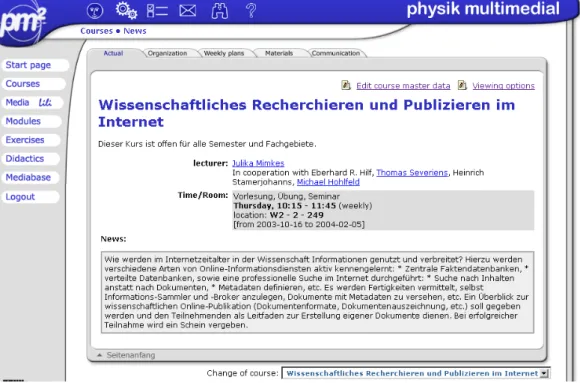
Courses with lectures, exercises or seminars may be supported by the platform. Basic data like information on time and location of lectures as well as news on the course can be saved and viewed. Course material and hyperlinks can be uploaded, managed and structured in weekly plans.
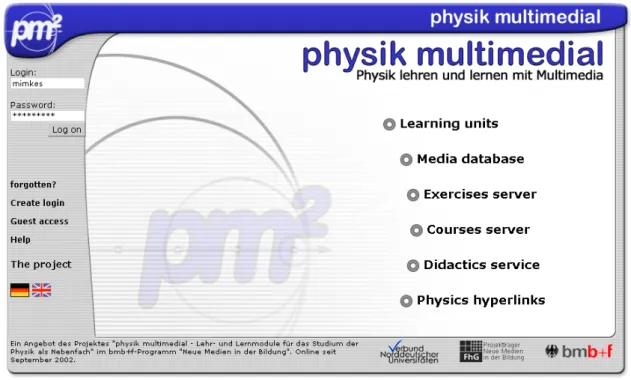
Figure 1. Starting page of physik multimedial
Different communication tools are accessible: a forum for every course to structure comments and questions, the possibility for lecturers to email to everyone and a chat server as a sychrone completion.
These tools may be used to discuss lectures and help to improve the contact between students and lecturers. There is also a possibiliy to send notes dictectly via the platform. Combinded with the status of the person (online / offline) a very quick communication is possibliliy.
2.2 The modules
The virtual learning environment physik multimedial also provides access to the physics’ modules.
Self-study units
Students have the possibility to acquire knowledge by using the self-study units. Multimedial elements like animations, pictures or films illustrate physics’ topics.
Lecturers may shorten the offered units by adding a relevance the each page of the self-study unit. At the moment, the self-study units “oscillations”, “waves” (group of Prof. Dr. Ryder) and “theory of errors” (group of Mr. Wilke, Greifswald) are online. Some more topics are under construction.
The multi-media database / archive
Pictures and animations can be chosen and downloaded directly from the multi-media database. A catalogue and a search interface may be used for this. These lecture components can be integrated into lecture concepts to enrich them with multimedial elements. Due to copyright issues only lecturers may enter the multi-media archive, which was created by Mr. Rackwitz and Mr. Romanovskis (Hamburg). The training facility server
Exercises like multiple – choice questions or simple arithmatic problems can be created with the means of the training facility server. Lecturers have the possibility to pick examples from the catalogue.
Every student gets his/her own set of values, while the exercise stays the same. They may solve the problems online and get a direct response, if the answer is correct or not - at least if the lecturer wants him or her to know. The number of trials can also be adjusted. A course statistic is automatically available for the teachers, so they are always informed about their students’ activity.
The group of Prof. Schick (Rostock) is responsible for the exercise module.
Didactics
Concepts how to teach and learn with the modules of physik multimedial are offerend by Dr. Petri und Prof. Dr. Schecker (Bremen).
This includes scenarios how to use the platform, information on physics software, discriptions of other universities using physics multimedia elements, pedagogical and psychological principles, evaluations, information about Gender Mainstreaming and more.
3 LiLi: Links to physics’ e-learning material
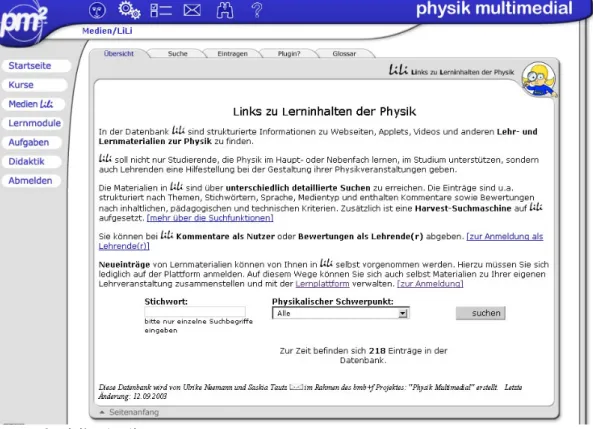
LiLi consists out of two tools: a data base and a search engine.
3.1. LiLi – the data base
At the moment LiLi contains around 600 links on physics’ material, comments, ratings and detailed descriptions.
The descriptions are based upon the meta data of the project, which are composed of the meta data set of Dublin Core [5], IMS [6], LOM [7] and Ariadne [8] and some own meta data [9].
Comments and ratings are inserted by three different groups of users: experts,
normal users and persons who register a link in LiLi. If three or more ratings are made, a mean value is shown.
LiLi’ s main problem is the slowly encreasing number of links and comments. Users are frustrated quickly when they do not find a result matching their search query. Despite the fact that every user of the platform of physik multimedial is allowed to insert entries, the number of contributions is growing slowly.
To guarantee the quality of the entries, the team of physik multimedial controls every entry before it is been activated.
A cataloque like Lili needs a lot of maintenance. An automatic link checker has been implemented, but a manually check still has to be done to find out, if the linked content is still the one described.
To retrieve content that is linked from portals, LiLi has been completed by a Harvest search engine.
3.2 LiLi – the Meta data sheme
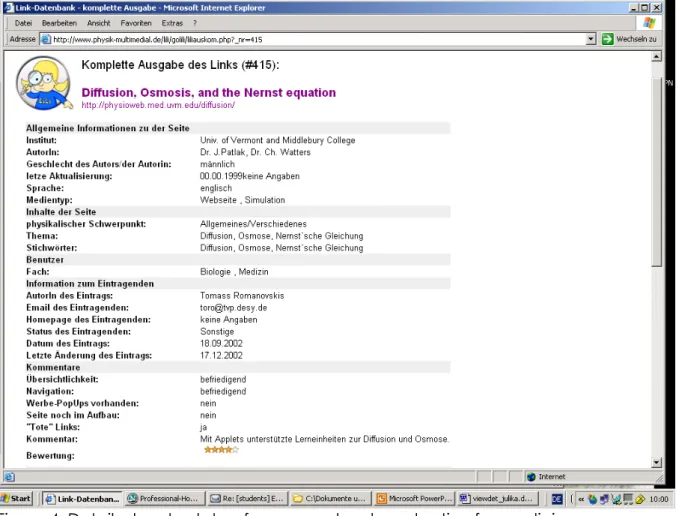
As mentioned above LiLi offers detailed meta data descriptions of the resources stored in the data base. Altogether 43 fields are offered. Figure 3 shows an example of classified material useful for medicine and biology.
Figure 4: Detailed meta data of an example, also adaptive for medicine Every author who uploaded a link to the archive is asked to fill in the additional information as well. At the moment (Oct. 2003) exist around 600 entries with meta data which are shown in 2 steps:
1. the title, the URL as text fields, a flag for language, the learned field , the subject, the type of media and comment
2. Further description which can be grouped in 8 main categories see below Title, URL as heading
Information of the ressource : Institute, Author, Sex of author, Language, Content of the ressource: Field in physics, Topic, Keywords
Meta-Meta-Data: Author of DB entry, Date, last updated
Comments: Clearity, Navigation, commercial-PopUps ex, Thematical errors, page under construction, „Dead" Links, annotation, rating
Pedagogical criteria: User Behavoir, Kind of material, hints for use, level, Interactivity, dense matter, handling time, coverage of the unit, no. of
transdisciplinary examples, area of these examples, introduction, Glossary, no. of formular, amount of descriptions
Technical data: Size, System, OS Version, System Requirements, Browser, Download, Installation,
Conditions of use: licence fee, Copyright
As you can image from the extensive list above it is very timecomsumpting to fill out every field. The ‘uploader’ have to know the material quite well or need
competence to review it. As a result only few meta data sets are complete. A user statistic will show later on the keywords and categories which are searched for. Because no subject classifications of the Learned Fields are used like PACS on MSC it is easy to look for material cross disciplinary.
3.3 LiLi – the Harvest search engine
The number of clicks you need from an internet page to reach relevant content is called search depth. This search depth, counted from the page that was inserted into LiLi was additionally entered into the data base. A harvest search engine follows all links on the pages inserted into LiLi and saves the content into an index file. This is repeted as often as indicated in the search depth for the individual page.
By this, an index file is created with hardy descibed and automatically retrieved links but with a very good signal – noise ratio. It can be searched through with a retrival software. At the moment the index file contains almost 20,000 objects. Automatically, the links are checked weekly and a ranking is implemented as well.
A robots is not able to investigate other data bases. This is why we try to exchange data with other data bases, with static html pages or by means of the OAI protocoll.
4 Conclusion
In the last 2 ½ years, the project physik multimedial developed a number of technical tools and physics’ modules and offers them now on a virtual learning environment. This platform gives lecturers the possibility to enhance their courses in a modern way. The ISN created LiLi. LiLi contains a data base with a few but well defined links to elearning material on physics. The second component of Lili is a search engine, that uses the links of the data base as starting points for the build-up of an index. This index contains a big number of links, but in a lower quality.
The project physik multimedial is still under construction. The platform and all modules can be accessed at http://www.physik-multimedial.de .
Besides physik multimedial we know only about one other e-learning platform dedicated for physics: LONCAPA [10]. LONCAPA has been created by a group of the Michigan State University.
5 Acknowledgement
Saskia Tautz and Ulrike Neeman developed the data base LiLi. The self-study unit has been created by Isabell Schaffer. Christian Schöne is a big help in the operation of the platform. Evelyn Brudler was responsible for organizing the workshops for the female biology studens. My special thanks to all of them!
Most of the good ideas are due to Prof. Dr. E. R. Hilf, who is always promoting the project in a provident way.
A close cooperation in the further devepment of the platform with Helmut Schottmüller (Universität Bremen) is very productive.
Prof. Dr. Horst Schecker (Universität Bremen) has coordinated the overall project in a very effective and competent way.
6 References
[1] Projektträger „Neue Medien in der Bildung und Fachinformation: http://www.medien-bildung.net
[2] Projekthomepage: http://www.physik-multimedial.de/pmm.html [2a] Lernplattform des Projekts: http://www.physik-multimedial.de [3] Institute for Science Networking: http://www.isn-oldenburg.de [4] Campus Virtuell: http://www.campus-virtuell.de
[5] Dublin Core: http://www.dublincore.org
[6] IMS Learning Resourse Meta-Data Information Model
http://www.imsproject.org/metadata/imsmdv1p2p1/imsmd_infov1p2p1.html [7] IEEE Learning Technology Standards Committee (LTSC) Learning Object Metadata
"http://ltsc.ieee.org/doc/wg12/LOM-WD3.htm" [8] Ariadne "http://ariadne.unil.ch/Metadata/"
[9] The projects meta data „http://www.physik-multimedial.de/links/meta_ol.html[10] [10]LONCAPA: http://www.loncapa.org
[11] Hans-Ulrich Kamke, Kerstin Zimmermann: Metadaten und Online-Learning Information Wissenschaft & Praxis, 54. Jahrgang, Nr. 6, September 2003, S.345-348 [12] Kerstin Zimmermann Academic Information Portals, Proc. inforum, Prague May 2003
[13]Regina Kainz, Hans-Ulrich Kamke, Kerstin Zimmermann Perspectives on Online Learning and Teaching Material, Proc. VIEWDET 2002, Wien, Feb. 2003, S.47-56
7 Contact
Dipl.-Phys.in Julika Mimkes
Institute for Science Networking Oldenburg Ammerländer Heerstr. 121
D-26129 Oldenburg
http://www.isn-oldenburg.de/~mimkes Dipl.-Phys.in Kerstin Zimmermann
Ftw. (Forschungszentrum Telekommunikation Wien) Donau-City-Str. 1/3
A-1220 Wien
[email protected] http://userver.ftw.at/~kersti