Cross-functional coopetition in new product
development: Can constraints drive integration?
A case of the design–manufacturing interface of electrified cars
Dissertation for obtaining the degree of
Doctor of Business and Economics (Dr. rer. oec.)
Chair for Technology and Innovation Management
Schumpeter School of Business and Economics University of Wuppertal
Gaußstraße 20 D-42119 Wuppertal
First Advisor: Prof. Dr. Peter Witt
Second Advisor: Prof. Dr.-Ing. Manfred Fischedick
Susanne Bix
The PhD thesis can be quoted as follows: urn:nbn:de:hbz:468-20190903-120508-8
[http://nbn-resolving.de/urn/resolver.pl?urn=urn%3Anbn%3Ade%3Ahbz%3A468-20190903-120508-8] DOI:10.25926/hja7-zx02
Abstract
Enhancing cross-functional integration in new product development becomes increasingly important for industrial players to keep up with shorter product life cycles in technological innovation dynamics. Abundant research reflects the topic’s significance, yet ambiguity in empirical results persists and industrial adoption of existing methods remains incremental. This thesis employs a qualitative approach to build a case study at the design-manufacturing interface of new product development of electrified cars. Cross-functional coopetition, as the joint occurrence of cooperation and competition, is adopted to generate an in-depth understanding of integration dynamics. Socio-organizational and contextual aspects are found to shape integration in a new product development context substantially. A model of interface dynamics is developed which provides for analysis and prediction of these aspects’ impact on effective integration. A grounded theory approach to enhance integration is explored that introduces constraints as stimuli to consider manufacturability aspects in the design process. Constraint introduction is found to positively impact both cross-functional integration and creativity, with eight characteristics of constraint quality identified as moderating factors. A theoretical model is contributed which outlines cause-effect relationships of constraints’ impact on antecedents of new product development success. It substantiates constraints’ role in innovation contexts and encourages application for design-manufacturing integration as well as for other interfaces or purposes.
Acknowledgement
This dissertation was submitted to the Bergische Universität Wuppertal as the result of my work as an external researcher at the Chair for Technology and Innovation Management. This project would not have been possible without the continuous support and participation of the following persons, to whom I want to express my deepest gratitude.
I am deeply indebted to my doctoral advisor Prof. Dr. Peter Witt, who holds this chair, for his provision of knowledge and encouragement throughout this research project. His straightforward guidance and diligent involvement to an extent that is anything but a matter of course was an extraordinary support for this project.
I like to thank Prof. Dr.-Ing. Manfred Fischedick for his involvement as the second examiner of this dissertation. This research project benefitted greatly from his foresight and vision in putting this case of electric mobility in a societal and technological perspective.
Also, I want to express my deepest gratitude for the participants in the empirical case setting that remains unnamed. Their openness and willingness to accommodate this research project, to share insights with me and to jointly develop ideas and propositions was enormous.
I am grateful for the doctoral colleagues that contributed encouragement and sparring throughout this project. In particular, I am indebted to Caroline, who accompanied the entire process as a longterm companion. Likewise, to Andreas, who hosted an environment of open discussion and sparring that contributed significantly to this work. Finally, I want to thank my family for their unwavering trust and support. The
Table of Contents
List of Abbreviations ... VIII List of Illustrations ... IX List of Tables ... XI
1 Introduction and objectives ... 1
1.1 Motivation and objectives ... 1
1.2 Structure of the thesis ... 3
2 Theories on cross-functional new product development ... 5
2.1 Theory overview ... 5
2.1.1 Normative models of new product development processes ... 5
2.1.2 Management of organizational interfaces ... 7
2.1.2.1 Characterization of organizational interfaces ... 8
2.1.2.2 Emergence of organizational interfaces ... 9
2.1.2.3 Instruments of interface management ... 10
2.1.3 Cross-functional integration in NPD ... 12
2.1.3.1 Definitions of cross-functional integration in NPD ... 12
2.1.3.2 Functional units involved in cross-functional NPD ... 13
2.1.3.3 Manifestations of integration between functions ... 14
2.1.3.4 Importance of cross-functional integration in NPD ... 15
2.1.3.5 Detrimental effects of cross-functional integration in NPD ... 18
2.1.3.6 Barriers to integration specific to NPD contexts ... 18
2.1.3.7 Barriers to integration specific to large-scale industrial environments 19 2.2 Existing methods to enhance cross-functional integration in NPD ... 20
2.2.1 Methods in engineering theory ... 21
2.2.1.1 Simultaneous engineering ... 21
2.2.1.2 Integrated product development ... 23
2.2.1.3 Axiomatic design ... 25
2.2.1.4 Design for X ... 26
2.2.1.5 Design for manufacturing/ Design for assembly ... 26
2.2.2 Methods in management theory ... 27
2.2.2.1 Integration mechanisms ... 28
2.2.2.2 Integrated models of NPD ... 30
2.3 Overview of empirical research on effects and contingencies of cross-functional integration in NPD ... 35
3 Theories on coopetition ... 40
3.2 Theories on coopetition theory ... 43
3.2.1 Theoretical predecessors ... 43
3.2.2 Definitions of coopetition ... 45
3.2.3 Levels of analysis and conceptualization of coopetitive behaviour ... 46
3.2.4 Antecedents, risks and benefits of coopetitive behaviour ... 47
3.3 Coopetition in a NPD context ... 49
3.4 Cross-functional coopetition ... 50
3.4.1 Definitions and conceptualizations ... 50
3.4.2 Dimensions of cross-functional coopetition ... 52
3.4.2.1 Cross-functional cooperative intensity ... 53
3.4.2.2 Cross-functional cooperative ability ... 53
3.4.2.3 Cross-functional competition ... 53
3.4.3 Risks and benefits of cross-functional coopetitive behaviour ... 54
3.4.4 Overview of empirical research on cross-functional coopetition ... 55
4 Theories on constraints in new product development ... 60
4.1 Introduction to constraints in NPD ... 60
4.2 Psychological background ... 62
4.2.1 Stimulation of creativity ... 62
4.2.2 Purposeful focusing of design processes ... 63
4.3 Classification and differentiation of constraints in NPD ... 64
4.3.1 Classifying constraints in NPD ... 64
4.3.2 Relating constraint research to requirements engineering ... 66
4.4 Overview of empirical research on constraints in NPD ... 66
5 Research need and topic discussion ... 73
5.1 Shortcomings of existing theoretical and empirical research ... 73
5.1.1 Gaps in research on cross functional integration in NPD ... 73
5.1.1.1 In-depth dynamics are insufficiently understood ... 73
5.1.1.2 Existing methods are insufficiently accepted ... 75
5.1.2 Gaps in research on cross-functional coopetition ... 80
5.1.3 Gaps in research on constraints in NPD ... 82
5.2 Topic discussion ... 84
5.3 Research model and research questions ... 88
6 Design of the empirical study ... 91
6.1 Research methodology ... 91
6.1.1 Choosing the appropriate methodology ... 91
6.1.2 Underlying epistemological program ... 94
6.2 Case study design ... 95
6.2.2 Case study design ... 96
6.2.3 Participant observation ... 97
6.3 Data collection ... 98
6.3.1 Semi-structured interviews ... 99
6.3.2 Direct observation and participant observation ... 101
6.4 Data analysis ... 102
6.5 Quality criteria ... 104
6.6 Suitability of the empirical setting for case study research ... 106
7 Results of the empirical study ... 108
7.1 The empirical setting ... 108
7.1.1 A challenging environment ... 108
7.1.2 New product development of electrified powertrains ... 109
7.1.3 Involved stakeholders during new product development of electrified powertrains ... 110
7.2 Coopetition at the design-manufacturing interface ... 114
7.2.1 Cooperative intensity ... 115
7.2.1.1 Informal and formal relations... 115
7.2.1.2 Cooperation contents ... 122
7.2.2 Cooperative ability ... 125
7.2.2.1. Differences in functional predispositions ... 126
7.2.2.2 Manufacturing not at eye level ... 130
7.2.2.3 Inhibitors of cooperative ability ... 135
7.2.3 Competition ... 143
7.2.3.1 Competition at the interfaces ... 144
7.2.3.2 Leadership-related situational factors ... 153
7.2.3.3 Complexity-related situational factors ... 155
7.3 Summary and theoretical model ... 159
7.3.1 Summary of analysis ... 159
7.3.2 Theoretical model ... 162
7.3.2.1 Social dynamics ... 162
7.3.2.2 Contextual dynamics ... 165
7.3.2.3 Interface-specific dynamics ... 169
7.3.2.4 A model of cross-functional interface dynamics ... 171
7.4 Introduction of manufacturability constraints ... 175
7.4.1 Defining suitable constraint types ... 175
7.4.1.1 Number of fasteners ... 176
7.4.1.2 Assembly time ... 177
7.4.1.3 Variable manufacturing costs ... 178
7.4.2 Defining suitable dimensions for organizational embedding ... 178
7.5 Manufacturability constraints’ impact on coopetitive behaviour ... 179
7.5.2 Impact on cooperative ability ... 185
7.5.3 Impact on competition ... 189
7.5.4 Increased design effort ... 192
7.6 The moderating impact of constraint types ... 193
7.6.1 External contextual applicability ... 194
7.6.2 Internal dimensioning ... 197
7.7 The moderating impact of organizational embedding ... 200
7.8 Manufacturability constraints’ impact on creativity ... 211
7.9 Summary and theoretical model ... 214
7.9.1 Summary of analysis ... 214
7.9.2 Theoretical model ... 216
8 Conclusions ... 224
8.1 Review of research questions and findings ... 224
8.2 Contributions to literature ... 227
8.2.1. Contributions to cross-functional integration in NPD ... 227
8.2.2 Contributions to coopetition research ... 228
8.2.3 Contributions to research on constraints in innovation ... 229
8.3 Limitations ... 230
8.4 Propositions for further research ... 232
Appendix A: Detailed tables of empirical research on effects and contingencies of cross-functional integration in NPD ... 236
Appendix B: Representative data for second-order themes ... 244
List of Abbreviations
BEV Battery electric vehicle CAD Computer-aided design CEO Chief executive officer
eHPV Engineered hours per vehicle FMEA Failure mode and effects analysis GMA General morphological analysis HR Human resources
km/h Kilometre per hour
KPI Key performance indicator MTM Methods-time measurement
NASA National Aeronautics and Space Administration NPD New product development
OEM Original equipment manufacturer PC Personal computer
PDF Portable document format PHEV Plug-in hybrid electric vehicle QFD Quality function deployment R&D Research and development SOP Start of production
TMU Time-measurement-unit TQM Total quality management VBA Visual basic for applications
List of Illustrations
Illustration 1: Structure of the thesis ... 4
Illustration 2: NPD stages identified by Booz, Allen & Hamilton based on Fraker (1984, p. 38) ... 5
Illustration 3: First generation of NPD process models based on Albers and Meboldt (2007, p. 3) ... 6
Illustration 4: Second generation of NPD process models: The stage-gate process based on Cooper (1990, p. 46) ... 6
Illustration 5: Third generation of NPD process models: Fuzzy stage-gate system based on Cooper (1994, p. 5) ... 7
Illustration 6: Causes for the emergence of organizational interfaces based on Brockhoff (1994, p. 18) ... 9
Illustration 7: Instruments of interface management based on Brockhoff, 1995, p. 205) ... 11
Illustration 8: Generic information streams between functional units in NPD adapted from Song et al. (1997, p. 37) ... 14
Illustration 9: Time gap between cost determination and cost occurrence in NPD based on VDI (1987, p. 3) ... 17
Illustration 10: Reduction of development time through simultaneous engineering based on Bochtler (1995, p. 2) ... 22
Illustration 11: Information streams in integrated product development based on Ehrlenspiel and Meerkamm (2013, p. 204) ... 24
Illustration 12: The procedure model of axiomatic design based on Gausemeier et al. (2012, p. 36) ... 25
Illustration 13: Integration mechanisms (own illustration building on Nihtilä, 1999, p. 59) ... 29
Illustration 14: The relay-race model according to Albach (1992, p. 16) ... 30
Illustration 15: The committee model according to Albach (1992, p. 16) ... 31
Illustration 16: The rugby-team model according to Albach (1992, p. 16) ... 31
Illustration 17: Schmidt-Tiedemann’s (1988) triple-helix model based on Albach (1994, p. 207) ... 32
Illustration 18: Development organizations based on Fujimoto (2000, p. 31) ... 34
Illustration 19: Syncretic model of rent-seeking strategic behaviour based on Lado et al. (1997, p. 119) ... 44
Illustration 20: Levels of analysis in coopetition adapted from Dagnino and Padula (2002, p. 36) ... 46
Illustration 21: Typology of inter-unit coopetition based on Luo (2005) ... 52
Illustration 22: Classifications of constraints in new product development ... 65
Illustration 23: Summary of research-based topic discussion ... 85
Illustration 24: Research model with research questions 1-5... 88
Illustration 26: Design-Manufacturing interfaces in empirical case and literature ... 114
Illustration 27: Data structure - Cooperative intensity ... 115
Illustration 28: Cross-functional communication patterns ... 116
Illustration 29: Cross-functional informal relationships ... 117
Illustration 30: Perceived efficiency of formal committees ... 120
Illustration 31: Discussion topics of different functional interfaces ... 123
Illustration 32: Data structure - Cooperative ability ... 125
Illustration 33: Mindset traits of functions ... 127
Illustration 34: Function-specific preferences ... 128
Illustration 35: Insight into cross-functional counterparts ... 131
Illustration 36: Data structure - Competition... 143
Illustration 37: Competition occurrence of examined interfaces... 144
Illustration 38: Topics for cross-functional competition ... 145
Illustration 39: Social dynamics at cross-functional interfaces ... 163
Illustration 40: Contextual dynamics at cross-functional interfaces ... 166
Illustration 41: Function-specific dynamics at cross-functional interfaces ... 169
Illustration 42: Model of cross-functional interface dynamics at the design-manufacturing interface ... 172
Illustration 43: Types of manufacturability constraints and measurement units ... 176
Illustration 44: Program flow of variable manufacturing cost estimation tool ... 178
Illustration 45: Data structure - Impact of constraint introduction on coopetitive behaviour ... 181
Illustration 46: Impact on cross-functional interaction ... 182
Illustration 47: Overview of constraint type-related differences in impact on coopetitive behaviour ... 194
Illustration 48: Moderating impact of constraint types ... 194
Illustration 49: Favoured values within organizational embedding dimensions ... 201
Illustration 50: Mentioning frequency of aggregate dimensions of impact on creativity ... 211
Illustration 51: Overarching participant feedback on constraint introduction ... 215
Illustration 52: Impact relationships of constraint quality characteristics ... 221
Illustration 53: The moderating impact of constraint quality ... 222
Illustration 54: Impact direction of constraint quality ... 223
Illustration 55: Theoretical model of the impact of manufacturability constraint introduction ... 224
List of Tables
Table 1: Definitions of cross-functional integration in NPD ... 13
Table 2: Empirical studies on the impact of cross-functional integration on NPD success (part 1) ... 36
Table 3: Empirical studies on the impact of cross-functional integration on NPD success (part 2) ... 37
Table 4: Empirical studies on the impact of cross-functional integration on NPD success (part 3) ... 39
Table 5: Overview on research on cross-functional coopetition... 59
Table 6: Research on impact of constraints on innovation performance ... 70
Table 7: Research on impact of constraints on creativity ... 71
Table 8: Overview of interview participants ... 101
Table 9: Structured derivation of constraint quality characteristics ... 218
Table 10: Empirical research on cross-functional integration in NPD - development of research field ... 239
Table 11: Empirical research on cross-functional integration in NPD - comprehensive research ambitions ... 241
Table 12: Empirical research on cross-functional integration in NPD - relationship specification ... 243
Table 13: Representative supporting data: research question 1 - cooperative intensity ... 247
Table 14: Representative supporting data: research question 1 - cooperative ability ... 254
Table 15: Representative supporting data: research question 1 - competition ... 259
Table 16: Representative supporting data: research question 2 - impact of constraint introduction on coopetitive behaviour ... 264
Table 17: Representative supporting data: research question 3 - moderating impact of constraint types ... 266
Table 18: Representative supporting data: research question 4 - organizational embedding ... 269
Table 19: Representative supporting data: research question 5 – constraints’ impact on creativity ... 270
1 Introduction and objectives
1.1 Motivation and objectives
"The long-term survival of a business enterprise hinges upon its ability to successfully introduce new products into the marketplace […]. The message to senior management is simple: either innovate or die!” (Cooper, 1996, p. 465). The fundamental importance of innovation for the sustainable success of any business is valid more than ever and uncontested in its significance. For innovation success, the generation of inventive ideas has proven to be less challenging than their consequent realization and industrialization (Neubauer, 2008; Bichlmaier, 2000; Schilling, 2017). Facing shortening product life cycles and higher customization, with its substantial consequences on time-to-market and product complexity, many companies strive towards optimizing the new product development (NPD) process (Schuh et al., 2013b; Lühring, 2006, p. 1). Integrating functional counterparts’ requirements and inputs into the design process, widely known as cross-functional integration, is of undisputed importance for this purpose, receiving significant attention in research and practice Lorenz, 2008; Brettel et al., 2011).
Effectively integrating functional interfaces in NPD is becoming both more important and more difficult in today’s dynamic business environment. Globalization disperses functions of a single organization on a worldwide array; the widespread offshoring of manufacturing in particular cuts ties between design and manufacturing. Cultural distance and intellectual property considerations foster walling-off tendencies between remote cross-functional partners. Increasing product complexity results in higher specialization, inhibiting cross-functional exchange or rotation. Continuously expanding enforcement of profit-centre structures during the last years likewise contributes to isolationism rather than promoting cross-functional integration. Even the extensive penetration of information technology has shown to create further barriers based on incompatible software systems and data bases instead of enhancing integration by virtually connecting remote cross-functional partners (Boutellier et al., 2008, p. 26; Hirsch-Kreinsen, 2000; Ehrlenspiel and Meerkamm, 2013, p. 149; Ettlie and Stoll, 1990, p. 13). Complicating matters further, the same dynamics render cross-functional integration more important: “[…] factors like rapid technological change, flexible production processes, and global competition are making close collaboration across functions even more crucial for the introduction of profitable and timely new products” (Olson et al., 2001, p. 258). The ever-proceeding expansion of knowledge enforces increasing specialization, making effective methods for cross-functional integration indispensable (Ehrlenspiel and Meerkamm, 2013, p. 149).
A broad body of relevant literature reflects the topic’s importance. Empirical efforts examining cross-functional integration’s impact on NPD success and theoretical contributions providing methods how to enhance cross-functional integration are
manifold. However, empirical results remain ambiguous and partially contradicting (Troy et al., 2008; Brettel et al., 2011), and existing methods lack sufficient industrial application due to their high theoretical burden as well as insufficient recognition of organizational and social factors (Lindemann et al., 2001; Ehrlenspiel and Meerkamm, 2013, p. 156; Cratzius, 2003, p. 96; Lühring, 2006, p. 13). The challenge of cross-functional integration in a NPD context seems well acknowledged by academics and practitioners, yet remains unsolved for satisfactory industrial application and sufficient explanatory theoretical depth.
Among the different functional pairings in consideration for a scientific reflection, the interface between the design department and the manufacturing department is of particular interest for innovative projects, as barely plannable design activities collide with highly structured production processes (Neubauer, 2008). Besides, this interface has been neglected in existing empirical studies of cross-functional integration with few exceptions (Brettel et al., 2011; Dekkers et al., 2013; Nafisi et al., 2016).
The motivation for a scientific study on the topic is spurred by innovative NPD projects in practice, for which insufficient cross-functional integration crystallizes as a particularly pressing matter. To provide an example, the empirical case which is analysed in the course of the study at hand is concerned with the development of an innovative electrified powertrain for automotive application, supporting a shift towards environmentally friendly mobility. Sufficient integration of different functional requirements into the design phase is decisive hereof; from marketing for example, to enforce a high electric range, and from manufacturing to enforce low production costs for wide affordability. The resulting challenge represents a question of cross-functional integration, emerging from this and similar endeavours of innovative NPD alike. Due to its complex products, multi-layered NPD processes and its significant role of driving industrial innovation, the automotive industry appears to be a fruitful empirical environment for scientific engagement regarding cross-functional integration in NPD (Womack et al., 2006, p. 11; Fujimoto, 2000).
With the problem of cross-functional integration in NPD being widely acknowledged, increasingly under pressure and yet insufficiently solved, the objective of the study at hand is to forge new paths to address the topic. Recent theoretical approaches will be integrated to this aim. First, coopetition, defined as the simultaneous existence of cooperation and competition (Tidström, 2014) and a highly acclaimed novel theory, is believed to provide an in-depth perspective of underlying mechanisms of cross-functional integration in NPD. Second, the theory on constraints in innovation, finding insightful application in NPD contexts recently, is developed towards an alternative method to enhance cross-functional integration in NPD.
1.2 Structure of the thesis
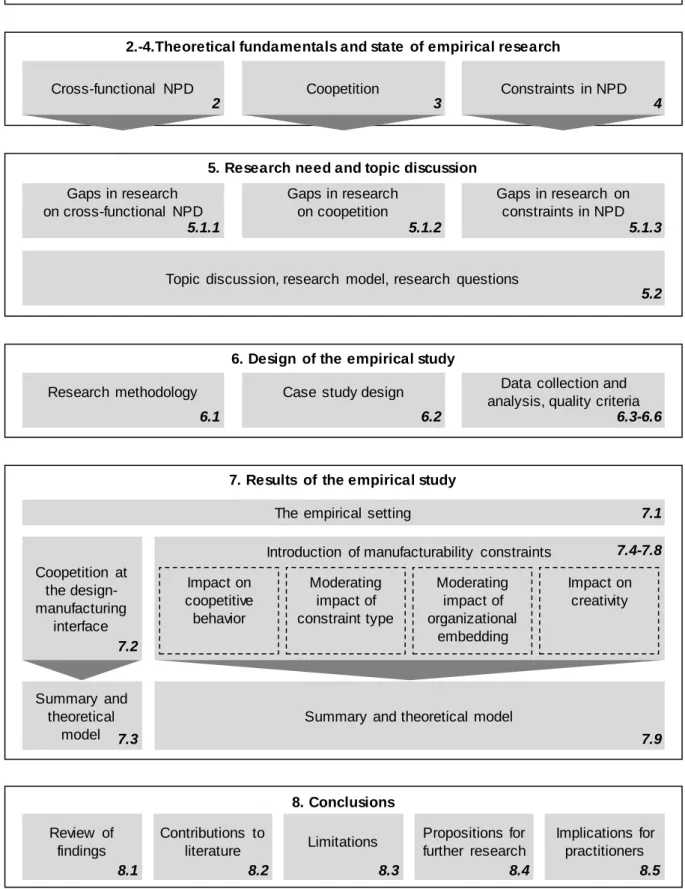
The structure of the thesis follows the aims outlined in the previous chapter, likewise taking into account the deployed case study methodology. Illustration 1 depicts the sequence of and the linkages between different chapters.
After the introduction in chapter 1, subsequent sections outline theoretical fundamentals and the current state of empirical research on the theoretical approaches this thesis builds on: Research on cross-functional NPD (chapter 2), coopetition research (chapter 3) and research on constraints in NPD (chapter 4). Building on identified academic gaps in the underlying theory, chapter 5 presents the research need including a detailed discussion of the topic, as well as the presentation of the research model and research questions guiding the empirical study. In chapter 6, the design of the empirical study is delineated. This includes discussing the research methodology and deriving the case study design. A detailed description of data collection, data analysis and the fulfilment of quality criteria for qualitative research follows suit. Chapter 7 constitutes the core of the empirical study, with the central case study being portrayed in respect to all research questions. After a description of the empirical setting, cross-functional integration at the empirical object of analysis is examined by adopting a perspective of cross-functional coopetition. The summary of results, and the theoretical contribution following from it, is provided hereinafter (chapters 7.2-7.3). Chapters 7.4-7.9 illuminate different aspects of a theoretical approach on the enhancement of cross-functional integration building on the introduction of manufacturability constraints. Accordingly, the theoretical model to be derived from the results is presented subsequently. Chapter 8 concludes on findings and contributions to literature. Likewise, limitations of the study are discussed, avenues for further research are presented and implications for practitioners are provided.
Illustration 1: Structure of the thesis
1. Introduction
2.-4.Theoretical fundamentals and state of empirical research
Cross-functional NPD Coopetition Constraints in NPD
5. Research need and topic discussion
Gaps in research on cross-functional NPD Gaps in research on coopetition Gaps in research on constraints in NPD
Topic discussion, research model, research questions
6. Design of the empirical study
Research methodology Case study design Data collection and analysis, quality criteria
8. Conclusions Review of findings Contributions to literature Limitations Propositions for further research Implications for practitioners
7. Results of the empirical study
Coopetition at the design-manufacturing
interface
Introduction of manufacturability constraints The empirical setting
Impact on coopetitive behavior Moderating impact of constraint type Impact on creativity Moderating impact of organizational embedding Summary and theoretical model
Summary and theoretical model
2 3 4 6.1 6.2 6.3-6.6 5.2 5.1.1 5.1.2 5.1.3 7.1 7.4-7.8 7.9 7.3 7.2 8.1 8.2 8.3 8.4 8.5
2 Theories on cross-functional new product development
2.1 Theory overview
In the following, theoretical principles that are essential for the understanding of cross-functional integration in NPD are summarized. This includes normative models of the NPD process itself, followed by the fundamentals of interface management. The latter is a required theoretical basis for fundamentals of cross-functional integration in NPD for later chapters throughout this thesis.
2.1.1 Normative models of new product development processes
It lies in the systematic nature of innovation, that it always takes place in a rather complex process involving several stakeholders from R&D, marketing and production
(Fagerberg et al., 2005; Olson et al., 2001). NPD activities are characterized by unstable dynamics with regard to customer needs and technological possibilities, creativity requirements, communication intensity, planning intensity and interdisciplinary cross-linkages with activities on the individual, functional and inter-functional levels (Negele, 1998; Paashuis, 1998). All of those emphasize the need for organizational coordination to maximize NPD success; NPD processes have therefore ever since been the subject of extensive research (Sosa and Mihm, 2008). Cooper (1996, p. 466) summarizes that it is the “new product process - its nature and quality - that has the strongest impact on the business's new product performance”.
In the following, the evolution of such coordinated, normative models of NPD processes is presented.
A first structured approach to NPD, called phased project planning, was introduced by the National Aeronautics and Space Administration (NASA) in the 1960s to manage NASA’s large-scale development projects. It differentiated four phases (preliminary analysis, definition, design, development/operations) with intermittent checkpoint reviews after each phase to ensure that mistakes are not carried forward into downstream phases. Phased project planning was soon adjusted to suit smaller and less complex industrial NPD projects (von Stamm, 2008, p. 49; Lorenz, 2008; NASA, 1968).
In the early 1980’s, Booz, Allen & Hamilton analysed existent NPD procedure models in the United States, coming up with a generic description of NPD processes that is, in variations, still valid for most companies up to this day (Booz, Allen & Hamilton, 1982).
Illustration 2: NPD stages identified by Booz, Allen & Hamilton based on Fraker (1984, p. 38)
S tr a te g y Idea generation Screening& Evaluation Business analysis Develop-ment Commer-cialization Testing
After a phase-based view of NPD had emerged, integration or separation of different conceptions of stages evolved from the late 1980s onwards, with serial models evolving towards more connected models with links and feedback and finally concurrent models (Teece, 1989; Trott, 2003; Johannessen, 2009; Jürgens, 2000). Cooper (1990) describes the evolution along three generations, with the first one following a simple supplier-to-customer relation with information flows pounding back and forth between the stages.
Illustration 3: First generation of NPD process models based on Albers and Meboldt (2007, p. 3) Entailing a rise of global competitive dynamics in the early 1990s, pressure for reduced cycle time and costs as well as for enhanced product quality led to the development of a more efficient and effective second generation of NPD processes, the stage-gate system. The central idea, from which it takes the name, are gates to separate individual development stages, inspired by production processes where value is created between gates that ensure quality and eliminate variance. The adoption of this production view to NPD are gates, that safeguard a certain quality standard and stages, that imply a higher product value for every stage downstream the NPD process (Cooper, 1990; Cooper and Kleinschmidt, 1991).
Illustration 4: Second generation of NPD process models: The stage-gate process based on Cooper (1990, p. 46)
While the stage-gated system experienced rapid adoption in the industry, criticism emerged towards the time-intensive passage of gates, slowing down NPD speed by setting back entire products at gates for merely one incomplete activity. Therefore, a third generation of NPD processes was developed to bring more flexibility and improved project prioritization to previously rigid stages, therefore named fuzzy stage-gate system (Cooper, 1994). It supports a more fluent process, where stages may overlap and gates allow for conditional criteria to pass, as opposed to absolute measures that required fulfilment previously. While these improvements yielded higher
Id e a Stage 1 Stage 2 Stage 3 Stage 4 P ro d u c t Stage 5 Strategy planning Ideas & Concepts Develop-ment Testing, prototyping Production, market launch Initial Screen Second Screen Preliminary Assessment Gate 2 Gate 3 Gate 4 Gate 5 Detailed Investigation (Business Case) Preparation
Development Testing & Validation
Full Production & Market Launch Decision on Business Case Post-Development Review Pre-Commer-cialization Business Analysis Gate 1 Stage 1 Stage 2 Stage 3 Stage 4 Stage 5 Id e a
$
Post Implement ation Reviewefficiency, complexity and coordination requirements were on the rise for stages whose limits are fuzzy and contingent on conditional criteria (Albers and Meboldt, 2007).
Illustration 5: Third generation of NPD process models: Fuzzy stage-gate system based on Cooper (1994, p. 5)
Until this day, the stage-gate system is widely utilized in practice and the most renown among existent NPD models, with a recent study identifying 88% of North American companies employing it in their NPD activities (Kahn, 2013, p. 28). Other structured models of NPD processes include the loose-tight concept (Albers and Eggers, 1991), in which innovation projects are managed in an increasingly tight manner towards the end of the process, or Lynn et al.’s (1996) probe-and-learn process which is
specialized on scientific and technologically intensive NPD efforts (Gassmann and von Zedtwitz, 2003).
In summary, normative models of NPD processes have evolved to become more flexible and comprehensive over time, entailing a higher burden for implementation. With rising product requirements, the need for reduced development cycle time and increasing interdisciplinary focus, complexity is becoming a major challenge in NPD management since the late 20th century. While the refinement of structured NPD
approaches has been crucial to improve development activities, the interaction between different functional stakeholders of any stage-gate system remains difficult (Cooper, 1996; ElMaraghy et al., 2012; Simms and Trott, 2014).
2.1.2 Management of organizational interfaces
Whereas interface integration in a NPD context is at the core of this thesis, interfaces generally exist in a broad range of organizational situations. A fundamental characterization of interfaces, explanations on their emergence and instruments to manage them will be broadly outlined in the following. Barriers and supportive aspects to interface integration in the specific context of NPD will be discussed in a subsequent section.
Interface management constitutes a central problem in management and organizational research that goes back to the times of Adam Smith: Referring to Smith’s conception of production based on the division of labour, List (1841, p. 224) notes that “the separation of business operations, without the unification of productive
etc. Gate 2 Gate 3 Gate 4 Gate 5 Gate 1 Preliminary Investigation Business Case Test & Validate Develop-ment Stage 1 Stage 2 Stage 3 Stage 4 Id e a
forces towards a collective purpose, can hardly foster such a production” (translated from the German original).
The fundamental root cause leading to the emergence of interfaces and all concomitant coordination difficulties is the steady increase of industrial specialization from the beginning of the industrialization age onwards. Given the simultaneous explosion of knowledge, with its velocity increasing up to this day, specialization is simply a necessary condition to support the expansion of knowledge (Ehrlenspiel and Meerkamm, 2013, p. 3). The result is the organizational paradigm of specialization and coordination mutually presupposing each other, with the emergence of interfaces being an unavoidable consequence thereof. Hence, managing interfaces emerges as an important management activity, as its failure to do so risks to eliminate the benefits from specialization (Brockhoff, 1989, p. 1; Cratzius, 2003, p. 17).
Interface management denotes “the systematic management of collaboration between different functional areas, above all function areas of marketing, production as well research and development” (Brockhoff and Hauschildt, 1993, quoted by Cratzius, 2003, p. 28, translated from the German original). According to Albach (1994, p. 198), the overall aim of interface management is closely related to NPD: the exchange of knowledge between functional departments in the innovation process.
Following Brockhoff (1994, p. 10), interface management designates both an intra-organizational and an inter-intra-organizational perspective. Inter-intra-organizational interfaces, occurring between individual organizations as opposed to intra-organizational interfaces between functional departments of one organization, are omitted from the scope of this thesis. For the questions examined in the empirical part of the study at hand, their inclusion is assumed to yield few insights, as the integration mechanics differ widely. Thus, differentiating causes and effects for inter- and intra-organizational interfaces would go beyond the scope of this thesis.
2.1.2.1 Characterization of organizational interfaces
While the expression “interface” originates from a technical context, designating transmission zones between software or hardware parts where energy or information is transferred, it is widely used in a broader social and organizational context to account for linkage points between organizational units or groups that work relatively autonomously in the greater context of an interlinked process or task (Specht, 2000; Lühring, 2006, p. 43; Brockhoff and Hauschildt, 1993, p. 3).
According to Brockhoff and Hauschildt (1993, p. 4-6), organizational interfaces are specific types of a social relation characterized by six aspects: autonomy of organizational units, equal hierarchical position, and common superiors, enforced relations, interactional relations and lastly, the existence of conflicts. The last aspect is inherently related to barriers to integration, which are generic causes to interface conflicts that hinder integration. Barriers to integration are manifold, including cultural
divergence, information asymmetries, different strategic perspectives and physical barriers. They constitute an entire body of research itself, see Ginn and Rubenstein (1986), Gupta et al. (1986), Dougherty (1992), Brockhoff (1989, p. 43-84), Kahn and Mentzer (1994).
2.1.2.2 Emergence of organizational interfaces
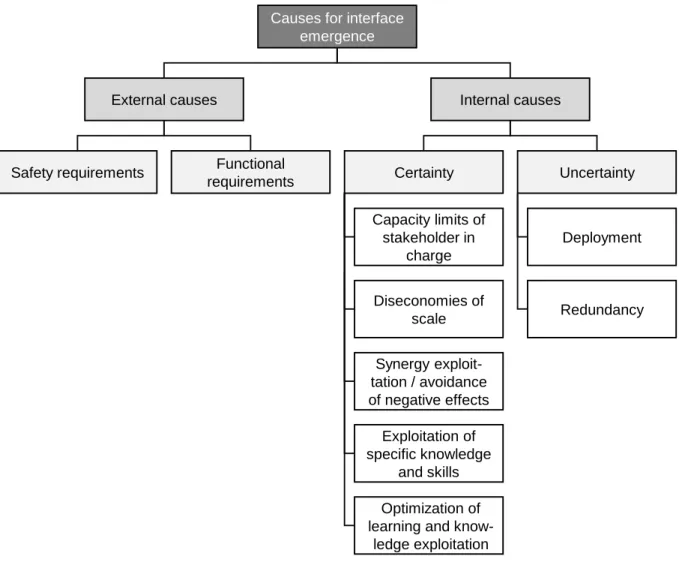
Following Brockhoff (1994, p. 32), organizational interfaces emerge when a task or process requires more than one functional stakeholder and when classical approaches to organizational coordination do not apply: Hierarchical directives are not relevant, as there is no direct common superior. Market mechanisms, e.g. coordination via transfer prices or outsourcing to an external supplier, do not apply as economic reasons apparently led to an internal solution for the interface to materialize in the first place. Illustration 6 depicts internal and external causes for the emergence of interfaces, with external causes being imposed on an organization, e.g. through regulatory requirements, and internal causes created by the organization itself (Brockhoff, 1994, p. 18).
Illustration 6: Causes for the emergence of organizational interfaces based on Brockhoff (1994, p. 18)
Causes for interface emergence
External causes Internal causes
Safety requirements Functional
requirements Certainty Uncertainty
Deployment Redundancy Capacity limits of stakeholder in charge Diseconomies of scale Synergy exploit-tation / avoidance of negative effects Exploitation of specific knowledge and skills Optimization of learning and
2.1.2.3 Instruments of interface management
An extensive body of literature covers coordination mechanisms to improve interface cooperation, presenting instruments that draw on a broad range of organizational and management levers. With literature featuring instruments as diverse as corporate culture mechanisms, process organization and personal incentivization schemes, a summary of prevalent literature will be given in the following.
Brockhoff and Hauschildt (1993, p. 7) take the hierarchical organization as reference point to their categorization of instruments to overcome interface difficulties. They distinguish between mechanisms that are hierarchy-neutral, hierarchy-complementary and hierarchy-substituting. Accordingly, hierarchy-neutral instruments can be applied to any hierarchy level and affect individual behaviour either implicitly or explicitly. Explicit mechanisms encompass incentive systems, recruiting schemes, education on the job as well as job rotation, while implicit mechanisms imply visions, goals and corporate culture. Hierarchy-complementary instruments focus on affecting group behaviour in a personal manner, with liaison people, central staffs, commissions or project management named as examples. The last group, hierarchy-substituting elements, make hierarchical structures and directives partially obsolete by affecting groups’ behaviour in an impersonal way. Markets and transfer price systems, programs and planning as well as spatial room arrangements, i.e. sitting together in one room, are mentioned as examples under this notion.
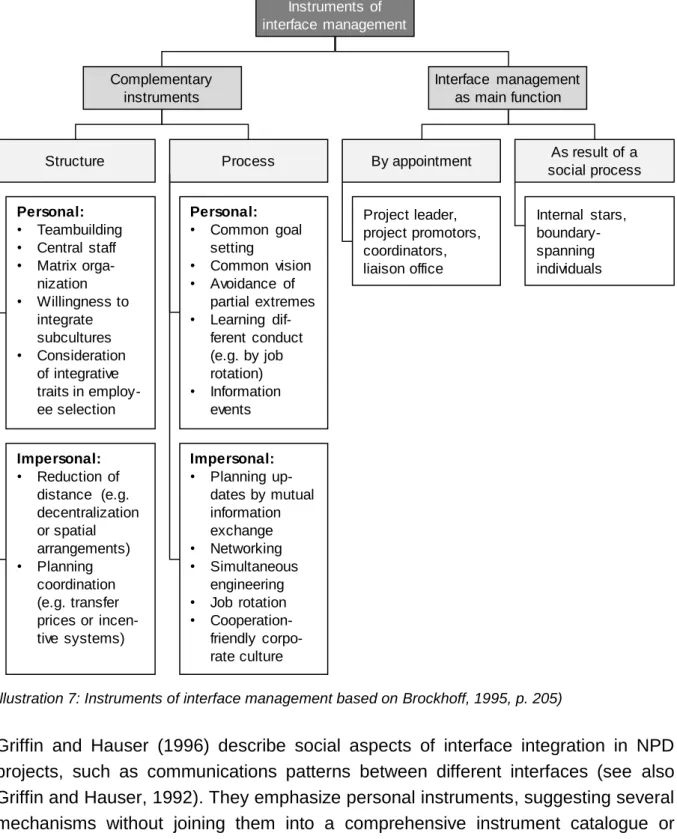
Brockhoff (1995, p. 205) distinguishes between interface management as a main function and complementary instruments, with the latter differentiating between instruments that address the vertical organization (structure) and instruments that affect the horizontal organization (process). Details are provided in illustration 7.
Illustration 7: Instruments of interface management based on Brockhoff, 1995, p. 205)
Griffin and Hauser (1996) describe social aspects of interface integration in NPD projects, such as communications patterns between different interfaces (see also Griffin and Hauser, 1992). They emphasize personal instruments, suggesting several mechanisms without joining them into a comprehensive instrument catalogue or overarching framework. Informal social systems, personnel movement, relocation and physical facilities find mentioning as levers to bring cross-functional stakeholders closer to each other, both physically and mindset-wise. Furthermore, they suggest incentive and reward systems to encourage members from different functional backgrounds to work with each other. In terms of organizational structure, different approaches, such as matrix organizations, project teams or coordinating groups are stated. Lastly, they suggest formal integrative management mechanisms to support integration in a manner similar to the normative models described above, e.g. formalized review procedures in Cooper’s (1990) stage-gate process.
Instruments of interface management Complementary instruments Interface management as main function
Structure Process By appointment As result of a social process Internal stars, boundary-spanning individuals Project leader, project promotors, coordinators, liaison office Personal: • Common goal setting • Common vision • Avoidance of partial extremes • Learning dif-ferent conduct (e.g. by job rotation) • Information events Impersonal: • Planning up-dates by mutual information exchange • Networking • Simultaneous engineering • Job rotation • Cooperation-friendly corpo-rate culture Personal: • Teambuilding • Central staff • Matrix orga-nization • Willingness to integrate subcultures • Consideration of integrative traits in employ-ee selection Impersonal: • Reduction of distance (e.g. decentralization or spatial arrangements) • Planning coordination (e.g. transfer prices or incen-tive systems)
Specht (2000) follows a logic of standard elements of organizational theory in putting forward his systemization of interface management instruments: He distinguishes mechanisms of the process organization, the organizational structure, culture- and individual-affecting instruments as well as information and communication instruments. With regard to the process organization, he names promotors, review, mapping and integrative planning systems and refers to existent methods, e.g. simultaneous engineering. Within the organizational structure, Specht differentiates between instruments of the primary organization, such as flat hierarchies or coordinating offices, and instruments of the secondary organization, such as project groups, management committees or linking pins. Similar to Brockhoff and Hauschildt’s explicit hierarchy-neutral instruments, Specht’s culture- and individual-oriented instruments encompass education on the job, job rotation, incentive systems as well as corporate identity and leadership role model measures. Lastly, Specht’s information and communication instruments bring together physical and virtual ways of working and communicating with each other, ranging from video conferencing over shared databases and group rooms up to virtual reality and mock-up applications.
2.1.3 Cross-functional integration in NPD
2.1.3.1 Definitions of cross-functional integration in NPD
No generally accepted definition of cross-functional integration has yet materialized in the existent literature (Olson et al., 2001; Brettel et al., 2011; Reiferscheid). Indeed, cross-functional integration is a concept with many different facets and interpretations: “[…] a great deal of variance exists in extant literature regarding how integration is defined and implemented and how relevant studies are conducted” (Troy et al., 2008, p. 132). Moreover, no prevalent generic term has emerged yet, with cross-functional integration, interfunctional cooperation or interdepartmental collaboration exemplifying just a few verbal manifestations. Throughout this thesis, the term cross-functional integration is used.
Definitions of cross-functional integration in NPD
Source Definition
Kahn, 1996, p. 139
“It is proposed that interdepartmental integration be defined as a multidimensional process that subsumes interaction and collaboration”
Song and Parry, 1997, p. 4
“Cross-functional integration refers to the level of unity of effort across functional areas in developing and launching a new product”
Song et al., 1997, p. 37
“Cooperation is broadly defined as coordination of behaviour […], numerous terms and phrases that have been used analogously, such as interfunctional integration, collaboration and teamwork. Basically, cross-functional cooperation refers to interdependency and information sharing between the various organizational units”
Olson et al., 2001, p. 260
“Our operational definition of cooperation includes both the frequency of interaction and the amount of information and resources shared between a pair of functions involved in an NPD project: marketing – R&D, marketing – operations, and R&D – operations”
Luca and Atuahene-Gima, 2007, p. 95
“Cross-functional collaboration refers to the degree of cooperation and the extent of representation by marketing, research and development (R&D), and other functional units in the product innovation process”
Brettel et al., 2011, p. 253
“The present study mainly relies on integration as the multidimensional construct including (a) the frequency of formal and informal communication, (b) the frequency and the amount of information and resources exchanged between the functions, and (c) the existence of collective goals”
Engelen et al., 2012, p. 53
“CFI [cross-functional integration, author’s note] as a multidimensional process of interaction and collaboration between functions, where interaction refers to the structured nature of cross-functional activities, such as the use and exchange of communication among functions, and collaboration is the unstructured, affective nature of cross-departmental relationships” Table 1: Definitions of cross-functional integration in NPD
Table 1 lists definitions that are used by predominant authors in the field of cross-functional integration. The central aspect common to all definitions is the exchange of resources, above all information, between different functional units in the NPD process. However, two aspects are seen as controversial: the degree to which stakeholders interact to exchange resources, and the functional units that are included in this definition. Therefore, two aspects are discussed in the following: At first, it will be discussed which functional units are involved in cross-functional integration. Second, I will investigate whether cross-functional integration concentrates on mere interaction or includes cooperation or collaboration.
2.1.3.2 Functional units involved in cross-functional NPD
With regard to functional units involved in NPD activities, the following is widely accepted in pertinent literature: R&D, marketing and production are perceived as the most important functional actors in NPD (Brockhoff and Hauschildt, 1993, p. 2; Olson
a multitude of empirical studies on cross-functional integration focusses only on R&D and marketing as central actors, neglecting the role of production.
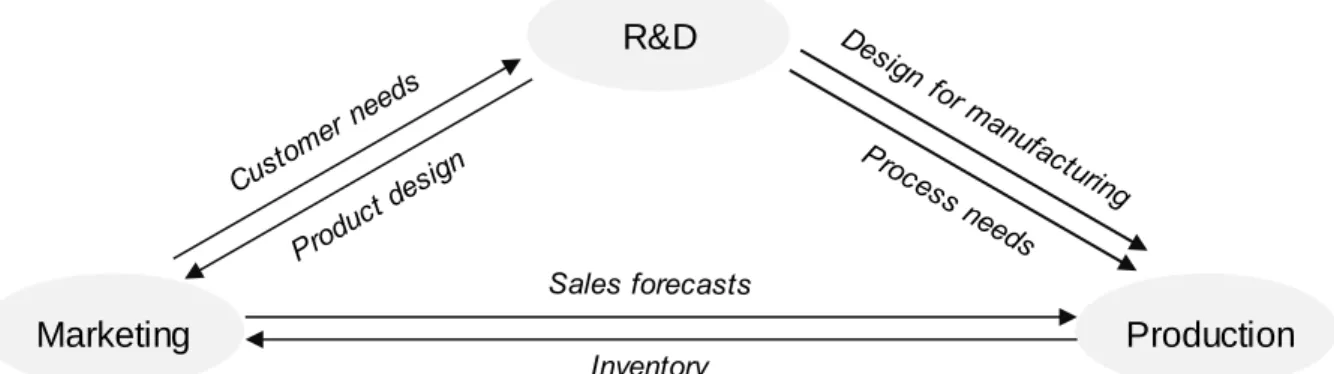
Illustration 8: Generic information streams between functional units in NPD adapted from Song et al. (1997, p. 37)
Illustration 8 depicts generic information streams between the three central functional units and resulting respective interdependencies. Marketing has to identify and translate customer needs into a well-conceived product positioning, with R&D depending on them to prioritize product features. R&D needs to deliver functioning designs that are producible within costs that are non-prohibitive to customer pricing, hence they are exposed to several interdependencies with production regarding manufacturability, required manufacturing capabilities and design validation with prototypes. Production depends on marketing’s forecasts, and marketing in turn on production to have reliable information on inventory, lead time and cost projections (Brettel et al., 2011; Wheelwright and Clark, 1992, p. 227 ff.).
2.1.3.3 Manifestations of integration between functions
Existent research presents several conceptions of integration; interaction, cooperation and collaboration are mentioned most frequently and shall therefore be described in the following.
According to Kahn (1996) and Moenaert et al. (1994), interaction refers to the frequency of formal communication and is structural in nature. It includes coordinated interdepartmental activities, both impersonal and personal, such as routine meetings or the sequential exchange of standardized documents (Neubauer, 2008; Kahn, 2001).
Collaboration, on the other hand, tends to be unstructured and intangible, hence representing a more informal aspect of integration. Kahn (1996, p. 139) describes it “as an affective, volitional, mutual/shared process where two or more departments work together, have mutual understanding, have a common vision, share resources, and achieve collective goals”. It touches upon qualitative, attitudinal aspects of integration as opposed to the mere frequency of interaction (Gerpott, 2005).
Furthermore, cooperation constitutes yet another conception for cross-functional integration that looks into the content of interdepartmentally shared information and relations; going beyond the mere outward nature of integration. Following Song et al.
R&D
(1997, p. 37), cooperation refers to “interdependency and information sharing between the various organizational units”.
Different models of cross-functional integration manifestations build loosely on those conceptions; two prominent ones by Kahn (1996) and Olson et al. (2001) are outlined in the following.
Kahn (1996) postulates a two-pillar model building on the interplay of interaction and
collaboration as defined above. In a series of empirical studies (Kahn, 1996; Fisher et al., 1997; Maltz and Kohli, 1996; Kahn, 2001; Kahn and Mentzer, 1998), the impact of both interaction and collaboration on NPD success was examined. It is found that interaction alone is not sufficient to yield improvements in NPD success. Collaboration is shown to be the more effective integration manifestation for NPD success, with interaction taking a rather presupposive role as a precondition for collaboration to develop.
Olson et al. (2001) builds on Song et al.‘s (1997) conception of cooperation and develops a model that measures the frequency of communication, the amount of shared information and levels of transferred work. The authors deliberately focus on those more behavioural dimensions of integration, which are easier to measure for researchers and easier to influence as managers. Attitudinal dimensions, as they are included in Kahn’s definition of collaboration, are therefore neglected.
2.1.3.4 Importance of cross-functional integration in NPD
As discussed above, NPD success is an undeniable requirement for organizations of all sorts and sizes. In particular for manufacturing companies, often with large asset bases forcing their management to generate a steady stream of business to cover fixed costs, predictable NPD success and rigid planning is essential for survival (Gao and Bernard, 2017).
Cross-functional integration is undisputedly one of the factors that bring NPD projects to success: “The need for a close collaboration, especially in the early phase of the developments, is undisputed in academia and practice” (Lorenz, 2008, p. 11). In its complexity and uncertainty, the NPD process implies various interdependencies between different functions, making NPD fundamentally a multidisciplinary process and hence cross-functional integration a necessary antecedent of NPD success (Olson
et al., 2001; Lorenz, 2008; Lee and Markham, 2016). Despite its recognized impact on NPD (see for example Ehrlenspiel 2017, p. 233 ff., Brown and Eisenhardt 1995, Boutellier et al. 2008, p. 156 ff., Albach 1994, p.198 or Wheelwright and Clark 1992, p. 227), the implementation of cross-functional cooperation is a success factor for NPD that remains challenging for most organizations. Therefore, it remains one of the top
list items of agendas in academia and practice alike (Gupta and Wilemon, 1996; Neubauer, 2008).
Lindemann et al. (2001) emphasize the holistic importance of integrated NPD. They state that integration in NPD impacts all aspects of the so-called magic triangle (cost-time-quality) in a universal way. Likewise they are noting flexibility and robustness of processes as beneficiaries of integrated product development.
One of the most detrimental effects of lacking integration is that the entire design process is disassembled into sub-problems of different functions to be solved subsequently. This results in sub-optimization, potentially sharply disadvantageous of the global optimization that the new product would require from a life-cycle perspective (Minnaar and Reinecke, 2012).
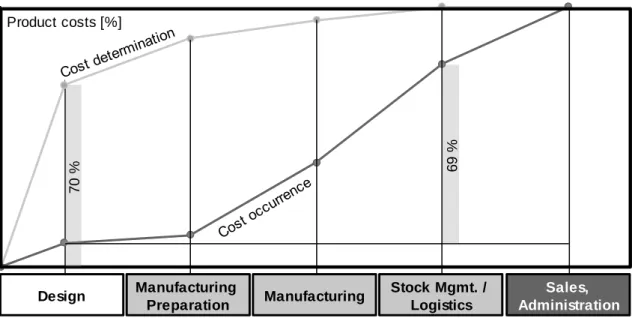
Often cited, the important role of NPD for the entire life cycle shows another essential need for cross-functional integration. The lion’s share of costs that occur over the entire product life cycle is determined in early phases of NPD. Hence, product designers, as the predominant stakeholders typically involved in early phase NPD, decide over costs that downstream functional areas are bound to bear, such as manufacturing, sales or aftersales, see illustration 9 for details (Negele, 1998; Lindemann et al., 2001; Ehrlenspiel and Meerkamm, 2013, p. 668). This implies a natural requirement for downstream functions to become involved. Resulting cost saving estimations are impressive:
Womack et al. (2006, p. 111) cite a two-third reduction of engineering efforts and a one-third reduction of development time. However, particularly in early phases, costs that occur later are hard to assess, which constitutes a central paradox in NPD cross-functional integration: Consequences on downstream stakeholders are the easiest to impact when they are the hardest to assess (Hacker, 2002).
Illustration 9: Time gap between cost determination and cost occurrence in NPD based on VDI (1987, p. 3)
Besides these arguments, today’s business environment requires cross-functional integration on an augmented scale. Innovation pressure is on an all-time rise, with higher frequency of new products and the need for shorter development times putting additional complexity to new product development, entailing higher pressure on cross-functional integration alike: “The more innovative the NPD projects are, the greater is the need to integrate marketing and R&D functions within the company" (Fain et al., 2011, p. 599). Olson et al. (2001, p. 258) enumerate macro trends such as rapid technological change, flexibility requirements of production systems and global competition that make “close collaboration across functions even more crucial for the introduction of profitable and timely new products".
One of the underlying causes for this increased integration pressure is uncertainty, which is an inherent part of every innovation project. Breakthrough innovations call for large investments and carry tremendous risks. In this regard, cross-functional integration helps to compensate for instabilities of innovative products, as it increases planning accuracy and reduces manufacturing costs by integrating production. It also moderates market- and demand-related risks by integration marketing. Thus, cross-functional integration helps mitigating the risks connected to innovation (Land et al., 2012; Song et al., 1998).
In summary, cross-functional integration becomes more important today to achieve higher innovation frequency, radically innovative products and reduced development time than it has already been, although very much the same reasons make cross-functional integration more difficult to achieve as they all likewise increase complexity. A later section will touch upon these barriers to integration in NPD in large-scale industrial environments in more detail.
0 50 100 Product costs [%] 7 0 % 69 % Manufacturing Preparation Manufacturing Sales, Administration Stock Mgmt. / Logistics Design
2.1.3.5 Detrimental effects of cross-functional integration in NPD
While the majority of the literature focusses on positive effects of cross-functional integration, and indeed empirical studies propose that it is overall supporting NPD performance, it may likewise bear costs.
High levels of integration entail high communication and alignment efforts, with reduced efficiency and lower decision speed as results. Reaching consensus across functions is typically more difficult than it is within a functional unit. This further increases alignment efforts and possibly requires specifically educated managers able to cope with the complex coordination of cross-functional processes (Brettel et al., 2011, 2011; Neubauer, 2008; Song et al., 1998). Shim et al. (2016) argue that enhanced integration can possibly result in important information being disregarded or technological completeness being triggered, bearing costly delays of the development period. Moreover, integration violates basic management principles that state that authority should be linked to responsibility and every employee should be subordinated to a single manager. Those violations carry the risk of organizational conflict, resulting in personal distress that decreases overall productivity (Song et al., 1998).
2.1.3.6 Barriers to integration specific to NPD contexts
As specified above, interface management is a pressing business issue in manifold contexts. However, environments of large-scale industrial NPD expose certain barriers to integration that make cross-functional integration even more difficult.
Following Lühring (2006, p. 66), higher levels of market uncertainty and technical uncertainty increase coordination requirements between functional areas. Hence NPD projects, which by their very own nature bear market-related and technical risks, demand generally higher coordination levels. Reasons thereof can be found in planning uncertainty which rises with longer development duration and lack of experience with product or process technologies that make it difficult to predict consequences on cross-functional counterparts (Thom, 1980, p. 27; Lühring, 2006, p. 65).
In addition, involved functional units as derived above (marketing, R&D and production) exhibit function-specific traits and cultures that pose significant barriers to integration. In his conceptual model of innovation processes, Seidel (1996, p. 28 ff.) distinguishes barriers along four different levels: The factual-intellectual level, the socio-emotional level, the value-based-cultural level and the creative-playful level. To begin with, the factual-intellectual level includes different objectives that involved functions have regarding their NPD activities. On this level, production often takes a position that opposes the objectives of the other functions. Marketing and R&D typically strive to bring about change through new products and new technologies, while production strives for stability and efficiency (Song et al., 1997). On the same
factual-intellectual level, the involved functions need very different kinds of information. While R&D and marketing embrace uncertainty to establish innovative solutions, production prefers reliable and less volatile information (Lühring, 2006, p. 58; Neubauer, 2008). On the socio-emotional level, function-specific languages and subcultures, often named “thought worlds” in prevalent literature, take effect as well as very different academic backgrounds (Dougherty, 1992). Production again protrudes, with its members often lacking the academic background that its counterparts from R&D and marketing largely exhibit (Maltz, 1997). Different thought worlds likewise impact the value-based-cultural level, with different planning horizons taking a dominant role. Marketing’s preferences lean strongly towards short-term reaction times to enable fluid responsiveness for altered market demands. Both R&D and production, on the other side, prefer long-term planning horizons to support large-scale technological innovation and a stable process build-up, respectively (Lühring, 2006, p. 58; Song et al., 1997).
Barriers to integration on the creative-playful level account for different functional affinities for creative solutions. Again, production takes the maverick position due to a function-inherent opposing attitude towards novel and inventive features, that endanger stability and long-term efficiency gains in the production process (Lühring, 2006, p. 58).
2.1.3.7 Barriers to integration specific to large-scale industrial environments Large-scale industrial environments pose particular barriers to integration stemming from three root causes: organizational size, complexity of products and suppression of innovative forces.
To begin with, organizational size impedes cross-functional integration by the spatial and personal distance between involved stakeholders. For most cases, distance increases with increasing firm size: The larger a functional department, the more difficult is it to know all employees within the department or from the cross-functional counterpart department in person. In addition, the larger an organization, the more likely is it to have several, spatially distant sites, further impeding personal acquaintanceship with employees at other sites.
Furthermore, higher levels of specialization occur in large organizations, which increases the distance between different functional thought worlds (Womack et al., 2006, p. 63; Damanpour, 1996). Organizational size induces organizational layers and substructures detrimental to integration: While one layer of functional specialization, e.g. division of R&D, marketing and production suffices to small companies, large companies divide their activities between more functional units: Marketing tends to split up along products, R&D along technologies, production along locations or plants. Integrating substructures that organizationally do not fit to each other impedes integration. Formalized career paths and incentivization, as well as specialization and decreasing mobility within the company, all reduce a personal exchange and job
rotation between functions that would have supported integration (Wheelwright and Clark, 1992, p. 256-258; Hirsch-Kreinsen, 2000). Formalized decision structures, such as formal committees, often are rooted in a certain functional unit, with the first cross-functional decision alignment occurring only on high hierarchical levels (Teece, 1999; Damanpour, 1996). Large organizations often operate on a global scale, with cultural distance and intellectual property uncertainties inducing them to wall off, again impeding integration. For production in particular, globalized organizations are prohibitive to integration, as production is often off-shored to remote locations while R&D and marketing often remain centralized (Hirsch-Kreinsen, 2000).
On the other side, large-scale industrial enterprises are often characterized by the complexity of their products, as those require high levels of specialization found in large organizations. While product complexity further induces specialization with all the effects on integration mentioned above, additional aspects come into play. At first, components of complex products exhibit high levels of both functional interdependency and process-related interdependency, so both R&D and production require so much alignment within their own groups of specialists that integration with other functions is at risk to be neglected. For the same reason, modularization in small cross-functional teams is often not feasible. Rising levels of regulations and security requirements for many complex products, such as in the automotive or aviation industry, increase pressure on intra-functional alignment and reduce leeway for design or process adaptations asked for by other functional units (Fujimoto, 2000; Wenzel, 2003). Furthermore, cost pressure often requires complex products to be designed as platform concepts today, further reducing the chance of other functional units’ demands to be respected. For example, production may ask for a certain design to be altered to enhance manufacturability, but R&D has its hands tied to remain within the specifications of the modular design. Likewise, production may refuse to produce a certain design as this would require alternations of production lines that are already used for other products on the same platform (Fujimoto, 2000).
In summary, particular barriers to integration make cross-functional cooperation in NPD and large-scale industrial environments even more difficult. It is important to note, that of the involved functional units it is often production that is pushed towards a maverick position through the mentioned barriers, making the integration of production particularly strenuous.
2.2 Existing methods to enhance cross-functional integration in NPD
This thesis strives to shed a comprehensive light on existing methods and their application. Therefore, the literature groundworks must not be limited by disciplinary boundaries of a certain research field, but should cover all areas that might play a role in empirical applications.