Institut f¨ur Systemarchitektur Fakult¨at Informatik
Automation of The SLA Life Cycle in Cloud
Computing
A Thesis Submitted in Partial Fulfilment of the Requirements for the Award of the Degree of
Ph.D. (Dr.-Ing.)
from
TECHNISCHE UNIVERSIT ¨AT DRESDEN
by
Waheed Aslam Ghumman M.Sc. Born on 23.01.1981 in Kasur, Pakistan
Scientific Advisers:
Prof. Dr. rer. nat. habil. Dr. h. c. Alexander Schill TU Dresden, Germany Prof. Dr.-Ing. habil. Martin Wollschlaeger TU Dresden, Germany Prof. Dr. J¨org L¨assig Hochschule Zittau/G¨orlitz
DECLARATIONS
1. I, Waheed Aslam Ghumman, hereby assure that I created the present work without inadmissible help of third parties and without use of other aux-iliary means than those specified; thoughts that are directly or indirectly taken over from other sources are marked as such.
2. At the selection and evaluation of the material, as well as at the prepa-ration of the manuscript, I did not receive supporting services from any other person or third party except those specified clearly.
3. Additional persons have not been involved at the mental creation of the presented work. In particular, I did not make use of the assistance of a commercial dissertation consultant. Third-parties did neither directly nor indirectly receive benefits of pecuniary value for works that are related to the content of the present dissertation.
4. Up to now, neither in Germany nor in any other country the work has been presented in this or a similar form to another examination agency, and it has not yet been published either except the one mentioned clearly. 5. I confirm that I acknowledge the applicable doctorate regulations of the
Fakult¨at Informatik, Technische Universit¨at Dresden.
Dedicated to
Acknowledgements
First of all, I would like to express my special gratitude and thank to my supervisor Prof. Alexander Schill for continuously motivat-ing me to complete this thesis. His timely guidance, expression of belief in my work and optimistic behavior during our meetings has played a vital role to accomplish this work. I would like to thank Prof. J¨org L¨assig for giving me the opportunity of carrying out initial research under his supervision. I would like to thank all of my colleagues at Hochschule Zittau/G¨orlitz especially Ab-hishek Awasthi, Markus Ullrish, Nico Dittmann, Andreas Schulz, Jens Heider and Daniel Tasche for their suggestions and for cre-ating a friendly working environment. I would also like to thank Mrs. Romy Jarschel, Dr. Marius Feldmann and Dr. Tenshi Hara for their help and support related to administrative tasks and for making arrangements of research trips.
A special thank to my parents for their hard work throughout their life to support me, to educate me and to sacrifice their leisures for my bright future. Words are not sufficient to express their kind-ness, love and guidance. I would like to greatly thank my beloved wife Mrs. Qurat Ul Ain Waheed for her selfless support, motiva-tion and love which has been a great influence on my professional work. Finally, I feel truly blessed to have my son Muhammad Rafey Waheed Ghumman in my life who is always a source of amusement and a motivation to work hard.
Thanks to all of you. Waheed Aslam Ghumman
ABSTRACT
Cloud computing has become a prominent paradigm to offer on-demand services for softwares, infrastructures and platforms. Cloud services are contracted by a service level agreement (SLA) between a cloud service provider (CSP) and a cloud service user (CSU) which contains service definitions, quality of service (QoS) param-eters, guarantees and obligations. Cloud service providers mostly offer SLAs in descriptive format which is not directly consumable by a machine or a system. The SLA written in natural language may impede the utility of rapid elasticity in a cloud service. Man-ual management of SLAs with growing usage of cloud services can be a challenging, erroneous and tedious task especially for the CSUs acquiring multiple cloud services. The necessity of automat-ing the complete SLA life cycle (which includes SLA description in machine readable format, negotiation, monitoring and manage-ment) becomes imminent due to complex requirements for the pre-cise measurement of QoS parameters. Current approaches toward automating the complete SLA life cycle, lack in standardization, completeness and applicability to cloud services. Automation of different phases of the SLA life cycle (e.g. negotiation, monitoring and management) is dependent on the availability of a machine readable SLA. In this work, a structural specification for the SLAs in cloud computing (S3LACC in short) is presented which is de-signed specifically for cloud services, covers complete SLA life cycle and conforms with the available standards. A time efficient SLA negotiation technique is accomplished (based on the S3LACC) for concurrently negotiating with multiple CSPs. After successful ne-gotiation process, next leading task in the SLA life cycle is to monitor the cloud services for ensuring the quality of service ac-cording to the agreed SLA. A distributed monitoring approach for the cloud SLAs is presented, in this work, which is suitable for services being used at single or multiple locations. The proposed approach reduces the number of communications of SLA violations to a monitoring coordinator by eliminating the unnecessary com-munications. The presented work on the complete SLA life cycle automation is evaluated and validated with the help of use cases, experiments and simulations.
Table of Contents
List of Tables . . . iv List of Figures/Illustrations . . . vi 1 Introduction 1 1.1 Cloud Computing . . . 1 1.1.1 Essential Characteristics . . . 2 1.1.2 Service Models . . . 31.2 Service Level Agreements and Legal Contracts . . . 4
1.3 SLA Life Cycle . . . 5
1.4 Motivation . . . 6
1.5 Thesis Vision, Objectives and Scope . . . 8
1.5.1 Vision and Objectives . . . 8
1.5.2 Scope . . . 9
1.6 Summary and Thesis Structure . . . 10
2 State of The Art 12 2.1 SLA Specifications and Languages . . . 13
2.1.1 WSLA, Keller & Ludwig, 2003 . . . 13
2.1.2 SLAng, Lamanna et al., 2003 & 2004 . . . . 15
2.1.3 WS-Agreement, Andrieux et al., 2007 . . . . 17
2.1.4 SLA*, Kearney et al., 2010 . . . 18
2.1.5 CSLA, Kouki et al., 2014 . . . 20
2.1.6 SLAC, Uriarte et al., 2014 . . . 22
2.2 Negotiation Techniques and Preliminaries . . . 24
2.3 SLA Negotiations . . . 26
2.3.1 SLA Negotiation Model Setups . . . 27
2.3.2 Concurrent Negotiations in Cloud-Based Sys-tems, Siebenhaar et al., 2012 . . . 28
2.3.3 Optimal Negotiation of Service Level Agree-ments for Cloud-Based Services through Au-tonomous
Agents, Yaqub et al., 2014 . . . 29
2.3.4 An Autonomous Time-Dependent SLA Ne-gotiation Strategy for Cloud Computing, Dast-jerdi & Buyya, 2015 . . . 31
2.4 SLA Monitoring, Management and SLA Life Cycle 33 2.4.1 Low Level Metrics to High Level SLAs - LoM2HiS Framework: Bridging the Gap Between Mon-itored Metrics and SLA Parameters in Cloud Environments, Emeakaroha et al., 2010, 2012 34 2.4.2 SLA Management and SLA Life Cycle in General . . . 36
2.5 Summary . . . 36
3 Structural Specification of SLAs in Cloud Comput-ing (S3LACC) 38 3.1 Preliminaries, SLOs and Metrics . . . 39
3.2 Requirements for SLA Specification . . . 40
3.2.1 Composition . . . 40
3.2.2 Common Template for Service User and Ser-vice Provider . . . 41
3.2.3 Dependency . . . 42
3.2.4 Scope of The SLA Specification . . . 42
3.3 Proposed SLA Specification - S3LACC . . . 43
3.3.1 S3LACC Overview . . . 43
3.4 Service Description . . . 45
3.5 Service Level Objectives (SLOs) . . . 47
3.5.1 Metrics . . . 48
3.6 Guarantees / Obligations . . . 52
3.7 S3LACC Framework . . . 53
3.8 Use Case . . . 54
3.9 Summary . . . 57
TABLE OF CONTENTS iii
4.1 Negotiation Protocol . . . 59
4.2 The Flip-Flop Negotiation Strategy and its Building Blocks . . . 63
4.2.1 Time Based 3D Linear Utility Function . . . 63
4.2.2 Concession Computation using Polynomial Interpolation . . . 67
4.2.3 Flip-Flop Negotiation Strategy . . . 69
4.3 Multi-Provider Concurrent Negotiations . . . 73
4.4 Experimental Verification . . . 74
4.5 Summary . . . 79
5 Automated SLA Monitoring 81 5.1 Introduction and Motivation . . . 81
5.2 Distributed Monitoring of the Cloud SLAs . . . 82
5.3 Distributed Monitoring of Cloud SLAs Using Par-tial Violations . . . 85
5.4 Implementation and Experimental Verification . . . 88
5.4.1 Experimental Validation Using Monitoring Simulation . . . 88
5.5 Summary . . . 94
6 Implementation, Comparative Analysis and Con-clusions 96 6.1 Introduction . . . 96
6.2 Implementation . . . 97
6.2.1 Prototype . . . 99
6.3 Comparative Analysis . . . 104
6.3.1 Comparative Analysis of S3LACC with Re-lated Work . . . 105
6.3.2 Comparative Analysis of Flip-Flop Negotia-tion with Related Work . . . 107
6.3.3 Comparative Analysis of the Proposed Mon-itoring Approach with Related Work . . . . 110
6.4 Conclusions and Scientific Contributions . . . 111
3.1 Example of requirements for the availability SLO
and its multiple metrics . . . 41
3.2 Example of S3LACC based SLA for the scenario described in Section 3.8 (Part 1/2) . . . 55
3.3 Example of S3LACC based SLA for the scenario described in Section 3.8 (Part 2/2) . . . 56
4.1 Example data for the availability percentage metric with effect of T on utility level . . . 66
4.2 Example metric data for Experiment 1 . . . 75
4.3 Negotiation Service (NS) data for Experiment 1, one NS is created for one provider . . . 75
4.4 Data for first CSP (N S1) for Experiment 1 . . . 76
5.1 Example data . . . 87
5.2 Experiment data and results with 4 SLOs . . . 91
5.3 Experiment data and results with 8 SLOs . . . 91
5.4 Experiment data and results with 20 SLOs . . . 93
6.1 Comparative analysis of S3LACC framework with other approaches . . . 105
List of Figures
1.1 Cloud computing overview . . . 3
1.2 Service level agreement between a cloud service user and a cloud service provider . . . 5
1.3 An overview of SLA life cycle . . . 6
2.1 WSLA meta model . . . 14
2.2 Agreement structure . . . 18
2.3 Agreement template structure . . . 18
2.4 Overview of the service discovery, offer and agreement 19 2.5 Structure of SLA and SLA Template in SLA* . . . 20
2.6 Variable model (1−n) with no broker . . . 28
2.7 Variable model (1−n) with broker . . . 28
2.8 An overview of concurrent negotiation architecture 28 2.9 LoM2HiS Framework Architecture . . . 35
3.1 S3LACC transformation process from SLA template to the final SLA . . . 44
3.2 UML representation of SLA structure in S3LACC . 45 3.3 An overview S3LACC framework . . . 53
4.1 Negotiation protocol based on alternating offer model 62 4.2 Example of time based 3D linear utility function . . 67
4.3 Concession computation γj(Tu) if Vj,w > Vj,qb−→a . . . 69
4.4 Concession computation γj(Tu) if Vj,w ≤ Vj,qb−→a . . . 69
4.5 Flip-flop negotiation strategy flowchart . . . 72
4.6 Experiment 1: comparison agreement utility for ne-gotiation using flip-flip and without flip-flop . . . . 77
4.7 Experiment 2: comparison agreement utility for ne-gotiation using flip-flip and without flip-flop . . . . 77
4.8 Comparison of time taken to reach an agreement for
Experiment 2 . . . 78 4.9 Experiment 3: comparison agreement utility for
ne-gotiation using flip-flip and without flip-flop . . . . 78 5.1 Classical distributed monitoring model for cloud SLAs 83 5.2 UML representation of monitoring simulation setup 89 5.3 Experiment to evaluate the proposed method for
number of communications for 4 SLOs . . . 92 5.4 Experiment to evaluate the proposed method for
number of communications for 8 SLOs . . . 92 5.5 Experiment to evaluate the proposed method for
number of communications for 20 SLOs . . . 94 6.1 UML diagram of SLA Structure in S3LACC
(Met-ric class is collapsed in this diagram due to space
limitation, which is expanded in next Figure) . . . 97 6.2 UML diagram of SLA Structure in S3LACC with
metric and related classes expanded . . . 98 6.3 Web interface for the negotiation simulation
exper-iments to compare the flip-flop negotiation strategy
with a simple negotiation strategy. . . 99 6.4 Results of the negotiation simulation based on the
parameters provided in the Figure 6.3. . . 100 6.5 Web interface for the monitoring simulation
exper-iments to evaluate the partial violation monitoring
method. . . 101 6.6 Results of the monitoring simulation based on the
Chapter 1
Introduction
1.1
Cloud Computing
Cloud computing is a type of computing in which resources are provided on demand as a service over the Internet. The term ‘cloud’ is generally used to denote an aggregation of objects that visually appears as a single entity and that hides its internal detail. Cloud computing has been defined by many authors, i.e. [1, 2, 3] with slightly varying definitions. L. M. Vaquero et al. [3] give the following definition of cloud computing:
“Clouds are a large pool of easily usable and accessi-ble virtualized resources (such as hardware, development platforms and/or services). These resources can be dy-namically reconfigured to adjust to a variable load (scale), allowing also for an optimum resource utilization. This pool of resources is typically exploited by a pay-per-use model in which guarantees are offered by the Infrastruc-ture Provider by means of customized service level agree-ments (SLAs)”.
The earliest known use of term ‘cloud computing’ dates back to 1996 when it was used in one of the Compaq’s internal document. More common initial usage of term ‘cloud computing’ is consid-ered to be in 2006 when Google and Amazon started describing cloud computing as a new paradigm of accessing software, data and compute services over the web rather than on local machines or desktops. Although, most active research and development work
on cloud computing had started in 2007/2008 [4, 5, 6, 7]. However, a standardized definition by the National Institute of Standards and Technology’s (NIST), USA was released in 2011 [8] as in the following:
“Cloud computing is a model for enabling ubiquitous, convenient, on-demand network access to a shared pool of configurable computing resources (e.g., networks, servers, storage, applications, and services) that can be rapidly provisioned and released with minimal management ef-fort or service provider interaction”.
1.1.1 Essential Characteristics
Cloud computing can be described as having the following essen-tial characteristics based on above definitions, recommendations by NIST [8] and common understanding among researchers, cloud providers and users:
On demand service: A cloud service should be available to a cloud service user as and when needed. The user should be in-dependently able to provision cloud services according to its need without human intervention on cloud service provider side.
Broad network access: Cloud computing resources should be accessible to heterogeneous platforms (e.g. mobile phones, laptop, workstation or tablets) over the standard network protocols.
Resource pooling: A cloud service should be able to securely serve multiple cloud service users by using same physical resource and virtually separating the resource on logical level for each user.
Rapid elacticity: The resources in cloud service should be easily scalable rapidly as needed, i.e. cloud service capabilities should be elastic with respect to user’s needs to ensure efficient usage of cloud resources.
Measured service: Cloud service should be transparently mea-surable and billable, or in more general terms pay-as-you-go.
1.1. Cloud Computing 3 1.1.2 Service Models
Cloud computing services are generally categorized into the fol-lowing three service models:
Infrastructure as a Service (IaaS): In this most basic cloud service model, computing infrastructure is provided as a service over the Internet, i.e. datacenter infrastructures, storage, virtual-ized or dedicated servers, network services (e.g. firewalls) or com-pute servers. So, rather than purchasing costly hardware, comput-ing infrastructure is used as a cloud service and usage payments are made as that infrastructure is used. Examples of IaaS are Ama-zon Elastic Compute Cloud (EC2), RackSpace, VMware, Google Cloud Storage etc.
Platform as a Service (IaaS): In this cloud service model,
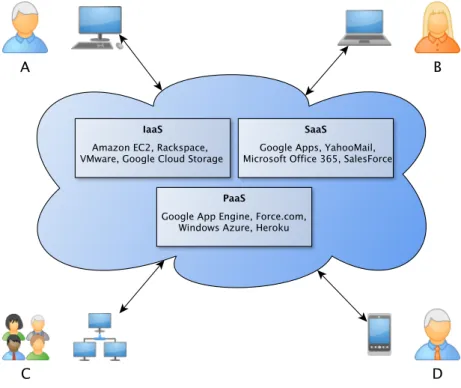
Figure 1.1: Cloud computing overview
a platform is offered as a service in which cloud user may devel-op/program, test or deploy a program, an application or a web service. Examples of PaaS are Google App Engine, Heroku, Red Hat’s OpenShift etc.
soft-ware application is offered as a service through a client interface. The service user does not control or manage the underlying infras-tructure, i.e. storage or operating system. Examples of SaaS are Google Apps, Salesforce, YahooMail etc.
An overview of cloud computing is shown in Figure 1.1 in which different users (A,B, C and D) may access different cloud services (IaaS, PaaS and/or SaaS) by using different devices or interfaces.
1.2
Service Level Agreements and Legal
Con-tracts
A service level agreement (SLA) is part of a contract between a cloud service provider (CSP) and a cloud service user (CSU) which defines and describes different agreed properties of the ser-vice. These properties are usually the quality of service (QoS) parameters that guarantee desired functionality of the cloud ser-vice. P. Bianco et al. [9] define service level agreements as in the following:
“An SLA is part of the contract between the service con-sumer and service provider and formally defines the level of service”.
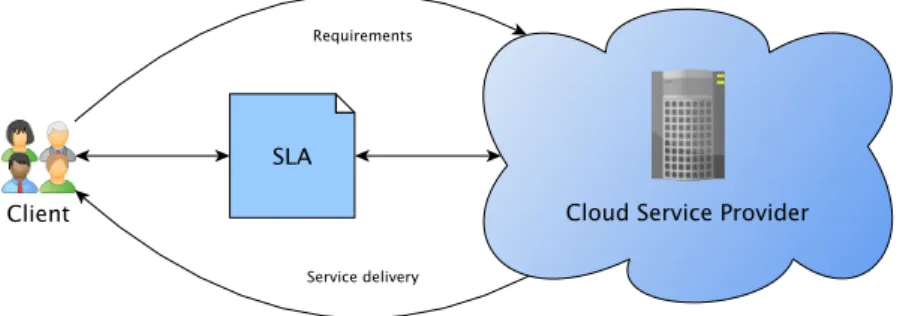
The use of service level agreements has been common in IT organi-zations for many years to identify support requirements for internal monitoring and external customers of IT services [9]. An overview of SLA in cloud environment is shown in Figure 1.2 in which a client gets a cloud service from a cloud service provider based on its requirements and QoS parameters for the service are described in an SLA. Service level agreement is either part of a main service contract or is completely separate document. Service contract is different from an SLA and is a legal binding between two or more parties which outlines service provided, cost, duration, resources, access rights etc. In other words, service contract describes terms of business and legal rights whereas an SLA describes the quality of service and performance measuring parameters e.g. availability percentage, throughput, response time etc.
1.3. SLA Life Cycle 5
Figure 1.2: Service level agreement between a cloud service user and a cloud service provider
1.3
SLA Life Cycle
Selection and acquisition of different cloud services is triggered by business objectives and needs, i.e. requirement to use a specific cloud service is based on definitive needs of a customer. These requirements also form a basis to define different properties of the desired cloud service or in other words, QoS parameters. These requirements for QoS parameters can also be described as require-ments of final SLA for the cloud service. Selection of cloud service provider depends on desired service, its properties (QoS parame-ters) and budget constraints etc. The selection process may in-clude a negotiation between a cloud service provider and a cloud service user over QoS parameters, budget constraints and other associated properties/requirements of the cloud service. After a successful negotiation process, an SLA is formed to described the agreed QoS parameters. This SLA serves as a basis to monitor real-time usage of the cloud service and also to manage the cloud service if some violation occurs with respect to the SLA. This whole process of defining requirements for cloud service (or requirements for final SLA), negotiation, monitoring, management of the SLA and re-defining/modifying the SLA based on new requirements, is described as SLA life cycle [10, 11]. An overview of SLA life cycle and its different phases is shown in Figure 1.3. SLA life cycle and its different phases are described further in later chapters.
Figure 1.3: An overview of SLA life cycle
1.4
Motivation
In e-business platforms, SLAs are essentially important for the service consumer to monitor and manage the acquired cloud ser-vices. Currently, SLAs are available only in descriptive form that is not directly consumable by an external system and requires man-ual tasks in different phases of SLA life cycle i.e these descriptive SLAs can not be directly used in an automated negotiation algo-rithm for an efficient and time saving negotiation between a cloud service provider and a cloud service user. The major benefits (i.e. cost effectiveness and rapid elasticity) of using cloud services may be compromised if SLAs are not directly readable by a system. It becomes very time consuming, demanding and laborious task to manually describe the service requirements, using those descrip-tive requirements to compare with offered cloud services, manually negotiate with cloud service providers based on those descriptive requirements, manually monitor and manage final agreed to SLAs to ensure QoS parameters.
Example 1.4.1 Consider a network administrator ‘ADMIN’ who is given a task to find an appropriate cloud based customer re-lation management (CRM) system for its company. ADMIN is given the requirements such as minimum availability during and outside office hours, budget, storage, number of end users and
1.4. Motivation 7
response time. ADMIN looks up for different options and finds out that many reasonable options exist to make a choice. For in-stance, Amazon Web Services Marketplace1 alone offers 93 results for cloud based CRMs. All available cloud based CRM solutions come with descriptive SLAs, different prices, user ratings, server options, storage options etc. ADMIN has the following tasks to complete the final purchase of CRM software:
• Define all given requirements from its company.
• Manually compare different requirement against available op-tions in market with respect to their SLAs, QoS parameters, budget and storage.
• Manually negotiate with different available cloud service providers to come up with an appropriate selection.
• Manually monitor and manage cloud service with respect to finalized SLA to detect violation, smooth running of service or to ensure other QoS parameters.
Above example demonstrates that manually selecting, monitoring and managing cloud services with respect to their SLAs can be very time consuming and exhausting task with chances of human errors which can badly affect the output and productivity of the selected cloud services. Also, any future changes in requirements can lead to repetition of complete cycle. Moreover, cloud ser-vices may include qualitative parameters such as reliability which requires further processing to transform it to a quantifiable pa-rameter. Many approaches and methods have been proposed and developed which either partly target these problems of manually defining, negotiating, monitoring and management of SLAs for cloud services or they present an SLA life cycle management ap-proach that does not includes all of the requirements discussed above. So, major motivation of this work is to reduce the manual tasks and automate the complete SLA life cycle. This automa-tion of the SLA life cycle includes definiautoma-tion of cloud service QoS
parameters in system readable format/structure, automated nego-tiation of SLAs, automated monitoring and management of SLAs. Another major motivation to automate the SLA life cycle is to facilitate the process of future changes in service requirements and to automate this process with minimum manual input.
1.5
Thesis Vision, Objectives and Scope
1.5.1 Vision and ObjectivesCloud computing has been established as a popular paradigm for scalable infrastructure solutions and services. Cost efficiency, rapid elasticity, and timely availability of cloud resources are key features of cloud services making it a propitious choice against tradition-ally investing huge amounts of money to purchase private hard-ware and softhard-ware resources. Currently, cloud services are largely offered with QoS parameters defined in service level agreements. But these SLAs are offered as a plain text document and every cloud provider has different contents for its SLA(s). Furthermore, the SLAs and their formats, the QoS parameters and their defini-tions are not standardized. These deficiencies of standardization and unavailability of a common framework for digital SLAs lead to new challenges and problems with growing cloud services ori-ented IT solutions. This work intends to provide an SLA structure that is based on standard SLA definitions. The single SLA struc-ture should be flexible to specify service requirements (from service user) or service offer (from service provider) as well as same SLA structure should be used during negotiation process and afterwards during monitoring and management processes. The desired SLA structure is used as a basis for automating the complete SLA life cycle, i.e. negotiation, monitoring, management and recycling of SLAs. In addition, a web front-end is visioned to serve as a com-mon platform for cloud service users, providers and developers for defining, monitoring and managing SLAs. This web front-end should offer different easy-to-use options to its users such that gen-erating random SLAs (close to real world SLAs), perform multiple
1.5. Thesis Vision, Objectives and Scope 9
predefined tests for automated negotiation and monitoring sce-narios to analyze the efficacy of selected negotiation/monitoring method. These analytical tests are anticipated to be conducive in decision making for selecting appropriate cloud provider(s), nego-tiation method and monitoring method.
1.5.2 Scope
This work on automation of the SLA life cycle includes the follow-ing research and development tasks:
• Detailed analysis of state of the art solutions for complete SLA life cycle and its different stages.
• Identification of existing problems and gaps between manual and automated SLA life cycle.
• Definition of a structure to specify requirements for SLA based on required cloud service.
• Both qualitative and quantitative QoS parameters should be processed using the proposed SLA structure.
• Automated negotiation strategy and its implementation for defined SLA structure with analytical comparison to existing negotiation approaches.
• The results of the automated negotiation process are not guar-anteed to be optimized with respect to the requirements and available options.
• Usage of same SLA structure to store the finalized SLA on cloud service user side.
• Automated monitoring of QoS parameters as defined in the fi-nal SLA. Only those QoS parameters are monitored for which proper definition is available in the finalized SLA.
• Automated management of SLAs and their respective QoS parameters is limited to the scope defined in finalized SLA, i.e. all triggers, events and processes are defined directly in
SLA which are used in automated SLA management (optional part).
• Integration of finalized SLA with other systems is possible as XML data or as a web service (optional part).
• Automated recycling of SLA based on future changes is pos-sible if recycling parameters are defined in the SLA which makes automated re-negotiation and stores finalized SLA for monitoring and management.
• Management of SLAs is limited to such tasks that are possi-ble to be performed as an action from within a programmapossi-ble function, e.g., collecting the documents required for service credits request in case of service violations or sending an elec-tronic claim to a cloud service provider.
• A web front-end is developed to facilitate user in defining SLAs and making different tests for automated negotiation process based on randomly generated SLAs.
• The web front-end is used for storing SLAs, redefining SLAs and to perform different tests for automated monitoring also.
• Implementation for an automated monitoring is provided only for a specific cloud service e.g. Amazon S3 but presented SLA structure is extensible for other cloud services.
1.6
Summary and Thesis Structure
In this chapter, a brief introduction of cloud computing is pre-sented with its essential properties and most common service mod-els in cloud computing. An overview of service level agreements, legal contracts and their difference is also described briefly. More detail on different components of an SLA and examples are cov-ered in next chapters. An introduction to the SLA life cycle and its different stages is described concisely. The motivation for au-tomating the SLA life cycle is elaborated with an example. The scope, vision and objectives of this work are also outlined precisely
1.6. Summary and Thesis Structure 11
in this chapter.
The remaining thesis work is intuitively divided into different chap-ters based on different stages of SLA life cycle as in the following:
• Chapter 2 describes the existing approaches and solutions for automation of the overall SLA life cycle and its different stages.
• Chapter 3 defines an SLA structure and its components. All components, their intended use and related examples are in-cluded in this chapter.
• In chapter 4, an automated negotiation method for SLAs is presented, implemented and validated using multiple experi-ments.
• An approach for automated monitoring of SLAs based on pro-posed SLA structure is formulated, implemented and experi-mentally analyzed in chapter 5.
• In chapter 6, an implementation of the presented SLA spec-ification and a comparison with existing solutions is given. This chapter summarizes the presented work and also briefly describes the possible future extensions.
Chapter 2
State of The Art
As discussed in Chapter 1, the SLA life cycle consists ot different stages, i.e. specification, negotiation, monitoring, management and recycling. In this chapter, state of the art approaches and techniques are discussed for these stages of the SLA life cycle. Al-though, many different approaches exist for each of the SLA life cycle stages, only approaches that are most relevant to this thesis work are mentioned and discussed. After describing state of the art for every SLA life cycle stage, an analytical overview is also presented in this chapter. This analytical overview discusses the drawbacks in existing approaches and also leads to requirements formalization for automation the of SLA life cycle presented in next chapters. This chapter is structured as follows. Section 2.1 motivates for the need of SLA specification languages and also discusses the most appropriate specification languages in the web services domain and the cloud services domain. Section 2.2 de-scribes general negotiation techniques that are used in two party or multiple party setups. Section 2.3 explains different SLA nego-tiation model setups and existing approaches for automated SLA negotiation are also presented. Section 2.4 presents existing tech-niques for the automated SLA monitoring/management and the SLA life cycle as a whole. Section 2.5 summarizes the contents presented in this chapter.
2.1
SLA Specifications and Languages
Cloud service providers generally offer SLAs in descriptive/natu-ral language format which is not directly consumable by a ma-chine/system. The SLA written in natural language may impede the utility of rapid elasticity in cloud service. Different stages of the SLA life cycle e.g. negotiation, monitoring and manage-ment are also dependent on availability of a machine readable SLA. A cloud service user is conventionally responsible itself to monitor and enforce a natural language based SLA by first man-ually transforming the SLA details and guarantees into a suitable machine readable format. Different languages and specifications have been proposed to represent an SLA as a machine readable format e.g. Web SLA (WSLA) Framework [12], SLAng for defin-ing SLAs in IT services [13][14], Web Services Agreement (WS-Agreement) specification [15], SLA* as part of SLA@SOI project [16], CSLA (Cloud Service Level Agreement) language [17] and a formal language SLAC for SLAs [18]. Among these approaches, WSLA, SLAng and WS-Agreement target specifically SLAs for web service, SLA* deals with services in general and remaining approaches are presented precisely for cloud services. In the fol-lowing, these approaches are discussed briefly and verbosely in ac-cordance with their relevance to cloud computing, expressiveness and completeness as a SLA specification language. A comparative review of SLA specification languages is also presented by Maarouf et al. [19] which we discuss further in later sections.
2.1.1 WSLA, Keller & Ludwig, 2003
IBM research developed the WSLA framework to define and mon-itor SLAs for web services. The WSLA framework includes an XML schema based language to define the SLAs and a runtime environment to interpret and monitor SLAs. Web services users and providers can define SLAs, specify SLA parameters and their measurement methods, relate the SLA parameters to the other resources and use a monitoring service to automatically enforce the SLAs. A UML (Unified Modelling Language) class diagram
2.1. SLA Specifications and Languages 14
[19] of meta model for the WSLA framework is depicted in Figure 2.1 and is elaborated in the following paragraphs. WSLA
classi-Figure 2.1: WSLA meta model
fies SLA management information into four types, i.e. (i) resource metrics (e.g. routers, servers and instrumented applications), (ii) composite metrics (e.g., by combining several resource/other com-posite metrics according to a specific algorithm for aggregated cal-culations), (iii) SLA parameters (to relate the composite metrics provided by a service provider to the service level objectives of service customer for evaluation, e.g. service availability, through-put or response time) and (iv) business metrics (to relate SLA parameters to the financial terms on service customer side). Each SLA parameter refers to one metric (resource or composite). The aggregation of metrics (to form a composite metric) is carried out either by defining a function (which may include other metrics as operands) or by defining a measurement directive (which describes the method of measurement for the metric). WSLA language spec-ification defines the SLA structure in three sections as described below:
• Parties section combines information about the signatory parties, i.e. service provider and service customer. This sec-tion may also include informasec-tion about supporting parties to assist, measure, monitor or manage the web service.
• Service Description section consists of information about the characteristics of a service together with its measurable parameters. This section defines all service parameters, their relation to the service(s), method of computation or measure-ment and access protocols for metrics of a managed resource. A measurement service (as part of the WSLA framework) processes the information provided in this section.
• Obligations section defines the guarantees and conditions under which these guarantees are valid. The WSLA frame-work defines two types of obligations, i.e. Service Level Objec-tives (SLOs) and action guarantees. SLOs define the promises to maintain the state of a service for a certain period of time. Action guarantee is a commitment of a signatory party to per-form an action linked with the violation of an SLO. Likewise, obligations of the parties involved and the conditions (under which those obligations are valid) are defined in this section, i.e. if a threshold is assigned to an SLA parameter then it might also be required to define the constraints under which this threshold is considered valid. A condition evaluation ser-vice (as part of WSLA framework) processes the information provided in this section to assess the violations of SLOs.
2.1.2 SLAng, Lamanna et al., 2003 & 2004
SLAng is an XML schema based language to define service level agreements in IT services and e-business domains. SLAng’s gen-eral structure of SLAs includes responsibilities of the service provider (Server), responsibilities of the service user (Client) and their mu-tual responsibilities (Mumu-tual). These responsibilities are expressed in three parts in an SLA: (i) end-point description (e.g. location in-formation of service user and provider), (ii) contractual statements
2.1. SLA Specifications and Languages 16
(e.g. contract start/end dates and duration) and (iii) Service Level Specification (SLS) parameters (i.e. QoS parameters and metrics to measure those QoS parameters). SLAng divides the SLAs in six types and two groups (vertical and horizontal) depending on their service usage type as described below:
• Vertical SLAs represent a service to provide infrastructure support to client
– Hosting SLA is between a service provider and a host
– Persistence SLA is between a host and a storage provider
– Communication SLA is between a application/host and Internet service providers
• Horizontal SLAs represent a partly subcontracted service (of the same type) by the client
– ASP SLA is between an application/service and an ap-plication service provider
– Container SLA is between two containers (that host ap-plications or services)
– Networking SLA is between two networking providers SLAng uses Object Constraint Language (OCL) and UML to rep-resent SLAs with respect to the responsibilities (Server, Client and Mutual), i.e. constraints that are necessary to exist for successful delivery of the service and that are agreed by the parties. SLAng such that constraints should be placed only on mutually visible (to both parties) events. This ensures that monitoring of violated con-straints is easily detectable by the affected party. SLAng currently supports multiple types of constraints, i.e. throughput, availabil-ity, timeliness (response time), reliability (correctness of response) and data accuracy/consistency. Further conditions about timing of a constraint to be applied (i.e. when a particular constraint is effective) or about state of service (i.e. mutually visible changes in state of the service) may also be applied to enhance the monitoring process.
2.1.3 WS-Agreement, Andrieux et al., 2007
WS-Agreement is an XML based language and a web services based protocol for specifying agreement/contract between two par-ties, generally a service provider and a service consumer. WS-agreement is presented by Grid Resource Allocation Agreement Protocol (GRAAP) working group of the Computer Area of the Open Grid Forum (OGF). The WS-Agreement specification con-sists of the following three parts:
• A structure to specify an agreement (as shown in Figure 2.2)
• A structure to specify an agreement template (as shown in Figure 2.3)
• A set of port types (agreement factory, pending agreement factory, agreement, agreement Acceptance) and operations (i.e. to exchange resource information between ports or de-stroy resources) to manage the complete life cycle of an ment, i.e. creation, monitoring and expiration of an agree-ment
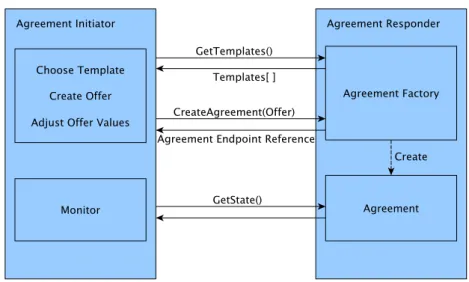
WS-Agreement specification facilitates a service consumer (agree-ment initiator) to discover the required services. A service provider (agreement responder) publishes available agreement templates. Each agreement template describes service name, context, ser-vice description terms (functionality that will be delivered un-der the service), guarantee terms (assurances on service quality) and agreement creation constraints (rules that must be followed to create an agreement). An overview of service discovery, offer and agreement after acceptance under WS-Agreement specifica-tion is shown in Figure 2.4. An agreement initiator sends a request to an agreement responder to get available agreement templates (which describe the available service, its variations, quality pa-rameters, guarantees etc). The agreement responder sends back a list of agreement templates. The agreement initiator makes an offer based on the agreement templates and sends it to agreement factory service which evaluates the offer. Result of the evaluation may be immediate acceptance or rejection depending on offer or
2.1. SLA Specifications and Languages 18
Figure 2.2: Agreement structure Figure 2.3: Agreement template struc-ture
decision is deferred. In case of acceptance, the agreement respon-der sends a new agreement. If the decision is deferred then an instance of pending agreement is sent to the agreement initiator and once a decision has been made then agreement state is changed to either observed (if offer is accepted) or rejected (if decision is rejected). WS-Agreement specification supports only one round of negotiation, i.e. agreement initiator makes an offer which is either accepted or rejected. This deficiency is further covered by WS-Agreement Negotiation [20] which extends the WS-Agreement specification to allow negotiations and re-negotiations.
2.1.4 SLA*, Kearney et al., 2010
SLA* is proposed as part of SLA@SOI European project to gener-alize the XML based web services standards WSLA, WS-Agreement and WSDL. SLA* is an abstract syntax to formalize SLAs and SLA templates (collectively termed as SLA(T)s) for services in general rather than only for web services. An SLA template is a structure
Figure 2.4: Overview of the service discovery, offer and agreement
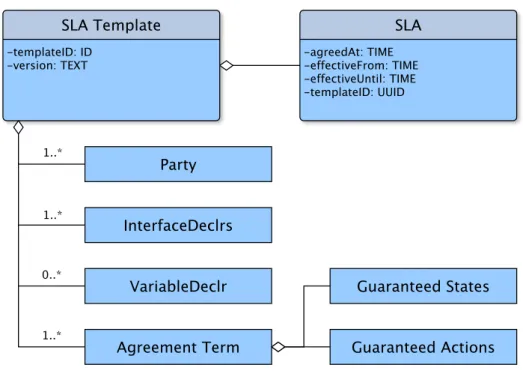
which includes information about a service, its QoS parameters, guarantees, rules, party (i.e. a service provider) and constraints whereas an SLA is an agreement made between two parties (a service provider and a service user) based on the SLA template after negotiating over the offer by service user. SLA* is developed with an idea of language independence, better expressiveness and easy extensibility. In SLA*, contractual obligations of parties are enforced through constraints on actions of the parties. SLA(T)s structures (SLAs and SLA templates) are represented in terms of entities. An entity is a collection of key/value attribute pairs where each attribute represents some property of that entity. A key is a property/attribute name e.g. party.role and value is an unordered set of expressions representing contents of that attribute including constraints. An overview of SLA(T) structure is shown in Figure 2.5. An SLA template consists of a template ID and a version number which is used as a reference in final SLA. Interface declaration represents an obligation on one of the SLA parties to provide an interface where an interface defines a particular oper-ation (e.g. messaging, reporting). In other words, obligoper-ations of parties to report or send a message about an event or operation is declared through interface declarations and this information is accessible to other party through SLA. Variable declarations rep-resent values or expressions and are used for convenience purpose.
2.1. SLA Specifications and Languages 20
Figure 2.5: Structure of SLA and SLA Template in SLA*
In SLA*, variables declarations are also used to specify domain re-lated alternatives for an option e.g. ‘> 1 and < 5’ or ‘in the time interval 7 : 00 to 15 : 00’. Apart from interface declarations (used to define functional obligations), agreement terms are used to rep-resent non-functional (QoS) obligations. SLA* agreement terms may contain pre-conditions or constraints that must exist before an agreement term becomes applicable. An agreement term may contain multiple guarantees of one of the two kinds, i.e. states and actions. A guaranteed state is a constraint in which a party is obligated to maintain a particular state of the service e.g. ‘re-sponse time < 8ms’. A guaranteed action is a constraint in which a party is obligated to perform a specific action within a possible deadline if a defined pre-condition to perform the action exists. SLA* syntax is implemented as Java API, an XML schema and BackusNaur Form (BNF) Grammer.
2.1.5 CSLA, Kouki et al., 2014
CSLA language is developed with main focus on dealing with QoS uncertainty and performance fluctuations in cloud services. The
CSLA is based on the Open Cloud Computing Interface (OCCI)[21] and reference architecture of cloud computing by National Insti-tute of Standards and Technology, USA [22] [17]. CSLA defines an SLA in three sections:
• Validity of the agreement, i.e. duration of agreement
• Parties of two types, signatory parties (i.e. service provider and service customer) and supporting parties (i.e. trusted third parties)
• Agreement template contains the following five elements:
– Cloud service definition, i.e. SaaS, PaaS or IaaS. Each service can be defined in different modes of delivery (i.e. normal mode and degraded mode) to handle the uncer-tainty and fluctuation in a cloud service.
– Parameters define variables that are used in other sections of the agreement template and refer to distinct elements such as metric, monitoring and schedule.
– Guarantees define the obligations of one or more par-ties and are comprised of four elements: scope (defines the services covered in the guarantee), requirements (de-fine the pre-conditions that must exist to run the scoped services or to fulfill the guarantee), terms (each guaran-tee term defines one or more objectives/SLOs evaluated by constraints using metric, comparator and a threshold) and penalties (to define compensations in case of viola-tions in guarantees). A priority is defined for each SLO to accommodate the QoS preferences of service user. The metric is calculated according to predefined monitoring in a particular schedule (period).
– Billing: CSLA supports two types of billing, i.e. pay-as-you-go and all-in-package.
– Termination defines the termination date/time for the service.
2.1. SLA Specifications and Languages 22
CSLA specification can be defined in different programming lan-guages and is not XML restricted. Also, CSLA language can be used for different types of a cloud services (i.e. SaaS, IaaS, PaaS). Similar to degradation options in cloud service definition, QoS degradation definition is also possible in CSLA by defining fuzzi-ness (acceptable margin around a threshold) and confidence (the percentage of compliance or reliability) to deal with uncertainty and unpredictability at QoS preferences level.
2.1.6 SLAC, Uriarte et al., 2014
SLAC is presented as specification language particularly for cloud computing and is claimed to support main cloud deployment mod-els. SLAC is based on WS-Agreement and inherits many features and structures from it. SLAC supports multi-party agreements in-cluding a broker, business aspects (pricing schemes) of SLAs and SLA management. A software framework1 is also developed which uses SLAC to specify, evaluate and enforce SLAs. The formal syn-tax of SLAC is defined in Extended Backus Naur Form (EBNF) [23]. The semantics of SLAC is formalized as Constraint Specifica-tion Problem (CSP) which enables the verificaSpecifica-tion of consistency of terms in an agreement at negotiation step and also validation of service characteristics at SLA enforcement step. SLAC defines the SLA in three parts:
• Description of the contract
• Specification of contract terms
• Guarantees for the contract terms
The description of an SLA consists of a unique identifier and at least two parties (service provider and service user) with party name (optional) and its role(s). Multiple roles for a single party enables the definition of such scenarios in which a service provider might also be a service user to some other party and an optional party name supports the definition of an SLA template in which
a party name is not yet mentioned. The terms of an agreement define the properties of the service as well as its value(s). Each SLA must contain one or more terms. A term can be a metric or group of terms (composed of multiple terms to define complex characteristics of a service). Each term also contains a party name (responsible to fulfill that term) and the contractors of the term (one or more) which enables the definition of parties with different roles, i.e. broker or service provider. A metric can be of three types:
• Numeric metric can be a value constrained by open or closed intervals or an expression. A unit is also attached to each metric e.g. milliseconds.
• Boolean metric can contain true or false values.
• List metric contains a list of values.
SLAC predefines all metrics (including list metrics along with list values) and their methods of measurements in the context of the cloud domain. Guarantees for the contract terms define the obli-gations of the responsible party (to take a defined action) in case of a particular event. An SLA defined in SLAC (using EBNF) can be checked for consistency at design time and a monitoring system uses the well defined SLA at run time to enforce and evaluate ser-vice guarantees. SLAC is extended to fulfill business aspects (i.e. pricing schemes and negotiations) by dividing SLA management into the following three phases:
• Information phase of an SLA, in which details about the ser-vice, service users, service providers and brokers is collected;
• Agreement phase, in which parties finalize contract terms through negotiation. This phase also includes finalizing the price models (i.e. flat or variable prices);
• Settlement phase, in which SLAs are enforced and evaluated through a monitoring service
2.2. Negotiation Techniques and Preliminaries 24
SLAC elaborately defines flat and variable pricing schemes in an extended language specification to facilitate practical pricing mod-els computing. The evaluation and experimentation of SLAC is performed mainly for IaaS scenarios, however, it is envisaged by the authors that SLAC can also be used to define SLAs for other cloud service models also, i.e. SaaS or PaaS.
2.2
Negotiation Techniques and Preliminaries
Negotiation is a process of communication between two or more parties to reach an agreement on a given issue/objective. In ser-vice computing, the most common negotiation arrangement con-sists of an offer from one party and acceptance (or counter offer) from another party in a cyclic pattern until an agreement is made. This arrangement may involve an adjudicator or negotiation agent to intercede the negotiation process. This negotiation model is termed as alternating offer protocol and is based on Rubinstein’s bargaining model [24]. Rubinstein’s model has the following char-acteristics:
• Two parties;
• Complete information is available about negotiation environ-ment;
• Unlimited number of iterations, i.e., negotiation process con-tinues until an agreement is made;
• Alternating offers, i.e. first party makes an offer in first round, offer can be accepted or rejected, if offer is rejected then op-posite party makes a counter offer in second round, first party may accept or reject that offer from opposite party, if offer is rejected then first party makes another offer in third round (better than first round offer) and it continues until one party accepts offer from other party;
• Delays are costly (in terms of time, money or some other factor).
Negotiation is a routine process in Service Oriented Architectures (SOA) and multi-agent systems. Parties in SOA or agents may have to negotiate in different scenarios to optimize their interests or activities leading to their goals. Generally, different negotia-tion strategies are required to be adopted in different setups for an optimal agreement between agents or parties [25]. A conces-sion is an amount that one party concedes with an intention of reaching an agreement during negotiation process. In simple se-tups (consisting of two parties), three common concession tactics exist [26] as described below. The concession tactics are commonly parameterized by the value β.
• Conceder (β > 1), in which a party makes a great concession during the start of the negotiation process. A party that fol-lows this concession strategy soon reaches its final limit of ac-ceptable value. Although this strategy increases the chance of a successful agreement sooner, however, it also favors the op-ponent party as giving great concessions at start time means to move towards a setting which is more favorable to the op-ponent party.
• Linear (β = 1) concession strategy makes an equal amount of concession in each round of negotiation process. This strat-egy is considered moderate as chances of reaching a common ground (win-win scenario) are high in this strategy. This strategy is, however, not very supportive in time bound setups as slow concession may increase time to reach an agreement.
• Boulware (β < 1) is a concession strategy in which a negoti-ating party maintains its initial offer value during almost all negotiation rounds until deadline is approaching and makes a great concession towards the end of the negotiation process. This strategy may result in a favorable agreement for negoti-ating party, however, due to no concession at all during initial rounds of negotiation process, a negotiating party may end up with no agreement due to time constraints.
2.3. SLA Negotiations 26
a party concedes more as deadline is approaching. Resource pendent tactics give a concession depending on the availability, de-mand and consumption of a resource. As resources become more scarce, the concession amount increases and vice versa. Behavior dependent tactics are applied where opponent’s concession strat-egy and willingness to make an agreement are apparently known. The benefit of using each of these concession tactics is measured through a utility function. The utility function returns a value representing the more favorable or less favorable agreement made based on initial values of the negotiating party and the value on which an agreement is made, i.e. as negotiating party makes con-cessions during negotiation process, the overall utility of the pos-sible agreement decreases.
2.3
SLA Negotiations
Cloud services are adopted as cost effective and time saving solu-tions for an infrastructure, software or a platform. Different qual-ity issues may arise (related to an acquired cloud service) due to a degraded service, delay in response, packet loss, provisioning time or some other QoS parameter. These issues may affect the desired business objectives and may cause different types of losses to a party. As the cloud service market has grown rapidly, selection of an appropriate service according to preset business objectives and negotiation process becomes a time consuming and complex task. Moreover, performing these tasks (i.e. negotiation and provider selection) manually may affect other stages of an SLA life cycle and different functions in an organization linked with the acquired cloud service. Cloud services are usually automatic in their elastic functionality, i.e. a cloud service may scale up or down automat-ically depending on load. Similarly, acquisition of new services without manual intervention is also a mandatory requirement in most of the cases [27]. As QoS parameters of a cloud service are defined in an SLA, so it requires an automatic negotiation process for an SLA for timely and effective acquisition of a cloud service. Many approaches has been presented to automate negotiation for
SLAs [28][29][26][30][31][32][33][34][35][27][36]. We discuss only a few of these approaches in the following sections.
2.3.1 SLA Negotiation Model Setups
Cloud services are available in different variations, i.e. a provider may offer cloud services under fixed terms (no negotiation over QoS parameters and price is possible) while another provider may offer negotiable cloud services. Moreover, cloud services may also involve a service broker (a negotiator/mediator between a service user and service provider(s)) to negotiate on behalf of the user . Considering these scenarios and different requirements, a negotia-tion model may be one of the following types:
• Fixed model (1−n) represents a setup in which one service user is selecting from n number of service providers offering their services on fixed terms, i.e. QoS parameters and price of the offered service are not negotiable.
• Variable model (1−n) with no broker represents a setup (depicted in Figure 2.6) in which one service user negotiates directly with n number of service providers over price and QoS parameters.
• Variable model (1− n) with broker is same as variable model (1 − n) with a difference that a broker or mediating party negotiates on behalf of the service user with service providers over QoS parameters and price (as depicted in Fig-ure 2.7).
• Variable model (m−n)represents a setup in which m num-ber of service users are competing/bidding for different cloud services offered by n number of providers. In this setup more than one service broker may exist and all service providers offer negotiable services. Also, a service provider may be a service user of some other cloud service.
• Mixed model represents the most flexible model in which all of the above setups can be combined, i.e. some service
2.3. SLA Negotiations 28
Figure 2.6: Variable model (1−n) with no broker
Figure 2.7: Variable model (1−n) with broker
providers may offer fixed term services while others may offer negotiable prices.
2.3.2 Concurrent Negotiations in Cloud-Based Systems, Siebenhaar et al., 2012
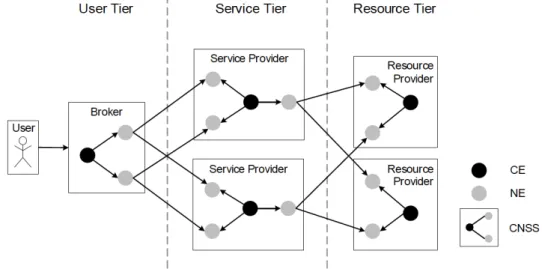
In this work [26], an SLA negotiation approach is presented for multiple cloud providers across multiple tiers, i.e. user tier (service user and broker), service tier (service provider and service user of other resource service provider) and resource tier (resource service provider). This approach enables combining services from mul-tiple providers and negotiating with them concurrently through different entities. An overview of the negotiation architecture is shown in Figure 2.8. Each negotiating entity in this architecture
Figure 2.8: An overview of concurrent negotiation architecture
is represented in a Cloud Negotiation Support System (CNSS). A user initiates a request of a single service or combined services (de-pending on its functional requirements and business objectives) to
the broker’s CNSS. Then the broker or coordinating entity (CE) evaluates the request, selects appropriate service providers and creates the required number of negotiating entities (NE) to start the negotiation process. In the service tier, a service provider may need infrastructure services from another service provider (in re-source tier) to fulfill needs of its service users (in user tier). Service provider sends its request for infrastructure services to CE which creates further NEs to negotiate with different resource providers. NEs of service/resource requester communicate with the NEs of service/resource provider, respectively. NEs in service provider are aware of available service levels and their QoS parameters which are used at the time of negotiation with NEs of user tier. Similarly, NEs of resource tier are aware of available resources and their QoS parameters. This information is used while negotiating with NEs of service tier. Each of these negotiation tasks is run concurrently by responsible NEs and the result of the concurrent negotiation process is passed to CE. The CEs of user tier and service tier eval-uate the results and select most appropriate service provider and resource provider, respectively. This negotiation architecture uses linear, conceder and Boulware tactics for experiments with their effect on consumer’s and provider’s utility.
2.3.3 Optimal Negotiation of Service Level Agreements for Cloud-Based Services through Autonomous Agents, Yaqub et al., 2014
In this work [35], a near-optimal SLA negotiation strategy is pre-sented for cloud computing environments. The negotiation setup uses Rubinstein’s alternating offer protocol [24] where two partic-ipating parties are negotiating over different issues (SLA param-eters) by exchanging bids (offers and counter offers). A bid b is defined as b = {x1, ..., xN} where x is chosen (offered) value of N
issues. For example, if we have two issues x1 =availability and
x2 =response time with best possible values of 99.9 and 0.4ms, respectively then we may start our first bid with best possible (de-sired) values, i.e. b = {99.9, 0.4}. The worth of the bid b is given
2.3. SLA Negotiations 30
by a linear additive utility function u(b) as:
u(b) =
N
X
i=1
wiVi(xi)
where wi is the weight (preference/priority factor for a QoS
pa-rameter) for an issue xi such that N
X
i=1
wi = 1
and Vi(xi) = eval(xi)/max(eval(xi)) ∈ [0,1] representing ratio of
selected value for an issue in a bid b to the best possible value of that issue e.g. if the issue x1(availability) has value of 95 in a bid then V1(x1) = 95/99.9 = 0.95. The evaluation (Vi(xI)) along
with weight (wi) for an issue (xi) enables a service user or service
provider to set its priorities with respect to service requirements. It is argued in this work that autonomous negotiation process is complex and computationally expensive. Generally, a negotiation strategy is modeled as a 3-tuple such thatS = (B, Mo, A) whereB
is bidding function to generate a counter offer based on opponent’s offer, Mo is the opponent’s assessed modes (concession strategy)
based on received bid and A is the acceptance function which decides to accept opponent’s bid. The computation of S based on its functions is a complex task and a computationally inexpensive negotiation strategy is proposed in this work termed as ‘Reactive Exploitation’ (RE). According to this negotiation strategy (RE), a party generates its bid based on a quasi tit-for-tat policy, i.e. a concession is given if the opponent is also observed to do the same. This negotiation strategy is outlined as in th following:
• The negotiation process is restricted by time constraints;
• A party starts negotiation process with minimal concession in first bid;
• Opponent accepts bid (which is quite unlikely due to low con-cession and opposite interests) or generates a counter offer
(bid);
• If a counter offer is received then from second bid onwards, first party generates its new bid based on the mean value of opponent’s lastl many bids and remaining time in negotiation process;
• First party maintains record of best counter offer received so far and latest generated bid;
• The RE strategy utilizes maximum time in most cases to ex-ploit maximal possible options;
• An agreement is made by selecting the best acceptable bid received in the process.
RE is experimented for PaaS environment against different nego-tiation agents, i.e. Boulware, Linear Conceder and TheNegotiator [37]. The results of experiments show that RE performs at par with state of the art opponents.
2.3.4 An Autonomous Time-Dependent SLA Negotia-tion Strategy for Cloud Computing, Dastjerdi & Buyya, 2015
This negotiation framework presents a time dependent strategy (as described in Section 2.2) to automate the SLA negotiation process computing environments. This approach is motivated to help in increasing the profits of cloud service providers by testing different work loads and market scenarios under time dependent tactics. The model setup used in this approach includes a scenario in which a service user wants to find an IaaS provider with the following requirements:
• Hard disk (functional requirement and fixed)
• CPU (functional requirement and fixed)
• Memory (functional requirement and fixed)
2.3. SLA Negotiations 32
• Availability (non-functional requirement and negotiable)
• Deadline (non-functional requirement and fixed)
As cloud service user and service provider have opposite priorities, e.g. a user wants to maximize service availability and minimize cost whereas a service provider wants to get maximum profit by offering minimum services. In other words, if overall utility of SLA agreement is increasing for one party then overall utility for op-posite party is decreasing. Moreover, users have time constraint (fixed deadline) with an assumption that if a service is not ac-quired by a particular time then service user is not able to satisfy its end users. A client negotiation service (NS) on service user’s side negotiates with different service providers on behalf of the user and this NS is also able to measure the reliability of an offer from a service provider. Similarly, a NS on provider side deals with different service requests from service users. The negotiation framework in this approach works as in the following:
• A service user (client)sends its service requirements (e.g. CPU, memory, storage and other QoS parameters) to client NS.
• Client NS starts discovering appropriate service providers de-pending on functional and non-functional requirements sub-mitted by client.
• Client NS starts negotiation process with NSes of the discov-ered providers by using time dependent tactics and makes an initial offer to provider’s NS.
• Provider’s NS evaluates the client’s offer by considering its available resources, functional requirements and QoS param-eters of requested service. If provider accepts the offer then a reliability factor is also sent to client’s NS along with ac-ceptance message, otherwise the provider generates a counter offer according to its negotiation tactics.
• Client NS may receive acceptance or counter offer. If a counter offer is received by NS then client’s NS evaluates the offer by again considering deadline and other requirements.
• This process of offer and counter offer is repeated until an agreement has been made or deadline approaches.
The outcome of above negotiation process is an SLA if negotiation is successful. This approach assumes that negotiating parties are unaware of opponent’s concession tactics and also investigates risk of malicious negotiation attempts under this setup, i.e. a mali-cious client may submit arbitrary offers to service provider to gain knowledge of provider’s concession tactics and resource utilization preferences. The malicious client may use this information to ac-quire an actual service from the same provider faster than other clients. This scenario may cause profit loss for a provider and also deprive other clients from acquiring scarce resources in a compet-itive environment. On the other hand a provider may also use offer information from client’s NS to maximize its profits in future transactions.
2.4
SLA Monitoring, Management and SLA Life
Cycle
Monitoring of cloud services is a task of great importance for both service provider and service user [38]. Quality assurance is manda-tory for cloud services to realize the underlying business objec-tives. SLAs contain different QoS parameters (e.g. availability, response time or throughput) as part of service contract. These QoS parameters must be observed continuously for preferred usage of cloud services according to QoS requirements. A complex SLA may contain multiple QoS parameters and guarantees by service provider. Manual and continuous monitoring of these QoS param-eters and guarantees is usually not possible and it may also hinder the timely actions to rectify a problem/degradation in a service. Also, if a violation with respect to SLA occurs, then an accurate measure/action must be taken as defined in the SLA (generally within a deadline). Automatic monitoring of QoS parameters and guarantees with respect to the SLA is a much needed functionality in cloud services [39]. Multiple approaches have been presented to
2.4. SLA Monitoring, Management and SLA Life Cycle 34
facilitate the automated monitoring task in cloud computing en-vironments [40][41][42][43][44][45][46]. A detailed review of cloud service monitoring is presented by Acetoet al. [38] and by Hussain et al. [47]. In the following sections, we discuss a most relevant monitoring approach, few SLA management approaches and SLA life cycle as a whole.
2.4.1 Low Level Metrics to High Level SLAs - LoM2HiS Framework: Bridging the Gap Between Monitored Metrics and SLA Parameters in Cloud Environ-ments, Emeakaroha et al., 2010, 2012
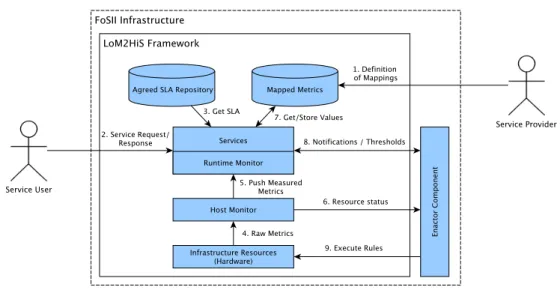
LoM2HiS (Low-level resource Metrics to High-level SLAs) frame-work [40] is presented as a solution to map low level resource met-rics (e.g. system uptime and downtime) to high level SLA pa-rameters (e.g. availability) for detection of SLA violation threats. LoM2HiS is developed as part of FoSII (Foundations of Self-governing ICT Infrastructures) infrastructure. FoSII is divided in two core parts, i) enactor component (self management part of the deployed services) and ii) LoM2HiS (monitoring component which provides information to enactor component). It is assumed in this approach that negotiation process has already been completed and SLA is stored in repository for service provisioning. Future SLA violation threats are detected by defining tighter thresholds than real SLA objective thresholds. However, threat thresholds are assumed to be predefined in this work and no particular component is defined for this purpose. A step by step functioning of LoM2HiS frame-work is shown in Figure 2.9.
The monitoring process of LoM2HiS starts after negotiated SLA is stored in repository. In step 1, service provider stores mapping of low level metrics to SLA parameters. As service user requests the service (step 2), the runtime monitor loads related SLA from the SLA repository (step 3). Infrastructure resources are the network resources and hosts in a datacenter for cloud services. Monitoring agents in infrastructure resources measure raw metrics (of service usage) which are accessed by host monitor (step 4). These raw
Figure 2.9: LoM2HiS Framework Architecture
metrics are analyzed by host monitor to extract metric-value pairs and periodically sends it to runtime monitor (step 5) as well as to enactor component (step 6). The runtime monitor uses an XML parser to extract the SLA parameters and their values available in the agreed SLA document. In step 7, runtime monitor gets re-lated mappings from repository and compares them with measured metrics (received from host monitor) to build an equivalent of the agreed SLA objectives. The result of this comparison is stored back to mapped metrics repository. The runtime monitor also no-tifies the enactor component if future violation threats occur (step 8). The enactor component takes decision about changes in service to prevent future violation threats (step 9). As a result, service is scaled up/down or any other preventive measure is taken on run time to continue fulfilling service objectives. Different com-ponents of implemented LoM2HiS framework and FoSII frame-work exchange messages using Java Messaging Service (JMS) API and communication model among components is based on queuing mechanism. An extended version of this approach is also presented in 2011/2012 [42].
2.5. Summary 36 2.4.2 SLA Management and SLA Life Cycle in General
SLA management of cloud services includes tasks such as prepar-ing claims in case of service violations, updatprepar-ing SLA parameters if requirements change or performing an action triggered due to a monitoring event. Shu et al. [48] present an approach for life cycle based SLA management for web services. An SLA manage-ment platform is presented in [48] to define SLAs for web services, registration of SLAs, monitoring a