WORKING PAPER NO. 11-30/R
COLLATERAL DAMAGE:
SIZING AND ASSESSING THE SUBPRIME CDO CRISIS
Larry Cordell
Federal Reserve Bank of Philadelphia
Yilin Huang
Federal Reserve Bank of Philadelphia
Meredith Williams
Federal Reserve Bank of Philadelphia
Collateral Damage:
Sizing and Assessing the Subprime CDO Crisis
Larry Cordell
Yilin Huang
Meredith Williams
1
1
Cordell is vice president, Huang is a senior specialist, and Williams is a systems analyst in the Risk Assessment, Data Analysis, and Research (RADAR) Group at the Federal Reserve Bank of Philadelphia. We wish to thank Jeremy Brizzi, Mike Hopkins, Paul Willen, Bill Lang, and the staffs at the Federal Reserve Board and the Federal Reserve Banks of Boston, New York, and Philadelphia for helpful comments. The views expressed here are those of the authors and do not necessarily reflect those of the Federal Reserve Bank of Philadelphia or the Federal Reserve System. This paper is available free of charge at www.philadelphiafed.org/research-and-data/publications/working-papers/.
Abstract
This paper conducts an in-depth analysis of structured finance asset-backed securities collateralized debt obligations (SF ABS CDOs), the subset of CDOs that traded on the ABS CDO desks at the major investment banks and were a major contributor to the August 2007 financial panic. We identify these CDOs with data from Intex©. We estimate that 727 publicly traded SF ABS CDOs were issued between 1999 and 2007, totaling $641 billion. We describe how and why multi-sector CDOs became subprime CDOs and show why they were so susceptible to catastrophic loss. We then track the flows of subprime bonds into CDOs to document the enormous cross-referencing of subprime BBB bonds and credit default swaps (CDSs) into CDOs. We also show that lower rated tranches of CDOs were not sold and were largely recycled into CDO2s and other CDOs. We estimate that total write-downs on SF ABS CDOs will be $420 billion, 65% of the original issuance balance. We then analyze the determinants of expected losses on the deals and AAA bonds and examine the performance of dealers and rating agencies. Finally, we discuss the implications of our findings and the many areas for future work.
I. Introduction
How much will total write-downs be on the universe of CDOs at the center of “the Panic of 2007”? 2 We set out to answer this question not only to resolve speculation about the amount of the write-downs but also to get an understanding of the exact size and composition of the market.3 Resolving this question and determining our bottom line figure of $420 billion of write-downs on $641 billion of issuance turned out to be a complicated undertaking, but for reasons much different than expected. The actual pricing of the CDO securities was among the more straightforward parts of our analysis. What proved to be much more difficult were several of the more basic parts of our research. First among them was defining the universe of publicly traded CDOs that traded on the major ABS CDO desks; these CDOs are considered a major factor in the panic that erupted in financial markets in August 2007 (Gorton (2008); Covitz, Liang, and Suarez (2009)). Developing a robust classification for the SF ABS CDO market and then identifying the 727 CDOs that comprise this market was complicated because we could not find any source that
attempted to define this market in a systematic way. Once we identified them, it cleared up much of the confusion about the size, composition, and institutional features of the SF ABS CDO market as well as making clear how and why this market came to be dominated by subprime securities, increasingly of the synthetic type. Surprisingly, tallying life-to-date write-downs proved more difficult than the valuation exercise for still active securities, which is most important to do since write-downs already incurred make up 71% of our $420 billion estimate. Finally, standardizing data across the many different structures presented a number of challenges that, once resolved, gave us valuable information for our analysis. Academic studies suffer from informational gaps when attempting to investigate this market because researchers lack the primary data necessary to undergo a thorough analysis of the SF ABS CDO market. To do this analysis, one needs access to, and expert knowledge of, monthly data files and valuation software from Intex, which we will show is the source data for the universe of publicly issued private-label mortgage-backed securities (MBS)4 as well as publicly traded SF ABS CDOs.5 For investment banking research and trading, Intex provides the primary source data and valuation tools (see Goodman, et al. 2008).6 What does make our study unique is that investment banks have no interest in conducting a study of a market that has completely shut down and which has generated such extraordinary write-downs, many at the same banks.
This paper is organized as follows. In Section II we pose a series of questions whose answers provide insights into how $641 billion of SF ABS CDOs could generate $420 billion of write-downs. First, we describe our methodology for defining and sizing the SF ABS CDO market. We estimate that 727
2
This characterization of the financial crisis beginning in 2007 is by Gorton (2008).
3
One early figure from a credible source had losses of $500 billion on a trillion dollars of issuance. See CreditFlux Newsletter, January 8, 2008. Lewis (2010) ended his book without knowing what losses on CDOs were or what the size of the market was.
4
Private-label, or nonagency, MBS refers to those securities not issued by the three agencies, Fannie Mae, Freddie Mac, and the Government National Mortgage Association (GNMA).
5
This surprisingly little-known company is immortalized in a 2009 article in New York magazine by Osinski (2009), who explains how he wrote the program for the Intex DealMakerTM that became “the bomb that blew up Wall Street.”
6
Barnett-Hart (2009) was able to indirectly use Intex with “Lehman Live,” a database of some 735 CDOs compiled by Lehman Brothers. We confirmed that Intex is the source data, but LehmanLive includes 142 deals that we don’t include and misses 134 deals that we do.
publicly traded SF ABS CDOs were issued between 1999 and 2007 totaling $641 billion. All told, $201 billion of the underlying collateral of CDOs was composed of synthetic references, or credit default swaps (CDSs). Next we describe why these CDOs were so susceptible to catastrophic loss by examining
subordination levels of different bonds and ex ante views about losses and house price appreciation in 2005 when CDO issuance exploded. We then describe how multi-sector CDOs evolved into subprime CDOs. Then we track through the flows of subprime securities into CDOs to show how $64 billion of BBB-rated subprime bonds became $140 billion of CDO collateral. We also document how most lower-rated tranches of CDOs were mostly recycled into other CDOs. In Section III, we describe how we extracted data from Intex and other sources and produce summary statistics. In Section IV, we describe our process for first compiling write-downs and then our approach for generating expected write-downs to arrive at our $420 billion figure. In Section V, we extend the work of Barnett-Hart (2009) to analyze the determinants of write-downs on the universe of SF ABS CDO bonds.7 In Section VI, we conclude by summarizing our findings, assessing the subprime CDO crisis, and discussing areas for future work. II. The SF ABS CDO Market
We begin our analysis in subsection A by describing the structural features of SF ABS CDOs and estimating the exact size and composition of the market. In subsection B we show why these CDOs were so susceptible to catastrophic loss. In subsection C, we describe why the market came to be dominated by subprime securities. In subsection D, we track the flows of subprime mortgage bonds into CDOs and CDO bonds into other CDOs and CDO2s to document the astonishing amount of cross-referencing that took place in these CDOs.
A. What Is the Exact Size and Composition of the SF ABS CDO Market?
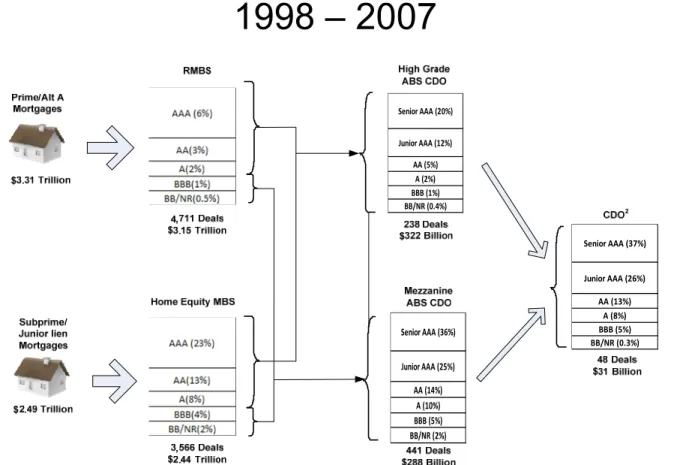
Before defining the SF ABS CDO market, we briefly describe the private-label mortgage securitization process and how CDOs were constructed. Figure 1 is a stylized visualization of the transformation of mortgage loans to mortgage-backed securities to SF ABS CDOs and, finally, to CDO2s. While this chart is represented elsewhere,8 unique to this work is the inclusion of actual figures on the size of the various submarkets from the analysis we describe below, as well as some structural features of the securities. As shown, between 1998 and 2007, a total of $3.3 trillion of mortgage loans were placed into RMBS securities (i.e., prime or Alt-A securities) and $2.5 trillion into home equity (HE) securities (i.e., mostly subprime but also some junior lien and “scratch and dent” loans), for a total of $5.8 trillion of private-label MBS issuance.9 Mortgage loans are the assets (collateral) for the RMBS and HE securities; liabilities are issued in a senior/subordinated structure. Exactly why prime and Alt-A securities are classified as RMBS while subprime securities are classified as ABS is described below.
7
We are especially indebted to Anna Katherine Barnett-Hart, who shared her data with us, allowing us to understand her sources and learn from them as we developed our own database.
8
This depiction was originally done by UBS in Goodman et al. (2008) and reprinted in Gorton (2008), but using only representative numbers for tranche sizes.
9
This figure matches almost exactly the figure of $5.66 trillion of private-label MBS issuance from 1998 to 2007 reported by Inside Mortgage Finance (2010), the unofficial keeper of U.S. ABS/MBS data. The IMF obtains its figures from independent sources. The minuscule difference is likely due to a small number of privately placed MBS.
CDOs are constructed using RMBS and HE securities as assets. CDO liabilities are also set up in a senior/sub structure. Generally, bonds with a credit rating of A or above were placed into so-called “high grade” CDOs; BBB-rated bonds were placed into “mezzanine” CDOs.10 Based on our classification described below, $342 billion of high grade and $299 billion of mezzanine CDOs were issued from 1998-2007. The final link in the chain is the CDO2s, whose underlying collateral is primarily CDO bonds. Forty-eight SF ABS CDO2s were issued totaling $31 billion. Our classification for CDO2s was done by using the simple rule that CDOs made up at least 50% of total deal collateral.11
As described, Intex contains the universe of publicly traded private-label MBS; it also contains the universe of publicly traded “144A” SF ABS CDOs issued through these markets.12 But Intex contains some $1.4 trillion of CDOs issued between 1998 and 2007, so our central challenge is to define the subset of CDOs that traded on the “ABS CDO desks” at the major investment banks and asset-management firms. This is important because these desks were where trading took place and where pricing and fair value information was generated and
exchanged. In particular, information generated at the ABS CDO desks in 2007 played a critical role in
launching the financial crisis, so we are most interested in identifying the universe of securities that traded there. First, CDOs are classified as “structured finance” in Intex if the CDOs can be “actively managed.” SF CDOs generally have a reinvestment period, usually up to five years, when collateral managers are allowed to purchase new assets or sell credit risky assets from the CDO. Mortgage-backed CDOs are allowed to be actively
managed because prepayment risk is high and CDOs can pay down quickly without replacement. In contrast, CMBS or CRE CDOs are mostly “static pools” because commercial mortgages have prepayment penalties or yield-maintenance clauses that effectively eliminate prepayment risk.13 The static pool feature of CMBS and the whole loan feature of CRE are reasons CMBS/CRE traded on the CMBS/CRE desks separately at the large investment banks. This is important because studies frequently mix CRE CDOs with SF CDOs.
Of course, since CDO structures comprise whatever dealers can sell, there are exceptions to this classification, most notably the 68 static ABS CDO pools that emerged with the growth of the synthetic market.14 We continue to define these deals as SF CDOs if they included subprime MBS, since these deals also traded on the ABS CDO desks.
A second distinction is made between corporate CDOs and ABS CDOs. It is also the case that there are separate desks where corporate CDOs, collateralized loan obligations (CLOs), and high-yield collateralized bond obligations (CBOs) were underwritten and traded. Therefore, by adding the “ABS” qualifier, we exclude from
10
This is only a stylized model because, in practice, it is the weighted average rating that determines the classification calculations we do below, so bonds with all different ratings can appear in each.
11
We needed to establish a cutoff because 628 of the 727 CDOs had at least some CDOs as collateral.
12
Rule 144A of the Securities Act of 1933 allows private companies to sell unregistered securities (the Rule 144 securities) to qualified institutional buyers (QIB) through a broker dealer. The rule also permits QIBs to trade these securities among themselves. To be a QIB, the institution must control a securities portfolio of $100 million or more. Because of the unregistered status of these securities, disclosure is often not as complete as in public securities.
13
Fabozzi (2007) argues that, because of these features, CMBS trade more like corporate bonds.
14
For the synthetics, which make up most of the static deals, investors often opted not to allow replacement, since they were made up entirely of CDSs.
our classification of SF ABS CDOs the CLO and CBO CDOs, whose underlying collateral is primarily made up of high-yield leveraged loans and corporate bonds.15
A final classification we make is to distinguish high grade and mezzanine CDOs. This classification involves using a weighting scale derived from initial rating agency ratings. As is industry practice, we define a deal with a Moody’s weighted average rating factor (WARF) of 180 or lower to be high grade; WARFs greater than 180 are classified as mezzanine.16 For deals for which WARFs are not available, we used the Fitch score.17 For deals with no Moody’s WARF or Fitch score available in Intex, we examined the underlying collateral of the CDOs using S&P ratings to determine risk classifications.
As shown in Table 1, we estimate that the universe of publicly traded SF ABS CDOs totals 727 deals with $641 billion of issuance. Of the total $641 billion of SF ABS CDO issuance, $342 billion is high grade (255 deals), and $299 billion is mezzanine (472 deals). Note that while mezzanine issuance balances are 47% of total SF ABS CDO issuance balances, mezzanine deals constitute 65% of all SF ABS CDO securities. This is the result of the very small size of BBB-rated bonds in a given RMBS relative to A-rated bonds and the lower leverage needed for mezzanine SF ABS CDOs to make the economics of a mezzanine deal work versus a high grade deal. The vintage breakouts are especially meaningful for our loss estimates, since later vintages will be especially hard hit by the mortgage crisis. Note that almost two-thirds of CDOs were issued in 2006-07. Finally, based on our ability to identify the CDSs within each CDO, we are able to compute a precise dollar amount and share of synthetic collateral in SF ABS CDOs. As shown in Table 2, $201 billion of SF ABS CDO collateral issued was in the form of synthetic credit default swaps (CDSs). Synthetics make up 31% of SF CDO collateral. Note that 93% of the synthetic CDO collateral was issued after the first half of 2005. In July 2005, the International Swap and Derivative Association (ISDA) Master Agreement for MBS was finalized, which standardized over-the-counter CDS transactions for MBS. Another development was the introduction of the ABX indexes in January 2006, which were often referenced in these CDOs and which provided much liquidity with which to execute CDSs.18
B. Why Were SF ABS CDOs Susceptible to Catastrophic Loss?
Figure 1 also contains information on the average subordination levels on the bonds in each class of securities. “Subordination” is a summary measure of how high collateral losses need to be before the bonds suffer losses. First, note that lower rated bonds have less subordination than higher rated bonds across all asset classes. Note also that AAA RMBS bonds have the lowest amount of subordination at 6%, while the AAA CDO2 bonds have the highest at 26%. Generally speaking, losses on the CDO2s need to reach 26% before the senior AAA bondholders take a loss, while losses would need to reach only 6% for
15
See also Fabozzi (2007, p. 327) for a breakout of different types of CDOs. CLO CDOs were frequently placed into the CDO2 category in Intex, since a defining feature of CLO CDOs is that they include other CLO bonds.
16
The weighted average rating factors of a CDO (WARFs) is calculated by weight-averaging the rating factor of each underlying collateral asset.
17
A Fitch score of 7 or lower is defined as high grade; a Fitch score greater than 7 is defined as mezzanine. S&P, the other major rating agency, had no comparable numerical weighting scale.
18
There are four ABX.HE indices, ABX.HE.06.1, 06.2, 07.1, and 07.2, each composed of 20 representative subprime securities issued over the previous six months. They were a key trading tool for banks and asset managers to hedge or take a position in the subprime market. See Gorton (2008).
RMBS AAA bonds to suffer losses.19 This is because RMBS is the least risky class, and CDO2s the most risky.
These summary subordination figures help explain why these CDOs were so susceptible to catastrophic loss. Note that the average subordination levels of the junior AAA-rated bonds of the mezzanine CDOs (25%) and CDO2s (26%) have comparable levels of subordination to those of the AAA HE mortgage bonds (23%).20 But mezzanine CDOs’ collateral is made up primarily of BBB-rated subprime securities, not houses. Subprime mortgage losses need to reach only 8%, the average subordination level for the A-rated bonds, before the BBB-A-rated bonds are completely written down. According to Gerardi, et al. (2008), consensus views on losses in early 2007 ranged from 3% to 5% for subprime deals. This means that losses would need to reach 5 to 8 times their expected levels before AAA-rated subprime bonds suffered their first dollar loss. Assuming bonds fail concomitantly, losses would need to reach only 1.5 to 2.5 times their expected levels before the mezzanine CDOs became completely worthless.
An even more revealing piece of evidence comes from a study by Lehman (2005), which conducted bond analysis on new subprime issuance in 2005 across different house price appreciation (HPA) scenarios. Lehman’s conclusion: “New issue BBB subordinates have downgrade risk if HPA slows to 5% by end-2005.” Their overall assessment was that “BBB subordination appears to be sized to an intermediate scenario between a 5% and 8% HPA for life.”21
What allowed the rating agencies to design CDOs in this way was an assumption of low asset correlations among the bonds in the CDOs. This assumption made more sense when the CDOs were truly multi-sector, as we will see was the case from 1998 to 2002. After 2002, when these CDOs became increasingly dominated by subprime MBS bonds, rating agencies changed their methodology to assign diversification benefits across different CDO dealers (see Moody’s 2005). But as Coval, Jurek, and Stafford (2009, p. 16) point out, “The overlap in geographic locations and within mortgage pools raised the prospect of higher-than-expected default correlations.” For example, had Citigroup issued subprime MBS made up of loans mostly in the Northeast, while Lehman’s MBS had been mostly from California, assigning
diversification benefits across issuers would make sense. But geographic diversification occurred within the subprime MBS because rating agencies gave more favorable ratings for doing so.22 Also, virtually all subprime securitizations were done shortly after origination, which meant that they were all from the same vintages.23 Thus, subprime MBS were highly correlated with each other by design. Below we will show that correlations were made even higher by placing or referencing the same bonds into many CDOs. In sum, SF ABS CDOs were susceptible to catastrophic loss after they became subprime CDOs because subordination levels were set too low for their highly correlated design. Reinforcing this, the main
19
Because of a feature called “over-collateralization,” more assets could be pledged to the deal than liabilities created, which added additional protection for bonds. This is shown in Figure 1 by more total balances of mortgage loans going into the RMBS and HE securities ($3.31T and $2.49T) than total MBS securities ($3.15T and $2.44T).
20
Median subordination levels were similar at 21% for AAA HE MBS and 23% for junior AAA mezzanine CDOs.
21
See Lehman (2005, p. 2.). Interestingly, one of the co-authors, Sihan Shu, reportedly went to work for John Paulson, the hedge fund manager that reaped billions of dollars of profits by shorting the subprime market.
22
See Ashcraft, Goldsmith-Pinkham, and Vickery (2010, p. 13).
23
underlying collateral of the CDOs, the BBB subprime bonds, were structured to unsustainable fundamentals (“5% to 8% HPA for life”) starting in at least 2005.
C. How Did SF ABS CDOs Become “Subprime CDOs”?
A critical point for understanding the subprime CDO crisis is to understand why subprime securities traded on ABS desks and came to dominate SF ABS CDOs. Historically, the typical subprime borrower “used a home equity loan to consolidate consumer debt using the current home as collateral rather than to obtain funds to purchase a new home” (Fabozzi (2007, p. 313)). For this reason, subprime securities traded on ABS desks. Conversely, prime and Alt-A loans traded through the RMBS, or “Resi,” desks. Fabozzi (2007, pp. 296-97) characterizes RMBS as “securities backed by 1- to 4-family single residential mortgages with a first lien,” mainly prime “jumbo” loans with loan balances too large to be insured by the agencies. Alt-A loans did not qualify for agency purchase because of the more limited documentation requirements, but they fit more closely into the definition of RMBS. Therefore, Wall Street jumbo and Alt-A “shelves” traded on the RMBS desks. The big Wall Street trading desks determined how Intex delivered its “deal libraries,” separately between RMBS and Home Equity, as depicted in Figure 1.
The dominance of subprime in SF ABS CDOs also had another cause: it was preferred by the rating agencies, whose views were driven by the poor performance of “multi-sector” CDOs issued during the 2000-2001 recession.This is also extremely important, since ratings are a requirement for CDO issuance, and the rating agencies’ views about the collateral mix determined how CDOs could be placed in the market. Moody’s views on “structured finance CDOs” were described by Hu (2007, p. 46) this way:
In the aftermath of the 2000-2001 economic recession, the poor performance of HY CBOs,
manufactured housing ABS, franchise loan ABS, and aircraft lease ABS led to losses in the underlying pools of many early SF CDOs….The industry realized that diversification just for diversification’s sake was not the most prudent collateral management strategy. Meanwhile, asset managers moved away from poorly performing asset types to strongly performing and traditional asset types such as RMBS, with which they were most familiar.
Of special note by Moody’s was the increased use of subprime collateral for CDO issuance, which Hu (2007, p. 47) described as the result of several factors, including wide spreads, the rise of synthetics, and the ability to “produce loan collateral on a massive basis,” which the CDO dealers willingly obliged the rating agencies. Thus, the rise of subprime CDOs was driven by a combination of the trading of subprime securities on the ABS desks, attractive yields, large issuance volumes, and rating agency practice.
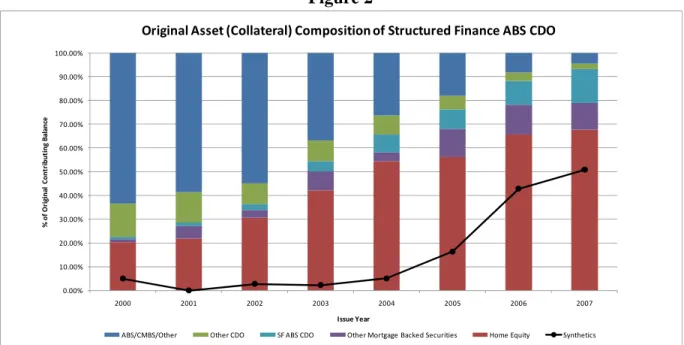
Figure 2 captures the evolution of SF ABS CDO issuance, further confirming the quality of our classification scheme. SF ABS CDOs issued in 1999 and 2000 were truly multi-sector CDOs. Mortgage-related securities accounted for only 21% of CDO issuance balances. In 2003, over half of the CDOs were made up of residential mortgages or other SF ABS CDOs. By 2006, SF ABS CDOs were effectively subprime CDOs, dominated by subprime and other SF ABS CDOs. Subprime bonds became the primary collateral because dealers could deliver subprime MBS “on a massive scale”: two-thirds of SF ABS CDOs were issued in 2006-07.
D. Where Did BBB Subprime MBS and CDO Subordinated Bonds Get Placed?
With the identification of the population of SF ABS CDOs, we can provide some of our most astounding findings, as we track the placement of subprime bonds and CDSs into CDOs, and CDO bonds into other CDOs and CDO2s. While the placement mechanism is complicated, it is traceable. Subprime bonds were directly placed into CDOs, in whole or in part; others were “referenced” in the form of CDSs, of any size, against the bonds. Likewise, CDO bonds and CDO CDSs can be traced through to other CDOs and CDO2s. We do this through each security’s CUSIP, which is listed as collateral in the CDOs in Intex.
First, we trace the placement of subprime bonds and CDSs into the CDOs. As shown in the top panel of Table 3, only 11% of HE bonds originally rated AAA issued between 1998 and 2007 were placed into CDOs, while 71% of AA-rated bonds, 78% of A-rated bonds, and 79% of BBB-rated bonds were placed or referenced in SF ABS CDOs, respectively. More important, the number of occurrences of lower-rated bonds being placed or referenced in SF ABS CDOs is far greater. More than twice as many AA- and A-rated bonds were placed or referenced in SF ABS CDOs as were issued (206% and 250%). For BBB-rated bonds issued, the 5,496 subprime bonds were placed or referenced in the 727 CDOs a total of 36,901 times!24 In Section II.B, we described why subprime MBS were so highly correlated. The manner in which subprime MBS were placed or referenced in CDOs increased these correlations further.
When we examine dollar balances, a different picture emerges. As shown in the bottom panel of Table 3, AAA-rated HE bonds by balance were only 1% of the dollar amount of AAA HE bonds issued and 16% of those placed or referenced in CDOs. Balance shares increase as the ratings go down. Note that the BBB-rated bonds had larger balances placed or referenced in CDOs than were issued (182%).25 In short, the demand for BBB-rated subprime bonds was such that $64 billion of BBB-BBB-rated subprime bonds was transformed into $140 billion of subprime CDO collateral, more than doubling their initial cash value.
In Table 4 we break out the placement of BBB subprime MBS into CDOs by MBS issuance year. Note that starting in 2002 up through the shutdown of the subprime market in late 2006, 88% - 92% of subprime BBB bonds were placed into CDOs. In fact, these figures understate the placement, since we only have figures on issuance volumes or at period end. Since SF ABS CDOs generally allow replacement of collateral over time, additional BBB bonds could have been placed into CDOs after issuance.Effectively, the CDO was the vehicle through which virtually all BBB-rated subprime bonds were placed in the market after 2001.
But if BBB-rated subprime bonds could not be sold directly into the market, how could dealers sell lower-rated CDO bonds into the market? Amazingly, the answer is that, for the most part, they did not need to sell them. They mostly recycled them into other CDOs and CDO2s. As shown in Table 5, between 58%- 74% of the BBB- to AA-rated CDO bond balances were placed into other CDOs and CDO2s. And they did not stop with the cash bonds. They even created CDSs from these CDO bonds. The Financial Crisis Inquiry Commission Report (FCIC (2011)) pointed out that the remaining lower-rated CDO bonds landed back at the dealers themselves, as they were generally unable to sell them. If this is the case, virtually
24
In practice, only a fraction of a cash MBS was placed into any one CDO, which is one reason counts are so high.
25
For example, Abacus 2007-AC1, a purely synthetic mezzanine CDO that was part of the SEC enforcement action against Goldman Sachs, was composed of 90 CDS totaling $2 billion. Each reference note was exactly one- ninetieth of $2 billion, or $22,222,222. The original cash value of the underlying BBB bonds was $1.238 billion.
none of the CDO bonds not rated AAA were sold in the market. They were recycled back into CDOs, with the aim of creating more AAA-rated CDO bonds.
You do not need to be a securities valuation expert to know why this was not going to end well. Starting in 2002, the subprime market functioned through placement of subprime BBB bonds into CDOs, and the recycling of lower-rated tranches of CDOs into other CDOs. Synthetics magnified the risks. What is more, it did not take declining house prices for these CDOs to suffer catastrophic losses. Rather, as pointed out, HPA only needed to decline to 5% before BBB subprime bonds suffered downgrade risk. In this respect mezzanine SF ABS CDOs were the fixed-income equivalent of internet stocks of the 1990s because they were structured to unsustainable fundamentals (“5% to 8% HPA for life”).
Another salient point from this rich body of evidence is that everything was public and, therefore, knowable at any time. As we’ve shown, most all securities can be traced to each other and back to their source, the subprime mortgage loans. Therefore, while CDOs are complex, their write-downs can be estimated in a rigorous way, which we do in Section IV.
III. Data and Summary Statistics A. Data
Intex warehouses an enormous amount of current and historical deal and collateral information for each of its securities, including data and program code for cash flow structures necessary to conduct a full valuation of each security. Intex provides information on the CDO deal or tranche-level static variables, including CUSIPs, original ratings, issuers, deal and tranche balances, coupons, gross margin spreads, underwriters, collateral managers, collateral type, trigger information, and other variables. All data are housed in monthly files, with updated performance information provided by trustees.
The collateral-related Intex information for SF ABS CDOs is not as readily accessible for all CDO deals as are the deal-level variables. To obtain the original collateral assets for the 727 CDOs, we applied the Intex API (application programming interface) to directly access its CMO descriptor indicator (CDI) and CMO descriptor update (CDU) files. CDI is a static file used for both the initial descriptive and cash flow information of the transaction, while CDU files contain, depending on the reporting period, the quarterly or semi-annual bond and collateral information such as payments, balances, and triggers. Historical CDU files provide snapshot information at the specified month. Given that CDOs are not consistently reported as of the deal closing date in Intex, our API needed to look through the CDI and CDU files to access the first available collateral asset information for each individual deal.
Since SF ABS CDOs are 144A deals, collateral asset information from Intex is not as consistent and uniform as for purely public deals. Of the 727 CDOs, 10 transactions have no CUSIP-level collateral information. We will use a dummy variable for deals with and without collateral asset details to test for risks in these deals. Second, categorizing the CDO collateral into the seven major asset classes (home equity, Alt-A RMBS, prime RMBS, CDO, CMBS, ABS, and other) proved to be complicated by
inconsistent reporting and missing information from trustees. We therefore supplemented Intex data with data from other sources, such as Bloomberg. We were also able to obtain some deal prospectuses from industry sources. Three Intex data elements — collateral type, deal type, and asset sub type — are used to classify collateral assets. Where necessary, issuer names are populated based on industry experience.
CDO trustees also report asset information in an inconsistent manner for synthetic CDS. Many deals list the synthetic position line item twice, one with the real CUSIP and the second with a dummy CUSIP, with actual contributing balances both referencing the same asset. Consolidating the data line items for synthetic positions presented a cumbersome, but ultimately successful, process for finalizing the data set and in reporting on synthetic balances. Finally, data flags for synthetic credit default swaps and fixed rate bonds are not populated for all of the collateral assets in the Intex data pull. We specifically reviewed the missing data flags for synthetic positions on individual deals.
B. Summary Statistics
In Table 6 we compute summary statistics for the 727 SF ABS CDO deals for the variables we use in our regression analysis. As for collateral assets, Home Equity (HE) dominates the collateral, averaging 56% of all CDO assets. Other CDOs are the next most common class at 14%, CMBS next at 9%, with Alt-A MBS next at 7%. No other asset group has more than 5%. Synthetics make up 28% of all CDO assets. The average CDO has 137 different assets with average deal size at $863 million; the largest deal was just over $5 billion at issuance. Each deal averaged 7 tranches, with a maximum of 15.
Since we will be conducting a separate analysis of the AAA bonds, we include some summary statistics used in the multivariate analysis. Average coupons on AAA bonds averaged 103 basis points (bps) on the fixed-rate bonds; floater margins average 44 bps. Bond balances average $251 million but are as high as $3.2 billion. Subordination averaged around 24% but goes as high as 87% for the “super-senior” AAAs. IV. Valuation Exercise for SF ABS CDOs
The next step in our analysis is to compute principal write-downs, both actual and expected, for the $641 billion of securities in the 727 SF ABS CDOs. In this section we detail our estimation process and summarize our findings. In subsection A, we calculate principal write-downs on all liquidated deals as of March 2011 . In subsection B, we describe our methodology for estimating expected write-downs for the non-liquidated deals and report the results. In subsection C, we sum up.
A. Losses on Liquidated SF ABS CDOs
We begin our valuation exercise by cumulating what we should already know: the principal dollar write-down of deals liquidated as of March 2011. The process for determining the principal write-write-down involves retrieving, for each reporting period, the principal received for each tranche. Principal write-downs for tranche i is defined as the original balance of tranche i less aggregated principal received by tranche i up to termination time T:
(1) , , ∑ ,
where
WD,T principal writedown of tranche i at termination T,
Balance,O balance of tranche i at origination, and PR, principal received by tranche i at time n.
To obtain principal write-downs for deal j composed of tranches 1 to m, we simply sum the principal write-downs across all tranches:
(2) , ∑ ,
where
WD,T principal writedown of deal j at termination T on m tranches.
The challenge of obtaining principal received stems from the lack of reporting of the final liquidation waterfall report by trustees. While trustees always report when a deal is active, reports are not always available for final liquidation waterfall reports. Therefore, we use Bloomberg and industry sources to obtain the information needed to do our accounting for the all-important final reporting period of
liquidation proceeds.26 We also used these sources to cross-check against each other for reasonableness to ensure we are aggregating write-downs correctly. We believe that our final tallies are the most accurate accounting possible without having all final trustee liquidation reports.
As shown in Table 7, for the 727 SF CDO deals in the database, 213 transactions totaling $208 billion have either been paid down or liquidated as of March 2011. Total deal write-downs on liquidated SF ABS CDOs total $161 billion, or 78%, of the original $208 billion of deal balances. As expected, deal write-downs increase by vintage. Write-down percentages for early vintages, 2000 to 2002, range from 5% to 9%, confirming the fact that earlier vintages of SF ABS CDOs benefited from the booming housing market and better diversification in the pools. Write-downs reached 18% by 2003 and escalated sharply thereafter, with 2006 and 2007 vintages reaching 82% and 88%, respectively.
B. Methodology for Estimating Write-Downs on Non-liquidated SF ABS CDOs
For the 514 non-liquidated deals, estimating write-downs is a bottom-up approach from the underlying collateral, involving four separate steps. The first step parallels what we did in the last subsection: take an accounting of principal received (up to time t) for each tranche and each deal (as in equations (1) and (2)). As of March 2011, $222.3 billion of active collateral balances were still reported out of an original issuance balance of $432.6 billion. Of this, $75.9 billion of principal has been received. Netting this out of $432.6 billion and subtracting the active balances leaves principal write-downs of $134.4 billion. 27 As we do with liquidated deals, we use Bloomberg and industry sources to cross-check our figures.
Step two is to estimate or, in some cases, obtain a fair value for the $222.3 billion of still-active collateral. For our valuation exercise, we apply the approach used in Goodman, et al. (2008) and assume these fair values are expected liquidation proceeds for the remaining collateral assets. Thus,
(3) , ∑ , ,
where
E LP, expected liquidation proceeds of deal j at time t, FV, fair value of collateral asset k at time t, and
26
We would like to thank Justin Pauley from RBS Global Banking & Markets for sending us RBS Global’s Structured Finance CDO Status Reports as well as a spreadsheet of pay-down information on a subset of the CDOs.
27
The calculation is $432.6B - $222.3B - $75.9B = $134.4B. Note that write-downs are not necessarily immediately recorded to the tranches (the liabilities) when the collateral (the assets) is written down. Thus, the tranches have “implied write-downs,” with losses needing to be allocated through the waterfall in the Intex software.
CBal , contributing balance of collateral asset k at time t.
Because of the large numbers of different types of assets and the ways we obtain fair values, we summarize our methods for obtaining fair values in Table 8. Of the 514 active SF ABS CDOs, 23,197 unique securities are still active or being reported. Two-thirds are residential mortgage bonds, including home equity, Alt-A RMBS, and prime RMBS. For these collateral assets, we use proprietary prepayment, default, and loss models from a third-party vendor that is a market leader in the industry. We use this third party’s vendor research to obtain appropriate “tunings” for prepayment speeds, severities, and default transitions. For discount rates, we estimate credit option-adjusted spreads (CrOASs) and add them to their index values, using a combination of market prices on the aforementioned ABX index for HE securities and the PrimeX index for prime RMBS securities.28 For Alt-A bonds, we interpolate between the two, assuming that Alt-A bond risk lies between subprime and prime RMBS.29 Thus, we obtain market-based fair values for these underlying HE and RMBS securities.
As shown in Table 8, even though mortgage assets dominate the transactions by balance, there are large numbers of other securities that need to be valued. For these, we use a combination of fair value prices from a number of pricing vendors and rating agency and vendor models. In cases where no value information is available, we use a simple ratings table to estimate fair values on the tiny amount of remaining collateral. Pricing information was obtained primarily from three sources: the Interactive Data Corporation (IDC), Gifford & Feng Associates, and Bloomberg’s Bval Service. For 710 of the securities, we obtained no information at all except for ratings and, in some cases, an asset class. For these securities, we use a combination of current rating and asset class risk categories to assign fair values, as described in the bottom table within Table 8. We apply further haircuts in the range of 5 to 10 points for more risky assets, such as franchise loan ABS. Fortunately, we needed to do this for less than 3% of total assets. Step three is to run price/yield analytics on the CDO collateral through the Intex cash-flow engine for each deal. For the active collateral, each asset contributes its liquidation proceeds to the deal, with the aggregate recovery amounts allocated in the Intex software to the various tranches of the CDOs according to the priority of principal and interest payments (i.e., the “waterfall”). The waterfall also adjusts for all structural features that can divert cash flows to more senior tranches. We use the “liquidation mode,” which results in expected prices for the CDO tranches without the need to address the discount rate issues associated with evaluating significantly illiquid and deeply distressed securities, since theoretically the liquidation occurs immediately and the resulting cash flows are allocated at time t. Thus,
(4) , , / ,
where
E P, expected price of tranche i at time t,
Waterfall priority of principal and interest payments from deal j, and
Balance, balance of tranche i at time t.
28
Similar in design to the ABX, PrimeX is an index developed from a basket of prime RMBS securities and is publicly traded, thus providing us with market prices to derive OAS and discount rates. For details, see Amherst Securities (April 27, 2010).
29
For the valuation of the CDOs that contain other SF ABS CDO bonds, we set up a two-stage process by first valuing the CDO bonds that have no SF ABS CDOs as collateral and then incorporate the pricing results from the first stage with fair values for all other assets to estimate prices for those CDOs that are partially or fully collateralized by SF ABS CDOs. For the small number of cases where the CDOs are private placements, we use external prices or, as a last resort, our ratings matrix described above.
Our fourth and final step is to calculate tranche-level expected principal write-down amounts for all active SF ABS CDOs by subtracting the historical principal received and the expected recovery values from the original balances of the tranches. Thus,
(5) , , ∑ , , ,
where
E WD, expected principal writedown of tranche i at time t.
As in equation (2), to obtain expected principal downs for deal j, we simply sum principal write-downs across all tranches:
(6) , ∑ ,
where
E WD, principal writedown of deal j at time t on m tranches.
Write-down percentages for both the tranche and the deal level are also calculated by dividing the dollar write-down amounts by the respective tranche or deal original balances. As shown in Table 9, the 514 active SF ABS CDOs as of March 2011 with original deal balance of $432.6 billion are expected to write down $257.8 billion, 60% of the original deal balance. Starting from the 2001 vintage, the estimated write-down percentages increase monotonically over the years, from 34% in 2003 to 80% by 2007, a familiar pattern from earlier tables.
C. Summing Up
As summarized in Table 10, we estimate that, all told, total principal write-downs on SF ABS CDO will reach $420 billion, 65% of the $641 billion of total issuance. Note that, as of March 2011, 71% of the write-downs have already occurred, with the remaining 29% of write-downs expected from the $222 billion of active collateral. Thus, while one can quibble with our valuation methodology, most write-downs from the SF ABS CDO market have already occurred; so our final write-down estimate will likely not be too far off the mark. These write-down estimates are astounding by any measure, more so when considering the sheer size of the SF ABS CDO market. When Goodman et al. (2008, p. 269) conducted a comparable bottom-up estimation of losses on 420 subprime-backed CDOs, they described their loss estimates as “indicative of the greatest ratings and risk management failure ever.” Their loss rates, computed in early 2008, are substantially lower than ours.30
30
For example, their expected loss rates on the senior AAA mezzanine bonds in 2006-07 averaged 43%, while our figures average over 70%.
Write-downs show a sharply escalating pattern by vintage (Table 11). Between 1999 and 2003, write-downs range from 20%-29%, comparatively low by these standards, but still substantial, showing that no vintage of SF ABS CDOs was immune from the very large write-downs experienced in the SF ABS CDO market. Write-downs in the earlier vintages reflect large losses suffered by the multi-sector CDOs during the recession of the early 2000s. Write-downs rise to 44% for the 2004 vintage and then rise
monotonically to 84% by 2007. Write-downs in the 2005-07 vintages are especially heavy; these vintages constitute 80% of issuance (see Table 2) and generate 90% of write-downs.
These expected write-down percentages, given subordination levels reported in Figure 1, mean that most bonds rated below AAA have been or are likely to be completely written off, with substantial write-downs for AAA bonds. This is confirmed in Table 12, which summarizes write-write-downs at the tranche level by original ratings. Write-down distributions reported show that no tranche is unaffected, with write-downs on the originally senior AAA tranches showing average write-write-downs of 55%. The junior AAA class shows an average write-down of 80%, 100% for the median bond. The write-downs experienced by the AAA bonds are the most damaging, since these bonds had the lowest capital charges and formed some of the collateral used to secure debt in other markets, most notably in the asset-backed commercial paper (ABCP) market (see Covitz, Liang, and Suarez (2009)). All bonds rated below AAA have average write-downs above 90%, with close to three-quarters or more facing complete write-write-downs.
V. Determinants of SF ABS CDO Losses
Now that we have estimated write-down percentages on SF ABS CDO deals and tranches, our final analysis involves examining the determinants of these write-downs. In the seminal paper by Barnett-Hart (2009, p. 34), which uses LehmanLive and a smaller proprietary sample, she laments that she did not have “a direct measure of CDO loss available.” Since we have estimated write-downs, we are able to extend her work in important ways, starting with a dependent variable that gives a direct estimate of write-downs, at both the deal and the tranche level. We have several other advantages as well. Our sample is comprehensive, much more complete than LehmanLive or other sources. Our access to Intex CDU files allows us to develop our own variables with source data. This proved especially helpful when
complexities in the deal structures, which were many, gave us opportunities to customize and standardize variables. As we show, the Intex software also includes many additional variables on the deal structures that can affect performance. Finally, we have an additional two years of performance, allowing us much more information on performance.
In subsection A, we conduct multivariate analysis on deal performance. In subsection B we examine dealer fixed effects. Finally, in subsection C we conduct analysis at the tranche level, but only on the AAA-rated bonds, since lower-rated bonds are mostly fully written down.
A. The Effects of Deal Characteristics on Deal Performance
Our modeling approach is to conduct an analysis of the variance of write-down percentages on SF ABS CDO deals using ordinary least squares (OLS). Our first set of regressions tests our model to determine which set of deal characteristics explains write-down percentages on SF ABS CDOs. Write-down percentages, a combination of actual and expected write-downs, are regressed on key characteristics of the CDOs. Our basic specification is as follows:
(7) , , , & .
Deal characteristics are broken down into four very broad categories that generate testable hypotheses. Structure refers to the structural characteristics of the deals that can affect performance; our hypothesis here is that more complex structures result in worse performance (Coval, et al. (2009)). Larger deal sizes, a larger number of assets, and a larger number of tranches can all add to increased complexity and increase write-downs. In contrast, static deals, which don’t allow replacement of assets when existing assets pay down or default, will decrease complexity and potentially reduce write-downs. Finally, not having deal triggers to protect bondholders in the event of unexpectedly high write-downs is a direct benefit to equity and lower-rated tranches, increasing risk and write-downs.
Variations in risk are also affected by the types of assets in the deals, discussed in Section II.C. Many studies have found that higher shares of nontraditional lending, packaged into home equity and Alt-A securities, should result in much poorer performance (Mayer, Pence, and Sherlund (2008); Mian and Sufi (2008); Demyanyk and Van Hemert ( 2011); and others). Likewise, higher concentrations of CDOs will result in worse performance, since CDOs are made up predominantly of nontraditional mortgage
collateral, particularly in later vintages. Other asset classes that performed better during the crisis should positively affect performance; these include prime mortgage securities, CMBS, and ABS. Of course, this is hard to ascertain ex ante, since performance of the underlying securities depends on the risk of the assets chosen and structural features of the underlying securities themselves. If the strategy was to pick higher margin (i.e., riskier) securities, these nonmortgage asset classes might not decrease risk at all. Risk characteristics measure the effects of the overall structure itself on deal performance. Thus, ceteris paribus, mezzanine SF ABS CDOs, since they are made up of BBB-rated securities, should perform worse than their high-grade counterparts. Likewise, purely synthetic and hybrid SF ABS CDOs should perform worse than purely cash CDOs, given the ability to quickly manufacture CDOs with synthetic collateral. The 48 CDO2s should perform worse still, since they are made up primarily of subordinated bonds of SF ABS CDOs, particularly in later years, as shown in Figure 2. The weighted average rating factor (WARF) determines the classifications for mezzanine and high-grade CDOs; thus, higher WARFs should lead to higher write-downs.
Finally, vintage effects and controls will also affect performance. There is ample research to document the decline in underwriting standards that fueled the housing boom and the extraordinary expansion of lending. In addition, house prices peaked in 2005 and started declining in 2006. These combinations of effects suggest that more recent vintages will perform much worse than earlier vintages (Goodman, et al. (2008)). Liquidated deals should also perform worse, since, as mentioned above, the worst-performing deals are often liquidated first. Ten of the deals provided no asset information whatsoever, which could be a sign of higher risk.
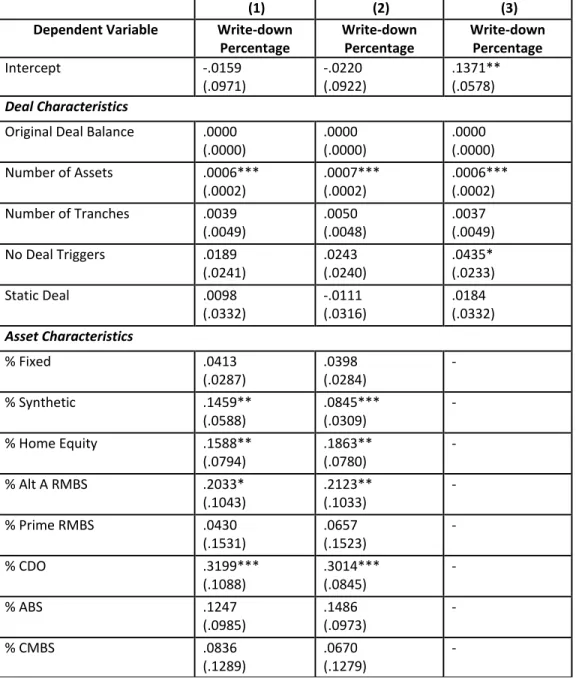
Overall, the regression results reported in Table 13 show that all the major risk dimensions discussed above have a significant effect on CDO write-down percentages, explaining 57% to 59% of variation in write-downs. We show three specifications of the model. The first regression includes all characteristics
and controls, our full model. Since asset and deal risk characteristics are so collinear, our second and third regressions treat each category separately along with the other effects.
As shown in Table 13, for the full model (1), all major groupings contributed significantly to explaining variation in write-down percentages. For the deal characteristics, results show that having more assets in the deal significantly increases write-down percentages, consistent with the hypothesis that more assets result in more complex deal structures, thereby increasing write-down percentages.
For the asset characteristics, several groupings contributed significantly to risk, with no major grouping decreasing risk. The share of synthetic collateral has a coefficient of 0.15. The way to interpret this coefficient is that a $1 increase in synthetic collateral increases write-downs by 15 cents. Home equity securities increase write-down percentages by 16%, Alt-A RMBS increase write-down percentages by 20%, and CDO collateral increases write-down percentages by 32%. The other asset categories have positive coefficients but were not significant. Still, it is important that none of these categories decreased write-downs, suggesting that riskier securities were placed into CDOs across the board. (We will further confirm this below.) Interestingly, the coefficient on Alt-A collateral was larger than that on home equity, which we interpret as consistent with higher unexpected write-downs in Alt-A securities, as evidenced by much lower subordination levels in Alt-A bonds relative to subprime (see Figure 1). This may also explain why prime RMBS did not decrease the risk of the SF ABS CDOs, since prime RMBS bonds had even lower subordination than Alt-A RMBS or home equity. Not surprisingly, CDO collateral had the largest coefficient of all (32%), since these subordinated bonds, dominated by SF ABS CDOs, are expected to be fully written off (Table 12).
The last two categories in Model (1) of Table 13, deal risk characteristics and controls, are all mostly dummy variables; so they have a different interpretation. For these coefficients, they represent the variation in risk relative to an omitted category. For the deal risk characteristics, only the flag on pure synthetic collateral was weakly significant, and negative, relative to cash CDOs. These variables are mostly collinear with the asset characteristics, which may be why they are not particularly important in Model (1).
For the controls category, the issue year dummy variables are positive and significant starting in 2004 (relative to the 1999-2000 cohorts) and increase in significance in a monotonic way up to the shutdown of the SF ABS CDO market in 2007. Relative to issue years 1999 and 2000, issue years 2001-2003 were negative and insignificant; no doubt these vintages benefited from the greater diversification of the pools (from Figure 2) as well as favorable market conditions in housing. Starting with 2004, collateral was 13% riskier than in the 1999-2000 cohort, increasing monotonically to 47% by 2007. Clearly, the huge rise in SF ABS CDO issuance combined with increasing concentrations of mortgage securities, with so much coming at the peak of the housing market in 2005 and thereafter, was a major determinant of write-downs in these CDOs. Also significant was the risk on the 10 deals that reported no asset information, which meant, in effect, that investors were likely relying entirely on ratings. Losses on liquidated deals are higher but not significant after controlling for other effects.
Since the asset and deal risk characteristics are so collinear, in Table 13 we report results of treating each category separately in Models (2) and (3). The effect of omitting the deal risk characteristics in Model (2)
has the effect of increasing the coefficients on home equity and Alt-A collateral but decreasing the coefficients on the synthetic and CDO collateral. Omitting the asset characteristics in Model (3) has the effect of increasing the effects of deal risk characteristics, since the hybrid and CDO2 flags are significant and positive. Omitting assets also makes the intercept term significant, suggesting a large fixed effect from not considering the composition of the assets.
B. Examining Dealer31 Fixed Effects
Perhaps the most important participant in the CDO structure is the dealer, responsible for underwriting, marketing, and issuing the deals. To analyze the link between CDO performance and dealers, we add dealer fixed effects to our full model (Model 1) estimated in subsection V.A. These regressions examine whether the identities of the dealers are significant predictors of performance, after controlling for CDO characteristics. The dealers identified match those in Barnett-Hart (2009).
There are two competing hypotheses on dealer effects that we can test with our model here. One hypothesis is that the dealers most actively short selling the mortgage market, notably Goldman Sachs and Deutsche Bank,32 would experience the highest principal write-downs, since they had the most to gain from poor performance of the mortgage market and would be inclined to push out worse deals.
Alternatively, the second hypothesis is that the worst-performing deals would be made by firms that had substantial positions themselves in SF ABS CDOs, since they would be the ones most likely to deal up to the point at which the market crashed (see Lewis (2010)). So the strategy is to add dealer fixed effects into the full model for the 17 largest dealers and then rank the coefficients from least to greatest relative to the omitted category (which is the collection of smaller dealers).33
Results in Table 14 show evidence of a significant dealer effect on CDO performance and provides the strongest support for the second hypothesis. When the dummy variables for the 17 largest dealers are included, the adjusted R2 for Model (1) increases by more than 1%, to 58.5%. The coefficients are significant for the three worst performers. The worst performer, Morgan Stanley, had loss rates that, after controlling for deal effects, were 8.4% higher on average than the collection of smaller dealers. What is most interesting about these results is that the four worst performers, Morgan Stanley, Citigroup, Bear Stearns, and UBS, all took substantial write-downs on SF ABS CDOs, often from holding the senior-most tranches of the CDOs they underwrote.34 Heavy write-downs in CDOs were in and of themselves not a conclusive factor, however, since Merrill was only the ninth worst and otherwise not significantly worse than the omitted group of smaller dealers.35
31
In Barnett-Hart (2009) and other sources, dealers are referred to as underwriters. In practice, the terms are used interchangeably. Our preference for “dealer” avoids confusion with underwriters of mortgage loans.
32
The shorting of the subprime mortgage market was the basis for the SEC lawsuit against Goldman Sachs. Lewis (2010) reports that Greg Lippman, of Deutsche Bank, was actively shorting the subprime market as early as 2006.
33
We conducted an F test to test the null hypothesis that the dealer fixed effects were all equal to zero. Our F statistic (F=2.27, p=0.0025) shows that the null hypothesis can be rejected.
34
According to Creditflux (2009), Morgan Stanley, Citigroup, Bear Stearns, and UBS took, respectively, $7.8 billion, $34.1 billion, $2.3 billion, and $21.8 billion of write-downs on “ABS of CDOs” during the crisis.
35
Barnett-Hart (2009) came to the same conclusion after she replaced CDO reported losses with the firm fixed effects in her regressions.
C. The Determinants of Performance of AAA-Rated SF ABS CDO Bonds
Our final set of regressions examines the performance of SF ABS CDO tranches, in particular, the AAA-rated securities, including both the junior and senior AAA-AAA-rated securities. Initially, we had intended to conduct a multivariate analysis on all the rated bonds until we saw that virtually all bonds rated below AAA have been or are expected to be fully written down (see Table 12). As a result, our analysis in this section is limited to the AAA-rated tranches, where a much larger share has at least some variation. The major reason to consider this analysis separately is that this allows us to examine more characteristics of the structures and, very importantly, the performance of the rating agencies that rated the bonds.36 So our strategy is to add rating agency fixed effects and tranche-level characteristics to the variables of the full model that apply to our multivariate analysis on AAA bonds. All told, 1,840 bonds were either rated AAA, or we could infer an AAA rating from the deal structure.37
Our expanded regression, presented in Table 15, shows that the additional tranche features contribute significantly to the variation in write-downs but that relative rating agency effects generally do not. For the rating agency variables, we assigned a dummy variable for each grouping of the three rating agencies. For these rating agency fixed effects, performance in variation is relative to the omitted group, which is the group of 364 AAA bonds rated by all three rating agencies. By far the largest grouping is from the AAA bonds rated by Moody’s and S&P, which together rated 1,306 AAA bonds, 71% of the total. For these bonds the coefficient is small and positive but insignificant. The 21 bonds rated by Moody’s and Fitch showed a large positive and significant coefficient, and the 23 bonds rated by S&P alone shows a large and significant negative coefficient. But the small number of bonds associated with these groupings could easily be the result of idiosyncratic factors. The most important finding is that the three biggest groups (ratings by all three rating agencies, Moody’s, S&P, and Fitch), which account for 94% of the rated AAA bonds, are not significantly different from each other. This result is consistent with the hypothesis that rating agency models were not much different from each other.38 In short, a consensus formed around valuations at the rating agencies. The 46 securities not rated by any of the rating agencies had a negative coefficient but was not significant, suggesting that AAA securities not rated by the three major rating agencies performed no better.
Several of the tranche characteristics are significant and quite important economically. Most important, a higher margin on the floating rate securities has a very large coefficient and is highly significant. Even after controlling for deal, asset, and tranche effects, higher discount margins translate into significantly greater risks, with a coefficient of 0.16. Since 1,613 of the securities (88%) are floating rate, this effect is material. Higher margins are generated by placing higher yielding, and riskier, securities into the deals. This was a primary reason for the placement of large amounts of BBB-rated subprime securities into the CDOs and may well have been a motive for adding in riskier BBB-rated bonds as well as riskier securities
36
Rating agencies do not rate the securities trusts, generally only the fixed-income parts of the deal, the bonds. In our 727 CDOs, 705 of the securities are not rated, mainly because they are equity tranches.
37
There were 123 bonds that were not rated, but which were senior in structure to the AAA-rated bonds. Since rating agencies do not assign a rating above AAA, we inferred the AAA ratings and assigned them to the appropriate rating agency rather than exclude these observations from the analysis.
38
According to the IOSCO Technical Committee (2008, p. 24), a Code of Conduct published by IOSCO in 2004 made disclosures about rating methodologies transparent enough so that dealers could easily anticipate the level of credit enhancement necessary to obtain a desired rating. The SEC (2008) also pointed out that rating agencies often used their own ratings on securities in the CDOs, further increasing uniformity.
in other asset classes, judging by the positive coefficients on write-downs for all major asset classes in the regression. The subordination-level coefficient is also large at -0.20 and also highly significant. Higher levels of subordination translated into smaller write-downs. Likewise, the flag for senior AAA bonds is large at -0.21 and is highly significant. Interestingly, the super senior flag, which represented 123 securities senior to even the AAA-rated bonds, was significant and positive.39
As for the other effects, there are some very interesting differences with the deal-level model. For the asset characteristics, only the share of synthetics in the securities and share of CDOs significantly
increased risk. As shown in Figure 2, rising shares of synthetic and CDO collateral came very late in 2006 and 2007 and were likely subject to more measurement error. They also had a much stronger negative effect on the senior-most bonds. The purely synthetic flag was negative and significant, suggesting that the knowledge that a deal was purely synthetic was better factored into protection for the AAA
bondholders than knowledge about the specific share of synthetic collateral in a deal.
Vintage effects were the biggest single factor explaining the variation in write-downs on the deals; they are even more so for explaining the variation in AAA bond performance. Vintage effects are significant and positive starting in 2003 in the tranche-level model (as opposed to 2004 in the deal-level regression), and the coefficient values are much higher in every single year. Clearly, the increasing concentrations of mortgage assets in the CDOs, the increasing risks of the securities being placed in the CDOs, and the increasing use of synthetic collateral in more recent years all increased risks for the senior-most
bondholders. Since these were mostly controlled for in the regressions, the vintage effects may have been picking up the economic effects on deal performance, as evidenced by house prices peaking in 2005. VI. Summary and Conclusions
Before our study, most of what we knew about the size and composition of the “structured finance CDO market” came from qualitative accounts (Gorton 2008); anecdotes in books from the popular press (e.g., Lewis (2010), McLean and Nocera (2010)); or the rating agencies, whose figures contain only the CDOs they rated and which are not classified in a systematic way.40 Information on write-downs was even more difficult to come by, primarily because what information we have received has come from rating agencies or investment banks, neither of which is interested in conducting studies on markets that have completely shut down. That is why the forensic work and analysis we conduct in this paper are so important. We believe that the 727 securities totaling $641 billion of issuance that we identify represent the population of securities that traded publicly on the ABS CDO trading desks of the largest financial firms active in the market. After identifying the securities, we then examine the linkages of SF ABS CDOs to subprime securities and document the enormous extent of the referencing of these securities in SF ABS CDOs and the multiplication of risks created by the $201 billion of synthetic collateral (see Table 2). While many have speculated on these linkages, we document that some 5,500 of BBB-rated subprime securities were placed or referenced into these CDOs some 37,000 times, transforming $64 billion of BBB subprime bonds into $140 billion of CDO assets (Table 3). We are also able to document that few of the lower rated
39
For these bonds, they were technically unrated. Since they are senior to all the AAA-rated bonds, we inferred the raters in these cases by matching the raters on the AAA bonds just below them in the structure.
40
The FCIC (2011) used data from Moody’s, since it couldn’t get figures from independent sources. The FCIC’s total figures were around 10% higher than ours, likely for definitional reasons.
tranches of the CDOs were ever sold but were recycled into other CDOs to create more AAA CDO bonds. Not surprisingly, this led to catastrophic loss. We believe our expected write-down figure of $420 billion is close to the tally of ultimate write-downs that will occur, if only because over 70% of these write-downs have already been realized (Table 10). Finally, we conduct an analysis of variance on the determinants of write-downs in the SF ABS CDO market, which we elaborate on below. Overall, we provide strong support for the conclusion in Goodman, et al. (2008, p. 269) that the SF ABS CDO market meltdown is “indicative of the greatest rating agency and risk management failure ever.”
What is not fully appreciated is just how susceptible SF ABS CDOs were to catastrophic loss after they became subprime CDOs. CDO dealers and rating agencies created structures that gave AAA bondholders of mezzanine CDOs levels of subordination comparable to those provided the AAA mortgage bonds. The low correlation assumption among subprime bonds that justified these CDO subordination levels was flawed because diversification was taking place within the subprime MBS (Coval, Jurek and Stafford (2009)). The enormous amount of cross-referencing of BBB subprime and CDO bonds among the SF ABS CDOs undoubtedly exacerbated this problem. As we describe in Section II, subprime mortgage losses needed to reach only 1.5 to 2.5 times the consensus view on expected losses before the mezzanine CDOs would be nearly or completely written down.41 What is more, house prices did not need to decline before these CDOs could experience write-downs. According to Lehman (2005), HPA only needed to decline to 5% before BBB subprime bonds—and the CDOs—suffered downgrade risk. In this sense, SF ABS CDOs were the fixed income equivalent of internet stocks of the 1990s, since their collateral was structured to unsustainable fundamentals (“5% to 8% HPA for life”).
Our multivariate analysis of the determinants of the losses confirms that firms were choosing securities to place into SF ABS CDOs primarily for yield. It is an important find that none of the different asset categories in these CDOs lowered risk, suggesting that riskier securities were placed into CDOs across all major asset classes (Table 13). When examining the performance of AAA-rated bonds, higher discount margins were a major determinant of losses (Table 15).
As for the dealers at the center of SF ABS CDO issuance, our results support the hypothesis that most were not fully aware of the risks in the CDOs, since the dealers that underwrote the worst-performing CDOs (Morgan Stanley, Citicorp, Bear Stearns, and UBS) all suffered large and debilitating losses from the “super-senior” AAA bonds of the CDOs they underwrote and held (see FCIC (2011) and Lewis (2010) for a list of firms that held CDO risk). Goldman Sachs and Deutsche Bank, which we later learned were selling off their risk and shorting the subprime mortgage market, were 7th and 11th in terms of rank and not statistically different in terms of write-downs from the small issuers. This makes sense given the size of the market. To absorb $641 billion in SF ABS CDOs required the participation of the largest players in the financial system.
41
The IOSCO Technical Committee’s report (2008, pp. 3-4) points out that “some observers argue that many of these [AAA] “low risk” tranches…are only “low risk” insofar as no systemic shock or other widespread adverse event has an effect on all assets of a given type that comprise the underlying cash flow for a CDO.” Our point is that it did not take a systemic shock to severely impair or completely wipe out the value of these AAA CDO bonds. Rather, it only took only slightly higher than expected losses.