Consulting and Technical Services (CATS)
Task Order Request for Proposals (TORFP)
DLLR MIDAS MIGRATION
CATS TORFP PROJECT P00P6202921
Department of Labor, Licensing & Regulation (DLLR)
CONTENTS
SECTION 1 ADMINISTRATIVE INFORMATION...6
1.1 RESPONSIBILITY FOR TORFP AND TO AGREEMENT ...6
1.2 TO AGREEMENT ...6
1.3 TO PROPOSAL SUBMISSIONS ...6
1.4 MINORITY BUSINESS ENTERPRISE (MBE) ...6
1.5 EMARYLANDMARKETPLACE FEE ...6
1.6 CONFLICT OF INTEREST...7
1.7 NON-DISCLOSURE AGREEMENT ...7
1.8 QUESTIONS AND INQUIRIES ...7
SECTION 2 SCOPE OF WORK ...8
2.1 PURPOSE, REQUESTING AGENCY BACKGROUND AND PROJECT BACKGROUND ...8
2.2 TECHNICAL REQUIREMENTS ...11
2.3 TO CONTRACTOR STAFF EXPERTISE REQUIRED...23
2.4 TO CONTRACTOR STAFF MINIMUM QUALIFICATIONS ...23
2.5 INVOICING ...26
2.6 REPORTING...28
2.7 MBE ...29
2.8 CHANGE ORDERS...29
2.9 SECURITY AND CONFIDENTIALITY ...29
2.10 SOFTWARE SOURCE CODE AND DOCUMENTATION ...30
SECTION 3 TO PROPOSAL FORMAT AND SUBMISSION REQUIREMENTS ...32
3.1 REQUIRED RESPONSE ...32
3.2 FORMAT ...32
SECTION 4 PROCEDURE FOR AWARDING A TO AGREEMENT...37
4.1 EVALUATION CRITERIA...37
4.2 TECHNICAL CRITERIA ...37
4.3 SELECTION PROCEURES ...37
4.4 COMMENCEMENT OF WORK UNDER A TO AGREEMENT ...37
ATTACHMENT 1 – PRICE PROPOSAL ...38
ATTACHMENT 2 – MBE FORMS...41
ATTACHMENT 3 – TASK ORDER AGREEMENT...50
ATTACHMENT 4 – CONFLICT OF INTEREST AFFIDAVIT AND DISCLOSURE...53
ATTACHMENT 5 – LABOR CLASSIFICATION PERSONNEL RESUME SUMMARY...54
ATTACHMENT 6 – DIRECTIONS...56
ATTACHMENT 7 – NOTICE TO PROCEED ...57
ATTACHMENT 7 – NOTICE TO PROCEED ...57
ATTACHMENT 8 – AGENCY RECEIPT OF DELIVERABLE FORM ...58
ATTACHMENT 9 – AGENCY ACCEPTANCE OF DELIVERABLE FORM ...59
ATTACHMENT 10 – NON-DISCLOSURE AGREEMENT (OFFEROR)... 60
ATTACHMENT 11 – NON-DISCLOSURE AGREEMENT (TO CONTRACTOR)...61
ATTACHMENT 13 – MIDAS II FORMS PROCESSING ...123
ATTACHMENT 14 – CONTRIBUTION REPORT SAMPLE ...134
ATTACHMENT 15 – CONTRIBUTION EMPLOYMENT REPORT SAMPLE...135
ATTACHMENT 16 – W-4 SAMPLE ...136
KEY INFORMATION SUMMARY SHEET
This Consulting and Technical Services (CATS) Task Order Request for Proposals (TORFP) is issued to obtain the services necessary to satisfy the requirements defined in Section 2 Scope of Work. All CATS TO Contractors approved to perform work in the functional area under which this TORFP is released are invited to submit a Task Order (TO) Proposal to this TORFP. Those TO Contractors deciding not to submit a TO Proposal are required to submit the reason(s) why per Section 3.1 of the TORFP. In addition to the requirements of this TORFP, the TO Contractors are subject to all terms and conditions contained in the CATS RFP issued by the Maryland Department of Budget and Management (DBM), Office of Information Technology (OIT) and subsequent TO Contract Project Number 050R5800338, including any amendments.
TORFP Title: DLLR MIDAS Migration
Functional Area:
FA3, Electronic Document Management TORFP Issue Date: 05/30/2006
Closing Date and Time: July 7, 2006 at 2:00 PM
TORFP Issuing Agency: Department of Labor, Licensing and Regulation
Send Questions and Proposals to: Patricia Tarpley
Office Phone: (410) 230-6024 Fax: (410) 333-3384
Email address: [email protected]
TO Procurement Officer:
Patricia Tarpley
Office Phone: (410) 230-6024
Fax: (410) 333-3384 Email address:
TO Manager:
Dennis Morton
Office Phone: (410) 767-2488
Email address: [email protected]
TO Project Number: P00P6202921
TO Type: Fixed price and Time and Materials Period of Performance: 2 years with 1, 1 year renewal option. MBE Goal: 25 percent
Small Business Reserve (SBR): No
Primary Place of Performance: Department of Labor, Licensing and Regulation, 1100 N. Eutaw Street, Baltimore, MD 21201
TO Pre-proposal Conference: Department of Labor, Licensing and Regulation, 1100 N. Eutaw Street, Basement Conference Room, Baltimore, MD 21201
06/14/2006 at 10:00 AM; See Attachment 6 for directions. Note: Following the Pre-Proposal Conference, a walk-thru with demonstration of the current system will be provided. *Use full agency acronym, division/modal, office, program as appropriate.
_____________________________________________________________________________________ _____________________________________________________________________________________
NOTICE TO MASTER CONTRACTORS
All CATS TO Contractors approved to perform work in the functional area under which this TORFP is released are invited to submit a Task Order (TO) Proposal to this TORFP. Those TO Contractors deciding not to submit a TO Proposal are required to submit the reason(s) why per Section 3.1 of the TORFP. If you have chosen not to propose to this TORFP, you must complete and email this notice to TO Procurement Officer If you are submitting a TO Proposal, we also ask that you take a few minutes and provide comments and suggestions regarding the enclosed TORFP.
TORFP Title: DLLR MIDAS Migration TORFP Project Number: P00P6202921
1. If you have responded with a "not submitting Task Order Proposal", please indicate the reason(s) below: ( ) Other commitments preclude our participation at this time.
( ) The subject of the TORFP is not something we ordinarily provide. ( ) We are inexperienced in the services required.
( ) Specifications are unclear, too restrictive, etc. (Explain in REMARKS section.) ( ) The scope of work is beyond our present capacity.
( ) Doing business with the State of Maryland is too complicated. (Explain in REMARKS section.) ( ) We cannot be competitive. (Explain in REMARKS section.)
( ) Time allotted for completion of a Task Order Proposal is insufficient. ( ) Start-up time is insufficient.
( ) Bonding/Insurance requirements are too restrictive. (Explain in REMARKS section.) ( ) TORFP requirements (other than specifications) are unreasonable or too risky.
(Explain in REMARKS section.)
( ) MBE requirements. (Explain in REMARKS section.)
( ) Prior State of Maryland contract experience was unprofitable or otherwise unsatisfactory. (Explain in REMARKS section.)
( ) Payment schedule too slow.
( ) Other:__________________________________________________________________.
2. If you have submitted a Task Order Proposal, but wish to offer suggestions or express concerns, please use the Remarks section below.
Remarks:
TO Contractor
Name:______________________________Date:_____________________________________________ Contact Person:__________________ Phone ___- ___ - ____Email____________________________
SECTION 1
ADMINISTRATIVE INFORMATION
1.1 RESPONSIBILITY FOR TORFP AND TO AGREEMENT
The TO Procurement Officer has the primary responsibility for the management of the TORFP process, for the resolution of TO Agreement scope issues, and for authorizing any changes to the TO Agreement. See Section 2.9 for information on change orders.
The TO Manager has the primary responsibility for the management of the work performed under the TO Agreement; administration functions, including issuing written directions; ensuring compliance with the terms and conditions of the CATS TO Contract; and, in conjunction with the selected TO Contractor, achieving on budget/on time/on target (e.g., within scope) completion of the Scope of Work.
1.2 TO AGREEMENT
Based upon an evaluation of TO Proposal responses, a TO Contractor will be selected to conduct the work defined in Section 2 Scope of Work. A specific TO Agreement, Attachment 3, will then be entered into between the State and the selected TO Contractor, which will bind the selected TO Contractor (TO Contractor) to the contents of its TO Proposal, including the price proposal.
1.3 TO PROPOSAL SUBMISSIONS
The TO Procurement Officer will not accept submissions after the stated date and exact time. The time will be local time as determined by the DLLR email system time stamp. The TO Proposal is to be submitted via e-mail to [email protected] as two attachments in MS Word protect for No Change (read only) format. The “subject” line in the e-mail submission shall state the TORFP # P00P6202921.
• The first file will be the TO Proposal technical response to this CATS TORFP and titled, “CATS TORFP # P00P6202921 - Technical”
• The second file will be the financial response to this CATS TORFP and titled, “CATS TORFP # P00P6202921 – Financial.
• Note: The proposal documents that must be submitted with a signature, Attachment 2 - MBE Forms D-1 and D-2, Attachment 3 – Task Order Agreement and Attachment 4 - Conflict of Interest and Disclosure Affidavit, must be submitted as Adobe PDF files with signatures clearly visible.
1.4 MINORITY BUSINESS ENTERPRISE (MBE)
A TO Contractor that responds to this TORFP shall complete, sign, and submit all required MBE documentation (Attachment 2 - Forms D-1 and D-2) at the time it submits its TO Proposal. Failure of the TO Contractor to complete, sign, and submit all required MBE documentation at the time it submits its TO Proposal will result in the State’s rejection of the TO Contractor’s TO Proposal.
1.5 eMARYLANDMARKETPLACE FEE
COMAR 21.02.03.06 requires that each TO Contractor that wins a TO Agreement under this TORFP pay a fee to support the operation of eMarylandMarketplace. The fee will be due on each TO
Agreement that exceeds $25,000. The applicable fee will be based on TO value, including any options. Contractors shall pay the fee as provided by COMAR 21.02.03.06 and in accordance with guidelines issued by the Maryland Department of General Services. A copy of COMAR 21.02.03.06 and the guidelines issued by the Maryland Department of General Services can be found on the eMarylandMarketplace website at www.eMarylandMarketplace.com.
The rate(s) or price(s) of the proposal/bid shall include the appropriate fee as per the COMAR 21.02.06.03 fee schedule. Fees may not be quoted as a separate add-on price. A total TO Agreement value that is other than an even dollar amount will be rounded to the nearest whole dollar to determine the appropriate fee level. For example, a total TO Agreement value of $50,000.49 will be rounded to $50,000 and a Level 1 fee will apply. A total TO Agreement value of $50,000.50 will be rounded to $50,001 and a Level 2 fee will apply.
1.6 CONFLICT OF INTEREST
The TO Contractor awarded the TO Agreement shall provide IT technical and/or consulting services for State agencies or component programs with those agencies, and must do so impartially and without any conflicts of interest. Each TO Contractor shall complete and include a Conflict of Interest
Affidavit in the form included as Attachment 4 this TORFP with its TO Proposal. If the TO
Procurement Officer makes a determination that facts or circumstances exist that give rise to or could in the future give rise to a conflict of interest within the meaning of COMAR 21.05.08.08A, the TO Procurement Officer may reject a TO Contractor’s TO Proposal under COMAR 21.06.02.03B. TO Contractors should be aware that the State Ethics Law, State Government Article, §15-508, might limit the selected TO Contractor's ability to participate in future related procurements, depending upon specific circumstances.
1.7 NON-DISCLOSURE AGREEMENT
Certain system documentation may be available for potential Offerors to review at a reading room at the Department of Labor, Licensing and Regulation, 1100 N. Eutaw, Baltimore, MD 21201. Offerors who review such documentation will be required to sign a Non-Disclosure Agreement (Offeror) in the form of Attachment 10. Please contact the TO Procurement Officer of this TORFP to schedule an appointment.
In addition, certain documentation may be required by the TO Contractor awarded the TO Agreement in order to fulfill the requirements of the TO Agreement. The TO Contractor, employees and agents who review such documents will be required to sign a Non-Disclosure Agreement (TO Contractor) in the form of Attachment 11.
1.8 QUESTIONS AND INQUIRIES
Questions and inquiries, both verbal and written, should be submitted in a timely manner to the TO Procurement Officer. In the case of questions not received in a timely manner, the TO Procurement Officer shall, based on the availability of time to research and communicate an answer, decide whether an answer can be given before the proposal due date. Answers to all substantive questions that have not previously been answered, will be distributed to all vendors who are known to have received the TORFP.
SECTION 2
SCOPE OF WORK
2.1 PURPOSE, REQUESTING AGENCY BACKGROUND AND PROJECT
BACKGROUND
2.1.1 PURPOSE
A) The Department of Labor, Licensing & Regulation (DLLR) is issuing this CATS TORFP to invite prospective Task Order (TO) Contractors to submit a proposal providing Optical Character Recognition (OCR) and document management system integration services, migrating existing OCR images and document management functionality and upgrading the Oracle database.
B) The TO Contractor shall migrate the current imaging and document management system to a new or upgraded platform. The system is known as MIDAS (Managed Image and Data Access System) and is administered by the Contributions Division (Tax) within the DLLR, Division of Unemployment Insurance (DUI). The TORFP also requests database
administration of its current MIDAS imaging system until the successful implementation of the new MIDAS system. In addition, the TORFP also requests proposals to integrate certain Visual Objects (VO) application programs into the new MIDAS system here after referred to as “MIDAS II”.
C) Services are to include but not be limited to: Project Planning, providing of proposed hardware and software for a turn key system, setup and installation, software development and implementation to include all project management and team transition efforts, affirming design, development and test, integration and test, training, end-to-end performance testing, system implementation, documentation, warranty, and maintenance. Maintenance is to include capability for ongoing optimum maintenance of the system and activities as well as State approved enhancements. Towards the end of the contract, the TO Contractor shall also support end-of-contract transition efforts back to the State or State's agent.
2.1.2 DLLR BACKGROUND
The DUI is a division of DLLR. Its mission is to provide temporary benefits to eligible individuals who are out of work through no fault of their own, and to collect the
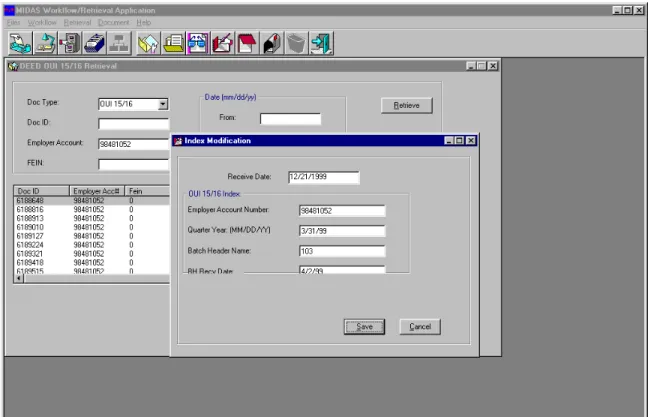
unemployment insurance tax from employers for the payment of unemployment insurance benefits. The MIDAS imaging and document management system scans and performs OCR on the employer UI tax returns and archives and indexes DUI Tax employer correspondence.
2.1.3 PROJECT BACKGROUND
A) System Background
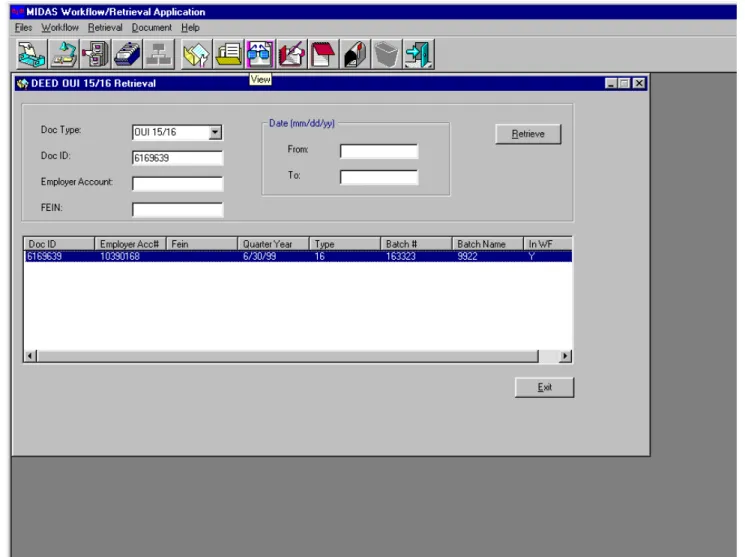
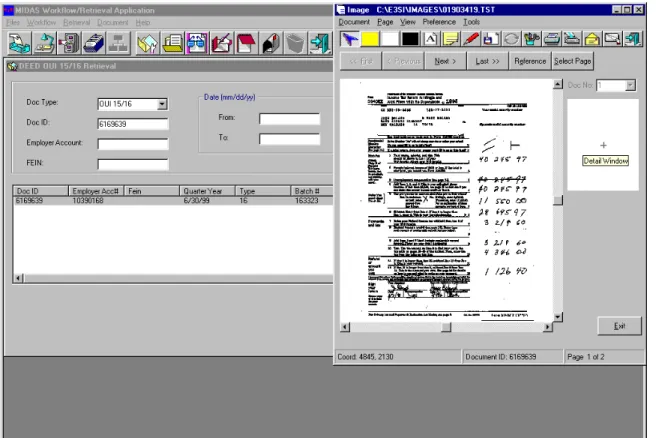
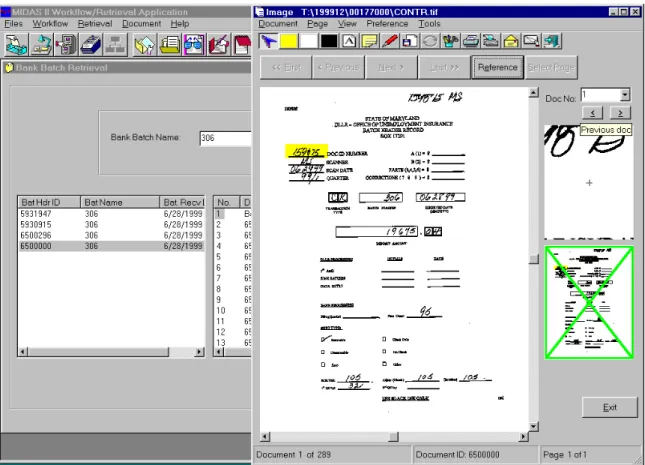
The DUI Tax has had a document management OCR system since October 1995. MIDAS is used to image and OCR the quarterly unemployment insurance contribution and employment reports (form OUI 15 / 16) for the 136,000 employers in the State of Maryland. MIDAS also scans and archives correspondence for DUI Tax. Since October 1995, over 18 million images have been scanned, indexed and stored by MIDAS. The DUI Tax has over 220 users
networked to the MIDAS system. It is a mission critical system. Users of the system are primarily located on the fourth floor of 1100 North Eutaw Street. Please refer to Attachment
12 (Overview of MIDAS II) for to a planned overview of anticipated MIDAS II and Attachment 13 (MIDAS II Forms Processing) for a description of MIDAS II forms processing.
B) Current System Architecture
The configuration and processes of MIDAS described below have been in production since January 2000. This description demonstrates the existing characteristics of the current imaging and OCR system.
1) Database - The system uses an Oracle database on a Sun Solaris Enterprise 3500 server. The database uses Oracle 8.i & UNIX. The database is accessed by locally developed client-server applications using industry standard ODBC connections. There are over 18 million records in the database MIDASDB, and nearly that many in the database TAXDB. A description of the various tables and their layouts will be available for review in the DLLR Reading Room.
2) Scan Stations: There are four (4) Kodak 5500 duplex scanners that scan documents into MIDAS. The scan stations use Windows 95 PCs that are connected to the servers on a fiber optic network connection. The scanning software is InputAccel, version 2.2.10. 3) Optical Storage: HP 660 EX Jukebox, with over 100 5.2 GB Platters in use.
4) Server TAXIA: Image Server (Hewlett Packard NetServer LH 4r). The server provides the ODBC Export application that writes to the Oracle tables. The server also manages InputAccel software functions.
5) Server TAXIPP: Image Pre-Processor (Hewlett Packard NetServer LH 4r).
6) Server TAXID: (Hewlett Packard NetServer LH 4r) - The server is used to provide form Identification and FormWare cleanup.
7) Server TAXFW: (Hewlett Packard NetServer LH 4r) On this server, the Batch Monitor VB program automatically routes batches of work to either FormWare OCR or the eiStream manual index processes.
8) Server TAXENH: (Hewlett Packard NetServer LH 4r) - The server provides the platform for FormWare Image Enhancement.
9) Server TAXOCR1: (Hewlett Packard NetServer LH 4r) - The server provides the platform for Image OCR.
10) Server TAXOTG1: (Hewlett Packard NetServer LH 4r) - The server provides image storage for 45 days until migrating to the HP optical storage device.
11) Server TAXOTG2: (Hewlett Packard NetServer LH 4r) - The server provides the platform for the OTG software that manages the migration of images to the Jukebox. 12) Server TAXEWF1: (Hewlett Packard NetServer LH 4r) - The server provides the
platform for the SQL Database.
13) Server TAXEWF1: (Hewlett Packard NetServer LH 4r) - The server provides the platform for the eiStream workflow application software.
C) Network Topology:
1) Novell - Users at the 1100 North Eutaw Street complex connect to a Novell server located on the 3rd floor. They also connect to Windows NT 4.0 servers located on the 4th floor and 1 Windows NT 4.0 server located on the 3rd floor. The network uses standard category-5 cable connected to hub clusters. The hub clusters are connected to a Synoptics switch in the 4th floor server room by either category-5 cable, or fiber optic cable. Distance or load determines the use fiber optic cable instead of standard
approximately 30 users on the 2nd floor, 25 users on the 1st floor and others scattered on the 5th and 3rd floors.
2) Citrix - A number of out-stationed DUI Tax personnel accessing the system through a Citrix connection that runs on NT 4.0 Terminal Services, or through the Internet on a VPN.
3) Desktop Workstation – Dell Optiplex GX270 using Windows XP Professional
operating system. Users currently log onto the network using Novel and Windows NT passwords via a unified login. The desktops are tightly monitored and controlled using Fortress software.
D) Current System Functionality
1) Connectivity: The network is using Novell Client 4.90 on Dell Optiplex GX270 desktop PCs, with Intel Pentium 4 processors, 512 MB SDRAM using Windows XP Pro.
2) Forms: DUI Tax uses an 8.5” X 11” double-sided form (DLLR/DUI 15/16
(Attachments 14 & 15) to collect tax and wage information from Maryland employers. The volume is approximately 200,000 images per quarter. The form uses red drop-out ink for constrained hand print. DUI Tax scans an 8.5” X 11” single-sided form
(Attachment 16) to gather W-4 information from unemployment insurance claimants. The volume is approximately 1,000 images per week. The image size for form 15 = 43KB; Form 16 = 12KB.
3) OCR: DUI Tax uses OCR technology to read numeric and alphabetic data on both forms referenced above in section 2.1.3.3.2. The data from the forms must be exported from the application into a database. From the database, data is sent to one of three separate mainframe systems; the employer tax file, the employee wage record file, or the claimant W4 file.
a) Employer Tax File – DUI Tax uses an outside vendor to print the 15/16 forms, using Red Drop-cut ink for the handprint constrain areas. Some fields are pre-printed with DUI Tax information. The contribution report is the front side (form 15) of the form. Employers complete the remaining fields with variable numeric data, which could be handwritten or machine-printed. On a daily basis, MIDAS sends OCR data extracted from the forms to the employer tax system file. The employer tax file contains name and address information for every employer in the State of Maryland subject to unemployment insurance taxes. In addition to OCR data, employers may also complete mark-sense boxes or constrained handprint boxes to indicate a change of address, or other entity changes. Changes of this nature trigger an entry of the form into a workflow path.
b) Employee Wage Record File – DUI Tax uses a vendor to print the 15/16 forms, using Red Drop-out ink for the handprint constrain areas. Most of the fields are pre-printed with DUI Tax information. The wage report is the obverse side (form 16) of the form. Employers complete the remaining fields with variable numeric and alphabetic data, both handwritten and machine printed. On a daily basis, MIDAS sends OCR data extracted from the forms to the employee wage record file.
c) Claimant W4 file – DUI prints the W4 forms on their own laser printer. Most of the fields are pre-printed with DUI W4 information. Claimants are requested to indicate a withholding preference by darkening a circle. The claimant W4 extract data are sent to the Maryland Automated Benefit System (MABS) on a daily basis. The average image size for form W4 = 35KB.
4) Workflow: Workflow queues are currently established for three forms and three separate units. Form 15 address change requests, close account requests and federal number updates are routed to the Employer Status Unit. Form 16 operator override events are routed to the Central Processing Unit. FormW4 illogic responses are routed to the Central Processing Unit.
5) Form ID: The software reads form identification numbers to automatically determine the type of form to be processed. Unique form identifiers designate the software OCR template to be used to correctly obtain the data from the form.
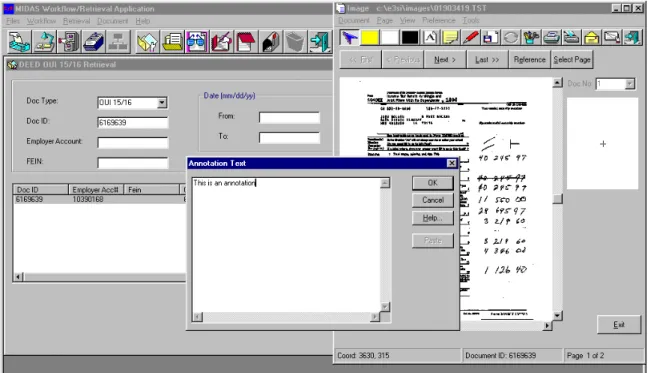
6) Annotations: MIDAS provides users the ability to make annotations that are associated with an image. Subsequent users have the ability to view, print and fax the document with, or without, the associated annotations.
7) Hardware: MIDAS includes the following:
a) Database Server: DUI Tax uses a Sun Solaris Enterprise 3500 with a Unix
operating system and an Oracle database. The databases are used for the MIDAS imaging document management system, and also for other DUI Tax applications. Actual statistics are available upon request. In very general terms, over 18 million records reside in the MIDAS image table and nearly as many in the TaxDB database.
b) Image Storage: DUI Tax currently uses an HP jukebox for optical storage. The jukebox uses four (4) drives and over 100 5.2GB” platters.
c) Application Servers – MIDAS as currently configured uses many servers. See section 2.1.3 B), Current System Architecture for a full description.
8) Visual Objects (VO) Applications: The DUI Tax network uses a variety of VO applications to manage their work. The VO applications are mission critical and provide automation for users to process and update information in a timely manner. The VO applications are an efficient front end for the legacy systems on the Annapolis Data Center (ADC). Examples include programs for: new accounts, address changes, time sheets, leave accounting, legal collections, delinquency enforcement tools, cashiering and batch control, COLD forms, employer entity information, Fastrac, employer audits and delinquency resolution. The agency plan for these applications is to re-engineer them to a VB.net platform, adding a web browser interface.
9) Disaster Recovery Plan: DUI Tax currently stores a full tape backup of the Oracle database at an off-site location.
TECHNICAL REQUIREMENTS
A) The Master Contractor shall provide technical and business services that support and ensure the reliability and functionality of the technical architecture, applications and 2.2
their business processes.
B) The Master Contractor shall meet the following technical requirements: 1) Maintenance support and database administration of current MIDAS. 2) Migrate currently stored images to MIDAS II
3) Upgrade MIDAS platform, hardware and software. 4) Integrate VO applications into MIDAS II.
5) Establish cost effective system redundancy. 6) Implement approved system enhancements.
7) Provide ongoing maintenance support and database administration for MIDAS II.
8) Support post-contract transition to DLLR staff or new contractor.
9) Cooperate with State audit processes including IV and V’s (Independent Verification and Validation).
10) Meet further requirements below.
C) The Master Contractor must address all criterion/requirement in the technical proposal and describe how the proposed services will meet the requirements as described in the TRFP to include the following.
D) The Master Contractor shall provide a strategy to integrate the existing images into the new MIDAS system.
E) The Master Contractor shall provide a plan for an efficient and cost effective solution for system redundancy
F) The Master Contractor shall propose a complete solution to address the services and hardware listed below and detail their service offerings for each component of the MIDAS Upgrade solution.
1) Hardware solution
2) Software solution
3) System integration
4) Database management
1) System maintenance
G) The Master Contractor shall provide a description of the methodology to integrate the database with the application software. The description must include the interface with the imaging application software as well as the network Visual Objects applications. H) The Master Contractor shall provide a description of the methodology for the rapid
response (retrieval) time for image viewing and OCR reject and repair.
I) The Master Contractor shall clearly describe the extent to which existing functions in the VO application suite will be replaced by their MIDAS solution.
J) The Master Contractor shall also include any illustrative material that the TO Contractor deems necessary to describe the work plan with documented policies, plans and
K) The Master Contractor must provide a document management system with OCR functionality. The system must integrate an existing image database and image file exceeding 18 million images, with an expected annual growth rate of 2 million images. At a minimum, the system must provide: image capture in a non-proprietary format, image retrieval at the desktop level within 10 seconds, data recognition on a dual-sided form using OCR / ICR technology, the ability to export the data to an ASCII file for transfer to two mainframe systems, automatic workflow triggered by form mark-sense areas, in-bound and out-bound fax capability and image import of Excel and Word documents.
L) The Master Contractor shall provide this system compatible with a network using Novell Client 4.90 on Dell Optiplex GX270 desktop PCs, with Intel Pentium 4 processors, 512 MB SDRAM using Windows XP Pro.
M) The Master Contractors shall be ready to provide a system that will OCR the existing DUI Tax forms. DUI Tax has changed the form in the past to accommodate new systems. Employers and tax practitioners become very confused when DUI Tax issues new forms. DUI Tax still receives old forms and is not interested in creating yet another new form.
N) The Master Contractor shall provide the ability to connect to the mainframe using industry standard ODBC connections through middleware (Neon Shadow) installed on the mainframe to transmit employer tax file, employer wage file and claimant W4 data.
O) The Master Contractor shall provide part-time database administration support. The assigned Master Contractor staff must have significant experience in Oracle on a Unix platform to support the current MIDAS imaging system until the successful
implementation of the MIDAS II. At a minimum, database administration will include performing weekly back-ups of the entire database for off-site safekeeping, as well as periodic monitoring and performance optimization.
Minimum qualifying experience will include:
1) Three or more years of experience designing and administering large Oracle databases in a Unix environment.
2) Knowledge of Input Accel, eiStream, FormWare, and OTG. 3) Business knowledge of UI systems.
4) PROJECT APPROACH
The Master Contractor must provide a detailed discussion of capabilities and approach to address all criterion/ requirement in the technical proposal, and describe how the proposed services will meet the requirements as described in this TORFP.
2.2.1 SUBMISSION OF DELIVERABLES AND DELIVERABLE DESCRIPTIONS
A) For each written deliverable, draft and final, the TO Contractor shall submit to the TO Manager one hard copy and one electronic copy compatible with Microsoft Office 2000, Microsoft Project 2000 and/or Visio 2000.
B) Drafts of all final deliverables are required at least two weeks in advance of when all final deliverables are due. Written deliverables defined as draft documents must
demonstrate due diligence in meeting the scope and requirements of the associated final written deliverable. A draft written deliverable may contain limited structural errors such as poor grammar, misspellings or incorrect punctuation, but must:
1) Be presented in a format appropriate for the subject matter and depth of discussion.
2) Be organized in a manner that presents a logical flow of the deliverable’s content. 3) Represent factual information reasonably expected to have been known at the time
of submittal.
4) Present information that is relevant to the section of the deliverable being discussed. 5) Represent a significant level of completeness towards the associated final written
deliverable that supports a concise final deliverable acceptance process.
C) Upon completion of a deliverable, the TO Contractor shall document each deliverable in final form to the TO Manager for acceptance. The TO Contractor shall memorialize such delivery in an Agency Receipt of Deliverable Form (Attachment 8). The TO Manager shall countersign the Agency Receipt of Deliverable Form indicating receipt of the contents described therein.
D) Upon receipt of a final deliverable, the TO Manager shall commence a review of the deliverable as required to validate the completeness and quality in meeting
requirements. Upon completion of validation, the TO Manager shall issue to the TO Contractor notice of acceptance or rejection of the deliverables in an Agency
Acceptance of Deliverable Form (Attachment 9). In the event of rejection, the TO Contractor shall correct the identified deficiencies or non-conformities. Subsequent project tasks may not continue until deficiencies with a deliverable are rectified and accepted by the TO Manager or the TO Manager has specifically issued, in writing, a waiver for conditional continuance of project tasks. Once the State’s issues have been addressed and resolutions are accepted by the TO Manager, the TO Contractor will incorporate the resolutions into the deliverable and resubmit the deliverable for acceptance. Accepted deliverables shall be invoiced within 30 days in the applicable invoice format (Reference 2.6 Invoicing).
E) When presented for acceptance, a written deliverable defined as a final document must satisfy the scope and requirements of this TORFP for that deliverable. Final written deliverables shall not contain structural errors such as poor grammar, misspellings or incorrect punctuation, and must:
1) Be presented in a format appropriate for the subject matter and depth of discussion. 2) Be organized in a manner that presents a logical flow of the deliverable’s content. 3) Represent factual information reasonably expected to have been known at the time
of submittal.
4) Present information that is relevant to the section of the deliverable being discussed. F) The State required deliverables are defined below. Within each task, the TO Contractor
may suggest other subtasks or deliverables to improve the quality and success of the project.
2.2.2.1 Attend Project Kick-Off Meeting. The TO Contractor attends a project Kick-Off Meeting with DLLR Management and User Staff to understand and communicate the project tasks, timeline and requirements. There will be a current system demonstration where the TO Contractor obtains an understanding of the current system’s functionality and capabilities. 2.2.2.1.1 Project Management Plan. The TO Contractor shall provide a Project Management Plan
to include the baseline schedule , milestones, deliverables, description of important project requirements, resources, a Gantt Chart, Staffing Management Plan, Communication & Management Plan, and Risk Management Plan. The TO Contractor shall adhere to the State’s System Development Life Cycle (SDLC) methodology at: www.dbm.maryland.gov. The plan shall reflect the deliverables and expected completion date described in section 2.2.2 “Deliverables and Time Performance” of this TORFP.
2.2.2.2 Provide Current MIDAS System Support:
2.2.2.2.1 Database Administration Support. The TO Contractor shall provide part-time on-site support consisting of routine tasks, such as full weekly backups to tape, and incremental daily backups to the server. The backups are an important component of the MIDAS disaster recovery plan and, must be periodically verified for actual recovery. The TO Contractor shall provide a written weekly assessment of the database, and provide DLLR with recommendations for improvement in the database performance. In addition, the TO Contractor shall make changes as required by DLLR to the database for new functions that may require a new / modified table, or a new/modified instance
2.2.2.3 Provide Transition and Setup Documentation Plans. The TO Contractor will provide DUI Tax with the documentation for the following plans and analysis. In addition, the TO Contractor shall include with their proposal plans for each of the following of previously successful projects tied to a reference. During this phase the TO Contractor shall consult with the TO Manager in all transition and set-up planning.
2.2.2.3.1 Transition and Setup Plan. The TO Contractor shall analyze the current MIDAS imaging and document management system and provide the results of the analysis to the State as a deliverable. The analysis shall include recommendations for both system hardware and software upgrades. The analysis will include an evaluation of the current system’s methodology for database architecture, scanning, OCR techniques, optical migration schemes, document archiving strategy and document purge criteria.
2.2.2.3.2 Quality Assurance for Business Process Plan – The TO Contractor shall provide a formal plan that ensures that delivered products and services satisfy contractual agreements and meet or exceed quality.
2.2.2.3.3 Security Plan. The TO Contractor must provide a plan describing the methodology used to ensure the new system will be secure from both inside and outside threats.
2.2.2.3.4 Database Migration Plan. The TO Contractor must provide a plan describing the strategy to migrate the existing Oracle database to either an upgrade of Oracle or to a new database platform. The plan must describe the justification for moving to a new platform, if so recommended. The plan must describe the timeline for the migration, describing in detail how the migration will occur, when it will commence and when the migration will be completed.
2.2.2.3.5 Image Storage Plan. The TO Contractor must describe and justify the image storage(s) device that will be used for the new system. The plan shall include the analysis used to make this decision.
2.2.2.3.6 Training Plan. The TO Contractor must provide a plan that describes the training that will be provided to DUI Tax. The training plan shall include an overview of the training for both system administrators and system users.
2.2.2.3.7 Disaster Recovery Plan. The TO Contractor must provide a detailed description of the disaster recovery system that will provide DUI Tax with assurance for system recovery in the event of a disaster.
2.2.2.3.8 Integration and Migration Plan. The TO Contractor must provide a plan that describes in detail the procedures for integrating existing software and systems with the new system. The plan shall also describe which existing software and images will be transferred to the new system, and how that transfer will occur.
2.2.2.3.9 User Acceptance Testing (UAT) Plan
A) The TO Contractor must provide a detailed UAT plan that incorporates the following MIDAS II business requirements to ensure successful testing without error of existing system applications, validate system set-up for transactions and user access, verify performance, confirm integrity, verify that all of the requirements of the CATS have been met, verify acceptable speed and error rates, and determine subjective level of satisfaction. The TO Manager shall provide the TO Contractor with current test data for the UAT. The TO Contractor shall provide the TO Manager a report that verifies that the following have been achieved.
1) The TO Contractor shall arrange for user testers to be properly trained as required. 2) All testing shall be carried out using the applications.
3) The UAT plan shall be so structured as to not waste the user’s time.
4) The UAT plan shall have a mechanism in place to communicate any issues and outcomes. The TO Manager will be advised of any issues that need resolution. All testing shall be well documented by the TO Contractor.
5) The TO Manager shall provide real life data for testing purposes.
6) The document retrieval software must allow for the desktop retrieval of existing documents in at least 10 seconds.
7) The documents can be retrieved from the pre-implementation system. 8) The new system recognizes the existing three (3) forms (contribution report,
employment report and W4 form).
9) The OCR functionality works with the DLLR/OUI form 15/16 and form W4. 10) The data capture and export functionality performs for tax employer data, tax wage
record data and claimant W4 data.
11) The new system scans a batch of test data, properly recognizes the form types, launches the appropriate OCR data perfection template, stages the unreadable document(s) with a data perfection operator, processes the perfected data to
completion, performs data export in an acceptable format and finally allows for document retrieval from either employer UI number or batch retrieval.
12) The existing UI Tax network applications are tested and perform acceptably with the new system.
13) Inbound fax images can be displayed and indexed in the document management system.
14) Outbound faxes of image documents can be issued for any document in the new system.
15) The final part of the UAT shall include a parallel run to prove the MIDAS II system against the current system.
16) The following Error Severity Level ranges will be used to catalogue problems with the system found during testing. At the conclusion of the UAT all problems will be resolved.
a) Show Stopper (Testing will stop).
b) Critical Problem (The TO Manger will determine if Testing can continue, .ut problem must be resolved prior to production).
c) Minor Problem (The TO Manager will determine if Testing can continue but problem must be resolved prior to production).
17) The TO Contractor will acknowledge in writing to the TO Manager confirming the successful completion of the UAT.
B) The TO Contractor will notify the TO Manager of all error conditions and their resolution.
2.2.2.4 Provide proposed Hardware and Software for a Turn key System. The TO Contractor shall provide hardware and software for the MIDAS II. The turnkey system shall include all the proposed hardware and software necessary for the MIDAS II. Hardware shall include the database server, servers for document management and OCR functions and the image
storage device(s). All equipment provided by the TO Contractor must be new and unused. Used, refurbished or remanufactured equipment will not be accepted. Please also see Section 2.2.5 of the Master RFP.
2.2.2.4.1 Inventory of Hardware and Software Report. The TO Contractor shall provide the TO Manager with an inventory report of all the provided proposed hardware and software necessary for the MIDAS II. Written acknowledgement of the delivery of the proposed hardware and software by the TO Manager will trigger the deliverable as referenced in sections 2.2.2 and 2.2.3 of this TO.
2.2.2.5 Perform Pre-Implementation Software Integration and Testing
2.2.2.5.1 Install and Test All Hardware. Install and test Database hardware, OCR hardware and document management hardware. The TO Contractor shall provide written confirmation of the installation and testing of the hardware to the TO Manager for acknowledgement. Approval by the TO Manager will trigger the deliverable as referenced in sections 2.2.2 and 2.2.3 of this TO.
2.2.2.5.2 Install and Test All Software. Install and test Database software, OCR software and document management software. The TO Contractor shall provide written confirmation of
the installation and testing of the software to the TO Manager for acknowledgement. Approval by the TO Manager will trigger the deliverable as referenced in sections 2.2.2 and 2.2.3 of this TO.
2.2.2.5.3 Perform Production Test of All Hardware and Software. The TO Contractor shall provide the TO Manager a report that states all hardware and software are installed and functioning as an integrated system.
2.2.2.5.4 Perform Pre-Implementation Verification and Validation Testing. Perform pre-implementation performance period to test with existing system applications, validate system set-up for transactions and user access, verify performance, confirm integrity, verify all of the requirements of the CATS have been met, verify acceptable speed and error rates, and determine subjective level of satisfaction. The TO Contractor shall provide the TO Manager with a report that verifies that all steps in the UAT plan as detailed in section 2.2.2.3.9 have been successfully achieved without error.
2.2.2.6 Provide System Documentation. The TO Contractor must provide documentation for system software, system architecture, network / system environment and security
architecture and detailed manuals of all software modifications beyond the COTS. System documentation deliverables shall include a manual for the System Administrator and a manual for system users. The manuals must be in a format that allows DLLR to modify and enhance for future system developments. The manuals must be in a format that the Project administrator agrees to, such as Microsoft Word or Adobe Acrobat. The TO Contractor shall provide written confirmation of the system and user documentation to the TO Manager for acknowledgement. Approval by the TO Manager will trigger the deliverable as
referenced in sections 2.2.2 and 2.2.3 of this TO.
2.2.2.6.1 System Administrator Manual. System documentation shall include a manual for the System Administrator.
2.2.2.6.2 System User Manual. System documentation shall include a manual for the System Users. 2.2.2.7 Initiate/Complete Implementation. The TO Contractor must update all plans for any
changes occurring prior to the implementation date. The implementation date must be begin on the first day of the quarter following the system acceptance date. After the
successful completion and acknowledgement of the Pre-Implementation performance period referenced in 2.2.2.5.4 above, the TO Contractor shall provide a written reaffirmation to the TO Manager of their intent to implement the system in production, specifying the start date and the applicable year and quarter. Approval by the TO Manager will trigger the
deliverable as referenced in sections 2.2.2 and 2.2.3 of this TO.
The TO Contractor must update all plans for any changes occurring prior to the
implementation date. The implementation date must be begin on the first day of the quarter following the system acceptance date.
2.2.2.8 Provide System Service/Maintenance Support
2.2.2.8.1 Provide System Service/Maintenance Agreement Plan. The TO Contractor shall develop and provide a Service Maintenance Agreement Plan incorporating all elements in section 2.2.3 “Service Level Agreements” of this TORFP.
A) The TO Contractor shall provide system service maintenance support for the purchased equipment and software upgrades for the life of the TO Contract for all parts and labor from the date of acceptance by the State.
B) The TO Contractor must license all software and system modifications in the name of DUI Tax. The address for all licensing matters shall be DUI Tax in room 414 at 1100 North Eutaw Street in Baltimore, Maryland 21201. During the life of the system support agreement, the TO Contractor will be responsible for applying all available software upgrades and improvements. This includes software releases to which licensed users are entitled. Incumbent upon the TO Contractor is the maintenance of licensing and
software support. It is the TO Contractor’s responsibility to ensure that DUI Tax is covered by any and all applicable licensing support agreements
C) The TO Contractor shall provide a qualified service technician at the purchased equipment site within four (4) hours of the placing of the service call.
D) The TO Contractor shall provide full restored functionality within twenty-four hours of the purchased equipment to be serviced.
E) The TO Contractor shall track each service call from initial call to completion and be prepared to report on progress of work and provide solution oriented escalation procedures to the TO Manager.
F) The TO Contractor shall include all charges for parts, materials, labor and travel as part of this procurement.
G) The TO Contractor shall protect the confidentially of sensitive data by having all personnel committed to this TO sign Attachment 17, DLLR Resources Data Sharing Agreement.
H) The State does not require a dedicated on-site presence for the life of the contract. 2.2.2.9 Provide Training:
DLLR will provide a training room with PCs and necessary equipment for training
purposes. The TO Contractor will be responsible for ensuring that the PCs will run the new applications
2.2.2.9.1 Provide System User and System Administrator Training. The TO Contractor shall provide user training for twenty (20) system users and system administrator training for five (5) system users located at 1100 N. Eutaw, Baltimore, Maryland.
2.2.2.9.2 Provide Certificates of Completion. The TO Contractor shall issue certificates of completion for each the system users and administrators successfully completing the training. At the conclusion of the training system users and system administrator personnel will be capable of independently performing all system transactions specified in the system user and system administrator manuals.
2.2.2 DELIVERABLES AND TIME PERFORMANCE
This section provides a description of the Deliverables and Expected Completion by identifying the number of calendars days estimated for the TO Contractor to complete the deliverable after receiving the Notice to Proceed (NTP).
ID Deliverables for 2.2.2 Expected
Completion: 2.2.2.1
2.2.2.1.1
Attend Project Kick-Off Meeting & Provide Project Management Plan
NTP + 15 Calendar Days
2.2.2.2
2.2.2.2.1
Provide Current MIDAS System Support until MIDAS II Implementation
Provide Current Database Administration Support until MIDAS II Implementation NTP + 300 Calendar Days 2.2.2.3 2.2.2.3.1 2.2.2.3.2 2.2.2.3.3 2.2.2.3.4 2.2.2.3.5 2.2.2.3.6 2.2.2.3.7 2.2.2.3.8 2.2.2.3.9
Provide Transition and Set-Up Documentation Plans: Transition and Setup Plan
Quality Assurance for Business Process Plan Security Plan
Database Migration Plan Image Storage Plan Training Plan
Disaster Recovery Plan
Integration and Migration Plan User Acceptance Testing (UAT) Plan
NTP + 30 Calendar Days
2.2.2.4 2.2.2.4.1
Provide proposed Hardware and Software for a Turn key System Inventory of Hardware and Software Report
NTP + 45 Calendar Days 2.2.2.5 2.2.2.5.1 2.2.2.5.2 2.2.2.5.3 2.2.2.5.4
Perform Pre-Implementation Performance Software Integration and Install and Test All Hardware Install and Test All Software
Perform Production Test of All Hardware and Software Perform Pre-Implementation Verification and Validation Testing
NTP + 120 to 270 Calendar Days
2.2.2.6 2.2.2.6.1 2.2.2.6.2
Provide System Documentation System Administrator Manual System User Manual
NTP + 180 Days
2.2.2.7 Initiate/Complete MIDAS II System Implementation NTP + 300 Calendar Days
2.2.2.8 2.2.2.8.1
Provide MIDAS II System Service/Maintenance Support
Provide MIDAS II System Service/Maintenance Agreement Plan
NTP + 301 Calendar Days + Two Years 2.2.2.9
2.2.2.9.1 2.2.2.9.2
Provide Training
Provide System User and System Administrator Training Provide Certificates of Completion
NTP + 300 Calendar Days
2.2.3 SERVICE LEVEL AGREEMENTS
A) The TO Contractor staff assigned to the Task Order shall work on-site at DLLR, unless otherwise approved by DLLR’s TO Manager, and shall adhere to DLLR’s policies
regarding the use of telephone, internet, computer equipment and DLLR’s standards for dress and business behavior.
B) The TO Contractor shall provide guaranteed service availability of 99.5% or greater of a qualified service technician at the purchased equipment site within four (4) hours of the placing of the service call.
C) The TO Contractor shall provide full restored functionality within twenty-four hours of the purchased equipment to be serviced
D) The TO Contractor’s personnel shall provide weekly, monthly and upon request reports on the status of all active assignments to include work accomplished.
E) The TO Manager shall be notified 48 hours in advance of scheduled maintenance activities that may impact site/system availability. All maintenance must have prior approval of the TO Manager.
F) OIT’s internal policies governing change management, documentation, maintenance, privacy and security, testing, training, disaster recovery, and data management will apply to all work under this Task Order. TO Contractor staff assigned to the TO shall adhere to these policies as directed by DLLR OIT Management.
G) Normal work hours shall be between 8:00 a.m. to 5:00 p.m., Monday through Friday, excluding State Holidays.
H) All personnel described in the TO Contractor’s proposal shall perform continuously for the duration of the TO, and for so long as performance is satisfactory to the TO
Manager. The TO Manager shall give written notice of TO Contractor performance issues to the TO Contractor, clearly describing the problem and delineating remediation requirement(s). The TO Contractor shall respond with a written remediation plan within three (3) business days and implement immediately upon written acceptance of the TO Manager. Should performance issues persist, the TO Manager may give written notice or request the immediate removal of person(s) whose performance is at issue, and determine whether a substitution is required. The TO Contractor may not substitute personnel, other than by reason of an individual’s death, sudden illness or termination of employment, without the prior written approval of the TO Manager. To replace any personnel specified in the task order proposal, the TO Contractor shall submit the resumes of the proposed substitute personnel to the TO Manager for approval at least two weeks prior to the effective date of substitution. All proposed substitute personnel shall have qualifications at least equal to those of the replaced personnel, and must be approved by the TO Manager that the proposed substitutes meet the minimum
qualifications specified in the Master Contract.
I) There will be no payment for labor hours for travel time or reimbursement for any travel expenses for work performed on this TO.
J) The TO Contractor shall provide system service maintenance support for the purchased equipment and software upgrades for the life of the TO Contract for all parts and labor from the date of acceptance by the State.
K) The TO Contractor must license all software and system modifications in the name of DUI Tax. The address for all licensing matters shall be DUI Tax in room 414 at 1100 North Eutaw Street in Baltimore, Maryland 21201. During the life of the system support agreement, the TO Contractor will be responsible for applying all available software upgrades and improvements. This includes software releases to which licensed users are
entitled. Incumbent upon the TO Contractor is the maintenance of licensing and software support. It is the TO Contractor’s responsibility to ensure that DUI Tax is covered by any and all applicable licensing support agreements.
L) The TO Contractor shall track each service call from initial call to completion and be prepared to report on progress of work and provide solution oriented escalation procedures to the TO Manager.
M) The TO Contractor shall include all charges for parts, materials, labor and travel as part of this procurement.
N) The TO Contractor shall protect the confidentially of sensitive data by having all personnel committed to this TO sign Attachment 17, DLLR Resources Data Sharing Agreement.
O) The State does not require a dedicated on-site presence for the life of the contract.
2.2.4 HARDWARE AND SOFTWARE WARRANTIES
Α) All hardware purchased under this agreement will have a minimum three year on-site warranty for all parts and labor. It is the TO Contractor’s responsibility to procure and enforce extended warranty contracts for the three year term. The cost of the extended warranties shall be borne by the TO Contractor and shall be part of the TO Contractor’s price proposal.
B) The TO Contractor that is selected shall be the Single Point of Contact (SPOC) for problem resolution for the MIDAS system. Problems to be resolved by the Contractor include hardware failure, software failure, database failure, software upgrades and integration issues.
C) On site warranty means the TO Contractor's qualified technician will travel, if necessary, to the State facility where warranty service is required.
D) Normal service hours will be between 8:00 a.m. to 5:00 p.m., Monday through Friday, excluding State Holidays. Normal service shall be performed before the end of the next business day from receipt of notice by the agency requesting service
2.2.5 REQUIRED PROJECT POLICIES, GUIDELINES AND METHODOLOGIES
The TO Contractor shall be required to comply with all applicable laws, regulations, policies, standards and guidelines affecting information technology projects, which may be created or changed periodically. The TO Contractor shall adhere to and remain abreast of current, new, and revised laws, regulations, policies, standards and guidelines affecting project execution. These may include, but are not limited to:
A) The State’s System Development Life Cycle (SDLC) methodology at:
www.dbm.maryland.gov - keyword: SDLC.
B) The State Information Technology Security Policy and Standards at:
www.dbm.maryland.gov - keyword: Security Policy.
C) The State Information Technology Project Oversight at: www.dbm.maryland.gov -keyword: IT Project Oversight.
D) The State of Maryland Enterprise Architecture (MTAF) at www.dbm.maryland.gov -keyword: MTAF Guiding Principles.
E) The TO Contractor shall follow the project management methodologies that are consistent with the Project Management Institute’s Project Management Body of Knowledge Guide. TO Contractor’s staff and subcontractors are to follow a consistent methodology for all TO activities.
2.3 TO CONTRACTOR STAFF EXPERTISE REQUIRED
The TO Contractor’s staff must demonstrate expertise in the following:
A) General Skill Sets and Knowledge: The TO Contractor’ staff shall provide dedicated technical and business personnel to perform, technical and business support to include project management, functional analyses, software programming, enhancements/
modifications, analytical services, and testing services as directed. To understand DLLR requirements, the TO Contractor shall acquire an understanding of DLLR's MIDAS System to enable their technical and business staff to comprehensively support the system.
B) Specific Skill Sets and Knowledge: Qualifying experience, at a minimum, shall include three or more years of experience in document management OCR systems integration and database administration; and expert knowledge in each of the following:
1) Database administration & System Integration. The TO Contractor shall demonstrate expertise integrating and providing document management and imaging services for a large installation. The prior experience must include installing a system in excess of 1,000,000 images and 1,000,000 database table entries.
2) Visual Basic
3) Oracle - For either conversion or administration 4) Unix For either conversion or administration
2.4 TO CONTRACTOR STAFF MINIMUM QUALIFICATIONS
The following minimum qualifications are mandatory. The TO Contractor’s staff shall be capable of furnishing all necessary services required to successfully complete all tasks and work requirements and produce high quality deliverables described herein. The TO
Contractor shall demonstrate, in its proposal, that it possesses such expertise in-house or has fostered strategic alliances with other firms for providing such services.
A) Total Experience. The number of minimum years of hands-on experience in the skill set and in general with Information Technology.
B) Specialized Experience. Minimum specific experience required directly relates to the particular skill category and level. The experience is not in addition to but is a part of the general experience required in the paragraph above.
C) Skill Set Experience. Recent hands-on experience within the last two (2) years of the particular knowledge base and skill set.
D) Education and Other Requirements. Minimum educational requirements needed to qualify for the position. The DLLR Task Order Manager may approve substitutions of
experience and/or certifications for education if the DLLR Task Order Manager determines the experience is superior in nature and provides the skills at a level necessary to successfully perform the duties of the position.
E) Duties. Immediately following experience and education requirements are the representative functions of the position.
F) Communication. The TO Contractor's proposed staff must possess effective oral and written communication skills to effectively communicate with State staff.
2.4.1 LABOR CATEGORIES
2.4.1.1 Management Series 2.4.1.1.1 Project Manager
A) Total Experience. Eight (8) years of experience in initiating, planning, organizing, directing, and controlling business application projects. Progressive experience in large-scale management information or business application systems support activities with particular regard to experience in integrating and providing document management and imaging services for a large installation. The prior experience must include a system in excess of 4,000,000 images and database table entries. Also as part of that progressive experience, it is required that the Project Manager have knowledge and abilities such as system design and analysis, system operations, computer operations, and all activities related to maintenance and software life cycle activities.
B) Specialized Experience. Three (3) years of specific experience in managing projects, according to the Project Management Institute (PMI) practices and procedures. This responsibility includes, but is not limited to, developing project plans, budgeting, estimating, and scheduling, developing risk management plans, and all other plans associated with project plan development and execution.
C) Education and other requirements. A Bachelor’s degree from an accredited college or university with a major in Computer Science, Information Systems, Engineering, Accounting or other related business or technical discipline. PMI Certification is highly desired.
D) Duties. Develop complete project plans as required for Business Application projects. Plan, organize, direct, and control Business Application projects. Review project documentation developed by others. Meet with State personnel and TO Contractor personnel to review and approve project documentation. Communicates effectively with all levels of management. He or she provides configuration management during the development phase of the project and ensures the project is completed correctly, efficiently, on schedule and within cost.
2.4.1.2 Systems Analyst Series 2.4.1.2.1 Systems Analyst
A) Total Experience. Three (3) years progressive experience in the analysis and design of business applications using database management systems or high level programming
languages.
B) Education and other requirements. A Bachelor's degree from an accredited college or university in a related field.
C) Duties. Perform duties assigned by the Senior Systems Analyst on simple to moderately complex systems. 2.4.1.3 Computer Programmer Series
2.4.1.3.1 Applications Programmer
A) Education. A Bachelor's Degree from an accredited college or university with a major in Computer Science, Information Systems, Engineering, Business, or other related
scientific or technical discipline or three (3) years of equivalent experience in a related field. A TO Contractor’s Degree is preferred. A TO Contractor’s Degree in one of the above disciplines equals one year specialized and two years general experience. B) General Experience. Must have five (5) years of computer experience in information
systems design.
C) Specialized Experience. At least three (3) years of experience as an application programmer on large-scale Database Management Software, knowledge of computer equipment, and ability to develop complex software to satisfy design objectives. D) Duties. Analyzes functional business applications and design specifications for
functional areas such as finance, accounting, and procurement. He or she translates detailed design into computer software. Tests, debugs, and refines the computer software to produce the required product. Prepares required documentation, including both program-level and user-level documentation. Enhances software to reduce operating time or improve efficiency. Provides technical direction to programmers as required to ensure program deadlines are met. Must be able to verify the accuracy and completeness of programs and systems by preparing sample representative data and perform testing by means of cycle and system processing.
2.4.1.3.2 Junior Applications Programmer
A) Education. A Bachelor's Degree from an accredited college or university with a major in Computer Science, Information Systems, Engineering, Business, or other related scientific or technical discipline or three (3) years of equivalent experience in a related field. A TO Contractor’s Degree in one of the above disciplines equals one year specialized and two years general experience.
B) General Experience. Must have three (3) years of computer programming experience. C) Specialized Experience. None.
D) Duties. Analyzes functional business applications and design specifications for functional areas such as finance, accounting, and procurement. Translates detailed design concepts into computer software. Tests, debugs, and refines the computer software to produce the required product. Prepares required documentation, including both program-level and user-level documentation. Enhances software to reduce operating time or improve efficiency. Provides technical direction to programmers as required to ensure program deadlines are met. Must be able to verify the accuracy and
completeness of programs and systems by preparing sample representative data and perform testing by means of cycle and system processing.
2.4.1.4 Specialist Series
The following general requirements apply to all personnel in the Specialist Series. A) Total Experience. Five (5) years progressive experience in Information
Systems/Automated Data Processing (IS/ADP) systems analysis.
B) Specialized Experience. Three (3) years of intensive and progressive experience in the specialty.
C) Education and Other Requirements. A Bachelor's degree from an accredited college or university with a major in Computer Science, Information Systems, Engineering, Business, or other related scientific or technical discipline.
D) Duties. Augments other skill categories by providing unique IS/ADP systems knowledge in areas that require in-depth current knowledge of a specialized IS discipline. Such specialized knowledge can only be achieved through intensive, extensive, and continuous application of the specialty at a level exceeding that of the more general and broad based IS requirements of the skill category series. This series may participate in all phases of performance with emphasis on the planning, analysis, testing, documentation, and acceptance phases. Prepares and delivers presentations and briefings as required.
2.4.1.4.1 Database Management Specialist – In addition to the general requirements for the specialist series:
A) Specialized experience. Must have thorough knowledge and understanding of IBM UDB, Access, SQL, DB2 and/or Oracle database management software. DLLR requires DB2 and Oracle database management support.
B) Duties. Supports application developers in planning preparation, load analysis, and backup and recovery of data. When necessary, reallocates resources to maximize benefits. Monitors system performance and evaluates areas to improve efficiency. Specifies proper types of files organization, indexing methods, and security procedures. Advises TO Contractor project teams on the design of complex databases (e.g., schema and subschema details). Defines specialized aspects of user's data base administrator documentation. Performs detailed comparisons of various data base systems. Performs duties in a complex, distributed, heterogeneous computing environment, which may involve different types of hardware platforms, operating systems applications, and network environments
2.5 INVOICING
A) Payment will only be made upon completion and acceptance of the deliverables as defined in sections 2.2.2 and 2.2.3.
B) Invoice payments to the TO Contractor shall be governed by the terms and conditions defined in the CATS TO Contract. Invoices for payment shall contain the TO
below, and must be submitted to the TO Manager for payment approval. Payment of invoices will be withheld if a signed Acceptance of Deliverable form – Attachment 9, is not submitted.
C) The TO Contractor shall submit invoices for payment upon acceptance of separately priced deliverables, on or before the 15th day of the month following receipt of the approved notice(s) of acceptance from the TO Manager. A copy of the notice(s) of acceptance shall accompany all invoices submitted for payment.
D) All invoices shall be submitted monthly no later than 15 calendar days after the end of the invoice period, unless specified differently in the Task Order, and include the
following information: name and address of the State agency being billed, vendor name, remittance address, federal taxpayer identification or (if owned by an individual) his/her social security number, Invoice Period, Invoice Date, Invoice Number, Amount Due, and the Purchase Order Number(s) being billed. Additional information may be required in the future. Invoices submitted without the required information will not be processed for payment until the TO Contractor provides the required information.
E) The TO Contractor shall provide the TO Manager with all invoices and supporting documentation.
F) The TO Contractor shall provide documentation to the TO Manager for the time
invoiced for employees, or sub-Contractors. The documentation shall be either certified employee time sheets or electronic time keeping records certified by the TO
Contractor’s Contract Manager to be the actual time worked by the employees, or its subcontractors on this TO Agreement.
G) For the Fixed Price portion of this TORFP, payment will only be made upon completion and acceptance by DLLR’s TO Manager. Acceptance criteria is as follows:
1) 10% - Deliverable 2.2.2.1 – Attend Project Kick-Off Meeting & Provide Project Management Plan – Task completion verified by TO Manager.
2) 5% - Deliverable 2.2.2.3– Provide Transition & Set-Up Documentation Plans – Task completion and receipt of all analysis and plans verified by TO Manager.
3) 5% - Deliverable 2.2.2.4 – Procure Hardware & Software. Receipt of hardware & Software verified by TO Manager.
4) 20% - Deliverable 2.2.2.5.1 – Install & Test all Hardware. 5) 10% - Deliverable 2.2.2.5.2 – Install & Test all Software.
6) 10% - Deliverable 2.2.2.5.3 – Perform Production Test of all H/W & S/W.
7) 10% - Deliverable 2.2.2 5.4 – Perform Pre-Implementation Performance Verification & Validation.
8) 10% - Deliverable 2.2.2.6 – Provide System Documentation – Receipt of satisfactory documentation verified by the TO Manager.
9) 10% - Deliverable 2.2.2.7 – Initiate/Complete System Implementation – Successful implementation verified by the TO Manager.
10) 10% - Deliverable 2.2.2.9 –Provide Training – Completion of training module verified by TO Manager.