(2) Problems in the Picking up of Assets from Their Stor-age Locations
① Troublesome labor of searching for assets based on the memory of workers or ambiguous assets location informa-tion.
② When designated assets are not found, the same kinds of assets that are stored after the designated ones may be picked up by mistake, leaving the designated ones. In this case, the older assets may become unusable due to the expiration of their consumption limit period (shelf life).
These problems have led to a rise in the need for assets loca-tion management systems that support easy and accurate man-agement. According to a survey by the ESP Research Institute, Inc., the market for indoor location management is expected to grow from about 1.2 billion yen in FY2004 to 38 billion yen in FY2008. In particular, the assets location management sector is expected to expand rapidly to reach a market scale of nearly 20 billion yen in FY20081).
Based on these market needs, many solution providers have recently been proposing assets location management solutions by linking RFID- or bar code-based assets management sys-tems with location management syssys-tems. These solutions can roughly be divided into two types; 1) those which manage the assets locations directly, and; 2) those which manage the loca-tions of the workers or the forklifts conveying the assets and thereby indirectly manage the assets locations. The assets loca-tion management soluloca-tion based on the combinaloca-tion of the SmartLocator and RFID, introduced in this paper, belongs to the latter type.
Assets management solutions based on RFID are studied and introduced aiming at improvements in job efficiency in various businesses such as the logistics, distribution and man-ufacturing industries. The introduction of RFID-based assets management improves the efficiency of input/output and pro-duction management in warehouses and factories. The man-agement of asset locations is regarded as a factor that can im-prove efficiency even further. This paper introduces the “SmartLocator,” a highly accurate indoor location manage-ment system using IR (Infra-Red) signals, together with an as-sets location management solution linking the SmartLocator and RFID.
Previously, the management of assets stored in warehouses and factories has been troubled by the following problems.
(1) Problems with the Storage Location Registration Op-eration
① As the assets storage locations are kept only in the memo-ries of workers or recorded only after the completion of daily work, problems such as forgetting, uncertain memory and incorrect notification of location information to other work-ers tend to occur.
② Even when the location information is recorded every time assets are stored, the input of the shelf numbers and ad-dresses is troublesome for some workers.
This paper introduces the “SmartLocator,” a highly accurate indoor location management system using IR-signals, and an assets location management solution based on combination of the SmartLocator and RFID. The solution is expected to improve ware-house input/output operation efficiency and it enables the effective utilization of storage spaces when it is applied to the logistics, physical distribution and manufacturing industries. In the future, at the same time as expanding marketing of the solution more widely, commercialization of an lighting tag that makes electrical works unnecessary will be advanced in order to help to further re-duce the costs of these industries.
HASHIMOTO Naohisa, ISSHIKI Naoki, IGUCHI Masao, MORISAKI Mitsunori, ISHII Ken'ichi
Keywords
RFID, SmartLocator, assets location management, lighting tag, fluorescent lamp
Abstract
1. Introduction
This section describes the issues of the positioning technolo-gies that are expected to be applied to the assets location man-agement systems of various solution providers and also the configuration and features of our indoor location management solution using IR signals, the “SmartLocator.”
Table shows the major indoor positioning technologies.
tions and terminals.
On the other hand, to provide high positioning accuracy for a positioning technology using active RFID tags7), it is necessary to install a large number of RFID readers in the relevant envi-ronment. This necessitates high installation costs because it is also necessary to install a backbone network for each RFID reader. For a positioning technology using ultrasound waves8), clear views should also be reserved and the area in which high positioning accuracy is available is limited as with the wireless LAN-based technologies. In addition, the necessities of the ul-trasound sensors and the backbone networks connection to the sensors lead to an increase in the installation costs just as with the active RFID-based technology. For the positioning tech-nology using passive RFID tags9), a degradation of the posi-tioning accuracy due to errors in passive RFID tag readout and simultaneous readouts of multiple tags is the problem.
As shown above, the positioning accuracy and installation costs were the major problems with the traditional indoor loca-tion detecloca-tion technologies. The SmartLocator described in the next section is a new, IR ray-based indoor location manage-ment technology that can solve the above problems.
The SmartLocator is a system that allows mobile devices in-corporating IR receivers, such as PDAs and mobile terminals, to detect their own locations by receiving the location ID sig-nals from IR transmitters installed on the ceiling, etc. As shown in Fig. 2, the SmartLocator is composed of IR transmitters, mobile devices incorporating IR receivers, and the location management server.
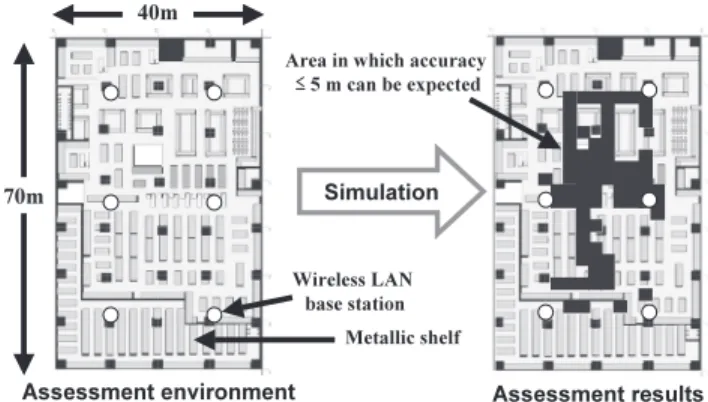
The SmartLocator detects the locations as described in the following: Each IR transmitter transmits an IR signal carrying Fig. 1 Assessment of expected accuracy of wireless LAN multi-based
station positioning technology.
Technology Accuracy Note
Wireless LAN
multi-base station 3 - 5m Accuracy is dependent on the sur-rounding environment. Active RFID 5 - 7m Accuracy is dependent on the
sur-rounding environment.
Ultrasound 3 - 30cm Accuracy is dependent on the sur-rounding environment.
Passive RFID 10 - 30cm Accuracy is affected by RFID out errors and simultaneous read-out of multiple tags.
IR tag
(SmartLocator) 0.7 - 2.5m A clear view should be reserved be-tween the IR transmitters and the IR receivers.
The technologies determining locations according to the ra-dio wave propagation time between multiple wireless LAN base stations and the terminals2-4) make it necessary to reserve a clear line of sight between each terminal and the base station in order to improve the positioning accuracy. However, as it is often difficult to reserve a clear view due to other stored assets and machinery in warehouses and factory workshops, the po-sitioning accuracy in these places often becomes considerably degraded. We actually simulated the location detection accu-racy of the wireless LAN positioning technologies by using a computer5). The results of the computer simulation are shown in Fig. 1. The left hand figure shows the plan of the assessed floor area, and the gray squares in it represent metallic shelves. The ceiling height is 2.5 meters and the shelf height is 2 me-ters. When six wireless LAN base stations are installed on this floor, communications are available in approximately 95% of the floor, but the area that can meet the indoor positioning ac-curacy requirement of no more than 5 meters6) is only about 16% of the floor. As shown by these results, the effective ap-plication of wireless LAN-based positioning technologies seems to be difficult to achieve in warehouses and factories where clear views cannot be reserved between the base
sta-3.1 Indoor Positioning Technologies
3. Indoor Location Management System “SmartLocator”
3.2 Configuration of the SmartLocator System
the location ID periodically (1 in Fig. 2). The area in which the location ID can be received is determined like an area illumi-nated by a spotlight; it is a circle with a diameter of about 1.4 to 5 meters at a height of about 3 to 7 meters, so the positioning accuracy of this area becomes between 0.7 and 2.5 meters. When a mobile device comes into this area, it automatically receives the location ID (2 in Fig. 2) and notifies the location management server of the received location ID through the wireless network (3 in Fig. 2). Finally, the location manage-ment server detects the location of the mobile device accord-ing to the installation location data of the IR transmitter with the received location ID (4 in Fig. 2)
The use of IR signals provides the SmartLocator with the following advantages compared to the wireless systems using wireless LAN or RFID.
・ Each reception area has a clearly defined boundary like a spotlighted area so two adjacent areas can be distinguished clearly.
・ Since the IR signals do not permeate through walls, the area of interest can be distinguished clearly from adjacent passages or rooms that are partitioned by a wall or shelf.
・ The positioning accuracy is little deteriorated by sur-rounding articles or environmental changes such as a reloca-tion of structures so stable locareloca-tion detecreloca-tion is possible. The system is accompanied by the constraint that a clear view should be reserved between the transmitters and receiv-ers due to the use of IR signals. However, despite this fact the system is still advantageous because accurate location detec-tion is possible whenever unimpeded IR signals can be re-ceived as described above. The preservation of lines of sight between transmitters and receivers is relatively easy if the
transmitters are installed on the ceiling.
Another advantage of this system is that the IR transmitters do not need backbone networks to be installed.
The above advantages allow the SmartLocator to detect loca-tions at lower costs and a higher accuracy than other position-ing technologies.
The assets location management solution combining the SmartLocator and RFID locates the position of assets by link-ing the RFID information and SmartLocator information ob-tained when the assets are placed in their storage locations.
An outline of this solution is described in the following. Firstly, the workers or forklifts should carry the mobile devices incorporating an IR receiver and RFID reader. In addition, the RFID tags in which the assets IDs are recorded are attached to the assets, and IR transmitters are installed on the ceiling above the areas where management of the assets locations is required. Then, assets that are conveyed by a worker or forklift are iden-tified based on the RFID, the location of the worker or forklift conveying the assets is detected with the SmartLocator. When the assets are placed in a storage location, the two kinds of in-formation are linked for the assets location management.
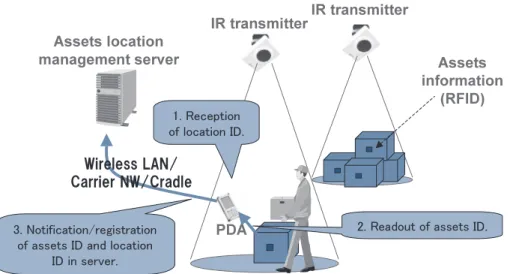
An example of the application of the assets location manage-ment solution can be seen in the warehouse input process in a warehouse without determined assets storage locations (free-location warehouse) as shown in Fig. 3.
When a worker conveys assets on a hand truck and places them in an unoccupied space, the worker reads the assets ID recorded in the RFID tags attached to the assets using a PDA, as the last step in the warehouse input process. At this time, when the worker takes out the PDA for reading the RFID, a view is reserved between the IR receiver on the PDA and the IR transmitter on the ceiling and the PDA receives the location ID (1 in Fig. 3). The PDA then associates the assets ID it read (2 in Fig.3) with the location ID it received from the transmit-ter, and notifies the assets location management server of the associated information for registration (3 in Fig. 3). The notifi-cation to the assets lonotifi-cation management server for registra-tion is performed by means of the wireless LAN when real-Fig. 2 Configuration of SmartLocator.
4. Assets Location Management Solution Based on Combination of SmartLocator and RFID
3.3 Features of the SmartLocator system
4.1 Outline of the Assets Location Management Solution
time management is required. Or, it is done by the batch registration using a cradle, etc. after completion of the ware-house work when real-time management is not important.
The SmartLocator and the assets location management solu-tion described above are commercialized by NEC Engineer-ing, Ltd.10)
In supporting the future development of the SmartLocator, we are currently conducting research into the “Lighting tag,” a system in which the power supply for the IR transmitter is ob-tained from fluorescent lamp11). The power supply can be ob-tained from the fluorescent lamp either by electromagnetic in-duction from an inverter type fluorescent lamp or by tapping off from a rapid-start type fluorescent lamp (Fig. 4). Either technology makes it possible to introduce the assets location management solution in various indoor environments equipped with fluorescent lamp illumination without the need of power supply installation work at the floor level. The lighting tags are currently under development aiming at commercialization in the not too distant future.
In this paper, we have introduced the assets location manage-ment solution based on the combination of the SmartLocator
and RFID. In the future, we intend to promote commercializa-tion of this solucommercializa-tion and will also develop the lighting tag sys-tem that will make power supply installation work unneces-sary.
Fig. 3 Assets location management linking the SmartLocator and RFID.
Fig. 4 Lighting tags.
5. Future Plans
Authors' Profiles HASHIMOTO Naohisa Staff,
RFID Business Solution Center, NEC Corporation
ISSHIKI Naoki Staff,
1st System Solutions Division, NEC Engineering, Ltd. IGUCHI Masao Staff,
1st System Solutions Division, NEC Engineering, Ltd. MORISAKI Mitsunori Researcher,
Internet Systems Research Laboratories, NEC Corporation
Member of the Institute of Electronics, Information and Communication Engineers
ISHII Ken'ichi Principal Researcher,
Internet Systems Research Laboratories, NEC Corporation
Member of the Institute of Electronics, Information and Communication Engineers
●The details about this paper can be seen at the following. Related URL:
http://www.sw.nec.co.jp/solution/osusume/smartlocator/ http://www.nec-eng.com/pro/smartlocator/
References
1) ESP Research Institute, Inc., "2005 ICHI KENCHI SISUTEMU NI KANSURU SHIJO CHOSA (2005 Market Survey of Location Detection Systems)." 2) Hitachi, Ltd.,
http://www.hitachi.co.jp/wirelessinfo/airlocation/ 3) AeroScout, http://www.aeroscout.com/ 4) Ekahau, http://www.ekahau.com/
5) Morisaki, et al., "Proposal of a Hybrid Positioning System with Illumination Tags and Wireless LAN," WPMC2004, Vol. 1, pp.339-343, Sept. 2004. 6) Ogino, et al., "Integrated Wireless LAN Access System - Study of Location
Methods-" DICOMO 2003, pp.596-572, June 2003. 7) Fujitsu, Ltd.,
http://jp.fujitsu.com/group/fst/services/ubiquitous/rfid/ 8) Aioi Systems Co., Ltd.,
http://www.hello-aioi.com/ja/sid/sid.html
9) http://itpro.nikkeibp.co.jp/article/NEWS/20051216/226404/ 10) NEC Press Release,
http://www.nec.co.jp/press/ja/0603/1301.html 11) NEC Press Release,