Journal of Information Systems Education, Vol. 13(4)
Software Piracy: A Study of the Extent
Of Coverage in Introductory MIS Textbooks
Laurie E. MacDonald
Kenneth T. Fougere
Bryant College
Smithfield, RI 02917
ABSTRACT
This research argues that although software piracy has serious implications for the software industry and the economy, the topic receives very little detailed coverage in MIS textbooks. Software piracy has a significant impact on the software industry and on the economy as a whole. Lost sales due to software piracy amount to over $11 billion annually and lost taxes approach $1 billion annually. Current technology makes it a simple task for even a novice computer user to copy software and therefore, unauthorized software is not uncommon. The researchers conducted an evaluation of MIS texts and found that software piracy receives very little coverage in the texts. The research suggests that MIS faculty need to provide material to supplement the textbook coverage in order to provide adequate coverage of this serious issue.
Keywords: Software Piracy, Textbook Analysis, Copyright, Software License, Intellectual Property
1. INTRODUCTION
Software piracy is the unauthorized reproduction of copyrighted software. The unauthorized copying may be done for personal use, business use, or it may be done to sell copies of the pirated software. The problem can be found wherever computers are used: in businesses, schools, libraries, and homes. The Business Software Alliance puts it bluntly when they point out that making unauthorized copies of software or downloading unauthorized copies of software via the Internet is against the law (Anonymous 2001a). The problem of making illegal software copies has been recognized in the computer industry for decades and has increased to match the growing use of computers (Wood 1998).
Software piracy cost the United States economy dollars, jobs, and tax revenue. The United States lost more than 100,000 jobs and over a billion dollars in tax revenue in 2000 due to software piracy (Anonymous 2001b; Johnston 2001). A study of Internet software auctions
by the Software & Information Industry Association in March-April 2000 found that illegal copies accounted for 91 percent of the software being auctioned (Anony-mous 2000a). It is predicted that if the rate of piracy continues unchanged, the U.S. economy will lose a total of 175,700 jobs and $1.6 billion in tax revenue by 2008. The available data on software piracy understates the total losses because the data is limited to corporate users and does not include illegal software used in homes and smaller business enterprises worldwide (Weiss 2000).
The National Retailers Federation estimates total retail sales at $3 trillion and places the total for all categories of inventory shrinkage (employee theft, shoplifting, vendor fraud, and errors) at $25 billion (Anonymous 1999a). The United States Census Bureau’s economic census places the total revenue for software publishers at approximately $62 billion (Anonymous 2000b) and the Business Software Alliance has found that the worldwide cost of software piracy reached $11.75 billion in 2000 (Anonymous 2001c). Thus, the theft of software as a percent of total software revenue far
exceeds inventory shrinkage as a percent of total retail sales.
1.1 A Global Problem
A study by Pricewaterhouse Coopers involved research in 61 countries and concluded that pirated PC business software accounted for 40% of the total PC business software used worldwide. At 27%, the U.S. had the lowest rate of illegal software and Vietnam had the highest rate at 98% for its business software (Johnston 2001). The widespread incidence of unauthorized software copies in Asia has been an ongoing problem. It has been argued that copyright laws are contrary to deeply held Asian cultural beliefs that support sharing (Swinyard 1990).
This study leaves those cultural issues to other researchers and will be limited to the implications of software piracy for IS curriculum. Software piracy is a serious criminal endeavor. For example, in August 2001, the FBI arrested four people in Los Angeles who were attempting to distribute counterfeit Microsoft software with an estimated retail value of $10.5 million (Gates 2001).
1.2 Working for Change
The Business Software Alliance and Microsoft have begun an effort to encourage companies to conduct regular software audits. They hope to reduce the amount of software piracy by getting companies to implement improved software management and will offer free tools and other assistance to help managers improve their software auditing capabilities. Their plan also includes an amnesty program for companies who conduct audits, report any illegal software, and correct the situation through proper licensing.
The increased use of Internet auctions has brought with it a concurrent increase in the availability of pirated software copies. A study by the Software & Information Industry Association found more than 1,300 Internet auctions making pirated software available (Anonymous 2000a).
IT professionals can have an impact in reducing the extent of software piracy. As IT professionals we need to foster an environment that strongly discourages unauthorized copying of software and we need to support policies that detect and punish software piracy. Our concern as instructors is for the preparation of IT professionals. We believe that while we generally do a good job of giving students a technical tool kit, we are not as confident that we are adequately preparing students to come to grips with the issues associated with software piracy. Because most university courses are guided in large part by the learning materials found in the text being used, the researchers used a text evalua-tion as the starting point to assess just how well we can
expect to address the issue of pirated software. We believe that unauthorized software copying is of particular concern to schools because it has been found that copying is more common in not-for-profit organiza-tions than it is in business organizaorganiza-tions (Taylor 1993; Athey 1990).
1.3 Research Statement
This research will argue that software piracy is an important issue for the software industry along with the importance of developing ways to teach our students how to identify and prevent software piracy in the future. The curriculum recommendations of both the AITP (formerly DMPA) and the ACM have included the study of ethical issues for IS majors (Couger 1989; Anonymous 1997a). Banerjee (1998) has noted that the inclusion of ethical issues in the IS curriculum is a viable deterrent measure against software piracy. The attitude among business faculty concerning unauthorized software copying will ultimately be passed along to their students (Taylor 1993).
2. THE STUDY 2.1 Text Analysis
A collection of Information Systems texts (Appendix A) was assembled for review and evaluation. The texts were selected by asking 11 MIS instructors to provide us with copies of texts that had used in teaching the MIS course. The group comprised 5 Full Professors, 4 Associates, and 2 Assistants. The textbooks represent those books that are used in IS core courses that are generally offered to all business students. Analysis of the texts was undertaken by the researchers to determine the extent of coverage afforded by these texts. Two instructors, both Full Professors, and three graduate business students evaluated the texts. The evaluation method was based on: (1) the model developed by the American Association for the Advancement of Science (Kulm 2001), (2) the technique employed by Leif (1994), and (3) the technique employed by MacDonald and Swearingen (1990). Appropriate coverage of an issue requires formal treatment in the text. The issue should be formally defined, and information regarding the issue should be developed under appropriate chapter or section headings. Such structure will result in citations in the Table of Contents, the Index, or both. Thus, the textbook analysis began with a review of the Index and Table of Contents for references to the issues under study.
2.2 Keywords
Because terminology will vary, a set of keywords was developed to represent the issues. The keyword list was developed after reviewing the MIS Quarterly Keyword Classification Scheme and web sites devoted to
Journal of Information Systems Education, Vol. 13(4)
software piracy by the Business Software Alliance, and the Software & Information Industry Association (Anonymous 2001a; Anonymous 2000a; Anonymous 1998b). The keywords are displayed in Figure 1.
The relevant text sections or chapters were reviewed and evaluated by the researchers and rated on a five point Likert scale as to the perceived depth and completeness of topic coverage. We were not looking for a specific prevention methodology as we reviewed the text materials; rather we were looking for some viable presentation of the issues and a model that
Figure 1: Piracy Keywords
Business Ethics Computer Ethics Copyright Copyright Infringement Ethics Illegal Intellectual Property Law License Patents Proprietary Rights Software Copies Software Copyright Software License Software Piracy Software Protection Software Use Policy Trade Secrets
includes both deterrence and detection and challenges the students to evaluate their personal ethical position. So a very important factor in reviewing the textbooks was the identification of material that would form the basis for class discussion of software piracy. That is, it is not so much the extent of the coverage but the probative value. The researchers hoped to find text material that would cause the student to come to grips with their own personal position on the ethics of making unauthorized software copies.
2.3 Keyword Categories
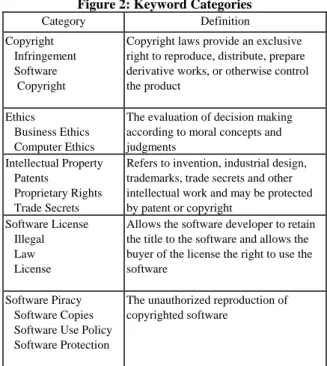
Analysis of the data for index citations revealed that the keywords should be combined into major groups because of the similar text material for various keywords. For example, software license, illegal, law, and license were all found to reference the same type of text material. The grouping of keywords into major categories for the data analysis is displayed in Figure 2. The definitions of the terms in Figure 2 represent a summation of comments on these terms from several sources (Liberman 1995; Anonymous 2002a; Anonymous 2002b; Anonymous 2002c; Anonymous
2001a; Anonymous 2001e).
3. FINDINGS 3.1 Keyword Citations
The results for the analysis of index citations are displayed in Figure 3. The frequency of index citations is somewhat encouraging. This statistic represents an effort to at least recognize the importance of this issue for future IT professionals. The term software piracy is found in the index of 72% of the textbooks in this study. At 67%, the word ethics is cited in a significant majority of the texts. Two other keywords, software licensing
Figure 2: Keyword Categories
Category Definition Copyright
Infringement Software Copyright
Copyright laws provide an exclusive right to reproduce, distribute, prepare derivative works, or otherwise control the product
Ethics
Business Ethics Computer Ethics
The evaluation of decision making according to moral concepts and judgments
Intellectual Property Patents
Proprietary Rights Trade Secrets
Refers to invention, industrial design, trademarks, trade secrets and other intellectual work and may be protected by patent or copyright
Software License Illegal Law License
Allows the software developer to retain the title to the software and allows the buyer of the license the right to use the software
Software Piracy Software Copies Software Use Policy Software Protection
The unauthorized reproduction of copyrighted software
and copyright are found in the index of 50% of the textbooks reviewed for this project. The topic of intellectual property is found in 39% of the books.
Figure 3 reveals that software piracy and the associated ethical and legal issues are cited in most of the textbooks. However, the number of pages devoted to these issues is meager at best. The average page count
Figure 3: Index Citation
50% 67% 39% 50% 72% 0% 20% 40% 60% 80% Copyright Ethics Intellectual Property Softw are License Softw are Piracy
Journal of Information Systems Education, Vol. 13(4)
1.2 1.3 1.0 0.9 0.0 0.5 1.0 1.5 Copyright Ethics Intellectual Property Software Licensefor each of the keywords is seen in Figure 4. Ethics receives the most coverage but this typically includes discussions of privacy and personal use of company computers with little substantive discussion of software piracy.
When the researchers reviewed the actual text material the results were disappointing. The researchers rating by keyword is seen in Figure 5. The text discussion of the issues was rated using a 5-point Likert scale for depth of presentation and the inclusion of both deterrence and
detection methods. A score of 5 would indicate exemplary coverage and a score of 1 would indicate
minimal discussion of the issues.
3.2 Keyword Coverage
Figure 5 indicates that the coverage was minimal for all keywords surrounding unauthorized software use. The discussion is typically limited to a brief mention of the problem, copyright laws, and the ethics of software piracy. A few excellent examples were found that provided thought-provoking cases to challenge the student to examine their own personal ethical position regarding copying software, but these were the exception, not the rule.
4. CONCLUSION
The typical undergraduate business student will take only a single MIS course (Stephens 2001). The textbooks for this course provide a good foundation for the student to learn how to use information technology in business. However, this research suggests that MIS textbooks do not give software piracy the depth of coverage warranted by its significance for the IT industry. The literature clearly demonstrates that software piracy is a serious problem (Wood 1998; Weiss 2000; Gates 2001; Beekman 2001). The paucity
of textbook coverage of unauthorized software copies suggests that classroom coverage of the issue depends on the
willingness of instructors to provide supplementary materials.
Making students aware of the software piracy problem should not be a difficult part of our teaching job. Students should readily appreciate the seriousness of the problem when they learn the impact software piracy has on jobs. Johnston (2001) points out that 140,000 jobs were lost to software piracy in 1998. Beekman (2001) indicates that many people are simply unaware that copying software is illegal under federal intellectual property laws. A discussion of the laws and the ethical issues will not be difficult to incorporate in the MIS curriculum. The textbook discussion of these issues can be supplemented with resources found on the Internet (Anonymous 2001d; Anonymous 2000a; Anonymous 1999b).
The findings of inadequate textbook coverage of software piracy suggest the need for further research to uncover the extent of actual classroom coverage of this important issue by IT instructors. Questions for further research will include:
• Why do textbook authors and publishers not provide more coverage of software piracy?
• Are MIS instructors supplementing the text with additional resources to provide more ex-tensive coverage of software piracy? If not, why not? If yes, what materials?
5. REFERENCES
Anonymous (2002a). “What is Copyright?”. http://www.whatiscopyright.org/
Anonymous (2002b). American Intellectual Property Law Association. “How To Protect and Benefit From
Your Ideas” http://www.aipla.org/html/publications/2002/howto.p
df
Anonymous(2002c).
http://www.microsoft.com/piracy/basics/what/
Anonymous (2001a). Business Software Alliance. http://www.bsa.org/usa/antipiracy/
Anonymous (2001b). Business Software Alliance. (2001). “2000 BSA U.S. Software State Piracy Study” http://www.bsa.org/resources/2001-11-01.65.pdf Anonymous (2001c). Business Software Alliance.
(2001). “2000 BSA Global. Software State Piracy Study” http://www.bsa.org/resources/2001-05-21.55.pdf
Anonymous (2001d). Microsoft Corporation. “Protecting Against Software Piracy”. Figure 4: Average Page Count
1.1 2.2 1.2 1.3 1.2 0 0.5 1 1.5 2 2.5 Copyright Ethics Intellectual Property Software License Software Piracy
Journal of Information Systems Education, Vol. 13(4)
http://www.microsoft.com/uk/piracy/
Anonymous (2001e). The Columbia Encyclopedia,
Sixth Edition. 2001. http://www.bartleby.com/65/bu/business-et.html
Anonymous (2000a). Software & Information Industry Association. “E-Commerce Epidemic: Software Piracy on Internet Auctions”. http://www.spa.org/piracy/default.asp
Anonymous (2000b). U.S. Census Bureau: http://www.census.gov/mrts/www/current.html
Anonymous (1999a). National Retailers Federation: http://www.nrf.com/content/holiday/retailtheft.htm Anonymous (1999b). Software & Information Industry
Association. “Copyright Law & Related Issues”. http://www.spa.org/piracy/copyright/sample.asp Anonymous (1998a). “Software Piracy”, The
Economist, June 27th 1998
Anonymous (1998b). MISQ Keyword Classification Scheme.
http://www.misq.org/roadmap/code/level1.html Anonymous (1997a). IS '97 “Model Curriculum and
Guidelines for Undergraduate Degree Programs in Information Systems”. http://www.is-97.org/rev/Review1.asp
Athey, Susan. (1990). “A Comparison of the Fortune 500 and AACSB-Accredited Universities' Software Copying Policies”. Journal of Information Systems Education 9/90, Volume 2, Number 4. http://gise.org/JISE/Vol1-5/ACOMPARI.htm
Banerjee, D. (1998) Modeling IT Ethics: A Study of Situational Ethics, Management Information Systems Quarterly, 22, 1, 31-60.
Beekman, George (2001) Computer Confluence. Prentice Hall
Couger, J.D. (1989) Preparing IS Students to Deal with Ethical Issues, Management Information Systems Quarterly, 13, 2, 211-218.
Gates, Dominic (August 13, 2001). “FBI arrests four
alleged software smugglers”, http://www.computerworld.com/storyba/0,4125,NAV
47_STO63030,00.html
Johnston, Margret (October 28, 2001). “Software piracy stunts job growth, trade group says”, http://www.computerworld.com/cwi/story/0,1199,NA V47_STO26575,00.html
Kulm, Gerald, JoEllen Roseman, and Michelle Treistman. (2001). “A Benchmarks-Based Approach
to Textbook Evaluation”. http://www.project2061.org/newsinfo/research/textbo
ok/articles/approach.htm
Leif, Douglas J. (1994). “Textbook Treatment of Structured Programming Standards and Guidelines”. Journal of Information Systems Education 7/94, Volume 6, Number 2. http://gise.org/JISE/Vol1-5/TEXTBOOK.htm
Liberman, Michael. “Comment, Overreaching Provisions in Software License Agreements”, 1
RICH. J.L. & TECH. 4 (1995). http://www.richmond.edu/jolt/v1i1/liberman.html
MacDonald, Laurie and John Swearingen. (1990). “Coverage of Key Issues in the MIS Course”. CIS Educator Forum, Volume 2, Number 4.
Stephens , Charlotte S (2001). “The core information technology course at AACSB-accredited schools: Consistency or chaos?”. Journal of Education for Business, 76, 4; 181-4.
Swinyard, W.R., H. Rinne, and A. K. Kau. (1990) The Morality of Software Piracy: A Cross-Cultural Analysis, Journal of Business Ethics, 9, 655-664. Taylor, G. Stephan, J.P. Shim. (1993) “A comparative
examination of attitudes toward software piracy among business professors and executives”. Human Relations, Vol. 46, Issue 4, 419-426.
Weiss, Todd R. (May 26, 2000). “Study: Corporate software piracy topped $12B last year”, http://www.computerworld.com/storyba/0,4125,NAV 47_STO45334,00.html
Wood, Wallace, R. Behling, and A. Y. Ang. (1998). “Software piracy: Issues and perceptions of Australian university students”, Journal of International Information Management, 7(2), 17-27.
AUTHOR BIOGRAPHIES
Laurie MacDonald has more than 35 years experience in information processing as a programmer, analyst, manager, and has taught for the past 25 years.
Kenneth Fougere has more than 45 years experience in business computing as a programmer, analyst, manager, and has taught for the past 30 years.
APPENDIX A
1. Applegate, Lynda M., McFarlan, F. Warren, and McKenney, James L. (1999) Corporate Information Systems Management. Irwin McGraw-Hill 2. Beekman, George (2001) Computer Confluence. Prentice Hall
3. Laudon, Kenneth C. and Laudon, Jane Price (1998) Information Systems and the Internet. The Dryden Press
4. Laudon, Kenneth and Laudon, Jane (2001) Essentials of Management Information Systems. Prentice Hall
5. Long, Larry and Long, Nancy (2002) Computers Information Technology in Perspective Review Copy. Prentice Hall
6. Martin, E. Wainright, Brown, Carol V., DeHayes, Daniel W., Hoffer, Jeffrey A., and Perkins, William C. (2002) Managing Information Technology. Prentice Hall, Inc.
7. McLeod Jr., Raymond and Schell, George (2001) Management Information Systems. Prentice Hall 8. McNurlin, Barbara C. and Sprague Jr., Ralph H. (1998) Information Systems Management in Practice. Prentice Hall, Inc.
9. O’Brien, James A. (2002) Management Information Systems. McGraw-Hill Irwin
10. Parsons, June Jamrich and Oja, Dan (2000) Computer Concepts. Course Technology
11. Pfattenberger, Bryan (2002) Computers in your Future. Prentice Hall
12. Post, Gerald V. and Anderson, David L. (2000) Management Information Systems. Irwin McGraw-Hill
13. Shelly, Gary B., Cashman, Thomas J., Vermaat, Misty E., Walker, Tim J., Safdie, Robert A. Torrie-Safdie, Dale E. (2000) Discovering Computers 2001 Concepts for a Connected World. Course Technology 14. Stair, Ralph M. (1996) Principles of Information Systems 2nd Edition. Boyd and Fraser Publishing Company
15. Stair, Ralph and Reynolds, George (2001) Fundamentals of Information Systems. Course Technology
16. Stair, Ralph M. and Reynolds, George W. (2001) Principles of Information Systems a Managerial Approach. Course Technology Thomson Learning 17. Turbin, Efraim, McLean, Ephraim, and Wetherbe, James (1996) Information Technology for
Management. John Wiley and Sons, Inc.
18. Turbin, Efraim, Rainer Jr., R. Kelly, and Potter, Richard E. (2001) Introduction to Information Technology. John Wiley and Sons, Inc.