Institut f¨
ur Geod¨
asie und Geoinformation
Professur f¨
ur Photogrammetrie
High-Level Facade Image Interpretation using
Marked Point Processes
Dissertation
zur
Erlangung des Grades
Doktor-Ingenieur
(Dr.-Ing.)
der
Landwirtschaftlichen Fakult¨
at
der
Rheinischen Friedrich-Wilhelms-Universit¨
at
Bonn
vorgelegt von
Susanne Wenzel
aus Berlin
Bonn 2016
Referent: Prof. Dr.-Ing. Dr. h.c. mult. Wolfgang F¨orstner
Koreferent: Prof. Dr. Lutz Pl¨umer
Tag der m¨undlichen Pr¨ufung: 10. Juni 2016
Diese Dissertation ist auf dem Hochschulschriftenserver der ULB Bonn elektronisch publiziert (http://hss.ulb.uni-bonn.de/diss_online).
F¨ur meine Familie J¨org, Tobias und Pauline,
Zusammenfassung
High-Level Interpretation von Fassaden-Bildern unter Benutzung von
Markierten Punktprozessen
Das Thema dieser Arbeit ist die Interpretation von Fassadenbildern als wesentlicher Beitrag zur Erstellung hoch detaillierter, semantisch reichhaltiger dreidimensionaler Stadtmodelle. In rektifizierten Einzelaufnahmen von Fassaden detektieren wir relevante Objekte wie Fenster, T¨uren und Balkone, um daraus eine Bildinterpretation in Form von pr¨azisen Positionen und Gr¨oßen dieser Objekte abzuleiten.
Die digitale dreidimensionale Rekonstruktion urbaner Regionen ist ein aktives Forschungsfeld mit zahlreichen Anwendungen, beispielsweise der Herstellung digitaler Kartenwerke f¨ur Navigation, Stadtplanung, Notfallmanagement, Katastrophenschutz oder die Unterhaltungsindustrie. Detaillierte Geb¨audemodelle, die nicht nur als geometrische Objekte repr¨asentiert und durch eine geeignete Textur visuell ansprechend dargestellt werden, erlauben semantische Anfragen, wie beispielsweise nach der Anzahl der Geschosse oder der Position der Balkone oder Eing¨ange. Die semantische Interpretation von Fassadenbildern ist ein wesentlicher Schritt f¨ur die Erzeugung solcher Modelle.
In der vorliegenden Arbeit l¨osen wir diese Aufgabe, indem wir aus Daten abgeleitete Evidenz f¨ur das Vorkommen einzelner Objekte mit Vorwissen kombinieren, das die Analyse der gesamten Bildin-terpretation steuert. Wir pr¨asentieren daf¨ur ein dreistufiges Verfahren: Wir erzeugen Bildmerkmale, die f¨ur die Beschreibung der relevanten Objekte geeignet sind. Wir lernen, auf Basis abgeleiteter Merkmale, eine Repr¨asentation dieser Objekte. Schließlich realisieren wir die Bildinterpretation basierend auf der zuvor gelernten Repr¨asentation und dem Vorwissen ¨uber typische Konfigurationen von Fassadenobjekten, welches wir aus Trainingsdaten ableiten.
Wir leisten dazu die folgenden wissenschaftlichen Beitr¨age: Wir schlagen eine neuartige Methode zur Interpretation von Fassadenbildern vor, die einen sogenannten markierten Punktprozess verwendet. Daf¨ur entwickeln wir ein Modell zur Beschreibung typischer Konfigurationen von Fassadenobjekten und entwickeln ein Bildinterpretationssystem, welches aus Daten abgeleitete Evidenz und a priori Wissen ¨uber typische Fassadenkonfigurationen kombiniert. F¨ur die Erzeugung der Evidenz stellen wir Merkmale vor, die wir Shapelets nennen und die skaleninvariant und durch eine ausgesprochene Distinktivit¨at im Bezug auf Fassadenobjekte gekennzeichnet sind. Als Basismerkmale f¨ur die Erzeugung der Shapelets dienen Linien-, Kreis- und Ellipsensegmente. Daf¨ur stellen wir eine neuartige Methode zur Vereinfachung von Liniensegmenten vor, die eine Pixelkette durch eine Sequenz von geraden Linienst¨ucken und elliptischen Bogensegmenten approximiert. Diese basiert unter anderem auf einer Adaption des Douglas-Peucker Algorithmus, die anstelle gerader Linienst¨ucke, Bogensegmente als geometrische Basiselemente verwendet.
Wir evaluieren jeden dieser drei Teilschritte separat. Wir zeigen Ergebnisse der Liniensegmentierung anhand verschiedener Bilder und weisen dabei vergleichbare und teilweise verbesserte Ergebnisse im Vergleich zu bestehende Verfahren nach. F¨ur die vorgeschlagenen Shapelets weisen wir in der Evaluation ihre diskriminativen Eigenschaften im Bezug auf Fassadenobjekte nach. Wir erzeugen auf einem an-spruchsvollen Datensatz von skalenvariablen Fassadenobjekten, mit starker Variabilit¨at der Erscheinung innerhalb der Klassen, vielversprechende Klassifikationsergebnisse, die die Verwendbarkeit der gelernten Shapelets f¨ur die weitere Interpretation belegen. Schließlich zeigen wir Ergebnisse der Interpretation der Fassadenstruktur anhand verschiedener Datens¨atze. Die qualitative Evaluation demonstriert die F¨ahigkeit des vorgeschlagenen L¨osungsansatzes zur vollst¨andigen und pr¨azisen Detektion der genannten Fassadenobjekte.
Abstract
In this thesis, we address facade image interpretation as one essential ingredient for the generation of high-detailed, semantic meaningful, three-dimensional city-models. Given a single rectified facade image, we detect relevant facade objects such as windows, entrances, and balconies, which yield a description of the image in terms of accurate position and size of these objects.
Urban digital three-dimensional reconstruction and documentation is an active area of research with several potential applications, e.g., in the area of digital mapping for navigation, urban planing, emergency management, disaster control or the entertainment industry. A detailed building model which is not just a geometric object enriched with texture, allows for semantic requests as the number of floors or the location of balconies and entrances. Facade image interpretation is one essential step in order to yield such models.
In this thesis, we propose the interpretation of facade images by combining evidence for the occurrence of individual object classes which we derive from data, and prior knowledge which guides the image interpretation in its entirety. We present a three-step procedure which generates features that are suited to describe relevant objects, learns a representation that is suited for object detection, and that enables the image interpretation using the results of object detection while incorporating prior knowledge about typical configurations of facade objects, which we learn from training data. According to these three sub-tasks, our major achievements are:
We propose a novel method for facade image interpretation based on a marked point process. Therefor, we develop a model for the description of typical configurations of facade objects and propose an image interpretation system which combines evidence derived from data and prior knowledge about typical configurations of facade objects. In order to generate evidence from data, we propose a feature type which we call shapelets. They are scale invariant and provide large distinctiveness for facade objects. Segments of lines, arcs, and ellipses serve as basic features for the generation of shapelets. Therefor, we propose a novel line simplification approach which approximates given pixel-chains by a sequence of lines, circular, and elliptical arcs. Among others, it is based on an adaption to Douglas-Peucker’s algorithm, which is based on circles as basic geometric elements.
We evaluate each step separately. We show the effects of polyline segmentation and simplification on several images with comparable good or even better results, referring to a state-of-the-art algorithm, which proves their large distinctiveness for facade objects. Using shapelets we provide a reasonable classification performance on a challenging dataset, including intra-class variations, clutter, and scale changes. Finally, we show promising results for the facade interpretation system on several datasets and provide a qualitative evaluation which demonstrates the capability of complete and accurate detection of facade objects.
Danksagung
Das Projekt Promotion war weit mehr als diese Dissertation – der Start in die wissenschaftliche Arbeit, Themenfindung, Lehre, viele angeregte Diskussionen, gemeinsame Reisen und schließlich die Konzentration auf dieses Thema. Begleitet wurde ich dabei von vielen Menschen, ohne deren Unterst¨utzung diese Arbeit nicht entstanden, das Projekt Promotion nicht beendet worden w¨are.
In erster Linie bedanke ich mich bei meinem Betreuer Wolfgang F¨orstner, der mich f¨ur die Photogrammetrie begeistert und in sein Arbeitsgruppe aufgenommen hat. Seine Faszination f¨ur das wissenschaftliche Denken und eine pr¨azise Argumentation haben mich inspiriert und meine Forschung gepr¨agt. Ich danke Lutz Pl¨umer f¨ur das Koreferat, seine Unterst¨utzung und die konstruktive Diskussion ¨
uber die vorliegende Arbeit.
Besonders Danken m¨ochte ich Cyrill Stachniss, der mich als Nachfolger von Wolfgang F¨orstner in sein Team aufgenommen und mir viel Zeit und Freiraum f¨ur meine Forschung und damit die erfolgreiche Beendigung dieser Arbeit gegeben hat. In der Entstehung dieser Arbeit haben mich viele Kollegen begleitet und mit spannenden Diskussionen und manchmal auch verr¨uckten Ideen inspiriert. Die Zusammenarbeit und vor allem das gemeinsame Denken mit Timo Dickscheid, Martin Drauschke, Filip Korˇc, Ribana Roscher, Jan Siegemund, Falko Schindler, Johannes Schneider und Michael Yang haben diese Arbeit auf den Weg und vor allem voran gebracht und meine Zeit am IPB zu einer ganz besonderen gemacht.
F¨ur die Unterst¨utzung, insbesondere in der letzten Phase der Promotion, danke ich Cyrill und Ribana, f¨ur das Korrekturlesen und die Hilfestellungen zur Beendigung der Arbeit. Falko hat mit seinem ausgekl¨ugelten Latex-Design den Grundstock f¨ur das Layout dieser Arbeit geliefert. Ich danke Thomas L¨abe f¨ur seine Unterst¨utzung in allen Fragen zur Hard-und Software. Heidi Hollander und Birgit Klein waren mir immer eine große Hilfe in allen organisatorischen Fragen, bei der Vorbereitung von Konferenzen und der Buchung der entsprechenden Reisen.
Ich widme diese Arbeit meiner Familie, ohne deren best¨andige Unterst¨utzung ich die Promotion nicht h¨atte abschließen k¨onnen. Meine Eltern haben mir den Weg geebnet, mein Studium erm¨oglicht und mich immer darin best¨arkt diesen Weg zu gehen.
J¨org hat mir immer den R¨ucken frei gehalten, alle eigenen Projekte immer und immer wieder zur¨uck gestellt und mich best¨andig ermuntert das Projekt Promotion zu beenden. Meine Kinder haben den Weg zum Hut neugierig begleitet und geduldig akzeptiert, dass ich oft nicht viel Zeit f¨ur sie hatte. Das war Teamarbeit!
Notation
General
A name of a set
{. . .} a set of elements, may be unsorted, no element is the same, elements may have arbitrary type
(. . .) a list of elements, sorted, elements may have arbitrary type
[. . .] vectors or matrices, the elements of matrices are stacked column wise and of fixed dimension, in case of vectors their elements are scalars
ln(·),lb(·) natural logarithm and binary logarithm
Statistics
· random variable · mean value
P(·) Probability of an event
A⊥⊥B independence of eventsA andB
E(·) Expectation
Px(·), P(·) a (cumulative) distribution function, px(·), p(·) a density function
N(·) Normal density function
U(a, b) Uniform distribution in interval [a, b] M(α) Multinomial distribution with parameterα B(a, b) Beta distribution, with parameters [a, b]
D(α) Dirichlet distribution with parameter vectorα
Geometry
x
,l
,C
names of geometric objects, regardless their mathematical representation.K
a circleS
a circle segmentC
a conicx,y 2D euclidean vectors
x,l 2D homogeneous vectors
(·)s spherical normalised homogeneous vector (·)e euclidean normalised homogeneous vector
N(·) operator for the spherical normalisation of a homogeneous entity Ne(·) operator for the euclidean normalisation of a homogeneous entity
Σxx covariance matrix ofx
R,T euclidean matrices M,H homogeneous matrices
X
={xi} A set of pointsxi, i
∈1. . . IK homogeneous matrix of a circle C homogeneous matrix of a conic
C
S a conic segment, in our case an ellipse segment, given by (C, φAlgebra
ID identity matrix of dimension D
|·| absolute value of a scalar, euclidean norm of a vector, determinant of a matrix |·|L L-norm
null(·) null space operator, yields a set of column vectors spanning the null space
Pairs of Adjacent Line Segments and Shapelets
t a PAS-descriptor
D(ta,tb) distance of two PAS-descriptors
Nt minimal number of PASto form a cluster of the shapelets-codebook
s a shapelet
S codebook of shapelets
TX, TY number of tiles horizontally and vertically for building the spatial tiling in BoW-representation
h histogram of shapelets IΣ Integral image
HΣ Integral histogram
Point Processes and Markov Chains
S bounded Borel set, usually S ⊂Rd M space of marks
X
a point process on S or marked point process onS × MX
a configuration of points in S,X
=x1, . . .xN(X)
N(
X
) number of points inX
Ω space of possible configurations on S N the set of all counting measures onS
N
σ-algebra onN, given by the numbers of points in configurations of Ω λd(·) Lebesgue measure onRdµ(·) intensity measure of a reference Poisson process, a measure onS πµ distribution of the finite Poisson process with intensity measure µ
x an object in image space, represented by [x, y, w, h, c], position, width, height, and class
f(
X
) density of a point process F(X
) distribution of a point process∼ symmetric relationship to denote neighbouring objects Ne(x) neighbourhood ofxwith respect to ∼
U(
X
) Gibbs energy of a configurationX
Udata(
X
) data term of the Gibbs energy, unary energyUgeom(
X
) geometric prior, unary energyUconf(
X
) configuration prior, pairwise energyUnum(
X
) prior on number of objects per classλ1, λ2, λ3 weights of individual energy terms
Φ(·) reward function, used inUdata(
X
)Ψ(·) penalty function used in the prior energy terms Ψ∩(·,·) penalty function for overlapping objects
d∩(·,·) intersection area of two objects
dd(·,·) minimal distance of two objects
d↔(·,·) alignment distance horizontal of two objects
dl(·,·) alignment distance vertical of two objects
d∆h(·,·) size difference in height of two objects d∆w(·,·) size difference in width of two objects
td(ci, cj) minimal distance of two object classesci andcj stored during training gk(·) function representing learned configuration statistics,
k ∈ {x, y, w, h,↔,l,∆h,∆w}
T temperature parametre of simulated annealing q(· |x) proposal distribution when at statex
A(· | ·) acceptance probability of the Metropolis-Hastings algorithm R(· | ·) acceptance ratio of the Metropolis-Hastings-Green algorithm Q(· |x) transition kernel when at statex
Abbreviations
AIC (Akaike’s) An Information Criterion
BIC (Schwarz’s) Bayesian Information Criterion
BoW bag of words
cdf (cumulative) probability distribution function
CNN convolutional neural network
CRF conditional random field
DLCE detecting line, circle, and ellipse segments
ELSD elliptical line segment detector
FAG feature adjacency graph
HOG histogram of oriented gradients
i.i.d. independent and identically distributed
ISM implicit shape model
IVM import vector machine
kAS k-adjacent line segments
KLR kernel logistic regression
MCMC Markov chain Monte Carlo
MDL minimal description length
MPP marked point process
MRF Markov random field
OA overall accuracy
PAS pairs of adjacent line segments
pdf probability density function
pmf probability mass function
RBF radial basis function
RF random forest
rjMCMC reversible jump Markov chain Monte Carlo
SVM support vector machine
Contents
1 Introduction 19
1.1 Motivation . . . 20
1.2 Goal and Achievements . . . 20
1.3 Related Work on Facade Image Interpretation. . . 22
1.4 General Concept and Organisation of the Thesis . . . 39
1.5 Summary . . . 44 2 Theoretical Background 45 2.1 Geometric Entities in 2D . . . 47 2.2 Statistical Background . . . 58 2.3 Model Selection . . . 60 2.4 Bag of Words . . . 61
2.5 Marked Point Processes . . . 71
2.6 Optimisation Using Reversible Jump Markov Chain Monte Carlo Sampling and Simulated Annealing . . . 77
3 Detecting Line, Circle and Ellipse Segments in Images 91 3.1 Introduction of the DLCE algorithm . . . 92
3.2 Circle Peucker. . . 93
3.3 Merging Line Primitives . . . 94
3.4 Related Work . . . 96
3.5 Experiments. . . 97
3.6 Summary . . . 103
4 Using Shapelets for Object Classification 107 4.1 Introduction of Shapelets and their Use for Object Categorisation. . . 108
4.2 Pairs of Adjacent Line Segments . . . 109
4.3 Learning Shapelets . . . 113
4.4 Using Shapelets for Classification . . . 114
4.5 Related Work . . . 116
4.6 Experiments. . . 118
4.7 Summary . . . 127
5 Top-Down Facade Image Interpretation by Marked Point Processes 129 5.1 Using Bottom-Up Evidence for Top-Down Facade Interpretation . . . 130
5.2 An Energy for Facade Image Interpretation . . . 133
5.3 Optimisation . . . 141
5.4 Related Work . . . 143
5.5 Experiments. . . 145
6 Conclusion 157 6.1 Summary . . . 157 6.2 Discussion . . . 158 6.3 Outlook . . . 159
A Matrix Calculus 161
B Uncertain Line Primitives 163
B.1 Points and Straight Lines . . . 163 B.2 Representation of Ellipses . . . 167 B.3 Representation of Circles . . . 169
C Optimisation 175
C.1 Golden section search . . . 175 C.2 Gauss-Helmert model . . . 177 C.3 Derivation of Green’s Ratio . . . 178
D Further Results 183
D.1 More Results on DLCE . . . 183 D.2 More Results on shapelets . . . 191
CHAPTER
1
Introduction
The objective of this theses is the interpretation of images showing facades of urban buildings. Given a single rectified facade image, our system detects and distinguishes relevant facade objects as windows, entrances, and balconies and results in a description of the image in terms of accurate position and size of these objects.
In this chapter, we motivate this task, describe the goals of the thesis, and point out our achievements. We review the related work in the field of facade image interpretation. Afterwards we are prepared to give an overview of the systems architecture and the according structure of the thesis.
1.1 Motivation . . . 20
1.2 Goal and Achievements . . . 20
1.3 Related Work on Facade Image Interpretation . . . 22
1.3.1 Tasks Addressed in Facade Image Interpretation and Reconstruction . . . 22
1.3.2 Methods Used for Facade Image Interpretation and Reconstruction . . . 31
1.3.3 What we Learned, Tasks Solved, and Open Issues . . . 38
1.4 General Concept and Organisation of the Thesis . . . 39
1.4.1 The Big Picture . . . 40
1.4.2 Organisation of the Thesis . . . 40
1.1
Motivation
The digital three-dimensional reconstruction and documentation of cities has received a growing interest over the last years. Thereby, urban reconstruction is an active area of research with several potential applications. First of all, digital mapping for navigation with cars, smart phones, tablets or on PCs requires two and three-dimensional urban models, as given by Google Earth, Bing Maps, OpenStreetMap, or classical map providing companies as Falk or land surveying offices. Further, urban planning relies on urban reconstruction as basic information about the environment or for visualization. Security relevant services, such as emergency management, disaster control, or security training need accurate, detailed, and up-to-date urban models. Finally, the entertainment industry is probably the largest market. Movies and computer games take place in real cities, where at least parts of the models are obtained by urban reconstruction (Musialski et al.,2012). From an economic point of view, there is an enormous benefit of being able to generate high-quality digital models in short time and fully automatic (Musialski et al.,2012).
Thereby, the urban area consist of many objects: streets, buildings, cars or street furniture. In this thesis, we focus on buildings, especially on facades, which contain relevant information for detailed reconstruction itself. A detailed building model which is not just a geometric object enriched with texture, allows for semantic requests as the number of floors or the location of balconies and entrances. For example, in case of a flood, this allows the emergency management to estimate the potential height of water until the first floor will be flooded. Or, in case of fire, the fire service will be aware of potential places were people try to get out of the house. The taxi driver will be able to stop his car exactly in front of the entrance. The architect will get detailed information about the structure of facades in the immediate vicinity of his planing area.
Various input data are used for the task of building reconstruction: LIDAR from ground or airborne and single or multiview images taken from ground or airborne. In this thesis, we use terrestrial, single view images. They are easy to obtain, to store, to exchange and a huge amount of images are available for free in the cloud. Nevertheless, for learning a model which is able to solve the task, in most cases, we need annotated training data which is not available for free in general.
There are still many unsolved problems on the way to fully automatic algorithms. Object detection from top-down expect well-defined object models, which clearly depend on context (Alegre and Dellaert, 2004;M¨uller et al.,2007; Ripperda,2008). On the other hand, estimating the objects from bottom-up is context free, but assumes the data to fit the underlying assumptions (Lee and Nevatia,2004;Cechˇ and ˇS´ara, 2008).
Further, there is a trade off between quality and scalability of approaches. The increase of automation often is related to loss of quality. High quality models often are generated pure manually, or at least with manual control. Obviously, human interaction does not scale with huge data (Musialski et al.,2012). The intermediate solution is given by medium user interaction, e.g.,M¨uller et al.(2007).
Finally, we deal with constraints given by the images. Illumination, shadows, occlusions and noise due to unwanted objects, such as cars, trees or decorations are problems we take into account.
1.2
Goal and Achievements
The goal of this theses is the interpretation of facade images by combining evidence for the occurrence of individual object classes which we derive from data, and prior knowledge which guides the image interpretation in its entirety. The former we denote as bottom-up evidence, while the latter we denote by top-down image interpretation. Given single rectified facade images, we aim at the accurate detection and description of relevant facade objects such as windows, entrances, and balconies.
We believe that image interpretation of complex scenes needs an interaction between low-level bottom-up feature detection and high-level inference from top-down. A top-down approach uses results of a bottom-up detection step as evidence for high-level inference of scene interpretation. Therefor, we present a three-step procedure which
• generates features from bottom-up that are suited to describe relevant objects;
• learns a representation of relevant objects at mid-level, based on learned features, that is suited for object detection; and
• enables high-level image interpretation using the results of object detection and incorporating prior knowledge about typical configurations of facade objects, which we learn from training data.
Further, we propose to apply the theory of marked point processes to the task of facade image interpretation and verify their potential as flexible model for the modelling of configurations of facade objects.
Achievements. According to these sub-tasks, these are our major scientific contributions, starting top-down:
• We propose a novel method for facade image interpretation based on a marked point process for which we define a probability density function over configurations of facade objects.
• We propose a feature type which we call shapelets, for which we learn pairs of adjacent line segments, including curved line segments, which are representatives for objects we aim at. • We propose a novel approach for line simplification which approximates given pixel-chains by
a sequence of lines and elliptical arcs. For this, to the best of our knowledge, we are the first that introduce an adaption to Douglas-Peucker’s algorithm, which is based on circles as basic geometric elements.
Thereby, the first item contains the main contribution of this work. The application of Marked point processes to the interpretation of facade images is a new field and the definition of a probability density over configurations of facade objects a particular challenge. But, as we aim at the combination of data-driven bottom-up evidence for the occurrence of target object classes with prior knowledge from top-down, we also develop an appropriate classification system from bottom-up. This results in further subordinate contributions.
The contents of this thesis have been partly published in the following articles and conference proceed-ings:
Wenzel and F¨orstner (2012) Learning a Compositional Representation for Facade Objects. In
ISPRS Annals of Photogrammetry, Remote Sensing and the Spatial Information Sciences; Proc. of 22nd Congress of the International Society for Photogrammetry and Remote Sensing (ISPRS), Volume I-3, pp. 197-202.
Wenzel and F¨orstner (2013) Finding Poly-Curves of Straight Line and Ellipse Segments in Images.
Photogrammetrie, Fernerkundung, Geoinformation (PFG), 4, pp. 297-308.
Wenzel and F¨orstner (2016) Facade Interpretation Using a Marked Point Process. InISPRS An-nals of Photogrammetry, Remote Sensing and the Spatial Information Sciences; Proc. of 23nd Con-gress of the International Society for Photogrammetry and Remote Sensing (ISPRS).
Out of scope in this thesis, but done prior to this, the following articles and conference proceedings have been published
Wenzel, Drauschke, and F¨orstner(2007) Detection and Description of Repeated Structures in Rectified Facade Images. Photogrammetrie, Fernerkundung, Geoinformation (PFG), 7, pp. 481–490.
Wenzel, Drauschke, and F¨orstner (2008) Detection of repeated structures in facade images.
Pattern Recognition and Image Analysis, 18, pp. 406–411.
Wenzel and F¨orstner(2008) Semi-supervised incremental learning of hierarchical appearance mod-els. 21st Congress of the International Society for Photogrammetry and Remote Sensing (ISPRS), Part B3b-2, pp. 399–404.
Wenzel and Hotz (2010) The Role of Sequences for Incremental Learning. ICAART 2010 - Pro-ceedings of the International Conference on Agents and Artificial Intelligence, 1, pp. 434–439.
1.3
Related Work on Facade Image Interpretation
Research in facade reconstruction started in the nineties and dealt with topics of three-dimensional reconstruction, object detection and semantic interpretation, which are addressed in the following review and which motivates the approach proposed in this thesis. Here, we give a broad view of facade image interpretation to identify trends, constraints and restrictions. This prepares us to argue about our proposed solution.
We divide the review into two parts, the first following tasks that were addressed, and afterwards following methods that were used to solve the different tasks and subtasks. In some cases, we visualize their results or even meaningful figures from their approaches to illustrate the tasks they solve, and their method, as well as their performance.
The subsequent chapters will contain their own reviews of related work dealing with the special methods, used in the corresponding part of the work to solve the according subtasks.
1.3.1
Tasks Addressed in Facade Image Interpretation and Reconstruction
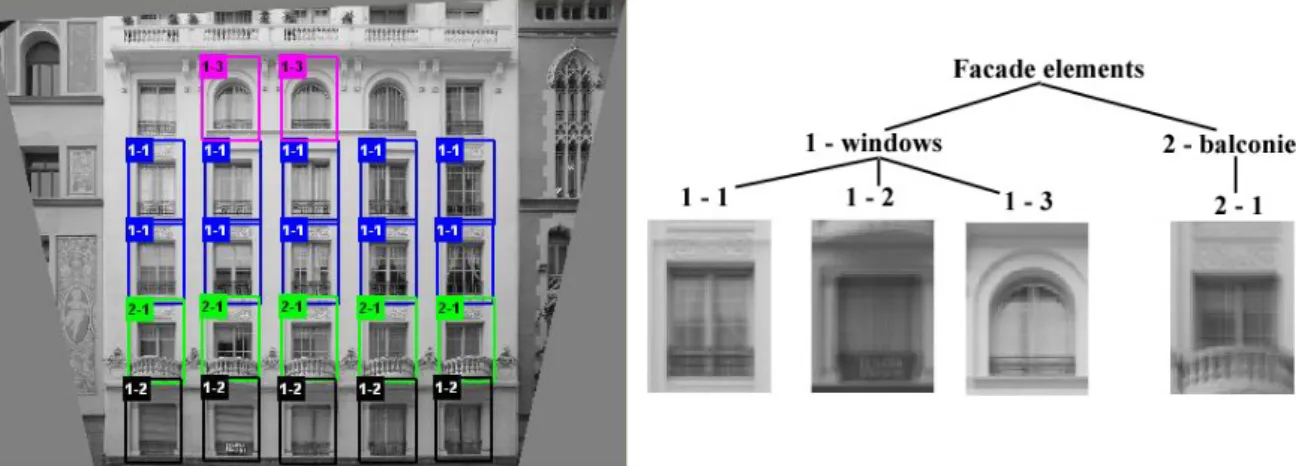
This section gives an overview of different task that were addressed in the context of facade image interpretation. The final goal of urban reconstruction are highly detailed, semantically meaningful 3D reconstructed buildings. We start with early approaches in 3D building reconstruction which motivates the need of facade image interpretation. Further, many approaches, dealing with facade image interpretation, also aim at 3D reconstruction, from which we we also partially review those methods related to 3D facade reconstruction, focusing on the facade image interpretation part.There is a long history in 3D city modelling, either from aerial images or airborne laser scans or even from scanning maps Gruen (1997). Later, terrestrial images, as well as terrestrial laser scans, were used, too. Early work focused on three-dimensional reconstruction of buildings from aerial digital images, possibly deriving a digital elevation model as intermediate result, by modelling the objects using parametrized volume primitives together with application-specific constraints (Braun et al., 1995; Weidner and F¨orstner,1995). Gruen et al.(1995) give an overview of these works. There is no explicit facade modelling included in theses works. But, they became more detailed. For example, Werner and Zisserman(2002) aim at the fully automatic reconstruction of buildings from multiple uncalibrated images. They generate a coarse piecewise planar model of the principal scene planes and their delineations and model indentations and protrusions, such as windows and doors, but without recognising their semantics, cf. Figure 1.1. Thereby the facades are modelled implicitly and the visualisation is enhanced by adding texture to the geometric model.
1.3.1.1 Window Detection
One of the earliest approaches which directly aim at the detection and reconstruction of windows from images is shown in Lee and Nevatia(2004). They state that the detection of details of building facades is needed for high quality visualisation as well as semantic modelling, and identify windows as key elements for a detailed facade reconstruction, cf. Figure1.2. In the following, window detection was addressed in many works, either as main focus or intermediate result. Ali et al.(2007) perform
window detection through pure classification, cf. Figure1.3. Most approaches include object specific prior knowledge, either assuming a typical grid structure of windows within facades (Lee and Nevatia, 2004;Recky and Leberl,2010;Wenzel et al.,2008) or a typical geometry and appearance of windows (Cech and ˇˇ S´ara,2008), cf. Figures1.4to1.6. Different from that,Jahangiri and Petrou(2009) aim at detecting salient regions which they assume to be meaningful parts of the facade and which turn out to be windows in most cases, cf. Figure1.7. Most flexible in terms of structure of the window grid and appearance of single windows,Tyleˇcek and ˇS´ara(2010) aim at detecting windows, in single rectified facade images, by modelling shape, appearance, location, and neighbourhood relations of windows, cf. Figure1.8.
Different from the approaches before,Mayer and Reznik(2005) andReznik and Mayer(2008) aim at the detection of windows from image sequences. Deriving depth of found window hypotheses, they reconstruct these parts of facades which are dominated by windows, cf. Figure1.9.
A task, opposite from window detection, is addressed byBurochin et al.(2014). They use opening detection as indicator for the identification of blind facades, thus, facades without any openings, such as windows or doors, which is important for urban planing.
1.3.1.2 Semantic Interpretation through Pixelwise Labelling
Aiming at more than one specific facade object, next group of approaches perform a pixelwise labelling or facade segmentation. Berg et al. (2007) address image parsing using single, low resolutional, uncalibrated images as input. They first identify coarse regions, such as sky, foliage, buildings, and street, and at a finer level of detail, they further identify the positions of windows, doors, rooflines, and the spatial extent of particular buildings, cf. Figure1.10. Similarly,Fr¨ohlich et al.(2010) model eight classes for pixelwise classification, whereby, they do not take any structural meta knowledge about facades into account, cf. Figure1.11.
Using high-level interpretation methods, cf. Section1.3.2,Teboul et al.(2010);Martinovi´c et al. (2012);Cohen et al.(2014) segment the images into 9 classes, which are window, wall, balcony, door, roof, chimney, sky, and shop, cf. Figure1.12. WhileTeboul et al.(2010) andCohen et al. (2014) rely on strong architectural constraints,Martinovi´c et al.(2012) and Kozi´nski et al.(2015) avoid strong prior assumption about the structure of facades and introduce weak architectural knowledge, which enforces the final reconstruction to be architecturally plausible and consistent, cf. Figure1.13. Kozi´nski et al.(2015) even model occlusions as extra class and are able to reconstruct the facades structure even if it is partly occluded, cf. Figure1.14.
Figure 1.1: The 3D building reconstruction, as shown inWerner and Zisserman (2002), is given as piecewise planar model including indentations and protrusions, which we may identify as windows. The geometric representation is attached with texture, given by the images, but no semantic information is extracted.
Figure 1.2: Window detection and reconstruction from single view rectified images, as shown inLee and Nevatia (2004). Left: Gradient projection. Right: Results after grouping similar elements and adding depth by plane sweep.
Figure 1.3: Results of window detection using an AdaBoost classifier, as shown inAli et al.(2007).
Figure 1.4: Results of window detection based on gradient projection, as shown inRecky and Leberl (2010).
Figure 1.5: Results of semi-supervised window detection, as shown in Wenzel and F¨orstner(2008).
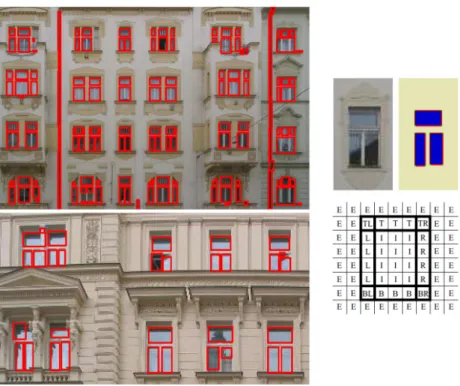
Figure 1.6: Results of window pane detection, as shown in Cech and ˇˇ S´ara (2008). Left: detected window panes. Right: labelled image patch and allowed configuration of labels (E external, I -internal windowpane label, (L,R,T,B) - (left, right, top, bottom edge), (TL, TR, BL, BR) - corners ).
Figure 1.8: Results of window detection, using a hierarchical generative model, as shown inTyleˇcek and ˇS´ara(2010). They show results for modern regular, irregular, and sparse facades.
Figure 1.9: Result of window detection and 3D reconstruction, as shown inReznik and Mayer(2008). Found window hypotheses are marked as red boxes.
Figure 1.10: Facade image parsing, as shown inBerg et al.(2007). From left to right: input image, three intermediate results of the parsing procedure, final result (red: found windows, yellow: roofline).
Figure 1.11: Pixelwise labelling of facade images, as shown inFr¨ohlich et al.(2010). Columns 1 and 4: original image. Columns 2 and 5: ground truth. Columns 3 and 6: result.
Figure 1.12: Facade image segmentation on Haussmannian buildings, as shown inTeboul et al.(2010).
Columns 1 and 4: original images. Columns 2 and 5: pixelwise classification. Columns 3 and 6: segmentation with procedural shape prior.
Figure 1.13: Results of facade image segmentation, as shown in Martinovi´c et al.(2012). They show results on complete building images, and furthermore, on facades showing less structure.
Figure 1.14: Results of facade image segmentation, as shown inKozi´nski et al.(2015). They explicitly model occlusions, and in the sequel, they predict the facades structure even it is partly occluded. From left to right: original image, pixelwise classification, segmentation with occlusion, extracted facade structure.
Figure 1.15: Result as shown in Alegre and Dellaert (2004). Left: original input image. Right:
inferred model.
1.3.1.3 Exploiting Repetitive Structures
Some of the aforementioned approaches implicitly exploit the repetitive character of facade elements in terms of similarity of facade objects (Lee and Nevatia, 2004; Wenzel and F¨orstner,2008). In order to provide a compact description of facades or to predict hidden or occluded facade objects, another group of works aim at exploiting the repetitive structures within facade images. Using the knowledge about structure of repeated objects, they are able to predict missing detections (Spinello et al.,2010; Musialski et al.,2009). They are partly able to deal with different lattices within one image (Wendel et al., 2010; Spinello et al., 2010; Park et al., 2010), but except Wenzel et al. (2007), there are no nested grids modelled.
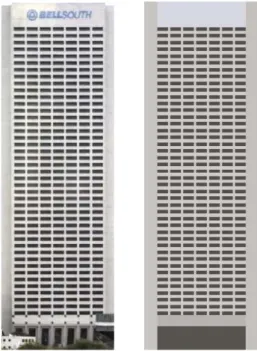
Alegre and Dellaert (2004) aim at a semantic interpretation of building facades and a compact representation of a hierarchical regular structure of a facade in terms of exact metric and semantic information, in order to provide highly structured descriptions of buildings. They use rectified images from modern office blocks, thus, showing regular grids of windows, cf. Figure1.15. They do not claim to detect repeated structures, but they use them for modelling, see the description of methods, cf. Section1.3.2.
Wenzel et al.(2007) andMusialski et al.(2009) aim at the detection of translational and reflective symmetries from single rectified facade images. Wenzel et al. (2007) derive hierarchically nested repeated translational symmetries, in order to provide a compact image description, cf. Figure1.16. Musialski et al.(2009) aim at grids with simple structure and propagate the found symmetries over the whole image to remove unwanted image content, e.g., noise or occlusions, cf. Figure1.17. Also Spinello et al.(2010) andPark et al.(2010) exploit repetitive object patterns for model compression and completion, but are not restricted to rectified images. WhileSpinello et al.(2010) allow for more complex window grids compared toMusialski et al.(2009), cf. Figure1.18,Park et al.(2010) deal with different lattices on different object planes, i.e. facades, within one image, cf. Figure1.19. Recently, Teeravech et al. (2014) aim at decomposing facade images into floors and tiles by discovering the repetitive patterns of the dominant structures, such as windows and balconies.
Different from the approaches before, Wendel et al. (2010) aim at the segmentation of facades. Using single, not necessarily rectified images showing a frontage consisting of different buildings, they use the results of detecting repetitive structures as a feature to split the frontage into facades of
Figure 1.16: Result of nested repetitive structure detection, as shown inWenzel et al.(2007). The graph on the right visualises the compact description in terms of found repetitions. Vertically, there is one object repeated five times. Horizontally, there is a nested repetition: a larger group which is repeated 3 times and contains another group of two windows, which corresponds to one repetition.
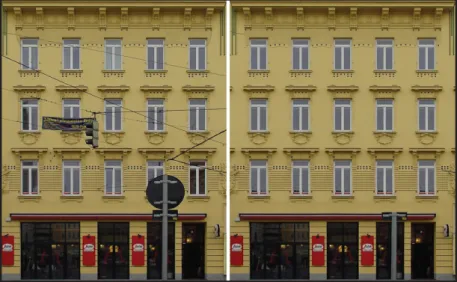
Figure 1.17: Result of propagating found repetitive structure for image restoration, as shown in Musialski et al.(2009).
Figure 1.18: Detecting and completing repetitive structure for image compression, as shown inSpinello et al.(2010). From left to right: extracted self-similar objects, conditional random field lattice and inferred position of objects, reconstruction of the image based on model compression.
Figure 1.19: Translational-symmetry-based perceptual grouping, as shown in Park et al. (2010). Different colours mean different groups.
individual buildings. Thereby, they close the gap between real-data and assumptions made for several algorithms, e.g., images showing a single facade.
1.3.1.4 Semantic 3D Reconstruction
Finally, the overall goal is the reconstruction of highly detailed, semantically meaningful, three dimensional models. To the best of our knowledge, Dick et al. (2004) first describe an automatic acquisition of three dimensional semantic architectural models, cf. Figure1.20. They use short image sequences as input and describe buildings as a set of walls together with what they call a Lego kit of parametrised primitives, such as doors or windows.
Brenner and Ripperda (2006) and Ripperda (2008) address the extraction of building facades in terms of a structural description in the form of a derivation tree which they use to derive a 3D reconstruction, cf. Figure 1.21. They use images as well as LIDAR data as input. Similarly, Schmittwilken and Pl¨umer(2010) aim at the reconstruction and classification of facade parts from 3D point clouds.
Van Gool et al.(2007) and M¨uller et al.(2007) semi-automatically derive 3D models of high visual quality, including a meaningful hierarchical facade subdivision, from single rectified facade images of arbitrary resolutions, cf. Figure1.22.
1.3.2
Methods Used for Facade Image Interpretation and Reconstruction
This section reviews the methods used to solve the aforementioned tasks. They partly deal with three-dimensional reconstruction using methods from multi-view geometry, including estimating vanishing points (Werner and Zisserman, 2002; Zhao et al., 2010) or plane sweep (Werner and Zisserman,2002;Lee and Nevatia,2004;Mayer and Reznik,2005;Reznik and Mayer,2008). We are dealing with single images solely and do not estimate nor use three-dimensional information. Therefore, we do not go into detail of these methods. We are interested in these methods related to single view facade image interpretation.1.3.2.1 Detecting Regions of Interest
In order to detect regions of interest in the image, such as windows, there are two main trends: either using gradient projection to find aligned edges or using a classificator that detects regions of interest
Figure 1.20: Result of semantic 3D reconstruction with added generic texture, as shown inDick et al. (2004).
Figure 1.21: Grammar based facade interpretation. Top: Semantic partitioning of a facade and the according derivation tree, as shown inBrenner and Ripperda(2006). Bottom: reconstruction results, as shown inRipperda (2008)
Figure 1.22: Results as shown inM¨uller et al.(2007). From left to right: rectified facade image as input, facade automatically subdivided and encoded as shape tree, resulting polygonal model, rendering of final reconstruction.
searching over the image. The former is restricted to facade types whose windows fulfil an alignment assumption, while the latter do not take any alignment or structure assumption, respectively, into account.
Gradient Projection. Gradient projection was one of the first methods used for window detection, based on the observation that facades are often characterised by grids of windows, aligned horizontally as well as vertically. It was introduced in the pioneering work ofLee and Nevatia(2004).
Defining windows as homogeneous rectangles in the images, window detection is based on horizontal and vertical gradient projection. WhileLee and Nevatia(2004) andTeeravech et al.(2014) use rectified images, which allow for gradient projection in order to directly detect outlines of windows,Recky and Leberl(2010) do not assume rectified images and use vertical gradient projection to identify splits within the facades, thus, floors. This also prevents strong assumptions of vertical alignment of facade objects, as they perform horizontal gradient projection within these stripes. The latter is also done by Teeravech et al.(2014). However, using rectified or non rectified images is not essential, as rectification, using vanishing point estimation, is straight forward using facade images (Schaffalitzky and Zisserman, 2000).
In the following,Lee and Nevatia(2004) group found candidates to get different window classes and use them to adjust the window grid. Grouping and classification, respectively, is based on normalised cross-correlation of image content and a dimensional similarity depending on geometric features of each candidate. Furthermore, they detect arc-shape windows within found candidates in a Hough voting scheme. Recky and Leberl(2010) analyse and label resulting image blocks with a greedy procedure based on the gradient content and a k-means clustering of colors in Lab-colorspace, respectively. As already mentioned above,Teeravech et al.(2014) do not aim at window detection, but at decomposing facade images into floors and tiles by discovering the repetitive patterns of the dominant structures, such as windows and balconies. They interpret the accumulated horizontal and vertical histogram profiles of gradients as a series of noisy wave cycles. Assuming them to represent the approximated position and dimensions of repetitive elements, they discover repetitive pattern from the dominant frequency by iteratively fitting candidate sine waves using a RANSAC-styled algorithm.
Obviously, all of these approaches rely on strong alignment assumption. WhileLee and Nevatia (2004) presume strong alignments of facade elements in horizontal and vertical direction,Recky and Leberl(2010) and Teeravech et al.(2014), nevertheless, still require strong horizontal alignment to achieve high-quality results. As a sequelLee and Nevatia(2004), as well asTeeravech et al.(2014), show results on rectified images showing large repetitive structures. The latter even use images containing the facade, solely.
Object Detection Detection of regions of interest, mainly windows, from bottom-up, is done in different ways.
Ali et al.(2007) perform window detection using an AdaBoost classifier. They do not exploit any prior knowledge about regularities or alignments, cf. Figure1.3. Jahangiri and Petrou(2009) aim at detecting salient regions which they assume to be meaningful parts of the facade. They define “blobs” as regions containing some variation, i.e. local texture, and that are roughly convex. This is thought as input for further analysis by a higher level interpretation module. Their extraction of blobs is based on the use of Gaussian kernels and mathematical morphology and is independent of scale and color. Their final output are bounding boxes of detected blobs, cf. Figure1.7.
Wenzel and F¨orstner(2008) propose an incremental learning scheme, based on repeated template matching using normalised cross-correlation, to get a class hierarchy of repetitive structure, cf. Figure1.5. Given one object of interest, manually labelled by the user, they automatically identify prototypes of image patches and use them to build a hierarchical appearance based model, in a supervised manner.
Compared to gradient projection methods, these approaches yield inferior results in terms of completeness (Ali et al., 2007) and distinctiveness (Jahangiri and Petrou, 2009). On the other hand they are more flexible due to perspective distortion (Ali et al., 2007) and loose structure of facade elements (Jahangiri and Petrou,2009). Due to repeated template matching, using normalised cross-correlation,Wenzel and F¨orstner(2008) need rectified facade images again, but do not use any alignment assumptions.
1.3.2.2 Bottom-up Pixelwise Labelling
In contrast to the detection of regions of interest, another group of approaches perform a pixelwise labelling or facade segmentation. They either combine a strong pixelwise classification, e.g., random forest, with an unsupervised segmentation (Fr¨ohlich et al., 2010; Teboul et al., 2010) or perform a hierarchical segmentation. Therfor, they first parse the image into a coarse set of classes which they further parse into more detailed classes using meta knowledge from coarse level of detail (Berg et al., 2007;Zhao et al., 2010).
For example, purely bottom-up, thus, without taking any structural meta knowledge about facades into account,Fr¨ohlich et al. (2010) introduce the combination of a strong pixelwise classification with the result of an unsupervised segmentation. They apply a random forest classifier to each pixel to get classwise probabilities and assign labels to each segment, given by the maximum average probability taken from the pixelwise classification, cf. Figure1.11.
But, purely bottom-up, these results lack in accuracy. Berg et al.(2007) andTeboul et al.(2010) combine results of pixelwise classification with methods from top-down, see below.
Recently,Jampani et al.(2015) proposed to use a sequence of boosted decision trees with what they call auto-context features. Thereby, they make use of typical architectural structure principals, while avoiding to fix them trough strong constraints. By learning the features in the surrounding of predictions from the layer before, they are able to learn the structure from data. The principle is similar to the idea from deep learning using a convolutional neural network.
1.3.2.3 Detecting Repetitive Structures
Exploiting repetitive structures, in the domain of facade images, usually deal with a large number of observations, trying to find these groups of observations that indicate the dominant translation. Therefor, these approaches either use Hough-like voting schemes (Wenzel et al.,2007;Musialski et al., 2009; Wendel et al., 2010; Spinello et al., 2010) or obtain a robust estimate using RANSAC (Park et al., 2010; Teeravech et al.,2014).
Wenzel et al.(2007) detect reflecting and translational symmetries based on matching SIFT features within a single rectified image. Therefrom, they derive a compact description of hierarchically nested repeated translations from the Hough-votes of found translations. They further evaluate identified translational symmetries based on minimal description length (MDL) as model selection criterion, cf. Figure 1.16. Similarly,Wendel et al. (2010) detect and match interest points within the image, but instead of matching them directly, they use color intensity profiles, between all of them, to get
corresponding profiles. Musialski et al.(2009) use normalised cross-correlation to match regions of small size, within the image, over several scales, similar toWenzel and F¨orstner(2008).
Different from these approaches,Park et al. (2010) detect a complementary set of features and group them by mean-shift into potential groups of similar features that possibly form a lattice. Different lattices are evaluated by RANSAC.
All these approaches yield reasonable results and might be used as mid-level tool in order to guide a high-level interpretation module, e.g., to guide the splitting procedure in grammar based approaches, see below.
1.3.2.4 High-Level Facade Interpretation
In order to derive highly detailed, semantic meaningful, partly even three-dimensional models, we need high-level interpretation. Most of these approaches use generative stochastic modelling, grammars or Markov random fields. Also marked point processes are used for facade image interpretation, which belong to generative stochastic modelling, too. But, we discuss these methods in a separate paragraph, as the modelling of prior knowledge from top-down is different from those we mention before.
Generative Stochastic Modelling. We summarise a large group of approaches under the term generative stochastic modelling that use generative models, thus models which are suited to generate synthetic samples of objects they modelled, and which are optimised by stochastic sampling, usually Markov chain Monte Carlo (MCMC), cf. Section2.6.
Dick et al.(2004) describe the automatic acquisition of three dimensional architectural models from short image sequences. Top-down, they aim at organising a given image into semantically meaningful parts by stochastically varying models. They describe a building as a set of walls together with what they call a Lego kit of parametrised primitives, such as doors or windows. Priors on wall layout, and on the parameters of each primitive are defined by experts and learnt from training data, respectively. Changing the parameters (as width, aspect ratio, brightness, etc.) usingMCMCsampling, they try to generate the image which is most similar to the given image. With this work, they prove the great potential and applicability of generative stochastic modelling.
In order to detect windows in image sequences,Mayer and Reznik(2005) train a window classifier and cope with structure usingMCMCto estimate parameters of windows, such that they are of same size and aligned. Therefor, they first determine facade planes by robust least squares matching between images of the sequence. The detection of window hypotheses is done by learning an implicit shape model. Changing the parameters of the model, as width, aspect ratio, or brightness withinMCMC they try to generate the image which is most similar to the given image. InReznik and Mayer(2008) they continue this work. Based on plane sweep, similar toWerner and Zisserman(2002), they derive depth information of facade objects, cf. Figure1.9. Some heuristics and again aMCMCprocess are used for self diagnosis of found window hypotheses. However, they only address windows as facade elements.
Also for the detection of windows, but in single rectified facade images,Tyleˇcek and ˇS´ara(2010) propose a complex generative model, where they include object geometry as well as neighbourhood relations. This way, they have a flexible configuration model for the window positions. They formulate a generative model with parameters for complexity, shape attributes, location attributes, and element neighbourhood relation. The recognition task is formulated as optimisation task of the joint density over the parameters. The joint density is decomposed hierarchically into several prior densities for each parameter group. They apply reversible jump Markov chain Monte Carlo (rjMCMC) sampling, cf. Section2.6.4, to find the optimal parameters. They show results even on irregular facade structure, cf. Figure1.8, but they do not show images with occlusions or high variability in window types.
Grammars. A shape grammar is a set of rules to generate geometric shapes. It consists of rules about the shapes itself and about the process how to combine these rules. Wonka et al.(2003) introduced shape grammars into the field of computer graphics for the generation of realistic building models. These grammars are context-dependent and therefore, difficult to obtain efficiently. Alegre and Dellaert
(2004) first demonstrate the potential of stochastic context-free grammars to represent a hierarchical regular structure of a facade. They use rectified images from modern office blocks, thus, showing regular grids of windows which they recursively split into parts using the rules of the grammar and rjMCMC for optimization, cf. Figure1.15.
LaterBrenner and Ripperda(2006) andRipperda(2008), in their pioneering work to the use of formal grammars for semantic 3D reconstruction, use a formal grammar to derive a structural facade description in the form of a derivation tree. They add variables and constraint equations to the symbols of the grammar. Thus, the derivation tree automatically leads to a constraint equation system. This equation system can be used to optimally fit the entire facade description to given measurement data. The application of derivation steps during the construction of the tree is done byrjMCMC, again. In Ripperda(2008) they further derive prior facade information from a set of facade images in order to support the stochastic modelling process, cf. Figure1.21. However, they assume 3D data, e.g., from LIDAR, and additionally images as input.
Van Gool et al.(2007) andM¨uller et al.(2007) combine procedural modelling which is a rule-based modelling technique known from computer graphics, with shape grammars and image analysis to derive a meaningful hierarchical facade subdivision, cf. Figure1.22. Splitting is done recursively, evaluating horizontal and vertical image content. Based on mutual information they search for irreducible tiles, e.g., vertical stripes which do not contain repetitions. The splitting is represented by a tree which allows the derivation of a set of rules for a grammar. The depth of found basic elements is generated semi-automatic by a manual user input.
Different from that, Teboul et al. (2010) do not aim at semantic 3D reconstruction, but at the segmentation of building facades using procedural shape priors, cf. Figure 1.12. They formulate what they call a constrained generic shape grammar to express special types of buildings and train a random forest classificator to determine a relationship between semantic elements of the grammar and the observed image support. Thus, a pixelwise classification is used as low-level input for the grammar. For model selection they formulate an energy. Thus, segmenting the facade is viewed as choosing those rules which generate a facade that best fits the image in terms of the energy given by the probabilistic output of the classifier. In their preceding work (Teboul et al., 2013), they include reinforcement learning. In this work, in contrast to Teboul et al.(2010), they avoid strong prior assumption about the structure of facades. They show how the procedural rules of a shape grammars can be derived based on the segmentation, rather than vice-versa.
We see that parameters of the grammar are estimated either usingMCMCsampling (Dick et al., 2004;Alegre and Dellaert,2004;Brenner and Ripperda,2006;Ripperda,2008) or directly determined during a recursive splitting and merging procedure (Van Gool et al.,2007; M¨uller et al.,2007). All of them deal with more or less long pipelines including feature detection, 3D reconstruction, maybe a region or pixelwise classification, and high-level reasoning in terms of grammar parsing. Nevertheless, all approaches are restricted either to the type of facades the grammar was designed for or to facades with simple structure.
In the context of 3D building reconstruction from point clouds,Becker (2009, 2010) propose to infer production rules of a formal grammar automatically and fully bottom-up from observed parts of facades. For these parts, they assume point clouds and images to be given. They aim at the geometric refinement of planar building facades, therfor they apply learned rules top-down to generate facade structure for the non observed parts of the building. AlsoDehbi and Pl¨umer(2011) proposed to learn the rules of a grammar. Their approach is based on Inductive Logic Programming. They extend context-free grammars by attributes and semantic rules, and link them with logic programs. Recently, Dehbi et al.(2016) continue this work to the automatic learning of the rules of a weighted attributed context-free grammar. They learn parameters and constraints of the grammar using Markov Logic Networks which combine probabilistic graphical models with logic and are strongly related to MRFs. Similar to our work, they are able to model facades with an a priori unknown number objects and learn the prior knowledge that is needed for top-down interpretation, from data.
Dynamic Programming. Dynamic programming is a method for optimization using the divide and conquer principle. It breaks down the whole problem into simpler subproblems which probably occur several times, solves these small problems, stores their solutions and uses them whenever they are needed for solving the whole task.
Recently,Cohen et al.(2014) propose to use dynamic programming for efficiently parsing facade images. They also introduce strong architectural constraints in order to obtain a reliable and consistent interpretation result. But, instead of parsing the facade using a predefined and fixed set of rules in terms of a grammar, they sequentially parse the individual classes according given constraints, which make the process more flexible to different types of facades. However, they still rely on strong architectural structure. Constraints, as well as according parameters, to apply for each type of facade, are predefined by the user.
Markov Random Fields. MRFs are graphical models which express the joint density of random variables within an undirected graph. Thereby, nodes and edges of the graph represent the random variables, i.e. objects, and their neighbourhood relations. They could be labels of pixels in a regular grid or complex objects whose neighbourhood relations are fixed by the graph.
Thus, by introducing neighbourhood relations,Berg et al. (2007) propose the two-step corse-to-fine parsing by first parsing the image into coarse regions, such as sky, foliage, buildings, and street, and second, into a finer level of detail, identifying the positions of windows, doors, rooflines, and the spatial extent of particular buildings, cf. Figure1.10. Both steps are based on a conditional random field (CRF) formulation, whereas the approach uses unary potentials in the first, while unary and pairwise potentials in the second step. Thus, the detailed parsing considers neighbourhood relations based on the underlying coarse parsing.
Through pixelwise labelling and incorporating, in this case pixelwise, neighbourhood relations,Cechˇ and ˇS´ara(2008) detect windows. They identify window panes as characteristic part of windows, which implicitly lead to the detection of windows. Using single orthographic rectified images of building facades, they define window panes as axis-parallel rectangles of relatively low variability in appearance. The detection of window panes is formulated as a task of maximum a posteriori labelling in a Potts model, thus a Markov random field (MRF). Every image pixel has one out of 10 possible labels, and the adjacent pixels are interconnected via links which define allowed label configuration, such that the labels are forced to form a set of non-overlapping rectangles, cf. Figure1.6. Thus, they get a strongly structured model, forcing the labels to form rectangles. Their approach allow for low variability in appearance of windows, and obviously they are restricted to the special type of windows they modelled.
Yang and F¨orstner(2011) combine a pixelwise classifier from bottom-up with a hierarchicalCRF for top-down interpretation. They use the probabilistic outputs of a random forest classifier as unary potentials and the spatial and hierarchical structures of the regions, they segmented before, within the pairwise potentials. Thus, they encode within the hierarchical model inter-class location information in terms of high-order potentials.
Similarly,Martinovi´c et al.(2012) propose a three-layered approach for semantic segmentation of building facades, cf. Figure1.13. They start from an oversegmentation of a facade and produce probabilistic interpretations for each segment, using Recursive Neural Networks. The initial labelling is merged with the output of a specialised facade component detectors formulating aMRF. They also introduce weak architectural knowledge, which enforces the final reconstruction to be architecturally plausible and consistent.
Kozi´nski et al. (2015) propose to express architectural prior knowledge into a set of hierarchical rules over different semantic classes that specify which pairs of classes can be assigned to pairs of vertically- and horizontally-adjacent pixels. They transfer those rules into the structure of a MRF. They handle occlusions and therefore, are able to recover partly occluded facades and to infer their structure.
Marked Point Processes. Point Processes are stochastic processes which allow to handle configura-tions of objects, without specifying their number. They are most flexible in defining the neighbourhood
relations of objects and can be seen as generalization ofMRFs, cf. Section2.5. They are used in image processing for the detection of dense object configurations, as tree crowns on agricultural farms or birds from remotely sensed images or cars in urban environment. Recently they were introduced in the field of facade image interpretation.
In order to detect openings in facades as indicator for the classification of blind facades,Burochin et al.(2014) formulate a stochastic process to sample rectangles in image polygons, formerly identified as facades, from oblique aerial images. Due to perspective distortions the resolution of rectified images is low in vertical direction, images are noise and contain shadows. Given these conditions they define openings as dark rectangles with respect to the wall background. As the detection results are dedicated as indicator for the classification of blind facades, beside other features, they obviously do not require complete and precise detections. But, to the best of our knowledge this is the first approach dealing with marked point processes in the context of facade image interpretation. Their energy model consist, as usual, of a data term and a prior term, weighted by a regularisation factor. The data term depends on the gradient information on the edges of proposed rectangles, while the prior term solely penalizes overlapping rectangles and does not consider any other configuration constraints. Optimization is done byrjMCMCwith simulated annealing.
RecentlyWang et al.(2015) propose structure-driven facade parsing using a marked point process. In fact they solely deal with windows as facade objects for which they derive multiple grids within the image. They propose an energy formulation whose data term depends on a probability map given by a pixelwise classification. The prior term consist on a repulsive term scoring interacting rectangles in terms of their horizontal and vertical distance. Interestingly, they do not model the assumed grid structure of windows within the prior energy, but through a structure-driven sampling during a multiple birth and death optimisation. Their results are not convincing compared to state-of-the-art results, such asTeboul et al.(2011);Martinovi´c et al.(2012);Kozi´nski et al.(2015). But, the concept of sparse and data-driven sampling via marked point process seems to be promising and worth being continued.
1.3.3
What we Learned, Tasks Solved, and Open Issues
Early approaches deal with the detection of particular facade objects, thereby, either assume large regular structures, at least in one direction (Lee and Nevatia,2004;Recky and Leberl,2010), or they allow for low variability in appearance of these objects, or even are restricted to the special type of windows they have modelled (Cech and ˇˇ S´ara,2008).
Pure bottom-up approaches lack in accuracy, as no prior knowledge is used to adjust the results (Fr¨ohlich et al.,2010). Most approaches that deal with pixel- or region-wise bottom-up classification or object detection, respectively, rely on standard features, e.g., colour intensities, gradients, or thereof derived features. These sets of features are defined beforehand and fixed for the approach and the given data. We have seen that learning such features, e.g., by an implicit shape model which is related to bag of words (Mayer and Reznik, 2005), or by boosted classification trees (Jampani et al., 2015) yield reliable results and is highly flexible according the given data.
For the task of semantic interpretation, incorporating prior knowledge through grammars yield state-of-the-art results. However, they rely on fixed, predefined, often hand crafted rules (Brenner and Ripperda, 2006;Ripperda,2008;Teboul et al.,2010). Their is no generalisation to other facade layouts. In order to produce highly detailed 3D models, procedural modelling combined with shape grammars is still semi automatic (M¨uller et al.,2007). However, there is clearly a need to learn the rules of a grammar from data (Teboul et al.,2013;Dehbi et al.,2016).
UsingMRFs, the structure of the underlying graph is fixed, either predefined in terms of fixed neighbourhood relations pixel- or region-wise (Cech and ˇˇ S´ara,2008;Kozi´nski et al.,2015) or derived from the results of a segmentation (Yang and F¨orstner,2011;Martinovi´c et al.,2012).
Most flexible in terms of structure and number of objects are marked point processes. But, their usage in the context of facade image interpretation is still at the very beginning. Recent results are not convincing. There is clearly a need for strong data terms related to the image content and for concepts how to incorporates our prior knowledge about facades structure into the en-ergy. Further, there is a need for the automatic derivation of according rules through learning from data.
We learned that the incorporation of prior knowledge from top-down, assuming evidence from bottom-up is essential in order to obtain reliable and accurate results. Thereby, the top-down approach uses the results of the bottom-up detection step or classification result, respectively, as evidence for the occurrence of objects. Grammars are used for that task most frequently, but learning their rules automatically from data is still in the beginning. We believe that marked point processes could serve as competitive approach to grammars, as they are most flexible in terms of their structure and number of objects.
In order to obtain bottom-up evidence, we believe that learning the representation of objects we aim at, is essential in order to avoid pre-defined, manually chosen and fixed sets of features for the classification.
1.4
General Concept and Organisation of the Thesis
We are now prepared to describe our concept for facade image interpretation. This section provides an overview of the systems architecture and the structure of the thesis. We will motivate all tasks and subtasks and assign them to their chapters and sections.
In the last section, we have seen, and most aforementioned approaches make use of it, that man-made objects, especially facades are well structured. We observe floors, symmetries, and repetitive elements. These structural concepts impose constraints on an image interpretation system. We aim at an image interpretation system which combines evidence from bottom-up and prior knowledge about these constraints from top-down. Thereby, we use evidence from bottom-up given by an object classifier which uses aggregates of line segments as features to describe the image content. We incorporate prior knowledge from top-down through a configuration model that describes typical configurations of facade objects that we learned from training data. Thereby, the term configuration depicts size and location of individual objects and their pairwise relations in terms of alignment, distance, and size differences.
Main focus of this work is the image interpretation from top-down. But, in order to provide evidence for the occurrence of objects in the image, we propose the according framework for representation and classification of image section.
In the following, in order to avoid confusion with the term line, we denote bystraight line segmentthe shortest path, between two points on the euclidean plan. Vice versa, the terms line and line segment inherently include curved paths such as circular and elliptical line segments.
Line segments reveal a large invariance to shadows and changes in illumination. Especially windows show a large variety in appearance, in particular due to the mirroring of other objects in the window panes. The overall characteristics of facade objects, inherently man-made, let line segments appear as promising image features. Due to decorative elements and varying shapes of facade objects, in particular windows and doors with arc-type scuncheon, curved lines segments further enrich the expressive power of line features. Further, aggregates of line segments show a large distinctiveness for certain object categories of facades. This motivates our approach for the extraction of our particular features from bottom-up and our representation at mid-level.
Input data are training images and their according annotations which label each pixel as member of one of the target classes. Please note that we represented each object in the image by its bounding box, for learning as well as detection. As target classes we aim at windows, balconies, and entrances which, from our point of view, are the most dominant and most important facade objects. The set of target classes can easily be extended by adding the according annotations to the training data.
We use terrestrial, single view and rectified images. Rectification is done in a preprocessing step using a semi-automatic algorithm which uses vanishing points to estimate to homography to transform the image to an ortho-rectified version. Due to the typical structure of facade images showing lots of