University of Barcelona
Master in Artificial Intelligence (UPC, URV, UB)
Faculty of Mathematics and Computer Science
Deep Learning for Universal Emotion Recognition in
Still images
Juan Luis Rosa Ramos
Advisors: Sergio Escalera, PhD in Multi-class visual categorization systems at Computer Vision Center
and Andr´es Cencerrado, PhD in High Performance Computing at University Autonoma Barcelonai
This work propose a methodology for still image facial expression. The proposed method con-tains a face detection and alignment module followed by a deep convolutional neural network (CNN) that outputs a seven emotions probability vector. The input images are human faces cropped and aligned thus, eliminating the variability of the dataset. Three CNN models where trained and tested with the purpose of recommending the best one in function of its the de-ployment environment so, their trade-off were take into account. They were build following a transfer learning approach, from pre-trained on face recognition models that were fine-tuned with a new face emotions dataset that was build from a collection of free, for research, available ones. There is also a data augmentation process made with the purposes of analyzing his influ-ence. Experimental results showed that the three models got more than acceptable accuracy and each one has his own advantages depending on the needs. More complicated models expend more training and inference timings but have more generalization capacities. The work also aims to compile an extensive information in face analysis datasets, training and inference times in two different Nividia GPUs. It explains the fine-tuning key points and insists in overfitting avoidance methods. It also has the purpose to serve as a software workflow guide for producing computer vision pipelines from zero to deployment helping to solve to other object classification problems. The best model is going to be deployed in a new driver awareness technology product that aims to avoid driving accidents.
—————————————————–
Este trabajo presenta una metodolog´ıa para el reconocimiento de sentimientos humanos a trav´es del an´alisis de expresiones faciales. Para ello, se resuelve un problema de clasificaci´on au-tom´atica de im´agenes. La metodolog´ıa propuesta contiene un m´odulo de detecci´on, recorte y alineamiento de caras (eliminando la variabilidad) seguido de una red neuronal convolucional (CNN) que devuelve un vector de probabilidades de siete emociones. En total, se han es-cogido, entrenado y testeado tres modelos diferentes de CNN con el prop´osito de poder hacer recomendaciones a usar en funci´on de las necesidades de puesta en producci´on. Las redes fueron entrenadas usando metodolog´ıa basada en la transferencia de conocimiento desde otras redes pre entrenadas con caras humanas. Fueron re entrenadas con un dataset construido ex profeso y con otro aumentado para testear la influencia de usar mas datos y clases m´as balanceadas. Una
serie de experimentos -en mismas condiciones y mismos par´ametros- nos ense˜nan que los tres modelos tienen niveles muy aceptables de acierto y que cada uno tiene sus particulares ventajas en funci´on de las necesidades: modelos mas complejos tardan muchas m´as horas en entrenar pero tienen mejores capacidades de acierto con nuevos tipos de datos. Este trabajo tambi´en compila una extensiva informaci´on sobre datasets de an´alisis facial, tiempos de entrenamiento e inferencia con distintas GPUs e incluso con CPU. Tambi´en incluye explicaciones sobre cu´ales son los puntos clave en metodolog´ıas de transferencia de conocimiento e insiste en como evi-tar que nuestras redes no tengan capacidad de generalizaci´on. El prop´osito de este trabajo tambi´en pretende servir una gu´ıa para aplicar la metodolog´ıa descrita a problemas diferentes al de an´alisis de caras y que se puedan resolver con clasificaci´on autom´atica de im´agenes ya que el flujo descrito va desde cero, hasta consejos de puesta en producci´on. El mejor modelo ser´a utilizado en una tecnolog´ıa de monitorizaci´on de conductores de veh´ıculos que lograr´a evitar accidentes en carretera.
—————————————————–
Aquest treball presenta una metodologia per al reconeixement de sentiments humans a trav´es de l’an`alisi d’expressions facials. Per a aix`o, es resol un problema de classificaci´o autom`atica d’imatges. La metodologia proposada cont´e un m`odul de detecci´o, retallada i alineament de cares (eliminant la variabilitat) seguit d’una xarxa neuronal convolucional (CNN) que retorna un vector de probabilitats de set emocions. En total, s’han escollit, entrenat i testejat tres models diferents de CNN amb el prop`osit de poder fer recomanacions a fer servir en funci´o de les necessitats de posada en producci´o. Les xarxes van ser entrenades usant metodologia basada en la transfer`encia de coneixement des d’altres xarxes pre entrenades amb cares humanes. Van ser re entrenades amb un dataset constru¨ıt expressament i amb un altre augmentat per testejar la influ`encia d’usar mes dades i classes m´es balancejades. Una s`erie d’experiments -en mateixes condicions i mateixos par`ametres- ens ensenyen que els tres models tenen nivells molt acceptables d’encert i que cada un t´e els seus particulars avantatges en funci´o de les necessitats: models m´es complexos triguen moltes m´es hores a entrenar per`o tenen millors capacitats d’encert amb nous tipus de dades. Aquest treball tamb´e compila una extensiva informaci´o sobre datasets d’an`alisi facial, temps d’entrenament i infer`encia amb diferents GPUs i fins i tot amb CPU. Tamb´e inclou explicacions sobre quins s´on els punts clau en metodologies de transfer`encia de coneixement i insisteix com evitar que les nostres xarxes no tinguin capacitat
de generalitzaci´o. El prop`osit d’aquest treball tamb´e pret´en servir una guia per aplicar la metodologia descrita a problemes diferents al d’an`alisi de cares i que es puguin resoldre amb classificaci´o autom`atica d’imatges ja que el flux descrit va des de zero, fins a consells de posada en producci´o. El millor model ser`a utilitzat en una tecnologia de monitoritzaci´o de conductors de vehicles que aconseguir`a evitar accidents a la carretera.
Keywords Facial Expression Recognition; Convolutional Neural Networks; Overfitting; Face analysis dataset
Contents
Abstract i
1 Introduction 1
1.1 Facial Expressions and Emotions . . . 1
1.2 Some applications . . . 2
1.3 Proposal . . . 3
2 Related work: emotions recognition 4 2.1 Early studies . . . 4
2.2 Description of emotions . . . 5
2.2.1 Categorical model . . . 6
3 Related work: automatic emotions analysis 7 3.1 Affective computing . . . 7
3.2 Automated face analysis with computer vision . . . 8
3.3 Related work on automated face analysis . . . 9
3.3.1 Main challenges . . . 9
3.3.2 Face detection and alignment . . . 10
3.3.3 Face analysis classification algorithms . . . 10
3.3.4 Inference in ConvNets . . . 11
4 Related Work: background on 2D CNN 13 4.1 Choosing a classification algorithm . . . 13
4.2 Main layers of a ConvNet . . . 14
4.2.1 Input layers . . . 14
4.2.2 Convolutional layers . . . 14
4.2.3 Dense layers . . . 14
4.2.4 Output layers . . . 15
4.3 CNN choosing a framework tool . . . 15
5 Contribution of this work 19 6 Dataset collection and augmentation 21 6.1 Related work: existing datasets . . . 21
6.2 Selected datasets . . . 25
6.2.1 The Japanese Female Facial Expression (JAFFE) Database . . . 25
6.2.2 The Extended Cohn-Kanade Dataset (CK+) . . . 26
6.2.3 Karolinska Directed Emotional Face(Kdef) . . . 26
6.2.4 Radboud Faces Database (Radboud) . . . 27
CONTENTS vii
6.2.6 Oulu-CASIA . . . 29
6.2.7 Dartmouth Database of Children’s Faces . . . 30
6.2.8 California Facial Expressions (CAFE) . . . 30
6.2.9 Face Place (Face) . . . 31
6.3 Constructed dataset . . . 31
6.4 Data augmentation . . . 32
7 Data preprocessing 36 7.1 Face detection and cropping . . . 36
7.2 Face alignment . . . 37
7.3 Dataset normalization . . . 39
8 Deeplearning: Training 2D convolutional networks 41 8.1 Fine-tuning CNN . . . 41
8.2 Avoiding overfitting . . . 42
8.3 Fine-tuning with Caffe . . . 43
8.4 ConvNets: pre-trained models . . . 44
8.4.1 Alexnet . . . 44
8.4.2 Alexnet weights . . . 45
8.4.3 VGG16 . . . 45
8.4.4 VGG16 weights . . . 46
8.4.6 Resnet weights: ResFace101 . . . 47
8.4.7 ImageNet dataset . . . 47
8.5 Methodology for training . . . 48
8.6 Computing resources . . . 48 8.7 Software resources . . . 50 8.8 Fine-tuning details . . . 51 8.9 Image inference . . . 52 9 Experimental methodology 56 9.1 Experimental settings . . . 56 9.2 Data distribution . . . 57 9.2.1 Original dataset . . . 57 9.2.2 Augmented dataset . . . 57 9.2.3 Test set . . . 57
9.2.4 Overfitting Test set . . . 58
9.3 Evaluation metrics . . . 58
9.4 Method details . . . 59
9.4.1 Parameters . . . 59
9.5 Analysis . . . 59
10 Dealing with overfitting 63 10.1 New experiments . . . 63
11 Testing inference in real drivers 66
12 Conclusion 74
12.1 Summary of Thesis Achievements . . . 74
12.2 Biased ConvNets . . . 75
12.3 Future Work . . . 75
Bibliography 76
List of Tables
6.1 Total numbers and class division of the images compiled for the dataset . . . 32
6.2 Augmented dataset final numbers . . . 35
8.1 Differences training with two different Nvidia Tesla GPUs . . . 50
8.2 Virtual machines used for training . . . 50
8.3 Software used for training . . . 50
8.4 Same parameters values used for training the three networks . . . 52
8.5 Comparison of the models time training with original and augmented dataset in a Tesla P100 GPU of 12 Gigas. . . 52
9.1 Final number of the dataset distributions. . . 58
9.2 Results of the six experiments . . . 60
9.3 Inference of 742 images time comparison using NvidiaP100 GPU or CPU . . . . 61
10.1 Comparison of the accuracies of the three models using different weights for training . . . 64
List of Figures
2.1 Primary emotions expressed on the face. From left to right: neutral, right, anger,
disgust, happy, sadness, surprise. . . 5
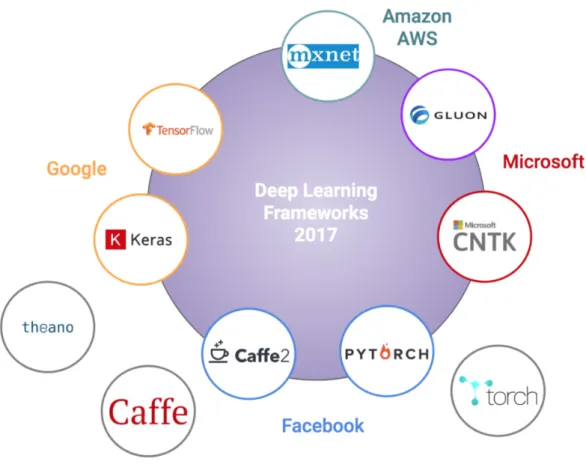
4.1 SOA of open source deep learning frameworks in 2017 . . . 17
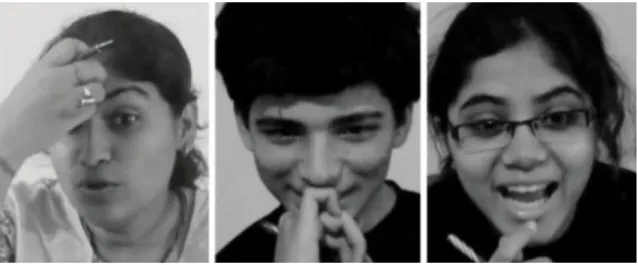
6.1 Occlusions caused by hands in spontaneous faces . . . 22
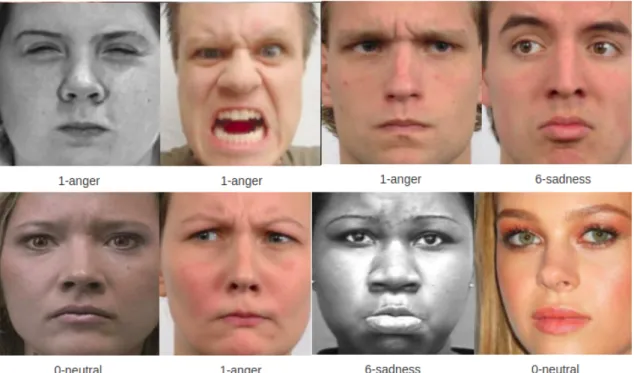
6.2 Differences and intensity in poses interpreting anger . . . 23
6.3 Some examples of FACS Action Units coding system . . . 23
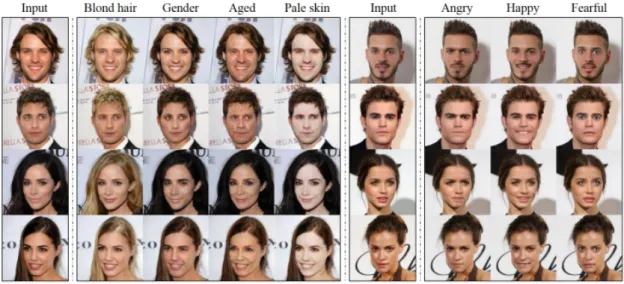
6.4 Translation results on the CelebA dataset by transferring knowledge learned from the RaFD dataset . . . 24
6.5 Transferring expressions in real time RGB videos from an human source to a human target in a youtube video . . . 24
6.6 Some samples of JAFFE database . . . 26
6.7 Some samples of CK+ database . . . 27
6.8 Some samples of Karolinska face Database . . . 28
6.9 Some samples of Radboud Faces Database . . . 29
6.10 Some samples of Pain expressions dataset . . . 30
6.11 A sample of Oulu-CASIA database. Built with three different cameras. . . 31
6.13 Data augmentation: Some examples of affine transformations . . . 34
7.1 Localization in the human face of 68 facial coordinate points . . . 38
7.2 Examples of face rotation and cropping finishing in face alignment . . . 40
8.1 VGG16 architecture image by Davi Frossard. . . 46
8.2 Mean image of the built dataset . . . 49
8.3 VGG16 fine-tuning and LR decreasing. . . 54
8.4 Loss curve stability differences between different LR (0,01 vs 0.001 in the bottom) 55 9.1 Some of the variety examples of the new dataset that were selected to trick the models . . . 62
10.1 Loss curves differences training Alexnet with different weights and same archi-tecture, dataset and LR . . . 65
11.1 Bad classification: the pose was tagged as anger but classified as sad . . . 68
11.2 No winning class in this predictions . . . 69
11.3 Extreme angle. Image was tagged as neutral . . . 70
11.4 Image tagged as happy. . . 71
11.5 Two good predictions. . . 72
11.6 Good predictions: happy and neutral classes were tagged . . . 73
12.1 Wrong classifications in biased classifiers. . . 76
Chapter 1
Introduction
1.1
Facial Expressions and Emotions
Emotions play a fundamental role in human cognition and they are an essential field in studies of cognitive sciences like neuroscience or psychology. They also play a role in marketing or product management as detecting happiness from a customer can be an evaluation that his/her goals are satisfied. Human emotions produce physiological changes (heart rate, breathing rate, perspiration, hormone levels or facial expressions) that can be automatically detected and interpreted. More specifically emotions can be estimated by facial inference since there is undoubtedly universal connections between emotions and facial expressions, independently of races, genders, ages or cultures. Spontaneous emotions arise even in blind individuals producing the same facial expressions as sighted individuals do [CMD04] and those facial expressions considered to be universal among humans have been observed in nonhuman [PDW07] primates. Human facial expressions communicates emotions and intentions studying them can infer us the observed mood and emotional states that affects our judgment and our decision process system.
1.2
Some applications
Automated study of facial expressions can help studies of visual perception, social interactions and disorders such as schizophrenia and autism leading to discoveries in areas that include detection of pain, frustration, emotions intensity, depression and psychological distress. Auto-mated face analysis can be crucial for Affective Computing a computing discipline research field covering a wide range from robotics to marketing or entertainment. In example, researchers have used facial analysis to spot struggling students in computer tutoring sessions making pos-sible to recognize different levels of engagement or frustration where the works were too easy or too difficult and thus, improving the learning experience in online platforms. Related to face analysis with computer vision techniques there has been some surprising experiments like the automatic identification of criminals [WZ16]. Researchers have developed a deep learning model trained with id photos and able to successfully identify around 83 per cent of the crimi-nals. Obviously, it is a nonsense to condemn someone by it’s ID photo but the results of those experiments linked to popular theories of physiognomy and creationism of the 17th century that assumed that a person’s character or personality could be judged by their outer appearance, especially the face. Furthermore, it also brings some criticism on the need and importance of policing artificial intelligence research and focus on the variety of datasets. Another application of face analysis should be related driver’s attention to the roads, crucial within the increase of assistance to driving systems. Driver drowsiness is the leading causes of traffic accidents and driver monitoring and risk alert must be more general and accessible. Nowadays, it is not the case and some techniques can only be used in certain driving conditions (breaking, lane departure) or make use of complicated sensors like electrical bio-signals that have no practical application. Computer Vision techniques that mainly concentrate on detecting eye closure, yawning patterns and the overall expression of the face or movement of the head are less intru-sive and more accessible to the general public as it can be integrated, in example, in a mobile phone.
1.3. Proposal 3
1.3
Proposal
The conclusions presented after the 5th EmotiW Challenge that took place during the 19th ACM international conference on Multimodal Interaction and can bee seen here were:
• Face and facial parts detection is a bottleneck.
• Deep learning based methods outperform traditional vision, machine learning methods.
• Transfer learning shown useful in several task.
• More labeled data and different emotion labeling strategies should be tested with.
This work aims to fine-tune three different convolutional neural networks (ConvNet) architec-tures with a new dataset for face analysis that was created expressly for this work. Knowing that there is no public pretrained ConvNet models for face expressions analysis and being emotion recognition a hot topic in disciplines like Human Computer Interaction or Affective Computing it is necessary to establish a baseline for future works. So, it will be built a dataset collecting the publicly available ones. This datasets will be used for training and testing differ-ent ConvNets architectures exploring throughout experimdiffer-entation the best recommendations and methods for fine tuning and measuring times in different hardware configurations. The presented work provides a methodology that covers from collecting data to inference systems passing through face detection and alignment methods. This methodology can be extended to other different purposes that can be solved with images or videos datasets. The best model was tested and integrated in a demo prototyping for driver assistance in a new product of a startup focused on mobility and road-safety in Barcelona.
Related work: emotions recognition
2.1
Early studies
Studies of the face were greatly influenced in premodern times by popular theories of phys-iognomy and creationism. Physphys-iognomy, without scientific support, assumed that a person’s character or personality could be judged by their outer appearance, especially the face. In the 17th century in England, John Buwler studied human communication with particular interest in the sign language of persons with hearing impairment. His book Pathomyotomia or Dissec-tion of the significant Muscles of the AffecDissec-tions of the Mind was the first consistent work in the English language on the muscular mechanism of Facial Expressions. About two centuries later and influenced by creationism, Sir Charles Bell investigated facial expressions as part of his research on sensory and motor control. Subsequently, Duchenne de Boulogne conducted systematic studies on how Facial Expressions are produced publishing photos of facial expres-sions obtained by electrically stimulating facial muscles. In the same historical period, Charles Darwin firmly placed facial expressions in an evolutionary context. He was one of the firsts to suggest the universality of facial expressions, his ideas about emotions were a centerpiece of his theory of evolution, suggesting that emotions and their expressions were biologically innate and evolutionarily adaptive, and that similarities in them could be seen phylogenetically. At the end of the 19th century he wroteThe Expression of the emotion in Man and Animals, which largely
2.2. Description of emotions 5 inspired the study of Facial Expressions of emotions. Darwin proposed that facial expressions are the residual actions of more complete behavioral responses to environmental challenges in example, constricting the nostrils in disgust served to reduce inhalation of noxious or harmful substances or widening the eyes in surprise increased the visual field to see an unexpected stimulus. In the XX century during the 70’s, Paul Ekman and Carroll Izard conducted what is known today as the “universality studies” demonstrating high cross-cultural agreement in judgments of emotions in faces by people in both literate and preliterate cultures (indigenous tribes). Friesen’s (1972) study documented that the same facial expressions of emotion were produced spontaneously by members of very different cultures in reaction to emotion-eliciting films.
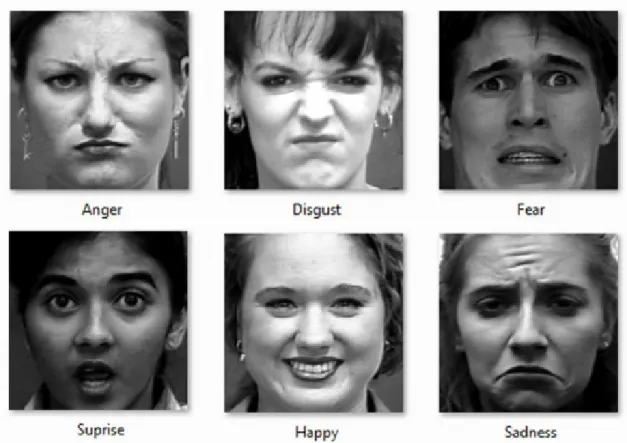
Figure 2.1: Primary emotions expressed on the face. From left to right: neutral, right, anger, disgust, happy, sadness, surprise.
2.2
Description of emotions
The psychologist Paul Ekman studies (beginning on the 60’s) stated that emotions are bio-logically innate, universal to all humans and displayed through facial expressions categorizing six basic emotions (scaling it up to twenty one lately). But, recent studies published by the Institute of Neuroscience and Psychology at the University of Glasgow [JGS14] affirms that the range of humans emotions may be limited to four so, there is not a definite classification model. In facial expressions analysis -in cognitive science and neuroscience- there has been two leading models for describing how humans perceive and express emotions: the continuous and the categorical model. The continuous model defines each facial expression as a feature vector in a face space having the ability of explaining different intensities of emotions. In contrast, the categorical model consists of C classifiers, each tuned to a specific emotion category in general
seven emotions classes: neutral, anger, disgusted, anger, happy, fear, sadness and surprise but without having the capacity of detect transitions between those states or the intensity of that emotions. Those six emotions plus the neutral one (or no expression) can be seen, represented by an actor, in the figure 2.1. Both models are used with good results but, science still strug-gling to define emotions Jaak Panksepp, the father of Affective Neuroscience, during the study of neural mechanisms of emotions, conceptualized affect as a set of seven distinct and basic categories: seeking, rage, fear, lust, care, panic and play. He concluded that, those emotions emerges not from the cerebral cortex but from deep ancient brain structures. On the other side, the social psychologist James Russell stated that all affects can be decomposed into two underlying dimensions: pleasure versus displeasure and low arousal versus high arousal.
2.2.1
Categorical model
Being the objective of this work to automatize the analysis and recognition of emotions with computing software it can be computationally less effective to choose a model that deals with fuzzy classes. The aim of the categorical descriptors are to classify emotions into a set of classes, easy to recognize and described in a daily language. Mainly because of its simplicity and its universality claim those basic descriptors are extensively exploited in affective computing and vastly used in research trying to detect affect of people from Facial Expressions. Although, the categorical model is not valid when it is needed to recognize expressions at different intensities or modes and it has problems explaining combinations of emotion such as happily surprised, angrily surprised or a morphing sequence (video in example) between a happy and a surprise face that are perceived as either happy or surprise but not something in between those.
Chapter 3
Related work: automatic emotions
analysis
3.1
Affective computing
It is an interdisciplinary field spanning computer science, psychology, and cognitive science that facilitates the study and development of systems and devices that can recognize, interpret, process and simulate human affects. Affective computing addressed the question of digitization and transmission of emotional experiences through monitoring and interpretation of physiolog-ical signals via sensors, microphone, cameras and software logic measuring signals like heart rate, blood pressure, blood-pulse volume,respiration, temperature, pupil dilation, skin con-ductivity and muscle tension. Combined measures of multiple autonomic signals that infers promising results as components of an emotion recognition system. Picard, Vyzas and Healey, for example, achieved 81% percent recognition accuracy on eight emotions through combined measures of respiration,blood pressure volume and skin conductance, as well as facial muscle tension. Experiments have been conducted throughout multimodal interaction like video plus audio where the subjects are exposed to stimuli and cardiovascular signals and electrodermal activities of the subjects (like galvanic skin response or skin temperature) are recorded. So far, this kind of evaluation techniques are only available in advanced research centers. However,
the advances in micro sensing technologies and research made the evaluation of human expe-rience considerably easier and more accessible to individuals without extensive background in psychophysiology. Thus, advances in pervasive computing and human computer interaction made affordable user-friendliness devices that helps development of cognitive engineering and benefits emotions detections being more effective. Into this fields of action, computer vision can help as a non intrusive technique, cameras are everywhere and inferring face emotions can help producing more enhanced products.
3.2
Automated face analysis with computer vision
Machine learning and computer vision researchers are creating computational models helping the studies and experimentation in social sciences. Furthermore, those models are essential for the development of artificial intelligence and robotics, also in human computer interaction (HCI) systems. The first works on automatically analyzing facial expressions were published in the late 70’s mostly of them -due to a poor face detection algorithms and limited computational power- received little attention throughout the next decade but the subject of study had a revival in the late 90’s when it was published the first big enough [LCK+10] public dataset
CK that is still in use in most of the works related to this subject. For achieving good results it is required strong preprocessing before classification algorithms. Multiple steps like face detection and face frontalization or alignment. This implies numerous challenges including some classical computer vision problems like non-frontal faces, occlusions (like sun glasses) different illuminations and also non inherit to computer vision problems like the fact that many facial expressions are inherently subtle making them difficult to model even for humans. Despite this challenges, machine learning and computer vision should proceed to successfully emulate the human capacity of emotions detection through the face and this should be achieved through computers because without any doubt it can aid visual perception, social interactions and disorders such as schizophrenia and autism.
3.3. Related work on automated face analysis 9
3.3
Related work on automated face analysis
3.3.1
Main challenges
Recently the Emotion Recognition in the Wild(EmotiW) challenge used categorical approach classification with imaging conditions close to real-life, including low and uneven illumination, low resolution, occlusions, non-frontal head-poses, and motion blur. Another difficulties men-tioned were relatively small sizes of dataset is, which makes it difficult to train large-scale models and thus, proning to overfitting (it will be demonstrated in this work). Computer vi-sion community is switching to deeplearning as it can be seen in the concluvi-sions presented after the 5th EmotiW Challenge that took part during the 19th ACM international conference on Multimodal Interaction:
• Face and facial parts detection is a bottleneck.
• Deep learning based methods outperform traditional vision, machine learning methods.
• Transfer learning shown useful in several task.
• More labelled data and different emotion labelling strategies should be tested with.
The three winners team of the 3rd EmotiW challenge used deep learning networks in their methods. In the present work those four points will be explored: a new dataset will be build and used for fine tuning a deep neural network that will be used to enhance a mobile applica-tion used for increasing security in car drivers. Deep neural networks have evolved to be the state-of-the-art technique for machine learning tasks ranging from computer vision and speech recognition to natural language processing. But before being analized by a ConvNet an au-tomated face analysis begins with face detection regardless of illuminations, occlusions, facial pose, orientation and expression.
3.3.2
Face detection and alignment
Face detection and alignment are challenging due to various poses, illuminations, scales and occlusions. In the case of relatively frontal pose, the Viola and Jones (2004) face detector is probably the most widely used at the present. Recent studies showed that deep learning approaches can achieve impressive performance on those two tasks. Recently, scientists are reaching great levels of accuracy using deep learning approaches. We have, for example, the work of [ZZLQ16] Kaipeng Zhang and Zhanpeng Zhang that proposed a deep cascaded multi-task framework for face detection. Previous widely used techniques were the use of cascade of classifiers like Viola and Jones algorithm that used AdaBoost for detecting possible faces identified by Haar-Like features which was specially efficient and thus widely adopted in digital cameras but it struggles with no full front view of the human face. Another approach for face detection, very useful for face alignment (the contours of the eyes and other permanent facial features) was the deformable parts models. An old idea (Fischler & Elschlager ‘73) requiring high computational resources that works combining modern features and machine learning. It is also necessary to mention a very efficient approach related to Computer Vision techniques that consists in using HOG features and a linear classifier like Support Vector Machine for detecting faces. This technique as been choose for building the dataset related to this work. In part-based models the subtle idea was that local appearances are more easier to model than the global ones. However, there are other emerging techniques specially for automatic face recognition that focus on the entire image rather than local features. An image is considered as a high dimensional vector and statistical methods are frequently used to reduce the basis vectors where the face vector is projected. Linear methods like Principal Component Analysis (PCA) or Linear Discriminant Analysis (LDA) reduces the dimension of the training set and facilitates the comparison of the sample image.
3.3.3
Face analysis classification algorithms
On this work it will be choose a deep convolutional model that will be more detailed further on. Among the many methods proposed in the literature, there is a distinction between the
3.3. Related work on automated face analysis 11 ones that do not use deep learning, which are referred as shallow, from ones that are called deep. Shallow methods start by extracting a representation of the face image using handcrafted local image descriptors such as SIFT or HOG then they aggregate such local descriptors into an overall face descriptor by using a pooling mechanism, for example the Fisher Vector. There are a large variety of such methods but this work is concerned mainly with deep architectures as they represent the SOA in others face classification tasks like face recognition. The defining characteristic of such methods is the use of a Convolutional Neural Network (CNN) feature extractor, a learnable function obtained by composing several linear and non-linear operators. Deep CNNs have been introduced more than three decades ago, it is only recently that they become a predominant method in image classification tasks. With the emergence of very large classification datasets, the increase in computation power and algorithmic improvements in training those models, the huge number of model parameters is no longer a limiting factor in applying CNNs in practical settings. Thus, in recent years, deep CNNs have been applied in various image classification problems, including, object recognition, scene recognition, face verification, age and gender classification and more.
3.3.4
Inference in ConvNets
Despite bein powerful on various classification vision related tasks, deeplearning is a burden to deploy in ractical applications or embedded systems since models size of deep learning are generally large and high computational complexity is required. Therefore, in the recent years algorithms to reduce deep trained models size and improve speed have been proposed. Methods to reduce models size consisting in detecting and discarding redundant weights by applying pruning without accuracy drop. Deep compression significantly reduces the computation and storage required by neural networks. For example, for a CNN with fully connected layers, such as Alexnet and VGGnet, it can reduce the model size by 35 to 49 times and in more complex models such as GoogleNet and SqueezeNet, deep compression can still reduce the model size by 10 times. Most of this compression is achieved during training time an example of this technique is [HPN+16] DSD or Dense-Sparse-Dense a novel training method that first regularizes the
model through sparsity constrained optimization, and improves the prediction accuracy by recovering and retraining on pruned weights without no loss of prediction accuracy. To reduce model size further, quantization techniques have been introduced such as bit-quantization. In bit-quantization, the least number of bits are utilized for representing information of model while minimizing accuracy loss.
Chapter 4
Related Work: background on 2D
CNN
4.1
Choosing a classification algorithm
Deep learning is a popular name for artificial neural network architectures built with a long sequence of hidden layers and used with tremendous success in computer vision challenges. The goal of training such models is to find the parameters of the network that minimise the average prediction log-loss after the output softmax layer. A typical architecture of a convolutional neural network will contain an input layer, some convolutional layers, some dense layers (fully-connected layers), and an output layer. The hidden blocks contains linear operators followed by one or more non-linearities such as ReLU or max pooling. The convolutional blocks works as the linear operator with a bank of linear filters (linear convolution) and the last three blocks are instead called Fully Connected (FC) and are the same as a convolutional layer, but the size of the filters matches the size of the input data, such that each filter “senses” data from the entire image.
4.2
Main layers of a ConvNet
4.2.1
Input layers
The input layer has predetermined fixed dimensions so the image has to be preprocessed before it can be fed into the layer. The input to the networks used in this work, is a face image of size 224x224 with the average face image (computed from the training set) subtracted. This is critical for the stability of the optimisation algorithm.
4.2.2
Convolutional layers
The numpy array gets passed into the Convolution2D layer where it is specify the number of filters as one of the hyperparameters. The set of filters or kernels are unique with randomly generated weights. Those receptive fields, slides across the original image with shared weights to output a feature map. So, convolution generates feature maps that represent how pixel values are enhanced, for example, edge and pattern detection. Other filters are applied one after another creating a set of feature maps. Pooling is a dimension reduction technique usually applied after one or several convolutional layers. It is an important step when building CNNs as adding more convolutional layers can greatly affect computational time. Most original models used a popular pooling method called MaxPooling2D that uses (2, 2) windows across the feature map only keeping the maximum pixel value. The pooled pixels forms an image with dimensions reduced by 4.
4.2.3
Dense layers
The dense layer (aka fully connected layers), is inspired by the way neurons transmit signals through the brain. It takes a large number of input features and transform features through layers connected with trainable weights. These weights are trained by forward propagation of training data then backward propagation of its errors. Back propagation starts from evaluating
4.3. CNN choosing a framework tool 15 the difference between prediction and true value, and back calculates the weight adjustment needed to every layer before. We can control the training speed and the complexity of the architecture by tuning the hyper-parameters, such as learning rate and network density. As we feed in more data, the network is able to gradually make adjustments until errors are minimized. Essentially, the more layers/nodes we add to the network the better it can pick up signals. As good as it may sound, the model also becomes increasingly prone to overfitting the training data. One method to prevent overfitting and generalize on unseen data is to apply dropout. Dropout randomly selects a portion (usually less than 50%) of nodes to set their weights to zero during training. This method can effectively control the model’s sensitivity to noise during training while maintaining the necessary complexity of the architecture.
4.2.4
Output layers
This output presents itself as a probability for each emotion class. Therefore, the model is able to show the detail probability composition of the emotions in the face. Our expressions are usually much complex and they contain a mix of emotions that could be used to accurately describe a particular expression.
4.3
CNN choosing a framework tool
The deep learning area had a first widely adopted framework called Theano. Unfortunately, there will be no further development work on Theano in 2018. In the past years, different open source python deep learning frameworks were introduced, often developed or backed by one of the big tech companies currently TensorFlow by Google is expected to dominate the market for years. PyTorch, introduced by Facebook in January 2017 it is a port to the popular Torch framework (implemented in C with a wrapper in Lua) with the binaries wrapped in GPU accelerated Python. Next to the GPU acceleration and the efficient usages of memory, the main driver behind the popularity of PyTorch is the use of dynamic computational graphs. The advantage of these dynamic graphs is that they are defined on the run instead of the
traditional define and run and this is especially important for cases where the input can vary for example, with unstructured data like text. Other tech giant company Microsoft, developed an internal deep learning framework called CNTK and officially launched the 2.0 version in 2017 after renaming it to the Microsoft Cognitive Toolkit. In 2017, Facebook also launched Caffe2 the successor of the well known Caffe framework. The original Caffe framework, developed by the Berkeley Vision and Learning Center is extremely popular for it’s community, it’s application in computer vision and it’s Model Zoo, a selection of pretrained models. It is also the framework most supported by Nvidia the leader of the GPUs ecosystem. Another popular deep learning framework is MXNet, supported by Microsoft and Amazon that it actually supports many languages, from C++ to Python, JavaScript, Go, and, indeed, R. MXNet stands-out is it’s scalability and performance. Close to all these frameworks, we also have interfaces that are wrapped around one or multiple frameworks. The most well know is Keras a high-level deep learning API, written in Python and created by Fran¸cois Chollet. Google announced in 2017 that Keras has been chosen to serve as the high-level API of TensorFlow and Keras will be included in the next TensorFlow release. Next to TensorFlow, Keras can also use Theano, Caffe or CNTK as backend. Hence, even for senior researchers and developers it is hard to keep up with the latest developments. There is a compilation of state of the art frameworks in figure 4.1. A positive reaction from some companies to all this constantly updates and releases of deep learning frameworks is the release of the Open Neural Network Exchange (ONNX). Announced in September of 2017 ONNX is an open format to represent deep learning models. This allows users to more easily move models between different frameworks. For example, it allows you to build a PyTorch model and run the model for inference using MXNet. ONNX is launched by Microsoft, Amazon and Facebook amongst others so ONNX supports Caffe2, Microsoft Cognitive Toolkit, MXNet, and PyTorch from the start and Tensorflow through a open source converter.
In this work, the framework chosen is Caffe, a deep learning framework made with speed and modularity in mind. It is developed by the Berkeley Vision and Learning Center (BVLC), as well as great community contributors and it is popular for computer vision purposes. Caffe supports Nvidia cuDNN (framework for convolutional operations in GPUs) for GPU acceleration and the
4.3. CNN choosing a framework tool 17
Figure 4.1: SOA of open source deep learning frameworks in 2017
supported interfaces are C, C++, Python, MATLAB and the linux command line interface. Models and optimization are defined by configuration without hard-coding and the switch between CPU and GPU is as simple as setting a single flag to train on a GPU machine. The execution speed makes Caffe perfect for research experiments and industry deployment as it can process an image in milliseconds for learning and faster in inference mode specially using recent library versions adapted to recent hardware like the Nvidia implementation for inference called TensorRT. Caffe (recently surpassed by Tensorflow) has the greatest community and powers lots of academic research projects, startup prototypes, and even large-scale industrial applications in vision, speech, and multimedia. This framework has also been choose because of pre-trained models available for a variety of domains becoming great for finetuning networks.
For using Caffe a GUI tool has been choose for training, analyzing, visualization and tuning the networks. This tool is developed by Nvidia and it is called Digits. Nvidia provides tools for all the deeplearning pipeline and they are optimized for using CUDA (that are the libraries
or drivers that connect Caffe with the GPU) and allows the parallelization and the speed up the mathematical computations (specially matrices). Nvidia Digits and Caffe framework also use the Nvidia CUDA Deep Neural Network library (cuDNN) a GPU-accelerated library of primitives for deep neural networks such as forward and backward convolution, pooling, normalization, and activation layers.
Chapter 5
Contribution of this work
This work aims to be a proposal of a working methodology for solving specific problems related to computer vision. The work also makes some recommendations for fine-tuning ConvNets and specially how to deal with the overfitting problem. A new dataset, related to face analysis and emotion recognition through face analysis, has been built. The CNN model built will try to contribute to a company software technology that pursues to assist car drivers with the intention of reducing driving accidents. So, it was needed to analyze the face of the driver and this occurs in a relatively controlled environment. Apart of face analysis, this working workflow can be used for solving other computer vision related problems like: obscene image classification in second hand selling apps or in social networks. It also can be used for tracking sell products in supermarkets or monuments recognition in tourism guides. The pipeline proposed in this work included the following points:
• The main datasets for face analysis are explored and explained their advantages and constraints.
• There is a compilation of already trained (with human faces) deeplearning networks and why they were choose.
• There is an explanation for how to choose a CNN framework that can cover all the deeplearning cycle including training and inference.
• There is a compilation of how to create a face analysis dataset and how to get it reliably labeled.
• There is also a part for how to build a solution for preprocessing the data that crops and align faces made with python standard libraries.
• There is also a part that explain how to augment our dataset and achieve a more balanced classes division.
• There is an explanation about how the data sets are divided between training, validation and testing sets.
• There is a fine tuning part for training CNN with small datasets where it can be found a parameters compilation and some useful tricks learned after training.
• After six experiments that were evaluated with an isolated test set there is a model recommendation.
• There is a guide recommendation for software and hardware environments with training times in function of the GPU.
• There is a deployment recommendations part with a python recommendation for inference and time comparison between using GPU or CPU.
• There is a part that deals with the generalization capacities of the models and the problem of overfitting.
• And finally there is a chapter that shows the results of test inference in real driving conditions.
In summary, the methodology proposed in this work involves all the cycle of a image classifi-cation pipeline from data collection to deploying a CNN model including recommendations for fast training and tricks for avoiding non evidence problems like non generalization models.
Chapter 6
Dataset collection and augmentation
With the ubiquity of cameras on computers and mobile devices, there is a growing interest in bringing face analysis applications to the real-world. To do so, data collected and labeled from real-world environments or laboratories is needed. In this sense, public datasets truly helps accelerate research, not just because they provide a benchmark, or a common language for researchers that can compare their different algorithms in an objective manner, but also because compiling such a corpus and getting it reliably labeled, is tedious work requiring a lot of effort which many researchers may not have the resources to do.
6.1
Related work: existing datasets
In other specific problems related to object recognition there exists public projects like the Im-agenet dataset or KITTI Vision Benchmark Suite. In face analysis there is no such a quantity public datasets available for face analysis and moreover, the existing ones lacks of standard-ization between them. The available data have substantial differences between them specially in how they are organized and labeled making some of them not useful for the purpose of this work because they demand high time and computing adaptations. In general, those datasets where built (and make publicly available) for solving specific problems and they lack of general methods and standards that help their reuse for other purposes. Some of the basic differences
existing in the available datasets are:
• Datasets built in a laboratory or controlled environment versus naturalistic ones that reflects the conditions find by real world applications. Things like lighting or occlusions (sunglasses or hands on the face) as it can be seen in figure 6.1.
• Usage of professional actors (or scientists making the job of an actor) interpreting the face expression versus spontaneous reactions to videos or images selected for provoking those same reactions as it can be seen in figure 6.2. In general interpreted poses are more easy to detect as they are more intense than spontaneous ones.
• Differences in how the labeler interprets what a specific pose is because, sometimes there are so subtle differences that it is difficult to classify from a human perspective but ConvNets can pay attention to those details.
• Differences in labeling and annotations. Some datasets make use of the seven emotions classes but most of them make use of FACS action units as it allows different uses of the same dataset.
• 3D models versus 2D models.
Figure 6.1: Occlusions caused by hands in spontaneous faces
At this point it is necessary to write about the coding system called FACS and why it is not useful for this work. FACS was developed by Ekman and Friesen [EF71] to measure the facial
6.1. Related work: existing datasets 23
Figure 6.2: Differences and intensity in poses interpreting anger
behavior and it codes different facial movements into Action Units (AU). Some examples can be seen in figure 6.3
Figure 6.3: Some examples of FACS Action Units coding system
Based on the underlying muscular activity that produces momentary changes in the facial expressions it allows an expression to be recognized by correctly identifying the combination of action units related to a particular expression. The use of FACS makes the dataset more generally applicable and can be applied to different uses (other than analyzing emotions). But, the conversion between FACS and emotions is a computation difficulty that can’t be slighted. Meanwhile, it should be mentioned that FACS poses a new utility of the dataset: expressions can be generated by computers. In recent years, facial animations attracted a lot of attention in the computer graphics community and a number of successful solutions have been proposed, making use of motion capture techniques to record facial expressions
portrayed by actors. Algorithms can render high quality animations reproducing the facial expressions recorded. However, despite the high quality graphics that can be produced, the technical investment is such that it is very unlikely to appeal to researchers in psychology or neuroscience. Recently, in 2017 there has been presented a work [CCK+17] that propose
StarGAN, a generative adversarial network capable of synthesizing facial expressions of face images and also generating facial attributes from still images. Spectacular results can be seen in figure 6.4 Another recent work is [TZS+16] the so called Face2Face where it is presented
Figure 6.4: Translation results on the CelebA dataset by transferring knowledge learned from the RaFD dataset
an approach for real-time facial reenactment where they animate and manipulate the face of a target video by a source actor analyzing in real time the face expressions of a source video and transferring them to a target video re-targeting those expressions in a very realistic manner. A clear example can be seen in figure 6.5.
Figure 6.5: Transferring expressions in real time RGB videos from an human source to a human target in a youtube video
6.2. Selected datasets 25 Pattern analysis depends hugely on the number of training examples or the result will often leads to over-fitting. Recently,it is possible to find some datasets of spontaneous facial expressions that had been collected in naturalistic settings (viewers watching video content) but they lack of precise labeling specially for indicating when a pose begins and finish. It is not clear when a pose morph to another (from neutral to fun). Those spontaneous datasets are not so useful in terms of productivity (time/results). On the other hand, the datasets built in studios with actors have low numbers of models and examples as most of them were built in the late 90’s or early 2000’s. So, in further works it is needed to consider the evolution and inclusion of spontaneous face detection and alignment pipelines for covering the needs of commercial and industrial systems. Analysis systems must learn to model not just inter-class appearance variations (differences between different people) but also intra-class variations (same person appearance variations) and this appears to remain a challenge for data collection efforts.
6.2
Selected datasets
In this work it has been built a new dataset collecting public existing ones. It has been done through an extensive research of public (for research purposes) available datasets in face emotions analysis. From the available datasets it has been discarded all the databases that were built or prepared around 3D models of the human face as the preprocessing of our data has not been done with 3d masques models. It has also been discarded those labeled with FACS units due to computing complexity and it has also been discarded videos datasets (mostly spontaneous faces) most of them are built with poor illumination changes or angles variations and poor labeling. The finally incorporated datasets were:
6.2.1
The Japanese Female Facial Expression (JAFFE) Database
Collected from the [LAK+98]paper the database contains two hundred and thirteen images of
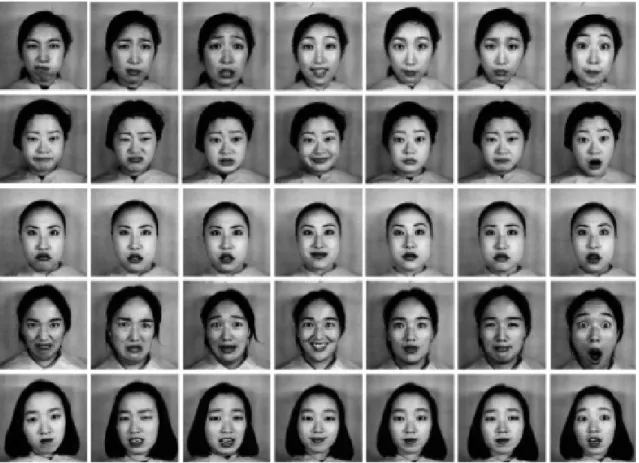
seven facial expressions posed by ten Japanese female models. The photos were taken at the Psychology Department in Kyushu University and some samples can be seen in the figure 6.6.
Figure 6.6: Some samples of JAFFE database
6.2.2
The Extended Cohn-Kanade Dataset (CK+)
The [LCK+10]CK database is one of the most widely used dataset for face analysis (AU and emotions detection) but, it has one great limitation for the purpose of emotional face analysis, while AU codes are well validated, emotion labels are not. The Extended Cohn-Kanade (CK+) database completes this dataset with emotion labels been revised and validated. Some samples can be seen in figure 6.7
6.2.3
Karolinska Directed Emotional Face(Kdef )
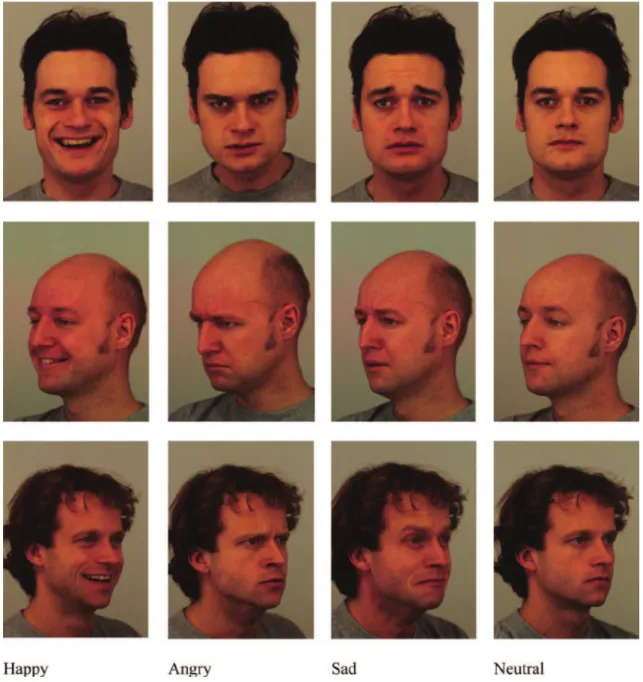
This [CL08] database is built by scientists Ellen Goeleven, Rudi De Raedt, Lemke Leyman, and Bruno Verschuere from Ghent University in Belgium.It is a subset of the original KDEF database that had 490 JPEG pictures showing 70 individuals (35 women and 35 men) displaying 7 different emotional expressions. Each expression is viewed from 5 different angles. All the individuals were trained amateur actors between 20 and 30 years of age. For participation in
6.2. Selected datasets 27
Figure 6.7: Some samples of CK+ database
the photo session, beards, moustaches, earrings, eyeglasses, and visible make-up were exclusion criteria. All the participants were instructed to try to evoke the emotion. Some angles of the pictures can not be aligned so they was discarded as it can be seen in figure 6.8
6.2.4
Radboud Faces Database (Radboud)
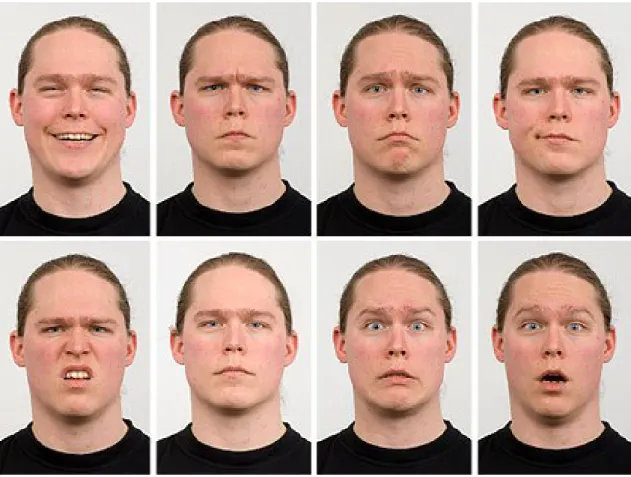
The Radboud Faces Database (RaFD) [LDB+10] is an initiative of the Behavioural Science
Institute of the Radboud University Nijmegen, (the Netherlands) from 2010 and including a set of pictures of 67 models (including Caucasian males and females, Caucasian children, both boys and girls, and Moroccan Dutch males) displaying 8 emotional expressions as it can be seen in figure 6.9. So, one emotion representation had to be discarded.
Figure 6.8: Some samples of Karolinska face Database
6.2.5
Pain expressions
Those are images prepared by the [Psy99] Psychology, School of Natural Sciences from the University of Stirling. This is a collection of images useful for conducting experiments in psychology and it has images of the seven emotions. It was specially useful for augmenting the intra-variability of the classes but, they employed only a few actors so unfortunately not enough samples, some of then can be seen in figure 6.10.
6.2. Selected datasets 29
Figure 6.9: Some samples of Radboud Faces Database
6.2.6
Oulu-CASIA
The facial expression database named [ZHT+11] the Oulu-CASIA NIR-VIS database consists
of videos with the six expressions (surprise, happiness, sadness, anger, fear and disgust) from 80 subjects captured with two imaging systems, NIR (Near Infrared) and VIS (Visible light), under three different illumination conditions: normal indoor illumination, weak illumination (only computer display is on) and dark illumination (all lights are off). The whole database includes two parts, one was taken in 2008 in Oulu by the Machine Vision Group of the University of Oulu, consisting 50 subjects and most of them are Finnish people. The other was taken in April 2009 in Beijing by the National Laboratory of Pattern Recognition, Chinese Academy of Sciences, consisting of 30 subjects and all of them are Chinese people. The authors also provide still images of the video sequence so we can incorporate this images. All the images will be incorporated disregarding type of camera, light conditions. This differences can be seen in figure 6.11
Figure 6.10: Some samples of Pain expressions dataset
6.2.7
Dartmouth Database of Children’s Faces
The [DGD13] Database contains images of forty male and forty female models between the ages of 6 and 16. This dataset has to had a very special treatment due to the privacy requirements because the models are minors so there will be no public images. They are photographed on a black background and are wearing black bibs and black hats to cover hair and ears and from five different camera angles and posing in eight different facial expressions.
6.2.8
California Facial Expressions (CAFE)
This dataset [DCR01] was created with the support of the National Institute of Mental Health in 2001 by Matthew Dailey, Garrison W. Cottrell, and Judith Reilly. It is only 146 images so it will be used for testing purposes.
6.3. Constructed dataset 31
Figure 6.11: A sample of Oulu-CASIA database. Built with three different cameras.
6.2.9
Face Place (Face)
This face database was created by the Tarrlab at Brown University (Tarrlab is now at Carnegie Mellon) in 2008 and it includes multiple images for over 200 individuals of many different races with consistent lighting, multiple views, real emotions, and disguises in jpeg format, 250x250 72 dpi 24 bit color. Stimulus images courtesy of Michael J. Tarr, Center for the Neural Basis of Cognition and Department of Psychology, Carnegie Mellon University. Emotions poses could not be found and 541 neutral images could be saved and used for testing the generalization capacieties of the trained networks.
6.3
Constructed dataset
The total images collected are 37848 and in the table 6.1 it can be seen how they are divided and the sources dataset of each class. As it can be seen in the table the principle source is the dataset Oulu-CASIA and this is caused because it was built with three different cameras so we have three different samples of the same pose and same actor as it can be seen in figure 6.11 that augmented the intra-class variations (same person appearance variations). The final
Class Total JAFFE CK+ Kdef Radboud Internet Pain CASIA Dartmouth Anger 6647 30 546 111 201 375 46 5178 160 Fear 6231 32 293 111 201 47 273 5114 160 Surprise 6059 30 730 112 201 173 92 5011 160 Disgust 4385 29 479 111 201 112 48 3245 160 Happy 3556 31 714 111 201 355 46 1938 160 Sadness 2949 31 297 112 201 180 0 1968 160 Neutral 2566 30 1633 111 201 383 48 0 160 SUM 32843 213 4692 779 1407 1625 553 22454 1120
Table 6.1: Total numbers and class division of the images compiled for the dataset
dataset is quite unbalanced as it can be seen in figure 6.12 and it that has been compensated doing data augmentation.
Figure 6.12: The final dataset has unbalanced distribution of clasess
6.4
Data augmentation
Deep artificial neural networks require a large corpus of training data in order to effectively learn and in the case of transfer learning for avoiding overfitting. Collection of such training data is often expensive and laborious. The problem with small datasets is that models trained with
6.4. Data augmentation 33 them do not generalize well to data from the validation and test set. It is common knowledge that the more data an ML algorithm has access to the more effective it has to be even, when the data is of lower quality. Algorithms can actually perform better, as long as useful data can be extracted by the model from the original data set. Previous works [WP17] had demonstrated the effectiveness of data augmentation through simple techniques, such as cropping, rotating, and flipping input images. A very generic and accepted current practice for augmenting image data is to perform geometric and color augmentations, such as reflecting the image, cropping and translating the image even changing the color palette of the image.
In this work the augmented data will be generated before training the classifier as computing resources have to be free for training CNN purposes. Despite that, in most of the deeplearning frameworks those transformations can be made during training time with the advantage that it generates the necessary images online and those will never be repeated during the training experiments. The problem is that this online generation takes time and resources that will increase the final financial costs of the experiments as they are realized in a private cloud provider. On the case of the dataset of this work geometric methods had been applied: flip-ping, rotation and blurring. The augmentation has been done with a python library called Augmentor. In principle, Augmentor consists of a number of classes for standard image manip-ulation functions, such as the rotate class or the crop class. Augmentor applies operations to images stochastically as they pass through the pipeline, according to a user-defined probability value for each operation. Four actions have been choose and the library will randomly apply them in execution time the change are very subtle as the training images were already heavily preprocessed:
• Flip horizontally, rotate the image 2 degrees to the left, apply blur and a small quantity of noise.
• Flip horizontally, rotate the image 3 degrees to the left and a small quantity of noise.
• Flip horizontally, rotate the image 2 degrees to the right, apply more blur and a high quantity of noise.
• Flip horizontally, rotate the image 2 degrees to the left and a higher quantity of noise.
Some examples of this transformations can be seen in figure 6.13 where there has been applied horizontal flipping a subtle degrees of rotation and different levels of noise and blur. The final numbers of the transformed images can be seen in the table 6.2 The deeplearning networks
Figure 6.13: Data augmentation: Some examples of affine transformations
have all been trained (fine tuned) with both datasets the original and the augmented in the same conditions to test the effects of data augmentation. The data augmentation has not been applied in the test set, a partition that has been created and isolated for testing purposes.
6.4. Data augmentation 35
Class Original images Augmented Total
Anger 5797 0 5797 Fear 5275 469 5744 Surprise 5082 547 5629 Disgust 5032 545 5577 Happy 2839 2466 5305 Sadness 2183 1883 4066 Neutral 1971 1652 3623 SUM 28179 7562 35741
Data preprocessing
Many facial recognition algorithms, including Eigenfaces, Fisherfaces and deeplearning methods can all benefit from applying face alignment. This is due to the fact that a CNN learns by continually adding gradient error vectors computed in backpropagation method (multiplied by a learning rate) to various weight matrices throughout the network, as training examples are passed through. If input training vectors aren’t scaled, the ranges of distributions of feature values would likely be different for each feature. Thus, the learning rate would cause corrections in each dimension that would differ (proportionally speaking) from one to another. We might be over compensating a correction in one weight dimension while under compensating in another. It is very common to [HRBLM] align the faces in a dataset before training a face recognizer and by performing this process, we obtain higher accuracy in the face recognition models.
7.1
Face detection and cropping
It has been used a code provided by the [Ros17] the author Adrian Rosebrock on his website that makes cropping and alignment. To extract faces from images it is used the Ddlib face detector [Kin09]. Dlib is a a popular C++ toolkit that contains pretrained models for face detection in an image. It provides the coordinates of a rectangular frame that fits the face. The frame coordinates are then used to crop faces from images. The face has to be detected from the input
7.2. Face alignment 37 image and for that purpose it will be used a HOG face detector. The histogram of oriented gradients is a method from 2005 that starts converting the image to grayscale then it looks at every single pixel in the image one at a time. For every single pixel, it looks at the pixels surrounding it with the goal is to figure out changes of intensity between those pixels. Then it draws an arrow showing in which direction the image is getting darker and repeating the process for every single pixel in the image it ends up with an image called gradients that show the flow from light to dark across the entire image. After this process it will divide the image into small squares (normally 16x16 pixels each) and count in each square how many gradients points in each major direction and draw an arrow of the strongest direction. The resulting is a much more simple representation that captures the basic structure of a patterns existing in our image. To find faces in this HOG image it will be compared to a known HOG patterns extracted from other training faces
7.2
Face alignment
The process of face alignment works in this way:
1. Identifying the geometric structure of faces in digital images.
2. Attempting to obtain a canonical alignment of the face based on translation, scale, and rotation.
Others alignment methods than the proposed one, had been discarded like: imposition of 3D models for applying a transformation to the input image. After identifying faces and draw a bounding box rectangle around the detected face the algorithm move to apply landmark prediction to detect the basics characteristics that all the human faces have in common. We commonly all have mouse, nose and two eyes so the algorithm has to detect, label and extract face regions including: mouth, right eyebrow, left eyebrow, right eye, left eye, nose and the jaw. The facial landmark detector implemented inside C++ computer vision library Dlib produces 68 mapping points using a shape predictor trained on the labeled iBug 300-W dataset, see
figure 7.1 for a sample of this points. This predictor is called a facial landmark predictor model and called from Dlib library code for predicting the situation of principal face landmarks. Once we have the landmarks detected the different face regions can be accessed through Dlib
Figure 7.1: Localization in the human face of 68 facial coordinate points
standardized points. For the purpose of centering the face, it is going to be used the two eyes and compute the center of each eye. The centroid or center of mass as well as the angle between the eye centroids. This angle serves as the key component for aligning the image. Given the eye centers it is possible to compute differences in x,y coordinates and take the arc-tangent to obtain angle of rotation between eyes determined by finding difference between right and left eyecenter. After that, it is computed the angle in the y and the angle in the x directions and the desired eyes angle are substracted to the actual ones. The scale of the image is obtained by taking the ratio of the distance between the eyes in the current image and the distance between the eyes in the desired image. Having the rotation angle and the scale of the face it is needed to compute the midpoint between the eyes (that has to be the top of the nose) and a rotation matrix that will be used to apply affine transformations to the images. So, the parameters that will get a rotation 2d function will be:
7.3. Dataset normalization 39
• The center of the eyes where the rotation will occur
• The angle of rotation for obtaining a horizontal line between the eyes
• The percentage of scalation of the image for having the desired size (up or down)
The warp transformations will be made using the CV2 C++ library. It is needed to pass to the warp function the translation, rotation and scaling matrix, the desired width and height of the output face and the interpolation algorithm used for the warp. An example can be seen in figure 7.2
Finally, the face will be scaled to the desired size (depending on the input layer of the network) and cropped always after obtaining the aligned face and not before. For the purpose of training and validating a convolutional neural network is is not recommendable to distract the network with other elements that did not contribute to the necessary purpose so it is necessary to adjust to the minimal features necessary to obtain the human face. The previously commented C++ library Dlib can crop (in a parameterized manner) the image on this case it is needed to just keep a 25% of the bounding box image.
7.3
Dataset normalization
Normalization in deeplearning consists in subtracting the mean of the whole dataset images before feating the network. The mean image of the built dataset can be seen in the figure 8.2. Subtracting the mean is a particular technique of data normalization and it helps the learning process or finding the global minimum of the cost function. There are many factors that affects the learning process and a crucial one is how well our data was pre-processed. The better it is pre-processed, the more likely our model will learn faster and better. The goal of computing the mean image is to make our data have zero mean. In images, this normalization has the property of removing the average brightness (intensity) of the data point. In many cases, we are not interested in the illumination conditions of the image, but more so in the content removing the average pixel value per data point makes sense here. Mean subtraction
Figure 7.2: Examples of face rotation and cropping finishing in face alignment
is done by each channel. When we are ready to pass an image through our network (whether for training or testing), we subtract the mean from each input channel of the input image the mean Red, Green, and Blue values. This process have been computed channel-wise rather than pixel-wise, resulting in an MxN matrix. In this case, the MxN matrix for each channel is then subtracted from the input image during training/testing.
Chapter 8
Deeplearning: Training 2D
convolutional networks
8.1
Fine-tuning CNN
Deep neural networks like Covnets compute a huge number of parameters per layer (often in the range of millions) those parameters get specially concentrated in the last fully connected layers (FC). For an Alexnet network trained in ImageNet with more than 4000 classes we have 37,752,832 learned parameters in the first FC and 16,781,312 learned parameters just in the second FC. In the case of the last FC retrained only with 7 emotions the last FC layer learns 28,679 parameters. Training a Convnet on a small dataset (one that is smaller than the number of parameters) greatly affects the Covnet’s ability to generalize, often resulting in overfitting. So, it is necessary to work with existing networks trained on a large dataset like the ImageNet (or better if they were trained with human faces) by continue training it (i.e. running back-propagation) on the smaller dataset that we have. As we will see, this practice works if the new dataset is not drastically different in context to the original dataset. Some learned general guidelines for fine-tuning implementation are:
• Truncate the last FC layer of the pre-trained network and replace it with our new FC