Relating ways to instantiate abstract
argumentation frameworks
Henry Prakken
Department of Information and Computing Sciences, Utrecht University
&
Faculty of Law, University of Groningen
November 25, 2013
Abstract
This paper studies the relation between various ways to instantiate Dung’s ab-stract argumentation frameworks. First theASPIC+ framework, which explic-itly generates abstract argumentation frameworks, is equivalently reformulated in terms of John Pollock’s recursive labelling method, which does not explicitly gen-erate such frameworks. The reformulation arguably facilitates more natural expla-nations of dialectical argument evaluation. Then a variant is examined of a recent proposal by Wyner, Bench-Capon and Dunne to instantiate abstract argumentation frameworks without defining explicit inferential relations between arguments. The proposal is reformulated in a way that is equivalent toASPIC+under some limiting assumptions. The proof exploits the equivalence betweenASPIC+and Pollock’s recursive labellings proven in the first part of the paper.
1
Introduction
While most current AI research on argumentation takes its point of departure in [8]’s abstract argumentation framework, there is a tension between approaches which do or do not specify inferential relations between arguments. Examples of the former ap-proach are assumption-based argumentation (initiated in [6]), classical argumentation as studied in [10], and theASPIC(+) framework of [7, 19, 15] (recently used in [22]). Examples of the latter approach are preference-based argumentation frameworks [1], abstract resolution semantics (initiated in [13]), [4] value-based argumentation frame-works, [2]’s instantiation of these with an argument scheme for practical reasoning, and [23]’s modelling of rule-based argumentation with Dung’s frameworks.
As can be seen from these references, Trevor Bench-Capon has throughout his ca-reer explored all these ways to use Dung’s work. In [4] he took the fully abstract approach, in [2, 23] he defined the structure of arguments but did not allow for infer-ential relations between them, and in [22] he employed a framework that allows for such relations. It therefore seems appropriate for this volume to further investigate the various ways in which Dung’s work can be related to accounts of the structure of argumentation.
In a first contribution I will show that systems for structured argumentation do not have to explicitly produce a Dung-style abstract argumentation framework. I will do so by proving an equivalence betweenASPIC+ as formulated in [19, 15] (which ex-plicitly produces Dung-style abstract argumentation frameworks) and a reformulation of ASPIC+ in terms of John Pollock’s [17] recursive labelling method (which does not follow this approach). This arguably facilitates more natural explanations of the outcome of dialectical argument evaluation. In a second contribution I will investigate [23]’s way to model structured argumentation without defining explicit inferential re-lations between arguments. It will turn out that this approach can be formulated in a way that is equivalent toASPIC+if some limiting assumptions are made. The proof exploits the equivalence betweenASPIC+and Pollock’s recursive labellings proven in
the first part of this paper. I will then conclude with some observations on the pros and cons of abstract models of argumentation.
2
Basic formalisms
In this section I review [8]’s abstract argumentation frameworks and theASPIC+ frame-work. Anabstract argumentation framework(AF) is a pair(A,D), whereAis a set ofargumentsandD ⊆ A × Ais a binary relation of defeat. A semantics forAFs
returns sets of arguments calledextensions, which are internally conflict-free and de-fend themselves against attack. One way to characterise the various semantics is with
labellings.
Definition 1 A labellingof an abstract argumentation framework (A,D) is any
as-signment of either the labelinorout(but not both) to zero or more arguments fromA
such that:
1. an argument isiniff all arguments defeating it areout. 2. an argument isoutiff it is defeated by an argument that isin.
Thenstable semanticslabels all arguments, whilegrounded semanticsminimises and
preferred semanticsmaximises the set of arguments that are labelledinandcomplete semanticsallows any labelling. Relative to a semantics, an argument isjustifiedon the basis of anAF if it is labelledinin all labellings, it isoverruledif it is labelledoutin all labellings, and it isdefensibleif it is neither justified nor overruled.
TheASPIC+ framework [19] gives structure to Dung’s arguments and defeat re-lation. It defines arguments as inference trees formed by applying strict or defeasible inference rules to premises formulated in some logical language. Informally, if an in-ference rule’s antecedents are accepted, then if the rule is strict, its consequent must be acceptedno matter what, while if the rule is defeasible, its consequent must be ac-ceptedif there are no good reasons not to accept it. Arguments can be attacked on their (non-axiom) premises and on their applications of defeasible inference rules. Some at-tacks succeed asdefeats, which is partly determined by preferences. The acceptability status of arguments is then defined by applying any of [8] semantics for abstract argu-mentation frameworks to the resulting set of arguments with its defeat relation.
ASPIC+ is not a system but a framework for specifying systems. It defines the notion of an abstractargumentation systemas a structure consisting of a logical lan-guageLclosed under negation1, a setRconsisting of two subsetsRsandRdof strict and defeasible inference rules, and a naming conventionninLfor defeasible rules in order to talk about the applicability of defeasible rules inL. Thus, informally,n(r)is a wff inLwhich says that ruler∈ Ris applicable.ASPIC+as a framework does not make any assumptions on how the elements of an argumentation system are defined. InASPIC+ argumentation systems are applied to knowledge bases to generate argu-ments and counterarguargu-ments. Combining these with an argument ordering results in argumentation theories, which generate Dung-styleAFs.
Definition 2 [Argumentation systems] Anargumentation systemis a tripleAS =
(L,R, n)where:
• Lis a logical language closed under negation (¬).
• R = Rs∪ Rd is a set of strict (Rs) and defeasible (Rd) inference rules of the formϕ1, . . . , ϕn →ϕandϕ1, . . . ,ϕn ⇒ϕrespectively (whereϕi, ϕare meta-variables ranging over wff inL), andRs∩ Rd =∅.
• n:Rd−→ Lis a naming convention for defeasible rules. We writeψ=−ϕjust in caseψ=¬ϕorϕ=¬ψ.
Definition 3 [Knowledge bases] Aknowledge basein anAS= (L,R, n)is a setK ⊆
Lconsisting of two disjoint subsetsKn(theaxioms) andKp(theordinary premises). Intuitively, the axioms are certain knowledge and thus cannot be attacked, whereas the ordinary premises are uncertain and thus can be attacked.
Arguments can be constructed step-by-step from knowledge bases by chaining in-ference rules into trees. In what follows, for a given argument the functionPremreturns all its premises,Concreturns its conclusion andSubreturns all its sub-arguments.
Definition 4 [Arguments] AnargumentAon the basis of a knowledge baseKB in
an argumentation system(L,R, n)is:
1. ϕifϕ∈ Kwith:Prem(A) ={ϕ};Conc(A) =ϕ;Sub(A) ={ϕ};TopRule(A)
= undefined.
2. A1, . . . An→/⇒ψifA1, . . . , Anare arguments such that there exists a strict/defeasible ruleConc(A1), . . . ,Conc(An)→/⇒ψinRs/Rd.
Prem(A) =Prem(A1)∪. . .∪Prem(An),Conc(A) =ψ,Sub(A) =Sub(A1)∪
. . .∪Sub(An)∪ {A};TopRule(A)=Conc(A1), . . . ,Conc(An)→/⇒ψ. Arguments can be attacked in three ways: on their premises (undermining attack), on their conclusion (rebutting attack) or on an inference step (undercutting attack). The latter two are only possible on applications of defeasible inference rules.
1In most papers onASPIC+negation can be non-symmetric, an idea taken from [6]. In this paper we
Definition 5 [Attack]AattacksBiffAundercuts,rebutsorunderminesB, where:
•AundercutsargumentB(onB0) iffConc(A) =−n(r)andB0∈Sub(B)such that B0’s top ruleris defeasible.
•ArebutsargumentB(onB0) iffConc(A) =−ϕfor someB0∈Sub(B)of the form B100, . . . , Bn00⇒ϕ.
•ArgumentAunderminesB(onB0) iffConc(A) =−ϕfor someB0=ϕ,ϕ6∈ Kn. Undercutting attacks succeed asdefeatsindependently of preferences over arguments, since they express exceptions to defeasible inference rules. Rebutting and undermin-ing attacks succeed only if the attacked argument is not stronger than the attackundermin-ing argument.
Definition 6 [Defeat]AdefeatsBiff:AundercutsB, or;Arebuts/underminesBon
B0andA ⊀B0.
Note that the definitions of attack and defeat explicitly take the subargument relations between arguments into account. In fact, it was recently shown in [20] and [14] that in-stantiations of Dung’s framework that do not do so are severely limited in applicability and run the risk of producing counterintuitive consequences.
Definition 7 LetAT be anargumentation theory(AS, KB). Astructured
argumen-tation framework (SAF)defined byAT, is a triplehA,C, iwhereAis the set of all finite arguments constructed fromKBinAS,is an ordering onA, and(X, Y)∈ C
iffXattacksY.
Abstract argumentation frameworks are then generated as follows:
Definition 8 [Argumentation frameworks] An abstract argumentation framework
(AF) corresponding to aSAF =hA,C, iis a pair(A, D)such thatD is the de-feat relation onAdetermined by SAF.
Now one way to define the justification status of an argument is as follows (other defi-nitions are possible but for present purposes they do not matter):
Definition 9 A wffϕ∈ Lisjustifiedifϕis the conclusion of a justified argument,
de-fensibleifϕis not justified but the conclusion of a defensible argument, andoverruled
ifϕis defeated by a justified argument.
3
Labellings vs. recursive labellings
My view on [8]’s work has always been that it has to be used as the final component of a full-fledged argumentation logic, to define a nonmonotonic consequence notion for the logic. First the structure of arguments must be defined, which will in general be recursive to reflect the step-by-step nature of argumentation. Then a defeat relation must be defined, which will in general have to distinguish between direct and indirect defeat, because of the recursive structure of arguments. Then the resulting set of argu-ments and the defeat relation defined over it are taken to be a DungAF. Adopting a semantics for theAF then yields the consequence notion for the logic.
While theoretically this works fine, a practical drawback is that in the thus induced DungAFthe distinction between direct and indirect defeat is left implicit, since in a DungAFthe subargument relation between arguments cannot be shown. For presen-tation purposes this is somewhat unnatural. Consider the following example of a civil legal case, adapted from [21]. Assume that in a medical malpractice case, a doctor is liable for compensation if the patient was injured because of the doctor’s negligence, and that if a patient is injured in a non-risky operation, this is negligence. We also have that an appendicitis operation generally is a non-risky operation but that opera-tions on patients with bad blood circulation are generally risky. Assume finally, that a given patient was injured in an appendicitis operation and that two medical tests gave contradicting results on whether the patient had bad blood circulation. This all can be represented with the following facts and defeasible rules (Rdconsists ofr1-r6whileK
consists off1-f4; note that for convenience we here use theASPIC+rules in
domain-specific ways).
r1: injury,negligence⇒compensation f1: injury
r2: injury,¬risky operation⇒negligence f2: appendicitis
r3: appendicitis⇒ ¬riskyOperation f3: medicalTest1
r4: badCirculation⇒riskyOperation f4: medicalTest2
r5: medicalTest1⇒badCirculation
r6: medicalTest2⇒ ¬badCirculation
We then have the following arguments:
A1: injury B1: medicalTests1 A2: appendicitis B2: B1⇒badCirculation A3: A2⇒ ¬riskyOperation B3: B2⇒riskyOperation A4: A1,A3⇒negligence A5: A1, A4⇒compensation C1: medicalTests2 C2: C1⇒ ¬badCirculation
Let us first concentrate on the attack relations between the arguments. At first sight it would seem that we have three argumentsA=A1-A5,B =B1-B3 andC =C1
-C2, such that bothAandB andBandCmutually attack each other as in Figure 1.
However, upon closer investigation things are more complicated. First, we have not
Figure 1: Abstract attack graph (simplistic)
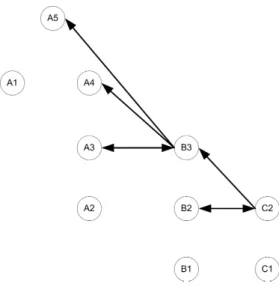
three but ten arguments. Second, we have not four but seven attack relations:A3and
B3directly rebut each other and as a consequenceB3indirectly rebuts bothA4andA5,
namely onA3. Likewise,B2 andC2directly rebut each other and as a consequence
C2 indirectly rebutsB3, namely onB2. So the full abstract attack graph induced by
theASPIC+attack relations is as in Figure 2. In this graph the information is lost that some attack arrows duplicate other attack arrows. For example, the arrows fromB3to
Figure 2: Abstract attack graph (correct)
Therefore, this graph does not adequately show a decision maker which conflicts have to be resolved. When faced with this graph, a decision maker might think that s/he has to determine of seven attack relations whether they result in defeat, but in fact s/he has to determine this for only four attack relations, namely, those betweenA3and
B2 and betweenB2 andC2. (This in fact illustrates the problems with
Preference-based abstractAFs [1] and abstract resolution semantics [3], since these approaches cannot recognise that some defeat relations duplicate other defeat relations.) If the attacks are resolved according to Definition 6 then the indirectly defeat relations are correctly computed on the basis of the direct defeat relations, resulting in an abstract argumentation framework with the intuitive outcome. For example, suppose thatA3≺
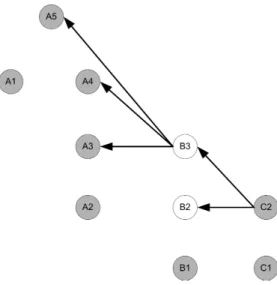
B3andB2 ≺C2. Then we obtain Figure 3 (which shows the unique labelling in all
semantics, in which the arguments that areinare coloured gray). However, even though this outcome is intuitive, the process of obtaining it from the abstract attack graph is not well explained by these graphics.
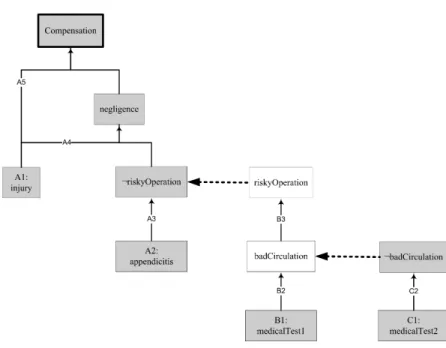
Moreover, the result of the abstractAFhas to be transported back with Definition 9 to theSAFthat induced it, which tells us thatB2andB3areoutin all labellings while
all other arguments are inin all labellings. Graphically this can be displayed as in Figure 4. Now this graph suggests a more intuitive way to explain how the status of A5 can be evaluated: A5 isinsince it has no direct defeaters and both of its direct
subargumentsA1andA4 arein. In turn,A1is in since it is an undefeated fact while
A4is in since it has no direct defeaters and both of its direct subargumentsA1andA3
arein. In turn,A3 isinsince, firstly, its direct defeater B3 isoutand, secondly, its
direct subargumentA2isinsince it is an undefeated fact. Finally,B3isoutsince it has
a direct defeater that isin namely,C2, which is is preferred overB3and which direct
subargumentC3isinsince it is an undefeated fact.
Figure 3: Abstract argumentation framework
status, since it looks at both the defeat relations and the inferential support relations between the arguments. In fact, such an explanation directly follows Pollock’s [17] recursive definition of ‘defeat status assignments’ (two other systems with similar re-cursive definitions are Defeasible Logic [16] and Carneades [9]). I will therefore in the next section adapt this definition toASPIC+ and then prove equivalence with Defini-tion 1 of labellings forASPIC+.
4
Recursive labellings
To adapt Pollock’s [17] recursive definition of ‘defeat status assignments’ toASPIC+, first the definitions of attack and defeat must be adapted; as in [17] they now only capture direct attack and defeat while their indirect counterparts will now be considered by the recursive labelling definition.
Definition 10 [p-Attack]Ap-attacksBiffAp-undercuts,p-rebutsorp-undermines
B, where:
•Ap-undercutsargumentBiffConc(A) =−n(r)andBhas a defeasible top ruler.
•Ap-rebutsargumentBiffConc(A) =−Conc(B)andBhas a defeasible top rule.
•ArgumentAp-underminesBiffConc(A) =−ϕandB=ϕ,ϕ6∈ Kn.
In our example we have that A3 andB3 p-attack each other butB2 does not
p-attackA4 orA5. Likewise,B2 andC2p-attack each other butC2 does not p-attack
B3.
Definition 11 [p-Defeat]Ap-defeatsBiff:Ap-undercutsB, or;Ap-rebuts/p-undermines
Figure 4: ASPIC+ framework
It is easy to verify that:
Proposition 1 AdefeatsBiffAp-defeatsBor a proper subargument ofB.
Proof:
• AunderminesBiff:
Conc(A) =−ϕandB=ϕ,ϕ6∈ Kn, orAundermines some subargumentB0of
Bsuch thatB0is a premise ofB; iff: Ap-defeatsBor a proper subargument ofB.
• ArebutsBiff:
Conc(A) =−Conc(B)andBhas a defeasible top rule or for some subargument B0 ofB it holds thatConc(A) =−Conc(B0)andB0has a defeasible top rule; iff:
Ap-rebutsBor a proper subargument ofB.
• AundercutsBiff:
Conc(A) = −n(r)andBhas a defeasible top ruleror for some subargument B0ofBit holds thatConc(A) =−n(r)andB0has a defeasible top ruler; iff: Ap-undercutsBor a proper subargument ofB.
Then the proposition easily follows.
Definition 12 Ap-structured argumentation framework (pSAF) defined by an
arguments constructed fromKBinAS,is an ordering onA, and(X, Y)∈ Cpiff
Xp-attacksY.
Definition 13 [p-Argumentation frameworks] Ap-abstract argumentation
frame-work (pAF) corresponding to a pSAF=hA,Cp, iis a pair(A, D)such thatDis the p-defeat relation onAdetermined bypSAF.
Definition 14 [p-labellings.]
1. (In, Out)is ap-labellingof apAFiffIn∩Out=∅and for allA∈ ApAF it holds that:
(a) Ais labellediniff:
i. All arguments that p-defeatAare labelledout; and
ii. IfAis of the formB1, . . . , Bn →/⇒ϕthen all ofB1, . . . , Bnare labelledin; and
(b) Ais labelledoutiff:
i. Ais p-defeated by an argument that is labelledin; or
ii. Ais of the formB1, . . . , Bn →/ ⇒ϕand some ofB1, . . . , Bnare labelledout.
The notions of complete, stable, preferred and grounded labellings are defined as above.
Theorem 2 (In, Out)is a p-labelling of pAF corresponding to pSAF=hA,Cp, i
iff(In, Out)is a labelling of AF corresponding to SAF=hA,C, i.
Proof:
From left to right, assume first thatAisin. We first prove by induction on the structure ofAthat all subarguments ofAarein. ForA ∈ Kthis holds trivially. IfAis of the formB1, . . . , Bn → / ⇒ ϕthen ifAisin, by definition of p-labellings also all of
B1, . . . , Bnarein. By the induction hypothesis all subarguments of all ofB1, . . . , Bn are alsoin, but then all subarguments ofAarein. Now sinceAisin, we have that all Bthat p-defeatAareoutand all subarguments ofAarein. Then allBthat p-defeatA areoutand allBthat p-defeat a subargument ofAareout, but then allBthat defeatA areout. So constraint (1) on labellings is satisfied.
Assume next that A isout. We prove by induction that A is defeated by some argument that isin, in which case constraint (2) on labellings is satisfied. ForA∈ K
this holds trivially, while ifAis of the formB1, . . . , Bn → /⇒ ϕthen either some
Bthat p-defeatsAisinor someBi isout. In the first case,Balso defeatsA. In the second case, by the induction hypothesisBiis defeated by an argument that isin. But thenAis defeated by the same argument.
From right to left, assume first thatAisin. Then allBthat defeatAareout. But then allB that p-defeatAor a proper subargument ofAareout. Next we prove by induction that all proper subarguments ofAarein. This is trivial ifA ∈ K. Suppose nextAis of the formB1, . . . , Bn → / ⇒ ϕ. Then by the induction hypothesis for
all ofB1, . . . , Bn, all their proper subarguments, including the immediate ones, are in. Moreover, by assumption all p-defeaters of any suchBiareout. But then allBiarein. Then constraint (1) on p-labellings is satisfied.
Assume next thatAisout. ThenAis defeated by an argument that isin. But then eitherAor a proper subargumentA0ofAis p-defeated by an argumentBthat isin. In the first case, constraint (2) of p-labellings is satisfied. In the second caseAis of the formB1, . . . , Bn →/⇒ϕ. Note thatA0isoutand thatA0is a subargument of some
Bi. But thenBdefeatsBi, so sinceBisinwe have thatBiisout. So constraint (2) on p-labellings is satisfied.
Since the sets that are labelled, respectively, p-labelled are the same, it immediately follows that the equivalence also holds for the notions of stable, preferred and grounded labellings.
This result is very similar to Hadassa Jakobovits’ results in [11, 12] that Pollock’s [17] ‘labellings’ for his inference graphs are equivalent to preferred semantics and that his ‘partial labellings’ are equivalent to her ‘rooted complete labellings’. The main difference is that Pollock’s inference graphs are not the same asASPIC+SAFs (although equivalence should be easy to prove).
With these equivalences established, there is no need any more to translate an AS-PIC+argumentation theory into a Dung-style abstract argumentation framework. In-stead, the labellings of arguments and the corresponding status of their conclusions can be shown inductively, which, as explained at the end of Section 3, is arguably more natural.
5
Argument structure in purely abstract frameworks
In the second part of the paper I want investigate an idea originally proposed by [23]. Their idea is that arguments in a Dung AF are instantiated as a rule and that the step-by-step nature of arguments is induced by allowing such rules to be attacked by special arguments challenging one of their antecedents, and to in turn allow these arguments to be attacked by a rule with as consequent the challenged antecedent. I will formalise this idea in the definition of a wbd-argumentation theory (wbd-AF), in which, given anASPIC+argumentation theory, arguments are either rules or items from the knowl-edge base orwhyϕmoves for anyϕthat is an antecedent of some rule. My aim then is to translate such awbd-AF into an ASPIC+-inducedpAF and then to investigate correspondences between the labellings of awbd-AF and the p-labellings of the cor-respondingpAFas defined above. If any correspondence is found, then the results of the previous section make it carry over to the Dungean semantics ofASPIC+-induced
AFs.
It will turn out that correspondences can be found but only under some limiting assumptions. The point is that in the new approach the success of an attack as de-feat should completely depend on the last of the arguments, that is, on their top rules. This at least requires that arguments are compared with a last-link argument ordering. Moreover, it excludes the use of non-axiom premises and even the use of strict rules. To see the latter, consider the following example, in which a defeasible rule is attacked
by a strict rule: p⇒r1q
r→ ¬q
InASPIC+with last-link comparison, whether a rebuttal with a strict top rule succeeds depends on how the antecedents of the strict rule (in this caser) are derived. For example, if we have
s⇒r2r
r1< r2
Then the attack with the strict rule succeeds but if we have t⇒r3r
rr< r1
then the attack with the strict rule does not succeed. So whether the attack with the strict rule succeeds depends on how awhyrattack on the strict rule is counterattacked. So to make [23]’s approach work in general the argument ordering of the wbd-style arguments must be made dependent on the ways the antecedents of the rules can be derived but this defeats the idea of the approach (this is why the nodes in [17]’s defeat graphs are not just well-formed formulas but ‘lines of argument’ encoding the way a formula is derived; thus if a formula can be derived in more than one way, the graph contains more than one node with the same formula). In fact, this is a problem for any model that defines the evaluation of arguments in a top-down manner without fully con-structing the argument before evaluating it, such as also my own dialogue framework in [18]. In that paper I made an assumption that ‘backwards extending’ an argument in reply towhymoves cannot make an argument weaker, but then I did not realise how strong that assumption is.
For these reasons I will from now on assume that the set of strict rules is empty and that all premises are axioms. Then with the last link ordering the preference re-lation between two rule arguments solely depends on their last rules. Note also that inASPIC+rebutting an argument with an item fromKnalways succeeds, since strict-and-firm arguments (that is, arguments with only strict rules and only axiom premises) are always preferred over all other arguments.
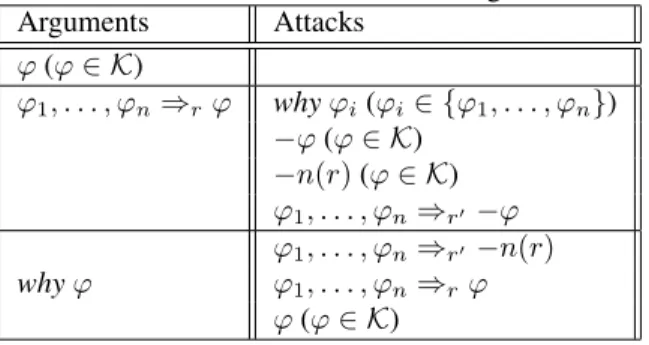
As for the attack relations in the wbd approach, defeasible rules are attacked by any undercutting rule, by any defeasible rule with contradictory consequent, by any item from the knowledge base that contradicts its consequent, and by awhyϕmove for any antecedentϕof the rule. Items from the knowledge base have no attackers whilewhyϕmoves are attacked by any rule with consequentϕ. Table 1 lists all these well-formed arguments and attacks (it assumes all mentioned rules to be inRd; for convenience, their informal name is sometimes subscripted to the arrow). The defeat relation now equals the attack relation except that an attack of a defeasible rule with a contradictory consequent only succeeds if the attacker is not inferior to its target, that is, only ifr06< r. This induces awbd-AF, that is, a set of arguments in the just-defined sense with a binary relation of defeat. Formally all this amounts to the following:
Definition 15 LetASbe any argumentation system with no strict rules,KBa
Table 1: wbd arguments and attacks Arguments Attacks ϕ(ϕ∈ K) ϕ1, . . . , ϕn⇒rϕ whyϕi(ϕi∈ {ϕ1, . . . , ϕn}) −ϕ(ϕ∈ K) −n(r)(ϕ∈ K) ϕ1, . . . , ϕn ⇒r0 −ϕ ϕ1, . . . , ϕn ⇒r0 −n(r) whyϕ ϕ1, . . . , ϕn ⇒rϕ ϕ(ϕ∈ K)
defined in Table 1,Cgthe attack relation onAgas defined in Table 1 and≤an ordering onRd. Then thewbd argumentation frameworkcorresponding to(AS, KB,≤)is a pairwbd-AF= (Ag,Dg)whereDgis the defeat relation onAgdefined byCgand≤ as follows:AdefeatsBiffAattacksBand, in case the attack is as in the fifth line of Table 1,r0 6< r.
ApSAF corresponding to(AS, KB,≤)is a triple(A,C,)whereis the last-link ordering onAinduced by≤as defined in [15]. ApAF corresponding to(AS, KB,≤)
is thepAFcorresponding topSAFas defined in Definition 13.
Awbd-AFiscompletedif it (1) contains every possible attack and (2) has no unan-sweredwhyattacks and (3)KandRdare defined such that no attack cycles through
whymoves are possible (that is, circular arguments are excluded).
Labellings of completedwbd-AFsare now defined in the usual way of Definition 1. In fact, I am only interested inwbd-AFsthat are ‘grounded’ in the knowledge base. Therefore, from now on I will implicitly assume that allwbd-AFsare completed. Then a givenwbd-AFis converted to apAFas follows:
Definition 16 For anywbd-AFG= (Ag,Dg)the correspondingpAFGp= (Ap,Dp)
is inductively defined as follows. 1. A∈ Apiff:
(a) A∈ AgandA∈ K; or
(b) Ais of the formB1, . . . , Bn ⇒ϕandConc(B1), . . . ,Conc(Bn)⇒ϕ∈
Agand all ofB
1, . . . , Bnare inAp.
2. (A, B)∈ DpiffA, B∈ ApandBhas a top rulerand (i)A∈ Kor (ii)Ahas a top ruleConc(A1), . . . ,Conc(An)⇒0rϕand(r0, r)∈ Dg.
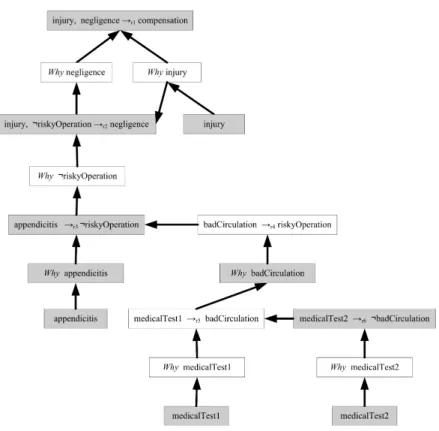
Figure 5 visualises thewbd-AFcorresponding to the example of Section 3. It assumes thatr5 < r6andr3 < r4, corresponding to the last-link argument orderingA3 ≺B3
andB2≺C2of our medical negligence example2
Figure 5: wbd argumentation framework
Proposition 3 For anywbd-AFG = (Ag,Dg)corresponding to(KB, AS,≤)with
correspondingpAFGp= (Ap,Dp), and anypSAF= (A,D): 1. Ais an argument inApiffAis an argument inA. 2. (A, B)∈ Dpiff(A, B)∈ D.
Proof:
Proof of (1): From left to right follows from the fact that all arguments inAp only use elements fromRdandKand the structural similarity between Definition 16(1,2) and Definition 4. From right to left is proven with induction on the structure of argu-ments. For elements ofKthis follows immediately from the fact thatGis completed. Consider next any argument on the basis ofAT of the formA1, . . . , An ⇒ϕ. Then by the induction hypothesis all ofA1, . . . , An are inAp. Moreover, by construction ofApwe have that for all suchA
i, eitherAi ∈ KsoAi ∈ Agor Aiis of the form Conc(B1), . . . ,Conc(Bn)⇒ri ϕsori ∈ Ag. But then anywhy Conc(Ai)attack on
Acan be counterattacked byAi orri, so sinceGis completed,A ∈ Ag. But then
A∈ Apby clause (2) of Definition 16. Proof of (2):
Ahas conclusion−n(r)thenAp-defeatsBregardless of the rule priorities. IfAhas a defeasible top ruler0thenr0 6< rsince(r0, r)∈ Dg. But thenAsuccessfully p-rebuts
B, soAp-defeatsB.
From right to left, note first that by (1) bothAandBare inApand then by defi-nition ofAp,AandBare either themselves inAgas elements ofKor their top rules are inAg. Then because of the restrictive assumptions onAT in Definition 15 it holds thatAp-defeatsBiffB has a defeasible top rulerand either (1)A ∈ K, in which case(A, B)∈ Dpsince(A, r)∈ Dgby row (3) of Table 1, or (2)Ahas a defeasible top ruler0with (2a) consequent−n(r), in which case(A, B)∈ Dpsince(r0, r)∈ Dg by row (4) of Table 1, or with (2b) consequent−ϕ(whereϕis the consequent ofr), in which case(A, B)∈ Dpsince(r0, r)∈ Dgby row (5) of Table 1 andr06< r.
It can be shown that in awbd-AF all arguments in the correspondingpAF are ‘hid-den’. Such hidden arguments are first defined as follows, after which it will be shown that together they correspond to the arguments of the correspondingpAF.
Definition 17 For each non-why argumentAinGa directed acyclic graphT = (N, L)
is inductively defined as follows: 1. (N0, L0) = ({A},∅)
2.
(a) Ni+1 =Ni∪ {A∗}ifA∗ is some argument inGthat attacks some why-attackerBof some argumentAi ∈N
isuch that no attacker ofBis inNi, otherwiseNi+n=Ni;
(b) Li+1 =Li∪ {(A∗, Ai)|Ai ∈NiandConc(A∗)∈Ant(Ai)}if someA∗ as defined under (a) exists, otherwiseLi+1=Li.
TAdenotes for any non-why argumentA∈Gthe set of all such graphsTforA, while
TGdenotes the set of allAT for any non-why argumentAinG.
Definition 18 LetGbe awbd-AF with correspondingpAFGp. For anyAT ∈ TG,
the corresponding argumentApis defined as follows: 1. IfAT ∈ KthenAp=AT;
2. If the root ofAT is inRdthenApis of the formA
1, . . . , An ⇒Conc(T), where
A1, . . . , An correspond to the subtreesAT1, . . . , AT n ofAT starting withA’s children.
Definitions 17 and 18 are illustrated by the structural similarity of Figures 4 and 5. The idea is that in Figure 5 allwhymoves are removed and the thus disconnected rules and facts are connected by support links.
Proposition 4 For anywbd-AFGwith correspondingpAFGp:
2. for any argumentAinGpthere exists a uniqueT ∈TGsuch thatAcorresponds toT.
Proof:
Proof of (1): For elements inK this is obvious. Next, the induction hypothesis is that for anyAT ∈ TG all treesBT1, . . . , BT n for all childrenB
1, . . . , Bn of A in
T correspond to an argument inGp. By construction ofAT we have thatGcontains a ruleConc(B1), . . . ,Conc(Bn) ⇒ Conc(A)so by construction ofGp it holds that
B1, . . . , Bn ⇒Conc(A)is an argument inGp; moreover, this argument corresponds toAT.
Proof of (2): Suppose A ∈ Gp. If A ∈ K then (A,∅) ∈ TG. Assume next A is of the form B1, . . . , Bn ⇒ B and all Bi correspond to some unique Ti ∈ TG. By construction ofGp we have that
Conc(B1), . . . ,Conc(Bn) ⇒ Conc(A) ∈ G. Then sinceGis completed,(N, L) ∈ TG whereN = T
1, . . . , Tn ∪ {A}andL =
L1, . . . , Ln∪ {(B1, A), . . . ,(Bn, A)}. Finally, by construction, (N, L)is unique in this sense.
Corollary 5 AnyA ∈ Gthat is not awhyargument is either inGp or a top rule of
some argument inGp. And any rule or premise of an argumentGp is an argument in
G. Proof:
The second holds by construction ofGp, while the first follows since anyAT corre-sponds to an argument inGpas specified in Proposition 4(1).
Lemma 6 For any labellingLof awbd-AFG, anyA ∈Gis labelledininLiff all
defeaters ofAareoutinLand for someT ∈TA, all children ofAinTareininL. Proof:
From right to left is immediate, as is the first part from left to right. For the remainder, note that among all defeaters ofA that areout inLare all itswhy attackers. Then each such attacker has an attacker fromKorRdthat isin. But then by construction of
TA every set consisting of one such attacker for everywhyattacker ofAis for some
T ∈TAthe set of all children ofAinT.
Lemma 7 For anywbd-AFGwith correspondingpAFGpand allAT andBT inGT
it holds thatBdefeatsAiffBpdefeatsApfor anyApandBpinGpcorresponding to
AT andBT.
Proof:obvious.
Now the following correspondences can be proven between labellings ofGandGp.
Theorem 8 LetGbe a completed wbd-AF corresponding to(AS, KB,≤)with
cor-responding pAFGpand let pAF’ correspond to(AS, KB,≤). Then for anyϕ∈ Lit holds thatϕis defensible (justified) on the basis ofGiffϕis defensible (justified) on the basis ofGpiffϕis defensible (justified) on the basis ofpAF’.
Proof:
1. Any non-why argumentA ∈ Gisinin some labelling (all labellings) ofGiff for someT ∈AT the argument corresponding toTisinin some p-labelling (all p-labellings) ofGp.
2. Any argumentA∈Gpisinin some p-labelling (all p-labellings) ofGpiffAT is
inin some labelling (all labellings) ofG, whereAT is the root of someT ∈TG such thatAcorresponds toT.
3. (1) and (2) also hold ifGpis replaced by pAF’.
Then (1) and (2) follow from the structural similarity between anyAT and its corre-sponding argument inGpand Proposition 4, Corollary 5 and Lemmas 6 and 7. The idea from left to right is that any labelling ofGcorresponds viaTGwith a p-labelling ofGp, since the set of all arguments in Gp corresponding to any element ofTG is precisely the set of all arguments inGp. For the same reason, from right to left any p-labelling ofGpcorresponds viaTGto a labelling ofG.
Finally, (3) follows from (1), (2) and Proposition 3.
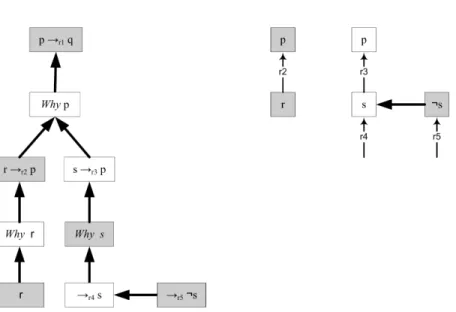
This result is illustrated by the correspondence between the (unique) labelling of Fig-ure 5 and the (also unique) p-labelling of FigFig-ure 4. A further illustration is given by the following example: p⇒r1q r⇒r2p s⇒r3p ⇒r4s ⇒r5¬s K={r} r4< r5
This induces thewbd-AF of Figure 6 on the left, with its correspondingpAFon the right. Thiswbd-AFhas a unique labelling in all semantics, in whichp⇒r1qisin, but
the correspondingGpcontains two alternative arguments with top ruler
1, one of which
isinbut the other isoutin the (unique) p-labelling ofGp. This example thus shows that in general labellings of awbd-AF do not have the same meaning as (p)-labellings of
SAFsorpSAFS. In a wbd-labelling, that a rule isinmeans that there issomeacceptable way of deriving its antecedents. By contrast, in a p-labelling, that an argument isin
means that this argument with aspecifically indicatedway of deriving the antecedents of its top rule is acceptable.
Finally, I briefly compare the approach of this section with [23]. There are some minor differences: [23] make some specific assumptions on the logical object language, which they assume to just consist of propositional literals, that is, atoms and their negations; furthermore, they replace awhy attack on a rule antecedent by an attack with the contradictory literal. A more important difference is that [23] do not assume a knowledge base but allow atomic arguments for any literal; moreover, such literals can not only be (asymmetrically) attacked by a rule for the original literal but also (symmetrically) by the original literal. As a consequence, the focus in [23] is not on deriving arguments from a knowledge base, which makes a detailed comparison with the present approach not straightforward.
Figure 6:wbd-AFwith correspondingpAF
6
Conclusion
This paper has investigated three ways to instantiate [8]’s abstract argumentation frame-work. The investigations have provided some reasons to believe that when the aim is to model realistic argumentation, too much focus on abstract argumentation frameworks may be harmful. First some presentational drawbacks were identified of systems for structured argumentation with inferential relations between arguments that explicitly model argument evaluation in terms of abstract argumentation frameworks. It was shown that these systems can be reformulated in a way that incorporates Dung’s se-mantics in a stepwise evaluation of arguments, which arguably facilitates more natural explanations of dialectical argumentation evaluation. Then a method for modelling the evaluation of arguments with structure was examined in which the inferential relations between arguments are not taken into account. It turned out that this method only works well under some limiting assumptions, which do not need to be made in a model likeASPIC+that explicitly models inferential relations between arguments. Thus this paper adds to a growing body of evidence (cf. [20, 14] that adequate models of real-istic argumentation should take both the structure of arguments and their inferential relations into account.
7
Afterword – some personal notes on Trevor
Bench-Capon and his work
I first met Trevor Bench-Capon at JURIX 1990 in Leiden, The Netherlands, but it was not until the late 1990s that we became closer, starting with a visit by me in april that year to Liverpool, and continued during the famous Bonskeid meeting on
argumenta-tion in the Scottish hills in the summer of 2000, where we used to play an outdoors game of chess after every lunch and dinner (chess may be the only field at which I can (only slightly) top Trevor’s level. Even with table tennis I suffered some terrible defeats). During my stay in Liverpool in 1999 I gave a talk in which, among other things, I summarised Dung’s famous work on abstract argumentation frameworks. If I remember correctly, then neither Trevor nor his close colleague Paul Dunne knew Dung’s work at the time. I still remember that especially Paul asked me many ques-tions about Dung’s work during and after my talk, and later it turned out that my visit to Liverpool had sparked a long series of AI journal publications by the two them (I am glad to see that Paul acknowledges my modest historical role in his contribution to this volume).
Over the years Trevor and I found ourselves interacting more and more during conferences and later during the ASPIC project, always to my great pleasure, because of Trevor’s intelligence, his knowledge of just about everything, his wisdom and his unbeatable sense of humour. One of the great joys of discussing research with Trevor is that he often shows you another way of looking at things. However, if this way is not quite yours, then such discussions do not always spark immediate collaboration. This may be one of the reasons why we started collaborating relatively late, namely in 2006, during a new visit of me to Liverpool, now for one month.
One of the points at which we did not always fully agree was how the structure of arguments should be accounted for in the context of Dung’s abstract frameworks. Although we both agreed and still agree that Dung’s work is a great formal tool for the study of argumentation, I have always thought that it should be combined with ac-counts of the structure of arguments and their inferential relations. In recent years I have become increasingly concerned about the dominance of purely abstract research on argumentation in our field, and in some recent papers I have (partly with Sanjay Modgil) identified some pittfalls of fully abstract approaches [20, 14]. I always found it slightly unfortunate that one of Trevor’s best ideas ever (the inclusion of values in models of argumentation) was first formalised at the fully abstract level. Indeed, our first joint publication [5] was an attempt to re-model Trevor’s idea (as meanwhile elab-orated with Katie Atkinson) in terms of an account of structured argumentation (in fact a preliminary version of theASPIC+ framework). The work on this paper was a real joy for me (I still have great memories of our exciting lunch-time conversations at Costa’s), but I had the impression that Trevor was at that time not yet fully convinced that theASPIC+-like technical machinery we used is useful. In fact, during one of our lunch meetings he showed me on a napkin how the structure of arguments can be accounted for purely within Dung’s abstract frameworks. At that time I found his idea quite exotic, but later I came to realise that it made perfect sense. Section 5 of this paper has been an attempt to acknowledge this by relating Trevor’s idea toASPIC+.
Whatever the merits are of fully abstract approaches to argumentation, the main idea of Trevor’s [4], namely that practical argumentation needs to take societal values into account, has been extremely influential in recent years, and rightly so. More-over, Trevor now also acknowledges the benefits of combining abstract with structured fameworks for argumentation, witness, for example, our recent joint work with Adam Wyner and Katie Atkinson on formalising argument schemes for legal case-based rea-soning in ASPIC+ [22]. I hope I am not too unmodest if I claim that this (besides
bringing Dung’s gospel to Merseyside) is one small point at which I have been able to influence Trevor’s work. If so, then this is just a small and insufficient return for the many great insights that he gave me and the many enjoyable moments I could have with him. I truly hope that there will be many more of such moments to come.
References
[1] L. Amgoud and C. Cayrol. Inferring from inconsistency in preference-based argu-mentation frameworks. International Journal of Automated Reasoning, 29:125– 169, 2002.
[2] K. Atkinson and T.J.M. Bench-Capon. Practical reasoning as presumptive ar-gumentation using action based alternating transition systems. Artificial Intelli-gence, 171:855–874, 2007.
[3] P. Baroni and M. Giacomin. Resolution-based argumentation semantics. In Ph. Besnard, S. Doutre, and A. Hunter, editors,Computational Models of Argument. Proceedings of COMMA 2008, pages 25–36, Amsterdam etc, 2008. IOS Press. [4] T.J.M. Bench-Capon. Persuasion in practical argument using value-based
argu-mentation frameworks.Journal of Logic and Computation, 13:429–448, 2003. [5] T.J.M. Bench-Capon and H. Prakken. Justifying actions by accruing arguments.
In P.E. Dunne and T.B.C. Bench-Capon, editors,Computational Models of Argu-ment. Proceedings of COMMA 2006, pages 247–258. IOS Press, Amsterdam etc, 2006.
[6] A. Bondarenko, P.M. Dung, R.A. Kowalski, and F. Toni. An abstract, argumentation-theoretic approach to default reasoning. Artificial Intelligence, 93:63–101, 1997.
[7] M. Caminada and L. Amgoud. On the evaluation of argumentation formalisms.
Artificial Intelligence, 171:286–310, 2007.
[8] P.M. Dung. On the acceptability of arguments and its fundamental role in non-monotonic reasoning, logic programming, andn–person games.Artificial Intelli-gence, 77:321–357, 1995.
[9] T.F. Gordon, H. Prakken, and D.N. Walton. The Carneades model of argument and burden of proof.Artificial Intelligence, 171:875–896, 2007.
[10] N. Gorogiannis and A. Hunter. Instantiating abstract argumentation with classical-logic arguments: postulates and properties. Artificial Intelligence, 175:1479–1497, 2011.
[11] H. Jakobovits. On the Theory of Argumentation Frameworks. Doctoral disserta-tion Free University Brussels, 2000.
[12] H. Jakobovits and D. Vermeir. Robust semantics for argumentation frameworks.
Journal of Logic and Computation, 9:215–261, 1999.
[13] S. Modgil. Hierarchical argumentation. InProceedings of the 10th European Conference on Logics in Artificial Intelligence (JELIA), pages 319–332, 2006. [14] S. Modgil and H. Prakken. Resolutions in structured argumentation. In B.
Ver-heij, S. Woltran, and S. Szeider, editors, Computational Models of Argument. Proceedings of COMMA 2012, pages 310–321. IOS Press, Amsterdam etc, 2012. [15] S. Modgil and H. Prakken. A general account of argumentation with preferences.
Artificial Intelligence, 195:361–397, 2013.
[16] D. Nute. Defeasible logic. In D. Gabbay, C.J. Hogger, and J.A. Robinson, editors,
Handbook of Logic in Artificial Intelligence and Logic Programming, pages 253– 395. Clarendon Press, Oxford, 1994.
[17] J.L. Pollock. Cognitive Carpentry. A Blueprint for How to Build a Person. MIT Press, Cambridge, MA, 1995.
[18] H. Prakken. Coherence and flexibility in dialogue games for argumentation. Jour-nal of Logic and Computation, 15:1009–1040, 2005.
[19] H. Prakken. An abstract framework for argumentation with structured arguments.
Argument and Computation, 1:93–124, 2010.
[20] H. Prakken. Some reflections on two current trends in formal argumentation. InLogic Programs, Norms and Action. Essays in Honour of Marek J. Sergot on the Occasion of his 60th Birthday, pages 249–272. Springer, Berlin/Heidelberg, 2012.
[21] H. Prakken and G. Sartor. On modelling burdens and standards of proof in struc-tured argumentation. In K.D. Atkinson, editor,Legal Knowledge and Information Systems. JURIX 2011: The Twenty-fourth Annual Conference, pages 83–92. IOS Press, Amsterdam etc., 2011.
[22] H. Prakken, A.Z. Wyner, T.J.M. Bench-Capon, and K.D. Atkinson. A formalisa-tion of argumentaformalisa-tion schemes for legal case-based reasoning in ASPIC+.Journal of Logic and Computation, 2013. In press.
[23] A.Z. Wyner, T.J.M. Bench-Capon, and P.E. Dunne. Instantiating knowledge bases in abstract argumentation frameworks. In Proceedings of the AAAI Fall 2009 Symposium on The Uses of Computational Argumentation, pages 76–83. AAAI Press, 2009. Technical Report SS-09-06.