Broad view, strong focus
Annual Report 2014
1
Vesteda 2014 Annual Report2
Vesteda 2014 Annual ReportDisclaimer References in this Annual Report to ‘Vesteda’, ‘we’, ‘the company’ or similar terms mean Vesteda as defined in the ‘Legal structure’ section on page 45. This Annual Report contains forward-looking statements. Those statements may - without qualification - contain expectations on future realised and unrealised results, yields, distributions, government measures, the effect of other regulatory measures on Vesteda’s activities, the partnership contributions in Vesteda, subsidiaries and joint ventures, macro-economic trends and Vesteda’s performance in them. Such comments are preceded or followed by or contain terms such as ‘believe’, ‘expect’, ‘forecast’, ‘of the opinion’, ‘anticipate’ or similar terms. These forward-looking statements are based on current assumptions about future activities and are subject to known and unknown factors and other uncertainties, many of which are beyond Vesteda’s control, and so actual results in the future may differ materially from these expectations.
Vesteda 2014 Annual Report | Contents
3
Contents
Profile Vesteda 4
Highlights 2014 6
Key developments 2014 7
Introduction by the Managing Board 8
Members of the Managing Board 10
Members of the Management Team 11
Management Report 12
Market developments 12
Strategy and long-term objectives 13
Operational developments 15
Notes to the results 19
Outlook and management agenda 24
Members of the Supervisory Committee 28
Report of the Supervisory Committee 30
Key portfolio developments 32
CSR and sustainability 38
Organisation 42
Governance and risk management 45
Legal and tax structure 45
Corporate governance 46
Risk management 48
About this report 52
Assurance report of the independent auditor 54
Vesteda Residential Fund FGR financial statements 2014 57 Consolidated statement of comprehensive income 60
Consolidated balance sheet 61
Consolidated statement of changes in equity 62
Consolidated cash flow statement 63
Notes to the consolidated financial statements 64
Independent auditor’s report 90
Annexes 93
Annex 1: Key figures past ten years 94
Annex 2: Composition of the investment portfolio 96
Annex 3: INREV, IVBN and IPD 103
Annex 4: GRI Notes and References 105
Annex 5: Progress made in CSR policy 111
Annex 6: Performance Measures Public Area 112
Annex 7: Tenant survey 113
Annex 8: External appraisers 115
Vesteda 2014 Annual Report | Profile Vesteda
4
Profile Vesteda
HigH-quality platform for institutional investors
With a portfolio of almost 23,000 residential units, Vesteda is
the largest independent residential fund in the Netherlands.
Vesteda is internally managed, cost-efficient and has its own
in-house property management.
Key cHaracteristics
Vesteda
• Established in 1997 as Vesteda Woningen (Vesteda Residential Fund) as a spin-off of the residential portfolio from Dutch pension fund ABP
• Open-end core residential real estate fund
• Broad institutional investor base with a long-term horizon • Attractive risk profile
• Governance in accordance with best-practice guidelines, including INREV, with the emphasis on transparency and alignment of interests
• Limited use of leverage (34.5% at year-end 2014, target 30-40%) • Active investor relations policy
• Internally managed: no management fee structures and carried interest arrangements • Transparent for tax purposes (fund for the joint account of participants; FGR fund structure)
Assets
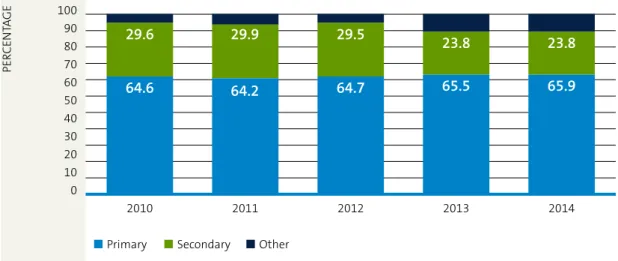
• Well-diversified portfolio (337 residential complexes largely located in economically strong or promising parts of the Netherlands)
• Focus on economically strong regions such as the Randstad and Noord-Brabant • Focus on the mid-rental segment
• Vesteda offers sustainable housing and operates in a socially responsible manner
Target
• Outperformance of the three-year IPD Netherlands ‘All Residentials’ benchmark 1) • Stable annual distributions of realised return, excluding result on disposals • Indirect yield over the long-term that on average at least equals Dutch CPI • Stable tenant satisfaction score 2)
1 Annex 3 provides an overview of the IPD residential benchmark results (2010-2014) 2 Annex 7 provides an overview of the tenant survey results (2010-2014)
Vesteda 2014 Annual Report | Profile Vesteda
5
Key portfolio cHaracteristics (year-enD 2014)
Number ofresideNtial uNits Portfolio value average Physical occuPaNcy rate gross reNtal iNcome
22,990 €3.6
bln
96.4
%
€247
mln
Portfolio by type of residential unit
(IN UNITS)
Portfolio by rental segment
(IN VALUE) Portfolio by region (IN VALUE) Apartment Family house Regulated segment Mid-segment Higher segment Primary 1) Secondary 1) Other 59% 19% 66% 24% 10% 63% 18% 41% 1 7 8 9 6 2 10 3 4 5
Portfolio distribution (year-end 2014)
Primary regions €750 mln Secondary regions Other €400 mln €75 mln 1 Amsterdam €635 mln (18%) 2 Rotterdam €355 mln (10%) 3 Almere €191 mln (5%) 4 Maastricht €189 mln (5%) 5 Eindhoven €134 mln (4%) 6 Zoetermeer €114 mln (3%) 7 The Hague €110 mln (3%) 8 Amersfoort €107 mln (3%) 9 Leidschendam-Voorburg €104 mln( 3%) 10 Breda €87 mln (2%)
1 Primary regions are regions that offer the highest market potential for the non-regulated rental sector. These regions are characterised by a high market potential and low market risks. Secondary regions score less in some respects but have a positive economic and demographic outlook.
Vesteda 2014 Annual Report | Highlights 2014
6
Highlights 2014
70 60 50 40 30 20 IN € MLN 2013 201452.9
62.4
8 7 6 5 4 3 2 1 0 IN % OF TH EOR ETIC AL GR O SS R ENT 2013 20145.7
4.4
8 6 4 2 0 -2 -4 IN % OF OPE N ING EQU ITY 2013 2014(2.5)
6.0
7 6 5 4 3 2 1 0 IN %IPD residential benchmark Vesteda Direct return Indirect return
0.6
4.5
5.0
0.8
850 800 750 700 650 600 IN € PE R U N IT 2013 2014846
827
25 20 15 10 5 0 IN € MLN 2013 20143.3
20.4
Average monthly rent
Financial vacancy
Total return (excl. revaluation of derivatives) Vesteda vs IPD residential benchmark
Interest expenses (including amortised fees)
Vesteda 2014 Annual Report | Key developments 2014
7
Key developments 2014
portfolio
• New developments into operation: Markthal (Rotterdam), Jheronimus (Den Bosch), Marckhoek (Breda). Representing a total of 169 residential units and a value of €45.5 million
• Changed disposal strategy from block sales to profitable individual unit sales:
746 individual residential units sold generating a net result of €20.0 million (margin of 16.9%) • First positive revaluation since 2008
• Vesteda outperformed the IPD Netherlands ‘All Residentials, All Investments’ benchmark, both on the direct return (+0.5%) and indirect return (+0.1%)
organisation
• Capacity acquisitions team increased
• Efficiency improvements realised at Property Management following the reorganisation • Integration of Portfolio Management and Asset Management
• First fund manager with AIFMD-license
• ISAE 3402 certification Type II for investment management and ISAE 3402 certification Type I for property management
• Number of FTEs fell to 189 at year-end 2014 from 227 at year-end 2013
appointments
• New CEO Gertjan van der Baan (January), new CFO Hélène Pragt (September)
• Nico Mol appointed as director Acquisitions & Development (November). Former director of Project Development
funDing
• S&P BBB corporate credit rating
• €300 million inaugural Bond Issue (EMTN) • €100 million Private Placement
• €30 million secondary equity transaction • €50 million equity redemption
Vesteda 2014 Annual Report | Introduction by the Managing Board
8
Introduction by the Managing Board
recovery on all fronts
In 2014, the real estate market saw a return to favourable conditions for the first time since the beginning of the crisis in 2008. Recovery of the residential market went faster than many expected, as a result of positive economic developments and low interest rates. A slight negative revaluation in the first half of 2014 was compensated by a positive revaluation of our residential portfolio in the second half of the year, the first upward revaluation for a good number of years.
Vesteda’s own performance in 2014 clearly improved as well. This improvement largely resulted from the focus on individual unit sales, rather than the sale of entire complexes, reduced interest charges as a result of the BBB corporate credit rating as received from Standard & Poor’s and several refinancing activities including the subsequent bond issue, lower property operating expenses and improved occupancy levels in all segments of the portfolio.
in tHe spotligHt
The Dutch residential market attracts growing attention from investors in view of these recent developments. In addition to a structurally attractive direct return combined with low risk, this appears a positive moment to enter the market, after six successive years of negative revaluations. This was confirmed by the growing number of new entrants in 2014. These included a number of foreign investors, who secured a position in the Dutch residential market through the acquisition of (sub) portfolios.
Vesteda 2014 Annual Report | Introduction by the Managing Board
9
specialist in tHe resiDential marKet
As the largest independent residential investment fund in the Netherlands, Vesteda provides a platform for investors who have or want to obtain exposure to the Dutch residential market through indirect investments. Vesteda has been active in the Dutch residential market with a single fund since 1997. Furthermore, being a ‘spin-off’ from ABP, our history goes back much further. The many years of experience and the focus on this market, combined with the company’s in-house property management, makes Vesteda a true residential specialist. The portfolio, which comprises almost 23,000 residential properties, provides diversity in terms of both rental market segment and region. Vesteda’s activities are focused in the economically stronger regions of the Netherlands, such as the Randstad urban conurbation and the province of Noord-Brabant.
upwarD potential
Vesteda expects to further improve its results in the years ahead. In addition to the expected continued improvements in the residential market, results should also be boosted by the impact of reduced interest charges and lower management expenses due to the effect of the property management reorganisation in 2014.
In 2015, Vesteda will focus on continued optimisations. This will include the optimisation of processes, organisation and systems within portfolio management, property management, acquisitions, disposals and funding. We have already taken significant steps here in 2014. As part of this effort, we increased the capacity of our acquisitions team, putting us in a position to respond effectively to acquisition opportunities as they arise, and of course realise Vesteda’s growth ambitions. We have reorganised the Property Management department and we have invested in the online client portal, Mijn Vesteda (My Vesteda), which enables tenants to handle most of their rental issues themselves, 24 hours a day, seven days a week.
In 2015, Portfolio Management and Property Management will further intensify their cooperation to ensure that we further explore on the best possible use of our residential market know-how and experience. Furthermore, Vesteda plans to further intensify its CSR activities and we will continue to intensify our investor relations activities, to help us boost the liquidity and the growth of the fund. We are convinced that 2015 will be a positive and successful year for Vesteda.
Vesteda 2014 Annual Report | Members of the Managing Board
10
Members of the Managing Board
The Managing Board of Vesteda consists of Gertjan van der Baan (CEO) and Hélène Pragt (CFO).Gertjan van der Baan (1968)
Chairman of the Managing Board (since 1 January 2014. First term of office ends in December 2017). As Chief Executive Officer, Gertjan van der Baan is responsible for Portfolio Management, Property Management, Acquisitions & Development, HR Management and Corporate Social Responsibility. Before joining Vesteda, Gertjan van der Baan was chairman of the Managing Board of Dutch residential property investor Nationaal Grondbezit ‘Nagron’. Nagron is part of the Rotterdam-based investor Van Herk Group, where he also served as CEO from 2009. Prior to joining Van Herk Group, Gertjan van der Baan worked nearly nine years at merchant bank Kempen & Co in the field of Corporate Finance.
Hélène Pragt (1966)
Member of the Managing Board (since 15 September, 2014. First term of office ends in September 2018). As Chief Financial Officer, Hélène Pragt is responsible for Fund Management (including Treasury, Investor Relations, Risk & Compliance, Control & Finance), Tax, IT and Legal Affairs. Hélène Pragt’s previous employers include Achmea and Unibail-Rodamco/ Rodamco Europe. Hélène Pragt held various positions at these companies, including Director Finance Unibail-Rodamco in the Netherlands and Belgium, and Director of Finance and Riskmanagement Achmea Shared Services. She has also been a member of the Supervisory Board and Chairman of the Audit Committee of housing association De Alliantie since 2008.
Vesteda 2014 Annual Report | Members of the Management Team
11
Members of the Management Team
Hans Touw, Director Portfolio Management
Joined Vesteda in 2010Nico Mol, Director Acquisitions & Development
Joined Vesteda in 2002Ruud Spee, Director Fund Management
Joined Vesteda in 2006Astrid Schlüter, Director Property Management
Joined Vesteda in 2013Trudy van Twuijver, Manager Human Resources
Joined Vesteda in 2011Vesteda 2014 Annual Report | Management Report
12
Management Report
marKet Developments
General
The market in which Vesteda operates continued its recovery in 2014. The demand for rental properties in the residential market increased as did the number of transactions and prices in the owner-occupied market. We also saw new construction slowly but surely start up again and on the investment market front there was a big increase in the amount of foreign capital available for investments in Dutch real estate.
Economic recovery was fragile
The slight economic recovery did not translate into an increase in consumer spending, although households’ purchasing power increased on the back of the low inflation figure of 1 percent. And while consumer confidence increased, the overall sentiment remained negative in the last year 1). The outlook for 2015 is more positive. For instance, the Dutch Central Planning Bureau (CPB) 2) expects all economic factors to either move into positive territory or remain positive this year. This creates a healthy outlook for the Dutch rental market.
Interest in rentals increases
Demand for rental properties improved in 2014, which led to higher per-m² prices 3) and higher occupancy rates in the residential portfolio. Upward pressure on the liberalised segment of the rental market should remain in the coming years and (qualitative) demand is expected to continue to exceed supply 4).
Qualitative demand in economically strong regions
Based on demographic developments, we expect to see a growing demand for smaller homes (growing number of one-person households 5)) and lifecycle proof homes for the elderly 6). The emphasis in demand will focus on economically strong regions, such as the Randstad urban conurbation. In those regions, m² prices will continue their upward trend 7).
Housing shortage in 2020 (as % of housing stock in 2015)
> 2.5% 2.5% to (2.1%) (2.1%) to (6.1%) (6.1%) to (13.1%) > (13.1%)
1 CBS Statline (2015), consumer confidence
2 CPB (2014), December forecast 2014 - Economic outlook 2015; table 1, page 7 3 IPD (2014), Database non-regulated sector rental homes
4 ABF Research (2014), Socrates 2014; page 23 etc.
5 CBS (2014) Forecast households on 1 January; key figures 2013-2060 6 CBS (2014) Forecast households divided by type; age, marital status, 2013-2060 7 IPD (2014), Database non-regulated sector rental homes
Vesteda 2014 Annual Report | Management Report
13
Owner-occupied market starting to recover
The owner-occupied market has benefited from the improved economic climate in the past year; figures from the CBS/ cadastral register show that the number of transactions increased by 40 percent compared to 2013, rising to 153,500 1) in total. Prices also showed some recovery; existing owner-occupied homes gained an average of 0.9 percent in value in 2014 compared to 2013 2), though there were clear regional differences. The Dutch real estate agents’ association NVM noted an average price increase of 3.5 percent 3) last year. The residential market is showing very clear signs of recovery. However, the outlook for 2015 remains modest, with expected value growth currently at one to two percent 4). This will be largely driven by the further tightening of mortgage interest tax relief for owner-occupied properties, as well as the termination of the first-time buyers’ scheme (‘starterslening’).
Housing market reform continues
In December 2014, the House of Representatives approved the amendment to the revised Housing Act and the bill is now with the Dutch Senate 5). The new Housing Act regulates the playing field and rules and regulation for housing associations. On the liberalised playing field, the competitive position of investors should improve, as housing associations can no longer use secured loans for this segment and will have to finance their activities at market rates. The Act also includes a freeze on the liberalised rental limit at the current level of €710.86 6) as from 1 January 2016. This limit is also significant in the context of the revision of the official valuation system for rental properties. In the new system, a property’s official value for tax purposes (WOZ waarde) will be included in the determination of rental values and the points rating will also be adjusted. The Housing Minister aims to put the amendment to the system into effect as of 1 October 2015. The effect of this amendment for Vesteda is that the number of potentially unregulated homes in our portfolio based on the number of points is expected to increase. The potential for rental growth will depend on market rents.
Heavy demand for investment assets
Last year was a good year on the investment market for rental properties, with a total investment volume of some €2.6 billion 7). The bulk of these investments were in existing rental properties, with housing association homes particularly popular judging from the deals Vestia and WIF closed with foreign investors. Due to the changes in the rules and regulations for housing associations’, the investment market should continue to see an increased supply of complexes and/or portfolios of homes for liberalisation. This will in turn create opportunities to add mid-market segment rental homes to our portfolio, in line with Vesteda’s chosen strategy. The gross initial yields on large transactions in the past year were between 6.5 and 7.0 percent 8).
Outlook 2015
Please refer to the section Outlook and management agenda on page 24 of this annual report.
strategy anD long-term objectives
Mission statement and strategy
Vesteda is a reliable housing company offering good quality living for the entire residential lifecycle of its tenants. The company focuses on the mid-rental segment and often has the potential to offer its tenants multiple options within their search area at a fair price .
Vesteda’s strategy is focused on the growth of its portfolio and improving its performance, resulting in increased returns and liquidity for its participants, together with satisfied tenants.
Vesteda’s ambition is to be the best performing residential core investment fund in the Netherlands.
1 Kadaster (2015), Press release 19 January 2015
2 CBS Kadaster (2014), Economic monitor 21 January 2015; Existing owner-occupied houses; sales prices price index 2010 = 100 3 NVM (2015), Press release housing market figures Q4 2014
4 FD (2014), ‘Housing market faces four hurdles’ (article 3 January 2015)
5 Minister for Housing (2014), ‘Amendment to the Revision Act on certified bodies in public housing’ (letter to Dutch Senate, 17 December 2014) 6 Staatscourant (2014), determination liberalisation limit 2015 (18 November 2014)
7 Property NL (2015), investment volumes 2014 to €10.03 bn (article 5 January 2015) 8 Vesteda Research (2014) Portfolio transactions
Vesteda 2014 Annual Report | Management Report
14
Strategic and portfolio objectives
Vesteda’s ambition and strategy are translated into strategic and portfolio objectives. For our long-term targets, please refer to the Key performance indicators table in the section ‘Outlook and management agenda’ on page 25 of this report.
Strategic objectives
Offering an attractive fund profile
• Maintaining a leading position in the Dutch residential investment market: large and well-diversified portfolio
• Attractive risk-return ratio: core residential investment fund with a defensive character • Offering liquidity and fiscal transparency
• Conservative use of loan capital with optimal diversification by market, type of financing and maturity
Optimal portfolio management
• Target portfolio with accent on the mid-rental segment • Acquisitions in economically strong market segments • Gross/net ratio ≤ 25% (excluding landlord levy) • Increased sustainability of the portfolio
Maintaining a professional and cost-effective organisation
• Professional and result-focused activities
• Maintaining customer satisfaction and customer focus • Competitive management expenses
• Attracting and retaining talented employees
Optimising total return
• Stable distribution (realised result less result on disposals) and real long-term value growth • Structural outperformance of the three-year IPD residential benchmark
In December 2014, management has identified the following five building blocks for value creation: • Portfolio management
• In-house property management • Disposals
• Acquisitions • Funding
For each of these five building blocks, the strategy has to be simple, focused and agile. Well-designed processes should result in high-performing operations and a performance-driven organisation. The key values of both the organisation and its employees are cooperation, professionalism and entrepreneurial spirit. The operational developments 2014 and management agenda 2015 for each of these five building blocks are described on pages 15 to 18 and 26 of this report.
Portfolio objectives
The shortage of homes is expected to continue to increase in the years ahead, especially in the economically stronger regions and in the mid-rental segment. Vesteda plans to increase the portfolio’s concentration on the mid-market rental segment (monthly rents of between approximately €711 and €1,200). On top of this, the main focus will be on regions that are well positioned or have a positive economic and demographic outlook. Vesteda will continue to dispose of assets outside these regions in the years ahead.
Vesteda’s acquisition strategy is focused on both individual complexes and whole portfolios of properties, and both new-build and existing homes. Vesteda considers housing associations important partners in light of developments in their sector.
This in combination with our disposal strategy should in the longer term result in a portfolio with an ever-increasing focus on the mid-rental segment, largely in the primary regions.
Vesteda 2014 Annual Report | Management Report
15
operational Developments
Portfolio Management
In 2014, Vesteda merged its Portfolio Management and Asset Management departments to form the new Portfolio Management department. Portfolio Management is now responsible for all of Vesteda’s strategic and operational real estate activities. Portfolio Management’s focus is on value creation and the realisation of the highest possible returns on the company’s real estate investments.
Thanks to an active letting policy through differentiated rent increases, dedicated investments to further improve the quality of the homes and targeted marketing campaigns, plus a pick-up in the rental market, Vesteda once again managed to reduce the financial vacancy rate in 2014. This was primarily seen in the higher-rental segment (to 11.1% at year-end 2014 from 13.8% at year-end 2013). The churn rate was also much lower in this segment last year (to 14.6% in 2014 from 22.6% in 2013).
In-house property management
Vesteda had largely completed its reorganisation of Property Management by the end of 2014. The company has redesigned the letting and management processes, largely with a view to stimulating entrepreneurship by delegating responsibility and result accountability at every level of the organisation. Property Management plans to further reduce its number of employees in 2015, to around 110 FTEs (from 153 FTEs at year-end 2013 and 116 FTEs at year-end 2014). In addition, Property Management rolled out its online tenant portal Mijn Vesteda (My Vesteda) on a national level in 2014. This portal enables tenants to take care of rental matters 24/7 and it gives them direct access to suppliers in the event of breakdowns or power-outs. The launch went smoothly and the portal has been very well received by tenants.
Disposals
In early 2014, Vesteda decided to discontinue major disposals from its portfolio. Despite a great deal of interest from international funds and Dutch private investors, the prices offered were such that (multi-unit) complex sales would not have been profitable. Instead, last year Vesteda devoted a great deal of attention to optimising the individual unit sale process. Thanks to this effort, Vesteda was able to respond very effectively to the continued recovery in the owner-occupied housing market. In 2014, the number of unit sales increased to 746, compared with 337 in 2013. The sales margin came in at 16.9%, compared with 15.5% in 2013.
Acquisitions
A few years ago, Vesteda has made the strategic decision to focus entirely on its investment activities. In line with this decision, the company has in recent years steadily downsized project development activities. There are only a small number of ongoing projects left in the pipeline. To continue to meet the demand for affordable rental homes, it was necessary to bolster and focus on Vesteda’s acquisition activities. This is why Vesteda last year decided to incorporate the acquisition activities in a new department, Acquisitions & Development, and to expand the acquisition team. As of 1 January 2015, the team comprises six employees, including a number of employees who were previously active in project development. Their know-how and experience of development projects will now be used for the acquisition of turnkey projects and large-scale renovation projects related to existing acquisitions. In 2014, Vesteda took the initial steps in a large number of potential acquisitions. This should result in a considerably larger acquisition portfolio in 2015. In 2014 Vesteda acquired the following complexes: existing complex De Boelelaan located in Amsterdam Zuid (transfer in Q1 2015; after renovation ready for occupation in early 2016), existing complex De Ooievaar in Purmerend (transfer in January 2015), new-build complex Schuytgraaf in Arnhem (delivery set for Q2 2015) and new-build complex Seattle Boston in Rotterdam (delivery set for Q1 2017).
The complexes are all located in economically strong regions and the rent from these homes is generally in the mid-rental segment.
Vesteda 2014 Annual Report | Management Report
16
Projects completed in 2014
Complex building Total number of units Additions to investment portfolio For sale
Jheronimus, Den Bosch 1) 88 44 44
Marckhoek, Breda 1) 64 23 41
Markthal, Rotterdam 102 102
-Amazones, Den Bosch 1) 42 - 42
296 169 2) 127 3)
1 Vesteda Project Development 2 Representing a total value of €45.5 mln
3 All units for sale (127 in total) have been sold in 2014 Marckhoek - Breda Markthal - Rotterdam
Jheronimus - Den Bosch Amazones - Den Bosch
Vesteda 2014 Annual Report | Management Report
17
Pipeline year-end 2014
Acquisitions (committed) and development Total number of units
Additions to investment portfolio
For sale Into operation (expected year)
De Ooievaar, Purmerend 2) 30 30 - 2015
Amazones, Den Bosch 1) 42 42 - 2015
De Boelelaan, Amsterdam 2) 154 154 - 2015
Schuytgraaf, Arnhem 2) 29 29 - 2015
CZAN, Amsterdam 14 14 - 2015
CZAN2, Amsterdam 64 64 - 2016
Seattle Boston, Rotterdam 2) 48 48 - 2017
Leidsche Rijn Centrumplan, Utrecht 1) 477 252 225 2017
858 633 3) 225
1 Vesteda Project Development 2 Committed for in 2014
3 Representing a total value of €134.5 mln
Seattle Boston - Rotterdam CZAN - Amsterdam
CZAN2 - Amsterdam
De Ooievaar - Purmerend De Boelelaan - Amsterdam
Leidsche Rijn Centrumplan - Utrecht
Schuytgraaf - Arnhem
Vesteda 2014 Annual Report | Management Report
18
Funding
In 2014, Vesteda further professionalised and intensified its investor relations, with the aim of increasing liquidity in the Vesteda fund. This should in turn increase the company’s equity and enable it to take advantage of attractive acquisition opportunities. The company devotes a great deal of attention to establishing contacts with new leading institutional investors. In addition, following a number of organisational changes it is now possible for new participants to enter the fund at any time.
Furthermore, Vesteda successfully continued the execution of its funding diversification strategy and realised significant milestones for its conversion from a secured CMBS funding structure to a corporate unsecured borrowing structure. Vesteda further optimised its debt funding profile and materially reduced its cost of loan capital.
Vesteda 2014 Annual Report | Management Report
19
notes to tHe results
Key figures
2014 2013 Change (%) Income (in € mln)
Gross rental income 247.4 254.1 (3%)
Loss of rent (10.8) (14.5) (26%)
Property operating expenses (61.8) (60.1) 3%
Other income 1.3 1.6 (19%)
Net rental income 176.1 181.1 (3%)
Result on projects in progress 3.8 (2.2) >100%
Net income 179.9 178.9 1%
Result on disposals 20.4 3.3 >100%
Management expenses (20.5) (16.5) 24%
Interest expenses (including amortised fees) (52.9) (62.4) (15%)
Unwind derivative position (12.5)
-Realised result (before tax) 114.4 103.3 11%
Unrealised result 21.8 (162.6) >100%
Result (before tax) 136.2 (59.3) >100%
31 December 2014 31 December 2013 Balance Sheet (in € mln)
Total assets 3,667 3,782 Equity 2,262 2,280 Loan capital 1,265 1,350 Leverage (in %) 34.5 35.7 Preceding 12 months
Loan Capital (in € mln)
Interest expenses 46.6
EBITDA 155.7
2014 2013
Return on Equity (in % of opening equity)
Realised return 5.0 4.2
- excluding result from disposals and unwind derivatives 4.6 4.1
- result on disposals 0.9 0.1
- result from unwind derivatives position (0.5)
-Unrealised return 1.0 (6.7)
Total return excluding revaluation of derivatives 6.0 (2.5)
Revaluation of derivatives (0.2) 1.7
Total return 5.8 (0.8)
Total return (in € per participation) 5.36 (0.76)
Distribution to investors 1) 4.7 4.1
Distribution to investors (in € per participation) 4.35 3.98
1 Vesteda’s distribution policy is to pay the realised return excluding the result on disposals and excluding the result of the unwind of derivative positions
Vesteda 2014 Annual Report | Management Report
20
31 December 2014 31 December 2013 Non-Financial Figures
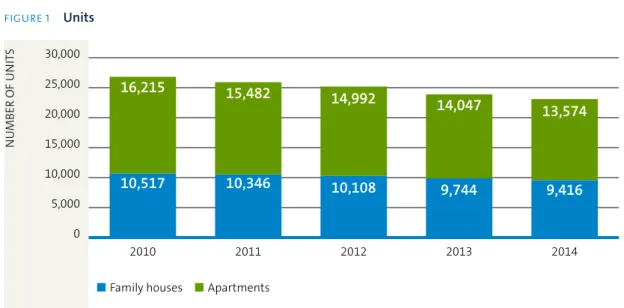
Number of units managed 22,990 23,791
- apartments 13,574 (59%) 14,047 (59%)
- single family homes 9,416 (41%) 9,744 (41%)
Number of units bought 169 49
Number of units sold 1,012 1,364
- individual unit sales 746 337
- complex sales 266 1,027
Occupancy rate (in % of units) 96.6 96.1
2014 2013
Financial vacancy rate (in % of theoretical gross rent) 4.4 5.7
Tenant satisfaction (rating out of 10) 6.9 6.9
Number of employees (in FTE) 189 227
Average energy index (EI) letting portfolio 1.53;C 1.57;C
For a ten-year overview of key figures please see Annex 1 on page 94.
Gross rental income
Gross rental income amounted to €247.4 million in 2014, 3% lower than the gross rental income reported for 2013. This decline was due to the reduced size of the portfolio, which in turn was the result of a higher portfolio outflow than inflow in the year under review (€142.4 million in disposals compared with an inflow in the investment portfolio of €45.5 million). However, the average rent per residential unit stood at €846 at year-end 2014, a rise of 2.2% compared with 2013. On a like-for-like basis the increase came in at 1.7%, which is significantly above the inflation rate in 2014 of 1.0%.
Lower loss of rent
Thanks to active asset management and property management, Vesteda managed to reduce vacancy levels in all segments of the portfolio, but most importantly in the higher-rental segments. The result was boosted by greater differentiation in rent levels, marketing efforts, individual unit sales and dedicated investments in the quality of the portfolio. Vesteda cut loss of rent to €10.8 million from €14.5 million, which partly offset the lower gross rental income and reflects the improved earning power of the portfolio. The financial vacancy rate improved to 4.4% in 2014, from 5.7% in 2013.
Higher property operating expenses
Total property operating expenses increased to €61.8 million in 2014, from €60.1 million in 2013. This increase was largely due to the landlord levy introduced in 2013. The levy amounted to €4.5 million in 2014, much higher than the €0.2 million in 2013. This cost increase was offset to a large extent by lower vacancy-related service charges and lower property management costs.
Property operating expenses expressed as a percentage of gross rental income came in at 25.9%. Excluding the landlord levy, this percentage dropped to 24%, well below the target of 25% set for 2014.
Result on projects in progress
Result on projects in progress consists of the income from development projects that have been completed and either added to the investment portfolio or sold in the market. The improved market conditions led to higher sales volumes at better prices, which contributed to the €3.8 million result on projects in progress.
Increased result on disposals
In 2014, Vesteda changed its disposal strategy to take more effective advantage of the improving market conditions. Individual unit sales were higher, while complex sales fell. Only 266 units were sold through complex sales, but these still added €0.2 million to the result on disposals. Vesteda realised 746 unit sales, with a net margin of 16.9%, adding €20.0 million to the result on disposals. This change in strategy resulted in €20.4 million result on disposals (including a result of €0.2 million from the sale of commercial real estate), a significant increase compared to 2013, and a significant boost to returns on the portfolio.
Vesteda 2014 Annual Report | Management Report
21
Higher management expenses
Management expenses were higher than the previous year. In 2014, Property Management was restructured to bring costs in line with market levels and to further improve processes and service quality. These costs amounted to €3.4 million in 2014.
In 2014, due to the restructuring, Vesteda staff numbers fell to 189 FTEs from 227 FTEs a year earlier.
Lower net interest expenses
The decrease in net interest expenses (-15%) was due to lower overall outstanding debt and the corporate refinancing of existing CMBS notes. In 2014, Vesteda deleveraged an amount of €85 million and successfully refinanced €400 million of debt at more favourable pricing conditions.
In April 2014, Vesteda refinanced €350 million of its CMBS notes (the A7 notes) with a bridge facility. Subsequently, in July 2014 Vesteda Finance B.V. issued a €300 million corporate bond, which refinanced the bridge facility.
In addition to this, in May 2014 Vesteda entered into a seven-year private placement with Pricoa Capital Group. These transactions contributed to Vesteda’s targets of increased debt funding diversification and the extension of the debt’s overall maturity profile.
As a result, average interest costs fell to 4.1% in 2014 from 4.3% in 2013. Vesteda reduced its leverage ratio to 34.5% at year-end 2014 from 35.7% at year-end 2013.
Unwind derivative position
The fixed rate refinancing and deleveraging activities required Vesteda to adjust its hedging position. We decided to reduce the notional of a €625 million Interest Rate Swap by €135 million to €490 million at an unwinding cost of €12.5 million. This transaction took place in September and was NAV neutral.
Higher realised result
Although the portfolio shrank in 2014, lower vacancies, solid returns on development projects, lower interest expenses and higher result on disposals led to a significant increase in the realised result. This higher result offset the lower gross rental income, the hedge unwind, the landlord levy and the higher management expenses following the reorganisation at Property Management in 2014. The earning power of the portfolio improved strongly in 2014.
Unrealised result
In 2014, Vesteda booked a positive unrealised result for the first time since 2008, thanks to the improved market conditions in the Dutch residential market. The positive revaluation of the portfolio was 0.5%. Together with the changes in the provisions for pipeline portfolio properties under construction, the unrealised result came in at €21.8 million, compared to a negative result of €162.6 million in 2013.
Result before tax
Thanks to the strong improvement of both realised and unrealised results, Vesteda booked a net result before tax of €136.2 million, compared to a loss of €59.3 million in 2013.
Equity
At 31 December 2014, equity stood at €2,262 million, compared with €2,280 million at 31 December 2013. This drop of €18 million was the balance of a positive result minus capital distributions: total result (€132 million), the redemption of participations (€50 million) and payment of the dividend realised in the financial year 2013 (€100 million).
Vesteda’s distribution policy is to pay the realised result less the result on disposals from the previous financial year. Realised result less the result on disposals amounted to €94.0 million in 2014. As a result of the one-off character of the unwinding transaction, Vesteda proposes not to take the unwinding cost into account for the 2014 distribution calculation. Vesteda will therefore propose to the General Meeting of Participants the pay-out of a total distribution of €106.5 million for the 2014 financial year.
Vesteda 2014 Annual Report | Management Report
22
List of institutional investors (participants)
At year-end 2014, Vesteda’s participant base consisted of the following 18 institutional investors, in alphabetical order: • APG Strategic Real Estate Pool N.V.
• Delta Lloyd Levensverzekering N.V. (includes Delta Lloyd Vastgoed Participaties B.V.)
• Delta Lloyd Life N.V. • Loyalis Leven N.V. • Loyalis Schade N.V.
• Nationale-Nederlanden Group • Stichting Achmea Dutch Residential Fund • Stichting Bedrijfstakpensioenfonds voor
de Media PNO
• Stichting Depositary PGGM Real Estate Fund
• Stichting Pensioenfonds ABP • Stichting Pensioenfonds C1000 • Stichting Pensioenfonds
Openbaar Vervoer
• Stichting Pensioenfonds voor de Grafische Bedrijven • Stichting Pensioenfonds voor
Fysiotherapeuten
• Stichting Pensioenfonds Xerox • Stichting Spoorwegpensioenfonds • Stichting TKPI European
Real Estate Fund
On 30 June 2014, APG Strategic Real Estata Pool N.V. entered the fund as a new participant. This was effected via a so-called Specified Terms Transaction (or a secondary trade), under which Stichting Achmea Dutch Residential Fund simultaneously reduced the size of its interest in the fund by the same number of participations.
Number of issued participations
At the end of December 2014, Vesteda had redeemed a total of 535,275 participations, representing an amount of €50 million. As at 31 December 2014, Vesteda Residential Fund had issued a total of 24,045,495 participations (31 December 2013: 24,580,770).
Loan capital
Market environment
In 2014, the conditions for sourcing new debt in the loan markets and debt capital markets improved further on the back of higher liquidity and a continued decline in interest rates. The environment for investment grade borrowers remained favourable overall for sourcing new loans and the issuance of private and public notes.
In contrast, since the outbreak of the credit crisis in 2007, conditions for the issuance of new CMBS notes have remained strained and offer significantly fewer opportunities for the refinancing of existing notes.
Long-term financing strategy
The financing strategy of Vesteda is to constantly improve its financing risk profile by increasing the diversification of its financing sources and maturities, while maintaining a relatively low leverage with a long-term target of 30%. By refinancing its CMBS paper with corporate unsecured loans and via the debt capital markets, Vesteda is aiming to reduce its average interest costs and to extend the maturity profile of its portfolio.
2014 in review
At year-end 2014, Vesteda’s drawn loan capital amounted to €1,265 million and represented 35.2% of its total investment portfolio. In the course of 2014, Vesteda was able to continue on its path of lowering interest costs to 4.1% in 2014 from 4.3% in 2013.
In 2014, Vesteda successfully continued the execution of its funding diversification strategy and realised important milestones for its switch from a secured CMBS funding structure towards a corporate unsecured borrowing structure. A €300 million bridge facility was arranged by a banking syndicate that was used for the redemption of the
€350 million A7 notes.
Vesteda obtained an investment grade BBB corporate credit rating with stable outlook by Standard & Poor’s and accessed the debt capital markets with its inaugural €300 million bond transaction under the newly incorporated EMTN programme of issuing entity Vesteda Finance B.V.
Vesteda managed to achieve additional diversification of funding sources through a debut private placement transaction of €100 million and a tenor of seven years. In addition, the company refinanced a €35 million mortgage facility with FGH Bank N.V. in the fourth quarter of 2014, with maturity set for 1 January 2018.
Vesteda 2014 Annual Report | Management Report
23
The refinancing transactions contributed to an extension of the maturity profile to a weighted average of 2.9 years by year-end 2014.
At year-end 2014, Vesteda’s debt capital structure comprised an unsecured corporate credit facility, mortgage loans, notes issued under its CMBS programme, a bond issue and a private placement. Throughout 2014, Vesteda met all the financial covenants of its financing arrangements and the rating agencies confirmed that Vesteda’s outstanding CMBS notes had retained their triple-A credit rating.
Summary Debt Instruments 2014
CMBS Programme
Vesteda is an established issuer in the CMBS market and had drawn on loan capital primarily in the form of CMBS notes from 2001 until 2012. Historically, Vesteda was able to issue notes at competitive pricing levels, benefiting from the continuous triple-A credit rating of its notes. The performance of all CMBS notes has been ratio compliant since the start of issuance.
In line with its debt funding strategy of a diversified corporate unsecured debt capital structure, Vesteda refinanced €350 million of its CMBS notes (the A7 notes) with corporate unsecured funding in 2014. At year-end 2014, Vesteda had only one CMBS note remaining in the amount of €300 million to be redeemed in 2015.
Vesteda is not exposed to interest rate risk on any loans under the CMBS programme. The outstanding CMBS loan is hedged by a standard Interest Rate Swap contract (ISDA) with Deutsche Bank.
Corporate Bank Facility
In 2014, Vesteda’s €600 million corporate unsecured bank facility with a consortium of banks consisting of ABN Amro Bank N.V., Coöperatieve Centrale Raiffeisen-Boerenleenbank B.A. and BNP Paribas Fortis SA/N.V. remained in place. The bank facility is divided into a €300 million three-year term loan tranche and a €300 million five-year revolving credit facility. In the course of 2014, Vesteda made active use of the revolving credit facility by using excess cash for temporary repayments, further reducing interest costs. As at year-end 2014, Vesteda had drawn €435 million under its corporate facility, with €165 million in funds available for drawdown under the revolving credit facility.
Mortgage Loan Facilities
In December 2014 Vesteda refinanced €47.5 million of its existing mortgage loans with FGH Bank N.V. with a new €35 million facility arranged by the same bank, while €12.5 million of the original facility was repaid. The new facility matures on 1 January 2018. Per year-end 2014, Vesteda’s mortgage loan portfolio amounted to €129 million (€144 million per year-end 2013).
Private Placement
In May 2014, Vesteda entered into a seven-year Private Placement with Pricoa Capital Group. This transaction contributes to Vesteda’s ambition to increase its debt funding diversification and extend its overall maturity profile. The private placement ranks pari passu with all other corporate unsecured debt.
Inaugural Bond Issue
After obtaining the BBB corporate credit rating from Standard & Poor’s and the establishment of the EMTN programme, Vesteda Finance B.V. issued a €300 million corporate bond in July 2014. The transaction marks the successful entrance by Vesteda as an issuer in the debt capital markets for corporate bonds at attractive rates.
Interest Expense and Average Maturity
Total interest payments fell further to €52.9 million in 2014, mainly as a result of the refinancing transactions at prevailing rates and the €85 million leverage decrease in 2014. At 4.1%, net finance expenses on its loan capital fell by 0.2 percentage points compared with 2013.
Vesteda 2014 Annual Report | Management Report
24
outlooK anD management agenDa
Outlook 2015
The economic climate is expected to improve in 2015, but the economic growth will remain limited in the year ahead. Low inflation (i.a. due to lower oil prices) and interest rates should boost consumer and producer confidence, which will in turn give additional impetus to the residential market - and in due course the construction sector - in the medium term. Furthermore, we expect to see an increase in the number of homes sold in the owner-occupied market, despite the tightened mortgage regulations. That said, any increase in house prices for existing homes will remain modest at one to two percent on a nationwide basis. It seems we are unlikely to see a real upward value development before 2016. Buyers increasingly have difficulties to finance the house they wish to buy. The rental market is therefore enjoying the benefits of an increasing number of people who want to rent a house. This should lead to additional demand in economically strong areas, and consequently rising rental prices. In addition, demographic developments, such as the ageing of the population and ongoing individualisation, will lead to an increasing demand in the coming years.
As a result of changes in the regulations for and in the financial position of housing associations, an increase in the supply of housing portfolios in the investment market was anticipated. In reality, the supply of housing associations is somewhat less. Improved market conditions have reduced the need to sell. The supply often concerns homes in the mid-market segment, with potential in terms of rent and value growth. There are still opportunities here for Vesteda, although there will be strong competition from both domestic and foreign investors. At the same time, the interest from foreign investors in Dutch residential properties should make it easier to sell residential complexes. It does seem, however, that value creation in an upwardly mobile market will be greater in individual unit sales than in sales of entire complexes
The outlook for 2015
Economy • Low inflation and lower oil prices are good for consumer purchasing power
• Low interest rate encourages investments of producers and consumers
• Moderate economic growth • Moderate purchasing power
improvement
• Consumer confidence returns slowly
• Unemployment remains high
Rental market • Shortage of homes in the non-regulated rental segment, especially in economically strong regions • Qualitative demand homes (increase
in singles and elderly people) • Revision of Housing Act improves
level playing field
• Freeze on liberalisation limit • Income-dependent rent increase in
regulated sector
• Segment above €1,000 remains (regional) niche market outside the Randstad area
• Introduction new WWS home valuation system
• Limited capacity in the construction industry due to crisis
• Small number of new-build homes to be delivered
• Long- term outlook of declining regions
• Low inflation limits annual rental growth
Owner-occupied market
• Economically strong regions showing a stronger recovery and more value growth
• Recovery owner-occupied market remains fragile
• Slight value growth homes (average across the Netherlands)
• Buying will be more difficult because of changes in mortgage interest tax regulations
Investment market • Supply housing association portfolios in non-regulated segment
• Interest from private and foreign investors eases sales of whole complexes
• Competition foreign investors with other return/risk profile and leverage ratios
Vesteda 2014 Annual Report | Management Report
25
Key performance indicators
Actual 2014 Target 2014 Target 2015 Long-term target Portfolio
Average occupancy rate (in % of units) 96.4 ≥ 96.0 96.6 ≥ 97.0
Financial vacancy rate (as a % of theoretical gross rent) 4.4 5.0 4.0 ≤ 5.0
Rent increase (nominal) 2.5%
(inflation 1.0%) at least average inflation at least average inflation at least average inflation Property operating expenses
(in % of gross rental income excluding landlord levy)
24 25-27 24 ≤ 25
Net rental income (in % of the value of the portfolio, at start of year)
4.8 4.6-4.8 4.9 ≥ 4.5
Average energy classification in portfolio C (EI: 1.53), 9% ≤ E for total investment portfolio
C (EI: < 1.45), for part of the investment portfolio C (EI: ≤1.50), 92% ≥ D 8% ≤ E 95% ≥ D (5% ≤ E) Management/Letting
Management expenses (basis points) 1) 55 bps 60 bps 45-55 bps < 35 bps
Customer satisfaction 6.9 ≥ 7.0 7.0 ≥ 7.0
Leverage 34.5% ≤ 35% ≤ 30%
Return
IPD Netherlands 'All Residentials' total return +0.6% above benchmark above benchmark above benchmark
Realised return (in % of opening equity) 5.0 4.2-4.4 6.2% ≥ 4.5
Distribution to investors realised return
excluding result on disposals and excluding result unwind derivative realised return excluding result on disposals realised return excluding result on disposals realised return excluding result on disposals
Further reduction in financial vacancy rate
Since the end of 2013, one of Vesteda’s priorities has been to improve the occupancy rate and reduce the financial vacancy rate. Measures to achieve this include: investment in the quality of the homes, realistic rent increases, an active marketing approach and a strong focus on the sale of individual units (lowering the pressure on supply). For 2015, the financial vacancy rate is estimated at 4.0% of the theoretical gross rent, a further decline compared with the financial vacancy rate for 2014 (4.4% of the theoretical gross rent). The acquisition of new-build properties and the timing of acquisitions in the year can have an impact on this front.
Rent increases
Government legislation has set the potential for rent increases in the regulated segment of the residential portfolio at inflation (forecast 2015: 1.3%) plus an income-based variable percentage of 1.5%-4%. The main focus of Vesteda’s policy for this part of its portfolio is to each year make use of the potential for rent increases to achieve Maximum Reasonable Rental prices. Rents are frozen above that level.
Although rents in the liberalised rental segment are not limited by any legal rules or regulations, these liberalised rents (especially in the high-end segment) are expected to remain under pressure thanks to the fragility of the economic climate and the modest increase in purchasing power. The current portfolio is partly over-rented. This will reduce the potential for rent increases in the liberalised portion of the residential portfolio. The rent adjustment for the liberalised homes to be carried out in mid-2015 is expected to be around inflation. We expect the overall rent increase to be on average above inflation.
1 Change of indicator in line with INREV TER into Total Management Expenses related to average GAV; target 2014 revised based on new calculation
Vesteda 2014 Annual Report | Management Report
26
Property operating expenses
Vesteda is estimating its gross-net ratio excluding the landlord levy at 24%, in line with 2014 (24%).
Management expenses
Vesteda expects to decrease management expenses due to the effect of the property management reorganisation in 2014.
Realisded return
Realised return is expected to come in at 6.2%, from 5.0% in 2014. This improvement in return is due to a further reduction in the financial vacancy rate, plus lower management expenses and interest expenses.
Management agenda 2015
Portfolio Management
In 2015, Portfolio Management will monitor developments in the residential (investment) market very closely and translate these into opportunities to optimise the performance and the composition of acquisitions and the portfolio even further. Vesteda’s acquisition and disposal targets should take the portfolio firmly towards the company’s target composition (mid-rental segment in economically attractive cities and regions).
Portfolio Management will be working very closely with Vesteda’s in-house Property Management with a clear focus on adding value to the current portfolio. They will do this by improving the quality of our residential assets through dedicated investments, rental growth and cost efficient maintenance. This should enable us to boost long-term income and to outperform the IPD residential benchmark on a structural basis.
In-house property management
Vesteda’s decision to use in-house property management means the company can offer its clients an all-in service package and gives Vesteda a solid mix of in-house real estate and tenant know-how and expertise. The reorganisation completed in 2014 has created a powerful and motivated new organisation. Property Management has set itself the target of becoming the residential specialist and best property manager in the Netherlands at competitive costs. Optimising the use of the intensified cooperation between the various business units should enable Vesteda to improve its performance: higher tenant satisfaction, optimum occupancy and cost controls, plus lower overheads.
Acquisitions
Vesteda’s target for the year ahead is to continue expanding its portfolio. We expect to see numerous acquisition opportunities, largely from the housing association sector. Any acquisitions will have to contribute to the portfolio strategy, by increasing the focus on the mid-rental segment properties in our core regions, in cities where we are still targeting growth in terms of the size of our portfolio. In view of the scale of these acquisition targets, a significant part of our acquisition efforts will concentrate on the purchase of existing real estate, both individual assets and portfolios. Parallel to this effort, we will also be focusing on the turnkey acquisition of new-build complexes.
Disposals
Any residential units that fail to contribute sufficiently to our returns and/or are no longer a good fit with Vesteda’s investment strategy will be sold. The number of homes to be sold will be very closely calibrated with the progress made on the acquisition front, to safeguard the growth of the portfolio. We expect to maximise result on disposals by focusing on unit sales and responding pro-actively to market developments.
Funding
The debt funding actions we undertook in 2014 strengthened Vesteda’s credit profile and represent a solid basis for the execution of further steps towards the refinancing of the last note of Vesteda’s CMBS programme in 2015. The €300 million bridge facility, which matures at year-end 2015, remains in place to refinance the €300 million CMBS A4 notes maturing in July 2015 and gives us the flexibility to enter into suitable long-term debt funding options in 2015. Current lending market conditions, the relatively low interest rate environment and Vesteda’s strengthened credit profile give us a solid basis to further reduce interest costs, to extend the weighted average maturity profile and maintain a diversified debt portfolio.
In 2015, Vesteda will continue to professionalise and intensify its investor relation policy, with the aim of generating permanent positive interest in Vesteda participations, and ultimately to strengthen Vesteda’s strategic position and the liquidity of the fund, plus lower our cost of capital.
Vesteda 2014 Annual Report | Management Report
27
Finally
We are pleased that our tenants and buyers have chosen Vesteda’s services and homes. We are grateful for the trust our participants continued to place in us in 2014 and appreciate the input, expertise and contributions from the members of the Supervisory Committee. Most of all, we would like to thank our employees for their dedication, commitment and hard work in the past year.
Amsterdam, 18 March 2015 Vesteda Managing Board
Vesteda 2014 Annual Report | Members of the Supervisory Committee
28
Members of the Supervisory Committee
The Supervisory Committee had five members in 2014.Kees de Boo (1944), chairman
Dutch. Chairman of the Supervisory Committee. Former Chairman of the Managing Board of NS Vastgoed.
Areas of expertise: management, finance (including property investment), project development, asset management.
Ancillary positions: member of the Supervisory Board of Propertize, member of the board of Artis (Amsterdam Zoo), member of the Supervisory Board of Stichting Pro Senectute, member of the Code of Conduct Committee of Neprom.
Reappointed May 2011, second term of office ends in May 2015.
John de Die (1960)
Dutch. Chairman of the Audit Committee. CFO-COO of AAC Capital Partners, former CFO of Rodamco Europe, Geveke, Kempen & Co, former Head of Finance at KLM.
Areas of expertise: risk management & control, corporate finance, investments, reporting.
Ancillary positions: member of the Supervisory Board of Diamond Tools Group, member of the Supervisory Board of Stichting Waarborgfonds Eigen Woningen, member of the board of VUmc Kinderstad, Chairman of the board of directors of Stichting
Sportbedrijf Amstelveen, coordinator/lecturer at Amsterdam Business School (UVA).
Appointed April 2011, first term of office ends in April 2015.
Peter Kok (1954)
Dutch. Member of the Audit Committee. Former interim CFRO of APG and former CFO of Delta Lloyd.
Areas of expertise: management, finance, risk management.
Ancillary positions: chairman of the Supervisory Committee of Airport Real Estate Management, member of the Supervisory Committee of Mn Services, Optimix Investment Funds N.V. and ANWB, member of the board of Stichting Toetsing Verzekeraars.
Vesteda 2014 Annual Report | Members of the Supervisory Committee
29
Hans Pars (1962)
Dutch. Chairman of the Nomination and Remuneration Committee. Associate partner at Twijnstra Gudde, former CEO of Wereldhave N.V., Chief Investment Officer of VastNed Groep and Managing Director CEE at Rodamco Europe N.V.
Areas of expertise: management, property investment, asset management.
Appointed March 2012, first term of office ends in March 2016.
Jeroen Drost (1961)
Dutch. Member of the Supervisory Committee. Former CEO of NIBC Bank. Former CEO Asia, ABN AMRO Bank Hong Kong.
Areas of expertise: general management, international investment and commercial banking experience.
Ancillary positions: board member of Stichting WTC The Hague, non- executive member of the Managing Board of Fidea Belgium until December 2014, member of the Supervisory Board of Dura Vermeer, member of the Supervisory Board of AON Groep Nederland, member of the Supervisory Board of Klépierre France.
Vesteda 2014 Annual Report | Report of the Supervisory Committee
30
Report of the Supervisory Committee
To the General Meeting of Participants (GMP) in Vesteda Residential Fund
We are pleased to present you with the 2014 annual report and financial statements as drawn up by the Managing Board for your adoption. In line with the provisions of the Terms and Conditions, said adoption will serve as discharge of the manager and custodians for their management and discharge of the members of the Supervisory Committee (SC) for their supervision of the same in 2014.
Unqualified auditor’s statement
In the meeting of 18 March 2015, the SC discussed the 2014 financial statements as drawn up by Vesteda’s Managing Board. The 2014 annual accounts were drawn up in line with International Financial Reporting Standards (IFRS) and audited by and discussed with the external auditor Ernst & Young Accountants LLP. Ernst & Young Accountants has issued an unqualified independent auditor’s report on said financial statements.
Committees
Supervisory Committee
The SC and the Managing Board held four regular meetings and also several meetings regarding strategic decisions to be taken for the year under review and subsequent years.
Mr. Gertjan van der Baan was appointed as CEO of Vesteda on 1 January 2014. Together with Mr. Gertjan van der Baan, the Supervisory Committee proposed to concentrate on the overall portfolio and organisation and decided not to proceed with the separation into sub-funds. Both proposals were discussed with the General Meeting of Participants and were approved unanimously.
The SC was closely involved in the reorganisation of Vesteda’s operational property manager with the ultimate goal of positioning it as a true value-added property organisation.
Furthermore, the CEO and the SC jointly proposed to set up an equity raising programme to increase the liquidity in the fund, enable the growth of the fund and to broaden the fund’s investor base.
In 2014, the SC continued to support the subsequent steps in the debt funding transition from CMBS-encumbered debt funding to a corporate unsecured funding structure. A corporate rating and bond issue secured further alignment of Vesteda’s debt capital structure with the portfolio strategy of the fund.
The SC established both the By-Laws of the SC and the Manager rules for the manager, which describe formal modus operandi of both the SC and the manager.
The SC initiated the search to fill the vacant CFO position. The Nomination Committee, in cooperation with Mr. Gertjan van der Baan, selected a preferred candidate on the basis of interviews, the results of assessments and the positive outcome from reference and integrity checks. As a result Mrs. Héléne Pragt was appointed as of 15 September 2014. Furthermore, the SC initiated the process to secure successors for the future vacant positions for members of the SC and its chairman. The SC continued this dialogue with the participants during the General Meeting of Participants in April 2014. Mr. Jeroen Drost was appointed at the General Meeting of Participants as per November 2014.
In the regular meetings held in 2014, the SC discussed recurring agenda items such as the financial statements and the annual report, quarterly reports, the risk management policies, return criteria, investment and divestment proposals, budget and the Business Plan 2015, plus proposals made through the Audit Committee and the Nomination and Remuneration Committee.
Furthermore, the SC held meetings in the absence of the Managing Board, including self-evaluation and meetings with the Risk Management Officer.