Journal of Management Information Systems / Fall 2009, Vol. 26, No. 2, pp. 147–176. © 2009 M.E. Sharpe, Inc. 0742–1222 / 2009 $9.50 + 0.00. DOI 10.2753/MIS0742-1222260207
Implications
HOON S. CHA, DAVID E. PINGRY, AND MATT E. THATCHER
HOON S. CHA is an Assistant Professor of Information and Decision Sciences at the Franklin P. Perdue School of Business, Salisbury University. He holds an M.S. and Ph.D. in Management Information Systems from the University of Arizona and a B.S. in Material Sciences and Engineering from Seoul National University. He worked for Samsung for three years as an IT consultant. His research examines the impact of IT offshoring decisions on firm knowledge and costs and the allocation of IT investment among business functions and its effects on business value.
DAVID E. PINGRY is McClelland Professor of Management Information Systems and Economics at the Eller College of Management, University of Arizona, where he has been since 1974. He holds a Ph.D. in Economics from Purdue University and an A.B. in Economics from the University of Illinois. Professor Pingry was also on the faculty at Virginia Tech, held visiting faculty positions at Purdue University and Texas A&M, and held the Treibick Visiting Endowed Chair in the Connecticut Information Technology Institute at the University of Connecticut. His current interests are deci-sion support systems, patent policy, and IT productivity.
MATT E. THATCHER is an Associate Professor of Computer Information Systems at the College of Business, University of Louisville. He holds a B.S. in Economics and an M.A. and Ph.D. in Information Systems from the Wharton School of the University of Pennsylvania. His research examines the strategic and economic effects of IT with a focus on four themes: IT value, software patent policy design, IT outsourcing, and the social costs of information privacy. His work has appeared in Information Systems Research, Journal of Management Information Systems, MIS Quarterly, Communica-tions of the ACM, Decision Support Systems, Journal of Strategic Information Systems, Journal of Financial Services Research, and Journal of Information Technology Theory and Application.
ABSTRACT: We use an economic learning model to examine how knowledge parameters characterizing a sourcing relationship between a vendor and a client interact with production costs and coordination costs to affect the business value of alternative outsourcing strategies. This information is then used to determine a firm’s optimal rate of information technology (IT) outsourcing. We find that the optimal outsourcing rate is dependent on the ability of the outsourcing client to acquire production knowledge from its outsourcing vendor and to retain its internal coordination knowledge despite losses of fundamental production skills due to outsourcing. Specifically, when the client is unable to acquire sufficient production knowledge from the external vendor, the client’s optimal outsourcing decision is to engage in either one of two extreme
strategies—total insourcing or total outsourcing—depending on the rate at which the client’s coordination knowledge depreciates. On the other hand, when the client is able to acquire a substantial amount of production knowledge from the external vendor, the firm’s optimal decision is to outsource only a portion of its IT services, where the proportion depends on the rate at which the client’s coordination knowledge depreciates.
KEY WORDS AND PHRASES: coordination, economic analysis, IT outsourcing, knowl-edge, modeling, organizational learning, outsourcing, production costs, vendor–client relationship.
TO MEET GROWING INFORMATION TECHNOLOGY (IT) needs, an increasing number of firms have decided to outsource some or all of their IT functions and services—such as software development, production, and maintenance—to highly skilled external vendors with scale economies. In today’s competitive business environment, IT managers must identify the factors and circumstances that determine the optimal rate of IT outsourcing for their firms. This paper focuses on the critical role that the accumulation and loss of knowledge plays in determining a firm’s optimal rate of IT outsourcing. Specifically, we extend the mathematical learning model of Cha et al. [9] to develop normative statements about how much of its IT function a firm should outsource. Using these normative findings, we are able to explain findings from two mini-cases and an empirical study that focus on IT outsourcing relationships in the financial services industry.
The academic literature has produced many studies that have examined various factors that drive a firm’s IT outsourcing decision. These factors include lower pro-duction costs of outsourcing vendors due to their superior propro-duction economies and technical expertise [3, 32, 40]; a firm’s need to focus on its core competencies [21, 24, 31]; societal and industry-level characteristics [2, 23]; firm-level characteristics such as financial characteristics [3, 32, 40, 42], firm demographics [3, 39, 41], and strategic focus [22, 39]; and IT-level characteristics [2, 6, 34, 42]. For an extensive survey and analysis of the many theories used to explain various outsourcing decisions and arrangements, see Dibbern et al. [16].
More related to this paper is work that has examined a firm’s outsourcing decisions based on transaction cost theory [33]. According to transaction cost theory, a firm incurs two types of costs to provide any product or service—production costs and coordination costs. Production costs are the costs incurred to make the product or provide the service and includes the cost of labor, material, and capital. Coordination costs are the costs incurred to monitor, control, and manage the work. For example, in order to develop and implement a software application, a firm must perform a sequence of related knowledge-based processes. This requires that a firm engage in lower-level production processes such as research, analysis, design, coding, testing, and maintenance of the specific software application. It also requires that a firm engage
and development priorities and integrating new applications with existing internal resources to solve business problems [43]. Production and coordination processes generate specific costs. A firm determines its optimal degree of outsourcing based on the trade-off between the lower production costs and higher coordination costs associated with outsourcing [37, 38].
In addition, production processes and coordination processes each require specific knowledge. Both of these stocks of knowledge can be enhanced through learning by doing (usually assumed to be a function of the level of production), and both are subject to knowledge depreciation from technology obsolescence, poor general and knowledge management strategies, and employee turnover. Further, the ability of project managers to effectively manage the higher-level coordination processes and integrative activities depends critically on the firm’s experience with performing the lower-level production processes.
Given that learning by doing is a function of the level of production, a firm that outsources its development activities may lose much of its experiential production knowledge over time. This erosion of production knowledge will in turn increase the firm’s internal marginal production costs (related to IT activities that remain in-house) and diminish the ability of managers to effectively coordinate and integrate the out-sourced IT activities with the firm’s existing internal activities [43]. It is particularly difficult to coordinate these outsourced activities given how pervasive IT is throughout the firm and how interrelated IT is with most firm processes and activities [44]. Firms must accumulate and retain experiential production knowledge about outsourced IT functions in order to effectively coordinate and integrate them with the firm’s exist-ing processes. Failure to do so may reduce, or even completely eliminate, the initial production cost savings often associated with IT outsourcing [1, 9].
On the other hand, an outsourcing client may be able to capture a portion of its vendor’s production knowledge for its own internal use. Often, vendors are in a position, due to their higher levels of production, to accumulate large repositories of learning-by-doing production knowledge. A client may be able to acquire a portion of the vendor’s relevant and useful production knowledge through several mechanisms. For example,
s !NOUTSOURCINGCLIENTMAYREQUIREBYCONTRACTTHATTHEVENDORTRANSFERAPOR-tion of its produc!NOUTSOURCINGCLIENTMAYREQUIREBYCONTRACTTHATTHEVENDORTRANSFERAPOR-tion knowledge to the client through a mentoring program that makes vendor employees accountable for transferring to client employees the IT skills and knowledge necessary to maintain IT competencies and achieve their internal production goals for those IT projects that remain in-house.
s !NOUTSOURCINGCLIENTMAYINVESTINCOLLABORATIVEAPPLICATIONDEVELOPMENTSYS-tems and group decision support sys!NOUTSOURCINGCLIENTMAYINVESTINCOLLABORATIVEAPPLICATIONDEVELOPMENTSYS-tems that improve the communication and collaboration between client and vendor, thus improving the client’s ability to acquire production knowledge from the vendor.
s !NOUTSOURCINGCLIENTMAYREQUIREBYCONTRACTTHATTHEVENDOREMBEDASMALL set of the client’s employees on the outsourced projects. These embedded em-ployees would not only provide domain expertise to the vendor but also, and
perhaps more important, allow the client to acquire, from the vendor, production knowledge that may be used to improve the client’s production processes that remain in-house.
Thus, while higher outsourcing rates reduce the client’s learning-by-doing experi-ence [1, 12, 14, 15, 18, 29, 30, 43], they may also increase the opportunity for the client to acquire new and useful production knowledge from its highly skilled vendors with scale economies [13]. As a firm increases its outsourcing rate, there is a trade-off between the benefits associated with gaining production knowledge through knowledge transfers from the vendor and the costs associated with losing internal learning-by-doing experiences. The resulting impact of outsourcing on the client’s own repository of production knowledge, and therefore total production cost, is ambiguous. However, higher outsourcing rates, and the associated loss of experiential knowledge, tend to hinder the client’s ability to coordinate and integrate the IT activities with its existing business processes. This represents a reduction in the client’s repository of coordination knowledge and, therefore, an increase in its coordination costs. Given these various knowledge flows and their links to production and coordination costs, the impact of outsourcing on total cost is ambiguous.
There are many empirical studies that illustrate the significant effects of a firm’s knowledge of, and experience with, IT on firm costs [11, 17, 26, 27, 36]. Some of the knowledge flows in outsourcing have been discussed in prior work [1, 12, 13, 14, 15, 18, 29, 30, 43]. However, the analysis presented in this paper builds specifically on a learning-based outsourcing model developed by Cha et al. [9]. Cha et al. incorporated transaction cost theory into an economic learning model and then used this model to determine the business value of a single, selective outsourcing strategy where the cli-ent outsources half of its IT functions. They then examined the dynamic relationship between firm knowledge and costs over the life of the IT project under this strategy and determined the conditions (e.g., project length and knowledge assumptions) under which a firm would prefer to outsource and backsource its IT functions.
In contrast, we extend the learning-based outsourcing model and expand the analysis to determine the business value of a full range of outsourcing strategies in different knowledge environments. This allows us to make normative statements about how much of its IT function a firm should outsource in different circumstances. In order to gain this new perspective, we relax two of the critical assumptions of Cha et al.’s model. First, we treat the outsourcing rate as an endogenous variable as opposed to an exogenous variable. This relaxation allows us to examine a firm’s outsourcing rate as a strategic decision and to examine the knowledge environments in which different outsourcing strategies, including total insourcing, total outsourcing, and all selective outsourcing strategies in between, may minimize a firm’s total costs. Second, we model the knowledge transfer rate (i.e., that rate at which the client acquires production knowledge from the vendor) as an increasing function of the outsourcing rate. That is, we acknowledge that the rate at which a client acquires knowledge through vendor transfers may depend on the extent of the outsourcing relationship. These extensions allow us to derive new managerial insights into outsourcing decisions made by firms in a range of industries, including banking and insurance.
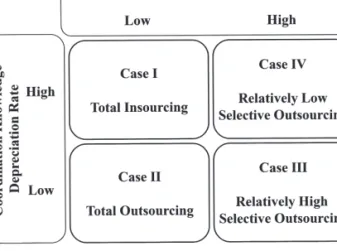
The analysis of the model is accomplished by creating four scenarios, each repre-senting a different combination of two critical knowledge parameters. The production knowledge transfer rate represents the ability of the client to capture production knowl-edge from the vendor. The coordination knowlknowl-edge depreciation rate represents the ability of the client to retain coordination knowledge as it outsources its IT activities. This parameter captures the impact of the loss of client learning-by-doing knowledge on client coordination knowledge.
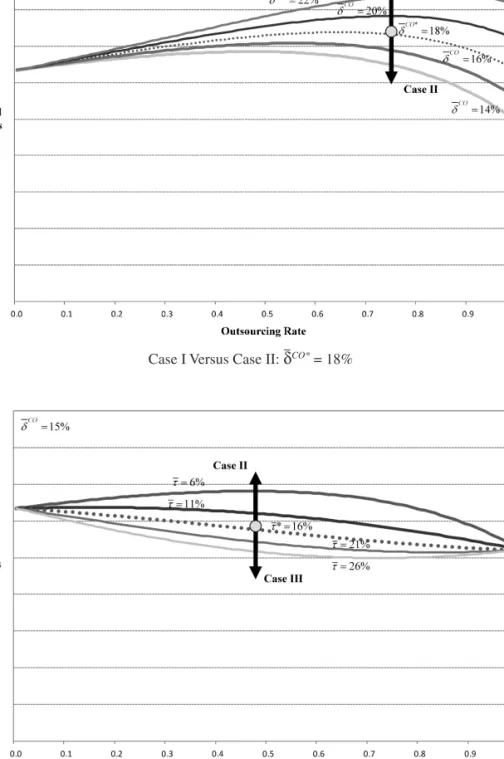
The critical findings are summarized in Figure 1. We find that when the rate at which the vendor transfers production knowledge to the client is relatively low, the client’s optimal outsourcing decision is to engage in either one of two extreme strategies—total insourcing or total outsourcing. The optimal choice depends on the rate at which the client’s coordination knowledge depreciates. Specifically, if the depreciation rate of the client’s coordination knowledge is low, then the client will minimize costs through a total outsourcing strategy; otherwise, if the depreciation rate of the client’s coordina-tion knowledge is relatively high, then the client will minimize costs through a total insourcing strategy (i.e., keeping all of its IT activities in-house).
On the other hand, we find that when the rate at which the vendor transfers production knowledge to the client is relatively high, the firm’s optimal decision is to implement a selective outsourcing strategy in which the firm outsources only a portion of its IT services. In this case, the optimal rate of IT outsourcing also depends on the rate at which the client’s coordination knowledge depreciates; that is, the lower the depre-ciation rate, the higher is the optimal rate of IT outsourcing. Later in the paper, these results are interpreted in the contexts of two mini-cases and a recent empirical study that focus on IT outsourcing relationships. In these contexts, we discuss how firms may be able to invest in various knowledge management strategies and technologies and other organizational capabilities to influence the knowledge environment and create the conditions for successful outsourcing.
The Learning-Based Outsourcing Model
WEASSUMETHATTHECLIENTFIRMPRODUCESa total quantity q of IT services and that the firm may decide to outsource any proportion (0 b A b 1)1 of its IT services to an
outside vendor, which has lower production costs than the client firm. The outsourc-ing rate is determined at the beginnoutsourc-ing of the contract and is fixed over the life of the contract. The vendor accepts this contract without negotiation (similar to a leader– follower relationship). The contract is a time-and-materials contract where the vendor’s production costs are passed directly to the client firm.
We assume that (1) firm costs vary inversely with the firm’s knowledge level and (2) the marginal change in a firm’s knowledge level is a function of its quantity of output, rate of knowledge transfer, and rate of knowledge depreciation. The derivations of the specific production and coordination knowledge/cost relationships are presented in Appendix A. The critical model parameters and relationships are summarized below and in Table 1. For the cases discussed later, the numeric values of the exogenous parameters are set to reflect a situation where the vendor has lower unit production costs and a larger scale than the client firm for the outsourced activity.
In our analysis, we want to determine the total cost to the client firm of outsourcing strategies, ranging from total insourcing to total outsourcing, in different knowledge environments, and identify the optimal degree of IT outsourcing in each environment. The total cost incurred by the client firm is the sum of all production costs and coordina-tion costs. The vendor’s produccoordina-tion costs are a funccoordina-tion of its repository of produccoordina-tion knowledge. The vendor accumulates experiential production knowledge by producing a quantity of Aq + D IT services for all of its clients. The more IT services the vendor produces for its clients, the larger is its repository of production knowledge and the lower are its production costs. However, the vendor also loses some of its repository of production knowledge over time through depreciation at a rate of DPR.
The client maintains two repositories of knowledge: a repository of production knowledge that supports its production of the IT services that remain in-house and a repository of coordination knowledge that supports the integration of the outsourced activities with the firm’s internal resources, which allows the firm to solve business problems and implement firm strategies. Like the vendor, the client loses some of its repository of production knowledge over time through depreciation at a rate of DPR.
However, the client accumulates new experiential production knowledge by producing the quantity of (1 – A)q IT services that remains in-house. In addition, the client may use different mechanisms to accumulate new and useful production knowledge at a rate of T from the vendor, where the amount of knowledge acquired from the vendor is T(Aq + D). We assume that the proportion of production knowledge transferred from the vendor to the client firm increases with the outsourcing rate A—or the extent of the outsourcing relationship—such that T = AT_, (0 b T_ b 1), where T_ is the upper boundary of the knowledge transfer rate when the firm outsources all of its services. So, as the client increases its outsourcing rate, there is a trade-off between benefits associated with acquiring production knowledge from the vendor and costs associated with losing experiential production knowledge.
Table 1. Critical Model P arameters and R elationships Notation Description Comments q Client fir m’ s output
This is the quantity of IT ser
vices that the fir
m m
ust produce either through inter
nal production or quantity through an e xter nal v endor . W
e assume that a fir
m producing more output will accum
ulate more
production kno
wledge via lear
ning-b y-doing activities . A Client fir m’ s outsourcing
This is the propor
tion (0
b
A
b
1) of the production of the client’
s
q
units of IT ser
vices that the client
rate outsources to an e xter nal v endor , where (1 – A ) is the propor tion of client’ s q
units that remain
in-house f or production. D PR Production kno wledge This is the r
ate at which the production kno
wledge of both fir
ms depreciates o ver time . Some depreciation r ate kno wledge is lost o
ver time because of technology obsolescence
, imperf ect kno wledge management pr actices , emplo yee tur no ver , and other f actors . T Production kno wledge This is the r
ate at which the client fir
m accum
ulates production kno
wledge through kno
wledge tr ansf er r ate tr ansf
ers from the e
xter
nal v
endor
. W
e assume that the propor
tion of the v
endor’
s production
kno
wledge acquired b
y the client increases with the outsourcing r
ate such that
T = AT _ , (0 bT _ b1). D CO Client fir m’ s coordination This is the r
ate at which the coordination kno
wledge of the client fir
m depreciates o ver time . If a kno wledge depreciation fir
m outsources its production activities
, it ma y lose m uch of its e xper iential kno wledge o ver time , rate
which will hinder the abilities of project managers to eff
ectiv
ely coordinate and integ
rate these
activities
. Theref
ore
, w
e assume that the depreciation r
ate of coordination kno
wledge increases with
the outsourcing r
ate such that
D CO = (1 – A ) D _ CO + AD _ CO , ( D _ CO b D _ CO ). D V endor’ s e xter nal
This is the quantity of IT ser
vices that the v
endor produces to meet the demand of its other clients
demand quantity
W
e assume that a v
endor producing more output f
or its clients will accum
ulate more production
kno
wledge via lear
ning-b y-doing activities . This quantity D ma y be vie w ed as the v endor’ s deg ree of specialty or siz e of production economies .
The client firm must coordinate and integrate the IT functions produced both in-house and by the vendor. The ability of project managers to effectively integrate the outsourced activities with the firm’s internal business processes depends critically on a firm’s domain experience accumulated through learning-by-doing activities. If a firm outsources its production activities, it may lose much of this experiential knowledge over time, which will hinder the abilities of project managers to effectively coordi-nate these activities. Therefore, we assume that the depreciation rate of coordination knowledge increases with the outsourcing rate A such that DCO = (1 – A)D_CO + AD_CO,
(D_CObD_CO), where D_CO is the depreciation rate of coordination knowledge under a total
insourcing strategy (A = 0) and D_CO is the depreciation rate of coordination
knowl-edge under a total outsourcing strategy (A = 1). Of course, the more the client firm outsources, the greater is the decline in its repository of coordination knowledge and the higher is its coordination cost.
The firm’s objective is to minimize total costs, the sum of production and coordination costs. Given the model, the closed-form solution to this cost-minimization problem is elusive. Therefore, we examine the implications of our model by analyzing four different cases, each representing a different combination of two critical knowledge parameters: (1) the upper bound (T_) of the transfer rate of production knowledge from the vendor to the client, which determines the behavior of production costs, and (2) the upper bound (D_CO) of the depreciation rate of the client’s coordination
knowledge, which determines the behavior of coordination costs. We examine the impact of each case on the production and coordination costs incurred under the full range of outsourcing strategies. We then aggregate this information to determine the firm’s optimal (or total cost minimizing) rate of IT outsourcing. Before presenting the cases, we examine the general behavior of the production and coordination costs as a function of the outsourcing rate.
Effect of Outsourcing Rate on Production Costs
Figure 2 maps the vendor’s production costs and the client firm’s in-house production costs as a function of the outsourcing rate. The parameter values used to demonstrate the relationships in Figures 2–4 are presented in Table 2. The unit cost of vendor produc-tion COS is decreasing in A because the outsourcing vendor can produce more outputs
(Aq + D) as A increases. This enables the vendor to accumulate more knowledge and, thereby, reduce its production costs. The client firm’s unit cost of in-house production CIH is either increasing or decreasing in A, depending on the upper bound (T_) of the
knowledge transfer rate. In Figure 2, the first two in-house production curves (T_ = 5 percent and 15 percent) illustrate cases in which the costs associated with losses of learning-by-doing knowledge outweigh the benefits associated with gains in knowl-edge transfer from the external vendor. In contrast, the last two in-house production curves (T_ = 25 percent and 35 percent) illustrate cases in which the benefits associated with gains in knowledge transfer outweigh the costs associated with losses in internal, experiential learning.
Figure 3 maps the total unit production costs as a function of the outsourcing rate. The total unit production costs are the weighted sum of the vendor production costs and the in-house production costs, CPR = ACOS + (1 – A)CIH. Figure 3 illustrates that Figure 2. In-House and Vendor Production Costs
Figure 4. Coordination Costs
Table 2. Instantiation of Parameters
Notation Description Value Comments
q Outsourcing firm’s 4,000 We explored parameter values output quantity such that D >> q because this assumption ensures that the D Vendor’s external 20,000 external vendor provides a
demand quantity significant learning-by-doing production cost advantage for the client.
DPR Production 10% Previous work has empirically knowledge estimated the amount of firm-level depreciation rate knowledge depreciation in different
industries, including aircraft D_CO Lower bound 5% production [8], shipbuilding [5, 28],
of coordination automotive assembly [19], and knowledge pizza franchises [12]. These studies depreciation rate report depreciation rates ranging
from 4 percent to 40 percent per period. Given our focus on service firms in examples discussed later and the high reliance on IT in service firms, we assume a depreciation rate at the lower end of the spectrum.
are always decreasing in A, they decrease at an increasing or decreasing rate depend-ing on the knowledge transfer rate as illustrated by the shape of each production cost curve in Figure 3. Specifically, if the knowledge transfer rate is relatively low (i.e., T_ < 16 percent in this illustration), then the marginal decrease in production costs grows as the outsourcing rate increases. Alternatively, if the knowledge transfer rate is relatively high (i.e., T_r 16 percent in this illustration), then the marginal decrease in production costs shrinks as the outsourcing rate increases.
Effect of Outsourcing Rate on Coordination Costs
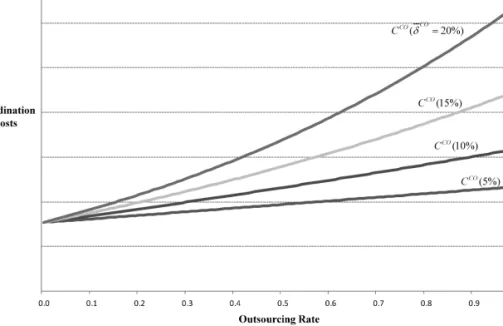
The behavior of coordination costs as the outsourcing rate varies is determined by the upper bound (D_CO) of the coordination knowledge depreciation rate. If outsourcing has
no impact on coordination knowledge (D_CO = D_CO), then the client firm’s coordination
cost (CCO) is linearly increasing in A as illustrated in Figure 4 (see D_CO = 5 percent).
However, the higher is D_CO, the greater is the marginal increase in coordination costs
over the outsourcing rate (A)—that is, the coordination cost curves become steeper with higher realizations of D_CO.
Outsourcing Cases: Effect of Knowledge Transfer and
Knowledge Depreciation
IN ORDER TO DERIVE INSIGHTS FROM THIS MODEL, we present four different cases where each case represents a different combination of the knowledge transfer and knowledge depreciation parameters. The parameter values used to demonstrate the results for each of the four cases are presented in Table 2. Interestingly, each case has a differ-ent implication for the business value of alternative outsourcing strategies and for the firm’s optimal degree of outsourcing.
Case I: Low Knowledge Transfer with High
Knowledge Depreciation
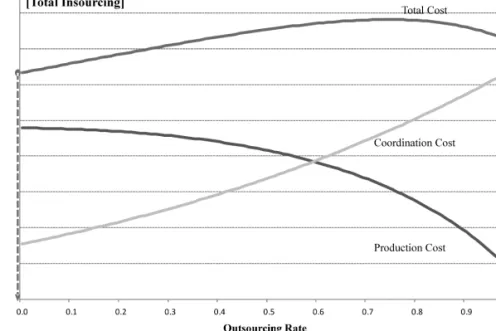
In Case I, we assume a relatively low upper bound on the knowledge transfer rate and a high upper bound on the client’s knowledge depreciation rate. Figure 5 illustrates the behavior of production costs, coordination costs, and total costs of outsourcing as a function of the outsourcing rate for Case Iassuming T_ = 5 percent and D_CO = 20 percent.
The arrow line shows the optimal outsourcing rate for this case. Case I is a somewhat bleak scenario for the firm when outsourcing because it is able to capture only a relatively small portion of the vendor’s production knowledge while its coordination knowledge depreciates rapidly over time, seriously hindering its ability to efficiently integrate the outsourced IT activities with the firm’s internal resources. For Case I, the production cost curve is declining with the outsourcing rate because more IT services
are produced with the vendor’s lower production costs. Interestingly, given the low upper bound on the knowledge transfer rate assumed in this case, the total production cost curve is concave. That is, the marginal decrease in total production costs (or the marginal production cost benefit to the client firm) grows with the outsourcing rate. In contrast, the coordination cost curve is increasing with the outsourcing rate. In fact, given the high upper bound on the depreciation rate assumed in this case, coordination costs increase rapidly with the outsourcing rate.
The total cost curve inCase I (see Figure 5) is the sum of the production cost curve and the coordination cost curve. The assumption of a low transfer rate in this case generates a total cost curve with a concave shape. This implies that the client’s optimal outsourcing decision will be to engage in either one of two extreme strategies—total insourcing or total outsourcing—depending on the realization of the depreciation rate. Given the high depreciation rate assumed in this case, it is more costly for the client firm to implement total outsourcing than to keep all of its IT activities in-house (i.e., total insourcing). Under these circumstances, the increase in coordination costs asso-ciated with total outsourcing outweighs the production cost advantages realized from the vendor’s production economies and knowledge transfers. So the cost-minimizing decision in Case I is to keep all IT activities in-house despite the vendors’ lower production costs.
Although Figure 5 illustrates the results for Case I assuming D_CO = 20 percent, the results hold for a wide range of D_CO (i.e., D_COr 18 percent). See Appendix B for details on the boundary conditions.
Case II: Low Knowledge Transfer with Low
Knowledge Depreciation
In Case II, we continue to assume a low upper bound on the knowledge transfer rate (i.e., T_ = 5 percent). This generates the same production cost curve as presented in Case I. However, we now assume a lower upper bound on the client’s knowledge depreciation rate (i.e., D_CO = 15 percent). This assumption generates a coordination cost curve that is less steep than in Case I. That is, coordination costs still increase with the outsourcing rate, but at a more gradual rate. Figure 6 illustrates the results for Case II.
In this case, the total cost curve is still concave (given the same production cost curve). However, given the lower upper bound on the depreciation rate of coordina-tion knowledge assumed in this case, the total cost associated with total outsourcing is now lower than the total cost associated with keeping all IT activities in-house. Because the client firm is better able (compared to Case I)to retain the coordination knowledge needed to integrate and manage the outsourced activities within the firm, the cost-minimizing decision in Case II is to outsource all of its IT activities to take advantage of the vendors’ lower production costs. Although Figure 6 illustrates the results for Case II assuming D_CO = 15 percent, the results hold for a wide range of D_CO (i.e., D_CO < 18 percent). See Appendix B for details on the boundary conditions.
Cases I and II illustrate that when the knowledge transfer rate is sufficiently low, the client’s optimal outsourcing decision is to engage in either one of two extreme
strategies—total insourcing or total outsourcing—depending on the rate at which the client’s coordination knowledge depreciates. In contrast, as we will see below, we find that when the knowledge transfer rate is high, the firm’s optimal decision is to engage in a selective outsourcing strategy.
Case III: High Knowledge Transfer with Low
Knowledge Depreciation
In Case III, we continue to assume a low knowledge depreciation rate (D_CO = 15 per-cent). This leads to the same coordination cost curve as presented in Case II. However, we now assume a high upper bound on the knowledge transfer rate (i.e., T_ = 25 per-cent or 35 perper-cent). Figure 7 illustrates the results for Case III. In this case, the high knowledge transfer rate transforms the shape of the total cost curve from a concave shape (as in Cases I and II) to a convex shape (or U-shape) as shown in Figure 7. Given the shape of the total cost curve, the firm will now choose a selective outsourc-ing strategy (i.e., an outsourcoutsourc-ing rate somewhere between total insourcoutsourc-ing and total outsourcing) to minimize total costs. The critical insight is that a high transfer rate allows the outsourcing firm to use a selective outsourcing strategy to gain substantial production cost advantages and knowledge transfers from the vendor without sacrific-ing all of its own in-house learnsacrific-ing-by-dosacrific-ing experiences (as in Case II). Maintainsacrific-ing some in-house production slows the decline in the client’s coordination knowledge and, therefore, helps the client to better coordinate the IT activities. The results hold Figure 7. Optimal Outsourcing Strategy: Case III
the boundary conditions.
This case illustrates another interesting result. With an increase in the upper bound on the knowledge transfer rate—for example, from 25 percent (see the solid line in Figure 7) to 35 percent (see the dotted line in Figure 7)—the firm’s cost-minimizing decision will be to decrease it outsourcing rate (from 74 percent to 62 percent in this illustration) given the change in the total cost curve. This result has interesting implications for the vendor. That is, the vendor may want to encourage the client firm to outsource as many IT activities as possible. Our findings suggest that one way the vendor may encourage the client firm to increase its outsourcing rate is by decreasing the rate (T_) at which it transfers production knowledge back to the client. In the extreme case, the vendor could decrease the transfer rate enough (i.e., T_ < 16 percent in this illustration) so that the total cost curve would transform into a concave shape similar to that shown in Case II, leading the client firm to outsource all of its IT activities.
Of course, such a manipulation of the knowledge transfer rate by the vendor is at odds with the interests of the client firm because such a manipulation increases the client firm’s total costs (see the comparison of total costs under the two transfer rates in Figure 7). That is, the client firm realizes lower total costs when it optimizes its outsourcing rate under a higher knowledge transfer rate. This conflict, in which the client has incentive to improve the transfer rate and the vendor has incentive to depress the transfer rate, leads to an interesting bargaining problem.
Case IV: High Knowledge Transfer with High
Knowledge Depreciation
In Case IV, we assume a high upper bound on the knowledge transfer rate (i.e.,
T = 25 percent or 35 percent) and a high upper bound on the knowledge depreciation rate (D_CO = 20 percent). Figure 8 illustrates the results for Case IV. As in Case III, the high knowledge transfer rate generates a total cost curve with a U-shape, again leading the firm to choose a selective outsourcing strategy to minimize its total costs. However, in this case, the client firm will minimize total costs by choosing a lower outsourcing rate than in Case III due to the higher coordination costs associated with outsourcing.
Of course, the vendor may again want to encourage the client firm to increase its outsourcing rate by decreasing the knowledge transfer rate. However, in this case, if the vendor sets a very low knowledge transfer rate (i.e., T_ < 12 percent in this illustration; see Appendix B for details on the boundary conditions), then the total cost curve may transform back to a concave shape (see Case I), forcing the client firm to minimize total costs by keeping all of its IT activities in-house. In addition, if the vendor could in some way help improve the client firm’s ability to coordinate the outsourced IT services with its internal resources, then it might encourage the client firm to increase its outsourcing rate (see Case III). This analysis raises more interesting bargaining problems as both vendor and client attempt to invest in mechanisms and contract provisions to manipulate these parameters.
Managerial Implications
A KEY CONTRIBUTION OF THIS PAPER is the use of an economic learning model to examine, from a normative perspective, how knowledge parameters characterizing a sourcing relationship between a vendor and a client interact with production costs and coor-dination costs to affect the business value of alternative outsourcing strategies. This information is then used to determine a firm’s optimal rate of IT outsourcing. The analysis of the model enables an informed discussion of these complex relationships. In this section, we discuss (1) some interesting insights derived from the model; (2) mechanisms client firms may use to affect the knowledge parameters and, therefore, alter the form of the optimal outsourcing strategy; and (3) our interpretation, in the context of our model, of two mini-cases and a recent empirical study that focus on IT outsourcing relationships in the banking and insurance industries.
Summary of Key Contributions
The critical contribution of our model is the examination of two critical knowledge parameters that help determine a firm’s optimal degree of IT outsourcing. These param-eters are (1) the transfer rate of production knowledge from the vendor to the client and (2) the depreciation rate of the client’s coordination knowledge. We find that when the knowledge transfer rate is low, the client’s optimal outsourcing decision is to engage in either one of two extreme strategies—total insourcing or total outsourcing—depending on the rate at which the client’s coordination knowledge depreciates. Specifically, if the depreciation rate of the client’s coordination knowledge is low, then the client
minimize costs through a total insourcing strategy. On the other hand, we find that when the knowledge transfer rate is high, the firm’s optimal decision is to implement a selective outsourcing strategy in which the firm outsources only a portion of its IT services. In this case, the optimal rate of IT outsourcing also depends on the rate at which the client’s coordination knowledge depreciates. Specifically, the lower the depreciation rate, the higher is the optimal rate of IT outsourcing.
A final insight that we highlight is that when the transfer rate is relatively high and a selective outsourcing strategy is optimal (i.e., Cases III and IV), a further marginal increase in the knowledge transfer rate will actually provide incentives for the client firm to reduce its outsourcing rate. That is, it will enable the client to both gain the benefits of the vendor’s lower production costs and improve its own internal produc-tion costs without sacrificing too much of its coordination knowledge and integrative capabilities.
Mechanisms for Manipulating Knowledge Parameters
Some previous work suggests that firms, as a rule of thumb, should engage in selec-tive outsourcing to lower costs and effecselec-tively mitigate outsourcing risks [21, 44]. However, given the results of Cases I and II, this rule of thumb is not effective if the outsourcing firm cannot ensure, either through contract provisions or investments in effective shared knowledge management systems, a relatively high transfer rate of production knowledge from the vendor to the client. As is illustrated in Case II, without such assurances, a client firm may be forced to fully rely on the vendor for its IT functions in order to minimize total costs.
Therefore, before determining the optimal rate of IT outsourcing, a client firm must examine the degree to which investments in technologies, training, and contractual pro-visions may affect the specific values of the knowledge parameters. For example,
s )NVESTMENTSINMONITORINGAPPLICATIONSCOMMUNICATIONSYSTEMSGROUPDECISION support systems, negotiation systems, and collaborative application development systems (e.g., code repository and computer-aided software engineering tools) may increase the rate of knowledge transfer from the vendor to the client. Such investments may make a selective outsourcing strategy more attractive to the client than either total insourcing or total outsourcing.
s )NVESTMENTSINCONTRACTANDPROJECTMANAGEMENTTRAININGMENTORINGPROGRAMS e-learning applications, knowledge management systems, and other technologies that codify organizational learning may decrease the coordination knowledge depreciation rate. Such investments may encourage the client firm to outsource a larger portion of its IT activities—even making total outsourcing an optimal strategy when saddled with a low rate of knowledge transfer.
However, it is critical to note that these investments may not generate the desired results because (1) investments in these technologies and vendor-specific relationships are expensive, (2) the costs of replacing legacy systems (or integrating them with
new investments) are high, and (3) vendors may be unwilling to support a substantial increase in the transfer rate of production knowledge even if the proper mechanisms were in place.
Outsourcing Relationship Mini-Cases
Mini-Case I (Moving from Case I to Case II): Continental Bank and Integrated Systems Solutions Corporation
Some of the managerial insights derived from our learning-based outsourcing model are illustrated by a case study of Continental Bank reported by Huber [24]. In 1991, Continental Bank identified three main problems with its internal IT unit: (1) the bank’s existing legacy systems lacked integration and could not respond quickly or flexibly to customers’ needs, (2) the IT staff was too small and lacked sufficient IT skills and knowledge to handle major systems upgrades or large conversion projects, and (3) the bank did not have enough money to invest properly in new technologies and IT staff. In fact, “top technical people didn’t want to work at a bank, where IT assignments paled in comparison with the opportunities at companies that focused on technology” [24, p. 123]. In the context of our learning model, Continental Bank did not have a substantial repository of either production knowledge or coordination knowledge.
To deal with these problems, in December 1991, Continental Bank entered a ten-year outsourcing agreement in which it agreed to outsource almost all of its IT services (i.e., development of new applications and maintenance of existing applications) to Integrated Systems Solutions Corporation (ISSC), a subsidiary of IBM. The bank did not believe that retaining or accumulating internal technological resources (i.e., produc-tion knowledge) provided any competitive advantage to the bank. Therefore, the bank did not have interest in investing in costly mechanisms to generate a high transfer rate of production knowledge from ISSC to the bank. However, as we discuss below, the bank did invest in mechanisms to significantly improve its coordination skills (i.e., reduce its coordination knowledge depreciation rate in the context of our model). This decision is consistent with the results of our model. That is, total outsourcing is the optimal degree of outsourcing when both the transfer rate of production knowledge and the depreciation rate of coordination knowledge are low.
In order to improve its coordination skills (and make its total outsourcing strategy effective), the bank implemented several mechanisms. For example, in an effort to develop tighter management control over IT, the bank incorporated strict methods that ISSC must use to measure and document progress in the IT development activities. Specifically, the method used function-point analysis to measure work in terms of the business functionality delivered to the bank. This requirement provided the bank with a better understanding of the type of work being performed and its costs. It helped Continental to retain coordination knowledge and to better integrate the outsourced IT with internal activities and set IT strategy and future development priorities.
In another effort to tightly manage the outsourced IT, the bank established a coop-erative management structure. For example, the bank developed a technical oversight
within the bank to set the IT development priorities and manage the bank’s relation-ship with ISSC. Specifically, all internal IT proposals were submitted to the technical oversight group, which evaluated the proposals and ranked them according to the bank’s overall priorities. This structure encouraged business units to communicate their needs and expertise more effectively, leading to an allocation of the IT budget more consistent with the bank’s strategic goals. This and the other mechanisms initi-ated at the beginning of the outsourcing agreement resulted in “changed behavior of the bank’s business units. They are now active and disciplined participants in the IT process. With virtually all IT work on a hard-dollar, contract basis, they are devoting time on the front end of projects to define clearly and carefully their technology needs and how they want to spend their budgets” [24, p. 129]. In the context of our model, the technical oversight group, initiated with the outsourcing relationship, helped to increase the bank’s repository of coordination knowledge and to decrease the deprecia-tion rate of that knowledge repository by formalizing IT project evaluadeprecia-tion.
In summary, Continental Bank decided at the beginning of its outsourcing agreement that it would accept a low transfer rate of production knowledge from ISSC since in-ternalizing specific IT skills would be very expensive, given its low existing repository of production knowledge, and would not provide the bank competitive advantage in the industry. However, the bank did realize the need to significantly improve its coor-dination activities in order to make a total outsourcing strategy effective. Therefore, after the outsourcing agreement in 1991, the bank did implement mechanisms that improved its coordination skills (or lowered its coordination costs) and, in the context of our model, likely shifted the bank away from Case I toward Case II, where its total outsourcing strategy would be effective.
Mini-Case II (Moving from Case I to Case III): FISC and Offsource
The managerial insights derived from our learning-based outsourcing model are fur-ther illustrated by a case study reported by Kaiser and Hawk [25]. Kaiser and Hawk described a U.S. financial insurance company (referred to by the pseudonym “FISC”) that, in the late 1990s, decided to selectively outsource the design, development, and support of several mission-critical software applications to an India-based offshore vendor (referred to by the pseudonym “Offsource”). As Offsource expanded its role in the sourcing relationship, FISC’s management became concerned about its dimin-ishing in-house IT skills and production knowledge, the costs associated with such losses, and the impact of these losses on FISC’s abilities to coordinate the outsourced activities with the firm’s other internal activities.
In the context of our learning model, FISC was realizing a low production knowl-edge transfer rate and a high coordination knowlknowl-edge depreciation rate in its sourcing relationship (Case I). Based on our model, FISC would have two choices: (1) shift to
total insourcing (the optimal sourcing strategy in a Case Ienvironment) and backshore
all of the previously outsourced IT activities or (2) implement mechanisms to make
depreciation rate. Given the high costs of backshoring, FISC decided to maintain the selective outsourcing relationship but address the rapid loss of in-house production and coordination knowledge by ensuring that its employees developed good technical and business skills.
FISC formalized knowledge transfer and internal knowledge retention by imple-menting several major initiatives. For each IT employee, FISC created an individual development plan (IDP) and a mentoring program. The IDP created specific employee knowledge goals and the mentoring program required the vendor to assist the employ-ees to meet those goals. By integrating the IDPs with a mentoring program, FISC was able to effectively retain important IT competencies and acquire (through knowledge transfers) Offsource’s expertise. In addition, FISC created a dual project management hierarchy that improved FISC’s organizational memory by codifying organizational knowledge, increasing the transfer rate of knowledge from Offsource to FISC, and reducing the rate of internal knowledge depreciation within FISC.
Together, these three mechanisms increased the production knowledge transfer rate and decreased the coordination knowledge depreciation rate. They moved FISC away from Case I, where the optimal strategy would be total insourcing, toward Case III, where the optimal strategy would be an aggressive (or relatively high) selective out-sourcing strategy similar to that implemented by FISC. Overall, this example illustrates how a client firm may invest in knowledge-enhancing mechanisms to improve the business value of a selective outsourcing strategy.
An Empirical Study of Outsourcing Relationships in the
Banking Industry (Comparing Case III and Case IV)
The normative findings derived from our model are consistent with findings from a recent empirical study by Weigelt [43] on IT outsourcing in banking. It examined the extent to which U.S. banks outsource their Internet banking solutions, such as online account inquiry, funds transfer, bill payment, and account maintenance, to external technology vendors. Vendors such as Fiserv and EDS have gained expertise and pro-duction cost advantages in this area by developing and installing Internet solutions for multiple banks and incorporating the lessons learned into prepackage software solutions. While outsourcing part or all of its Internet solutions to these vendors may reduce a bank’s need for extensive production knowledge, such as programming skills, it requires significant coordination knowledge that enables the bank to understand, customize, and integrate the new prepackaged technology with its internal business processes.
Weigelt’s study presented two critical findings related to our learning-based out-sourcing model. First, the empirical study showed that higher IT outout-sourcing rates reduce a firm’s integrative capabilities. This finding supports our model assumption that a firm’s coordination knowledge depreciation rate increases with its outsourcing rate. Second, the study showed that coordination knowledge declines at a slower rate for outsourcing banks with experience with a prior technology related to Internet banking. In Weigelt’s study, prior experience with a related technology was defined
banking and familiarized banks with remote customer self-service technologies. Prior experience with PC banking may help banks to better understand the cause-and-effect relationships underlying outsourced Internet solutions, make sense of them, and integrate them with internal business processes. Furthermore, the study also showed that pursuing higher IT outsourcing rates was particularly disadvantageous for banks lacking PC banking experience.
In the context of our model, experience with a prior related technology may be another mechanism that an outsourcing firm may use to mitigate the decline in coor-dination knowledge associated with outsourcing. That is, this mechanism may lower the firm’s upper bound on the coordination knowledge depreciation rate (D_CO) when
compared to a firm without such experience. Our model results suggest that firms with prior experience (see Case III), and thereby with lower coordination knowledge depreciation rates, should outsource a larger percentage of their IT function than firms without prior experience (see Case IV). These normative results are consistent with the empirical findings in the banking industry reported by Weigelt [43].
Conclusion
IN ORDER TO MAKE AN INFORMED DECISION, it is incumbent on managers to understand the complex relationships outlined in the model when negotiating an outsourcing contract. Further, it is incumbent on the manager to understand the effects that knowledge reten-tion and transfer investments may have on these relareten-tionships and, thus, on the form of the contract. Major errors could easily be made. Given the sensitivity of outcomes to the parameters of the model, poor knowledge and contract management may erode any potential benefits derived from the outsourcing relationship. Although our model provides several important insights, future work should focus on both analytically extending the current model and empirically testing the relationships derived from the model.
The normative economic model we presented has several limitations. First, the model focuses exclusively on how knowledge parameters, productions costs, and coordination costs interact to determine the optimal degree of IT outsourcing. As such, the model ignores other factors that have been shown in the literature to affect the degree of IT outsourcing. While mathematical models suffer from the inability to incorporate all factors into one comprehensive representation, future work may focus on modeling some of the interactions between the knowledge parameters and other factors of inter-est, especially other firm-level and IT-level characteristics.
Second, our model assumes the length of the outsourced IT project is fixed, known, and relatively long because we wanted to focus our analysis on large-scale IT projects. However, project size and length will affect the desirability of alternative outsourcing strategies in different knowledge environments. For example, a firm with a high coor-dination knowledge depreciation rate may find significant business value in outsourc-ing some or all of an IT project if the project is sufficiently short and the short-run production cost advantage offered by the vendor is sufficiently large. This combination
of factors may allow the firm to enjoy the short-run benefits of the vendor’s expertise and scale economies while avoiding, due to the short length of the project, the adverse effects of outsourcing on coordination knowledge and costs in the long run.
Third, our model assumes that the client firm’s outsourcing rate and each firm’s demand are fixed over the life of the project. A further extension of the model could allow for dynamic changes in the demands and the outsourcing rate over the life of the contract, essentially giving the client firm the option to expand or contract the out-sourcing relationship as the demand and knowledge parameters change over time.
Fourth, we assume that the production knowledge transfer rate and the coordina-tion knowledge depreciacoordina-tion rate are increasing linear funccoordina-tions of the client firm’s outsourcing rate. Future work may explore how different functional forms of these critical knowledge parameters affect a firm’s optimal degree of outsourcing. We have explored some other functional forms of these knowledge parameters, including qua-dratic forms, and have found that the general results and relationships reported for Cases I–IV still hold. However, further work may be fruitful.
Fifth, the results derived from our model call for empirical research that examines the degree of IT outsourcing as a function of knowledge parameters. Argote et al. [5] and Darr et al. [12] provide a general framework to conduct empirical research concerning organizational learning among multiple organizations using a longitudinal data set. This framework could be applied to test if firms choose IT outsourcing rates consistent with our model’s normative predictions.
Finally, at a more macro level, we note that implicit in our model and the FISC case is that the critical issue for making the selective outsourcing strategy viable is to protect the client firm from in-house knowledge losses by mining the now accu-mulating knowledge of the vendor. That is, we highlight the knowledge flows from the vendor to the client. This is in stark contrast to much of the outsourcing litera-ture that considers the efficient and effective transfer of information in the opposite direction—from the client to the vendor—as a key to the successful implementation of outsourcing [10].
Consider the case of a large IT outsourcing project involving the German operations of an international bank (the client) and a large Indian IT service provider (the vendor) reported in Gregory et al. [20]. The goal of the project was to reengineer two critical transactions systems to improve their efficiency and effectiveness and to reduce the dependency on human resources. The bank faced many issues revolving around the communication of the business goals and practices to the vendor. The case describes the strategies adopted to enable the communication of knowledge from the client bank to the vendor. To enable this transfer, “cross-organizational communication was speci-fied by assigning a communication ‘counterpart’ to every project leader or manager on both sides (cross-border coordination)” [20, p. 6]. This strategy was combined with strong incentives for knowledge sharing and mandated project meetings.
The strategies adopted by the bank are strikingly similar to the strategies adopted in FISC even though the direction of knowledge transfer is reversed. It seems, perhaps not surprisingly, that following the strategy of creating close communication ties between similar levels in the hierarchy can create bilateral knowledge flows. That is,
manage-facilitate the transfer of knowledge from client to vendor. Whether the conversation is directional or bilateral will depend on the rules of engagement, incentives, and, perhaps, cultural considerations—as discussed in the bank case.
Some papers address the importance of knowledge transfer, partnership, or social exchange theory in the outsourcing context (e.g., [35]). These approaches assume bi-lateral communication. Generally, the insight is that the more interaction between the
client and the vendor, the better the outcome of the outsourcing.2 There is a fundamental
identification problem here. If it is found that “communication improves outsourcing,” is that because the knowledge was transferred from the client to the vendor, from the vendor to the client, or both? This distinction may be critically important in interpreting empirical work and creating strategy recommendations for managers. Future models and empirical work should examine these knowledge flows further.
Acknowledgments:The authors gratefully thank Eric Clemons, Rob Kauffman, and the two
anonymous reviewers for their helpful comments and contributions. An early version of this paper was presented at the 42nd Hawaii International Conference on System Sciences (HICSS) in January 2009. The contributions and suggestions provided at this presentation and by the HICSS referees are acknowledged and appreciated.
N
OTES1. The degree of IT outsourcing has been measured as an approximate percentage of the
information systems function that is currently outsourced [4, 34, 41].
2. This is not surprising, since it is usually argued that the advantage of vertical integration (insourcing) is that you have lower coordination costs. To the extent that you can reproduce (at a low enough cost) the information transfer of the vertically integrated solution in an outsourcing environment, one would expect that performance of the relationship would be enhanced.
3. The fixed transaction cost (z) in the coordination costs is associated with activities such
as monitoring performance and managing contracts [7, 33].
R
EFERENCES1. Anderson, E.G., and Parker, G.G. The effect of learning on the make/buy decision.
Pro-duction and Operations Management,11, 3 (2002), 313–339.
2. Ang, S., and Cummings, L.L. Strategic response to institutional influences on information
systems outsourcing. Organization Science,8, 3 (1997), 235–256.
3. Ang, S., and Straub, D.W. Production and transaction economies and IS outsourcing: A
study of the U.S. banking industry. MIS Quarterly,22, 4 (1998), 535–552.
4. Apte, U.M.; Sobol, M.G.; Hanaoka, S.; Shimada, T.; Saarinen, T.; Salmela, T.; and Vep-salainen, A.P.J. IS outsourcing practices in the USA, Japan and Finland: A comparative study.
Journal of Information Technology,12, 4 (1997), 289–304.
5. Argote, L.; Beckman, S.L.; and Epple, D. The persistence and transfer of learning in
industrial settings. Management Science, 36, 2 (1990), 140–154.
6. Aubert, B.; Rivard, S.; and Patry, M. A transaction cost approach to outsourcing behavior:
Some empirical evidence. Information and Management,30, 2 (1996), 51–64.
7. Aubert, B.; Rivard, S.; and Patry, M. A transaction costs model of IT outsourcing.
Infor-mation and Management,41, 7 (2004), 921–934.
8. Benkard, C.L. Learning and forgetting: The dynamics of aircraft production. American
9. Cha, H.S.; Pingry, D.E.; and Thatcher, M.E. Managing the knowledge supply chain: An organizational learning model of information technology offshore outsourcing. MIS Quarterly, 32, 2 (2008), 281–306.
10. Chua, A.L., and Pan, S.L. Knowledge transfer and organizational learning in IS offshore sourcing. Omega,36, 2 (2008), 267–281.
11. Ciborra, C.U., and Andreu, R. Sharing knowledge across boundaries. Journal of
Informa-tion Technology,16, 2 (2001), 73–81.
12. Darr, E.D.; Argote, L.; and Epple, D. The acquisition, transfer and depreciation of knowledge in service organizations: Productivity in franchises. Management Science,41, 11 (1995), 1750–1762.
13. Das, A. Research opportunities in offshoring. Decision Line,35, 5 (2004), 7–19. 14. Davis, G.B.; Ein-Dor, P.; King, W.R.; and Torkzadeh, R. IT offshoring: History, prospects and challenges. Journal of the Association for Information Systems,7, 11 (2006), 770–795.
15. Dhar, S., and Balakrishnan, B. Risks, benefits, and challenges in global IT outsourcing: Perspectives and practices. Journal of Global Information Management,14, 3 (2006), 33–69.
16. Dibbern, J.; Goles, T.; Hirschheim, R.; and Jayatilaka, B. Information systems outsourcing: A survey and analysis of the literature. ACM SIGMIS Database,35, 4 (2004), 6–102.
17. Dos Santos, B.L., and Peffers, K. Rewards to investors in innovative information tech-nology applications: First movers and early followers in ATMs. Organization Science,6, 3 (1995), 241–259.
18. Earl, M.J. The risks of outsourcing IT. Sloan Management Review,37, 3 (1996), 26–32. 19. Epple, D.; Argote, L.; and Murphy, K. An empirical investigation of the microstructure of knowledge acquisition and transfer through learning by doing. Operations Research,44, 1 (1996), 77–86.
20. Gregory, R.; Beck, R.; and Prifling, M. Breaching the knowledge transfer blockade in IT offshore outsourcing projects—A case from the financial services industry. In R.H. Sprague Jr. (ed.), Proceedings of the Forty-Second Hawaii International Conference on System Sciences. Los Alamitos, CA: IEEE Computer Society Press, 2009 (available at www.hicss.hawaii.edu/ HICSS_42/BestPapers42/CollaborationTrack/Cross-Organization.pdf).
21. Grover, V.; Cheon, M.J.; and Teng, J.T.C. A descriptive study on the outsourcing of in-formation systems functions. Information & Management,27, 1 (1994), 33–44.
22. Grover, V.; Cheon, M.J.; and Teng, J.T.C. An evaluation of the impact of corporate strat-egy and the role of information technology on IS functional outsourcing. European Journal of
Information Systems,3, 3 (1994), 179–190.
23. Hu, Q.; Saunders, C.; and Gebelt, M. Research report: Diffusion of information systems outsourcing—A reevaluation of influence sources. Information Systems Research,8, 3 (1997), 288–301.
24. Huber, R.L. How Continental Bank outsourced its “crown jewels.” Harvard Business
Review,71, 1 (1993), 121–129.
25. Kaiser, K., and Hawk, S. Evolution of offshore software development: From outsourcing to cosourcing. MIS Quarterly Executive,3, 2 (2004), 69–81.
26. Kelley, M.R. Productivity and information technology: The elusive connection.
Manage-ment Science,40, 11 (1994), 1406–1425.
27. Kemerer, C.F. How the learning curve affects CASE tool adoption. IEEE Software,9, 3 (1992), 23–28.
28. Kim, I., and Seo, H. Depreciation and transfer of knowledge: An empirical explora-tion of a shipbuilding process. International Journal of Production Research,47, 7 (1990), 1857–1876.
29. King, W.R. Strategic outsourcing decisions. Information Systems Management,11, 4 (1994), 58–61.
30. Lacity, M.C.; Willcocks, L.P.; and Feeny, D.F. IT outsourcing: Maximize flexibility and control. Harvard Business Review,73, 3 (1995), 84–93.
31. Lacity, M.C.; Willcocks, L.P.; and Feeny, D.F. The value of selective IT outsourcing.
Sloan Management Review,37, 3 (1996), 13–25.
32. Loh, L., and Venkatraman, N. Determinants of information technology outsourcing: A cross-sectional analysis. Journal of Management Information Systems,9, 1 (Summer 1992), 7–24.
A transaction cost approach to analyzing outsourcing decision problems. European Journal of Operational Research,115, 2 (1999), 351–367.
34. Poppo, L., and Zenger, T.R. Testing alternative theories of the firm: Transaction cost, knowledge-based, and measurement explanations for make-or-buy decisions in information services. Strategic Management Journal,19, 9 (1997), 853–877.
35. Rottman, J.W., and Lacity, M.C. A U.S. client’s learning from outsourcing IT work off-shore. Information Systems Frontiers,10, 2 (2008), 259–275.
36. Saraswat, S.P., and Gorgone, J.T. Organizational learning curve in software installation: An empirical investigation. Information & Management,19, 1 (1990), 53–59.
37. Shy, O., and Rune, S. Strategic outsourcing. Journal of Economic Behavior & Organiza-tion,50, 2 (2003), 203–224.
38. Shy, O., and Rune, S. Partial outsourcing, monitoring cost, and market structure. Canadian Journal of Economics,38, 4 (2005), 1173–1190.
39. Slaughter, S., and Ang, S. Employment outsourcing in information systems. Communica-tions of the ACM,39, 7 (1996), 47–54.
40. Smith, M.A.; Mitra, S.; and Narasimhan, S. Information systems outsourcing: A study of pre-event firm characteristics. Journal of Management Information Systems,15, 2 (Fall 1998), 61–93.
41. Sobol, M.G., and Apte, U.M. Domestic and global outsourcing practices of America’s most effective IS users. Journal of Information Technology,10, 4 (1995), 269–280.
42. Teng, J.; Cheon, M.; and Grover, V. Decisions to outsource information systems functions: Testing a strategy-theoretic discrepancy model. Decision Sciences,26, 1 (1995), 75–103.
43. Weigelt, C. The impact of outsourcing new technologies on integrative capabilities and performance. Strategic Management Journal,30, 6 (2009), 595–616.
44. Willcocks, L.P.; Fitzgerald, G.; and Lacity, M.C. To outsource IT or not? Recent research on economics and evaluation practice. European Journal of Information Systems,5, 3 (1996), 143–160.
Appendix A: The Basic Learning-Based Outsourcing Model
from Cha et al. [9]
THEUNITCOSTINCURREDBYTHEFIRMat any given time t is the sum of all production
costs and coordination costs,
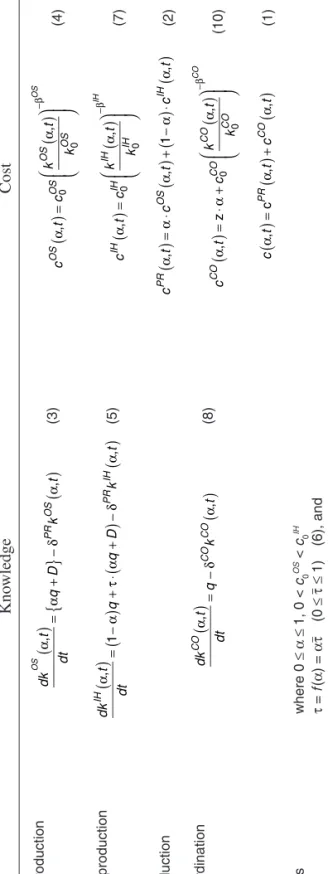
c ,t cPR ,t cCO , ,t (A1) where cPR is the cost to produce one of the q units of IT services (e.g., software ap-plication) and cCO is the cost to coordinate the production of one of the q units. The functional forms of each cost component in Equation (1) are summarized in Table A1 and are discussed in more detail below.
Production Costs
We divide the production costs in Equation (A1) into two components:
cPR ,t cOS ,t
1 cIH ,t 0 1, (A2)where A is the proportion of the client’s q units of output that the client outsources to the external vendor, cOS is the cost incurred by the external vendor to produce one of the q units, and cIH is the cost incurred by the client firm to produce one of the q units.
Table
A
1. Outsourcing Model Functions
Kno wledge Cost V ender production dk t dt qD kt OS PR OS , , (3) ct c kt k OS OS OS OS O S , , 0 0 (4) In-house production dk t dt qq Dk t IH PR IH , , 1 (5) ct c kt k IH IH IH IH IH , , 0 0 (7) Total production ct ct ct PR OS IH ,, , 1 (2) Total coordination dk t dt qk t CO CO CO , , (8) ct c kt k CO CO CO CO C O , , z 0 0 (10) Total cost ct tc t PR CO ,, , c (1) Conditions where 0 b Ab 1, 0 < c0 OS < c0 IH T = f ( A ) = AT _ (0 bT _ b1) (6), and D CO = g ( A ) = (1 – A ) D _ CO + AD _ CO ( D _ CO b D _ CO ) (9)