Access Using Isolation-Only Transactions
Qi Lu
May 1996
CMU-CS-96-131
School of Computer Science Carnegie Mellon University
Pittsburgh, PA 15213
Submitted in partial fulfillment of the requirements for the degree of Doctor of Philosophy.
Thesis Committee: Mahadev Satyanarayanan, Chair
Jeannette Wing David Garlan
Eliot Moss, University of Massachusetts
Copyright c1996 Qi Lu
This research was sponsored by the Air Force Materiel Command (AFMC) and the Advanced Research Projects Agency (ARPA) under contract number F19628-93-C-0193. Additional support was provided by the IBM Corporation, Digital Equipment Corporation, Bellcore, Intel Corporation, and AT&T.
The views and conclusions contained in this document are those of the author and should not be interpreted as necessarily representing the official policies or endorsements, either expressed or implied, of AFMC, ARPA, the U. S. Government, or the sponsoring corporations.
Abstract
Disconnected operation based on optimistic replication has been demonstrated as an effective
technique enabling mobile computers to access shared data in distributed file systems. To guard against inconsistencies resulted from partitioned data sharing, past research has focused on detecting and resolving write/write conflicts. However, experience shows that undetected read/write conflicts pose a subtle but serious threat to data integrity in mobile file access. Solving this problem is critical for the future success of mobile computing.
This dissertation shows that isolation-only transaction (IOT), an upward compatible trans-action mechanism for the Unix File System, is a viable solution to this problem. The central idea of the IOT model is imposing serializability-based isolation requirements on partitioned transaction executions. Transactions executed on a disconnected client stay in a tentative state until the client regains connection to relevant servers. They are committed to the servers as soon as they pass consistency validation. Invalidated transactions are automatically or manu-ally resolved to ensure global consistency. Powerful resolution mechanisms such as automatic transaction re-execution and application specific resolver invocation can transparently resolve conflicts for many common Unix applications. In addition, a concise conflict representation scheme enables application semantics to be smoothly integrated for only conflict resolution and consistency validation. The practical usability of IOT is further enhanced by a flexible interactive interface, full compatibility with existing Unix applications, and the ability to retain overall file system scalability, security and transparency.
A working IOT implementation in the Coda file system has been developed and used in experiments in software development and document processing applications. Quantitative evaluation based on controlled experiments and trace-driven simulations establish that the IOT model is scalable and incurs modest performance and resource overhead.
The main contributions of this thesis research are the following: the design of an isolation-only transaction model specialized for improving mobile file consistency while preserving upward compatibility with existing Unix applications; the development of a working IOT implementation in the Coda file system; experimentation and evaluation demonstrating the feasibility and practicality of the IOT model.
Acknowledgments
First and foremost, I would like to thank my advisor Satya, without whom this thesis would not have been possible. He taught me design, implementation, and evaluation skills that are critical in completing this dissertation. His patience, encouragement and support made my transition from the previous research area of software engineering to distributed and mobile computing systems much easier. His unparalleled expertise and insight in experimental systems research have been a constant source of guidance throughout the thesis research process. I also would like to thank other members of my thesis committee, Eliot Moss, Jeannette Wing and David Garlan for their valuable help that significantly improves both the technical content and the presentation of this dissertation.
My stay at the School of Computer Science of CMU would not have been as enjoyable and rewarding without the wonderful people who made it a great place to do research in computer science. I am deeply indebted to my first advisor, late Professor Nico Habermann, for his invaluable help in my development as a graduate student and a researcher both technically and personally. I would like to thank Sharon Burks for being so helpful when I needed the most. Present and past Coda project members including Maria Ebling, Bob Baron, Jay Kistler, Hiroshi Inamura, Hank Mashburn, Lily Mummert, Brian Noble, Morgan Price, Josh Raiff, David Steer, and Tetsuro Muranaga offered me generous support. Jay helped formulating the central theme of my thesis; Puneet was always available for help; Tetsuro used my software in his mobile CSCW research to provide me valuable usage experience. LeAnn Neal Reilly carefully proof read the entire dissertation. I also would like to thank my officemates, past and present, for creating an intellectually stimulating environment.
My parents taught me the value of hard work and instilled in me the desire to be successful. Without their love and sacrifice, I never could have come this far. Thanks also to my daughter, Diana, for reminding me that there is so much more to life than computer science. Finally, my wife, Yin, deserves greater thanks than I can possibly give. Over the past seven years, she has been an immeasurable source of strength, love, comfort, and support. Yin, this thesis is dedicated to you.
Contents
1 Introduction 1
1.1 Mobile File Access: : : : : : : : : : : : : : : : : : : : : : : : : : : : : : : 1 1.2 Disconnected Operation : : : : : : : : : : : : : : : : : : : : : : : : : : : : 2 1.3 Partitioned Sharing and Data Inconsistency : : : : : : : : : : : : : : : : : : 3 1.4 The Thesis : : : : : : : : : : : : : : : : : : : : : : : : : : : : : : : : : : : 4 1.5 Organization of this Dissertation : : : : : : : : : : : : : : : : : : : : : : : : 5 2 Partitions, Conflicts and Inconsistency 7 2.1 The Impact of Optimistic Replication on UFS Semantics : : : : : : : : : : : 7 2.2 Consistency Maintenance : : : : : : : : : : : : : : : : : : : : : : : : : : : 12 2.3 From Partitioned Sharing to Inconsistency : : : : : : : : : : : : : : : : : : : 13
3 Design Rationale 15
3.1 Design Objectives and Constraints : : : : : : : : : : : : : : : : : : : : : : : 15 3.1.1 Design Objectives : : : : : : : : : : : : : : : : : : : : : : : : : : : 15 3.1.2 Design Context : : : : : : : : : : : : : : : : : : : : : : : : : : : : 17 3.2 High Level Design Decisions : : : : : : : : : : : : : : : : : : : : : : : : : 19 3.2.1 Focusing on Disconnected Operation : : : : : : : : : : : : : : : : : 19 3.2.2 Optimistic Approach: : : : : : : : : : : : : : : : : : : : : : : : : : 20 3.2.3 Inconsistency Detection : : : : : : : : : : : : : : : : : : : : : : : : 20 3.2.4 Consistency Restoration : : : : : : : : : : : : : : : : : : : : : : : : 22 3.2.5 Starting Point: Inferred Transaction Model : : : : : : : : : : : : : : 23 3.3 Isolation-Only Transaction Model : : : : : : : : : : : : : : : : : : : : : : : 25
3.3.1 What Is IOT? : : : : : : : : : : : : : : : : : : : : : : : : : : : : : 25 3.3.2 Execution Model : : : : : : : : : : : : : : : : : : : : : : : : : : : 26 3.3.3 Why Isolation Only? : : : : : : : : : : : : : : : : : : : : : : : : : : 28 3.3.4 Consistency Model : : : : : : : : : : : : : : : : : : : : : : : : : : 29 3.3.5 Handling Non-Transactional Operations : : : : : : : : : : : : : : : : 35 3.3.6 Model Optimization : : : : : : : : : : : : : : : : : : : : : : : : : : 35 3.3.7 Closing Remarks : : : : : : : : : : : : : : : : : : : : : : : : : : : 38 4 Detailed Design: Consistency Enforcement 43 4.1 Concurrency Control for Connected Transactions : : : : : : : : : : : : : : : 44 4.1.1 Design Alternatives : : : : : : : : : : : : : : : : : : : : : : : : : : 44 4.1.2 Realizing OCC in Coda : : : : : : : : : : : : : : : : : : : : : : : : 45 4.2 Maintaining the Local State of A Disconnected Client : : : : : : : : : : : : : 50 4.2.1 Maintaining Local Consistency : : : : : : : : : : : : : : : : : : : : 50 4.2.2 Recording Transaction History : : : : : : : : : : : : : : : : : : : : 51 4.2.3 Managing Disconnected Mutations : : : : : : : : : : : : : : : : : : 52 4.2.4 Cancelling Disconnected Transactions: : : : : : : : : : : : : : : : : 55 4.3 Merging Local State with Global State: : : : : : : : : : : : : : : : : : : : : 58 4.3.1 Synchronizing Local and Global States : : : : : : : : : : : : : : : : 58 4.3.2 From Servers to Client: Cache Validation : : : : : : : : : : : : : : : 60 4.3.3 From Client to Servers: An Incremental Propagation Approach : : : : 60 4.3.4 Transaction Validation : : : : : : : : : : : : : : : : : : : : : : : : 64 4.3.5 Transaction Commitment : : : : : : : : : : : : : : : : : : : : : : : 65 4.3.6 Transaction Resolution : : : : : : : : : : : : : : : : : : : : : : : : 65 5 Detailed Design: Conflict Representation 67 5.1 Basic Issues of Conflict Representation : : : : : : : : : : : : : : : : : : : : 67 5.1.1 Inconsistent Objects : : : : : : : : : : : : : : : : : : : : : : : : : : 67 5.1.2 Two Venus Operation Modes : : : : : : : : : : : : : : : : : : : : : 68 5.1.3 Conflict Representation Requirements : : : : : : : : : : : : : : : : : 69 5.2 Conflict Representation in Service Mode : : : : : : : : : : : : : : : : : : : 69
5.2.1 Conflict Notification : : : : : : : : : : : : : : : : : : : : : : : : : : 69 5.2.2 Access Prevention : : : : : : : : : : : : : : : : : : : : : : : : : : : 70 5.2.3 Visibility Maintenance : : : : : : : : : : : : : : : : : : : : : : : : : 71 5.3 Conflict Representation in Resolution Mode : : : : : : : : : : : : : : : : : : 75 5.3.1 Exposing Local and Global State of an Inconsistent Object : : : : : : 76 5.3.2 The Realization of Dual Replica Representation : : : : : : : : : : : : 81 5.3.3 The Multiple View Capability : : : : : : : : : : : : : : : : : : : : : 85 5.3.4 Establishing Transaction Resolution Object View : : : : : : : : : : : 86 6 Detailed Design: Conflict Resolution 89 6.1 A Cooperation-Based Resolution Framework : : : : : : : : : : : : : : : : : 89 6.1.1 A Resolution Session Model : : : : : : : : : : : : : : : : : : : : : : 89 6.1.2 Supporting Application-Independent Resolution Actions : : : : : : : 93 6.1.3 Extending Transaction State Transitions : : : : : : : : : : : : : : : : 95 6.2 Automatic Conflict Resolution : : : : : : : : : : : : : : : : : : : : : : : : : 97 6.2.1 Site of Resolver Execution: : : : : : : : : : : : : : : : : : : : : : : 97 6.2.2 Resolver Invocation : : : : : : : : : : : : : : : : : : : : : : : : : : 98 6.2.3 Resolver Execution : : : : : : : : : : : : : : : : : : : : : : : : : : 99 6.2.4 Safety Issues : : : : : : : : : : : : : : : : : : : : : : : : : : : : : : 101 6.2.5 Programming Application-Specific Resolvers : : : : : : : : : : : : : 103 6.3 Manual Conflict Resolution : : : : : : : : : : : : : : : : : : : : : : : : : : 105 6.3.1 Maintaining A Repair Session : : : : : : : : : : : : : : : : : : : : : 105 6.3.2 The Transaction Repair Tool : : : : : : : : : : : : : : : : : : : : : : 106
7 Detailed Design: User Interface 109
7.1 Programming Interface: : : : : : : : : : : : : : : : : : : : : : : : : : : : : 109 7.1.1 Interface for Programming Isolation-Only Transactions : : : : : : : : 109 7.1.2 Interface for Programming Application-Specific Resolvers : : : : : : 113 7.1.3 Other Issues : : : : : : : : : : : : : : : : : : : : : : : : : : : : : : 114 7.2 Interactive Interface : : : : : : : : : : : : : : : : : : : : : : : : : : : : : : 114 7.2.1 Interactive Transaction Manipulation Using the IOT-Shell : : : : : : 115
7.2.2 Internal Mechanisms for Interactive Transaction Execution : : : : : : 116 7.2.3 Controlling and Monitoring Facilities : : : : : : : : : : : : : : : : : 117 7.2.4 A Practical Example : : : : : : : : : : : : : : : : : : : : : : : : : : 118
8 Implementation Issues 121
8.1 Overall Architecture : : : : : : : : : : : : : : : : : : : : : : : : : : : : : : 121 8.2 Maintaining Internal Transaction Representation : : : : : : : : : : : : : : : 123 8.2.1 Main Data Structures : : : : : : : : : : : : : : : : : : : : : : : : : 123 8.2.2 Recording Transaction Readset/Writeset: : : : : : : : : : : : : : : : 125 8.3 Shadow Cache File Management : : : : : : : : : : : : : : : : : : : : : : : 127 8.3.1 Shadow Cache File Organization : : : : : : : : : : : : : : : : : : : 127 8.3.2 Prioritized Cache Space Management : : : : : : : : : : : : : : : : : 128 8.3.3 Reclaiming Shadow Space: : : : : : : : : : : : : : : : : : : : : : : 130 8.4 Implementation Optimizations : : : : : : : : : : : : : : : : : : : : : : : : : 130 8.4.1 Lazy Serialization Graph Maintenance : : : : : : : : : : : : : : : : 130 8.4.2 Coalescing the Serialization Graph : : : : : : : : : : : : : : : : : : 131 8.4.3 Sharing Environment Variables : : : : : : : : : : : : : : : : : : : : 132 8.5 Persistence and Crash Recovery : : : : : : : : : : : : : : : : : : : : : : : : 132 8.5.1 Persistent Data Structures : : : : : : : : : : : : : : : : : : : : : : : 133 8.5.2 Crash Recovery : : : : : : : : : : : : : : : : : : : : : : : : : : : : 133 8.6 Transaction Validation : : : : : : : : : : : : : : : : : : : : : : : : : : : : : 134 8.6.1 Overloading with Cache Coherence Maintenance : : : : : : : : : : : 134 8.6.2 Object Version Maintenance : : : : : : : : : : : : : : : : : : : : : : 135 8.6.3 Validation Atomicity: : : : : : : : : : : : : : : : : : : : : : : : : : 135
9 Evaluation 137
9.1 Overview : : : : : : : : : : : : : : : : : : : : : : : : : : : : : : : : : : : 137 9.1.1 System Evolution and Status : : : : : : : : : : : : : : : : : : : : : 137 9.1.2 Basic Evaluation Approach : : : : : : : : : : : : : : : : : : : : : : 139 9.2 Transaction Performance: : : : : : : : : : : : : : : : : : : : : : : : : : : : 139 9.2.1 Performance Overhead for Normal Operations : : : : : : : : : : : : 140
9.2.2 Performance Overhead for Transactional Operations : : : : : : : : : 145 9.2.3 Performance of Automatic Resolution : : : : : : : : : : : : : : : : : 153 9.2.4 Other Performance Issues : : : : : : : : : : : : : : : : : : : : : : : 155 9.2.5 Summary : : : : : : : : : : : : : : : : : : : : : : : : : : : : : : : 156 9.3 Resource Cost Measurement : : : : : : : : : : : : : : : : : : : : : : : : : : 157 9.3.1 Global System Resources : : : : : : : : : : : : : : : : : : : : : : : 157 9.3.2 Local System Resources : : : : : : : : : : : : : : : : : : : : : : : 161 9.3.3 Summary : : : : : : : : : : : : : : : : : : : : : : : : : : : : : : : 177 9.4 A Preliminary Usability Assessment : : : : : : : : : : : : : : : : : : : : : 177 9.4.1 Interactive Transaction Invocation : : : : : : : : : : : : : : : : : : : 178 9.4.2 Programming A Transaction : : : : : : : : : : : : : : : : : : : : : : 179 9.4.3 Resolver Development: : : : : : : : : : : : : : : : : : : : : : : : : 179 9.5 Further Evaluation : : : : : : : : : : : : : : : : : : : : : : : : : : : : : : : 183 9.5.1 Data Collection : : : : : : : : : : : : : : : : : : : : : : : : : : : : 183 9.5.2 User Survey : : : : : : : : : : : : : : : : : : : : : : : : : : : : : : 184 10 Related Work 185
10.1 Transaction Models and Systems : : : : : : : : : : : : : : : : : : : : : : : 185 10.1.1 General Purpose Transaction Systems : : : : : : : : : : : : : : : : : 185 10.1.2 Transaction Support for File Systems : : : : : : : : : : : : : : : : : 186 10.1.3 Optimistic Concurrency Control : : : : : : : : : : : : : : : : : : : : 186 10.1.4 Special Transaction Models : : : : : : : : : : : : : : : : : : : : : : 187 10.2 Optimistically Replicated Systems : : : : : : : : : : : : : : : : : : : : : : : 187 10.2.1 The Coda File System : : : : : : : : : : : : : : : : : : : : : : : : : 187 10.2.2 The Ficus File System : : : : : : : : : : : : : : : : : : : : : : : : : 189 10.2.3 The Bayou System: : : : : : : : : : : : : : : : : : : : : : : : : : : 189 10.2.4 Davidson’s Optimistic Transaction Model : : : : : : : : : : : : : : : 190 10.3 Commercial Products : : : : : : : : : : : : : : : : : : : : : : : : : : : : : 190 10.3.1 Lotus Notes : : : : : : : : : : : : : : : : : : : : : : : : : : : : : : 190 10.3.2 Oracle Server Replication : : : : : : : : : : : : : : : : : : : : : : : 191
11 Conclusion 193 11.1 Contributions : : : : : : : : : : : : : : : : : : : : : : : : : : : : : : : : : 194 11.2 Future Work : : : : : : : : : : : : : : : : : : : : : : : : : : : : : : : : : : 195 11.2.1 Implementation Extensions : : : : : : : : : : : : : : : : : : : : : : 196 11.2.2 Model Generalization : : : : : : : : : : : : : : : : : : : : : : : : : 196 11.2.3 Resolver Development: : : : : : : : : : : : : : : : : : : : : : : : : 198 11.3 Final Remarks : : : : : : : : : : : : : : : : : : : : : : : : : : : : : : : : : 198
List of Figures
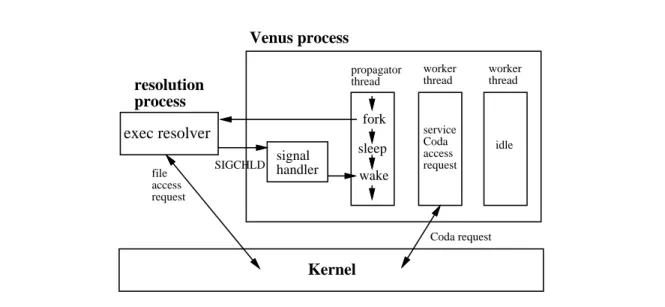
3.1 Venus States and Their Transitions: : : : : : : : : : : : : : : : : : : : : : : 18 3.2 An Example of Non-Serializable Partitioned Transactions : : : : : : : : : : : 24 3.3 IOT States and Their Transitions : : : : : : : : : : : : : : : : : : : : : : : : 27 3.4 Read-Only Transactions Violating One-Copy Serializability: : : : : : : : : : 39 3.5 Relationship Among Semantic Models : : : : : : : : : : : : : : : : : : : : 41 4.1 Transaction Mutation Log Organization : : : : : : : : : : : : : : : : : : : : 47 4.2 The Transaction Reintegration Process: : : : : : : : : : : : : : : : : : : : : 48 4.3 The New Transaction Reintegration Process : : : : : : : : : : : : : : : : : : 54 4.4 The IOT-Venus States and Their Transitions : : : : : : : : : : : : : : : : : : 59 4.5 An Incremental Transaction Propagation Framework : : : : : : : : : : : : : 61 4.6 An Algorithm for Incremental Transaction Propagation : : : : : : : : : : : : 63 5.1 An Example of Dangling Symbolic Links : : : : : : : : : : : : : : : : : : : 70 5.2 Visibility of Cached Objects : : : : : : : : : : : : : : : : : : : : : : : : : : 74 5.3 Cached Object States and Their Transitions : : : : : : : : : : : : : : : : : : 75 5.4 The Basic Structure of Dual Replica Representation : : : : : : : : : : : : : : 80 5.5 An Example of Dual Replica Conflict Representation : : : : : : : : : : : : : 80 5.6 Internal Structure of Dual Replica Representation : : : : : : : : : : : : : : : 82 5.7 The Internal Structure of Local and Global Views : : : : : : : : : : : : : : : 85 6.1 A Cooperation-Based Resolution Session Model : : : : : : : : : : : : : : : 90 6.2 Extended IOT State Transitions : : : : : : : : : : : : : : : : : : : : : : : : 96 6.3 The Process Structure of Automatic Resolver Execution: : : : : : : : : : : : 99
6.4 A List of Transaction Repair Tool Commands : : : : : : : : : : : : : : : : : 106 7.1 Library Routines for Programming Transactions : : : : : : : : : : : : : : : : 110 7.2 A Template Transaction Program Using Target Application Source Code : : : 111 7.3 A Transaction Program not Using Target Application Source Code : : : : : : 112 7.4 Library Routines for Programming Resolvers : : : : : : : : : : : : : : : : : 113 7.5 Transaction Specification Commands and Examples: : : : : : : : : : : : : : 115 7.6 Interactive Transaction Execution in the IOT-Shell : : : : : : : : : : : : : : 117 7.7 A Practical Transaction Example : : : : : : : : : : : : : : : : : : : : : : : 118 8.1 The IOT System Architecture : : : : : : : : : : : : : : : : : : : : : : : : : 122 8.2 Main Data Structures in Internal Transaction Representation : : : : : : : : : 123 8.3 Extending Kernel/Venus Communication with Process Information : : : : : : 126 8.4 An Example of Internal Organization of Shadow Cache Files : : : : : : : : : 128 8.5 Prioritized Cache Space Allocation : : : : : : : : : : : : : : : : : : : : : : 129 8.6 An Example of Coalescing a Serialization Graph : : : : : : : : : : : : : : : 131 9.1 Performance Comparison for Andrew Benchmark : : : : : : : : : : : : : : : 147 9.2 Comparison of Trace Replay Performance : : : : : : : : : : : : : : : : : : : 149 9.3 Comparison of Software Build Task Performances : : : : : : : : : : : : : : 151 9.4 Comparison of Document Build Task Performances : : : : : : : : : : : : : : 152 9.5 Latency of Localization and De-localization : : : : : : : : : : : : : : : : : : 154 9.6 Reintegration Traffic for Multiple Runs of Andrew Benchmark : : : : : : : : 160 9.7 High-Water Marks of Shadow Space Cost : : : : : : : : : : : : : : : : : : : 165 9.8 Shadow Space Cost Without Transaction Cancellation: : : : : : : : : : : : : 169 9.9 High-Water Marks of RVM Space Cost : : : : : : : : : : : : : : : : : : : : 171 9.10 RVM Space Cost Without Transaction Cancellation : : : : : : : : : : : : : : 172 9.11 Subtree Height Distribution : : : : : : : : : : : : : : : : : : : : : : : : : : 175 9.12 Examples for Transaction Specification : : : : : : : : : : : : : : : : : : : : 178 9.13 An Example of a Resolver for Make : : : : : : : : : : : : : : : : : : : : : : 180 9.14 An Example of A Resolver for RCS Checkout : : : : : : : : : : : : : : : : : 182
List of Tables
2.1 A Table of Abbreviations : : : : : : : : : : : : : : : : : : : : : : : : : : : 8 3.1 Inferred Transaction Types and UFS System Call Mapping : : : : : : : : : : 23 3.2 Transaction Specification for File Access Operations : : : : : : : : : : : : : 36 9.1 Client Platforms Supported by IOT : : : : : : : : : : : : : : : : : : : : : : 138 9.2 Normal Operation Performance of Andrew Benchmark : : : : : : : : : : : : 141 9.3 Normal Operation Performance of Trace Replay with=1: : : : : : : : : : 142 9.4 Normal Operation Performance of Trace Replay with=60 : : : : : : : : : 143 9.5 Normal Operation Performance of Building Coda Client and Server : : : : : 143 9.6 Normal Operation Performance of Typesetting a Dissertation and a Proposal : 144 9.7 Transaction Execution Performance of Andrew Benchmark : : : : : : : : : : 146 9.8 Performance of Transactional Trace Replay with=1 : : : : : : : : : : : : 148 9.9 Performance of Transactional Trace Replay with=60 : : : : : : : : : : : 148 9.10 Transaction Performance Overhead for Software Build Tasks : : : : : : : : : 150 9.11 Transaction Performance Overhead for Document Build Tasks : : : : : : : : 151 9.12 Impact of Disconnected Transactions on Reintegration Server Load : : : : : : 158 9.13 Information for the Work-Day and Full-Week Traces : : : : : : : : : : : : : 162 9.14 Simulated Transaction Applications : : : : : : : : : : : : : : : : : : : : : : 163 9.15 Transaction and File Reference Statistics of Trace Simulation : : : : : : : : : 166 9.16 Transaction Application Statistics Of Trace Simulation : : : : : : : : : : : : 168 9.17 RVM Cost for Common Transactions : : : : : : : : : : : : : : : : : : : : : 170 9.18 File System Object Distribution : : : : : : : : : : : : : : : : : : : : : : : : 174
Chapter 1
Introduction
With the growing prevalence of portable computers, providing mobile computers with conve-nient access to shared data in distributed file systems (DFSs) becomes an important problem. Although disconnected operation has been shown to be a viable technique for supporting mobile access in distributed Unix file systems (UFS) [27, 62], it induces the risk of data in-consistency due to partitioned data sharing. This dissertation advocates a new abstraction called Isolation-Only Transaction (IOT) as an effective means to improve consistency for mo-bile file access [40, 41]. It demonstrates the viability of this approach through the design, implementation and evaluation of IOT in the Coda file system.
This chapter begins with a brief background of DFSs and disconnected operation. It then introduces the data inconsistency problems caused by partitioned sharing during disconnected operation. It concludes with the thesis statement and an outline of its substantiation in the rest of the document.
1.1
Mobile File Access
Distributed File Systems DFSs such as NFS [58], AFS [44, 24, 59], NetWare [50] and LanManager are becoming an integral part of the basic computing infrastructure in organizations with a large number of networked personal computers or workstations. Their increasing popularity can be attributed to the following reasons. First, DFSs allow information to be shared among a large number of physically dispersed users. Second, DFSs can provide location transparency by hiding the physical distribution of the underlying system so that the users can conveniently access shared data using their logical identities from anywhere within the system. In addition, the administrative burden on users is lessened because the users can concentrate on their own work while tasks such as backup and software maintenance are handled by trained personnel.
Most of the DFSs in widespread use are organized according to the client/server architecture. File data are managed by a nucleus of dedicated server machines operating at secure locations by a central authority. A large number of client machines from different locations can access the data through a standard interface such as the UFS API (Application Programming Interface). A key technique for enabling good performance and scalability is client caching, where copies of shared data are stored on the client machine so that they can be accessed without frequent communication with the servers. At large scale, data availability becomes a serious concern because frequent failures such as a network partition or a server crash denies users access to needed data. The main technique for improving data availability is replication, where multiple copies of the same data are maintained at different sites so that the data can accessed even though a portion of the network or the servers are down.
The Impact of Mobile Computers Mobile computers are one of the fastest-growing seg-ments of the computer industry. Many portable computers are powerful enough to operate as a client of DFSs and benefit from the capability of transparently accessing shared data. Un-fortunately, mobile access to shared data is constrained in important ways. First, mobile client machines are often resource poor relative to their stationary counterparts. Second, portable computers are less secure and more prone to loss and destruction. Most importantly, mobile elements of DFSs must operate under a wider range of network conditions. Because mo-bile connectivity is often absent, intermittent, slow or expensive, the ability to operate while disconnected provides a crucial worst-case fall-back position that the users can rely on.
1.2
Disconnected Operation
The Coda file system pioneered the use of disconnection operation as a basic technique for mobile file access [61]. The essence of disconnected operation is to enable a disconnected client to act as a temporary server and continue to service file access requests using the cache copies of the requested data. The effect of disconnection is hidden from the applications running on the mobile client machine as long as the data they access are cached locally. In principle, the cache copy of an object can be viewed as its second class replica and disconnected operation as a special form of optimistic replication [26], where the client replica can be accessed without restriction while partitioned from the corresponding servers. The design rationale of disconnected operation is based on optimistic replication. It pursues maximum data availability by relaxing the traditional partitioned replication control necessary for maintaining one-copy equivalence [9]. Practical experience with disconnected operation in Coda has demonstrated that it is a viable and effective technique for supporting mobile file access in a Unix environment [62].
1.3
Partitioned Sharing and Data Inconsistency
The superior data availability brought about by disconnected operation is not without cost. Arbitrary partitioned sharing allowed during disconnected operation can cause two kinds of conflicts and possibly leave data in an inconsistent state. Past research has focused on write/write
conflicts where the same object is updated on both a disconnected client and the corresponding
servers. Fortunately, empirical evidence has shown that partitioned write sharing is very rare in practice [26] and write/write conflicts can be efficiently detected and often transparently resolved [53, 30, 31, 29, 56, 32, 68]. The more subtle threat comes from read/write conflicts where the same object is read in one partition and updated in another. Partitioned read/write sharing can cause data inconsistencies in various ways as demonstrated by the following examples.
Example 1. Mary is a business executive and she works on a report for an upcoming shareholders’ meeting using a disconnected laptop during a weekend trip. Before disconnecting, she cached a spreadsheet with the most recent budget figures and she writes her report based on the numbers in that spreadsheet. While she is away, new budget data become available and the server copy of the spreadsheet is updated. The read/write conflict on the spreadsheet could leave the report in an inconsistent state if Mary fails to recognize the stale data in her report while other presentations by her colleagues at the meeting all cite the up-to-date figures.
It is true that even if Mary’s laptop remains fully connected to the servers, the same inconsistency could still occur due to lack of coordination among the users. However, file access using disconnected operation substantially enlarges the window of vulnerability. Furthermore, detecting stale data upon reconnection is no small chore for Mary because her report may use data from many other files containing data such as sales figures and revenue projections. All of them could have changed on the servers during her absence. The consistency of the report would be much better protected if Mary could be notified upon reconnection about the server updates on any of the data she used in writing the report.
Based on an actual instance of using disconnected operation in the Coda file system, the fol-lowing scenario illustrates that partitioned read/write sharing can also incur data inconsistency during software development activities.
Example 2. Joe is a programmer for a research software project and he decides to release a set of new libraries containing bug fixes. He executes a dedicated software administration script which installs the relevant archive files into a public area before posting an electronic bboard message announcing the new release. Unfortunately, Joe’s client lost connectivity to the servers during the process and only part of the installed archive files make it to the servers while the rest stay in the client’s cache waiting to be propagated upon reconnection. Because of the support of disconnected operation, the effect of disconnection is hidden from applications. Therefore, the script has no idea that part of the installation is only performed locally on the client and not visible from the servers. It will continue to send a message to the bboard to announce the installation. Let us suppose that the message is successfully posted to the bboard via a different network communication route and another user sees the post. The user then builds a new utility tool linking those installed libraries without knowing that some of them are still the old version. There are read/write conflicts here because some of the library files are updated in one partition and read in another. Such read/write conflicts could cause serious problems for the newly built utility tool because it is linked with an incompatible set of libraries.
Note that this example is different from the previous one in that the inconsistency could
not have happened had Joe’s client remained connected to the servers because that would have
guaranteed that by the time the bboard announcement was posted all the installed new libraries were already visible on the servers. Moreover, the problem could get much worse if the utility tool is used to mutate other objects, thereby causing cascaded inconsistencies. The latter are often insidious and difficult to track down.
1.4
The Thesis
Motivation and Objective The above scenarios of read/write conflicts are not far-fetched. They can really be experienced during disconnected operation. Partitioned read/write sharing will become an increasingly important issue, particularly in large scale DFSs where information sharing among collaborating users is common. Undetected read/write conflicts pose a serious threat to data integrity and may impede the usability of disconnected operation.
The main objective of this research is to develop a practically usable mechanism that can guard against inconsistencies resulting from partitioned read/write sharing. Our central focus is improving consistency support for disconnected operation while maintaining upward compatibility with existing Unix applications.
Thesis Statement Our solution is an explicit transaction extension to UFS which provides not only the necessary context information for analyzing partitioned read/write dependencies
but also ample opportunities for automatic conflict resolution. Our thesis statement is:
As an explicit extension to UFS, the isolation-only transaction mechanism automatically detects read/write conflicts via optimistic enforcement of serializability-based isolation requirements. Equipped with flexible conflict resolution facilities, IOTs can be effectively used to improve data consistency for mobile file access in distributed Unix file systems.
Thesis Validation This thesis has been validated through the actual development of an IOT extension to the Coda file system. A working implementation has been produced, followed by extensive experiments in the application domains of document processing and software development. A thorough quantitative evaluation and an initial usability assessment offer strong evidence in support of the thesis statement.
1.5
Organization of this Dissertation
The rest of this document is organized as follows. Chapter 2 presents a close examination of the fundamental cause of data inconsistencies resulting from partitioned sharing. Chapter 3 highlights the key design objectives and constraints, followed by a detailed description of the IOT model.
Chapters 4 to 8 cover the detailed design and implementation issues of the development of an IOT extension to Coda. Chapter 4 describes how the IOT consistency model is enforced through an incremental transaction propagation scheme. Chapters 5 and 6 concentrate on the key issues of conflict representation and conflict resolution. A library programming interface as well as an interactive shell interface for using the IOT service are presented in Chapter 7. The remaining important implementation issues are discussed in Chapter 8.
Chapter 9 evaluates the design and implementation; the focus of the evaluation is the amount of system resources consumed in supporting the IOT service on a mobile client. The evaluation is based on controlled experiments as well as trace-driven simulation and analysis. Chapter 10 discusses related work and Chapter 11 concludes with a summary of the main contributions and a discussion of future work.
Chapter 2
Partitions, Conflicts and Inconsistency
The purpose of this chapter is to discuss the fundamental cause of data inconsistencies incurred by partitioned read/write conflicts. The two practical examples presented in the first chapter are just different manifestations of the same problem, the discrepancy between the standard UFS semantics and the weakened semantic guarantees induced by optimistic replication. The gap between what is expected by the applications and what is actually provided by the system in the presence of partitioned sharing opens a window of vulnerability. A clear understanding of the conceptual depth and scope of the problem is essential to developing a practical solution because it establishes a foundation upon which important design decisions can be analyzed and reasoned about.
To present an in-depth analysis of the causal relation between optimistic replication and data inconsistency, this chapter first examines how standard UFS semantics is weakened by optimistic replication. It then revisits the basic notions of data consistency and consistency maintenance. Finally, it identifies the conditions under which partitioned sharing will result in data inconsistency.
2.1
The Impact of Optimistic Replication on UFS Semantics
In this section, we first review the standard UFS semantics. We then describe how optimistic replication is normally performed in distributed Unix file systems. Finally, we explain how standard UFS semantics is weakened in the presence of partitioned sharing. Because there are many abbreviations frequently used in this chapter and throughout the dissertation, a list of important abbreviations together with a brief description and the corresponding page number for further reference are displayed in Table 2.1.
Abbreviation Description Page ACID Atomicity, Consistency, Isolation and Durability 28
API Application Programming Interface 1
ASR Application-Specific Resolver(Resolution) 32
CCS Cache Coherence Status 60
CML Client Mutation Log 46
DFS Distributed File System 1
DRR Dual Replication Representation 79
GC Global Certification 31
G1SR Global One-Copy Serializability 30
IFT Inferred Transaction 23
IOT Isolation-Only Transaction 25
OCC Optimistic Concurrency Control 26
RVM Recoverable Virtual Memory 133
SG Serialization Graph 51
TML Transaction Mutation Log 46
UFS Unix File System 1
WFG Wait-For Graph 49
1SR One-Copy Serializability 23
1UE One-Copy Unix Equivalence 11
2PC Two-Phase Commitment 47
2PL Two-Phase Locking 44
Table 2.1: A Table of Abbreviations
The Standard UFS Semantics The UFS API provides applications with a hierarchically organized file storage service via a set of system calls such as read, write, createand
unlink. The UFS semantic model for reading and writing file system objects is based on the traditional shared-memory model. It guarantees that any read operation on an object will see the result of the most recent update on that object, and the result of any write operation must be immediately visible to all subsequent read operations.
By definition, the UFS semantics depends heavily on the notion of ordering among file access operations. Such an order is quite obvious among operations performed on a single machine, but often not so clear in a distributed environment where concurrent file access operations can be issued from different hosts simultaneously. A widely accepted formal definition of ordering among events in a distributed system is the Lamport time [34], which builds up the happened before relation by modeling a distributed system with two intuitive
notions of process and message communication. A processP(e.g., a Unix process) consists of a sequence of events. IfPexecutes a file access operationop1before another operationop2, then op1 is said to have happened beforeop2. If eventa is the sending of a messages msg
and eventbis the receiving ofmsg, thenahappened beforeb. The relation is transitive, i.e., if a happened beforeb andb happened before cthen ahappened before c. The following example illustrates this definition.
Example 3. Suppose that two users Joe and Mary use their own workstations to work cooperatively on a group of objects stored in a distributed file system. Joe fixes a bug in a source file work.c and sends Mary an email message after he finishes editing it. Mary then compiles a new version ofwork.ofrom the updated
work.c for further testing. Even though performed on two different hosts, the editing ofwork.c happened before the compiling ofwork.o because the email communication between the two users establishes the distributed order.
UFS shared-memory semantics originated from the early days when Unix file systems were primarily operated on time-sharing machines. It has the advantage of being simple, intuitive and convenient for programming applications. In modern Unix systems, however, file systems are often distributed over a number of hosts for better concurrency and resource sharing. Distribution makes the UFS semantics more difficult to maintain, particularly when caching and replication are involved to improve performance and availability. To retain semantic compatibility, cache coherence protocols and replica control strategies are often the focal point of distributed file system designs.
Optimistic Replication in UFS Replication is a technique that has proven to be effective for improving data availability. When used in distributed Unix file systems, each logical object is maintained by multiple physical copies called replicas at different sites. When some of the sites are not accessible, an object may still be retrievable from other replicas, depending on the replica control policy. The traditional pessimistic replica control strategies such as
read-one-write-all and its variations strictly maintain the one-copy equivalence to applications by limiting
partitioned replica accesses. Optimistic replication goes much further by allowing arbitrary partitioned replica accesses, thus providing much higher data availability in the presence of partition failures.
In optimistically replicated distributed file systems, a commonly used replica control strat-egy is the read-any-write-all-available policy that allows applications to perform arbitrary access operations on an object as long as one of its replicas is accessible. A read operation always returns the most up-to-date version among all accessible replicas. Similarly, a write operation always reaches all the accessible replicas. When partitions are healed, mutations performed at different partitions of the system will be propagated to those replicas that have not received the new update. When the same object is updated in more than one partition,
the conflicting partitioned updates may not be automatically resolvable.1 In that case, the file
system has to mark the object as inaccessible because the one-copy image for that object can no longer be maintained. The resolution of the different replicas often requires user intervention.
Weak UFS Semantics The superior availability of optimistic replication comes at the cost of weakened currency guarantees promised by the standard UFS semantics [61]. In the presence of partition failures, a read operation on an object only retrieves the most recent among the accessible replicas. There could very well be a more up-to-date replica in another partition. Similarly, a write operation can only propagate its result to the accessible replicas. A subsequent read operation on the same object in a different partition will not be able to see the new value. Furthermore, any partitioned update/update conflict would force the file system to break the one-copy image to applications and request user assistance to reconcile the conflict.
For brevity of discussion, we use the terms weak read and weak write to refer to a partitioned read and partitioned write operation. We also use weak UFS semantics to stand for the UFS semantics with optimistic replication where update/update conflicts are automatically detected. A detailed description of the actual weak UFS semantics implemented in the Coda file system can be found in [61].
Relaxation of UFS Semantics Many distributed UFSs relax the standard UFS semantics for various performance benefits. For example, AFS adopts a session semantics [35] for cross-client file sharing where updates to a filefooare not visible on the servers untilfoois closed and other clients maintaining an openfoowill not see the updates untilfoois re-opened. As another example, NFS employs a 30-second delay in its cache write-back policy to improve performance. Updates are not immediately visible on the servers until 30 seconds later. The semantic relaxations in AFS and NFS are bounded relaxation because their semantic differences with standard UFS are limited and applications can still obtain the standard UFS semantics by using calls within the UFS API. For example, an AFS client can alway retrieve the most recent data on the servers using the opencall. A client in AFS or NFS can use the close call to flush updates back to the servers immediately.
The essence of optimistic replication is using controlled semantic relaxation to achieve higher data availability. Most of the UFS semantics is not affected except for the weakened currency guarantees and the possibilities of divergent replicas of the same object. Unlike AFS and NFS, the semantic relaxation of optimistic replication (or the weak UFS semantics) is
unbounded relaxation because it is impossible for the applications to avoid reading a stale file
1Theoretically, the file system can use one of the partitioned updates to overwrite the other if there is a
well-defined order among the partitioned updates. In practice, however, it is too costly to keep track of such ordering information for all partitioned mutation operations because this would require maintaining a complete history of all the file access operations and message communication performed on every host of the system.
by just using calls within the UFS API. The currency degradation of file access operations depends on the dynamic system connectivity. Thus, the window of vulnerability for semantic deviation can persist as long as disconnection continues.
One-Copy UFS Equivalence Under weak UFS, applications executed in the presence of partition failures can produce different results than they would under standard UFS semantics. A concept that best characterizes such behavioral difference is one-copy UFS equivalence
(1UE). A distributed file system is 1UE if for every set of computations the final file system
state generated by any partitioned execution is identical to executing the same computations on a single Unix host. Note that 1UE itself is not a semantic model. It is a concept that describes a special characteristics of the semantic model of a distributed file system. For example, Sprite [48] is one of the few distributed file systems that are 1UE because of its faithful distributed implementation of the standard UFS semantics.
Weak UFS is not 1UE and it can be demonstrated by the following two simple examples. Let us consider Example 3 once again. Suppose that during Joe and Mary’s cooperation there is a network failure that causes their workstations to fall into two different partitions of an optimistically replicated file system. Note that even though Joe and Mary’s machines are not able to communicate within the file system to share files, it is still possible for Joe to send email to Mary via a different network communication route. Obviously, Mary’s compilation result
work.o does not include Joe’s bug fix because the replica ofwork.c that she accesses has not received Joe’s update yet. If both users are not aware of the disconnection, the resulting state ofwork.ois certainly not what they have expected because repeating the same scenario on a non-replicated file system would guarantee that the new work.o contains the bug fix. Alternatively, suppose that there is a lack of coordination between Joe and Mary, and they both editwork.con the replicas within their corresponding partitions. What they end up with is two diverged versions ofwork.cthat require them to manually reconcile the difference, something that never happens in a non-replicated file system.
These two examples are particular instances of two basic classes of non-1UE behaviors called stale read and diverging writes. A stale read consists of a pair of read and write operations on the same object obj, denoted Read(obj) and Write(obj). Although
Write(obj)happened beforeRead(obj)and there are no other write operations onobj
in between, Read(obj) retrieves the content of obj that existed before Write(obj)
updated it. The case of diverging writes consists of a pair of partitioned write operations that update two different replicas of the same object with no well-defined order between them. Any computation that creates non-1UE results must contain at least one instance of stale read or diverging writes. Otherwise, any read operation in that computation would have read the same value under standard UFS semantics and they would have created 1UE results instead.
2.2
Consistency Maintenance
The Application-Specific Nature of Consistency In the context of a Unix file system, the notion of consistency is attached to a group of objects, denoted as OBJS= fo1, o2, ...., o
n g. They are considered to be consistent or in a consistent state when their data contents satisfy a set of conditions that are necessary for them to serve their intended purposes and for the applications accessing them to function properly. The consistency requirements for OBJS are often expressed as a set of predicatesCONS(OBJS)= fP1(o1, ...., o
n), ....,
P2(o1, ..., o n)
g. It is the applications that decide whether a group of objects are consistent or not. The same group of objects can be in a consistent or inconsistent state depending on which applications are using them and under what situations.
Suppose that the fileswork.candwork.oof Example 3 reside in a system installation area that is publicly visible to other users. The two objects are considered mutually consistent when
work.ois the compilation result ofwork.cand every timework.cis updated a new version ofwork.omust be immediately re-compiled. Their consistency requirement isCONS(work .c, work.o)public =
f work.ois compiled from the latest version of work.c usingccg. Consider a different scenario wherework.cis in the public installation area andwork.ois in the private workspace of Joe and compiled with a different compiler for experimentation. Joe may preferwork.oto remain unchanged even whenwork.cgets updated by a new release. Therefore, the new consistency requirement isCONS(work.c, work.o)joe=
fwork.ois
compiled from versionVofwork.cusingcc^version(work.c)Vg.
Note that we make a clear distinction between the two concepts of conflict and inconsistency in this dissertation. The notion of conflict is syntactic, meaning that the same object is written in one partition and read or written in another. The notion of inconsistency is semantic, meaning the data contents of a group of objects do not satisfy the conditions required by the applications that use those objects. Conflicts can be detected by the file system, whereas inconsistency can only be detected by the corresponding applications.
Application Responsibility Unix file systems treat file objects as uninterpreted byte se-quences. They do not have the semantic knowledge to interpret data stored in the files. As long as a file system strictly implements the standard UFS semantics, it bears no responsibility for any inconsistency which occurs in the file system. It is the applications that are responsible for not only maintaining data consistency but also detecting inconsistency and restoring con-sistency. After all, it is the applications that have the final say on whether a group of objects are consistent or not.
In Unix file systems, inconsistencies among objects often exist. For example, the public release of a software system often consists of a collection of source code, object code and executable files. A common consistency requirement is that the object and executable files must
be built from the corresponding source files. Such a consistency requirement is often briefly violated during the process of system upgrade when only some of the object and executable files are re-built from the new source files. In addition, human errors such as forgetting to compile a library file could also cause inconsistency in the release. The first kind of inconsistency only exists for a short duration while the second kind can persist for a long period of time. But sooner or later the inconsistencies will be discovered by the users and applications when they lead to unexpected results, and consistency will be restored afterwards.
File System Responsibility When the implementation of a file system is not strictly faithful to the standard UFS semantics, maintaining data consistency becomes a shared responsibility between the file system and applications. When a relaxed semantic model such as the weak UFS semantics is employed, there is a window of vulnerability for a certain application, denoted APP, to produce a different computation result than it expects. Suppose that the final system state after executing APP from the initial state Sinit is Sstd;UFS(APP, Sinit) and Sw eak ;UFS(APP, Sinit) under the standard UFS semantics and weak UFS semantics respectively. Also suppose that the set of objects involved isOBJSAPP and their consistency requirement is CONS(OBJSAPP). If Sstd;UFS(APP, Sinit) satisfies CONS(OBJSAPP) while Sw eak ;UFS(APP, Sinit)does not, then the inconsistency is entirely the file system’s responsibility. In other words, the file system is responsible for any inconsistency due to its inability to keep the semantic promises in the presence of partitioned conflicts. It is important to note that application errors and user mistakes still account for many inconsistencies. When
Sstd;UFS(APP, Sinit)fails to satisfyCONS(OBJSAPP), it isAPPand its users, not the file system, that are responsible for the inconsistency. In other words, the file system should not be held accountable for inconsistencies caused entirely by application errors and user mistakes.
2.3
From Partitioned Sharing to Inconsistency
Conflicts Cause Non-1UE Effects Weak UFS semantics itself does not lead to inconsistency. The necessary condition for an application to yield a different computation result under weak UFS than under standard UFS is that there must be conflicting partitioned accesses to different replicas of the same object. We define the term read/write conflict to mean a pair of read and write operations that access the same object in two different partitions. Similarly, a write/write conflict means that the same object is updated in two different partitions. Conflicts are the necessary condition for non-1UE effects because any instance of a stale read or diverging writes must involve a read/write or write/write conflict.
However, conflicts are not a sufficient condition for non-1UE effects. A read/write conflict can often produce the same result as under the standard UFS semantics. For example, suppose that Joe first prints out a copy of work.c from his desktop workstation and later edits it on
his laptop, and there is a partition failure causing the two operations to be performed on two partitioned replicas of work.c. But the net result would be the same even if there were no partition failures and the standard UFS semantics are guaranteed. Notice that a write/write conflict always produces a non-1UE effect because one-copy equivalence can no longer be maintained.
Non-1UE Effects Cause Inconsistency Non-1UE effects can cause objects to fall into an inconsistent state even though the involved applications and users all operate correctly. A pair of diverging writes immediately renders an object unusable and a stale read operation can lead to inconsistent behaviors in many different ways. As described in Example 3, reading a stale
work.c can leave the compilation result of work.oin an inconsistent state because it does not reflect the latest bug fix as its user expects. Mary might have used it to build new system executables and happily notified other users that the bug has been fixed, only to find out later that that is not the case. A stale read can also inappropriately expose an inconsistent set of objects to the users, as exemplified by the following actual Coda experience.
Example 4. A user runs a script to deposit the new release of a set of files into a public installation area and to announce the new release on an electronic bulletin board. Due to a partition failure, only some of the new files get to the public area. Other users who try to use the newly released files after seeing the announcement will end up getting a mutually inconsistent set of the corresponding files because only some of them are new.
Just as not all conflicts lead to non-1UE effects, not all non-1UE behaviors result in inconsistency. As mentioned in previous discussions, sometimes the users may prefer reading stale files to keep their own private workspace intact so that their private system development activities will not be affected by frequent updates in the public area. In addition, users can often tolerate reading stale files when the relevant new updates do not have any impact on their activities. For example, a user would not mind using an old version of emacswhen its executable file is updated for a new release that enhances features he/she does not care about. Finally, a user may even willingly accept a stale read if the alternative is no data access at all. Summary There are two important steps in the causal link from partitioned sharing to incon-sistency: conflicts cause non-1UE effects, non-1UE behaviors cause inconsistency. Both are necessary conditions and not sufficient conditions. When weak UFS semantics is employed, the file system and applications have shared responsibility for consistency maintenance. However, the file system should only be responsible for those inconsistencies that result from non-1UE behaviors. This is because other inconsistencies are caused by mistakes made by users and applications, for which they are responsible.
Chapter 3
Design Rationale
This chapter outlines our fundamental design rationale and puts forth the IOT computation model. The first section highlights key design objectives and identifies main design constraints imposed by the dominant features of the underlying Coda file system and its target usage environment. The second section discusses a number of high level design decisions that shape the overall IOT structure. Finally, a detailed operational description of the IOT model is presented in the third section.
3.1
Design Objectives and Constraints
Data inconsistency resulting from partitioned sharing is a challenging problem that is of major practical significance. To develop a new file system mechanism capable of addressing such a complicated problem, we commence the description of our research by clarifying the main ob-jectives we seek to achieve and determining the basic system context under which this endeavor is carried out. We choose to discuss design objectives and constraints before presenting the IOT model because this discussion is necessary to clarify key rationale and justify important design features of the IOT model.
3.1.1
Design Objectives
Our ultimate goal is to develop an IOT model and a working implementation that can be actually used by Unix users and applications to effectively address the data inconsistency problems in mobile file access. Practicality is the overriding goal, and it translates into the following specific design objectives.
Improved Consistency Support Providing improved consistency support for mobile file access is what originally motivated this thesis research. The IOT mechanism must provide help to Unix users and application programmers to obtain better consistency protection in the presence of partitioned file accesses, particularly on mobile computers using disconnected operation. Specifically, we want the IOT model to be able to recognize instances of data inconsistency that would otherwise be undetected in the current state of practice. Moreover, it must aid Unix users and programmers in managing the often-difficult task of restoring data consistency.
Upward Unix Compatibility A true test of practicality of any new system facility such as IOT is whether it can accommodate the large body of existing Unix applications. Maintaining upward Unix compatibility is a major priority. We must ensure that the behavior of Unix applications will remain unchanged as long as IOT is not involved. In addition, existing Unix applications with little or no change should be able to take advantage of the IOT service. Limited Resource Consumption One of the unique concerns in supporting mobile file access is limiting resource cost on a portable computer because it often has less capacity than a stationary one. The IOT mechanism must be very sensitive to its resource consumption because excessive consumption may lead to denial of other valuable services to users and applications. Ease of Use We pursue two complementary goals of conceptual simplicity and access flex-ibility. The IOT functionality must be presented to Unix users and application programmers with a simple abstraction that is easily understood and fully compatible with the traditional Unix application paradigm. The actual mechanisms through which the IOT service is accessed must be flexible and easy to use.
Reasonable Overall Performance Good performance is an intrinsic part of system usability. The IOT mechanism will inevitably incur a certain amount of performance overhead. But, it is imperative that we seek good overall system performance because excessive performance degradation could seriously undermine the usability of the IOT mechanism.
Summary The pursuit of practicality for a new transaction mechanism under the compli-cated setting of an optimistically replicompli-cated distributed file system is an arduous journey. As subsequent design and implementation trade-off analysis will demonstrate, the specific objec-tives of improved consistency, Unix compatibility, low resource cost, ease of use and good performance often create competing demands on various system components at both design and implementation levels. Our approach is to balance these concerns and make the necessary compromises that best serve the ultimate purpose of practical usability.
3.1.2
Design Context
Since the IOT mechanism is an extension to an existing distributed file system, its structural and functional properties are fundamentally dependent upon the underlying system infrastructure. In this section, we discuss the dominant Coda features that have substantial impact on IOT design and implementation. Our purpose is to identify a minimum set of specific file system characteristics under which the IOT model and its underlying principles can be applied to provide data consistency support.
Coda In a Nutshell As a descendant of the Andrew File System (AFS), the Coda file system provides a location-transparent view of a hierarchical name space to a large number of clients. Files are organized by the unit of volumes, each forming a partial subtree of the name space and typically containing the files of one user or project. The distinct features that set Coda apart from other distributed Unix file systems are the two complementary mechanisms it employs to achieve high availability: disconnected client operation and server replication, both relying on optimistic replica control. Disconnected operation is the basis for providing transparent mobile file access on portable computers in Coda.
Client/Server Architecture Coda employs whole-file client disk caching to achieve scala-bility and good performance. It uses the callback mechanism to maintain cache coherence. The Coda servers, collectively called Vice, are a group of dedicated Unix workstations placed in secure locations and running trusted software. At a Coda client, is a user level cache manager called Venus that transparently intercepts file access requests on Coda objects and services them using data fetched from Vice. The architectural reliance on Vice as the nucleus of the system eases the administrative burden, allowing the system to gracefully scale up to thousands of nodes. At the same time, it simplifies the system security model by only trusting the servers and not the clients.
Disconnected Operation Disconnected operation provides a client with continued file access in the presence of network failures. When the relevant servers are not accessible due to voluntary or involuntary disconnections, the role of the Venus cache manager is dramatically expanded so that it can temporarily become a self-reliant server servicing file access requests using its cache contents. Disconnected updates are performed only locally at the client cache and are logged and later reintegrated to the corresponding servers upon reconnection. Coda views caching as a special form of replication. The cache copy of an object is regarded as a second class replica while its server copy is a first class replica [26]. Conceptually, the disconnected operation mechanism is a form of optimistic second class replication.
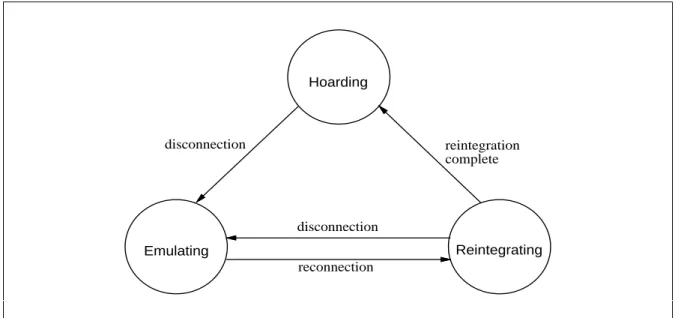
Reintegrating Hoarding Emulating disconnection disconnection reconnection reintegration complete
Figure 3.1: Venus States and Their Transitions
Venus operates in three different modes to cope with unpredictably changing system con-nectivities, as shown in Figure 3.1. When fully connected, Venus is in the hoarding state and functions as a normal cache manager performing client disk caching and maintaining cache coherence. When disconnected, it enters the emulating state and acts as a stand-alone server servicing file access requests using cache copies on its local disk. For applications running on a disconnected client, disconnection is transparent as long as the objects they access are locally cached. When the disconnected client regains lost connections, Venus transits into the reintegrating state to detect partitioned update/update conflict and propagate disconnected mutations to the corresponding servers. When the client cache state is fully synchronized with the server state, Venus goes back to the hoarding state.
Server Replication As a complementary mechanism to disconnected operation, server repli-cation is also employed by Coda to further enhance data availability. The same logical data objects are replicated on multiple servers, allowing a client to service cache misses as long as one of the server replicas is accessible. Replication control among first class replicas uses the optimistic read-any-write-all-available strategy, allowing arbitrary partitioned sharing among different partitions of the system. Partitioned update/update conflicts are automatically detected using the version vector mechanism [53], and effective mechanisms are provided to transpar-ently resolve conflicts [30, 31, 29, 56, 32, 68]. Although optimistic server replication helps to
improve data availability, it does not have a direct role in supporting mobile file access.
Target Usage Environment Coda was designed to provide a general-purpose filing service for a network of workstations in an academic and research environment. Each workstation is operated by its primary user and the main target application domains are document processing, software development, and office automation. The likelihood of write-sharing among different users across clients is very low. As indicated by a recent study [49], the dominant usage form of disconnected operation is that users voluntarily disconnect their portable computers and continue their work at home or on trips.
Summary We have identified the above set of Coda features as the IOT design context because they have profound impact on how the IOT mechanism should operate. Although the actual implementation of IOT on Coda is subject to more restrictions from detailed Coda internal operations, the IOT model design is generic with respect to those main constraints. In other words, any distributed file system that supports disconnected operation, uses a highly scalable client/server architecture, provides good performance with client disk caching and assumes a similar usage environment should be able to accommodate an IOT extension for improved consistency support.
3.2
High Level Design Decisions
This section discusses a number of high level design decisions that essentially shape the overall IOT structure, paving the way for next section’s presentation of the IOT computation model.
3.2.1
Focusing on Disconnected Operation
We limit the scope of this research by focusing on disconnected operation and excluding server replication from consideration. Our IOT model assumes that there is no server replication, and its design is optimized to provide consistency support only for disconnected operation. The main reasons that prompted this decision are the following. First, disconnected operation is the enabling technique for providing mobile file access in distributed file systems and improving its consistency support has a more significant practical impact. Second, server replication greatly complicates the task of consistency maintenance for partitioned file access operations. Third, a number of data inconsistency problems caused by optimistic server replication have already been addressed by a recent Ph.D. dissertation [29].
3.2.2
Optimistic Approach
There are two basic alternatives to safeguarding data consistency for disconnected operation. The pessimistic approach is to prevent potential inconsistency from happening by restricting partitioned file access operations using techniques such as quorum consensus and token pass-ing [3, 18, 43, 23]. However, pessimism is fundamentally incompatible with the optimistic design principle embodied in disconnected operation. The IOT model inherits Coda’s opti-mistic design philosophy by putting no limit on partitioned file accesses and by validating disconnected computations according to certain consistency criteria upon reconnection.
Similar to the traditional optimistic computation models, our approach assumes the low likelihood of having inconsistent disconnected computation results and takes advantage of this assumption to provide high data availability to applications executed on an isolated client. All disconnected computation results are considered tentative until the optimistic premise can be verified. The difference between our approach and the traditional optimistic models lies in the visibility of the tentative results. During disconnected operation, they are exposed not only to subsequent computations on the same client but also to external observers such as a human user, while the traditional models conceal them until the optimistic assumption can be confirmed. Therefore, it is imperative that we provide mechanisms that can be effectively employed not only to verify the optimistic premise of disconnected operation but also to compensate for the external side effects that are based on inconsistent, tentative computation results.
3.2.3
Inconsistency Detection
Because its main purpose is detecting data inconsistencies caused by partitioned file accesses, the IOT model effectively serves as the consistency criterion for deciding what kind of parti-tioned file accesses are admissible for disconnected operation.
Alternatives Based on the causal link from conflicts to non-1UE effects to inconsistencies discussed in the previous chapter, there is a spectrum of strategies for modeling the consistency criterion of disconnected operation. The main design trade-off is between the two competing goals of accuracy and efficiency. The accuracy of a consistency model measures how likely a computation rejected by the model causes actual data inconsistency. The efficiency of a model refers to the amount of computation needed for verifying the consistency of disconnected computations.
One end of the spectrum is to model the consistency criterion of disconnected operation using the application-specific definition of consistency itself, as has been recently explored in the Bayou System [68]. This approach has the advantage of perfect accuracy. However,