Mergers and Risk
Craig H. Furfine and Richard J. Rosen
Mergers and Risk
Craig H. Furfine
Federal Reserve Bank of Chicago 230 S. LaSalle St.
Chicago, IL 60604 [email protected]
Richard J. Rosen
Federal Reserve Bank of Chicago 230 S. LaSalle St.
Chicago, IL 60604 [email protected] September 2006
Abstract: This paper examines the impact of mergers on default risk, finding that, on average, a merger increases the default risk of the acquiring firm. This is surprising for two reasons: risk reduction is among the reasons commonly cited for mergers, and asset diversification should reduce default risk unless the newly-merged firm takes some action to increase risk. We
associate the risk increase with mergers satisfying one of a trifecta of conditions related to agency problems: mergers financed with stock, acquirers with a high market-to-book ratio, and acquirers with poor stock price performance prior to a merger announcement. We also demonstrate higher levels of default risk are not accompanied by higher post-merger returns.
We would like to thank Mitchell Petersen and participants at seminars at Florida State University and the Federal Reserve Bank of Chicago for their helpful comments. We also would like to thank Rung Roengpitya, Lauren Gaudino, and Cabray Haines for their assistance. The opinions expressed in this paper are those of the authors and do not necessarily reflect the opinions of the Federal Reserve Bank of Chicago or the Federal Reserve System.
explored. Much of the focus has been on whether mergers create value, and if so, for whom. We propose to look at mergers from a different angle. An acquisition not only affects a firm’s
potential return stream but also changes the firm’s risk, including its chances of going bankrupt. This paper examines the impact of mergers on default risk, finding that, on average, a merger
increases the default risk of the acquiring firm.
This result is surprising for two reasons. First, risk reduction is among the reasons commonly cited for mergers. A risk-reducing merger can allow a firm to increase its leverage, thereby taking advantage of the tax shield provided by debt (Lewellen, 1971). Managers may also want to reduce the risk of their firms, thereby reducing the chance they get fired for poor performance (Amihud and Lev, 1980). Similarly, since much of managerial wealth is tied up in their firm, managers may seek to reduce their firm’s risk to diversify their personal wealth (May, 1995). Our findings suggest that these theories do not motivate a substantial fraction of mergers.
Second, the asset diversification resulting from putting together the assets of the acquirer and the target should reduce default risk unless the merging firm takes some action to increase risk. We provide examples of the power of diversification, showing that, all else equal, risk can fall when a firm acquires a target three times as risky as the acquirer, even if the returns of the acquirer and target are positively correlated. This points toward increases in risk being the result of actions of firms beyond the simple decision to make an acquisition.
To see whether risk increases across different types of mergers, we divide our sample by factors others have identified as motivating acquisitions or affecting the return from an
acquisition. We identify mergers meeting at least one of three conditions, which as a group we call the trifecta, where agency problems may lead managers to make negative net present value acquisitions. We think that it is more likely that these acquisitions will increase the risk of the acquiring firm.
The first leg of the trifecta involves mergers with a potential agency problem between the acquiring firm and the shareholders of the target. There is evidence that the impact of a merger announcement on the acquiring firm’s stock depends on the form of payment used to purchase the
target. The market reaction is more positive or less negative for mergers financed with cash compared to stock (Travlos, 1987; Servaes, 1991). This may occur because a firm is more likely to finance an acquisition with stock when the firm’s stock is overvalued (Dong, et al., 2003; Rhodes-Kropf, et al., 2003; Shleifer and Vishny, 2003). If managers are financing with overpriced stock they may be more willing to make risk-increasing acquisitions. We find the acquiring firm’s risk increases significantly more for stock-financed mergers than for mergers financed using cash.
The next leg of the trifecta involves acquisitions by managers who want to increase their private benefits, even at the expense of their shareholders. Acquisitions generally increase managerial compensation, including bonuses, even when shareholder wealth declines (Bliss and Rosen, 2001; Grinstein and Hribar, 2004). Similarly, managers might make acquisitions that increase risk without a sufficiently large increase in return because of the private benefits that flow from them. We use stock return in the period leading up to a merger announcement as a measure of how likely it is that managers pursue private benefits rather than shareholder return. We expect managers of poorly-performing firms to be those most likely to pursue private benefits when making acquisitions. Indeed, we find that risk increases following acquisitions by these poorly-performing firms.
The final leg of the trifecta includes mergers where managers make bad acquisition decisions because of hubris (Roll, 1986). Hubris may lead them to believe they can reduce acquisition risk more than they are actually able to. Our proxy for hubris is a high market-to-book ratio (Rau and Vermaelen, 1997). Managers of these firms may overestimate their abilities, and their boards of directors may be reluctant to step in because of the managers’ successes. We find that the default risk increases more for acquirers with a high market-to-book ratio than for those with a low ratio, consistent with hubris.
The minority of acquisitions meeting none of three conditions to be in the trifecta do not, in general, lead to an increase in risk for the acquiring firm. Firms that finance acquisitions with cash average a significant reduction in risk surrounding a merger. In addition, firms with neither extremely good nor extremely poor pre-announcement stock performance and those with below-median book-to-market ratios do not have increases in average risk following acquisitions.
We then address whether or not these risk-increasing mergers are necessarily bad for
shareholders. A firm might make an acquisition that increases default risk if the acquisition also increases the firm’s value. We find evidence that mergers create some increases in the wealth of acquiring firm shareholders. The average market value of an acquiring firm increases when it announces an acquisition and in the period following the merger. However, we do not believe that the increase in return is a result of the average increase in risk. This view is supported by the fact that when we focus on classes of mergers where risk increases on average – those in the trifecta – we find that there is no significant positive return post-merger. More generally, there is a negative
correlation between return and increases in risk, both in the subsample of risk-increasing mergers and in our entire merger sample.
We also examine the factors responsible for the increase in risk surrounding a merger. As noted earlier, mergers create asset diversification that should reduce default risk unless the merging firm takes some action to increase risk. Indications of such actions include changes to the value or volatility of the acquiring firm’s equity. The average merger in our sample neither reduces shareholder value nor increases equity volatility, so these are not the causes of the risk increases we find. Instead, we find that a main factor contributing to the increase in default risk is an increase in (balance sheet) leverage. This may be as a result of combining the balance sheets of the two merger partners, or it may involve strategic decisions by the acquirer. Note that mergers in the trifecta do not stand out here.
Although we believe our work is the first to focus on the impact of mergers on acquirer-firm risk, other papers have indirectly addressed this question by examining mergers’ impact on the prices of publicly-traded bonds. For example, Maquieira et al. (1997) explore whether corporate mergers create value or merely transfer value across debt and equity claimholders by examining the stock and bond price reactions to merger announcements. Although not central to their analysis, they show acquiring-firm bond prices rise following the announcement of a merger between firms in the same industry but not between firms in different industries. Billett et al. (2004) conduct a similar study, finding, on average, a statistically significant but relatively small decline in acquirer bond prices following merger announcements.
The remainder of the paper proceeds as follows. Section I describes the data used in the study. Section II examines whether an acquisition changes default risk. Section III demonstrates the power of diversification, quantifying the extent to which asset diversification should lead to lower default risk following a merger. Section IV investigates how changes in risk correlate with observable characteristics of the merger. Section V discusses the relationship between return and risk in our sample. Section VI breaks down the factors that contribute to the change in default risk. Section VII concludes.
I. Data description
For our analysis, we measure default risk using the Expected Default Frequency (EDF) developed and marketed by MoodysKMV (KMV) through their CreditMonitor product.1 The primary intent of this product is to allow potential creditors to assess the risk of their corporate clients in order to allocate credit more effectively. Credit Monitor provides a five year history of each firm’s probability of default over the coming year. We use one-year default probabilities reported at a monthly frequency between January 2000 and December 2004 for a collection of 9,547 firms in the KMV North American database.
The calculation performed by KMV in its derivation of a firm’s EDF can be viewed as a two-step process, where the first two-step uses relatively standard finance theory and the second relies on the proprietary default database owned by KMV. Using an internally developed extended version of the Merton (1974) model, KMV calculates a distance to default measure for each firm for each month. This is a technically demanding but theoretically straightforward computation that
involves calculating a firm’s asset volatility by de-levering its equity volatility (calculated from daily stock price changes) using data on a firm’s capital structure (from its most recent publicly
1 In addition to our deeper exploration of the risk impact of mergers, we believe our use of EDFs is a methodological improvement over previous studies that look at the merger-related change in bond prices. Because, we measure default risk without relying on the prices of publicly traded bonds, we avoid trading and liquidity issues, maturity, call provisions, convertibility, seniority, and a host of other factors that have been shown to affect the price of publicly traded bonds. Further, we are able to include a larger variety of acquiring firms since we do not require a firm to have public debt nor do we require such debt to be actively traded.
available balance sheet).2 Once asset market value and volatility are derived, distance to default is simply calculated as volatility asset * assets of value market debt of value book assets of value market − .
This distance to default measures the number of standard deviations away from default a firm’s current asset value is.
One can imagine employing a variety of statistical distributions to translate distance to default into a default probability. Primarily because default is an extremely low probability event and statistical distributions have generally restrictive allowances for large deviations from average, the major value added by the KMV product is its mapping of each firm’s distance to default into a one-year default probability using a historical empirical distribution of defaults. For example, if KMV calculates a firm to be seven standard deviations from default, it uses its database of
250,000 company-years of data to find that 0.05% of the time, a firm seven standard deviations away from default does default within one year. In this example, KMV would report this firm to have an EDF of 0.05% (five basis points).
Our second major data source is the Securities Data Corporation’s Merger database (SDC). To match merger information with KMV data, we first restrict the merger to have been
announced and completed between February 1, 2000 and June 30, 2004. To focus our attention on mergers that can reasonably be expected to have an impact on acquirer default risk, we examine only those where the acquirer purchases at least 50% of the target firm and that the acquirer’s post-merger ownership of the target exceeds 90%. We further impose the restriction that the ratio of deal size to acquirer’s total assets is at least 5% but no more than 150%. This eliminates a fair numbers of mergers in which we expect little or no impact on overall acquirer default risk because the target is only a tiny fraction of the acquirer size. We further drop all mergers undertaken by acquirers with an EDF greater than 15%, since they are already close to default.3 Our baseline dataset consists of the mergers in SDC that satisfy our conditions and for
2 This is done by expressing the observed equity value and equity volatility as implied-option related functions of a firm’s asset value, asset volatility, capital structure, and the risk free rate. These two equations can be solved for the implied asset value and asset volatility in much the same way that option traders can solve for implied volatility from option prices.
which the acquirer is in the KMV data the month before the merger is announced (see the Appendix for more details on how we merge the SDC and KMV data).
For some of our analysis, we require information regarding acquirer stock returns and balance sheet changes. For this information, we employ data from CRSP and Compustat, respectively. Mergers for which we could not obtain acquirer data from CRSP and Compustat were dropped.
Some firms make a series of acquisitions within a short period. We drop all acquisitions that are within six months after another acquisition by the firm. One focus is how changes in stock prices in the six months prior to an acquisition influence the choice of a target, and we do not want these stock price changes to be directly affected by another acquisition. If a firm makes multiple acquisitions in a single month, we exclude all the mergers. Neither of these cuts affects our qualitative results. Our final sample consists of 1,458 mergers, which, despite the relatively short time period being examined, represents a much larger selection of mergers than typically analyzed in previous research.
II. Do mergers add risk?
Our main goal is to determine whether mergers increase risk. We construct a variable ΔEDF
that is the difference between the acquirer’s EDF six months following the merger effective date and the acquirer’s EDF one month prior to the merger announcement date:4
ΔEDF = EDFc+6 – EDFa-1,
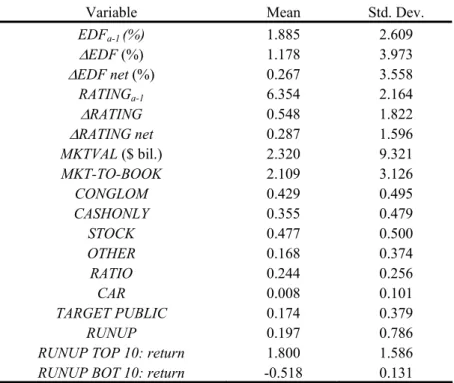
where c is the month in which the merger is completed and a is the month in which the merger is first announced. One of our key findings is that mergers generally lead to an increase in default risk for the acquiring firm. This result can be seen in the second row in Panel A of Table 1, which indicates the mean increase in one-year default probability is 1.18% across all 1,458 mergers. To put this percentage in perspective, consider that the mean level of default probability for acquirers one month prior to a merger announcement, EDFa-1, is 1.89%.
4 The EDF calculations are based on both market and balance sheet information. KMV does not update the balance sheet information after a merger until a firm releases new financial information. For this reason, we wait six months after a merger to estimate the post-merger risk. Our results are robust to other time horizons. Additionally, the time between the announcement and effective dates of a merger is not correlated with the change in risk surrounding the merger.
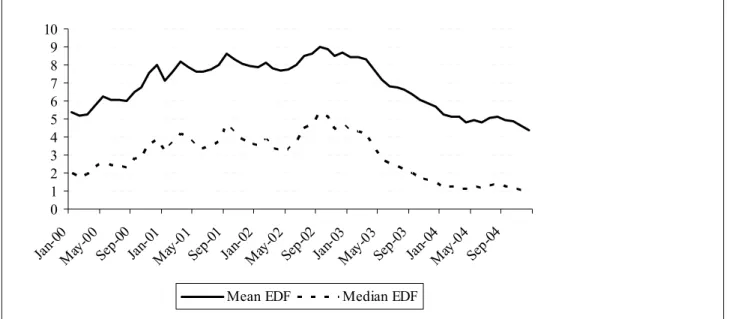
One criticism of assuming that a positive ΔEDF implies an increase in risk following a merger is that risk might have increased for the acquirer without the merger. For example, if a merger takes place when risk is changing in the overall economy, then ΔEDF might reflect the economy-wide changes rather than the effects of the merger. As illustrated in Figure 1, EDF for all firms in the KMV database increases from the start of our sample until it peaks in September 2002. It then declines throughout the remainder of our sample period. If many mergers in our sample became effective during the first part of our sample period, we may have incorrectly associated an increase in default risk with a merger when instead it merely reflected overall trends. To show that the changes in overall risk do not completely offset the change in risk surrounding the merger, we first assign firms to a risk class, since the magnitude of changes in EDF is likely to be larger for high-risk firms. The risk classes correspond roughly to credit ratings, and are given in Panel B of Table 1.5 We then create a new variable ΔEDF net:
ΔEDF net = ΔEDF – (EDFc+6,i(a−1) –EDFa−1,i(a−1) ),
where EDFt,i(s) is the mean EDF in month t for firms in the KMV database that were in risk class
i in month s. As shown in Table 1, ΔEDF net is positive and significant, indicating that risk increases even after netting out the typical change in risk for firms of similar initial risk. Net of risk changes at all firms, the average change in risk for an acquirer is 0.27%, less than the raw changes in EDF, but still statistically significantly different from zero.6
As a robustness check of the results based on the EDF measure, we also look at how implied credit ratings are affected by mergers. We use the assignment of firms to credit ratings described in the last paragraph and in Panel B of Table 1. The average rating of acquirers, given by
RATING and shown in Panel A of Table 1, is between Baa3 and Ba1, that is, on the borderline between investment grade and non-investment grade. On average, mergers result in a worse (riskier) credit rating of approximately 0.55 (one half ratings notch). After adjusting for changes
5 It is important to note that there is no requirement that the firms have traded bonds. The mapping of EDF to equivalent rating does not require that the firm have any bonds outstanding. For the 438 mergers for which we have Compustat information on the acquirer’s S&P senior debt rating, the correlation between our implied credit rating and the S&P bond rating is 0.55. This is consistent with the fact that EDFs and credit ratings are both measuring default risk, but that EDFs are designed to be a “point-in-time” risk measure, where rating agencies typically rate bonds “through the cycle.” Thus, actual credit ratings are far more stable through time than is a company’s EDF. 6 As a further robustness check, we adjusted the change in EDF controlling for both initial implied credit rating and acquirer firm industry. The reported results were qualitatively similar.
to other firms in the same rating class, we find that risk increases following an acquisition by approximately one quarter of a ratings notch. This is consistent with the results for the EDF.
Panel A of Table 1 also reports summary statistics for other variables used in exploring how changes in default risk post-merger are related to observable characteristics of the acquirer and of the merger. We discuss these other variables as we include them in our analysis.
The results in Table 1 are consistent with mergers increasing default risk. Acquiring firms have significantly more risk of default after a merger than before, and this increase in risk is not explained by secular changes in economy-wide risk.
III. The power of diversification
In the previous section, we document that the average merger is associated with an increase in the default risk for the acquiring firm. We are interested in knowing whether this increase in risk results from risk being added to the acquirer following the acquisition or whether it results from the addition of risk from the target. That is, risk may not be created by acquisitions but merely transferred. Because the analysis of Section II was based only on acquirer risk, it may be that the typical merger is risk-increasing from the acquirer’s point of view because the typical target has more default risk than the typical acquirer.
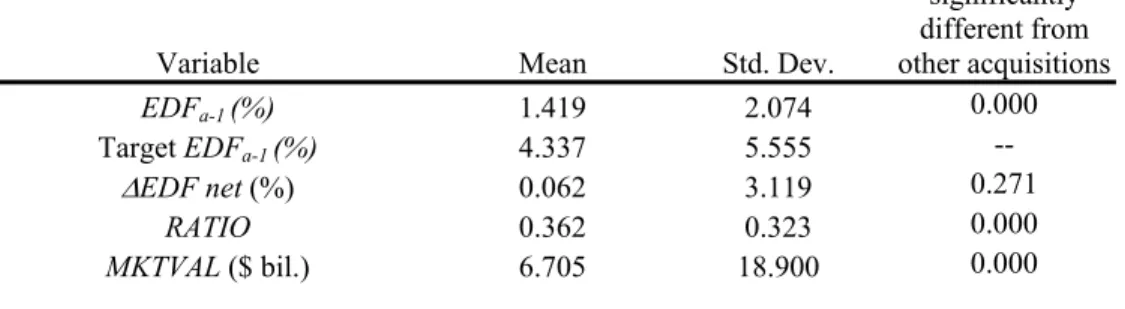
It is not possible to address this question for the entire sample of mergers because most targets in our sample are private and, thus, we do not have information regarding their default risk. Instead, we use the smaller sample of 254 mergers for which the target is also public. Panel A of Table 2 reports that for this public target sample, the mean EDF in the month prior to their merger announcement is 1.42% for the acquiring firm and 4.33% for the target firm.7 Since the average price paid for the target is equal to 36% of the market value of the acquiring firm, it is possible that some of the increase in the risk of the merged firm relative to the pre-merger risk of the acquiring firm is due to acquiring a risky target.
To test whether mergers add risk, we need to know by how much acquirer risk would rise simply as a result of acquiring a riskier target. Failure is inherently a tail event, so we need to
7 The public target subsample is not completely representative of the full sample, since the acquirers are larger and somewhat safer (see Panel A of Table 2), among other differences. However, the exercise in this section is meant to be illustrative only.
focus on how the tail of the return distribution is affected by the merger. We take two different approaches to this. The first is to examine the public target subsample assuming that returns are normally distributed. While not a perfectly accurate measure of stock returns, this assumption allows us to estimate failure probabilities explicitly, conditional on an estimated correlation between the returns of the target and the acquirer. The second approach is to take the summary statistics on the public target sample and simulate mergers under different assumptions about the return distribution.
Under the assumption that returns are normally distributed, it is straightforward to find a pro forma risk for a merged firm. To do this, we use Va,the market value for the acquirer at the end
of the month prior to the merger announcement, and Vt, the same for the target. Given these
market values and the EDFs from KMV, we back out the standard deviation of the acquirer’s market value (σa) and the target’s market value (σt ) by assuming returns are distributed
normally. We use daily data for the six months up to the end of the month prior to the merger announcement to estimate the correlation between the two returns (ρ). With this, we define EDF pro forma as the (one-year) probability of default for a firm with market value Va + Vt and
variance of return σa2 + σt2 + 2 ρ σa σt. Let
ΔEDFpro forma = EDFc+6 – EDFpro forma
and let
ΔEDF netpro forma = ΔEDFpro forma – (EDFc+6,i(a−1) –EDFa−1,i(a−1) ).
These variables measure the difference between the post-merger default risk and the estimated default risk of a combined target and acquirer prior to the merger.
Perhaps surprisingly given that targets are riskier than acquirers, the pro forma default risk of an average merger is lower than the default risk of the stand-alone acquirer. EDF pro forma is 0.85% while the average EDF of the acquirer is 1.42%. This implies that absent any actions taken by management, the change in EDFfor our public target sample should be -0.57%. That is, even with the average default risk for the target being three times as high as that of the acquirer, it can be expected that there are significant risk-reducing diversification benefits from the merger. This may be because acquirers select targets with risks that have low correlation with those of the
acquiring firm, and we find that this is the case. On average, the correlation between the returns of the target and acquiring firms in our sample is a relatively low 0.20.
The estimated increase in default risk for a merger is larger than the increase for the acquirer, because including the target allows us to factor in diversification benefits. The mean value of
ΔEDF net pro forma is 0.91%. This means the average probability of default is 0.91 percentage points higher after a merger than that estimated for the pro forma combination of the target and the acquirer prior to a merger. This compares to ΔEDF net, the value focusing on the acquirer only, of 0.06%. Thus, diversification is very powerful. This is evidence that the increase in default risk is above the added relative risk of the target firm. Some risk is added in the merger process.
Of course, the distribution of acquirer stock returns is not likely to be perfectly described by a normal distribution. To explore the impact of this assumption on our results, our second approach to examining diversification is to simulate the impact on risk of various hypothetical mergers while varying our assumption regarding the underlying distribution of returns and return correlations. To approximately match the summary statistics, we base our simulations on the hypothetical acquisition of a target with an equity value of 3 by an acquirer with equity value 10. To match the characteristics of our data, we assume that the acquiring firm has an EDF of 1.42% and that the target firm has an EDF of 4.34%. Under the assumption of normally distributed equity returns, we can infer the target and acquirer’s volatility from their respective EDF as outlined above. Following the merger, the combined firm’s equity returns will be normally distributed, with a volatility dependent on the correlation between the acquirer and target returns pre-merger. The first column in Panel B of Table 2 reports that if the target and acquirer stock returns are uncorrelated, we would predict a post-merger EDF of 0.43%, approximately 70%
below the original EDF of the acquirer, even though the target is three times as risky. As we increase the assumed level of correlation to near our sample average of 0.2, we find that
diversification remains extremely strong, with the estimated post-merger default risk remaining over 50% below its initial level.
KMV indicates, however, that the relationship between distance to default and EDF is not perfectly approximated by the normal distribution. As we mentioned in Section I, KMV finds that
0.05% of the time, a firm seven standard deviations away from default defaults within one year. This implies a fatter-tailed distribution than the normal. We attempt to approximate this by noting that a t-distribution with 3 degrees of freedom has the characteristic that 0.05% of its mass lies more than seven standard deviations from below the mean. The second column in Panel B of Table 2 repeats our earlier simulation exercise under the assumption that equity returns for the target and acquirer have the same shape as the t(3) distribution, and in turn ask what the
probability that the sum of these two variables (appropriately scaled to reflect the relative size of the acquirer and target) results in the failure of the simulated merged firm. As the table reports, diversification is not as powerful when stock returns have fatter tails. Nevertheless, it remains strong. The simulation results indicate that when return correlations are around the typical level of 0.2, post-merger default risk is estimated to be 1.10% or 32 basis points below the acquirer’s original level. This suggests that even with fatter tails in the return distribution, the power of diversification remains very strong.
IV. Which mergers add risk?
The previous sections document that risk increases following a merger and that this persists even given the powerful diversification one might expect by the combination of two imperfectly correlated firms. We now turn to exploring whether some mergers add more risk than others, breaking down mergers using characteristics that others have identified as affecting merger decisions or outcomes.
Earlier studies have examined whether conglomerate firms are more efficient than single-industry firms (e.g., Lang and Stulz, 1994; Berger and Ofek, 1995) and whether conglomerating mergers have a different impact on firms than within-industry mergers (e.g., Servaes, 1991). To explore issues related to conglomeration versus specialization, we define an indicator variable
CONGLOM, which equals 1 whenever the target and the acquirer are in different industries. We get our industry definitions from SDC, which divides firms into 61 industry groups. In our sample, 42.9% of mergers involve firms from different industries (see Table 1). All else equal, one might expect cross-industry mergers to offer diversification benefits.
There is evidence the method of payment for a target is related to the market reaction and success of mergers (e.g., Travlos, 1987 and Rosen, 2006). Some argue that a firm uses stock to finance acquisitions when the firm believes that it stock is overvalued (e.g., Travlos, 1987 following an argument made by Myers and Majluf, 1984), consistent with the finding that stock-financed mergers are generally associated with larger decreases in equity value than are cash-financed mergers. This suggests payment method also may be correlated with the risk-reducing characteristics of a merger. To control for this possibility, we construct variables CASHONLY
and STOCK, which are indicator variables for whether the target is acquired entirely by cash or through the use of at least some stock, respectively. We define a third category as OTHER, which includes all mergers that are neither CASHONLY nor STOCK.8 Among our 1,458 mergers, 35.5% are cash transactions and 47.7% involve at least some stock (see Table 1).
The use of stock to finance a merger may be a sign of an agency problem – that is, trying to exploit the information advantage the acquirer has over the target firm’s shareholders. There is also the possibility that mergers may reflect agency problems between the acquiring firm’s managers and its shareholders. There is evidence that mergers increase the private benefits of managers even when they do not benefit a firm’s shareholders (Bliss and Rosen, 2001). A declining stock price may indicate that management is pursuing its own goals rather than solely attempting to maximize shareholder value. Define RUNUP as the return on a firm’s stock in the six months ending at the end of the month before a firm announces an acquisition net of the return on the value-weighted market portfolio during the same period. We use RUNUP as our measure of relative performance. On average, firms do well in the period before they announce an acquisition, with an average RUNUP of 19.7% (see Table 1). For our regression analysis, we focus on firms that perform exceptionally poorly. Let RUNUP BOT 10 be a dummy variable that takes the value 1 if a firm’s RUNUP is in the bottom 10 percent. For symmetry, define RUNUP TOP 10 similarly for firms with RUNUP in the top 10 percent. Table 1 gives the RUNUP for firms in each of these deciles. We expect firms in the bottom 10 percent of RUNUP to be more likely to have agency problems between managers and shareholders.
8 Many of the mergers classified OTHER are financed with bonds or other liabilities, but some include royalties or other earnings payouts, assets on the acquirer’s or target’s balance sheets, third-party stock, or other forms of value.
There are reasons to believe that firms with high market-to-book ratio, having better growth opportunities, should make more acquisitions (Jovanovic and Rousseau, 2002). However, the managers of these firms, because of their long-term success, might overestimate their own abilities. This hubris can lead to poor acquisition decisions (Rau and Vermaelen, 1997).
Therefore, we include MKT-BK DUMMY, a dummy variable that takes the value 1 if and only if a firm’s market-to-book ratio is greater than 1, to capture the effect of the market-to-book ratio.
The size of the target relative to the acquirer can affect the potential for risk-reducing diversification. The larger a target is relative to an acquirer, the more potential there is for
diversification benefits.9 We capture relative size by constructing RATIO as the price paid for the target divided by the market value of the acquirer. We use the price paid for the target because for many of our mergers, the target is not traded and, thus, has no observable market value.10 On average, mergers are valued at 24.4% of acquirer market capitalization (see Table 1). The ratio of target to acquirer size has been found to affect the market reaction to a merger announcement (see, e.g., Asquith, et al., 1983). Larger values of RATIO are associated with larger gains in wealth, implying potentially smaller increases in default risk.
We also explore whether the market reaction to a merger announcement carries information about whether the market thinks a merger will add risk. If shareholders believe the acquirer’s risk will increase without a corresponding increase in expected return, then the share price of the acquirer should decrease. Thus, the market reaction to a merger announcement may be negatively correlated with expectations about changes in risk. Of course, since the market reaction also reflects information about expected return, this correlation might be weak. Define
CAR to be the acquirer’s cumulative abnormal stock return above the CRSP value-weighted index summed across days -1, 0, and +1 relative to the merger announcement. In our sample, the
average CAR is 0.8%. This is within the range, although at the high end, of what other studies find.11 This may be because we have a larger proportion of small acquirers, and the CAR is
9 Only 38 of 1,458 (2.6%) of our mergers have targets larger than the acquirer.
10 We considered using the market value of the target prior to the merger in the numerator of RATIO if it was available. However, because targets generally sell at a significant premium, this runs the risk of making RATIO systematically lower for mergers where the target is publicly traded.
11 Studies that find negative average returns to acquiring firms include Asquith, et al. (1987), Banerjee and Owers (1992), Bradley, et al. (1988), Byrd and Hickman (1992), Jennings and Mazzeo (1991), Servaes (1991), Varaiya and Ferris (1987), and You, et al. (1986). See Table 8-6 in Gilson and Black (1995). See also the survey by Andrade, et
decreasing in acquirer size (Moeller, et al., 2004; Kahl and Rosen, 2002). Consistent with this, the CAR for large acquirers (over $1 billion in total assets) is -1.0%.
Finally, in our sample, 17.4% of targets are publicly traded (TARGET PUBLIC = 1; see Table 1).12 There is evidence the CAR is lower for the acquisition of public targets than for the
acquisition of other targets (i.e., private firms and subsidiaries; see Fuller, et al., 2002). We examine how the public status of the target affects the change in risk.
As a first pass at examining how the characteristics of the acquirer and the merger affect the change in risk, Table 3 presents information on ΔEDFnet and ΔRATING net (the change in implied credit rating net of expected changes) when the sample is split by the ex ante characteristics of the acquiring firm and the merger-related variables. Looking across the
different merger characteristics, we find one-year default probabilities increase significantly more for mergers financed with at least some stock relative to cash-only acquisitions, mergers where the acquirer has a high market-to-book ratio, mergers where the acquirer performed either particularly well or poorly prior to the merger, mergers where the target is public, and mergers accompanied by a negative CAR relative to those with a positive CAR. Somewhat surprisingly, cross-industry mergers do not increase risk less than specializing mergers. Also, there is no statistically significant difference between the change in risk based on the size or the pre-merger EDF of the acquirer or the relative size of the target.
The summary statistics indicate that on average, mergers increase the default probability of the acquirer, but this increase varies according to the characteristics of both the acquirer and the merger. Since many of the characteristics are correlated with each other, we use the following regression to explore which factors drive a post-merger change in risk:
Δ default risk = α + β1CONGLOM + β2STOCK + β3OTHER + β4RATIO +
β5MKT-BK DUMMY + β6 RUNUP TOP 10 + β7 RUNUP BOT 10 +
β8TARGET PUBLIC + β8CAR + ε. (1)
We measure the change in default risk using ΔEDF net. The first column of Table 4 presents the results for this regression.
al. (2001). The impact is especially pronounced for large acquirers and in the recent merger wave (Moeller, et al., 2004; Moeller, et al., 2005).
If cross-industry mergers allow more risk-reducing diversification, then the coefficient on
CONGLOM in Table 4 should be negative. It is not. The coefficient is positive, although it is not significantly different from zero. A cross-industry merger is no more likely to diversify risk than is a merger between two firms in the same industry.
The coefficient on STOCK reflects two types of influences. There is a direct effect of the type of financing on the change in risk from a merger. The direct effect implies financing with stock should add less risk than using cash because in a cash acquisition, the acquirer is replacing (safe) cash with the leveraged and risky balance sheet of the target. The second effect occurs because the choice of stock could be a signal about whether the acquirer’s stock is overpriced or other factors that could influence the choice of a target. We find stock-financed mergers add more risk than those financed entirely with cash (CASHONLY is the omitted variable in the regression). This is the opposite to the direct effect, and implies that firms choose targets or take actions post-acquisition that add significantly more risk in stock-financed post-acquisitions than in cash-financed acquisitions.
The ability of an acquisition to change the risk of the acquiring firm is a function, at least in part, of the relative size of the target and the acquirer. A target that is very small relative to its acquirer is likely to have little impact on the acquirer’s overall risk. This motivates our decision to restrict the sample to targets that are at least 5% the size of the acquirer (where we measure relative size using RATIO). Viewed in this way, if large targets are similar to small targets in all ways but size, the coefficient on RATIO should be positive since the average merger increases risk. However, as shown in the first column of Table 4, the coefficient on RATIO is negative although it is never statistically significant at traditional levels.
We include MKT-BK DUMMY and RUNUP BOT 10 in the regressions as proxies for managerial motivations for mergers. If hubris leads to acquisitions, we expect a positive coefficient on MKT-BK DUMMY, as we find. The coefficient on RUNUP BOT 10 is also positive, consistent with agency problems such as pursuing private benefits. Together, these
suggest that at least some firms are making risk-increasing acquisitions that may not be in the interests of their shareholders.13 We return to this topic in the next section.14
Recall that our sample includes acquisitions of public firms, private firms, and subsidiaries. We find that risk increases less when a public firm is acquired, even after we control for the fact that public targets tend to be larger than other targets.15 This may be because public targets are significantly more diversified than other targets.
Finally, we find there is a negative correlation between the market reaction to a merger announcement and the increase in risk from the merger. As shown in the first column of Table 4, for every 1% increase in the CAR, the decline in risk is 3.4 basis points. The CAR represents the market’s view of the merger, which might be affected by the expected change in risk from the merger. That is, the CAR may be a proxy for whether a merger is intended to increase the value of the firm or the private benefits of the firm’s managers. However, there is also a direct effect of the announcement return on the risk of the firm. One of the factors in the derivation of a firm’s EDF is the market value of the firm’s equity. Thus, there is a mechanical relationship between changes in the stock price and changes in the EDF. The CAR is part of the interim return that goes into the change in default risk calculation. To strip away the mechanical relationship, we regress the CAR on the return during the period during which we measure the EDF change:
CAR = α + β RETURN INTERIM + ε, (2)
where RETURN INTERIM is the return on the acquiring firm’s stock net of the CRSP value-weighted index in the period starting with the month the merger is announced and ending the end
13 The results are robust to other specifications. Replacing the dummy with the market-to-book ratio or with top 10 percent and bottom 10 percent dummies produces similar results: the higher the market-to-book ratio, the more risk increases surrounding a merger. Also, firms in the bottom 10 percent appear different than other poorly-performing firms. In regressions of ΔEDF net on controls including a dummy for firms in the second worst decile, the
coefficient on the new variable is smaller in magnitude and not significant.
14 Both the market-to-book ratio and the runup variables are related to changes in an acquiring firm’s stock price in the six months before its merger announcement. While related, they pick up different elements of the firm’s performance. The runup reflects short-term momentum, but the market-to-book ratio is more closely related to long-term performance. In fact, over 40% of the firms with mergers in the bottom 10 percent of RUNUP have a market-to-book ratio above the median. We use the market-market-to-book ratio rather than the runup to characterize firms with managers we expect to have hubris because sustained success is more likely to generate overconfidence than a quick burst of good performance. Could a low market-to-book ratio be caused by managers pursuing private benefits? Certainly, although long-term underperformance may lead to managerial turnover. Nevertheless, if we find a negative relationship between the market-to-book ratio and changes in risk surrounding a merger, it may be because these managerial problems are more important to merger decisions than hubris.
15 Previous studies show that the market reaction to the announcement of the acquisition of a public firm is more negative than the announcement of the acquisition of a private firm or subsidiary (Fuller, et al., 2002).
of the month six months after the merger is completed. The results from regressions of equation (1) in which we replace CAR with the residuals from this regression (CAR resid) are reported in the second column of Table 4. The coefficient on CAR resid in Table 4 is not significantly different from zero. This suggests CAR serves as a proxy for the overall change in value of the firm in the interim period rather than as a signal of the riskiness of the merger. Note that using
CAR resid rather than CAR has little effect on the magnitudes of the coefficients of other variables.
As a robustness check, we repeat the regression in column (2) of Table 4 using the implied credit rating as a measure of risk. The results are reported in the third column of the table. There are no qualitative differences between the two regressions.
The regressions suggest the market-to-book ratio is an important factor in predicting how default risk changes surrounding an acquisition. To see whether market-to-book ratios interact with the other independent variables, we separate the data by whether the ratio is above or below one, but the results are robust to other cutoffs. Results from regressions of (1) (using CAR resid) across these subsamples are reported in the first two columns of Table 5. There are few
important differences across the samples, suggesting minimal impact on risk of the interaction between the market-to-book ratio and the other control variables.
We also split the data by the risk of the acquirer. Acquisitions by high-quality firms may be fundamentally different than those undertaken by low-quality firms. In addition, a 1% increase in default risk may mean something different when the initial default risk is 0.5% versus an initial risk of 5%. Default risk is often characterized as being either investment-grade or
non-investment-grade (i.e., junk). An EDF equal to 0.75% approximates the standard distinction between investment-grade and other debt. This is the separation point we use. Overall, 46% of our sample mergers have an acquirer with a pre-merger EDF greater than 0.75%. Split-sample results from regressions of (1) are reported in the last two columns of Table 5. Again, there are few important differences between the samples. The coefficient on CAR resid is significant for the safe-acquirer sample but not for the risky-acquirer sample, but the two coefficients are not significantly different from each other. Similarly, the coefficient on TARGET PUBLIC is
that for the risky-acquirer sample. The results are robust to changing the dependent variable to the change in credit rating (results not shown).
We further estimate our regression model using just the mergers with public targets (not shown), the signs on the variables generally are consistent with the full sample regression, but there is little statistical significance. We also run a regression on the full sample including the controls used earlier plus a set of interaction variables between the public target dummy and the other controls (also not shown). The only interaction term that is significant is the interaction between RUNUP BOT 10 and the public target dummy. The coefficient on this variable is negative, and indicates that poorly performing firms that acquire public targets do not significantly increase their default risk surrounding the acquisition.
V. Return and risk
Although mergers offer the potential for risk-reducing diversification, there is no reason that a firm should avoid an acquisition that increases risk, as long as there is a compensating increase in return. In this section, we explore the relationship between return and risk in our sample.
Measuring the return from an acquisition poses a problem. The existing literature focuses on two indicators of return, the CAR and the long-run return. Both of these measures start at
approximately the date a merger is announced. However, one of the factors used to construct our measure of the change in risk is the return on a firm’s stock. Thus, there is a mechanical
connection between ΔEDF and any return measure that uses information from the period over which ΔEDF is calculated. To avoid this, we use the buy-and-hold return for the period starting on the end of the sixth month after a merger is completed and extending for one year. Formally, let RETURN POST be the return on an acquiring firm’s stock over this period net of the return on the value-weighted CRSP stock index over the same period.16
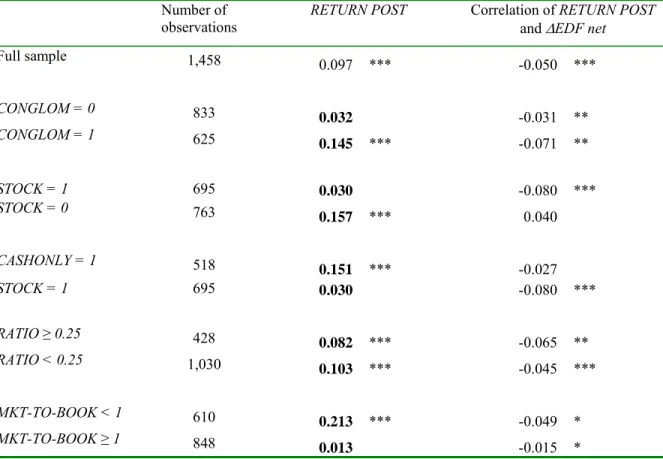
Table 6 gives the return for the full sample and for various subsamples. On average, mergers increase the value of the acquiring firm. This is not just a function of the post-merger period we examine. Although not shown in the table, return is also positive on average for periods starting
16 A small number of firms drop out of the CRSP data prior to the end of the one-year period, often as the result of a subsequent acquisition. In these cases, we assume that the firm earns the market return once it is no longer listed in CRSP.
either on the day prior to the announcement or on the effective date and extending for up to two years (and possibly longer). It is also interesting that RETURN POST is non-negative for each of the subsamples we examine. However, the return is smaller for the subsamples that increase risk the most, suggesting that there may not be a positive correlation between risk and return.
To explore the relationship between risk and return in more detail, we take the correlation between RETURN POST and ΔEDF net. The correlation is presented in the last column of Table 6. The correlation is negative for the full sample and for all but one of the subsamples we
examine. This implies that there is not a tradeoff between risk and return. Mergers that increase risk the most also lead to the biggest declines (or smallest increases) in (future) return.
Return tends to be lower for mergers in the risk-increasing trifecta. As shown in Table 6, for stock-financed mergers and those where the acquirer has a high market-to-book ratio or low pre-merger performance, RETURN POST is not significantly different from zero. This means that risk increases, but there is no compensating increase in return. Additionally, there is a
significantly negative correlation between return and the risk increase from acquisitions. These acquisitions increase risk the most and do not have a positive expected return, consistent with both hubris and other agency problems such as managers pursuing private benefits.
VI. How do mergers affect risk?
The EDF of a firm depends on the market value and volatility of the firm’s equity as well as the book value of its debt. Mergers can affect default risk by changing a firm’s equity cushion or by altering the riskiness of the equity. In this section we briefly discuss how each of these
contributes to the increase in risk.
A firm has less protection against default as it loses market value. We estimate the change in market value using the percentage change in market value of the acquiring firm’s common stock.17 As defined earlier, RETURN INTERIM is the buy-and-hold return net of the CRSP value-weighted index for an acquirer’s stock between the end of the month prior to its merger
17 This captures much of the change in the value of the target, since the correlation between the returns on the target’s stock and the acquirer’s stock is typically very high after a merger is announced.
announcement and the end of the month six months after the merger is effective.18 The average return is positive, although small (see Table 7). The total net return is 1.5% over the entire interim period, of which 0.8% is from the announcement return (as given in Table 1). Thus, the change in the market value of the acquirer’s stock is likely contributing little to the change in the EDF. To the extent that there is any effect, it is to push the default risk lower.
For stock acquisitions, high market-to-book acquirers, and poorly performing acquirers, interim return is negative but not significantly different from zero. This is more evidence that these acquisitions are, in general, different from other acquisitions. The only other subsample with a negative interim return is RUNUP TOP 10.
An acquisition may also affect the riskiness of a firm’s equity base. We measure equity risk using the standard deviation of a firm’s common stock. Define Δσas the standard deviation of the merged firm’s daily stock return in the first six calendar months after the merger minus the standard deviation of the acquiring firm’s daily stock return in the last six calendar months prior to the merger announcement. The standard deviation of returns is essentially unaffected by mergers. The mean of Δσis -0.1%, which is small relative to pre-merger risk (see Table 7). Further, the negative sign indicates a reduction in stock return volatility, which, all else equal, should reduce rather than increase default risk.
Another way of measuring the equity cushion is by using leverage. For example, if a firm with low leverage acquires a highly leveraged firm, risk is transferred from the target firm’s shareholders to the acquiring firm’s shareholders. This reduction in the equity cushion increases default risk, all else equal. We measure this risk using the ratio of the book value of equity to the book value of assets. The change in this risk, Δ EQ/TA, is measured from the end of the quarter prior to the merger to the first quarter-end after the completion of the merger. In our sample, mergers are associated with a decreasing equity-to-asset ratio, that is, increasing leverage (see Table 7). The ratio decreases an average of 3.6% from its pre-merger average level of 57.8% (EQ/TAa-1).
18 Note that RETURN INTERIM is not a post-merger return as is typically measured in the literature since it can contain a significant period of time before a merger is completed.
The derivation of a firm’s EDF indicates that a firm’s market value, leverage, and equity volatility are the main contributors to this measure of default risk. As we have observed an increase in EDF associated with mergers, one might have expected to find changes in all three of these components consistent with higher risk of default. However, we find that only leverage changes in a way consistent with greater default risk. Both higher acquirer market value and lower return volatility would, on their own, reduce risk.
The types of risk a firm is exposed to may also be changed by a merger. We focus on systematic versus idiosyncratic risk by examining what happens to a firm’s β surrounding a merger. We estimate β using a market model, with the pre-merger β based on the acquiring firm’s returns over the six calendar months prior to a merger announcement and the post-merger β based on the merged firm’s returns over the six calendar months following the merger
completion. The change in β, Δβ, is positive and significant. Given that σ does not rise, this is consistent with a substitution of a firm’s idiosyncratic risk with risk that is systematic following a merger.
VII. Summary and conclusion
There is an extensive literature exploring why firms merge, and our empirical findings allow us to comment on a variety of theoretical motivations for undertaking mergers. In part, the extant literature is motivated by findings suggesting shareholders of acquiring firms do not obtain large increases in value and may even lose value following a merger (see footnote 11). However, a merger can make shareholders better off even if expected post-merger returns do not increase (or even fall) as long as risk decreases. If the merger offers diversification benefits, it can move acquirer shareholders to a better risk-return tradeoff. Our main finding is that this does not occur. Despite documenting that the typical merger offers strong diversification potential, we find that on average, mergers are associated with increases in default risk.
Given this, why do firms make acquisitions? The literature has identified a number of possible reasons, many of which involve agency problems. By examining how a merger affects the riskiness of the acquiring firm, we can shed some light on why firms merge. While the average merger increases risk, this largely results from mergers meeting at least one of three
conditions. This trifecta, as we call it, involves acquisitions financed with stock, mergers where the acquirer has a high market-to-book ratio, or mergers where the acquirer has poor pre-merger stock performance. Mergers meeting none of these conditions do not, on average, increase risk. It has been shown in the literature that acquisitions financed using stock are associated with larger declines in acquirer market values than those financed with cash (e.g. Travlos, 1987), perhaps because the acquirers are overvalued prior to an acquisition (e.g., Shleifer and Vishny, 2003). We find that changes in risk also are associated with financing choices. When we break down mergers by the form of payment, we find default risk increases significantly more for mergers financed with stock than those paid for using cash. Since mechanically, a stock-financed acquisition reduces risk relative to a cash-financed acquisition, the fact that we find that risk increases more with a stock transaction indicates that when spending overvalued stock, a firm may be less sensitive to the impact of the acquisition on risk.
There is also evidence that managerial motivations might affect merger decisions. Managers may think they can manage the merged firm better than they actually can (Roll, 1986), or they may make acquisitions to increase private benefits such as compensation (Bliss and Rosen, 2001) or job protection (Gorton, et al., 2005). We find evidence consistent with both. Firms with poorly performing stock, those we might expect to have poor management, consistently have larger risk increases surrounding mergers than do other acquirers. This indicates that either some acquirers are going out of their way to select targets without diversification potential or risk considerations are secondary in considering merger partners. On the other hand, firms with a high market-to-book ratio, where managerial hubris might be a problem, are also likely to increase risk when they make an acquisition.
Many mergers, even those that do not meet the conditions for the trifecta, are worth highlighting. One specific subgroup of mergers in which risk reduction may be thought to be most likely is cross-industry mergers. These mergers seem to offer potential diversification benefits, and some discussions of the diversification discount seem to assume cross-industry mergers are diversifying (at least relative to same-industry mergers). However, we find no evidence that cross-industry mergers reduce default risk.
We examine whether firms are compensated for taking on risk in a merger. We find that while the average return following a merger is positive, there is no correlation between the return and the average increase in risk from a merger. When considering the subsample of mergers in our trifecta, these acquisitions increase risk the most and do not have a positive expected return, consistent with both hubris and other agency problems such as managers pursuing private benefits. Thus, it does not appear that adding risk is accompanied by a compensating increase in return.
Finally, we explore how the acquiring firm becomes riskier following a merger. We document that on average, acquirer stock market value increases, whereas the volatility of stock returns falls. Although overall volatility falls, the beta of the acquiring firm increases on average,
suggesting a substitution of systematic for idiosyncratic risk. When examining the balance sheets of the post-merger firm, we find that higher levels of default risk are likely due to firms operating with higher leverage post merger.
Overall, our study suggests that it is important to examine how mergers affect risk as well as return. We identify characteristics of mergers and acquirers that make it more likely that a merger significantly increases risk for the acquiring firm. We also identify classes of mergers where risk typically falls surrounding a merger, meaning that a merger can be good for
Appendix
Merging the SDC data with the data from KMV is surprisingly nontrivial. This is because the only common identifying variable, stock ticker, is inconsistently employed by both databases. For example, SDC does not always recognize changes in stock tickers in a timely manner. Further, KMV provides only one ticker for each firm over the five year period. In cases where the firm is active at the end of 2004, the reported ticker is the ticker as of December 2004. In cases where the firm is not an active member of the database at the end of 2004, KMV assigns that firm a ticker that as far as we can tell, is unique only to KMV and need not bear any similarity to the firm’s past actual stock tickers. When SDC and KMV had tickers in common, we hand-checked the data to confirm that the acquirer name in SDC matched the firm name in KMV. When it did not, we used acquirer CUSIP information from SDC and the Center for Research in Securities Prices (CRSP) database to match CUSIPs with tickers and company names over the five years of data and then again attempted to hand-match with KMV. For mergers in the SDC data that reported a ticker that was not in KMV, we matched the data by hand using company names, confirming with CRSP that the name was correct in KMV at the time of the merger.
References
Amihud, Yakov and Baruch Lev (1981), “Risk Reduction as Managerial Motive for Conglomerate Mergers,” Bell Journal of Economics 12(2): 823-837.
Andrade, Gregor, Mark Mitchell, and Erik Stafford (2001), “New Evidence and Perspectives on Mergers”, Journal of Economic Perspectives 15(2): 103-120.
Asquith, Paul, Robert Bruner, and David Mullins (1983), “The Gains to Bidding Firms from Mergers,” Journal of Financial Economics 11(2): 121-139.
Asquith, Paul, Robert Bruner, and David Mullins (1987), “Merger Returns and the Form of Financing,” mimeo.
Banerjee, Ajeyo, and James Owers (1992), “Wealth Reduction in White Knight Bids,” Financial Management 21(3): 48-57.
Berger, Philip and Eli Ofek (1995), “Diversification’s Effect on Firm Value,” Journal of Financial Economics 37: 39-65..
Billett, Matthew T, Tao-Hsien Dolly King, and David C. Mauer (2004), “Bondholder Wealth Effects in Mergers and Acquisitions: New Evidence from the 1980s and 1990s,” Journal of Finance 49(1): 107-135.
Bliss, Richard, and Richard Rosen (2001), “CEO Compensation and Bank Mergers,” Journal of Financial Economics 61(1): 107-138.
Bradley, Michael, Anand Desai, and E. Han Kim (1988), “Synergistic Gains from Corporate Acquisitions and Their Division between the Stockholders of Target and Acquiring Firms,”
Journal of Financial Economics 21 (1): 3-40.
Byrd, John, and Kent Hickman (1992), “Do Outside Directors Monitor Managers? Evidence From Tender Offer Bids,” Journal of Financial Economics 32 (2): 195-221.
Dong, Ming, David Hirshleifer, Scott Richardson, and Siew Hong Teoh (2003), “Does Investor Misvaluation Drive the Takeover Market?” working paper, Ohio State University.
Fuller, Kathleen, Jeffry Netter, and Michael Stegemoller, 2002, “What Do Returns to Bidding firms Tell Us? Evidence from Firms That Make Many Acquisitions,” Journal of Finance
57(4), 1763-93.
Gilson, Ronald J., and Bernard S. Black (1995), The Law and Finance of Corporate Acquisitions, Westbury, New York: The Foundation Press, 2nd edition.
Gorton, Gary, Matthias Kahl, and Richard Rosen, 2005, “Eat-or-be-eaten: A Theory of Defensive Merger Waves,” working paper.
Grinstein, Yaniv and Paul Hribar (2004), “CEO Compensation and Incentives: Evidence from M&A Bonsuses,” Journal of Financial Economics 73:119-143.
Jennings, Robert, and Michael Mazzeo (1991), “Stock Price Movements around Acquisition Announcements and Management’s Response,” Journal of Business 64(2): 139-163. Jovanovic, Boyan and Peter L. Rousseau (2002), “The Q-Theory of Mergers,” American
Kahl, Matthias, and Richard Rosen (2002), “Acquirer Size, Abnormal Returns, and The Managerial View of Mergers”, unpublished working paper, University of California, Los Angeles.
Lang, Larry and Rene Stulz (1994), “Tobin’s q, Corporate Diversification, and Firm Performance,” Journal of Political Economy 102:1248-1280.
Lewellen, Wilbur G. (1971), “A Pure Financial Rationale for the Conglomerate Merger,” Journal of Finance 26(2): 521-537.
Maquieira, Carlos P., William L. Megginson, and Lance Nail (1997), “Wealth Creation versus Wealth Redistributions in Pure Stock-for-Stock Mergers,” Journal of Financial Economics
48: 3-33.
May, Don (1995), “Do Managerial Motives Influence Firm Risk Reduction Strategies?” Journal of Finance 50(4): 1291-1308.
Merton, Robert C. (1974), “On the pricing of corporate debt: The risk structure of interest rates”,
Journal of Finance 29: 449-470.
Moeller, Sara B., Frederik P. Schlingemann, and Rene M. Stulz (2004), “Do Shareholders of Acquiring Firms Gain from Acquisitions?” Journal of Financial Economics, forthcoming. Moeller, Sara B., Frederik P. Schlingemann, and Rene M. Stulz (2005), “Wealth Destruction on a
Massive Scale? A Study of Acquiring-Firm Returns in the Recent Merger Wave,” Journal of Finance, 60(2): 757-782.
Myers, Stewart C. and Nicholas S. Majluf (1984), “Corporate Financing and Investment Decisions When Firms Have Information that Investors Do Not,” Journal of Financial Economics 13: 187-221.
Rau, P. Raghavendra and Theo Vermaelen (1998), “Glamour, Value and the Post-acquisition Performance of Acquiring Firms,” Journal of Financial Economics 49: 223-253.
Rhodes-Kropf, Matthew, David T. Robinson, and S. Viswanathan (2004), “Valuation Waves and Merger Activity: The Empirical Evidence”, forthcoming, Journal of Financial Economics. Roll, Richard (1986), “The Hubris Hypothesis Of Corporate Takeovers,” Journal of Business
59(2): 197-216.
Rosen, Richard (2006), “Merger Momentum and Investor Sentiment: The Stock Market Reaction to Merger Announcements,” Journal of Business, 79(2): 987-1017.
Servaes, Henri (1991), “Tobin’s Q and the Gains from Takeovers,” Journal of Finance 46(1): 409-419.
Shleifer, Andrei, and Robert W. Vishny (2003), “Stock Market Driven Acquisitions”, Journal of Financial Economics 70(3): 295-311.
Travlos, Nicolas G. (1987), “Corporate Takeover Bids, Method of Payment, and Bidding Firms’ Stock Returns,” Journal of Finance 42: 943-963.
Varaiya, Nikhil, and Kenneth Ferris, 1987, “Overpaying In Corporate Takeovers: The Winner’s Curse,” Financial Analysts’ Journal: 64-70.
You, Victor, Richard Caves, Michael Smith, and James Henry (1986), “Mergers and Bidders’ Wealth: Managerial And Strategic Factors,” in: Lacy Glenn Thomas, III (ed.), The Economics of Strategic Planning. Essays In Honor Of Joel Dean, Lexington Books, 201-221.
Table 1. Summary statistics and credit-rating equivalents.
Summary statistics for the sample of firms with acquisitions from 2000-2004. EDFa-1 is the acquiring firm’s EDF at
the end of the month prior to the merger announcement. ΔEDF is the change in the acquiring firm’s EDF from the end of the month prior to the merger announcement to the end of the month six months after the completion of the merger. ΔEDFnet is the change in the acquiring firm’s EDF from the end of the month prior to the merger announcement to the end of the month six months after the completion of the merger net of the change in the mean EDF across firms with a similar credit rating in the KMV database over the same period. The RATING variables are defined similarly, with the mapping from EDF to rating given in Panel B of the table. MKTVAL is the market value of the acquiring firm at the end of the month prior to the merger announcement. MKT-TO-BOOK is the ratio of the acquirer’s market value of equity to the book value of equity as of the last quarterly balance sheet prior to the month of the merger announcement. CONGLOM is an indicator variable that takes the value 1 if and only if the target and the acquirer are in different industries. CASHONLY is an indicator variable that takes the value 1 if and only if the acquisition is financed entirely with cash. STOCK is an indicator variable that takes the value 1 if and only if the acquisition is financed at least partially with stock. OTHER equals 1 - CASHONLY - STOCK. RATIO is the ratio of the deal’s value to the market value of the acquirer. CAR is the cumulative abnormal return for the acquiring firm’s stock from the day prior to the merger announcement through the day after the announcement. TARGET PUBLIC is an indicator variable that takes the value 1 if and only if the target is publicly traded and in both the CRSP and KMV data. RUNUP is the buy-and-hold return on the acquirer’s stock for the period from seven months prior to the announcement through the month prior to the announcement. RUNUP TOP 10: return is the RUNUP for firms in the top 10 percent of RUNUP. RUNUP BOT 10: return is defined similarly for the bottom 10 percent of RUNUP. All the variables have 1,458 observations.
Panel A. Sample means and standard deviations
Variable Mean Std. Dev.
EDFa-1 (%) 1.885 2.609 ΔEDF (%) 1.178 3.973 ΔEDFnet (%) 0.267 3.558 RATINGa-1 6.354 2.164 ΔRATING 0.548 1.822 ΔRATING net 0.287 1.596 MKTVAL ($ bil.) 2.320 9.321 MKT-TO-BOOK 2.109 3.126 CONGLOM 0.429 0.495 CASHONLY 0.355 0.479 STOCK 0.477 0.500 OTHER 0.168 0.374 RATIO 0.244 0.256 CAR 0.008 0.101 TARGET PUBLIC 0.174 0.379 RUNUP 0.197 0.786
RUNUP TOP 10: return 1.800 1.586
(Table 1 cont.)
Panel B. Implied credit ratings
Rating class EDF range* Rating equivalent
1 0.02 Aa or better 2 0.03-0.04 A1-A2 3 0.05-0.10 A3 4 0.11-0.16 Baa1 5 0.17-0.32 Baa2 6 0.33-0.74 Baa3 7 0.75-0.99 Ba1 8 1.00-1.99 Ba2 9 2.00-2.99 Ba3 10 3.00-4.99 B1 11 5.00-9.99 B2 12 10.00-13.99 B3 13 14.00-19.99 C 14 20.00 D * EDFs are in 0.01 increments from 0.02 - 20.00.