EXPLORING CONSUMERS’ ATTITUDES, KNOWLEDGE AND PERCEPTIONS OF THE NATIONAL CREDIT ACT
Mrs N Dilotsotlhe
Lecturer, University of Johannesburg Mr. N Mkhize
Lecturer, University of Johannesburg
Corresponding and presenting author: Mr N Mkhize, University of Johannesburg K Red 15
Auckland Park Bunting Road University of Johannesburg Johannesburg
2001
011 559 1277 [email protected]
Key words: National Credit Act, Over-indebtedness, Unsecured lending, micro lenders Topic: Marketing Management
EXPLORING CONSUMERS’ ATTITUDES, KNOWLEDGE AND PERCEPTIONS OF THE NATIONAL CREDIT ACT
ABSTRACT
The current research paper investigated customers’ level of knowledge and perception of the influence of NCA towards a selected micro lender in an effort to prevent consumers from over-indebtedness. A quantitative research methodology in the form of survey questionnaire was implemented for the purposes of the study. Following data completion with consumers of a micro lender, a total of 232 responses were considered for further statistical analysis. The findings of the study established that respondents possessed favourable attitudes, knowledge and perceptions regarding the application of the NCA in regards to the micro lender. These results can further assist financial institutions and policy makers to instil positive attitudes, better knowledge and higher level of understanding towards the implementation of the NCA in South Africa.
1. INTRODUCTION
In the plight of increased cost of living and consumers need to maintain their social needs in an emergent economy of South African often comes with demand to sustain their consumption for goods and services (Fin24, 2014). In this regard, consumers often look to financial institutions such as micro lenders to facilitate their credit requirements in order to fulfil their consumption for such products, which in turn leads to increased spending and credit growth in the economy (Fin24, 2014). Previous literature by Adewale (2014:368 Chipeta and Mbululu (2012:216) and Steyn (2013) support this view and argue that there is a positive relationship between economic development and increased levels of consumption by consumers. Although economic development and consumption is advantageous, the means consumers use to access the resources necessary to purchase goods and services has come under scrutiny. This is because consumers end up accumulating bad debts as a consequence of higher consumption for credit in an effort to maintain their higher cost of living in the marketplace (Fin24, 2014; Steyn, 2013). However, there are limited sources of income available to gratify consumers’ desires, and as a result, many consumers resort to credit to extend their line of income (Chipeta & Mbululu, 2012:216). Although, credit is seen an essential component in consumers lives through assisting them to meet their financial obligations and to maintain their lifestyles but it promotes debt trap as consumers are forced to borrow and spend credit beyond their means(Fin24, 2014).
De Wet, Botha and Booyens (2015:84) argue that credit plays an important role in the financial empowerment of consumers, and that it gives them the option of obtaining necessary goods and services without having to pay for them immediately. This financial empowerment has both good and bad consequences. The major advantage of credit is that it extends the income life line of consumers, allowing them to maintain their consumption patterns, but a disadvantage is that most of these consumption patterns are hedonistic and excessive in nature in most parts of the world (De Wet et al., 2015:84). In contrast to other nations, Japan is depicted to have no tradition of evolving credit amongst consumers hence it serves as an unattractive market for credit as consumers tend to borrow when necessary( Euromonitor, 2016). Another drawback to micro-lending is that it reduces the little income that consumers have through interest rates, which are excessive for certain customers (Adewale, 2014:368).
In South Africa, the facilitation of appropriate credit applications and access between consumers and micro lenders contributes to credit growth and the overall growth of the economy through stimulating consumption patterns. However, the prevalence of consumer credit within the micro-lending sector of the country has been under the spotlight since the year
2007 (Adewale, 2014:367). This is attributed to absolute levels of debt-to-disposable income, which were at 74.6% for the year 2016 and 78% in 2015 (South African Reserve Bank, 2016). Lending institutions have established a trend of bestowing credit recklessly at individuals and household levels, and this has become a major concern for governments especially in South Africa as citizens are becoming over-indebted (Chipeta & Mbululu, 2012:216). Among the consequences of indebtedness are psychological frustration, which can lead to depression, mental illness, dispossession of valuable assets, and a breakdown in relationships. In addition, consumers are faced with unanticipated interest costs and unforeseen contingencies (Chipeta & Mbululu, 2012:216). Therefore, a government intervention was necessary, and this came in the form of the National Credit Act which was primarily implemented to replace outdated legislation of the Apartheid era (Adewale, 2014:368).
.
The Act has provided consumers with various remedial actions to assist them to get out of debt. One of the remedies proposed by the National Credit Regulator (NCR) report (2012) was that consumers attend debt counselling. Fin24 (2014) reports that an average of 6 500 consumers apply for debt counselling monthly, totalling more than 700 000 consumers since the inception of debt counselling in June 2007 (Fin24, 2014). Businesslive (2017) agrees with this perspective and suggest that these are good numbers, but more consumers need to go through debt counselling to avoid spending beyond their means, and financial institutions have a role to play in providing this service to their customers to ensure that they understand and apply for necessary credit that meets their financial obligations.
To reiterate, this research paper aims to contribute to the investigation of customers’ attitudes towards, as well as their level of knowledge and perceptions of the NCA, in an effort to develop strategies and curb against over-indebtedness within the micro lending industry of South Africa. The study will contribute to academic understanding of the effectiveness of the NCA. In addition, the findings will assist financial advisors, government, and financial literacy stakeholders to develop responsive strategies in preventing the over-indebtedness of consumers.
The article first provides a literature review on the nature of micro-lending, an overview of the NCR and the research problem is then outlined. The reader is subsequently introduced to the research methodology of the study and thereafter the results of the study are briefly outlined. Lastly, the article outlines the practical conclusions, managerial implications and possible avenues for future research.
2. LITERATURE REVIEW
Over-indebtedness has always been present in both developing and developed nations since the emergence of micro lending practices dating as far back as 2000 (Euromonitor, 2016) . Currently, over 11 million consumers who are able to acquire credit have been classified as over-indebted by the SAHRC (Staff Writer, 2016). According Hurwitz and Luiz (2007), in the South African context, broader over-indebtedness began at the end of the apartheid era, because more people could then legally borrow money from financial institutions. Naturally, the increased number of people had an impact on debt levels in households, and this over-indebtedness has affected South African society in a negative manner (Fin24, 2014). More specifically, Steyn (2013) argues that higher levels of indebtedness lead to weak credit health amongst micro lenders and increased consumers’ reckless lending behaviour due to poor savings behaviour.
Indebtedness refers to ‘the state of being in debt, without regard to the ability or inability of the party to pay the same’ (“Indebtedness”) (Law dictionary, 2017). Most people have a certain
degree of debt because their household assets such as properties and motor vehicles have been bought on credit hence the increased demand for asset banked finance amongst micro lenders in the South African market (Adewale, 2014:371). However, buying goods and services on credit is not an ideal situation as consumers find themselves caught in more bad debts as a result of excessive accumulation of credit, but consumers do not have enough to income to sustain their lifestyles. Instead, consumers should result to using credit for investment purposes whereby they can gain additional funding in future and avoid unnecessary spending for products and services that do not provide financial stability.
This section provides a review of the scholarly literature which addresses the attitude, knowledge and perceptions towards NCA amongst consumers within a micro lending perspective. It then provides a brief discussion on the credit market, highlighting the issue of over-indebtedness, after which it contextualises the effectiveness of the NCA in South Africa. 2.1 A brief profile of the credit market in South Africa
The end of the Apartheid era saw significant growth in the number of people who were able to borrow from the various financial institutions. The resultant increase in micro-lending and unsecure debt transactions has coincided with an increase of approximately 14% credit growth in post-A Apartheid South Africa (Dilotsotlhe, 2016). The current situation in the credit market is worrisome, but with the downgrade of South Africa’s investment status to junk status, it is speculated that interest rates will increase within the range of 3% to 6%, making the consumers more constrained since home and vehicles loans will be more costly due to higher costs of lending (Fin24, 2014)The middle class could be the most affected by the downgrade, since they hold the most loans for housing, motor vehicles and other assets (Fin24, 2014).
Micro-lending is a term used to describe the practice of borrowing finance or taking out small loans (Shreiner, 2002:591). Additionally, micro-lending refers to the provision of short-term loans to consumers at lower interest which are supposed to be repaid within a given time with interest added (Van Heerden, 2008). Consumers in South Africa who opt for short loans are those of the low- and middle-income brackets (Van Heerden, 2008). In this regard, a micro-lender is a credit grantor and is essential to the maintenance of lifestyles of these consumers (Shreiner, 2002:591).
The micro-lending sector has played a positive role in the growth credit within the financial services sector, as it services mostly low-income earners, who were not previously reached (Van Zyl, Botha & Skerritt, 2006:116). Due to the limited income that the ‘poor’ receive per month, micro-loans assist in relieving temporary financial challenges (Wright & Haynes, 2005:94). Most customers who participate in micro-lending use the money to stretch their salary over the duration of the month. This is not an ideal situation, as consumers need to learn how to live within their means. Such borrowing behaviour creates a debt spiral, which is extremely challenging to emerge from.
2.2 Benefits and Risks to Lenders
Micro-lenders seem to have found a gold mine in stimulating unsecured lending and leading to the expansion of bad debts (Rom, 2014). Unsecured lending refers to all credit transactions where the lender is not guaranteed safety (Fin24, 2014). Rom (2014) support this notion and adds that unsecured loans have contributed to the sustainability of micro-lenders, and observes that the percentage of unsecured lending increased between 2009 and 2014 by 44%, while mortgage loans grew by only 4% in the same period. Micro-lenders have thus increased their revenue streams astronomically which in turn indicates business risk as continuous accumulation bad debts amongst consumer’s leads to higher level of over indebtedness. This increase has come at a cost however, as consumers in the market are in many cases unable to meet their repayment obligations on time due to over-indebtedness (Fin24, 2014). In 2014, the market of unsecured loans was worth over R20 million, and almost half of the market’s
consumers had difficulties in meeting their obligations and were thus considered to be ‘bad debts’ (Fin24, 2014; SARB, 2013). Bad debts are a great risk to Financial Services Providers (i.e. banks) and as a result micro-lenders have felt the pinch of impairments more than other service providers in the industry (Rom, 2014). There have been three types of unsecured loans which have been generating the most attention: personal loans, credit cards, and store card facilities. At one point in time , consumers in the marketplace were unable to pay back their unsecured loans which resulted in lenders such as major banks having to reduce their budget of unsecured loans by more than half (50%) on average (Rees, 2013). The retail sector has been the biggest benefactor of unsecured lending, as they have had increased sales through unsecured store cards, which consumers use to buy clothes which they could not otherwise afford (Rom, 2014). Furthermore, it is evident that unsecured lending is a prominent issue as consumers are investing in high risk loans which will affect their long-term survival and maintenance of financial obligations.
In South Africa, while micro-loans benefit lenders by generating revenue streams, they are also attractive to borrowers because they enable many such consumers to improve their circumstances and experience better lives if obtained for responsible causes (World Economic Forum, 2013). Within the context of unsecured lending, unsecured credit transactions have emerged. The Rand value of unsecured credit granted increased to R18.88 billion (9.14%) for the quarter which ended in December 2016. On a year-on-year basis, the rand value of unsecured credit agreements increased by R2.62 billion (9.91%). In addition, statistical information that has been received by the NCR (statistical returns from credit providers) (NCR, 2016) indicates that credit granted in the form of unsecured personal loans has grown.
2.3 The nature of over indebtedness
In the light of the aforementioned perspective on the growth of credit grants and unsecured transactions coincides with issues of over-indebtedness in South Africa. This is because consumers are not risk adverse when it comes to taking out unsecured loans to facilitate their financial obligations in the marketplace and further leads them in more debts. Over-indebtedness occurs when a borrower can no longer service all of his/her debts within the required specifications, thereby causing a depletion in their household income and consumption (Goodwin-Groen, 2006). Currently, the South African household debt-to-disposable income is estimated to be at 74.4%, and is considered to be aggressive and a major cause for concern (SARB, 2016). Over-indebtedness amongst South African consumers in particular remains a very acute problem. The following section provides a discussion on how credit providers can play a role in addressing over indebtedness in South Africa.
2.4 Responsibility of Financial Credit Providers
A credit provider must not enter into a reckless credit agreement with a consumer as this behaviour perceived to increase their risk of accumulating bad debts. The NCR (section 81, 2006) states that, before entering into a credit agreement, a credit provider must first take reasonable steps to assess the consumer’s general understanding of the risks and costs of the proposed credit, as well as the consumer’s debt repayment history, existing financial means, prospects and obligations. The consumer must fully and truthfully provide the requested information. A credit agreement is reckless if (NCR, 2006):
at the time it was concluded the credit provider failed to conduct the necessary assessment, irrespective of what the outcome of such assessment might have been; or
the credit provider entered into the agreement despite information being available to the credit provider that revealed the consumer did not generally understand the risk, the costs, or obligations under the proposed credit agreement, or the conclusion of the agreement, would cause the consumer to become over-indebted.
The extent of over-indebtedness amongst South African consumers is revealed in recent information/statistics released by the South African Reserve Bank, and it poses a risk to the financial stability of the country (Ombudsman, 2017; SARB, 2013). More recently, Staff Writer (2017) established that approximately 1.64 trillion debt is owed to micro lenders in South Africa. High levels of debt will leave consumers too exposed to a range of external market shocks, which may reduce their responsiveness to unanticipated changes in the macro-economic environment (Debelle, 2004:56; Alan, 1996:1).
Therefore, the next section provides a discussion on the purpose of the NCA and its implications for the credit market in South Africa.
2.5 Overview of the National Credit Act of South Africa
The National Credit Act (NCA) is the one of the most effective pieces of such legislation in the world for addressing the regulation of over indebtedness and credit growth in emerging countries such as South Africa (Rom, 2014). The NCA was established to protect the consumer from reckless lenders, and hopes to foster the well-being of consumers (Gordon, 2011). The importance of consumers’ knowledge of the NCA is important to their well-being and their management of financial obligations in order to make sound decisions that will prevent them from engaging in unsecured transactions.
According to the findings of the South African Department of Trade and Industry (2003:4), the main reasons behind the establishment of the NCA were:
Outdated legislation
Ineffective consumer protection with particular reference to consumers that are in low income groups
Limited access to credit
Rising levels of consumer indebtedness
Reckless lending behaviour by credit providers and the exploitation of consumers
The NCA comprehensively regulates the management and function of the credit industry in South Africa. The NCA applies to all individual consumers, to partnerships and close corporations and with a turnover of less than R1 million, as well as to trust establishments that have more than three trustees, and to credit providers who have a credit book of R500,000 or more and who have entered into 100 or more credit agreements (Kelly-Louw, 2007:148). In general, the NCA encompasses all transactions related to credit application and accessibility. From a consumer perspective, three of its essential stipulations are in relation to: credit agreements, credit records and the Act’s governing structures.
The policies of the NCA are put in place to ensure that the consumers are protected against reckless lending and accumulating more credit than desired, which leads to over-indebtedness. Credit providers such as micro lenders are now forced to do a check on an applicants’ credit and debt repayment habits every time there is an application for a credit facility. The credit provider is mandated under this act to have a proper collection process in place to recover defaulted loans without penalising clients (National Credit Act 34, 2005).The inception of the NCA has led to consumers having improved rights that are enforceable by the National Credit Regulator, access to formal channels for disputed credit agreements, and debt counselling.
De Wet et al. (2015:84) assert that a major contributing factor to consumers being highly indebted is their high vulnerability to accumulating more credit and the need to maintain their higher costs of living. The shift from being highly indebted to being over-indebted occurs when
a highly indebted consumer is presented with an unforeseen adverse external market shock and is subsequently unable to tolerate the impact, resulting in them being unable to service their due obligations timeously (De Wet et al., 2015:84). In an effort to deal with the rising concern of credit growth and indebtedness, the South African Reserve Bank suggested the application and use of an effective policy instrument to address an unsustainable credit record. . Furthermore, the NCA seeks to regulate the granting of credit by financial institutions through the National Credit Regulator (NCR), which facilitates the role of a national consumer tribunal, and a debt counselling service (Chipeta & Mbululu, 2012:216; NCA, 2005). Although the NCA has been identified as sound policy framework to address the level of credit and bad debts, there is limited research on the perceived influence of the NCA on consumers’ attitudes, knowledge and perceptions. For instance, empirical studies of Chipeta and Mbululu (2012:216), De Wet et al. (2015:84) and Adewale (2014:368) have mainly focused on the use of existing economic data to investigate the influence of NCA on indebtedness, consumer credit levels and economic growth.
2.6 Perceptions and Attitudes of credit consumers
South Africans have a rooted culture of debt rather than savings due to the rising need for credit to facilitate their needs for consumption of goods and services (Adewale (2014:370). Evidence by Van De Walt and Prinsloo (1993:26) argues that consumers’ spending power towards material and social needs in order to maintain their desired standard of living has landed majority in more debt due to their bad attitude towards credit provisions. Notably, previous research speculates that there are lower levels of perceptions of consumers towards over-indebtedness due to low education levels, weak disclosure and deceptive marketing practices amongst micro lenders which results in unaffordable credit contracts and has further led has led to more social problems (Stoop, 2009:366). Although this is the case, there is limited research from consumers’ perspectives on their attitudes and perceptions towards engaging in over-indebtedness. Therefore, the NCA has been implemented to influence consumers’ attitudes and perceptions towards taking up unnecessary credit policies to maintain their lifestyles.
In summary, the literature as discussed here contends that assessing the level of over-indebtedness is critical to understanding how the NCA can provide a solution to addressing the increment of bad debts within the credit market of South Africa.
3. PROBLEM INVESTIGATED
Over-indebtedness is a serious dilemma that most consumers face, especially lower- to middle-income consumers (Staff Writer, 2017). Over-indebtedness results in various challenges, and is a result of both reckless lending by financial institutions and reckless borrowing from consumers. According to the report by FinMark Trust (2009), over-indebtedness also results from low levels of knowledge, and a lack of enforcement.
Indebtedness is perceived to be a root cause of poor financial management amongst micro lenders, which can come about as a result of a lack of financial education and regulation (Old Mutual, 2017). The knowledge, attitudes and perceptions of consumers are essential in abating indebtedness.
4. RESEARCH OBJECTIVES AND PURPOSE STATEMENT
To determine the overall attitudes of clients of a selected micro-lender towards the implementation of the NCA
To determine the levels of knowledge that the customers of a selected micro-lender have of the NCA
To determine the perceptions that the customers of a selected micro-lender have regarding the benefits of the NCA
The purpose statement of the study needs to support the stated research problem and research objectives. Therefore, the purpose of this research study is to investigate micro-lender customers’ level of knowledge, attitudes and perception of the influence of NCA on the degree over-indebtedness.
5. RESEARCH METHOD
The research plan for the study incorporates the sampling approach, data collection method and data analysis is extrapolated in the sub-sections that follow.
A descriptive and quantitative research design was employed for the purposes of this study. Non-probability sampling was adopted, and a judgement sampling approach was used, and these were deemed to be appropriate to address the research problem. Structured questionnaires were administered in Johannesburg, where a pilot of the study was conducted to test the quality of the measurement instrument. In total, all 232 responses were deemed useful for conducting data analysis in accordance to previous studies that used a sample range of 200 to 500 respondents regarding the NCA (Adewale, 2014:368; Chipeta & Mbululu, 2012:216; De Wet et al., 2015:84). This provided quantitative data which when analysed statistically, allowed the comparison between key variables, determination of correlations, and other relevant factors.
The research adhered to sound ethical guidelines as observed in scientific literature in order to uphold respondents’ privacy, confidentiality, dignity, rights and anonymity when collecting and analysing the survey data. The quantitative data analysis was conducted using SPSS 23. To validate the adopted scale items for this study, an exploratory factor analysis was employed through the use of an inter-correlation matrix and eigen values to measure the strength of association among the variables. In addition, factor analysis produced Cronbach alpha coefficients that were reliable (<0.60) and equal to 1, as suggested by Cooper and Schindler (2001:591).
5.1 Sample profile
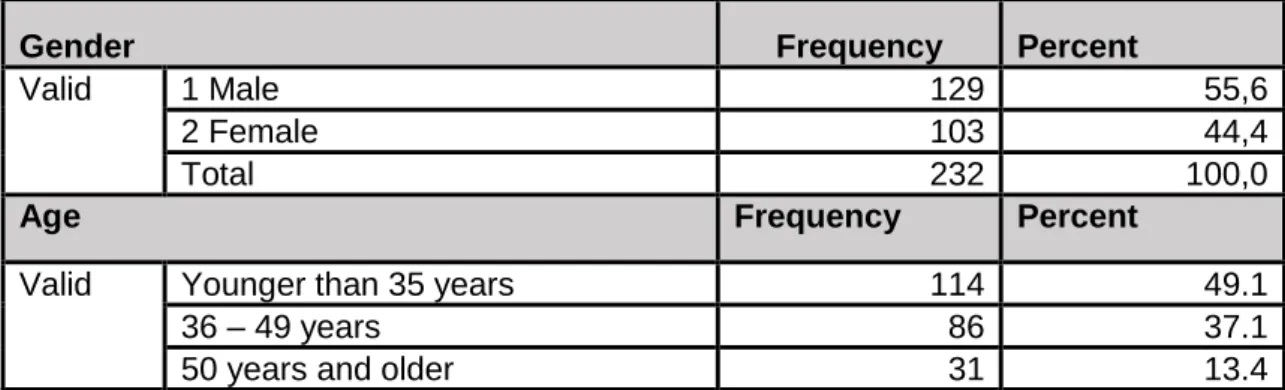
The sample profile of the respondents who agreed to take part in this study, including gender, age, ethnic group, income level, level of education and are summarised in Table 1 below. Table 1: Sample profile
Gender Frequency Percent
Valid 1 Male 129 55,6
2 Female 103 44,4
Total 232 100,0
Age Frequency Percent
Valid Younger than 35 years 114 49.1
36 – 49 years 86 37.1
Total 231 99,6
Missing System 1 ,4
Total 232 100,0
Income level Frequency Percent
Valid 1 Less than R7 999 61 26,3
2 R8 000 – R14 999 95 40,9
3 R15 000 or more 76 32,8
Total 232 100,0
Level of education Frequency Percent
Valid 1 Grade 11 or lower 3 1,3 2 Grade 12 (Matric) 70 30,2 3 Post-matric Diploma/Certificate 121 52,2 4 Baccalaureate Degree(s) 32 13,8 5 Post-graduate Degree(s) 5 2,2 Total 231 99,6 Missing System 1 0,4 Total 232 100,0
Source: Author’s construct
From Table 1, it is clear that of the 232 respondents, 55.6% were male (n=129) and 44.4% were female (n=103). It is also evident that respondents’ mean age was 37.09 years with a standard deviation of 9.473. The youngest credit receiver was 20 years old, and the oldest credit receiver was 59 years old. Owing to the wide distribution of age, the total sample was divided into three main age groups, namely, younger than 35 years, 36-49 years and 50 years and older. It is furthermore evident that the majority of the respondents were black (78.9%), followed by coloured (13.8%), Indian or Asian (3.9%) and the white respondents constituted the smallest proportion of the sample (3.4%). Importantly, this representation is in line with the population distribution in South Africa as established in literature and industry reports’ further analysis found that the largest group in the sample (52.2%) holds a post-matric diploma or certificate, followed by a group that has completed Grade 12 (30.2%), while 13.8% of respondents had a degree (Table 4.5). Only 1.3% did not have a matric. Thus, 98.3% of the respondents had at least a matric qualification.
5.2 Reliability and Validity
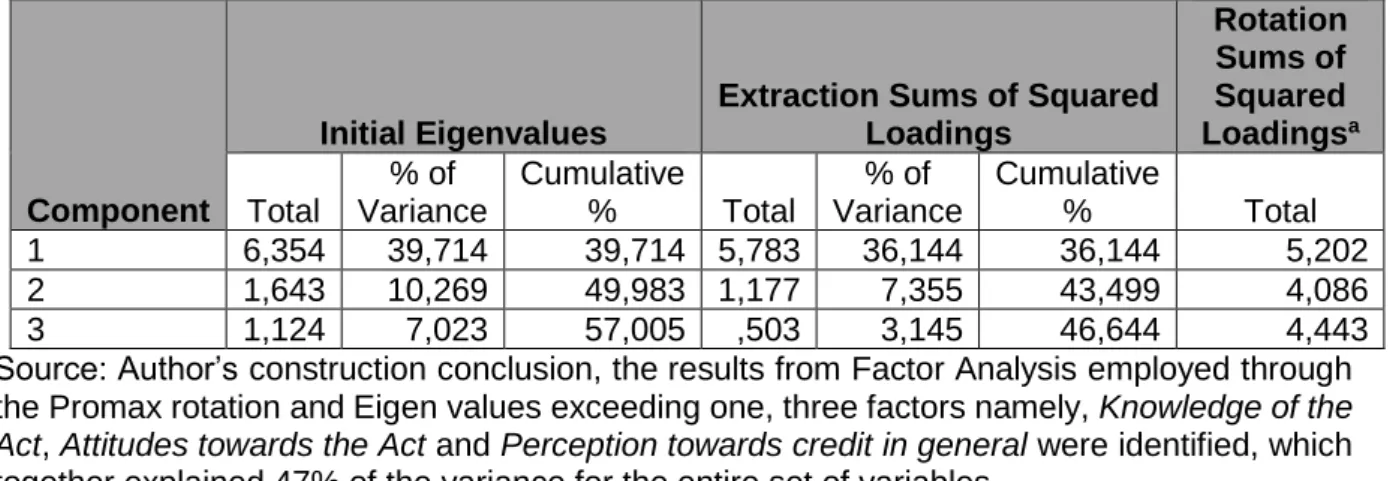
To determine construct validity of the measuring scales adopted for the purposes of the study, exploratory factor analysis was performed. The measure of sampling adequacy was higher than 0.60 (<0.91) at 5% level of significance, and thus 91% of the variance was explained by the underlying dimensions for each measurement scale. It can therefore be concluded that factor analysis can be used on the sample. With regard to eigen values, the researcher followed the Kaiser’s criterion, in which components with eigen values of 1 or more should be considered for extraction (Pallant, 2013:191). To determine how many components meet this criterion, it is necessary to peruse the total variance-explained table. Principal components analysis exposed the presence of three components with eigen values exceeding 1, which explains 39.7%, 10.2% and 7.0% of the variance respectively. Consequently, from the Promax rotation, it was also reported that factor 1 represents knowledge of the act, factor 2 indicates attitudes towards the act and factor 3 highlights perception towards credit in general. The reliability of the scale items was determined through calculation of Cronbach Alpha values for
each respective scale. Therefore, all the adopted scales were deemed to be reliable, as the Cronbach Alpha values were reported to be above 0.60 (Pallant, 2013:191). Table 2 and 3 provide a summary of the underlying dimensions uncovered from factor analysis and the reliability scores for the measuring scales.
Table 2: Total variance explained
Component
Initial Eigenvalues
Extraction Sums of Squared Loadings Rotation Sums of Squared Loadingsa Total % of Variance Cumulative % Total % of Variance Cumulative % Total 1 6,354 39,714 39,714 5,783 36,144 36,144 5,202 2 1,643 10,269 49,983 1,177 7,355 43,499 4,086 3 1,124 7,023 57,005 ,503 3,145 46,644 4,443
Source: Author’s construction conclusion, the results from Factor Analysis employed through the Promax rotation and Eigen values exceeding one, three factors namely, Knowledge of the Act, Attitudes towards the Act and Perception towards credit in general were identified, which together explained 47% of the variance for the entire set of variables
Table 3: Reliability analysis of the measuring scales
Construct/Factor
Cronbach Alpha values (α>0.60)
Attitudes towards the Act
0.680
Knowledge of the Act
0.693
Perception towards credit in general
0.875
Source: Author’s construct6. RESULTS AND FINDINGS
In this section, the results of the study are outlined through tabulating the results. The results are then discussed. This section is critical to understanding the levels of knowledge, as well as the perceptions and attitudes towards credit and the NCA.
All the items were measured on a 5-point Likert-type scale with 1 indicating ‘strongly disagree’ and 5 indicating ‘strongly agree’. For the purposes of this article we have rearranged the Likert scale to show only three of levels of agreement, namely, agree (combining the level of response of strongly agree and agree responses), neutral, and disagree (combining the level of strongly disagree and disagree responses). Therefore, the higher the average scores, the higher the general agreement in the group on the specific questions.
Table 4: Perception towards credit in general
Perception towards credit in general Disagree Neutral Agree
I understand how credit works 9% 13% 78%
I understand my rights as a borrower 11% 26% 63%
I understand my responsibilities as a borrower 0% 11% 89% I know where to go when in trouble with debt 43% 11% 46%
Source: Author’s construct
The borrowers’ scores indicated that they were in agreement with statements relating to understanding their rights and responsibilities as consumers, and how credit works. They were although not fully in agreement (46%) with the statement regarding knowing where to go when in trouble with debt. This could well mean that the information given to consumers regarding the availability of debt counsellors is inadequate, and this in turn could be the reason for an increase in customers’ impaired records and a decrease in credit health, as explained in Section 2 of the literature review, as they do not know where to seek help should they face financial difficulties. A good result is that consumers feel that there are responsible for their credit behaviour, given that no consumer disagreed with this point.
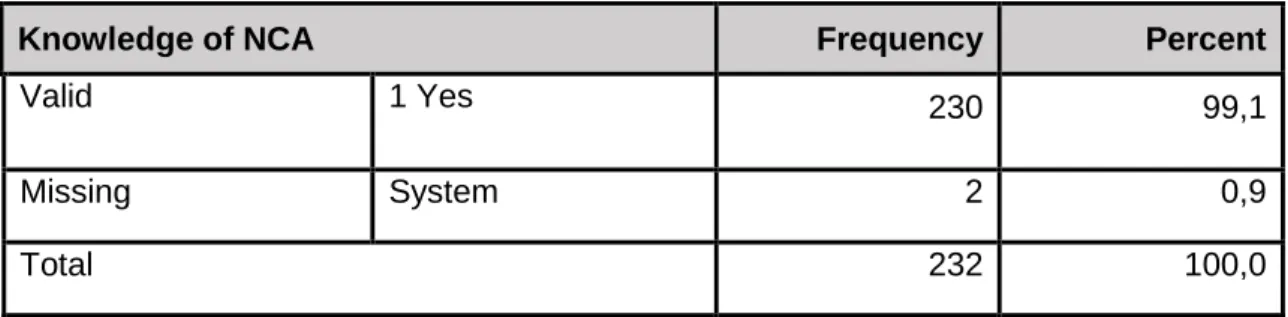
Table 5: Knowledge of the NCA
Knowledge of NCA Frequency Percent
Valid 1 Yes 230 99,1
Missing System 2 0,9
Total 232 100,0
Source: Author’s construct
Concerning the level of awareness of NCA, most of the respondents (99.1%) indicated aware of the National Credit Act. Even those who did not recognise the name itself had basic understanding of what the National Credit Act is all about. In addition, 89% of respondents stated that they became aware of the Act through their own institutions. Although this is commendable, there are various additional factors which could contribute to this high level of education of the sample size. For example, the majority (68.2%) of respondents possess a post-matric qualification, and 98.3% possess at least a matric. Therefore, good literacy corresponds with a better awareness of the NCATable 6: Understanding of NCA
How well they know the National Credit Act Disagre e
Neutral Agree Being aware of the Act has allowed me to better manage
my finances
55% 20% 25%
I have a right to be given written documentation relating to my credit transaction
0% 8% 98%
As a customer, I am entitled to one free credit report from credit bureaux per year
66% 4% 30%
I have the right to access and challenge information held by a credit bureau
26% 5% 69%
Source: Author’s construct
The scores from the customer questionnaire indicated that customers knew that they are entitled to copies of the contract agreement, and they can challenge the information held by the credit bureau. The scores also showed that customers were not fully in agreement with statements regarding their entitlement to a free credit report per year, as well as statements that assert that NCA knowledge has allowed them to better manage their finances. This could be interpreted as a result of a lack of information pertaining to the services of a credit bureau. These results confirm the literature, which states that an increased number of people in our country remain in the dark about their credit status until they decide to apply for credit. Regarding whether knowledge of the NCA contributes towards better management of their
finances, the scores could mean that being aware of the NCA has made little difference in respondents’ lives, as they are still struggling financially to make ends meet due to several reasons, including slow economic growth. These scores are further substantiated by the report on consumer vulnerability conducted by UNISA Bureau of Market Research (2013) and discussed in literature review.
Attitude towards the National Credit Act Disagree Neutral Agree The Act promotes a fair and non-discriminatory marketplace for
accessing credit
7% 5% 88%
The Act limits my chances of accessing credit 19% 13% 68%
The Act protects me from unfair credit and credit marketing practices
65% 0% 35%
The Act promotes responsible credit granting and use and for that purpose prohibits reckless lending
14% 3% 83%
The Act regulates interest rates and fees to ensure that customers are not overcharged by credit providers
81% 4% 15%
The Act ensures that consumers are provided with reasons should a credit application be declined
39% 4% 57%
The Act provides debt re-organisation, to enable restructuring of debts for over-indebted consumers
3% 0% 97%
The Act ensures credit providers use simple language in credit agreements that the consumer can understand
37% 4% 69%
Source: Author’s construct
7. PRACTICAL MANAGERIAL IMPLICATIONS AND RECOMMENDATIONS
This research paper aimed to investigation the customers’ attitudes towards, as well as their level of knowledge and perceptions of the NCA, in an effort to finds ways to prevent over-indebtedness. Firstly, the findings established that consumers have good perceptions relating to understanding their rights and responsibilities and as well as how credit works. Secondly, majority of participants indicated that they have knowledge on the NCA and are thus aware of its core purposes. Lastly, consumers understood and have favourable attitudes towards their contractual obligations towards the NCA. Therefore, it can be noted that participants showed an acceptable level of agreement regards to attitude, knowledge and credit.
In the light of these findings, it is clear that financial education needs to be outlined in order to decrease the levels of indebtedness amongst South Africans, and it is the responsibility of micro-lenders to educate and not to develop knowledge that serves their own purposes. Policy makers need to assist with the enforcement of the NCA as the positive attitudes, perceptions and high levels of knowledge have not translated to decreased levels of indebtedness and impaired consumers.
The limitations associated with this study should be highlighted in order to gain broader knowledge of the phenomenon under study. First, this research focused only on the perceptions of the customers of micro-finance in Johannesburg, which limits the generalisability of the sample entire micro-lending industry of South Africa. Secondly, as the study was conducted among customers through the use of questionnaires, the respondents could often present biased information to depict the organisation and their responses in a
favourable manner. The study looked at knowledge, perceptions and attitudes regarding the NCA but did not test the behaviour of the respondents. An understanding of behaviour is crucial to grasping the magnitude of indebtedness of South Africans.
The following recommendations are made for future research:
Further research could include a larger and broader sample that is more representative of the population, looking at the impact that the NCA on the behaviour of consumers who claim to have knowledge of the Act and their indebtedness.
A comparison of data could be undertaken involving the income and level of education of credit receivers in order to ascertain whether borrowing is influenced by these factors.
Future studies can include bias measures or scales in order to understand the level of bias that consumers have. In this study, respondents would have tailored their responses to create the impression that they understand finance, as there is considerable social prestige associated with such understanding
A longitudinal study looking into the changes in behaviour will also assist in understanding the behaviour of respondents.
Understanding borrowers’ psychology: why do people become habitual borrowers? The study could be expanded to other geographical areas and industries to validate
the measuring instruments. 8. CONCLUSIONS
In conclusion, the respondents have favourable perceptions and understanding of the NCA with regard to knowledge, attitudes and credit in general. The customer scores indicated that the respondents were in agreement with most of the statements, except those relating to the regulation of interest rates and fees and protection against unfair credit and credit market practices. This could mean that customers feel that they pay very high instalments and that the NCR is not doing enough to ensure that they are not overcharged by credit providers. Regarding the protection against unfair credit and credit market practices, the scores could be interpreted to indicate that the customers feel that they are bombarded with a lot of enticing adverts to get loans which is evident in previous works of Adewale (2014:367) and Chipeta and Mbululu (2012:216). The scores could also indicate that the NCR is unable to fulfil some of its mandates of protecting the consumer and regulating interest rates and fees especially amongst the students.
REFERENCE LIST
Adewale, A.R. 2014 Financial Regulation, Credit Consumption and Economic Growth–An Analysis of the National Credit Act in South Africa. Journal of Applied Business Research, 30(2):367-378.
Alan, G. 1996. Can measures of the consumer debt burden reliably predict an economic slowdown? Economic Review, 81(4):1-9.
Bowling, A. 2002. Research methods in health: investigating health and health services. London: McGraw-Hill Education.
Chipeta, C. & Mbululu, D. 2012. The effects of the National Credit Act and the global financial crisis on domestic credit extension: Empirical evidence from South Africa. Journal of Economic and Financial Science, 5(1):215-228.
Cooper, D.R. & Schindler, P.S. 2001. Business Research Methods. New York: McGraw-Hill. Credit Bureaux. 2007. Roles and Functions of Credit Bureaux under the NCA.
Available online from: www.compuscan.co.za. (Accessed 5 May 2017).
De Wet, S., Botha, I. & Booyens, M. 2015. Measuring the effect of the National Credit Act on Indebtedness in South Africa. Journal of Economic and Financial Sciences, 8(1):83-104.
Department of Trade and Industry. 2003. Credit Law Review. Available online from: http://www.ncr.org.za/publications/Background_NCA_docs/Summary%20of%20Findi ngs.pdf.(Accessed 5 May 2017).
Euromonitor. 2016. Consumer lending in Japan. Available online from: http://www.euromonitor.com/consumer-lending-in-japan/report. (Accessed 16 August 2017).
FinMark Trust. 2009. Financial Literacy Scoping Study and Strategy Project Final Report. Pretoria: ECI Africa.
Goodwin-Groen, R.P. 2006. The National Credit Act and its regulations in the context of access to finance in South Africa. Pretoria: Prepared and Published by Author.
Hurwitz, I. & Luiz, J. 2007. Urban working class credit usage and over-indebtedness in South Africa. Journal of Southern African Studies, 33(1):107-131.
South Africa. 2005. National Credit Act. Government Gazette No. 28619, Vol. 489. 2006. Pretoria: Government Printers.
Kelly-Louw, M. 2007. Introduction to the National Credit Act. The Quarterly Law Review for People in Business, 15(4):147-159.
National Credit Act. 2005. All you need to know about the National Credit Act as a consumer. 1:3-70.
National Credit Regulations. 2006. Regulations made in terms of the National Credit Act, 2005
(Act No 34 of 2005). Available online from:
http://www.ncr.org.za/pdfs/The%20National%20Credit%20Regulations.pdf. (Accessed 5 May 2017).
National Credit Regulator. 2012. Consumer Credit Market Report. Available online from: http://www.ncr.org.za. (Accessed 5 May 2017).
National Credit Regulator. 2012. Research on the increase of unsecured personal loans in South Africa’s credit market. Available online from: http://www.ncr.org.za. (Accessed 5 May 2017).
National Credit Regulator. 2016. Consumer Credit Market Report. Available online from https://www.ncr.org.za/documents/CCMR/CCMR%20June%202016.pdf. (Accessed 5 May 2017).
Ombudsman. 2017. Over indebtedness. Available online from:
http://ombudsman.ombudsmen.co.za/find-an-
ombudsman/index.php?option=com_content&view=article&id=133:over-indebtedness&catid=38:consumer-alerts&Itemid=69. (Accessed 16 August 2017). Pallant, J. 2013. SPSS Survival Manual: A Step by Step Guide to Data Analysis Using IBM SPSS. 5th ed. Berkshire: McGraw-Hill.
Rees, M. 2013 Opinion: Marikana burst unsecured lending bubble. Available online at https://www.moneyweb.co.za/archive/opinion-marikana-burst-the-unsecured-lending-bubbl/?sn=2009. (Accessed 5 May 2017).
Rom, R. 2014. The Impact of Unsecured Lending on the Financial Wellbeing of Consumers. Master’s Thesis. University of Pretoria.
Shreiner, M. 2002. Aspects of outreach: A framework for discussion of social benefits of microfinance. Journal of International Development, 14:591-603.
South Africa National Credit Regulator. 2007. All you need to know about the National Credit Act as a consumer. Pretoria: Government Printers.
South African Reserve Bank. 2012. Quarterly Bulletin - No 263. Available online from: http://www.resbank.co.za. (Accessed 5 May 2017).
South African Reserve Bank. 2012. Quarterly Bulletin - No 264. Available online from: http://www.resbank.co.za. (Accessed 5 May 2017).
South African Reserve Bank. 2013. Quarterly Bulletin - No 267. Available online from: http://www.resbank.co.za. (Accessed 5 May 2017).
South African Reserve Bank. 2014. Quarterly Bulletin, No. 272. Available online from: http://www.resbank.co.za. (Accessed 5 May 2017).
Staff Writer. 2016. Shocking number of South Africans are flat broke. Available online at https://businesstech.co.za/news/finance/123083/shocking-findings-in-sa-debt-data-review/.(Accessed 5 May 2017).
Staff Writer. 2017. Shocking number of South Africans flat broke. Available online from: https://businesstech.co.za/news/finance/123083/shocking-findings-in-sa-debt-data-review/ (Accessed 16 August 2017).
Stoop, P. N. 2009. South African consumer credit policy: Measures indirectly aimed at preventing consumer over-indebtedness. SA Mercantile Law Journal= SA Tydskrif vir Handelsreg, 21(3):365-386.Van Der Walt, B. F., & Prinsloo, J. W. 1993. Consumer Credit in South Africa. Quarterly Bulletin, 26-38.
Van Heerden, G. 2008. The potential effect of the National Credit Act of 2006 on the future of selected, specialized micro lending institutions in South Africa. Pretoria. University of Pretoria.
Van Zyl, C., Botha, Z. & Skerritt, P. 2006. Understanding South African financial markets. Pretoria: Van Schaik.
Wright, N. & Haynes, B. 2005. Building Economic Self-Reliance. Journal of Microfinance, 7(2):1-154.
World Economic Forum. 2013. Global Competitiveness Report 2012-2013. Geneva: World Economic Forum. Available online from: www.weform.org/issues/global-competitiveness. (Accessed 5 May 2017).
Zikmund, W.G. (2003). Business Research Methods. 7th ed. Thomson: South-Western. Law Dictionary. 2017. What is INDEBTEDNESS? definition of INDEBTEDNESS (Black's Law
Dictionary). Available online from:http://thelawdictionary.org/indebtedness/ (Accessed