BSI Standards Publication
Control of hazardous energy on
Publishing and copyright information
The BSI copyright notice displayed in this document indicates when the document was last issued. © The British Standards Institution 2020
Published by BSI Standards Limited 2020 ISBN 978 0 580 99359 6
ICS 13.110
The following BSI references relate to the work on this document: Committee reference MCE/3
Draft for comment 19/30363908 DC
Amendments/corrigenda issued since publication
Date Text affected
Foreword iii
0 Introduction 1
Table 1 — Hazardous energy control 2
1 Scope 3
2 Normative references 3
3 Terms and definitions 4
4 Risk assessment 5
5 Normal operation 6
5.1 Safeguarding 6
6 Isolation for maintenance operations 7
6.1 General 7
6.2 Identify types and isolation points for all hazardous energy 8
6.3 Disconnection of all hazardous energy sources 8
6.4 Locking off or lock-out 11
Figure 1 — Multi-lock hasp shown on a pneumatic valve 12
Figure 2 — Example of a lock-off box 12
6.5 Applying a suitable warning sign or tag-out 13
Figure 3 — Examples of signs for mechanical, production and electrical work 13
6.6 Release and/or block any stored energy 13
6.7 Verifying that the machine has been correctly de-energized 14
6.8 Re-energization of the machine 14
6.9 Handing over the work 15
6.10 Management and supervision of isolation 15
7 Maintenance and commissioning requiring the machine to be wholly or partially energized 15
7.1 General 15
7.2 Written risk assessment 15
Table 2 — Indicative list of requirements of risk reduction measures 16
7.3 Electrical maintenance on machinery 16
Figure 4 — Deciding whether to work dead or live 17
7.4 Pneumatic and hydraulic power systems 18
7.5 Re-energization of a machine requiring inspection and testing with whole or partial energization 18
7.6 Commissioning on machinery 19
8 Information, organizational controls, safe systems of work and training 20
8.1 General 20
8.2 Information 20
8.3 Organizational controls 20
Figure 5 — Safe systems of work related to generic work activities 21
8.4 Use of personal protective equipment (PPE) 21
8.5 Training and competence for the work activity 21
Annex A (informative) Tasks where the use of safety control systems to provide HEC might be
allowable 23
Annex B (informative) Handing over work 24
Table B.1 — Typical examples of hand over 25
Figure B.1 — Example of a communal safety lock issuing and handover log 27
Annex C (informative) Example procedure for electrical work on low voltage equipment 28 Table C.1 — Typical methods of isolation at low voltage 29
Figure C.1 — Example of a typical low voltage electrical permit to work 32
Contents
PageAnnex D (informative) Work on or near live electrical equipment 33 Table D.1 — Example of a risk assessment to Work NEAR Live Conductors 35
Table D.1 — Example of a risk assessment to Work NEAR Live Conductors 36
Annex E (informative) Example of a safe system of work for intrusive inspection as part of
verification of leaks during pressure testing of mechanical power systems 37
Annex F (informative) Guidance for work on an energized machine with physical hazards 40
Annex G (informative) Human factors relevant to compliance with hazardous energy control
procedures 41
Annex H (informative) Procedures following electrical work on low voltage machine – return
to service 42
Table H.1 — Return to service 43
Bibliography 44
Summary of pages
This document comprises a front cover, and inside front cover, pages i to iv, pages 1 to 45, an inside back cover and a back cover.
Foreword
Publishing information
This British Standard is published by BSI Standards Limited, under licence from The British Standards Institution, and came into effect on 29 February 2020. It was prepared by Technical Committee MCE/3, Safeguarding of machinery. A list of organizations represented on this committee can be obtained on request to its secretary.
Presentational conventions
The provisions of this standard are presented in roman (i.e. upright) type. Its requirements are expressed in sentences in which the principal auxiliary verb is “shall”.
Commentary, explanation and general informative material is presented in smaller italic type, and does not constitute a normative element.
Requirements in this standard are drafted in accordance with Rules for the structure and drafting of UK standards, subclause G.1.1, which states, “Requirements should be expressed using wording such as: ‘When tested as described in Annex A, the product shall ...’”. This means that only those products that are capable of passing the specified test will be deemed to conform to this standard.
Where websites and webpages have been cited, they are provided for ease of reference and are correct at the time of publication. The location of a webpage or website, or its contents, cannot be guaranteed.
Contractual and legal considerations
This publication does not purport to include all the necessary provisions of a contract. Users are responsible for its correct application.
Compliance with a British Standard cannot confer immunity from legal obligations.
0 Introduction
This British Standard provides requirements and guidance to users of machinery on how to control hazardous energy on machines for safe working during all types of interaction.
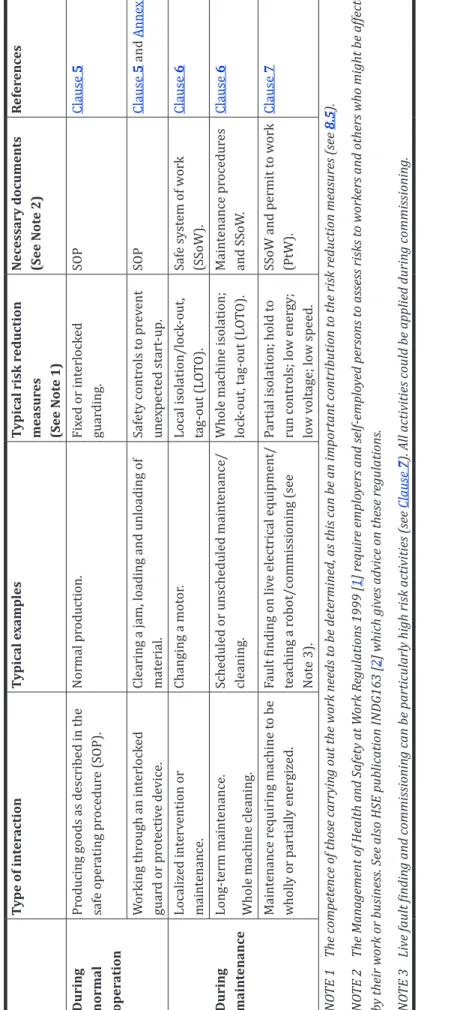
Table 1 identifies five potential types of interaction on a machine, two for normal operation and three for maintenance, based on the risk profile of each interaction.
During normal operation of machines, fixed and interlocked guards are commonly provided to prevent access to dangerous parts. Maintenance tasks (which could include setting, process changeover, cleaning, unblocking as well as planned and unplanned maintenance), might require alternative methods and controls to prevent injury, as the risks could well be different, requiring different risk reduction measures. Organizations need to risk assess how workers interact with a machine to determine which interventions can be carried out while relying on interlocking and which interventions require isolation.
NOTE Table 1 is not intended to be hierarchical and there is always be the need to assess the element of risk
involved for any given interaction and an adequate level of risk reduction applied.
Table 1 contains references to the clauses which give appropriate requirements and guidance on risk reduction measures for each type of interaction.
It is important to include all forms of hazardous energy in any risk assessment, e.g. electrical, pneumatic, hydraulic, and energy due to inertia or gravity.
Table 1 — Haz ar dous ener gy c ontr ol Type of int er action Typical e xamples Typical risk r eduction measur es (S ee Not e 1) Nec essary documents (S ee Not e 2) Refer enc es
During normal oper
ation
Pr
oducing goods as described in the
saf e oper ating pr ocedur e (SOP). Normal pr oduction. Fix ed or int er lock ed guar ding. SOP Clause 5 W or king thr oug h an int er lock ed guar d or pr ot ecti ve de vice.
Clearing a jam, loading and unloading of mat
erial. Saf ety contr ols t o pr ev ent une xpect ed start-up. SOP Clause 5 and Anne x A Localized int erv ention or maint enance. Changing a mot or . Local isolation/lock -out , tag-out (L OT O). Saf e s yst em of w or k (SSoW). Clause 6 During maint enanc e Long-t erm maint enance.
Whole machine cleaning.
Scheduled or unscheduled maint
enance/
cleaning.
Whole machine isolation; lock
-out , tag-out (L OT O). Maint enance pr ocedur es and SSoW . Clause 6 Maint enance r equiring machine t o be w holl y or partiall y ener gized. Fault finding on li ve electrical equipment/ teaching a r obot/commissioning (see Not e 3).
Partial isolation; hold t
o run contr ols; lo w ener gy; lo w v oltage; lo w speed.
SSoW and permit t
o w or k (PtW). Clause 7 NO TE 1 The c ompet enc e of those c arr
ying out the w
or k needs t o be det ermined, as this c an be an import ant c ontribution t o the risk r eduction measur es (see 8.5 ). NO TE 2 The Manag
ement of Health and Safet
y at W or k R egulations 1999 [ 1 ] r equir e emplo yers and se lf-emplo yed persons t o asse ss risks t o w or
kers and others w
ho might be affect
ed
by their w
or
k or busine
ss. See also HSE public
ation INDG163 [ 2 ] w hic h gi ve s ad vic e on the se r egulations. NO TE 3 Li ve fault finding and commissioning can be particular ly high risk acti vitie s (see Clause 7 ). A ll acti vitie s c
ould be applied during c
ommissioning.
1 Scope
This British Standard provides requirements for the control of hazardous energy whilst work is being carried out on machines.
This British Standard includes requirements for machinery in relation to electrical and mechanical hazards (i.e. moving parts, or parts that could move).
NOTE 1 For requirements for other hazards, see, for example, BS EN ISO 4413 and BS EN ISO 4414, which provide guidance on hydraulic and pneumatic systems.
NOTE 2 For guidance on controlling electrical hazards, see The Electricity at Work Regulations 1989 (EWR) [3]
and associated guidance HSR 25 “The Electricity at Work Regulations 1989 Guidance on Regulations” [4] and
HSG85 “Electricity at work safe working practices” [5].
This British Standard also provides requirements for fixed equipment, such as motors and pumps fed via plug and socket-outlets.
This British Standard does not apply to: a) machines fed at high voltage;
NOTE 3 High voltage is defined in BS 7671 as above 1 000 volts A.C. or 1 500 volts D.C.
b) material handling vehicles (e.g. forklifts, pallet trucks), rider operated vehicles, construction plant machinery, mobile elevated working platforms or road vehicles;
c) transportable or portable work machine (including powered hand tools), although the basic principles can often be applied; and
d) process plant equipment.
NOTE 4 For general guidance on isolation of process equipment, see HSG253 [6].
2 Normative references
The following documents are referred to in the text in such a way that some or all of their content constitutes provisions of this document1). For dated references, only the edition cited
applies. For undated references, the latest edition of the referenced document (including any amendments) applies.
BS EN 62061, Safety of machinery — Functional safety of safety-related electrical, electronic and programmable electronic control systems
BS EN ISO 7010, Graphical symbols — Safety colours and safety signs — Registered safety signs
BS EN ISO 12100, Safety of machinery — General principles for design — Risk assessment and risk reduction
BS EN ISO 13732-1, Ergonomics of the thermal environment — Methods for the assessment of human responses to contact with surfaces — Part 1: Hot surfaces
BS EN ISO 13732-3, Ergonomics of the thermal environment — Methods for the assessment of human responses to contact with surfaces — Part 3: Cold surfaces
BS EN ISO 13849-1, Safety of machinery — Safety related parts of control systems — Part 1: General principles for design
BS EN ISO 13855, Safety of machinery — Positioning of safeguards with respect to the approach speeds of parts of the human body
1) Documents that are referred to solely in an informative manner are listed in the Bibliography.
BS EN ISO 13857, Safety of machinery — Safety distances to prevent hazard zones being reached by upper and lower limbs
BS EN ISO 14119, Safety of machinery — Interlocking devices associated with guards — Principles for design and selection
BS EN ISO 14120:2015, Safety of machinery — Guards — General requirements for the design and construction of fixed and movable guards
BS EN IEC 62046, Safety of machinery — Application of protective equipment to detect the presence of persons
3 Terms and definitions
For the purposes of this British Standard, the following terms and definitions apply.
3.1 duty holder
person responsible for compliance with health and safety requirements relating to hazardous energy control within a specific work area
NOTE This can include isolation. 3.2 energy dissipation
dissipation (or restraint/containment) of any stored energy which might give rise to danger
NOTE Examples of stored energy include:
a) mechanical parts which could continue to move through inertia;
b) mechanical parts liable to move by gravity;
c) springs;
d) capacitors, inductors or batteries; and
e) pressurized fluids.
3.3 isolation
procedure to securely disconnect and separate a machine from all hazardous energy sources
3.4 isolator
device designed or intended to provide physical separation for a source of energy, capable of being secured in the isolated position
3.5 lock-out, tag-out (LOTO)
isolation procedure involving disconnecting a machine from all energy sources, then secured by locking the equipment in the off position and attaching a tag (sign) to warn against re-energization
NOTE 1 This term is commonly used by maintenance and production departments.
NOTE 2 Tag out alone without lock out is not considered sufficiently safe as a means of securing an isolation. 3.6 machine
installed machinery or equipment
NOTE 1 Examples include those used in manufacturing and processing, filling and packing, utilities, laboratories, engineering workshops, warehouses, waste treatment.
NOTE 2 The associated tanks, silos, pipes and services can also be included.