i
Identifying Prehistoric Interaction on Rapa Nui (Easter Island): Modelling the Development of Social Complexity in Extreme Isolation
Dale F. Simpson Jr.
M.A. (First Class Honours), Postgraduate Diploma (Distinction), B.A. (Advanced)
A thesis submitted for the degree of Doctor of Philosophy at The University of Queensland in 2019
ii Abstract
Anthropological archaeologists have been investigating ancient human interaction for decades as interaction studies highlight how humans have communicated for 200,000 years at a variety of spatial and temporal scales. With the development of provenance studies and improved geochemical sourcing techniques, researchers can better document the movement of raw materials and formed artefacts from sources to habitation and ceremonial sites to understand economic, ideological, and sociopolitical interaction. In the Pacific, numerous researchers have documented how Oceanic people were highly mobile and adept at intra– and inter–island interaction across the great ‘sea of islands’ (Hauʻofa 1993). Within Polynesia, tracing interaction has mostly been accomplished through geochemical analyses of stone materials, especially basalt adzes. These findings uncovered regional voyaging and interaction spheres between numerous islands and archipelagos.
Rapa Nui (Easter Island) has been the subject of various scientific investigations. Much of this work has been dedicated to moai (statues) and ahu (platforms) and how these megalithic features venerated the island’s chiefly ancestors and supported sociopolitical organisation, ideological communication, economic (re)distribution, and elite management over the island’s ancient political economy. Although moai and ahu have been studied for centuries, archaeological investigation of the island’s many basalt sources and artefacts, including their geological provenance and geochemistry, has been minimal. Consequently, this lack of comprehensive geochemistry for basalt sources and artefacts has restricted the potential of ancient interaction studies on Rapa Nui.
To fill this gap in the archaeological literature, the “Rapa Nui Geochemical Project (RNGP)” was established in 2013. The main goals of the RNGP include: 1) to identify, geologically, the various types of basalt used archaeologically and document the stages of production for artefacts and construction stones; 2) to elucidate spatial and temporal patterns of basalt acquisition, transfer, and use; 3) to delineate economic, ideological, and sociopolitical interaction, including pathways that accompanied and facilitated stone exchange between members of the ancient Rapanui culture; 4) to highlight the attributes of Rapa Nui’s chiefly controlled ancient political economy through documenting the spatial and temporal distributions of archaeological basalt industries; 5) to evaluate economic and sociopolitical interpretations put forward by the ‘ecocide’ or ‘collapse’ narrative (Bahn and Flenley 1992;
iii
Diamond 1995, 2005); and 6) to create public archaeology and educational opportunities for the local Rapa Nui community.
Over six years, the RNGP collaborated with more than 30 individuals from 20 institutions from around the globe to conduct field archaeology (four campaigns from 2014–2018), geoarchaeological and material culture documentation (SLR camera and drone photos/videos and artefactual 3D scanning), geochemical analyses (inductively coupled plasma–mass spectrometry and portable x–ray fluorescence), radiometric dating (14C), artistic site reconstructions, and educational outreach.
RNGP results from six study areas reveal a diversity of operational sequences for basalt tool making which parallels the numerous economic, ideological and sociopolitical pathways used by the ancient Rapanui to acquire basalt for artefact and construction stone creation. The RNGP geochemically identified eight unique basalts during analysis and highlighted how quarries and sources at Ava oʻKiri and Pu Tokitoki provided most of the material used to manufacture the sample of basalt artefacts (adzes, picks, knives, and axes) analysed in this study.
Four pathways for the transfer of basalt were uncovered in this investigation, they included, opportunistic, communal, and confederation and elite (re)distribution. Thus, the complexity of interaction outlined in this Ph.D. thesis refutes economic and sociopolitical propositions put forward by the ‘collapse narrative’ for Rapa Nui’s pre–contact period. Instead, it establishes the common interaction and collaboration within and between mata (clans) and the two island confederations that existed during the island’s past, especially regarding the access to and use of culturally valuable stone such as basalt.
iv Declaration by author
This thesis is composed of my original work, and contains no material previously published or written by another person except where due reference has been made in the text. I have clearly stated the contribution by others to jointly-authored works that I have included in my thesis. I have clearly stated the contribution of others to my thesis as a whole, including statistical assistance, survey design, data analysis, significant technical procedures, professional editorial advice, financial support and any other original research work used or reported in my thesis. The content of my thesis is the result of work I have carried out since the commencement of my higher degree by research candidature and does not include a substantial part of work that has been submitted to qualify for the award of any other degree or diploma in any university or other tertiary institution. I have clearly stated which parts of my thesis, if any, have been submitted to qualify for another award.
I acknowledge that an electronic copy of my thesis must be lodged with the University Library and, subject to the policy and procedures of The University of Queensland, the thesis be made available for research and study in accordance with the Copyright Act 1968 unless a period of embargo has been approved by the Dean of the Graduate School.
I acknowledge that copyright of all material contained in my thesis resides with the copyright holder(s) of that material. Where appropriate I have obtained copyright permission from the copyright holder to reproduce material in this thesis and have sought permission from co-authors for any jointly authored works included in the thesis.
v Publications during candidature
Peer–Reviewed
Larsen, A. and Simpson Jr., D.F. (2014). Comment to Rull et al. 2013. Challenging Easter Island's Collapse: the need for interdisciplinary synergies. Frontiers in Ecology and Evolution 15 doi: 10.3389/fevo.2014.00056.
Simpson Jr., D.F. (2014). A review of Rapa Nui’s Geodynamic, Volcanic, and Geologic Evolution. Apuntes de la Biblioteca William Mulloy 3: 1–30.
Simpson Jr., D.F. (2016). Minas, canteras y artefactos de basalto: Investigación científica aprobada por la comunidad Rapa Nui (Isla de Pascua). Annales del Museo de Historia Natural de Valparaiso 29: 120–131.
Simpson Jr., D.F. and Dussubieux, L. (2018). A collapsed narrative? Geochemistry and spatial distribution of basalt quarries and fine–grained artefacts reveal communal use of stone on Rapa Nui (Easter Island). Journal of Archaeological Science: Reports 18: 370–385.
Simpson Jr., D.F., Weisler, M.I., St. Pierre, E., Feng, Y. and Bolhar, R. (2017). Archaeological documentation and high–precision geochemistry of the Rua Tokitoki adze quarry and Poike’s fine–grained basalt source on Rapa Nui (Easter Island). Archaeology in Oceania 53(1): 15–27. Simpson Jr., D.F., Van Tilburg, J.A. and Dussubieux, L. (2018). Toki (adze) and pick production during peak moai (statue) manufacture: Geochemical and radiometric analyses reveal prehistoric provenance, timing and use of Easter Island’s fine–grain basalt resources. Journal of Pacific Archaeology 9(2): 11–34.
General Publications
Simpson Jr., D.F (2015). Prehistoric Miners of Rapa Nui. Revista Moe Varua 87: 1–5.
Simpson Jr., D.F. (2016). Elite control and exchange of archaeological stone. Revista Moe Varua 103: 1–4.
Simpson Jr., D.F. (2019). Conducting responsible and ethical archaeological research on Easter Island: Building diachronic and lasting relationships with the local Rapa Nui (Easter Island) community. Journal of the Texas Tech University Ethics Center 3(1): 20–26.
Reports
Simpson Jr., D.F. (2015). 2014–15 Ph.D. fieldwork report. Rapa Nui Journal 29(1): 58–66. Simpson Jr., D.F. (2015). Identificar la Interacción en la Prehistoria de Rapa Nui: Modelización del desarrollo de la complejidad social bajo un aislamiento extremo (003523– 14; 003523–14; 003523–14). Reportaje Numero Uno por el Consejo de Monumentos Nacionales de Chile, Rapa Nui.
Simpson Jr., D.F. (2016). Identificar la Interacción en la Prehistoria de Rapa Nui: Modelización del desarrollo de la complejidad social bajo un aislamiento extremo (003523– 14; 003523–14; 003523–14). Reportaje Numero Dos por el Consejo de Monumentos Nacionales de Chile, Rapa Nui.
vi
Simpson Jr., D.F. (2017). Identificar la Interacción en la Prehistoria de Rapa Nui: Modelización del desarrollo de la complejidad social bajo un aislamiento extremo (003523– 14; 003523–14; 003523–14). Reportaje Numero Tres por el Consejo de Monumentos Nacionales de Chile, Rapa Nui.
Simpson Jr., D.F. (2018). Identificar la Interacción en la Prehistoria de Rapa Nui: Modelización del desarrollo de la complejidad social bajo un aislamiento extremo (003523– 14; 003523–14; 003523–14). Reportaje Numero Cuatro por el Consejo de Monumentos Nacionales de Chile, Rapa Nui.
Simpson Jr., D.F. (2018). Identificar la Interacción en la Prehistoria de Rapa Nui: Modelización del desarrollo de la complejidad social bajo un aislamiento extremo (003523– 14; 003523–14; 003523–14). Reportaje Numero Cinco por el Consejo de Monumentos Nacionales de Chile, Rapa Nui.
Databases
Simpson Jr., D.F. (2016). Rapa Nui Preliminary Geochemistry (pXRF) Analysis. Terevaka.net Datashare. Accessed online 2017–01–07: http://terevaka.net/toki/.
Simpson Jr., D.F. (2017). Basalt quarries and sources as documented and analysed by the Rapa Nui Geochemical Project. Easter Island Statue Project database.
Sumitted manuscripts included in this thesis
Simpson Jr., D.F. and Lobos Haoa, Veri (in press). Rapa Nui’s stone quarries: An art and colouring book. Rapa Nui Press.
Simpson Jr., D.F. (in press). The Prehistoric Miners of Rapa Nui (Easter Island). To be submitted at the end of 2019 to Springer Publications.
Publications included in this thesis
Chapters 3–6 of this thesis are manuscripts accepted for publication in peer–reviewed journals. I am the lead author of all of these publications. I was responsible for conception and design of the research, analysis and interpretation of data, and the writing, submission, and revision of all manuscripts. I was the second author on a fifth manuscript. I worked closely with the lead author on conception and design of the research, analysis and interpretation of data, and writing of the manuscript.
Chapter 3: “Reviews of Rapa Nui’s geodynamic, volanic, and geologic evolution and archaeological sourcing studies” has been peer–reviewed and accepted for publication in Apuntes de la Biblioteca William Mulloy.
Contributor Statement of contribution
Dale F. Simpson Jr. (Candidate) Collation and review of literature (100%) Wrote and edited the paper (100%)
vii
Chapter 4: “Archaeological documentation and high–precision geochemistry of the Rua Tokitoki adze quarry and Poike’s fine–grain basalt source on Rapa Nui (Easter Island)” has been peer–reviewed and accepted for publication in Archaeology in Oceania.
Contributor Statement of contribution
Dale F. Simpson Jr. (Candidate) Research conception and design (60%) Analysis and interpretation of data (25%) Wrote the paper (60%)
Edited the paper (70%)
M.I Weisler Research conception and design (40%)
Analysis and interpretation of data (25%) Wrote the paper (20%)
Edited the paper (30%)
Emma J. St. Pierre Analysis and interpretation of data (25%) Wrote the paper (10%)
Yuexing Feng Supervision of geochemical analysis (100%) Robert Bolhar Analysis and interpretation of data (25%)
Wrote the paper (10%)
Chapter 5: “Toki (adze) and pick production during peak moai (statue) manufacture: Geochemical and radiometric analyses reveal pre–contact provenance, timing and use of Easter Island’s fine–grain basalt resources” has been peer–reviewed and accepted for publication in Journal of Pacific Archaeology.
Contributor Statement of contribution
Dale F. Simpson Jr. (Candidate) Research conception and design (60%) Analysis and interpretation of data (50%) Wrote the paper (60%)
Edited the paper (70%)
Jo Anne Van Tilburg Research conception and design (20%) Analysis and interpretation of data (25%) Wrote the paper (20%)
viii
Laure Dussubieux Research conception and design (20%) Analysis and interpretation of data (25%) Wrote the paper (20%)
Edited the paper (15%)
Chapter 6: “A collapsed narrative? Geochemistry and spatial distribution of basalt quarries and fine–grained artefacts reveal elite bottlenecking efforts, confederation (re)distribution, and communal use of stone on Rapa Nui (Easter Island)” has been peer–reviewed and accepted for publication in Journal of Archaeological Science: Reports.
Contributor Statement of contribution
Dale F. Simpson Jr. (Candidate) Research conception and design (60%) Analysis and interpretation of data (70%) Wrote the paper (70%)
Edited the paper (80%)
Laure Dussubieux Research conception and design (40%) Analysis and interpretation of data (30%) Wrote the paper (30%)
ix
Contributions by others to the thesis Marshall Weisler (University of Queensland; UQ) was my principal advisor (80% supervision). He provided financial support for geochemical analysis reported in one paper, archaeological collections made available though Roger Green, expertise, interpretations, writing of one paper, and editing and feedback of the entire thesis.
Tiina Manne (UQ) was my secondary adviser (20% supervision). She provided important editing and feedback of the entire thesis.
Annie Ross (UQ) provided important editing and feedback for Chapters One, Two, and Seven. Emma St. Pierre (UQ) conducted geochemical analysis and helped to write one paper.
Yuexing Feng (UQ) was the Earth and Science’s lab manager who supervised geochemical analysis.
Robert Bolhar (University of Witwatersrand) provided interpretations of geochemical results and helped to write one paper.
Laure Dussubieux (The Field Museum) is the research scientist who provided geochemical training (pXRF; LA–ICP–MS), expertise, interpretations, editing, and feedback. She helped write two papers.
Jo Anne Van Tilburg (University of California, Los Angeles) is the director of the Easter Island Statue Project who provided archaeological samples, radiometric dating results, database creation and management, expertise, interpretations, editing, and feedback. She helped write one paper.
Alice Hom (Easter Island Statue Project) is the cartographer who produced figures and database creation and management.
Chris Stevenson (Virginia Commonwealth University) provided research design, archaeological samples, expertise, editing, and feedback.
Brett Shepardson (Northern Arizona University/Terevaka Archaeological Outreach) provided archaeological samples, created and managed online datashares, and directed educational outreach activites.
Francisco Torres (Museo Antropológico Sebastian Englert) provided access to collections and expertise.
x
Pelayo Tuki (Museo Antropológico Sebastian Englert) provided access to collections and expertise.
Burkhard Vogt (Deutsches Archäologisches Institut) provided archaeological samples. Claudio Cristino (Universidad de Chile) provided archaeological samples.
Andrea Seelenfreund (Universidad Academia de Humanismo Cristiano) provided archaeological samples.
Veri Lobos Haoa (Independent artist) conceptualised and illustrated site reconstructions. Alberto Délano–Cox (Independent translator) translated English documents into Spanish. Martina Magnusson (Independent photographer) produced images.
Sebastián Yancovic Pakarati (Manu Project) assisted with fieldwork for two field seasons. He also organized logistics and operated the drone to produce images and video.
Edmundo Pont (Consejo de Monumentos Rapa Nui) provided expertise and assisted with fieldwork for one season.
Nicolas Yancovic Pakarati (Easter Island Expedition) assisted with fieldwork for one season. Merahi Atam (Consejo de Monumentos Rapa Nui) assisted with fieldwork for one season. Baihere Tuki Haoa (Easter Island Statue Project) assisted with fieldwork for one season. Maria Soraya Laharoa Navarro assisted with fieldwork for one season.
Stephanie Pauly assisted with fieldwork for one season.
Statement of parts of the thesis submitted to qualify for the award of another degree No parts of this thesis were used to qualify for the award of another degree.
Research Involving Human or Animal Subjects
xi Acknowledgements
Without my family and the many great friends, colleagues, and informants on and off the island, I would not have been able to conduct and finish this research. I especially thank my father Dale F. Simpson Sr, my mother Charlene R. Simpson, and my son Jeronimo Simpson González for their love, backing, and support during my investigation.
Maria Soraya Laharoa Navarro, Sam Schaefer, Dustin Porter, Myron Yusi, Brian and Catie Hanslick, Matt and Kelly Long, Aaron Green, C.J. Reach, Christian Pulliam, Tristan Wallbank, Javiera Gonzalez, Sarah Starke, Lissi Mares, Erin Sauer, Matt Porter, Jarret Dyer, Casey Carter, Kieth Miller, Liz Koenig, and Priscilla Rubliar motivated me to complete this thesis.
I would like to thank my friends in Australia for their support, especially Steven and Angela Burke, Jesse Branches, Jana Dwyer, and Rachel Neumann.
I greatly thank The University of Queensland and The School of Social Sciences for their support. Most of all, I would like to thank Marshall Weisler for his guidance and expertise in Polynesian archaeology and geochemistry. I would also like to thank Tiina Manne for her valuable comments and editing. I very much thank Chris Clarkson for his instruction in 3D scanning and the use of his equipment.
I especially thank the academic staff in The Schools of Social Science and Earth Sciences who were publication co–authors (Annegret Larsen, Marshall Weisler, Emma St. Pierre, and Yuexing Feng), postgraduate advisors and coordinators (Keitha Brown, Benjamin Byrne, Jonathan Pragnell, Cheryll Alipio, Lynda Cheshire, Anne Dighton, and Suzanna Fay– Ramirez), reviewers for my milestone documents (Tyler Faith, Ian Lilly, and Richard Walter), and those instructors who allowed me to lecture and/or participate in their courses and masterclasses (Marshall Weisler, Serena Love, Gerhard Hoffstedter, Michelle Brady, Glenys McGowan, and Michelle Brady).
I also thank other staff and colleagues at UQ including Ariana Lambrides, Matt Harris, Aleisha Buckler, Jane Lavers, Jessica McNeil, Xavier Carah, Tam Smith, Nathan Wright, Meltem Cemre, Emma James, Margaretha Mcfarland Vlahos, Kate Connell, Hilda Maclean, Anna Florin, Jaydeyn Thomas, Aaron Fogel, Rhona Fenwick, Kelsey Lowe, Robin Twaddle, Antoine Muller, Katie Woo, Solvor Emery, Reiner Mantei, Lyssa Artemisia, Meaghan Stewart, Chris Lovell, Jennifer Rowe, Heather Dixon, Emilija Niclolosi, Debbie Lim, Jessica Holland, Itsumi Miyashiro, Julie Alldridge, and Alison Buckley who welcomed me, supported me, and treated
xii
me as one of their own. A visit to Rapa Nui by Annie Ross in 2019 motivated and helped me to finish this thesis.
I would like to thank both local Rapa Nui and Chilean state institutions for granting authorisation to conduct geological and archaeological investigations (permit numbers 003523–14; 003524–14; 003525–14) including: MAPSE (Museo Antropológico Sebastian Englert; Francisco Torres, Lilian López Labbé, Valeska Chavez Pakomio, Santonio Tepano, Vai A Tare Haumaru, Paula Valenzuela, Titilok Pakomio, Paula Aguirre Reyes, Marlene Carolina Hernandez Vasquez, and Jocy Hey Lillo [deceased]); STP (Secretaría Técnica Patrimonio Rapa Nui; Paula Torres Jeria, Suvi Hereveri Tuki, Camila Zurob Dreckman, Lucia Tepihe, Pantu Rapu Tepano, Jhony Tuki, and Edmundo Pont); CMN (Consejo de Monumentos Nacionales; Jimena Ramírez González; Merahi Atam López, María Atallah Leiva, and Lya Edmunds Hernández), CONAF (Corporación Nacional Forestal; Susana Nahoe; Melinka Cuadros; and Hotu Matu’a Pate [deceased]), CODEIPA (La Comisión para el Desarrollo de Isla de Pascua; Anakena Manutomatoma and Osvaldo Pakarati), SENATUR (Servico Nacional de Turismo; Sebastián Paoa Águila), and DGAC (Dirección General de Aeronáutica Civil; Patricio Arévalo Salgado).
I am also so grateful for the fieldwork assistance by Maria Soraya Laharoa Navarro, Nicolas Yancovic Pakarati, Sebastián Yancovic Pakarati, Baihere Tuki Haoa, and Stephanie Pauly. I would like to thank the following academics who assisted in this dissertation – Laure Dussubieux (The Field Museum), Jo Anne Van Tilburg (University of California, Los Angeles), Alice Hom (Easter Island Statue Project), Chris Stevenson (Virginia Commonwealth), Brett Shepardson (Northern Arizona University/Terevaka Archaeological Outreach), Robert Bolhar (University of Witwatersrand), Burkhard Vogt (Deutsches Archäologisches Institut), Claudio Cristino (Universidad de Chile), Andrea Seelenfreund (Universidad Academia de Humanismo Cristiano), Veri Lobos Haoa (Independent artist), Martina Magnusson (Independent photographer), and Alberto Délano–Cox (Independent translator).
Much gratitude to my external examiners Terry Hunt (University of Arizona) and Peter Sheppard (University of Auckland) for marking my thesis and providing vital comments to improve my re–submission.
Funding for research (2013–2017) was provided by the University of Queensland’s Centennial Scholarship, International Postgraduate Research Scholarship, and a School of Social Science
xiii
Research Bursary. Funding to conduct partial geochemical analysis was provided by an Australian Research Council Discovery Grant DP0986542 (Weisler). An Archaeology Strategic Planning Grant (Weisler) funded travel to Rapa Nui in 2014. UQ’s Anthropology Museum provided employment while Diana Young and Jane Willcock accommodated training. UQ’s Archaeology Experience outreach program and Heather Dixon provided employment and opportunity. The College of DuPage and Marianne Hunnicutt provided employment allowing me to teach online anthropology classes during my candidature. Hotel Explora provided support and employment at the end of my candidature. I thank Lan Chile and Air Tahiti Nui for waving excess bag and weight fees.
Lastly, I would like to thank the entire Rapa Nui community. For almost 20 years, I have had the approval and pleasure of living and working on an island where so many individuals supported me and my goal to become an outstanding Polynesian and Rapa Nui archaeologist. Mauururu ki te mahingo Rapanui!
xiv Financial support
Funding for research (2013–2017) was provided by the University of Queensland’s Centennial Scholarship, International Postgraduate Research Scholarship, and a School of Social Science Research Bursary. Funding to conduct partial geochemical analysis was provided by an Australian Research Council Discovery Grant DP0986542 (Weisler). An Archaeology Strategic Planning Grant (Weisler) funded travel to Rapa Nui in 2014.
Keywords
basalt adze quarries, collapse, geoarchaeology, geochemistry, inductively coupled plasma– mass spectrometry (ICP–MS), East Polynesia, elite political economy, prehistoric interaction, Rapa Nui (Easter Island)
Australian and New Zealand Standard Research Classifications (ANZSRC)
ANZSRC code: 210106, Archaeology of New Guinea and Pacific Islands (excl. New Zealand), 50%
ANZSRC code: 210102, Archaeological Science, 40%
ANZSRC code: 210199, Archaeology not elsewhere classified, 10%
Fields of Research (FoR) Classification FoR code: 2101, Archaeology, 100%
xv Table of Contents
Page
Abstract ii
Declaration by author iv
Publications during candidature v Publications included in this thesis vi
Contributions by others to the thesis ix
Statement of parts of the thesis submitted to qualify for the award of another degree x
Acknowledgements xi
Keywords xiv
Australian and New Zealand Standard Research Classifications (ANZSRC) xiv FoR Classification
Table of Contents xv
List of Figures xvii
List of Tables xxi
Chapter 1. Introduction 1
Archaeological interaction studies within Pacific the ‘sea of islands’ 2
Rationale 4
Thesis Research Aims 8
Theoretical Orientation 9
Ph.D. Thesis Struture 12
References Cited 15
Chapter 2. Interacting sea of islands – A review of ancient interaction studies in Near and Remote Oceania, with particular reference to West and East Polynesia, and Rapa Nui (Easter
Island) 29 Chapter 3. Reviews of Rapa Nui’s geodynamic, volanic, and geologic evolution and
xvi
Chapter 4. Archaeological documentation and geochemistry of the Rua Tokitoki adze quarry
and the Poike fine–grain basalt source on Rapa Nui 222
Chapter 5. Toki (adze) and pick production during peak moai (statue) manufacture: Geochemical and radiometric analyses reveal pre–contact provenance, timing and use of Easter Island’s fine– grain basalt resources 260
Chapter 6. A collapsed narrative? Geochemistry and spatial distribution of basalt quarries and fine–grained artefacts reveal elite bottlenecking efforts, confederation (re)distribution, and communal use of stone on Rapa Nui 312
Chapter 7. Conclusion 354
Main findings 355
Future Objectives for Enhancing Research Outcomes 382
Concluding Remarks 384
Rapa Nui Geochemical Project (2013–2019) 385
References Cited 387
Appendix A: Previous geochemical data for Rapa Nui including stone types, major and minor elements (in both WT% and ppm), and scientific source 401
Appendix B: Database of all RNGP archaeological sites under study (n=84) 427
Appendix C: EISP and RNGP archaeological artefacts under study (n=78) 445
Appendix D: RNGP archaeological sites under geochemical study (n=31) 484
Appendix E: EISP and RNGP LA–ICP–MS elemental data 501
Appedix F: Letters of support, letters of permission, authorisation permits 521
Appendix G: RNGP educational outreach efforts 549
Appendix H: Artistic site reconstructions by Rapanui artist Veri Lobos Haoa 552
xvii List of Figures
Page Chapter 2. Interacting sea of islands – A review of ancient interaction studies in
Near and Remote Oceania, with particular reference to West and East Polynesia, and Rapa Nui
Figure 1. The palaeo–landmasses of Sunda and Sahul divided by Wallacea with the
division between Near and Remote Oceania denoted 155
Figure 2. The distribution of Lapita sites within Near and Remote Oceania 156 Figure 3. The main culture areas of the Pacific Islands: Melanesia, Micronesia and
Polynesia 157
Figure 4. East Polynesia with archipelagos connected to the Cook Islands 158
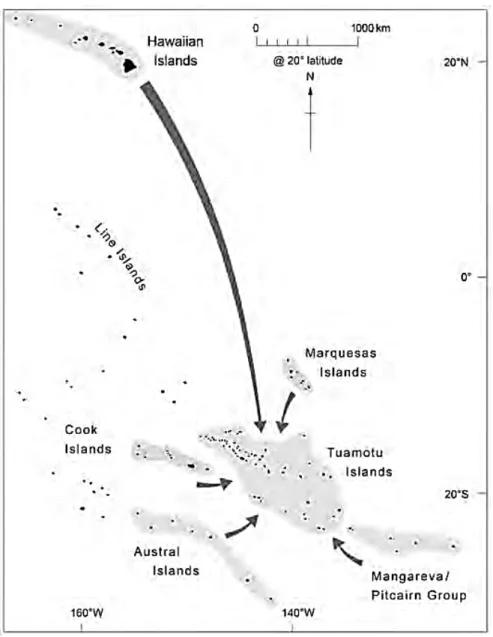
Figure 5. Tuamotus connectivity 159
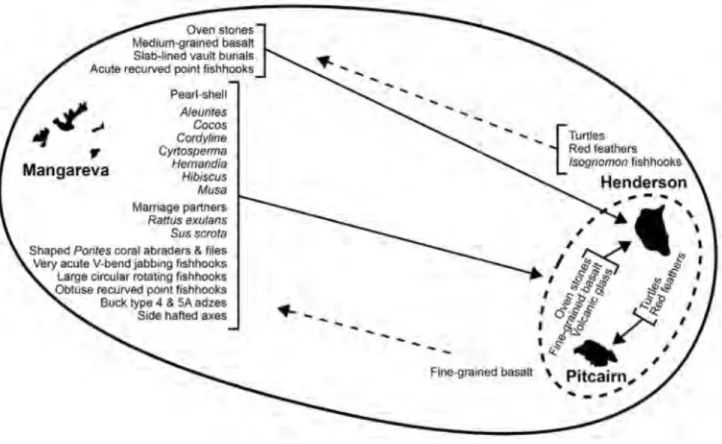
Figure 6. MHP interaction sphere 160
Figure 7. Location of Rapa Nui and places mention in text 161
Figure 8. Moai–ahu complex 162
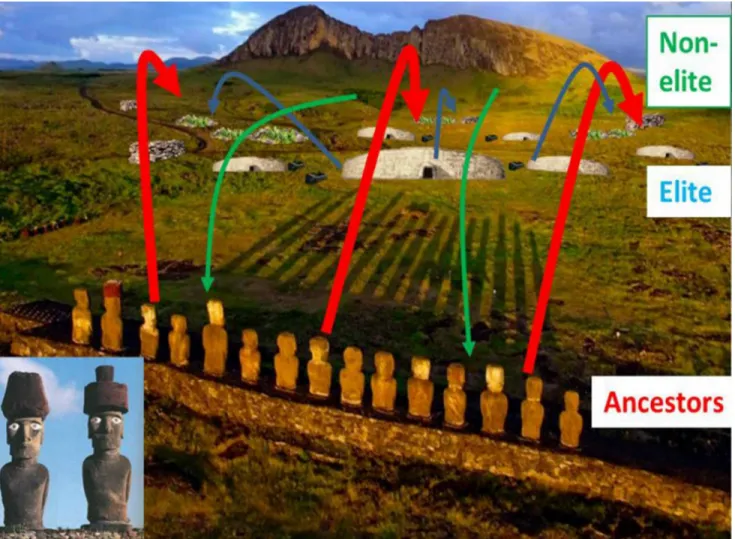
Figure 9. Elite Rapanui visualscape around Ahu Tongariki 163 Chapter 3. Reviews of Rapa Nui’s geodynamic, volcanic, and geologic evolution
and archaeological sourcing studies
Figure 1. Geodynamic setting of Rapa Nui showing major plate and microplate
boundaries and the Easter Seamount Chain–Nazca Ridge structure 191 Figure 2. Submarine structure of the Easter volcanic complex with inset map of
nearby volcanic fields and seamounts 192
Figure 3. Radiometric dating of Rapa Nui’s three volcanic centres 193 Figure 4. Volcanological evolution and geological material of Rano Kau, Poike,
and Terevaka 194
Figure 5. Rapa Nui’s secondary volcanic eruptions and associated geological
material 195
Figure 6. Rano Kau with Kari Kari 196
Figure 7. Volcanological evolution of Rano Kau 197
xviii
Figure 9. Phreatomagmatic crater of Rano Kau, Te Manavai, and Orito 199 Figure 10. Poike with Maunga Parehe, Maunga Tea Tea, Maunga Vai a Heva, and
Puakatiki summit lava cone 200
Figure 11. Poike with Puakatiki summit cone, Motu Marotiri, and Ahu
Tongariki 201
Figure 12. Volcanological evolution of Poike 202
Figure 13. Terevaka with Rano Aroi 203
Figure 14. Terevaka with Rano Kau 204
Figure 15. Volcanological evolution of Terevaka 205
Figure 16. Hanga O Teo 206
Figure 17. Rano Aroi filled with nga‘atu (Schoenoplectus californicus) 207 Figure 18. Tangaroa, Hiva Hiva, and Roiho districts 208
Figure 19. Ana Tapairu with retention wall 209
Figure 20. Ana Aharo with water retention 210
Figure 21. Rano Raraku with Rano Kau 211
Figure 22. Toa Toa with Rano Kau 212
Figure 23. Moai made from multiple types of Rapa Nui stone 213 Figure 24. Documented stone sources and quarries and their geographic locations
on Rapa Nui 214
Figure 25. Papa with petroglyphs at Papa Vaka Papa Moa 215 Figure 26. Worked puku with multiple extraction areas 216
Figure 27. Rua Tokitoki adze quarry 217
Figure 28. Pukao quarry at Puna Pau 218
Figure 29. TAS diagram dividing shield, caldera–related, and fissure volcanic lava (Ba–Basalt; H–Hawaiite; M–Mugearite; Be–Benmoreite; T–Trachyte; R–Ryolite). The dashed line is the boundary separating tholeiitic and alkalic basalt
219
xix
Chapter 3. Archaeological documentation and geochemistry of the Rua Tokitoki adze quarry and the Poike fine–grain basalt source on Rapa Nui
Figure 1. The location of Rapa Nui, quarries, and place names mentioned in the
text. 244
Figure 2. A drone view of Rua Tokitoki 245
Figure 3. Targeted flow south of Rua Tokitoki 246
Figure 4. Large flaked boulder at Rua Tokitoki 247
Figure 5. Debitage around the western pit of Rua Tokitoki 248 Figure 6. A drone view of the front of Ahu Kiri Reva 249 Figure 7. A drone view of the back of Ahu Kiri Reva 250 Figure 8. The trachyandesite (benmoreite) keho source on Poike 251 Figure 9. A bivariate plot of TAS total alkali (Na2O + K2O) versus silica (SiO2),
showing the rock types for the Rua Tokitoki quarry and the Poike source 252 Figure 10. A. REE patterns normalized to chondrite. B. Multi–element patterns
normalized to Primitive Mantle 253
Figure 11. A. 207Pb/204Pb versus 206Pb/204Pb and B. 143Nd/144Nd versus 87Sr/86Sr
isotopic values for the Rua Tokitoki and the Poike source 254 Chapter 5. Toki (adze) and pick production during peak moai (statue) manufacture:
Geochemical and radiometric analyses reveal pre–contact provenance, timing and use of Easter Island’s fine–grain basalt resources
Figure 1. Location of Rapa Nui, quarries, and place names mentioned in chapter 291 Figure 2. EISP excavation grid for RR–001–156 and RR–001–157 292
Figure 3. Excavated moai RR–001–156 293
Figure 4. RNGP sites in Ava o‘Kiri and Pu Tokitoki under geochemical analysis 294 Figure 5. RNGP#48 Rapa Nui’s largest fine–grain basalt quarry with multiple puku,
seven pu, numerous adze forms, artefacts, and extensive debitage 295 Figure 6. RNGP sites in the southwest coast under geochemical analysis 296 Figure 7. RNGP#11 Southwest coast mine complex with RNGP sites #11(a) and
#13(b) 297
xx
Figure 9. RNCG#25: Keho quarry in Rano Kau 299
Figure 10. Radiometric data from B. papyrifera samples at RR–001–156 plotting
beta/sample ID, square location, level cm, and calibrated date 300 Figure 11. Component loadings by elements included in the PCA 301
Figure 12. PCA analysis of RNGP study areas 302
Figure 13. PCA analysis of EISP archaeological samples and RNGP study areas 303 Chapter 6. A collapsed narrative? Geochemistry and spatial distribution of basalt
quarries and fine–grained artefacts reveal elite bottlenecking efforts, confederation (re)distribution, and communal use of stone on Rapa Nui
Figure 1. Geographic location of Rapa Nui, quarries, and place names mentioned
in the chapter 340
Figure 2. Location and numbers of artefacts analysed per location 341 Figure 3. A bivariate plot of TAS total alkali (Na2O + K2O) versus silica (SiO2),
showing the rock types for RNGP artefacts 342
Figure 4. A bivariate plot of TAS total alkali (Na2O + K2O) versus silica (SiO2),
showing the rock types for RNGP study areas 343
Figure 5. PCA analysis of RNGP study areas and artefact types 344 Figure 6. PCA analysis of RNGP study areas and artefacts from coastal ahu versus
inland sites 345
Figure 7. PCA analysis of RNGP study areas including samples from Rua Tokitoki
(n=7) and the Poike source (n=3) 346
Figure 8. Movement of basaltic material as identified by the RNGP 347 Figure 9. PCA analysis of RNGP study areas (including Poike), MAPSE artefacts,
xxi List of Tables
Page Chapter 2. Interacting sea of islands – A review of ancient interaction studies in
Near and Remote Oceania, with particular reference to West and East Polynesia, and Rapa Nui (Easter Island)
Table 1. Procurement and exchange transactions according to Renfrew (1975) 164 Table 2. Summary of geochemical analysis of archaeological remains from
Polynesia 165
Table 3A. Economic roles and responsibilities of the various Rapanui positions 166 Table 3B. Ideological roles and responsibilities of the various Rapanui positions 167 Table 3C. Sociopolitical roles and responsibilities of the various Rapanui positions 168 Chapter 3. Reviews of Rapa Nui’s geodynamic, volanic, and geologic evolution
and archaeological sourcing studies
Table 1. Rapa Nui stone types, locations, and usage 220 Table 2. Geoarchaeological analysis that has produced geochemical data 221 Chapter 4. Archaeological documentation and geochemistry of the Rua Tokitoki adze
quarry and the Poike fine–grain basalt source on Rapa Nui (Easter Island)
Table 1. Basalt sources, quarries, and workshops reported on Rapa Nui 255 Table 2. Rapa Nui stone types, locations, and use 256
Table 3. Major element analysis 257
Table 4. Trace element analysis 258
Table 5. Sr–Nd–Pb isotopic ratios 259
Chapter 5. Toki (adze) and pick production during peak moai (statue) manufacture: Geochemical and radiometric analyses reveal pre–contact provenance, timing and use of Easter Island’s fine–grain basalt resources
Table 1. EISP archaeological samples from the excavation of moai RR–001–156
subjected to geochemical analysis 304
xxii
Table 3. Compared average compositions for Corning Glass B and D. The averages are calculated from 15 compositions measured over the course of the project. Table 2 includes compositions published by Brill et al. (1999) and Dussubieux et al. (2009) using different ICP–MS. The relative standard deviation (divided by the average concentration for a given element) is calculated giving an indication of measurement precision
307
Table 4. Average compositions with relative standard deviations for the different areas investigated in this study. The number of samples is indicated with the name of the study area. Bold and underlined elements represent those used in statistical analysis
309
Table 5. Radiometric data from five B. papyrifera samples at RR–001–156 311 Chapter 6. A collapsed narrative? Geochemistry and spatial distribution of basalt
quarries and fine–grained artefacts reveal elite bottlenecking efforts, confederation (re)distribution, and communal use of stone on Rapa Nui (Easter Island)
Table 1. RNGP quarries, sources, and workshops under geochemical analysis 349 Table 2. Summary of locations, site type, and geochemical assignment 350 Table 3. Economic, ideological, and sociopolitical mechanisms for stone access,
control, exchange, and use during Rapa Nui’s pre–contact period following Renfrew’s (1975) modes
351
Table 4. Economic, ideological, and sociopolitical mechanisms for stone access, control, exchange, and use during Rapa Nui’s pre–contact period following Plog’s (1977) variables
1 CHAPTER 1: Introduction
Introduction
One of the defining characteristics of our species is how we have economically, ideologically, and sociopolitically interacted across time and space. From the first human interactions some 200,000 years ago (McDougall et al. 2005; López et al. 2015; Stringer 2015) until today, Homo sapiens have networked in multiple ‘modes’ (Finnegan 2002), including within local, regional, intercontinental, and global ‘interaction spheres’ (Caldwell 1964). Interested in documenting and investigating the various spatial and temporal scales of human interaction, anthropological archaeologists use a diversity of paradigms, methodologies, and practices to examine ancient and historic contexts found throughout the world (Bauer and Agbe–Davies 2011; Dillian and While [eds] 2011; Knappet 2011, 2013; Schortman and Urban 1987, 1992; Stein 2002). Archaeological theories such as diffusionism, culture–history, processualism, post– processualism, and network analysis have been used to frame human interaction studies across North, Central, and South America, Europe, Africa, Asia, and the Pacific, often focusing on archaeological materials including ceramics, obsidian, cherts, basalts, metals, glass, semiprecious materials such as jade, amber, and turquoise, and building materials including marble, basalt, and sandstone (Ammerman [ed.] 1985; Baugh and Ericson [eds] 1994; Evett 1973; Hallam et al. 1976; Harbottle 1982; Kristiansen and Larsson 2005; Lightfoot and Martinez 1995; Renfew 1975, 1977; Schortman and Urban [eds] 1992; Torrence 1996a, 1996b; Weisler [ed.] 1997). Results from these efforts provide case studies and assist to define concepts such as reciprocity, redistribution, exchange, connectivity, and trade that help to frame, support, and inform investigations into ancient and historic human interaction (Chapter Two).
For much of this research, providing the hard evidence for the intercommunication and interconnections between human groups has come in the form of material fingerprinting studies (Dussubieux et al. [eds] 2016; Glascock [ed.] 2002; Glascock et al. 2007; Shackley 1998; Weisler 1998). These studies have allowed for the identification of an artefact’s geological source (using archaeometry), and the recognition of the various economic, ideological, and sociopolitical mechanisms responsible for the acquisition, transfer, use, and discard of an artefact (using anthropological archaeology theory).
2
Characterisation or sourcing studies are normally focused on non–perishable raw materials and finished hard goods that are foreign to the place of deposition (Cochrane and Hunt 2017; Kirch 1997; Rolett 2002; Weisler 1997a). They range in sophistication from macroscopic observation of gross physical properties (colour, size, texture), to microscopic viewing (inclusions, streaking), and analyses of chemical and elemental composition using, for example, inductively coupled plasma–mass spectrometry (ICP–MS), instrumental neutron activation analysis (INAA), proton–induced X–ray emission/proton–induced gamma ray emission (PIXE– PIGME), and X–ray fluorescence (XRF) (Deutchman 1980; Dillian and White 2010; Ericson 1981; Glascock [ed.] 2002; Glascock et al. 2007; Lattanzi 2007; Shackley 1998; Summerhayes et al. 1998; Weisler [ed.] 1997). A benefit of using the latter set of fingerprinting techniques is that technical precision and accuracy in elemental characterisation and sourcing have greatly improved over the years (Earle 2010). This includes resolving difficulties in discriminating source and artefact chemistry, the recognition of proper sampling sizes for geological settings as well as for artefacts, the use of precise and accurate analytical technologies and statistical programs for parts per million (ppm) and weight percentage (wt%) elemental calculations, and the development of universal geological blanks and controls (for example, Standard Reference Samples [SRSs] of the United States Geological Survey) for statistical calculations and comparative analyses within and between research laboratories (Dussubieux et al. [eds] 2016; Ma et al. 2011; Weisler et al. 2016a).
While much work still needs to be done to identify and geochemically analyse additional sources and artefacts, altogether, sourcing techniques, when aligned with anthropological archaeology theory, help researchers to document and explain 200,000 years of human interaction in local, regional, intercontinental, and global nodes and networks.
Archaeological interaction studies within the Pacific ‘sea of islands’
Oceanic people were highly mobile and adept at intra– and inter–island contact and interaction in the great ‘sea of islands’ (Hauʻofa 1993). As Pacific islands were colonised from west to east, the introduction of imported artefacts and raw materials into new geological and environmental contexts are often readily apparent in Oceanic archaeological assemblages (Rolett 2002; Weisler 1997a). Therefore, the movement of Pacific people, and the translocation of materials from Near Oceania into Remote Oceania (Green 1991) and from West Polynesia into East Polynesia (Green 1968; Kirch 1990; Marack 1996; Weisler and Walter 2017), have been of particular interest for archaeological interaction studies (Cochrane and Hunt 2018;
3
Erlandson 2008; Kirch and Weisler 1994; Kirch 2017; Kirch and Kahn 2007; Weisler 1997a; Weisler [ed.] 1997). In turn, tracing the movement of people and materials throughout Oceania has informed on the timing, the geographic scale, the duration, and the complexity of ancient human interactions in the Pacific.
Due to more than 30,000 years of human occupation in the Pacific, archaeologists have studied human interaction through three main periods: from the Pleistocene to the early Holocene; during the period of the Lapita Cultural Complex of the mid–Holocene; and during Polynesian exploration, expansion, and development in the late Holocene (Kirch 2017; Simpson 2015a; Chapter Two). Results from interaction studies concerning these periods have resulted in particular models – ‘diffusionist’, ‘debt’, ‘isolationist’, and ‘interactionist’ – to explain the pattering and the divergence of material in the archaeological record within and between Pacific islands (see, for example, Emory 1968; Erlandson 2008; Hunt and Graves 1991; Irwin 1992; Kirch and Green 1987; Rolett 1993; Sinoto 1996; Terrell 1986; Weisler 1997a).
More specific outcomes of this work have uncovered Pleistocene interactions, including the first inter–island networks in Near Oceania from 24,000 to 8000 years ago (Flannery and White 1991; Fredericksen 1997; Summerhayes 2009; Summerhayes et al. 1998; Torrence 1996b; Torrence et al. 2013), spatially large and complex interaction spheres in the Papuan Highlands (Hughes 1977) and around the Bismarck Archipelago (Pengilley et al. 2019), and ‘central manufacturing places’ that developed into specialised pottery production and distribution centres that continued for many generations (Irwin 1974, 1978a 1979b, 1985).
Lapita interaction studies have used mostly obsidian and pottery to highlight the navigational efficacy of Austronesian speaking seafarers in the mid–Holocene, and the extent of exchange of material throughout Near and Remote Oceania at this time (Ambrose and Green 1972; Best 1984; Frederickson 1997; Green and Kirch 1997; Hunt 1989; Kirch 1991, 1997, 2017; Spriggs 1997). Interaction studies focused on West and East Polynesia are divided between investigating the interconnections between Lapita’s most far–flung sites in Fiji, Samoa, and Tonga, and investigating the interaction of the ancient Maʻohi (Polynesian) culture.
Archaeological sourcing work in Polynesia, particularly of basalt adzes, has been responsible for reconstructing a complex regional interaction sphere that once existed from 900–1500 AD, linking the Societies, Tuamotus, and Marquesas, along with the southern Cooks, Australs, and Mangareva, Henderson, and Pitcairn Islands (Collerson and Weisler 2007; Weisler 1998; Weisler and Walter 2017). Regarding the Mangareva, Henderson, and Pitcairn (MHP)
4
interaction sphere, Weisler (1994, 1995, 1996, 1997b, 2002; Weisler et al. 2004) reconstructed 400–500 years of ancient interaction, demonstrating how inter–island voyaging within the MHP interaction sphere, and the inter–island transfer of raw materials and artefacts, sustained small, marginal human populations on ecologically impoverished islands in the far eastern Pacific. As Rapa Nui (Easter Island) may have been colonised from this region, understanding patterns of interaction within the MHP prehistoric network, along with careful review of archaeological interaction studies within the ‘sea of islands’ (Chapter Two), informs Rapa Nui interaction studies and interpretations that are the focus of this thesis.
Rationale
Rapa Nui has been the focus of numerous scientific studies, reports, articles, books, presentations, museum exhibitions, conferences, movies, and TV shows (for example, see www.moaiculture.com). An overwhelming majority of these are archaeological in nature, with many aiming to explain the so–called ‘mysteries’ or ‘enigmas’ of Rapa Nui (Chapman and Santa–Coloma 2010; Edwards and Edwards 2013; Flenley and Bahn 2003; Hunt and Lipo 2017). These include, for example, the geographic origins of the Rapanui, moai statue carving and transport, ahu platform construction, and the various meanings of the kohau rongorongo proto–language script.
While early anthropological and archaeological surveys were conducted by Routledge (1919), Knoche (1925), Lavachery (1939), Métraux (1940, 1957), and Englert (1948), scientific archaeology was first conducted on the island in 1955 with the Norwegian Archaeological Expedition (NAE). Led by Thor Heyerdahl, the NAE obtained the first radiometric dates from archaeological contexts and presented the first three–phase culture history for Rapa Nui (Heyerdahl and Ferdon et al. 1961, 1965). From this first scientific investigation until 2019, Rapa Nui has provided ample opportunity to analyse a multiplicity of palaeoecological and archaeological materials, for instance: stone, coral, bone, wood, shell, pollen, microfossils, construction stone, statuary, and monumental architecture. Rapa Nui’s archaeological record also includes a variety of sites and features, including: megalithic platforms, roads, boat ramps and slips, habitation sites for both elite and non–elite Rapanui, horticultural features and plantations, ovens and oven houses, petroglyphs and petroglyph panels, chicken husbandry sites, water collection features, and stone quarrying sites. As such, the island’s archaeological record has been interpreted by researchers using a diversity of theories, including: diffusionism, culture history, cultural ecology, settlement pattern studies, evolutionary, interpretive, and political economy (Chapter Two).
5
In a recent review of Rapa Nui archaeology, Hunt and Lipo (2017) noted that, especially in the last 20 years, an understanding of Rapa Nui’s pre–contact past has been fostered through systematic re–evaluations of previous archaeological assumptions using detailed scientific data. Such re–assessments have included determining when the island was colonised, how moai were manufactured and transported, and where and why ahu were constructed throughout the island (Hunt and Lipo 2011, 2017).
One archaeological topic that has been comprehensively re–evaluated is the notion of Rapa Nui’s alleged pre–contact socio–ecological collapse (Bahn and Flenley 1992; Diamond 2005). The collapse narrative postulates that before contact with the outside world in 1772, Rapanui caused “deforestation [to fell trees to transport moai] of Easter Island which allowed wind to blow off the island’s thin topsoil: starvation, a population crash and a descent into cannibalism followed, leaving those haunting statues for the Europeans to find” (Easterbrook 2005:1). While this quote succinctly sums up the Rapa Nui collapse narrative, more recent multi– disciplinary scientific investigations (including this thesis) have focused efforts on empirically testing suppositions put forth by the collapse narrative, to ultimately demonstrate that its conclusions are unsound (Hunt 2007, Hunt and Lipo 2006, 2007, 2010, 2011; Jarman et al. 2017; Lipo et al. 2013, 2016; Larsen and Simpson 2014; Mulrooney 2012, 2013; Mulrooney et al. 2009; Rull et al. 2013, 2016; Simpson and Dussubieux 2018; Simpson et al. 2018; Stevenson et al. 2015; Thromp and Dudgeon 2015; Chapters Six and Seven).
Concurrently, in the last 20 years improved geodynamic, volcanological, and geological knowledge about Rapa Nui (see Simpson 2014), and more geochemical analyses of lithic quarries/sources1 and artefacts, have elaborated on previous studies to illuminate ancient interactions based on material culture use (Chapter Three). A benefit of studying quarries and sources is that they are often distributed unevenly, allowing archaeologists to use geochemical analyses to document patterns of access, control, distribution, and use. This information, in turn, can inform economic, ideological, and sociopolitical interaction and organisation for Rapa Nui, as it has been employed elsewhere in Polynesia (Clark et al. 2014; McAlister and Allen 2017; Rolett et al. 2015; Weisler and Walter 2017; Weisler et al. 2014, 2016b).
1 The term ‘source/quarry’ is used as only a few stone locales on Rapa Nui are actual ‘quarries’ defined by the presence of extraction pits, while other locales are more properly called ‘sources’ as tool–quality stone or construction materials were merely collected from the surface (after Weisler and Sinton 1997:180).
6
One important methodological issue in quarry studies is how to document reduction and transfer processes used to make and exchange lithic materials. While Shott (1996, 2003) judged the staged manufacture concept for stone artefacts as highly problematic and of limited utility, McCoy (2014) notes that all reduction technologies are a ‘continuum’, and because of this, parent material is reduced in size as the process unfolds, allowing the identification of operational sequences or stages. This information, then, adds detail to artefact life–histories, commodity chains, and human–material entanglements (Blair 2009; Earle 2011; Hodder 2015; Simpson 2015c). Five general stages can be identified regarding the use of archaeological quarries, sources, mines, and workshops to produce, transfer, and use stone tools: 1) procurement, often involving mining and quarrying; 2) reduction, frequently involving more than one step, often with specialists, to manufacture lithics; 3) exchange of objects through varying economic, ideological, and sociopolitical contexts; 4) the multiple uses of lithics in both mundane and sacred contexts; and 5) the discard of stone tools.
To describe these stages of lithic manufacture and use to inform interaction studies, Rapa Nui archaeologists have predominantly focused on the island’s four obsidian sources: Maunga Orito; Te Manavai; Rano Kau; and Motu Iti (Chapter Three, Figure 24) and the artefacts produced from these sources (Bollt et al. 2006; Mulrooney et al. 2014, 2015; Stevenson and Williams 2018; Thomas 2009). This is because obsidian is found at most Rapa Nui archaeological sites (McCoy 1976; Vargas et al. 2006), it can be dated by obsidian hydration (Stevenson 1984, 1986, 1997, 2000; Stevenson et al. 2015), and has diagnostic geochemical signatures that are useful for assigning artefacts to sources (Beardsley and Goles 1998, 2001; Beardsley et al. 1996; Cristino et al. 1999; Morrison and Dudgeon 2012; Mulrooney et al. 2014, 2015; Stevenson et al. 2013; Thomas 2009).
Distribution studies based on characterisation data propose that obsidian from the four quarries was differentially utilised based on glass quality, geological location, and the different needs for obsidian between elite and non–elite Rapanui (Beardsley et al. 1996; Martinsson–Wallin 1994; Mulrooney et al. 2014; Stevenson et al. 2013). While results from obsidian provenance investigation prompted Thomas (2009:49) to conclude that “analysis appear[s] to demonstrate a lack of competition and instead promote[s] the idea of communal resource access and/or implications of a trade network on [Rapa Nui]”, Stevenson et al. (2013:119) questioned how archaeological obsidian could have been used “in formalized trading partnerships between those lineages with obsidian deposits and those without”. McCoy (2014:16, 18) predicted that some archaeological stone was sourced from ‘common’ areas and “was obtained through
7
exchange with mata (clans) or lineages from other parts of the island”. However, none of these researchers could demonstrate why, how, or when obsidian material was acquired and/or exchanged within and between the ancient mata. Therefore, this is a major gap in the archaeological literature regarding how the pre–contact island culture transferred and exchanged archaeological stone, including obsidian.
While nine different geochemical studies have been conducted on Rapa Nui’s archaeological obsidian (Chapter Three, Table Two), only four publications (none of which used the same analytical technology, which limits comparison of elemental data and interpretations between studies) have been dedicated to fine–grain archaeological basalt (Chapter Three). Of these, one used macroscopic and microscopic analyses of only archaeological samples (Ayres et al. 1998), one used INAA analysis of only geoarchaeological samples (Stevenson et al. 2000), one used ICP–MS of both geological and archaeological samples (Harper 2008), and one used pXRF of only archaeological samples (Fischer and Bahamondez 2011). Whereas results from the first of these studies led Ayres et al. (1998) to propose that patterns of ancient basalt adze exchange best fit into opportunistic and kin–based geographic exchange patterns (see Peterson et al. 1997), Stevenson et al. (2000) argued that the lack of ceremonial and domestic features associated with basalt quarries and sources suggest that ‘task groups’, organised by ‘corporate strategies’ (see Blanton et al. 1996; Simpson 2008; Stevenson 1997), visited communal areas to extract basalt on a routine basis. Harper’s (2008) work showed how selected adzes (toki) were provenanced from inside the Rano Kau area, while ahu platform blocks (paenga) were quarried from somewhere in the Terevaka volcanic complex, and then moved to ahu sites later. Results of geochemical analyses of toki (adze and pick) by the Easter Island Statue Project hinted at possible centralised distribution of adzes and picks from one or two main quarries outward to Rano Raraku, the moai quarry (Fischer and Bahamondez 2011). Still, similar to the investigation of archaeological obsidian, none of these aforementioned researchers could demonstrate why, how, or when fine–grain basalt material was acquired and/or exchanged within and between the ancient mata and the two island confederations (Hotus et al. 1988; Routledge 1919; Vargas et al. 2006). Therefore, this is a major gap in the archaeological literature regarding how the pre–contact island culture transferred and exchanged archaeological stone, including basalt.
Consequently, this lack of comparable and comprehensive geochemistry for basalt sources and artefacts has restricted the potential of Rapa Nui interaction studies, as investigators have reported multiple basalt sources, quarries, and workshops throughout the island (Chapter 3,
8
Figure 24; Chapter 4, Table 1) and have archaeologically recovered abundant basalt artefacts and construction stone including adzes, chisels, knives, axes, fishhooks, keho (flat basaltic laminates), pae (non–dressed basaltic blocks), and paenga (dressed stone). Hence, as basalt tools were necessary for woodworking, canoe building, moai and ahu stone sculpting (Simpson et al. 2017, 2018; Van Tilburg 1994), understanding their sources, manufacture, distribution, and timings of use can inform interpretations of ancient island economy, ideology, and sociopolitical interaction and organisation through time (Best et al. 1992; Duff 1959; Emory 1968; Weisler 1997b, 1998; Weisler 1997 [ed.]). Such analysis is the subject of this thesis. Thesis Research Aims
The main goal of this thesis is to use a political economy (PE) theoretical lens (Earle 1997, 2002; Earle and Spriggs 2015; Simpson 2008, 2009; Stevenson 1997) to interpret the archaeological evidence for acquisition, transfer, and use of fine–grain basalt during Rapa Nui’s past (Simpson and Dussubieux 2018; Simpson et al. 2017, 2018). To address the transfer of basalt artefacts – from geological sources to archaeological sites – and to understand economic, ideological, and sociopolitical interactions, there is a need to develop an approach that utilises high quality geoarchaeological and geochemical methods that are accurate, precise, and replicable. This approach provides archaeological site and archaeometric data that, when joined with anthropological archaeology theory (i.e. PE), helps to uncover and describe patterns of access to, and control of quarries/sources, along with patterns of exchange, use, and discard of stone materials and artefacts. This information will assist in filling gaps that exist in Rapa Nui’s archaeological literature regarding access to basalt from quarries and sources, the manufacturing process of basalt artefacts, and the exchange of basalt between and amongst the Rapanui in pre– contact times.
Supplementary goals of this thesis include: 1) to identify, geologically, the various types of basalt and document the reduction stages used to produce artefacts and construction stones; 2) to use a variety of approaches and methods (literature review, field archaeology, drone and SLR photography and videography, 3D scanning, 14C dating, an online datashare [www.terevaka .com/toki], and artist’s reconstructions [Appendix H]) and state–of–the–art geochemical technologies (pXRF and ICP–MS) to reveal temporal and spatial patterns of basalt acquisition, reduction, transfer, and use; 3) to highlight attributes of Rapa Nui’s elite–controlled ancient political economy; 4) to determine economic, ideological, and sociopolitical contexts that accompanied and facilitated basalt exchange between members of the ancient Rapanui culture; 5) to revisit the ‘ecocide’ or ‘collapse’ narrative (Bahn and Flenley 1992; Diamond 2005) and argue
9
that it is an inadequate framework to understand Rapa Nui history (see also Larsen and Simpson 2014); and 6) to create public archaeology and educational opportunities for the island community (see Shepardson et al. 2014; Simpson 2015b, 2016b, 2019; Torres and Hereveri 2015; Torres et al. 2015; Appendix G). Therefore, to attain my main and supplementary goals, the following individual research questions (RQ) were posited:
RQ1: What types of economic, ideological, and sociopolitical interactions were evident during Rapa Nui’s pre–contact and historic/contact periods?
RQ2: What are the characteristics of Rapa Nui’s chiefly and elite–controlled ancient political economy?
RQ3: What fine–grain basalts are found in the Rapa Nui Geochemical Project study areas and what types of basalts were used to manufacture portable artefacts according to total alkali versus silica (TAS) analysis? What were the geological formation processes that created tool–grade basalt? What elements should geochemists use to discriminate between Rapa Nui’s basalt sources in the future?
RQ4: What are the spatial distributions, physical characteristics, and timing of use for Rapa Nui’s fine–grain basalt mines, sources, quarries, and workshops?
RQ5: What were the economic, ideological, and sociopolitical mechanisms that facilitated the access to and use of archaeological stone, including fine–grain basalt, during Rapa Nui’s past?
RQ6: What do the overall results from this thesis suggest about economic and sociopolitical interpretations put forward by proponents of the ‘ecocide’ or ‘collapse’ narrative?
To help answer these six research questions and to formalise a research approach, I established the Rapa Nui Geochemical Project (RNGP) in 2013 (Simpson 2019; Simpson and Dussubieux 2018; Simpson et al. 2018). Since then, the project has used four campaigns (2014–2018) of field archaeology (Simpson 2015a,b, 2016a,b), archaeological site and material culture documentation (Simpson 2015c,d, 2016c, 2017b), geochemical analyses (Simpson 2017a, 2018a,b; Simpson and Dussubuiex 2018; Simpson et al. 2017, 2018), radiometric dating (Simpson et al. 2018), and quarry site interpretations by Rapanui artist Veri Lobos Haoa (Appendix H) to reconstruct patterns of past interaction and archaeological basalt use on Rapa Nui (Simpson 2013, 2016d; Simpson and Dussibiuex 2018; Chapter Seven).
Theoretical Orientation
The conceptual framework for this thesis is PE theory, as this approach can “identify alternative patterns of [cultural] development that archaeologists are now recording” (Earle and Spriggs
10
2015:517). PE is an important framework for explaining the mobilisation and control of surpluses in subsistence goods (staple resources) and the administered exchange of wealth objects (luxury resources). As a consequence, PE, as an explanatory trope, has gained considerable interest in Pacific archaeology, as the importance of chiefs and elites in overseeing and manipulating ancient political economies to serve their individual agency is well documented (Dow and Reed 2013; Earle 1997, 2002; Earle and Spriggs 2015; Firth 1967; Goldman 1970; Graves and Sweeny 1993; Hommon 2013; Kirch 1984, 1990, 2010; Kirch et al. 2011; Kolb 1991, 1992, 1994; Lass 1998; Sahlins 1958; Younger 2012).
Encouraging the use of a PE approach for past Pacific sequences, Earle and Spriggs (2015:515) argue that PE theory, supported by traditional Marxist principles and scientific data, “provides the means to look at how specific [and interrelated] archaeological histories have resulted in striking parallels, conjunctures, and divergences”. Drawing upon case studies from the Lapita Cultural Complex, post–Lapita Vanuatu, and the Hawaiian Islands, Earle and Spriggs (2015) focus on how power – acquired by certain individuals and derived from their influence over the economy, land ownership and labour control, warrior might, and religious ideology (Earle 1997, 2002; Mann 1986) – was asserted via control over various ‘bottlenecks’ or constriction points in staple and luxury resource commodity chains. So–called bottlenecks offered chiefs and aspiring leaders the opportunity to limit access to specific segments of resource production and/or to limit access to whole artefacts, thus creating ownership over staple and luxury resources, technologies, and/or knowledge. In turn, ownership and intemperate access gave chiefs and elites the ability to finance, direct, and legitimise economic, ideological, and sociopolitical development and influence cultural evolution through time.
An important goal for archaeologists interested in reconstructing ancient political economies and the agency played by chiefs and elites to foster cultural developmental, is to reveal ‘bottlenecking dynamics’ found in the archaeological record across time and space (Earle and Spriggs 2015). This is done by identifying the concrete elements of the general economy (Sayer 1987) and then examining its staple and luxury resource commodity chains for potential bottlenecks that would allow for surplus extraction and manipulation by chiefly and elite members.
On Rapa Nui, the use of PE theory to interpret archaeological data has led to a nuanced appreciation of the various economic, ideological, and sociopolitical structures present in ancient Rapa Nui culture (Howard, 2007; Simpson 2008, 2009; Simpson et al. 2017; Stevenson 1997, 2002; Stevenson and Haoa 1998; Stevenson et al. 2005, 2013). It highlights how chiefly
11
Rapanui used ceremonial and domestic architecture to construct elite–controlled landscapes (which promoted hegemony and enforced particular ancestor worship systems), employed corporate work strategies for staple resource production and monumental architecture construction, and engaged in bottlenecking efforts such as first–fruits ceremonies, which were all legitimised by elite mana and protected by chiefly tapu and rahui (Chapters Two and Seven). Together, these sources of power allowed Rapanui chiefs and elites to maintain control over territories and landscapes, the labour force, and the most significant stages of staple resource commodity chains. Ultimately, economic, ideological, and sociopolitical hegemony created by control over the PE helped to legitimise Miru (the highest ranked island clan) and tangata honui (clan leaders) management of mata kainga (clan land), mata (clan) inhabitants living inland (commoners), and the island’s productive resources over time (Simpson 2008, 2009).
By controlling (and redistributing) staple food resources (e.g. sweet potato, taro, sugarcane, chicken) and their production sectors (e.g. gardens, chicken houses), each Rapanui chief and his retainers facilitated individual mata to be more–or–less self–sufficient with regards to food production and consumption during pre–contact times (Hunt and Lipo 2011, 2017). As such, each district’s moai–ahu complex (Stevenson 2002) and the development of its accompanying mata kainga, can be conceptualised as being the unique product of the individual agency (both successes and failures) of multiple chiefs and elites over numerous generations. Arguably, intergenerational success was measured by each generation’s ability to: 1) maintain connections to the Miru and the ariki mau (paramount chief) for spiritual and ideological support, as well as with other clans for non–localised material and marriage partner exchange; 2) organise corporate labour works within mata kainga including the construction, maintenance, and expansion of moai–ahu complexes and horticultural and chicken husbandry productive features; and 3) properly invest, divert, and (re)distribute both staple and luxury resources to maintain the economic, ideological, and sociopolitical sustainability of their mata. Yet, a constraint for chiefs and elites lay in the fact that deposits of culturally valuable stone used by the ancient Rapanui (e.g. tuff, scoria, obsidian, basalt) were not evenly distributed across the island’s distinctive volcanic landscapes (Chapter Three). For example, while some clan lands were rich in obsidian sources, their mata kainga was completely devoid of tuff stone to manufacture moai. Similarly, red scoria, used to carve topknots or pukao, is concentrated around Puna Pau, but this area lacked the fine–grain basalt to make toki (adzes) and picks, needed to carve pukao.
12
These limiting geological factors resulted in an island–wide stone–use pattern where multiple clans accessed identical stone material from a minimum number of localised quarries and sources. This communal pattern of stone use is exemplified by the fact that 96% of all moai come from one source, Rano Raraku, but statues are distributed throughout the island in each mata kainga. This is the same for the ~100 pukao found at almost all district centres, but which were all sourced from a single quarry at Puna Pau (Van Tilburg 1994; Vargas et al. 2006; Thomas 2014).
It would seem, then, that there existed at least three general forms of economic, ideological, and sociopolitical interaction during pre–contact times: 1) within the mata – which was managed and directed by the individual agency of each tangata honui and his retainers; 2) between mata – which helped to negotiate and exchange for valuable stone resources (amongst other staple and luxury resources and marriage partners) used in ceremonial and domestic constructions and activities; and 3) within and between the island’s two confederations. What is still unknown, however, is if this communal pattern for access to and use of valuable stone is also the same regarding the island’s fine–grain basalt resources. Did chiefs and elite retainers have access to, and could they bottleneck superior basalt deposits for their own ambition and use, including to manufacture adzes and picks that were utilised for prestigious moai carving and canoe building? These questions are explored and answered in this thesis. I argue that by using results gained by precise and accurate sourcing analyses (archaeometry) to understand prehistoric basalt acquisition, control, exchange, and use, along with frameworks and interpretations provided by Pacific and Rapa Nui PE investigations (anthropological archaeology theory), this thesis provides the basis for understanding economic, ideological, and sociopolitical interaction of the ancient Rapa Nui island culture.
Ph.D. Thesis Structure
This Ph.D. thesis comprises seven chapters: an introduction (Chapter One); a methodological and theoretical review of interaction studies in the Pacific and on Rapa Nui (Chapter Two); four chapters based on papers published in peer–reviewed journals (Chapters Three through Six); and a conclusion (Chapter Seven). Nine appendices (A – I) are also included to support the aims and goals of this doctoral thesis.
Chapter Two reviews major archaeological theories, methodologies, and key terms (reciprocity, redistribution, exchange, trade, connectivity, and interaction) used to frame human interaction studies. This chapter then examines archaeological interaction studies in the
13
‘sea of islands’, including Near and Remote Oceania, Polynesia, and Rapa Nui. By connecting historic, ethnohistoric, and ethnographic records with results and interpretations from archaeology, an evaluation of ancient and historic Rapa Nui economic, ideological, and sociopolitical interaction is presented, along with a recreation of the island’s ancient political economy. Research questions addressed: RQ1, RQ2, RQ5, RQ6.
Chapter Three synthesises the robust records that describe the geodynamic, volcanic, and geologic evolution of Rapa Nui. This chapter also focuses on: Rapa Nui’s geomorphological formation and dating; the island’s main volcanoes and their associated geological material; and Rapa Nui rock types, their locations in the landscape, and their pre–contact use to fabricate archaeological structures and artefacts. Previous Rapa Nui geological and geoarchaeological research that has produced geochemical data and/or interpretations about archaeological stone use are also presented and complied. Research questions addressed: RQ3, RQ4, and RQ5. Chapter Four details a geochemical pilot study conducted at The University of Queensland’s Earth Science Laboratories, which utilised 10 samples from the adze quarry at Rua Tokitoki and a fine–grain basalt source found on Poike. This chapter also provides site descriptions, describes two unique basalt stone quarrying pro