Type of Tomato Classification Using Deep Learning
Mahmoud A. Alajrami, Samy S. Abu-Naser
Department Information Technology, Faculty of Engineering and Information Technology,
Al-Azhar University, Gaza, Palestine
Abstract: Tomatoes are part of the major crops in food security. Tomatoes are plants grown in temperate and hot regions of South American origin from Peru, and then spread to most countries of the world. Tomatoes contain a lot of vitamin C and mineral salts, and are recommended for people with constipation, diabetes and patients with heart and body diseases. Studies and scientific studies have proven the importance of eating tomato juice in reducing the activity of platelets in diabetics, which helps in protecting them from developing deadly blood clots. A tomato classification approach is presented with a data set containing approximately 5,266 images with 7 species belonging to tomatoes. The Neural Network Algorithms (CNN), a deep learning technique applied widely in image recognition, is used for this task.
Keywords: Deep learning, tomato, classification, discovery.
1INTRODUCTION
Since the dawn of time, humans have been dependent on plants and edible vegetables for survival, but our ancestors have traveled long distances in search of food, and it is not surprising that the first human civilizations began after the invention of agriculture, without crops being able to survive.
Modern technologies have given the human community the ability to produce enough food to meet the demand of more than 7.5 billion people. However, with the technological development in botany and the interference in the genetics of plants, a new species of the same plant species has been purified, but in various forms.
Tomatoes are a major crop, and proper automation of the tomato process will help improve crop yields and protect productivity and continuous continuity. The transformation of tomato cultivation using smart agricultural methods can affect economic growth in many countries. There is a strong relationship between increased productivity and economic abundance.
Tomato is a plant grown for the purpose of obtaining its fruits. The word tomato is used for both fruits and plants, and for a slight sour taste. There are more than 4000 species of fern and palm trees. When tomatoes are green at first, we turn red, orange, or yellow upon ripening.
Tomato grows well in warm, well-drained fertile lands, and in areas subject to direct sunlight for at least 6 hours a day. Tomatoes are a favorite crop for home gardening, as they can be grown on almost all types of land, in addition to giving a large crop of relatively small area. Most varieties produce from 4.5 to 7 kg of fruits per plant, and the variety Bendruza can produce fruits that may weigh more than 1.4 kg.
In this work, we show that a Deep Convolutional Neural Network (CNN) does well in classifying tomatoes.
In computer vision, CNNs have been known to be powerful visual models that yield hierarchies of features enabling accurate segmentation. They are also known to perform predictions relatively faster than other algorithms while maintaining competitive performance at the same time.
Deep learning is an AI science that imitates the workings of the human brain in data processing and production of patterns for use in decision making. Deep learning is a subset of machine learning in artificial intelligence that has networks of learning skills from uneducated or unstructured data.
Deep Learning has grown hand-in-hand with the digital era, which has conveyed about an explosion of data in all forms and from every area of the world. This data, recognized as Big Data, is pinched from sources like social media, search engines, e-commerce platforms and more. This huge amount of data is freely accessible and can be shared through fintech applications like cloud computing. Though, the data, which normally is unstructured, is so massive that it could take years for humans to understand it and
extract pertinent information. Companies understand the unbelievable potential that can result from disentanglement this wealth of information, and are progressively adapting to Artificial Intelligence systems for automated support [15-25].
One of the most popular AI techniques used in processing big data is machine learning, a self-adaptive algorithm that gradually gets better analysis and patterns with experience or with new added data. If a digital payment company wants to discover the occurrence or possibility of fraud in its system, it can use machine learning tools for this.
The computer algorithm embedded in the computer model will process all the transactions that occur on the digital platform, find patterns in the data set and indicate any anomalies discovered by the pattern [26-40].
Deep Learning, a division of machine learning, uses a hierarchical level of artificial neural networks to perform the machine learning process. Artificial neural networks are built like the human brain, with nerve nodes linked together like the Internet. While traditional programs are built to perform analysis with data in a linear fashion, the hierarchical mission of deep learning systems allows machines to process data using a non-linear approach. The traditional approach to fraud detection or money laundering may depend on the amount of transaction leading up to that, while the non-linear technology for deep learning will include geographical address, IP address, time, location, retailer type, and any other feature likely to indicate fraudulent activity. The first layer of the neural network processes the initial data entry such as the amount of the transaction and sends it to the next layer as output. The second layer processes the previous layer information by including additional information such as the user's IP address and submitting its results [41-60].
Significant effects were felt in image recognition from 2011 to 2012. Although CNNs trained with backpropagation have been around for decades, GPN applications for NNs for years, including CNN, and rapid applications for CNNs with aggregation Far on GPUs in Ciresan mode and colleagues are needed to advance computer vision. In 2011, this approach first achieved extraordinary performance in the Visual Pattern Recognition competition. Also in 2011, she won the Chinese handwriting competition ICDAR, and in May 2012 she won the ISBI Image segmentation competition. Until 2011, CNN networks did not play a major role in computer vision conferences, but in June 2012, a paper written by Ciresan et al. In the groundbreaking conference, CVPR demonstrated how CNNs for maximum clustering on the GPU could significantly improve many of the standard visibility records. In October 2012, a similar system by Krizhevsky et al. He won the massive ImageNet competition with a large margin on shallow machine learning methods. In November 2012, the Ciresan et al. System won. ICPR's competition to analyze large medical images for cancer screening, and the following year also MICCAI Grand Challenge on the same topic. In 2013 and 2014, the error rate of the ImageNet task was reduced by using deep learning, following a similar trend in widespread speech recognition. The Wolfram Image Selection project has published these improvements. Some researchers estimate that ImageNet's October 2012 victory marked the beginning of a "profound educational revolution" that transformed the AI industry. Here, using the latest in deep learning techniques. The feasibility of our approach is to use a general data set of 5,266 images of healthy and infected tomatoes, to
2. STUDY OBJECTIVES
1- Show the feasibility of using deep neural networks to classify tomato species.
2- Developing a template that developers can use to create an app to detect tomato varieties..
3. DATASET
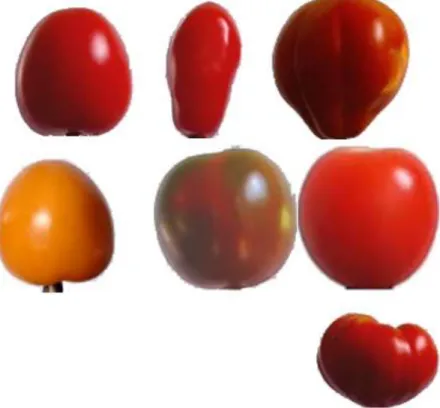
We extracted our dataset from the well-known kaggle dataset, which contains 3,950 images on Tomato; our dataset contains samples for 7 types of Tomato, 7 classes in total as follow[16]:
class (0): Tomato1. class (1): Tomato2. class (2): Tomato3. class (3): Tomato4. class (4): Tomato Yellow. class (5): Tomato Maroon. class (6): Tomato Cherry Red.
The images were resized into 150×150 for faster computations but without compromising the quality of the data.
Figure 1: Dataset Tomato Samples 4-METHODOLOGY
Our model takes raw images as an input, so we used Convolutional Nural Networks (CNNs) to extract features, in result the model would consist from (features extraction), which was the same for full-color approach and gray-scale approach, it consist of 4 Convolutional layers with Relu activation function, each followed by Max Pooling layers.
5-SYSTEM EVALUATION
We used the original tomatoes dataset that consists of 5,266 images after resizing the images to 150x150 pixels. We divided the data into training (70%), validation (30%).
The training accuracy was 99.99% and the validation accuracy was 93%.
6-CONCLUSION
We proposed a solution to help people determine the type of tomatoes for more accurately. We have built a model using deep learning (convolutional neural networks), trained , validated tested it. Furthermore, we used this trained model to predict the type of (previously unseen) images of tomatoes with our network which consists of 4 CNN and 4 Maxpolling layers that accept tomatoes images with 7 different species an input. The testing accuracy was 93%.
REFERENCES
1. Brix, H. 1972. Growth response of Sitka spruce and white spruce seedlings to temperature and light intensity. Can. Dep. Environ., Can. For. Serv., Pacific For. Res. Centre, Victoria BC, Inf. Rep. BC-X-74. 17.
2. Pollard, D.F.W.; Logan, K.T. 1976. Prescription for the aerial environment for a plastic greenhouse nursery. p.181–191 in Proc. 12th Lake States For. Tree Improv. Conf. 1975. USDA, For. Serv., North Central For. Exp. Sta., St. Paul MN, Gen. Tech. Rep. NC-26
3. Brown, K.; Higginbotham, K.O. 1986. Effects of carbon dioxide enrichment and nitrogen supply on growth of boreal tree seedlings. Tree Physiol. 2(1/3):223–232.
4. "Build with AI | DeepAI". DeepAI. Retrieved 2018-10-06. 6. Werbos, P.J. (1975). Beyond Regression: New Tools for Prediction and Analysis in the Behavioral Sciences.
5. Ng, Andrew; Dean, Jeff (2012). "Building Highlevel Features Using Large Scale Unsupervised Learning". arXiv:1112.6209.
6. Max A. Little, Patrick E. McSharry, Eric J. Hunter, Lorraine O. Ramig (2008), 'Suitability of dysphonia measurements for telemonitoring of Parkinson's disease', IEEE Transactions on Biomedical Engineering.
7. T. Giselsson, R. Jørgensen, P. Jensen, M. Dyrmann, and H. Midtiby, A public image database for benchmark of plant seedling classification algorithms, CoRR, abs/1711.05458, 2017.
8. S. Lee, C. Chan, S. Mayo, and P. Remagnino, How deep learning extracts and learns leaf features for plant classification, Pattern Recognition, vol. 71, , 2017.
9. Jeon, Wang-Su, and Sang-Yong Rhee, Plant leaf recognition using a convolution neural network, International Journal of Fuzzy Logic and Intelligent Systems 17, no. 1, pp 26-34. 2017.
10. Y. Sun, Y. Liu, G. Wang, and H. Zhang, Deep learning for plant identification in natural environment, Computational Intelligence and Neuroscience, 2017.
11. A. Milioto, P. Lottes, and C. Stachniss, Real-time semantic segmentation of crop and weed for precision agriculture robots leveraging background knowledge in CNNs, cs.CV, 2018. URL
12. https://towardsdatascience.com/types-of-machine-learning-algorithms-you-shouldknow-953a08248861
13. https://www.sciencedirect.com/topics/computer-science/supervised-learning