PONTIFICIAE ACADEMIAE SCIENTIARVM SCRIPTA VARIA 5 4
STUDY WEEK
on
PATTERN RECOGNITION
MECHANISMS
April 25-29, 1983 EDITED BYCARLOS CHAGAS - RICARDO GATTASS - CHARLES GROSS
EX AEDIBVS ACADEMICIS IN CIVITATE VATICANA —
THE ANALYSIS OF MOVING VISUAL PATTERNS
J. ANTHONY MOVSHON*, EDWARD H. ADELSON**, MARTIN S. GIZZI*
and WILLIAM T. NEWSOME***
INTRODUCTION
There is abundant evidence that the orientation of contours is a feature of considerable importance to the visual system. Both psycho-physical and electrophysiological studies suggest that the retinal image is treated relatively early in the visual process by orientationally-tuned spatial filters (see Hubel and Wiesel, 1962; Campbell and Kulikowski, 1966, among many others). Orientational filtering undoubtedly plays a role in the analysis of the structure of a visual pattern, but the visual system has other tasks, most obviously that of extracting information about the motion of objects. A simple analysis reveals that separating a two-dimensional image into its one-dimensional (that is, oriented) com-ponents presents problems for a system concerned with extracting object motion. Here we outline the problem, propose a novel formal solution to it, and consider the applications of this solution to a variety of per- ceptual and electro-physiological phenomena.
The ambiguity of motion of one-dimensional patterns. The motion
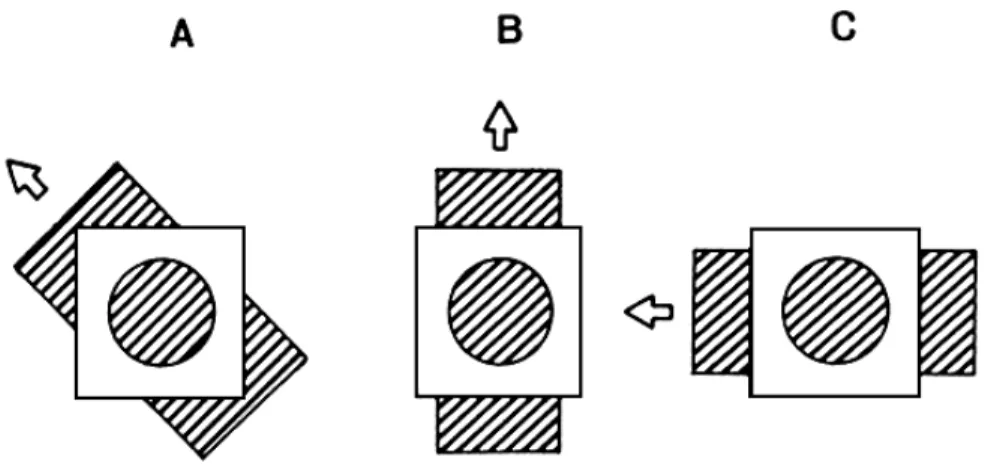
of a single extended contour does not by itself allow one to determine the motion of the surface containing that contour. The problem is illustrat-ed in Fig. 1. The three sections of the figure each show a surface contain-ing an oblique gratcontain-ing in motion behind a circular aperture. In Fig. 1A the surface moves up and to the left; in Fig. 1B it moves up; in Fig. 1C, it
* Department of Psychology, New York University, New York, NY 10003, USA.
** Present address: RCA David Sarnoff Research Laboratories, Princeton, NJ 08540, USA.
*** Laboratory of Sensorimotor Research, National Eye Institute, National Institutes of Health,
Bethesda, MD 20205, USA. Present address: Department of Neurobiology and Behavior, State University
118 PONTIFICIAE ACADEMIAE SCIENTIARVM SCRIPTA VARTA - 54
Fig. 1. Three different motions that produce the same physical stimulus.
moves to the left. Note that in all three cases the appearance of the moving grating, as seen through the window, is identical: the bars appear to move up and to the left, normal to their own orientation, as if produced by the arrangement shown in Fig. 1A. The fact that a single stimulus can have many interpretations derives from the structure of the stimulus rather than from any quirk of the visual system. Any motion parallel to a gra-ting's bars is invisible, and only motion normal to the bars can be detected. Thus, there will always be a family of real motions in two dimensions that can give rise to the same motion of an isolated contour or grating (Wohlgemuth, 1911, Wallach, 1935; Fennema and Thompson, 1979; Marr and Ullman, 1981).
PATTERN RECOGNITION MECHANISMS 119
We must distinguish at the outset between what we term
one-dimensional (1-D) and two-one-dimensional (2-D) patterns. A 1-D pattern is
one like an extended grating, edge, or bar: it is uniform along one axis. In general, such a pattern would have to extend infinitely along its axis to be truly 1-D but for the present purposes it is sufficient that the pattern extend beyond the borders of the receptive field of a neuron being stud-ied, or beyond the edge of a viewing aperture. The essential property is that, when a l-D pattern is moved parallel to its own orientation, its appearance does not change. By convention (and in agreement with its appearance), we will represent the "primary" motion of a 1-D pattern as having the velocity normal to its orientation. 2-D patterns are not invariant with translation along any single axis; they include random dot fields, plaids, and natural scenes. Such patterns change no matter how they are moved, and their motion is not ambiguous in the same way as the motion of a 1-D pattern is.
In this paper we are concerned only with uniform linear motion. For certain other kinds of motion (e.g. rotation or curvilinear motion, or motion in depth), analogous ambiguities exist and can be described and solved in a manner similar to the one we present here (but see also Hildreth, 1983).
The disambiguation of motion. If the motion of a 1-D pattern such
as an edge is ambiguous, how is it possible to determine the motion of an object at all? It turns out that, although a single moving contour cannot offer a unique solution, two moving contours (which belong to the same object) can, as long as they are not parallel. As Fig. 1 shows, there is a family of motions consistent with a given 1-D stimulus. Naturally, this is also true of the 1-D elements of a 2-D stimulus. Consider the diamonds shown in Fig. 2A. The left-hand diamond moves to the right; the right-hand diamond moves down. Note that in both cases, in the local region indicated on each diamond by the small circle, the border moves down-ward and to the right. The moving edge in Fig. 2B, which could represent a magnified view of the circled regions of the diamonds' borders in Fig. 2A, can be generated by any of the motions shown by the arrows. Motion parallel to the edge is not visible, so all motions that have the same com-ponent of motion normal to the edge are possible candidates for the "true" motion giving rise to the observed motion of the edge. We may map this set of possible motions as a locus in "velocity space", as shown in Fig. 2B. Velocities are plotted as vectors in polar coordinates, starting at the origin. The length of the vector corresponds to the speed of the motion, and the
120 PONTIFICIAE ACADEMIE SCIENTIARVM VARIA - 54
Fig. 2. A. Two moving diamonds. The local regions circled on each diamond’s border have identical motions. B. A single moving contour, with the representation of its possible motions in a polar “velocity space”, in which each vector represents a possible direction and speed. C. The solution to the ambiguity of one-dimensional motion based on an intersection of constraints. Each border’s motion establishes a family of possible motions; the single intersection of these two families represents the only possible motion for a single object containing both contours.
PATTERN RECOGNITION MECHANISMS 121
angle corresponds to the direction. As shown in Fig. 2B, the locus of motions consistent with a given l-D stimulus maps to a line in velocity space. The line is perpendicular to the primary vector representing the motion normal to the 1-D pattern.
It now becomes clear how one may unambiguously assign a velocity to a 2-D pattern, given knowledge only of the motion of its 1-D components. Consider, for example, the diamond moving rightward in Fig. 2C. One edge (viewed in isolation) moves up and to the right; the other moves down and to the right. In velocity space the two edges set u p two lines of possible motions. Only a single point in velocity space is consistent with both—namely, the point of their intersection, which corresponds to a pure rightward motion (Fennema and Thompson, 1979; Horn and Schunck, 1981; Adelson and Movshon, 1982).
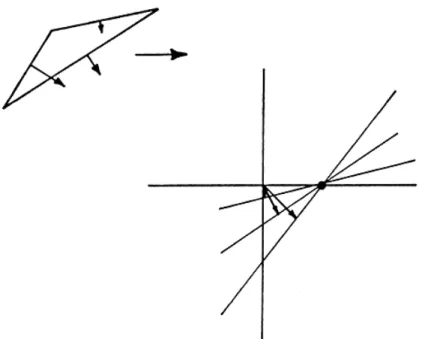
There are, of course, other ways of combining vectors. For example, one might argue that a simple vector sum would do just as well as the more complex "intersection of constraints" just described. Indeed a vector sum happens to give the correct answer for the diamond of Fig. 2C, but this is only by chance. Consider, for example, the triangle of Fig. 3, which moves straight to the right. The velocities normal to the edges all have a downward component. Thus, when they are summed, the resultant itself goes down and to the right, instead of straight to the right. On the other hand, applying the intersecting constraints principle leads to the correct solution of a pure rightward motion, as shown in the lower part of Fig. 3.
The solution to motion ambiguity just described is purely formal, and does not imply a particular model of how the visual system actually establishes the motion of objects. In the case of the triangle, there are a number of strategies, such as tracking the motion of the corners, which would not give ambiguous results. But while alternate solutions exist in particular cases, the ambiguity inherent in 1-D motion remains a constant problem when we try to understand how the visual system analyzes motion. 1-D stimuli such as bars and gratings are among the most important stimuli used in studying motion mechanisms. Moreover, the visual system itself seems to analyze the world via orientation selective neurons or channels, which necessarily discard information along one axis in favor of another. In this chapter, we consider some issues this analysis raises in the perception of motion, and describe a series of psychophysical and physiological experiments that address these questions.
122 PONTIFICIAE ACADEMIAE SCIENTIARVM SCRIPTA VARIA - 54
Fig. 3. An illustration of the inadequacy of vector summation as a solution to motion ambiguity. All three primary motion of the triangle's borders have a downward component but the true motion is directly to the right, as given by the intersection of constraints.
Stimuli
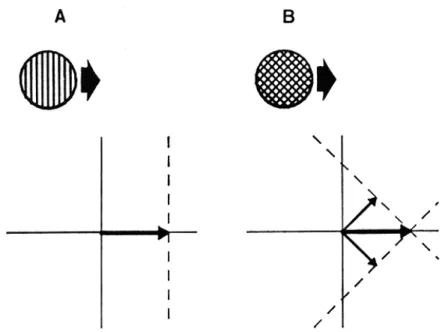
We used two kinds of stimuli in our experiments: sine wave gratings and sine wave plaids. The sine wave grating is our 1-D stimulus, and is therefore mathematically ambiguous in its motion. A moving grating can be diagrammed as occupying a line in velocity space, as shown in Fig. 4A. A pair of sine wave gratings, when crossed, produce the "plaid" pattern of Fig. 4B. In this case, there is no ambiguity about the motion of the whole pattern, since the two families of possible velocities (shown by the dotted lines) intersect at a single point. These stimuli have some advan-tages for experimentation over more conventional patterns like single con-tours and geometric figures. For one thing, all of our stimuli were identical
PATTERN RECOGNITION MECHANISMS 123
Fig. 4. A single grating (A) and a 90 deg plaid (B), and the representation of their motions in velocity space. Both patterns move directly to the right, but have different orientations and 1-D motions. The dashed lines indicate the families of possible motions for each component.
in spatial extent, and uniformly stimulated the entire retinal region they covered. This sidesteps the issue which arises in considering stimuli like the diamond of Fig. 2, of how the identification of spatially separate moving borders with a common object takes place. Moreover, the plaid patterns were the literal physical sum of the grating patterns, which makes superposition models particularly simple to evaluate.
These stimuli were generated by a PDPll computer on the face of a display oscilloscope, using modifications of methods that are well-established (Movshon et al., 1978). Gratings were generated by
modulat-124 PONTIFICIAE ACADEMIAE SCIENTIARVM SCRIPTA VARIA - 54
ing the luminance of a uniform raster (125 frames/sec, 550 lines/frame) with appropriately timed and shaped signals. The orientation of the raster could be changed between frames, permitting the presentation of superimposed moving gratings on alternate frames. Plaid patterns were generated by this interleaving method at the cost of reducing the effective frame rate of each component of the display. The spatial frequency, drift rate, contrast and spatial extent of the test patterns were determined by the computer.
The same computer was responsible for organizing the series of experimental presentations and collecting the data, using methods detailed elsewhere (Movshon et al., 1978; Arditi et al., 1981). In psychophysical studies, subjects' responses were normally yes-no decisions concerning some aspects of the immediately preceding display; in electrophysiologi-cal experiments, the computer collected standard pulses triggered by each action potential and assembled them into conventional averaged response histograms. In both kinds of experiment, all of the stimuli in an ex-perimental series were presented in a randomly shuffled sequence to reduce the effects of response variability.
PSYCHOPHYSICAL STUDIES
When presented with a pair of crossed gratings in motion, the visual system usually chooses the percept of a plaid in coherent motion, rather than the equally consistent percept of two gratings sliding over one another. Informal preliminary observations suggested to us that the likelihood that two gratings would phenomenally cohere was determined by various features of the gratings. We decided to examine the mechan-isms that underlie this percept of coherent motion. We first established the conditions that produce or prohibit coherence, and then used masking and adaptation techniques to test the hypothesis that the mechanisms re-sponsible for coherence represent a later and different stage of motion processing than the mechanisms responsible for the detection of simple moving patterns.
The conditions for coherence
We quickly found that the likelihood that a pair of gratings would cohere depended critically on the similarity between them. The first and most obvious dimension we examined was contrast, and the results of these experiments led to the methodology that we used for subsequent studies
PATTERN RECOGNITION MECHANISMS 125
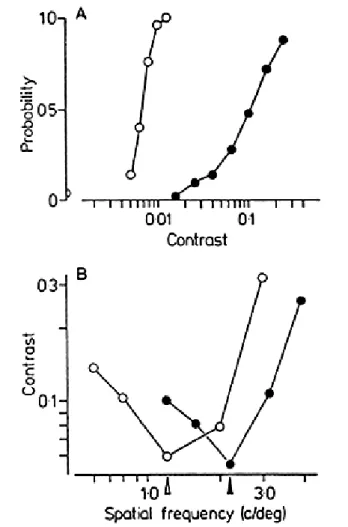
(Adelson and Movshon, 1982). Figure 5A shows the results of an ex-periment on the effect of contrast.
The two gratings were of 1.5 and 2.0 c/deg, and they moved at an angle of 120 deg to one another with a speed of 3 deg/sec. The contrast of the lower-frequency grating was fixed at 0.3, and that of the other was varied from trial to trial. The absolute orientations and directions of the two gratings were varied randomly from trial to trial. We performed two experiments in this situation. In the first (results given by open symbols), we asked the subject to indicate whether the second grating was detectable in the display. For this sequence, 14% of the trials were blank containing only one grating, and the probability that the observer signaled the presence of the second grating in this case was about 0.05 (half-symbol on the ordinate). As the contrast was increased, the probability that the observer detected the grating increased rapidly and monotonically, so that his performance was perfect by a contrast of about 0.008. In the second experimental series (results given by filled symbols), we showed the same family of 120 deg plaids, but now asked the subject to indicate whether the two gratings moved coherently, as a single plaid, or slid incoherently across one another. This judgment is, of course, criterion-dependent, and naive subjects often required several practice sessions before they gave stable data. It was also especially important to maintain stable fixation on the mark at the center of the display, since coherence seems to depend strongly on retinal speed. The data show that as the contrast increased, the likelihood of a coherence judgment also increased. It is clear, how-ever, that there was a considerable range of contrasts (between about 0.01 and 0.07) over which the two gratings were clearly visible, but failed to cohere. As the contrast of the weaker grating was increased (i.e. made closer in contrast to the "standard" grating), the probability of coherence increased. Because of the monotonicity of this kind of data, it is possible to define a "coherence threshold", as the contrast of the weaker grating that produces a 50% probability of coherence. In subsequent experiments, we measured this coherence threshold for various combinations of grat-ings using a staircase technique.
Figure 5B shows the results of two experiments that tested the de-pendence of coherence on the relative spatial frequency of the test grat-ings (Adelson and Movshon, 1982). in these, the spatial frequency of the "standard" grating was set at 1.2 (open arrow and symbols) or 2.2 c/deg (filled arrow and symbols), and the coher-ence threshold measured for a variety of test spatial frequencies. The two gratings were separated in
126 PONTIFICIAE ACADEMIAE SCIENTIARVM SCRIPTA VARIA - 54
Fig. 5. Two experiments on perceptual coherence. A. The effect of contrast on coherence. The two curves show the subject's probability of detecting the second grating (open symbols), and of seeing coherent motion (filled symbols). See text for details. B. The effect of spatial frequency on coherence. The standard grating was of 1.2 (open symbols and arrow) or 2.2 c/deg (filled symbols and arrow), and the data represent the coherence thresholds for a number of gratings of different spatial frequencies. See text for details. From Adelson and Movshon (1982).
direction by 120 deg, and their absolute orientation and direction were again varied randomly from trial to trial. The speed of all test gratings was fixed at 3 deg/sec. It is clear that the relative spatial frequency of the gratings importantly influenced coherence: when the test and standard gratings were of similar spatial frequency, the coherence threshold was
PATTERN RECOGNITION MECHANISMS 127
low, but when they were made more than about a factor of two different, threshold rose sharply. The coherence threshold when the two gratings were of the same spatial frequency was about 0.7 log units higher than the detection threshold.
We performed a variety of experiments conceptually similar to these, investigating the effects of the angle between the gratings, their relative speeds, and also the effects of the absolute speeds and spatial frequencies of the gratings. In general, coherence threshold rises as the angle between the gratings is made larger, as their speeds increase, and as the spatial frequency increases, although this latter effect is rather weaker than the others. Under ideal conditions (identical spatial frequencies, low speeds, and a modest angle), the coherence threshold approaches detection thresh-old so closely as to make the measurements problematic, since coherence is difficult to judge when the observer is not even certain that the second grating is visible.
Models for the perception of coherent pattern motion
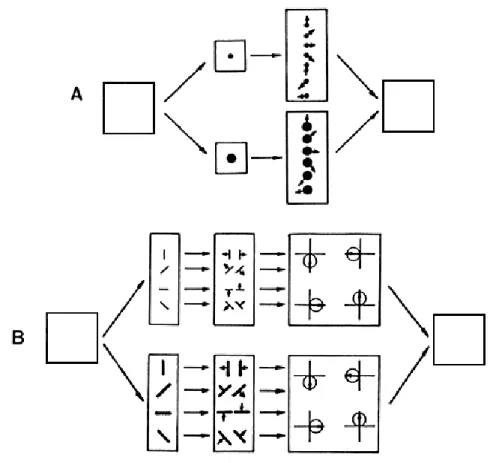
The experiments just described gave us a base from which to con-struct models for various aspects of motion perception. One of the striking features of coherent motion perception is its spatial frequency tuning: two gratings cohere into a moving pattern only if they are of similar spatial frequencies (Fig. 5B). This suggests that the visual system imposes a band-pass spatial filtering on the stimulus before extracting the coherent percept. The filtering could be isotropic—such as the filtering imposed b y mechanisms with circularly symmetric receptive fields (e.g. retinal gang-lion cells). It could also be oriented—such as the filtering imposed b y mechanisms with elongated receptive fields (e.g. cortical simple cells). We consider two models, schematically out-lined in Fig. 6.
Model 1: analyzing motion without orientational filtering. The first
scheme (Fig. 6A) passes the image through a set of non-oriented bandpass channels. The outputs of these stages are sent to a motion analysis system, which might track salient features such as local peaks, or might perform a cross-correlation between successive views (e.g. Reichardt, 1957; van Santen and Sperling, 1983). This analysis must proceed in para-llel in several spatial frequency bands, schematically indicated by the small and large symbols in Fig. 6A. After the determination of motion direction has proceeded within each spatial frequency band, the results are com-bined (in an unspecified way) to give the final motion percept. The results
128 PONTIFICIAE ACADEMIAE SCIENTIARVM SCRIPTA VARIA - 54
Fig. 6. Two models of the mechanisms underlying perceptual coherence. See text for discussion.
shown in Fig. 5B would come about in the following way: when two gratings are of similar spatial frequency, they would both pass the same spatial filter, and so would produce strong local peaks and troughs where their bars crossed. Thus, a feature tracker or a cross-correlator would be able unambiguously to assign a single motion to the whole pattern. If, o n the other hand, the two gratings were of different spatial frequencies, they would not pass the same filter, and so would not produce, in the output of any filter, local peaks and troughs that could be tracked. Indeed, within each frequency band, it would be as though there were only a single grating present, and the familiar problem of motion ambiguity would cause this grating to appear to move normal to its own orientation—the motion extraction stages would operate in their default mode, with only
PATTERN RECOGNITION MECHANISMS 129
l-D patterns to process. Thus, two separate motions would be seen, rather than a single coherent one. This model, incidentally, bears a close resem-blance to one put forward by Marr and Poggio (1979) for stereopsis.
Model 2: analyzing motion after orientational filtering. An alternate
scheme (Fig. 6B) would begin by filtering the image with orientation-selective mechanisms (shown as bars), similar to those commonly associat-ed with cortical neurons or psychophysical channels. The outputs of these mechanisms would then pass to motion analyzers, which would not need to track localizable features, because they only provide information about the motion normal to their own orientation (bars with arrows). As we will see below, motion-sensitive cells in striate cortex behave in this way. But here, of course, arises the problem of motion ambiguity—how does one determine the motion of the pattern as a whole, given the velocities of its oriented components? There are several ways in which this problem can be solved, but they are all formally equivalent to the "intersection of constraints" scheme we outlined at the start of this chapter. This might be implemented in neural terms by combining the signals from several appropriately distributed l-D motion detectors by circuitry similar to a logical "and" or a conjunction detector, requiring the simultaneous activa-tion of several l-D analyzers before the second-stage 2-D analyzers would respond. The combination rule here corresponds to a cosinusoidal rela-tionship between component velocity and direction; since this relarela-tionship maps to a circle in the polar velocity space, we symbolize the second-stage analyzers by these circles. As in model 1, this analysis must take place in parallel in several frequency bands, two of which are symbolized by the small and large symbols in Fig. 6B.
The question of empirical interest is whether the visual system begins with oriented motion channels, and deals with the ambiguity problem later, or begins analyzing motion before orientation in order to avoid the ambiguity problem. Almost all of the psychophysics and physiology available points to the prevalence of oriented filtering at early stages in the visual system, and it would be surprising to find that the task of extracting pattern motion used mechanisms very different from those inferred in other experiments. Yet, on the other hand, it appears that early oriented filtering makes the task needlessly difficult. If the first stage were non-oriented, there should be no problem in finding these local features and using them to infer the pattern's motion.
Affecting coherence with one-dimensional noise. To study the role
130 PONTIFICIAE ACADEMIAE SCIENTIARVM SCRIPTA VARIA - 54
wave plaid stimuli with one-dimensional dynamic random noise, which appears as a rapidly and randomly moving pattern of parallel stripes of various widths. This noise pattern masks the gratings that compose the moving plaid (e.g. Stromeyer and Julesz, 1972). if coherence depends o n the outputs of oriented analyzers, then noise masking should elevate coherence threshold more strongly when the mask is oriented parallel to one of the gratings than when it is oriented differently from either. If, on the other hand, the process involves non-oriented filtering, then the orientation of the noise mask should not matter. Only the noise energy within the frequency band of interest, and not its orientation, should have effects on coherence. Our observations of the effects of one-dimensional noise on the threshold for coherence unambiguously demonstrate an orientation dependence in the masking. If the orientation of the noise pattern is within about 20 deg of the orientation of either component of the plaid, the pattern's coherence is reduced in a manner that seems consistent with the reduction in the apparent contrast of the component
masked by the noise. If, on the other hand, the noise orientation is different from that of the components, even if it is normal to the
direction of pattern motion, little or no effect on coherence is observed. We conclude from these observations that the mechanisms responsible for the phenomenal coherence of moving plaids belong to a pathway which, at some point, passes through a stage of orientation selective spatial analysis.
The effects of adaptation on coherence
As we have seen, the apparent direction of a pattern's motion can be quite different from the motions of the components that comprise it. We suggested earlier that pattern motion might be extracted in two distinct stages. The first stage is presumably revealed by the many orientationally-selective effects seen in experiments on the detection of moving gratings (e.g. Sekuler et al., 1968; Sharpe and Tolhurst, 1973). The second stage, involving further analysis of complex 2-D motions, reveals itself in our experiments on the coherence of plaids. If these stages are really distinct, it might be possible to affect them differentially in adaptation experi-ments. That is to say, it should be component motion, rather than pattern motion, that elevates detection threshold, whereas it should be pattern motion, rather than component motion, that affects coherence phenomena. We have presented some preliminary data suggesting that this is the case (Adelson and Movshon, 1981).
PATTERN RECOGNITION MECHANISMS 131
It is well established that adapting to a moving grating elevates threshold for the detection of a similar grating moving in the same direc-tion (Sekuler and Ganz, 1963). This adaptadirec-tion is both direcdirec-tion and orientation selective: an oblique drifting grating has little or no effect o n the threshold of a vertical grating (Sharpe and Tolhurst, 1973). Suppose now that we combine two oblique gratings into a plaid, so that the plaid appears to move directly to the right. Suppose further that the oblique gratings have been chosen so that they cause no threshold elevation of a vertical grating (moving rightward), when presented alone. If adaptation is caused by the motion of the components, then threshold for the vertical grating should remain unchanged. If adaptation is caused by the coherent motion of the pattern as a whole, then threshold should be elevated, since the plaid adapting pattern, like the test grating, moves directly rightward. Similarly, the effect on the detection of a rightward moving plaid of adaptation to a vertical, rightward moving grating may be assessed.
Figure 7 shows threshold elevation data for four different test-adapt combinations of this sort. All the stimuli in the experiment moved directly to the right at a constant speed of 1.5 deg/sec. Two kinds of stimuli were employed: single vertical gratings (spatial frequency 3 c/deg), and 120 deg plaids whose component gratings (oriented plus and minus 60 deg from vertical) had a spatial frequency of 3 c/deg. Thus all stimuli were identical in direction and speed of movement, but the orientational com-ponents of the plaids and gratings differed by 60 deg. We examined the elevation of contrast threshold for each kind of test stimulus following adaptation by each kind of adapting stimulus; the adapting stimuli were all of high contrast (0.5), and thresholds were measured by the method of adjustment. We tested for threshold elevation both in the adapted and unadapted directions. Inspection of Fig. 7 reveals that the results of these experiments conformed closely to the expectations of a model involving orientation selectivity. The detection threshold for a plaid or grating pattern could be strongly elevated in a directionally-selective man-ner following adaptation to a similar pattern, but was only slightly changed after adaptation to a different pattern. This result is in line with the ample evidence in the literature concerning the orientation and direction selectivity of the threshold elevation aftereffect (Blakemore and Campbel1, 1969; Blakemore and Nachmias, 1971; Sharpe and Tolhurst, 1973), and suggests that the 2-D motion of patterns is not encoded at the level of visu-al processing where these effects are expressed. There is some reason to suppose that threshold elevation effects of this kind are mediated by
132 PONTIFICIAE ACADEMIAE SCIENTIARVM SCRIPTA VARIA - 54
Fig.7. The effects of adaptation to moving gratings and plaids on the detectability of gratings and plaids. Contrast threshold elevation is the ratio of adapted to unadapted contrast threshold, expressed in log units. The two bars of each histogram represent the effects on test stimuli moving in the adapted and unadapted direction, as indicated by the arrows. The data shown are the means of values obtained for three observers; the standard error of the mean was about 0.025 log units.
neurons in the primary visual cortex (e.g. Maffei et al., 1973; Vautin and Berkley, 1977; Movshon and Lennie, 1979).
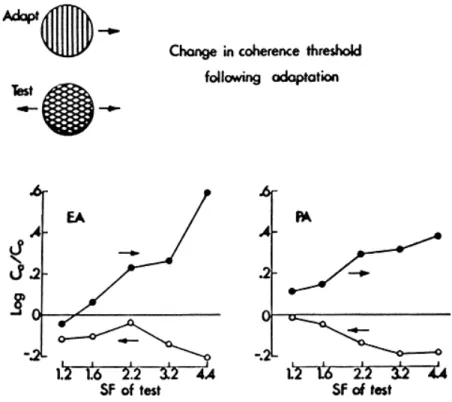
Adaptation also alters the perception of coherent motion (Wallach, 1976; Adelson and Movshon, 1981). The most interesting case here is one of those used in the threshold elevation experiments described above, in which the adapting stimulus is a rightward moving grating, and the test stimulus a rightward moving plaid. The data in Fig. 7 show that this condition produces no important change in the detectability of the plaid, yet our results show profound effects upon its coherence. We measured this effect by determining coherence thresholds in the manner described earlier above, following adaptation to a high-contrast vertical grating moving to the right. The test plaids had a 120 deg angle, and we varied the spatial frequency of the plaid's component gratings so that either the spatial frequency of the components or the spatial period of the plaid matched the adapting grating. As may be seen from Fig. 8, this paradigm
PATTERN RECOGNITION MECHANISMS 133
Fig. 8. The effect of grating adaptation on the coherence threshold for plaids. The adapting grating was constant, and coherence was tested for plaids of several spatial frequencies moving in the adapted (filled symbols) and unadapted directions (open symbols). Threshold elevation is the ratio of adapted and unadapted coherence thresholds, expressed in log units. The standard error of the mean was about 0.05 log units.
produced very large elevation of coherence thresholds for patterns that moved in the adapted direction; this effect was most marked for test plaids of relatively high spatial frequency. Conversely, the threshold for coher-ence of plaids moving in the opposite direction was, if anything, reduced following adaptation.
Evaluation of psychophysical models
The results of these two adaptation experiments suggest the existence of two different sites at which the adapting effect of a moving pattern may be expressed. At the first level, presumed to mediate the detection of moving patterns in our conditions, it is the similarity of 1-D motions
134 PONTIFICIAE ACADEMIAE SCIENTIARVM SCRIPTA VARIA - 54
that determines the effectiveness of adaptation. At the second level, re-sponsible for the coherence of moving plaids, it is the similarity of 2-D motions that is critical. Combined with the evidence from masking ex-periments, this suggests that our psychophysical model 2, with an initial oriented stage followed by an analysis of 2-D motion, is an appropriate framework within which our data on the perception of moving patterns may be understood. Some issues concerning this model do, however, deserve some further consideration.
The first issue concerns the sequential link between stages 1 and 2 of the model. While our results demonstrate with reasonable clarity that there are two separate systems involved in motion analysis, they do not demonstrate a serial link between the two processes. Some aspects of the results do, however, suggest such a link. For one thing, the effects of one-dimensional noise masks on coherence appear to be related to the effect of the noise on the perceived contrast of the component gratings. That is, the change in coherence seen under masked conditions appears similar to that which would be produced by simply reducing the contrast of the masked grating by a modest amount. If we suppose that the effects of noise on perceived contrast represent a stage 1 effect, this result tends to suggest that the contrast signals from stage 1 feed into stage 2. Similar evidence can be obtained in adaptation experi-ments, by examining the effect on coherence threshold of adapting to one or another component of the test plaid. Such adaptation reduces the apparent contrast of a single test grating (Blakemore et al, 1973), and causes a small change in coherence threshold that is of roughly the expected magnitude for one due to a change in the effective contrast of one of the plaid components. Thus while we cannot rule out the possibility that we may be studying the effects of two parallel stages, we continue to favor a serial scheme like that of model 2.
Implicit in this serial scheme is that the signals determining the percepts we have studied arise wholly from elements in the model's second stage. The percepts of coherent and incoherent motion are mutually exclusive — when one grating is "captured" by another, it becomes impossible to see the separate motions of the component gratings. In this, the coherence phenomenon resembles such other multistable visual stimuli as the Necker cube and Attneave's triangles (see Kaufman, 1975). It there-fore follows that signals related to the "component" stage of processing d o not influence the perception of motion when coherence is seen.
PATTERN RECOGNITION MECHANISMS 135
tion is available, our model must explain how it is that signals related to the component motions are ignored when coherence is seen. After all, a single grating is an effective stimulus for both component- and pattern-level analyzers. It seems that we must postulate that the responses of analyzers at the second level to component motion are actively suppressed when coherent motion is seen. Interestingly, we will show electrophysio-logical data in a later section that reveals precisely this sort of behavior. We may then outline the events that occur in each stage of the model as we alter a parameter (contrast, for example) that influences coherence. When the contrast of one of the two gratings of a plaid is low, signals in the second-stage analyzer sensitive to the pattern direction are weak, while those in an analyzer sensitive to the direction of the components are more prominent. As the weaker component increases in contrast, we suppose that the second-stage analyzers sensitive to the component motions are suppressed, while those sensitive to the pattern motion are activated. Mutual inhibition among these detectors could achieve this result, and assure the mutual exclusivity of the two percepts; this is, of course, only one of several ways in which this might be achieved, so we do not make it a specific feature of our model.
In summary, we believe that our psychophysical studies reveal the existence of two motion-analyzing processes, probably serially linked, having "component-analyzing" and "pattern-analyzing" properties. We now proceed to examine some electrophysiological evidence that suggests the existence of two analogous stages of processing of motion information in the visual cortex.
ELECTROPHYSIOLOGICAL STUDIES
Our electrophysiological studies concerned the motion-analyzing properties of single neurons in the visual cortex of cats and macaque mon-keys. It is well-known that neurons both in and outside the primary cortex (Vl, area 17) are selective for the direction and speed of motion of visual stimuli (e.g. Hubel and Wiesel, 1962, 1965, 1968; Pettigrew, Nikara and Bishop, 1968; Zeki, 1974; Movshon, 1975; Spear and Baumann, 1975; Hammond, 1978). A distinction emerges from our analysis that had not been carefully studied between what we term "component" and "pattern" direction selectivity. As we have discussed, one may consider the motion of an object in two ways: as the motion of the various l-D components of
136 PONTIFICIAE ACADEMIAE SCIENTIARVM SCRIPTA VARIA - 54
the object, or as the motion of the object as a whole. Now, cortical orien-tation selectivity is typically conceived as part of a process by which cortical neurons break up an image into 1-D constituents. It is natural to ask whether motion signals are similarly parsed, especially since it is from the ambiguities inherent in the motion of isolated 1-D features that our ideas arise . Our results suggest that striate cortical neurons in cats and monkeys are selective only for 1-D motion, and cannot distinguish 2-D motion. We have, however, encountered neurons that appear to be sensitive to 2-D motion in MT, an extrastriate area of the monkey's visual cortex.
Pattern and component directional selectivity
In the course of our experiments on directional processing we have developed definitions and a simple test that allows us to distinguish two types of direction selectivity. We have applied this to the responses of neurons in Vl of both cat and macaque (Movshon, Davis and Adelson, 1980), to neurons in the lateral suprasylvian visual cortex (LS) and superior colliculus of the cat (Gizzi et al., 1981; Gizzi, 1983), and to neurons in MT of the macaque (Gizzi et al., 1983). Component
direction-al selectivity corresponds to what previous workers would have termed
orientation selectivity with directional selectivity. Neurons showing com-ponent direction selectivity respond to the direction of motion of single oriented (1-D) contours presented in isolation, and to the direction of motion of those contours when they form part of a more complex 2-D pattern. Pattern direction selectivity corresponds to what previous workers have termed "pure" direction selectivity. Neurons showing pattern direc-tion selectivity, like component neurons, respond to the direcdirec-tion of motion of isolated 1-D contours. When those contours are embedded in a more complex 2-D pattern, however, these neurons respond not to the motion of the contours, but to the motion of the pattern as a whole.
These two kinds of direction selectivity have been of concern for some time in visual electrophysiology, but no satisfactory test has been devised to distinguish them. Previous approaches have relied on two tests designed to establish orientation selectivity; if these tests fail, the neuron is—by default—considered to be "pure" or (in our terms) pattern direc-tion selective (Barlow and Pettigrew, 1971; Zeki, 1974; Spear and Bau-mann, 1975) First, neurons have been considered orientation selective when they respond to stationary flashed line or grating stimuli in an orien-tation selective manner. Second, they have been considered orienorien-tation
PATTERN RECOGNITION MECHANISMS 137
selective if their specificity for the direction of motion of a line is more refined than their selectivity for the direction of motion of a spot (Henry
et al., 1974). The first of these tests seems to us unimpeachable; its
problem lies in the fact that many of the neurons of interest respond poorly to any stationary stimuli. It can also give misleading results if the stimulus is improperly placed in the receptive field. The second test is unreliable for two reasons. Since small spots and random textures contain energy at all orientations, the presence of strong inhibition in the orienta-tion domain (e.g. Blakemore and Tobin, 1972; Nelson and Frost, 1978) can have the effect of making direction selectivity for spots or texture fields as tight as, or tighter than for bars, even in an orientation selective neuron. Moreover, the test specifies no reasonable decision rule—how much difference between the two curves is tolerable before the test fails? And both tests suffer from the problem that they are negative tests when applied to pattern direction selectivity: when a neuron fails to show some property it is pattern direction selective, and no positive attribute is as-sociated with this classification.
Our test to distinguish between the two types of direction selectivity relies on the difference in response between moving grating and plaid stimuli. It does not require that the neuron respond to stationary pat- terns, and it has the further advantage that the stimuli to be compared are identical in spatial extent and physical contrast. It is not applicable to neurons that fail to respond to gratings, but we have found very few neurons in cat or monkey V1, in the cat's lateral suprasylvian visual cortex, or in macaque MT, which will not respond reliably to gratings confined to the central activating region of the receptive field.
Response predictors. Figure 9 illustrates the response of a
hypo-thetical direction selective neuron. In each plot the direction of motion of the stimulus is given by the angle, and the response of the cell to that direction is given by the distance of the point from the origin. The left-hand plot reveals that this "neuron" responded best to gratings moving directly rightward and did not respond to leftward motion. The direction tuning curve for a single grating therefore has a single peak correspond-ing to the best direction of motion. When one component of a 90 degree plaid (one whose components are oriented at 90 degrees to one another) is within the direction bandwidth of the neuron, the other component will be outside the acceptable range. If the neuron is component direction selective, the predicted direction tuning curve to a plaid then, is the sum of the responses to the two components presented separately. Before the
138 PONTIFICIAE ACADEMIAE SCIENTIARVM SCRIPTA VARIA - 54
Fig. 9 Hypothetical data illustrating component and pattern directional selectivity See text for details.
responses are added, however, any spontaneous firing rate (here zero) is subtracted from each. After the two responses are added, the spontaneous rate is added back in. In the right-hand plot, responses are plotted as a function of the direction of motion of a plaid. When the plaid is moving in the optimal direction (as determined with a single grating), the com-ponents will be oriented 45 degrees to either side of the optimum (see Fig. 4). Thus the response peaks are also shifted to either side by 4 5 degrees, and the predicted tuning curve for the plaid is a bi-lobed curve whose peaks straddle the single peak derived from the single grating experiment. This prediction is shown by solid lines in the right-hand plot. The prediction for pattern direction selectivity is even simpler: the neuron's tuning curves for the two stimuli should be similar since their directions of motion are the same. The predicted tuning curve is thus simply the curve derived from the single grating experiment, and is shown by dashed lines in the right-hand plot.
The basis of this test is to dissociate the oriented components of a pattern from the direction in which they move: a single grating always moves at right angles to its orientation, but the plaids move at a different angle to their oriented components (+5 deg in the case shown in Fig. 9). The two predictions for the different types of direction selectivity are radically different and one may simply see whether the neuron's response depends on the overall direction of motion, or on the orientation of the
PATTERN RECOGNITION MECHANISMS 139
moving components. To compare the goodness of fit of the component and pattern predictions, the actual response was correlated with each of the predictions. Since the two predictions are not necessarily uncorrelated themselves, a comparison of the simple correlations might be misleading. In order to make the two predictions independent, we used a partial cor-relation of the form:
Rp = (rp - rcrpc) / [(1—rp)(1—rc)]
1/2
where Rp is the partial correlation for the pattern prediction, rc is the
cor-relation of the data with the component prediction, rp is the correlation
of the data with the pattern prediction, and r[c is the correlation of the
two predictions. A similar partial correlation for the component predic-tion was calculated by exchanging rc and rp. These two correlation values
may be used to assign each neuron to a "pattern" or "component" class, or to some intermediate grouping.
At this point the close similarity between linearity of spatial filtering and component direction selectivity should be evident. A neuron that behaves as a linear spatial filter and that possesses orientation selectivity must, in our terms, be component direction selective; our analysis of component direction selectivity here is thus similar to that used b y De Valois et al. (1979) in their studies of the responses of striate neurons to gratings and checkerboards. Pattern directional selectivity would, how-ever, involve important nonlin-earities.
Directional selectivity in visual cortical neurons
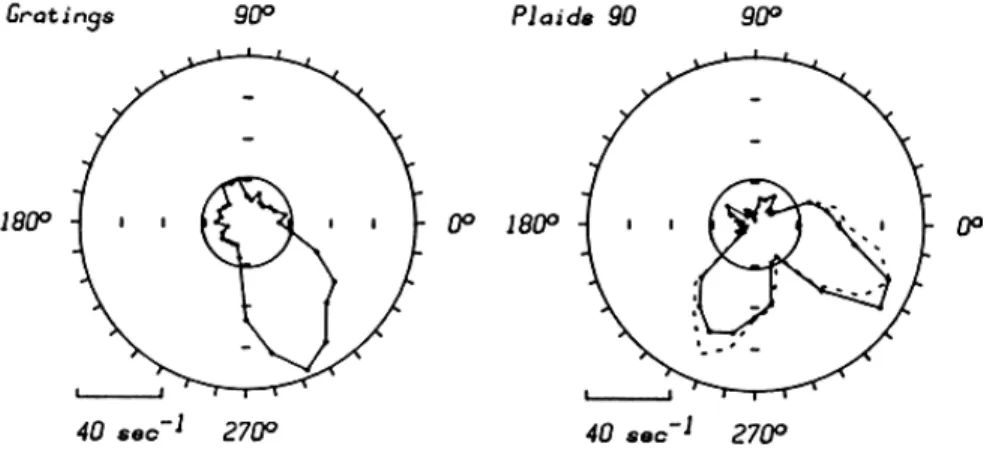
Figure 10 shows typical responses of a component direction selective neuron, in this case a neuron of the "special complex" type (Gilbert, 1977) recorded from area 17 of a cat. The left-hand polar diagram shows the neuron's response to single grating stimuli as a function of direction of motion; the inner circle represents the spontaneous firing level in the absence of a stimulus. The neuron had a marked preference for gratings moving downward and slightly to the right. On the right, the filled sym-bols show the neuron's response to 90 deg plaids. Two preferred directions are evident, symmetrically displaced by 45 deg from the directional opti-mal for single gratings. Note that the neuron did not give any response to a plaid that moved downward and to the right, in the direction optimal for single gratings. The dashed lines in the right-hand plot show the com-ponent direction selective prediction for the neuron's response, and it is
140 PONTIFICIAE ACADEMIAE SCIENTIARVM SCRIPTA VARIA - 54
Fig. 10. Directional selectivity of a special complex cell recorded in area 17 of a cat. The spatial frequency was 12 c/deg, and the drift rate was 4 Hz. On the left is shown the neuron’s tuning for the direction of motion of single gratings, and on the right is shown the neuron’s response to moving 90 deg plaids The dashed curve on the right shows the expected response of a component direction selective neuron. The inner circles in each plot show the neuron’s maintained discharge level. For this cell the component correlation was 0.976, and the pattern correlation was -0.076 (n = 32).
evident that this describes the data very well. In this case, the component correlation value was 0.976 (n = 32), and the pattern correlation value was -0.076. Behavior of this sort was typical of all neurons we studied in area 17 of the cat and in the primary visual cortex of the monkey; this behavior is similar to that observed by De Valois et al (1979) in macaque striate neurons. Cells of the simple type were often sensitive to the relative phase of the two gratings, and variations in phase tended to make one or the other peak enlarge or disappear. No manipulation of phase, however, ever produced pattern direction selective behavior in these neurons.
It is well known that contours of non-optimal orientation may have an inhibitory influence on cortical neurons (Blakemore and Tobin, 1972; Nelson and Frost, 1978). An inhibitory influence of this sort is evident in the single-grating tuning data on the left in Fig. 10, but is visible only because of the relatively high maintained discharge shown by this cell (about 21 impulses/sec). Most cortical neurons have much less spon-taneous discharge, and consequently reveal inhibitory influences incom-pletely; it is therefore not surprising that the magnitude of the responses we observed to plaids tended to be somewhat less than those predicted
PATTERN RECOGNITION MECHANISMS 141
from simple superposition. The magnitude of the inhibitory effect varied widely, but on average the response to plaids was between 25% and 40% less than predicted. This inhibition was what originally motivated us to use the correlation measure described earlier, since this is insensitive to devia-tions in response magnitude from the predicdevia-tions.
We have also studied the behavior of a number of neurons in the lateral suprasylvian cortex of the cat, an area thought to be involved in processing motion information in that species (Spear and Baumann, 1975; Gizzi et al., 1981). Almost all neurons in LS, like those in V1, showed clear component direction selectivity, and none gave a convincingly pat-tern direction selective response.
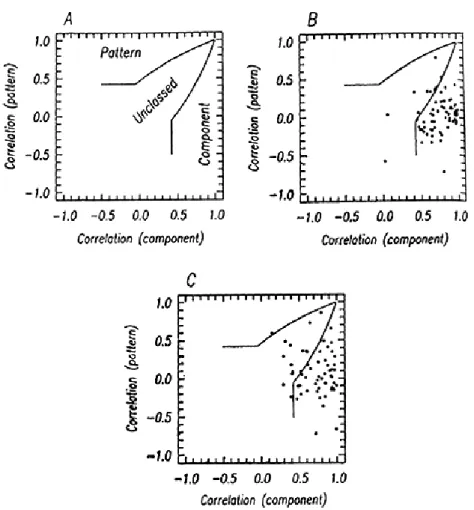
In order to examine the distribution of behavior of neurons in dif-ferent areas, we prepared scatter diagrams in which the values of the pattern and component correlation coefficients were plotted against one another. Figure llA illustrates the significance of various regions of these plots. The region marked "component" is a zone in which the component correlation coefficient significantly exceeds either zero or the pattern correlation coefficient, whichever is larger. The region marked "pattern" similarly marks neurons that were unambiguously pattern direc-tion selective. The region marked "unclassed" represents cases in which both the pattern and component correlations significantly exceeded zero, but did not differ significantly from one another, or cases in which neither correlation coefficient differed significantly from zero.
Figure llB shows a scatter plot of data in this space for 69 neurons recorded from cat and monkey V1. It is clear that these cluster around a component correlation value of 1 and a pattern correlation value of zero. While a few neurons lie in the two indeterminate regions of the plot, n o clearly pattern direction selective cases exist. Figure llC shows a similar plot for data from 61 cells recorded in the cat's LS cortex. Here the data are slightly more scattered, but the result is again unambiguous: most neurons lie in the component zone, and only one is (barely) within the pattern zone. It thus appears that neurons in these areas are capable of signaling only the motion of 1-D components, and cannot unambigu-ously define the motion of whole patterns. Our search for pattern direction selective neurons then turned to MT, an extrastriate area in the macaque's cortex thought to be involved in analyzing motion information.
MT is the natural place to study motion sensitivity in primates. In
macaque, MT is a heavily myelinated area on the posterior bank of the superior temporal sulcus. It is one of three cortical areas to receive a
142 PONTIFICIAE ACADEMIAE SCIENTIARVM SCRIPTA VARIA - 54
Fig. 11. Scatter diagrams of the directional selectivity of neurons in the visual cortex. A. The space within which the data lie )see text for details). B. Diagram of the behavior of 69 cells from area 17 of cats and monkeys. C. Diagram of the behavior of 61 cells from the lateral suprasylvian visual cortex of cats (Gizzi et al., 1981.)
PATTERN RECOGNITION MECHANISMS 143
major projection from striate cortex, the others being V2 and V3 (Zeki, 1978a; Maunsell and Van Essen, 1983). The physiological properties of neurons in macaque MT were first described by Dubuer and Zeki (1971; Zeki, 1974), who reported that the area contained a high proportion of directionally selective neurons. This observation is in marked contrast to the very low frequency of directional selectivity in V2 and V3 (Zeki, 1978b). This area was renamed MT by Van Essen (1979) because of its clear homology with the middle temporal area in the owl monkey (Allman and Kaas, 1971; Zeki, 1980; Baker et al., 1981). The areas receive similar projections and contain neurons with similar receptive field properties. Van Essen et al. (1981) reported that some cells in macaque MT showed orientation selectivity when tested with stationary stimuli, as has been reported for the majority of cells in owl monkey MT (Baker et al., 1981). Nevertheless, as orientation selectivity distinguishes Vl, so direction
selectivity distinguishes MT. It is not certain whether this reflects the selectivity of that afferent input or whether direction selectivity is a result of the processing within MT. Only about a quarter of the neurons in macaque Vl are directionally selective (Hubel and Wiesel, 1968; De Valois et al., 1982); in V2, the proportion may be even lower (Baizer et al., 1977; Zeki, 1978b). These areas provide the major intra-cortical input to MT. On the other hand Dow (1974) reported that many neurons in layer IVb of V1 are directionally selective — the projection from striate cortex to MT arises from this layer and layer VI (Lund et al., 1976; Maunsell and Van Essen, 1983). There is also input (which may be directionally selective) to MT from the inferior pulvinar (Trolanowski and Jacobsen, 1976; Benevento and Rezak, 1976).
Figure 12 shows data, in a format similar to that used in Fig. 10, for two neurons recorded from MT. The neuron in Fig. 12A preferred upward movement of single gratings; like its component direction selective counterpart in V1 (Fig 10), this preference was translated into a dual preference for two directions 45 deg apart when it was tested with 9 0 deg plaids. As comparison of the data with the dashed lines in the right-hand plot of Fig. 12A reveals, the component direction selective prediction provided a very good description of this behavior. About 40% of the cells we studied in MT were clearly component direction selective. Figure 12B shows data from a neuron in MT whose behavior was rather different. This neuron preferred downward and rightward movement of grating stimuli, and maintained this preference when tested with 135 deg plaids. The actual response to plaids differed very dramatically from the
com-144 PONTIFICIAE ACADEMIAE SCIENTIARVM SCRIPTA VARIA - 54
Fig. 12. Directional selectivity of two neurons from MT. The format for each figure is the same as in Fig. 10. A. Spatial frequency 3.6 c/deg, drift rate 4 Hz, component correlation 0.991, pattern correlation — 0.092 (n = 16). B. Spatial frequency 2.7 c/deg, drift rate 4 Hz, component correlation 0.349, pattern correlation 0.940 (D = 16).
PATTERN RECOGNITION MECHANISMS 145
ponent direction selective prediction. About 25% of the neurons we studied in MT behaved in this way. This apparently simple behavior must involve some remarkable neural circuitry. Consider that the most effective plaid stimulus was composed of two gratings which, in isolation, had directions 67.5 deg different from the optimum; neither direction alone elicited a significant response. Thus the most effective plaid pattern was composed of two gratings which were by themselves ineffective; conversely, when the most effective grating stimulus was combined with another to form a plaid, the response was poor. These features of the tuning characteristics suggest that a combination of suppressive and facilitatory processes must be involved in the generation of pattern direction selectivity. We have some evidence from further experiments that this is the case, and that some neural operation similar to the "intersection of constraints" that we described in the introduction is in fact performed by pattern direction selective neurons in MT.
Figure 13 shows a scatter diagram of the directional behavior of 108 neurons from MT, in the format laid out in Fig. llA. The data here were derived from experiments using 135 deg plaids. Most neurons in MT are rather more broadly tuned for direction than their counterparts in
Fig. 13. A scatter diagram of the directional selectivity of 108 neurons in MT, tested with 135 deg plaids. The format is the same as in Fig. 11.
146 PONTIFICIAE ACADEMIAE SCIENTIARVM SCRIPTA VARIA - 54
Vl, and in consequence the distinction between the component and pat-tern predictions cannot often be made very clearly with 90 deg plaids. In contrast to the data from V1 and from cat LS shown in Fig. 11, the distribution of values for MT cells shown here is very broad. About 25% of the cells fall into the pattern category, and 40% into the com-ponent category. The significant population of cells that falls in the "un-classed" region deserves comment. Most of these (about 30% of the total) are in the upper right corner of the plot, where both correlation coefficients are different from zero, but do not differ from each other. These cells generally had very broad tuning curves, so that even using 135 deg plaids the variability of the response made statistical distinction between the accuracy of the two predictions difficult. It would thus be a mistake to conclude that these cells were of some "intermediate" type. Rather, the particular standard test conditions and statistics used were insufficiently sensitive to classify them. The remainder of the unclassed cells (about 10% of the total) gave plaid responses that did not correlate well with either prediction. In most of these cases, the response to single gratings was rather weak and variable, resulting in an unsatisfactory pair of predicted tuning curves; in a number of these cases, the response to plaids was brisk and reliable.
The continuity of the distribution in Fig. 13 does not immediately suggest the existence of two discrete cell classes in MT. We do, however, have some evidence that the laminar distribution of the component and pattern cells may differ, with the pattern cells primarily encountered in layers II, III and V, and the component cells more often being in layers IV and VI; thus two genuine classes of cell may exist in MT. Regardless of the resolution of this issue, it is clear that information about both types of motion is available in the signals relayed by neurons in MT, including the pattern direction selective type that we have not encountered else-where.
DISCUSSION
Our psychophysical studies revealed the existence of two stages in the processing of motion information in the human visual system. The first stage appears to analyze the motion of 1-D patterns, and to be re-sponsible for the detection of simple moving patterns. The second stage seems to be concerned with establishing the motion of complex patterns
PATTERN RECOGNITION MECHANISMS 147
on the basis of information relayed from the first stage. In our experi-ments, the action of this stage is most clearly seen in the various coherence phenomena that we have described. These two stages of analysis appear to have natural analogs in our electrophysiological results. The properties of component direction selective neurons in Vl and MT seem to cor-respond to the first stage, while the pattern direction selective neurons in MT seem to correspond to the second stage.
This parallel between psychophysical and electrophysiological data is gratifying, but it is important to examine in a little more detail the basis for the parallels we draw. Our arguments in both the psychophysical and electrophysiological domain rest on evidence concerning the way in which neural mechanisms represent information. Our knowledge of this re-presentation derives from an examination of tuning characteristics, esta-blished with stimuli designed to reveal particular properties of the system we studied. One may ask whether it is legitimate to conclude that the two putative stages genuinely differ simply because their tuning characteristics differ. This issue has been a disputatious one in electrophysiology in recent years, largely as a result of a debate concerning the kinds of signals relayed by striate cortical neurons. On the one hand, traditional descrip-tions of striate neurons (e.g. Hubel and Wiesel, 1962) have emphasized their sensitivity to contours such as lines and edges, and given rise to the idea that these neurons function as edge-detectors. More recent studies (e.g. Maffei and Fiorentini, 1973; De Valois et al., 1979) have characteriz-ed striate neuron responses using sinusoidal gratings, and emphasizcharacteriz-ed their sensitivity to the spatial frequency of these patterns. With the exception of some specific nonlinear models (e.g. Marr, 1982), this debate has cen-tered around matters of interpreta-tion rather than of testable fact. Most available data suggests that striate cortical neurons function as approxi-mately linear spatial filters, and that their responses to aperiodic patterns and to sinusoidal gratings can be simply related to one another (e.g. Movshon et al., 1978). Thus the various ways in which striate neurons have been described are probably formally identical, producing an argu-ment about semantics rather than substance.
Our results and claims differ from these in an important respect. Our notion of pattern direction selectivity involves specific nonlinear pro-perties in computing the "intersection of constraints"; the results we have obtained from pattern direction selective neurons in MT are incompatible with a linear model. Now, given the specific nonlinearity present in these neurons, it is natural to argue that they are different in an important way
148 PONTIFICIAE ACADEMIAE SCIENTIARVM SCRIPTA VARIA - 54
from neurons in the other cortical areas we have studied, whose direction-al selectivity may be more simply understood. There is direction-also the matter of motion ambiguity with which we began this paper. Our results on striate neurons demonstrate that they provide ambiguous signals about the motion of complex objects. This ambiguity may be resolved by a specific kind of neural computation, and our results from MT show that this computation may be performed there. Thus the signals from pattern direction selective neurons contain an important kind of information not available from the output of any single striate neuron. It is this particular synthesis of information relayed from V1 to MT to which we attribute the greatest significance.
Thus we may plausibly argue from the way in which information is represented in V1 and MT neurons that the two stages of motion process-ing are present. We cannot, of course, prove that assertion merely with psychophysical or electrophysiological data, for these only allow the development of reasonable hypotheses. Proof of these must await combin-ed psychophysical and electrophysiological study of the consequences of inactivating MT for the perception of moving visual patterns.
ACKNOWLEDGMENTS
This work was supported by grants to J.A. Movshon from the National Institutes of Health (EY 2017) and the National Science Foundation (BNS 82-16950)- E.H. Adelson was partly supported by a training grant from NIH (EY 7032) to New York University, and M.S. Gizzi was supported by a grant from the New York State Health Research Council. We thank Harriet Friedman for assistance with histology, and Aries Arditi and Robert Schumer for helpful discussions.
PATTERN RECOGNITION MECHANISMS 149
REFERENCES
ADELSON E.H and MOVSHON J A., Two kinds of adaptation to moving patterns. << Invest. Ophthalmol. Vis. Sci. >>, supp. 20, 17 (1981).
— Phenomenal coherence of moving visual patterns. << Nature >>, 200, 523-525 (1982). ARDITI A.R, ANDERSON P.A. and MOVSHON J A., Monocular and binocular detec-tion of
moving sinusoidal gratings. << Vision Res. >>, 21, 329-336 (1981).
ALLMAN J. and KAAS J.H, A representation of the visual field in the caudal third of the
middle ttemporal gyrus of the owl monkey (Aotus trivergatus). << Brain Res. >>, 31,
85-105 (1971).
BAIZER J.S., ROBINSON D.L. and DOW B.M., Visual responses of area 18 neurons i n
awake, behaving monkey. << J. Neurophysiol. >>, 40, 1024-1037 (1977).
BAKER J., PETERSON S., NEWSOME W.T. and ALLMAN J., Visual response properties o f
neurons in four extrastriate areas of the owl monkey (Aotus trivergatus): A quantitatiue comparison of tbe medial (M), dorsomedial (DM), dorsolateral (DL) and middle temporal (MT) areas. << J. Neurophysiol. >>, 45, 397-416 (1981).
BARLOW H.B. and PETTIGREW J.D., Lack of specificity of neurons in the visual cortex o f
young kittens. << J. Physiol., Lond. >>, 218, 98-100 (1971).
BENEVENTO L.A. and REZAK M., The cortical projections of the inferior pulvinar and
adjacent lateral pulvinar in the rhesus monkey (Macaca mulatta): An autoradiographic study. << Brain Res. >>, 108, 1-24 (1976).
BLAKEMORE C. and CAMPBELL F.W., On tbe existence of neurones in the human visual
system selectively sensitive to the orientation and size of retinal images. << J .
Physiol., Lond. >>, 203, 237-260 (1969).
BLAKEMORE C., MUNCEY J.P.J. and RIDLEY R.M., Stimulus specificity in the human visual system. << Vision Res >>, 13, 1915-1931 (1975).
BLAKEMORE C. and NACHMIAS J., The orientation speciticity of two visual aftereffects. << Physiol., Lond. >>, 213, 157-174 (1971).
BLAKEMORE C. and TOBIN E. A., Lateral inhibition between orientation detectors in the
cat's visual cortex. << Expl. Brain Res. >>, 15, 539-540 (1972).
CAMPBELL F.W. and KULIKOWSKI J.J., The orientational selectivity of the human
visual system. << J. Physiol., Lond. >>, 187, 437-445 (1966).
DE VALOIS K.K, DE VALOIS R L. and YUND E W., Responses of striate cortex cells to
grating and check erhoard patterns. <<Physiol., Lond.>>, 291, 483-505 (1979.)
DE VALOIS R.L., YUND E.W. and HEPLER N.K., The orientation and direction select-ivity
of cells in macaque visual cortex. << Vision Res. >>, 22, 531-544 (l982).
DOW B.M., Functional classes of cells and their laminar distribution in monkey visual
cortex. << J. Neurophysiol. >>, 37, 927-946 (l974).
DUBNER R. and ZEKI S.M., Response properties and receptive fields of cells in an
anatomically defined region oj the superior temporal sulcus in the monkey. << Brain
Res. >>, 35, 528-532 (1971).
FENNEMA C.L. and THOMPSON W.B., Velocity determination in scenes containing
several moving objects. <<.Comp Graph Image Proc. >>, 9, 301-315 (1979).
GATTASS R. and GROSS C.G., Visual topography of striate projection zone (UT) in
posterior superior temporal sulcus of macaque. << J. Neurophysiol. >>, 46, 621-638
150 PONTIFICIAE ACADEMIAE SCIENTIARVM SCRIPTA VARIA - 54
GILBERT C.D., Laminar differrences in receptive field properties of cells in cat primary
visual cortex. << J. Physiol., Lond. >>, 268, 391-421 (1977).
GIZZI M.S., The Processing o/ Visual Motion in Cat and Monkey Central Nervous System. Ph. D. dissertation, New York University (1983).
GIZZI M.S., KATZ E. and MOVSHON J.A., Orientation selectiv ity in the cat's lateral
su-prasy lv ian v isua cortex .<<Invest. Ophthalmol. Vis. Sci.>>,supp. 20, 149 (1981).
GIZZI M.S., NEWSOME W.T. and MOVSHON J.A., Directional selectivity o/ neurons i n
macaque MT s. << Invest. Ophthalmol. Vis. Sci. >>, supp. 24, 107 (1983).
HAMMOND P., Directional tuning of complex cells in area 17 o/ the feline visual cortex. << J. Physiol., Lond. >>, 285, 479-491 (1978).
HENRY G.H., BISHOP P.O., TUPPER R.M. and DREHER B., Orientation, axis and
direction as stimulus parameters eor striate cells. << Vision Res. >>, 14, 767-777
(1974).
HILDRETH E.C., The Measurement of Visual .Motion. Ph. D. dissertation, Massachusetts Institute of Technology (1983).
HORN B,K.P. and SCHUNCK B.G., Determining optical flow. << Artificial Intelligence >>, 17, 185-203 (1981).
HUBEL D.H. and WIESEL T.N., Receptive fields, binocular interaction and functional
architecture in the cat's visuavlcortex. <<J. Physiol., Lond.>>, 160, 106-154 (1962). — Receptive fields and functional architecture in two non-striate visual areas (18 and 19)
of the cat. << J. Neurophysiol. >>, 28, 229-289 (1965).
— Receptive fields and functional architecture of monkey striate cortex. << J. Physiol.,
Lond. >>, 194, 215 243 (1968).
KAUFMAN L., Sight and Mind. New York: Oxford University Press (1975).
LUND J.S., LUND R.D., HENDRICKSON A.E., BUNT A.M. and FUCHS A.L., The origin o f
efferent pathways from the primary visual cortex, area 17, of the macaque monkey as shown by retrograde transport of horseradish-peroxidase << J. Comp. Neurol. >>, 164, 287-304 (1976).
MAFFEI L. and FIORENTINI A., The visual cortex as a spatial frequency analyzer. << Vision Res. >>, 13, 1255-1268 (1973).
MAFFEI L, FIORENT'INI A. and BISTI S., Neural correlate of perceptual adaptation t o
gratings. << Science >>, 182, 1036-1038 (1973).
MARR D., Vision. New York: Freeman (1982).
MARR D. and POGGIO T., A computational theory of human stereo vision. << Proc. R. Soc. Lond. >>, 204, 301-328 (1979).
MARR D. and ULLMAN S., Directtional selectirity and its use in early visual processing. << Proc. R. Soc. Lond. B. >>, 211, 151-180 (1981).
MAUNSELL J.H.R. and VAN ESSEN D.C., Fnnctional properties of neurons in the middle
temporal visual area of the macaque monkey. I. Selectivity for stimulus direction, speed, and orientation. <<J. Neurophysiol.>>, 49, 1127-1146 (1983a).
— The connections of the middle temporal visual area (MT) and their relationship to a cortical hierarchy in the macaque monkey << J. Neurosci. >>, (1983b).
MOVSHON J.A., The velocity tuning of single units in cat striate cortex. << J. Physiol., Lond. >>, 249, 445-468 (1975).
MOVSHON J.A., DAVIS E.T. and ADELSON E.H., Directional movement selectivity in