DABIC, M., VLACIC, E., RAMANATHAN, U., P. EGRI, C., 2019. Evolving
Absorptive Capacity: The Mediating Role of Systematic Knowledge
Management. IEEE Transactions on Engineering Management, pp. 1-11.
DOI:
10.1109/TEM.2019.2893133
https://ieeexplore.ieee.org/document/8643412
Evolving Absorptive Capacity: The Mediating Role of Systematic Knowledge
Management
Abstract—Absorptive capacity is mediated through knowledge management capacity on innovation output and performance in technology-oriented firms. While prior research has focused on the direct effect of absorptive capacity on innovation, our model posits that absorptive capacity is more efficient in promoting firms’ innovation provided that it is supported by systematic knowledge management practices. We tested this model that included all four components of absorptive capacity using a sample of 127 manufacturing and technology firms in Croatia. Structural equation modelling procedures were used to test hypotheses. Our findings confirm the significance of the relationship between absorptive capacity and knowledge management within firms. Further, we found that firms with higher acquisition and transformation dimensions of absorptive capacity can enhance and replenish their knowledge management practices, which in return results in higher innovation output. These findings extend previous research by explaining the sometimes-contradictory findings concerning knowledge management practices, which firms may adopt to enhance their absorptive capacity.
Index Terms—Absorptive capacity, knowledge management, innovation, technology-based firms, SMEs
I. INTRODUCTION
Innovation has been widely recognised as critical to achieving and maintaining firms’ competitive advantage [1], [2], [3]. In a hyper-competitive environment where knowledge and technology are changing drastically [4], [5], a significant amount of knowledge resides outside of the traditional boundaries of firms [6]. Absorptive capacity—a firm’s capability to validate, acquire, integrate and apply external knowledge—is even more important in keeping abreast and making use of external knowledge, especially in SMEs [7].
Although previous studies have recognised the usefulness of absorptive capacity in knowledge creation and its management [8 ] , the crucial link between absorptive capacity and systematic knowledge management has rarely been tested in SMEs. Indeed, some researchers have argued that in SMEs, there is an absence of systematic knowledge management [9], [10]. Hence, study aims to answer the following research questions: Do various dimensions of absorptive capacity have similar effects on knowledge management in SMEs? Do systematic knowledge management practices act as the underlying mechanisms that explain the effect of absorptive capacity on firms' innovation-related performance?
This paper focuses on absorptive capacity to explain the underlying mechanisms of firms’ innovation performance and makes three contributions to the existing knowledge base. First, the paper specifies and examines the consequence of four constituent dimensions of absorptive capacity, and delineates their pathways to innovation by introducing knowledge management as a mediator. Second, the paper builds on the multi-dimensional conceptualisation of absorptive capacity as a type of dynamic capability and tests its differential effects on knowledge management. Third, the effect of systematic knowledge management on innovation is validated by two measures, output quantity and financial performance [11].
The remainder of the paper is organized as follows. Section II presents the theoretical background and develops hypotheses. Section II presents the research methodology, and Section III presents the results of analyses. In Section IV, we discuss the theoretical and managerial implications of our results, and identify limitations and directions for future research. Section V presents conclusions.
Cohen and Levinthal [7] introduced the concept of absorptive capacity as the organisational capacity to recognise the significance of external knowledge and its utilization to improve the firm’s innovative capabilities. While the primary goal of R&D is to generate technical knowledge and innovation, Cohen and Levinthal [12] argue that R&D also facilitates the firm to recognise and utilise external industry knowledge. Subsequently, the concept of absorptive capacity has been used at different levels of organisational analysis. These include the inter-organisational level (e.g., joint ventures) [13], [14], [15]; organisational level [16], [17], [18], [ 1 9 ] , [20]; team absorptive capacity [15], and in the technology management arena [21], [22], [23].
Cohen and Levinthal’s [7] seminal paper identified that R&D investment has a dual purpose: to produce new knowledge; and to allow the firm to search, incorporate and make use of external knowledge. The concept of absorptive capacity is especially useful in knowledge intensive industries due to the existence of knowledge spillover and difficulties in assimilating it. The absorptive capacity concept advances that “learning is cumulative and the learning performance is greatest when the object of learning is related to what is already known” [7, p. 131].
In the theoretical development of the concept [24], [25], researchers have reconceptualised absorptive capacity as a form of dynamic capability characterized by four distinct dimensions: acquisition, assimilation, transformation, and exploitation [26], [27], [28]. The acquisition dimension of absorptive capacity is related to routines for identifying and acquiring knowledge that resides outside of the firms’ boundary. The assimilation dimension relates to the routines, habits, and processes that allow firms to examine, understand, and make sense of external information; while the transformation dimension relates to firms’ capability to develop, refine, combine, and integrate a set of external and internal knowledge. Finally, the exploitation dimension is the capability to make use of, apply and implement knowledge for customer products and services. Whereas acquisition and assimilation are seen as potential absorptive capacity, transformation and exploitation are considered to be realised absorptive capacity [29]. In respect to manufacturing processes, Tu et al. [30] found that absorptive capacity had a positive impact on organisations’ ability to assimilate innovative manufacturing technology and management practices.
Despite these theoretical developments, there remain two gaps in the literature on absorptive capacity: the differential roles of the four dimensions of absorptive capacity; and the relationship between absorptive capacity and systematic knowledge management in SMEs. Although all four aspects of absorptive capacity have been traditionally assumed to positively contribute to innovation output, recent research indicates that the mechanisms and routines underlying the four dimensions of absorptive capacity might be different [31]. For instance, while coordination activities (such as cross-functional interfaces, decision- making involvement, and job rotations) primarily improve a unit’s potential absorptive capacity, socialisation capabilities (such as connectedness, network density, socialisation tactics) primarily benefit realised capabilities [8]. Additionally, Murovec and Prodan’s [32] study highlights the differentiating impact of absorptive capacity according to the innovation orientation (Push or Pull). Recent work [33] has also examined the mediating relationships among the four aspects of knowledge absorptive capacity and the innovation performance of technology oriented firms. However, previous research has not examined the extent to which the effect of absorptive capacity on innovation outcomes depends on knowledge management being systematically embedded within the organization’s structure and processes. Systematic knowledge management is the integration of knowledge related goals and criteria into organizational strategy as well as operational systems, procedures, and practices. Firms with high systematic knowledge management explicitly incorporate knowledge as a key component in strategic decision making and resource allocation, assessment of firm performance, management information systems, employee incentive and reward systems, and managerial practices.
The second literature gap concerns the relationship between systematic knowledge management and different aspects of innovation outcomes [34]. There has been considerable research establishing the positive relationship between absorptive capacity and innovation output such as number of new products launched and financial performance exclusive of new product launch [28], [35], [36], [37], [38], and in technology sourcing [39] However, it is uncertain whether new product launch necessarily results in better financial performance [28], [40].
This study addresses these two gaps in the absorptive capacity literature. Specifically, our research model posits that systematic knowledge management is a critical mediator in relationships between various dimensions of absorptive capacity and innovation outcomes for SMEs. Theory suggests that firms’ absorptive capacity and innovation capability are important factors in achieving competitive advantage [7], [20], [41], [42]. In this section, we first develop hypotheses regarding the relationship between each dimension of absorptive capacity and systematic knowledge management in SMEs. We then develop hypotheses regarding the mediating effect of systematic knowledge management in the absorptive capacity—innovation relationship. The conceptual model for our research hypotheses is depicted in Figure 1.
--- Insert Figure 1 about here ---
A. Absorptive Capacity and Systematic Knowledge Management
Acquisition of new externally generated knowledge is essential for the development of knowledge within SMEs [43] and critical for operations [44]. Finding and identifying relevant external knowledge is crucial for the development of a firm’s knowledge management and enhances organisational learning [45]. We argue that acquisition is a ‘knowledge-replenishing’ activity in that effective acquisition of knowledge and information will replenish its knowledge stock. Research has shown that the appropriate utilization of knowledge from external sources often increases a firm’s ability to exploit potential business opportunities [46]. Knowledge is comprised of both tacit and explicit knowledge, and the knowledge management process involves transforming tacit knowledge at an individual level into explicit knowledge at group and organisational levels, which is turn is internalized by individuals as manufactured explicit knowledge [47], [48]. Hence, the broadening of an individual’s knowledge is an experiential process that fosters creative thinking and the formation of new knowledge [49]. SMEs that emphasise the acquisition dimension of its absorptive capacity have higher levels of individual exposure to new, different and non-routine knowledge and information. This enhances the potential that new tacit knowledge will be captured, internalised, and used by the organisation.
Another rationale underlying this positive relationship is acquisition capabilities facilitate the search for different knowledge sources and enhance understanding of diverse knowledge encountered. Thus, firms with high acquisition capabilities are more able to identify opportunity gaps in markets, determine the direction of future product innovation and development in their industry, and select potential ideas to build products and services [50]. As such, acquisition capabilities are an important factor in achieving competitive advantage for SMEs. Hence, we propose:
H1: The acquisition dimension of absorptive capacity is positively related to systematic knowledge management in SMEs.
Assimilation capabilities are the firms’ routines and processes related to matching, interpreting and understanding knowledge that is obtained externally [20]. It is argued that indiscriminate incorporation of diverse ideas from outside the firm strains SMEs’ systems and individuals, and that knowledge extraction activities may contribute negatively to knowledge management practices. Assimilation involves sharing narratives and ‘war stories’ within teams and organisations to construct an understanding of often conflicting and confusing ideas. Sharing, matching, and interpreting knowledge is most effective in organisations with self-organising teams [47], [51], [52]. However, this sharing process involves repeated and time-consuming dialogues among organisational members [53], which might strain the managerial attention and knowledge management processes and systems in SMEs.
For instance, Szulanski [16] found that units in large organisations have difficulties in interpreting and understanding new knowledge. This is because the investment of time and e
ffort needed to assimilate knowledge is ambiguous and lacks supporting evidence. Given these difficulties for units in larger organisations, it follows that SMEs might also experience challenges in analysing and interpreting diffuse and conflicting knowledge from outside the firm’s boundaries. Thus, we propose:
H2: The assimilation dimension of absorptive capacity is negatively related to systematic knowledge management in SMEs.
Transformation capability facilitates combining existing knowledge with externally acquired knowledge in firms [20]. This is then shared within the firm to replenish the firm’s existing conceptual model. Individuals who directly interface with external knowledge engage in dialogues with other members in the organisation so that individuals who are not directly involved in acquisition and assimilation are able to understand the perspective of the knowledge originators [54] and improve their creative thinking. In the process of juxtaposition and combination, the organisation’s members also obtain extra, redundant information, thus enabling the organisation to gain deeper expertise on a topic [55], [56], [57]. Foss et al.’s [46] empirical study partially confirmed this argument. They found that cross-functional teams, liaison groups, and cross-divisional groups are crucial in juxtaposing and combining different knowledge sources, which makes firms more efficient in identifying the opportunities arising from a broad scope of external knowledge sources.
In sum, transformation absorptive capacity serves to integrate new knowledge with existing knowledge generates new and deeper insights, and replenishes the firm’s knowledge stocks, thereby enhancing knowledge management practices.
H3: The transformation dimension of absorptive capacity is positively related to systematic knowledge management in SMEs.
Exploitation represents the firm’s capability to integrate knowledge into its existing operations and produce operational results [20]. Although the exploitation of knowledge in new products and services might enhance product performance [58], exploitation also extracts knowledge from the firm and organisation so may damage the creativity of firm’s knowledge management. This complex process involves different individuals, teams and departments, and
the time and effort required to manage and routinize some interdependent technologies, routines, and individuals can strain a firm’s knowledge management process. Routinisation limits the search for new knowledge outside of prescribed paths narrows the scope of information processing thereby decreasing the emergence of creative ideas. Thus, an emphasis on exploitation may have a negative effect on the firm’s knowledge management practices.
H4: The exploitation dimension of absorptive capacity is negatively related to systematic knowledge management in SMEs.
B. Systematic Knowledge Management as Mediator
Previous research has established that a firm’s knowledge management practices is positively related to the quantity and quality of innovation output [36], [59], [60], [61], [62], [63], especially in technology development firms [64]. Knowledge management practices refresh the firm’s knowledge base, which can improve the frequency and speed of innovation [35], [36], [37], [65], [66]. Knowledge management practices that result in new products that are difficult to replicate by competitors can also increase revenues and profits. Since technology personifies knowledge-based resources managers must choose whether to obtain this knowledge from internal research and development (R&D) operations or through external resources. Absorptive capacity allows firms to manage their external knowledge more efficiently, leading to better innovation performance [67]. For example, Fernald et al. [68] found that pharmaceutical firms could only make use of knowledge obtained from alliances and acquisitions when they possess a higher level of absorptive capacity. Essentially, absorptive capacity leads to better organisational learning, more in-depth technical knowledge management, and thus enhances innovation outcomes [69], [70].
In sum, we advance that any external knowledge that is obtained through absorptive capacity would not be in full effect until it has been integrated into the firm's knowledge processes. Thus, we argue that the effect of absorptive capacity (acquisition, assimilation, transformation, and exploitation) on new product introduction and financial performance is mediated through knowledge management.
Hence, we propose the following two sets of hypotheses:
H5a: Systematic knowledge management mediates the relationship between the acquisition dimension of absorptive capacity and innovation output quantity.
H5b: Systematic knowledge management mediates the relationship between the assimilation dimension of absorptive capacity and innovation output quantity.
H5c: Systematic knowledge management mediates the relationship between the transformation dimension of absorptive capacity and innovation output quantity.
H5d: Systematic knowledge management mediates the relationship between the exploitation dimension of absorptive capacity and innovation output quantity.
H6a: Systematic knowledge management mediates the relationship between the acquisition dimension of absorptive capacity and innovation performance.
H6b: Systematic knowledge management mediates the relationship between the assimilation dimension of absorptive capacity and innovation performance.
H6c: Systematic knowledge management mediates the relationship between the transformation dimension of absorptive capacity and innovation performance.
H6d: Systematic knowledge management mediates the relationship between the exploitation dimension of absorptive capacity and innovation performance.
III. METHODOLOGY
A. Sample
The sampling frame for this study was Croatian technology oriented industry firms, which reported innovation and research activities. The Croatian Chamber of Economy database was used to identify 600 firms that were SMEs (with 10 to 250 employees), and were in manufacturing, engineering, and information and communication technology (ICT) sectors (2007 Croatian National classification codes, equivalent to the pan-European NACE classification).
After pretesting the survey questionnaire with 15 randomly selected managers from the sampling frame, the survey was conducted in 2016. As in other knowledge management studies (e.g., [8], [33], [57], [63]), data was collected through survey questionnaires sent to key informants in firms. The targeted informants were SME owners and senior executives because they would possess a high degree of knowledge of their organisations’ innovation activities (knowledge creation, knowledge acquisition, R&D, technology processes) as well as financial and functional performance. We followed Klassen and Jacobs’ [71] procedure for electronic surveys. Invitations to participate in
the survey were sent via email with a link to the web-based survey questionnaire, and two follow-up reminder emails were sent. Participants were provided assurances of the confidentiality of their survey responses and anonymity in the reporting of study results. A total of 127 surveys were received (21.1% response rate), and after removing 17 incomplete surveys, the final study sample was 110 firms. The majority (70%) of responding firms were small with 10-49 employees, with the remainder being medium-size firms with 50-250 employees. Of the 110 respondents, 54% were owners, 37% were CEOs or directors, and 9% were in other positions. Measures
Previous research on absorptive capacity and innovation has emphasized that absorptive capacity is a multi-dimensional construct [72], and measures for each dimension of absorptive capacity have been developed and validated (e.g., [29], [73], [74], [75]). The measures of four separate dimensions of absorptive capacity included 18 items validated by [75] and 9 items adapted from [76]: acquisition (9 items), assimilation (6 items), transformation (8 items), and exploitation (4 items). Our measure of systematic knowledge management (SKM) consisted of 15 items adapted from [75, pp. 227-230]. For both absorptive capacity and systematic knowledge management items, responses were on a 7-point Likert scale with 1 = strongly disagree to 7 = strongly agree. The Appendix provides the items for both sets of measures.
An exploratory factor analysis was conducted with items related to absorptive capacity and systematic knowledge management. After removing items that had low factor loadings (below 0.40) and cross-loading items, the final CFA showed five factors (see Table 1). Four factors related to dimensions of absorptive capacity: acquisition (AC_Acquisition; 8 items, Cronbach α = 0.876, AVE = 0.569), assimilation (AC_Assimilation; 6 items, α = 0.944, AVE = 0.785), transformation (AC_Transformation; 8 items, α = 0.948, AVE = 0.745), and exploitation (AC_Exploitation; 4 items, α = 0.934, AVE = 0.840). The fifth factor related to systematic knowledge management (SKM; 15 items, α = 0.970, AVE = 0.704).
--- Insert Table 1 about here ---
Innovation output quantity was measured by the number of new products introduced in the last five years. Innovation performance was measured by the share of revenue and profit that were attributed to the innovative products and services.
Table 2 presents the descriptive statistics for the study variables. There is a high correlation (r = 0.904) between the exploitation and transformation dimensions of absorptive capacity. This is similar to Carlile and Rebentisch’s [6] finding that effective exploitation of the knowledge is closely related to its transformation. However, following Fornell and Larcker’s [77] test for the discriminant validity of these and other study measures, the square root of the average variance extracted (AVE) is greater than the correlations between each latent construct.
--- Insert Table 2 about here ---
C. Model Development
AMOS structural equation modelling procedures were used to test study hypotheses, per [78], [79]. The analysis was conducted in two stages [80]. First, the measurement model with covariance relationships among the first-order constructs was assessed for cross loadings (none were found). The first-order SEM model that tested the relationship between absorptive capacity dimensions and systematic knowledge management had an acceptable fit. Whereas there were significant relationships between AC_Transformation and SKM, and between AC_Exploitation and SKM, there were nonsignificant relationships between AC_Acquisition and SKM, and between AC_Assimilation and SKM. The next stage tested for direct and indirect relationships between absorptive capacity dimensions and innovation (output and performance). The fit of the SEM indirect model with SKM as a mediator (CFI = 0.87, RMSEA = 0.07, CMIN = 2.661) was within recommended model fit index cutoffs [79], [81]. As reported in the next section, this model showed strong evidence of an indirect influence of SKM on innovation output and performance for different dimensions of absorptive capacity.
IV. FINDINGS
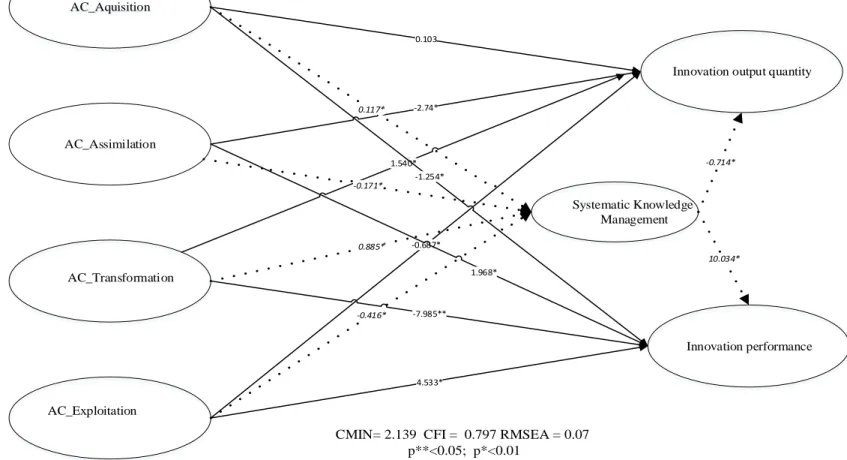
Figure 2 presents the results of the SEM analysis that includes both direct and indirect effects of absorptive capacity on innovation, with systematic knowledge management as a second-order variable. Figure 2 shows that SKM is negatively related to innovation output quantity (β = -0.714, p < 0.05) and is positively related to innovation performance (β = 10.034, p < 0.05).
--- Insert Figure 2 about here
---
H1 proposed that the acquisition dimension of SME’s absorptive capacity is positively related to systematic knowledge management. As shown in Figure 2, there was a significant and positive relationship between AC_Aquisition and SKM (β = 0.117, p < 0.05). Thus, H1 is supported.
H2 was supported given that AC_Assimilation was negatively related to SKM (β = -0.171, p < 0.05). H3 was supported in that AC_Transformation was positively related to SKM (β = 0.885, p < 0.05). Additionally, H4 was supported in that AC_Exploitation was negatively related to SKM (β = -0.416, p < 0.05).
Table 3 presents the results of the mediation tests of H5 and H6. H5 proposed that systematic knowledge management practices mediate the relationship between absorptive capacity and innovation output quantity. As proposed, SKM fully mediated the relationships between AC_Assimilation and innovation output quantity (H5b supported), and between AC_Transformation and innovation output quantity (H5c supported). SKM also partially mediates the relationship between AC_Exploitation and innovation output quantity (partial support for H5d). However, H5a was not supported in that SKM did not mediate the relationship between AC_Acquisition and innovative output quantity.
H6 proposed that SKM mediates the relationship between absorptive capacity and innovation performance. As proposed, knowledge management practices fully mediated the relationships between AC_Assimilation and innovation performance (H6b supported), and between AC_Exploitation and innovation performance (H6d supported). However, SKM did not mediate the relationship between AC_Acquisition and innovation performance (H6a not supported), or the relationship between AC_Transformation and innovation performance (H6c not supported).
--- Insert Table 3 about here ---
V. DISCUSSION
This study proposed and tested a conceptual model of the relationship between firms’ absorptive capacity on innovation output and performance being mediated through systematic knowledge management practices in SMEs. While prior research has focused on the direct effect of absorptive capacity on innovation launch [35]-[38], we argued that absorptive capacity would only be effective in promoting innovation within a firm provided that new knowledge could be integrated into the systematic knowledge management practices of the firm. Our model was tested by using a sample of technology-oriented SMEs in Croatia.
A. Theoretical Implications
This study provides insights into the effect of various dimensions of absorptive capacity on innovation output and innovation performance. In particular, we found that optimizing the effect of absorptive capacity lies in embedding those functions into systematic knowledge management practices within the firms.
Firms with higher acquisition and transformation dimensions of absorptive capacity can replenish and enhance firms’ knowledge management practices [55], [57]. Further, we found that the assimilation and exploitation aspects of absorptive capacity of firms are negatively related to knowledge management [16], [53].
An important finding was that systematic knowledge management is a mediator between absorptive capacity and innovation output quantity as well as innovation performance. One interesting finding is that system knowledge management is positively related to innovation performance but negatively related to innovation output quantity. i.e., high levels of systematic knowledge management results in a fewer number of higher performing innovations. One implication is that knowledge management research should include both quantitative and performance innovation outcomes [28].
B. Managerial Implications
In regards to managerial implications, this investigation revealed potential weak links in SMEs’ knowledge management processes for engendering innovation. Because the acquisition of external knowledge is key to the renewal and rejuvenation of a firm’s knowledge management practices, particular emphasis should be given to strengthening external relationships with industry associations, large enterprises or other organisations. Subsequently, firms should recognise that both assimilation and exploitation processes extract knowledge from the individuals and teams involved in storing, retrieving and transforming knowledge. To better manage the assimilation and exploitation process of knowledge management, firms should invest in coordination systems so that individuals and teams regularly share knowledge and insights. Another implication concerns managerial decisions about whether the strategic objective is to have a large number of innovations or to focus on a fewer number of more profitable innovations. Our findings indicate
that embedding systematic knowledge practices within organizations is associated with the latter strategy which is a more effective use of limited resources in SMEs.
C. Limitations and Future Research
This study has limitations which indicate opportunities for future research. First, our study relied on senior executives’ assessments of their firms’ processes and performance. Although survey data may be subject to perceptual biases, we sought to alleviate this concern by using established measures [75], [76]. Even so, one direction for future research would be to supplement survey data with objective indicators of systematic knowledge management, absorptive capacity, and performance constructs.
As a cross- sectional study, this limits conclusions about the causality of relationships. Future longitudinal studies utilizing both quantitative and qualitative data are needed to delve deeper into the dynamic linkages between absorptive capacity, knowledge management processes, and innovation outcomes. Of particular interest is the time lag between the four dimensions of absorptive capacity and integration into firms’ knowledge management practices, as well as the time lag from new knowledge to innovation success.
The context for this study was one European country thus future research is needed to examine the generalizability of findings to other countries in Europe and globally. Comparative cross-national research is needed to determine the extent to which knowledge management and absorptive capacity processes are context specific as well as influenced by national institutional frameworks.
VI. CONCLUSION
This paper makes three contributions to the research literature on the absorptive capacity of firms [8], [82], [83]. First, we emphasise the role of internal practices and procedures in realizing the effect of absorptive capacity. Rather than relying on the R&D department of a firm to absorb new knowledge from an external environment, we posit that for SMEs to reap the value of external knowledge, systematic knowledge management practices need to be in place throughout the company. This was demonstrated by our finding that external new knowledge must be integrated into firms’ the existing knowledge management practices in order to yield positive innovation outcomes.
This study also contributes to understanding the nuanced relationship between absorptive capacity and knowledge management by delineating that knowledge acquisition and transformation replenishes the knowledge stock of a firm, while assimilation and exploitation processes extract from the knowledge stock. This is in contrast to the theoretical differentiation of potential and realised absorptive capacity [20] that emphasises the distinction between valuing and acquiring external knowledge versus exploiting external knowledge for product mixes and profits. In the course of valuing, acquiring and utilizing knowledge, however, the existing knowledge stock is also affected. Firms need to constantly replenish their knowledge management stock by incorporating new and creative information to foster innovation. Concurrently, firms need to extract knowledge into routines, products, and services to be effective.
Third, this study found that the mediating role of systematic knowledge management differs depending on whether focusing on innovation output quantity or innovation financial performance as also confirmed in [63]. Specifically, knowledge management primarily mediates the relationship between absorptive capacity and innovation output quantity. We posit that it might take a substantial amount of time for the new product and service to increase sales and profits for the company.
APPENDIX CONSTRUCT MEASURES
Absorptive Capacity (sources: 18 items validated by [75]; *9 items adapted from [76]) AC_Acquisition (9 items)
AC1. We frequently scan the environment for new technologies. AC2. We thoroughly observe technological trends.
AC3. We observe in detail external sources of new technologies. AC4. We thoroughly collect information from industry.*
AC5. We have information on the state-of-the-art of external environment.* AC6. We frequently acquire technologies from external sources.*
AC7. We periodically organize focused meetings with external partners to acquire new technologies. AC8. Employees regularly approach external institutions to acquire technological knowledge
AC9. In support of new technology acquisition we approach external networks and/or associations (clusters, chambers, associations, consortia, ...)*
AC_Assimilation (6 items)
AC10. We often transfer technological knowledge to our firm in response to technology acquisition opportunities. AC11. We thoroughly maintain relevant knowledge over time.
AC12. Employees store technological knowledge for future reference. AC13. We communicate relevant knowledge across the units of our firm. AC14. We regularly match new technologies with ideas for new products.
AC15. We quickly recognize the usefulness of new technological knowledge for existing knowledge. AC_Transformation (8 items)
AC16. Knowledge management is functioning well in our company.*
AC17. When recognizing a business opportunity, we can quickly rely on our existing knowledge. AC18. We are proficient in reactivating existing knowledge for new uses.*
AC19. We quickly analyse and interpret changing market demands for our technologies.
AC20. In support of new technology implementation and transformation into new products or services we approach external networks and/or associations (clusters, chambers, associations, consortia, ...).*
AC21. We are proficient in transforming technological knowledge into new products. AC22. Our employees are capable of sharing their expertise to develop new products.* AC23. We regularly apply technologies in new products.
AC_Exploitation (4 items)
AC24. New opportunities to serve our customers with existing technologies are quickly understood. AC25. We constantly consider how to better exploit technologies.
AC26. We easily implement technologies in new products.*
AC27. It is well known who can best exploit new technologies inside our firm.
Systematic Knowledge Management (15 items adapted from [76])
SKM1. In realizing revenues we recognize/rely on the potential of our own knowledge base. SKM2. We use knowledge management related activities to create added value for our customers. SKM3. We use some financial indicators for knowledge management performance assessment. SKM4. We use some non-financial indicators for knowledge management performance assessment.
SKM5. We have an employee rewarding system that somehow prizes the diffusion of knowledge among employees. SKM6. We are focusing our resources towards activities that are undoubtedly increasing our intellectual capital or
knowledge base level.
SKM7. Managers in this organization frequently involve employees in important decisions.
SKM8. We encourage all our staff to collect and report information about what is going on in the external organizational environment.
SKM9. We have systems, procedures or rules for receiving, collating and sharing information from outside the firm. SKM10. People are encouraged to interact with the environment, e.g. competitors, customers, technological
institutes, universities, suppliers or similar.
SKM11. Our employees are assuming responsibility for their own personal development and learning; they are open-minded to learning and are continuously developing and upgrading own knowledge.
SKM13. We are articulated and structured in managing our knowledge management activities. SKM14. Our knowledge management is implemented through defined procedures.
SKM15. We support financially or by other means our employees by scholarships, internships, specializations or similar.
REFERENCES
[1] J. C. Spender, “Making knowledge the basis of a dynamic theory of the firm,” Strat. Manage. J., vol. 17, no. S2, pp. 45-62, 1996.
[2] D. J. Teece, G. Pisano, and A. Shuen, “Dynamic capabilities and strategic management,” Strat. Manage. J., vol. 18, no. 7, pp. 509-533, 1997.
[3] C. A. Bayraktar, G. Hancerliogullari, B. Cetinguc, and F. Calisir, “Competitive strategies, innovation, and firm performance: An empirical study in a developing economy environment,” Technol. Anal. Strat. Manage., vol. 29, no. 1, pp. 38-52, 2017.
[4] C. E. Helfat, S. Finkelstein, W. Mitchell, M. Peteraf, H. Singh, D. Teece, and S. G. Winter, Dynamic Capabilities: Understanding Strategic Change in Organizations. New York: John Wiley & Sons, 2009. [5] R. A. D'Aveni, G. B. Dagnino, and K. G. Smith, “The age of temporary advantage,” Strat. Manage. J., vol. 31,
no. 13, pp. 1371-1385, 2010.
[6] P. R. Carlile and E. S. Rebentisch, “Into the black box: The knowledge transformation cycle,” Manage. Sci., vol. 49, no. 9, pp. 1180-1195, 2003.
[7] W. M. Cohen and D. A. Levinthal, “Absorptive capacity: A new perspective on learning and innovation,”
Administ. Sci. Quart., vol. 35, pp. 126-152, 1990.
[8] J. J. Jansen, F. A. Van Den Bosch, and H. W. Volberda. 2005. “Managing potential and realized absorptive capacity: How do organizational antecedents matter?” Acad. Manage. J., vol. 48, no. 6, pp. 999-1015, 2005. [9] R. McAdam and R. Reid, “SME and large organisation perceptions of knowledge management: Comparisons and
contrasts,” J. Knowl. Manage., vol. 5, no. 3, pp. 231-241, 2001.
[10] K. Y. Wong and E. Aspinwall, “An empirical study of the important factors for knowledge-management adoption in the SME sector,” J. Knowl. Manage., vol. 9, no. 3, pp. 64-82, 2005.
[11] J. Ye, B. Hao, and P. C. Patel, “Orchestrating heterogeneous knowledge: The effects of internal and external knowledge heterogeneity on innovation performance,” IEEE Trans. Eng. Manage., vol. 63, no. 2, pp. 165-176, 2016.
[12] W. M. Cohen and D. A. Levinthal. 1989. “Innovation and learning: The two faces of R&D,” Econ. J., vol. 99, no. 397, pp. 569-596, 1989.
[13] F. A. Van Den Bosch, R. Van Wijk and H. W. Volberda, “Absorptive capacity: Antecedents, models and outcomes,” July, 5 ERIM Report Series Reference No. ERS- 2003-035-STR. [Online]. Available: https://ssrn.com/abstract=411675, 2003.
[14] U. Lichtenthaler and E. Lichtenthaler, “A capability-based framework for open innovation: Complementing absorptive capacity,” J. Manage. Studies, vol. 46, no. 8, pp. 1315-1338, 2009.
[15] J. Backmann, M. Hoegl, and J. L. Cordery, “Soaking it up: Absorptive capacity in interorganizational new product development teams,” J. Prod. Innovat. Manage., vol. 32, no. 6, pp. 861-877, 2015.
[16] G. Szulanski, “Exploring internal stickiness: Impediments to the transfer of best practice within the firm,” Strat. Manage. J., vol. 17, no. S2, pp. 27-43, 1996.
[17] R. Veugelers, “Internal R&D expenditures and external technology sourcing,” Res. Policy, vol. 26, no. 3, pp. 303-315, 1997.
[18] I. M. Cockburn and R. M. Henderson, “Absorptive capacity, coauthoring behavior, and the organization of research in drug discovery,” J. Ind. Econ., vol. 46, no. 2, pp. 157-182, 1998.
[19] J. Nahapiet and S. Ghoshal, “Social capital, intellectual capital, and the organizational advantage,” Acad. Manage. Rev., vol. 23, no. 2, pp. 242-266, 1998.
[20] S. A. Zahra and G. George, “Absorptive capacity: A review, reconceptualization, and extension,” Acad. Manage. Rev., vol. 27, no. 2, pp. 185-203, 2002.
[21] M. A. Schilling and C. W. L. Hill, “Managing the new product development process: Strategic imperatives,”
Acad. Manage. Exec., vol. 12, no. 3, pp. 67-81, 1998.
[22] H. Rush, J. Bessant, and M. Hobday, “Assessing the technological capabilities of firms: Developing a policy tool,” R&D Manage., vol. 37, no. 3, pp. 221-236, 2007.
[23] C. M. Rodriguez, J. A. Wise, and C. R. Martinez, “Strategic capabilities in exporting: An examination of the performance of Mexican firms,” Manage. Decis., vol. 51, no. 8, pp. 1643-1663, 2013.
[24] G. George, J. Wiklund, and S.A. Zahra, “Ownership and the internationalization of small firms,” J. Manage., vol. 31, no. 2, pp. 210-233, 2005.
[25] H. W. Volberda, N. J. Foss, and M. A. Lyles. "Absorbing the concept of absorptive capacity: How to realize its potential in the organizational field," Org. Sci., vol. 21, no. 4, pp. 931-951, 2010.
[26] G. Todorova and B. Durisin, “Absorptive capacity: Valuing a reconceptualization,” Acad. Manage. Rev., vol. 32, no. 3, pp. 774-786, 2007.
[27] M. R. Saeedi, H. Dadfar, and S. Brege, “The impact of inward international licensing on absorptive capacity of SMEs,” Int. J. Qual. Serv. Sci., vol. 6, no. 2/3, pp. 164-180, 2014.
[28] Y. Song, D. R. Gnyawali, M. K. Srivastava, and E. Asgari, “In search of precision in absorptive capacity research: A synthesis of the literature and consolidation of findings,” J. Manage., vol. 44, no. 6, pp. 2343-2374, 2018.
[29] C. Camisón and B. Forés, “Knowledge absorptive capacity: New insights for its conceptualization and measurement,” J. Bus. Res., vol. 63, no. 7, pp. 707-715, 2010.
[30] Q. Tu, M. A. Vonderembse, T. S. Ragu-Nathan, and T. W. Sharkey, “Absorptive capacity: Enhancing the assimilation of time-based manufacturing practices,” J. Oper. Manage., vol. 24, no. 5, pp. 692-710, 2006. [31] A. Y. Lewin, S. Massini, and P. Carine, “Microfoundations of internal and external absorptive capacity
routines,” Org. Sci., vol. 22, no. 1, pp. 81-98, 2011.
[32] N. Murovec and I. Prodan, “Absorptive capacity, its determinants, and influence on innovation output: Cross-cultural validation of the structural model,” Technovation, vol. 29, no. 12, pp. 859-872, 2009.
[33] X. Xie, H. Zou, and G. Qi, “Knowledge absorptive capacity and innovation performance in high-tech companies: A multi-mediating analysis,” J. Bus. Res., vol. 88, pp. 289-297, 2018.
[34] G. Estrada, D. L. Shunk, and F. Ju, “Systematic continuous improvement model for variation management of key characteristics running with low capability,” Int. J. Prod. Res., [Online]
https://doi.org/10.1080/00207543.2017.1369599, 2017 .
[35] D. L. Deeds, D. DeCarolis, and J. Coombs, “Dynamic capabilities and new product development in high technology ventures: An empirical analysis of new biotechnology firms,” J. Bus. Venturing, vol. 15, no. 3, pp. 211-229, 2000.
[36] W. Tsai, “Knowledge transfer in intraorganizational networks: Effects of network position and absorptive capacity on business unit innovation and performance,” Acad. Manage. J., vol. 44, no. 5, pp. 996-1004, 2001. [37] H. Yli-Renko, E. Autio, and H. J. Sapienza, “Social capital, knowledge acquisition, and knowledge exploitation
in young technology-based firms,” Strat. Manage. J., vol. 22, no. 6-7, pp. 587-613, 2001.
[38] S. N. Tavani, H. Sharifi, S. Soleimanof, and M. Najmi, “An empirical study of firm’s absorptive capacity dimensions, supplier involvement and new product development performance,” Int. J. Prod. Res., vol. 51, no. 11, pp. 3385-3403, 2013.
[39] F. T. Rothaermel and M. T. Alexandre, “Ambidexterity in technology sourcing: The moderating role of absorptive capacity,” Org. Sci., vol. 20, no. 4, pp. 759-780, 2009.
[40] M. M. Montoya-Weiss and R. Calantone, “Determinants of new product performance: A review and meta-analysis,” J. Prod. Innovat. Manage., vol. 11, no. 5, pp. 397-417, 1994.
[41] J. Sugheir, P. H. Phan, and I. Hasan, “Diversification and innovation revisited: An absorptive capacity view of technological knowledge creation,” IEEE Trans. Eng. Manage., vol. 59, no. 4, pp. 530-539, 2012.
[42] H. E. Posen and J. S. Chen, “An advantage of newness: Vicarious learning despite limited absorptive capacity,”
Org. Sci., vol. 24, no. 6, pp. 1701-1716, 2013.
[43] M. Saad, V. Kumar, and J. Bradford, “An Investigation into the development of the absorptive capacity of manufacturing SMEs,” Int. J. Prod. Res., vol. 55, no. 2, pp. 6916-6931, 2017.
[44] P. L. Yeoh, “Realized and potential absorptive capacity: Understanding their antecedents and performance in the sourcing context,” J. Marketing Theory Pract., vol. 17, no. 1, pp. 21-36, 2009.
[45] S. J. Yoo, O. Sawyerr, and W. L. Tan, “The mediating effect of absorptive capacity and relational capital in alliance learning of SMEs,” J. Small Bus. Manage., vol. 54, no. S1, pp. 234-255, 2016.
[46] N. J. Foss, J. Lyngsie, and S. A. Zahra, “The role of external knowledge sources and organizational design in the process of opportunity exploitation,” Strat. Manage. J., vol. 34, no. 12, pp. 1453-1471, 2013.
[47] I. Nonaka, “A dynamic theory of organizational knowledge creation,” Org. Sci., vol. 5, no. 1, pp. 14-37, 1994. [48] I. Nonaka and G. Von Krogh, “Perspective—Tacit knowledge and knowledge conversion: Controversy and
[49] S. A. Tywoniak, “Knowledge in four deformation dimensions,” Org., vol. 14, no. 1, pp. 53-76, 2007. [50] U. Lichtenthaler and E. Lichtenthaler,M “Technology transfer across organizational boundaries: Absorptive
capacity and desorptive capacity,” Calif. Manage. Rev., vol. 53, no. 1, pp. 154-170, 2010.
[51] J. S. Brown and P. Duguid, “Organizational learning and communities-of-practice: Toward a unified view of working, learning, and innovation,” Org. Sci., vol. 2, no. 1, pp. 40-57, 1991.
[52] D. McIver, C. A. Lengnick-Hall, M. L. Lengnick-Hall, and I. Ramachandran, “Understanding work and knowledge management from a knowledge-in-practice perspective,” Acad. Manage. Rev., vol. 38, no. 4, pp. 597-620, 2013.
[53] M. Schrage, Shared Minds: The New Technologies of Collaboration, New York: Random House, 1990. [54] C. F. Graumann, “Perspectival structure and dynamics in dialogues,” The Dynamics of Dialogue, in I. Markova
and K. Foppa, Eds., New York: Springer, pp. 105-127, 1990.
[55] U. Zander and B. Kogut, “Knowledge and the speed of the transfer and imitation of organizational capabilities: An empirical test,” Org. Sci., vol. 6, 76-92, 1995.
[56] J. Birkinshaw, “Entrepreneurship in multinational corporations: The characteristics of subsidiary initiatives,”
Strat. Manage. J., vol. 18, no. 3, pp. 207-229, 1997.
[57] J. N. Lee and B. Choi, “Determinants of knowledge management assimilation: An empirical investigation,”
IEEE Trans. Eng. Manage., vol. 57, no. 3, pp. 430-449, 2010.
[58] J. P. Liebeskind, “Knowledge, strategy, and the theory of the firm,” Strat. Manage. J., vol. 17, no. 52, pp. 93-107, 1996.
[59] P. J. Lane and M. Lubatkin, “Relative absorptive capacity and interorganizational learning,” Strat. Manage. J., vol. 19, no. 5, pp. 461-477, 1998.
[60] P. J. Lane, J. E. Salk, and M. A. Lyles, “Absorptive capacity, learning, and performance in international joint ventures,” Strat. Manage. J., vol. 22, no. 12, pp. 1139-1161, 2001.
[61] G. N. Stock and M. V. Tatikonda, “External technology integration in product and process development,” Int. J. Oper. Prod. Manage., vol. 24, no. 7, pp. 642-665, 2004.
[62] G. N. Stock and M. V. Tatikonda, “The joint influence of technology uncertainty and interorganizational interaction on external technology integration success,” J. Oper. Manage., vol. 26, no. 1, pp. 65-80, 2008. [63] I. C. Hsu and R. Sabherwal, “From intellectual capital to firm performance: The mediating role of knowledge
management capabilities,” IEEE Trans. Eng. Manage., vol. 58, no. 4, pp. 626-642, 2011.
[64] M. L. Flor, S. Y. Cooper, and M. J. Oltra, “External knowledge search, absorptive capacity and radical innovation in high-technology firms,” Eur. Manage. J., vol. 36, no. 2, pp. 183-194, 2018.
[65] M. Verkasolo and P. Lappalainen, “A method of measuring the efficiency of the knowledge utilization process,” IEEE Trans. Eng. Manage., vol. 45, no. 4, pp. 414-423, 1998.
[66] A. Q. R. A. Aljanabi, N. A. M. Noor, and D. M. Kumar, “The mediating role of absorptive capacity in its effect on organizational support factors and technological Innovation,” Inform. Manage. Bus. Rev., vol. 6, no. 1, pp. 25-41, 2014.
[67] A. Escribano, A. Fosfuri, and J. A. Tribó, “Managing external knowledge flows: The moderating role of absorptive capacity,” Res. Policy, vol. 38, no. 1, pp. 96-105, 2009.
[68] K. D. S. Fernald, H. P. G. Pennings, J. F. van den Bosch, H. R. Commandeur, and E. Claassen, “The
moderating role of absorptive capacity and the differential effects of acquisitions and alliances on big pharma firms' innovation performance,” PLoS ONE 12, no. 2): e0172488.
https://doi.org/10.1371/journal.pone.0172488, 2017.
[69] P. J. Lane, B. R. Koka, and S. Pathak, “The reification of absorptive capacity: A critical review and rejuvenation of the construct,” Acad. Manage. Rev., vol. 31, no. 4, pp. 833-863, 2006.
[70] K. Rangus, M. Drnovšek, A. Di Minin, and A. Spithoven, “The role of open innovation and absorptive capacity in innovation performance: Empirical evidence from Slovenia,” J. East. Eur. Manage. Stud., vol. 22, no. 1, pp. 39-62, 2017.
[71] R. D.Klassen and J. Jacobs, “Experimental comparison of web, electronic and mail survey technologies in operations management,” J. Oper. Manage., vol. 19, no. 6, pp. 713-728, 2001.
[72] A. Fosfuri and J. A. Tribó, “Exploring the antecedents of potential absorptive capacity and its impact on innovation performance,” Omega, vol. 36, no. 2, pp. 173-187, 2008.
[73] T. C. Flatten, A. Engelen, S. A. Zahra, and M. Brettel, “A measure of absorptive capacity: Scale development and validation,” Eur. Manage. J., vol. 29, no. 2, pp. 98–116, 2011.
[74] M. M. Jiménez-Barrionuevo, V. J. García-Morales, and L. M. Molina, “Validation of an instrument to measure absorptive capacity,” Technovation, vol. 31, no. 5, pp. 190-202, 2011.
[75] J. L. Ferreras-Méndez, A. Fernández-Mesa, and J. Alegre, “The relationship between knowledge search strategies and absorptive capacity: A deeper look,” Technovation, vol. 54, pp. 48-61, 2016.
[76] C. O'Dell and C. J. Grayson, If Only We Knew What We Know: The Transfer of Internal Knowledge and Best Practice, New York: The Free Press, 1998
[77] C. G. Fornell and D. F. Larcker, “Evaluating structural equation models with unobservable variables and measurement error,” J. Marketing Res., vol. 18, no. 1, pp. 39-50, 1981.
[78] J. C. Anderson and D. W. Gerbing, “Structural equation modelling in practice: A review and recommended two-step approach,” Psychol. Bull., vol. 103, no. 3, pp. 411-423, 1988.
[79] J. F. Hair, W. C. Black, B. J. Babin, R. E. Anderson, and R. L. Tatham, Multivariate Data Analysis, 6th ed., Englewood Cliffs, NJ: Prentice-Hall, 2006.
[80] D. W. Gerbing and J. C. Anderson, “The effects of sampling error and model characteristics on parameter estimation for maximum likelihood confirmatory factor analysis,” Multivar. Behav. Res., vol. 20, no. 3, pp. 255-271, 1985.
[81] R. M. Baron and D. A. Kenny, “The moderator-mediator variable distinction in social psychological research: Conceptual, strategic, and statistical considerations,” J. Pers. Soc. Psychol., vol. 51, no.6, pp. 1173–1182, 1986. [82] N. J. Foss, K. Laursen, and T. Pedersen, “Linking customer interaction and innovation: The mediating role of
new organizational practices,” Org. Sci., vol. 22, no. 4, pp. 980-999, 2011.
[83] W. J. Wales, V. Parida, and P. C. Patel, “Too much of a good thing? Absorptive capacity, firm performance, and the moderating role of entrepreneurial orientation,” Strat. Manage. J., vol.34, no. 5, pp. 622-633, 2013.
Fig. 1. Conceptual model and hypotheses AC_Acquisition AC_Assimilation AC_Transformation AC_Exploitation Systematic knowledge management Innovation output quantity Innovation performance H1 H2 H3 H4 H5a-d H6a-d
AC_Aquisition AC_Assimilation AC_Transformation AC_Exploitation Systematic Knowledge Management
Innovation output quantity
Innovation performance 0.103 -2.74* 1.540* -0.687* 4.533* -7.985** 1.968* -1.254* 0.117* 0.885* -0.171* -0.416* -0.714* 10.034*
CMIN= 2.139 CFI = 0.797 RMSEA = 0.07 p**<0.05; p*<0.01
TABLE 1
CONFIRMATORY FACTOR ANALYSES: ITEM FACTOR LOADINGS Absorptive Capacity
Systematic Knowledge Management AC_
Acquisition AC_ Assimilation
AC_
Transformation AC_ Exploitation
AC1 0.867 AC10 0.853 AC16 0.860 AC24 0.928 SKM1 .841
AC2 0.777 AC11 0.900 AC17 0.925 AC25 0.954 SKM2 .847
AC3 0.864 AC12 0.881 AC18 0.842 AC26 0.950 SKM3 .743
AC4 0.752 AC13 0.912 AC19 0.920 AC27 0.829 SKM4 .844
AC5 0.674 AC14 0.881 AC20 0.630 SKM5 .829
AC6 0.838 AC15 0.888 AC21 0.914 SKM6 .843
AC7 0.688 AC22 0.896 SKM7 .814 AC9 0.504 AC23 0.880 SKM8 .853 SKM9 .811 SKM10 .877 SKM11 .861 SKM12 .890 SKM13 .899 SKM14 .790 SKM15 .835 Cronbach alpha .876 .944 .948 .934 .970 Average variance explained 56.9% 78.5% 74.5% 84.0% 70.4%
TABLE 2
DESCRIPTIVE STATISTICS: MEANS, STANDARD DEVIATIONS, AND CORRELATIONS Mean SD AVE sqrt (1) (2) (3) (4) (5) (6) (1) AC_Acquisition 6.35 1.56 0.754 (2) AC_Assimilation 5.80 1.94 0.886 0.598** (3) AC_Transformation 6.45 1.50 0.863 0.453** 0.760** (4) AC_Exploitation 6.35 1.53 0.917 0.466** 0.726** 0.904**
(5) Systematic knowledge management 6.09 1.75 0.839 0.461** 0.629** 0.767** 0.774**
(6) Innovation output quantity 5.72 1.90 0.166 0.370** 0.432** 0.477** 0.558**
(7) Innovation performance 5.44 1.98 0.187 0.362** 0.400** 0.420** 0.364** 0.325**
TABLE 3
DIRECT AND INDIRECT EFFECTS
Direct Model Indirect Model Mediation
Path
Path
coefficient Path
Path coefficient
H5a AC_Acquisition –> Innovation output quantity -0.130 AC_Acquisition –> SKM -> Innovation output quantity 0.829 No mediation H5b AC_Assimilation –> Innovation output quantity 0.150 AC_Assimilation –> SKM –> Innovation output quantity -1.337*** Full mediation H5c AC_Transformation –> Innovation output quantity -0.177 AC_Transformation –> SKM –> Innovation output quantity 6.919*** Full mediation H5d AC_Exploitation –> Innovation output quantity 0.964*** AC_Exploitation –> SKM –> Innovation output quantity -3.213*** Partial mediation H6a AC_Acquisition –> Innovation performance -0.139 AC_Acquisition –> SKM –> Innovation performance -0.477 No mediation H6b AC_Assimilation -> Innovation performance 0.367** AC_Assimilation –> SKM -> Innovation performance 0.648 Full mediation H6c AC_Transformation -> Innovation performance -0.163 AC_Transformation –> SKM -> Innovation performance 3.125 No mediation H6d AC_Exploitation –> Innovation performance 0.905*** AC_Exploitation –> SKM –> Innovation performance -5.911 Full mediation Notes: AC = Absorptive capacity, SKM = Systematic knowledge management