XBRL implementation methods in COREP reporting
MSc program in Information and Service Management Master's thesis
Teemu Kettula 2015
Department of Information and Service Economy Aalto University
School of Business
XBRL
XBRL implementation methods in COREP reporting
Master’s Thesis
Teemu Kettula
05/2015
Information and Service
Management
Approved in the Department of Information and Service Economy 05/2015 and awarded the grade _______________
AALTO UNIVERSITY SCHOOL OF BUSINESS ABSTRACT Department of Information and Service Economy 05/2015 Master’s Thesis
Teemu Kettula
ABSTRACT
Objectives of the Study
The main objective of this study is to find out the XBRL adoption methods for European banks to submit COREP reports to local FSAs and to explore transitions in these methods. Thus, the goal is to find patterns from the transitions in XBRL implementation methods.
The study is exploratory, as there is no earlier literature about XBRL implementation methods in COREP reporting or from XBRL implementation method transitions in any field. Additionally, this thesis has developed a useful framework for examination of technology adaption methods, transitions in technology adaption methods and patterns in technology adaption methods’ transitions.
Academic background and methodology
Academic background includes general earlier XBRL related literature, explaining the major benefits and attributes for companies using XBRL, XBRL usage around the world and discussing the implementation strategies that companies may use to adopt XBRL into their organizational processes. It also presents the basic elements of COREP reporting. Additionally, the incremental vs radical change in technology adoption is adopted to this research as it brings valuable addition to the framework. The theoretical framework is built on the XBRL implementation strategies, on pieces from XBRL related literature and on the model of technology adoption.
The methodology consists of multiple case study with qualitative data collected through questions distributed via online tool and internet telephone interview with voluntary bank representatives around Europe. This data is analyzed with comparative case analysis/cross-case analysis.
Findings and conclusions
Findings confirm only one of the four propositions thoroughly. Propositions are presented in the theoretical part of the thesis. Results support the proposed theoretical framework, although XBRL have not yet matured deeply into banking industry’s legacy systems in Europe. Respondents had clear opinions on methods they are using and the XBRL attributes. Four of the seven attributes arise as more valuable to respondents than other three attributes, meaning that respondents’ opinion differed from earlier literature.
Keywords
XBRL, COREP, non-adoption, low adoption, medium adoption, advanced adoption
AALTO-YLIOPISTON KAUPPAKORKEAKOULU TIIVISTELMÄ
Tieto- ja palvelutalouden laitos 05/2015
Pro Gradu-tutkielma Teemu Kettula
ABSTRAKTI
Tutkimuksen tavoitteet
Tutkimuksen päätavoitteena on löytää Eurooppalaisten pankkien XBRL adoptointi metodit COREP raportin jättämiseksi paikallisille Finanssivalvonnoille sekä tutkia mahdollisia muutoksia adoptointi metodeissa.
Tutkimus on luonteeltaan tutkiva, sillä aikaisempaa tutkimusta XBRL implementointi metodeista COREP raportoinnin yhteydessä ei ole tehty. Myöskään millään muullakaan alalla ei ole tutkittu XBRL implementointi metodien mahdollisia muutoksia. Tämän lisäksi tutkimuksessa on luotu uusi hyödyllinen tutkimuskehikko teknologioiden implementointi metodien, niiden muutosten sekä muutosten mallien tutkimiseen.
Kirjallisuuskatsaus ja metodologia
Tutkimuksen kirjallisuuden taustoihin kuuluu aikaisemman XBRL kirjallisuuden läpikäynti, suurimpien XBRL:n hyötyjen sekä attribuuttien tutkiminen, XBRL:n käyttö ympäri maailmaa sekä erilaisten XBRL implementointi metodien läheisempi tarkastelu. Kirjallisuudessa esitetään myös COREP raportoinnin perus elementit sekä teknologian vähäisten ja radikaalien muutosten käyttöönottoon liittyvää teoriaa ja kuinka nämä vaikuttavat tutkimuksen viitekehikkoon. Tutkimuksen viitekehikko on rakennettu XBRL käyttöönotto metodien sekä teknologian käyttöönottoon liittyvän teorian pohjalle.
Metodologia koostuu moni tapaustutkimuksen tutkimisesta. Kvalitatiivinen datan keräys on suoritettu verkko työkalulla, jonka avulla on päästy kiinni useampaan vastaajaan. Tämän lisäksi Internet puheluita on käytetty vapaaehtoisten pankkien vastaajien haastattelemiseen Euroopan laajuisesti. Kerätty tieto on analysoitu vertailevalla tapausanalyysillä/cross-case analyysillä. Tulokset ja päätelmät
Tulokset vahvistavat kokonaisvaltaisesti ainoastaan yhden neljästä tutkimus ehdotuksesta. Tutkimus ehdotukset on esitetty tutkimuksen teoreettisessa osiossa. Tulokset tukevat myös ehdotettua teoreettista viitekehystä, vaikka XBRL ei olekaan vielä syvästi vakiintunut tiedostomuoto Euroopan pankkisektorin it-järjestelmissä. Vastaajilla oli selvä näkemys organisaationsa käyttämästä XBRL metodista sekä XBRL attribuuteista. Aikaisemmassa kirjallisuudessa on tunnistettu seitsemän XBRL attribuuttia, näistä tämän tutkimuksen vastaajien mielestä neljä attribuuttia olivat arvokkaimpia. Tämä tulos eroaa aikaisemmasta tutkimuksesta. Avainsanat
XBRL, COREP, ei-adoptointi, vähäinen adoptointi, keskinkertainen adoptointi, kehittynyt adoptointi
ACKNOWLEDGEMENTS
I am especially grateful for persons in Federation of Finnish Financial Services, TIEKE and those local FSAs all around EU area that helped me to connect with key informants of banks. I would also like to thank my supervisors Esko Penttinen and Timo Saarinen for their time and devotion to give me guiding comments and practical assistance along the thesis process.
TABLE OF CONTENTS
ABSTRACT ... ii
ABSTRAKTI ... iii
ACKNOWLEDGEMENTS ... iv
TABLE OF CONTENTS ... v
LIST OF FIGURES ... viii
LIST OF TABLES ... ix
Abbreviations ... x
1. INTRODUCTION ... 1
1.1. Background and Motivation ... 1
1.2. Research Questions and Objectives ... 6
1.3. Structure of the Thesis ... 8
2. LITERATURE REVIEW ... 9
2.1. XBRL ... 9
2.1.1. Basic Idea of the XBRL ... 9
2.1.2. Common Benefits and Attributes in XBRL Adoption ... 12
2.1.3. The Use of XBRL around the World ... 14
2.1.4. Implementation Methods ... 19
2.2. COREP Reporting ... 26
2.3. The Significance of the Change in Technology Adoption ... 28
2.3.1. Incremental Change ... 29 v
2.3.2. Radical Change ... 30
3. Theoretical framework ... 32
3.1. Overview of the Framework ... 32
3.2. Propositions Development ... 34
3.2.1. Research Constructs ... 34
3.2.2. Reporting Efficiency through XBRL Attributes ... 38
3.3. Technology Integration and Organizational Knowledge ... 41
3.4. Summary of Theoretical Framework ... 42
4. Research methodology ... 44
4.1. Type of Research ... 44
4.2. Data Collection Methods ... 46
4.2.1. About the Online Tool ... 46
4.2.2. About the Interviews ... 49
4.3. Respondents ... 50
4.3.1. Participants Using the Online Tool ... 50
4.3.2. Participants of the Interviews ... 51
4.4. Analysis Methods ... 52
5. Empirical study ... 53
5.1. Data Collection ... 53
5.2. Description of the Sample ... 55
5.2.1. Basic Information about the Sample ... 55
5.2.2. The Use of Time Versus Workload in COREP Submission ... 57
5.3. Result ... 58 vi
5.3.1. Proposition 1: Most Banks Should Follow Evolutionary Path in XBRL Adoption If They
Do Not Have Earlier Experience from XBRL. ... 61
5.3.2. Proposition 2: Most of the Banks Have Started Their Regulatory COREP Reporting with Either Low or Medium Adoption. ... 62
5.3.3. Proposition 3: If a Bank Has Excellent Earlier experience About XBRL They Can Jump in Advanced Adoption by “One-shot”. ... 62
5.3.4. Proposition 4: The Complexity of Adoption Level Correlates Significantly and Positively with XBRL Attributes. ... 63
5.3.5. Other Findings ... 66
5.3.6. Assessment of the Interview ... 65
6. CONCLUSIONS ... 68
6.1. Conclusions ... 68
6.2. Managerial Findings ... 69
6.3. Limitations and Suggestions for Future Research ... 71
REFERENCES ... 73
APPENDICES ... 83
APPENDIX A: COREP Reporting Methods for Banking Field in EU, Case XBRL... 83
APPENDIX B: Contact Letter for FSA ... 88
APPENDIX C: Contact Letter for Banks & Eurofiling List ... 89
APPENDIX D: Reminder Contact Letter to Banks and Eurofiling list ... 91
LIST OF FIGURES
Figure 1-1 Financial reporting supply chain roles (Baldwin et al 2006) ... 7
Figure 2-1 Example of XBRL code (XBRL.org 2014) ... 12
Figure 2-2 XBRL reporting supply chain (Eirle et al 2014) ... 17
Figure 2-3 Governmental gateway (OECD 2009)... 18
Figure 2-4 Earlier studies on XBRL implementation ... 19
Figure 2-5 XBRL adoption levels ... 25
Figure 2-6 COREP supply chain ... 27
Figure 3-1 Theoretical framework for XBRL adoption patterns for European banks ... 33
Figure 3-2 Evolutionary path ... 35
Figure 3-3 "One shot" ... 37
Figure 3-4 Summary of the theoretical framework for XBRL adoption patterns for European banks ... 42
Figure 4-1 Research-participant control continuum, adopted from Wilkinson and Birmingham (2003, 5) ... 46
Figure 5-1 Online tool response distribution ... 60
Figure 5-3 Results in framework ... 61
LIST OF TABLES
Table 1-1 Previous Finnish thesis on XBRL ... 5
Table 2-1 Summary of literature on XBRL attributes, adopted from Asatiani (2012) ... 13
Table 2-2 Examples of XBRL's use in EU ... 14
Table 2-3 Comparison among incremental and radical change, adopted from Saarinen, T., Aalto University School of Business (2013) ... 28
Table 4-1 Item measurement scale ... 48
Table 5-1 Online tool response rates ... 54
Table 5-2 Information about the sample ... 56
Table 5-3 Timely effort versus workload on submitting COREP ... 57
Table 5-4 Data from online tool ... 59
Table 5-5 Participants' opinions on XBRL attributes ... 64
Table 5-6 Combination of XBRL attribute results and earlier research ... 64
Table 5-7 XBRL's usage in other parts of business reporting ... 67
ABBREVIATIONS
AICPA American Institute of Certified Public Accountants CEBS Committee of European Banking Supervisors COREP Common Reporting
CRD Capital Requirement Directive CRR Capital Requirement Regulation DPM Data Point Model
EBA European Banking Authority EDI Electronic Data Interchange
ESMA European Securities and Markets Authority
FFIEC Federal Financial Institutions Examination Council FINREP Financial Reporting
FRC Financial Reporting Council
FRSSE Financial Reporting Standard for Smaller Entities GAAP Generally Accepted Accounting Principles GL Global Ledger
HTLM Hypertext Markup Language IOS Inter-Organizational System IT Information Technology
ITS Implementing Technical Standards
iXBRL Inline eXtensible Business Reporting Language PDF Portable Document Format
SEC U.S. Securities and Exchange Commission SBR Standard Business Reporting
SORPS Statement of Recommented Practise XBRL eXtensible Business Reporting Language
XBRL GL eXtensible Business Reporting Language Global Ledger XML eXtensible Markup Language
1.
INTRODUCTION
Introduction chapter presents the background and purpose of this research. It will explain why the topic is important and present the research questions. Lastly, this chapter provides a presentation of method and structure of the thesis.
1.1.
Background and Motivation
Recent years have shown the fast evolvement of open standards in information technology (IT). Organizations are deploying inter-organizational systems (IOS) to alleviate cooperation with their stakeholders such as suppliers, trading partners (Zhu et al 2006) and regulators. Especially, the Internet has been the key channel for organizations to communicate with their stakeholders (Hunton 2002; Beattie and Pratt 2003; Kelton and Yang 2008). Hacki and Lighton (2001) stated that drastic decrease in communication costs has facilitated several forms of networked organizations. Additionally, the open-standard character of the Internet uncovers a much broader trading community (Zhu et al 2006) than yet revealed. However, the standards have played a crucial part in IT adoption and diffusion (Shapiro and Varian 1999).
Already in 1990, David and Greenstein distinguish that innovations related to operating standards were the major drivers for industrial productivity. The wide diffusion of successful new standards over industries is crucial for individual organizations to realize economic value (Zhu et al 2006) and to seize competitive edge against the organizations lagging in adoption of technologies (Zhu 2004). In turn, organizations that do not adopt new standards may lose their competitive advantage (Shapiro and Varian 1999; Zhu and Weyant 2003).
First steps for organizations to take advantage of IOS started in 1970s, when industries adopted Electronic Data Interchange (EDI) systems (Iacovou et al 1995; Riggins et al 1994) to facilitate cooperation among suppliers and other stakeholders. Unfortunately, EDI was inflexible and not very user friendly, though it helped the transmission of structured machine-readable data across organizational boundaries (Pallis 2007, 390). Fortunately, better IOS than EDI have been
established since the beginning of the Internet era; the development of open standards such as eXtensible Markup Language (XML), Hypertext Markup Language (HTML) and Portable Document Format (PDF) has increasingly become general platform for inter-organizational cooperation (Shapiro and Varian 1999) over the internet.
Current trend for organizations has been to disclose their business and financial information into their web pages within aforementioned forms (Janvrin and No 2012). This process allows organizations to be able to meet stakeholders’ demands for transparency allowing simultaneous gains in cost efficiencies (Beattie and Pratt 2003; Hodge et al 2004; Kelton and Yang 2008). Although, XML, HTML or PDF formats are full of valuable information, the stakeholders need to do time-consuming and error-prone cutting and pasting before the data can be exploited for analysis (Janvrin and No 2012).
Troshani and Lymer (2010, 136) state that current financial reporting suffers from efficiency, transparency and accuracy problems related partly to economic comparability of data and reporting of interaction failures. Nowadays, preparing and publishing financial information is problematic for all the organizations in all over the world (Pinsker and Li 2008, 47). However, eXtensible Business Reporting Language (XBRL) is the newest open information and communication reporting language, which has been said to overcome aforementioned limitations by providing standards for financial reporting which will revolutionize methods to prepare, validate, publish, exchange, consume, and analyze financial and business information (Cox 2006; Steenkamp and Nel 2012, 409; Hao et al 2013; XBRL International 2014a). In other words, XBRL is creating a new way to transmit financial information to stakeholders (Williams et al 2006; Locke and Lowe 2007).
XBRL, or “the open international standard for digital business reporting” as the XBRL International (2014a) refers to it, is an XML-based computer language that enables data to be tagged and later stored as well as retrieved from a financial database (Plumlee and Plumlee 2008). It is “a standards-based way to communicate and exchange business information between business systems” (XBRL International 2014a). The XBRL is also stakeholder friendly as stakeholders can easily find the unique tagged data associated with reported facts, extract or
transform it, and use analytical applications instantly to make analysis (Plumlee and Plumlee 2008; Janvrin and No 2012; XBRL International 2014a). Moreover, XBRL tags make the data understandable, readable, searchable for both computer, and human (Pinsker 2003; Plumlee and Plumlee 2008).
XBRL tags are standardized all over the world through multiple accounting rules called taxonomies (Pinsker 2003), they seize the idea inside all of the reporting terms used in financial reports as well as the connection among all of the terms (XBRL International 2014a). Namely the standardized tools changes an internal and external auditor’s work for more efficient, leaving them only to understand the rules within the financial reporting (Pinsker 2003). Parties responsible for the development of the standard XBRL taxonomies are worldwide XBRL consortium, regulators, accounting organizations, government agencies, software vendors and other entities that are involved in defining the information in the reports (Pinsker 2003; XBRL International 2014a). As a specific example, European Banking Authority (EBA) has developed Implementing Technical Standards (ITS) draft for supervisory reporting (FCA 2014). In order for EBA to ensure that ITS supervisory reporting requirements are executed systemically, the data items are translated into a Data Point Model (DPM). DPM is a technical composition of an XBRL taxonomy developed to support EU area’s XBRL adoption in banking field. According to EBA, the DPM is “a structured representation of the data, identifying all the business concepts and its relations, as well as validation rules”. (EBA, 2014a.)
O’Riain et al (2012, 141) state that XBRL has become inseparable part of the financial information, though it should not be understood for just financial reporting purposes as the standard is also widely used in variety of other projects around the world. Otherwise, slow implementation of the latest online reporting innovation, XBRL, has forced in use by many regulators around the world with multiple modern regulations. Lin and Wu (2007) state that new regulatory settings have the power to drive or demand innovation in organizations, whereas Cordery et al (2011) find three main reasons for XBRL non-adoption, and one of them is the lack of governmental push which results in organizational ignorance.
Even though governments have pushed XBRL related technology to organizations, the knowledge of XBRL is poor according to Pinsker (2003), Steenkamp and Nel (2012). Cohen (2009, 190) states that the benefits for investors and regulators of XBRL usage has been clearly presented, but the presentation of XBRL reports immediate value for the organizations have not been done properly. Thus, the biggest reason for organizations XBRL non-adoption has been the lack of information regarding XBRL’s purpose and benefits for them (Cordery et al 2011). Therefore, it is important to spread the knowledge and consciousness of the XBRL to all organizations, as all the stakeholders will benefit directly or indirectly from the implementation of XBRL.
Regulators use XBRL in a wide range of purposes around the globe. Some examples of regulative XBRL usage are firstly, a Global Reporting Initiative (GRI) framework intended for reporting organization’s economic sustainability (Tuovinen 2013). Secondly, Solvency II reporting framework an insurance companies’ risk regulation. Thirdly, COREP-FINREP reporting based on the global BASEL III agreement associated with risks in banking industry (Bonsón et al 2010). Moreover, COREP (Common Reporting) reporting is for banks’, investment firms’ and building societies solvency regulation whereas FINREP (Financial Reporting) is for all credit institutions applying IFRS (International Financial Reporting Standards) (Accenture 2013).
The European Union (EU) proceeds also collaboration with supervisory authorities for harmonization of the financial system (Vives 2001). Recently, minimum solvency requirements have changed in the banking industry due to the BASEL standards, especially because of the BASEL III. In BASEL III agreement, new technologies have played a crucial role. (Bonsón et al 2010.) For that reason and others, the EBA issued a mandate that requires banks to furnish financial solvency information, COREP, quarterly in XBRL format starting from January 1, 2014 and FINREP staring from July 1, 2014 (Accenture 2014).
The co-founder Charlie Hoffman presented the idea of XBRL to the American Institute of Certified Public Accountants (AICPA) in 1998 (Roohani and Xianming 2009). Roohani and Xianming (2009) noticed that within the first ten years of its existence, there were 114 XBRL
related articles in major academic journals. Between the years 2009-2014 there has been over 200, so the pace of XBRL related research is getting faster. Only in Finland, XBRL related Master’s thesis have been made nine couples. Five out of nine Master’s theses were publicly available. Those studies’ title, year, author and key results are presented in Table 1-1.
Author (year) Title of the thesis Key results
Asatiani (2012)
The business value of XBRL to the financial report receivers in Finland
Most important environmental factor to increase business value of XBRL is network effects. Efficiency and interoperability are two business value components that affects to the adoption of XBRL and yield significant benefits from it.
Norovuori (2012)
The factors in ICT innovation’s diffusion from an environmental context perspective: The case of XBRL
Most important factors affecting to the diffusion of XBRL are regulatory pressures. Less effective factors: path dependencies, national market characteristic and support infrastructure.
Lindfors (2012) XBRL and the qualitative characteristics of useful financial statement information
First officially filed XBRL documents have significant deficiencies. Still XBRL enhances the usefulness of financial statements as they area more understandable to users, leads to better investment decisions. XBRL is regulatory-driven infrastructure project.
Tuovinen (2013)
Effects of XBRL’s adoption from the companies perspective
Implementation of XBRL takes time at the beginning due to employees’ education. Companies experienced that implementation decreases only little time from reporting. Groups thought that reporting information could be more easily available into use than companies without subsidiaries.
Suonsalo (2013)
XBRL from audit companies' perspective
Audit companies develop XBRL to gain positive reputation. Most benefits of XBRL are for authorities and users. Deep XBRL implementation requires effective internal control and enables better ways to analyze information.
Table 1-1 Previous Finnish thesis on XBRL
This study evolves XBRL literature by creating a picture of the changes in the XBRL implementation methods. The study will be limited in European COREP reporting, thus into the banking industry. Even though a lot of XBRL implementation research exists (Phillips et al 2008; Garbellotto 2009a; Garbellotto 2009b; Garbellotto 2009c; Mascha et al 2009; Barley et al 2010; Janvrin and Mascha 2010; Henderson et al 2012; Janvrin and No 2012; Garner et al 2013; Eierle
et al 2014), the examination of European banks’ changes in XBRL implementation methods will contribute the XBRL research. According to Alles and Debrecyny (2012, 83-89), XBRL related research is still needed in the near future, because academic research plays an important role for regulators, software vendors and other XBRL users to adopt XBRL into their operations. Different countries have inevitably differences in their reporting environment, which in turn creates research opportunities for XBRL globally (Alles and Debrecyny 2012, 83-89). Williams et al (2006, 92) notice that research lacks empirical studies for XBRL’s implementation and impacts. Baldwin et al (2006, 108) explain that research regarding XBRL adoption patterns and penetration is needed to better understand the adoption.
This study aims to formulate a theoretical framework through extensive literature review. The idea is to validate the framework by interviewing bank representatives with a set of questions asked via an online tool. Deeper analyses is done by calling voluntary banks representatives after the online tool responses and asking for questions that are more specific. Analysis method for the study is a multiple case study. It was selected since the sample size can be greater than one, and to collect responses from multiple banks to be able to find transitions and patterns from the changes in the XBRL adoption methods.
1.2.
Research Questions and Objectives
The purpose of this paper is to investigate the changes in XBRL implementation methods within COREP reporting in European banking industry. The objective of the research is to find out the XBRL adoption methods for European banks to submit COREP reports to local FSAs and explore transitions in the methods. Thus, the goal is to find patterns from the transitions in XBRL implementation methods. Additionally, research aims to provide managerial answer for banking industry in general level, that have there been changes in the XBRL implementation strategies regarding COREP reporting. This thesis seeks answer to the following three questions:
• What have been the XBRL adoption methods for EU banks to implement XBRL?
• Have there been any field-wide standard transitions within the XBRL implementation methods?
• If banks have implemented In-house integrated strategy, what have been the reasons? 6
The research consists of a literature review among the XBRL implementation methods as well as a multiple case study for European banks done with an online tool, Webropol 2.0 and by interviewing voluntary COREP responsible. Eventually, comparison between literature and in-depth data from empirical part is performed in the results chapter.
Figure 1-1 Financial reporting supply chain roles (Baldwin et al 2006)
Figure 1-1 presents the roles that each entity plays in the information supply chain. Roles in information supply chain are systematizers, providers, intermediaries and users. This classification helps to identify the impact of XBRL to specific roles. First role, systematizers are the ones to initially build the XBRL environment. Therefore, Baldwin et al (2006) explain that entities belonging to this group must have a deep understanding and application of the prevalent accounting standards. Second role, producers produce the XBRL data, for example, banks produce data and convert the data into information in XBRL format for regulatory reports. Additionally, banks can benefit from global XBRL adoption within all of their business reporting
processes: borrower reporting, investor reporting, regulatory reporting, internal financial reporting, and operational reporting (Penler and Schnitzer 2002). Third role, intermediaries are the ones to collect information and spread it to users. Last role, users use the information reported by intermediaries. Thus, users get more accurate data than before in real-time.
In Europe, banking industry is the second biggest XBRL user after regulators, due to heavily regulatory nature of the field and massive regulative reporting requirements. In the context of information supply chain roles, banks are both providers and users, thus this research focuses on banks’ provider side. (Baldwin et al 2006.)
1.3.
Structure of the Thesis
This study begins with a comprehensive review on XBRL and COREP as well as related literature in Chapter 2. The theoretical framework will be presented in Chapter 3. Chapter 4 introduces the study methodology and how the multiple case study is done in practice. Chapter 5 is empirical part of the study, presenting the results to the four propositions from online tool questions and assessment of the interview. Last, the Chapter 6 includes the conclusions, and limitations and suggestions for future research.
2. LITERATURE REVIEW
This chapter reviews the relevant literature for the study. Chapter begins by introducing XBRL, explaining the major benefits and attributes for companies using XBRL, its usage around the world and discussing about the implementation methods that companies may use to adopt XBRL into their organizational processes. Chapter continues by explaining the basic elements of COREP reporting and its roots from top-down basis. After the introduction of above-mentioned theories, the research concentrates on discussing the incremental vs. radical change in technology adoption.
2.1.
XBRL
In order for companies to understand basic impact of XBRL reporting language to financial reporting, they first need to know how to generate XBRL documents and the key concepts of XBRL. This chapter reviews the basics of XBRL, its benefits, use around the world, implementation strategies and finding the right approach for individual organizations. Next subchapter presents the basic idea behind COREP reporting in EU area as well as the connection between XBRL and COREP reporting.
2.1.1. Basic Idea of the XBRL
XBRL (eXtensible Business Reporting Language) is the open international standard for digital business reporting, managed by a global non-profit consortium, XBRL International. Aim of the consortium is to collaboratively build XBRL language and to promote its global adoption (Hao et al 2013). Thus, tactical goal is the support in implementation projects, increasing awareness, development and maintenance of specifications, and management and coordination (Eurofiling 2014a).
XBRL is an XML-based computer language that enables data to be tagged, stored and retrieved from a financial database (Plumlee and Plumlee 2008). It provides major benefits for preparing, analyzing and communicating business information on the internet (Eirle et al 2014). Thus, the XBRL is a standards-based way to communicate and exchange business information between
business systems. Moreover, XBRL tags make the data understandable, readable, and searchable for both computer, and human (Pinsker 2003; Plumlee and Plumlee 2008), whereas standard internet page or regular document (pdf, html, spreadsheet) handles financial information only as a parcel of text and cannot be manipulated by its users (Pinsker 2003). XBRL erases manual re-entries of data from accounting processes and therefore cuts costs and increases the speed of handling data. (XBRL International 2014a.)
Troshani and Rao (2007) explain that change from current reporting practices to the use of XBRL will have a big effect on processes and presentation of data. Current practices are very time-consuming, labor-intensive and error-prone while many processes will be automated with the use of XBRL. Not only the display of information is easy, but also the manipulation of data with any XBRL-enabled hardware or software package. Nowadays, XBRL-enabled feature belongs to most of the software packages in the market, for example MS Excel. In general, XBRL enables interoperability among multiple technologies to any user around the globe. User just downloads the XBRL formatted data from internet into software of choice and starts analysis. (Pinsker 2003.)
Before users can use the financial information for analysis, its provider must first create the information in an XBRL format. Producer gets the data from their own accounting system to the XBRL document by making rules, tags, in each data point to describe taxonomy they are using (Wu and Vasarhelyi 2003). As explained earlier, the systematizers make the specific reporting taxonomies, and they are selected in use by information providers to facilitate appropriate reporting. Provider need to select also the best suitable individual tag for all of the individual reporting concepts standing in their reports. (Moeller 2010, 347.)
Since the early days of XBRL, the number of XBRL taxonomies has grown steadily. Taxonomies are like dictionaries taking into consideration the specific accounting rules. Taxonomies give also information about tags interrelationships within specific type of report (Moeller 2010, 347). XBRL International (2014) defines taxonomies “They define the specific tags that are used for individual items of data (such as “net profit”), their attributes and their interrelationships. Different taxonomies will be required for different business reporting
purposes. Some national jurisdictions may need their own reporting taxonomies to reflect local accounting and other reporting regulations. Many different organizations, including regulators, specific industries or even companies, may require taxonomies or taxonomy extensions to cover their own specific business reporting needs.”
Companies have the possibility to customize taxonomies just by establishing new rules for tags in to the taxonomy they are using. This process is one of the most important features of XBRL, namely extending the used taxonomy if it does not have the specific item belonging to company’s financial statement (Cohen 2004). However, Baldwin et al (2006) as well as Alles and Debreceny (2012) state that extendable taxonomy creates expensive tradeoff for a standard taxonomy, which would enhance the comparability of companies’ reports.
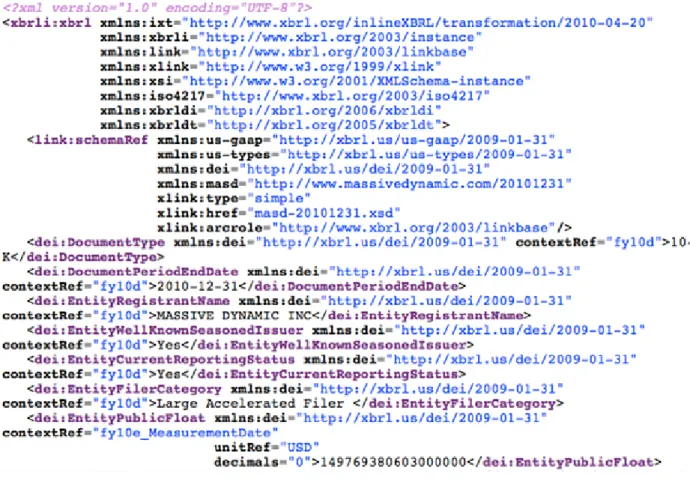
When the provider has decided to use certain taxonomy and made possible extensions to it as well as done with tagging the data points, the final XBRL-coded instance document is ready to be sent to intermediaries. After receiving the instance document, the intermediaries can read and process it with their XBRL-enabled application immediately. (Wu and Vasarhelyi 2003.) Boritz and No (2004) explain that only numbers, texts and parentheses exist in the XBRL instance document, thus it is not human readable, but only computer readable. Plumlee and Plumlee (2008) continue that an XBRL instance document can be also human readable if a style sheet application is added to an XBRL-conversion tool. Figure 2-1 shows what kind of data XBRL contains without a conversion tool. In XBRL, each data point contains semantic information, which makes the data readable for both humans and computers. This functionality erases the need for manual re-entries of data, thus making it valuable feature compared to a traditional financial statements reporting formats such as PDF, HTML or XML, which need a lot of manual work before analyzing with a computer. (Wu and Vasarhelyi 2003.)
Figure 2-1 Example of XBRL code (XBRL.org 2014)
2.1.2. Common Benefits and Attributes in XBRL Adoption
Earlier XBRL literature has investigated the common benefits of XBRL. It helps companies to reduce time and costs in reporting by addressing and eliminating incompatible reporting formats (Weber 2003; Hao et al 2014). Markelevich and Riley (2013) claim that XBRL can facilitate improved information quality and flow of information if company is willing to go beyond the regulative requirements.
Asatiani (2012) has collected most important global attributes associated with XBRL adoption into Table 2-1. XBRL attributes are accessibility, accuracy, comparability, usability, relevance, transparency and understandability. Asatiani (2012) found out in his research that for couple of Finnish regulator organization most important attributes were accessibility, accuracy, comparability, usability, relevance and understandability.
XBRL attributes Description Source
Accessibility XBRL is open standard that can be easily distributed through the Internet. Documents created in XBRL are also compatible with wide range of software contributing further to the accessibility of the information.
Baldwin et al 2006; Farewell and Pinsker 2005
Accuracy The decrease of human intervention in the reporting process and ability to access and check information at any time, increases the accuracy of the reports published using XBRL.
Baldwin et al 2006; Vasarhelyi et al 2010
Comparability Comparability derives from the standardized taxonomy that ensures that tagged items from the different reports refer to the same thing, thus making them easily comparable.
Baldwin et al 2006; Farewell
and Pinsker 2005; Vasarhelyi et al 2010
Usability XBRL is fully compatible and editable with variety of the software, unlike for example PDFs or HTML document there is no need to manually transfer the data into usable format and it is ready “out-of-the-box”.
Farewell and Pinsker 2005
Relevance The possibility of automatization supports the timely delivery of the information and selection of currently needed data by the system.
Baldwin et al 2006; Vasarhelyi et al 2010 Transparency Transparency in XBRL means clear definitions of
each component of the report, ability to easily and quickly analyze the reports are serving that purpose. Hodge et al 2004; Baldwin et al 2006; Pinsker and Li 2008; Vasarhelyi et al 2010; Hao et al 2014 Understandability XBRL has potential to convert financial reports
into information for everybody, not just accountants. The ability to connect elements with each other and administrative footnotes, also easiness to analyze the report with the help of software can enable other stakeholders interested in financial reports, but lacking proper background, to use them in their own benefit with ease.
Vasarhelyi et al 2010
Table 2-1 Summary of literature on XBRL attributes, adopted from Asatiani (2012)
2.1.3. The Use of XBRL around the World
The idea about the XBRL was established in 1998 when Charlie Hoffman presented the idea of XBRL to the AICPA (Roohani and Xianming 2009). In 1999, AICPA established steering committee to develop and promote XBRL and to improve financial reporting (Locke and Lowe 2007). Nowadays, steering committee has expanded to a consortium that consists of more than 700 direct or indirect members in more than 50 countries. Members around the world consist of commercial companies (banks, stock exchange, audit, consulting, and software), non-profit organizations (accountants, securities exchange, banks, analysts) and public authorities (banking supervisors, central registers, central banks, securities regulators, statistical offices, tax authorities). (Eurofiling 2014a.)
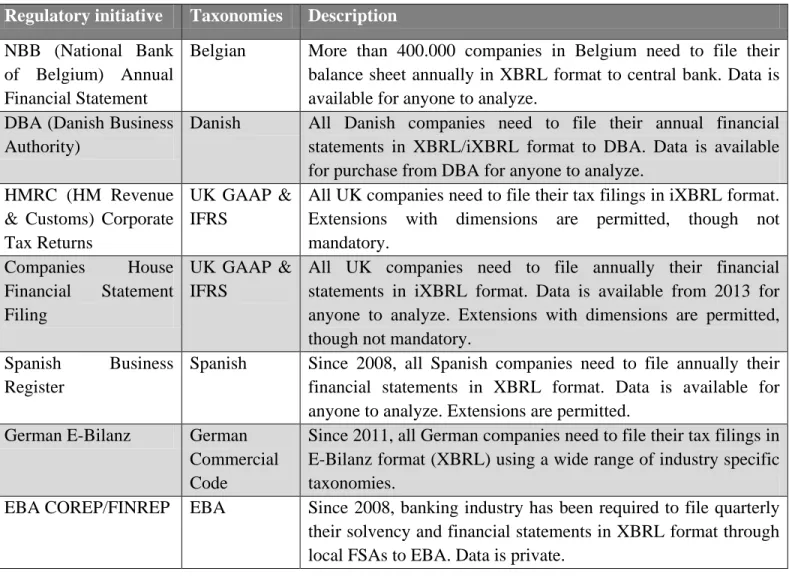
Regulatory initiative Taxonomies Description
NBB (National Bank of Belgium) Annual Financial Statement
Belgian More than 400.000 companies in Belgium need to file their balance sheet annually in XBRL format to central bank. Data is available for anyone to analyze.
DBA (Danish Business Authority)
Danish All Danish companies need to file their annual financial statements in XBRL/iXBRL format to DBA. Data is available for purchase from DBA for anyone to analyze.
HMRC (HM Revenue & Customs) Corporate Tax Returns
UK GAAP & IFRS
All UK companies need to file their tax filings in iXBRL format. Extensions with dimensions are permitted, though not mandatory. Companies House Financial Statement Filing UK GAAP & IFRS
All UK companies need to file annually their financial statements in iXBRL format. Data is available from 2013 for anyone to analyze. Extensions with dimensions are permitted, though not mandatory.
Spanish Business Register
Spanish Since 2008, all Spanish companies need to file annually their financial statements in XBRL format. Data is available for anyone to analyze. Extensions are permitted.
German E-Bilanz German Commercial Code
Since 2011, all German companies need to file their tax filings in E-Bilanz format (XBRL) using a wide range of industry specific taxonomies.
EBA COREP/FINREP EBA Since 2008, banking industry has been required to file quarterly their solvency and financial statements in XBRL format through local FSAs to EBA. Data is private.
Table 2-2 Examples of XBRL's use in EU
Members of worldwide XBRL consortium use XBRL in many different ways. Some of them might use it only to fulfill financial regulatory settings developed by local authorities to monitor and control financial sustainability of reporting organizations (producers). Others might use it to develop taxonomies for the organizations doing the regulative reports (systemizers) and some of them, usually analysts or investors, use XBRL to analyze and understand the risks and performance involved with organizations they are analyzing (users). (XBRL International 2014a.) Table 2-2 shows couple of local and global regulatory initiatives in Europe (XBRL International 2014b).
The use of XBRL is initiated by regulators around the world. This however, does not mean that all the different countries would have the same legislation or accounting standards. Actually they all differ in some way, but still XBRL can fit for them all as XBRL taxonomies can be modified or “extended” to various reporting scenarios. Therefore, each country needs to have their own taxonomy.
A good and clear example is the difference in IFRS (International Financial Reporting Standards), UK GAAP (Generally Accepted Accounting Principles) and COREP reporting. All reports have differencies compared to each other, while most data might be similar in each report. Reason for this is to support decision makers in variety of countries and institutions to make better decisions from data they have learned to process over time. This also means that these regulative reporting procedures need to carry their own XBRL taxonomy in order for companies to be able to report according to these standards (Wu and Vasarhelyi, 2003). Some companies may need to report under several regulative standards which have different purpose for different regulators. Thus, each country may have many different XBRL taxonomies for different industries and reporting initiatives as well as taxonomies for companies of different sizes.
For example, in UK, they have several optional taxonomies in use: IFRS, FRS 100, FRS 101, FRS 102, FRS 103, FRSSE, SORPS and plenty of more. Most importantly, all listed companies are required to to use IFRS taxonomy. Other companies have had the possibility to choose to follow UK GAAP or IFRS taxonomy. Whereas, smaller companies have had the possibility to
choose to use FRSSE (Financial Reporting Standard for Smaller Entities). However, in the beginning of 2015, UK has regulated three new Financial Reporting Standards mandatorily in use (FRS 100, 101 and 102), these standards brings new options for UK entities and organizations. Eventually, SORPS (Statement of Recommented Practise), which is the old reporting standard for companies that operate within specialised sectors, will be replaced by FRS 102. In addition to the above new standards, Financial Reporting Council (FRC) issued standard FRS 103 is for insurance companies. (FRC 2014.)
Another example is from U.S., where they have taxonomies for dozens of different purposes or fields of business. Similarly to UK, U.S. have financial reporting taxonomy for commercial and industrial companies (U.S. GAAP CI), banking and savings institutions (U.S. GAAP BASI) and for insurance companies (U.S. GAAP INS) (XBRL US, 2014). Locke and Lowe (2007) remind that these taxonomies are based on accounting standards and regulator specifications and the outcome is reported to external parties.
Around the globe, XBRL is used mainly to transfer unambiguously aggregated information about company’s performance from company to company/regulator. From (local) government agencies to central government agency. From subsidiaries to headquarters. From suppliers to customers. Information they are transferring to each other is usually at a summary level. This kind of information can be suitable for making a variety of decisions in each end and it is everything one needs. However, when the summaries are separated from original systems, lots of details of the original transactions become unavailable leaving summaries out of questions in accounting reporting. (XBRL International 2014c.)
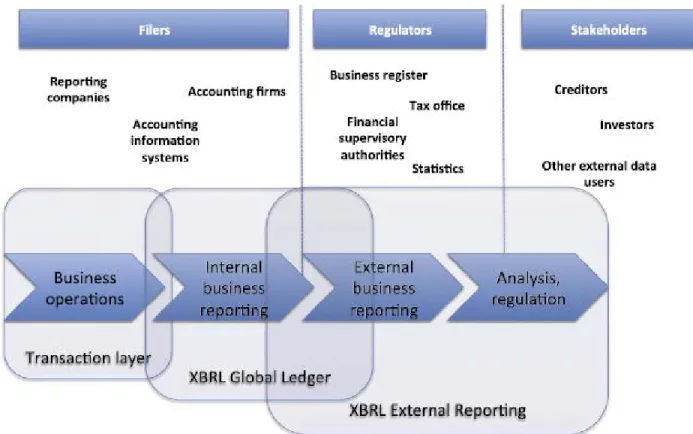
Even though the external reporting has been the main focus area of many regulative reporting initiatives, XBRL fits also for other tasks as described in Figure 3. XBRL enables also transactions layer, which can be used to improve accounting data. Additionally, XBRL GL (Global Ledger), which is a standardized way to store and process operational (transactions) data and data specifications included in an accounting or ERP systems (XBRL International 2014c), to update general ledger and to generate financial reports (Bizarro and Cargia 2011). The use of XBRL GL taxonomy requires more internal work from the company that reports, because they
need to understand XBRL technology (Locke and Lowe 2007) and use sophisticated ERP or accounting systems with XBRL enabled add-ons.
Figure 2-2 XBRL reporting supply chain (Eirle et al 2014)
As mentioned in Table 2-2, XBRL can also be used in tax reporting. In UK, it is mandatory for private companies to file their tax and revenue reports by using the inline XBRL (Brands 2012; HMRC 2014). Monterio (2011) believes that the amount of XBRL related tax reporting initatives for companies will continue to grow in near future as the tax regulators around the world have seen proof of XBRL’s benefits in tax reporting.
One could argue that regulation and throught that, the amount of deliverables continues to grow. For example, some organizations may need to report several different reports to authorities just from different sides of the business. However, authorities in some countries have combined their strenghts and started to combine different reporting requirements from several authorities into one taxonomy. This kind of standardization project is called Standard Business Reporting (SBR)
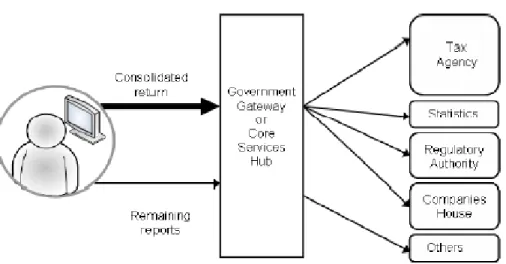
and its purpose is to reduce the burden of regulative and other forms of reporting for SMEs (Cohen 2006; Alles 2009). Eirle et al (2014) seize the idea behind the SBR: government has only one common gateway for individual filers to return their deliverables. This, channel is linked to all governmental agencies and they have the access to the data layers they need, see Figure 2-3. Multiple SBR projects are in place, for example, in Australia, Belgium, Netherlands, New Zealand, Singapore (OECD 2009; Debreceny and Farewell 2010) and Finland (Eirle et al 2014; Tieke 2014).
Figure 2-3 Governmental gateway (OECD 2009)
If current technological trend in financial reporting goes on, the XBRL is expected by XBRL International assurance working group’s one scenario to be the primary and only format in which companies needs to publicly report their financial statements (XBRL International 2006; Boriz and No 2009). This way the process would be much easier than it is currently in most countries, where financial statements need to be handed out in PDF and XBRL format. This is the case at least with the listed companies in U.S. and UK (SEC 2009; FRC 2014). Plumlee and Plumlee (2008) estimate that in the near future XBRL tags are included into an accounting and ERP systems, pushing tagging into the report creation process.
As stated earlier, banking industry is so far one of the biggest user segments in XBRL and they have used it for over decade. For example, in February 2002 Australian Prudential Regulation Authority (APRA), regulating banks, was the first institution in the world to allow XBRL
submission from banks, insurance companies ans funds (Doolin and Troshani 2007; Cordery et al 2011). Another example is in the U.S. where banks have needed to report quarterly the Call Report to the Federal Financial Institutions Examination Council (FFIEC) in XBRL format since 2006 (Alles and Debreceny 2012). Last example, is from EU, where FSAs have been regulated to send their local banks COREP reports quarterly in XBRL format since the beginning of 2014 (Bonsón et al 2010). Eventually, this leads to a situation where banks are also obligated to send COREP in XBRL format to local FSA.
In the future, the use of XBRL will continue to grow and cut the regulative burdens from the reporting by automating it. It is also possible that there will be new kinds of applications to use and take advantage of XBRL. European Securities and Markets Authority (ESMA) have also prepared an Article 4 § 7a which demands all publicly traded companies in EU to do all of their annual financial reports within XBRL format starting from January 1, 2020 (XBRL Europe 2014).
2.1.4. Implementation Methods
Earlier literature has identified couple of different ways to name the implementation methods for XBRL. Figure 2-4 indicates the most popular ways to name the implementation methods, their relations to similar methods (on a column basis) with different name and the author of origin (on a row basis). Following subchapters will follow the Garner et al (2013) classification with one minor change; “high adoption” will be named as “advanced adoption”, because it better fits in this study. Subchapters will also discuss studies from Garbellotto (2009) and Henderson et al (2012).
Figure 2-4 Earlier studies on XBRL implementation
Garner et al 2013 Garbellotto 2009 Inter-organizationally Inter-organizationally Inter-organizationally Henderson et al 2012
Inter-organizationally & Internally Deeply embedded
Nonadoption Low Adoption Medium Adoption High Adoption (Advanced)
Outsourcing Bolt-on Built-in
Non Adoption
This group of organizations has not taken XBRL in use at any forms. The nonadoption occurs when an organization lacks trading partners or regulatory agencies who are using XBRL and requiring their stakeholders to use it. Thus, organizations in this group avoid timely and monetary costs associated with XBRL conversion but simultaneously are passing by the benefits of using XBRL. (Garner et al 2013.)
Low Adoption
As figure 5 indicates, the low adoption approach is practically outsourcing. When organizations decide to outsource their financial reports’ XBRL conversion and filing to a third party, they simultaneously decide not to remarkably change their internal information systems. For many organizations, the outsourcing has been the best approach, as they perceive outsourcing to be cheaper, and they know they do not have XBRL tagging expertise in-house or they simply do not want to purchase an XBRL mapping tool. (Garner et al 2013.) It can be a permanent solution for some organizations due to environmental difficulties and risks or a way of starting transition from zero XBRL expertise at the beginning of new regulatory arrangement (XBRL International 2014d). Thus, organizations typically outsource these processes and rarely do them by themselves (Markelevich and Riley 2013).
Outsourcing process is relatively fast as it typically takes only three to four months to complete. Usually, outsourcing XBRL conversion and filing involves tight collaboration with a third party expert. The collaboration can be achieved by using sophisticated tools, which allow the outsourcing organization to do some of the work by themselves. (XBRL International 2014d.) Organization just prepares the plain text documents, sends them to vendor for conversion into XBRL (Markelevich and Riley 2013) and before sending final XBRL instance documents to appropriate regulator or trading partner, the organization needs to validate the accuracy and completeness of the work performed by the vendor (Garner et al 2013).
The advantage of outsourcing is that organization submitting the documents do not need to have any XBRL knowledge. Additionally, organizations can save lots of time by outsourcing XBRL conversion compared to converting XBRL documents in-house.
Medium Adoption
Organizations with advanced reporting requirements and pervasive reporting processes that are severe, costly and doctrinaire to change are often medium adopters. This level is the cheapest solution for in-house XBRL conversion. (XBRL International 2014d.) Medium adoption refers to bolt-on approach, where organization buys XBRL mapping tool to convert financial data in-house into XBRL instance document to meet regulatory or trading-partner requirements (Garner et al 2013). Organization can retain their existing information systems and reporting process, as the mapping tool is just separate additional tool (SaaS) or add-on (Microsoft Excel or Word) which can be planted in the reporting process by “bolting on” (Garbellotto 2009a).
Use of some bolt-on software requires considerably XBRL knowledge and decision making in selecting tags for financial data. Usually the level of XBRL related knowledge in using bolt-on software is dependent on what is being reported. Organizations continue to use bolt-on solution to ensure that they fully control the process of making regulatory reports and simply because it is so cheap. (XBRL International 2014d.)
The time spend in the complete XBRL conversion process, including the software selection process, creating first set of XBRL instance documents has been estimated to take about half a year. Garbellotto (2009a) claims that the cost of XBRL mapping tool is only around $1.000, whereas Weirich and Harrast (2010) go a step ahead and estimate that the first submission by using bolt-on tool would cost between $40.000 and $82.000 for staff and software time. Thus, after purchasing the software, organization needs to train personnel to use it, make decisions about the taxonomy and tags, and create a repeatable process for the mapping and the conversion. The learning curve between first and second submission can be very radical. U.S. Securities and Exchange Commission (SEC) experienced in their Voluntary Filing Program (VFP) that the decrease would be around 70 percent (average costs: 1. submission $30.933 & 2. submission $9.0601). (Garbellotto 2009a.)
Organizations who use medium adoption spend lots of money and staff time to convert their documents into XBRL instance documents. Notwithstanding, they do and control the conversion process themselves, the XBRL is not fully integrated into their accounting systems. Therefore
they cannot use XBRL in internal purposes, thereby cannot fully utilize the efficiency advantages of XBRL. Organizations that have medium adoption need to update accounting system and XBRL tags if organization voluntarily does or regulator mandates any changes. The advantage over low adoption is that XBRL tags can be used for other purposes later. (Garner et al 2013.) Advanced Adoption
Organizations using advanced adoption have the possibility to take full advantage of the benefits associated to XBRL implementation (Garner et al 2013). Garbellotto (2009b) states that in this level of adoption, the XBRL conversion belongs to the reporting process naturally rather than being a separate part of the reporting process. By this Garbellotto (2009b) refers to a bolt-on approach, which has an output of conversion from Excel spreadsheet that does not have any connection to the accounting systems and the data. Under these circumstances, Garner et al (2013) state that the advanced adopters “maintain full control over the conversion process, boast an easier transmission of internal financial data, and have the potential to realize lower total reporting costs”.
Organizations with advanced adoption need to maintain continuously superior XBRL expertise and initially make great investment in hardware and/or software needed in the XBRL conversion process. Advanced adoption has similar problems than ones in medium adoption; if regulation or trading partner requirements changes, both accounting system and XBRL tags may need to be updated. These changes might bring mistakes and inconveniencies into the XBRL reporting process.
Most of the advanced adoption organizations avoid these problems by using XBRL GL framework. As said earlier, this framework allows different financial systems to communicate, leading to more accurate and faster information supply chain. Therefore, XBRL GL software can be substantially cheaper in money and timely measures than corresponding Enterprise Resource Planning ERP system. Additionally it offers a more efficient way to connect internal systems than making the decision to purchase for example new ERP system. Managers and decision makers can find the use of XBRL GL very useful. (Garner et al 2013.) However, Locke and
Lowe (2007) and Cohen (2009) continue that if an organization wants fully utilize XBRL’s efficiencies; they have to combine the XBRL GL and XBRL for external reporting.
Garbellotto (2009b; 2009c) has divided the most complex level of adoption into two categories, firstly to built-in approach and secondly to deeply embedded approach, see figure 5. The difference between these two categories is mostly related to the use of XBRL reporting. The built-in is lighter version of these two, yet it covers only inter-organizational implementation of XBRL reporting. The heavier version, deeply embedded approach covers both inter-organizational and internal implementation of XBRL reporting. (Garbellotto 2009b; Garbellotto 2009c.) This means that within deeply embedded approach organization is able to also internally fully utilize the benefits of XBRL and substantially reduce the amount of money and time used for overall reporting. Thanks to the fact that multiple software inside the organization can function together, such as general ledger and payroll. (Garner et al 2013.) Stantial (2007) found one case where advanced adoption compared to nonadoption saved 25 percent in time and cost of organizational reporting as they had deeply embedded systems.
Compared to bolt-on strategy, the built-in is more complex, but still its benefits are for example that it automatically combines different reports, it enables single reporting process, easier responding to changing reporting requirements and easier transition to deeply embedded approach. In built-in approach, organization cannot separate the reports creation process and conversion to XBRL format. (Garbellotto 2009b.) In this approach, organizations may use XBRL GL taxonomy to standardize their trial balance accounts and amounts to correspond with the XBRL taxonomy (Garbellotto 2009b). Markelevich and Riley (2013) claim that not all organizations can realize the same benefits, nor have similar costs from the integration.
Deeply embedded approach is the most complex of all the approaches presented above and its implementation demands careful planning. In this approach, organization’s financial data and links among XBRL usage are standardized by using XBRL GL taxonomy. Thus, the entire reporting process is automated including every original piece of information. Additionally, organization can create clear and accessible audit trail (Baldwin et al., 2006; Garbellotto, 2009c) and use the same information for multiple purposes easily (Garbellotto, 2009c). In result, XBRL
enables organization to form consistent information supply chain, where uniform business rules, controls and analysis can be applied to the standardized data regardless to the initial software with what the data has been formed or where the data locates. XBRL can also be embedded to organization’s ERP system; therefore, it can be used to internal reporting and information management. Yet, XBRL does not replace existing information technology infrastructure rather it is a supplement and it can be implemented gradually, starting from a single process or a business unit. (Garbellotto 2009c.)
Finding the Right Approach
Janvrin and No (2012) found four themes affecting to an XBRL implementation from existing literature. The four themes are management support and involvement, implementation approach, organizational readiness or expertise and control over XBRL reporting process. Thus, in information system adoption the most important factor is the support from top management. Yet, organization’s decision to either outsource or insource the XBRL process, financial and technical readiness and the level of control over XBRL reporting process affects greatly on XBRL implementation. (Janvrin and No 2012.)
Harding (2010) finds that in most cases, the first approach for XBRL implementation to organizations is to take advantage of outsourcing for the production of first few reports and after organizations internal XBRL knowledge and expertise has increased, to move to produce XBRL instance documents by themselves. Markelevich and Riley (2013) have counter argument as from their experience organizations normally start with bolt-on tool as it is easy to implement and it requires only little amount of XBRL expertise. When organization chooses among all the implementation approaches, they must scale the XBRL implementation project’s control, costs, knowledge, level of commitment, timing and the purpose for XBRL internally in the future (Harding 2010).
Figure 2-5 XBRL adoption levels
Markelevich and Riley (2013) claim that none of the approaches presented in figure 2-5 are necessarily better than others, as one approach cannot be a fit for all of the organizations. Besides, the success of chosen approach is dependent on multiple factors, like Cordery et al (2011), and Markelevich and Riley (2013) notice, the company size plays an important role in determining the XBRL adoption: larger organizations are more likely to adopt XBRL voluntarily. Organization should also consider following facts before choosing the approach for XBRL document creation. The type of present information systems, number of current IS data sources, prevailing quality of IS information, as well as the size and frequency of organizations reporting. Biggest benefit from XBRL for organizations is currently having disintegrated IS. Several organizations have disconnection between their external reporting and rest of the organization (i.e. compliance, governance, managerial accounting, risk management and tax). XBRL integration leads to a situation where the entire organization uses the same data, even though it can be used differently within each department. (Markelevich and Riley 2013.)
When XBRL is used for tagging the raw accounting data, that data can be used throughout the organization for consolidation, data transfer, internal auditing and compliance tasks. Tagging can be done with the XBRL GL, which was made for tagging financial and nonfinancial data at transactional level. As said before, under these circumstances, it erases manual reentries of data, ease the flow of information supply chain, and improves the data quality in an organization. (Markelevich and Riley 2013.)
An organization would have fewer benefits from XBRL if their prevailing information quality was high, with only couple of known problems. Same thing when an organization creates infrequently structured financial reports. Therefore, XBRL is most valuable for organizations reporting frequently and/or if the organization has several problems with the data. Even though organization’s prevailing ERP system could do similar things than XBRL, decision maker should remember that most of the ERP systems are proprietary and XBRL is open and free format for everybody.
2.2.
COREP Reporting
In 2006, Committee of European Banking Supervisors (CEBS), currently European Banking Authority (EBA), developed guidelines for Common Reporting (COREP). COREP is a standardized reporting framework following EU wide Capital Requirement Directive IV (CRD) and Capital Requirement Regulation (CRR). CRD IV and CRR have been created to serve global BASEL III agreement. BASEL III agreement, CRD IV and CRR came into force in the beginning of 2014 (Better regulation 2015). Outcome of the COREP was to deliver a prudential reporting scheme for institutions to communicate their results in a standardized way (EBA 2010). The COREP reporting covers credit risk, market risk, operational risk, capital adequacy and large exposures (own funds) based on the Directives 2006/48/EC and 2006/49/EC (EBA 2010; FCA UK 2014). Almost 30 countries in Europe are using COREP reporting and around 8.000 banks (Eurofiling 2014b), building societies and investment firms report it to their local FSA quarterly (Accenture 2014).
BASEL III agreement is above all the banking field’s agreements and it is associated with capital measurement and capital standards around the world (Apostolou & Nanopoulos 2009, 270; Bonsón et al 2010). It stands behind “three pillars” concept: firstly, minimum capital requirements (addressing risk), secondly, supervisory review, and thirdly, market discipline (Decamps et al 2003). Goal of the agreement is to enhance collaboration of Supervisory Authorities (Boixo and Flores 2005). In Europe, EBA regulates the banking industry accordance with the global BASEL III agreement.
The EBA is an independent EU Authority to supervise and control European-banking sector through effective and consistent regulations. EBA’s main objective is to maintain financial stability in the EU. It was established in the beginning of 2011 to take control of its predecessors, Committee of European Banking Supervisors (CEBS), existing tasks and responsibilities. (EBA 2014b.)
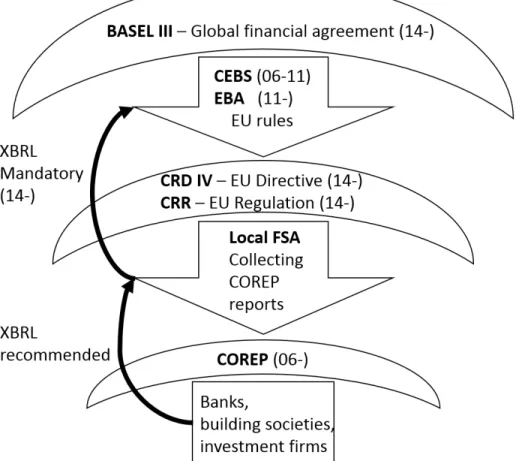
Figure 2-6 COREP supply chain
Figure 2-6 shows rough COREP supply chain, where BASEL III is an umbrella term that gives guidance for European financial sector’s rules. In Europe, EBA amends these global rules in practice with CRD IV and CRR. COREP reporting belongs into the CRD IV and CRR framework. Local Financial Supervisory Authorities (FSA) collects COREP reports from regulated organizations. Each local FSAs have mandate to decide themselves how to gather COREP reports, but staring from January 1, 2014, they are obligated to deliver all the COREP
reports to EBA within XBRL format. Thus, EBA recommends local FSAs also to gather the data on XBRL format. For practicality issues, EBA have created a model COREP template for local FSAs that they can use to collect the data from regulated organizations. Regulated organizations fulfill the template that local FSA distributes to them, transforms it into an XBRL instance document and send it back to the local FSA. COREP reporting is done quarterly. (Eurofiling 2014b.)
2.3.
The Significance of the Change in Technology Adoption
The change in organization/business processes can be distinguished in two different ways, incrementally or radically. Incremental change is continuous path starting from existing processes, proceeding step-by-step to its goal by carrying only moderate operational risk. Radical change is done once from clean table by carrying higher operational risks. Different elements of the incremental and radical change are shown in Table 2-3.
Improvement Innovation
Level of change Incremental Radical
Starting Point Existing Process Clean Slate Frequency of Change One-time/continuous One-time
Time Required Short Long
Participation Bottom-up Top-Down
Typical Scope Narrow, within functions Broad, cross-functional
Risk Moderate High
Primary Enabler Statistical Control Information Technology
Type of Change Cultural Cultural/Structural
Table 2-3 Comparison among incremental and radical change, adopted from Saarinen, T., Aalto University School of Business (2013)
These two approaches are used in very different situations. For example, incremental change is better when company needs to cut costs or change their existing process to be more efficient, thus improving processes. Additionally, Cooper and Markus (1995) describe that incremental
change works better in humane change projects, where company needs to train personnel and give personnel keys to do the needed change in processes by themselves. Jarvenpaa and Stoddard (1998) stated that successful companies re-engineer their processes in incremental steps started by discontinuous radical change. Radical change alone is accomplished with business process re-engineering, which is about making huge steps in performance by acting fast in radical projects. To be successful in re-engineering, the project must be top-down driven and the change motivation must become from performance crisis. (Jarvenpaa and Stoddard, 1998.) Thus, radical change works better if organization’s “back is against the wall”, and it needs to think outside the box and brake the wall behind to create new opportunities or when company innovates new business opportunities.
2.3.1. Incremental Change
The incremental change model is linked to the sociotechnical change approach, where the change is influenced both hard and soft system changes. In incremental change model, employees who are recipients of the change must work and implement the change. Employees and leadership of existing process are used in change management and the communication about the change is wide and open for all. The speed of the change is determined by the capabilities of existing employees, thus milestones are flexible. Therefore, the pace of this type of change should be comfortable for existing employees and to all other internal and external constraints, which company have at the point of change. The motivation for the change comes from internal dissatisfaction for existing processes and the feeling for doing better. Before IT takes place and consolidates new processes, these new processes are stressed by piloting them. Additionally, incremental change model assumes that change is most suitable in tiny steps at a time. (Jarvenpaa and Stoddard, 1998.) Ettlie et al (1984) state that incremental change adoption tends to happen more likely within large, complex and decentralized companies that dominate markets with their growth strategies.
The major advantage of the incremental model is that the general risk of failure is small because many existing employees participate in the change, thus each employee can feel ownership for the changes happening. In general, incremental model increases company’s capacity for change.