Frankfurt, 14th May 2013
German Private Equity Barometer: 1
stQuarter 2013
German Private Equity Barometer
– produced in collaboration between BVK and KfW Bankengruppe –
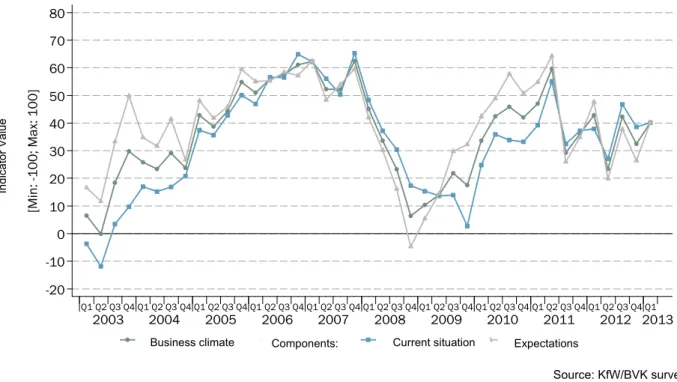
Relatively optimistic economic forecasts are leading to a brighter business outlook on the German investment market in spring 2013. The German Private Equity Barometer has climbed 7.6 points to 40.1 during the first quarter of this year. But beneath the rise in the Barometer lie movements in two contrary directions: whereas the mood in the later-stage segment shows clear signs of an upturn, the Barometer remains static in the early-stage segment. Unlike in the later-stage, overall economic optimism has yet to translate into improved conditions for early-stage fund-raising and exit activities.
-20 -10 0 10 20 30 40 50 60 70 80 Indikatorwert [Min: -100; Max: 100] Q1 Q2 Q3 Q4 Q1 Q2 Q3 Q4 Q1 Q2 Q3 Q4 Q1 Q2 Q3 Q4 Q1 Q2 Q3 Q4 Q1 Q2 Q3 Q4 Q1 Q2 Q3 Q4 Q1 Q2 Q3 Q4 Q1 Q2 Q3 Q4 Q1 Q2 Q3 Q4 Q1 2003 2004 2005 2006 2007 2008 2009 2010 2011 2012 2013
Geschäftsklima Komponenten: Geschäftslage Geschäftserwartung
Source: KfW/BVK survey.
Figure 1: German Private Equity Barometer
The German Private Equity Barometer provides an overall indicator of the climate in the German equity investment market. It also includes two component indicators, namely the current business situation and business expectations for the next six months. Indicators for the business situation and business expectations are calculated as net balances of the percentages of “good” and “bad” responses received from the investment companies taking part in the survey. The overall business climate indicator is derived as an average of these figures. The German Private Equity Barometer has been published on a quarterly basis, exclusively in the Handelsblatt newspaper, since November 2003.
After a significant fall in the fourth quarter of 2012, the German Private Equity Barometer (GPEB) has started the year by returning to an upward path. This is due in particular to increased optimism in the later-stage investment area. The business climate indicator, which
Business climate Components: Current situation Expectations
Indi ca to r V a lue
is produced jointly by BVK (the German Private Equity and Venture Capital Association) and KfW, climbed from 32.5 to 40.1 points in the first quarter, surpassing its long-term average by 4 points.
The indicator for the current business position and the indicator for business expectations over the next six months both made gains (+1.5 points and +13.8 points respectively) (Figure 2). 2008 2009 2010 2011 2012 2013 Aufschwung Lage unterdurchschnittlich Erwartung überdurchschnittlich Boom Lage überdurchschnittlich Erwartung überdurchschnittlich Abschwung Lage überdurchschnittlich Erwartung unterdurchschnittlich Rezession Lage unterdurchschnittlich Erwartung unterdurchschnittlich -50 -40 -30 -20 -10 0 10 20 30 40 50 Mittelwertbereinigte Geschäftserwartung -50 -40 -30 -20 -10 0 10 20 30 40 50 Mittelwertbereinigtes Lageurteil Source: KfW/BVK survey.
Figure 2: German Private Equity Barometer – Economic Trend Monitor
The Economic Trend Monitor shows the mean-adjusted values for the German Private Equity Barometer indicators for the current business situation and for business expectations, and allocates them into one of four base scenarios: upturn, boom, downturn and recession. In an ideal economic situation, these scenarios would progress in the sequence listed.
The main stimulus for the improved sentiment evident on the equity investment market has come from macro-economic developments. Throughout, investment financiers have made a massive upward correction to their business forecasts at the start of the year. The sub-indicator for the overall economic development demonstrates the second-largest increase (+58.4 points) since the Barometer was established in 2003.
In addition, equity financiers report a marked improvement in deals completed, both in early-stage and later-early-stage: on balance, they assess the demand for equity capital, the quality of investment proposals (business plans) and entry valuations for potential portfolio companies as all being “good” or “very good”.
Against this background, it is surprising that in the first quarter of 2013 a marked improvement business climate has only been evident in the later-stage segment. One of the
Mean adjusted current situation
Mean a d ju st ed ex pec a tion s Upswing Boom Recession Downturn
reasons for this may well be the particular reticence which investors still display towards early-stage investment.
Dr Jörg Zeuner, Chief Economist at KfW Bankengruppe, finds this surprising: “Market conditions are positive, and institutional investors are searching hard for high-yield investment opportunities. This should really be making fund-raising easier for venture capitalists. What we are finding instead is that more than half of all early-stage financiers still see the fund-raising situation as poor. We watch this situation with some concern, as private funding to finance innovation is not forthcoming, even though the quality of the investment proposals submitted seems promising.”
Ulrike Hinrichs, Managing Director of BVK, adds: “Although fund-raising is a challenge for every investment company at the present time, I am optimistic that German venture capital companies will stand their ground against their international rivals in the competition for capital. Institutional investors know the value of Germany as an investment location. Its attractiveness is borne out by a number of factors, not least the very positive assessments expressed by investment companies with regard to deal flow quality and volume, and the extremely promising outlook indicated by business forecasts.”
Early-stage
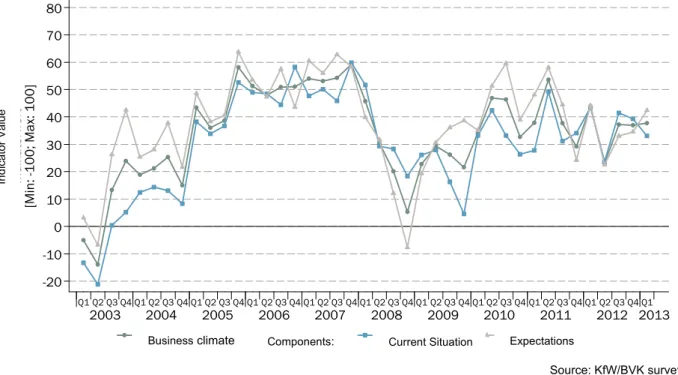
The mood among early-stage financiers was unchanged in the first quarter of 2013. The business climate index for the early-stage segment rose by 2.1 points to 39, a marginal increase on the previous quarter. Business expectations for the next six months did in fact improve, from 35 points to 43. However, this was off-set by a deterioration (from 39 points to 34) in the assessment of the current situation in the first quarter of 2013.
-20 -10 0 10 20 30 40 50 60 70 80 Indikatorwert [Min: -100; Max: 100] Q1 Q2 Q3 Q4 Q1 Q2 Q3 Q4 Q1 Q2 Q3 Q4 Q1 Q2 Q3 Q4 Q1 Q2 Q3 Q4 Q1 Q2 Q3 Q4 Q1 Q2 Q3 Q4 Q1 Q2 Q3 Q4 Q1 Q2 Q3 Q4 Q1 Q2 Q3 Q4 Q1 2003 2004 2005 2006 2007 2008 2009 2010 2011 2012 2013
Geschäftsklima Komponenten: Geschäftslage Geschäftserwartung
Source: KfW/BVK survey.
Figure 3: German Private Equity Barometer – Early-stage
Among early-stage investors, the main factors adversely affecting the climate are the lack of recovery in fund-raising prospects and the poor quality of exit options, which are assessed as being significantly worse than in the preceding quarter. This is rather surprising, given the background of:
- generally low interest rates at present (putting pressure on institutional investors to make investments),
- positive developments in the economy
- low prices for potential deals, and
- an improved exit situation in the later-stage segment
The early-stage segment is clearly still suffering from a marked reticence on the part of both potential providers of capital and potential buyers of portfolio firms.
Later-stage
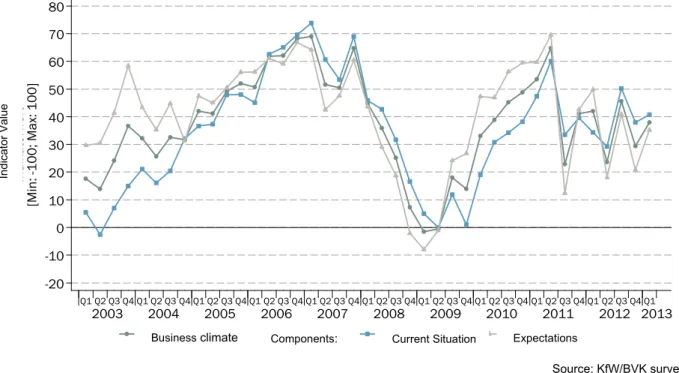
Unlike the early-stage segment, in the first quarter of 2013 the business climate index for private equity financiers in the later-stage segment has made a significant recovery from its earlier drop. The indicator climbed 8.6 points to 38. This brightening of sentiment reflects in particular an improvement in business expectations (+14.4 points), whereas assessments of the current business position have only moved slightly upwards (+2.7 points).
Business climate Components: Current Situation Expectations
Indi ca to r V a lu e
-20 -10 0 10 20 30 40 50 60 70 80 Indikatorwert [Min: -100; Max: 100] Q1 Q2 Q3 Q4 Q1 Q2 Q3 Q4 Q1 Q2 Q3 Q4 Q1 Q2 Q3 Q4 Q1 Q2 Q3 Q4 Q1 Q2 Q3 Q4 Q1 Q2 Q3 Q4 Q1 Q2 Q3 Q4 Q1 Q2 Q3 Q4 Q1 Q2 Q3 Q4 Q1 2003 2004 2005 2006 2007 2008 2009 2010 2011 2012 2013
Geschäftsklima Komponenten: Geschäftslage Geschäftserwartung
Source: KfW/BVK survey.
Figure 4: German Private Equity Barometer – Late-stage
Unlike the early-stage sector, the positive overall economic conditions do work their way through into the fund-raising and exit environment in the later-stage segment of the market: after the depressed atmosphere evident in late 2012, the first quarter sentiments regarding the fund-raising situation and exit opportunities have improved significantly. With regard to the prospects for fund-raising and exit opportunities in six months’ time, private equity financiers are again optimistic.
The positive climate reported in the later-stage area has benefited as well from the low level of interest on capital markets. Later-stage financiers, especially those active in the buy-out sector, frequently use leveraging to finance their transactions. Access to this type of lending has improved significantly in recent times, and this has had a positive influence on financiers’ prospective returns. Another factor driving the more optimistic mood evident in the later-stage segment is the innovation activity being undertaken by companies in Germany.
New calculation method for indicators used in the German Private Equity Barometer
From the first quarter of 2011, some improvements were made to detailed aspects of the indicator calculation method used in the German Private Equity Barometer. At the same time the factor used in the indicator calculation to weight replies from the investment companies who responded to the survey was also modified. The previous weighting, which had a near-linear relationship to the volume managed by a particular investment company, was replaced by a logarithmic weighting. The higher weighting which is now implicitly attributed to smaller investment companies allows for a more appropriate depiction of the mood across the full spectrum of the German investment capital market. This change has led to a marked reduction in the spread of individual GPEB indicators. This new calculation method has also been applied retrospectively to all the periods available. In consequence, values shown in earlier publications are no longer comparable with information published since the first quarter of 2011.
Business climate Components: Current Situation Expectations
Indi ca to r V a lue
Author: Dr Philipp Brutscher, 069 7431-9592, [email protected] Press contact: Christine Volk, 069 7431-386, [email protected]