Estelle M. Phillips
Submitted for the degree of Doctor of Philosophy at University College
ABSTRACT
The main question being addressed by this research was 'how do postgraduate research students experience the process of doing a Ph.D.?' The way this question was investigated was to discover how the students involved solved the problems which confronted them when doing a research degree.
Seven case studies of Ph.D. students and their supervisors are
reported. The student and supervisor pairs caine from different disciplines and two universities. The case studies were conducted through interviews and the repertory grid was used as a tool throughout the three years of field work. Additional methods used included rating forms and free writing. The focus of the study was the postgraduates' changing perceptions of their Ph.D.
The topics investigated in order to monitor these changes included: 1) The students' relationship with their supervisors
2) The difference between what they expected to accomplish in a given time and what they actually did accomplish
3) Writing up the results of their work.
Results indicated that the process was similar in these respects for Arts and Science students. It was found that:
a - it was necessary for students to develop an ability to evaluate their own work. The rate of this development appeared to be related to the degree to which the students were allowed to remain dependent on their supervisors. It is suggested that some kind of 'weaning' process should be introduced into the student and supervisor relationship as the postgraduates develop the self-confidence to monitor their own work.
b - The students' ability to estimate accurately what work they could accomplish in a given period of time did not improve over the three years. The observed discrepancies between what the students expected to achieve and what they actually did achieve are used as the basis for describing a hypothetical mechanism by which plans are revised as goals and time limits are adjusted.
c - Writing helped to clarify thinking but was seen by the postgraduates as a difficult activity and of minor importance. This was because it served specific functions. At the ideas generating stage of the work writing helped the students to think more creatively and at the
presentation of results stage it helped to organize their work into a coherent whole.
d - Their enthusiasm for their Ph.D. diminished due to the length of time they had to spend working on a single problem. The postgraduates' perceptions changed from seeing the Ph.D. as something special and unique to seeing it as a job of work that had to be completed. Throughout this thesis, the students' changing perceptions of their Ph.D.s are presented as vital to completion of the higher degree course.
Page/ 10
16
17
21
25
26
26
29
31
35
38
47
48
53
57
60
6 1—'
62
63
64
65
67
69
75
82
89
90
TABLE OF CONTENTS
ABSTRACT PREFACE CHAPTER 1 INTRODUCTION
The Pilot Study The Present Study CHAPTER 2 SETI'ING THE SCENE
Introduction
Computerized Search
What has been written about research students? What is known about the training of research
students?
What research has been done of people engaged in research?
What is known about planning work as a psychological activity?
What is known about thesis writing? Summary
CHAPTER 3 RELATIONSHIP BETWEEN THE THEORETICAL FRAMEWORK AND THE METHODS USED
Rationale for methodology
The repertory grid and its relationship to personal construct theory
Some criticisms of the repertory grid Implications of using the methods CHAPTER 4 METHOD
Summary of methods Role of researcher
The institutions involved Selection of the cases Confidentiality
The interviews
Repertory Grid methodology Analysis of the Grids
Page
92
93
95
100-1O2
102
103
117
118
125
131
134
137
141143
143
144
151
155
158
162
164
164
166
179
180
183-'
184
187
188
189
190
193
ParagraphsThe overall picture CHAPTER
5
RESULTS AND INTERPRETATIONSGeneral Summary
What is the effect of the student and supervisor relationship on the outcome of the research?
Introduction
The overall picture 1976-1979 The general malaise
(a) Enthusiasm (b) Isolation (c) Boredom
Cd) Job to be completed Changing Perceptions
Section Summary
How did the postgraduates plan their work? Introduction
The First Year The Second Year The Final Year
Changing Perceptions Section Summary
What is the role of writing in learning to do research and to report it?
Approaches to Writing Writing and Thinking Section Summary Summary of Results
CHAPTER
6
SOME METHODOLOGICAL PROBLEMSThe Repertory Grid: Technical Considerations Theoretical Considerations Administrative Considerations The Interviews: Participants
25 3-_ 259 260 264 265 270 27& 277 279 281 289 296-' 195 196 196 197 200 204 210 214 214 215 222 226 CHAPTER 7 DISCUSSION
Introduction
What is the effect of the student and supervisor relationship on the outcome of research?
Divergent perceptions of students and supervisors
What is the role of feedback in the learning process
The role of direction in supervision Students and supervisors
How do postgraduates plan their work? Introduction
The relationship between time and goals
Planning work: Discrepancies between expectation and achievement
A model of the planning process
What is the role of writing in learning to do research and to report it?
The place of pre-writing in the learning process The place of writing in learning to do research Section Summary
CHAPTER 8 PRACTICAL IMPLICATIONS
SUGGESTIONS FOR FUTURE RESEARCH Practical Recommendations
Recommendations regarding students Recommendations regarding supervisors CONCLUS ION
REFERENCES APPENDICES
Letters to set up research Self Rating Scales
Results of Rating Scales Analysis of Grids
The Grids
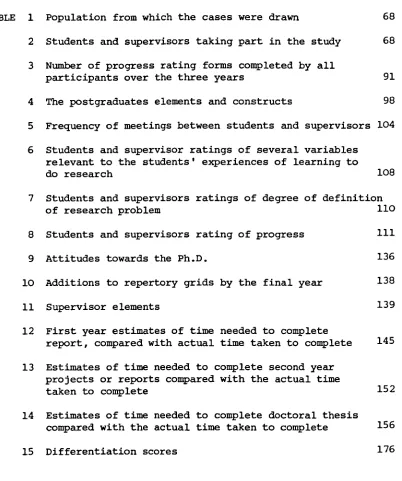
LIST OF TABLES
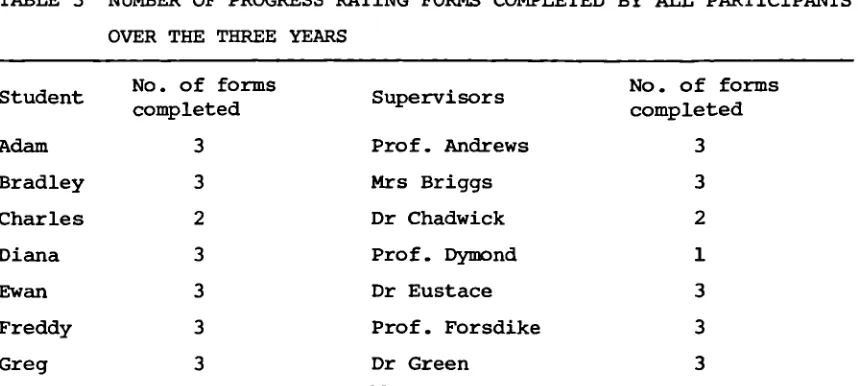
Page TABLE 1 Population from which the cases were drawn 68 2 Students and supervisors taking part in the study 68 3 Number of progress rating forms completed by all
participants over the three years 91
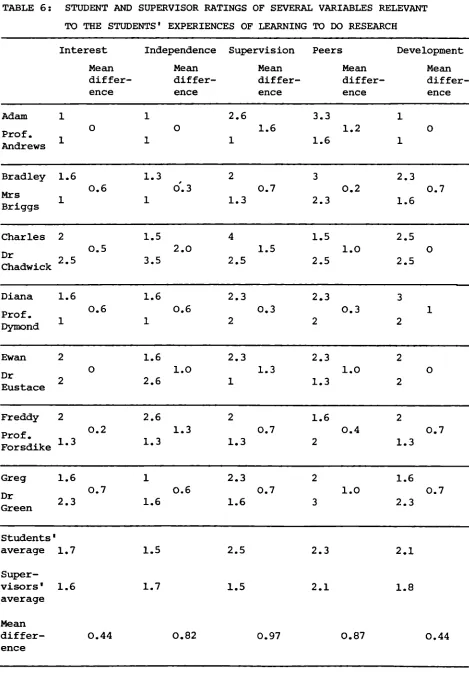
4 The postgraduate s elements and constructs 98 5 Frequency of meetings between students and supervisors 104 6 Students and supervisor ratings of several variables
relevant to the students' experiences of learning to
do research 108
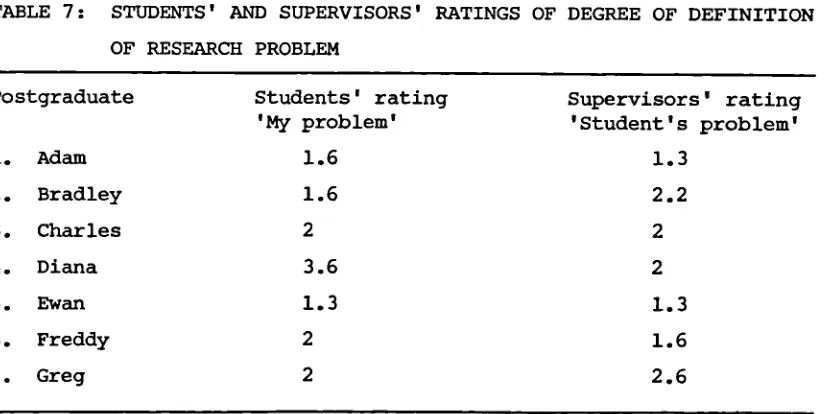
7 Students and supervisors ratings of degree of definition
of research problem 110
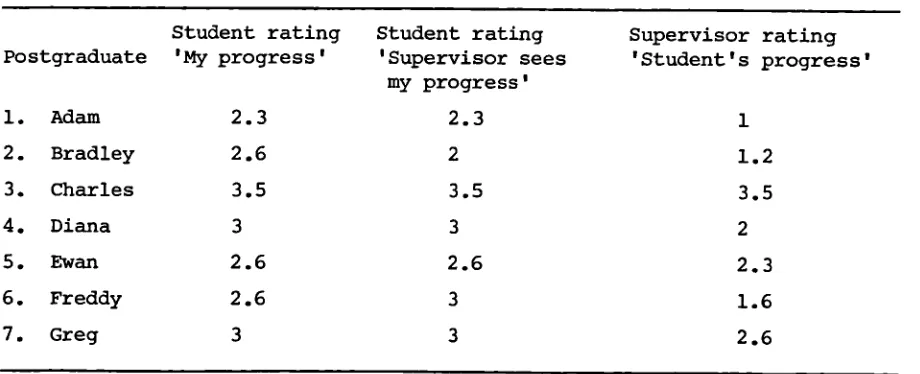
8 Students and supervisors rating of progress 111
9 Attitudes towards the Ph.D. 136
10 Additions to repertory grids by the final year 138
11 Supervisor elements 139
12 First year estimates of time needed to complete
report, compared with actual time taken to complete 145 13 Estimates of time needed to complete second year
projects or reports compared with the actual time
taken to complete 152
14 Estimates of time needed to complete doctoral thesis
compared with the actual time taken to complete 156
LIST OF FIGURES
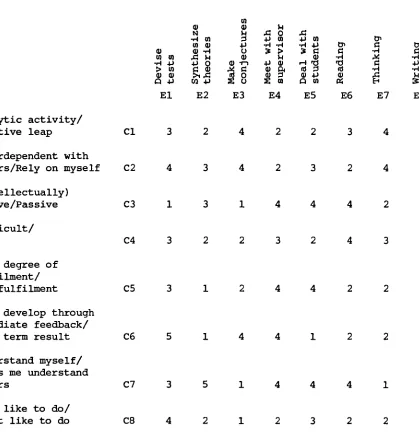
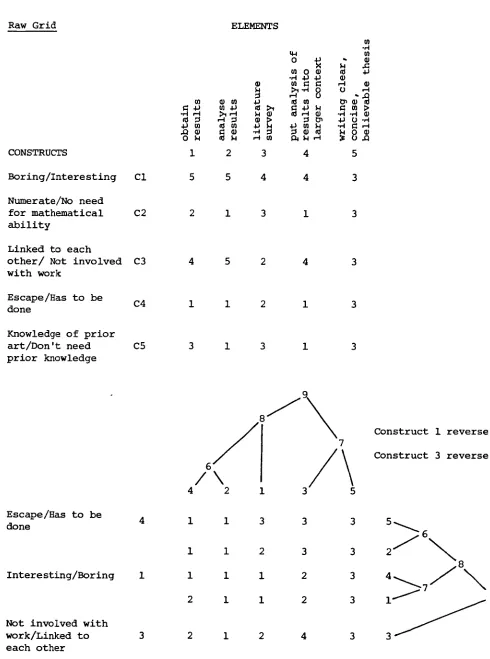
Page FIGURE 1 Raw grid showing elements, constructs and first
set of ratings on a five-point scale of all
elements on all constructs 80
2 The same grid re-sorted by the Focus program and including tree diagrams which show the relationship
between element and construct clusters 85 3 Construct matrix showing
matching scores 289
4 Raw grid 292
5 Elements matching scores matrix 292
6 Construct matching scores matrix 293
7 Focus matrix 293
8 Grid at time 1 294
DEDICATION
ACKNOWLEDGEMENTS
This thesis is concerned with the psychological phenomena involved in doing a Ph.D. The aim of the research was to produce an accurate and comprehensive description of the experiences of a group of postgraduates as they went through the process of learning to do research.
In order to investigate the development of research skills repertory grids, free writing and rating forms were used in conjunction with inter-views. By these means case studies of seven postgraduate research stu-dents and their supervisors, from two universities, were undertaken. The students were interviewed at monthly intervals over the three year period of their postgraduate registration. Their supervisors were inter-viewed twice a year over the same three years.
Throughout this thesis pseudonyms have been used for those partici-pating in the study and the two universities have not been identified. These measures to disguise the students and supervisors have been taken in order to preserve confidentiality and anonymity. Without giving as-surances of this kind the research would not have been possible.
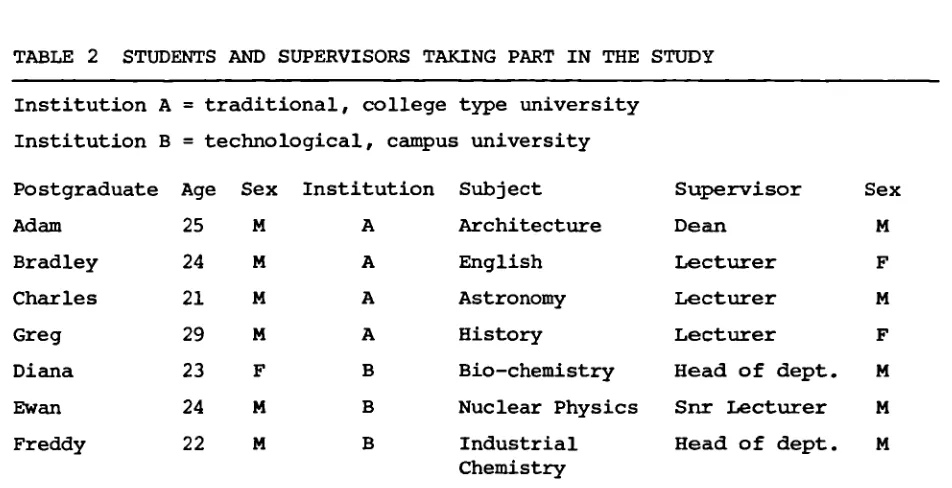
The pseudonyms used for the seven pairs are: Postgraduate Supervisor
Adam - Professor Andrews
Bradley
-Charles
-Diana
-Ewan
-Freddy
-Mrs Briggs Dr Chadwick Professor Dymond Dr Eustace
Professor Forsdike
Greg - Dr Green
Further information, including their subject areas, is given on page 68 of this thesis.
were built up. The way that the measures interrelate is described on page 94, but primarily the grids and paragraphs provided more detailed information on topics introduced in the interviews, while the rating forms provided some quantifiable data. The different methods combined to give a holistic picture of what was happening to the students as they
learned to do research.
Personal Construct Psychology provides the structure for a study where the focus is on the students' point of view. The repertory grid helps to identify personal criteria for students as they monitor their own learning and the meaning of what is happening is described by the students in detail. The repertory grid technique also provides infor-mation on changes over time. Fo these reasons it was decided that using personal construct theory as a conceptual framework from which to view the question of how postgraduate students experience the process of doing a Ph.D. would provide one way to talk about differences in percep-tion. Using repertory grids, rooted in the theory of personal constructs, would provide a useful methodological device for monitoring individuals' perceptions of their situation, and any changes in such perceptions that occurred as time passed. These models of man as a scientist are used in order to help explain what happens when people learn how to do research.
without having to rely on another person's assessment of one's work. It is intricately bound up with the second assumption, concerning the role of feedback in learning to do research. The assumption here is that feed-back, from whatever source and in whatever form, is vital to the progress of the students' work. These two assumptions are relevant to all the re-search described in this thesis.
The expectations, with one important exception, were found to be false during the first year of this study. The false expectations were
1) all new research students would go into the situation with some idea of what they would be doing over the three years. The evi-dence did not support this hypothesis. Even those postgraduates, who thought they knew the area on which they would be working, changed their minds after starting work on it.
2) The research problem would evolve and become more clear as a result of working on it. This did not appear to happen but, as suggested on page 24, it may be that the question was not cor-rectly researched.
3) Any discrepancy between expectation and achievement, in the students' estimates of the work they could manage in a given period of time, would lessen as they progressed through their course. This too, was not corroborated. Reasons for this lack of learning are discussed in relation to planning work and writing it up in chapter 7.
BEFORE AFTER Supervisor F e e d b a. . c k /
0
0
Student F e e d? Ib
a• I C
k
N' B
oh-\of cour why Discussion Supervisor \s\Information •1 Work Student
the experiences of postgraduate research students regardless of whether they were in the Arts or the Sciences, or a traditional, or 'red-brick' university. Some of these general principles are now given in summary form so that the reader may have some conception of what is to follow.
The main finding to come out of the research was that the length of time that it took for the postgraduate students to become autonomous researchers was determined by the relationship they had with their super-visors. The ability of the students to evaluate their own work appeared to be a function of the length of time that the students were allowed to remain dependent on their supervisors. At first the supervisors were the mediators between the students' work and the information it contained regarding their progress.
Student and supervisor interact Student and work are autonomous through the student's work. while the student's relationship
As the postgraduates settled into their research programme they gradually developed the skill to interpret the information contained in their own work together with the self-confidence necessary to base their subsequent actions on that information.
It appeared too, that planning over time was more difficult to do for written than for practical work such as computing or experimenting. Further, that writing seemed to serve two functions; initially it was a creative activity similar to thinking but later it was more of an organ-izational activity that helped to clarify thought and fuse disparate as-pects of the research. For these reasons it was one of the most difficult
activities undertaken by the postgraduates. It was also the activity that was perceived by them as being of relatively minor importance.
The postgraduates' enthusiasm for their Ph.D. diminished due to the length of time they had to spend working on a single problem, but this had an important effect on the development of their work. At first they had seen the Ph.D. as very special and people with doctorates as different from others because they had all made a unique contribution to the de-velopment of knowledge. Later they realized that the thesis was just another job that had to be finished and the 'special' qualities needed were those of persistence, determination and hard work.
Many thousands of postgraduate students learn how to do research by spending a minimum of three years in a university registered for a Ph.D. degree; yet very little is known about the process of learning to do research. This thesis is the result of an attempt to study how a few people tried to do research for the first time. It is concerned with how people solve the problems which confront them when they are doing a research degree.
Both Medawar (1964) and Sacks (1978) have pointed out that the scien-tific literature often creates the erroneous impression that research pro-ceeds logically and with pre-ordained inevitability. Sacks says 'Perhaps what is happening is that the reconstructed logic of the process comes to stand for the process itself' (p.49). It is the aim of this thesis to examine the truth of this view. First, a historical account of the de-velopnient of this study up to the formulation of its questions is given.
The Pilot Study
noted together with subjective estimates of time taken. The trials each took between 15 and 30 minutes.
The result of this experiment showed significant differences between the two groups (p = < .05). The subjects in the 'no feedback' condition waited 0.98 minutes before beginning to write their first trial series of numbers and hypotheses. This was significantly longer than their counter-parts in the 'feedback' group who waited only 0.412 mins. They also took significantly longer (12.43 mins) to complete the problem and announce a rule than the 'feedback' group (7.25 mins). This was regardless of whether or not the solution finally offered was correct. The 'no feedbackt group also overestimated the time it had taken them to complete the task sig-nificantly more than the tfeedbackl group. The differences here were:
No feedback group - 7.81 mins more
than actual time taken. Feedback group - 0.98 mins less
The subjects taking part in this experiment were all asked to rewrite the instructions before and after completing the problem. They all took much longer to rewrite the instructions after they had completed the problem regardless of group and irrespective of whether or not the solution they
* offered was correct.
Some of the questions raised by these results were:
1 - Why did people take longer to start work on a problem when they were not expecting information regarding their progress even though they had the same amount of information about the problem when they started? 2 - Why did the 'no feedback' group overestimate the time spent working on
the problem?
3 - Why was the time needed to rewrite instructions for a familiar prob-lem more than the time needed for a novel probprob-lem?
Answers to these questions can be suggested within the framework of Ornstein's (1969) theory of cognitive organization and duration experi-ence. Ornstein says that subjective experience of time changes according to the amount of information being stored mentally. His theory suggests that at first the cognitive load is great and therefore time is perceived as passing relatively slowly. Once the information is efficiently processed and organized into a cohesive system it makes up a smaller load and time is perceived as passing more quickly.
In the pilot experiment people took longer to act on the problem when they were not expecting external information. This could be because they were trying to organize the information they already had into a manageable form. However, this would not be the best strategy to adopt for those who were expecting help from outside. In this case the sooner they acted the sooner they would be given more information. For these reasons behaviour was affected by the anticipation of feedback.
The people in the 'feedback' group knew that once they had taken some action based on their initial knowledge they would receive further information to help them towards solution. The additional knowledge would at first extend the cognitive load, according to Ornstein's theory, but gradually it would help to integrate the discrete pieces of informa-tion into a form that made sense. When this happened, storage space would automatically be reduced and this in turn would shorten the duration experience.
those who had to manipulate large amounts of separate information. Such an explanation provides possible answers to questions (1) and (2). Name-ly , that people who are not expecting feedback take longer to act on a problem because they are trying to organize the information they do have
internally. This, together with the additional information they deduce from operating on the problem, takes up more cognitive space and conse-quently time is perceived as passing slowly or, to use Ornstein's termi-nology, duration experience is lengthened.
Question (3) concerning the additional time needed for both groups to rewrite instructions after completing the problem could be related to this explanation. Writing about a recent experience and presenting the relevant information involves people in running through the process in their mind. After the experiment both groups had more to think about than prior to the experiment. This meant that (i) it took longer to run through the process (ii) the duration experience, or perception of the passage of time, was longer after completion than prior to commencement and (iii) the overall cognitive load was greater, therefore it took longer to express instructions for the problem in writing after having experienced it.
but promising though Ornstein's approach may be, it must be used with caution when explaining any results based on time intervals of more than one minute.
The Present Study
About this time in the evolution of the present study the Social Science Research Council sent out a letter to supervisors questioning the present system of research degree education and asking whether an alternative form of training might not be preferable. The juxtaposition of the early problem solving experiment and the concern regarding postgraduate education
led to the conception of the present study.
Real life problem solving in the form of doing research was to be the topic addressed and the role of feedback was to be the principal focus. Rewriting instructions was to become writing paragraphs about work intended to be undertaken before it was attempted and work completed after it had been done. The extended time period of formulating and then bringing a research problem to fruition would make it easy to monitor the changing organization of a postgraduate's thinking as the problem became more familiar. It would also be possible to investigate how time was experi-enced by following estimations of time needed for parts of the work and then comparing them with the time taken.
af-fected the work of the students and how the postgraduates' perception of their Ph.D. changed as a result of their progress, could all be investi-gated using clinical methods.
The expectation of the author at the start of this study of postgradu-ates was that their research problems would come into focus as a result of working in the area, rather as a photograph gradually emerges and sharpens as it is first immersed in developing fluid and then left to dry.
Other expectations were concerned with the students themselves. These were influenced by a small amount of personal experience, hearsay from other postgraduates and articles in the national press. The prevalent pic-ture of postgraduates at this time was of a bright and enthusiastic group of people. They had done well in examinations, knew more or less what they were going to do, and planned their work in a logical manner. Finally, the original picture of the typical postgraduate was confounded by tales of isolation, lack of structure and sometimes disinterested supervisors. The last is important as it was from the missing feedback during periods of disinterest on the part of supervisors that the effects of 'feedback' and
'no feedback' was to be observed.
The research question investigated during the course of the author's Ph.D. programme, and hence the topic being addressed by this thesis is
'How do postgraduates experience the process of doing a Ph.D.?'
Subsumed under this, the questions originally being addressed were: (1) What is the effect of feedback on the postgraduates' progress? This
was to be investigated by involving the supervisors in the research. (2) How accurate are the students in assessing their own progress?
Record sheets were designed to monitor this.
problems? Writing paragraphs before and after attempting parts of their work would help clarify this while also giving some insight into their subjective experience of time.
(4) How does perception of the Ph.D. change as a result of having worked on it for three years? Repertory grids would be used to give some idea of how cognitive structures changed over time. ('Cognitive structures' here is used to describe the way in which postgraduates group aspects of their thinking about their work.)
It was with this formulation that an attempt was made to discover how it felt to the postgraduates to go through the process of learning to do re-search by registering for a Ph.D. degree.
The overall question of students' perceptions of the process of doing a Ph.D. did not change during the study. However, the research problem of the author gradually came into focus as a result of working in the area. The question being considered underwent subtle changes during the three years of conducting the research. This was because it was established quite early in the research that the earlier questions were not the most helpful for supplying information that would provide a solution to the superordinate question concerning the process of doing a Ph.D. The im-portant questions eventually turned out to be:
(1) What is the effect of the student and supervisor relationship on the outcome?
(2) How do postgraduates plan their work?
(3) What is the role of writing in learning to do research and to report it?
of feedback and the ability to monitor one's own progress. The analysis of how time was experienced through the difference between expectation and achievement of short term goals developed directly into the planning of work. 'Planning' is defined here as a strategy designed by an indi-vidual to achieve a specific goal in a given period of time.
'Perception of the Ph.D.' turned out to be an ambiguous question. At first it was thought that the grids would be sensitive to changes in the way the postgraduates thought about their research problems. In the event what the grids showed were the changes in the way the postgraduates thought about doing a Ph.D. This was probably due to the elements elicited for the grids which were primarily concerned with the author's research problem - not the research problem of the postgraduates being researched!
CHAPTER 2
Introduction
This chapter is divided into six sections. The first merely describes an attempt to locate relevant literature through the use of a computer-ized search. The next three sections are concerned with questions which aim to establish what is currently known about research students and their training. The last two sections are directly concerned with the questions being addressed in this thesis. They aim to further understand-ing of how postgraduate research students experience the process of learn-ing to do research through studylearn-ing for a Ph.D. The questions address planning work and writing the thesis, and are concerned with the general question regarding perception of the Ph.D.
The literature review spans the period from 1955 to 1981. In 1955 Kelly published his theory of personal constructs and McClelland published his theory of the need to achieve. Both are relevant to the present study even though neither are specific to postgraduates. In fact several re-lated, or relevant, studies appeared in different parts of the psycho-logical literature during this period although they have not been collected together before within the framework of learning to do research. Certain questions have been formulated in order to try to present a logical con-text within which to place this study. These questions, which form the headings of the sections, are included purely to facilitate the organiza-tion of the chapter into a coherent form and are intended to help the reader follow the information in respect of the research questions as it develops.
1. Computerized search
identifying literature from a variety of disciplines and specialist areas in order to draw them together for the purpose of this thesis.
In order to discover what was known about postgraduate research
students and to identify who had investigated this area of higher education a literature search was carried out using the Lockhead Palo Alto computer
(DIALOG system). The strategy adopted was to identify studies which in-cluded in their titles or descriptions the key words 'supervision', 'post-graduate', 'Ph.D. thesis', in combination with 'research', 'higher degrees',
'education' and 'teaching'. The data bases searched were the Social Science Citation Index, Comprehensive Dissertation Abstracts, and Educational
Research Information Centre. The search yielded a total of 18 titles. However,
an
examination of the detail of these references did not re-veal the existence of any study which addressed itself to the questions investigated in this thesis. In fact, the references indicated that there is little in existence which has any direct relevance to the current in-vestigation.The main point that he makes is that the present student and super-visor (adviser-advisee) relationship is a symbiotic one that needs to be changed into a relationship with clearly differentiated boundaries. He says that the way to do this is for supervisors to encourage their students to value and trust their own experiences. The advantage of using their own experience to further the research task would be that the new knowledge created during the process of 'becoming a scientist' would in turn, help the students to become more autonomous. This occurs merely by the student's recognition of the inevitable link between the experiences of the knower and the generation of new knowledge. Such an approach places the knower at the centre of the development of knowledge. Polanyi (1958; 1969) was concerned with the knowing process and stressed the importance of tacit, or personal knowledge. Seetnan acknowledges this subjective element in research and so urges supervisors to help their students become independent by accepting a two-stage approach to super-vision. During the first stage the supervisor has the responsibility of deciding whether the proposed work is of the required standard and if the student has the necessary potential to carry it through. He sees this difficult decision as seeking a minimal, rather than an optimal, point on which to base future discussions with the student. The second stage begins when he adopts a colleague-consultant role which places responsi-bility for their work firmly onto the students themselves. This planned procedure differs from a laissez-faire approach by having clearly defined
2. What has been written about research students?
Despite the disappointing results of the computerized search, several relevant studies were discovered by xxre conventional means. Academics in Britain who have their Ph.D.s in psychology and are now in the posi-tion of being supervisors to research students have quesposi-tioned the process that leads to the award of the Ph.D. (as Seeman had done in the United States).
Wason (1974) referred to
(1) the lack of a regular work schedule,
(2) the difficulty of finding a problem on which to work, (3) the problems he had encountered during supervision, (4) the confusion experienced by the new postgraduate.
He also commented on the difficulties the students encountered when writing the thesis, which he assumed to be done after the research had been completed. These are factors which have been explored in some depth in the present study.
Baddeley (1979) was more critical in his analysis and asked whether the Ph.D. degree in psychology was becoming devalued. He referred to
(1) the narrowness of a training that concentrates on a single topic, (2) the narrowness of the thesis that results from it,
(3) the training and whether it has any relevance at all to either an academic or an industrial career.
He concluded that the present system failed to provide adequate research training for many postgraduate students.
steering an adequate line between laissez-faire and firm direction. He also referred to the relative uselessness of thesis writing as a training to communicate research findings.
The thesis is a problem for research students and their supervisors which has also been identified by Frances (1976), a professor of
hydraulics, working in the area of civil and mechanical engineering. He was particularly concerned about the ambiguity present in guidelines for students, supervisors and examiners. He points out that within the con-text of the Ph.D. thesis, originality has never been defined. He lists a number of ways in which the students being examined may be considered to have shown originality. These are by:
(1) setting down a major piece of new information in writing for the first time,
(2) giving a good exposition of another's idea, (3) continuing a previously original piece of work,
(4) carrying out original work designed by the supervisor,
(5) providing a single original technique, observation, or result in an otherwise unoriginal but competent piece of research,
(6) having followed instructions and understood the original concepts, (7) having many original ideas, method and interpretations all performed
by others under the direction of the postgraduate, (8) showing originality in testing somebody else's idea.
He concludes that the examiner's interpretation of this ambiguity is an important component in the decision whether or not to award the Ph.D. degree.
Baum (1979), an academic researcher, summarized the problems currently inherent in the system as:
(1) uninterested supervisors (2) unhelpful research samples (3) frustration
(4) boredom
(5) lack of research training (6) deadening of enthusiasm.
He also pointed out that even the 'failures' of this system were among the successes of the initial degree stage. He concluded that it seems to be the manner in which the present system is operated that is at fault.
Rudd (1975) based his study on the results of interviews with 696 British postgraduate students. He estimated that a quarter of all re-search students were seriously dissatisfied with the supervision that they were receiving. He did not, however, attempt to link the supervisors' ex-periences to those of the students. Yet it is argued throughout this thesis that the progress of the research is nre likely to be a function of the relationship between the student and supervisor than the behaviour of either one of them.
3. What is known about the training of research students?
As it happens, it was from his experiences in supervising postgraduate students as well as working with clients (patients) that Kelly (1955) first introduced personal construct theory. He noted that in his role of
helping the person to 'pinpoint the issues, to observe, to become intimate with the problem, to form hypotheses either inductively or deductively, to make some preliminary test runs, to relate his data to his predictions, to control his experiments so that he will know what led to what, to general-ize cautiously and to revise his thinking in the light of experience'
(Kelly, 1963).
Kelly's approach states that we perceive the world through our own personal pair of goggles. We all bring our own unique history and experi-ences to situations and this affects how we construe them. He emphasized the individual as the maker of meaning and believed that in order to understand people's behaviour it is necessary to know how they construe their situation. People are neither prisoners of their environment nor victims of their biographies, but active individuals struggling to make sense of their experiences and acting in accordance with the meaning they impose on these experiences.
Other approaches to learning often assume that teacher and learner alike both perceive the learning situation in the same way. The Ph.D. is a learning situation where the students are encouraged to seek out infor-mation for themselves and might incorporate the idea of developing the ability to learn from mistakes.
The new postgraduates have spent long years at school receiving knowledge that helped them to pass examinations. It is probable that their undergraduate courses were also based on a model which resulted in the handing out, as opposed to seeking out, of information. Snyder
This means that those qualities most likely to be needed for a
researcher, i.e. curiosity and the ability to see different possibilities in a situation, may be discouraged in the population from which research students are drawn. Further, that the very students who would be most suited to research are those who would have had more negative experiences with members of the academic staff. Within the context of this thesis and the questions being considered, it seems that a predisposition for an un-successful student and supervisor relationship may be being set up by the university system.
Yet what Snyder observed is merely a continuation of what occurs at an earlier age. De Bono (1973) states that at the end of long years of formal education, there is a deterioration in the thinking ability of
children which is reflected in their attempts to solve problems. He shares Bruner's (1972) view that schooling in our society not only makes it un-necessary for the learner to think, but also makes it difficult for the pupil who comes up with an unacceptable, new point of view. He describes the process of the reduction of fantasy, imagination and clever guessing to a minimum. Yet these are precisely the characteristics that are needed to do good research.
be-cause it is only retrospectively that people can recognize the learning that has occurred. Such recognition is not possible at the time that learning takes place. This idea is relevant to the present study because it goes some way towards explaining y people's perceptions of their Ph.D. change over time.
Abercrombie (1966) speaking of undergraduates, points out that the student sees the teacher as more remote than the teacher sees the student. She stresses the fact that a student's perception of the teaching relation-ship is more asymmetrical than a teacher's perception. This observation, together with that noted by Wason concerning the effort needed for a new postgraduate to address a member of the academic staff by their first name, is important within the context of the present study. This is because the effects of the student and supervisor relationship on the outcome of the postgraduates' research will be considered in some detail in this thesis. The present state of knowledge is mainly concerned with information on
supervising based on introspective accounts of supervisors, and with statis-tics on non-completion rates based on large scale surveys of postgraduate students.
use-ful to them in their work as teachers. This begins to explain how people's perceptions change.
The following explanation for this phenomenon has been proposed by Bannister and Mair (1968). 'This suggests that the aim of training might have been first to beat all the nonsense out of the trainee and get him to concentrate on one or two "important" things. When the subject had re-covered from the impact of the focusing, he could again individually elaborate his construction of the teaching situation' ( p . 209). Perhaps the same thing is happening to research students.
In fact, McKnight (1981) has related such a cycle to research projects and suggests that 'in the early stages of a project one expects construing to be fairly undifferentiated. He says that the lack of differentiation at this point can be seen as reflecting a lack of experience. As the project progresses and experience is gained, so differentiation increases up to some maximum which probably occurs after all the work is completed and prior to writing the report'. McKnight's students were working on their undergraduate projects but it might be that postgraduate research students too are expected to write a thesis at precisely the time that they are least able to co-ordinate their findings into an integrated whole, i.e. before there is a small but organized anunt of differentiation.
4. What research has been done of people engaged in research?
Research Council reported in 1980 that less than a third of postgraduates funded by them completed their Ph.D's in four years. Wright (1965) re-ported that only half of her sample of 61 higher degree students had com-pleted after eleven years. New postgraduates seem to be at a disadvantage when starting their research degree course. Why should this be so?
Welsh (1978) discovered that there was dissatisfaction with super-vision due to insufficient contact between the postgraduates and their supervisors. The degree of formality the new graduates have been used to within the educational system, coupled with the effect that the system has had in discouraging original thought have both to be overcome before they can really start to generate ideas and discuss them with their supervisors. She has stressed (1981) the importance for supervisors to communicate to their students the necessity of adopting a structured approach, based on effective planning, if they wish to complete their Ph.D. successfully.
Katz and Hartnett (1976) looked at graduate education in America from the point of view of the contribution it makes to the development of the person by helping to blend the intellectual and the emotional. They point out that little attention has been given to students and what happens to them during their postgraduate careers. A significant point made by them concerns the lack of feedback from supervisors to their students. They recommend that supervisors should become more nurturant even if this nurturance was only to extend to introducing current students to those who had recently received their Ph.D. They are critical of the narrowness of the topics studied and the standard of writing in theses. These made-quacies are attributed to the system and the supervisors' place in it and not to any inherent lack of ability in the postgraduates.
po-tential researchers compared to a control group of young graduates, was that they could formulate a greater number of problems in their respective subject areas although these were not necessarily 'better' problems than those formulated by the control group.
Continuing their study of young research workers in Sweden, Maini and Nordbeck (1972) identified five main phases in research: (1) preparatory,
(2) planning, (3) data collection, (4) analysis and interpretation of data, and (5) report writing. They stressed the importance of critical moments in the individual research process which can occur at any time during these phases. A critical moment is defined as 'such isolated or recurrent incidents arid periods experienced by the researcher as being crucial for the progress and results of his research'.
The five phases noted by the Swedish team are all important aspects of what occurs during the process of research, but the emphasis in this thesis is on process as a continuous development of interconnected activi-ties. These activities include all of those identified by Nordbeck and Maini as phases, but need not necessarily occur in strict linear succession.
the study of research workers doing research, even though their sample included postgraduates as well as post-doctoral researchers. For these reasons, the present investigation aims to look at the whole process of learning to do research rather than concentrate in depth on any single aspect of it.
The next two sections refer more directly to two of the questions being asked in the introduction to this thesis. These are:
How do postgraduates plan their work?
and, What is the role of writing in learnthg to do research and to report it?
5. What is known about planning work as a psychological activity?
There is very little that is known about the psychology of planning but, according to Miller, Galanter and Pribram (1960) who are responsible for the seminal work currently available on this topic, planning is 'an indis-pensable aspect of the human mind' (p.102). They define it as 'any hier-archical process in the organism that can control the order in which a sequence of operations is to be performed' (p.16).
The definition of planning being used in this thesis is: A strategy designed by an individual to achieve a specific goal in a given period of time. Such definition is more in keeping with Jaques' (1976) notion of time-span and McClelland's (1955) theory of motivation than with Miller, Galanter and Pribram's concept of planning.
the planners are able to evaluate their own actions from the feedback con-tained in the operation before initiating the next sequence. This assumption is not necessarily correct as it is possible that any discrepancy between
'what is' and 'what should be' at the 'test' phase is not obvious to the planners.
There are other points in Miller et al. 's conception of planning that are not in accordance with the idea of planning as it is used in this thesis. For example, they state that different people plan on different time scales from each other and that different people fill in more or less detail of a plan. These differences are put down to stable personality characteristics of the individual planner.
It is precisely the amount of time and detail in a plan within one individual that is of particular relevance to the topic of this thesis. A flexible plan for Miller et al., is one where the parts can be performed in any order, e.g. writing five letters. A flexible plan within the con-text of this thesis is one that can be modified as a result of information received from operating on parts of it, i.e. feedback from an action may lead the individual to change the plan to some extent. The change could relate either to time or task, or both. Miller et al. do not insist on a specific goal and are not interested in precise time scales. They are con-cerned with the execution rather than the formation of plans (p.69) (original emphasis). The concern in this study of the postgraduates is with the cog-nitive structures lying behind the execution of a plan; the execution here would be the behaviour which results from the plan. Miller et al. make the assumption that plans are constantly being revised after they have begun to be executed but do not state how this happens. It is the mechanisms
Furthermore the conception of planning employed by Miller et al. is too general for purposes of this thesis. Within their definition of plans they include the notion of cognitive maps (knowing where to find a recipe book) ,memory (selection and retrieval of metaplans to generate plans), and behaviour (operating on the environment and evaluating feedback). The idea of plans being stored and available for a certain specific time is not really relevant to the idea of plans as an intention to achieve a
specific goal in a given time, and does not account for planning on differ-ent time scales at the same time.
Borger and Seaborne (1960) also comment on the generality in Miller et al. 's use of the term. They say that both conscious and unconscious processes are included in Miller, Galanter and Pribrain's concept of plan-ning, and draw attention to the computer-like and programmed aspect of be-haviour using the term plan. This idea in particular is not consistent with the model of man as an actively construing planner, which is the model used in the present study.
Initially, the new postgraduates have to plan a programme of work in conjunction with their supervisors. This may take the form of a general overall plan for the three years, or a series of more detailed, short term plans with specific deadlines, or both.
the number of circumstances which need to be anticipated. The amount of initial information required and the number of sub-categories into which this information is organized will be determined by an individual according to his time-span capacity.
This means that different people will require different lengths of time for planning work and setting short-term goals, and that the amount of information to be organized at different stages of the plan will also vary from one person to another. This coincides with the view taken by McClelland
(1955) in his explanation of the need to achieve.
According to McClelland the achievement motive demands that an individu-al must continuindividu-ally work with more and more complex situations in order to avoid boredom. His theory is 'hedonistic' in that it is based on the af-fective, or emotional, component of personality which constantly needs to be satisfied. He also relates level of intelligence to the need to achieve. He concludes that, in order for satisfaction to be reached, any of a
numerous and complex variety of methods could be implemented. Because of this it becomes a highly individual matter.
These two studies, while relevant to the idea of planning work, are primarily concerned with managing work through time and the need to achieve. However, they are more consistent with the approach to planning being taken in the present study, than is the approach taken by Miller, Galanter and Pribrain. Both are concerned with the individual and while Jaques is
6. What is known about thesis writing?
The Ph.D. thesis is the product on which assessment of the students' work is eventually based and the critics of the present system are unanimous in their comments regarding the difficulties experienced by students at the 'writing up' stage of their research. Baddeley (1979) discussed prob-lems of adequate supervision in writing and the training of writing skills, Wason (1974) described procrastination and incoherence in presenting results in written form.
Murray (1978) refers to writing as a process of rewriting and explains that writers read and rewrite to discover what they have to say. He sug-gests a technique to improve writing skills where students' successive drafts are examined to see whether the later drafts define and refine meaning more effectively than did the earlier drafts.
In a study of writing among 170 academic staff members, Lowenthal and Wason (1977) also found rewriting to be an important factor in the writing process. They identified two distinct writing types in their survey. They described these types as:
(1) those who see writing as a serial process in which the words are corrected as they are written and who plan their writing in detail before beginning to write;
(2) those who can only think as they write and compose a succession of complete drafts.
Commenting on thesis writing from the student's, rather than the supervisor's, point of view McGuinnes (1974) says that points develop as one writes and that thesis writers will not know what their thesis is about until they have written it. She, too, stressed the importance of a series of rewritings. The emphasis on rewriting and learning from what has been written suggests that, at the very least, writing helps to sort out chaotic ideas. At the other extreme, this way of talking about writing a thesis makes it sound as though what has been written controls the writer rather than the other way around.
This is not as unusual as might be imagined. Cohen (1977) suggested that writing played
an
important part in the process of psychological dis-covery. He postulated a link between writing and creativity and reported that many psychologists said that the only time they think was when they sat down to write.It may be that the difficulty in writing experienced by so many
academics at both the student and staff levels is due to a strong link be-tween written language and thought. This is particularly significant when considering the number of people who discuss their ideas and their work
bases his argument primarily on observations of poets and authors. But
the assumption of a link between writing and thinking is supported by the
work of both Cohen and Wason with regard to academic and scientific writing.
It may well be that the definition used by Murray is also appropriate for
the postgraduate involved in thesis writing. In fact, the highly objective
language of science may be disguising the important subjective element of
discovery which results from experiencing the process of writing.
Certainly writing is important for the postgraduate students who need
to get some order out of their research data. The question is whether their
period of learning to do research has included acquiring the necessary
skills. Pirsig (1974) described his teaching method for people having
writing difficulties; it was simply to define the topic as narrowly as
possible. The illustration he uses was originally intended as a project
on the United States, this narrowed to the main street of the town, then
the front of one building and eventually one brick of the building. This
exercise was twofold: (1) to force concentration on a well defined area
that had not been written about before and (2) to minimize the risk of
imitation.
If the skills of writing cannot be defined but can be taught as Pirsig
implies, then perhaps they resemble the skills needed to do research which
are also never articulated to the students. It is precisely these skills,
implicit though they may be, that students are required to learn during
their three years as postgraduates. Writing the thesis is known to be a
particularly problematic area for Ph.D. students. Difficulties experienced
at this time may be due to the ancunt of thinking that needs to be
incorpo-rated into the work of organizing the research into a coherent whole at a
Summary
From this particular selection of literature it has been possible to establish that there is a paucity of information regarding postgraduate research degree training. The computerized search yielded only one paper, based on the Mierican system, while the four articles most directly rele-vant to this study were based on introspective accounts from the point of view of the supervisor. It suggested that new postgraduates experience certain difficulties with regard to supervision and that only a small pro-portion of them complete their Ph.D.s in four years.
Much of the information relative to the training of research students was extrapolated from information about students at the undergraduate level of our education system. The research on researchers showed a slight
tendency to confuse postgraduate and post-doctoral research workers but nevertheless gave some useful information relevant to this study. The ability to generate problems and an awareness of critical moments were identified as significant features of young researchers in Sweden. The Swedish studies also discussed the existence of five main phases during the process of research.
The answer to the question 'what is known about planning work as a psychological activity?' was 'very little'. The most significant con-tributors to this field used 'planning' in such a way that very little of what they argued could be usefully applied to the postgraduates in this
study. However, other theorists, concerned with managing time and with motivation towards a goal could be interpreted in a way applicable to the psychological planning of work.
rewriting' (Murray, 1978). It was described as a serial process for some and a succession of complete drafts for others. It could be a source of great satisfaction or an extremely painful process.
CHAPTER 3
Introduction
This chapter describes the reasons for the methods of data collection and analysis used in the study. The seven case studies were analyzed and
interpreted from within the framework of Kelly ' s Personal Construct Theory. The format of the chapter is designed to give a rationale for the methodology followed by a brief introduction to the link between Personal Construct Theory and the repertory grid. It concludes with some criticisms of the grid technique as a research tool. The methods themselves are de-scribed in more detail in the next chapter.
Rationale for Methodology
As there is very little research or theory existing on the distinctive ways in which postgraduates tend to do research, the main purpose of this
study was exploratory rather than confirmatory. An exploratory study requires a discipline no less rigorous than that associated with the
methods of data collection involved in the experimental, hypothesis testing and large scale survey models of research. But it deviates in many re-spects from the more traditional models. The differences arise primarily because the aims of the research are different.
In the exploratory study the aims are:
(1) To research interesting problems which are not susceptible to the requirements of more traditional methods.
im-portance of avoiding the traditional approach when to use it would result in restricting choice of problem to suit a particular method rather than vice versa.
(2) To generate hypotheses rather than to test them, but to be as rigorous as possible while doing so.
The point here is that experimental methods control out extraneous, but often relevant, variables. In the natural setting such variables are noted and their effects described as far as possible. Exploration, rather than experimentation, is the keyword. The next chapter describes the pro-cedures adopted to fulfil these requirements.
(3) To produce comprehensive findings from the everyday world by using systematic techniques to study real-life situations rather than the more artificial experiment and laboratory based studies.
Battersby (1981) has pointed out that the type of methodology suited to studying topics located within their natural environment demands a strin-gent discipline. Instead of rigorous experimental hypothesis testing, the case study looks for patterns and structures from which concepts may be developed for future investigation. It permits individuals to elabor-ate on their personal interpretation of events. The information obtained by these means, makes it possible to identify where later, quantitative studies should be focused. More specific questions may be posed at that later stage, and any original hypotheses, which may have been derived
The case study involves an intensive investigation of the people involved covering all relevant aspects of the complex process that is being researched. It usually continues over an extended period of time. The data collection for the present study was carried out over the three years that a Ph.D. is supposed to take from inception to completion. This three year period of registration for a higher degree was the same for the author as it was for the postgraduates being studied. The processes in-volved in working for a higher degree such as defining a specific problem on which to work, researching it and reporting it in writing, are
necessari-ly protracted. Therefore, any patterns that recurred, either over time or between the student and supervisor pairs, could be monitored and recorded. As Wason (1974) has suggested, these processes, undergone while working on an activity, may alter the perception of the activity itself.
In addition to taking account of the longitudinal nature of such pro-cesses, the case study approach is well suited to looking for patterns in order to formulate tentative hypotheses. There was no need for a large
sample at this stage of exploration where the important thing was to obtain systematic data from a real-life setting. In fact, as it was not at all certain at the start of the research what the important issues were likely to be, it was neither sensible nor practical to engage in experimentation or survey type research. The most appropriate time to introduce experi-ments and surveys to test any hypotheses that may have been developed, arid so build on the discoveries of exploratory research, would be after the ex-ploration has been completed.
These were;
1. individual interviews 2. repertory grids
3. feedback interviews, based on computer analyses of the grids 4. free writing
5. progress rating forms.
The systematic use of different methods has been mentioned by Webb et al. (1966). They say that there is a possibility of bias occurring in data due to different kinds of error creeping into different methods. Therefore, using a variety of methods is a way of increasing confidence. The advantage of using a number of different methods is that each may pro-vide a differing view of the phenomena in question and hence minimize the risk of a distorted picture which might arise from the use of any one par-ticular method.
The value of following a small number of student and supervisor pairs over the whole period of the students' registration for a higher degree was that the people involved could be studied in their natural setting. In addition, the different stages of their work could be monitored and the meaning to them of what was happening could be explored. The amount of detail required in order to achieve this depth of research was such that a larger number of cases would have been impractical.
Harré (1977) has argued for an intensive, rather than extensive, study in order to find out how people come to act as they do in a real life setting. He suggested Kelly's (1955) personal construct approach, based on the cognitive resources of the participants, as a model for ex-planation in psychological science. Harré was concerned to move away
from studies of 'independent and dependent variable' treatments. He ex-plains that this is because the extensive study gives rapid results but often tends towards the trivial in terms of what it is that is being in-vestigated. Therefore, in order to use the extensive study in a more ef-fective way it would be sensible to base the decision of what is to be investigated on the results of an earlier problem-defining study.
Harré and Kelly both believe that what people do is conditioned by their conceptions of what is going on in the changing situations in which they place themselves. Thus, the decision to work from a conceptual frame-work of Personal Construct Psychology (Kelly) was a direct result of the aim of the author to explore a little known area. This theory emphasizes the point of view of the individuals being studied. A somewhat more de-tailed explanation of it is given in the pages that follow in order to make explicit the links between Kelly's theory and the use of the repertory grid for this research.
from the purely qualitative technique, would be revealed. In addition, it was hoped that a certain amount of organization of the data would result from the grid and that this organization could be used as an aid to understanding the information derived from the more informal methods.
The Repertory Grid and its Relationship to Personal Construct Theory
When Kelly (1955) first introduced the repertory grid it was used only for significant people in the life of the individual being considered, and was known as the Role Construct Repertory Test.
More recently it has been used with a variety of elements, including inanimate objects and abstract ideas, e.g. in personnel management with parts of a job as the elements (Easterby-Smith, 1980); in politics using
attitudes as elements (Slater, 1980); and Runkel and Dainrin (1961) used grid methodology to explore the way in which student teachers learn their subject.
Elements are chosen to represent the area in which construing is to be investigated. For example, if it is interpersonal relationships, the elements would probably be people. Elements can also be groups of people, such as colleagues at work or members of the family; they can be objects such as books; events such as holidays; and they can be experiences such as selecting a career, or participating in a drama production.
A construct differs from a concept in that it is bi-polar. Black and white are two separate concepts whose opposites are 'not black' and
'not white'. Therefore, a person's shoes could be just as much 'not white' as a forget-me-not and her blouse could be as 'not black' as a pillar box. Kelly rejected the notion of concepts and assumes a different structure of thought. He says that we see things in terms of how different or similar things are to each other. It is the idea of a contrast that separates out Kelly's notion of a construct from the traditional idea of a concept. A concept sometimes includes a connotation of 'natural' or inherent features while a construct is always only an interpretation.
A construct is the way in which we look at something and determines the interpretation we make of it. Suppose somebody construes in terms of a 'black' vs. 'white' construct. Such things as her blouse, shoes, the paper on which she writes, the skin of her neighbour, etc. are amenable to the 'black' vs. 'white' construct. Although it is possible for the construct to be misapplied - she may call her grey blouse white when her friend sees it as black - it is still applicable to those things which, for her, can be either black or white. The same is true for an inappropri-ate construct; merely to construe her neighbour's skin as black may not be a very informative way to look at her neighbour. However, there are other things, such as a pillar box or forget-me-not, for which this con-struct is obviously irrelevant.
having her hair washed. The hairdresser, on the other hand, would have chosen it for the angle it could reach, the material from which it is constructed, the shape, portability and storage design built into it, its cost and durability.
A construct system is a way of seeing that is determined by our atti-tudes and experiences. It results from our perceptions of similarities and differences between objects and events. Our present perceptions are open to question and reconsideration - 'even the most obvious occurrences in daily life might appear utterly transformed if we were inventive enough to construe them differently.' (Kelly, 1966, p.1). This idea is the basis of the philosophical position known as 'constructive alternativism'.
Construct systems are unique to each individual and, because of this, our experience of the world is different from the next person's. For ex-ample, let the play 'Whose Life Is It Anyway', a story of an artist para-lyzed as the result of an accident, be taken as an element. One person may say that it is about illness vs. health, the second person that it is about euthanasia vs. murder, the third that it is about personal freedom vs. society's values, another that it is a comedy rather than a tragedy and yet another that the principal actor could have been a woman instead of a man. All these people have different opinions about the element which are determined by their values and expectations. Each of them brings a different set of constructs to bear on what they are seeing.
According to Kelly's theory and to empirical work with the repertory grid by other researchers (Runkel and Danirin, 1961; Bannister and Mair, 1968), it is usual for the way in which we construe aspects of the world to change over time. This change is concerned with the amount of differ-entiation with which people view particular elements.
Kelly included two different cyclic processes in construing within his theory of personal constructs. One was to do with learning, which Kelly saw as a general life activity, and the other he referred to as a creativity cycle. The creativity cycle involves using 'loose' constructs which can be linked to each other in different ways until one way is ac-cepted as more useful than the others. When this happens the constructs are 'tightened' so that people can see where they have got to and try out the ideas.
This can be interpreted to mean that initially, when a person is new to an area one would expect a lack of differentiation, i.e. most aspects would be treated equally. For example, an untrained person might construe
'flowers' by their appearance arid group them accordingly into 'tulips', 'carnations', 'roses' etc.
Once an individual starts to explore an area and becomes familiar with parts of it there is a period of high differentiation. For example,
if this person were to study botany she would probably categorize flowers into one or two important parts such as 'stamen', 'pollen' etc. At this time, most aspects are treated separately and difficulty might be experi-• enced when attempts are made to co-ordinate all the individual components.
than it had been during the learning period. However, this new and expert way of viewing flowers would be qualitatively different from the original. At this point the way in which the topic is differentiated in the person's thoughts helps her to grasp the significant features without being confused by more trivial details. Even if there were to be a similar number of
re-lationships between constructs, the constructs themselves would be grouped in quite a different way to the earlier groupings, and would probably in-clude different constructs to those she possessed before she became a pro-fessional.
This way of interpreting Kelly discriminates between learning about something specific and the kind of learning that occurs as a result of living our lives.
A construct system is constantly changing and becoming more complex as we learn more about our environment. We build up our picture of the world by construing patterns in events from the ways in which they re-semble or differ from each other. Constructs are personal, bi-polar ab-stractions used by people to structure aspects of their world, for example - doing a Ph.D.
Some Criticisms of the Repertory Grid
only cognitive measures, while purporting to look at the total individual (Bruner, 1956). The decision to use the grid in this study was only made after these particular criticisms had been carefully considered.
Concerning reliability and validity, Kelly himself said that re-liability was 'that characteristic of a test which makes it insensitive to change.' (Quoted in Fransella and Bannister, 1977, p.82.) He also said that validity was 'the capacity of a test to tell us what we already know' (quoted on p.92). This study is concerned with a topic about which very little is currently known. Its primary focus is the extent to which student's experiences of the process being explored change over time. For these reasons the criticisms based on traditional concepts of reliability and validity were considered to be less relevant to the case studies of this project than to other, more experimental types of approach.
Bannister and Fransella (1971), summarize several research projects using the repertory grid and conclude that it permits a variety of valid inferences to be drawn. Further, that accurate predictions could be made and patterns identified when grids were used in single case studies.
So far as Bruner's 'mentalistic' criticism is concerned, Kelly re-jected the cognitive and emotional dichotomy, believing that a person's psychological construction of external reality was the result of thoughts,
feelings, and sensory experience all interacting with each other. This belief also explains why a person would not be expected to construe a
situation in identical terms on two occasions. The construct system is in a constant state of flux because of the interactions between the changing emotions, thoughts and sensations.