Angelo Ghezzi, MD Maria Pia Amato, MD Naila Makhani, MD,
MPH
Teri Shreiner, MD, MPH Jutta Gärtner, MD Silvia Tenembaum, MD
Correspondence to Dr. Ghezzi:
Pediatric multiple sclerosis
Conventional first-line treatment and general management
ABSTRACT
Many disease-modifying therapies are currently available for adults with relapsing-remitting multiple sclerosis (MS) but none of them has been tested in pediatric MS in randomized placebo-controlled trials. At present, as suggested by observational studies and experts’ guide-lines, interferon-band glatiramer acetate continue to be the standard first-line treatments for pediatric MS. Observational studies and some controlled unblinded trials have shown a positive effect of these meditations in reducing relapse rate and delaying disease progression, with an acceptable safety profile. The goal of this article is to provide an overview of current knowledge with regard to safety, tolerability, and efficacy of first-line treatment options for MS in the pediatric age group, with the aim of providing guidance for planning first-line treatment of MS in children and adolescents.Neurology®2016;87 (Suppl 2):S97–S102
GLOSSARY
DMT5disease-modifying therapies;GA5glatiramer acetate;IFN-b5interferon-b;MS5multiple sclerosis;NAb5 neu-tralizing antibodies;RRMS5relapsing-remitting multiple sclerosis.
Many disease-modifying therapies (DMT) are currently available for adults with relapsing-remitting
multiple sclerosis (RRMS), including interferon-
b
(IFN-
b
) 1a/1b, glatiramer acetate (GA),
teri-flunomide, dimethyl fumarate, natalizumab, fingolimod, and alemtuzumab. Their effectiveness has
been demonstrated by phase 3 studies and by observational postmarketing studies for some.
1–5IFN-
b
, GA, and teriflunomide have also been tested in patients with clinically isolated syndrome
(CIS), and have been found to reduce the risk of a subsequent attack.
6–10Results are disappointing in
the treatment of secondary progressive multiple sclerosis (MS) as only IFN-
b
was shown to reduce
the progression if administered to patients with a residual inflammatory component.
11,12No medication currently approved for adults with RRMS has completed testing for pediatric
MS in randomized placebo-controlled trials, although several pediatric MS trials have recently
been launched. Use of DMT in pediatric MS remains off-label in many countries, especially
in patients younger than 12 years; nevertheless, these medications are widely used.
The high frequency of relapses in pediatric MS, especially in the first years, with a relapse rate
higher than that of adults, and the pattern of MRI lesions, with more pronounced inflammatory
aspects, support the use of DMT in the pediatric population as they mainly target the
inflam-matory component.
1,3Recent volumetric MRI data have demonstrated that pediatric patients with MS have
a smaller overall brain volume than would be expected for age,
13in spite of the purported higher
capability to compensate for brain damage,
14suggesting that demyelinating lesions can also
affect overall brain growth and development. It is also important to note that cognitive
dys-function occurs in about 1/3 of children and adolescents with MS. These findings additionally
support the view that pediatric MS is not a benign disorder, again reinforcing the need to treat
these patients early.
From the Divisione di Neurologia 2–Centro Studi Sclerosi Multipla (A.G.), Ospedale di Gallarate; Department NEUROFARBA (M.P.A.), Section of Neurosciences, University of Florence, Italy; Division of Neurology (N.M.), Department of Pediatrics and Neurology, Yale School of Medicine, New Haven, CT; Department of Neurology (T.S.), University of Colorado Denver Anschutz Medical Campus, Aurora; Department of Pediatrics and Pediatric Neurology and German Center for Multiple Sclerosis in Childhood and Adolescence (J.G.), University Medicine Göttingen, Germany; and Department of Neurology (S.T.), National Pediatric Hospital Dr. Juan P. Garrahan, Buenos Aires, Argentina.
In comparison to adult MS patients, time
between MS onset and accumulation of
dis-ability is longer in patients with pediatric
MS, suggesting that children with MS have
a higher capability to compensate for
inflam-matory brain damage despite high relapse
rates. Conversely, the time to progress from
mild to severe disability (about 10 years) is
similar in children and adults,
15suggesting
that this interval is relatively fixed, not
age-dependent, and mainly driven by
neurodegen-eration. However, given their younger age at
onset, pediatric patients with MS reach both
mild and severe disability at a younger age.
Taken together, these data indicate that it is
appropriate to intervene early to prevent
dis-ease progression. The adult-onset MS
experi-ence suggests that DMTs are more effective if
administered early in relapsing MS.
4,5CURRENT VIEWS OF FIRST-LINE TREATMENT IN PEDIATRIC MS The efficacy and safety of IFN-b and GA in pediatric MS has been assessed by several phase 4 observational studies whereas comparable information is not currently available on the use of teriflunomide, dimethyl fumarate, and fingolimod. Pediatric trials with these agents are ongoing and their use in children with MS should generally occur in the context of controlled clinical trials, or considered with extreme caution in selected cases, until data on their effectiveness, tolerability, and safety are available.
Two position papers1,3have reported data on the
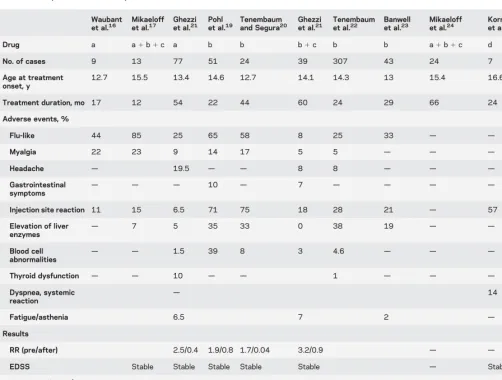
use of IFN-band GA in pediatric patients: results are summarized in table 1.15–25 Data from observational
studies are available in about 600 patients treated with IFN-b: 7 studies included.20 patients; 6 have a follow-up of 2 years or more.
Two studies have compared pediatric patients with MS treated with IFN-b with a control group.24,26In one unblinded study, 16 patients were
randomized to intramuscular IFN-b-1a, half of adult dose, once a week or to no treatment. After 4 years, relapse rates (p5 0.04), disability progression (p5
0.01), and new T2 lesions (p50.006) were lower in treated vs untreated patients.26In another study,
con-trols were extracted from a database: after a mean follow-up of 5.5 years, patients treated with IFN-b demonstrated significantly reduced occurrence of re-lapses, especially in the first 2 years of exposure, and a decrease in development of severe disability, although not statistically significant24(table 1).
Most studies have demonstrated a favorable effect of IFN-bon pediatric MS evolution, with a decline of relapse rate during the treatment phase, compared to
the pretreatment period. The level of disability re-mained unchanged at the last observation in the majority of studies. There are no data suggesting that one drug is better than another, so the final choice is made by the treating physician after consideration of side effects, route, and frequency of administration with the patient and parents.
With the obvious limitations of the observational design of these studies, the general conclusion is that IFN-bis effective in the majority of patients, though about 30% of pediatric patients do not respond as expected, requiring more aggressive treatments27(see
“Pediatric multiple sclerosis: Escalation and emerging treatments,”p. S103).
Data on adverse events have not been collected in a standardized fashion, and the definition of an adverse event differs across published studies, as well as the accu-racy of detection. Flu-like symptoms have been reported in 8%–85% of children treated with interferon, myalgia in 5%–23%, headache in 8%–20%, gastrointestinal symptoms in 7%–10%, injection site reaction in 7%–75%, elevation of liver enzymes in 0%–38%, blood cell abnormalities in 2%–39%, and thyroid dysfunction in 1%–10%. Other rare adverse events have been reported in single cases (no more than 2 cases) and comprise menstrual disorders, depres-sion, psychological disturbances, suicide attempt, arthritis, cartilage disorders, autoimmune disorders, serious infections, and malignancy.
There is limited information on the effect of IFN-b on body development. Data have been pro-vided on 16 cases from a cohort of 52 pediatric pa-tients with MS exposed to IFN-b treatment for a mean time of 43 months28: in 10 girls who reached
a mean age of 21.265.0 years and in 6 boys who reached a mean age of 15.062.5 years, weight and height resulted within the 10th–90th percentile of the normal population. Based on available data of scien-tific literature, there is no sign of a possible negative effect of IFN-bon body development.
A recent phase 4 multicenter study including 307 patients treated with IFN-b-1a 22/44 mg 3 times weekly confirmed the favorable safety profile of IFN-bas well as the reduction of release rate during the treatment phase.22Rare adverse events (less than
2%) noted in this study included allergic reactions in 5 patients (1.6%), epilepsy and convulsive disorders in 5 (1.6%), thyroid dysfunction in 3 (1.0%), and autoimmune disorders, bone/cartilage disorders, and serious infections in 2 patients, respectively (0.7%). One child required omentectomy, classified under malignancy in Medical Dictionary for Regulatory Activities Query, and considered not related to IFN-btreatment by the treating physician.
was favorable in both studies, and no major adverse events have been recorded. However, acute hepatotoxic-ity confirmed by hepatic biopsy in an adolescent treated with GA has recently been reported.29Of note, this girl
had been treated before with IFN-b-1a 44 mg and had developed elevation of liver enzymes, resulting in
IFN-b-1a discontinuation and a switch to GA. Nevertheless, the exact causative mechanism of this adverse event remains to be elucidated.
RESULTS IN YOUNG CHILDREN VS ADOLESCENTS Some studies have included children under the age of 10 years or 12 years, analyzing those subgroups separately: the clinical outcome was not different compared to patients with a higher age as well as the occurrence of adverse events; the only exception was increased rate of elevation of liver enzymes in the younger group of patients with MS in one study23(table 2).
Based on the results from a recently published study by Tenembaum et al.,22 the label of IFN-b-1a 22 or 44mg has been modified in the European Union as follows:“The results of this study suggest that the safety profile in children (2–11 years old) and in adolescents (12–17 years old) receiving Rebif 22 or 44mg subcutaneous 3 times per week is similar to that seen in adults. The safety and efficacy of Rebif in children below 2 years of age have not yet been estab-lished. Rebif should not be used in this age group.”
DMT IN CLINICAL PRACTICE In recent years, 2 posi-tion papers have been published on the use of DMTs in the pediatric MS population.1,3The European
doc-ument suggested early use of DMTs to prevent relap-ses, accumulation of disability, and accumulation of brain damage, recommending careful clinical and MRI follow-up.3Similarly, the International Pediatric
Multiple Sclerosis Study Group consensus statement
Table 1 Demographic and clinical findings of studiesaevaluating the results of
interferon-b(IFN-b) and glatiramer acetate in pediatric patients with multiple sclerosis
Waubant
et al.16 Mikaeloffet al.17 Ghezziet al.21 Pohlet al.19 Tenembaumand Segura20 Ghezziet al.21 Tenembaumet al.22 Banwellet al.23 Mikaeloffet al.24 Korneket al.25 Ghezziet al.21
Drug a a1b1c a b b b1c b b a1b1c d d
No. of cases 9 13 77 51 24 39 307 43 24 7 14
Age at treatment onset, y
12.7 15.5 13.4 14.6 12.7 14.1 14.3 13 15.4 16.6 14.0
Treatment duration, mo 17 12 54 22 44 60 24 29 66 24 75
Adverse events, %
Flu-like 44 85 25 65 58 8 25 33 — — —
Myalgia 22 23 9 14 17 5 5 — — — —
Headache — 19.5 — — 8 8 — — — —
Gastrointestinal
symptoms — — —
10 — 7 — — — — —
Injection site reaction 11 15 6.5 71 75 18 28 21 — 57 14
Elevation of liver enzymes —
7 5 35 33 0 38 19 — — —
Blood cell abnormalities
— — 1.5 39 8 3 4.6 — — — —
Thyroid dysfunction — — 10 — — 1 — — — —
Dyspnea, systemic
reaction —
14 7
Fatigue/asthenia 6.5 7 2 — 7
Results
RR (pre/after) 2.5/0.4 1.9/0.8 1.7/0.04 3.2/0.9 — — 2.9/0.3
EDSS Stable Stable Stable Stable Stable — Stable Stable
Treatment failure/ discontinuation, %
44 25 26 64 25 — — —
Other endpoints RR reduced
by 50%
Less attacks, less disability
28% Relapse-free
—
Abbreviations: a5IFN-b-1a 30mg IM weekly; b5IFN-b-1a 22 or 44mg SC 3 times weekly; c5IFN-b-1b 250 mg every other day; d5Copaxone 20 mg IM daily; EDSS5Expanded Disability Status Scale; RR5relapse rate.
recommends the use of first-line therapies as the standard of care for all pediatric patients with a diagnosis of MS.1
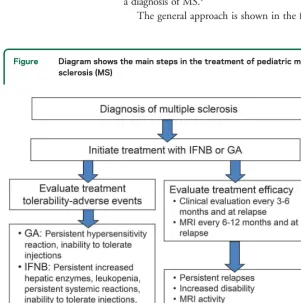
The general approach is shown in the figure.
Pediatric patients with MS should start DMT treat-ment soon after diagnosis, with regular follow-up: 1. To assess clinical response with regular clinical
evaluations (every 3–6 months, according to label/regulatory/local guidelines) and brain MRI every 6–12 months (according to label/regulatory/ local guidelines)
2. To check the tolerability/safety profile (every 3–6 months, according to label/regulatory/local guide-lines); periodic assessment of blood cell count, liver function, and thyroid and kidney function should be performed
There are no pharmacodynamic/pharmacokinetic studies of IFN-band GA in pediatric MS. In general, it is recommended to initiate IFN-b therapy with 25%–50% of the adult dose. If well-tolerated, it is recommended to titrate up to full adult dose, espe-cially for children over 12 years of age with a body weight more than 30 kg.
Adverse events should be appropriately managed: acetaminophen or ibuprofen before IFN-binjection or at appearance of flu-like symptoms reduce their frequency and severity. An educational program for patients and parents is also an important aspect when starting a DMT therapy, as they should be carefully informed on realistic expectations and management of adverse events, and trained on injection technique. Patients treated with IFN-bcan develop neutral-izing antibodies resulting in a reduced biological activity of this medication and an increased risk of relapses30,31: according to these recommendations,
testing for the presence of neutralizing antibodies (NAbs), if available, should be performed in patients
Table 2 Adverse events in children compared to adolescents or to the whole cohort of patients with multiple sclerosis
Ghezzi et al.21 Tenembaum and Segura20 Ghezzi et al.21 Tenembaum et al.22 Banwell et al.23
Drug a b b b c
Age, y ,12 Whole cohort ,10 .10 ,12 Whole cohort ,12 .12 ,10 .10
No. of cases 9 77 8 16 5 39 52 255 8 35
Adverse events
Flu-like 11 25 75 50 — 8 26.9 23.9 25 37
Myalgia — 9 25 12.5 — 5 — — — —
Headache — 19.5 — — 20 8 — — — —
Gastrointestinal symptoms — — — — — 7 — — — —
Injection site reaction 11 6.5 50 87.5 20 18 21.2 29.0 25 20
Elevation of liver enzymes 11 5 37.5 31.2 — 0 15.4 14.1 — —
Blood cell abnormalities 22 1.5 0 12.5 — 3 3.8 4.7 — —
Thyroid dysfunction — 10 — — — — 1.9 0.8 62.5 22
Dyspnea, systemic reaction — — — — — — 1.9 1.6 — —
Fatigue/asthenia 11 6.5 — — — 7 — — — —
Abbreviations: a5IFN-b-1a 30mg IM weekly; b5IFN-b-1a 22 or 44mg SC 3 times weekly; c5IFN-b-1b 250 mg every other day.
Figure Diagram shows the main steps in the treatment of pediatric multiple sclerosis (MS)
at 12 and 24 months of therapy or if there is evidence of breakthrough disease activity. Positive titers of NAbs may be relevant to guide treatment decisions: if confirmed at repeated measurements with 3- to 6-month intervals, IFN-bshould be discontinued.
Recent reports have described the occurrence of thrombotic microangiopathy in adults treated with IFN-b32as well as the association between
glomerulone-phritis and sarcoid-like lung disease with long-term
IFN-btreatment.33Patients should be carefully monitored for
safety evaluation and to discover possible rare adverse events: this issue is particularly important in pediatric patients, when children are being exposed to medications during key periods of growth and body development.
DISCUSSION Trials are ongoing evaluating the clin-ical outcome of pediatric patients with MS treated with fingolimod, dimethyl fumarate, and terifluno-mide. If their effectiveness and safety in this age group is confirmed, new medications will be available in the future, with the advantage of oral administration. At present, IFN-band GA continue to be the standard first-line treatments for pediatric patients with MS, as supported by observational studies and experts’ consensus guidelines.
Clinicians should carefully follow-up children and adolescents with MS treated with DMT giving appro-priate assistance, strengthening the adherence to ther-apy, managing adverse events properly, and switching treatment to other options in patients with inade-quate or suboptimal response (see“Pediatric multiple sclerosis: Escalation and emerging treatments,”p. S103).
AUTHOR CONTRIBUTIONS
Angelo Ghezzi designed the study, collected literature sources, analyzed and interpreted data of these studies, coordinated the group, and drafted and revised the manuscript. Maria Pia Amato, Teri Schreiner, Jutta Gärtner, and Naila Makhni helped draft, revise, and edit the manuscript for impor-tant intellectual content. Sylvia Tenembaum helped revise and edit the manuscript for important intellectual content.
STUDY FUNDING
This supplement is made possible by funding from the MS Cure Fund, Danish MS Society, German MS Society, Italian MS Association, MS International Federation, MS Research Foundation (Netherlands), National MS Society (USA) and Swiss MS Society.
DISCLOSURE
A. Ghezzi received honoraria for speaking from Biogen-Idec, Merck-Serono, Novartis, Genzyme, Teva, and Allergan, and for consultancy from Merck-Serono, Teva, Novartis, and Biogen-Idec, and received support for participation in National and International Congresses from Schering, Biogen-Idec, Merck-Serono, Novartis, Genzyme, and Teva. M. Amato served on scientific advisory boards for and has received speaker honoraria and research support from Biogen Idec, Merck Serono, Bayer Schering Pharma, and Sanofi-aventis and serves on the editorial board ofBMC Neurology. N. Makhani received fellowship funding from the Canadian Network of MS Clinics and receives research funding from the Dairy Farmers of Ontario and Race to Erase MS. Dr. Makhani is a site inves-tigator for a clinical trial sponsored by Novartis. T. Shreiner received consulting fees from Biogen Idec, and participated in clinical research sponsored by Biogen Idec, Novartis Pharmaceuticals, MSDx, Adamas
Pharmaceuticals, and NIH. J. Gärtner received honoraria and consul-tancy fees from Bayer Vital, Biogen, Merck Serono, Teva, and Novartis and has received research grant support from Novartis and Biogen. S. Tenembaum served as an advisory board member or speaker for Merck Serono. Professional travel/accommodations expenses have been awarded to Dr. Tenembaum by Merck-Serono. She serves on a clinical trial advisory board for Genzyme-Sanofi. Go to Neurology.org for full disclosures.
Received August 19, 2015. Accepted in final form January 19, 2016.
REFERENCES
1. Chitnis T, Tenembaum S, Banwell B, et al. Consensus statement: evaluation of new and existing therapeutics for pediatric multiple sclerosis. Mult Scler 2012;18: 116–127.
2. Goodin DS, Frohman EM, Garmany GP, et al. Disease modifying therapies in multiple sclerosis: Subcommittee of the American Academy of Neurology and the MS Council for Clinical Practice Guidelines. Neurology 2002;58: 169–178.
3. Ghezzi A, Banwell B, Boyko A, et al. The management of MS in children: a European view. Mult Scler 2010;16: 1258–1267.
4. Trojano M, Pellegrini F, Fuiani A, et al. New natural history of interferon-beta treated relapsing multiple sclero-sis. Ann Neurol 2007;61:300–306.
5. Trojano M, Pellegrini F, Paolicelli D, et al. Real-life impact of early interferon beta therapy in relapsing multi-ple sclerosis. Ann Neurol 2009;66:513–520.
6. Kappos L, Polman CH, Freedman MS, et al. Treatment with interferon beta-1b delays conversion to clinically def-inite and McDonald MS in patients with clinically isolated syndromes. Neurology 2006;67:1242–1249.
7. Jacobs LD, Beck RW, Simon JH, et al. Intramuscular interferon beta-1a therapy initiated during a first demye-linating event in multiple sclerosis. N Engl J Med 2000; 343:898–904.
8. Comi G, Martinelli V, Rodegher M, et al. Effect of glatir-amer acetate on conversion to clinically definite multiple sclerosis in patients with clinically isolated syndrome (Pre-CISe study): a randomised, double-blind, placebo-con-trolled trial. Lancet 2009;374:1503–1511.
9. Comi G, De Stefano N, Freedman MS, et al Comparison of two dosing frequencies of subcutaneous interferon beta 1a in patients with a first clinical demyelinating event suggestive of multiple sclerosis (REFLEX): a phase 3 ran-domized controlled trial. Lancet Neurol 2012;10:33–41. 10. Miller AE, Wolinsky JS, Kappos L, et al; TOPIC Study
Group. Oral teriflunomide for patients with a first clinical episode suggestive of multiple sclerosis (TOPIC): a rando-mised, double-blind, placebo-controlled, phase 3 trial. Lancet Neurol 2014;13:977–986.
11. European Study Group on Interferon beta-1b in Secondary Progressive MS. Placebo-controlled multicentre randomised trial of interferon beta-1b in treatment of secondary pro-gressive multiple sclerosis. Lancet 1998;352:1491–1497. 12. Panitch H, Miller A, Paty D, Weinshenker B, North
American Study Group on Interferon beta-1b in Second-ary Progressive MS. Interferon beta-1b in secondSecond-ary pro-gressive MS: results from a 3-year controlled study. Neurology 2004;63:1788–1795.
14. Rocca MA, Absinta M, Ghezzi A, Moiola L, Comi G, Filippi M. Is a preserved functional reserve a mechanism limiting clinical impairment in pediatric MS patients? Hum Brain Mapp 2009;30:2844–2851.
15. Renoux C, Vukusic S, Mikaeloff Y, et al; Adult Neurology Departments KIDMUS Study Group. Natural history of multiple sclerosis with childhood onset. N Engl J Med 2007;365:2603–2613.
16. Waubant E, Hietpas J, Stewart T, et al. Interferon beta-1a in children with multiple sclerosis is well tolerated. Neuro-pediatrics 2001;32:211–213.
17. Mikaeloff Y, Moreau T, Debouverie M, et al. Interferon-beta treatment in patients with childhood-onset multiple sclerosis. J Pediatr 2001;139:443–446.
18. Ghezzi A, Amato MP, Gallo P, et al. Disease modifying drugs in childhood-juvenile multiple sclerosis: results of the ITEMS (immunomodulatory treatment of early-onset MS) study group. Mult Scler 2005;11:420–424. 19. Pohl D, Rostasy K, Gartner J, Hanefeld F. Treatment of
early onset multiple sclerosis with subcutaneous interferon beta-1a. Neurology 2005;65:888–890.
20. Tenembaum SN, Segura MJ. Interferon beta-1a treatment in childhood and juvenile-onset multiple sclerosis. Neurology 2006;67:511–513.
21. Ghezzi A, Amato MP, Annovazzi P, et al. Long-term re-sults of immunomodulatory treatment in children and adolescents with multiple sclerosis: the Italian experience. Neurol Sci 2009;30:193–199.
22. Tenembaum S, Banwell B, Pohl D, et al; REPLAY study group. Subcutaneous interferon beta-1a in pediatric mul-tiple sclerosis: a retrospective study. J Child Neurol 2013; 28:849–856.
23. Banwell B, Reder AT, Krupp L, et al. Safety and tolera-bility of interferon beta-1b in pediatric multiple sclerosis. Neurology 2006;66:472–476.
24. Mikaeloff Y, Caridde G, Tardieu M, et al. Effectiveness of early beta interferon on the first attack after confirmed
multiple sclerosis: a comparative study. Eur J Paediatr Neurol 2008;12:205–209.
25. Kornek B, Bernert G, Balassy C, et al. Glatiramer acetate treatment in patients with childhood and juve-nile onset multiple sclerosis. Neuropediatrics 2003;34: 120–126.
26. Pakdaman H, Fallah A, Sahraian MA, et al. Treatment of early onset multiple sclerosis with suboptimal dose of interferon beta-1a. Neuropediatrics 2006;37:257–260. 27. Yeh EA, Waubant E, Krupp LB, et al. Multiple sclerosis
therapies in pediatric patients with refractory multiple scle-rosis. Arch Neurol 2011;68:437–444.
28. Ghezzi A, Amato MP, Capobianco M, et al; Immuno-modulatory Treatment of Early-onset MS (ITEMS) Group. Treatment of early-onset multiple sclerosis with intramuscular interferonbeta-1a: long-term results. Neurol Sci 2007;28:127–132.
29. Makhani N, Ngan BY, Kamath BM, Yeh EA. Glatiramer acetate-induced acute hepatotoxicity in an adolescent with MS. Neurology 2013;81:850–852.
30. Sørensen PS, Deisenhammer F, Duda P, et al; EFNS Task Force on Anti-IFN-beta Antibodies in Multiple Sclerosis. Guidelines on use of anti-IFN-beta antibody measure-ments in multiple sclerosis: report of an EFNS Task Force on IFN-beta antibodies in multiple sclerosis. Eur J Neurol 2005;12:817–827.
31. Polman CH, Bertolotto A, Deisenhammer F, et al. Rec-ommendations for clinical use of data on neutralising anti-bodies to interferon-beta therapy in multiple sclerosis. Lancet Neurol 2010;9:740–750.
32. Hunt D, Kavanagh D, Drummond I, et al. Thrombotic microangiopathy associated with interferon beta. N Engl J Med 2014;370:1270–1271.
DOI 10.1212/WNL.0000000000002823
2016;87;S97-S102
Neurology
Angelo Ghezzi, Maria Pia Amato, Naila Makhani, et al.
Pediatric multiple sclerosis: Conventional first-line treatment and general management
This information is current as of August 29, 2016
Services
Updated Information &
http://n.neurology.org/content/87/9_Supplement_2/S97.full
including high resolution figures, can be found at:
References
http://n.neurology.org/content/87/9_Supplement_2/S97.full#ref-list-1
This article cites 32 articles, 0 of which you can access for free at:
Citations
les
http://n.neurology.org/content/87/9_Supplement_2/S97.full##otherartic
This article has been cited by 1 HighWire-hosted articles:
Subspecialty Collections
http://n.neurology.org/cgi/collection/multiple_sclerosis Multiple sclerosis
http://n.neurology.org/cgi/collection/all_pediatric All Pediatric
http://n.neurology.org/cgi/collection/adolescence Adolescence
following collection(s):
This article, along with others on similar topics, appears in the
Errata
/content/87/19/2068.2.full.pdf
or:
page
next
An erratum has been published regarding this article. Please see
Permissions & Licensing
http://www.neurology.org/about/about_the_journal#permissions
its entirety can be found online at:
Information about reproducing this article in parts (figures,tables) or in
Reprints
http://n.neurology.org/subscribers/advertise
Information about ordering reprints can be found online:
rights reserved. Print ISSN: 0028-3878. Online ISSN: 1526-632X.
generates the question: Would this high exacerbation rate happen if patients were allowed to achieve remis-sion with steroids without using MMF?
It was previously illustrated that among patients with MG who were treated with steroids, 80.2% (93/116) achieved remission/minimal manifestations status and only 18% (17/93) experienced an exacer-bation afterward.2This clues in that the high
exacer-bation rate reported by Oskarsson et al. after discontinuing MMF may not reflect the natural dis-ease activity but rather reflects MMF dependence, and that continuing MMF mainly treats the depen-dence. Both studies are limited by a lack of informa-tion on the prednisone dose required to maintain remission/minimal manifestations status (an impor-tant data point to determine whether MMF is effective).
Author Response: Björn Oskarsson, Sacramento; David M. Rocke, Davis; Karsten Dengel, Sacramento; David P. Richman, Davis, CA:We thank Dimachkie et al. for their interest in our article.1However, in
oppo-sition to Dimachkie et al., we would consider MG exacerbations after discontinuation of MMF as MG exacerbations rather than a novel MMF dependence
condition. Given this premise, patients with pharmaco-logically controlled MG seem a more appropriate con-trol group compared to patients who had MG but sustain remission without pharmacologic treatment. We would suspect that patients without symptoms or treatment may have a less-active disease compared to a population requiring treatment. This last group is also rare in our clinic, further making such a compari-son less meaningful.
The patients were selected on the basis of being on stable doses of prednisone (0–25 mg/d; see table 2)1
and only MMF was varied. Our article does not address corticosteroid treatment of MG and we do not argue that corticosteroids are not an effective treatment of MG. The interest in treating MG with MMF stems primarily from MMF’s more favorable side-effect profile.
© 2016 American Academy of Neurology
1. Oskarsson B, Rocke DM, Dengel K, Richman DP. Myas-thenia gravis exacerbation after discontinuing mycopheno-late: a single-center cohort study. Neurology 2016;86: 1159–1163.
2. Pascuzzi RM, Coslett HB, Johns TR. Long-term cortico-steroid treatment of myasthenia gravis: report of 116 pa-tients. Ann Neurol 1984;15:291–298.
CORRECTIONS
Neurofilament light chain level is a weak risk factor for the development of MS
In the article“Neurofilament light chain level is a weak risk factor for the development of MS”by G. Arrambide et al.,1
there is an error in figure 2. In panel C, thepvalue should read“p,0.0001”rather than“p, 0.0001”as originally published. The editorial staff regrets the error.
REFERENCE
1. Arrambide G, Espejo C, Eixarch H, et al. Neurofilament light chain level is a weak risk factor for the development of MS. Neurology 2016;87:1076–1084.
Pediatric multiple sclerosis: Conventional first-line treatment and general management
In the article“Pediatric multiple sclerosis: Conventional first-line treatment and general management”by A. Ghezzi et al.,1
there is an error in the fourth author’s name, which should have read“Teri Schreiner”rather than“Teri Shreiner”as originally published. The authors regret the error.
REFERENCE
1. Ghezzi A, Amato MP, Makhani N, et al. Pediatric multiple sclerosis: conventional first-line treatment and general management. Neurology 2016;87(suppl 2):S97–S102.