Constraining Forces Stabilizing Superconductivity in
Bismuth
Ekkehard Krüger ID
Institut für Materialwissenschaft, Materialphysik, Universität Stuttgart, D-70569 Stuttgart, Germany
Abstract: As shown in former papers, the nonadiabatic Heisenberg model presents a novel
1
mechanism of Cooper pair formation generated by the strongly correlated atomic-like motion of
2
the electrons in narrow, roughly half-filled “superconducting bands”. These are energy bands
3
represented by optimally localized spin-dependent Wannier functions adapted to the symmetry of
4
the material under consideration. The formation of Cooper pairs is not the result of an attractive
5
electron-electron interaction but can be described in terms of quantum mechanical constraining forces
6
constraining the electrons to form Cooper pairs. There is theoretical and experimental evidence that
7
only this nonadiabatic mechanism operating in superconducting bands may produceeigenstatesin
8
which the electrons form Cooper pairs. These constraining forces stabilize the Cooper pairs in any
9
superconductor, whether conventional or unconventional. Here we report evidence that also the
10
experimentally found superconducting state in bismuth at ambient as well as at high pressure is
11
connected with a narrow, roughly half-filled superconducting band in the respective band structure.
12
This observation corroborates once more the significance of constraining forces in the theory of
13
superconductivity.
14
Keywords: superconductivity; bismuth at ambient pressure; Bi–I; bismuth at high pressure; Bi–V;
15
constraining forces; nonadiabatic Heisenberg model
16
1. Introduction
17
Bismuth shows sequential structure transition as function of the applied pressure, as summarized in an illustrative form by O. Degtyarevaet al.[1]:
Bi–I −−−−→2.55 GPa Bi–II −−−−→2.7 GPa Bi–III −−−−→7.7 GPa Bi–V <122 GPa (1)
At ambient pressure, Bi crystallizes in the structure Bi–I, an As-type structure with a trigonal
18
(rhombohedral) space group and two atoms in the unit cell [2]. This structure is stable up to a
19
pressure of 2.55 GPa. Then, with increasing pressure, Bi undergoes the monoclinic structure Bi–II and
20
the host-guest structure Bi–III. A further structure called Bi–IV exists above the temperature of 450 K
21
and is not relevant in this paper. Between a pressure of 7.7 and (at least) 122 GPa, the cubic Bi–V phase
22
is stable [1].
23
It is interesting, that all these Bi phases become superconducting at low temperatures. The Bi–I
24
phase is superconducting with the extremely low transition temperatureTc=0.53mK [3]. In the Bi–II
25
and Bi–III structures, the transition temperature increases with increasing pressure from about 4 K to 7
26
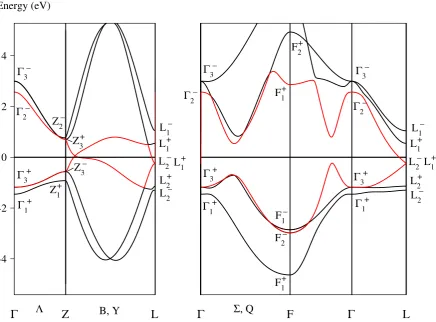
K. Finally, in the Bi–V phase,Tchas the maximum value of about 8 K [4]. The different values ofTc
27
are evidently connected with the different crystal structures sinceTcchanges discontinuously at the
28
transitions from one structure to another [4].
29
This striking symmetry-dependence of the superconducting transition temperature suggests that
30
also in bismuth superconductivity is connected with narrow, roughly half-filled “superconducting
31
bands”. A closed energy band (Definition 2 of Ref. [5]) with optimally localized, symmetry-adapted,
32
and spin-dependent Wannier functions is called superconducting band (Definition 22 of Ref. [5])
33
because those metals (and only those metals) that possess such a narrow, roughly half-filled
34
superconducting band in its band structure experimentally prove to be superconductors, see the
35
Introduction of Ref. [5]. This observation can be interpreted within the group-theoretical nonadiabatic
36
Heisenberg model (NHM) [6], a new model of strongly correlated atomic-like electrons. Within this
37
model, the formation of Cooper pairs is still mediated by boson excitations (responsible, as usual, for
38
the isotope effect). However, these boson excitations produce constraining forces as they are familiar
39
from classical mechanics: belowTc, they reduce the degrees of freedom of the electron system by
40
forcing the electrons to form Cooper pairs. A short description of the NHM and this novel mechanism
41
of Cooper pair formation is given in Secs. 2 and 3, respectively, of Ref. [7]. In Sec.4we shall summarize
42
this new concept of superconductivity in the form of single statements.
43
There is theoretical evidence that the constraining forces operating in narrow, roughly half-filled
44
superconducting bands are required for the Hamiltonian of the system to possesseigenstatesin which
45
the electrons form Cooper pairs [8]. The aim of the present paper is to corroborate this important
46
assertion by showing that also the experimentally established superconductivity in bismuth [3,4] is
47
evidently connected with superconducting bands.
48
In this context, we consider (in the following Sec. 2) only the two structures Bi–I and Bi–V
49
at the beginning and the end of the sequence (1). Bi–I and Bi–V possess the lowest and highest
50
superconducting transition temperatures, respectively. Bi–II is not very informative within the NHM
51
since it has only a low monoclinic symmetry. At this stage, it would be complicated to apply the
52
NHM to the incommensurate host-guest structure of Bi–III. Both Bi–I and Bi–V, on the other hand,
53
have clear symmetries with the trigonal space groupR3m(166) and the cubic space groupIm3m(229),
54
respectively [1,2]. Bi–V even has the highest possible symmetry in a solid state with allows the NHM
55
to make clear predictions.
56
2. Superconducting bands in the band structure of bismuth
57
2.1. Band structure of Bi–I
58
The band structure of Bi–I is depicted in Fig.1. The Bloch functions of the band highlighted in red are labeled by the single-valued representations
Γ−
2, Γ+3; Z3+, Z −
3; L+1, L −
2; F1+, F −
2 . (2)
It is clear that this band (or any other band in the band structure) does not contain a closed band
59
(Definition 2 of Ref. [5]) with the symmetry of band 1 or band 2 in TableA4, meaning that we cannot
60
unitarily transform the Bloch functions into best localized and symmetry-adapted Wannier functions
61
situated at the Bi atoms. The situation is changed when we consider the double-valued representations
62
of the Bloch functions:
63
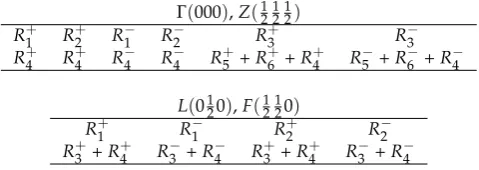
According to TableA3, we may unitarily transform the Bloch functions (2) into Bloch functions labeled by the double-valued representations,
Γ−
2 → Γ
−
4, Γ3+ → Γ+4 +Γ5++Γ+6;
Z3+ → Z4++Z5++Z+6, Z3− → Z−4 +Z5−+Z6−; L+1 → L+3 +L+4, L−2 → L−3 +L−4; F1+ → F3++F4+, F2− → F3−+F4−.
(3)
The underlined representations belong to the band listed in TableA5. Thus, we can unitarily transform
64
the Bloch functions of this band intospin-dependentWannier functions being best localized, centered at
65
the Bi atoms, and symmetry-adapted to the groupR3m. Consequently, according to Definition 22 of
66
Ref. [5], the band highlighted in red is a superconducting band.
-4
-2
0
2
4
Γ
2 _Γ
3 _Γ
3 +Z
1+Z
3+Γ
1 +
Z
3_Z
2_L
1_L
1+L
2_L
1+L
2+L
2_Γ
3 _Γ
2 _Γ
3 +Γ
1 +F
2+F
1+F
1_F
2_F
1+L
1_L
1+L
2_L
1+L
2+L
2_Γ
3 _Γ
2 _Γ
3 +Γ
1 +Γ
Λ
Z
B, Y
L
Γ
Σ,
Q
F
Γ
L
Energy (eV)
Figure 1. Band structure of Bi–I calculated by the FHI-aims program [9,10], using the structure parameters given by O. Degtyarevaet al.[1]. The symmetry labels are determined by the author. Bi–I has the trigonal space groupR3m[2] (international number 166), the notations of the points and lines of symmetry in the Brillouin zone forΓrhfollow Fig. 3.11 (b) of Ref. [11], and the symmetry labels are
defined in TableA1.EFdenotes the Fermi level. The band highlighted in red is the superconducting
band.
2.2. Band structure of Bi–V
68
The band structure of Bi–V is depicted in Fig.2. The Bloch functions of the band highlighted in red now are labeled by the single-valued representations
Γ− 4; H
−
4; P5; N −
3. (4)
Again, this band (or any other band in the band structure) does not contain a closed band (Definition 2 of Ref. [5]) with the symmetry of the bands listed in TableA8. Hence, we cannot unitarily transform the Bloch functions into best localized and symmetry-adapted Wannier functions situated at the Bi atoms. According to TableA7, we may unitarily transform the Bloch functions (4) into Bloch functions labeled by the double-valued representations,
Γ−
4 → Γ
− 6 +Γ
− 8, H4− → H6−+H8−, P5 → P7+P8, N3− → N5−.
(5)
The underlined representations belong to band 4 listed in TableA9. Thus, we can unitarily transform
69
the Bloch functions of this band intospin-dependentWannier functions being best localized, centered at
-5
0
5
Γ
H
P
Γ
N
H
P
N
Γ
4_Γ
4_
H
4_H
3+P
5N
2_N
3_N
4_N
1+H
4_H
3+P
5N
1+N
2_N
3_N
4_Energy (eV)
Figure 2.Band structure of Bi–V at the pressure of 13.5 GPa calculated by the FHI-aims program [9,10], using the structure parameters at this pressure as given by O. Degtyarevaet al.[1]. The symmetry labels are determined by the author. Bi–V has the cubic space groupIm3m[1] (international number 229), the notations of the points and lines of symmetry in the Brillouin zone forΓvc follow Fig. 3.15 of Ref. [11], and the symmetry labels are defined in TableA6. EFdenotes the Fermi level. The band
highlighted in red forms the superconducting band.
the Bi atoms, and symmetry-adapted to the groupIm3m. Consequently, according to Definition 22 of
71
Ref. [5], the band highlighted in red is a superconducting band.
72
2.3. Interpretation
73
Both structures Bi–I and Bi–V possess a superconducting band in their band structure that
74
• is one of the narrowest bands in the band structure;
75
• is nearly half filled;
76
• and comprises a great part of the electrons at the Fermi level.
77
Consequently, the NHM predicts that both phases become superconducting below a transition
78
temperatureTc.
79
The superconducting band of Bi–I (Fig.1) even comprises all the electrons at the Fermi level.
80
However, the small Fermi surface and the small density of states at the Fermi level results in the
81
extremely low superconducting transition temperature ofTc=0.53mK [3].
82
The superconducting band of Bi–V (Fig.2) closely resembles the superconducting band of niobium
83
as depicted, e.g., in Fig. 1 of Ref. [8]: both nearly half-filled bands have comparable widths and comprise
84
a comparable part of the Fermi level. Consequently, we may expect that both the Bi–V phase of bismuth
85
and the elemental metal niobium have similar transition temperatures. Indeed, we haveTc ≈ 8K
andTc =9.2K for Bi–V and niobium, respectively. Narrow and half-filled superconducting bands
87
rarely arise in crystals with the high bcc symmetry. So the elemental bcc metals Ta, W, and Mo possess
88
superconducting bands which are far from being half-filled and, consequently, have lower transition
89
temperatures. In the band structures of the most elemental metals (such as Li, Na, K, Rb, Cs, Ca Cu, Ag,
90
and Au), narrow, roughly half-filled superconducting bands cannot be found and, hence, these metals
91
do not become superconducting [12]. Consequently, there is high evidence that the superconducting
92
state in Bi–V is connected with the narrow and almost perfectly half-filled superconducting band in
93
the band structure of this phase.
94
3. Results
95
In terms of superconducting bands, the NHM confirms the experimental observations that
96
• the Bi–I phase (i.e., bismuth at ambient pressure) becomes superconducting below an extremely
97
low transition temperature and
98
• the Bi–V phase (i.e., bismuth at high pressure) becomes superconducting below a transition
99
temperature comparable with the transition temperature of niobium.
100
4. Discussion
101
This group-theoretical result demonstrates again [5] the significance of the theory of
102
superconductivity defined within the NHM. We summarize the main features of this novel concept of
103
superconductivity (a more detailed description is given in Ref. [7]):
104
• The NHM is based on three postulates [6] concerning theatomic-likemotion of the electrons in
105
narrow, half-filled energy bands as it was already considered by Mott [13] and Hubbard[14].
106
• The postulates of the NHM are physically evident and require the introduction ofnonadiabatic
107
localized states of well-defined symmetry emphasizing thecorrelatednature of any atomic-like
108
motion.
109
• The atomic-like motion is determined by the conservation of the total crystal-spin angular
110
momentum which must be satisfied in the nonadiabatic system. In a narrow, roughly half-filled
111
superconducting band this conservation law plays a crucial role because the localized (Wannier)
112
states are spin-dependent.
113
• The strongly correlated atomic-like motion in a narrow, roughly half-filled superconducting
114
band produces an interaction between the electron spins and “crystal-spin-1 bosons”: at any
115
electronic scattering process two crystal-spin-1 bosons are excited or absorbed in order that the
116
total crystal-spin angular momentum stays conserved.
117
• Crystal-spin-1 bosons are theenergetically lowestlocalized boson excitations of the crystal that
118
possess the crystal-spin angular momentum 1·¯hand are sufficiently stable to transport it (as
119
Bloch waves) through the crystal.
120
• The spin-boson interaction in a narrow, roughly half-filled superconducting band leads to the
121
formation of Cooper pairs below a transition temperatureTc.
122
• The Cooper pairs arise inevitably since any electron state in which the electrons possess their full
123
degrees of freedom violates the conservation of crystal-spin angular momentum.
124
• This influence of the crystal-spin angular momentum may be described in terms of constraining
125
forces that constrain the electrons to form Cooper pairs. This feature distinguishes the present
126
concept from the standard theory of superconductivity.
127
• As already mentioned in Sec.1, there is evidence thatonlythese constraining forces may produce
128
superconductingeigenstates.
129
• Hence, the constraining forces are responsible for all types of superconductivity, i.e., conventional,
130
high-Tcand other superconductivity.
131
• Crystal-spin-1 bosons are coupled phonon-plasmon modes that determine the type of the
132
superconductor.
• In the isotropic lattices of the transition elements, crystal-spin-1 bosons have dominant phonon
134
character and confirm the electron-phonon mechanism that enters the BCS theory [15] in these
135
materials.
136
• Phonon-like excitations are not able to transport crystal-spin angular-momenta within the
137
anisotropic materials of the high-Tcsuperconductors [16], often containing two-dimensional
138
layers. Within these anisotropic materials, the crystal-spin-1 bosons are energetically higher
139
lying excitations of dominant plasmon character leading to higher superconducting transition
140
temperatures [15].
141
• The theory of superconductivity as developed so far is valid without any restrictions in narrow,
142
roughly half-filled superconducting bands because constraining forces do not alter the energy of
143
the electron system.
144
• However, the standard theory may furnish inaccurate information if no narrow, roughly
145
half-filled superconducting band exists in the band structure of the material under consideration.
146
It is clear that this concept of superconductivity as developed in the last 40 years should be further
147
refined in the future.
148
Acknowledgments:I am very indebted to Guido Schmitz for his support of my work. I thank Günter Zerweck
149
for his valuable reference to bismuth.
150
Abbreviations
151
The following abbreviation is used in this manuscript:
152 153
NHM Nonadiabatic Heisenberg model
154
Appendix A. Group-theoretical tables for the trigonal space groupR3m(166) of Bi–I
155
It is sometimes useful to represent trigonal (rhombohedral) systems in a hexagonal coordinate
156
system. In this case, the unit cell contains two additional inner points which, however, are connected to
157
each other and to the points at the corners by the translation symmetry of the system. In the framework
158
of the group theory of Wannier functions as presented in Ref. [5], the inner points of a unit cell must
159
not be connected by the translation symmetry. Thus, the group theory of Wannier functions is not
160
applicable to trigonal system represented by hexagonal axes. Therefore, in the present paper, we use
161
exclusively the trigonal coordinate system as given in Table 3.1 of Ref. [11].
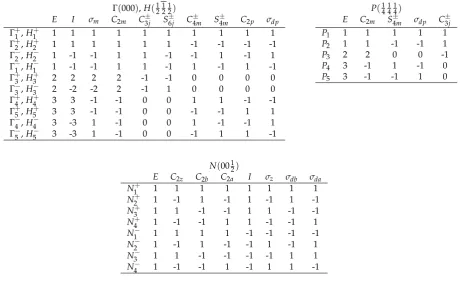
Table A1.Character tables of the single-valued irreducible representations of the trigonal space group R3m=ΓrhD53d(166) of Bi–I.
Γ(000),Z(121212)
E I S6± C±3 C02i σdi
Γ+ 1,Z
+
1 1 1 1 1 1 1
Γ+
2,Z2+ 1 1 1 1 -1 -1
Γ−
1,Z
−
1 1 -1 -1 1 1 -1
Γ−
2,Z
−
2 1 -1 -1 1 -1 1
Γ+ 3,Z
+
3 2 2 -1 -1 0 0
Γ−
3,Z3− 2 -2 1 -1 0 0
L(0120)
E C220 I σd2
L+1 1 1 1 1
L−1 1 1 -1 -1
L+2 1 -1 1 -1
L−2 1 -1 -1 1
F(12120)
E C230 I σd3
F1+ 1 1 1 1
F1− 1 1 -1 -1
F2+ 1 -1 1 -1
F2− 1 -1 -1 1
Notes to TableA1
1. i=1, 2, 3.
2. The symmetry elements are labeled in the Schönflies notation as illustrated, e.g., in Table 1.2 of Ref. [11].
3. The character tables are determined from Table 5.7 of Ref. [11].
4. The notations of the points of symmetry follow Fig. 3.11 (b) of Ref. [11].
Table A2.Character tables of the single-valued irreducible representations of the point groupC3vof
the positions of the Bi atoms (Definitions 11 and 12 of Ref. [5]) in Bi–I.
E C±3 σdi d1 1 1 1
d2 1 1 -1
d3 2 -1 0
i=1, 2, 3.
Table A3.Compatibility relations between the single-valued (upper row) and double-valued (lower row) representations of the space groupR3m.
Γ(000),Z(121212)
R+1 R+2 R−1 R−2 R+3 R−3
R+4 R+4 R4− R−4 R+5 +R+6 +R+4 R−5 +R−6 +R−4
L(0120),F(12120)
R+1 R−1 R+2 R−2
R+3 +R+4 R−3 +R−4 R+3 +R+4 R−3 +R−4
Notes to TableA3
1. The letterRstands for the letter denoting the relevant point of symmetry. For example, at point Fthe representationsR1+,R+2, . . . stand forF1+,F2+, . . . .
2. Each column lists the double-valued representation Ri ×d1/2 below the single-valued representationRi, whered1/2denotes the two-dimensional double-valued representation of the three-dimensional rotation groupO(3)given, e.g., in Table 6.1 of Ref. [11].
3. The single-valued representations are defined in TableA1.
Table A4.Single-valued representations of all the energy bands in the space groupR3mof Bi–I with symmetry-adapted and optimally localized usual (i.e., spin-independent) Wannier functions centered at the Bi atoms.
Bi(zzz) Bi(zzz) K Γ Z L F
Band 1 d1 d1 OK Γ+1 +Γ
−
2 Z + 1 +Z
−
2 L + 1 +L
−
2 F + 1 +F
−
2
Band 2 d2 d2 OK Γ+2 +Γ
−
1 Z + 2 +Z
−
1 L
−
1 +L + 2 F
−
1 +F + 2
Notes to TableA4
1. z=0.23 . . . [1]; the exact value ofzis meaningless in this table. In the hexagonal unit cell, the Bi atoms lie at the Wyckoff positions 6c(00±z)[1]. In the trigonal system, their positions in the unit cell areρ=±(zT1+zT2+zT3), where the vectorsT1,T2, andT3denote the basic vectors of the trigonal lattice as given, e.g., in Table 3.1 of Ref. [11].
2. The notations of the representations are defined in TableA1.
3. Assume a closed band of the symmetry in one of the two rows of this table to exist in the band structure of Bi–I. Then the Bloch functions of this band can be unitarily transformed into Wannier functions that are
• localized as well as possible;
• centered at the Bi atoms; and
• symmetry-adapted to the space groupR3m(166) [5].
The entry “OK” below the time-inversion operatorKindicates that the Wannier functions may even be chosen symmetry-adapted to the magnetic group
M=R3m+K·R3m, see Theorem 7 of Ref. [5].
However, a closed band (Definition 2 of Ref. [5]) with the symmetry of band 1 or band 2 does not exist in the band structure of Bi–I (see Fig.1).
4. The bands are determined following Theorem 5 of Ref. [5].
5. The Wannier functions at the Bi atoms listed in the upper row belong to the representationdiof C3vincluded below the atom. These representations are defined in TableA2.
Table A5.Double-valued representations of the superconducting band in the space groupR3mof Bi–I.
Bi(zzz) Bi(zzz) K Γ Z L F
Band 1 d d OK Γ+4 +Γ−4 Z+4 +Z−4 L+3 +L4++L−3 +L4− F3++F4++F3−+F4−
Notes to TableA5
1. z=0.23 . . . [1]; the exact value ofzis meaningless in this table. In the hexagonal unit cell, the Bi atoms lie at the Wyckoff positions 6c(00±z)[1]. In the trigonal system, their positions in the unit cell areρ=±(zT1+zT2+zT3), where the vectorsT1,T2, andT3denote the basic vectors of the trigonal lattice as given, e.g., in Table 3.1 of Ref. [11].
2. Assume an isolated band of the symmetry listed in this table to exist in the band structure of Bi–I. Then the Bloch functions of this band can be unitarily transformed into spin dependent Wannier functions that are
• localized as well as possible;
• centered at the Bi atoms; and
• symmetry-adapted to the space groupR3m(166) [5].
The entry “OK” below the time-inversion operatorKindicates that the spin-dependent Wannier functions may even be chosen symmetry-adapted to the magnetic group
M=R3m+K·R3m,
see Theorem 10 of Ref. [5]. Hence, the listed band forms a superconducting band, see Definition 22 of Ref. [5].
3. The listed band is the only superconducting band of Bi–I.
4. The notations of the double-valued representations are (indirectly) defined by TableA3. 5. Following Theorem 9 of Ref. [5], the superconducting band is simply determined from one of
the two single-valued bands listed in TableA4by means of Equation (97) of Ref. [5]. (According to Definition 20 of Ref. [5], both single-valued bands in Table A4are affiliated bands of the superconducting band.)
6. The superconducting band consists of two branches, because there are two Bi atoms in the unit cell.
7. The point group of the positions of the Bi atoms (Definitions 11 and 12 of Ref. [5]) is the group C3v. The Wannier functions at the Bi atoms belong to the double-valued representation
d=d1⊗d1/2=d2⊗d1/2 (A1)
Appendix B. Group-theoretical tables for the cubic space groupIm3m(229) of Bi–V
163
Table A6.Character tables of the single-valued irreducible representations of the space groupIm3m= Γv
cO9hof Bi–V.
Γ(000),H(121212)
E I σm C2m C±3j S
±
6j C
±
4m S
±
4m C2p σdp
Γ+
1,H1+ 1 1 1 1 1 1 1 1 1 1
Γ+
2,H2+ 1 1 1 1 1 1 -1 -1 -1 -1
Γ−
2,H
−
2 1 -1 -1 1 1 -1 -1 1 -1 1
Γ−
1,H
−
1 1 -1 -1 1 1 -1 1 -1 1 -1
Γ+
3,H3+ 2 2 2 2 -1 -1 0 0 0 0
Γ−
3,H
−
3 2 -2 -2 2 -1 1 0 0 0 0
Γ+
4,H4+ 3 3 -1 -1 0 0 1 1 -1 -1
Γ+
5,H5+ 3 3 -1 -1 0 0 -1 -1 1 1
Γ−
4,H
−
4 3 -3 1 -1 0 0 1 -1 -1 1
Γ−
5,H
−
5 3 -3 1 -1 0 0 -1 1 1 -1
P(141414)
E C2m S±4m σdp C3±j
P1 1 1 1 1 1
P2 1 1 -1 -1 1
P3 2 2 0 0 -1
P4 3 -1 1 -1 0
P5 3 -1 -1 1 0
N(0012)
E C2z C2b C2a I σz σdb σda
N1+ 1 1 1 1 1 1 1 1
N2+ 1 -1 1 -1 1 -1 1 -1
N3+ 1 1 -1 -1 1 1 -1 -1
N4+ 1 -1 -1 1 1 -1 -1 1
N1− 1 1 1 1 -1 -1 -1 -1
N2− 1 -1 1 -1 -1 1 -1 1
N3− 1 1 -1 -1 -1 -1 1 1
N4− 1 -1 -1 1 -1 1 1 -1
Notes to TableA6
1. m=x,y,z; p=a,b,c,d,e,f; j=1, 2, 3, 4.
2. The symmetry elements are labeled in the Schönflies notation as illustrated, e.g., in Table 1.2 of Ref. [11].
Table A7.Compatibility relations between the single-valued (upper row) and double-valued (lower row) representations of the space groupIm3m.
Γ(000),H(121212)
R+1 R+2 R−2 R−1 R+3 R−3 R+4 R+5 R−4 R−5
R+6 R+7 R−7 R6− R+8 R−8 R+6 +R+8 R+7 +R+8 R−6 +R−8 R−7 +R−8
P(141414)
P1 P2 P3 P4 P5
P6 P7 P8 P6+P8 P7+P8
N(0012)
N1+ N2+ N3+ N4+ N1− N2− N3− N4− N5+ N5+ N5+ N5+ N5− N5− N5− N5−
Notes to TableA7
1. In the table forΓandH, the letterRstands for the letter denoting the point of symmetry. For example, at pointHthe representationsR+1,R2+, . . . stand forH1+,H2+, . . . .
2. Each column lists the double-valued representation Ri ×d1/2 below the single-valued representationRi, whered1/2denotes the two-dimensional double-valued representation of the three-dimensional rotation groupO(3)given, e.g., in Table 6.1 of Ref. [11].
3. The single-valued representations are defined in TableA6.
4. The notations of double-valued representations follow strictly Table 6.13 (and Table 6.14) of Ref. [11]. In this paper the double-valued representations are not explicitly given but are sufficiently defined by this table.
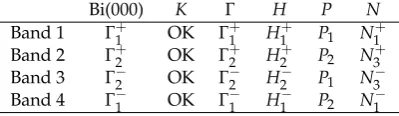
Table A8.Single-valued representations of the space groupIm3mof all the energy bands of Bi–V with symmetry-adapted and optimally localized usual (i.e., spin-independent) Wannier functions centered at the Bi atoms.
Bi(000) K Γ H P N
Band 1 Γ+1 OK Γ+1 H1+ P1 N1+
Band 2 Γ+2 OK Γ+2 H2+ P2 N3+
Band 3 Γ−2 OK Γ−2 H2− P1 N3−
Band 4 Γ−1 OK Γ−1 H1− P2 N1−
Notes to TableA8
1. The notations of the representations are defined in TableA6.
2. Assume a closed band of the symmetry in any row of this table to exist in the band structure of Bi–V. Then the Bloch functions of this band can be unitarily transformed into Wannier functions that are
• localized as well as possible;
• centered at the Bi atoms; and
• symmetry-adapted to the space groupIm3m(229) [5].
The entry “OK” below the time-inversion operatorKindicates that the Wannier functions may even be chosen symmetry-adapted to the magnetic group
M=Im3m+K·Im3m, see Theorem 7 of Ref. [5].
However, a closed band (Definition 2 of Ref. [5]) with the symmetry of the bands in this table does not exist in the band structure of Bi–V (see Fig.2).
3. The bands are determined following Theorem 5 of Ref. [5].
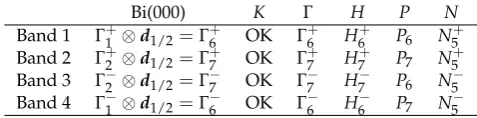
Table A9. Double-valued representations of the space groupIm3mof all the energy bands of Bi–V with symmetry-adapted and optimally localized spin-dependent Wannier functions centered at the Bi atoms.
Bi(000) K Γ H P N
Band 1 Γ+1 ⊗d1/2=Γ+6 OK Γ + 6 H
+
6 P6 N + 5
Band 2 Γ+2 ⊗d1/2=Γ+7 OK Γ+7 H+7 P7 N5+
Band 3 Γ−2 ⊗d1/2=Γ−7 OK Γ−7 H−7 P6 N5−
Band 4 Γ−1 ⊗d1/2=Γ−6 OK Γ
−
6 H
−
6 P7 N5−
Notes to TableA9
1. Assume an isolated band of the symmetry listed in any row of this table to exist in the band structure of Bi–V. Then the Bloch functions of this band can be unitarily transformed into spin-dependent Wannier functions that are
• localized as well as possible;
• centered at the Bi atoms; and
• symmetry-adapted to the space groupIm3m(229) [5].
The entry “OK” below the time-inversion operatorKindicates that the spin dependent Wannier functions may even be chosen symmetry-adapted to the magnetic group
M=Im3m+K·Im3m,
see Theorem 10 of Ref. [5]. Hence, all the listed bands forms superconducting bands, see Definition 22 of Ref. [5].
2. The notations of the double-valued representations are (indirectly) defined in TableA7.
3. Following Theorem 9 of Ref. [5], the superconducting bands are simply determined from the single-valued bands listed in TableA8 by means of Equation (97) of Ref. [5]. (According to Definition 20 of Ref. [5], each single-valued band in TableA8is an affiliated band of one of the superconducting bands.)
4. The superconducting bands consists of one branch each, because there is one Bi atom in the unit cell.
5. The point group of the positions of the Bi atoms (Definitions 11 and 12 of Ref. [5]) is the full cubic point groupOh. The Wannier functions at the Bi atoms belong to the double-valued representations of Oh listed in the second column, where the single-valued representations
Γ± 1 andΓ
±
2 are defined by TableA6, and d1/2 denotes the two-dimensional double-valued representation ofO(3)as given, e.g., in Table 6.1 of Ref. [11].
References
164
1. Degtyareva, O.; MCMahon, M.; Nelmes, R. High-pressure structural studies of group-15 elements.High
165
Pressure Research2004,24, 319–356.
166
2. Donohue, J.The structures of elements; Robert E. Krieger Publishing Company, Florida, 1982.
167
3. Prakash, O.; Kumar, A.; Thamizhavel, A.; Ramakrishnan, S. Evidence for bulk superconductivity in pure
168
bismuth single crystals at ambient pressure. Science2017,355, 52–55.
169
4. Li, Y.; Wang, E.; Zhu, X.; Wen, H.H. Pressure-induced superconductivity in Bi single crystals.Phys. Rev. B
170
2017,95, 024510.
171
5. Krüger, E.; Strunk, H.P. Group Theory of Wannier Functions Providing the Basis for a Deeper
172
Understanding of Magnetism and Superconductivity. Symmetry2015,7, 561–598.
173
6. Krüger, E. Nonadiabatic extension of the Heisenberg model. Phys. Rev. B2001,63, 144403–1–13.
174
7. Krüger, E. Superconducting Bands Stabilizing Superconductivity in YBa2Cu3O7 and MgB2. J. Supercond.
175
2010,23, 213–223.
8. Krüger, E. Modified BCS Mechanism of Cooper Pair Formation in Narrow Energy Bands of Special
177
Symmetry I. Band Structure of Niobium. J. Supercond.2001,14, 469–489. Please note that in this paper the
178
term “superconducting band” was abbreviated by “σband”.
179
9. Blum, V.; Gehrke, R.; Hanke, F.; Havu, P.; Havu, V.; Ren, X.; Reuter, K.; Scheffler, M. Ab initio molecular
180
simulations with numeric atom-centered orbitals.Computer Physics Communications2009,180, 2175 – 2196.
181
10. Havu, V.; Blum, V.; Havu, P.; Scheffler, M. Efficient O(N)O(N) integration for all-electron electronic structure
182
calculation using numeric basis functions. Computer Physics Communications2009,228, 8367 – 8379.
183
11. Bradley, C.; A.P.Cracknell. The Mathematical Theory of Symmetry in Solids; Claredon, Oxford, 1972.
184
12. Krüger, E. Superconductivity Originating from Quasi-Orbital Electrons II. The Superconducting Ground
185
State of Quasi-Orbital Conduction Electrons.Phys. Status Solidi B1978,85, 493–503.
186
13. Mott, N.F. On the transition to metallic conduction in semiconductors. Can. J. Phys.1956,34, 1356 – 1368.
187
14. Hubbard, J. Elelectron correlations in narrow energy bands. Proc. R. Soc. London, Ser. A1963,276, 238–257.
188
15. Bardeen, J.; Cooper, L.N.; Schrieffer, J.R. Theory of superconductivity. Phys. Rev.1957,108, 1175.
189
16. Krüger, E. One- and Two-Dimensional Sublattices as Preconditions for High–Tc Superconductivity. Phys.
190
Status Solidi B1989,156, 345–354.
![Figure 2. Band structure of Bi–V at the pressure of 13.5 GPa calculated by the FHI-aims program [9,10],using the structure parameters at this pressure as given by O](https://thumb-us.123doks.com/thumbv2/123dok_us/8047273.1340431/4.595.78.520.93.424/figure-structure-pressure-calculated-program-structure-parameters-pressure.webp)