HIVE, PIG & HBASE PERFORMANCE EVALUATION
FOR DATA PROCESSING APPLICATIONS
Vaishali Chauhan
1, Meenakshi Sharma
2 1,2Student of Master of Technology
Department of Computer Science and Engineering, AP Goyal Shimla University, (India)
ABSTRACT
Information extraction has received significant attention due to the rapid growth of unstructured data.
Researcher needs a low-cost, scalable, easy-to-use and fault tolerance platform for large volume data
processing eagerly. It is very important to evaluate the MapReduce based frameworks for data processing
applications. This paper leverages the comparative study of HBase, Hive and Pig.The processing time of
HBase, Hive and Pig is implemented on a data set with simple queries and we will observed the performance of
the HBase, Hive, Pig and evaluate the result according to it.
Keywords: Big Data ,Hadoop, HIVE , HBASE, PIG, Performance evaluation
I. INTRODUCTION
Big data describes the propinquity between data size and data processing speed in a system. A comprehensible
definition of the concept is ―data whose size forces us to look beyond the tried-and-true methods that are prevalent at that time‖ [1]. Data has been a backbone of any enterprise and will do so moving forward. Storing,
extracting and utilizing data has been key to many company‘s operations. In the past when there were no
interconnected systems, data would stay and be consumed at one place. With the onset of Internet technology,
ability and requirement to share and transform data has been a need. The explosion of data is being experienced
by every sector of the computing industry today. Internet giants such as Google, Amazon, Yahoo!, Facebook
and the like have to deal with huge amounts of user generated data in the form of blog posts, photographs, status
messages, and audio/video files. In the past, the types of information available were limited. Approach to
technology has a well-defined set Information management. But in today‘s world, our world has been the
explosion of data volumes. It is Terabytes and petabytes. The large existing data from different databases
relational data stored in Big Data. All of this data would be useless if we couldn‘t store it, and that‘s where Moore‘s Law [2] comes in. The law which states that the number of transistors on integrated circuits doubles every two years, since the early ‘80s processor speed has increased from 10 MHz to 3.6 GHz - an increase of 360 (not counting increases in ―word length‖ and number of cores)? But we‘ve seen much bigger increases in
storage capacity, on every level. RAM as moved from $1,000/MB to roughly $25/GB—a price reduction of
about 40,000, and all this together with the reduction in size and increase in speed. The first gigabyte disk drives
GB micro SD card weighs about half a gram. Whether you look at bits per gram, bits per dollar, or raw capacity,
storage availability has grown faster than CPU speed.
In the following table we give the units used to measure the data, starting with those most familiar to those that
are essential to measure the Big Data.
Name Symbol Value in bytes
Gigabyte GB 109(=10003)
Terabyte TB 1012(=10004)
Petabyte PB 1015(=10005)
Exabyte EB 1018(=10006)
Zettabyte ZB 1021(=10007)
Yottabyte YB 1024(=10008)
Table 1: Units of data
The term itself is being more formally defined by IBM as the combination of 3 V‘s is velocity, variety and
volume. These are the generic big data properties. However, the acquired properties depicted after entering the
system includes value, veracity, variability and visualization. Thus, the 7 V‘s correctly describes the big data
[3][4].
Fig: 1. The 7 V’s of big data [3] [4].
Volume: Millions of data is uploaded everyday on Facebook, twitter and other online platforms. The
system is generating terabytes, Petabyte and zeta bytes of data. This huge chunk of data is handled through
technique of Data Mining expanding its scope to cover big data analytics.
Velocity: The system generates streams of data and multiple sources that require that data. There is an
exponential growth in data every hour. Every minute the data is flooded with thousands of online uploads.
The widely accepted databases have increased to millions requiring features selection as a vital
Variety: Big data is part of structures and unstructured data which include blogs, images, audio, and
videos. These data may be analyzed for sentiment and content. Earlier may be the days when companies
dealt with only a single data format but today big data provides a platform for all data formats.
Variability: Big data allows handling uncertainty in data with changing data helping in prediction of future
behaviour of various customers, entrepreneurs, etc. Basically the meaning of data is constantly changing
and the data relies mainly on language processing.
Veracity: In order to ensure the accuracy of big data various security tools are provided for ensuring
potential value of the data. This involves automated decision making or feeding data into an unsupervised
machine learning algorithm. This ensures the authenticity, availability and accountability of the data.
Visualization: The techniques involved in making the data readable and easily accessible contribute to the
5th V of the Big data. The data needs to be easily understood and the techniques such as the various
optimization algorithms provide an advantage of providing an optimal review of the data analyzed.
Value: The value of big data is huge. It enables sentiment analysis, prediction and recommendation. It is
massive and rapidly expanding, but it loses its worth when dealt without analysis and visualization that
encounters noisy, messy and rapidly changing data.
II. HADOOP
Formal definition of Hadoop by Apache: ―The Apache Hadoop software library is a framework that allows for
the distributed processing of large data sets across clusters of computers using simple programming models. It is
designed to scale up from single servers to thousands of machines, each offering local computation and storage.
Rather than rely on hardware to deliver high-availability, the library itself is designed to detect and handle
failures at the application layer, so delivering a highly available service on top of a cluster of computers, each of
which may be prone to failures‖ [6]. Hadoop was initially inspired by papers published by Google, outlining its
approach to handle an avalanche of data, and has since become the standard for storing, processing and
analyzing hundreds of terabytes, and even Petabyte of data. Hadoop framework development was started by
Doug Cutting and the framework got its name from his son‘s elephant toy [7]. Hadoop is supposed to have
limitless scale up ability and theoretically no data is too big to handle with distributed architecture [8].
The two most important components that are the foundation to Hadoop framework are:
Hadoop Distributed File System – HDFS
HDFS is a distributed file system designed to run on commodity hardware. HDFS has a master/slave
architecture. See Figure 3.1. It‘s a write-once and read multiple times approach. Hadoop Distributed File
System (HDFS) is a file system which is used for storing large datasets in a default block of size 64 MB in
distributed manner on Hadoop cluster [9]. An HDFS cluster consists of a single NameNode (latest version
2.3.0 has redundant NameNode to avoid single point of failure), a master server machine that manages the
file system and regulates access to the filesystem by the clients. There are multiple data nodes per cluster.
The data is split into blocks and stored on these data nodes. NameNode maintains the map of data
distribution. Data Nodes are responsible for data read and write operations during execution of data
user can define which data chunks to save on which racks. This is to prevent loss of all the data if an entire
rack fails and also for better network performance by avoiding having to move big chunks of bulky data
across the racks. This can be achieved by spreading replicated data blocks on the machines on different
racks.
Refer Figure 3 [10], the NameNode and DataNode are commodity servers, typically Linux machines.
Hadoop runs different software on these machines to make it a NameNode or a DataNode. HDFS is built
using the Java language. Any machine that Java can be run on can be converted to act as the NameNode or
the DataNode. A typical cluster has a dedicated machine that runs only the NameNode software. Each of
the other machines in the cluster runs one instance of the DataNode software. The NameNode manages all
HDFS metadata [11].
Figure3: Hadoop Architecture [10].
Map Reduce Architecture
It is a programming framework for distributed computing, which was created by Google using divide and
conquer method to crack complicated Big Data problems into small units of work and process them in parallel
[12]. The basic meaning of Map Reduce is dividing the large task into smaller chunks and then deal with them
accordingly, thus, this speed up the computation and increase the performance of the system. Map Reduce can
be divided into two steps:
Map Stage
Map is a function that splits up the input text, so map function is written in such a way that multiple map
jobs can be executed at once, map is the part of the program that divide up the tasks [13]. This function takes
key/value pairs as input and generates an intermediate set of key/value pairs.
Reduce Stage
Reduce is a function that receives the mapped work and produces the final result [14]. The working of
Reduce function depends upon merging of all intermediate values associated with the same intermediate key
Figure 4: Hadoop Map Reduce Architecture [15].
1.
HIVE
Hive is one of the data warehouse infrastructure tools which are used to process structured data in
Hadoop. It has been resides on the top of Hadoop to summarize Big Data, making query and analysing
them easily [15].Firstly, Hive was developed by Facebook, then Apache Software Foundation
developed it further as an open source under the Apache Hive.
Hive is not a Relational Database tool nor it has been designed for Online Transaction Processing
(OLTP) nor is it a language for real time queries. Rather it has been designed for OLAP. It stores
Schema in a database and process the data into HDFS [16]. Hive is recommended for the developers
who are familiar to SQL, Initially Hive was developed by Facebook, later it was taken up by Apache
Software Foundation and further as an open source under the name Apache Hive. Hive is designed for
OLAP and is fast, scalable and extensible query language [19].
Figure 6: Working Of HIVE [20].
2.
Apache HBase:
Hadoop has the limitation that when huge amount of dataset is processed, even for
simplest jobs one has to search the entire dataset because data will be accessed only in a
sequential manner, HBase are the databases that are used to store huge amount of data
and access the data in a random manner [21].
Figure 6: HBase Architecture [21].
3.
Apache Pig:
Pig is a scripting language which was initially developed at Yahoo, for creating programs
for Hadoop by using procedural language known as Pig Latin, that help in the processing
of large data set present in Hadoop cluster. Pig is an alternative to Java for creating
reducer programs and focuses more on analyzing their data sets. Like actual pigs, who eat
almost anything, we can handle any kind of data through the Pig programming language-
hence the name Pig!. The rule of thumb is that writing Pig scripts takes 5% of the time
compared to writing MapReduce program. The benefit is that you only need to write
much fewer lines of code, thus reducing overall development and testing time [18].
Figure 7: Working Pig [18].
EXPERIMENT SETUP AND SIMULATION RESULTS
We have developed the system and performed the experiment in a virtual machine. Our
experiment on a 1 node running Linux Ubuntu 12.04.5 operating system,4GB RAM and 500
GB Hard Drive.
In particular, we installed HADOOP version 2.5.0, Pig version 0.11.1, HBsae version 1.1.1
and Hive version 0.14.0. The CSV format data set is been used for analyzing the version Big
Data technologies.
I.
Query - Apache HIVE
The query is written to create and load the database, before that we will a database
Hive > use agriculture;
*********************************************************************
create table agr7(commodity_code int, commodity_desc string, country_code string,
country_name string, market_year int, calendar_year int, month int, attribute_id int,
attribute_desc string, unit_id int, unit_desc string, values int)
row format delimited fields terminated by ',' ;
*********************************************************************
Hive> load data local inpath ‗agri_alldata1.txt‘ overwrite into table agri7;
Figure 8: Show loading of data
Figure 9: Output of HIVE
II.
Query – Apache HBase
The queries written in HBase is the databases that are used to store huge amount of
data and access the data in a random manner
*********************************************************************
Hbase> Create ‗agri‘,‘personal data‘,‘proffessional data,
*********************************************************************
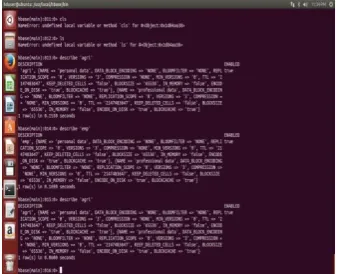
Figure 10: Load the data in HBase
Figure 11: Output of data in HBase
III.
Query – Apache Pig
The query written in the pig is in scripted form; we will load the database, then
DUMP it and store.
Database been LOAD
agri0
=
LOAD
'/user/hduser/agri1.txt/'
USING
PigStorage(',')
as
(commodity_code:int,commodity_desc:chararray,country_code:chararray,
country_name:chararray,market_year:int,calendar_year:int,month:int,
attribute_id:int,attribute_desc:chararray,unit_id:int,unit_desc:chararray, values:int);
*********************************************************************
Grunt> DUMP agri0;
Grunt> STORE agri0 INTO agriculture;
Figure 12: LOAD data
Figure 13: Output in Pig
PERFORMANCE ANALYSIS
We analyzed the various optimization and performance enhancers available in HBase, Hive and Pig. Different
analytics led to different results and gave insights about when one should work at what stage of Hadoop
framework and which optimization and performance enhancer to leverage at that particular stage.The result is
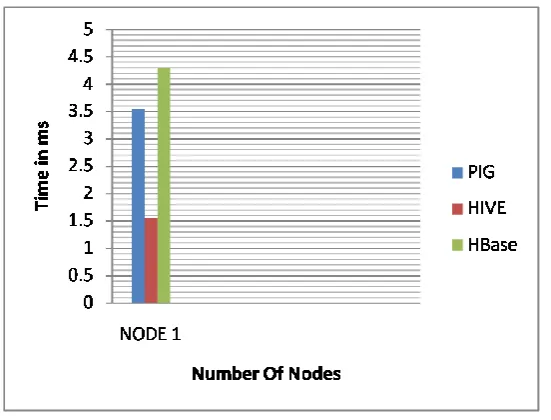
measured on the bases of the execution time been take by the query. As the graph show that development time
of Hbase of more as it involves large number of coding, where pig and hive development time is less
comparatively to Hbase.
Figure 14: Result on execution time
TABLE 2: Comparative study on BIG DATA Technologies
Features
Apache HBase
Apache Hive
Apache Pig
Available
Open-Source
Open-Source
Open-Source
Developed by
Apache Software
Foundation
Yahoo
Companies
using
EBay, Yahoo,
TrendMicro, and
Facebook etc.
Facebook, Netflix
Yahoo
Language
Java
HiveQL.
PigLatin
Required
Software
JDK version 1.7
Hive version 1.2
above require Java
1.7, Hadoop version
2.x preferred
Java1.6 or above is
supported
External file
support
Yes
Yes
Yes
When to Use
read/write access to our
Big Data
For analytical
purposes.
For data processing on
Data
Structure it
operates on
NOSQL
Apache Derby
database
Complex, nested.
Event Driven
No
No
No
Used
To provide quick
random access to huge
amount of structured
data.
Use for effective data
aggregation method,
ad hoc querying and
analysis of huge
volumes of data
For processing of large
data set present in
Hadoop cluster
CONCLUSIONS
There are various ways for Hadoop to run the job. The three programming approaches that are HBase, Hive and
Pig are used. But after performing practically we conclude that Hive takes less time as compare to both Pig and
HBase. But all approaches have pros and cons so we have to choose according to our need and data. For future
work, it would be fundamental to compare Hive and Pig on bigger data collections and giving out the best
results out of the two.
REFERENCE
[1] Jacobs, The pathologies of big data, Commun. ACM Vol. 52 (8) (2009) pp. 36–44.
[2] R. Schaller, Moore's law: past, present and future in Spectrum, IEEE Vol. 34 (1997): 52-59
(availablehttp://mprc.pku.edu.cn/courses/organization/autumn2013/paper/Moore%27s%20Law/M132oore
%27s%20law%20past,%20present%20and%20future.pdfaccessed December 2013).
[3] Rasmus Wegener and Velu Sinha, ―The Value of Big data: How analytics differentiates winners‖, Bain and
Company.
[4] Yaochu Jin,, Barbara Hammer, ― Computational Intelligence in Big Data‖, IEEE Computational
intelligence magazine, August 2014.
[5] Huijse et al.,‖ Computational intelligence challenges and Applications on Largee Scale Astronomical Time
Series Databases‖, IEEE, 2013.
[6] Apache Hadoop. What Is Apache Hadoop?, 2014. http://hadoop.apache.org/, accessed April 2014.
[7] Wikipedia. Apache Hadoop, 2014. http://en.wikipedia.org/wiki/Apache_Hadoop, accessed April 2014.
[8] T. White. Hadoop – the definitive guide. O‘Reilly Media, Inc., Sebastopol, California, 1 edition, 2009.
[9] Qureshi, S. R., & Gupta, A, ―Towards efficient Big Data and data analytics: A review‖, IEEE International
Conference on IT in Business, Industry and Government (CSIBIG),March 2014 pp-1-6.
[10] Apache Hadoop. MapReduce Tutorial, 2013. https://hadoop.apache.org/docs/r1.2.1/mapred_tutorial.html,
[11] Apache Hadoop. HDFS Architecture Guide, 2013. http://hadoop.apache.org/docs/r1.2.1/hdfs_design.html,
accessed April 2014.
[12] Aravinth, M. S., Shanmugapriyaa, M. S., Sowmya, M. S., & Arun, ―An Efficient HADOOP Frameworks
SQOOP and Ambari for Big Data Processing,‖ International Journal for Innovative Research in Science and
Technology, 2015, pp. 252-255.
[13] http://www.zetta.net/blog/cloud-storage-explained-yahoo
[14] Borthakur, D., Gray, J., Sarma, J. S, et.al, ―Apache Hadoop goes realtime at Facebook,‖ACM International
Conference on Management of data, 2011,pp 1071-1080.
[15] Pandit, A., et al., ―Log Mining Based on Hadoop‘s Map and Reduce Technique.‖, International Journal on
Computer Science & Engineering , 2013pp. 270-274.
[16]http://www.bigdatauniversity.com/web/media/player.php?file=BD030V212EN/Videos/HiveLesson3_Hive
DML_Video1_2_1_2.mp4&caption=files.db2university.com/BD030V212EN/Videos/EN/HiveLesson3_Vi
deo 1_captions.srt, 25 September,2015
[17] Anshu Choudhary and C.S. Satsangi ―Query Execution Performance Analysis of Big Data Using Hiveand
Pig of Hadoop‖,vol. Su-9 no.3,pp.91-93,Sep 2015.
[18] Olston, C., Reed, B., Srivastava, U., Kumar, R., & Tomkins, A, ―Pig latin: a not-so-foreign language for
data processing,‖ ACM International Conference on Management of data, pp.1099-1110.
[19] Sarkar, D, ―Understanding Windows Azure HDInsight Service. In Pro Microsoft HDInsight,‖ Springer,
2013, pp.13-22.
[20] http://www.dezyre.com/Hadoop-Administration/28, 20 September,
[21] Vora ,M. N, ―Hadoop-HBase for large-scale data.‖ IEEE International Conference on In Computer Science
![Fig: 1. The 7 V’s of big data [3] [4].](https://thumb-us.123doks.com/thumbv2/123dok_us/7764504.1275976/2.595.108.487.398.587/fig-the-v-s-of-big-data.webp)
![Figure 5: Apache Hive Architecture [18].](https://thumb-us.123doks.com/thumbv2/123dok_us/7764504.1275976/5.595.192.450.486.586/figure-apache-hive-architecture.webp)
![Figure 6: HBase Architecture [21].](https://thumb-us.123doks.com/thumbv2/123dok_us/7764504.1275976/6.595.80.528.99.319/figure-hbase-architecture.webp)
![Figure 7: Working Pig [18].](https://thumb-us.123doks.com/thumbv2/123dok_us/7764504.1275976/7.595.130.491.214.413/figure-working-pig.webp)