ABSTRACT
WANG, ZHI. Securing Virtualization: Techniques and Applications. (Under the direction of Xuxian Jiang.)
Virtualization is being widely adopted in today’s computing systems. Its unique advantages in iso-lating and introspecting commodity OSes as virtual machines have enabled a wide spectrum of appli-cations. However, a common, fundamental assumption of all these virtualization-based systems is the presence of a trustworthy hypervisor. Unfortunately, recent successful attacks against hypervisors, in addition to the bloated trusted computing base and highly complex internal logic of commodity (type-I and type-II) hypervisors, seriously question the validity of this assumption.
In this dissertation, we first present two systems to mitigate the threats posed by vulnerable type-I and type-II hypervisors, respectively: HyperSafe is a lightweight approach that enables control flow in-tegrity of type-I hypervisors for their self-protection. It has two key techniques:non-bypassable memory lockdownreliably protects the hypervisor’s code integrity even in the presence of exploitable memory corruption bugs, and restricted pointer indexing enforces control flow integrity by converting control data into restricted pointer indexes; HyperLock is a systematic approach to strictly isolate vulnerable type-II hypervisors from compromising the host OSes. It also has two key techniques:hypervisor isola-tion runtimesecurely isolates a hypervisor in its own dedicated address space and restricts its instruction set for safe execution, andhypervisor shadowingefficiently creates an individual shadow hypervisor for each guest so that a compromised hypervisor can affect only the paired guest, not others. We have built a prototype for both systems based respectively on two open-source type-I hypervisors (i.e., BitVisor and Xen) and one type-II hypervisor (i.e., KVM). The security experiments and performance measurements of these prototypes demonstrated the practicality and effectiveness of our approaches.
© Copyright 2012 by Zhi Wang
Securing Virtualization: Techniques and Applications
by Zhi Wang
A dissertation submitted to the Graduate Faculty of North Carolina State University
in partial fulfillment of the requirements for the Degree of
Doctor of Philosophy
Computer Science
Raleigh, North Carolina
2012
APPROVED BY:
Peng Ning Douglas Reeves
Huiyang Zhou Xuxian Jiang
DEDICATION
BIOGRAPHY
ACKNOWLEDGEMENTS
Pursuing a PhD degree is a daunting task that requires not only determination and persistence from the person pursuing the degree, but also a synergy from people related to it. At all stages of my graduate study, I have received various invaluable help from a number of people, whom I undoubtedly owe gratitude to.
First, I would like to thank my adviser, Prof. Xuxian Jiang, for his numerous help during my graduate study. Prof. Jiang has been instrumental, supportive, and conducive in guiding and shaping my research. His enthusiasm in research, standard for excellence, and eye for details will always be a source of motivation for me. I am also thankful to Prof. Peng Ning, Prof. Douglas Reeves, and Prof. Huiyang Zhou for their time and efforts serving in my PhD thesis committee and providing valuable advice that helped to improve this dissertation.
Second, I am grateful to all my coauthors for their helpful discussions and collaborations, to name but a few: Weidong Cui from Microsoft Research, Peng Ning from NC State, Dongyan Xu from Purdue, Xinyuan Wang from the George Mason University, and my colleagues in the Cyber Defense Lab at NC State, Ahmed Moneeb Azab, Sina Bahram, Tyler Bletsch, Mike Grace, Jinku Li, Deepa Srinivasan, Minh Q. Tran, Chiachih Wu, Wu Zhou, and Yajin Zhou.
In addition to academics, I received help in many other perspectives as well: Xuxian Jiang, Peng Ning, Douglas Reeves, and William Enck from NC State, Dongyan Xu from Purdue, ´Ulfar Erlingsson from Google, Dimitrios Pendarakis, Arvind Seshadri, and Josyula R Rao from IBM Research, Gary Tyson and Xin Yuan from Florida State, Ernie Salle from VMware, Weidong Cui, Michael Fortin, and Deepa Srinivasan from Microsoft, provided invaluable help during the stressful time of my job search by acting as a referee and/or giving constructive feedbacks and advice; Carol Allen, Margery Page, Tom Ryan, Douglas Reeves, David Thuente, and other staff members from the Department of Computer Sci-ence and the Office of International Services also deserve my gratitude. Because of them, my graduate study has been smooth; I am also grateful to organizations that generously funded my graduate research. The work in this dissertation was supported in part by US National Science Foundation (NSF) and the US Army Research Office (ARO) under several grants. As usual, any opinions, findings, and conclu-sions or recommendations expressed in this dissertation do not necessarily reflect the views of the NSF and the ARO.
TABLE OF CONTENTS
List of Tables . . . vii
List of Figures . . . viii
Chapter 1 Introduction . . . 1
1.1 Problem Overview . . . 1
1.2 Our Approach . . . 3
1.3 Dissertation Contributions . . . 5
1.4 Terminology. . . 5
1.5 Dissertation Organization . . . 6
Chapter 2 Related Work . . . 7
2.1 Hypervisor Integrity. . . 7
2.2 Kernel and Application Integrity . . . 8
2.3 Kernel Rootkit Defense . . . 10
Chapter 3 Providing Control Flow Integrity for Type-I Hypervisors with HyperSafe . . 12
3.1 Introduction . . . 12
3.2 Design . . . 15
3.2.1 Goals and Assumptions . . . 15
3.2.2 Key Technique I: Non-Bypassable Memory Lockdown . . . 16
3.2.3 Key Technique II: Restricted Pointer Indexing. . . 19
3.3 Implementation . . . 23
3.3.1 Non-Bypassable Memory Lockdown . . . 23
3.3.2 Restricted Pointer Indexing. . . 24
3.4 Evaluation . . . 28
3.4.1 Security Analysis . . . 28
3.4.2 Synthetic Experiments . . . 29
3.4.3 Performance Evaluation . . . 31
3.5 Discussion. . . 33
3.6 Summary . . . 35
Chapter 4 Isolating Type-II Hypervisors with HyperLock . . . 36
4.1 Introduction . . . 36
4.2 Design . . . 38
4.2.1 Hypervisor Isolation Runtime . . . 40
4.2.2 HyperLock Controller . . . 42
4.3 Implementation . . . 44
4.3.1 Memory Access Control . . . 44
4.3.2 Instruction Access Control . . . 45
4.3.3 Others. . . 48
4.4 Evaluation . . . 49
4.4.2 Performance Evaluation . . . 51
4.5 Discussion. . . 53
4.6 Summary . . . 54
Chapter 5 Countering Kernel Rootkits with HookSafe . . . 55
5.1 Introduction . . . 55
5.2 Problem Overview . . . 57
5.3 Design . . . 58
5.3.1 Overview . . . 58
5.3.2 Offline Hook Profiling . . . 59
5.3.3 Online Hook Protection . . . 60
5.3.4 Hardware Register Protection . . . 62
5.4 Implementation . . . 63
5.4.1 Offline Hook Profiler . . . 63
5.4.2 Hook Indirection . . . 64
5.4.3 Memory Protection . . . 67
5.4.4 System Call Indirection Optimization . . . 68
5.5 Evaluation . . . 69
5.5.1 Effectiveness Against Kernel Rootkits . . . 69
5.5.2 Performance . . . 71
5.6 Discussion. . . 73
5.7 Summary . . . 74
Chapter 6 Conclusion and Future Work . . . 75
LIST OF TABLES
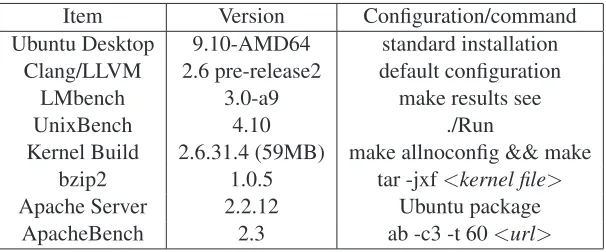
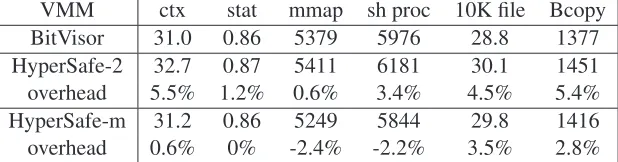
Table 3.1 Software packages for the evaluation of HyperSafe . . . 31 Table 3.2 LMbench results for HyperSafe (inµs– smaller is better) . . . 33
Table 4.1 The breakdown of HyperLock’s runtime service implementation.read msrand write msrare implemented together.enter guestincludes53lines of in-line assembly code and 25 in-lines ofCcode. . . 48 Table 4.2 Software packages for the evaluation of HyperLock . . . 51
LIST OF FIGURES
Figure 1.1 Three key components of the dissertation . . . 2
Figure 3.1 A break-down of hypervisor integrity guarantees and the corresponding key techniques in HyperSafe . . . 15
Figure 3.2 Traditional page table updates vs. new page table updates in HyperSafe (note theWPbit isONby default) . . . 18
Figure 3.3 Traditional indirect call vs. new indirect call in HyperSafe (noteRiis the return address of the indirectcall) . . . 19
Figure 3.4 Destination equivalence effect on ret instructions (a dashed line represents an indirectcallwhile a solid line stands for a directcall) . . . 22
Figure 3.5 The instrumentedcalltopmap readand the correspondingret(note the instru-mentation is done inx86 64) . . . 25
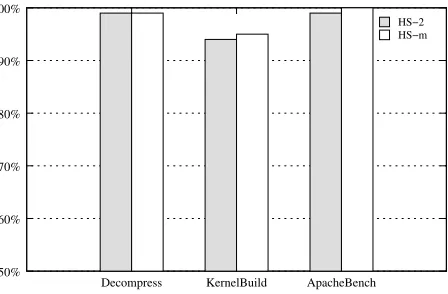
Figure 3.6 Normalized performance of application benchmarks with the original BitVisor as the baseline . . . 32
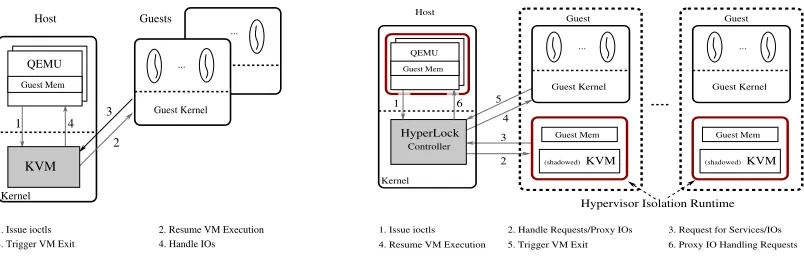
Figure 4.1 Traditional KVM execution vs. “HyperLocked” KVM execution . . . 39
Figure 4.2 Trampoline code layout: each code fragment starts with a one-byteINT3 and ends with a short JMP, which skips over the nextINT3 of the following code fragment. The starting address of the trampoline code is loaded into an IDT entry as the interrupt handler. . . 42
Figure 4.3 AVMWRITEmacro-instruction that writes0xc00195d7into theGUEST EIP VMCS field. . . 46
Figure 4.4 Normalized overhead of HyperLock . . . 52
Figure 5.1 Distribution of5,881kernel hooks in a running Ubuntu system. . . 57
Figure 5.2 The HookSafe architecture . . . 59
Figure 5.3 The architecture of online hook protection. . . 60
Figure 5.4 An example access profile related toext3 dir operations ->readdirkernel hook 63 Figure 5.5 The implementation of hook indirection . . . 64
Figure 5.6 An example HAP instruction and the related C code. . . 65
Figure 5.7 HookSafe foils the adore-ng rootkit. . . 70
Chapter 1
Introduction
1.1
Problem Overview
Virtualization is being widely used in today’s computing systems including various clouds. For exam-ple, Amazon Web Services (AWS) [10], one of the largest public clouds, is based on the open-source Xen [14] hypervisor. In virtualization, commodity operating systems (OSes) are encapsulated in virtual machines, and executed under the full control of the hypervisor.
The hypervisor’s unique strength in isolating and introspecting commodity OSes as virtual machines has promoted a wave of research [37,45,53,55,64,72,73,79,83,103] to address challenging security problems such as kernel rootkit detection and defense. One fundamental assumption shared by all these systems is the presence of a trustworthy hypervisor. A typical supporting argument is that the hypervisor has a code base that is much smaller than conventional OSes and thus can be better scrutinized to remove software bugs. However, as a matter of fact, contemporary type-I hypervisors (Section 1.4) such as Xen [14] and VMware ESXi [98] all have a large and complex code base. For instance, Xen 3.4.1contains about230Ksource lines of code (SLOC). By leveraging an existing host OS, a type-II hypervisor (Section1.4) itself indeed has a smaller code base (e.g., a recent version of KVM [48] has about 36 KSLOC), but the huge host kernel now becomes a part of the trusted computing base (TCB).
Guest OS
(KVM, VirtualBox...) (Xen, VMware ESXi...)
Type−I Hypervisor Type−II Hypervisor
HookSafe
(Chapter 5)
(Chapter 4)
HyperSafe HyperLock
(Chapter 3)
Figure 1.1: Three key components of the dissertation
The architecture of virtualization that gives the hypervisor dominative power in controlling and in-specting virtual machines also makes it challenging to secure. As the lowest and most-privileged layer in the system, the hypervisor cannot be secured with the traditionalone-layer-belowapproach (e.g., se-curing a hypervisor with nested virtualization [15,38]). Otherwise, we would face the same question of how to secure this new lowest software component. Yet, a failure to secure the hypervisor will have grave consequences on the whole system. To address this challenge, researchers have approached the problem from different perspectives: seL4 [49] formally verifies that a relatively small micro-kernel (about8.7K
SLOC) strictly conforms to its specification, including the absence of many software vulnerabilities (e.g., buffer overflows). However, it is still not scalable enough to verify commodity hypervisors with a much larger code base and the complex x86 CPUs and chipsets [76]. Unlike seL4, we focus on se-curing existing commodity hypervisors; HyperSentry [13] and HyperCheck [100] are two systems that monitor the integrity of the hypervisor from a separate environment. They can detect a violation of the hypervisor integrity only after it has happened. We instead try to protect the integrity of the system at the first place; There are also research efforts [26,62,90] in further reducing the TCB of a hypervisor, often with a micro-kernel based approach. As such, they can reduce the number of vulnerabilities in a hypervisor, but do not provide stronger security guarantees.
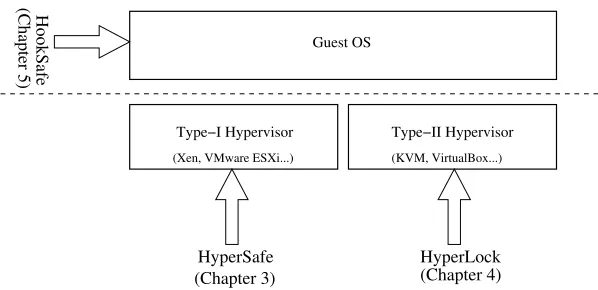
To address these challenges, we propose a systematic approach in this dissertation which consists of three key components as shown in Figure1.1: HyperSafe (Chapter3) and HyperLock (Chapter4) are two systems to harden the security for hypervisors. They compliment each other to accommodate the architectural differences between type-I and type-II hypervisors (Section1.4). Specifically, HyperSafe enables theself-protectionfor a type-I hypervisor by providing its control flow integrity, while Hyper-Lock securely isolates a vulnerable or compromised type-II hypervisor in a dedicated address space to prevent it from affecting the host or other guests. Under the protection of these two systems, a wide range of virtualization-based security services can be reliably applied, for example, to measure or pro-tect the guest integrity. The third system in this dissertation called HookSafe leverages the isolation and control provided by virtualization to defeat malicious kernel rootkits.
1.2
Our Approach
To protect the hypervisor integrity, we treat type-I and type-II hypervisors differently due to their ar-chitectural differences: a type-I hypervisor is self-contained and manages the hardware resources by itself. It is the sole privileged component running beneath all other software components on a physical machine. In Chapter3, we propose HyperSafe, a system that can enable theself-protectionfor a type-I hypervisor by enforcing its control flow integrity [5]; A type-II hypervisor instead relies on a host OS for many of its functionalities, such as scheduling, memory management, and device management. It usually runs as a loadable kernel module inside the host OS. In Chapter4, we propose HyperLock, a system that can securely isolate a type-II hypervisor inside its own address space to prevent it from compromising the host OS and other guests on the same physical machine.
Compared to a type-I hypervisor, a type-II hypervisor runs as an extension to the host OS. Protection schemes for a type-II hypervisor accordingly should be applied to its host OS as well due to the lack of isolation between them. Particularly, the techniques in HyperSafe cannot be directly applied to a type-II hypervisor. This is because the host OS frequently updates page tables for its applications, thus the page table access control in HyperSafe likely will introduce unacceptable performance overhead for a type-II hypervisor. In Chapter4, we propose HyperLock, a systematic approach to strictly isolate a vulnerable type-II hypervisor from the host OS. HyperLock also has two key techniques: hypervisor isolation runtimecreates a dedicated address space for the hypervisor to isolate it from the host OS, and further restricts its instruction set for safe execution; hypervisor shadowingleverages the virtual memory sharing to efficiently create multiple instances of the hypervisor, and pairs each guest with its own hypervisor instance. Under the isolation of HyperLock, a compromised hypervisor can affect only the paired guest, but not the host OS or other guests.
We have built a prototype for both HyperSafe and HyperLock based respectively on the type-I Xen [14] and BitVisor [86] hypervisors, and the type-II KVM [48] hypervisor. Our experiments show that these two systems can effectively secure a virtualization system with a small performance overhead (less than5%for both systems).
1.3
Dissertation Contributions
The contributions of this dissertation are threefold: type-I hypervisor integrity, type-II hypervisor in-tegrity, and kernel rootkit defense.
• Type-I hypervisor integrityWe have designed, implemented, and evaluated HyperSafe, a
sys-tem that uniquely enables theself-protectionfor type-I hypervisors by enforcing their control flow integrity. Specifically, we have proposed two techniques, non-bypassable memory lockdown and restricted pointer indexing, in HyperSafe to guarantee the hypervisor code and control data in-tegrity on the commodity x86 platform. HyperSafe is the first system that can protect the inin-tegrity for commodity type-I hypervisors.
• Type-II hypervisor integrityWe have designed, implemented, and evaluated HyperLock, a
sys-tem that can securely isolate a vulnerable or compromised type-II hypervisor. Likewise, we have proposed two techniques in HyperLock, hypervisor isolation runtime and hypervisor shadowing. The first technique constrains the execution of a type-II hypervisor in a dedicated and isolated address space, while the second technique creates multiple instances of a hypervisor and pairs each guest with its own hypervisor instance. Under HyperLock, a compromised hypervisor will be prevented from taking over the host or other guests. HyperLock is the first system that can isolate type-II hypervisors.
• Kernel rootkit defenseWe have designed, implemented, and evaluated HookSafe, a
virtualization-based system that can defeat nefarious kernel rootkits by preventing them from hijacking kernel hooks. In HookSafe, we have proposed techniques to relocate widely-scattered hooks in the guest kernel to a central location and protect them efficiently with the hardware page-level memory protection, thus addressing theprotection-granularity gap challenge. HookSafe is a systematic and lightweight approach to protect the guest kernel from threats posed by kernel rootkits.
1.4
Terminology
This section establishes the terminology that is used throughout this dissertation.
• Virtual MachineA virtual machine is a software abstraction that resembles an actual (e.g., x86)
or imaginary (e.g., Java virtual machine) machine’s hardware. A virtual machine can run all the software written for the machine that it virtualizes. For example, KVM can be used to run Mi-crosoft Windows in a virtual machine on the Linux platform.
(the discussion of the following terms is specific to the HVM). A virtual machine that has been loaded to the physical machine for execution is also called as a guest.
• VirtualizationVirtualization is the technology to create, execute, and manage virtual machines.
The software that implements virtualization is usually calledvirtual machine monitoror
hyper-visor. There are two types of hypervisor: type-I hypervisor and type-II hypervisor.
• Type-I HypervisorA type-I hypervisor (also called native hypervisor or bare-metal hypervisor)
runs directly on top of the machine’s hardware. It controls and manages the hardware resources by itself and is the sole privileged component in a virtualization system. Xen [14], VMware ESX [98], and Microsoft Hyper-V [3] are examples of type-I hypervisors.
• Type-II Hypervisor A type-II hypervisor (also called hosted hypervisor) runs as an extension
(e.g., a loadable kernel module) in a commodity host OS. It relies on the host OS for many of its functionalities such as memory management, device management, and scheduling. By leveraging mature functionalities in the host OS, a type-II hypervisor is relatively easy to manage and imme-diately supports most, if not all, of the hardware devices supported by the host OS. However, a type-II hypervisor usually has much larger TCB than a type-I hypervisor because the host OS is a part of the TCB. KVM [48] and VMware workstation [98] are examples of type-II hypervisors.
• Control Flow IntegrityControl flow integrity (CFI) [5] is a security property under which
run-time execution of a program must follow a path in its statically decidable control flow graph (CFG) [7]. CFI was introduced by Abadi et al. [5] for user space applications. CFI requires the code integrity as a precondition to prevent the introduction of new code into the program.
• SandboxA sandbox is a security mechanism to execute untrusted binary in a constrained
envi-ronment to prevent it from compromising trusted parts of the system. Sandbox is used widely to isolate untrusted or malicious program extensions. For example, Native Client [113] was designed to isolate untrusted browser plugins written in the native x86 instructions.
1.5
Dissertation Organization
Chapter 2
Related Work
In this chapter, we introduce and compare to some closely related work in the areas of hypervisor integrity, OS kernel and application integrity, and kernel rootkit defense.
2.1
Hypervisor Integrity
The first area of related work includes research efforts to verify, monitor, improve, and protect the hyper-visor integrity. They are directly related to the HyperSafe and HyperLock systems of this dissertation.
Hypervisor Integrity Verification and Monitoring There are recent efforts in applying static
analysis to identify and remove software bugs or using formal methods to prove certain security prop-erties. For example, static analysis, model checking, and symbolic execution have long been explored in the area of security research [8,21,22,30,34]. These systems are designed to uncover bugs in the source code [22,30]; prevent the bug from being exploited [8]; reason about the safety of one facet of the software [21]; or demonstrate the absence of certain kinds of bugs [34]. Some of these systems can be scaled to analyze commodity OS kernels. However, they typically focus on a small subset of secu-rity vulnerabilities or properties. For example, Bugrara et al. [21] validates the safety of Linux kernel’s pointer dereferences in system call arguments, where the safety is defined by the presence of sanity checks of pointers, not the proper use of the dereferenced contents.
From another perspective, HyperSentry [13] and HyperCheck [100] measure the hypervisor for integrity violations from SMM (system management mode). They can detect that a hypervisor has been compromised after it has already happened. In comparison, our systems aim to protect the hypervisor integrity at the first place.
Hypervisor TCB Reduction There also exist related efforts in reducing the hypervisor TCB
often by adopting the micro-kernel principles. For example, Xoar [26] applies the approach to partition the control domain (of type-I hypervisors) into single-purpose components. Xen disaggregation [62] shrinks the TCB for Xen by moving the privileged domain builder to a minimal trusted component. KVM-L4 [65] extends a micro-kernel with CPU and memory virtualization to efficiently support virtual machines. NOVA [90] applies the micro-kernel approach to build a bare-metal hypervisor. NoHype [92] removes the (tyI) hypervisor layer by leveraging the virtualization extension to processors and pe-ripheral devices. In comparison, HyperSafe enables the self-protection for type-I hypervisors, while HyperLock isolates type-II hypervisors byreplacingthe hypervisor’s TCB in the host kernel with the smaller (12%of the KVM code size) and simpler HyperLock controller.
Nested virtualization, in which CPU’s hardware-virtualization support is virtualized by a L0 hyper-visor to run commodity hyperhyper-visors (called L1 hyperhyper-visor) on top it, may also reduce the hyperhyper-visor TCB. Nested virtualization has been implemented for both Xen [14] and KVM [15,38]. With the nested virtualization support, we can measure or protect the integrity of a L1 hypervisor from the L0 hyper-visor by applying the traditionalone-layer-belowapproach. However, the L0 hypervisor is still largely left unprotected. HyperSafe and HyperLock can naturally be applied to protect the L0 hypervisors.
Hardware Support for Static and Dynamic Root of Trust Also closely related, the Trusted
Computing Group [95] has provided foundational work, such as Trusted Platform Module (TPM) [93] and Core Root of Trust for Measurement (CRTM) [95], to enable trusted computing in commodity hardware. The recent Intel TXT technology [43] provides a reliable way called measured late launch to securely load a clean hypervisor (or OS kernel). Trusted computing technologies have been leveraged to provide secure loading (with the guaranteed load-time integrity) [60,94], integrity measurement [44, 78], and attestation [80, 81, 85]. We also rely on them to ensure hypervisor load-time integrity and further complement these systems by effectively providing runtime integrity to the hypervisor.
2.2
Kernel and Application Integrity
The second area of related work aims to protect the integrity of an OS kernel or its applications.
Virtualization-based Guest Integrity Protection The first category of related work in this area
words, HyperSafe and HyperLock cannot enjoy the luxury of such a one-layer-below approach since hypervisors already run at the lowest layer.
Device Driver Isolation The second category of related work includes systems that isolate faults
or malicious behaviors in device drivers. They are related because type-II hypervisors are often imple-mented as a device driver or loadable kernel module.
Nooks [91] improves OS reliability by isolating device drivers in a light-weight kernel protection domain. Nooks assumes the drivers to be faulty but not malicious. Accordingly, the Nooks sandbox by design lacks instruction access control and malicious drivers cannot be completely isolated by Nooks. A closely related system is SUD [18] that can securely confine malicious device drivers in the user space. SUD relies on IOMMU, transaction filtering in PCI express bridges, and IO permission bits in TSS to se-curely grant user space device drivers direct access to hardware. However, SUD cannot be applied to the hosted hypervisors such as KVM simply because that hardware virtualization extension (e.g., Intel VT) is not constrained by the IOMMU or other hardware mechanisms that SUD relies on. Microdrivers [35] reduces device driver’s TCB in the kernel by slicing the driver into a privileged performance-critical kernel part and the remaining unprivileged user part. RVM [107] executes device drivers in the user space and uses a reference monitor to validate interactions between a driver and its corresponding de-vice. In HyperLock, we securely confine the privileged KVM code in the hypervisor isolation runtime. Gateway [87], HUKO [112], and SIM [83] are systems that use a hypervisor (e.g., KVM) to isolate kernel device drivers or security monitors. We did not take this approach because otherwise we will face the recursive question of how to isolate the hypervisor that runs at the lowest level.
Software Fault Isolation The third category of related work is a series of prior efforts [5,31,33,
59, 99,113] in implementing SFI to confine untrusted code in a host application. HyperLock applies
similar technologies to isolate type-II hypervisors.
2.3
Kernel Rootkit Defense
The third area of related work includes efforts to detect, protect, and analyze kernel rootkits. They are related to our third system, HookSafe, that can defeat kernel rookits by protecting kernel hooks.
Kernel Rootkit Prevention The first category of related work in the kernel rootkit defense includes
systems that aim at preventing kernel rootkit infection. For example, SecVisor [79] is a tiny hypervisor that uses hardware support to enforce kernel code integrity. Patagonix [55] provides hypervisor support to detect covertly executing binaries. NICKLE [72] mandates that only verified kernel code will be fetched for execution in the kernel space. However, these systems do not protect kernel hooks from being subverted to compromise kernel control flow, which is the main goal of HookSafe.
Lares [64] is a closely related work and our work mainly differs from it in two ways. First, our goal is to enable efficient, large-scale hook protection while Lares is mainly intended to enable reliable active monitoring of a VM by securing the execution path in which a monitoring point has been planted. Second, Lares directly uses hardware-based page-level protection to trap all writes to those memory pages containing kernel hooks. As a result, any write to irrelevant dynamic data in the same physical page will cause a page fault (Section5.2). When it is applied to protect thousands of hooks that are often co-located with dynamic kernel data, it will lead to significant performance overhead. In comparison, HookSafe recognizes the protection granularity gap and solves it by introducing a hook indirection layer that relocates protected kernel hooks to a page-aligned centralized memory space. By doing so, our approach only incurs small (6%) performance overhead.
Kernel Rootkit Detection The second category of related work aims at detecting the presence of
kernel rootkits. For example, a number of rootkit detection tools such as System Virginity Verifier [77] validate the kernel code and examine the kernel data (including hooks) known to be the targets of current rootkits. Copilot [67] uses a trusted add-in PCI card to grab a runtime OS memory image and infers possible rootkit presence by detecting any kernel code integrity violations. The approach is extended by follow-up research to examine other types of violations such as kernel data semantic integrity [66] and state-based control flow integrity [68]. Livewire [37] pioneered the virtual machine introspection methodology to inspect the inner states of guest VM to detect malware infections. Other systems such as Strider GhostBuster [101] and VMwatcher [45] leverage the self-hiding nature of rootkits to infer rootkit presence by detecting discrepancies between the views of a system from different perspectives. Note that all these approaches were proposed to detect kernel rootkits after the system has been infected. In comparison, HookSafe targets at preventing rootkits by protecting kernel hooks and kernel text from being manipulated by them.
Kernel Rootkit Analysis There also exist a number of recent efforts [53,73,104,114,115] on
Chapter 3
Providing Control Flow Integrity for
Type-I Hypervisors with HyperSafe
3.1
Introduction
Recent years have witnessed the wide adoption of virtualization in today’s computing systems. The unique security advantages from virtualization, especially in isolating and introspecting commodity OSes as virtual machines (VMs), have prompted a wave of research [37,45, 53, 64, 72, 73,79, 83, 103, 114]. For example, Livewire [37] pioneers the concept of VM introspection and applies it for
system monitoring and malware detection. SecVisor [79], NICKLE [72], VMwatcher [45], Lares [64], HookSafe [103], and SIM [83] leverage virtualization to protect the guest OS kernel integrity or enable reliable monitoring of OS kernel behavior. Most recently, a number of virtualization-based system de-bugging and analysis tools such as K-Tracer [53], PoKeR [73] and AfterSight [24] have been developed to examine system anomalies and study kernel-mode malware, which is considered difficult or in some situations impossible to do with conventional approaches. One fundamental assumption shared by all these research efforts is the need for a trustworthy hypervisor (or virtual machine monitor - VMM). However, as mentioned earlier in Chapter1, existing type-I hypervisors are unavoidably vulnerable and there is a pressing need to investigate effective and efficient ways to secure the hypervisor [74].
function pointers will be allowed. Also, the memory management component is moved out of the kernel space and exempted from being formally proved. Further, besides its inherent scalability constraint, we also notice that the proven functional correctness from a manually-specified specification does not nec-essarily equal the actual safety properties of the system. As a result, though it is an attractive approach, significant efforts are still needed to make it suitable for commodity hypervisors as their designs are not constrained by these restrictions.
From another perspective, we can tackle this hard problem by guaranteeing runtime hypervisor integrity despite the presence of exploitable software bugs. Common wisdom holds that to secure a running application, one runs monitoring software a layer below the application. However, this is not applicable here, simply because the hypervisor already runs at the lowest level of the software stack. It may be argued that a nested hypervisor can be developed to run underneath and protect another hypervisor running above. However, a fundamental question of the same nature still remains: “how to protect the hypervisor running at the lowest-level?”
Existing hardware-based technologies including TPM [93] and measured late launch [43] are capa-ble of effectively establishing static/dynamic root of trust by guaranteeing the loading of a hypervisor in a trustworthy manner. In other words, they can guarantee the load-time integrity of the hypervisor. However, the main challenge ishow to maintain the same level of integrity continuously throughout the lifetime of the hypervisor.Due to the fact that we cannot rule out the presence of software vulnerabil-ities in the hypervisor, we have to address the threat that after the hypervisor is securely loaded, these vulnerabilities may be immediately exploited to sabotage its integrity.
In this chapter, we present the design, implementation, and evaluation of HyperSafe, a system that reliably establishes the continuous integrity of the lowest-level software on a system, i.e., the hyper-visor. Specifically, continuous integrity in this chapter is enforced in the form of lifetime control flow integrity [5]. Our system is lightweight and can be integrated into commodity hypervisors1 without requiring specialized hardware support. And unlike the previously mentioned common wisdom, even though HyperSafe is a natural part of the hypervisor, it preserves via a self-protection mechanism the lifetime hypervisor integrity.
In particular, HyperSafe implements two key techniques: The first one is non-bypassable memory lockdown, which essentially serves as the cornerstone for the entire scheme and enables the unique hy-pervisor self-protection. Specifically, once a memory page is locked down, this technique guarantees that the page needs to be unlocked first – even for legitimate hypervisor code – in order to modify the page. And by design, the unlocking logic will simply disallow any attempts that will either modify ex-isting hypervisor code or bring external (malicious) code for execution in the hypervisor space. In other words, this technique locks down those write-protected memory pages (containing hypervisor code and read-only data) as well as their attributes (in the page tables) and prevents them from being changed
1Considering the various flavors of hypervisor implementations (Section3.2), we focus on those Type-I hypervisors. Some
at runtime, thus effectively achieving hypervisor code integrity. We highlight that the enforcement can-not be bypassed even in the presence of potentially exploitable memory corruption bugs such as buffer overflows.
The second key technique is restricted pointer indexing, which essentially leverages the memory lockdown technique to expand the protection coverage from hypervisor code to control data. Notice that when used in related control transfer instructions (e.g.,call/jmp/ret), the control data can directly impact the control flow of hypervisor execution. Their security implications become evident, especially with the recent exposure ofreturn-oriented programming[40,82]. Unfortunately, we cannot directly apply the memory lockdown technique to protect all the control data, as some of them (e.g., return addresses in the stack) will be dynamically generated. To address that, we observe the potential control flow always follows the control flow graph, which can be predetermined ahead of time. With that, we can convert the control data (also calledpointersin this chapter) into pointer indexes and restrict them to be conformant to the control flow graph. In other words, we can pre-compute possible control flow targets, save them in the target tables, and restrict the accesses from pointer indexes to them. Since these target tables are static, we can directly leverage the memory lockdown technique to protect them. Consequently, the protection of the hypervisor integrity is expanded from the code to the control data for control flow integrity.
To the best of our knowledge, HyperSafe is the first system that is capable of providing hypervisor control flow integrity. To validate our approach, we have implemented a prototype of HyperSafe and ap-plied it to protect two open source Type-I hypervisors, i.e., BitVisor [86] and Xen [14]. Specifically, the first key technique is implemented by directly modifying the hypervisor source code while the second key technique is implemented as a compiler extension to the re-targetable LLVM framework [56], which is thus hypervisor-transparent. As a result, the BitVisor/HyperSafe prototype is a full implementation with both key techniques. For the Xen port, since the current LLVM release does not support compiling Xen yet, our current prototype only enables the non-bypassable memory lockdown, which still guaran-tees the nontrivial code integrity of Xen. Our prototyping experience indicates that HyperSafe’s code size is small and its integration with commodity hypervisors is straightforward. Evaluation with syn-thetic hypervisor attacks as well as a number of performance micro-benchmarks and user applications show that the integrity protection can be effectively enabled with less than5%performance overhead.
lifetime hypervisor control−flow integrity
run−time control−flow integrity
load−time integrity trusted booting
(e.g., tboot)
hypervisor code integrity
hypervisor control−data integrity
restricted pointer indexing non−bypassable memory lockdown
(Sec II.B) (Sec II.C)
Figure 3.1: A break-down of hypervisor integrity guarantees and the corresponding key techniques in HyperSafe
3.2
Design
3.2.1 Goals and Assumptions
In order to provide lifetime hypervisor control flow integrity, we have three main design goals.First, the proposed techniques should enable the self-protection of commodity hypervisors. As the name indicates, self-protection may not introduce new lower level mechanisms. Further, the self-protection mechanism needs to bereliable in the presence of exploitable memory corruption bugs (e.g., buffer overflows or format string bugs) andeffectivein proactively preventing attacks from gaining execution control over the hypervisor.
Second, the proposed techniques should not require re-structuring or impacting the original hypervi-sor design while still providing the desired integrity guarantee. In other words, the proposed techniques need to be generic and amenable to commodity hypervisors without limiting the design choices or im-posing implementation restrictions (e.g., in disabling certain programming language features). We may need to tolerate some minor modifications to commodity hypervisors, but the modifications should be minimal. Also, based on the traditional classification between Type-I bare-metal and Type-II hosted hy-pervisors and the fact that Type-II hyhy-pervisors require a hosted OS kernel, our focus in this chapter is the support of Type-I hypervisors.
Third, the proposed techniques can be efficiently implemented on commodity hardware, i.e., without relying on sophisticated hardware support to achieve the integrity guarantee or obtain reasonable perfor-mance for deployment. Given this requirement, the challenge is to ensure that the proposed techniques can be implemented on top of commodity hardware, have a small footprint, and remain lightweight with respect to performance impact.
Threat model and system assumption In this work, we assume an adversary model where
code or leverage and misuse existing code. Note this represents a powerful adversary model as attack-ers can attempt to inject code, modify existing code, and exercise more sophisticated attacks such as return-oriented ones [40].
In the meantime, we do assume trustworthy hardware, especially the TPM [93]-assisted static/dynamic root of trust [94], which can be leveraged to guarantee load-time hypervisor integrity. Due to the unsafe programming language used in the implementation, we do assume the presence of vulnerabilities in the hypervisor. However, the attackers are restricted in their attempts to subvert the hypervisor integrity by only exploiting these vulnerabilities, not by out-of-band attacks (e.g., TLB cache or SMM exploitation [108, 109]) or layer-below attacks (including physical-level attacks). Malicious DMAs [110] are not considered as they can be readily blocked with hardware-based IOMMUs [43]. Notice that our attack model is similar to that used in SecVisor [79]; however, one key distinction is that HyperSafe is de-signed to protect the hypervisor itself while SecVisor aims to protect the guest kernel code integrity using a smalltrustedhypervisor.
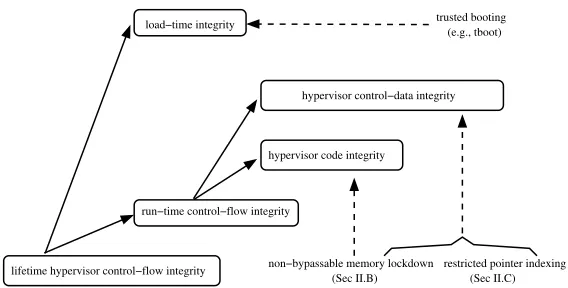
Based on this threat model, we propose two key techniques, i.e., non-bypassable memory lock-down andrestricted pointer indexing, to enable the self-protection of commodity hypervisors. Figure 3.1 shows a break-down of the required hypervisor integrity guarantees as well as the corresponding key techniques we propose to achieve them. Next, we will describe in detail these two key techniques.
3.2.2 Key Technique I: Non-Bypassable Memory Lockdown
As mentioned earlier, this technique serves as the cornerstone for the proposed hypervisor integrity pro-tection. In the following, we first give a brief overview of the available memory protection mechanisms in the Intelx86architecture on which our system is developed. In essence, thex86architecture supports two types of memory protection:segmentationandpaging. With the introduction of the new64-bit mode of thex86processor, segmentation has been mostly disabled in favor of paging.2 Because of that, our discussion will be focusing on paging and our system relies on paging-based memory protection.
Specifically, the paging-based memory protection divides the virtual address space into pages, and physical memory into frames of the same size. The translation from the virtual page to the physical frame is facilitated by the page tables. Each page table has a number of page table entries (512inx86 64). Each entry contains certain bits to specify the corresponding page protection attributes, such as whether the page is writable (theR/Wbit), executable (theNXbit), or requires privileged access (the U/Sbit). Different from the virtual page’s privilege levels, the CPU has four privilege levels (or rings) from0to 3with0being the highest privilege. The code running in privilege level3can only access user pages while the code running in privilege levels0,1and2is considered to be supervisor code and can access both user pages and supervisor pages.
2
With these protection attributes, paging-based memory protection allows for flexible customization to each and every individual page. For example, one common usage of these attributes in commodity OS kernels (e.g., Windows, Linux, and OpenBSD) is to write-protect their code and read-only data. Another similar one is to establish the W⊕X property of the OS kernel to ensure its code integrity as
demonstrated in a few recent systems [72,79].
Similarly, we are motivated to enforce the W⊕X for hypervisor integrity protection. However, there are several notable pitfalls. First, for historical reasons [72], commodity OS kernels may allow the pres-ence of mixed memory pages that contain both code and data. Certainly, the prespres-ence of such pages directlyviolates theW ⊕Xproperty and should be avoided in the hypervisor. Second, for performance and efficient resource sharing purposes, existing OS kernels typically allow the mapping of several virtual pages to the same physical frame and different virtual pages may possibly have conflicting pro-tection attributes. Such double mappingindirectlybreaks the W⊕X property and should not be allowed in the hypervisor either. Third, most importantly, the W⊕X-based integrity enforcement largely relies on the integrity of page tables. For a write-protected page to be modifiable, the corresponding page table entries will need to set in a way to allow it. Unfortunately, in current hypervisors (e.g., Xen and KVM) and OS kernels (e.g., Windows and Linux), their page tables are allwritable! This implies that even if a hypervisor ideally sets these memory protection attributes, the enforcement can be easily bypassed since the page tables are writable. Our experience indicates that the ability to modify even one bit in a page table entry could well be enough to subvert the entire protection.
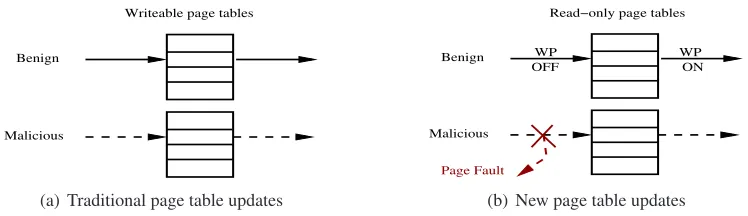
From another perspective, if we assume the proper initialization of the hypervisor page tables (i.e., no mixed pages, no double mapping, and a correct W⊕X setup for each memory page), the attacker will be forced to first manipulate the page tables in order to bypass the W⊕X protection. This observation motivates us to also write-protect the page tables. By doing so, we can ensure that no code including legitimate code will be able to modify the write-protected hypervisor code (and related control data – Section3.2.3). As mentioned earlier, in order to proceed with any modification, the page tables need to be changed to allow it. But the write-protection of page tables disallows such a change. Consequently, any write attempt to them (including the page tables) will be hardware-trapped into the page fault han-dler, which, as a part of legitimate code, is unable to modify them either. This is a strong guarantee that serves as the basis to establish and sustain hypervisor runtime integrity.
The above strong guarantee is desirable for hypervisor protection as it can effectively prevent ma-licious updates to page tables. Unfortunately it will also trap and block all benign updates. Again, the reason is that once paging is enabled, the hypervisor can only access its memory through virtual ad-dresses, which will be translated and subjected to protection checks by the page tables.3As a result, the creation of read-only page tables immediately leads to an unsolvable paradox: read-only page tables can
3
Benign
Malicious
Writeable page tables
(a) Traditional page table updates
OFF WP Benign
Malicious
WP ON
Page Fault
Read−only page tables
(b) New page table updates
Figure 3.2: Traditional page table updates vs. new page table updates in HyperSafe (note theWPbit is ONby default)
detect and deny any malicious manipulation but they also make the benign changes impossible.
To accommodate benign page table updates, we need to design a secure way to temporarily bypass the enforcement without being misused (e.g., by return-oriented attacks). This is how our technique – non-bypassable memory lockdown – comes into play. Specifically, our technique uses a hardware feature called the W P bit (i.e., the Write Protect bit in the machine control register CR0 [111]), which has existed in allx86CPUs since the Intel Pentium. TheW P bit controls how the supervisor code interacts with the write protection bits in page tables: If the WP bit is turned off, the supervisor code has unfettered access to any virtual memory (i.e., the write-protection is ignored). Otherwise, the write protection attributes in page table entries will decide whether the supervisor code can write to the memory page or not. Note theW P bit was originally introduced to facilitate the Copy-On-Write (COW) implementation of forking a new process. More specifically, in Linux, when a process forks, memory pages are shared (or marked as read-only) between parent and child processes. Therefore, any write to a COW-shared page leads to the creation of a new copy of the page and the sharing can then be removed. As a result, OS kernel can simply set theW P bit to trap its own writes to these pages, which greatly simplifies the COW design and implementation. (Otherwise, OS kernel must check for COW every time it writes to user space.)
func_j
Ri call *%eax
Ri: ... ...
func_j:
ret [esp]
eax
Call Site i Callee j
(a) Traditional indirection call
Ri: ... ... call *%eax
Ri
func_j
ret func_j: Target Table i
eax
[esp] Target Table j
Call Site i Callee j
(b) New indirection call
Figure 3.3: Traditional indirect call vs. new indirect call in HyperSafe (noteRiis the return address of the indirectcall)
case in Section3.4.1. Figure3.2shows the comparison between traditional page table updates and the new page table updates in HyperSafe.
It is worth mentioning that to protect the hypervisor page tables, we also need to protect related machine control registers and data structures. For example, the hypervisor’s page table base address is contained inCR3, which should not change after the initialization. The same also applies for the entries in the GDT (Global Descriptor Table) and the IDT (Interrupt Descriptor Table). In addition, the hypervisor virtualizes the guest’s memory by using either shadow page tables (SPTs) or nested page tables (NPTs). The updates to them need to be protected in a similar way to prevent the attacker from gaining the control over the hypervisor’s memory (e.g., by mapping it to a compromised guest).
To summarize, our technique effectively locks down hypervisor memory pages to strictly specify and manage memory protection attributes. Most importantly, the enforcement of these memory attributes such as W⊕X is non-bypassable (Section3.4.1). As a result, we can reliably provide hypervisor code integrity. Next, we will present another key technique that essentially expands the protection coverage to control data and enables control flow integrity.
3.2.3 Key Technique II: Restricted Pointer Indexing
Control flow integrity (CFI) is a powerful security measure, which strictly dictates the software’s run-time execution paths. If the software’s runrun-time paths follow the statically determined control flow graph, attackers can be prevented from arbitrarily controlling the execution flow of the system. Based on how control is transferred, there are two types of control flow transfer instructions: direct and indirect. A di-rect control transferis initiated by a direct function call where the destination is encoded in the machine code in the form of an absolute address or a relative offset. Accordingly, control flow integrity from direct control transfers is maintained as long as the code integrity is guaranteed.
there are two types of control data: function pointers and return addresses. For simplicity, we also call thempointers. Due to the dependence of indirect control flow on these pointers, we need to protect their integrity to preserve indirect control flow integrity.
Unfortunately, we face three main challenges:First, control data can be widely scattered in memory and can co-exist together with other dynamic data on the same pages [103]. Naive page level protection will likely lead to huge performance overhead.Second, some control data can be dynamically generated and thus their locations cannot be determined a priori. A representative example is the return address. This implies any protection scheme that requires their locations to be static will fail.Third, some control data such as return addresses can be updated at a high frequency. This invalidates any approach that requires write-protecting frequently updated control data. Our experience with a local build of the Xen hypervisor (version3.4.1) for thex86-64architecture indicates that there is acallinstruction on average for every23machine instructions in the binary and aretinstruction for every79instructions. At runtime, each callinstruction will push a return address onto the stack, which will then be popped off by the correspondingretinstruction.
From another perspective, we notice that though the control data may be dynamically generated or frequently updated, their contents always fall in a data set that can be determined offline. As such, we can aggregate them into individual target tables and, by introducing one layer of indirection, replace each control data with a restricted index to the target table (hence the namerestricted pointer indexing). More specifically, the target table contains all the legitimate destinations for an indirect control flow instruction allowed by the hypervisor program’s control flow graph (CFG). For each indirectcall/jmp, its table contains the function entry points it may enter. Similarly, the target table for aretincludes all the return addresses it may return to.
Based on the target tables, HyperSafe can essentially replace all the runtime control data in the hypervisor program with their indexes in the target tables. To perform a control transfer, the indirect control flow instruction will be instrumented to convert the index back to the destination address (e.g., by looking up the index in the table). For that, we need to take the following two steps:
First, the instructions that introduce the control data into the hypervisor program must be converted to use the indexes instead. For simplicity, we call these instructions source instructions. The source instruction for a return address is the related callthat pushes the return address onto the stack. As a result, the call instruction will be instrumented into two instructions: one pushes the index onto the stack and anotherjmps to the function entry point. For an indirectcall, its source instruction is an earlier instruction that loads the function address to the register or memory. Unlike the return address case, the function pointer can possibly appear in the data section (e.g., as a member of an initialized global object or variable). As a result, we can leverage the compiler to identify and convert them.
consumed by indirectcall/jmpinstructions. During instrumentation, aretwill be converted to a sequence of instructions to pop the index off the stack, convert it into the return address, and then return to it. An indirectcall/jmpwill be converted to use the index to locate the function entry point and then continue execution there.
Based on the above instrumentation, an indirect call acts as a sink instruction for the consumed function pointer and a source instruction for the dynamically-pushed return address. Therefore, it will be instrumented twice. There may also exist other instructions that access the control data but are not the source and sink instructions. Among them, some instructions can be left intact if the contents of the control data are not explicitly examined by them. One example is themov instruction that copies the index to and from registers or memory. Instructions that compare two function addresses do not need instrumentation either if we assign the pointer indexes in the order of their addresses. On the other hand, instructions that examine the contents of control data must be expanded to convert indexes into original control data. A general solution is to discover and convert all such instructions, ideally by the compiler. Fortunately, very few instructions will touch return addresses on the stack. If they do, most likely they are implemented in assembly and thus we can instrument them manually. For function pointers, most accessing instructions aremovorcmp. In this case, the contents of the function pointers are not examined and we can safely keep these instructions as is.
In Figure3.3, we show the control flow for an instrumentedcall/retpair in HyperSafe when com-pared to the original pair. In the figure, the originalcallhas been instrumented to fetch the index from
eax, convert it to a function entry point by indexing into its target table, and then jump to the function. By substituting indexes for control data, HyperSafe limits the destination of a runtime control trans-fer to only those explicitly specified in the target table. In other words, indirect instructions can only transfer control to the targets allowed by the CFG. Moreover, because all the destination addresses are known beforehand from the hypervisor program binary, these target tables can be pre-computed offline. At runtime, they are protected by directly applying the memory lockdown technique.
ret func_j:
ret func_i:
R2:
call func_j R3: R1: call %eax
call func_i
Figure 3.4: Destination equivalence effect onretinstructions (a dashed line represents an indirectcall while a solid line stands for a directcall)
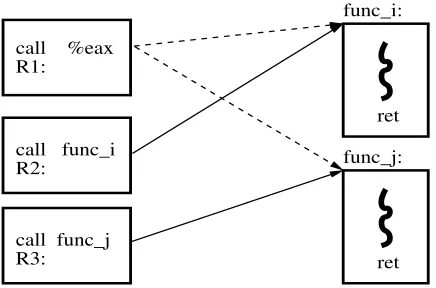
As pointed out in [5], the major factor that impairs the precision of control flow integrity is the so calleddestination equivalenceeffect. That is, two destinations are considered to be equivalent if they connect to a common source in the CFG. Further, the equivalence relation is transitive. In Figure3.4, we show an example of the destination equivalence effect on theretinstructions. In this figure, there are one indirectcallinstruction and two directcallinstructions. The indirectcallmay invoke both functions
f unc iandf unc jwhile the two directcallsexecutef unc iandf unc j, respectively.R1,R2andR3 are the corresponding three return addresses. From the figure, the functionf unc ican return toR1and
R2, and the functionf unc j can return toR1andR3. Because of the destination equivalence effect,
R1,R2andR3are all equivalent in this example. More specifically, sinceR2is equivalent toR1and
R1is equivalent toR3, based on the transitivity of the equivalence relation,R2is equivalent toR3. The destination equivalence effect also indicates that a return address has the same index in each target table that contains it. This is obvious since only one index can be assigned to a specific destination. In our example,R1,R2andR3forms one equivalent group, and tworetinstructions inf unc iandf unc j
can return to them. If one table per function is used to enforce the control flow integrity, we can use a table “R1,R2,error” for theretinstruction inf unc i, and another table “R1,error,R3” for theret
instruction inf unc j, whereerrordenotes a special destination to trap an impossible control transfer. Therefore, our one-table-per-function-based control flow integrity enforcement policy is more precise than the one originally proposed in [5], whereR1,R2andR3will bear the same label ID and bothret
3.3
Implementation
We have implemented a prototype of HyperSafe and applied it to protect two open-source Type-I hy-pervisors, i.e., BitVisor [86] (with∼190K SLOC)4 and Xen [14] (with∼230K SLOC). In particular, the first technique – non-bypassable memory lockdown – is implemented by directly extending their memory management modules. For the second technique – restricted pointer indexing, we choose to extend the open-source LLVM compiler so that we can enable it by simply re-compiling the hypervi-sor code with the modified compiler. Our development environment is a standard 64bit Ubuntu 9.10 desktop. As mentioned earlier, the BitVisor port is a full implementation, while the Xen port only con-tains the non-bypassable memory lockdown feature, which nevertheless guarantees the nontrivial code integrity of Xen. Meanwhile, our current prototype integrates the trusted booting software, i.e., tboot [94], to protect the load-time integrity. After the hypervisor is successfully loaded, HyperSafe will then ensure its runtime integrity. In the following, we focus on the BitVisor port as an example to present our implementation details.
3.3.1 Non-Bypassable Memory Lockdown
The key novelty of our system is the non-bypassable memory lockdown technique for hypervisor in-tegrity protection, achieved purely based on commodity hardware support. Specifically, HyperSafe write-protects the hypervisor’s page tables and turns on the WP bit in CR0 to initiate the memory lockdown. Our system requires only minimal modifications to the supported hypervisors, therefore sat-isfying the second design goal (Section3.2). Specifically, in our BitVisor prototype, we only added or changed521lines of C code and9lines of assembly code. To avoid potential pitfalls in W⊕X
enforce-ment (Section3.2), we adjust the link script to align related sections to avoid mixed pages and at runtime disallow double mappings.
In our prototype, we reserved the top 128M B physical memory for BitVisor. This memory is mapped1 : 1 to the virtual address0x40200000. A 32M B memory range, starting at the virtual ad-dress0x40800000, is reserved as the shared page table pool from which all the hypervisor’s page tables are allocated. After secure booting from tboot, the hypervisor properly initializes the page table data structure, turns on the W P protection in theCR0 register, and then enables the paging mode. After entering the paging mode, every virtual memory access will be automatically translated through page tables. Because of that, all the page tables have to be accessible and mapped in the hypervisor’s virtual address space. In BitVisor, since all the page tables are allocated from and mapped in the page table pool, we simply set the whole page table pool as read-only to lock the page tables. To accommodate be-nign updates, our system first traverses through the page table hierarchy to locate the affected page table entries, and then escorts their updates to guarantee that existing hypervisor code will not be modified and no external code will be introduced for execution.
4
After the page tables have been write-protected, any write attempts to modify them at runtime (e.g., either by legitimate hypervisor code or malicious code injected due to a successful exploitation) will be trapped. Inside the page fault handler, we will enforce an unlocking logic that simply preserves the W⊕X property. In the meantime, there also exist a number of legitimate reasons for the hypervisor to
update its page tables without violating the W⊕X property. For example, the hypervisor may need to map part of guest memory pages or device memory for its access. This mapping is typically temporary as it will be removed immediately after the hypervisor has accessed it. For that, instead of triggering a page fault, the hypervisor first turns off the WP protection, updates related page table entries, and turns it back on. The BitVisor implementation provides several helper routines, i.e.,pmap wr64andpmap -wr32, that are used to update page table entries. Our prototype wraps these routines by adding additional inline assembly code to turn WP protection on and off. To ensure that such escort operations are atomic, our prototype disables the interrupts when an escort operation is in progress. Further, in order to prevent the misuse of these routines, HyperSafe validates whether the change is benign. Our current prototype simply denies any change to the permission of the hypervisor’s code and data sections after initial setup. Also, it disallows the double mapping of the hypervisor’s code and data sections. This check can be implemented efficiently by verifying the page table update against various address ranges (e.g. physical or virtual address ranges of hypervisor’s code and data sections). As discussed in Section 3.4.1, this check isnotredundant even in the presence of a control flow integrity guarantee.
In our prototype, we use the memory lockdown feature to write-protect not only the hypervisor’s code, but also its static data. Some examples of this data include the entries in the GDT, the IDT, and various target tables. As mentioned earlier, all these data structures are security-critical and should be write-protected by HyperSafe. For guest page tables, there are two main virtualization modes: shadow page table (SPT) and nested page table (NPT). In the SPT mode, hypervisor “shadows” the guest page tables by maintaining a corresponding copy, i.e., the shadow page tables. The CPU translates the guest virtual address directly to the host physical address using these shadow page tables. The hypervisor also traps updates to the guest page tables and synchronizes shadow page tables with them. In the NPT mode, there are two levels of page tables used by the hardware. The CPU first translates a guest virtual address to a guest physical address with the guest page tables, and then maps that guest physical address to a host physical address based on nested page tables maintained by the hypervisor. Note that the shadow page tables (if running in the SPT mode) or the nested page tables (if running in the NPT mode) need to be protected so that the hypervisor memory will not be accidently mapped and accessible to the guest.
3.3.2 Restricted Pointer Indexing
ret
push $index call pmap_read
and $0x3f, %r8 # limit the index pop %r8 # pop index off stack
jmp *%r8 # jmp to destination mov RT_pmap_read (,%r8,8), %r8 # load destination jmp pmap_read
is instrumented as:
Figure 3.5: The instrumentedcalltopmap readand the correspondingret(note the instrumentation is done inx86 64)
replaces the destination addresses used by the program with their indexes. By doing so, we can guar-antee that an indirect control flow transfer instruction that utilizes one of these protected pointers will transfer the controlonlyto the addresses specified in the target tables. As discussed earlier, we can also flexibly control the precision by adjusting these target tables to handle the destination equivalence effect. In our prototype, we implemented a scheme that uses one table for each indirectcall/jmpinstruction and one table for each function (applicable for all theretinstructions contained in the function). The table per indirect call/jmpinstruction contains all the function entry points it may call. Similarly, the table per function has all the valid return addresses for this function. As such, the target tables reflect the hypervisor’s control flow graph.
Our technique is implemented as a compiler extension to the re-targetable LLVM framework. We choose it because it is a production-quality open source compiler infrastructure that has a modular design and can be flexibly extended. In particular, our extension includes a program analysis and optimization phase that can be applied to the intermediate representation (IR) of a program. In essence, it integrates the supported alias analysis to build and generate the target tables while extending the compiler back-end to instrument instructions for the use of target tables. Note the target tables contain information for both direct and indirect calls. The control flow graph for the direct calls is simple to extract because their targets are already encoded in the instructions. For the control flow graph of indirect calls, we extend the existing alias analysis in LLVM. Specifically, we leverage the data structure analysis implemented in LLVM to identify possible call targets. Note that the data structure analysis is a context-sensitive, field-sensitive unification-based pointer analysis. As a result, it is considered conservative. During our implementation, we found that it is relatively effective to analyze C code. However, it is unable to handle assembly, which is one common limitation of existing alias analysis tools.
In our prototype, we realize that one specific way BitVisor saves and utilizes function pointers foils the data structure analysis. In particular, to facilitate multi-core support, BitVisor keeps a per-cpu data structure and accesses it with the help of the gs segment. (Notegs is one of the two segments that
x86 64 keeps to allow for such access.) With that, each processor can set its gs segment’s base or
per-cpu data with thegs:of f setaddressing mode, which will be translated by the current CPU into the
gs base+of f set. As assembly code is required to load the per-cpu data, the data structure analysis in
LLVM is unfortunately unable to uncover all the call targets. To handle that, we manually went through the indirect calls that were not able to be analyzed and then leveraged our domain knowledge to resolve them. Our experience shows that there are126indirectly called functions and360indirect call sites in BitVisor, and the data structure analysis was able to extract indirect call targets for about three fourths of them. Therefore, we had to manually analyze the rest. We point out that most of these manual efforts only need to be done once, though ideally we still need an automated approach. For that, the recent efforts [19] on alias analysis at the assembly level can be naturally integrated and extended.
Once the complete call graph is derived, it is a rather straightforward process to generate the target tables. In our prototype, we use the standard union-find algorithm to locate the equivalent targets and assign the same index to the destinations if they appear in multiple target tables. Also, our prototype assignserror to certain target table entries if they are not reachable in the call graph. In our build of the hypervisor, it turns out that there are681target tables forretinstructions and360target tables for indirectcalls. If we include direct calls, there are4100call sites in total.
After building the control flow graph and generating the target tables, we extend the compiler back-end to instrument relevant source and sink instructions. In our build environment, the compiler first compiles the C source into assembly code, and then generates the executable binary with GAS, the GNU Assembler. Our prototype extends a LLVM component called AsmPrinter to generate the instrumented assembly code. Specifically, acallinstruction is instrumented to push the index of its return address to the stack, while aretis instrumented to pop the index off the stack, fetch the actual return address from its target table, and continue execution there.
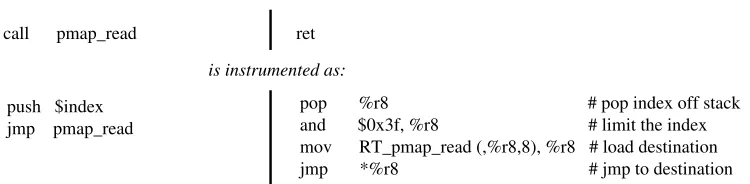
To better describe the scheme and discuss one possible optimization we identified and implemented in our system, we consider the instrumentation of a directcall. In Figure 3.5, we present the results after instrumenting a directcallto the functionpmap readand the correspondingretin that function. Basically, the instrumentedcallinstruction pushes the index of the return address to the stack followed by a jump to the target function. Theretinstruction is rewritten to first pop the index off the stack, then load the actual return address from its target table (RT pmap read) and resume execution to it. In this example,RT pmap readis defined as a static global variable to contain the return addresses of58calls
topmap read. For alignment purposes, the table actually contains64 elements and invalid elements
are filled in witherror– the address of an error reporting routine to trap illegal control flows. In the meantime, it also allows HyperSafe to prevent possible index overflows with oneandinstruction (the second instruction in the instrumentedretas shown in the figure). To reduce the performance overhead, we use a caller-saved register, i.e.,r8, to facilitate the instrumentation and avoid unnecessary register spilling.