Properties of Frequency Response Function of a Fully Embedded Structure
Based on Seismic Response Records
Satoshi Kurita1, Kahori Iiyama2, Kiyoshi Hirotani3, and Yoshihiro Ogata4
1
Professor, Dept. of Architecture, Tokyo University of Science, JAPAN([email protected]) 2
Research Associate, Dept. of Architecture, Tokyo University of Science, JAPAN 3
Manager, Dept. of Civil & Architectural Engineering, Tohoku Electric Power Co., Inc., Japan 4
Assistant manager, Dept. of Civil & Architectural Engineering, Tohoku Electric Power Co., Inc., Dr. Eng., Japan
ABSTRACT
To clarify effects of SSI on earthquake responses of fully embedded structure, we perform simulations of observed earthquake responses of a fully embedded building with numerical models, and investigate the effects of SSI by comparing frequency response functions of the numerical models and those of the observation. And we examine observationally variations of the frequency response functions of the building with the maximum response acceleration, and dependence of the effects on vibration-amplitude is discussed. The results reveal that the damping in the vicinity of the first natural frequency of the soil-structure system is large and is low dependent to vibration amplitude. It is found and that the amplification of response in the lower frequency than the natural frequency is caused by the interaction force.
INTRODUCTION
Soil-structure interaction (SSI) is important for massive, stiff structures such as nuclear power plant structures. A large number of investigations on SSI have been performed with vibration tests, seismic response observations, and numerical analyses. And, numerous analytical models for taking SSI into account have been proposed. Some of the analytical models were verified by simulations of forced vibration test and seismic observations. However, seismic response observations of fully embedded structure are fewer than those of partially embedded structure, and little is known about the actual effects of SSI on the earthquake response of a fully embedded structures. Especially, the effects during severe earthquake have not been investigated.
To clarify effects of SSI on earthquake responses of fully embedded structure, we perform simulations of observed earthquake responses of a fully embedded building with numerical models. And then, the effects of SSI are investigated by comparing frequency response functions of the numerical models and those of the observation. Next, we examine observationally variations of the frequency response functions of the building with the maximum response acceleration, and dependence of the effects on vibration-amplitude is discussed. A large number of earthquake response recordings of the building have been accumulated. During the 2011 Tohoku earthquake motion, the maximum acceleration of 750 gal was observed at the top floor. We use the accumulated earthquake response recordings for the above investigations.
OUTLINE OF BUILDING AND EARTHQUAKE OBSERVATION
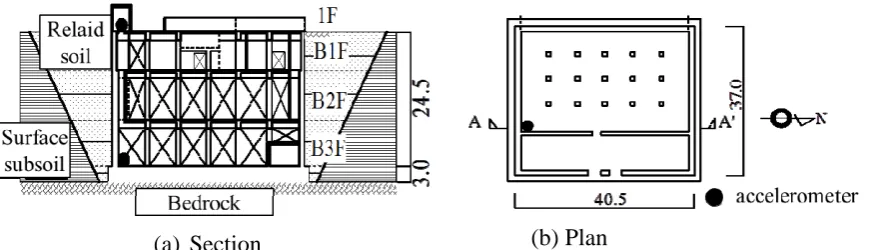
1.36km/s and 0.91km/s respectively. Vs of the relaid soil is from 110 m/s to 180 m/s. Accelerometers were installed on the third basement floor slab and on the first floor slab above ground. A large number of seismic response records have been accumulated. The maximum horizontal accelerations at the 1st floor slab were of the 2011 Tohoku earthquake were 750 gals in the N-S direction and 532 gal in the E-W direction.
Natural frequencies and modal shapes
We examine the mode properties of the structure and the lateral soil using numerical models adopted in the practical design of the building. The modal properties of the structure are calculated by performing an eigenvalue analysis with a lumped-mass stick model under a fixed foundation condition. On the other hand, the surface soil and relaid soil are substituted by an equivalent 1-D layered media, and the modal properties of the lateral soil are calculated by performing an eigenvalue analysis with a 1-D lumped mass model for soil. Table 1 shows the natural frequencies of the structure and those of the lateral soil. Fig. 2 shows the participation vectors of the lateral soil and that of the structure. The second natural frequency of the lateral soil is close to the first natural frequency of the structure. The profile of the second participation vector of the lateral soil is similar to that of the first participation vector
Figure 1. Section and plan of the building (a unit of length is m).
(a) Section (b) Plan
Figure 2. Mode shapes
Table 1: Natural frequencies of structure and lateral soil.
Structure Lateral soil
of the structure below the second basement, but those profiles are quite different above the second basement.
EFFECTS OF SSI TO FREQUENCY RESPONSE FUNCTION
Effect of interaction between structure and lateral soil
We examine effects of the lateral soil to the response of the structure with earthquake response recordings and numerical models. The numerical models are shown in Fig. 3. One of the numerical models is a sway-rocking model (SR model). The other is a sway-rocking model for embedded structures (SRE model, Yano et al. (1988)). Both models have the same sway spring and the same rocking spring that represent the interaction between the base mat and the bedrock. The SRE model has the lateral soil springs that represent the interaction between the side wall and the lateral soil. On the other hand, the SR model has no lateral soil spring. Differences between results of the SR model and those of the SRE model indicate effects of the interaction between the structure and the lateral soil. The lateral soil springs are evaluated with the Novak method (Novak et al. (1978)). The sway spring and rocking spring are evaluated with the Tajimi method (Tajimi (1980)). As an example, the lateral soil spring between the first basement floor and the lateral soil is shown Fig. 4.
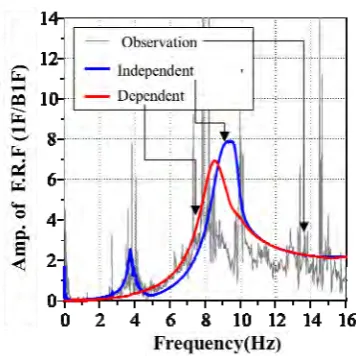
Using the two numerical models, we perform simulations of the earthquake response recordings obtained during the earthquake of December 17, 2005. During the earthquake, the maximum response acceleration of 123 gal was observed at the top floor (the first floor slab). In the seismic response analyses, the sway spring, rocking spring, and lateral springs are constant with respect to frequency. The values of the real parts of those springs are evaluated at 0 Hz (static stiffness). The values of the imaginary parts (damping coefficient) is evaluated at the first natural frequency of the structure. And the modal damping of the structure is 5%. Fig. 5 shows the comparison of numerical results and the earthquake observation. The vertical axis of Fig. 5 is the amplitude of the frequency response function (F.R.F) between the third basement floor slab and the first floor level. The observed F.R.F has peaks in the vicinity of 4 Hz and in the vicinity of 8Hz. The peak frequency in the vicinity of 4 Hz is near to the first natural frequency of the soil model. The SRE model reproduces this peak, but the SR model dose not. The results indicate that the peak of the F.R.F in the vicinity of 4Hz is caused by the interaction force between the side wall and the lateral soil. In other word, the internal force is generated by the resonant vibration of the lateral soil with large amplitude, and the vicinity of 4Hz the structure is vibrated by the interaction force. The peak of the observed F.R.F in the vicinity of 8Hz results from the resonant vibration of the soil-structure system. The peak value is remarkably small. This indicates that the damping caused by the interaction between the structure and the lateral soil is significantly large. Neither the SR model nor the SRE model simulates the peak.
Effect of Frequency dependency
frequency independent SRE model. The difference in the peak frequency and peak value between the observation and the frequency dependent SRE model is not negligible. On the other hand, the F.R.F of the frequency dependent SRE model has no peak in the vicinity of 4 Hz. The disappear of the peak indicates that in the frequency dependent SRE model, the interaction force between the structure and the lateral soil is negligibly small in the vicinity of 4Hz. As you can see from Fig. 4, the value of the real part (stiffness) of the lateral spring at 4 Hz is approximately one third of that at 0Hz. The small value of the stiffness makes the peak of the F.R.F in the vicinity of 4 Hz disappear.
Figure 4. Lateral soil spring between the first basement floor and the lateral soil.
Figure 3. Numerical models.
Figure 5. Frequency response functions of observation, SR-model, and SRE-model (interaction springs are frequency independent).
Figure 6. Frequency response functions of the observation, the frequency dependent SRE model, and the frequency independent
Dependence of the effects on vibration-amplitude
To examine variations of the frequency response function of the structure with maximum response acceleration, we analyze recordings observed during the earthquakes listed in Table 2. The maximum accelerations at the top floor of those earthquake response recordings range from 7 gal to 750 gal. The maximum acceleration of 750 gal was recorded during the 2011 Tohoku earthquake. Fig.7 shows the frequency response functions obtained by analyzing the earthquake response recordings. In cases where the maximum acceleration at the top floor is less than 100 gal, the peak of the frequency response function appear in the vicinity of 4Hz. The peak value decreases as the maximum acceleration increases. In cases where the maximum acceleration is larger than 100 gal, the peak disappears. Taking into account the fact that the peak is caused by the interaction force between the structure and the lateral soil, it is considered that the variations of the frequency response function on the maximum acceleration is related to the nonlinearity of the soil. On the other hand, the peak in the vicinity of 8 Hz is lower dependent to the maximum acceleration than that in the vicinity of 4 Hz. The peak value is remarkably small even in the case of low maximum acceleration. This reveals that the damping in the vicinity of 8 Hz is large and has is low dependent to vibration amplitude.
Figure 7. Variations of amplitude of frequency response function with maximum response acceleration Table 2: Outline of earthquake response
recordings
No. Date of earthquake
Max. Acceleration (gal)
Peak value of F.R.F B3F 1F
1 2003/7/21 6 7 3.17
2 2005/8/16 216 467 3.33
3 2006/4/2 18 27 2.95
4 2008/10/30 41 65 3.25
CONCLUSION
We performed simulations of observed earthquake responses of a fully embedded building with numerical models, and investigated the effects of SSI by comparing frequency response functions of the numerical models and those of the observation. And we examined observationally variations of the frequency response functions of the building with the maximum response acceleration, and dependence of the effects on vibration-amplitude was discussed. The results reveal that the damping in the vicinity of the first natural frequency of the soil-structure system is large and is low dependent to vibration amplitude. It is found and that the amplification of response in the lower frequency than the natural frequency is caused by the interaction force. The sway-rocking model did not simulate observed earthquake response records well. It is necessary to improve the model.
REFERENCES
Yano, A., HIJKATA, K., Ohshima, Y., Miura, A., and Oguro, E. (1988). “Seismic design model ofembedded structures”, Proc., 9th World Conference on Earthquake Engineering, Tokyo-Kyoto, VIII, 353-358.
Novak, M., Nogami,T., and Aboul-Ella, F. (1978), “Dynamic soil reactions for plane strain case”, ASCE, EM4, pp. 953-959