Copyright2000 by the Genetics Society of America
Note
The Mre11p/Rad50p/Xrs2p Complex and the Tel1p Function in a Single
Pathway for Telomere Maintenance in Yeast
Kim B. Ritchie* and Thomas D. Petes*
,†Manuscript received November 2, 1999 Accepted for publication January 14, 2000
*Department of Biology and†Curriculum in Genetics and Molecular Biology, University of North Carolina,
Chapel Hill, North Carolina 27599-3280
ABSTRACT
The Mre11p/Rad50p/Xrs2p complex is involved in the repair of double-strand DNA breaks, nonhomolo-gous end joining, and telomere length regulation. TEL1 is primarily involved in telomere length regulation. By an epistasis analysis, we conclude that Tel1p and the Mre11p/Rad50p/Xrs2p complex function in a single pathway of telomere length regulation.
I
N Saccharomyces cerevisiae, Mre11p, Rad50p, and Xrs2p tions of this region result in short telomeres (Green-wellet al. 1995), and Tel1p-dependentphosphoryla-form a complex (JohzukaandOgawa1995;Usui
tion of Rad53p, RPA, and Rad9p in response to DNA
et al. 1998), which we term the “MRX complex,”
re-damage has been observed (Brushet al. 1996;Sanchez quired for several types of DNA repair and
recombina-et al. 1996;Emili1998). The closest homologue of Tel1p tion (Kannar and Hoeijmakers 1997; Haber 1998).
in the S. cerevisiae genome is Mec1p (Greenwellet al.
Null mutations in MRE11, RAD50, or XRS2 lead to: (1)
1995;Morrowet al. 1995). Strains with a mec1 mutation
sensitivity to DNA-damaging agents, reflecting failure
are sensitive to DNA-damaging agents (Weinert1998) to repair double-stranded DNA breaks (DSBs) by
ho-and have slightly shortened telomeres (Ritchie et al.
mologous or nonhomologous recombination; (2) slow
1999). growth; (3) short telomeres; (4) defective meiotic DSB
One method of attempting to define the functions of formation; and (5) elevated levels of spontaneous
mi-the various genes affecting telomere length is epistasis totic recombination (Haber1998).
analysis, comparison of the phenotype of doubly mutant Although the exact biochemical role of the MRX
com-strains to com-strains with the individual single mutations. plex is not clear, human Mre11p has nuclease activity
By this type of analysis, Tel1p and Yku70p function in that is increased by the addition of hRad50p (Paull
separate pathways (Porteret al. 1996), as do Tel1p and
andGellert 1998); yRad50p exhibits ATP-dependent
Mec1p (Ritchieet al. 1999).
binding to DNA (RaymondandKleckner1993).
Addi-To examine genetic interactions between TEL1 and tion of hNbs1p (the probable human functional
equiva-the genes encoding equiva-the MRX complex, we constructed lent of Xrs2p) to the hMre11p/hRad50p complex
re-diploids heterozygous for the tel1 mutation and rad50 sults in several activities (unwinding of the DNA duplex
(KRY274), mre11 (KRY277), or xrs2 (KRY282) (Table 1). and cleavage of fully paired hairpins) not observed in
These strains were sporulated and the resulting tetrads the absence of hNbs1p (PaullandGellert1999).
were dissected. Since mutations affecting telomere Mutations in the TEL1 gene shorten telomeres, but
length often exhibit phenotypic lag (LustigandPetes do not result in a senescent phenotype (Lustig and
1986), we examined telomere lengths after subculturing Petes1986). The closest structural homologue of TEL1
the haploid strains derived from the spores. As shown is the human ATM gene, which is mutated in patients
in Figure 1, a–c, single mutations in TEL1, RAD50, with the disease ataxia telangiectasia (Greenwellet al.
MRE11, or XRS2 all shorten telomeres to the same
ex-1995;Morrowet al. 1995). One conserved region
be-tent, as expected from previous studies (Kironmaiand tween Tel1p and ATM is a C-terminal domain required
Muniyappa1997;BoultonandJackson1998). Strains for ATM kinase activity (Khannaet al. 1998). Although
with the tel1 mre11, tel1 rad50, or tel1 xrs2 genotypes have there is no direct evidence that Tel1p is a kinase,
muta-telomeres of the same length as observed for strains with the single mutations. This result indicates that all four genes are involved in a single pathway of telomere
Corresponding author: Thomas D. Petes, Department of Biology,
Uni-length regulation.
versity of North Carolina, Chapel Hill, NC 27599-3280.
E-mail: [email protected] Strains with mre11, rad50, or xrs2 mutations have
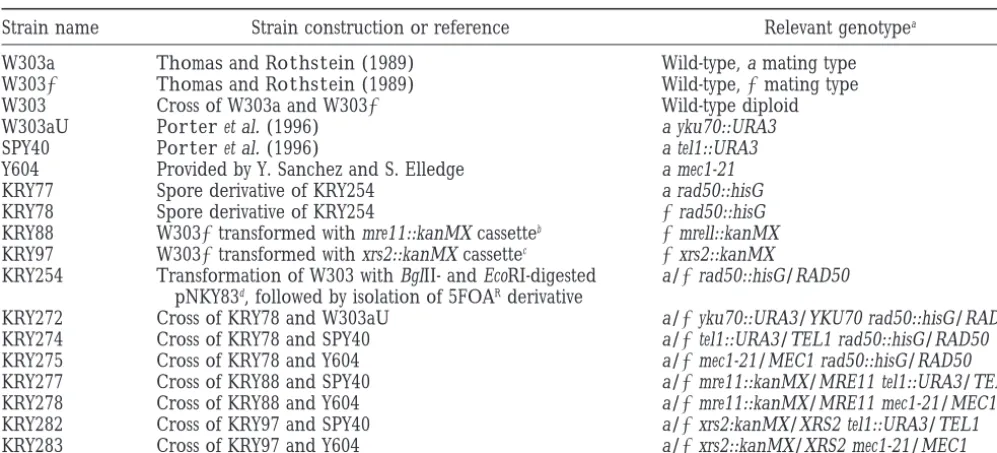
TABLE 1
Strain names, strain constructions, and relevant genotypes
Strain name Strain construction or reference Relevant genotypea
W303a ThomasandRothstein(1989) Wild-type, a mating type W303␣ ThomasandRothstein(1989) Wild-type,␣mating type W303 Cross of W303a and W303␣ Wild-type diploid
W303aU Porteret al. (1996) a yku70::URA3
SPY40 Porteret al. (1996) a tel1::URA3
Y604 Provided by Y. Sanchez and S. Elledge a mec1-21
KRY77 Spore derivative of KRY254 a rad50::hisG
KRY78 Spore derivative of KRY254 ␣rad50::hisG
KRY88 W303␣transformed with mre11::kanMX cassetteb ␣mrell::kanMX
KRY97 W303␣transformed with xrs2::kanMX cassettec ␣xrs2::kanMX
KRY254 Transformation of W303 with BglII- and EcoRI-digested a/␣rad50::hisG/RAD50
pNKY83d, followed by isolation of 5FOARderivative
KRY272 Cross of KRY78 and W303aU a/␣yku70::URA3/YKU70 rad50::hisG/RAD50
KRY274 Cross of KRY78 and SPY40 a/␣tel1::URA3/TEL1 rad50::hisG/RAD50
KRY275 Cross of KRY78 and Y604 a/␣mec1-21/MEC1 rad50::hisG/RAD50
KRY277 Cross of KRY88 and SPY40 a/␣mre11::kanMX/MRE11 tel1::URA3/TEL1
KRY278 Cross of KRY88 and Y604 a/␣mre11::kanMX/MRE11 mec1-21/MEC1
KRY282 Cross of KRY97 and SPY40 a/␣xrs2:kanMX/XRS2 tel1::URA3/TEL1
KRY283 Cross of KRY97 and Y604 a/␣xrs2::kanMX/XRS2 mec1-21/MEC1
aAll strains in the study are isogenic (except for changes introduced by transformation) with W303a (a leu2-3,112 his3-11,15
ura3-1 ade2-1 trp1-1 can1-100) (ThomasandRothstein1989).
bThe MRE11 gene was disrupted with the kanMX cassette by using the PCR-based method described byWachet al. (1994).
The oligonucleotide sequences were 5⬘GACAATTGACGCAAGTTGTACCTGCTCAGATCCGATAAAACTCGACTCGTACGCTGC AGGTCGAC and 5⬘GGTTATAAATAGGATATAATATAATATAGGGATCAAGTACAAATCGATGAATTCGAGCTCG.
cThe XRS2 gene was disrupted with kanMX cassette as described for the MRE11 gene, except that we used the following
primers:
5⬘GTAATAGATGAGCAACAATACTGAGAAGGTGATAACTATAAATTTCGTACGCTGCAGGTCGAC and 5⬘GCAAAATATAATTTAATGAAATTGGAAATACTCGGAAAATTTATCAATCGATGAATTCGAGCTCG.
dAlaniet al. (1989).
stantially reduced growth rates (Alaniet al. 1990;Haber mec1-21, and mec1-21 rad50 derivatives of KRY275. After
25 cell generations, the telomeres in the mec1-21 rad50 1998), whereas tel1 strains grow at wild-type rates
(Lus-tigandPetes1986). The growth rates of the tel1 mre11, strains were shorter than those in the rad50 strain (data not shown). We conclude that the MRX complex
func-tel1 rad50, or func-tel1 xrs2 are approximately the same as
those observed for the single mutant mre11, rad50, and tions in a different pathway from Mec1p, consistent with our previous conclusion that Tel1p and Mec1p
xrs2 strains (Figure 1d). In addition, plating efficiencies
(relative to a normalized value of 100% for wild type) represent different pathways.
Since the Tel1p and MRX complex are in a single were similar for rad50 (64% with 95% confidence limits
⫾5%) and tel1 rad50 (67%⫾ 7%) strains; tel1 strains pathway, but Tel1p and Yku70p are in separate pathways (Porteret al. 1996), Rad50p and Yku70p should
func-had approximately the same plating efficiency as wild
type (96%⫾5%). tion in separate pathways. In previous epistasis studies
of the relationship between rad50 and yku70, different We previously showed that tel1 mec1 strains had a
senes-cent phenotype and telomeres that were slightly shorter conclusions were reached by different groups (Boul-tonandJackson1998;Nugentet al. 1998). We
reexam-than those of the tel1 single-mutant strains (Ritchieet
al. 1999). We constructed diploids that were heterozy- ined this issue by analyzing telomere lengths in spore cultures derived from a diploid (KRY272) that was het-gous for mec1-21 and rad50 (KRY275), mre11 (KRY278),
or xrs2 (KRY283). We found that spores with the mec1- erozygous for rad50 and yku70 mutations. Telomere lengths in the double-mutant strain were shorter than
21 rad50, mec1-21 mre11, or mec1-21 xrs2 genotypes had
a senescence phenotype that was indistinguishable from those in either single mutant (Figure 3). In addition, spores of the double-mutant genotype grew more slowly the tel1 mec1-21 spores analyzed previously (Figure 2).
After repeated subculturings, fast-growing “survivors” than cells of either single-mutant strain (data not shown). These results demonstrate that RAD50 (like appeared in the mec1-21 rad50 cultures; survivors also
occur in telomerase-defective (LundbladandBlack- TEL1) functions in a different pathway of telomere
length regulation than YKU70, supporting the previous burn1993) or tel1 mec1-21 (Ritchieet al. 1999) strains.
Figure2.—Growth rates in wild-type, mec1-21, rad50, and
mec1-21 rad50 strains. The diploid strain KRY275 is
heterozy-gous for mec1-21 and rad50. This strain was sporulated and dissected. After spore colonies had formed, they were sub-Figure1.—Telomere lengths and growth rates in wild-type,
tel1, rad50, mre11, xrs2, tel1 rad50, tel1 mre11, and tel1 xrs2 cloned by repeated streaking (nine times) on YPD medium (Ritchie et al. 1999). The strain names and genotypes are
strains. Diploids heterozygous for tel1 and rad50, mre11, or
xrs2 were sporulated and dissected. Spore cultures were vegeta- as follows: KRY275-11a (wild type), KRY275-11b (mec1-21), KRY275-11c (mec1-21 rad50), and KRY275-11d (rad50). Plates tively subcloned four times (ⵑ80 cell divisions) on rich growth
medium (YPD) at 30⬚. Genomic DNA was isolated from each from subclonings (SC) 1, 2, 4, and 9 were photographed. The
mec1-21 rad50 strain underwent senescence, with very poor
strain and treated with PstI. The resulting fragments were
examined by Southern analysis, using a telomere-specific growth by SC4. Survivors were generated by SC9. It should be noted that plates were usually incubated for 30⬚ for 3 days probe (Ritchieet al. 1999). The diffuse band below the 1-kb
marker represents telomeric sequences, whereas the two before they were photographed. Under these conditions, the slower growth rate of rad50 strains relative to wild-type strains bands at 3.5 and 4.8 kb represent tandem subtelomeric Y⬘
elements (Ritchieet al. 1999). Growth rates were qualitatively is subtle. examined by streaking strains of various genotypes on rich
growth medium (YPD), followed by growth at 30⬚for 2 days. All strains derived from spores were subcultured at least four
What is the function of Tel1p and the MRX proteins times before analysis. Strain names and genotypes are as
fol-in regulatfol-ing telomere length? One obvious possibility is lows: (a) KRY274-3a (wild type), KRY274-3b (tel1), KRY274-3c
(tel1 rad50), and KRY274-3d (rad50); (b) KRY277-2a (wild that these proteins directly activate telomerase catalytic type), KRY277-2b (mre11), KRY277-2c (tel1 mrell), and KRY277- activity. An argument against this possibility is that tel1 2d (tel1); (c) 3a (wild type), 3b (tel1),
KRY282-tlc1 strains and rad50 KRY282-tlc1 strains have synthetic
pheno-3c (xrs2), and KRY282-3d (tel1 xrs2); and (d) W303a (wild
types different from those of the single mutants: tel1 tlc1 type), SPY40 (tel1), KRY77 (rad50), KRY274-3c (tel1 rad50),
KRY88 (mre11), KRY277-2c (tel1 mre11), KRY97 (xrs2), and strains senesce more slowly than tlc1 strains (Ritchieet
KRY282-3d (tel1 xrs2). al. 1999), and rad50 tlc1 strains accumulate postsenes-cence survivors more slowly than tlc1 strains (Le et al.
plex could increase accessibility of telomeric DNA to telomerase. Two further points should be mentioned. First, Tel1p and the MRX complex could affect accessi-bility of the telomere to cellular exonucleases as well as telomerase. Thus, in the absence of telomerase, tel1 strains might have delayed senescence relative to strains with only a telomerase mutation (Ritchieet al. 1999).
Second, since tel1 mutants do not exhibit the growth deficiency or DNA repair defects shared by mre11, rad50, and xrs2 strains, lack of phosphorylation by Tel1p does not affect all of the functions of the MRX complex.
We thank N. Kleckner, Y. Sanchez, and S. Elledge for plasmids and strains used in our study. We also thank R. Craven and J. Mallory for helpful discussions and/or comments on the manuscript. This research was supported by National Institutes of Health grants GM-24110 and GM52319.
LITERATURE CITED
Alani, E., S. Subbiah andN. Kleckner,1989 The yeast RAD50 gene encodes a predicted 153-kD protein containing a purine nucleotide-binding domain and two large heptad-repeat regions. Genetics 122: 47–57.
Alani, E., R. PadmoreandN. Kleckner,1990 Analysis of wild-type and rad50 mutants of yeast suggests an intimate relationship between meiotic chromosome synapsis and recombination. Cell
61:419–436.
Boulton, S. J.,andS. P. Jackson,1998 Components of the Ku-dependent non-homologous end-joining pathway are involved in telomeric length maintenance and telomeric silencing. EMBO J. 17: 1819–1828.
Brush, G. S., D. M. Morrow, P. HeiterandT. J. Kelly,1996 The ATM homologue MEC1 is required for phosphorylation of repli-cation protein A in yeast. Proc. Natl. Acad. Sci. USA 93: 15075– 15080.
Emili, A.,1998 MEC1-dependent phosphorylation of Rad9p in re-sponse to DNA damage. Mol. Cell 2: 183–189.
Greenwell, P. W., S. L. Kronmal, S. E. Porter, J. Gassenhuber, B. Obermaieret al., 1995 TEL1, a gene involved in controlling telomere length in S. cerevisiae, is homologous to the human ataxia telangiectasia gene. Cell 82: 823–829.
Haber, J. E.,1998 The many interfaces of Mrell. Cell 95: 583–586.
Figure3.—Telomere lengths in wild-type, rad50, yku70, and
Johzuka, K.,andH. Ogawa,1995 Interaction of Mre11 and Rad50:
yku70 rad50 strains. A diploid strain (KRY272) heterozygous
two proteins required for DNA repair and meiosis-specific
double-for the rad50 and yku70 mutations was sporulated and tetrads strand break formation in Saccharomyces cerevisiae. Genetics 139: were dissected. Telomere lengths were analyzed in the spore 1521–1532.
products of two independent tetrads as described in the Figure Kanaar, R.,andJ. H. J. Hoeijmakers,1997 Recombination and
1 legend. Lanes 1 and 2, KRY272-8a; lanes 3 and 4, KRY272- joining: different means to the same ends. Genes Funct. 1: 165–
8b; lanes 5 and 6, KRY272-8c; lanes 7 and 8, KRY272-8d; lanes 174.
Khanna, K. K., K. E. Keating, S. Kozlov, S. Scott, M. Gateiet al.,
9 and 10, KRY272-15a; lanes 11 and 12, KRY272-15b; lanes 13
1998 ATM associates with and phosphorylates p53: mapping
and 14, KRY272-15c; lanes 15 and 16, KRY272-15d.
the region of interaction. Nat. Genet. 20: 398–400.
Kironmai, K. M.,andK. Muniyappa,1997 Alteration of telomeric sequences and senescence caused by mutations in RAD50 of
Sac-which the Tel1p and the MRX proteins promote the charomyces cerevisiae. Genes Cells 2: 443–455.
activity of telomerase indirectly. Le, S., J. K. Moore, J. E. HaberandC. W. Greider,1999 RAD50 and RAD51 define two pathways that collaborate to maintain
Since Tel1p has kinase motifs, one model is that Tel1p
telomeres in the absence of telomerase. Genetics 152: 143–152.
is required to phosphorylate one or more proteins of
Lundblad, V.,andE. H. Blackburn,1993 An alternative pathway
the MRX complex and that this phosphorylation is re- for yeast telomere maintenance rescues est- senescence. Cell 73: 347–360.
quired for the role of the complex in telomere
elonga-Lustig, A. J.,andT. D. Petes,1986 Identification of yeast mutants
tion. The role of the complex could be to “open” the
with altered telomere structure. Proc. Natl. Acad. Sci. USA 83:
telomere chromatin, allowing telomerase to interact 1398–1402.
Morrow, D. M., D. A. Tagle, Y. Shiloh, F. S. CollinsandP. Heiter,
with telomeric DNA. A related possibility is that the
1995 TEL1, an S. cerevisiae homolog of the human gene
mu-single-stranded poly G1-3T telomeric sequences could
tated in ataxia telangiectasia, is functionally related to the yeast
form a hairpin-like structure, and cleavage of this struc- checkpoint gene MEC1. Cell 82: 831–840.
Nugent, C. I., G. Bosco, L. O. Ross, S. K. Evans, A. P. Salinger
com-et al., 1998 Telomere maintenance is dependent on activities and MEC1 in regulating telomere length in the yeast Saccharomyces required for end repair of double-strand breaks. Curr. Biol. 8: cerevisiae. Mol. Cell. Biol. 19: 6065–6075.
657–660. Sanchez, Y., B. A. Desany, W. L. Jones, Q. Liu, B. Wanget al., 1996
Paull, T. T.,andM. Gellert,1998 The 3⬘-5⬘exonuclease activity Regulation of RAD53 by the ATM-like kinases MEC1 and TEL1 of Mrell facilitates repair of DNA double-strand breaks. Mol. Cell in yeast cell cycle checkpoint pathways. Science 271: 357–360.
1:969–979. Thomas, B. J., and R. Rothstein,1989 Elevated recombination
Paull, T. T.,andM. Gellert,1999 Nbs1 potentiates ATP-driven rates in transcriptionally active DNA. Cell 56: 619–630. DNA unwinding and endonuclease cleavage by the Mrell/Rad50 Usui, T., T. Ohta, H. Oshiumi, J. Tomizawa, H. Ogawa et al.,
complex. Genes Dev. 13: 1276–1288. 1998 Complex formation and functional versatility of Mre11 of
Porter, S. E., P. W. Greenwell, K. B. RitchieandT. D. Petes,1996 budding yeast in recombination. Cell 95: 705–716.
The DNA-binding protein Hdf1p (a putative Ku homologue) is Wach, A., A. Brachat, R. PohlmannandP. Philippsen,1994 New required for maintaining normal telomere length in Saccharomyces heterologous modules for classical or PCR-based gene disruptions
cerevisiae. Nucleic Acids Res. 24: 582–585. in Saccharomyces cerevisiae. Yeast 10: 1793–1808.
Raymond, W. E.,andN. Kleckner,1993 RAD50 protein of S. cerevis- Weinert, T.,1998 DNA damage checkpoints update: getting
molec-iae exhibits ATP-dependent DNA binding. Nucleic Acids Res. 21: ular. Curr. Opin. Genet. Dev. 8: 185–193.
3851–3856.
Ritchie, K. B., J. C. MalloryandT. D. Petes,1999 Interactions Communicating editor:M. Carlson