ISSN: 2319-8753
I
nternational
J
ournal of
I
nnovative
R
esearch in
S
cience,
E
ngineering and
T
echnology
(An ISO 3297: 2007 Certified Organization)
Vol. 3, Issue 12, December 2014
Dynamic Channel Allocation Using Virtual
Machines for Cloud Sensor Networking
Environment
P.K.Kumaresan1, S.Senthil Kumar2, M Saravanan3, A.V.Ramesh Kumar4, S.G. Balakrishnan5
professor, Dept of CSE, VMKV Engg College, Salem, India1.
Assistant Professor, Dept of IT, VMKV Engg College, Salem, India 2
Associate Professor, Dept of IT, VMKV Engg College, Salem, India 3,4,5
ABSTRACT: Cloud computing allows business customers to scale up and down their resource usage based on needs. Many of the gains in the cloud model come from resource multiplexing through virtualization technology. In this work, present a system that uses virtualization technology to allocate data center resources dynamically based on application demands and support green computing by optimizing the number of servers in use. We introduce the concept of “skewness” to measure the unevenness in the multi-dimensional resource utilization of a server. By minimizing skewness, we can combine different types of workloads nicely and improve the overall utilization of server resources. We develop a set of heuristics that prevent overload in the system effectively while saving energy used. Trace driven simulation and experiment results demonstrate that our algorithm achieves good performance.
KEYWORDS: Cloud computing; virtual machines; sensor networking; multiplexing, Hybrid Multi-hop routing (HYMN)
I. INTRODUCTION
ISSN: 2319-8753
I
nternational
J
ournal of
I
nnovative
R
esearch in
S
cience,
E
ngineering and
T
echnology
(An ISO 3297: 2007 Certified Organization)
Vol. 3, Issue 12, December 2014
II. LITERATURE REVIEW MULTI-HOP ROUTING ALGORITHMS FORWIRELESS SENSOR NETWORKS
In general, in order to maximize the WSN’s lifetime, the total power consumption of the network should be minimized while ensuring fair power consumption among nodes. Much effort has been focused on WSN multi-hop routing algorithms, and many algorithms have been proposed. These may be widely categorized as flat multi-hop routing algorithms and hierarchical multi-hop routing algorithms.
A. Flat multi-hop routing algorithms
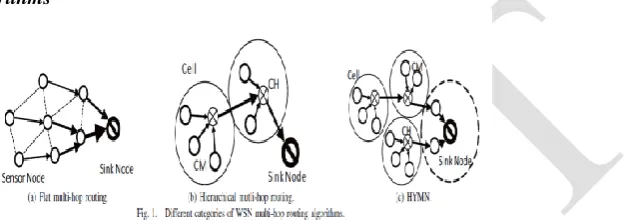
Fig. 1(a) shows an example of how flat multi-hop routing is used to send data
In the figure, an arrow’s thickness is proportional to the amount of data being sent over the corresponding link. Each sensor node has the ability to greatly among different algorithms. For example, communicate over a bounded area with other sensor nodes. Link utilization differs algorithms proposed in [2], [3] have been designed to minimize the total power consumption of the network as the objective; in this kind of algorithms, the cost of using a communication channel is defined by the following equations.
linkcost(i, j) = es(i) + er(j)
Here, linkcost(i, j) is defined as the amount of energy consumed for sending a unit of data from node i to j. es(i) is the energy consumed by node i while sending a unit of data to node j; this value is proportional to the square of di,j, which is the distance between nodes i and j. er(j) is the energy consumed by node j in receiving a unit of data. By using the route where the sum of all link costs is minimized, the WSN’s total power consumption can be minimized. From a different perspective, these algorithms pose an inherent problem, i.e., certain nodes are over-burdened, and thus consume their energy in a rapid manner. An effective algorithm [4], which uniformly distributes power consumption over each node, aims to address this problem. The following equation is used to define the link cost
. linkcost(i, j)uniform = linkcost(i, j) ∕ Eni.
By using the residual power of the sending node, Ei, asthe denominator of the link cost, the possibility of it being selected as a relay node decreases as its remaining energy decreases. Toh [2], set n to be 2. It is possible to uniformly distribute power consumption over individual nodes and at the same time to minimize overall power consumption. Besides the previously mentioned algorithm, others such as zPmin[3]and max–min T [4]–[5] have also been proposed.
B. Hierarchical multi-hop routing algorithms
ISSN: 2319-8753
I
nternational
J
ournal of
I
nnovative
R
esearch in
S
cience,
E
ngineering and
T
echnology
(An ISO 3297: 2007 Certified Organization)
Vol. 3, Issue 12, December 2014
large, thus draining the battery quickly; Multi-hop LEACH (M-LEACH) [7] has been proposed to mitigate this problem, as shown in Fig. 1(b).In M-LEACH, minimizing the power consumption of the CHs by means of multi-hop communications, can obviously delay their power exhaustion. While CHs are determined randomly in LEACH, changing the principle that governs how CHs are selected can decrease power consumption, as in HEED [8]and PEACH [9]. In hierarchical multi-hop routing algorithms, since the number of relay nodes used to convey data to the sink node is relatively smaller than that in flat multi-hop routing algorithms, the length of the communication distance of each hop becomes greater, and thus requiring higher power to transmit a unit of data. Nevertheless, hierarchical multi-hop routing algorithms are a promising approach in terms of their capability to use data compression to reduce the power consumption of the network by reducing the data flow.
C. Sink node isolation problem in WSNs
In multi-hop routing algorithms, nodes that are within the maximum transmission range of the sink node form the subset of nodes that enable the sink node to gain connectivity to the network. We refer to the area, which contains these nodes, as the Sink Connectivity Area(SCA). As illustrated in Fig. 1(a), since the amount of data relayed per node increases as nodes become closer to the sink node, leading to quicker power exhaustion of these nodes than others. When all of the nodes located in SCA die, the sink node can no longer gather data from other alive nodes due to the lack of available routes between the sink node and the rest of the network; this is equivalent to the breakdown of the network deployed to gather sensed data. In other words, to evaluate the network lifetime exactly, it is essential to take into account the influence of the sink node isolation problem, while most of previous works have only investigated the surviving rate of nodes in the network. Therefore, we propose an algorithm designed with the consideration of the impact of the sink node isolation problem in order to improve the longevity of the network.
III. HYBRID MULTI-HOP ROUTING ALGORITHM
In general, since the number of sensor nodes in the SCA is much smaller than that outside the SCA, the amount of data generated by the nodes in the SCA can be negligible as compared to the volume of data flowing into the SCA from outside. This implies that most of the power consumption in the SCA is due to transferring the data that comes from outside the SCA to the sink node. In other words, in order to limit the power consumption in the SCA, the amount of data flowing into the SCA needs to be reduced, and/or the power consumption to relay the data from outside the SCA to the sink node needs to be minimized. In fact, the proposed scheme, referred to as Hybrid Multi-hop routing (HYMN), illustrated in Fig. 1(c), aims to achieve the effect of both solutions by employing a hierarchical multi-hop routing algorithm outside the SCA and using a flat multi-hop routing algorithm inside the SCA.
A. Routing outside the SCA
Since the transmission power is proportional to the volume of data, it is important to reduce the volume of data that enters the SCA; this can be achieved by using a data compression mechanism. If there is any relationship among data, it can be aggregated and compressed; the compression ratio depends on the correlation of the data and can be derived from the maximum mutual information. In the case of environmental monitoring which collects information on temperature, humidity, and atmospheric pressure, it has been widely known that data collected from neighboring areas have a strong correlation that can lead to high compression ratio. From the above discussion, HYMN employs a hierarchical multi-hop routing which is an appropriate strategy to perform efficient data compression to reduce the amount of data flowing into the SCA.
B. Routing inside the SCA
In the SCA, the most important aspect in routing is to minimize the power consumption while transferring the data coming from outside the SCA to the sink node. Fortunately, this can be completely achieved by adopting a flat multi-hop routing scheme in the SCA.
C. Optimal location of hybrid boundary
ISSN: 2319-8753
I
nternational
J
ournal of
I
nnovative
R
esearch in
S
cience,
E
ngineering and
T
echnology
(An ISO 3297: 2007 Certified Organization)
Vol. 3, Issue 12, December 2014
IV. ADVANCED HYBRID MULTI-HOP ROUTING PROTOCOL
This protocol is interconnecting the Flat multi-hop and hybrid multi-hop. Where in this approach the next cluster head is search and found in the same range of height in the plane. In the flat multi-hop the source to destination the distance is fixed and the time is more. In the hybrid multi-hop finding the cluster head in zic-zac manner and the distance is unknown and time is also unknown. So when we combine both approaches the time, distance are known and the searching is happening in a certain height and certain range, so we are saving the energy and power consumption. Hence we are saving the life time of the network
IV.NETWORK MODEL
In this paper, we propose to use the hybrid architecture to achieve both adaptively to changing traffic and low channel switching overhead. Let G(V,E) be the network topology, where V is the set of mesh routers and E represents pairs of mesh routers that are within radio communication range. Assume each mesh router has multiple interfaces. In the hybrid architecture, we let one interface of each mesh router be able to switch channel frequently, and let the other interfaces work on fixed channels. In the rest of this paper, we call the former interface as dynamic interface, and the latter as static interface. Fig. 1 illustrates a hybrid multichannel multi radio wireless mesh network. Most mesh nodes including the gateway have 3 interfaces, and a few boundary nodes(c, g, I, f) have 2 interfaces. For each mesh node, one interface works as dynamic interface, and the others work as static interfaces. The channel allocation of static interfaces aims at maximizing the throughput from end-users to gateways, which usually constitutes a major portion of the traffic in the network. Some heuristic algorithms, such as [10], could be used. In the algorithm, a load balanced tree is constructed for each gateway. The goal of the tree construction is to allocate bandwidth fairly to each user with regard to the user-gateway throughput. After the topology has been constructed, each link can then be assigned channels. The links closer to the gateways are given higher priority to be allocated with less congested channels. In Fig. 1, the tree topology is shown in bold lines, and we call these links as static links. The channels assigned to static links are also shown in the figure. Dynamic interfaces work in an on-demand fashion. Two dynamic interfaces that are within radio transmission range of each other are able to negotiate a common channel and communicate when they have data to transmit. We call these links as dynamic links. Fig. 1 illustrates all possible dynamic links in dotted lines.
As we are considering a hybrid architecture, the dynamic channel allocation should be aware of the interference from the static interfaces, which requires some additional considerations in the protocol design.
All dynamic interfaces need to negotiate on a default channel in each control interval. As the control interval is very important for dynamic channel allocation, we should eliminate the interference from static interfaces in this phase. Thus, we exclude this default channel in the channel allocation of the static interfaces. Note that this will not harm the channel usage efficiency of the whole system, because dynamic interfaces can still use this default channel in the data interval.
ISSN: 2319-8753
I
nternational
J
ournal of
I
nnovative
R
esearch in
S
cience,
E
ngineering and
T
echnology
(An ISO 3297: 2007 Certified Organization)
Vol. 3, Issue 12, December 2014
list of other mesh nodes within its interference range.(Note that the list of interfering neighbors may change due to the change in the radio environments. However, it is not varying frequently, so we can assume that it is stable in a period of time. The list can be updated by rediscovering the radio environment periodically.) We can let each mesh node measure the channel usage of its static interfaces periodically, and send this information to all the other mesh nodes within its interference range. Thus, the dynamic interface of each mesh node is able to know the channel usage of static interfaces within its interference range. There are several advantages of using this hybrid architecture.
If purely static channel allocation strategies are used, the connectivity of the original network topology may be degraded; this can lead to suboptimal routing paths. By using one dynamic interface in each mesh node, the connectivity of the network topology can be well maintained, because each dynamic interface is able to communicate with any other interface within radio transmission range.
Purely static channel allocation strategies cannot adapt to the frequently changing network traffic. For example, in the tree topology, if the users of the left sub tree happen to generate a much larger amount of traffic than the users in the right subtree, then the links in the left sub tree get more congested. The use of dynamic links is able to direct traffic around the congested areas and therefore achieve better load balance in the network.
V.BLOCK DIAGRAM FOR HYMN
Although flat multi-hop routing algorithms enable routing of data in a fashion that minimizes the power consumption of the WSN, they fail to exploit the data aggregation opportunities by virtue of data collected from the WSN. In many WSN applications with the relatively high node density, the data collected by individual nodes are highly redundant, thus making data aggregation a very attractive scheme in WSNs. Hierarchical multi-hop routing algorithms aim to capitalize on the highly correlated nature of WSN’s collected data. We describe the operation of the most notable example of hierarchical multi-hop routing algorithms, dubbed Low-Energy Adaptive Clustering Hierarchy (LEACH), for illustrative purposes. In LEACH, nodes are organized in a two-level hierarchy, where their roles differ according to which level they belong to. That is, a node can be a Cluster Head (CH) or a Cluster Member (CM), and these roles are changeable in a unit of time referred to as a round. To implement the Advanced HYMN routing approaches in Mesh Network to improve the life time and QOS of the network through routing. Clustering approaches are used to increase the number of nodes in network. CH (channel head) selection is based on dynamic (based on Highest energy level in every nodes). To reduce the routing distance through the clustering approaches (packets transfer from CH to Sink node (receiver node)).
VI.PERFORMANCE EVALUATION
ISSN: 2319-8753
I
nternational
J
ournal of
I
nnovative
R
esearch in
S
cience,
E
ngineering and
T
echnology
(An ISO 3297: 2007 Certified Organization)
Vol. 3, Issue 12, December 2014
VII. CONCLUSION
Many of the gains in the cloud model come from resource multiplexing through virtualization technology. In this work, present a system that uses virtualization technology to allocate data center resources dynamically based on application demands and support green computing by optimizing the number of servers in use. We introduce the concept of “skewness” to measure the unevenness in the multi-dimensional resource utilization of a server. By minimizing skewness, we can combine different types of workloads nicely and improve the overall utilization of server resources. We develop a set of heuristics that prevent overload in the system effectively while saving energy used. Trace driven simulation and experiment results demonstrate that our algorithm achieves good performance.
REFERENCES
[1] H. Nakayama, N. Ansari, A. Jamalipour, and N. Kato, “Fault-resilientSensing in Wireless Sensor Networks,”Computer Communications,Special Issue on Security on Wireless Ad Hoc and Sensor Networks.,vol. 30, no. 11-12, pp. 2376-2384, Sep. 2007.
[2] C.K. Toh, “Maximum battery life routing to support ubiquitous mobilecomputing in wireless ad hoc networks,” IEEE Communications Mag.,vol. 39, no. 6, pp. 138-147, Jun. 2001.
[3] J. Aslam, Q. Li, and D. Rus,“Three power-aware routing algorithms forsensor network,” Wireless Commun. and Mobile Computing,, vol. 3, no.2, pp. 187-208, Mar. 2003.
[4] J.H. Chang and L. Tassiulas, “Maximum lifetime routing in wirelesssensor networks,” IEEE/ACM Trans. Networking, vol. 12, no. 4, pp.609-619, Aug. 2004.
[5] Y. Xue, Y. Cui, and K. Nahrstedt,“Maximizing lifetime for data aggregationin wireless sensor networks,” Mobile Networks and Applications,vol. 10, no. 6, pp. 853-864, Dec. 2005.
[6] W. Heinzelman, A. Chandrakasan, and H. Balakrishnan,“An application specific protocol architecture for wireless microsensor networks,” IEEETrans. Wireless Communications, vol. 1, no. 4, pp. 660-670, Oct. 2002.
[7] V. Mhatre and C. Rosenberg,“Homogeneous vs. heterogeneous clustered sensor networks: a comparative study,” in Proc. of IEEE ICC, vol. 6, pp. 3646-3651, Paris, France, Jun. 2004.
[8] O. Younis and S. Fahmy, “Heed: a hybrid, energy-efficient, distributed clustering approach for ad-hoc sensor networks,” IEEE Trans. MobileComputing, vol. 3, no. 4, pp. 366-379, Oct./Dec. 2004
[9] S. Yi, J. Heo, Y. Cho, and J. Hong,“Peach: power efficient and adaptive clustering hierarchy protocol for wireless sensor networks,” ComputerCommunications, vol. 1, no. 4, Oct. 2004, pp. 193-208.
[10] A. Raniwala and T. Chiueh, “Architecture and Algorithms for anIEEE 802.11-based Multi-Channel Wireless Mesh Network,” Proc.IEEE INFOCOM, 2005.