BY
KARlUKI S. NGUGI
C50/6535/03
A
DISSERTATION SUBMITTED IN PARTIAL FULFILMENT
FOR THE DEGREE OF MASTER OF ARTS IN ENGLISH AND
LINGUISTICS.
DEPARTMENT OF ENGLISH AND LINGUISTICS
KENYATTA UNIVERSITY
NAIROBI
DECLARATION
1. This dissertation is my original work and does not contain any material previously presented for the award of a degree or diploma in any University except where due citations have been made.
NAME: KARlUKI SAMUEL NGUGI SIGNATURE.~U-'" Department of English and Linguistics
Kenyatta University
DATE
/9
-
OJf:-O~
2. This dissertation has been submitted with our approval as the University Supervisors.
NAME: SIGNATURE
a) Dr. J.Wangia
Department of English 'and Linguistics Kenyatta University
:#-Date:
Ie
fv}t7
2f)o.E) Ib) Mr. C. Gecaga
Department of English and Linguistics Kenyatta University
DEDICATION
I dedicate this work to my family:
My wife Zipporah Your insightful suggestions and financial support are highly appreciated.
My son Mark Your constant reminder that I had homework todo cannot be forgotten.
ACKNOWLEDGEMENTS
To start with, my most sincere thanks go to God. Apostle Paul's testimony that 'I can do all things through Christ who strengthens me' has been fulfilled in my life with the completion of this dissertation.
I also wish to sincerely acknowledge and appreciate the work done by my Supervisors Dr. Wangia and Mr. Gecaga. They went with me all the way from stage one to the last of this dissertation, offering their expertise in an endeavour to make each section of this work better and better. Iam greatly indebted tothem.
I cannot forget to thank in a very special way the other Lecturers in the department of English and Linguistics of Kenyatta University. Their input at whatever stage of this dissertation is appreciated.
My colleagues were also of great help. They gave me insightful academic suggestions and provided moral support when hope appeared to dwindle away. Receive my thanks.
The next lot without whom this work would not have been accomplished are my informants. Their cooperation granted me the opportunity to interact with new faces. Some of them have since then become my great friends. Thanks alot.
I wish to acknowledge the work done by Mr. Kuria - a friend and an academician, Mr. Ngigi of Moi University and Dadi my research assistant. Thanks for your suggestions and moral support.
Last but not the least is Millicent Waweru who typed this work with a lot of patience and dedication. I owe alot to her.
TABLE OF CONTENTS
TITLE 1
DECLARATION .11
DEDICATION .III
ACKNOWLEDGEMENTS .IV
TABLE OF CONTENTS V
ABSTRACT VII
DEFINITION OF TERMS .IX
LIST OF TABLES, GRAPHS AND FIGURES XI
CHAPTER ONE 1
1.0INTRODUCTION 1
1.1 BACKGROUND TO THE STUDY 1
1.2 STATEMENT OF THE PROBLEM 7
1.3RESEARCH OBJECTIVES 8
1.4RESEARCH QUESTIONS 8
1.5RESEARCH ASSUMPTIONS 9
1.6RATIONALE OF THE STUDy 9
1.7SCOPE AND LIMITATIONS 11
CHAPTER TWO 13
2.0 THEORETICAL FRAMEWORK 13
2.1 INTRODUCTION ; 13
2.2 THE INTERPRETIVE THEORY. 13
2.3 THE SKOPOS THEORY 17
2.4 THE CULTURAL THEORY 19
2.5.0 LITERATURE REVIEW 20
2.5.1 INTRODUCTION · 20
2.5.2 LITERATURE ON TRANSLATION 20
2.5.3 LITERATURE ON THE CONSTITUTION .28
CHAPTER THREE 35
3.0 METHODOLOGy 35
3.1 INTRODUCTION , 35
3.2 RESEARCH AREA 35
3.3 SAMPLE SIZE 37
3.4 SAMPLING PROCEDURE .- 39
3.5 DATA ELICITATION & RESEARCH INSTRUMENTS .41
3.6 MODE OF ASSESSMENT .45
.CHAPTER FOUR 47
4.0 PRESENTATION & ANALYSIS OF DATA .47
4.1 INTRODUCTION 47
4.2 DATA PRESENTATION AND ANALYSIS .47
CHAPTER FIVE 68 5.0 FINDINGS, RECOMMENDATIONS &CONCLUSIONS 68
5.1 INTRODUCTION 68
5.2 FINDINGS AND CONCLUSIONS 68
5.3 RECOMMENDATIONS 71
5.4 AREAS FOR FURTHER RESEARCH 78
5.5 CONCLUSION 79
BIBLIOGRAPHY 80
APPENDICES 85
APPENDIX 1 85
APPENDIX 2 93
APPENDIX 3 103
APPENDIX 4 104
AB
S
TRACT
The purpose of this dissertation was to establish the need for the translation of the Draft Constitution of Kenya - 2004 into Gikiiyii, for Gikiiyfi speakers whose proficiency in English and Kiswahili is low. The study was based on the premise that if the document under study was meant for all Kenyans, then the document should be published and preserved in languages that all Kenyans, including those who are not good at Kiswahili and English, understand.
The study had four objectives. The first was to establish how the target population would fare in comprehending the document under study first in the English language and then in Gikiiyfi. The second was to investigate the major difficulties that the target group faced in the comprehension of the Draft Constitution of Kenya - 2004 which is currently in English and Kiswahili. The third was to test the extent to which men and women differ in the comprehension of the said document in the two languages. The last was to suggest strategies for translating the document into Gikiiyfi.
The data was presented and analysed quantitatively as well as qualitatively. It was established that there was need for translating the Draft Constitution into Gikiiyti as the target population had a better understanding of the sampled portions that were extracted from the document and translated into Gikiiyfi.
DEFINITION OF TERMS
1. A Clause
It is a term used in the Draft Constitution for reference purposes. It states III details any specific issue under any article.
2. Article
It is a term used in the Draft Constitution for reference purposes. Ideally, it is a sub-section of the chapter highlighting the issues discussed in any given chapter.
3. Chapter
This term is used in the Draft Constitution for reference purposes. It refers to a section of the Draft Constitution, which spells out the main issues dealt with in each of these sections. Chapter six deals with The Bill of Rights.
4. Draft Constitution of Kenya - 2004
This is the preliminary version of the Kenyan Constitution which is under review. The Draft is made up of twenty one chapters. This study focused on chapter six.
5.
InterpretationIn this study, this term means to decode the meaning of a given text. 6. Receptor comprehension
It is the act or capability of understanding by the person(s) for whom a text is intended.
7. Source Language (SL)
Itis the original text that is written
9. Target Language (TL)
This refers to the language inwhich atarget text or atranslated text is written. 10. Target Text(T.T)
It is any text that isa translation of a source text. 11. Text
Halliday and Hassan (1976) define a text as any stretch of utterances. It can range from a word, to a sentence, to a paragraph or to a whole book. In this study, the
term is used to mean either an article or a clause. 12. Translation
It means all tasks where the meaning of expressions in one language referred to
as the source language (SL) isturned into the meaning of another language
Graph 1:Shows the Performance of Females in Category A. Graph 2: Shows the Performance of Males in Category A. Graph 3: Shows the Performance of Females in Category B. Graph 4: Show the Performance of Males in Category B. Graph Sa: Shows mean scores of females in Category A. Graph Sb:shows mean scores of males in Category A. Graph Sc: Shows mean scores of females in category B. Graph Sd:shows mean scores of male in Category B.
Pg 51 Pg 52 Pg 53 Pg 54 Pg 56 Pg56 Pg 57 Pg57
List of Tables
Table 1: Shows the Score Obtained by Female Individuals in Each Category Pg 48 Table 2: Shows the Score Obtained by Male Individuals in Each Category Pg 49 Table 3: Shows Total Scores and Mean Scores Obtained by Both Male and
Female Respondents in Each Category Pg 50
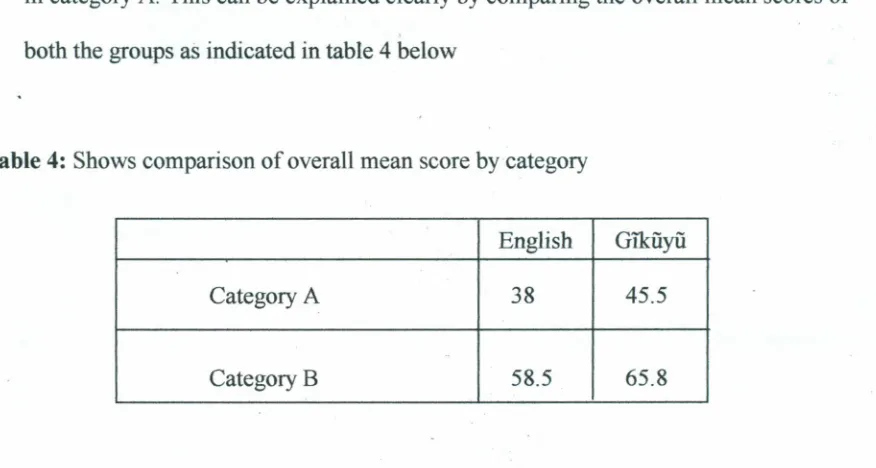
Table 4: Shows comparison of overall mean score by category Pg 59
List
of Grapbs
List of Figures
CHAPTER ONE
1.0
INTRODUCTION
1.1 BACKGROUND TO THE STUDY
Kenya is composed of many ethnic communities, each with its own linguistic code. In addition, Kiswahili is the national language while English is the official language.
Although many Kenyans are bilingual, many others especially the older generation are not. It is also notable that, many of the so-called bilinguals may have very low proficiency in English and Kiswahili. A number of studies that have been done in Kenya in second language learning and acquisition show that many students leave school with low competence in English particularly at primary level (Maina 1991, Nyamasyo 1992, Mberia 2002 and Kirigia 1991).
Nyamasyo (1992) notes that, high priority is given to the learning of English and for the use of English in the learning of other subjects. This notwithstanding, she
notes, it is claimed that most students leave school with very little competence in
English and that there are numerous complaints in Kenya as well as in other
countries such as Zimbabwe and Hong Kong, by parents, teachers, lecturers and employers about poor grammar, poor spelling abilities, low reading ability or a low level of proficiency in standard English among secondary schoolleavers.
It is in view of the foregoing that we argue that, many Kenyans are unable to read
and effectively comprehend the contents of certain important documents that are
meant for them but are usually written in English and Kiswahili. This is because reading comprehension presupposes the mastery of the reading process, (Kirigia
1991: 23) as well as the mastery of the language itself.
As a result of the above argument, the researcher advocates that important documents that touch on the lives of all Kenyans should be made available in languages that they fully understand. This fact, more often than not, has been neglected. This alienates the people from matters that concern them. A case in
point is the Kenyan constitution that is currently under review. For many years,
that, this document that was inherited from the colonial government, is not only
full of legal register but also foreign ideologies. Its inaccessibility to the ordinary
Kenyan is therefore not only due to language barrier but also the register and the
ideologies thereof. Some of the laws in the constitution were only meant to
protect the interests of the colonialists. In the opinion of the researcher, this could
have been the reason why no one bothered to translate the document into any
Kenyan indigenous language. On the other hand, other laws helped create
'monsters' in the name of African leaders. For instance, the Kenyan constitution
places the president above the law by heaping all the powers on the presidency.
These laws and others led to the clamour, by the Kenyan people, for review of the
constitution. Indeed, though the Draft Constitution of Kenya - 2004 contains
some contentious issues, it has tried to address some of the negative ones. For
example it proposes and advocates for a devolved government, that is, a
government whose powers are shared among the various organs of the
government and in which these organs are autonomous, free from political
influence and interference.
A step in the right direction has been taken with regard to the Draft Constitution
that has been formulated and presented for adoption as the revised constitution. It
people. There is therefore need to have the document written in other Kenyan
indigenous languages such as Gikiiyii.
As pointed above, the problem of receptor comprehension of this document that is
written in English is coupled by the fact that it is full of legal register. This
relegates an already English language incapacitated people, further from
comprehending the document. The researcher proposes that the best solution to
this problem is translating the document into the people's first language.
Translation is an activity that presumes the existence of a linguistic code that is
not properly understood by some receivers. This definition accurately depicts the
scenario in Kenya with regard to the Constitution of Kenya.
A commendable effort has been made on the part of Bible translation where
translators have made it possible for many Kenyans to get the word of God in
languages that they best understand.
The constitution of Kenya stipulates the rules and regulations that govern the
people of Kenya. It also contains the Bill of Rights that all Kenyans should enjoy
yet it is rendered in languages which most Kenyans are not very competent. It is
because of this fact that the researcher sees the need for the translation of the
speakers of the language who would have wanted to participate fully in the
proposed national referendum (A forum in which Kenyans are expected to air
their views about the document) but who will be prevented from doing so simply
because of the language barrier. It is hoped that, the translation of such a
document into Kenyan local languages, would be part of civic education. This
would in turn help thousands who have been alienated from the on-going debate
concerning the Draft Constitution simply because they cannot fathom the contents
of the document due to language barrier.
In support of such an endeavour, one of Kenya's scholars, Prof. Ngugi Wa
Thiong'o (2004), noted in a recent public lecture at the Nairobi University, that "a
majority of our people are at the foot of the mountain. Only a few are at the top. It
is the duty of those blessed with intellectual abilities to bridge the gap by speaking
with the people in a language they understand". He went on to suggest that "All
knowledge on Africa currently in English should be translated into vernacular"
(Daily Nation 3rd August, 2004).
The above suggestion has been made considering the fact that, as Kirigia (1991: )
puts it, "Many school pupils terminate their education at the completion of the
primary cycle of education." This claim is supported by the writer of the editorial
Primary Education) in 2004 were expected to drop out of school". It further states
that the affected candidates will be expected to seek places in ill-equipped Youth
Polytechnics or simply fall by the way side. This has been the trend in the recent
years and therefore the Kenyan population is full of such individuals.
The main concern of this study is whether these people have, by the time they
leave school, acquired a solid background in reading with understanding
important documents which are written in English. This is because for most of
them English has been taught as either a second language or a foreign language.
In this study, we therefore concentrated on people who dropped out of the
mainstream formal school system having attained the highest primary level of
education of their time. These people include both men and women. Several
studies that have been conducted in the past have shown that women's linguistic
forms differ significantly from those of men (Trudgill, 1974, Milroy, 1980 and
Labov, 1972).
Milroy (1980) contends that language varies with other linguistic elements and
also with a number of extra-linguistic independent variables such as sex, age and
social class and that differences in language take many forms such as
multi-lingualism which is said to be highly valued by and assoc'iated with males of a
New Guinea complex but devalued by women. It was assumed that the same
extent to which men differ from women with respect to the comprehension
performance of the two languages under study.
1.2 STATEMENT OF THE PROBLEM
This study investigated the extent to which some Gikiiyfi speakers' receptor
comprehension of the Draft Constitution - 2004 is hindered by language barrier.
The importance of the Draft Constitution cannot be overestimated. This
notwithstanding, the document has been written in languages that some Kenyans
do not understand. The document also contains a substantial amount of legal
register, which may hinder easy accessibility as well as total appreciation and understanding of the contents of the Draft such as "The Bill of Rights".
As such, some Gikfiyii speakers may find it difficult to fathom the contents of this
document. The researcher as a teacher of English for a number of years in the area
where this research was carried out observes, that some Gikiiyii speakers are quite
handicapped in as far as English and Kiswahili are concerned. This is because the
residents of this area are to a large extent homogeneous. They are a predominantly
1.3 RESEARCH OBJECTIVES
This study had the following objectives:
1. To test the accuracy of receptor comprehension of selected texts in the Draft
Constitution on a selected group of Gikiiyii respondents" when the texts are written in English and when the texts are translated in Gikiiyii.
2. To establish the major difficulties that some Gikiiyfi speakers face in
comprehending the Draft Constitution that is written inEnglish.
3. To test to what extent the sex variable would bring a difference in
comprehension and interpretation of the contents of the Draft Constitution.
4. To describe possible strategies of translating the Draft Constitution into Gikfiyii.
1.4 RESEARCH QUESTIONS
This study attempted to answer the following questions:
1. Is there a marked difference in the level of comprehension performance by some Gikfiyfi speakers) between portions of the Draft Constitution written in
2. What difficulties do some Glkfiyii speakers face in comprehending the Draft
Constitution that is in the English language?
3. Is there any difference between men and women in the ability to comprehend
and interpret the Draft Constitution?
4. What strategies are appropriate for translating the Draft Constitution from
English into Gikiiyti?
1.5
RESEARCH ASSUMPTIONS
This research was guided by the following assumptions:
1. There is a marked difference in the comprehension of the Draft Constitution
by some Gikiiyfi speakers, when it is written in English as opposed to when it
is written in Gikiiyii.
2. There are some difficulties that some Gikiiyti speakers face III the
comprehension of the Draft Constitution that is written in English.
3. Men and women are likely to exhibit significant differences in comprehending
and interpreting the Draft Constitution.
4. There are appropriate strategies by which the Draft Constitution can
effectively
be translated into Gikfiyii.
1.6
RATIONALE
OF THE STUDY
Just like some aspects of our African cultures have been abandoned as a result of
recent article in the Daily Nation (6-3-2002) posits that 'Kenya may lose 16
tribes' (sic). Some of the languages listed as facing extinction are: the Bang'om,
the Terik, the Dahalo and the Burji. The paper cites a Kenyatta University
Lecturer, Ezekiel Alembi, as having agreed with the above statistics when he
asserted, "Yes, languages are dying". It is with similar concern that this study
contends that it is possible to preserve important documents in Kenyan indigenous
languages thereby protecting and promoting the diversity of Kenya's indi~enous
languages.
Fasold (1984) advances the notion of the equality of languages. He says that any
language can express what another language can though some languages lack
enough vocabulary to say certain things. Fortunately, this deficiency is catered for
by strategies such as coinage, borrowing and other translation strategies.
The current constitution and the Draft Constitution pledge to respect, promote and
protect the diversity of Kenyan languages including the sign language.
Unfortunately, the documents are quiet on the 'how' the promotion should be
done. Nyamasyo (2004:77) observes "While the above legal positions augur well
for the indigenous languages of Kenya, it is not clear how they will be
implemented". Instead of actual promotion, there has been a tendency to sideline
all other languages in favour of English. This study is meant to help illuminate the
documented and read by the populace. This would be successful especially
through the use of documents of national importance such as the constitution itself which this study, proposes to be translated into Gikfiyfi.
This study was meant to add to the body of knowledge existing in the area of translation studies. Our data on a Gikiiyfi translation was intended to add to the
body of existing data showing translation across unrelated languages. The
analysis, suggestions and recommendations made were meant to be used by people willing to undertake the real task of translating the Draft Constitution or any other document into Gikfiyfi. It is believed that this study would benefit scholars who may wish to carry out studies of asimilar nature in other languages.
1.7 SCOPE AND LIMITATIONS
The aim of this study was mainly to establish the need for the translation of documents of national importance into the country's indigenous languages. We
also suggested translation strategies that those translating into the GIkuyu language may employ. We did not translate the entire Draft Constitution since time and financial constraints could not allow such an endeavour.
Having looked at all those pertinent issues in this study, that is, the background
information, the statement of the problem, research objectives, research questions,
research assumptions, rationale of the study, the scope and limitations of the
study, the researcher proceeded to look at the theories that enabled him to argue
the case in this study. He also reviews related literature that helped in illustrating
CHAPTER 2
2.0
THE
OR
ETICAL
F
R
AMEW
OR
K
2.1 INTRODUCTION
In translation, one cannot depend on a particular theory. This is because as Kelly
(1979:219) points out, "Had translation depended for its survival on theory, it
would have died out long before Cicero." Indeed, translation is an
interdisciplinary subject. De Waard and Nida (1986: 185) describes the situation
thus:
Translation is also a science in the broad sense of the term, for it is an activity which may be systematically described and related meaningfully to various disciplines. In the strict sense of the word, however, translation is not a science but a technology, for it is built upon a number of scientific
disciplines including Psychology, Linguistics, Communication Theory,
Anthropology and Semiotics.
Since translation cuts across all these disciplines, which were thought could
adequately capture and address the concerns involved in this study. The
researcher adopted an eclectic approach and proposed three theories: These were
The Interpretive, the Skopos and the Cultural theory.
2.2 The Interpretive Theory
This theory has to do with the notion of resemblance between utterances and their
meaning. Mostly, what happens in translation is that the translator recounts what
has been said by somebody else. As such the notion of resemblance co~es in.
other objects where they share common properties utterances can resemble each other in their phonological properties or in their inferential properties or in meanmg.
The theory has been proposed since a translation of a document like the Draft Constitution needs to be meaning based. As such, the target text is expected as
much as possible to resemble the source text as far as meaning and inferential properties are concerned. Gutt (1991) also says that the notion of interpretive resemblance is important in translation. This happens when interpretive resemblance is inferred when utterances share contextual implications in a certain context. When an utterance is used to represent another due to its interpretive resemblance, this is referred to as interpretive use. For instance, an utterance such as "I have a mountain of homework" is to be understood and interpreted (translated) interpretively to mean "I have a lot of homework."
The theory, which has been re-named the Sociosemioic theory by DeWaard and Nida (1986), helps the translator understand better not only the meaning of words,
sentences and discourse structures, but also the symbolic nature of the events and objects mentioned in the discourses. This theory is particularly important in distinguishing between designative (Basic) and associative (Interpretive)
meaning and therefore if all the other aspects of translation would prove difficult,
it is the meaning that is given special attention.
As the name suggests, the translator usmg the interpretive theory does not
translate word for word like a machine would do. He/she translates interpretively.
Sterk (1998:1) puts it this way:
All good translation needs the creative input of a human being. A machine can come up with a target text rendering that shows a word-for-word linguistic correspondence with the source text. This can be useful, but it cannot.be called a valid translation. The reason is that only a human being can correctly read the words and expressions of the source text in the context in which they are written and where they acquire their particular meaning. Only a human being can fully comprehend the source text with all its implications, its veiled references and emotive overtones, and, finally, only a human being has the creative ability to re-express that content in another language with as little distortion as possible.
(Emphasis mine)
Therefore, the main tenet of the interpretive theory is the re-expression of the
meaning of the source text in another language. This can only be possible if the
translator understands the source text. Understanding is an instance of interpretation in which the right meaning is assigned. That is, the only way to
understand the source text is to interpret it (Sterk 1988). Two steps are vital when
translating using the interpretive theory;
a) Understanding the meaning of the source text.
To illustrate this, two texts of the Draft Constitution translated interpretively are shown below.
English Every accused person has the right to a fair trial, which includes the right. To choose, and be represented by, an
advocate and be informed of this right promptly.
Gikflyii Mundu 0wothe fithitangitwo ena haki ya giiciirithio na
kihooto na haki ingi ta:
Giithuura wakiri na kurfigamlrirwo niwakiri ficiona ningi kiimenyithio ati ena haki io na ihenya ota iiria kwahoteka.
(any accused person has the right to be tried fairly and
other rights such as to choose an advocate and to be
represented by that advocate and to be informed that he\she
has that right immediately)
The Bill of rights English
Gikiiyii: Haki cia andii iria iheanitwo watho-ini
2.3 The Skopos Theory
Newmark (1988) posits that there is wide, albeit not universal, agreement that the main aim of the translator is to produce as nearly as possible the same effect on his readers as was produced on the readers of the original. This principle, he says, is referred to as the principle of similar or equivalent response or effect or of
functional or dynamic equivalence.
This principle raises a controversy about whether a translation should incline towards the source or to the target language. The Skopos theory, unlike some
other translation theories emphasizes on the need to identify with the target audience. It requires the translator to ask himself or herself - who is the reader?
Skopos is a Greek term for aim or purpose. It was introduced in translation theory
by Hans J. Vermeer and Reiss Katharina (2000). They aimed at a general theory of translation of texts. They used the term Skopos as a technical term for the purpose of translation and for the action of translation. Munday (2001:79) states
that the theory;
Focuses above all, on the purpose of the translation since the purpose determines the translation methods and strategies to be employed in order to produce a functionally adequate result.
In Skopos theory, knowing why a source text is to be translated and what function
Skopos theory, the end justifies the means, that is, the way the target text shapes
up is determined to a great extent by the function or Skopos intended for it in the
target context.
Reiss and Vermer (1984:119) propose the following rules to guide the theory:
1. A TT (translatum) is determined by its Skopos
2. A TT is an offer of information in a target culture and target language concerning
an offer of information in the source culture and source language (sl).
3. A TT does not initiate an offer of information in a clearly reversible way.
4. A TT must be internally coherent.
5. A TT must be coherent with the source text.
6. The five rules above stand in a hierarchical order with the Skopos rule
predominating.
This theory has been suggested for this study as it would act to offer checks and
balances to the translator using the interpretive theory. This is because the Draft
Constitution is a legal document and therefore its meaning needs to be upheld.
Thus the Skopos is to enable the readers of the target text get to know their rights,
their responsibilities towards the government and one another, the laws by which
2.4 The Cultural Theory
Language is a major proponent of culture, therefore one cannot translate a text
and ignore the source text culture and the target text culture. This is because a text
reflects the culture of the source language. There are some expressions that are
peculiar to a source language and a translator should not reproduce them in the
target language. This is because his readers are unlikely to understand them.
Euphemisms is a notion often made use of in the cultural theory of translation. As
Bascom (1994) states, euphemism has often been described as the avoidance of direct reference to certain activities or objects, which fall within certain domains,
such as sex, death and bodily functions. Euphemism is the replacement of specific
terms of reference within these domains in certain social contexts with others of a
different (usually considered to be more "polite") register.
In translation, euphemisms should not be unclear, rather they should be clear
replacement terms for others not being used in those contexts. All the same, it
should be noted that the contexts as well as the domains are culture specific. If euphemisms are not used, the target reader may even become offended. For instance, when translating the expression 'abortion' into Gikfiyii, 'kfiruta ihu' (to
remove the pregnancy) would be offensive. The best option would be 'kiiruta nda' (to remove the stomach). The best Gikfiyfi expression for the English word
(the man's seed and the woman's seed joining together) other than 'kugwatia' or
'kuigutithia' (conceive).
For such and other expressions that require a sensitivity and understanding of the receptor culture we propose the use ofthe cultural theory in this translation.
From the analysis of the three theories above, it seems necessary to make use of all of them in this study. It is evident that they are meant to supplement one another in a translation of the nature proposed in this study.
2.5.0
L
ITERA TURE REVIEW
2.5.1 INTRODUCTION
In literature review the researcher focused the study on two areas. These are:
i) Literature on translation
ii) Literature on the constitution
2.5.2 LITERATURE ON TRANSLATION
Translation is not a new discipline. Steiner (1992) notes that any model of communication is at the same time a model of translation, of a vertical or
horizontal transfer of significance. For instance, Steiner (Ibid) notes that there are
and inference. This is also true of any two human beings. Each person speaks an idiolet that is, "the language variety used by a particular individual" (Catford, 1965:86). Therefore, in each communication gesture, there is a private residue which has to be translated in the mind of the listener. This kind of translation can only be successful if the participants involved are using a common language or
two different languages in which they are proficient. Steiner (1992:49) notes that "inside or between languages, human communication equals translation" and that "a study of translation is a study of language." He further points out that, "the affair at Babel confirmed and externalized the never ending task of the translator - it did not initiate it."
Larson (1984:94) defines translation as 'a neutral term used for all tasks where the meaning of expressions in one language referred to as the source language is
turned into meaning of another referred to as the target language". It is the rendering of a message literally or non-literally from its original language into another language.
Newmark (1988:7) defines translation as " A Craft consisting in the attempt to
This shows that translation is an important and inevitable human activity.
Translation exists because men speak different languages (Steiner 1992). This
statement is a true reflection of a multilingual society like Kenya. It is a situation
aptly captured by Crystal (1987) when he points out that, "When people are faced
with a foreign language barrier, the usual way round it is to find someone to
interpret or translate for them". The notion of language barrier is therefore
rendered obsolete through translation. This means that translation is a solution to
language problems.
Apart from the solution of language barrier, translation also solves the problem of
languages that are faced with extinction. Woodbury (2000) posits that language
endangerment is an extremely serious problem, one with great humanistic and
scientific consequences. Following up the issue, he states that, roughly 5000 to
6000 languages are spoken in the world today but a century from now the number
will almost cert~inly fall to the low thousands or even hundreds. He makes these
comments due to the rate at which communities that were once self-sufficient find
themselves under intense pressure to integrate with powerful neighbours, regional
forces, or invaders, often leading to the loss of their own languages and even their
ethnic identify. We posit that our indigenous Kenyan languages are not an
exception. According to The Daily Nation newspaper of March 6, 2002, a report
released by the United Nations on February 20, 2002, shows that more than 3,000
death". The report says that 16 of the above stated languages "are in Kenya - four of which are already extinct".
Some of the languages that the above newspaper reports as dead languages in Kenya are the, EI Molo, Oropom, Lorkoti, Yaaku, Sogoo, Kore, Segeju, Omotik and Kinare and as stated in the rationale of this study many others are classified as
"seriously endangered". Quoting the Atlas of the world's languages in Danger of
Disappearing, the United Nations report says 10 per cent of Africa's "endangered" and "extinct" languages are in Kenya.
Woodbury (2000) states that one solution to this world problem is to have these languages documented as much as possible. Effective documentation, he says,
includes extensive videotape, audiotape, and written records of actual language use both formal and informal. He points out that for this documentation to be
useful, it must include translation of materials into a language of wider
communication.
It has often been said that translation is impossible. What needs to be pointed out is that translation is possible, but it is a complex task. In support of this assertion,
languages. He posits that this task requires a keenness of insight that surpasses
that of most mortals. Having talked to many translators and translation critics,
Crystals (1987) notes that most confess that the task is, in the end, an impossible
one. He quickly proceeds to point out that the skilled translator can do much "to
combat the task, however partial or ephemeral the victories". (Ibid)
The artistic aspect of translation should be defended by scholars in this field. Ali
(1981: 15) notes that, "Translation is not simply a blind transfer of a message from
one language into another". That "one has to be skilful in that task" is her
standpoint.
Therefore, the fact that translation deals with material which is not originally that
of the translator, but which has been produced by another author, should not
guarantee the overlooking of the value of translating. Translations should
therefore enjoy the same prestige and popularity as any other form of writing.
Ali (1981) also decries the unfortunate attitude of some scholars who do not see
the artistic .aspect involved in translating. Such scholars, she says, fail to
recognize that a good translation requires a skilful usage of words and expressions
We need to point out that though translation is an interdisciplinary subject, it is
purely a linguistic study. Indeed it is an interdisciplinary study. Newmark
(1985:5) points out that "translation theory derives from comparative linguistics and within linguistics, it is mainly an aspect of semantics; all questions of semantics relate to translation theory. That sociolinguistics has a continuous bearing on translation theory" is a fact. Halliday (1970) also notes that the principles and the methods for comparing languages including the theory of translation belong to the field of comparative linguistics it compares the working of different languages. Since translation is regarded as a special case of this kind
of comparison, comparative linguistics includes the theory of translation. The relevance of comparative linguistics to translation is the fact that it makes it possible to compare features in different languages with a reasonable degree of accuracy and objectivity.
Finally, a few aids to the translator have been suggested by Kelly (1979). One such aid is the use of experts. He points out that "translators called on experts in the subject of their texts and engaged in lexicological research." He says that
Jerome employed a rabbi as his informant in the translation of the Hebrew Old Testament. 1,000 years later, he points out, Wycliffe's team included not only
experts in Latin but also theologians. The second prop is what he calls the
ubiquitous dictionary, that IS, a Universal Dictionary. Finally he talks of
what is called the base/model (B/M) approach, first proposed by Fehderam
(1979).
Apart from the above mentioned aids, the translator has several translation
strategies athis/her disposal. Some of the strategies are: i) Coinage
ii) Borrowing
iii) Definition/Unpacking
iv) Building in redundancy
v) Accommodation
vi) Base/Model approach
-
:
Coinage
Coinage is one of the least common processes of word-formation in English.
Yule, (1985) says that coinage is the invention of totally new terms. The Gikiiyii
speakers have:for example coined the word 'kamungiirio' (mobile phone).
Borrowing.
It is said to be one of the most common sources of new words in English (Yule
Ibid). Examples of loan words that the English language has adopted from other
languages are such as alcohol (Arabic) boss (Dutch) Zebra (Bantu) tycoon
Accommodation
Shi (2004: 1) says that accommodation means "changes are made so that the target
text that is produced is in line with the spirit of the original." It has also been
referred to as adaptation.
Building in Redundancy
The Oxford Advanced Learner's Dictionary defines redundancy as the use of
language that is superfluous, that is, language that is not needed. Information
theorists on the other hand say that for efficient communication to take place,
languages have a tendency of being approximately 50 percent redundant
(Beekman and Callow, 1974). One good example of redundancy is in the Bible,
Genesis 1:27 "So God created man in His own image, in the image of God created
He him; male and female created He them." Building in redundancy is one useful
strategy in translation.
Definition
To define aterm is to unpack its meaning, that is, to state precisely or explain or
state clearly the meaning of a word (Oxford Advanced Learner's Dictionary). For
example the meaning of the word 'fathom' (Used elsewhere in this study) as in 'I
2.5.3 LITERATURE ON THE CONSTITUTION
Legal and political philosophers have fronted many definitions of the term
constitution. The definitions have been noted to differ only in phraseology but
they are agreed that the constitution is the fundamental or basic law of the land.
According to Gicheru & Miano (1987), the constitution consists of those rules or
laws which determine the form of a given government and the respective rights
and duties of it towards a citizen and of the citizen towards the government.
In the Encyclopedia Britanica volume 6, the term constitution is seen in two
senses. In its wider sense, it is said to mean the whole scheme whereby a country
is governed; this is said to include much else besides law. In its narrower sense,
the term constitution is said to mean the leading legal rules, usually collected into
some document which comes to be almost venerated as "the constitution".
Gicheru & Miano (1987) state that "By a constitution is normally meant a
document having a special legal sanctity which sets out the framework and
principal functions of organs of government of a state and declares the principles
governing the operation of those organs..." They further observe that whatever its
form, a true constitution will have the following facts about it very clearly
marked.
1. How the various agencies are governed
3. In what manner such power is to be exercised.
The above definitions point towards the importance of a country's constitution. It
is because of this fact that we argue that the contents of any given constitution
should be known by all the citizens of that country, whether the citizens are
literate or illiterate. This fact is aptly captured in the Encyclopedia Britanica
volume 6 when it specifically talks about constitutional law. It is said to be the
law relating to the government of the country as well as, to the state and its
various organs and their relations among themselves and with the ordinary citizen.
Citizens in a democratic country like Kenya are said to enjoy freedom of speech,
the right to say or publish what they please, freedom from arbitrary arrest,
freedom to practice their religions and freedom of association, that is, to form
political parties, clubs, trade unions or any other organization one wishes to form
among other freedoms. In most countries like Kenya these rights are written into
the constitution by being specifically enumerated and enacted as part of the
constitutional document itself. Our main worry is the language used in writing the
constitution .. The main question is, important as the constitution is,' is it
understood by all the citizens for whom it is meant?
A constitution is written in the sense that there is some document or series of
documents setting out the fundamental principles and chiefly legal rules, and to
this someone can point and say, "This is the constitution", Such a constitution is
the basis of public law Gicheru and Miano, 1987).
In most countries like Kenya, the constitution, using the term in the narrower
sense, is a scheme of government that has been deliberately adopted by the
people. That is to say that these governments are constitutional governments.
Constitutional governments are limited governments in the sense that they require
that public authority be exercised according to law. In other words, these
governments are democratic.
For Karl Marx, "Democracy, an association in which the free development of
each is the condition for the free development of all", (Gicheru and Miano, 1987)
should be upheld. The term democracy is derived from the Greek words 'demos'
(people) and 'cratia' (power). This means that democracy is aform of government
where power ultimately rests with the people. It is only prudent then, that the
people (citizens) know the rules that govern them. This can only be possible if
they understand their constitution. This, in turn, can only be possible if the
language used in the constitution is understood by all. This is afact implied in the
PREAMBLE
We, the people of Kenya
ACKNOWLEDGING the supremacy of the Almighty God of all creation:
HONOURING those who heroically struggled to bring freedom and justice to
our land:
PROUD of our ethnic, cultural and religious diversity and determined to live in
peace and unity as one indivisible sovereign nation:
RESPECTFUL of the natural environment that is our heritage, and determined to
sustain it for the benefit of future generations:
COMMITTED to nurturing and protecting the well-being of the individual, the
family and the community:
RECOGNISING the aspirations of all Kenyans for a government based on the
essential values of freedom, democracy, social justice and the rule of law:
EXERCISING our sovereign and inalienable right to determine the form of
governance of our country and having participated fully in the making of this
Constitution:
ADOPT, enact and give this Constitution to ourselves and to our future
generations.
Real democracy, that is, one advocated for by Abraham Lincoln when he posited
a classic definition of democracy as 'a government of the people, for the people
and by the people', cannot be achieved if a section of the society (e.g.
communities like those involved in this research) cannot contribute or discuss the
constitution due to language barrier.
Meaningful democracy means real consent. This is where the people express their
consent directly or indirectly through their representatives (Gicheru and Miano,
1987). If the government of the day does not live up to the expectations of the
governed, this consent, which is enshrined in the constitution by way of having
people contribute to the making of the constitution, may be withdrawn by the
people. Kibwana et al(1996:2) notej
But the constitution also tells the people what rights they have. It tells them how, when and who by (sic) those rights can be taken away. Some of the rights in the constitution make it possible for the citizens to influence the behaviour of government. Other rights
enable the citizen to change the government altogether. (Emphasis mine).
This cannot be possible if a given section of the society is in darkness regarding
the contents of the constitution because they are language handicapped and cannot
therefore read the constitution and understand its contents.
Such rights as the freedom of expression, press and association are guaranteed
democracy as they facilitate free discussion without which democracy cannot
thrive. Indeed democracy is government by discussion and public opinion as
expressed in the constitution.
It is afact that one cannot express his/her opinion on an issue that he/she does not
understand since it is written in a language that he/she does not fully comprehend.
The constitution begins when the need for peaceful conflict resolution in the
society is realized. This is an inevitable exercise since whenever human beings
are granted freedom, there are certain issues that generate conflict in the society that people find themselves in. This in turn happens because unlike other animals,
man is not a docile animal. Therefore, there is always the need for the society to
identify the germs of potential or real conflict, examine them and devise ways and
means of resolving them amicably. This means that any human society cannot do
without a constitution, whether written or not. It also means that for the people to
participate productively in the above described activity, they need to understand
the constitution.
In conclusion, the importance of the constitution in a society has been reaffirmed.
That notwithstanding, the constitution does not exist in avacuum. People are the
means by which it is not only established but also exercised. By all means, it is
prudent to have all individuals in the society, regardless of their social status,
background, know exactly what their constitution contains. One way to make this
happen, in the Kenyan society, is to have the constitution translated into Kenya's
indigenous languages. Gikiiyii is one such language which is the focus of this
study.
In the next chapter, the researcher presented the research design that was adopted
CHAPTER 3
3.0
METH
ODO
L
O
GY
3.1 INTRODUCTION
As a teacher of English in a secondary school in the area under study for several years, the researcher observed that students even at this level had very low proficiency levels in English and Kiswahili. This led to a concern that has generated this research, that is, if those who proceed to secondary school have such serious problems with the use of English, what about those that terminate their education after completing the primary cycle of education? The researcher had also observed that the general population in this area tended to use Gikiiyil almost allthe time. All these people need to read, understand and respond to issues contained in important documents such as the constitution inorder to associate themselves with such documents, own them and benefit from them.
3.2 RESEARCH AREA
This area is semi arid. In addition, the roads are rough and as such transport is a
big problem. This worsens during the rainy season when it becomes difficult to
transport essential conunodities such as foodstuffs and newspapers.
Such problems and others such as insecurity are likely to have made this location
to 'repel' outsiders, that is, speakers of languages other than Gikiiyti. This is the
reason why the area has failed to attain a cosmopolitan status, a characteristic
common with areas that are as near Nairobi as Karai is.
A community that is cosmopolitan in nature is usually rich in its linguistic
diversity and forces members of such a community to acquire neutral languages
such as Kiswahili and English (Kenyan context). This is not so with Karai
location. It is dominated by one homogenous linguistic community, that is, a
predominantly Gikiiyii vspeaking community. Speakers of other languages such as
dholuo, Kikamba, Luhya and Maa co-exist with the speakers of Gikiiyfi but since
they are very few in number their languages are insignificant. As a matter of fact,
most speakers of these other languages acquire Gikiiyfi and often speak it atwill.
The above characteristics make Karai umque when compared to the other
locations that combine with it to form the Kikuyu Division. This uniqueness
assumed that this area was representative of other such locations with similar
characteristics and where Giktiyfi is spoken as a first language.
It was also assumed that the target population had average reading ability and
would form a population from which reliable findings would be got. Another
assumption made was that since Kenyans had given their views to the constitution
review commission of Kenya, and the debate concerning contents of the resultant
Draft Constitution had been going on for a period of time, the study population
would be familiar with the issues that were raised and tested in the questionnaires.
3.3 SAMPLE SIZE
This study involved a total of 40 respondents. This was considered a good sample
because as Milroy (1987 :21) states, "socially sensitive studies of language
variation depend on good data, which entails the provision of sufficient types and
quantities of language." She further observes "that large samples tend not to be as
necessary for linguistic surveys as for the other surveys because they tend to be
redundant, bringing increasing data handling problems with diminishing
analytical returns."
As stated earlier, the respondents in this study were drawn from graduates of the
highest primary level of education. Over the years, the education system in Kenya
Available information according to Anderson (1970) shows that between 1950 to
1960, the highest primary level was standard eight. Between 1960 and 1984, the
highest level was standard ·s~ven. Since 1985 to date, the highest level is again
standard eight (Appendix 5 shows a complete picture of the primary and
secondary systems ofeducation).
The sample was distributed across the board among all categories of graduates of
primary level of education in the three different periods described above. It was
further divided into two groups as follows:
a) 20 Gikiiyti speakers, ten men and ten women, with the current standard 8
level of education. (This group has been labeled category A in this study.)
b) 20 Gikiiyfi speakers, ten men and ten women, with the 1950 to 1984
standard 8 and standard 7 level of education. (This group has been labeled
category B in this study.)
Men and women are socialized differently. Their level of exposure is thus varied.
It is because of these reasons that the sex variable was introduced. It was hoped
3.4 SAMPLING PROCEDURE
Judgment sampling technique was used to identify the locality of the study. This .'
method involves identifying in advance the type of speakers to be studied Milroy (1987:26). The technique was also used to identify the second group of the respondents mentioned above, that is, category B. The researcher picked the first individual who fitted in this group. This sampling technique gave the researcher a starting point.
Social network approach was then used to help in picking of the rest of the respondents in this group. Social Networks are those informal and formal social relationships of which any human society is composed. Social network helps us view how an individual relates to other individuals in the society. More precisely, it helps the researcher find a means of approaching a group with which she/he has no pre-existing personal ties.
The social network approach takes as its starting point the isolated individual who is assumed to be linguistically typical of a particular age, class or sex group. One useful concept in this approach is the concept of a 'friend of or a 'friend to a friend' which was used in this study as follows: The first individual the researcher had picked using judgement sampling identified several others they were with at school. Likewise, these 'others' identified yet other members of this social
.
instruction to these people was to suggest people that they were sure did not go
beyond the level of education described above.
The first group of respondents that is category A was picked from a local village
polytechnic where, they are taught manual skills such as carpentry, dressmaking,
masonry, home economics, agriculture and business. During the research, the
principal of the polytechnic reported that the teachers use a mixture of Gikfiyfi,
English and Kiswahili. It was therefore assumed that these respondents usually
encounter English accidentally just like any other person who is not in a given
institution. The timetable shown on appendix 3 shows that there is no attempt to
teach language or communication skills). It was assumed that not much English or
Kiswahili was purposefully taught. It is also worth noting that all the teachers that
teach in the institution involved are speakers of Gikiiyfi as their first language.
To get the required number of respondents in this second category of respondents
described above, the random sampling method was used to get ten men and ten
women from the population found in the local village polytechnic. All the 50
students present when the researcher visited the institution were subjected to the
English and Gikfiyii tests. Men's scripts were separated from those of women.
Finally for each test, we had 20 scripts for women and 30 for men. From the
women's, the researcher counted and put aside every second script and ended up
that this time the researcher counted and put aside every third script ending up
with ten scripts which were used in the study.
3.5 DATA ELICITATION AND RESEARCH INSTRUMENTS
The Draft Constitution is composed of 21 chapters and seven schedules. Each
chapter deals with a different issue as shown below:
CHAPTERS
Chapter One: Chapter Two: Chapter Three: Chapter Four: Chapter Five: Chapter Six: Chapter Seven: Chapter Eight: Chapter Nine: Chapter Ten: Chapter Eleven: Chapter Twelve: Chapter Thirteen: Chapter Fourteen:
Sovereignty of the people and supremacy of the
constitution.
The Republic
National values, principles and goals.
Citizenship
Culture
The Bill of Rights.
Land and property.
Environment and natural resources.
Leadership and integrity.
Representation of the people.
The Legislature
The executive
Judicial and legal system
Chapter Fifteen: Public Finance
Chapter Sixteen: The public service
v'
Chapter Seventeen: National security
Chapter Eighteen: Constitutional Commissions
Chapter Nineteen: Amendment of the Constitution.
Chapter Twenty: General Provisions
Chapter Twenty-One: Transitional and consequential provisions
SCHEDULES:
First Schedule:
Second Schedule:
Third Schedule:
Fourth Schedule:
Fifth Schedule:
Seventh Schedule:
Regions, Districts and boroughs
National symbols
National oaths and affirmations
Distribution of functions between the Government and the
devolved levels of Government.
Legislation to be enacted by parliament.
Transitional and consequential provisions.
Faced with all these chapters and schedules, the researcher purposively sampled
chapter six of the Draft Constitution, that is, the chapter on 'the bill of rights' to
be used for data elicitation. This chapter was chosen since it concerns every
individual's rights. It was therefore thought to be a chapter that directly touches
interested in knowing what their rights are. This chapter was therefore considered
a good area for testing receptor comprehension.
Using judgement sampling technique, 16 short texts on 'the bill of rights' were
further sampled and typed. The researcher identified those texts that would elicit
the nature of questions described in the next page. Those texts were extracted the
way they appear in the Draft Constitution. They are all within reasonable
comprehension level of an upper primary school child who is expected to use the
English language with ease.
Many of these texts were short as stated above. Such short texts were chosen
purposely because, according to Fyfe and Mitchell (1985:54), "people tend not to
read lengthy instructions." Apart from being short, the texts were also few. This
was meant to avoid making the respondents lose concentration because of reading
many such texts.
From the above described texts, the researcher formulated twelve questions three
of which were basically based on the principle of multiple choice test theory. This
was so because according to Oller (1979:256), multiple choice questions are not
only easy to administer but also candidates who pass them well are those that are
'strong' and quite sure of what they have done. As for a compression test likethe
what they read and were not tricked by the choices. For this reason, Oller (1979)
further asserts that;
It is the purpose of the multiple choices offered to any field of alternatives
to trick the unwary, ill informed or less skillful learner.... If the test
succeeds in discriminating among the stronger and weaker students
I
t
'doesso by decoying the weaker learners into misconceptions, half-truths and
janus-faced traps.
Three questions were close-ended multiple choice and two questions were free
response open-ended type. The researcher decided to use both open-ended and
close-ended questions because while the close-ended questions have advantages
as stated above, the open-ended questions, tend to produce a greater amount of
reliable and valid test valiance (Oller 1979).
The remaining seven questions were :
a) Two true or false questions that were to be followed by short explanations for
the choice made.
b) Four yes or no questions which were to be followed by subsequent short
explanations for the choice made.
c) One right or wrong question which was to be followed by subsequent short
explanation for the choice made.
These categories of questions were meant to avoid monotony as well as to ensure
guesswork and luck were avoided. They therefore ensured that reading with
The same sampled texts and questions exactly as described above were translated
into Gikilyii. We therefore ended up with two questionnaires (one in English and
one in Gikiiyfl). These questionnaires are attached as appendices 1 and 2
respectively in this study. In each of the questionnaires one self-evaluation
question was added. It was meant to give a chance to the respondents to self
evaluate themselves stating which one of the two tests they found easier.
The last instrument applied in this study was the unstructured or open interviews,
This was meant to enable the researcher gather "data on covert variables such as
attitudes ... " (Seliger 1989: 166) that could help explain the data obtained from the
questionnaires.
3.6 MODE OF ASSESSMENT:
On one group of the respondents, that is, category A, the researcher administered
the questionnaire himself. The respondents took the second questionnaire upon
completion of the first. The instructions were that each questionnaire was allowed
two hours. This was meant to show the seriousness involved in the exercise,
However, none of the respondents took more than one and a half hours with the
questionnaire written in English. As for the questionnaire written in Gikiiyil some
For the second group of respondents, that is, category B, the researcher
administered the questionnaire with the help of an assistant. It was a bit difficult
to administer the questionnaires to this group. The main problem was their
availability. Being parents and breadwinners in their families it was problematic
to agree with each individual and allocate time for the exercise and therefore the
services of a research assistant were sought. Eventually, the questionnaires were
administered under similar conditions as the first group, that is, the respondents
took the second questionnaire upon completion of the first and that they took
between 1
Y
z
and 2 hours to complete each questionnaire.The researcher marked the tests and approached the available (80%) respondents
once more during which open interviews were conducted. The gathered data was
presented in tables with the following comparisons:
a. Each individual's performance in the two tests in the two languages.
b. The performance of the two groups of respondents involved in the study.
c. The performance of men to that of women respondents.
These tables plus other data presentation instruments are shown clearly in the next. ,
CHAPTER 4
4.0
PRESENTATION
AND ANALYSIS OF DATA
4.1
INTRODUCTION
In
this study we adopted both a qualitative and quantitative approaches to dataanalysis. The analysis of the scores obtained from tests that were done by the
respondents generated the numerical data which called for quantitative analysis.
On the other hand, the open interviews generated data that was analysed and
discussed qualitatively.
4.2
DATA
PRESENTATION AND
ANALYSIS
The researcher marked the tests out of 24 (2 marks for each question) and
converted the marks into percentages. He then presented the percentage
Table
I:
Shows the Score Obtained by Female Individuals in Each CategoryCategory A Category B
GTIcuyii English GTIcuyii :'English
Fl 88% 58%., Fl
*
42%., 50%F2 67% 50%., F2 75%., 38%
F3 42% ., 17% F3
*
50%., 54%F4
*
25% 33%., F4 75% 58%.,F5 58% 46%., F5 58% 58%.,
F6 54% 50%., F6 33% 25%.,
F7 46% 25%., F7 79%., 42%
F8 71% ., 67% F8 92%., 75%
F9 46% 42%., F9 92% 92%.,
FIO 38% 38%., FlO 38% 63%.,
Totals for females 535 426 Totals for females 634 555
in this group in this group
Mean scores for 53.5 42.6 Mean scores for 63.4 55.5 females in this group females in this group
Key F --'Female
*
~ose who went against our predictions .Table 2: Shows the Score Obtained by Male Individuals in Each Category
Category A Category B
Gikiiyii English Gikiiyii English
Ml 54% 54%., Ml 75% 63%.,
M2 29%., 17% M2
*
63%., 75%M3
*
54%., 58% M3 88% 83%.,M4 25% 17%., M4 92% 92%.,
M5 33% 17%., M5 67% 50%.,
M6
*
21% 33%., M6 67% 42%.,M7 46% 29%., M7
*
83%., 88%M8 67% 46%., M8
*
38% 46%.,M9
*
21% ., 25% M9 71%., 54%MI0
*
25%., 38% MIO 38% 21%.,Totals for males 375 334 Totals for males 682 614
in this group in this group
Mean scores for 37.5 33.4 Mean scores for 68.2 61.4
males in this group males in this group
Key M---'Male
*
-M'hose who went against our predictions .., -. Stands for the outcome of the self-evaluation question. The tick shows the test (English or Gikfiyii that each informant ticked as the test that they thought they
Table 3: Shows Total Scores and Mean Scores Obtained by Both Male and Female Respondents in Each Category ,
Category A Category B
Overall totals for females &males in this group
Gikiiyii 910
English
760 Overall totals for females &males in this group
Gikiiyii English
1316 1169
Mean scores for 45.5 females &males in this group
38 Mean scores for 65.8
females &males in this group