Self-Confidence and Parenting: A Correlational Study of
School Students
Prof. (Dr.) Madhu Gupta1 & Bindiya Lakhani2
1. Professor, Dept of Education, M.D. University, Rohtak
Email:[email protected]
2. Assistant Prof., Aravali College of Advanced Studies in Education, Faridabad
Email: [email protected]
Abstract
The concept of self-confidence is associated with overall development of the school students and today it is widely recognized through the support of parents. The present study was designed to find out the relationship of self-confidence of school students parenting and its modes (rejection vs acceptance, carelessness vs protection, neglect vs indulgence, utopian expectation vs realism, lenient standard vs moralism, freedom vs discipline, faculty role expectation vs realistic role expectation; and marital conflict vs marital adjustment). While employing descriptive survey method, the present study was conducted on a sample of 400 school students. The sample was selected by using random sampling techniques. Self-Confidence Scale developed by Gupta and Lakhani and Parenting Scale developed by Bhardwaj, Sharma and Garg was used for data collection. Product moment correlation (r) was applied to study the relationship among variables under study. The findings of the study revealed significant relationship of self-confidence of school students with parenting and its modes. Significant relationship of self-confidence of school students with mothering, fathering and their modes were also found. The findings have special implications for parents. By providing the loving environment at home, parents can help the children to identify their strengths and weaknesses to enhance the self-confidence of their children.
Introduction
Education is a means of transmitting knowledge, culture and values from one generation to another. An effective system of education results in the development of the learner’s potentialities, enlargement of their competencies and transformation of their interests, attitudes and values. It’s not the passive learning but it is an interactive and integrative process (Murugan and Manimehalai, 2015)(16). The impact of
education is intense and pervasive on all human activities. The task of formal and informal education is to assist the child in his corridor of growth and development. The widespread and imperative role of self has been recognized significantly in the development of the individual. A developed self helps an individual to improve self-esteem & learning helplessness and to reap the benefits of learning optimism (Seligma, 1990)(17). Philosophers, writers, educators and psychologists have
emphasized the vital role played by self-confidence in overall development of an individual (Benabour and Tirole, 2001)(5). It is a conviction of one’s acceptance,
rejection and valuing oneself as an individual. Self-confidence is ones perceived ability to act efficiently in a situation to conquer obstacles and to get things set out alright (Basavana, 1975)(4). It is an apparent ability of one to deal situations
effectively without leaning on others and to have a positive self-evaluation (Agnihotri, 1987)(2). Self-confidence is shaped in primitive development years and
commonly reflection of parenting and school environment. If an individual has number of abilities, lot of knowledge, but have no self-confidence, there is no success.
Self-confidence is basic approach for an individual to have a positive and realistic self-perception. It is the featured by personal traits such as assertiveness, optimism, certainty eagerness, affection, pride, independence, trust, the capability to handle the criticism and psycho socio problems for one individual. For one, it could be about speaking in the community and for another; it might be the handling of social circumstances. It is associated with one’s own knowledge, abilities and confidence in one self as it generates the mental power & body and emphasize on attainment of goals. Cheng and Furnham (2002)(10) found that self-confidence is correlated with
self rated happiness and loneliness in adolescents. Partington (2004)(17) reported that
academic achievement and future aspirations than those with low self-confidence. Chang and Cheng (2008)(9) indicated that there was significant positive relationship
existed between students' science achievement and their self-confidence. Gurubassappa (2009)(12) found significant relationship of intelligence with self-
confidence of students. It is also significantly connected with self-control, self-image, self-satisfaction, self-respect, self-reliance, stress, spirituality and physical health (Ajilal and Raju, 2013)(3), Gurubassappa (2009)(12) found significant relationship of
intelligence with self- confidence of students. James and Jasser, (2015)(14) reported
that parent’s attachment and supervision have significant impact on self-confidence of children. Studies have also shown that the level of self-confidence is also related to propensity to stress, rigidity, resistance to change, persuasion, different kinds of social behaviour and educational aspirations.
Parent is the prime helper, monitor, director, observer, curator and decision maker for the child. The first and forecast responsibility of parents is to take care of their children in the best probable manner and to see their progress. Adequate parenting prerequisite both efficient mechanism - in terms of assurance, sympathy and positive regards for children. Parenting is a practice that formally starts during or before pregnancy and continues till the balanced development of the child. In today’s era of 21st century self-confidence work as encounters against the amours of the life. If a
student has self-confidence, he would have clear self-concept, self-control, good social relations and decisions taking ability. It is only the parents who sow the seeds of confidence in child. Bhardwaj (1996)(6) explored that parenting has impact on
self-concept and curiosity among girls and boys. Parent’s potency and optimism can be an asset for the child. Parents work as the gateway of the positive and negative self-talk. Aggarwal and Mishra (2005)(1) found that parent’s rejection, demand,
symbolic reward, love and object reward affect the student’s self- confidence. Raju and Samiullah (2011)(18) revealed that students with high parental involvement have
shown better academic achievement compared to students with low parental involvement. Singh and Singh (2016)(20) showed positive relationship between
parental warmth, general self efficacy and control.
and fathering separately along with their modes. Therefore, to fill this gap in literature, the investigator has investigated the relationship of self-confidence with parenting including mothering and fathering.
Objectives of the Study
To find out the relationship of self-confidence of school students with parenting and its modes (rejection vs acceptance , carelessness vs protection neglect vs indulgence, utopian expectation vs realism, lenient standard vs moralism, freedom vs discipline, faulty role expectation vs realistic role expectation; and marital conflict vs marital adjustment) .
To find out the relationship of self-confidence of school students with mothering and its modes (rejection vs acceptance , carelessness vs protection neglect vs indulgence, utopian expectation vs realism, lenient standard vs moralism, freedom vs discipline, faulty role expectation vs realistic role expectation).
To find out the relationship of self-confidence of school with fathering and its modes (rejection vs acceptance , carelessness vs protection neglect vs indulgence, utopian expectation vs realism, lenient standard vs moralism, freedom vs discipline, faulty role expectation vs realistic role expectation).
Hypotheses of the Study
Ho1 There exists no significant relationship of self-confidence of school
students with (i) parenting as a whole (ii) rejection vs acceptance (iii) carelessness vs protection (iv) neglect vs indulgence (v) utopian
expectation vs realism (vi) lenient standard vs moralism (vii)freedom vs discipline (viii) faculty role expectation vs realistic role expectation; and (ix) marital conflict vs marital adjustment.
Ho2 There exists no significant relationship of self-confidence of
Ho3 There exists no significant relationship of self-confidence of school students
with (i) fathering as a whole (ii) rejection vs acceptance (iii) carelessness vs protection (iv) neglect vs indulgence (v) utopian expectation vs realism (vi) lenient standard vs moralism (vii) freedom vs discipline; and (viii) faculty role expectation vs realistic role expectation.
Design of the Study
In the present study, descriptive survey method was used.
Sample
For the present study, 400 students studying in secondary schools of Faridabad district affiliated to CBSE board were randomly selected for data collection who have both the parents-mother and father.
Tools Used
Self-Confidence Scale developed by Gupta and Lakhani (2018)(11) was used to
assess the level of self-confidence among secondary and senior secondary school students. The scale has 48 items under five dimensions (decisiveness, self-concept, self-control, inter-personal relations and parental support). The reliability of the scale was 0.840. Inter-correlations among different dimensions of the scale have indicated high construct validity of the scale which ranging from 0.264 to 0.439.
Parenting Scale developed by Bhardwaj, Sharma and Garg (2018)(7) was used in
whole. The same has not been studied separately in mothering and fathering as well.
Statistical Techniques Used
Product Moment Correlation (r) was used in the present study. Analysis and Interpretation
The objective of the study was to find out the relationship of self-confidence of
school students with parenting and its modes. For the purpose, the relationship of self-confidence of school students with parenting including mothering and fathering
was studied.
Relationship of Self-Confidence of School Students with Parenting and its Modes An attempt has been made to find out the relationship of self-confidence of school
students with parenting and its modes (rejection vs acceptance, carelessness
vs protection, neglect vs indulgence, utopian expectation vs realism, lenient standard
vs moralism, freedom vs discipline, faculty role expectation vs realistic
role expectation and marital conflict vs marital adjustment). The correlations of
self-confidence of school students with parenting and its modes have been presented in
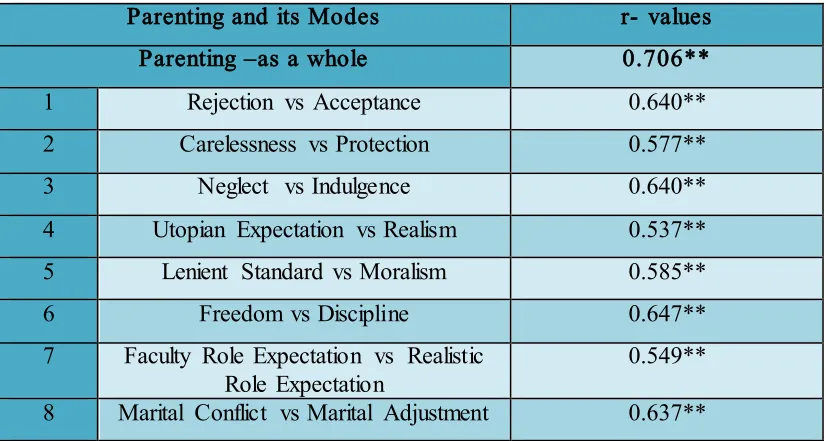
table 1 and figure 1.
Table-1
Correlations of Self-Confidence of School Students with Parenting and its Modes
Parenting and its Modes r- values Parenting –as a whole 0.706** 1 Rejection vs Acceptance 0.640** 2 Carelessness vs Protection 0.577** 3 Neglect vs Indulgence 0.640**
4 Utopian Expectation vs Realism 0.537** 5 Lenient Standard vs Moralism 0.585** 6 Freedom vs Discipline 0.647** 7 Faculty Role Expectation vs Realistic
Role Expectation
0.549**
Fig: 1: Correlations of Self-Confidence of School Students with Parenting and its Modes
It is clear from the table 1 that the correlation (0.706) of self-confidence of school students with parenting as a whole is significant at 0.01 level. Therefore the null hypothesis H01(i) “There exists no significant relationship of Self-Confidence
of school students with parenting as a whole” stands rejected. Therefore, it can be concluded that self-confidence of school students has positive and significant relationship with parenting as a whole. Table 1 also depicts that self-confidence of school students has also positive and significant relationship with modes of parenting (rejection vs acceptance, carelessness vs protection, neglect vs indulgence, utopian expectation vs realism, lenient standard vs moralism, freedom vs discipline, faculty role expectation vs realistic role expectation and marital conflict vs marital adjustment). Therefore the null hypotheses H01(ii), H01 (iii), H01 (iv), H01 (v), H01(vi),
H01 (vii) & H01 (viii) are rejected. Kuldeep (2009)(15) also found the same result and
concluded that parenting techniques are significantly correlated with self-confidence of school students. Usha and Lakshmi (2008)(20)also found significant relationship of
parenting techniques and self-confidence of school students.
realism, lenient standard vs moralism, freedom vs discipline, faculty role expectation vs realistic role expectation).
Table-2
Correlations of Self-Confidence of School Students with Mothering and its Modes
Mothering and its Modes r-values
Mothering –as a whole 0.577**
1 Rejection vs Acceptance 0.640** 2 Carelessness vs Protection 0.537**
3 Neglect vs Indulgence 0.647**
4 Utopian Expectation vs Realism 0.585** 5 Lenient Standard vs Moralism 0.640** 6 Freedom vs Discipline 0.637**
7 Faculty Role Expectation vs Realistic Role Expectation
0.706**
** Significant at 0.01 level
Fig: 2: Correlations of Self-Confidence of School Students with Mothering & its Modes
An examination of the table 2 shows that the correlation (0.706) of self- confidence of school students with mothering as a whole is significant at 0.01 level. Therefore the null hypothesis H02 (i) “There exists no significant relationship of self- confidence
of school students with mothering as a whole” is rejected. Therefore, it can be concluded that of self- confidence of school students with mothering as a whole has positive and significant relationship. Table 2 further shows that of self- confidence of
0.577
0.64
0.537
0.647
0.585
0.64 0.637
0.706
Mothering Rej vs Acc Car vs Pro Nsg vs Ind Utp Exp vs
Real
Lent Std vs Mor
school students has also positive and significant relationship with modes of mothering (rejection vs acceptance, carelessness vs protection, neglect vs. indulgence, utopian expectation vs realism, lenient standard vs moralism, freedom vs discipline, faculty role expectation vs realistic role expectation). Therefore the null hypotheses H02 (ii), H02 (iii), H02 (iv), H02 (v), H02 (vi), H02 (vii) and H02 (viii) are not retained.
Relationship of Self-Confidence of School Students with Fathering and its Modes In this section, relationship of self-confidence of school students with fathering and its modes (rejection vs acceptance, carelessness vs protection, neglect vs indulgence, utopian expectation vs realism, lenient standard vs moralism, freedom vs discipline, faculty role expectation vs realistic role expectation) has been found.
Table-3
Correlations of Self-Confidence of School Students with Fathering and its Modes
Fathering and its Modes r-values Fathering–as a whole 0.656** 1 Rejection vs Acceptance 0.637** 2 Carelessness vs Protection 0.534** 3 Neglect vs Indulgence 0.642**
4 Utopian Expectation vs Realism 0.584** 5 Lenient Standard vs Moralism 0.634**
6 Freedom vs Discipline 0.628**
7 Faculty Role Expectation vs Realistic Role Expectation
0.699**
0.656 0.637
0.534
0.642
0.584 0.634 0.628
0.699
Fathering Rej vs Acc Car vs Pro Nsg vs Ind Utp Exp vs Real
Lent Std vs Mor
Fre vs Dis FR Exp vs RR Exp
Fig: 3: Correlations of Self-Confidence of School Students with Fathering and its Modes
An examination of the table 3 shows that the correlation (0.656) of self-confidence of school students with fathering as a whole is significant at 0.01 level. Therefore null hypothesis H03(i)“There exists no significant relationship of self-confidence of school
students with fathering as a whole and self-confidence” is rejected. Therefore, it can be concluded that of self-confidence of school students have also positive and significant relationship with fathering as a whole. Table 3 further shows that modes of fathering (rejection vs acceptance, carelessness vs protection, neglect vs indulgence, utopian expectation vs realism, lenient standard vs moralism, freedom vs discipline and faculty role expectation vs realistic role expectation) have also positive and significant relationship with self-confidence. Therefore, the null hypotheses H03(ii), H03 (iii), H03 (iv), H03 (v), H03 (vi), H03 (vii) andH03 (viii) are rejected.
Conclusion
approved a person. They should respect the individuality of children and at the same time set limits or standards for their behaviour and encourage them to work hard to achieve those standards. Hence, it is concluded that parenting work as stairs to reach the heights of self-confidence.
REFERENCES
(1)Aggarwal, S. C. and Mishra, A. K. (2005). Impact of parent-child relationship on self- confidence. Indian Journal of Psychometry and Education, 36(2), 146- 152.
(2)Agnihotri, R. (1987). Manual of Self-Confidence Scale. National Psychological Corporation, Agra.
(3)Ajipal, P. and Raju, S. (2013). The predictors of self-confidence from certain psychological variables. Journal of Community Guidance and Research, 30(1), 100-107.
(4)Basavana (1975). Manual for Self-Confidence Inventory. Rupa Psychological Centre, Varanasi.
(5)Benabour, R. and Tirole, J. (2001). Self-confidence and personal motivation. Retrieved from www.princeton.edu
(6)Bhardwaj, N. (1996). Perceived parental behaviour and self-concept among adolescents. Presentation 2nd National Conference of PLAI,
Nagpur; L.A.D. College.
(7)Bhardwaj, R. L., Sharma, H. and Garg, A. (1995). Manual of Parenting Scale. National Psychological Corporation, Agra.
(8)Bhatnagar, M. K. (2014). Self confidence in secondary school students Indian Journal of Psychometry and Education, 45(2), 199-200.
(9) Chang, C. Y. and Cheng, W. Y. (2008). Science achievement and students self-confidence and interest in science: a Taiwanese representative sample study. International Journal of Science Education, 30(9), 1183-1200.
(10)Cheng and Furnham (2002). Personality, peer relations and self-confidence as a predictor of happiness and loneliness. Journal of Adolescents, 25, 327-339.
(11)Gupta, M. and Lakhani. B. (2018). Manual of Self-Confidence Scale. National Psychological Corporation, Agra.
(13) Hebaish, S. M. A. (2012). The correlation between general self-confidence
and academic achievement in the oral presentation course. Theory and Practice in Language Studies, 2(1), 60-65.
(14)James and Jasseer (2015). Parental attachment and parental supervision as predictor of self-control among juvenile delinquents. Journal of Community Guidance and Research. 32(1), 77-83.
(15)Kuldeep, S. A. (2009) Impact of parenting techniques on emotional stability, self-confidence and academic achievement of secondary school students. Ph.D Thesis M.D. University,
(16) Murugan, V. and Manimehalai, N. (2015). Life skills and academic achievement of elementary teacher education students. Journal of Educational Research and Extension, 52(1), 12-20.
(17)Raju, M. A. and Samiullah, S. (2011). Impact of parental involvement on academic of VII standard students .Journal of Community Guidance & Research, 28(2), 224-228.
(18)Seligman, E. (1990). Learned optimism: How to change your mind and your life. Retrieved from www.ask.com.
(19)Singh, K.N. and Singh N.K.( 2016). The study on perceived parental rejection as a prediction of self efficacy belief among adolescents. Indian Journal of Psychometry and Education, 47(2), 216-222.