ISSN 2348 – 7968
Simulation of Computer Aided Learning using Games for
JAMB Questions and Answers
Esiefarienrhe Michael Bukohwo1, Sule Philips Onyilo2
1University of Agriculture, Markurdi
Markurdi, Nigeria. [email protected]
+2348032311297
2Abubakar Tafawa Balewa University, Bauchi
Bauchi, Nigeria
Abstract
Preparing for an examination that is strictly objective type questions could be very boring, time-consuming and stressful. With multiple options to choose from, students easily guess answers thereby leading to high failure rate. Jamb examination is objective-based and the rate of failure has been very high. To develop the culture of reading and adequate preparation for the examination, the researchers have developed a computer-based game for students use during preparation. Jamb past questions has been coded in a quiz game format where by student can prepare, test their ability and still have fun while learning. Preparing for example using game software is very interesting because it draws the player’s attention, reduces boringness and sleep while reading. The software for the Game was designed using Visual Basic 6.0 with underlying database from MySql. The software was used by students to prepare for Jamb and the results shows 85% Jamb past rate. This means that if the software is implemented at the national level as a study kit for examination, there will be a significant increase in the success rate of students writing Jamb and this will translate to more admission to higher institutions of learning. On the long run, there will be substantial increase in the economic wellbeing of Nigerian.
Keywords: Computer Game, Simulation,
Information Technology, Computer Science, Multimedia, System Development Life Cycle,
1. Introduction
Various researchers have exploited and discussed the benefits of using computer as a tool for learning. (Abbey, 2002; Rosenberg, 2002; Picciano, 2001; Paulsen, 1999). They agreed that the benefits derived from ICT application to learning includes: increased flexibility regarding both time and geographic location, reduction in administrative process and increase in efficiency and the increased levels of
digital modes of communication. The use of multimedia learning tools has been extensively researched over the past twenty years. One of these tools is Intelligent Tutoring Systems (Graesser et al., 2004; Ma, Adesope, & Nesbit, 2011; VanLehn, 2011). The use of computer and all forms of multimedia tools/applications for knowledge acquisition is termed e-learning. It is the use of electronic media and Information and Communication Technologies (ICT) in education. E-learning is broadly inclusive of all forms of educational technology in learning and teaching and is broadly synonymous with multimedia learning, technology-enhanced learning (TEL), computer-based instruction (CBI), based training (CBT), computer-assisted instruction or computer-aided instruction (CAI), internet-based training (IBT), web-based training (WBT), online education, virtual education, virtual learning environments (VLE) (which are also called learning platforms), m-learning, and digital educational collaboration. These alternative names emphasize a particular aspect, component or delivery method. The application of technology particularly to knowledge acquisition exists in the forms of games. Computer games, their uses, social and psychological effects and application to education have been widely studied in many academic literature (Mayer and DaPra, 2012; Gibb et al., 1983; Mehrabian and Wixen, 1986; Silvern and Williamson, 1987). Digital games are considered to be the largest and fastest
ISSN 2348 – 7968 growing market segment of the
multibillion-dollar entertainment industry. The global market is worth billions of dollars (Kirriemuir and McFarlane, 2004), and development costs, revenue, and audiences for digital games are comparable—and often exceed—that of the movie industry (Kirriemuir, 2002). It is not surprising that there is a large and growing interest in the applicability of games in education. Digital gaming is eliciting similar high hopes and bold claims such as Games are built on sound learning principles; Games provide personalized learning opportunities; Games provide more engagement for the learner; Games teach 21st century skills and Games provide an environment for authentic and relevant assessment.
Despite the strong debate on how games can improve education and how useful they can be for teaching complex concepts and skills, very little research has been performed on the relationship between games and academic performance (Ke, 2009; O’Neil et al., 2005). Most of the available studies consist of descriptive analysis of the impact games have on students’ attitude towards the subject being taught and their motivation to attend and engage in class. The data from these studies are typically limited to surveys filled out by teachers and students after using games in the classroom for several weeks or months (Wastiau et al., 2009).
In rare occasions when researchers have attempted to investigate the relationship between learning within digital games and academic performance, the results are mixed because of differences in definitions and methodologies. Games may not be the most effective tool for all content and in all situations (Ke, 2009). In fact, some have suggested that content areas such as mathematics, physics, and language arts are well suited for gaming (Hays, 2005; Randel, Morris, Wetzel, &Whitehill, 1992), but this result has not been replicated by others (Ke, 2009). Ke found that games seemed to foster higher-order thinking skills
such as planning and reasoning more than specific content knowledge.
In order to really evaluate the efficacy of games, researchers need to consider more nuanced features such as the length of game play and the content, structure, and mechanics of the games (Khoo& Gentile, 2005). Identifying an agreed upon set of features such as gaming genres, difficulty levels (from the perspective of game mechanics), delivery platforms, interfaces (e.g., joy stick, touch screen, mouse), and delivery environments (e.g., classroom, lab, home) would be a huge step forward. In addition, creating definitions and models for many of the attributes that are considered integral parts of the power of games (e.g., motivation, engagement, agency) would, in concert with the clarifying principles above, allow for a more coherent research approach.
Perhaps what is most unique about digital games—as opposed to any other learning innovation—is the combination of motivation, engagement, adaptivity, simulation, collaboration, and data collection that can’t be achieved at scale any other way. As a result, simply measuring increases in standardized test scores or similar traditional measures of achievement after the introduction of digital games may miss some of the broader learning opportunities that games present (Shaffer, Squire, Halverson, & Gee, 2005). While there may well be some intangible benefits of digital games in the classroom, unless there is an “investment in evaluation and the accumulation of clear evidence of impact, there will be a tendency to dismiss game environments as motivational fluff” (O’Neil et al., 2005).
In general, the research supports that digital games can facilitate learning, but it is difficult to draw stronger conclusions about the educational impact of digital games at this point because relatively few games have been tested against other teaching and learning approaches (Egenfeldt-Nielsen, 2006). Research, however, should continue to explore the
ISSN 2348 – 7968 effectiveness of digital games for learning and
instruction. Evaluations should no longer focus on whether games can be used for learning. Because of key differences in specific features between games, attempts to generalize the effect of one game to all games may be unhelpful (Kirriemuir& McFarlane, 2004). Instead research should prioritize how games can best be used for learning. It is in the light of the above that the researchers have developed game software to overcome the problems being faced by students in their preparation for JAMB Examination. Preparation to pass Jabm is tedious and dreaded for by students who though scared, have no alternative but to read and commit to memory and write the examination. In their preparation, the students faced the following problems: Lack of adequate tools and materials for jamb preparation, Jamb examination malpractice, bulky and boring past questions and answers on hard copy, studying under tension and wrong approach towards jamb examination preparation.
Faced with these problems, it has become imperative to design application that present students the opportunity to evaluate themselves by answering Jamb past questions while playing games and interactively scoring themselves. The use of the system will greatly improve student performance in Jamb examination. The researcher as part of the design method used will create a database containing 20years of past questions and answers that will serve as a base for the game application and will also serve other users who may need such data for other applications. The application will solve the problem of mass failure occasioned by poor preparation. With the new system, students can still prepare for exams and still have at the same time.
1.1 The Joint Admissions and Matriculations
Board (JAMB)
JAMB is Nigeria's entrance examination board for tertiary institutions. The examinations being administered by the board are available for all students who choose to apply to Nigerian public and private Mono-technics, Polytechnics, and Universities. Most of these candidates must already have concluded their external examinations, administered either by the West African Examinations Council (WAEC) or the Nigerian National Examinations Council (NECO). The examination consists of objective-type questions.
2. Materials and Methods
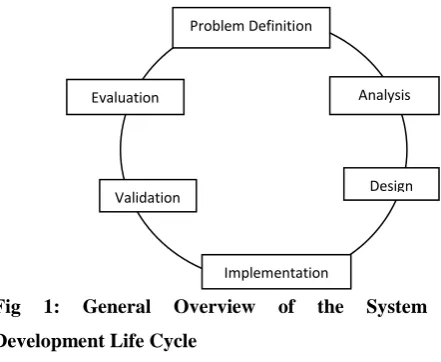
The Structured System Analysis and Design Methodology (SSADM) which is a Software Engineering Methodology that involves system decomposition to sub-system and the systematic analysis of each sub-system were in the design of the Game system. Flowcharts and Pseudo codes were drawn and written for the proposed solution. The SSADM includes the System Development Life Cycle (SDLC) which consists of problem definition, analysis, design, implementation, validation and evaluation as shown in Fig. 1.
The Expert System methodology, which involved knowledge engineering process of inference and knowledge-based, is also used in the work.
Fig 1: General Overview of the System
Development Life Cycle
The context diagram Fig. 2 shows the components that make up the system. The system is an interactive one consisting of modules to access the
Problem Definition
Analysis
Design Evaluation
Validation
Implementation
ISSN 2348 – 7968 database, the user interface, maintenance of the
system, input and output modules.
Fig 2: Context Diagram of the Game System
Process design
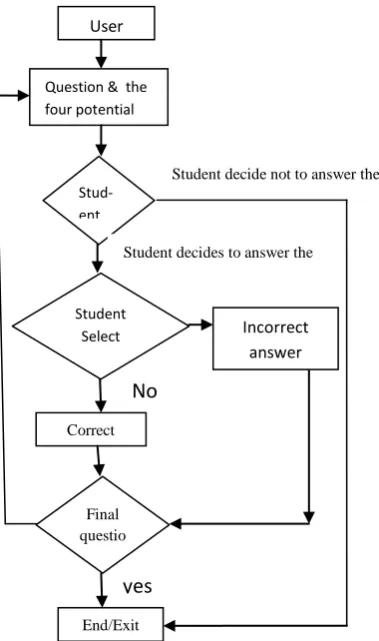
The process design shows the step by step flow of control from the user login to exit. Below is a flowchart showing the process design for the game system.
Fig. 3: The Process Design Chart
2.1 Input and Output design
The output of the program in a Visual Basic Dialog Form that is well design to display the result of the processes required by the user it also include input and message box that display and indicate the user when there is problem along his execution line
2.2 Coding
Coding the new system into computer language is important stage where the system analysis and design are transformed into control specification by the help of computer programming language. The programs coordinate the data movement and control the entire process in the system. The researcher used visual basic 6.0 programming language to code the new system. The choice of this language is as the result of its user friendly interface and versatility. Below is an example of coding of a section of the logic utilized by the program.
If intNumber = 1 Then
Q.Text = "Which of these define the smallest unit, " + vbCrLf + "consisting of a unit of a group atoms, in which" + vbCrLf + "a substance can be divided without a change " + vbCrLf + "in chemical nature"
A.Text = "A* Molecule" 'correct B.Text = "B* Helium"
C.Text = "C* Berelium" D.Text = "D* Cell" 'label19.Caption = "2012"
2.3 Testing
Prior to the implementation new program the code was run and debugged of errors. Also a test plan was developed and run on a given set of data and the output of the tested program has matched the expected result. The testing was done in the following stages;
2.4 Unit testing
All the command buttons that unload a form and load another were tested step by step which ensure the proper coordination of one unit with other.
Login system
Output design Questions
database
Interactive
learning
Usage Database Maintenanc
e system Input design
User
Question & the four potential
End/Exit Correct
Stud-ent
Student Select
Final questio
Incorrect answer
No
Student decide not to answer the
Student decides to answer the
yes
ISSN 2348 – 7968
Question screen/ interface
Option B
Is that your
answer?
Blink Option
Option A
Exam date
Option C
Option D
Yes
Score
No
2.5 System testing
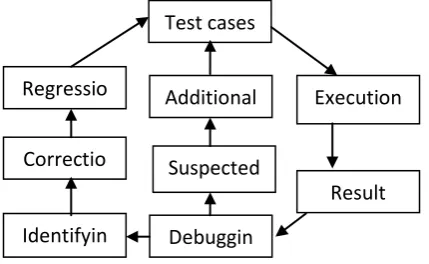
This was done at the end of the whole system to ensure that there are no bugs in any part of the software development. This was achieved by using the debugging process as shown in Fig 4 below.
Fig. 4: Debugging Process Diagram
2.6 Implementation
Implementation is the stage of a project in which theory is turned into practice. In this stage the
installation requirement of the
new system was met, which led to a successful implementation. The new system does not require complex hardware or software platform to run. Installation can be achieved on at least PII computer with or without Visual Basic 6.0 installed on it.
2.7 Hardware Requirement:
The recommended system requirement in the application are:
A computer system with 1.6GHz processor or higher.
1GB RAM or more
3GB of available Hard disk space.
Reasonable monitor resolution
2.8 Software requirement
Microsoft windows XP or windows 7 or higher
Visual basic studio.
3 Discussion of Results
The software was build in such a way the user does not rely have to installed visual basic before he can use it. Once the user install the software on his or her computer system the next and the vital processes is to run the program for use either by double-clicking on the software icon or right click and click open to run the program. Any time the program is run the interface that will be display on the
screen are as follows:
i. Progress bar ii. Question interface iii. Option button iv. Dialogue box v. Blink option
Test cases
Additional
Execution
Result
Debuggin
Suspected
Identifyin
Correctio
Regressio
ISSN 2348 – 7968 i. Progress bar: the windows forms
progress bar control indicates the progress of a process by displaying on appropriate number of rectangles arranged in a horizontal bar, when the process is complete, the bar is filled.
ii. Question Screen/interface
This is the provision created for popping out questions and pictures. The question screen is been designed in such a way that the font colour of question should be a colour font to aid the easy reading and absent of difficult view of letters.
iii. Options Button (A, B, C, and D):
These are programmed buttons with three wrong answers and one right answer. The player is allowed to choose only one option out of the four by clicking the answer he think is correct.
iv. Dialogue box
The dialogue box appears whenever the option button is clicked. The dialogue box contain the inscription “Is that your final answer?” With two options button Yes or No. When the Yes button is clicked, the system provides the right answer and determines whether the player is right or wrong.
v. Blink Option
The blink option with green color shows the option that is correct. That is whenever a question is popped out the candidates is allowed to select an option A,B,C and D out of the four options. After the candidate has selected an option the system blink a green lcolor for the correct answer.
4. Conclusion
The primary aims of this research work which are to make learning and preparation for JAMB easier and more flexible especially to meet the modern computer base test (CBT) pattern of exam introduce by JAMB. This indeed shows that much can be achieve by the integration of computer/ICT into this area (JAMB preparation) and other subject like learning technique, the rate of understanding etc. moreover the abstract nature of ICT concepts can be made more interesting and appreciative by using interacting learning system (software).
The analysis, findings and output of this research work has indeed revealed the potentiality of computer as reliable problem solving tool which will assist students to achieve stated objectives of education and also provide an avenue for the students to improve more on their understanding of JAMB questions as they study with fun and interest.
It is hopes that this software will be used by students to prepare for the examinations. This can be facilitated if the various school authorities procure and make the software available to students as a kit
ISSN 2348 – 7968 for examine preparation. The Government can
also assist schools be making the software available at the National level.
REFERENCE
Abbey, B. (2000). Instructional and cognitive impacts of web-based education. USA: Idea Group Publishing.
Anigbogu S. O and Inyiama H. C. (2006). Artificial Intelligence-Based Medical Diagnostic Expert System for Malaria and the Related Ailments. Journal of Computer Science and its Applications. 12(1) 3-8. Egenfeldt-Nielsen, S. (2006). Overview of research on the educational use of video games. Digital Kompetanse, 3(1), 184–213.
Gibb, G.D., Bailey, J.R., Lambirth, T.T. & Wilson, W.P. (1983). Personality differences in high and low electronic video game users. Journal of Psychology, 114, 159-165
Graesser, A.C., Lu, S., Jackson, G.T., Mitchell, H.H., Ventura, M., Olney, A., & Louwerse, M.M. (2004). AutoTutor: A tutor with dialogue in natural language. Behavioral ResearchMethods, Instruments and Computers, 36, 180-193.
Hays, R. T. (2005, November). The effectiveness of instructional games: A literature review and discussion. Orlando, FL: Naval Air Warfare Center Training Division. Retrieved from
http://www.dtic.mil/cgi-bin/GetTRDoc?AD=ADA441935
Ke, F. (2009). A qualitative meta-analysis of computer games as learning tools. In R. E. Furdig (Ed.) Handbook of Research on Effective Electronic Gaming in Education (pp. 1–32), New York: IGI Global.
Khoo, A., & Gentile, K. A. (2005). Problem-based learning in the world of digital games. In O. Tan (Ed.) Problem-based Learning in eLearning Breakthroughs. (pp. 97–129).
Kirriemuir, J (2002). A Survey of the Use of Computer and Video Games in Classrooms. Internal report for Becta (British Educational Communications and Technology Agency). www.becta.org.uk
Kirriemuir John and McFarlane Ceangal (2004). Angela Literature Review in Games and Learning. Futurelab, Bristol, United Kingdom. Available via: www.futurelab.org.uk/research/lit_reviews.htm Retrieved on: 10/02/2014.
Mayer, R.E., & DaPra, S.C. (2012). An embodiment effect in computer-based learning with animated pedagogical agents. Journal of Experimental Psychology: Applied, 3, 239-252.
Ma, W., Adesope, O.O., & Nesbit, J.C. (2011). Intelligent tutoring systems: A metaanalysis. American Educational Research Association Meeting, New Orleans, LA.
Mehrabian, A. & Wixen, W.J. (1986). Preference for individual video games as a function of their emotional effects on players. Journal of Applied Social Psychology, 16, 3-15.
O’Neil, H. F., Wainess, R., & Baker, E. L. (2005). Classification of learning outcomes: Evidence from the computer games literature. The Curriculum Journal, 16(4), 455–474.
Paulsen, M. B., & Feldman, K. A. (1999). Epistemological Beliefs and Self-Regulated Learning Behaviors. The Journal of Faculty Development (aka Journal of Staff, Program & Organization Development), 16(2), 83-91.
Picciano, A.G. (2002). Beyond student perceptions: Issues of interaction, presence, and performance in an online course. Journal of Asynchronous Learning Networks, 6(1)
Randel, J. M., Morris, B., Wetzel, C., & Whitehill, B. (1992). The effectiveness of games for educational purposes: A review of recent research. Simulation & Gaming, 23(3), 261.
Rosenberg, M. J. (2001). E-learning: Strategies for delivering knowledge in the digital age. San Francisco: McGraw-Hill.
Shaffer, D. W., Squire, K. R, Halverson, R., & Gee, J. P. (2005). Video games and the future of learning. Phi Delta Kappan, 87(2), 104–111.
Silvern, S.B. & Williamson, P.A. (1987). The effects of video game play on young children's aggression, fantasy, and prosocial behavior. Journal of Applied Developmental Psychology, 8, 453-462.
VanLehn, K. (2011). The relative effectiveness of human tutoring, intelligent tutoring systems, and other tutoring systems. Educational Psychologist, 46(4), 197-221
Wastiau, P., Kearney, C., & Van den Berghe, W. (2009). How are digital games used in schools? European Schoolnet. Retrieved from
http://games.eun.org/upload/gis-synthesis_report_en.pdf www.jambonline.org.ng