Microbial Simulation Experiment on Enhancing
Coalbed Methane Production
Chen Hao,1,2,3 Qin Yong,1,2 Zhou Shangwen,3 Wang Hongyan,3 Chen Zhenhong,3 Li Guizhong3 Deng Ze3 and Cheng Lei4
(1.Key Laboratory of CBM Resource and Reservoir Formation Process, Ministry of Education,China University of Miningand Technology, Xuzhou 221008, China
2.School of Resources and Geosciences, China University of Mining and Technology, Xuzhou, China
3. Research Institute of Petroleum Exploration and Development-Langfang Branch, Langfang, Hebei Province, 065007;
4. Biogas Research Institute of the Ministry of Agriculture, Chengdu, Sichuan Province. 610041)
Abstract: Coalbed Methane(CBM) production enhancement for single wells is a big problem to CBM industrialization. Low production is due to insufficient gas generation by thermogenic. Luckily, Biogenic gas was found in many areas and its supply is assumed to improve coalbed methane production. Therefore, microbial simulation experiment will demonstrate the effectiveness of the assumption. From microbial simulation experiment on different coal ranks, it is found that microbes can use coals to produce biogas under laboratory conditions. With different temperatures for different experiments, it turns out that the gas production at 35 ℃ is greater than that at 15℃,indicating that 35℃ is more suitable for microbes to produce gas. According to quantitative experiments, adding exogenous nutrients or exogenous bacteria can improve CBM production. Moreover, the production enhancement ratio can reach up to 115% under the condition of adding exogenous bacterial species, while the ratio for adding nutrients can be up to 144%. Key words: Coalbed Methane(CBM); Methanogens; Biogenic Gas; CBM Production Enhancement
1.introduction
Coal-bed methane (CBM), or coal-bed natural gas, is an unconventional gas that has become an emerging and important energy resource worldwide(Strapoc D,2011;Park SY,2016). As is known to all, China has huge potential resources in coalbed methane (CBM)(Zhang,2018). According to the maturity of coals, CBM can be divided into low rank CBM (RO<0.7), medium rank CBM (0.7<RO<1.3) and high rank CBM(RO>1.3). So far, the high and medium ranks CBM have made a major breakthrough and has been under commercial production at Qinshui Basin and Ordos Basin. But low rank CBM, accounting for 40% of the national resources, is relatively slow in exploration. The main reason for it is the limited amount of gas production due to low thermal evolution. Moreover, the sweet spot for biogas is hard to discover and CBM production is generally low in most exploration areas. In addition, as coal basins have mostly experienced one or more of the tectonic uplift movements in China, the thermal evolution is slow or stagnant after
the rise of coal seams. At the same time, the formation pressure decreases due to the uplift, a large amount of gas has escaped and the coal seam is small in adsorption quantity, leading to low output. Some areas, however, the atmospheric fresh water brings in a large number of biological bacteria(Zhang J,2015,2017;Wei M,2014). Under their action, small molecules are broken down into methane in coal seams, which can be adsorbed by coal beds to form favorable CBM reservoirs (Ahmed,2001;M,Martini A,2008;Alexei V,2011;). In view of this, the coalbed methane production could be improved by the introduction of biological bacteria with artificial methods(Rathi R,2015;Kirk MF,2015;Robbins SJ,2015).Therefore,microbial simulation experiment on enhancing CBM production is of great practical significance on CBM exploration and development.
A number of studies related to biogas simulation experiment haven been conducted abroad(Jones EJP,2008,2010;Haider,2013,2014,2018).Scott(1999)proposed the concept of “microbially enhanced coalbed methane”, that is, with bacteria and nutrients injected into coals, methane is generated by the biodegradation of coals, asphaltenes and waxes so as to increase methane production in coal seams. Other studies show that the organic matter rich in small molecules, can be utilized for microbes to produce gas. Recently, some institutions in the United States have carried out a lot of work and trials to improve production by microbes(Priyadarshani,2012;Colosimo F,2016;Park SY,2016). In their approaches, firstly, find out the nutrient formulations suitable for the growth of the microbial community and then inject them into underground, thus realizing the conversion of coals into methane(Zehnder,1988; Dariusz,2011,Davis KJ,2018). All these show in terms of the industrial production scale, it is feasible for coals to be converted into methane by microbes. Meanwhile, domestic scholars (Li,1996;Wang,2010) have adopted the anaerobic culture method and have developed active anaerobic bacteria in lignite samples in Zhaotong city, Yunnan province ,China. A follow-up 60-day experiment on methane generation has been carried out, and biogas generation laws, composition and formation mechanism have also been analyzed. The results reveal that the lignite with the reduction environment is beneficial to the prosperity of methanogens in Zhaotong Basin. Biogas generation has undergone three stages: slow growth, significant increase and slow down, which show that methanogens will reach a higher level in quantity and activity in the second stage after slow reproduction in the first stage. Moreover, there are at least two or more peak stages for biogas generation in lignite coals(Wang BY,2010;Yang XQ,2018).
2. Mechanism Analysis of Gas Generation by Microbes
organic monomers to decompose into reduced organic compounds, in which carbohydrates, protein, lipid and other macromolecular organic polymer are fermented into sugar, amino acids, fatty acids, glycerol and other organic monomers by hydrolysis or fermentative bacteria, and then the organic monomers are hydrolyzed into educed organic compounds, such as propanoic acids, butyric acids, lactic acids and alcohols. The second stage is for reduced organic compounds to decompose into CO2 and acetic acid, in which the intermediate products are further decomposed by obligate hydrogenogens and acetogens into acetic acid, CO2, formic acid and methanol, C1 compounds such as methylamine and hydrogen. The decomposition is divided into two situations: 1)In the geological system with the presence of nitrate and sulfate, the electrons firstly flow to nitrate and sulfate, and then through metabolism of bacteria reduction of the nitrate and sulfate, oxidize the reduced organic matter into CO2 and acetic acid; 2)In the ecological environment with the presence of nitrate and sulfate, the electrons directly flow to CO2. The third stage is the methane production phase, in which acetic acid is composed of CO2(or HCO3-) and hydrogen by homoacetogen, and then methane is generated by fermentation of the acetic acid. Or methane is generated from CO2 by methanogens utilization of coenzyme M reduction system during the anaerobic respiration metabolism process or from other C1 compounds by other fermentation paths (Walter B,2002;Dariusz,2011). Therefore, the formation of biogas can be attributed to the reduction of H2 + CO2 and the fermentation of acetic acid and methyl.
3 Method and Process of Biogas Simulation Experiment
3.1 Sample Source and Basic Characteristics
The samples are collected from Qinshui Basin and Ordos Basin with representative coals of different ranks. All the samples are fresh coals which have been taken out rapidly from coal mines, sealed by plastic wrap and then transported to the laboratory in the shortest time, thus guaranteeing the samples to be sealed in anaerobic state to the greatest extent.
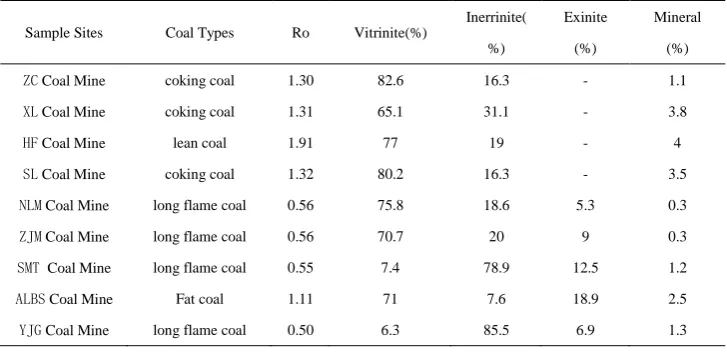
Glasspool 2007). From the vitrinite reflectance and maceral tests of coal samples, Ro ranges from 0.5% to 1.32%. Coal samples include different types like long flame coal, fat coal, coking coal and lean coal. Vitrinite content ranges between 6.3% and 82.6% (see table 1).
Table 1 Test results of vitrinite reflectance and maceral
Sample Sites Coal Types Ro Vitrinite(%)
Inerrinite(
%)
Exinite
(%)
Mineral
(%)
ZC Coal Mine coking coal 1.30 82.6 16.3 - 1.1
XL Coal Mine coking coal 1.31 65.1 31.1 - 3.8
HF Coal Mine lean coal 1.91 77 19 - 4
SL Coal Mine coking coal 1.32 80.2 16.3 - 3.5
NLM Coal Mine long flame coal 0.56 75.8 18.6 5.3 0.3
ZJM Coal Mine long flame coal 0.56 70.7 20 9 0.3
SMT Coal Mine long flame coal 0.55 7.4 78.9 12.5 1.2
ALBS Coal Mine Fat coal 1.11 71 7.6 18.9 2.5
YJG Coal Mine long flame coal 0.50 6.3 85.5 6.9 1.3
3.2 Microbial Detection of Coal Samples
3.2.1 Microbial DNA Extraction and Sequencing of Coal Samples
Microbial detection mainly extracts DNA from coal samples by molecular ecological means based on the test kit principle(Bi ZT,2017;Raudsepp MJ,2017). First, break the cell wall of bacteria by highly active protease(proteinase K)-a kind of hay protein enzymes, separate the DNA from denatured protein and other ingredients by adding Sodium dodecyl sulfate(SDS), and purify DNA using silicon matrix based on the unique adsorption principle of DNA. Then, duplicate double-stranded DNA by adding base pairs based on 16S rRNA uniqueness of PCR technology to obtain the required specific DNA banding, and finally detect the extraction quality of DNA banding under the gel electrophoresis(ChengL,2013).
3.2.2 Metagenomics 454 Sequencing Analysis
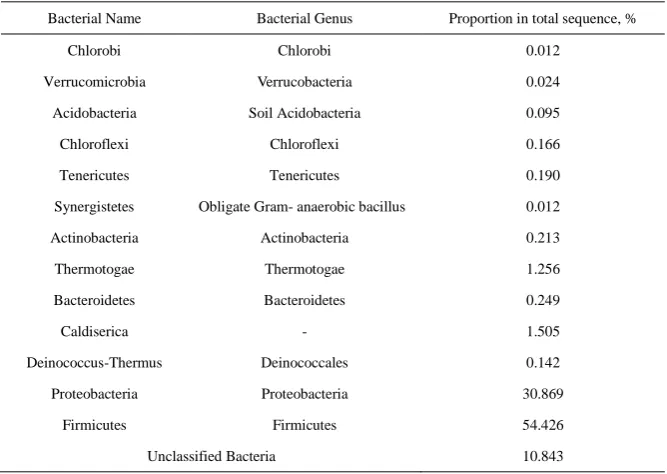
and the sequencing results are shown in Table 2. Archaea from Shuangliu coal mines belongs to euryarchaeota phyla, and its detection results are shown in Table 3, which are mainly composed of acetic acid nutritional methanogens. Bacteria (Table 4) groups are mainly Firmicutes(54.4%), Proteobacteria (30.9%), uncultured microbes(10.8%) and Thermotogae(1.26%). Firmicutes mainly include Acidaminobacter genera, accounting for 88.3%. Proteobacteria includes Smithella genera(44.9%) belonging to Syntrophaceae family and Desulfovibrio genera(31%).
Table 2 Comparison of microbial diversity estimators and coverage for Shuangliu coal samples
Classification Sample
Name
Sequence
NO.
OUT
NO.
Avg.Fetc
h Length
Coverage
Rate, % Chao1
Archaea SL Coal
Mine
1866 158 491 0.971 236.79
Bacteria SL Coal
Mine
8500 448 523 0.912 769.08
Table 3 Archaea Community Detection Result from 454 Pyrosequencing Analysis
Bacterial Name Bacterial Genus Proportion in total sequence, %
Methanoculleuss acetic acid nutritional methanogens 85.4
Methanosaeta acetic acid nutritional methanogens 10.2
Methanolinea Hydrogen nutritional methanogens 0.1
Haloferax Extremely halophilic microbial group 0.1
uncultured archaea group 4.1
Table 4 Bacterial Community Detection Result from 454 Pyrosequencing Analysis
Bacterial Name Bacterial Genus Proportion in total sequence, %
Chlorobi Chlorobi 0.012
Verrucomicrobia Verrucobacteria 0.024
Acidobacteria Soil Acidobacteria 0.095
Chloroflexi Chloroflexi 0.166
Tenericutes Tenericutes 0.190
Synergistetes Obligate Gram- anaerobic bacillus 0.012
Actinobacteria Actinobacteria 0.213
Thermotogae Thermotogae 1.256
Bacteroidetes Bacteroidetes 0.249
Caldiserica - 1.505
Deinococcus-Thermus Deinococcales 0.142
Proteobacteria Proteobacteria 30.869
Firmicutes Firmicutes 54.426
Unclassified Bacteria 10.843
The composition and preparation of inorganic salt anaerobic enrichment cultures are as follows: weigh 1L distilled water, 0.5g NaCl, 0.5g MgCl2.6H2O, 0.1g CaCl2.2H2O, 0.3g NH4Cl, 0.5g KCl and 0.2g KH2PO4, 5ml Soil extract, and 2ml trace elements of 284# in turn[10], cool slightly after boiling, add Cysteine-HCl and KOH (5 mol) and adjust PH to 6.0-6.5, then add Resazurine and observe colors changing from blue to red to colorless, continue heating after boiling, with anaerobic N2 inlet in, adjust temperature to keep the cultures under boiling for about 30min, continue further to inlet N2/CO2 mixture, and then transfer it into the bucket with ice, and finally keep some portions under the protection of N2 , and keep sterilization for 30 minutes at 121℃(WiddelF,2006,Barnhart EP,2013,2016).
3.4 Experiment Design
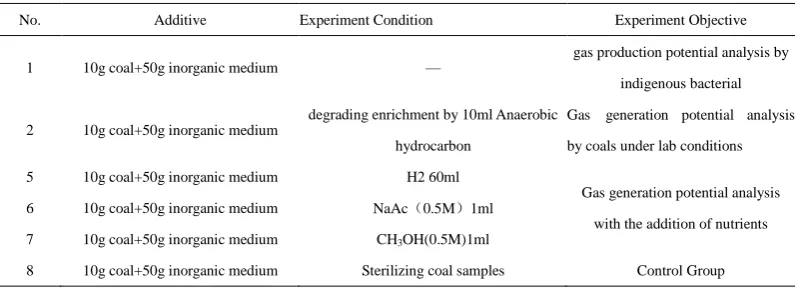
First grind coal samples to 60 mesh, remove residual gas in the coal seams and pack samples into each group of 10g coal and 50g inorganic cultures. Then add different exogenous substances to simulate the influence of different conditions on gas generation. The 1st group is to simulate gas generation of coals utilizing their own nutrients and analyze gas production potential by indigenous bacteria without the addition of exogenous substances; The 2nd to 4th groups are to analyze the production enhancement potential with the addition of exogenous bacteria; The 5th to 7th groups are to analyze the production enhancement potential with the addition of different nutrients; The 8th group is used as the control group. All the samples have been handled under static dark condition at 15℃ and 35℃, the whole process has been completed in anaerobic sterile operation box, and gas production tests have been carried out every once in a while and improvements on frequencies have been made.
Table 5 Design of Biogas simulation experiment
No. Additive Experiment Condition Experiment Objective
1 10g coal+50g inorganic medium — gas production potential analysis by
indigenous bacterial
2 10g coal+50g inorganic medium
degrading enrichment by 10ml Anaerobic
hydrocarbon
Gas generation potential analysis
by coals under lab conditions
5 10g coal+50g inorganic medium H2 60ml
Gas generation potential analysis
with the addition of nutrients
6 10g coal+50g inorganic medium NaAc(0.5M)1ml
7 10g coal+50g inorganic medium CH3OH(0.5M)1ml
8 10g coal+50g inorganic medium Sterilizing coal samples Control Group
4. Potential Analysis of Enhancing CBM Production by Microbes
After 172 days of lab incubation, most of the coal samples have different degrees of gas generation, showing that it is completely possible for coals to produce gas by microbes. Biogas generation is very common under geological conditions. Furthermore, coal samples without gas production could produce gas by adding nutrients or Bacteria, while coal samples with gas production may continue or be restricted to produce gas due to the promotion or destruction of the former gas generating balance with the addition of exogenous substances.
4.1 Gas Generation Potential Analysis of Coals Utilizing Indigenous Bacterial
Without adding any substances, HF, SL and ZC coal samples show good gas production,
while in other areas they do not. The reason for this may be associated with the macerals of coal rocks, in which coal samples with higher vitrinite content may produce gas, while coals with higher inertinite content may not produce gas. Methanogens is a kind of anaerobic microbes and may preferentially degrade vitrinite parts of coals. From gas generation experiment(Figure 2), it can be seen that gas generation rate is rapid at the initial period of cultures and then declines after 150 days. Gas generation varies greatly under different temperature gradients and the gas production at 35℃ is higher than that at 15℃, indicating that 35℃ is more suitable for coals to produce gas by microbes, with 0.49mmol of total gas production, about 0.78m3/t.
Fig 2 Gas production trends of Inorganic salt enrichment cultures under different temperatures
(the temperatures of A and Bare 15℃ and 35℃,)
4.2 Production Enhancement Potential Analysis by Adding Bacteria
Comparison of gas generation has been made between coal sample groups with and without
addition of exogenous methanogens, and CK group (coal samples without addition, only including methanogens and inorganic salt). Among them, most bacteria clones of the inoculation(AHB) belong to five groups: uncultured WWE1 (4.8-36.7%), Clostridiales (8.9-22.8%), Spirochaetales (7.2-10.1%), Thermotogaceae (4.8-6.3%) and Proteobacteria (5.1-6.3%). Archaea includes acetic acid nutritional methanogenic archaea(Methanosaeta), uncultured Methanomicrobia groups and hydrogen nutritional Methanomicrobiaceae, with hydrogen and acetic acid nutritional methanogenesis archaea coexisting. It could be seen from the gas production curve(Figure 4) that gas production shows an increasing trend after adding exogenous methanogens, indicating that the addition of exogenous bacteria has promoted gas production.
Fig 3 Gas production curve of adding exogenous bacteria
4.3 Production Enhancement Potential with the Addition of Exogenous Nutrients
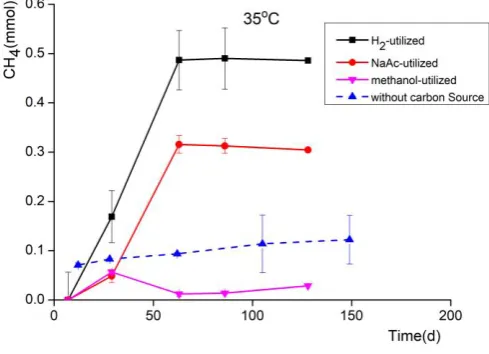
By four control experiments: one without carbon source, the other three with hydrogenation nutrients, NaAc and methanol respectively, coal samples have been cultivated for 135 days under laboratory conditions(Figure 5). It could be seen from the gas production curve that the gas production was 0.1mmol without adding carbon source, and it has increased when NaAc or hydrogen nutrients are added. Meanwhile, the gas production added with hydrogen nutrients is higher than that by adding NaAc. Moreover, the gas production decreases when adding methanol, indicating an inhibitory effect on gas production. It could be concluded that coal samples may give priority to hydrogen nutrients.
Fig 4 Gas production curve of adding different nutrients
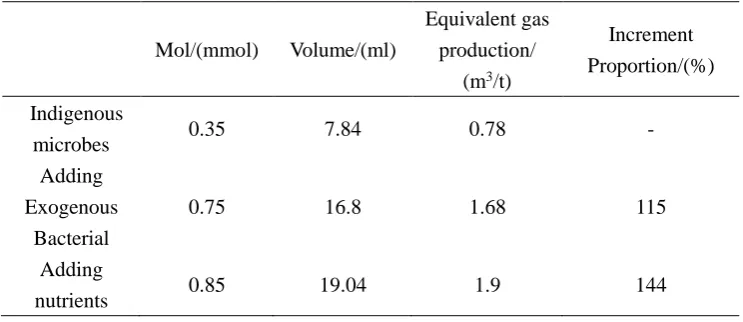
Through biogas simulation experiments, it is found that coals could produce gas by utilizing their own microbes and gas production could be greatly increased by artificial intervention. Gas production by adding exogenous bacterial species is up to 1.68m3/t, an increase by 115%, while gas production by adding nutrients can reach 1.9m3/t, an increase by 144%.
Table 6 Gas production of microbes under different conditions
Mol/(mmol) Volume/(ml)
Equivalent gas production/
(m3/t)
Increment Proportion/(%) Indigenous
microbes 0.35 7.84 0.78 -
Adding Exogenous
Bacterial
0.75 16.8 1.68 115
Adding
nutrients 0.85 19.04 1.9 144
5. Biogas Simulation Experiment Prospect
Coal resources are abundant in China, but as gas content is low in some coal field, it does not deserve CBM commercial development (Qin,2005,2006;Tao,2005;). Research on biogas production shows a clear mechanism of methane generation, and coal seam conditions can be improved by artificial means(Huang ZX,2017;Iverach CP;2017). For example, gas production could be improved by injecting microbes into coals in the areas that lack microbes(Gallagher LK,2013;). Meanwhile, in some areas with biological bacteria, gas production can be promoted by adding nutrients (kotarba,2004;Guo HG,2015) . The simulation experiment, that methanogens can utilize coals to produce biological methane, theoretically justifies the effectiveness of the technology(Green MS,2008). Moreover, as coal seams are shallow with well developed pores, it is technically feasible to inject nutrients and bacteria to enhance CBM production. Currently, a large mount of biogas has been found in CBM areas in China. Therefore, we can firstly select areas with good geological conditions for biogas development, including areas with active groundwater recharge, large coal reservoir thickness, high permeability and good cap rock, then simulate gas production by laboratory experiment and inject different kinds of nutrients or microbes to accelerate coals or to activate endogenous bacteria to produce gas in order to enhance CBM production. But converting coal beds into methane by improving coalbed environment is still in the phase of laboratory simulation, as many problems remain unsolved in field applications. Nevertheless, this technology has a huge potential and is believed to be the next breakthrough for CBM industrialization.
Acknowledgements
(CBM)” (Serial No.: 2016ZX05041) and PetroChina Major Science and Technology“Study and Application of Key Technologies for Exploration and Development of Coalbed Methane”(Serial No.: 2017E14).
References
Ahmed, M., Smith, J.W.,. Biogenic methane generation in the degradation of eastern Australian Permian coals[J].
Organic Geochemistry .2001,32, 809–816.
Alexei V. Milkov.Worldwide distribution and significance of secondary microbial methane formed during
petroleum biodegradation in conventional reservoirs[J]. Organic Geochemistry 42 (2011) 184–207.
Barnhart, E.P., De León, K.B., Ramsay, B.D., Cunningham, A.B., Fields, M.W., 2013. Investigation of
coal-associated bacterial and archaeal populations from a diffusive microbial sampler (DMS). Int. J. Coal Geol.
115, 64–70.
Barnhart, E.P., Weeks, E.P., Jones, E.J.P., Ritter, D.J., McIntosh, J.C., Clark, A.C., Ruppert, L.F., Cunningham,
A.B., Vinson, D.S., Orem, W., Fields, M.W., 2016. Hydrogeochemistry and coal-associated bacterial
populations from a methanogenic coal bed. Int. J. Coal Geol. 162, 14–26.
Bi ZT, Zhang J, Park S, et al. A formation water-based nutrient recipe for potentially increasing methane release
from coal in situ[J]. Fuel, 2017, 209: 498-508
ChengL,RuiJ,LiQ,ZhangH,LuY.Enrichment and dynamics of novel syntrophs in a methanogenic
hexadecane-degrading culture from a Chinese oil field[J].FEMS Microbiology Ecology,2013,83(3):757-766.
Colosimo F, Thomas R, Lloyd JR, Taylor KG, Boothman C, Smith AD, et al. Biogenic methane in shale gas and
coal bed methane: A review of current knowledge and gaps[J]. International Journal of Coal Geology, 2016,
165: 106-120.
Davis KJ, Lu SP, Barnhart EP, et al. Type and amount of organic amendments affect enhanced biogenic methane
production from coal and microbial community structure[J]. Fuel, 2018, 211: 600-608.
Dariusz Strapoc .Biogeochemistry of Microbial Coal-Bed Methane[J], Annu. Rev. Earth Planet. Sci. 2011,39:617
–656.
Guo H G, Yu Z S, Zhang H X. Phylogenetic diversity of microbial communities associated with coalbed methane
gas from Eastern Ordos Basin, China[J]. International Journal of Coal Geology, 2015, 150-151: 120-126.
Green MS, Flanegan KC, Gilcrease PC. Characterization of a methanogenic consortium enriched from a coalbed
Gallagher LK, Glossner AW, Landkamer LL, et al. The effect of coal oxidation on methane production and
microbial community structure in Powder River Basin coal[J]. International Journal of Coal Geology, 2013, 115:
71-78
Haider R, Ghauri M A, Rahim M U. On comparison between fungal and bacterial pretreatment of coal for
enhanced biogenic methane generation[J]. Geomicrobiology Journal, 2018, 35(5): 432-437.
Haider R, Ghauri MA, SanFilipo JR, Jones EJ, Orem WH, Tatu CA, Akhtar K, Akhtar N. 2013. Fungal degradation
of coal as a pretreatment for methane production. Fuel. 104:717–25.
Haider, R., Ghauri, M.A., Jones, E.J., Sanfilipo, J.R., 2014. Methane generation potential of Thar lignite samples.
Fuel Process. Technol. 126, 309–314.
Huang ZX, Sednek C, Urynowicz MA, et al. Low carbon renewable natural gas production from coalbeds and
implications for carbon capture and storage[J]. Nature Communications, 2017, 8(1): 568
Iverach CP, Beckmann S, Cendón DI, et al. Biogeochemical constraints on the origin of methane in an al luvial
aquifer: evidence for the upward migration of methane from underlying coal measures[J]. Biogeo sciences,
2017, 14: 215-228
Jones EJP, Voytek MA, Warwick PD, Corum MD & Cohn A. Bioassay for estimating the biogenic
methane-generating potential of coal samples[J]. International Journal of Coal Geology, 2008, 76(1): 138-150.
Jones, E.J.P., Voytek, M.A., Corum, M.D., Orem, W.H . Stimulation of methane generation from nonproductive
coal by addition of nutrients or a microbial consortium[J]. Appl. Environ,Microbiol,2010, 76, 7013–7022.
Kirk MF, Wilson BH, Marquart KA, et al. Solute concentrations influence microbial methanogenesis in
coal-bearing strata of the Cherokee Basin, USA[J]. Frontiers in Microbiology, 2015, 6: 1287
KOTARBA M J, LEWAN M D. Characterizing thermogenic coalbed gas from Polish coals of different ranks by
hydrous py-rolysis [J]. Organic Geochemistry,2004,35,615 − 646.
Li Mingzhai, Zhang Hongnian, Liu hua, et al. The Progress Of Biogas Simulation Experiment[J]. Journal of Oil
And Gas Geology, 1996,(02) .42-51.
M,Martini A,Petsch S.Biodegradation of secondary organic matter associated with coalbed methane in the Power
River and San Juan Basin,USA[J].Int J Coal Geol,2008,76: 86-91.
Park SY, Liang Y. Biogenic methane production from coal: A review on recent research and development on
microbially enhanced coalbed methane (MECBM)[J]. Fuel, 2016, 166: 258-267.
Priyadarshani, I., Rath, B., 2012. Commercial and industrial applications of micro algae -a review. J. Algal
Qin Yong. Research Progress And Analysis of CBM Formation and Reservoir Property Abroad[J]. Geological
Front, 2005, (03) : 289-298.
Qin Yong. Situation and Challenges Faced by Chinese CBM Industrialization(Ⅰ) -The Current Development
Stage[J]. Journal of Natural Gas Industry, 2006, 26 (1) : 4-7.
Rathi R, Priya A, Vohra M, et al. Development of a microbial process for methane generation from bituminous
coal at thermophilic conditions[J]. International Journal of Coal Geology, 2015, 147-148: 25-34
Robbins SJ, Evans PN, Esterle JS, et al. The effect of coal rank on biogenic methane potential and microbial
composition[J]. International Journal of Coal Geology, 2016, 154-155: 205-212
Raudsepp MJ, Gagen EJ, Golding SD, et al. The effect of bituminous coal on methanogenic mixed cultures and
pure cultures of Methanococcus and Methanosarcina[J]. Fuel, 2017, 205: 60-70
SCOTT A R. Improving coal gas recovery with microbially enhanced coalbed methane [C]//MASTALERZ M,
GOLDING S D (Eds) Coalbed Methane: Scientific, Environmental and Economic Evaluation. Kluwer,
Dordrecht,1999:89−110.
Scott AC, Glasspool IJ. 2007. Observations and experiments on the origin and formation of inertinite group
macerals. Int. J. Coal Geol. 70:53–66
Stopes M. 1935. On the petrology of banded bituminous coals. Fuel 14:4–13.
Strapoc D, Mastalerz M, Dawson K, Macalady J, Callaghan AV, Wawrik B, Turich C, Ashby M. 2011.
Biogeochemistry of microbial coal-bed methane. Ann Rev Earth Planet Sci. 39:617–56.
Tao mingxin . Current Situation and Development Trend of CBM Geochemical Research[J]. Progress In Natural
Science, 2005 (15), 648-652.
Taylor GH, Teichmuller M, Davis A, Diessel CFK, Littke R, Robert R. 1998. Organic Petrology.
Berlin/Stuttgart: Gebr ¨uder Borntraeger. 704 pp.
Wawrik B, Mendivelso M, Parisi VA, et al. Field and laboratory studies on the bioconversion of coal to methane
in the San Juan Basin[J]. FEMS Microbiology Ecology, 2012, 81(1): 26-42
Wang BY, Tai C, Wu L, et al. Methane production from lignite through the combined effects of exogenous
aerobic and anaerobic microflora[J]. International Journal of Coal Geology, 2017, 173: 84-93
Wang Aikuan, Qin Yong. Research Status and Progress of Biogenic Coalbed Methane Experiment[J]. Journal of
Coal Geology and Exploration, 2010, 42 (5) : 23-27.
Wang Aikuan. Gas Generation Characteristics and Mechanism of Indigenous Bacteria in Lignite[D]. China Mining
Walter B. Ayers Jr. Coalbed gas systems, resources, and production and a review of contrasting cases from the San
Juan and Powder River basins.AAPG Bulletin, v. 86, no. 11 (November 2002), pp. 1853–1890
WiddelF,BoetiusA,RabusR.Anaerobic biodegradation of hydrocarbons including methane[J]. The Prokaryotes:
Ecophysiology and Biochemistry,2006(2):1028-1049.
Wei M, Yu ZS, Jiang Z, et al. Microbial diversity and biogenic methane potential of a thermogenic-gas coal
mine[J]. International Journal of Coal Geology, 2014, 134-135: 96-107.
Yang XQ, Chen YM, Wu RW, et al. Potential of biogenic methane for pilot-scale fermentation ex situ with lump
anthracite and the changes of methanogenic consortia[J]. Journal of Industrial Microbiology & Biotechnology,
2018, 45(4): 229-237
ZEHNDER A J B. Biology of anaerobic microorganisms [M]. New York:John Wiley and Sons, 1988:2-5.
ZHANG Daoyong,ZHU Jie,ZHAO Xianliang,et al.Dynamic assessment of coalbed methane resources and
availability in China[J].Journal of China Coal Society,2018,43( 6) : 1598-1604.
Zhang J, Liang YN, Pandey R, et al. Characterizing microbial communities dedicated for conversion of coal to
methane in situ and ex situ[J]. International Journal of Coal Geology, 2015, 146: 145-154.
Zhang J, Liang YN. Evaluating approaches for sustaining methane production from coal through