VOLUME 5
March 1952
Number 2
In this Issue
Editorial -It Pays to Graze Correctly ... B.W. Allred
53
Application of Fertilizers to Aid Conservation on
Annual Forage Range ... O.K. Hoglund et al.
55
Economic Aspects of Range Management
H.R. Hochmuth
62
Sugar Versus the Intuitive Choice of Foods by
Livestock .... ... ... ... Max J. Plice
69
Winter-Range Utilization by Elk and Mule Deer in
Southeastern Washington ...Helmut K. Buechner
76
Bert C. Buffum-Pioneer Range Manager
Alan A. Beetle
81
Forage Production of North Platte River Islands
E.S. Ruby
84
Book Reviews:
Range Management-Principles and Practices
(Sampson)... ... ..Harold F. Heady
90
Insect Control by Chemicals (Brown)
Reed W. Fautin
91
Roundup Recipes (Peplow and Peplow)
C. Kenneth Pearse
92
Forages: The Science of Grassland Agriculture
(Hughes et al.) .... ... Horace S. Haskell
93
Ecological Animal Geography (Allee and Schmidt)
Hudson G. Reynolds
94
Current Literature... ... Robert R. Humphrey
96
News and Notes . ... ... ... ... 100
With the Sections... ... ... ... 104
Published Quarterly by
Red
theNEW
bookby
u
pioneer reseurcher. , .RANGE
MANAGE
MENT
Principles and Practices. By A. W.
SAMPSON, University of California. Range
Management combines practical methods
involved in the care and management
of range lands and grazing animals with
the scientific facts upon which these
methods must be based. Dr. Sampson,
one of the founders of range manage-
ment as a distinct study, has used pre-
liminary versions of the book in his
classes for several years. The new book
contains the features these years of use
showed to be best for teaching students
of range management, forestry, and
wildlife both in and out of the class-
room.
Range Management contains many spe-
cial features not treated fully in any
previous book, including :
Control of noxious woody plants . . .
range conditions . . . how to select a
ranch . . . protection of timber repro-
duction and shade trees . . . artificial re- seeding . . . world range problems . . .
use of fire in control of brush . . . place of wildlife on range.
1952 570 pages
Divided
into
four
parts:Range Management in Perspec- tive: reviews world grazing practices
and problems
,
discusses application ofphysiology and ecology to range prob-
lems, and considers the physical and
vegetal characteristics of U. S. grazing
lands.
Native Range Forage Plants: illus-
trates, describes, and discusses a large
number of the more important native
Western range forage grasses, grass-like plants, forbs, and browse vegetation.
Improvement and Management
of Range and Stock: covers artificial
and natural reseeding, grazing, noxious
plant control, husbandry and manage-
ment practices common to all range
livestock, range condition, forage utili-
zation, and range surveys.
Protection of Range Resources and Range Livestock : tells how to
protect land resources and range live-
stock in chapters on timber, poisonous
plants, wildlife, erosion, and adminis-
tration of public lands.
illus. $7.50
Send for a copy on approval
In Coming Journal Issues
MAY-
DAN FULTON, Presidential Address,
American Society of Range Manage- ment, 1952 Annual Meeting. Boise, Idaho.
R. M. LOVE, Experiments on Arthur E. Brown Ranch, California
0. C. OLSON, The Range Soil Profile C. J. CHOHLIS, Range Condition in
Northwest
R. E. WILLIAMS, Management of Pine Forest Ranges
A. A. BEETLE, Relic Area in Wyoming H. F. HEADY, Mixed Prairie
Also report on 1952 Annual Meeting
JULY-
International Grassland Issue, Com- memorating VI International Grass- land Congress, to be held in USA, Aug. 17-23, 1952.
Interesting papers on grassland man- agement in Japan, Hawaii, Italy, Greece, Israel and Ceylon. ti
SEPTEMBER-
Annual Student Issue
A roundup of range educational devel- opments and news for 1951-52. Also numerous technical papers.
NOVEMBER-
Many applied and technical papers pre- sented at 1952 Annual Meeting at Boise.
Volume 5, Table of Contents and Index
IN EACH ISSUE
Stimulating Editorials, Interesting Book Reviews, Current Literature, News and Notes, With the Sections, and Society Business
1.
DUPONTCHEMICALSARE
TESTED
AND
PROVED
TO KILL:
MESQUITE
For best results, spray from the air with low-volatile Du Pont 2,4,5-T Ester Brush Killer when foliage is growing and when soil moisture and temperature are high. Use 1 x to 1 x pints in 1 gallon light diesel oil plus 3 gallons of water per acre. In- crease dosage for heavy growth.
4.lOTE or BLUE BRUSH
A thorough, drenching spray on the foliage ia highly effective, using 1 gallon Du Pont 2,4,5-T Ester Brush Killer in 96 gallons diesel oil or kerosene. For best results, spray from the ground when the plants are growing fast, and when the soil moisture is high.
7. SCRUB OAK
For thick growth, spray the green oak leaves in the late summer or fall with Du Pont “Ammate” Weed Killer, 1 pound per gallon of wa- ter. For scattered trees growing in clumps, cut the trees and spray the fresh stumps with 4 pounds of “Ammate” per gallon of water.
2.
SAND SAGE
Spray by air with 2 s pints Du Pont 2,4-D Ester Weed Killer in 3 or 4 gallons of water plus 1 gallon diesel fuel or kerosene per acre. For best results, apply in May or early in June when the soil moisture is high and plants are growing rapidly.
5. HUISACHE
Spray from the ground in the grow- ing season for best control. Spray the bottom 2 or 3 feet of trunks from the ground up with 1 gallon Du Pont 2,4,5-T Ester Brush Killer in 43 gallons of kerosene. For best results, be sure to wet the entire circumference of the stems.
. I
3. PRICKLY PEAR
Spray from the ground in summer with 1 gallon Du Pont 2,4,5-T Es- ter Weed Killer in 20 gallons kero- sene or diesel oil and 20 gallons of water, wetting all the foliage thor- oughly. Tests show that this same treatment also controls Tasajillo and Cholla cacti.
6. MCCARTNEY'S ROSE
Spray from the ground in the grow- ing season with 1 to 1% quarts Du Pont Ester Brush Killer or 3 to 4 quarts Du Pont 2,4-D Ester Weed Killer in 2 gallons of light diesel oil and 100 gallons of water. Use high- pressure spray to penetrate the thick clumps of brush so as to wet all foliage.
For help in control of mixed stands of brush, see your local agricultural experi- ment station, and write to DLL Pont for full information. Du Pont has cooperated in extensive. tests in the range areas. Address Du Pont, Grasselli Chemicals Dept., 5031 Du Pont Bldg., Wilmington, Del., or 513 Esperson Bldg., Houston 2, Texas DU PONT CHEMICALS FOR THE FARM INCLUDEr
fungicides: PARi!ATE* (Liquid and Dry), FERMATE*, ZER- LATE*, Copper-A (Fixed Copper), SULFORON* and SUL- FORON*-X Wettable Sulfurs... Insecticides: DEENATE* DDT, MARLATE* Methoxychlor, LEXONE* Benzene Hexachlo- ride, KRENITE* Dinitro Spray, EPN 300 Insecticide, Calcium Arsenate, Lead Arsenate . . . Weed and Brush Killers: AMMATE*, 2,4-D, TCA and 2,4,5-T. . . Also: Du Pont Cotton Dusts, Du Pont Spreader-Sticker, PARMONE* Fruit Drop Inhibitor, and many others. *REG. U. 5. PAT. OFF.
Better Things for Better living
1
For Society Members
Entering the
Armed Forces
Do not let your membership lapse from non-payment of dues.
You may pay your dues for 2 or more years.
If you desire the Journal to reach you during your service in the armed forces, advise the Executive Secre- tary of any change of address. The Journal will not be forwarded by the Post Office. Your address must be correct when the Journal leaves the publisher.
If you do not desire the Journal delivered to you, advise the Execu- tive Secretary and he will reserve your Journals to be delivered to you upon release from service or upon request. However, to have the Jour- nals reserved for later delivery, you must not allow your dues to be in arrears.
-
WESTERN RANCHING SERVICES
R. B. (Dick) Peck, Owner
Box 1249 Dalhart, Texas
* Ranch Property Management * Range Reseeding
* Brush Control
* Water and Meadow Development * Ranch Appraisals
NATIVE RANGE
GRASS SEEDS
Blue Grama-Side Oats Grama-Blue Stem -Buff alo-Crested Wheat-Love Grasses-
Sand Drop, etc.
We purchase-Harvest-and Sell.
PEPPARD SEED CO.
1131
West 8th StreetKANSAS CITY 7, MO.
FOR WEED AND BRUSH CONTROL
Udkg
QualityChe
2,4-D WEED KILLERS o..
. . . Esters and Amine salts.
Selected weed killers proved effective against annual and perennial weeds, many types of thistle and cress -and nettle.
2,4, S-T BRUSH KILLERS. .~.
, , , isopropyl and Butyl esters.
Low volatile, high kill esters of 2, 4, 5-T recom- mended and approved for mesquite and other brush control on range and grassland, along railroads, pipelines and other right-of-ways.
To meet increasing demands, Kolker-one of the nation’s
major producers of weed and brush controi chemicals-has expanded production faciiities at its Newark plant. Expert technical assistance supplied. Call on Kolker-and be sure of delivery at the right time, at the right price.
DIAMOND ALKALI COMPANY
+
Products of DIAMOND ALKALI’S subsidiary,
KOLKER CHEMICAL WORKS, specializing in
organic chemicals for agriculture and
industry.
Order from
KOLKER CHEMICAL WORKS, INC.
80 LISTER AVENUE, NEWARK 5, NEW JERSEY
THE
AMERICAN SOCIETY
OF RANGE MANAGEMENT
OBJECTIVES
To foster advancement in the science and art of grazing land management, to promote progress in the conservation and greatest sustained use of forage and soil resources, to stimulate discussion and uriderstanding of scientific and practical range and pasture problems, to provide a medium for the exchange of ideas and facts among society members and with allied technologists, and to encourage professional improvement of its members.
MEMBERSHIP
Persons shall be eligible for membership who are interested in or engaged in practicing range or pasture management or animal husbandry; administering grazing lands; or teaching, or conductin g research, or engaged in extension activities in range or pasture management or related subjects.
OFFICERS
PRESIDENT: L. A. Stoddart, Dept. of Range IManagement, Utah State Agricultural College, Logan, Utah
VICE-PRESIDENT: B. W. Allred, U. S. Soil Conservation Service. Fort Worth 1, Texas
EXECUTIVE SECRETARY: W. T. White, 209 S.W. 5th Ave., Portland 5, Oregon
BOARD OF DIRECTORS
PAST PRESIDENT: Dan A. Fulton, Ismay, Montana
1950-52
J. A. Campbell, Dept. of Lands and Forests, Edmonton, Alberta, Canada J. S. McCorkle, U. S. Soil Conservation Service, Albuquerque, New R/Iexico
1951-53
A. P. Atkins, P. 0. Box 270, Guymon, Oklahoma Bruce Orcutt, Beaverslide Ranch, Miles City, Montana
1952-54
E. J. Dyksterhuis, U. S. Soil Conservation Service, Lincoln 1, Nebraska Harold F. Heady, School of Forestry, University of California,
Volume 5, Number 8, . March, 1952
Journal
of
RANGE
MANAGEMENT
Editorial
It Pays to Graze Correctly
A 8
SOUTHWESTERN cattle ranchesgo, the spread operated by Arthur Blaschke in the liveoak savannahs of the Texas Hill Country northwest of San An- tonio is a. small one.
But Blaschke has a word of advice for all ranchmen, large or small.
“A lot, of ranrhers still believe that the only operators who can afford to have plenty of grass all the time are the ones who have big spreads and stacks of money in the bank. They seem to think a small ranrhman can’t afford a conservation grazing program because he has to graze heavily to make a living.”
Then Blaschke makes his point: “It goes for the little operator as wll as the big one; more net profit can be made from conservation grazing than from a method of grazing where the best forage plants are continually nubbed to the ground. I
have tried it both ways-and I can’t
afford to be short of good grass.” Sinw he started his soil and water con- servation program in 1946, Blaschke’s grasslands have improved from poor and fair range condition to good and excel- lent rondition. He used to feed his home- raised corn and oats as maintenance sup-
Blaschke’s interest in grass improve- nent started when Dudley Mann, Soil Conservation Service District Conserva- ;ionist, gave him some grass weepings ‘ram the Service’s San Antonio Sursery. 4 Spanish oak thicket was cleared with a Iand axe and the cleared a acre was
‘aced sheep-tight. The grass sweepings
were scattered in the clearing. Only a
1 ittle native grass was left. From the grass
weepings, plants of Rhodesgrass, King
&ments to carry his livestock through
54 EDITORIAL
Ranch bluestem, and slender grama grew the first year. Rhodesgrass died the next winter but King Ranch bluestem and slender grama continued to thrive. Xative little and big bluestem, Indiangrass, and sideoats grama sprang up from tiny plants already there. The exclosure be- came a grass jungle and Blaschke saw that his rocky limestone range would pro- duce far more native grass and King Ranch bluestem than he had believed possible.
When Blaschke decided to boost his grass crop he saw that the good native grasses on his range were few and far be- tween. He said that the ground was so hard that a pony couldn’t make a track plain enough to see.
Blaschke’s grassland was already cross- fenced so that it was easy to work out a program of rests for part of the grass during the growing season each year. As a result of more lenient use and occasional rests, the bluestems, Indiangrass, and sideoats grama began spreading into open- ings from the protective live oak mottes, where they had survived during the heavy grazing period. Several palatable native legumes and other good forbs thickened up too and now Blaschke has a good stand of productive animal-fattening plants. The heavy litter has accumulated for several years, and the soil is mellow and rain water soaks in easily.
“I used to run a few cows, a few sheep and a few goats when my range wa,s in poor condition,” he said. “Cattle and goats are a good combination for my kind of country. Cattle do well on the blue- stems and Indiangrass; the goats work the live oak sprouts-as well as’ the grass. So I sold what few sheep I had in order
. to keep my grazing load in line with the
grass yield. Now I get more pounds of animal products, from my ranch with
fewer animals than when I had more live- stock than grass.”
Blaschke has no income except from ranching and he makes a good living. He has a modern well-kept home and his farm buildings are serviceable and substantial. His fences are good. He and his family live comfortably. He is out of debt.
Also he is a good neighbor. When the Kendall County Soil Conservation Dis- trict was organized in 1946, he was one of the five landowners elected as super- visors of this very active soil conservation district. He was named secretary of this district.
The last two years have been dry in the Hill Country. On the droughtier sites some of the live oak and post oak have died. But on Blaschke’s ranch the blue- stems and Indiangrass flowered out and made a little seed. The grasses did not grow high enough to hide the goats this year, but they reach above the knees of Arthur’s white-face cows. His livestock will make it through the winter on grass as usual.
Arthur knows the plants on his ranch that his animals like to eat. Also he can recognize them any time of the year. Blaschke takes great pride in what he knows about range plants. He knows that his animals can “have their grass and eat it” provided enough of the grass is left to protect the soil, and keep it thrifty and productive.
Anyone can use Blaschke’s system. It costs little and the reward is great. It’s as simple as this: Know grasses well enough to manage them right so they will yield more and livestock will do better. The soil then will be preserved and manage- ment costs will go down. The result is greater family and national security.-
Application
of Fertilizers
to
on Annual Forage
Aid Conservation
Range
1
0. K. HOGLUND, H. W. MILLER, AND A. L. HAFENRICHTER
T
HE annual forage range of the foot- hills of California varies widely in yield and plant composition from year to year and with intensity of use for grazing (Tal- bot and Biswell, 1942; Bentley and Tal- bot, 1948). It has a short season of use during late winter and early spring. The forage has nutritional deficiencies in late spring and summer after it is dry (Hart et al., 1932; Gordon and Sampson, 1939). Runoff and erosion occur when this range is in fair or poor condition (Grover, 1945; Rogers, 1945). The amount of residue left after grazing influences runoff and erosion, yield of forage, and date of range readi- ness .The application of fertilizers is one method for improving vegetal cover for soil and moisture conservation, increasing the yield and quality of forage, and facili- tating grazing management.
A study of the effect of direct applica- tion of fertilizers on annual forage range was begun in 1944 at Sunol, California. It is in the 16-inch rainfall belt and had been used for grazing since the eaxrly 1920’s. Previous to this use the land had produced grain under the alternate crop- fallow system for at least 20 years. The soil was rated grade 4 (35 percent), according to Weir and Storie (1936), and has been tentatively mapped as Positas gravelly clay loam. A recent conservation survey placed it in land-capability classes III and IV. Erosion has been moderately severe, 25 to 75 percent of the surface soil having been lost. At variable depths, from 6 to 24 inches, a stiff red clay sub- soil 2 to 8 inches thick is encountered,
although in some small areas this clay horizon is lacking. Gravel and small stones occur throughout the profile of this ma- ture, marine terrace soil.
Annual applications of ammonium phosphate-sulfate were made for 5 suc- cessive years. A preliminary report was made by Dickey, Hoglund, and Madson
(1948). It described the methods used for measuring the effect of the fertilizer on forage and residue (stubble plus litter) production.
A small area of this range in land- capability class IV was given factorial applications of nitrogen and phosphorus, separately and in combination, in each of 4 successive years. The plots were not replicated and a new area was used each year. Lime, gypsum, and barnyard ma- nure were applied to another unreplicated series in each of 3 successive years. In each of these trials the forage above a 3-inch stubble was harvested, dried, and weighed, but no measurement of the resi- due was taken.
This work was conducted by the Nur- sery Division, Soil Conservation Service, U. S. Department of Agriculture, Pleasan- ton, California, in cooperation with the University of California Agricultural Ex- periment Station, Davis, California.
RESULTS AND DISCUSSION
Application of Ammonium Phosphate- fiulfate
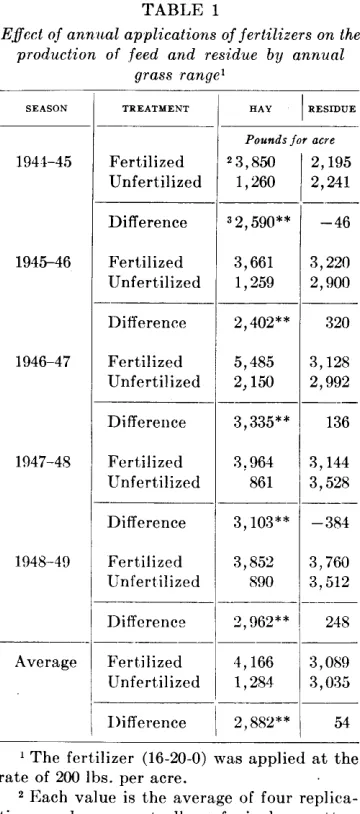
The data in Table 1 show that the an- nual application of 200 pounds of am- monium phosphate-sulfate (16-20-O) fer- tilizer increased the production of forage
Nursery Agronomist and Nursery Manager, Soil Conservation Service, Pleasanton, California; and Chief, Regional Nursery Division, Soil Conservation Service, Portland, Oregon
56 0. K. HOGLUND ET AL.
from an average of 1,284 pounds to 4,166 pounds per acre. The difference was 2,882 pounds of air-dry matter and was highly significant. It represents 3.60 animal-unit- months of grazing because it is generally accepted that 800 pounds represents one animal-unit-month of feed at the stage when this forage was harvested.
TABLE 1
E.#cct of annual applications of fertilizers on the production of feed and residue by annual
grass range’
SEASON TREATMENT
194 l-4.5 1945-46 1946-47 1947-48 1948-49 Average
HAY RESIDUE
Pounds for acre
Fertilized Unfertilized
Difference
23,850 2,195
1,260 2,241
-- -.-
32,590** -46
Fertilized Unfertilized -
Difference
3,661 3,220
1,259 2,900
2,402** 320
Fertilized Unfertilized
Difference
5,485 3,128
2,150 2,992
-~ -_-
3,335** 136
Fertilized 3,964
Unfertilized 861
--____ ~-
Difference 3,103**
Fertilized Unfertilized Difference ~-__ Fertilized Unfertilized 3,852 890 --___ 2,962** 4,166 1,284
LIifference 2,882**
3,144 3,528 -- -384 3,760 3,512 245 3,089 3,035 54
I The fertilizer (16-20-O) was applied at the rate of 200 Ibs. per acre.
2 Each value is the average of four replica- tions and represents Ibs. of air-dry matter.
3 Significant at the 1% level. (**)
The increase in production from the use of fertilizer was obtained in each of the 5 years of trial. There was no season x
treatment interaction. This indicates the degree to which nutrients in the soil were limiting the production of forage. Fer- tility limited forage production more than rainfall, or at least total rainfall did not vary enough among years to offset the beneficial effects of the fertilizers.
The level of forage production varied significantly by crop year. An excep- tionally high yield was obtained in 1946- 47. A study of climatic data showed that +2.74 inches of rain above the 33-year average was received in November and temperatures were slightly above average in December. However, these differences were not sufficiently great to account en- tirely for the increased yield. This agrees with the observations of Talbot and Bis- well (1942). Total forage yield on un- treated plots was low in 1947-48 and in 1948-49. In these years the untreated plots were high in percentage of broadleaf filaree (B-odium botrys), and low in per- centage of grass.
The repeated use of fertilizer reduced the fluctuation in production of forage among years and among plots within years. The limitations of the data due to the design of the trial are recognized, but the values for C, coefficient of variation, among years were 18 percent and 33 per- cent respectively, for fertilized and un- treated plots. The values for C for ferti- lized and untreated plots for the duration of the trial were 26 percent and 49 per- cent, respectively. For these reasons the use of fertilizer supplying nitrogen and phosphorus made for more uniform pro- duction of feed from year to year and from one part of the field to another. Both of these improvements in production facilitate grazing management and are in addition to substantial increases in yield of forage.
APPLICATION OF FERTILIZERS 57
in each of the last 4 years of the trial. Wild oats (Arena futua), and Soft chess (Bromus mollis), were used as indicator plants and heights were 4 to 5 inches and 2 to 4 inches, respectively. The average date of grazing readiness on the untreated plots was March 15, and the green feed period averaged approximately 6 weeks. The average date of readiness on the fer- tilized plots was February 1, and the length of the green feed period was slightly more than 12 weeks. The greatest difference in grazing readiness was ob- tained in the 1947-48 season when effec- tive rains were obtained early in the fall. In this season, forage on the fertilized plots reached readiness 71 days sooner than that on the untreated plots.
The application of fertilizer had no in- fluence on the amount of residue. The averages for residue on the fertilized and on the untreated plots as shown in Table
1 were 3,089 and 3,035 pounds of dry mat- ter per acre. The difference was not sig- nificant. The residue included both stubble and litter; no separsitions were made. The amount of residue increased significantly from the first year to the second, but thereafter there were no sig- nificant, changes. The increase from the first to the second year doubtless repre- sents an accumulation of litter. Although all of the hay was removed from the plots each year, no attempt was made to remove the litter. The amount of litter, approximately 1.5 tons per acre, provided adequate protection against runoff and erosion even when abnormally heavy rains occurred.
Application of Nitrogen and Phosphorus
The data in Table 2 give an indication of the relative influence of nitrogen and phosphorus on production of forage as measured by the yield of hay. The data have many limitations because the plots were small for this kind of land, there were no replications within years, and the de-
sign of the trials imposed restrictions on interpretation. Even so, there were some consistent trends.
Production of forage was increased with each additional amount of nitrogen added. This occurred in each of the 4 years, except with one treatment in one year. In the 1946-47 season less forage was pro- duced with 84 pounds than with 61
pounds of nitrogen. The difference may not have been significant. If it was, it would indicate the possibility of a season x treatment (nitrogen) interaction that may have been caused by the hot and dry climatic conditions during the last 40 days of the growing season in that year.
No significant increases in average pro- duction were obtained by adding incre- ment’s of P205. A slightly higher average yield of hay was obtained from plots re- ceiving P205 as compared with those re- ceiving none. The difference was approxi- mately 400 pounds, which was not sig- nificant by the “t” test but was indicative
of some influence from the addition of P205. There was a pronounced season x treatment (phosphorus) interaction. In the 1947-48 and 1948-49 seasons, addi- tions of increments of P205 caused pro- gressive increases in yield of forage. The only possible reason is t,hat the percentage of broadleaf filaree was higher in these seasons than in the other two. Filaree may be a heavier feeder on phosphorus than are the grasses. This seems to be indicated in comparative chemical analy- sis made on range plants (Gordon and Sampson, 1939). There was no evidence whatever that any of the fertilizer treat- ments had any effect on the percentage of bur clover (Medicago hispida), the prin- cipal legume of this range, in any of the four seasons.
58 0. K. HOGLUND ET AL.
of nitrogen except in the 1946-47 season. duction of forage was concerned. The Response to PzO, was indicated, but in- average increment of increase in produc- creases in yield were not sufficiently great tion of forage per pound of nitrogen added to be regarded as significant. Further, the was approximately 39 pounds. The aver- addition of more than 65 pounds of Pz05 age increment per pound of P205 would did not influence yields except in 1946-47 be misleading because there were no sig-
TABLE 2
&fect of upplying diflerent rates of nitrogen and phosphorus, alone and in combinations, on the production of feed by annual grass range*
PzOK, LBS. PER ACRE
NITROGEN LBS./A AVERAGE
0 65 129 172
Yield, pounds per acre
0 1945-46 2028 2988
1946-47 2660 2998
1947-48 725 748
1948-49 986 578
- -
Average 1601 1903
2568 3027 811 1233 --
1910
32 194.5-46 3778 4128 4Gf2
1946-47 -1210 4865 4455
1947-48 1287 1350 1524
1945-49 1751 2171 2540
~--__-- __~_____ ---
Average 2757 3129 3295
.
61 1945-46 4974 5624
1946-47 6575 5955
1947-128 1568 2546
1948-49 223(! 2888
____--- -____ ---~_
Average 3837 4253
5898 5718 3019 3309 -___
4486
84 1945-46 6458 6808
1946-47 5690 5256
1947-48 2680 3189
1948-49 3140 ’ 4625
5844 6134 6319
4933 4933 5203
3270 4329 3367
3459 4410 4009
-
Average 4500 4970
--- - ~-~~--
Average. . . . 3174 3564
4477 ---
3543
- -
-. -.
-.
1758 3224 554 1329
1799
4346 4471 1723 2482 ---
3256
7344 5060 2078 3-193 --
4494
4952 -____-
3625
2336 2977 792 1106
1803
4231 4500 1471 2236 -____
3110
5960 5827 2303 2950 -~-
4268
4725 -_____.-
* Nitrogen was applied in the form of ammonium sulphate and phosphorus as single super- phosphat(e.
APPLICATION OF FERTILIZERS 59
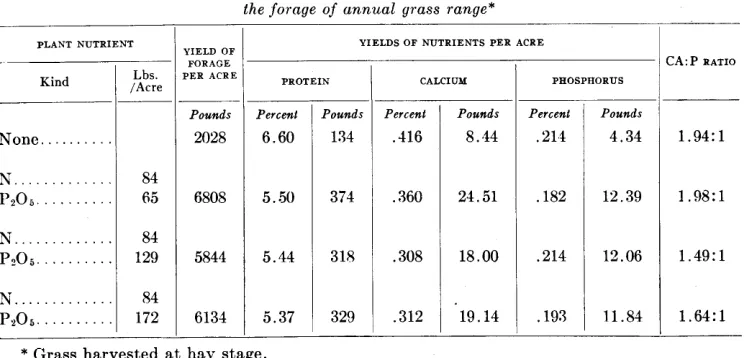
observations indicating no increase in per acre increased with additions of fer- legumes on the treated plots would make tilizer the percentage of protein, calcium, t,he use of phosphates questionable insofar and phosphorus in the feed decreased as value of forage is concerned. slightly. There were no apparent signifi-
TABLE 3
Eflect of nitrogen and phosphorus on the amount of protein, calcium and phosphorus contained in the forage of annual grass range*
PLANT NUTRIENT
Kind
None. . . . . . .
N ... 84
P205. ... 65
N ... 84
P%O5. ... 129
N ...
PtOs. ...
Lbs. /Acre
84 172
- -
YIELD OF FORAGE PER ACRE
YIELDS OF NUTRIENTS PER ACRE
PROTEIN
-
I
CALCIUM-
I
PHOSPHORUSPounds Percent Pounds Percent Pounds Percent Pounds
2028 6.60 134 .416 8.44 .214 4.34
6808 374 .360 24.51 .182 12.39 1.98:l
5844
6134 5.50
5.44
5.37
318 .308 18.00 .214 12.06 1.49:1
329 .312 ‘19.14 ,193 11.84 1.64:1
-
* Grass harvested at hay stage.
The addition of fertilizer to land that produces feed for livestock may cause differences in the quality of the feed apart from the differences in the amounts that are produced. Combinations of quantita- tive and qualitative differences are im- portant to the grazier. Table 3 gives the results from a preliminary test to deter- mine trends in quality of feed as influ- enced by additions of nitrogen and phos- phorus. The chemical determinations were made by Nelson’s Laboratories, Stockton, California. The hay from the 1945-46 s eason was used. This season was regarded as average for climatic conditions, and the major part of the forage was grass.
With due regard for the many limita- tions of the data, it is quite certain that nitrogen increased production of feed and of protein per acre. There was an increase in production of phosphorus per acre, but no differences were attributable to in- creases in the amount of phosphorus fer- t,ilizer added. As the production of forage
-
CA:P RATIO
1.94:1
60 0. K. HOGLUND ET AL.
the feed that would be taken by a grazing animal, especially with respect to quality.
Applications of Gypsum, Lime, and hfanure
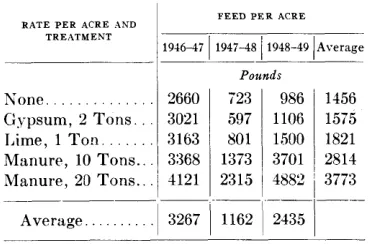
Table 4 presents results from applica- tions of gypsum, lime, and manure on the production of feed. The trials were made in each of 3 years, but there were no replications within years. The only differ- ences in production between treated and untreated plots that were significant be- yond doubt were obtained by applying manure. The manured plots also con- tained more bur clover than any of the others. Differences in yields obtained by adding lime and gypsum are of doubtful significance, and there were no observed differences between the botanical compo- sition of these plots and the check. In- creased forage yields accompanied by increases in the percentages of legumes have been obtained in some par& of Cali- fornia by the addition of sulphur (Conrad,
1950).
TABLE 4 ’
Injkence of lime, gypsum, and manure on the production of Seed by annual grass ronge
RATE PER ACRE AND TREATMENT
194647
Kane. 2660
Gypsum, 2 Tons. 3021
Ilime, 1 Ton.. 3163
Manure, 10 Tons. 3368
Manure, 20 Tons.. / 4121
Average. . . 3267 1162 ) 2135 i
-
I
_
FEED PER ACRE
1947-48 1948-49 Average
Pounds
723 597 801 1373 2315
986
1106 1500 3701 4882
1156 1575 1821 2814 3773
There was a slight indication that sea- sonal influences may have affected the results, but they were not sufficiently con- sistent to allow conclusions. The level of production was highest in 1946-47 which was a good year for the grasses. In this year there may have been a slight increase
from the use of lime. However, the 194% 49 season was unfavorable to grass and favorable to the growth of filaree. Manure gave significant increases in production and was the only fertilizer that increased the amount of bur clover in the hay. Even so, the percentage of bur clover was less than 10 percent and may have been caused by seed brought in with the ma- nure.
SUMMARY
Fertilizer trials on annual-forage range have been made on Positas gravelly clay loam soil at Sunol, California since 1944. Five years’ results from repeated an- nual applications of 200 pounds per acre of ammonium phosphate-sulfate (16-20-o) show that this fertilizer:
1. Increased forage production by an average of 2,882 pounds, which is equivalent to 3.60 animal-unit- months per acre.
2. Reduced fluctuation in production from year to year.
3. Advanced the date of grazing readi- ness by 6 weeks.
4. Doubled the length of the green feed period.
5. Had no effect on the production of residue.
Four years’ results from the application of three rates of nitrogen and three rates of PZOb, applied separately and in com- bination to a new set of plots each year, show that:
The production of forage was in- creased with each increase in amount of nitrogen added.
Forage production limits were not .
reached by the application of 84 pounds per acre of nitrogen.
APPLICATlON OF FERTILIZERS 61
.
4. Neither fertilizer had any important LITERATURE CITED
effect on botanical composition. BENTLEY, J. R., AND M. W. TALBOT. 1948.
5. Nitrogen increased both t,he quan- Annual-plant vegetation of the California
tity of forage and the amount of foothills as related to range management.
protein per acre. Ecology 29: 72-79.
The calcium : phosphorus ratio of fer-
CONRAD, J. P.
6. California and some related factors. Soil 1950. Sulphur fertilization in
tilized forage averaged 1.70 : 1, while Science, 70: 43-54.
the ratio on untreated plots was DICKEY, P. B., 0. I<. H~GLTJND, AND B. A.
1.94: 1. MADSON. 1948. Effect of fertilizer on the
Three years’ results from applications production and season of use on annual of gypsum, lime, and barnyard manure Agron., 40 grass range in California. Jour. Amer. Sot, : 186-188.
show: GORDON, AARON, AND A. W. SAMPSON. 1939.
1. Neither lime nor gypsum had any Composition of common California foothill
significant effect on yield or plant * plants as a factor in range management.
composition. Calif. Agr. Expt. Sta. Bul. 627. 95 pp. 1945. 2. Barnyard manure significantly in- GROVER, D. Corning Soil Conservation I. Range District. condition, U. S.
creased forage yields. Dept. Agr., Soil Conservation Service, Region 7. (processed).
ACKNOWLEDGEMENT HART, G. H., H. R. GUILBERT, AND H. Goss.
The authors acknowledge the advice and helpful assistance of B. A. Madson, Director, Field Stations, California Agri- cultural Experiment Station; L. R. Wohletz, State Soil Scientist, and W. R. Frandsen, Soil Conservationistz Soil Con- servation Service ; and review of the
manuscript by M. W. Talbot, Associate Director, California Forest and Range Experiment Station, Forest Service; and .J. P. Conrad, Agronomist, California Ag- ricultural Experiment Station.
1932. Seasonal changes in the chemical composition of range forage and their relation to the nutrition of animals. Calif. Agr. Expt. Sta. Bul. 543. 62 pp.
ROGERS, J. B. 1945. Range condition,
Contra Costa Soil Conservation District. U. S. Dept. Agr., Soil ConservatIion Serv- ice, Region 7. (processed).
TALBOT, M. W., AND H. H. BISRELL. 1942.
The forage crop and its management. In
The San Joaquin Experimental Range.
Calif. Agr. Expt. Sta. Bul. 663, pp. 13-49.
WEIR, W. W., AND R. E. STONE. 1936. A
Economic Aspects of Range Management
H. R. HOCHMUTH
Agricultural Economist, Bureau of Agricultural Economics, U. S. Department sf Agriculture, Logan, Utah,
R
ANGE management in its broadest aspects is the management of non- tillable lands for multiple use purposes including soil and water conservation, rec- reation, and sustained forage production. This definition then becomes a definition of resource management. In a more re- stricted sense, range management can be defined as management of range lands for maximum sustained forage production.Economics, when applied to the broad field of conservation and multiple use, is generally termed conservation or resource economics. This branch of economic thought is perhaps too extensive and theo- retical for purposes of this paper. There- fore, the following discussion will concern itself only with certain economic aspects of producing forage for grazing animals.
RANGE ECONOMICS
The field of range economics is inexactly described because of multiple use impli- cations of range lands. In this discussion, range economics will be comparable to production economics as applied to forage and livestock. If one of the purposes of range management is to produce forage for domestic livestock, then from the viewpoint of production economics, range economics can be closely allied with ranch management. In this manner the theory of the firm is used to analyze the economic aspects of range forage production.
In cropping regions we do not place any emphasis on “agronomy economics”. Agronomical practices, just one of the many groups of inputs in farm (ranch) management, have soil conservation im- plication as do rmge practices. We speak of range economics because much of our
range lands in the West is in federal own- ership and the intricate nature of land tenure and multiple use tends to conceal the true position of range lands in pro- duction economics. Lands anywhere, whether they be cropped by men or animals, are not free of multiple use implications. It would seem that most, if not all, lands may have several possible alternative uses. Comparative advantage in any period of time determines the uses of, and combinations of, private land. Range lands do not belong in any special category that requires a new set of land economic principles.
Private land, including range land, is owned and operated as part of the firm. The owner or operator attempts to maxi- mize his income. His costs and returns are subject to the law of variable proportions. Public range lands are subject to the same economic laws. The differences in costs and returns between private and public lands exist in the allocation of some of the intangible or unmeasurable benefits. Society may receive some of the returns from public range lands in the form of social benefits. In addition, so- ciety may have a different time preference for land-investments returns than does the individual rancher. This may be the case in conservation requirements and practices. Although some of these social returns are real and tangible, they are not readily isolated by usual (or under- standable) economic analysis.
RANCH ECONOMICS
ECONOMICS OF RANGE MANAGEMENT 63
soil and resource conservation economics, what then are some of these economic aspects? The economics of range manage- ment lead directly to the factors of input- output in production economics and ranch management. However, soil conservation requirements cannot be denied. They can be considered as part of the ranch input- output in the same manner as “range management” is a production factor of ranch management.
The immediate measurable returns from range lands come not from forage production but from grazing animals; from domestic livestock tangible returns, from wild life less tangible returns.
There are some range watersheds in the West where grazing by domestic animals has been excluded. These lands have watershed values so high that multiple use does not maximize income of society. Protection of agricultural lands from floods and delivery of irrigation water to high value lands becomes an exclusive use of those range lands. In this case, graziers using this type of range have conflicting interests with a larger segment of society and if exploitation maximizes their income they can transfer some of their costs to society. Society can obtain the exclusive use of this land by, (1) immediate con- demnation proceedings where the major- ity dictates to the individual for the bene- fit of the majority or, (2) when marginal returns from grazing do not equal mar- ginal returns from an alternative com- peting use; in this case, water and soil conservation. Where destructive floods are present society usually will act more quickly than economic forces to protect itself. Therefore, to study the direct eco- nomic aspects of range management, ‘we must first study the firm. The ranch is the firm using range forage resources as input-output factors.
Economics of ranch management might logically be separated into three main categories. These are: economics of range
forage production, economics of livestock production, and financial management.
It would be incorrect to maintain t’hat these three categories are wholly separate entities. Interacting factors affect all. However, it is desirable in this discussion to draw some line of demarcation. Under economics of range forage production, of which this paper is principally concerned, a partial listing would include:
1. Range improvements to include stock water developments, fencing, rodent control, reseeding, and brush control.
2. Systems of grazing to include de- ferred and rotational grazing. 3. Adaptations to weather variability- 4. Adaptations to land tenure relation-
ships.
Livestock production is concerned with types of stock, breeding practices, sup- plemental feeding, and perhaps many others. Financial management includes factors of investment allocation, indebt- edness, selling practices, taxes, land values, and comparative costs.
ECONOMIC ASPECTS OF FORAGE PRODUCTION AND USE
Economic aspects of producing forage
from range and pasture lands are con-
cerned with obtaining optimum produc-
tion (use) of forage at the minimum cost.
In addition, it is inferred that long time soil conservation requirements are satis- fied. Emphasis is placed on long time soil requirements, because from an economic viewpoint it is unlikely that the grazier can always stock to proper capacity or desirable utilization each year. Extreme variation in weather, among other factors, precludes this.
64 H. R. HOCHMUTH
A pessimistic note on benefit-cost analysis as applied to public lands is sounded by Kelso (1948). He writes:
‘L . . . economic analysis and criteria (will have only) a minor role in guiding public investments on public lands. (All that economists) can accomplish in this regard will be some slight aid in guiding public investment policy . . .”
Kelso continues by indicating that po- litical considerations will outweigh the economic in making final decisions. This would seem to be a defeatist policy from the economic viewpoint. Others maintain that public land policy should be ame- nable to economic analysis, although per- haps the criteria for calculating costs and returns may differ from those of private lands. In addition, it may be emphasized that considerable of our public range lands do not differ greatly from the adjoining private lands and as such should not differ as to potential or future value.
The levels of production of forage, and investment in range lands to increase forage production, depend on the net product of any factor of input. The net product is reflected in the net income to the firm. For private lands, and public lands used in association with private lands, the gain or loss from inputs can best be determined by analyzing the com- plete ranch organization. For example, the value of forage produced on one seas- onal range should be considered in its association with adjacent or complemen- tary range having differing seasons of use.
Budget analysis of the ranch offers a convenient tool for a determination of the costs and benefits of range management practices. Given sufficient data one prac- tice (input) can be varied while holding all other ranch inputs constant. In this manner the net effect on ranch income of certain range management practices can be determined.
RANGE IMPROVEMENTS
It is difficult to conceive of a situation wherein range improvement practices will not result in increased net productivity of the range. At least increased productivity of forage or livestock is perhaps the prin- ciple aim of range improvements. How- ever, the increase in productivity as meas- ured in gross returns to the individual firm or to society is not the prime factor in deciding if range improvement expendi- tures are economically feasible. The fac- tor is, does the improvement create a net increase in returns over the short term or a net increase in capital investment ca- pable of paying an adequate return over the long term?
For private lands there can be no alter- native to measurable net returns. If the ranch as organized cannot obtain an ade- quate net return on capital investment, then the investment becomes economi- cally unsound. For public lands the same situation exists, except that government may have a different time preference or can charge off a portion of the costs to intangible or tangible social benefits. In addition the cost is spread over a broad base of society and if disinvestment occurs the net effect is small.
Reseeding of range lands is an excellent example of the economic implications of range improvements. It is known that under certain soil, site, and moisture con- ditions, reseeding can be accomplished with various degrees of success. At present in most reseeding projects some of the costs and some of the returns are ob- tained. However, complete input-output data on range reseeding is lacking. In addition, net returns to the firm are an unknown or an indefinitely known quan- tity.
ECONOMICS OF RANGE MANAGEMENT 65
Investment in reseeding on public lands includes an inherent charge to soil and water conservat)ion. On the basis of net production of forage it is probable that considerable of the reseeding on public lands would exhibit a low benefit-cost ratio. Range reseeding has not progressed far on many acres of private lands adapted to this treatment because the rancher may not be convinced that it is the best investment opportunity for his capital.
The above is not an indictment of range reseeding, past, present or future-far from it. Reseeding seems to be the most promising activity for increasing produc- tion on range lands. However, it behooves the range manager and agricultural econ- omist to develop a set of criteria whereby the rancher can determine the economic feasibility of reseeding. Successful reseed- ing performances on public lands in which returns to total ranch organization are not evaluated do not answer the benefit-cost problems on private lands.
Similar situations exist for many other range improvements practices. Each prac- tice or combination of practices must result in increased net returns to the firm. If not, capital investment will not flow in that direction. The difference between in- vestment in reseeding and in other types of improvements is one of certainty or risk. The high risk factor is an unknown item of cost in much range reseeding. The risk (failure) factor is such as to deter the actuarial calculation of the weather var- iant in benefit-cost ratios.
ECONOMIC ASPECTS OF FLUCTUATING FORAGE PRODUCTION
Variation in range forage production
resulting from variation in precipitation
is one of the more important range man-
agement economic problems viewed from
the ranch organization and income aspect.
The grazing economy of the range area depends in large part on range forage and the over-all level of range forage produc- tion is determined primarily by annual precipitation.
Many factors are correlated with plant growth, but annual precipitation and its seasonal distribution seems to be the dom- inating factor over large areas of the West.
In an analysis of range condition and annual precipit,at,ion, Clawson (1948) states :
“There are comparatively few range areas which will not produce more forage in a year of relatively high annual precip- itation than in a year of relatively low annual precipitation. An unfavorable seasonal distribution of precipitation may render a relatively high annual total pre- cipitation less effective. . . but (mainly) it
is total annual precipitation which domi- nates total forage production on any given site.”
Lantow and Flory (1940) arrive at es- sentially the same conclusion.
The average rancher is concerned each year with the level of production to be accomplished the following year. In his deliberations he is guided by two impor- tant factors both beyond his individual capacity to control. Price is one determi- nant in when he will sell, and whether he will maintain, increase, or decrease his livestock inventory. Another factor is his range forage supply. These two factors contain much of the economic forces that determine the income from a ranch.
66 H. R. HOCHMUTH
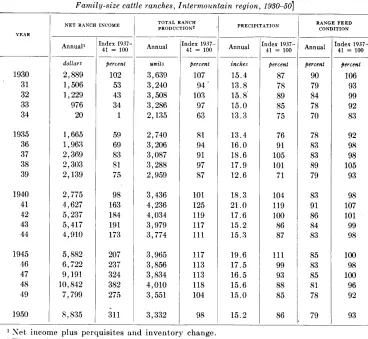
fluctuation in income over the 1930-50 in unit dollars from a ranch. The influence period resulted from the action of eco- of price on income can be reduced to a nomic and physical forces on ranch large extent by using average weighted organization and operations. The low in prices of a base year or years. It is to be 1934 was due to a combination of low expected that all price influence can not prices and drouth. This situation spells be eliminated because price affects inven- disaster in the range area. tory numbers and selling practices.
TABLE 1
Index numbers of income, production, precipitation, und range feed condition (193?‘-41 = 100). Family-size cattle ranches, Intermountain region, 1930-501
YEAR
TOTAL RANCH PRODUCTION2
Annual’ 1 hdex 41 = 100 X937- Annual ndex 1937- 41 = 100
1930 31 32 33 34 percent 102 53 43 34 1 1935 36 37 38 39 59 69 83 81 75
dollars units @ercent
2,889 3,639 107
1,506 3,240 94 ’
1,229 3,508 103
976 3,286 97
20 2,135 63
1,665 2,740 81
1,963 3,206 94
2,369 3,087 91
2,303 3,288 97
2,139 2,959 87
2,775 3,436 101
4,627 4,236 125
5,237 4,034 119
5,417 3,979 117
4,910 3,774 111
5,882 3 965
3:856
117
6,722 113
9,191 3,834 113
10,842 4,010 118
7,799 3,551 104
8,835 3,332 98
l Set income plus perquisites and inventory change. 1940 41 42 43 44 98 163 184 191 173 1945 46 47 48 49 207 237 324 382 275
1950 311
-
I
-
NET RANCH INCOME PRECIPITATION
Annual ndex 1937- 41 = 100 Annual
.ndex 1937- 41 = 100
inches percent percent percent
15.4 87 90 106
13.8 78 79 93
15.8’ 89 84 99
15.0 85 78 92
13.3 75 70 83
13.4 76 78 92
16.0 91 83 98
18.6 105 83 98
17.9 101 89 105
12.6 71 79 93
18.3 104 83 98
21.0 119 91 107
17.6 100 86 101
15.2 86 84 99
15.3 87 83 98
19.6 111 85 100
17.5 99 83 98
16.5 93 85 100
15.6 88 81 96
15.0 85 78 92
15.2 86 79 93
RANGE FEED CONDITION
2 The total quantity of ranch products produced during year. To eliminate the influence of price all items of income and expense were weighted by base prices. The base prices were weighted by the qua,ntities of each item purchased or sold in the base years. The formulas used are:
Xq’p’
for income, zq~po; for quantity T ___. Zq’PO and for price ___ ZqlPl zqopo ’ QPO
pl and ql are current prices and quantities and po and go are weighted average prices and quanti- -ties respectively in the base years.
ECONOMICS OF RANGE MANAGEMENT 67
other factors on ranch income becomes apparent. The index (193741= 100) of total ranch production shows much simi- larity to the index of precipitation (Fig. 1). The inference to be drawn is that precipitation has a direct effect on forage production and hence, ranch production. This is not a new revelation. However, the foregoing discussion is made to point out the economic nature of fluctuating
climatic factors and their effect on forage (ranch income) production. This is per- haps the most important and least under- stood of the many economic aspects of range management.
Per lnt 130
Indej Iiumbers (193741
120
110
80
‘70
F
1 10 1936 1940 194s l!
FIG. 1. Total ranch production and annual
precipitation. Family-size cattle ranches.
Intermountain Region, 1930-50.
The rancher is always faced with the necessity of adjusting his livestock num- bers to the fluctuating forage supply. Re-
ports by Nelson (1934), and Craddock and Forsling (1938), reveal the infeasi- bility of stocking rates based on average forage production or average precipitation.
Range technicians, pointing to the un- stable character of precipitation in the Western states and the resulting unstable forage supply, have recommended various range management practices. Perhaps the principle recommendation is to leave from 25 to 40 percent of the forage ungrazed for a feed reserve, for soil protection, and for protection of plant vigor. However, in the extremely dry years even this program does not suffice to furnish adequate for- age for livestock and still maintain soil and plant protection.
Large reductions in livestock numbers over short periods generally are financially undesirable to the rancher. Drought creates a situation which even a conserva- tive grazing policy cannot solve over the short run. Perhaps crop insurance (finan- cial reserve) is the answer rather than the now recommended procedure of leav- ing forage on the range as partial insurance against the weather risk factor. However, there are no actuarial de- terminations of forage production prob- abilities to aid a crop (forage) insurance program for the range area. Range tech- nicians can make a valuable contribution to range and ranch management by de- veloping a lengthy series of data on for- age production and range plant responses to climate under a wide set of soil, site, and climatic conditions.
68 H. R. HOCHMUTH
assist the financial management of the ranch at this time. The problem is not one to be wholly solved by balancing the forage supply. At this critical time it can only be ameliorated by drawing on a financial reserve. Range forage (crop) in- surance could be a feasible answer if the basic range data were available.
LITERATURE CITED
CLAWSON, MARION. 1948. Range forage con- ditions in relation to annual precipitation. Land Econ. 24: 264-280.
CRADDOCK, G. W., AND C. L. FORSLING. 1938.
The influence of climate and grazing on
spring-fall sheep range in Southern Idaho. U. S. Dept. Agr. Tech. Bul. 600, 43 pp. 1IOCHhlUTH, l-I. R., ANI> WYLIE D. GOOI~SELL.
1948. Commercial family-operated cattle ranches, Intermountain region, 1930-47. FM 71. Bur. of Agr. Econ. LT. S. Dept. Agr. 29 pp.
IiELSO, M. M. 1948. Economic criteria for conservation and development of public lands. Proc. West. Farm Econ. Assn. 85-92. LANTOW, J. I.., ANI) E. L. FLORY. 1940. Fluc- tuating forage production. Soil Conserv. 6: 137-144.
Kelson, E. W. 1934. The influence of pre- cipitation and grazing upon black grama grass range. U. S. Dept. Agr. Tech. Bul. 409, 32 pp.
MESQUITE SPRAYING
Sugar Versus the Intuitive Choice of
-Foods by Livestock
MAX J. PLICE
Associate Agronomist, Oklahomu Agricultural Experiment Station, Stillwater
I
T HAS been known for centuries that livestock, and animals in general, have food preferences. It has also long been known that cattle, for example, prefer forage from well-fertilized pastures over that from non-fertilized pastures, other things being equal. Observations along this line have led many persons to be- lieve that grazing animals are wise in their ways and know intuitively that vegeta- tion on the fertilized soil is richer and better balanced in food nutrients than that on the unfertilized soil; conse- quently, the fertilized forage is better for them. Such an ability to choose foods is a faculty, or gift, which even human beings cannot, be said to possess.A particularly interesting negative ex- ample of “food choice” is that of animals in pastures refusing to eat grass whose growth has been influenced by their drop- pings (Fig. 1). Some pastures of small size become almost worthless because they are highly spotted with untouched bunches of lush, dark-green, healthy-look- ing, manure-affected grass. The normal, or unaffected, grass may be mediocre, or even poor, in appearance; yet it will be eaten to the complete exclusion of the lush grass. Various reasons have been offered in order to explain this phenome- non and the present paper is an attempt to throw further light on the matter. +
PRESENT WORK
The question of what makes feed or forage palatable or unpalatable is still a moot one. Some of the factors which are believed to influence palatability are kind of feed, and physical and chemical nature
of the feed, including all the significance which these things connote. A further important factor, surely, is the degree of familiarity, or accustomedness, which ani- mals have with any particular feed ma- terial. A general discussion of the subject does not come within the purview of the present work, however, and only that part related to manure-affected plant growth will be dealt with.
In an effort to learn something about the matter, many chemical analyses of plants have here been made over a period of years to find a substance, or substances, in such plants which might make them unpalatable, or repugnant, to animals; further, to see whether a nutrient, or mineral imbalance in the plants could be such a factor. Several things, including tannins, coumarins, nitrates, etc., are be- lieved to decrease forage palatability.